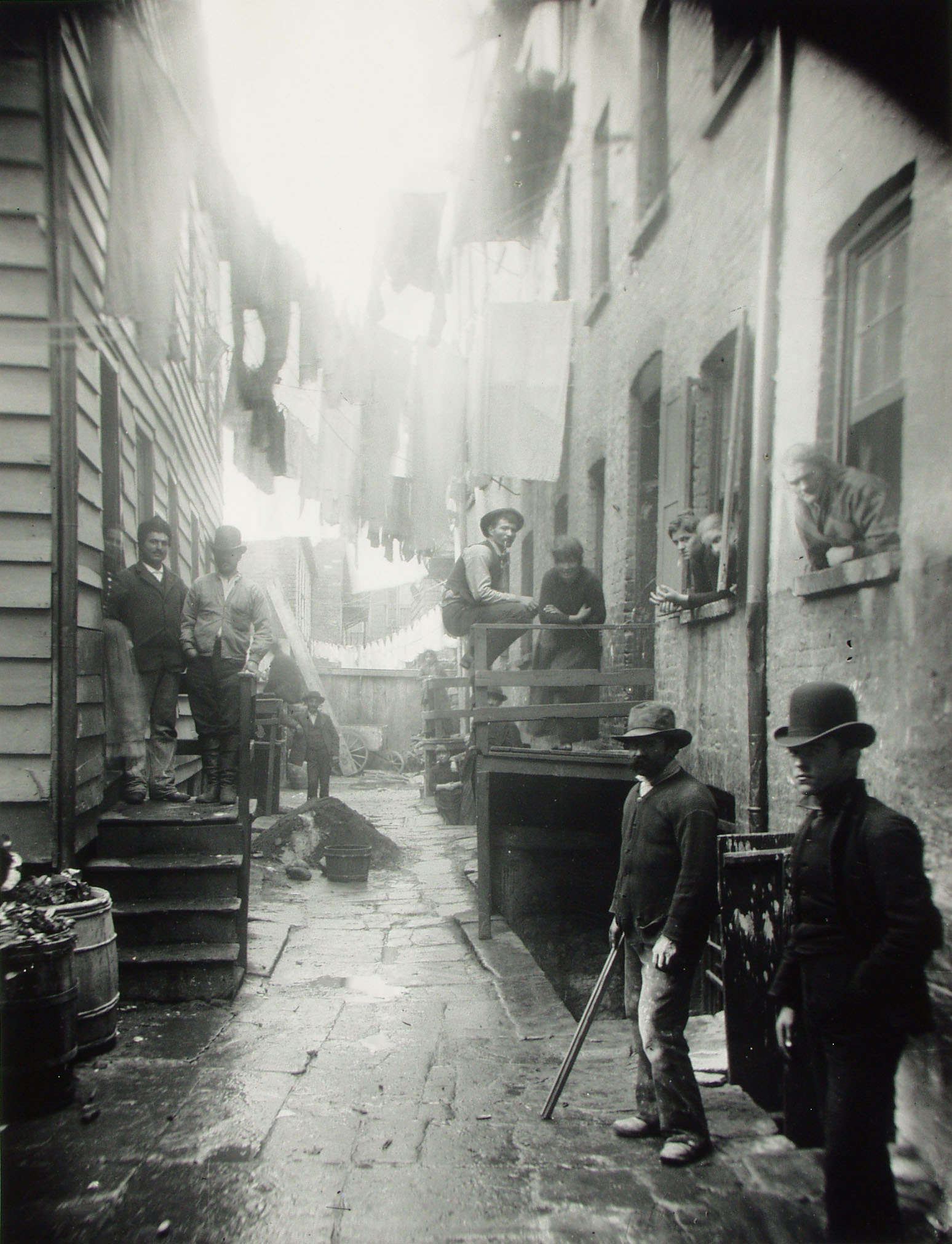
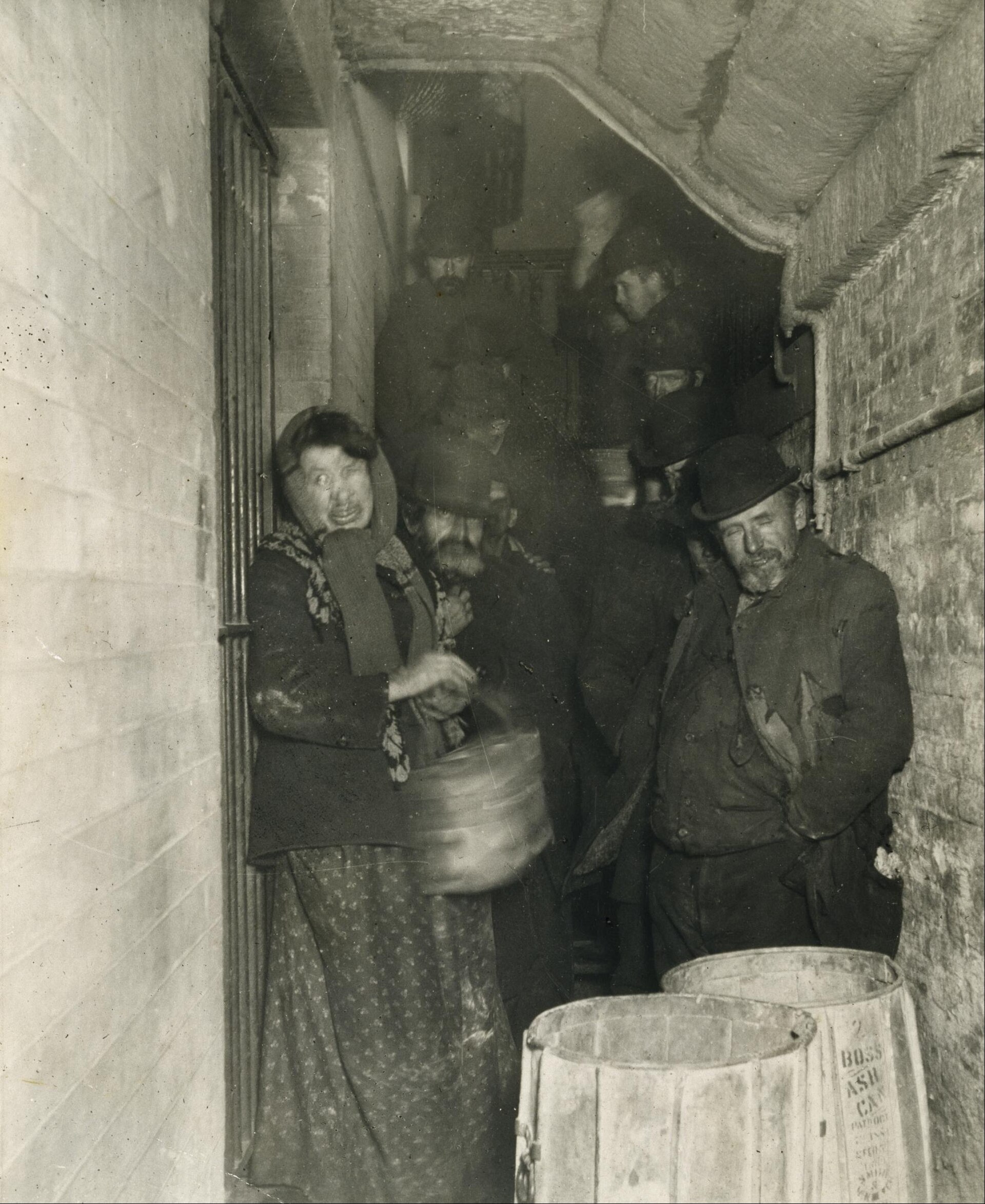
Bandit's Roost, 59 1/2 Mulberry Street
1888 · Gelatin silver print from a dry-plate glass...
Museum of the City of New York, New York
 Danish-American · 1849-1914
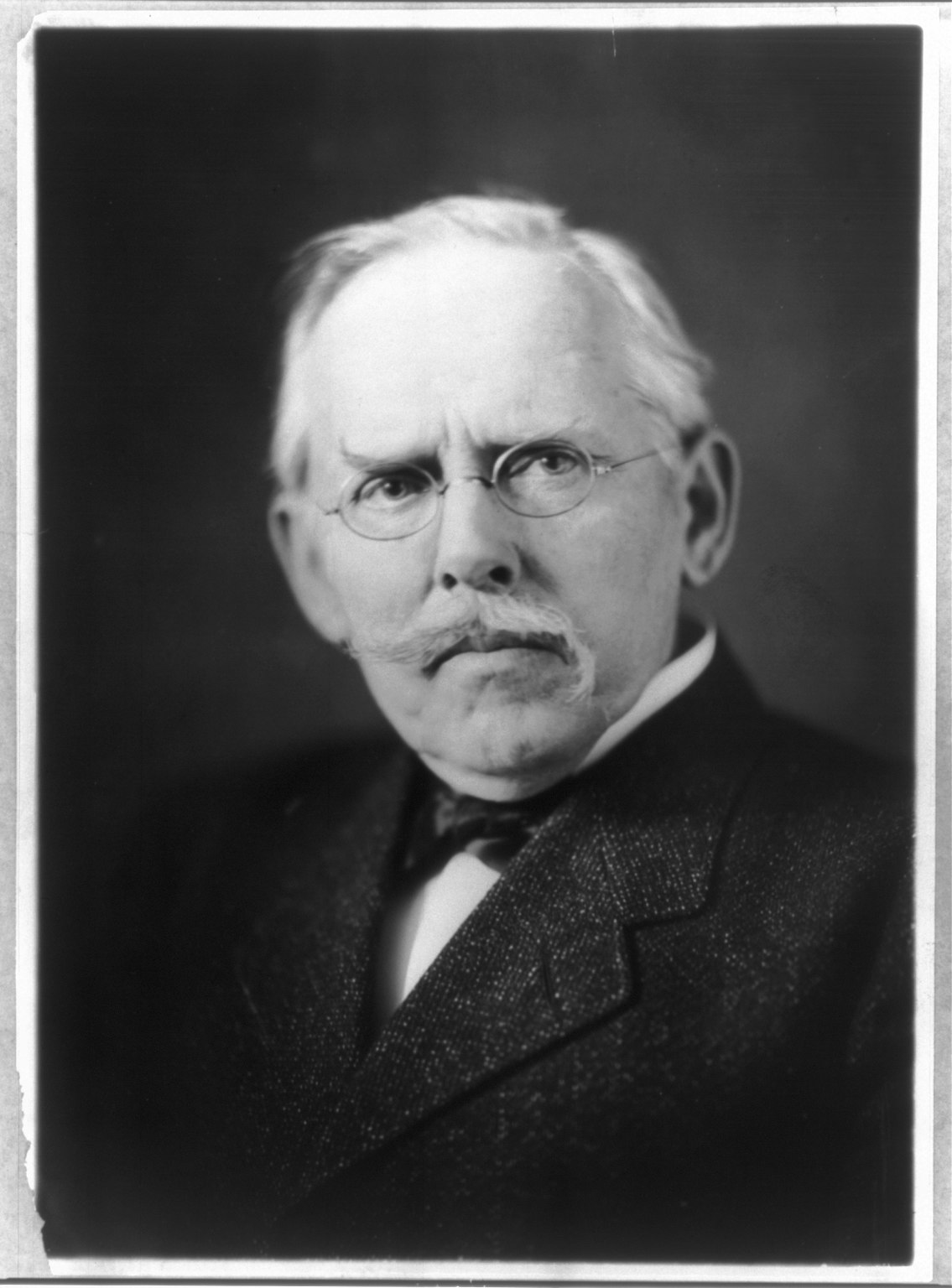
Studio portrait of Riis, 1906, from the Library of Congress's Miscellaneous Items in High Demand collection, catalogued LCCN 2005678010. The same 1906 photograph illustrates the infobox of the English Wikipedia's own Jacob Riis article. No photographer is named in the museum-supplied catalogue record consulted for this page.
Library of Congress, Prints and Photographs Division| Full name | Jacob August Riis |
|---|---|
| Worked as | Photographer, Journalist, Social reformer |
| Born | 3 May 1849 · Ribe, Denmark |
| Died | 26 May 1914 · Barre, Massachusetts, United States |
| Nationality | Danish-American |
| Movement | None in the conventional art-historical sense. Riis's photographs are grouped with the... |
| In this archive | 1 artwork |
| Sources | 16 cited |
| Last verified |
About this page 1 artwork in the archive · Last verified · 16 sources cited
Jacob A. Riis is remembered as the photographer of How the Other Half Lives, the 1890 book of New York tenement photographs credited with helping demolish Mulberry Bend and pass the Tenement House Act of 1901. The single hardest fact to find about the archive that carries his name is that Riis very likely did not take a meaningful share of his own most famous pictures. He ran the 1887-88 flash-powder campaign that produced Bandit's Roost, Five Cents a Spot and most of the rest together with two amateur photographers, Dr. Henry G. Piffard and Richard Hoe Lawrence, and did not own or reliably operate a camera himself until January 1888. Riis's own memoir admits as much without ever quite saying so: it describes a hired professional he later had to fire for trying to sell his negatives behind his back, and only after that failure did he buy a camera of his own, alone, on an island full of the dead.
He did not consider this a scandal, because he did not consider himself a photographer in the first place. Riis was a police reporter for roughly a decade before he ever exposed a plate, and the modern scholar who has done the most archival work on him, Bonnie Yochelson, curator of the Museum of the City of New York's complete 2015 catalogue of his photographs, states plainly that he was a radical publicist who used photographs to enhance his arguments but had no great skill or ambition as a photographer. Riis's own practice bears this out: he first relied on amateur collaborators, then briefly operated a camera himself, then by 1900 was collecting negatives made by professional photographers working for government agencies and charities. The name on the print was never a claim about whose hand made the exposure.
What survives is a rediscovery story as much as a body of work. Riis left his negatives, lantern slides and prints behind in a Queens attic when he moved to Massachusetts before his death in 1914, and for roughly three decades nobody looked at them. The photographer Alexander Alland tracked the material down in 1946, and the Museum of the City of New York's Jacob A. Riis Collection, the sole archive of his images, exists because of that rediscovery. The market barely exists in parallel: almost everything of consequence sits in five institutions, not in private hands, and this record says so rather than inventing a sale that never happened.
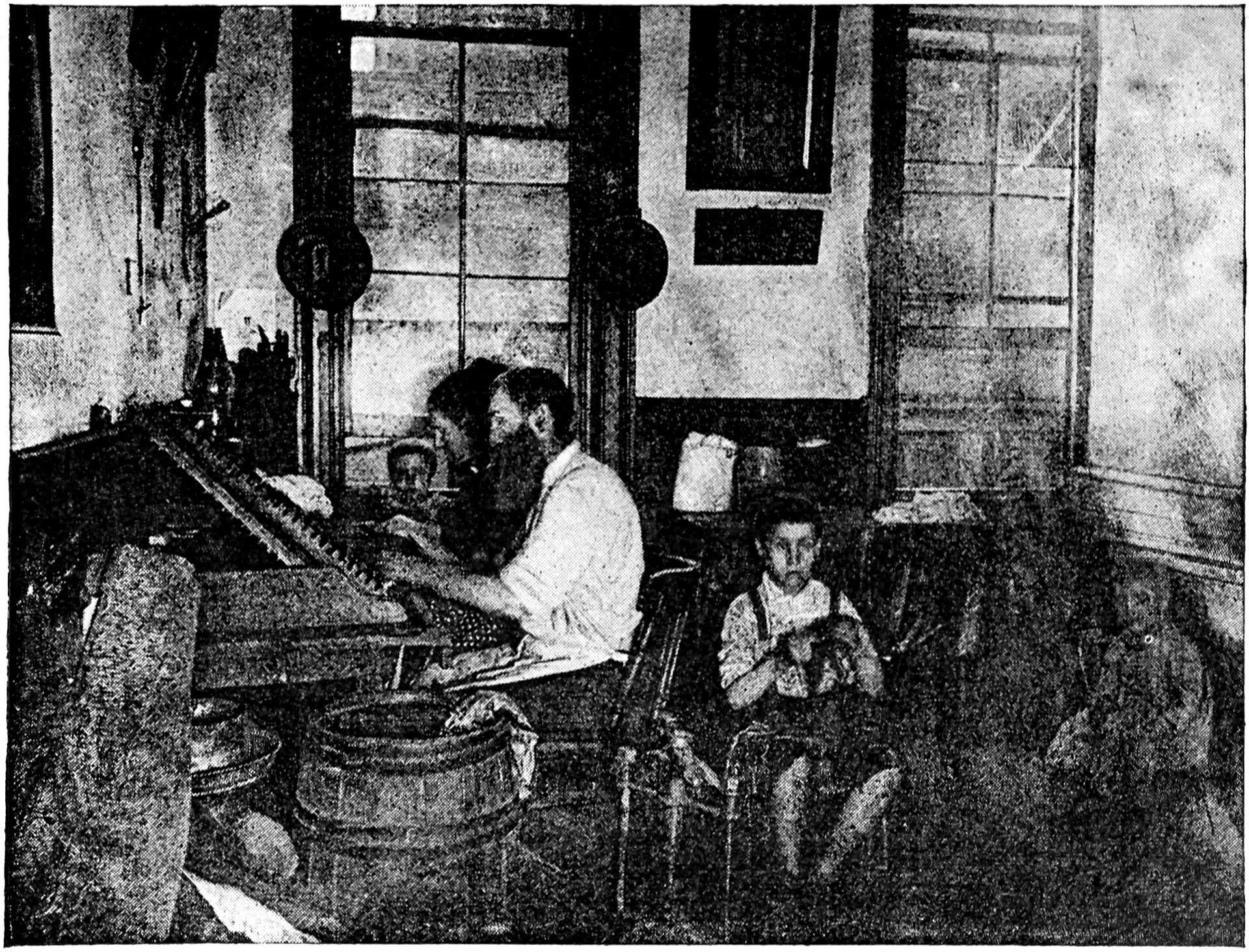
Born 3 May in Ribe, Denmark, the third of fifteen children of a schoolteacher; only Jacob and two sisters survived into the twentieth century.2
Returns to Ribe from a Copenhagen carpentry apprenticeship; finds no work and, discouraged in his suit for Elisabeth Gjortz, decides to emigrate.2
Arrives in New York on 5 June after sailing from Glasgow on the steamer Iowa in steerage, with $40 in savings, a locket of Elisabeth's hair, and letters of introduction; spends half the $40 the same day on a revolver.2
Marries Elisabeth Gjortz in Ribe after returning to Denmark a financial success; the couple settle in New York.2
Reads a newspaper report of the new German magnesium flash-powder photographic process and organises a night-time photographic campaign with Dr. Henry G. Piffard, Richard Hoe Lawrence and Dr. John T. Nagle.12
Buys his own camera in January after a hired professional photographer tries to sell his negatives behind his back; delivers his first lantern-slide lecture, The Other Half: How It Lives and Dies in New York, on 25 January to the Amateur Photographers' Association, showing about 100 views.112
The Bandit's Roost negative is made during this campaign, per the institutional catalogue date; this record's own sibling entry records a dispute over the exact year and over which of the three men exposed it.2
How the Other Half Lives: Studies Among the Tenements of New York is published by Charles Scribner's Sons, mixing photographic halftones with drawn line engravings.23
Theodore Roosevelt becomes President of the New York City Police Board; Riis and Roosevelt begin two years of joint night tours of the tenements Riis calls, in his memoir, Mulberry Street's golden age.1
Mulberry Bend is condemned and demolished; Riis's own memoir implies a date around 1895, while secondary accounts place the demolition beginning in 1897, a discrepancy this record does not resolve.12
The New York State Tenement House Act, the New Law, is passed on 12 April, following a commission Governor Roosevelt appointed in 1900; Riis's book and reporting are widely credited, including by institutional sources this record could not fully verify against Roosevelt's own primary text, with prompting the reform.91011
Riis's first wife, Elisabeth, dies.2
Riis remarries, to Mary Phillips, and the couple relocate to a farm in Barre, Massachusetts.2
Riis leaves his photographic negatives, lantern slides and prints behind in the attic of the family house in Richmond Hill, Queens, on his final relocation to Massachusetts.8
Dies 26 May at the Barre, Massachusetts farm; buried under an unmarked granite boulder in Riverside Cemetery, Barre.2
The photographer Alexander Alland tracks down Riis's glass negatives in the Richmond Hill attic, with the cooperation of Riis's son Roger Williams Riis.8
Alland's reprints of the rediscovered negatives are exhibited as The Battle With the Slum, 1887-1897 at the Museum of the City of New York; the negatives, slides and prints enter the museum as accession group 90.13, gift of Roger Williams Riis.458
Alexander Alland publishes Jacob A. Riis, Photographer and Citizen, the first sustained argument that Riis's photography merits study on its own terms.8
The Museum of the City of New York, with the Library of Congress, presents Jacob A. Riis: Revealing New York's Other Half, curated by Bonnie Yochelson, the first major Riis retrospective since 1947; Yale University Press publishes Yochelson's accompanying complete catalogue of his photographs.467
Almost nothing of consequence is privately owned. The negatives are at the Museum of the City of New York, the papers at the Library of Congress, Alexander Alland's reference prints at the New-York Historical Society, and individual prints traceable to Alland's own reprinting at the International Center of Photography, the Museum of Modern Art and Yale University Art Gallery. What does reach the market is mostly later reprints rather than lifetime material, trading modestly: a tertiary price-guide aggregator shows individual prints realising or estimated in the low hundreds to low thousands of dollars, and a first-edition, inscribed copy of How the Other Half Lives carried a 2008 Christie's estimate of USD 4,000 to 6,000. This record could not confirm an actual hammer price, as against a pre-sale estimate, for any specific Riis lot from a primary auction-house archive this session, and states that gap rather than presenting an estimate as a result.
| Institution | City | Holdings | Note |
|---|---|---|---|
| Museum of the City of New York | New York | The Jacob A. Riis Collection, accession group 90.13: the original glass negatives, lantern slides and prints given by Riis's son Roger Williams Riis in 1947, described by the museum as more than 1,000 photographs and the sole archive of Riis's images. | Curated its own complete retrospective and catalogue in 2015-16. |
| Library of Congress, Manuscript Division and Prints and Photographs Division | Washington, D.C. | Riis's personal papers, journals and correspondence, and photographic material including period portraits of Riis himself. | Co-presented the 2015-16 Museum of the City of New York retrospective. |
| New-York Historical Society | New York | The Alexander Alland Photograph Collection (PR 110) and the Jacob A. Riis Reference Photograph Collection (PR 059), Alland's own 1940s reprints of the rediscovered negatives. | The negatives Alland reprinted are the ones that re-established Riis's photographic reputation after roughly three decades of obscurity. |
| International Center of Photography | New York | A gelatin silver print of Bandit's Roost, accession 235.1982, a direct gift of Alexander Alland Sr. | |
| Museum of Modern Art | New York | A print of Bandit's Roost dated to the 1888 negative and printed in 1958. | |
| Yale University Art Gallery | New Haven, Connecticut | A print of Bandit's Roost, accession 2008.205.1, catalogued circa 1888, printed after 1946. | |
| Jacob A. Riis Museum, Museum of Southwest Jutland | Ribe, Denmark | Housed in the building where Riis grew up; holds Danish-side archival material consulted for Bonnie Yochelson's 2015 catalogue. | Denmark's own institutional memory of the man it calls its most influential Danish-American. |
In early 1887 Riis read a four-line newspaper dispatch, he later wrote, from somewhere in Germany, describing a new way to take pictures by flashlight.
In early 1887 Riis read a four-line newspaper dispatch, he later wrote, from somewhere in Germany, describing a new way to take pictures by flashlight. Within a fortnight a raiding party had formed: Riis himself, Dr. John T. Nagle of the Health Department's Bureau of Vital Statistics, and two distinguished amateur photographers, Dr. Henry G. Piffard and Richard Hoe Lawrence. Riis's own account of the arrangement, in his 1901 memoir The Making of an American, is unambiguous about who actually worked the equipment: the interest centred in the camera and the flashlight, he wrote of his companions, while the police who sometimes came along did so from curiosity. The amateurs tired of the slum and the late hours before long, and Riis found himself, in his own words, alone just when I needed help most. He hired a professional photographer next, who turned out to be dishonest, tried to sell Riis's negatives behind his back, and sabotaged at least one assignment on religious grounds. Riis had to replevin his own negatives to get them back. Only then, by his own account, was there at last but one way out of it: for me to get a camera myself.
This is a documented admission from the man himself that a meaningful share of the negatives now shown under his name alone were made by other people, not a modern accusation imposed on him from outside. Several institutional and scholarly sources go further: the Library of Congress's own exhibition materials on Riis describe a stereographic view of the Bandit's Roost scene as showing a woman with two small children on one side and young toughs eyeing the camera on the other, in documentation this record could not read past a bot-verification wall this session, so the precise joint credit could not be confirmed against the museum's own text and is reported here as unresolved rather than settled. Yale University Art Gallery's own object record for its Bandit's Roost print (accession 2008.205.1) credits Riis alone. Bonnie Yochelson, the Museum of the City of New York's authority on the corpus, is quoted in Popular Photography's report on her 2015 retrospective saying plainly that a handful of the images presented in How the Other Half Lives were actually taken by the duo, and that the idea of authorship was not important to him. No source consulted for this record names which of the three men actually pressed the shutter for any specific surviving negative, including Bandit's Roost. This record's own sibling entry for that photograph, riis-bandits-roost-mulberry-street, treats the question the same way: open, argued, and unresolved in either direction.
Riis worked as a police reporter, first for the New-York Tribune and then the New York Sun, for roughly ten years before he photographed anything.
Riis worked as a police reporter, first for the New-York Tribune and then the New York Sun, for roughly ten years before he photographed anything. He was based in a press office across from police headquarters on Mulberry Street, in a stretch nicknamed Death's Thoroughfare by his own later biographer Alexander Alland, where the street bent at the Five Points and alleys radiated outward into the worst slums in the city. Riis worked that beat on night shifts, developing what one modern account calls a tersely melodramatic writing style, years before he had any photographic ambition at all.
That order matters to how this record reads him. Riis did not become a reformer because he took up a camera; he took up a camera, reluctantly and late, because a decade of reporting on the same few blocks had not moved anyone to act. The University of Chicago Press's own description of Bonnie Yochelson and Daniel Czitrom's Rediscovering Jacob Riis states the sequence precisely: Riis was a writer and lecturer who first harnessed the power of photography to affect social change, relying at first on amateur photographers, then briefly on his own camera, and by 1900 on professional photographers working for government agencies and charities. A photograph, on this account, was always a tool he deployed rather than a picture he made.
The flashlight of those days, in Riis's own words, was contained in cartridges fired from a revolver.
The flashlight of those days, in Riis's own words, was contained in cartridges fired from a revolver. Half a dozen men invading a tenement at midnight, shooting off pistols loaded with magnesium powder, carried terror wherever the party went, and tenants bolted through windows and down fire escapes on sight of them. After he began working alone, Riis substituted a frying pan for the revolver and flashed the light on that; it seemed more homelike, he wrote. It was not safer. Twice I set fire to the house with the apparatus, he recorded, and once to myself. I blew the light into my own eyes on that occasion, and only my spectacles saved me from being blinded for life. For more than an hour after I could see nothing and was led about by my companion, helpless.
This is Riis's own testimony, not a secondhand paraphrase, and it should be read as such: a man who describes his own working method as clumsy and dangerous is not exaggerating for effect, since the admission does him no favours. The same passage records a Chinese community in Chinatown nearly rioting when Riis tried to photograph a Joss figure against their religious objections, and a hired photographer who refused, on his own religious scruples, to photograph children praying in a nursery, even as he was separately trying to steal from his employer. Riis kept both incidents in his memoir as evidence of, in his words, queer human nature, not as anecdotes flattering to himself.
Riis's photographs reached an audience as projected lantern slides roughly two years before they reached one as a printed book.
Riis's photographs reached an audience as projected lantern slides roughly two years before they reached one as a printed book. His first lecture, The Other Half: How It Lives and Dies in New York, was delivered on 25 January 1888 to the Amateur Photographers' Association at 122 West 36th Street, showing about one hundred photographic views; he went on to lecture in churches and before charity boards in Harlem, Brooklyn and Madison Square, and later before the First Congregational Church in Washington, D.C. Only one full transcript of a lecture survives, from that Washington appearance, and Bonnie Yochelson's research for the 2015 Museum of the City of New York retrospective matched photographs in the museum's own collection against the images named in that script, using it as a primary tool for identifying which negatives Riis actually screened.
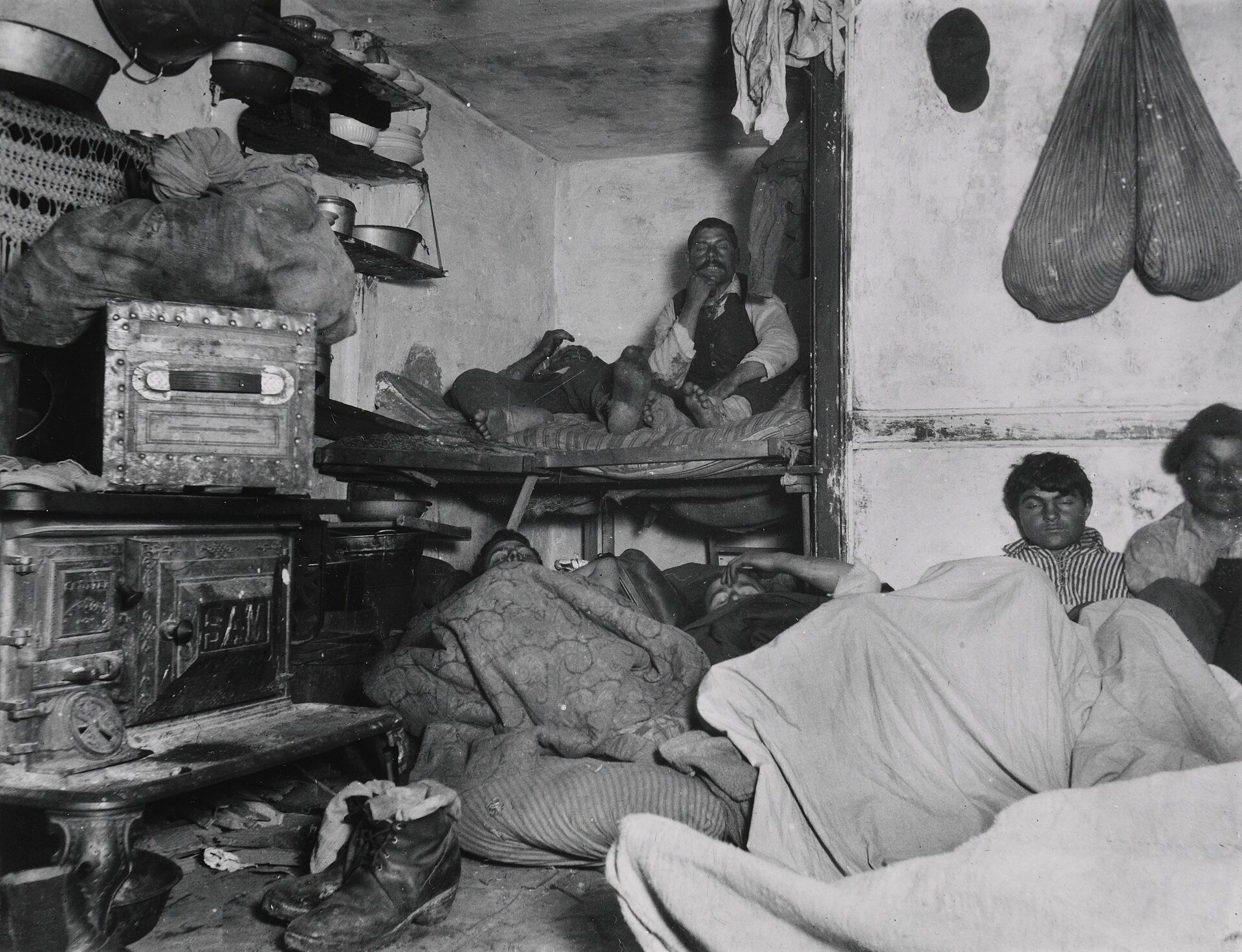
How the Other Half Lives followed in 1890, published by Scribner's with more illustrations and halftones than the earlier magazine version of the material could carry, mixing genuine photographic halftones with line engravings drawn by an illustrator rather than exposed by a camera. The reproduction was not the negative. Contemporary accounts already noted the gap: the New York Tribune captioned one image of a men's lodging room, on its first newspaper appearance, Rubbish, Some of It Human, a caption Riis did not write and could not control once his pictures left his hands. The gap has only widened since. Very few original prints from Riis's own lifetime survive; most reproductions in circulation today, according to reporting on the 2015 retrospective, are contemporary reprints made by Chicago Albumen Works, produced specifically because the images had in the past been cropped, embellished and blown up, and needed to be brought back into line with what the negatives actually show.
Theodore Roosevelt read How the Other Half Lives shortly after it appeared and went looking for its author.
Theodore Roosevelt read How the Other Half Lives shortly after it appeared and went looking for its author. Riis's own account of the moment, in his 1901 memoir, is the primary record of it: Roosevelt came to the Evening Sun office one day looking for me. I was out, and he left his card, merely writing on the back of it that he had read my book and had come to help. That was all, and it tells the whole story of the man, Riis wrote. He describes the years that followed, once Roosevelt became President of the Police Board in 1895, as Mulberry Street's golden age: two years he calls himself and Roosevelt brothers in, walking the same tenements together at night.
Multiple institutional sources, including the National Park Service and the Theodore Roosevelt Presidential Library, state that Roosevelt later called Riis New York's most useful citizen, in an 1901 piece for a national magazine. A separate line, praising Riis for high courage, disinterested desire to do good, and sane, wholesome common sense, is attributed to the same 1901 piece by the Library of Congress's own exhibition materials, not by the National Park Service or Theodore Roosevelt Presidential Library pages this record could read; this record could not independently locate and read the primary text of that 1901 piece this session, since the Library of Congress's own exhibition page on the Roosevelt-Riis relationship and the National Portrait Gallery's parallel page both returned a bot-verification wall under a plain fetch, the in-app browser, and a full Chrome session alike, so the exact wording of both quotations is reported here from secondary institutional sources rather than confirmed against Roosevelt's own text, and that gap is recorded rather than papered over. What is independently verifiable is the legislative outcome: Governor Roosevelt appointed a tenement house commission in 1900 whose February 1901 report led directly to the Tenement House Act of 12 April 1901, the New Law that required outward-facing windows, private toilets and improved light courts in every new tenement built in New York City afterward.
Riis's own memoir dates the Bend's official condemnation to the winter of 1886 and states it went, meaning was finally demolished, nine years later: on that arithmetic, around 1895.
Riis's own memoir dates the Bend's official condemnation to the winter of 1886 and states it went, meaning was finally demolished, nine years later: on that arithmetic, around 1895. Other secondary accounts, including the Wikipedia entry on Mulberry Bend that this record's own sibling entry on Bandit's Roost already flags as tertiary, place the demolition beginning in 1897, with the new park opening the same year and a renaming to Columbus Park in 1911. This record does not resolve the discrepancy; Riis's own scrapbook, by his account, ran from 1883 to 1896 as one running comment on the Bend, and his prose elsewhere describes the demolition delayed nearly a decade after it had been decreed, which is compatible with either date depending on which decree is being counted from.
What is not in doubt is Riis's own description of the aftermath. When the park's sod had been laid, he wrote, he walked on it in defiance of a keep off the grass sign and was struck by a policeman for doing it. He counted, by his own account, seventeen murders in the block in the years before demolition, all of them, he wrote, at least once in his career as the neighbourhood's police reporter, against a single act of violence he was called to record there in the four years afterward. That is Riis's own claim about his own beat, offered as evidence of what the park achieved, and it is recorded here as his testimony rather than as an independently audited crime statistic.
Riis's language about poverty is explicitly religious.
Riis's language about poverty is explicitly religious. In his own memoir he describes trusting his accounts, financially and otherwise, to the Great Paymaster, who has all the money there is, and states that if you are trying to do the things which are right, and which you were put here to do, you can and ought to leave ways and means to Him who drew the plans. This is Riis's own stated framework for his work, not a reading imposed on him afterward: a Protestant, social-gospel-inflected conviction that reform was a moral debt owed by the comfortable to the poor, and that character and environment were bound together.
Modern scholarship argues, with named authors on both sides of specific claims, that the same framework produced real and documented prejudice. The historian Maren Stange, cited on Wikipedia's Jacob Riis entry, argues that Riis recoiled from workers and working-class culture and appealed primarily to the anxieties of a middle-class audience anxious about immigration changing the country. The historian Lewis Fried is cited for describing Riis's image of the Jews of the Lower East Side as an alien, exotic, unassimilable race, and Riis's own writing is quoted using the neighbourhood name Jewtown and describing an entering a Jewish house of mourning as going back 2000 years. The historian Jeffrey Gurock is cited arguing Riis was insensitive to the fears of the East European Jewish immigrants he photographed. Riis is separately quoted, early in his career, writing that the Chinese must go, and twenty years later endorsing what he called a flat verdict of exclusion against Asian immigration. Countering this from a different direction, the economist Thomas Sowell has argued that Riis, like many reformers of his generation, misread immigrants' deliberate short-term tolerance of crowded tenements, made to maximise savings sent home, as a problem requiring correction rather than a rational strategy. This record states each position as an argued claim with a name attached, not as an uncontested fact, and none of it is independently verified beyond the tertiary source, Wikipedia's own citation apparatus, through which this record encountered it this session; the primary journal articles by Fried, Gurock and Stange were not read directly here and should be consulted before any of these specific characterisations is repeated as settled.
Riis left his negatives, lantern slides and prints behind in the attic of the family house in Richmond Hill, Queens, when he relocated to a farm in Barre, Massachusetts, with his second wife Mary...
Riis left his negatives, lantern slides and prints behind in the attic of the family house in Richmond Hill, Queens, when he relocated to a farm in Barre, Massachusetts, with his second wife Mary Phillips after his first wife Elisabeth died in 1905. The material sat there, unexamined by anyone, from his death in 1914 until 1946. The photographer Alexander Alland, who had already rediscovered and reprinted the negatives of the documentary photographer Jessie Tarbox Beals, tracked the boxes down that year and pressed Riis's son, Roger Williams Riis, to search the house. Alland's find became the Museum of the City of New York's 1947 exhibition The Battle With the Slum, 1887-1897, named after Riis's own 1902 book, and Alland's reprints of Riis's negatives are still, by the New-York Historical Society's own account, the reference photographs many institutions worked from before higher-quality modern printing became available. Alland went on to publish his own critical study, Jacob A. Riis, Photographer and Citizen, in 1974, the book that first argued at length that Riis's photography deserved to be judged on its own terms rather than as an illustration to his journalism.
The rediscovery was itself precarious. Alland's own left-leaning political and professional activities drew an unfavourable government loyalty investigation in 1949, during the same postwar period in which he was salvaging Riis's reputation, and he supported his family afterward running an antiques shop rather than working as a photographer. The man who put Riis's negatives back into circulation was, for a period, treated by his own country as a security risk.
The Museum of the City of New York describes its own Jacob A.
The Museum of the City of New York describes its own Jacob A. Riis Collection, accession group 90.13, the 1947 gift of Roger Williams Riis, as encompassing more than 1,000 photographs and constituting the sole archive of Riis's images. The single most authoritative modern reckoning of that archive is Bonnie Yochelson's Jacob A. Riis: Revealing New York's Other Half: A Complete Catalogue of His Photographs, published by Yale University Press in 2015 to accompany her Museum of the City of New York retrospective, the first major Riis show since Alland's in 1947. Yochelson assembled the catalogue from five repositories over two decades of research: the Riis Collection at MCNY itself, the Library of Congress, the New-York Historical Society, the New York Public Library, and the Museum of Southwest Jutland in Denmark.
The catalogue's own publisher states Yochelson's central finding without softening it: Riis was a radical publicist who utilized photographs to enhance his arguments, but had no great skill or ambition as a photographer. That is the closest thing this corpus has to a ruling authority, and it is a ruling against the ordinary premise of an artist's catalogue raisonne, that the point of the exercise is to separate the master's hand from the workshop's. Here the cataloguer's own conclusion is that the question of whose hand exposed a given negative was never one Riis himself thought worth answering. The Bandit's Roost negative's own museum wall caption, reported directly by Popular Photography's coverage of the 2015 exhibition, still reads photo by Jacob A. Riis, catalogued 90.13.4.104, with no institutional correction of the single-author credit despite the same museum's own guest curator being the leading proponent of the argument against it.
Riis's negatives and the bulk of his prints are institutionally held and rarely change hands.
Riis's negatives and the bulk of his prints are institutionally held and rarely change hands. The Museum of the City of New York holds the negatives themselves; the Library of Congress holds his manuscript papers, journals and correspondence; the New-York Historical Society holds Alexander Alland's own reference-print collection, catalogued separately as PR 059; the International Center of Photography, the Museum of Modern Art and Yale University Art Gallery each hold individual prints traceable to Alland's own 1940s-1980s reprinting and distribution; and the Museum of Southwest Jutland operates the Jacob A. Riis Museum in the house in Ribe, Denmark, where he grew up.
What does trade is late and modest. A tertiary price-guide aggregator lists individual Riis prints, mostly later reprints rather than lifetime material, realising or being estimated in the low hundreds to low thousands of dollars at recent sales; a first-edition copy of How the Other Half Lives with an inscription carried a 2008 Christie's estimate of 4,000 to 6,000 dollars, and an individual Bandit's Roost gelatin silver print carried a 2011 Bonhams estimate of 2,000 to 4,000 dollars. This record could not confirm a specific hammer price, as opposed to an estimate, from a primary auction-house archive for any of these lots this session, and states that gap rather than presenting an estimate as a result. The pattern is the ordinary one for an edition photographer whose most consequential material was never privately owned in the first place: supply is thin because almost everything of consequence is already in a museum, not because it is rare in the connoisseurship sense.
Photographer; Journalist; Social reformer. 1849-1914.
Born 3 May 1849, Ribe, Denmark; died 26 May 1914, Barre, Massachusetts, United States.
Museum of the City of New York (New York); Library of Congress, Manuscript Division and Prints and Photographs Division (Washington, D.C.); New-York Historical Society (New York); International Center of Photography (New York); Museum of Modern Art (New York); Yale University Art Gallery (New Haven, Connecticut).
Almost nothing of consequence is privately owned. The negatives are at the Museum of the City of New York, the papers at the Library of Congress, Alexander Alland's reference prints at the New-York Historical Society, and individual prints traceable to Alland's own reprinting at the International Center of Photography, the Museum of Modern Art and Yale University Art Gallery.
Who physically exposed the Bandit's Roost negative: Riis, Piffard, or Lawrence? No source consulted, including Riis's own memoir, names an individual for this specific negative.
Last verified
One artwork and its story every Tuesday, with the picture: who owned it, what it made, and what closes soon in the exhibition calendar. No promotion, and nothing we cannot cite.
We send one email to confirm the address and keep nothing else. Every letter carries a one-click unsubscribe. How we handle your data.
