Han van Meegeren
 Dutch · 1889-1947
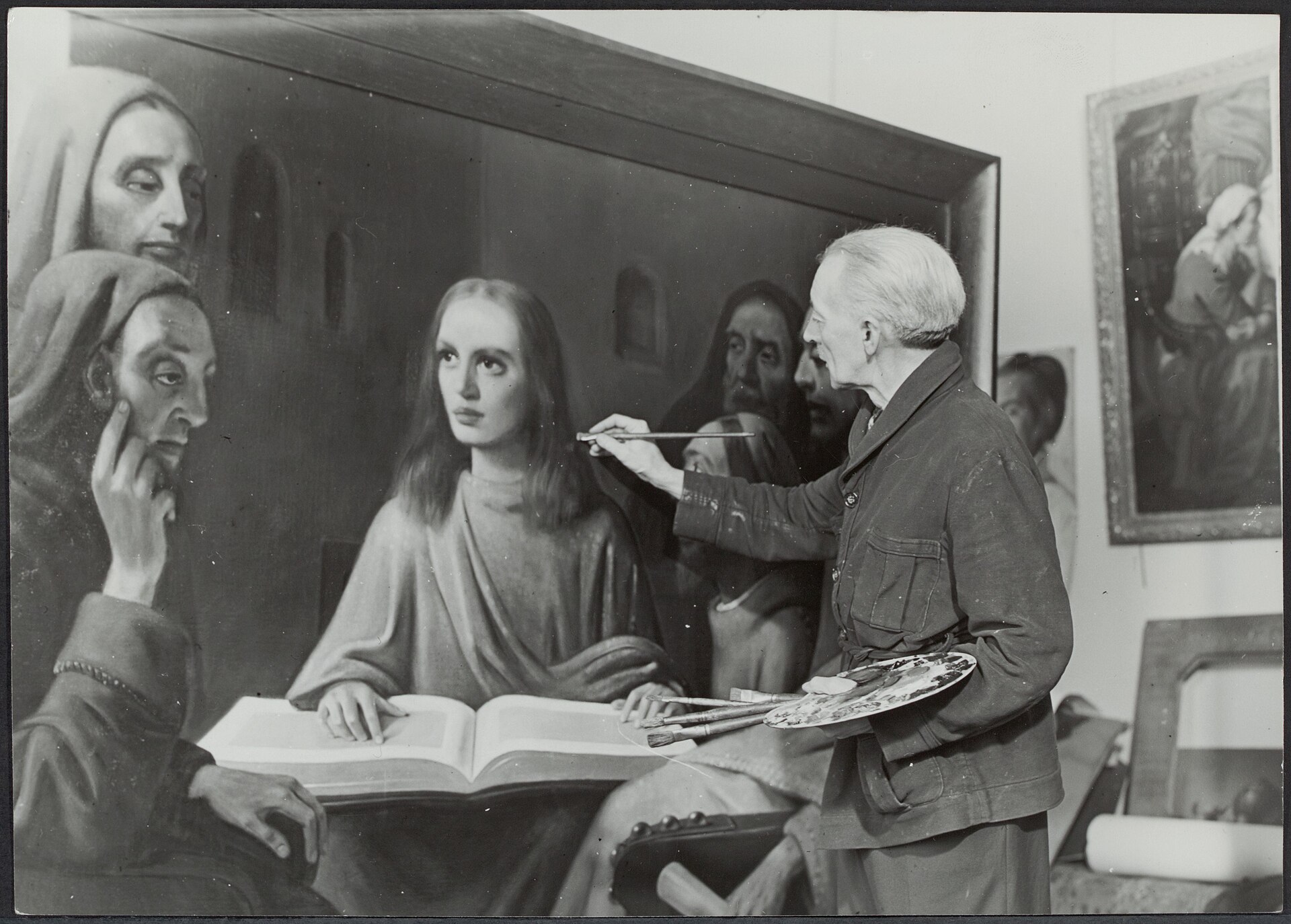
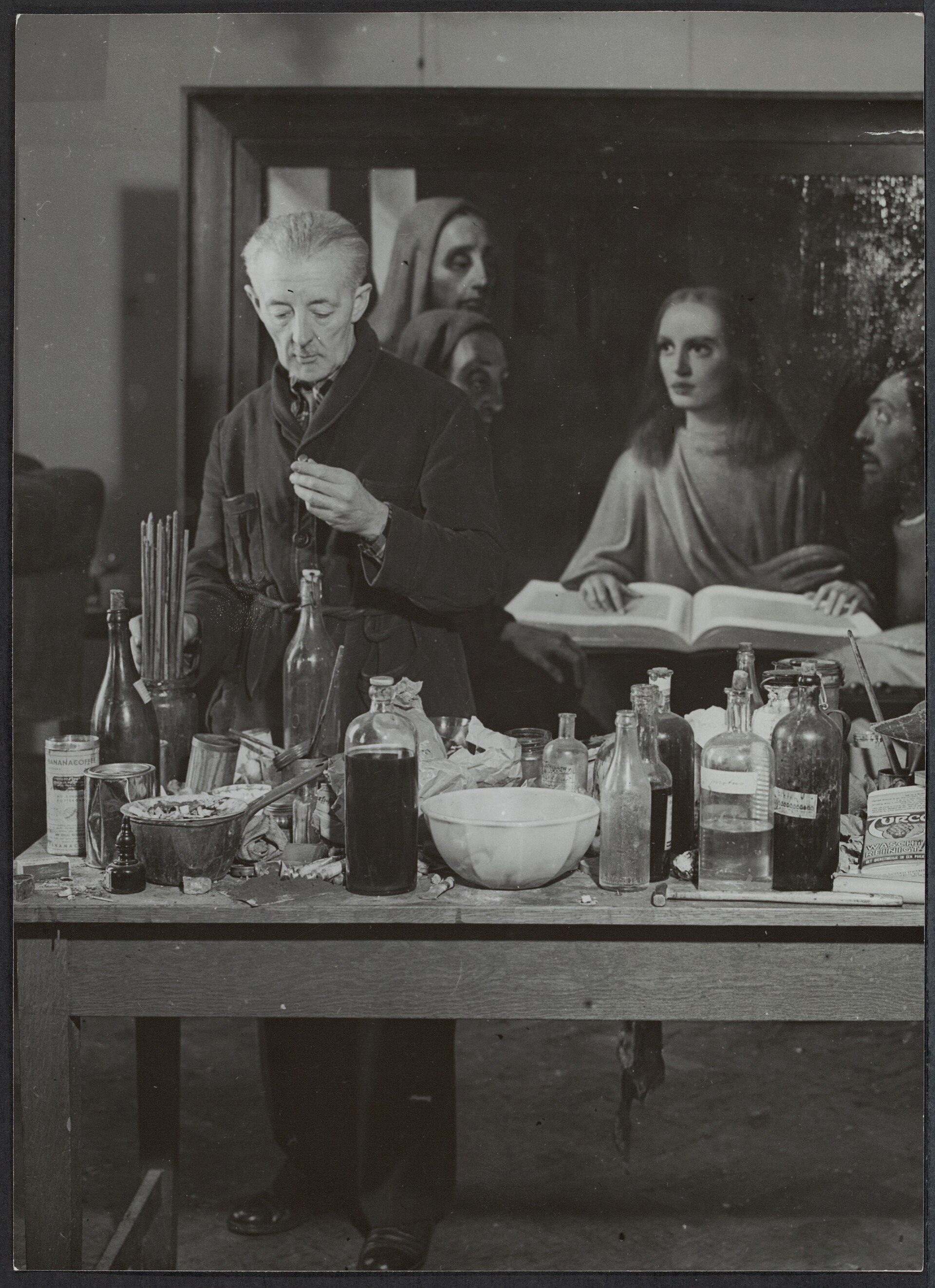
Van Meegeren at work in October 1945, photographed by Koos Raucamp for the Anefo press agency, painting Jesus among the Doctors in the manner of Vermeer to demonstrate that he could produce the pictures he said he had forged. No licensed pre-arrest studio portrait was found in the sources consulted.
Photograph by Koos Raucamp (Anefo), CC BY 4.0| Full name | Henricus Antonius van Meegeren |
|---|---|
| Worked as | Painter, Art forger |
| Born | 10 October 1889 · Deventer, Netherlands |
| Died | 30 December 1947 (one source gives 30 November 1947 · Valeriuskliniek, Amsterdam |
| Nationality | Dutch |
| Movement | Academic Dutch Golden Age revivalism, deployed as forgery |
| Sources | 11 cited |
| Last verified |
About this page Last verified · 11 sources cited
On this page 13 sections
ContentsClose
Han van Meegeren did not copy a Vermeer. Between 1936 and 1943 he painted a group of religious and genre pictures in the manner of Johannes Vermeer, Pieter de Hooch and, in earlier attempts, Frans Hals, sold them to Dutch museums, private collectors and, in one case, to Hermann Goering, and was arrested in May 1945 on a charge that could have cost him his life: selling a Dutch national treasure to the enemy. He avoided that charge only by confessing to a lesser one, and then had to prove the confession true by painting a further fake Vermeer under official supervision while reporters watched.
The detail most accounts get wrong is the nature of the deception itself. Van Meegeren was not a skilled mimic working from an existing picture. His best-known forgery, The Supper at Emmaus, resembles no surviving Vermeer, because it was never meant to. It supplied physical evidence for a religious, Italianate early period that the leading Vermeer scholar of the day had already argued must exist and had not yet found. The forgery worked because it answered a question a real authority had already asked in print.
This page follows what is documented rather than what is retold: the guilders actually paid and by whom, the forensic commission that unpicked the paint film, the trial that inverted the ordinary burden of proof, and what happened to the pictures afterward. Most of them were not destroyed. Dutch museums still hold several, catalogued under his own name, as evidence of exactly what he did.
Images
Chronology
- 1889
Born 10 October in Deventer, the third of five children of Hendrikus Johannes van Meegeren, a teacher of French and history.1
- 1907-1913
Studies architecture at Delft Technical University while training as a painter under Bartus Korteling.1
- 1913
Awarded the Delft gold medal, 8 January, for a study of the interior of the Church of Saint Lawrence.1
- 1917
First public exhibition, Kunstzaal Pictura, The Hague, 24 April to 22 May.1
- 1928
Critics turn decisively against his original work as derivative; he co-founds the periodical De Kemphaan the same year in response.1
- 1932
Moves to Roquebrune-Cap-Martin in the south of France, renting the villa Primavera, and begins developing his forgery technique.1
- 1937-09
Abraham Bredius examines The Supper at Emmaus.7
- 1937-11
Bredius publishes his endorsement in The Burlington Magazine for Connoisseurs, calling the picture the masterpiece of Johannes Vermeer of Delft.7
- 1937
Museum Boijmans Van Beuningen buys The Supper at Emmaus, championed by director Dirk Hannema; the museum's own online record instead dates the acquisition to 1939.38
- 1938-1943
Further forgeries sold to D.G. van Beuningen, Willem van der Vorm and the Dutch state, culminating in The Washing of the Feet, bought through dealer P. de Boer in 1943.14
- 1943
Christ and the Adulteress sold via the intermediary Alois Miedl to Hermann Goering for a reported 1,650,000 guilders.15
- 1945-05-29
Arrested and charged with collaboration after the painting sold to Goering is traced back to him.15
- 1945-07/12
Paints Jesus Among the Doctors under supervision to prove his forgery claim.1
- 1945-12
Files for bankruptcy.1
- 1946-01/02
Released from custody.1
- 1947-10-29
Trial opens, Fourth Chamber, Amsterdam Regional Court.1
- 1947-11-12
Convicted of forgery and fraud, not collaboration; sentenced to one year.1
- 1947-11-26
- 1947-12-30
Dies at the Valeriuskliniek, Amsterdam, after a second heart attack; one specialist source gives 30 November instead.16
- 1950-09-04/06
House and estate contents auctioned in Amsterdam.1
- 1958
Second trial in the van Beuningen v. Coremans libel action concludes in Coremans's favour.1
- 1967
Bernard Keisch's lead-210 analysis at Carnegie Mellon University independently corroborates the forgery finding.1
- 2010-05-12/2010-08-22
Museum Boijmans Van Beuningen exhibits ten of the forgeries together.8
The market
The forgeries themselves were never sold at public auction. Every sale listed here was a private, dealer- or director-brokered purchase by a museum or a private collector who believed he was buying a seventeenth-century Old Master, which is why no hammer-and-premium figure exists for any of them; the guilders below are the reported total consideration, not an auction result.
The market for van Meegeren's own, honestly signed work is a different and much smaller thing. What survives from his legitimate career now circulates through minor Dutch and Belgian regional auction houses at modest estimates, nothing like the sums his fictions once commanded.
| Date | Sale | Work | Result | Note |
|---|---|---|---|---|
| 1937 | Private purchase (Museum Boijmans Van Beuningen) | The Supper at Emmaus | Hammer 520,000-550,000 guilders (reported variously; 540,000 per the museum's own 2010 exhibition materials) With premium not applicable - direct museum purchase, not at auction NLG | Museum's current online record states no figure and dates the acquisition to 1939. |
| 1938-1939 | Private sale to D.G. van Beuningen | Interior with Drinkers | Hammer c. 219,000-220,000 guilders With premium not applicable - direct sale NLG | |
| 1938-1939 | Private sale to Willem van der Vorm | Interior with Card Players | Hammer c. 219,000-220,000 guilders With premium not applicable - direct sale NLG | |
| 1940-1941 | Private sale to D.G. van Beuningen | The Head of Christ | Hammer 400,000-475,000 guilders With premium not applicable - direct sale NLG | |
| 1940-1942 | Private sale to D.G. van Beuningen | The Last Supper II | Hammer 1,600,000 guilders With premium not applicable - direct sale NLG | |
| 1941-1942 | Private sale to Willem van der Vorm | Isaac Blessing Jacob | Hammer 1,270,000 guilders With premium not applicable - direct sale NLG | |
| 1943 | Private sale via intermediary Alois Miedl | Christ and the Adulteress | Hammer 1,650,000 guilders With premium not applicable - direct sale NLG | Buyer was Hermann Goering; picture recovered by Allied forces from the Altaussee salt mine after the war. |
| 1943 | Purchased through dealer P. de Boer for the Dutch State | The Washing of the Feet | Hammer 1,250,000-1,300,000 guilders per most secondary accounts; the Rijksmuseum's own published provenance instead gives fl. 1,300,000 or fl. 1,170,000 With premium not applicable - direct sale NLG | Now Rijksmuseum, object number SK-A-4239. |
| 10 December 2024 | Veilinghuis Van Spengen | Christus geneest de blinde man in Jericho (1923), a genuine, signed early painting | Hammer estimate EUR 2,000-3,000; realised price not confirmed in the sources consulted With premium n/a - estimate only EUR | Illustrative of the current, much smaller market for his own honest work. |
Hammer is the price at which the bidding stopped; with premium adds the fee the house charges the buyer on top. Hammer price and buyer's premium in the glossary.
Where to see the work
| Institution | City | Holdings | Note |
|---|---|---|---|
| Rijksmuseum | Amsterdam | The Washing of the Feet (SK-A-4239); Woman Reading Sheet Music (SK-A-4240); the two unsold Vermeer-idiom trial pictures; the 1945 courtroom demonstration painting Jesus Among the Doctors | Catalogued under van Meegeren's own name as documented forgeries and practice pieces. |
| Museum Boijmans Van Beuningen | Rotterdam | The Supper at Emmaus (inv. St 1) | Currently in storage rather than on permanent display, per the museum's own online record. |
| Museum de Fundatie | Zwolle | Christ and the Adulteress | Held on long-term loan from the Netherlands Cultural Heritage Agency (Rijksdienst voor het Cultureel Erfgoed), which took custody of the picture as recovered Nazi-looted property after the war. |
Forgeries and misattributions
- Fakes of the forger
- Van Meegeren's son, Jacques van Meegeren, later painted further pictures in his father's manner and signed them with forged versions of his father's own signature, extending the fraud into a second generation after the original forger's death. Not detailed in the sources consulted for this page; flagged for the primary account of how these later fakes were identified and separated from genuine early van Meegerens.1
The essay
Chapter 1A real painter before he was a famous forger
Van Meegeren trained first as an architect at Delft Technical University from 1907, alongside painting studies under Bartus Korteling, a teacher who admired Vermeer's technique and dismissed...
Van Meegeren trained first as an architect at Delft Technical University from 1907, alongside painting studies under Bartus Korteling, a teacher who admired Vermeer's technique and dismissed Impressionism as decadent. He won the Delft gold medal on 8 January 1913 for a study of the interior of the Church of Saint Lawrence, then completed the Royal Academy of Art in The Hague in 1914. His first public exhibition was held at Kunstzaal Pictura in The Hague in April and May 1917, and in December 1919 he was admitted to the Haagse Kunstkring, an exclusive artists' society.
He was, for a decade, a working portraitist with real clients, including English and American visitors on the Cote d'Azur, and he painted Hertje (The Deer), a portrait of Princess Juliana's roe deer, in 1921. By 1928 critics had turned on him. One dismissed him as a gifted technician who produced only a composite facsimile of the Renaissance school, with every virtue except originality. Van Meegeren answered through De Kemphaan (The Ruff), a monthly periodical he co-published with Jan Ubink between April 1928 and March 1930, in which he denounced modern painting as art-Bolshevism. He later gave critics' contempt as his own explanation for turning to forgery, a statement of motive that should be read as his account rather than a settled fact; the biographer Jonathan Lopez has argued instead that the money itself, and the lifestyle it funded, was the more consistent driver across the years the forgeries actually ran.
Chapter 2He did not copy a Vermeer. He invented one that a scholar had already predicted
By the 1930s Vermeer's accepted output was a small, mostly domestic group, and Abraham Bredius, the dominant authority on the artist, had argued in print that an early phase existed showing Italian...
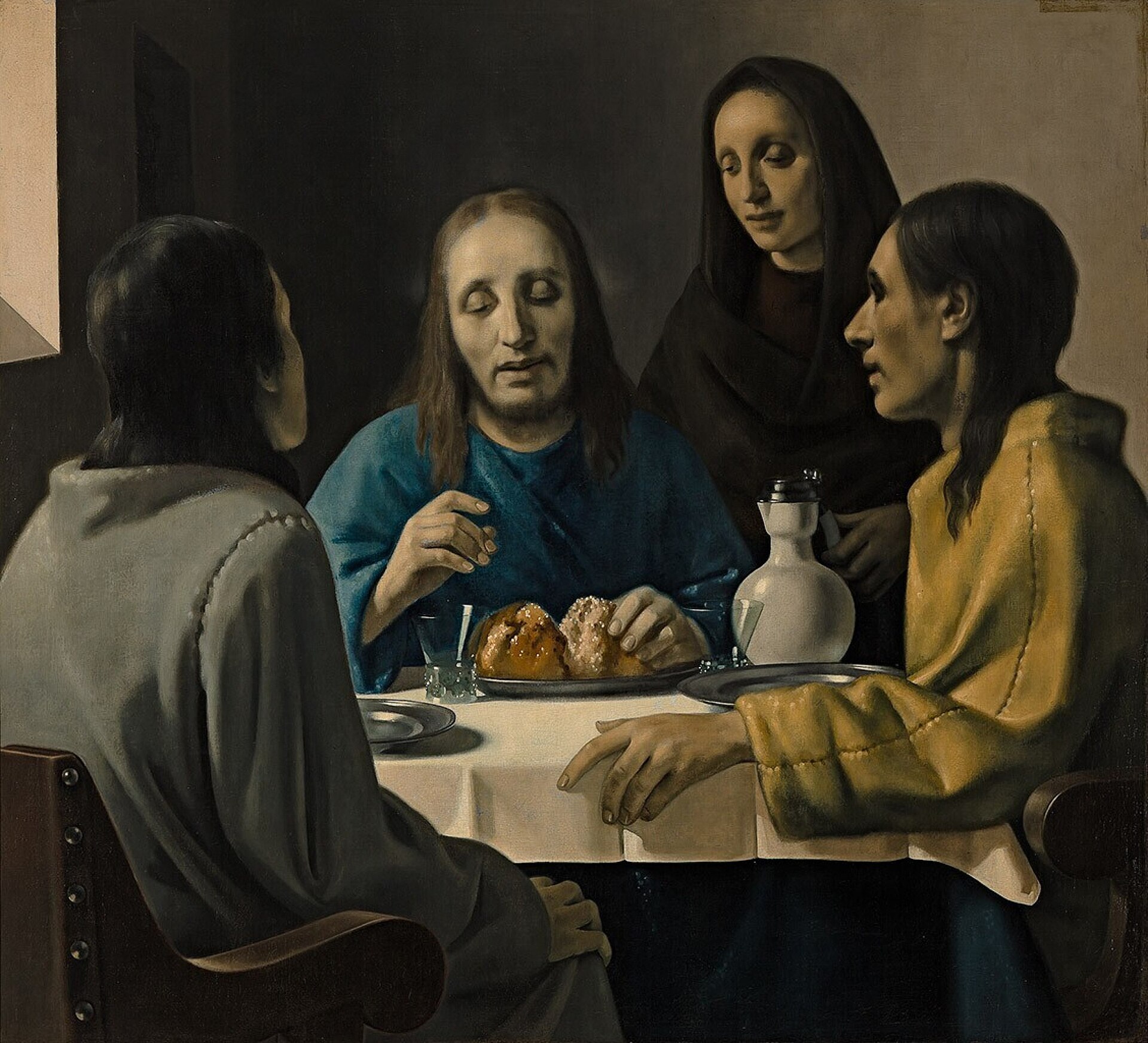
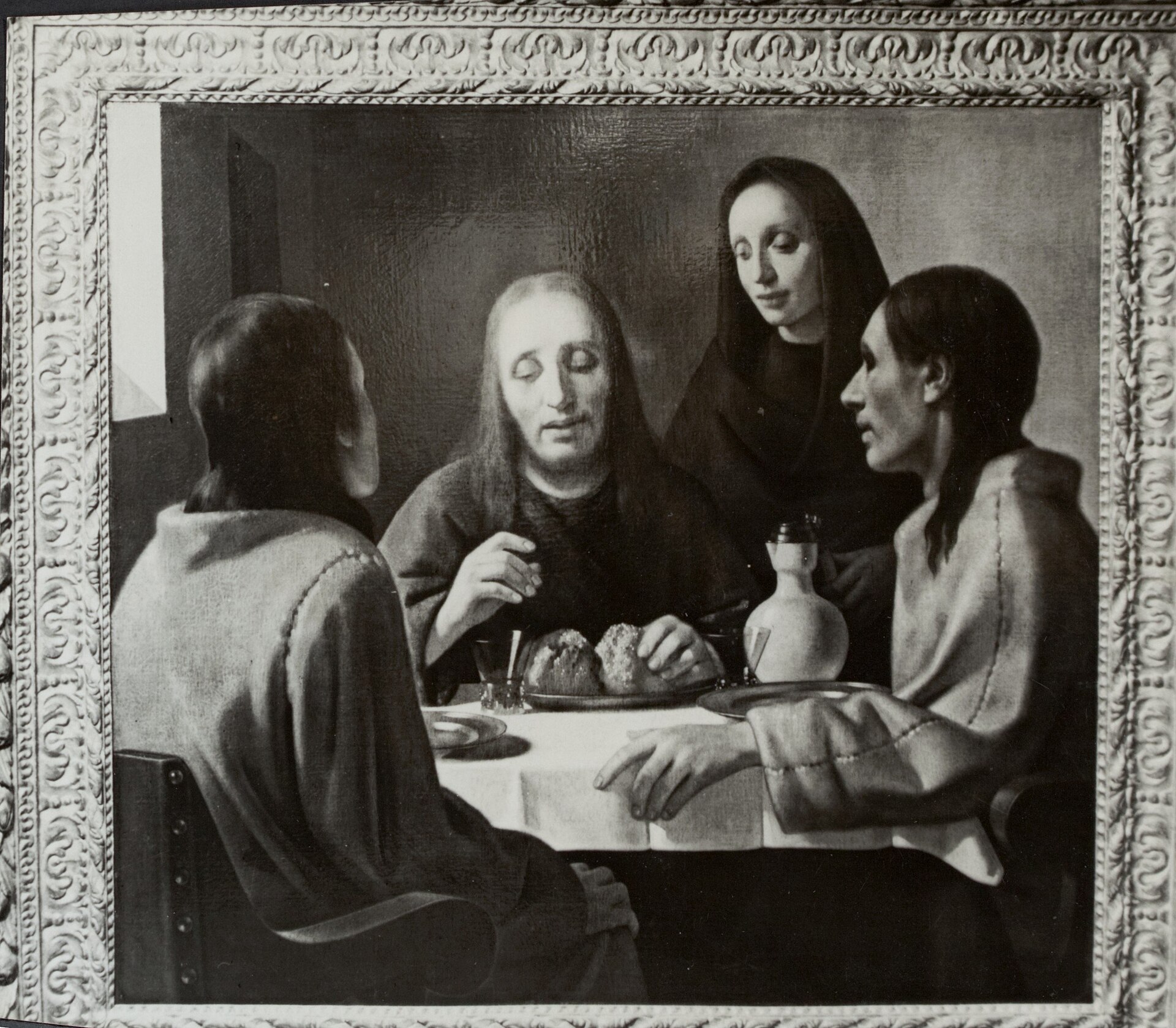
By the 1930s Vermeer's accepted output was a small, mostly domestic group, and Abraham Bredius, the dominant authority on the artist, had argued in print that an early phase existed showing Italian, Caravaggesque influence that no surviving picture yet demonstrated. Van Meegeren's The Supper at Emmaus is not a pastiche of any known Vermeer. Its composition follows Caravaggio's treatment of the same subject, and it supplied, on canvas, exactly the missing evidence Bredius's own scholarship had called for.
The picture carries a barely visible signature reading IVMeer in the upper left corner. Van Meegeren worked on a genuine seventeenth-century canvas and used badger-hair brushes of the type associated with Vermeer's studio, but the decisive move was intellectual rather than technical: he did not ask to be believed because the picture looked like a Vermeer. He asked to be believed because it filled a gap a named scholar had already published.
Chapter 3The certificate that did the selling
Bredius examined the painting in September 1937 and published his verdict in The Burlington Magazine for Connoisseurs that November: he was, he wrote, inclined to call it the masterpiece of Johannes...
Bredius examined the painting in September 1937 and published his verdict in The Burlington Magazine for Connoisseurs that November: he was, he wrote, inclined to call it the masterpiece of Johannes Vermeer of Delft. He was in his eighties and among the most respected Vermeer scholars of his generation; his endorsement converted an object with no ownership history into a museum acquisition.
Museum Boijmans Van Beuningen in Rotterdam bought the picture in 1937, championed by the museum's director, Dirk Hannema, with funding raised through the Rembrandt Society and the Rotterdam shipowner Willem van der Vorm. The price is not settled. Most secondary accounts give 520,000 guilders; the museum's own 2010 exhibition materials give 540,000 guilders; other accounts run as high as 550,000. The museum's current online collection record states no price at all, and gives the acquisition year as 1939 while its accompanying text describes a purchase made in 1937 - a gap the museum's own published entry does not explain. The painting is catalogued today as inventory St 1, held in storage.
Chapter 4The technique, built to beat two specific tests
The routine authentication checks used by Dutch museums in the 1930s were mechanical: a solvent swab to see whether the paint film softened, and a needle to see whether it yielded.
The routine authentication checks used by Dutch museums in the 1930s were mechanical: a solvent swab to see whether the paint film softened, and a needle to see whether it yielded. Fresh oil paint fails both. Van Meegeren's solution was to abandon oil as a binder. He ground period-correct pigments, including lapis lazuli, lead white, indigo and cinnabar, into a medium built around phenol formaldehyde resin, sold commercially as Albertol and known publicly as Bakelite, thinned with lilac oil, then baked the finished canvas at 100 to 120 degrees Celsius. The resin cross-linked into a hard, insoluble film that answered a solvent swab and a needle the way three-century-old paint does. He rolled the canvas over a cylinder to force a network of cracks and washed India ink into them so the craquelure read as accumulated grime rather than fresh damage.
The choice of canvas mattered as much as the paint. He bought and scraped down genuine seventeenth-century pictures, so that any X-ray of the stretcher, tacking edge or ground would read as period-correct, and painted over them with badger-hair brushes matching the type used in Vermeer's own studio. Every element of the method targeted a specific, then-current examination procedure rather than the general impression of age; that is the reason the deception held for as long as it did.
Chapter 5What he actually sold, and to whom
The forgeries generally accepted as sold under a false Old Master attribution number at least ten, following Museum Boijmans Van Beuningen's own 2010 exhibition of the group, mostly in the idiom of...
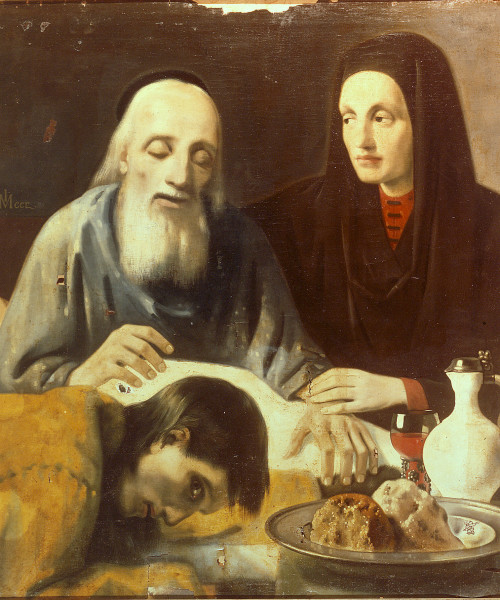
The forgeries generally accepted as sold under a false Old Master attribution number at least ten, following Museum Boijmans Van Beuningen's own 2010 exhibition of the group, mostly in the idiom of Vermeer and Pieter de Hooch, with earlier experiments in the manner of Frans Hals and Gerard ter Borch. Reported prices, in guilders and unadjusted: Interior with Drinkers to D.G. van Beuningen, around 219,000 to 220,000; Interior with Card Players to Willem van der Vorm, a similar figure; The Head of Christ to van Beuningen, 400,000 to 475,000; The Last Supper II to van Beuningen, 1,600,000; Isaac Blessing Jacob to van der Vorm, 1,270,000; Christ and the Adulteress to Hermann Goering via the intermediary Alois Miedl, 1,650,000; and The Washing of the Feet, bought through the Amsterdam dealer P. de Boer for the Dutch state in 1943, reported at 1,250,000 to 1,300,000 in most secondary accounts, though the Rijksmuseum's own published provenance for the picture gives the lower figure as 1,170,000 rather than 1,250,000. Two further pictures in the Vermeer idiom, Lady Reading Music and Lady Playing Music (1935-36), were painted as trial pieces and never sold; they remain, with the courtroom demonstration painting, in the Rijksmuseum's collection.
Almost all of the money therefore ran through three buyers: two Rotterdam magnates, van Beuningen and van der Vorm, competing for the same body of invented Old Masters, and the Dutch state itself. None of these were public auction sales; each was a private, dealer- or director-brokered purchase, which is one reason no hammer-and-premium figure exists for any of them.
Chapter 6The sale to Goering
Christ and the Adulteress, painted around 1942, was sold in 1943 through the banker and art dealer Alois Miedl, who had made himself useful to the German occupation, to Hermann Goering, for a...
Christ and the Adulteress, painted around 1942, was sold in 1943 through the banker and art dealer Alois Miedl, who had made himself useful to the German occupation, to Hermann Goering, for a reported 1,650,000 guilders (some accounts round this to 1,600,000). Goering's collection, including the picture, was moved to the Altaussee salt mine in Austria by 25 August 1943 along with thousands of other looted and purchased works, and was recovered there by Allied forces after the war.
Investigators traced the sale back to van Meegeren after questioning Miedl in May 1945. Whether Goering himself ever learned the picture was a twentieth-century fake rather than a seventeenth-century Vermeer is not settled; the biographer Jonathan Lopez has suggested he may not have, a minority position that has not displaced the standard account and is recorded here as an open question rather than a fact.
Chapter 7Arrested for treason, and forced to prove himself a forger to survive it
Van Meegeren was arrested on 29 May 1945 and charged with collaboration: selling Dutch cultural property to the enemy, an offence that in the immediate aftermath of the occupation carried the gravest...
Van Meegeren was arrested on 29 May 1945 and charged with collaboration: selling Dutch cultural property to the enemy, an offence that in the immediate aftermath of the occupation carried the gravest penalties available. He was held first at Weteringschans prison and later at the Military Command headquarters on Herengracht in Amsterdam.
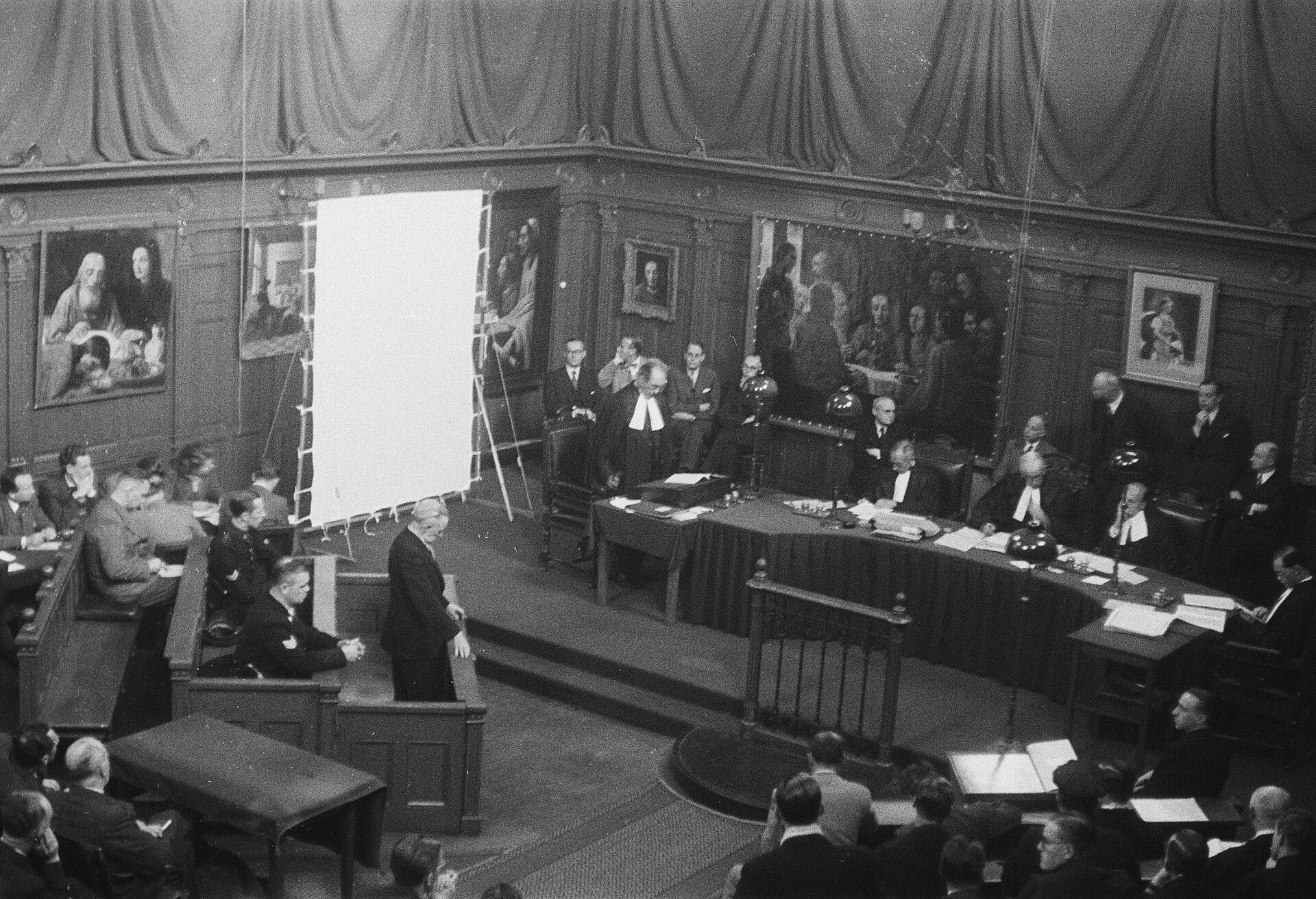
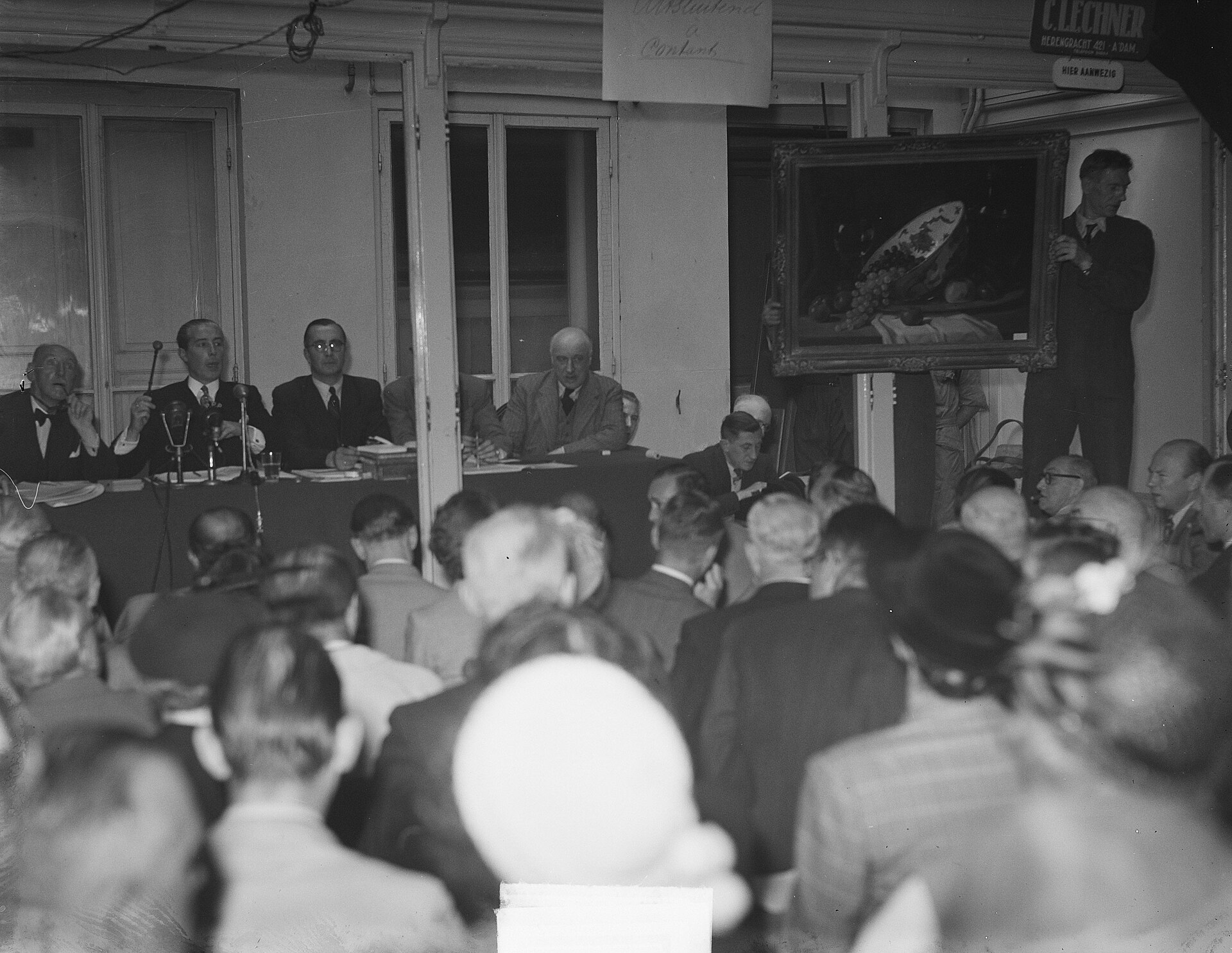
His defence was a confession to a different, survivable crime. He stated that the painting in Goering's hands was not a Vermeer but his own work, and that no national treasure had left the country because none had existed to begin with. To make the claim credible he had to demonstrate it, and between July and around November or December 1945 he painted a further picture, Jesus Among the Doctors (also called Young Christ in the Temple), in the presence of reporters and court-appointed witnesses. Accounts differ on whether this took place in open court or in a guarded studio or prison setting; that detail is repeated confidently in both forms across the secondary literature and is not resolved here. He was released from custody in January or February 1946 and had filed for bankruptcy the previous December.
Chapter 8The forensic commission that settled the question
An international panel led by Paul B. Coremans, director of the chemical laboratory of the Royal Museums of Fine Arts of Belgium, with curators, professors and physicians from the Netherlands...
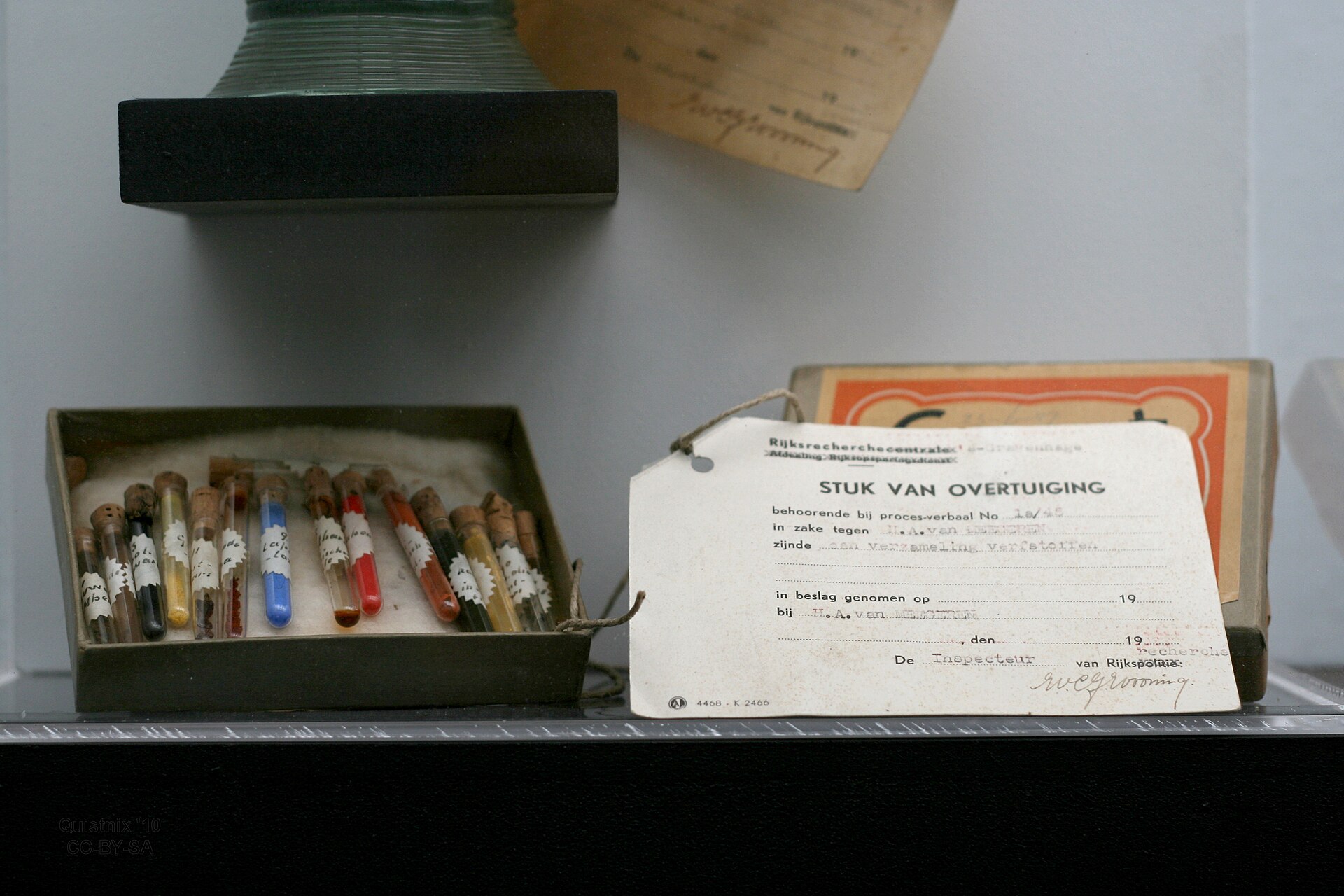
An international panel led by Paul B. Coremans, director of the chemical laboratory of the Royal Museums of Fine Arts of Belgium, with curators, professors and physicians from the Netherlands, Belgium and England, examined the disputed pictures. The commission identified phenol formaldehyde resin in the paint films, matched it to material recovered from van Meegeren's own working premises, and documented paint hardness and craquelure behaviour inconsistent with natural aging. Coremans published the results in 1949, in Amsterdam, through J.M. Meulenhoff, translated by A. Hardy and C. Hutt: a forty-page volume with plates, catalogued as Van Meegeren's Faked Vermeers and De Hooghs: A Scientific Examination, and still the primary technical record of the case.
Two decades later the same material became the test case for a new physical-dating method. Bernard Keisch at Carnegie Mellon University applied lead-210 dating, which measures the disequilibrium between freshly smelted lead's lead-210 content and the radium-226 left behind in its ore residue; that disequilibrium takes roughly a century and a half to resolve. The white lead in the forgeries behaved like modern lead, not seventeenth-century lead, corroborating Coremans's chemical findings by an entirely independent physical method.
Chapter 9Convicted of forgery, not treason, and dead before he could serve the sentence
The trial ran from 29 October to 12 November 1947 in the Fourth Chamber of the Amsterdam Regional Court.
The trial ran from 29 October to 12 November 1947 in the Fourth Chamber of the Amsterdam Regional Court. The prosecutor, H.A. Wassenbergh, asked for two years. On 12 November 1947 the court convicted van Meegeren of forgery and of obtaining money by deception, not of collaboration; his own confession had removed the factual basis for the treason charge that had produced his arrest. The sentence was one year.
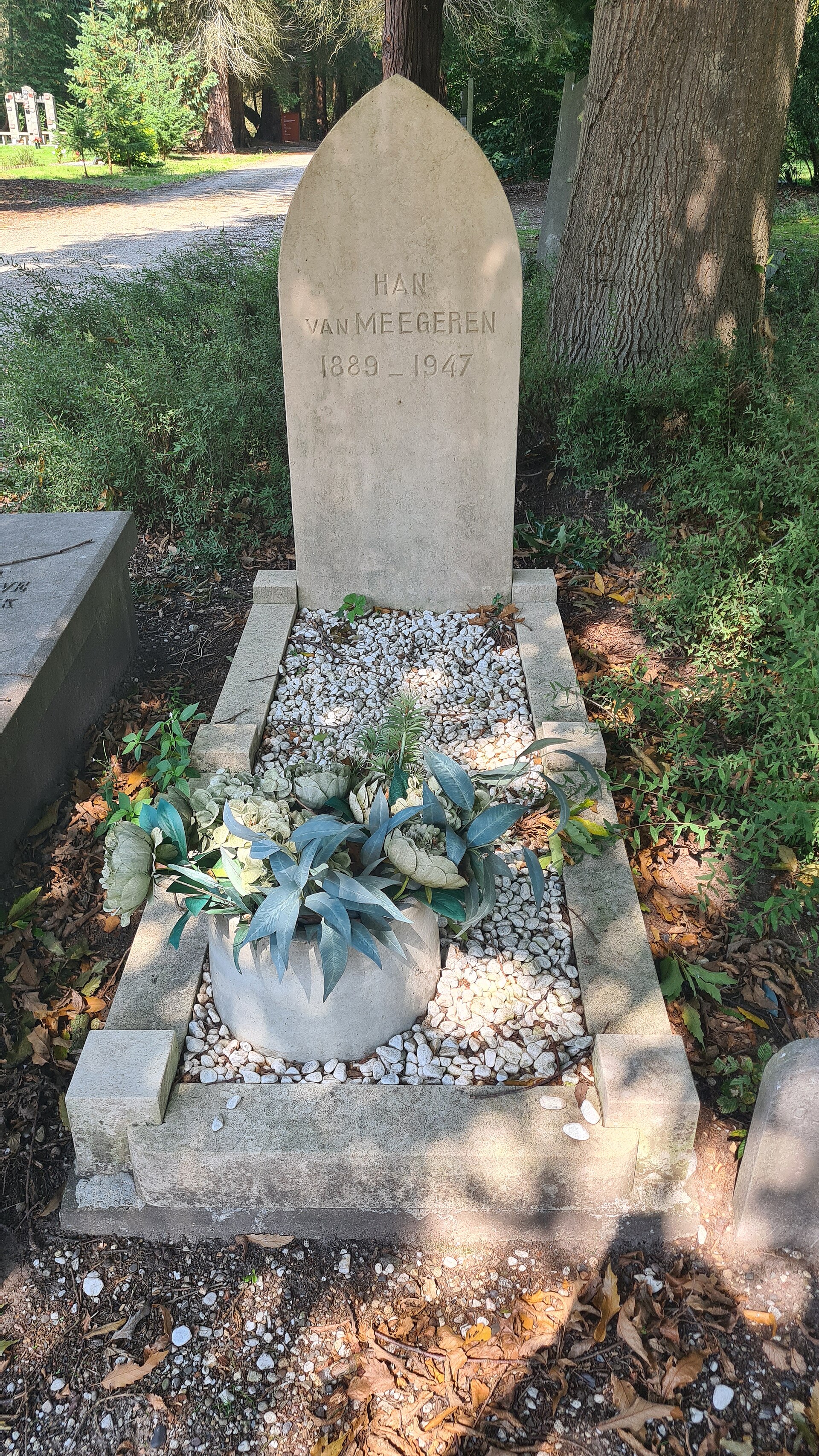
He did not serve it. He suffered a first heart attack on 26 November 1947, and a second, fatal one at the end of December, dying at the Valeriuskliniek in Amsterdam. Most accounts, including the Dutch necrology literature, give the date as 30 December 1947; at least one specialist forgery-history source gives 30 November 1947 instead, and the discrepancy is not resolved in the sources consulted here. His funeral procession travelled from his home on the Keizersgracht to the Driehuis-Westerveld crematorium in Velsen, attended by friends, diplomats and artists; his ex-wife Jo attended as chief mourner. His son Jacques later carried the urn to Deventer, where van Meegeren's sister Guusje had bought a plot at the town's general cemetery. He is interred there under grave number 948, beneath a simple gothic-arched headstone his son designed.
Chapter 10What happened to the pictures, and to the estate
Most of the forged paintings were not destroyed.
Most of the forged paintings were not destroyed. The Rijksmuseum in Amsterdam holds The Washing of the Feet (object number SK-A-4239, bought from the dealer P. de Boer for the Dutch state in 1943, recorded in the museum's collection since 1974) and Woman Reading Sheet Music (SK-A-4240, acquired 1947), along with the two unsold trial pictures and the courtroom demonstration painting. Museum Boijmans Van Beuningen in Rotterdam still holds The Supper at Emmaus under van Meegeren's own name, currently in storage rather than on display. Museum de Fundatie in Zwolle holds Christ and the Adulteress, the picture sold to Goering, on long-term loan from the Netherlands Cultural Heritage Agency, which took custody of it as recovered Nazi-looted property after the war.
Van Meegeren's own estate was sold at auction on 5 and 6 September 1950, with his house auctioned separately on 4 September; contents raised roughly 123,000 guilders, with total proceeds around 242,000, distributed by court order to the buyers of the forgeries and toward unpaid income tax. He had declared bankruptcy in December 1945 and the debts to his victims were still being settled nearly three years after his death.
Chapter 11A lawsuit about his own diagnosis
D.G. van Beuningen, the buyer of three of the forgeries, sued Coremans in Brussels, seeking roughly 500,000 pounds sterling, arguing that the forgery finding had wrongfully devalued paintings he...
D.G. van Beuningen, the buyer of three of the forgeries, sued Coremans in Brussels, seeking roughly 500,000 pounds sterling, arguing that the forgery finding had wrongfully devalued paintings he still owned. Coremans won the first trial; van Beuningen died in 1955, and a second trial in 1958 again found for Coremans, helped by X-ray evidence showing a genuine seventeenth-century hunting scene, attributed to a painter named Hondius, underneath one of the disputed canvases, along with witness testimony that van Meegeren had bought that same hunting scene in 1940 - a paper trail for one of his reused supports.
Separately, the Brussels art expert Jean Decoen argued in a 1951 publication that The Supper at Emmaus and The Last Supper II were themselves genuine seventeenth-century paintings that van Meegeren had merely used as physical models for his forgeries, rather than painting outright. Decoen's position did not persuade the field and has not displaced the forensic finding, but it is a real, named, published dissent and is recorded as one here rather than smoothed away.
Chapter 12The forger's own forgeries, and what his name is worth now
Van Meegeren's son, Jacques van Meegeren, later painted further pictures in his father's manner and signed them with forged versions of his father's own signature, extending the fraud into a second...
Van Meegeren's son, Jacques van Meegeren, later painted further pictures in his father's manner and signed them with forged versions of his father's own signature, extending the fraud into a second generation; the sources consulted here do not detail how or when these were identified as such, and that gap is recorded rather than filled.
The contrast with the current market is stark. Van Meegeren's own, honestly signed early work now circulates through small Dutch and Belgian regional auction houses at modest estimates - a large 1923 religious canvas, Christus geneest de blinde man in Jericho, carried an estimate of only 2,000 to 3,000 euros at a December 2024 sale, and most of his genuinely-attributed lots sit in the low hundreds to low thousands of euros. The guilders his fictions once commanded, and the smaller sums his honest signature commands now, sit either side of the same career and measure exactly what the certificate, not the canvas, was worth.
What is documented
Technique
The surviving work
- What is accepted
- At least ten paintings are documented as sold under a false Old Master attribution between 1937 and 1943, following Museum Boijmans Van Beuningen's own 2010 exhibition of the group, mostly in the manner of Vermeer and Pieter de Hooch. Two further trial pictures in the Vermeer idiom, painted 1935-36 and never sold, and the 1945 courtroom demonstration picture, Jesus Among the Doctors, are held separately by the Rijksmuseum as documented practice and demonstration works rather than sold forgeries.
- What is contested
- Earlier and looser counts in circulation run from nine to about a dozen, depending on whether unsold trial pieces and 1920s experiments in the manner of Frans Hals are counted alongside the sold Old Master forgeries proper. No single scholar has published a definitive count superseding the Boijmans exhibition's figure of ten.
- Who rules on attribution
- No attribution board or single authority exists. Each holding institution (the Rijksmuseum, Museum Boijmans Van Beuningen, Museum de Fundatie) catalogues its own picture as a documented van Meegeren forgery under its own curatorial authority; there is no active external body that rules on the group as a whole.
Catalogue raisonne
- Friso Lammertse, Nadja Garthoff, Michel van de Laar and Arie Wallert, Van Meegeren's Vermeers (Rotterdam: Museum Boijmans Van Beuningen, 2011). The catalogue for the museum's own 2010 exhibition of ten forgeries; the closest thing to an authoritative, current corpus list, but it is an exhibition catalogue rather than a critical catalogue raisonne and does not claim to be exhaustive. Full bibliographic detail (ISBN, page count) is drawn from the museum's own webshop listing, which redirected and then returned a 404 on direct verification here; flagged for confirmation against the physical volume.811
Questions about Han van Meegeren
Who was Han van Meegeren?
Painter; Art forger. 1889-1947.
When did Han van Meegeren live?
Born 10 October 1889, Deventer, Netherlands; died 30 December 1947 (one source gives 30 November 1947; see open questions), Valeriuskliniek, Amsterdam.
How are fakes and misattributions of Han van Meegeren detected?
Fakes of the forger. Van Meegeren's son, Jacques van Meegeren, later painted further pictures in his father's manner and signed them with forged versions of his father's own signature, extending the fraud into a second generation after the original forger's death.
Where can you see work by Han van Meegeren?
Rijksmuseum (Amsterdam); Museum Boijmans Van Beuningen (Rotterdam); Museum de Fundatie (Zwolle).
What does the market for Han van Meegeren look like?
The forgeries themselves were never sold at public auction. Every sale listed here was a private, dealer- or director-brokered purchase by a museum or a private collector who believed he was buying a seventeenth-century Old Master, which is why no hammer-and-premium figure exists for any of them; the guilders below are the reported total consideration, not an auction result.The market for van Meegeren's own, honestly signed work is a different and much smaller thing.
What is still unresolved about Han van Meegeren?
The exact date of death: 30 December 1947 in most accounts and in the Dutch necrology literature, but 30 November 1947 in at least one specialist forgery-history source.
Open questions
- The exact date of death: 30 December 1947 in most accounts and in the Dutch necrology literature, but 30 November 1947 in at least one specialist forgery-history source.
- The exact price paid for The Supper at Emmaus in 1937: reported at 520,000, 540,000 and 550,000 guilders across different accounts, with the museum's own online record giving no figure at all.
- Why Museum Boijmans Van Beuningen's own collection record dates the Emmaus acquisition to 1939 while its accompanying text describes a purchase made in 1937; the gap is unexplained in the published entry.
- Whether the 1945 demonstration painting, Jesus Among the Doctors, was executed in open court or in a guarded studio or prison setting; both versions appear confidently in the secondary literature.
- Whether Hermann Goering ever learned that the picture he acquired in 1943 was a modern forgery rather than a genuine Vermeer; the standard account assumes he was deceived, but at least one biographer has suggested otherwise without settling the question.
- The precise total sum van Meegeren earned from the forgeries; a round figure of over seven million guilders circulates in secondary accounts, but no single audited total was found in the sources consulted here.
- The current location of Jesus Among the Doctors; one secondary source places it in a church in Johannesburg, a claim not confirmed here against a primary institutional record.
- The price paid for The Washing of the Feet: most secondary accounts (including Wikipedia) give 1,250,000-1,300,000 guilders, but the Rijksmuseum's own published provenance record for the picture gives fl. 1,300,000 or fl. 1,170,000 instead - a different, unexplained low figure from the holding institution itself.
Sources
- 1Wikipedia, 'Han van Meegeren'. en.wikipedia.org/wiki/...
- 2Intent to Deceive: Fakes and Forgeries in the Art World, forger profile, 'Han van Meegeren'. intenttodeceive.org/forger-profiles/...
- 3Museum Boijmans Van Beuningen, collection record for The Supper at Emmaus (De Emmausgangers), Han van Meegeren, 1937, inv. St 1. boijmans.nl/en/...
- 4Rijksmuseum, collection record for De voetwassing (The Washing of the Feet), object number SK-A-4239. rijksmuseum.nl/en/...
- 5NIOD / tweedewereldoorlog.nl, '100 voorwerpen,' entry 'Christ and the Adulteress'. tweedewereldoorlog.nl/100voorwerpen/...
- 6Stichting Dodenakkers.nl, 'Meegeren, Henricus Antonius (Han) van'. dodenakkers.nl/kunst-cultuur/...
- 7EssentialVermeer.com, 'Han van Meegeren's Fake Vermeers', including the quoted line from Bredius's 1937 Burlington Magazine article. essentialvermeer.com/misc/...
- 8CODART, exhibition listing, 'Van Meegeren's fake Vermeers', Museum Boijmans Van Beuningen, 12 May-22 August 2010. codart.nl/guide/...
- 9Invaluable.com, sold-at-auction artist listing for Han van Meegeren. invaluable.com/artist/...
- 10Paul B. Coremans, Van Meegeren's Faked Vermeers and De Hooghs: A Scientific Examination, trans. A. Hardy and C. Hutt (Amsterdam: J.M. Meulenhoff, 1949), per the Stanford University Libraries SearchWorks catalogue record. searchworks.stanford.edu/view/...
- 11Museum Boijmans Van Beuningen webshop, listing for Van Meegeren's Vermeers by Friso Lammertse, Nadja Garthoff, Michel van de Laar and Arie Wallert (2011). Direct fetch redirected and then returned 404; bibliographic detail not independently confirmed and flagged for verification against the physical volume. webshop.boijmans.nl/EN/...
Last verified