Giovanna Garzoni
 1600-1670
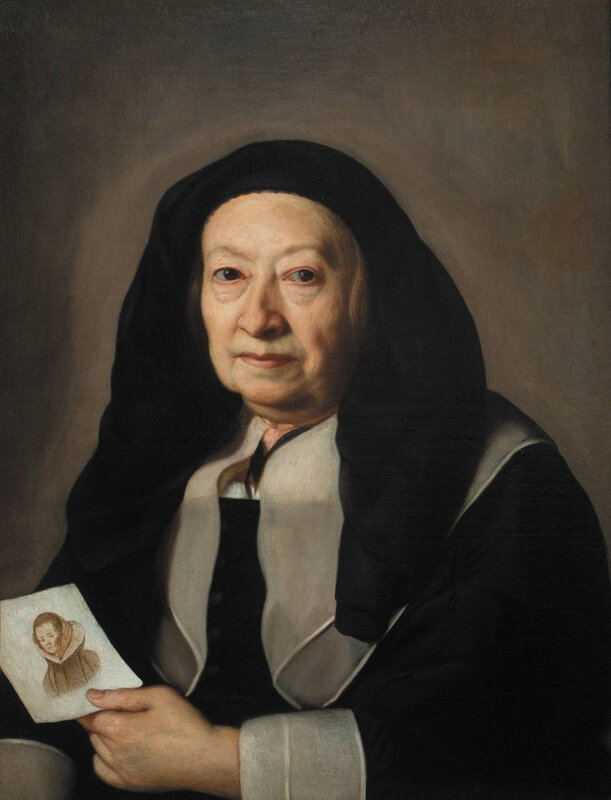
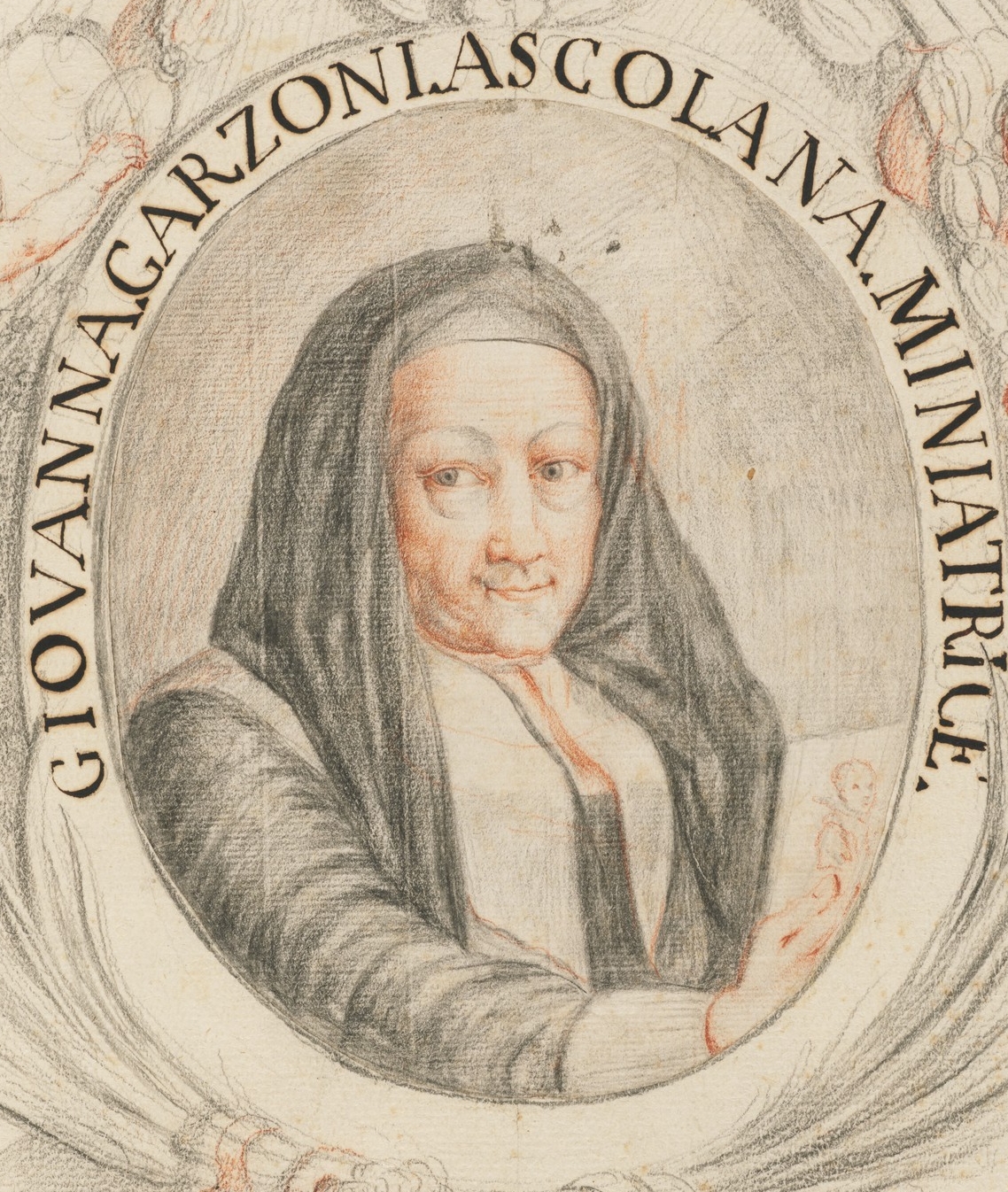
Portrait of the elderly artist in a dark veil and dress, holding a small portrait miniature, oil on canvas, 64 by 49 cm, Pinacoteca Civica, Ascoli Piceno, given on Commons as by Carlo Maratti about 1665; a Commons photograph of the same painting was taken at the 2020 Pitti show. The sitter and the Maratti attribution rest on Commons data and an exhibition photograph, not on the museum's own record, which I did not open. Fusani mentions a different Maratti portrait on her tomb monument that was lost in a theft.
Pinacoteca Civica, Ascoli Piceno (public domain, Wikimedia Commons)| Worked as | Painter, Miniaturist, Botanical illustrator, Calligrapher |
|---|---|
| Born | 1600 (year inferred from her own inscription on a Holy... · Ascoli Piceno, Marche (almost certainly, per Treccani) |
| Died | Between 10 and 15 February 1670 · Rome |
| Nationality | Italian (Marchigian-born, of Venetian parents) |
| Movement | Italian Baroque |
| Sources | 24 cited |
| Last verified |
About this page Last verified · 24 sources cited
On this page 13 sections
ContentsClose
Giovanna Garzoni painted small things for people who owned a great many large ones. Her still lifes of fruit, flowers, insects and Chinese porcelain, made in tempera or gouache on vellum or parchment, hung in the cabinets of the Medici at Florence, and her portrait miniatures went to the dukes and duchesses of Savoy. She worked for the viceroy of Naples, moved in the Barberini circle in Rome and, by most accounts, reached the French court. The Pitti Palace and the Uffizi in Florence hold the core of what survives, and the 2020 exhibition there, curated by Sheila Barker, assembled about one hundred works.
The single most important thing to know is that nobody has published a checkable list of her works. There is a standard monograph and catalogue, Gerardo Casale's of 1991, and a long run of exhibition catalogues, but no source opened for this page gives a total of accepted works, and attributions in the market are routinely settled by one specialist looking at a photograph. The second thing is how much of the standard account rests on a single line of text: her birth year of 1600 comes only from the inscription on one early Holy Family, and the story of her chaste widowhood, repeated in older books, has been challenged by documents about her husband's debts and a lawsuit by her father.
On the evidence I found, her prices sit well below the top result. The best result I could find is USD 622,400 for a hedgehog on vellum at Christie's New York in 2007; an aggregator puts the middle half of its priced lots between about USD 16,800 and USD 63,200. The market is thin, copies and followers abound, and some of her own works are replicas of her own parchments.
Images
Chronology
- 1600
Born, almost certainly at Ascoli Piceno, to Giacomo Garzoni of Venice and Isabetta Gaia; the year comes only from the inscribed age on a Holy Family of 1616.1
- 1616
Holy Family dated and inscribed as painted when she was sixteen; the National Gallery of Art catalogue also places her in Rome that year, which other scholars doubt.1221
- about 1617-1622
Makes the Libro de' caratteri cancellereschi corsivi at Venice while studying calligraphy under Giacomo Rogni; the book is now at the Accademia di San Luca.19
- 1625
Small parchment Portrait of a Gentleman, now at The Hague, dated 1625, made at Venice where she lived with her brother Mattio.1
- 1630
Leaves Venice for Naples with her brother to serve the Duke of Alcala; a letter of 15 June 1630 to Cassiano dal Pozzo is dated from Naples.121
- late 1631
Back in Rome after the Alcala post ends.1
- November 1632
Arrives in Turin at the request of Christine of France, Duchess of Savoy.1
- 1635
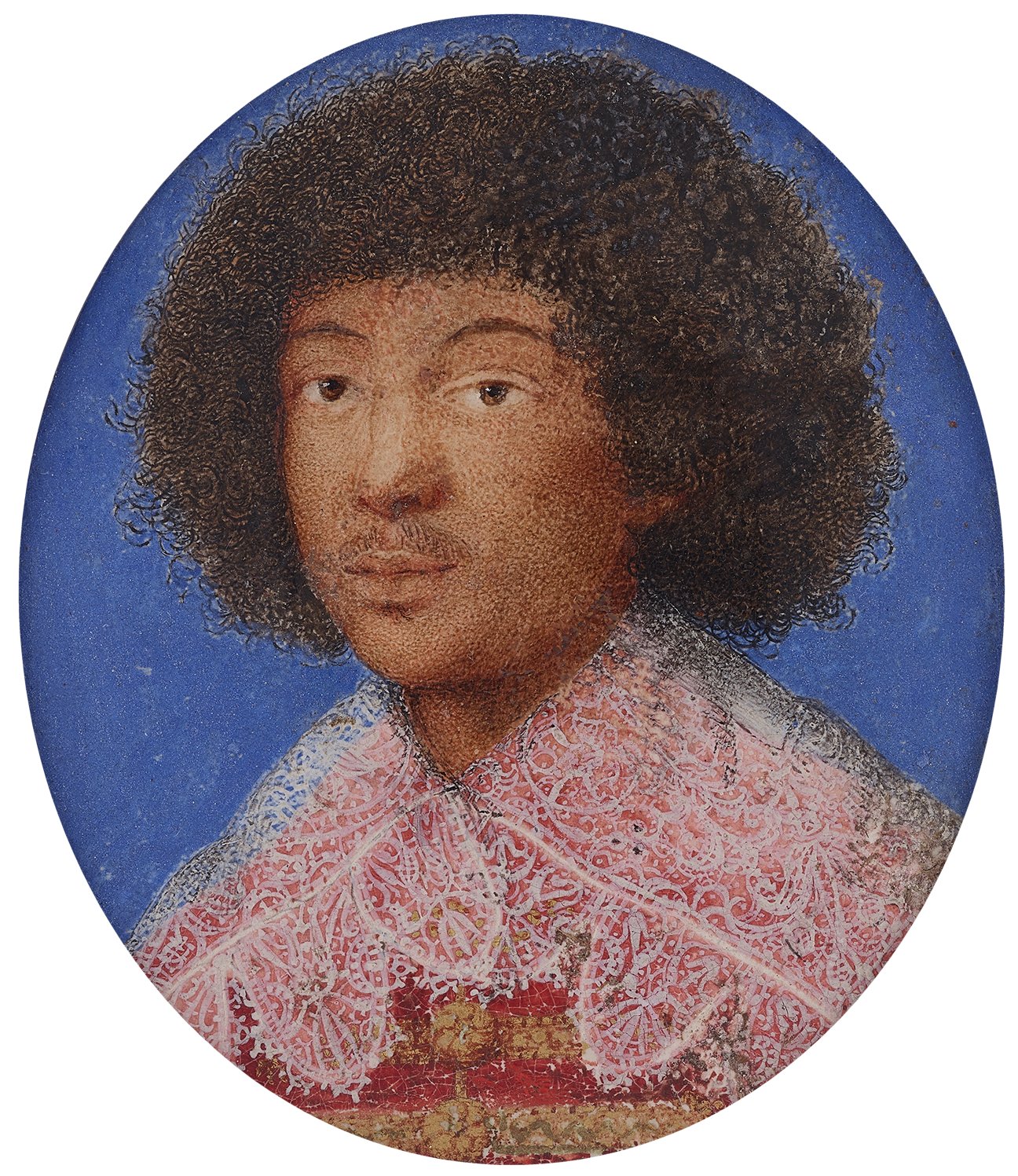
Paints the miniature of Zaga Christ in Turin, signed on the back in Italian and Amharic.467
- 1637
Duke Vittorio Amedeo of Savoy dies; she leaves Turin. Years to 1641 are undocumented per Treccani.1
- 1640
A short stay in Paris is documented, according to Apollo magazine.18
- 12 February 1642
Receipt for a pair of oval miniatures after Raphael and Orazio Gentileschi made in Florence for Grand Duchess Vittoria della Rovere.13
- 1642-1651
Works in Florence for the Medici, principally Ferdinando II, Vittoria and the cardinals Leopoldo and Giovan Carlo.12
- 1648
Sends carte dei semplici to Ferdinando II, according to Fusani.3
- January 1649
Lent Raphael's Madonna of the Chair to copy at home; it is returned damaged.3
- 1651
Settles permanently in Rome and keeps working for the Medici.1
- 28 October 1662
Letter thanking the grand duke for generous compensation and enclosing another dish to add to the twenty others.12
- 1666
Makes her will, leaving nearly all to the Accademia di San Luca.1
- 10 to 15 February 1670
Dies in Rome and is buried in Santi Luca e Martina.1
- 1696
The Academy's centenary volume names her a famous miniaturist and benefactor.3
- 1698
The tomb she asked for is finally built.1
- 27 November 1752
Her Zaga Christ miniature is sold in the Cottin sale at Paris as Le Portrait de Zaga Christ by Jeanne Gaizoni, lot 505.4
- 1964
Exhibition of Italian still life at Naples, Rotterdam and Zurich begins her modern rediscovery, per Christie's.10
- 1991
Gerardo Casale publishes the standard monograph.21
- 19 April 2007
Hedgehog in a Landscape sells at Christie's New York for USD 622,400.1011
- 6 December 2018
Zaga Christ miniature offered at Sotheby's London as an unidentified sitter at GBP 5,000 to 8,000.6
- 28 May to 28 June 2020
The Pitti exhibition curated by Sheila Barker, about 100 works.1920
- 2021
Allen Memorial Art Museum, Oberlin, buys the Zaga Christ miniature (accession 2021.21).4
The market
The record I can source is USD 622,400 for a hedgehog on vellum at Christie's New York in 2007, against an estimate of USD 300,000 to 400,000. An aggregator reports a median of USD 33,600 for 19 priced lots from 2001 to 2024. Estimates vary widely: a Plate of Figs from the Medici series was listed at USD 600,000 to 900,000 by a gallery in April 2023, a flower vase at USD 125,000 to 175,000 and later at USD 60,000 to 80,000, and a Saint Catherine confirmed by Barker went from an estimate of CHF 15,000 to 20,000 to a realised CHF 40,000 in September 2024. I could not separate hammer from premium for any sale because the sources report realised prices without stating the basis.
| Date | Sale | Work | Result | Note |
|---|---|---|---|---|
| 19 April 2007 | Christie's New York, lot 88 | A hedgehog in a landscape, bodycolor on vellum, 23.5 x 38 cm | Hammer not found With premium USD 622,400 price realised (Art.Salon); estimate USD 300,000 to 400,000; premium treatment not stated USD | Lot page on Christie's shows no price; Casale confirmed attribution from a transparency on 20 February 2007. |
| 6 April 2006 | Christie's (per aggregator) | Garzoni (Ascoli Piceno?), listed without title; possibly the Plate of Figs, lot 56 | Hammer not found With premium USD 374,400 (aggregator; basis not stated) USD | I could not confirm that this entry is the lot 56 Plate of Figs on Christie's page. |
| 14 October 2008 | Dorotheum (per aggregator) | Garzoni, no title | Hammer not found With premium EUR 67,400 (aggregator; basis not stated) EUR | Not verified on Dorotheum's site, whose pages blocked my fetch. |
| 24 January 2017 | Christie's, lot 49 | Saint John the Baptist after Raphael and Mary Magdalen after Orazio Gentileschi, pair of ovals | Hammer not found With premium USD 75,000 (aggregator; basis not stated) USD | Christie's lot page confirms the pair and the 1642 receipt but shows no price. |
| 6 December 2018 | Sotheby's London, Pohl-Stroher Collection part I, lot 9 | Portrait of a North African, possibly an Abyssinian (now Zaga Christ), 58 x 48 mm | Hammer result not visible without login With premium result not visible; estimate GBP 5,000 to 8,000 GBP | Later sold through Philip Mould and bought by the Allen Memorial Art Museum in 2021; prices not found. |
| 18 February 2020 | Freeman's Hindman | Flowers in a lapis lazuli vase with a conch shell and a monarch butterfly, bodycolor on vellum | Hammer not found With premium USD 32,500 (aggregator); estimate USD 15,000 to 25,000 USD | Provenance includes Koller Zurich, 18 September 2015, lot 3063. |
| 20 September 2024 | Koller Auctions | Saint Catherine of Alexandria, gouache with gold on vellum, 14.5 x 11 cm | Hammer not found With premium CHF 40,000 (aggregator); estimate CHF 15,000 to 20,000 CHF | Listing says Sheila Barker confirmed on 5 August 2024; Koller's 2024 review illustrates the work. |
| 25 January 2011 | Sotheby's New York, Ryskamp sale, lot 122 | Attributed to Garzoni: two twin-fingered lemons, dal Pozzo Paper Museum sheet no. 620 | Hammer not seen With premium result not visible; estimate USD 3,000 to 5,000 USD | Offered as attributed; previously sold by the trade as Italian artist about 1630. Sale date is from Wikipedia. |
Hammer is the price at which the bidding stopped; with premium adds the fee the house charges the buyer on top. Hammer price and buyer's premium in the glossary.
Where to see the work
| Institution | City | Holdings | Note |
|---|---|---|---|
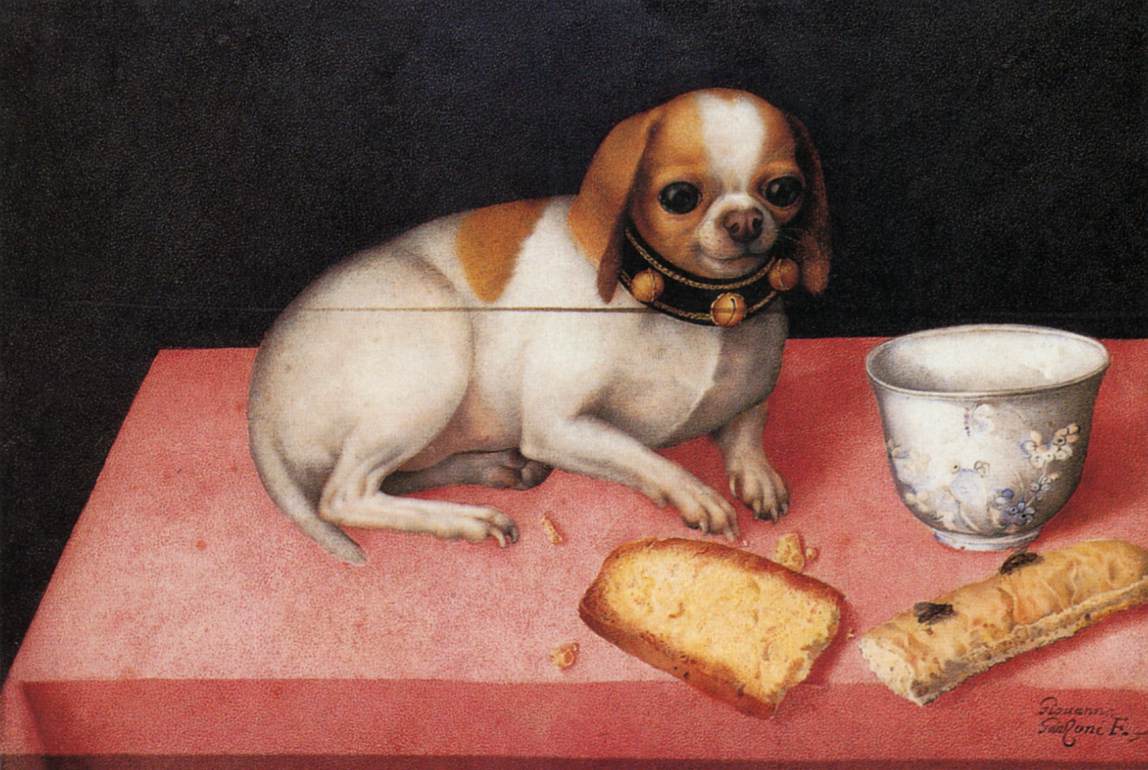
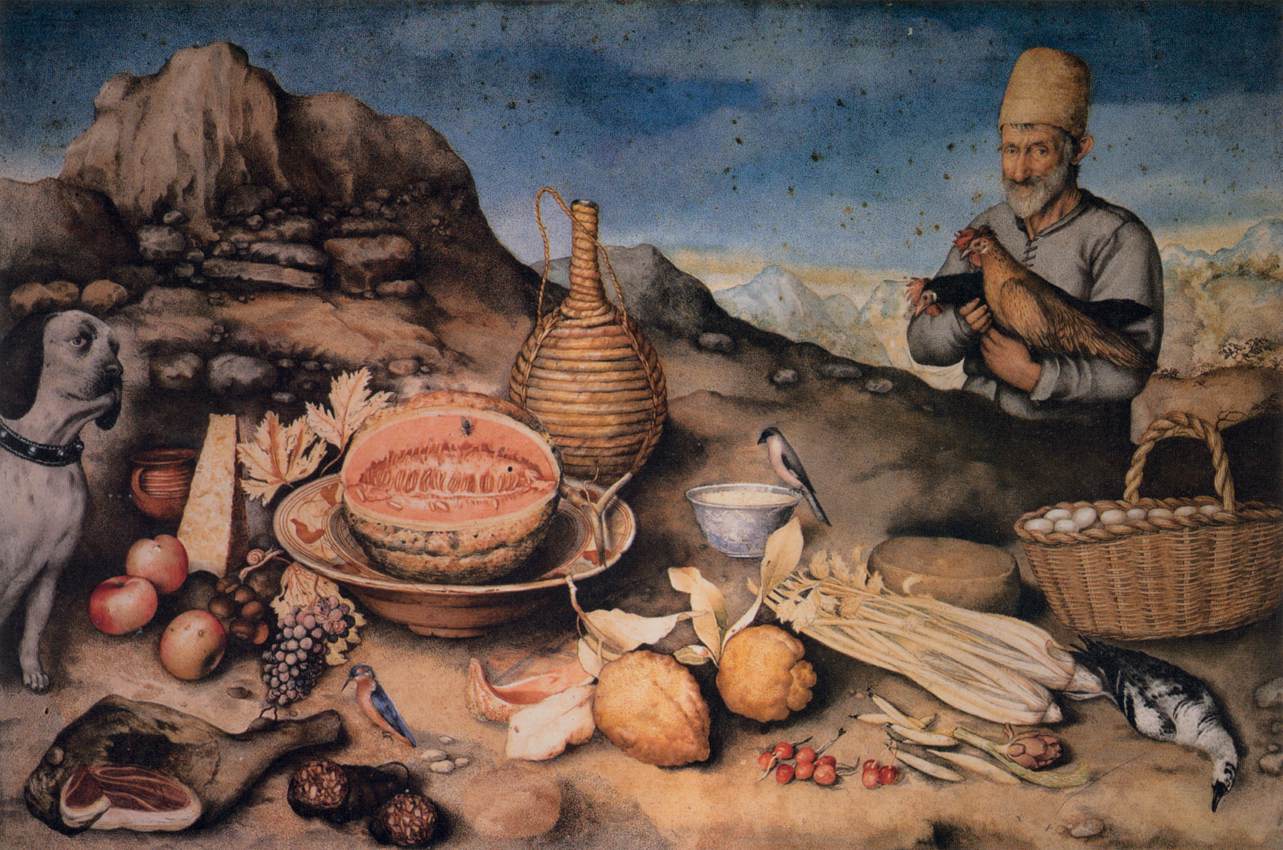
| Gallerie degli Uffizi, Galleria Palatina (Palazzo Pitti) | Florence | The fruit and vegetable dishes of 1650-62, the dog with biscuits and a Chinese cup (inv. 1890 no. 4770), the Old Man of Artimino (no. 4778). | Not all on permanent view; check before travelling. |
| Gallerie degli Uffizi, Gabinetto dei Disegni e delle Stampe | Florence | Carte dei semplici including hyacinth and buttercup sheets, flower vases of the 1640s and the Yixing vase of 1659-60. | Works on paper are shown by appointment or in exhibitions. |
| Accademia Nazionale di San Luca | Rome | Libro de' caratteri cancellereschi corsivi and Libro di miniature e disegni, her bequest. | Albums, not on regular display. |
| Dumbarton Oaks Research Library and Collection | Washington, DC | The album Piante varie with botanical plates and a posthumous portrait drawing. | Digitised through Harvard's library viewer. |
| Palazzo del Quirinale | Rome | Self-Portrait as Apollo, about 1618-20 (dating disputed). | |
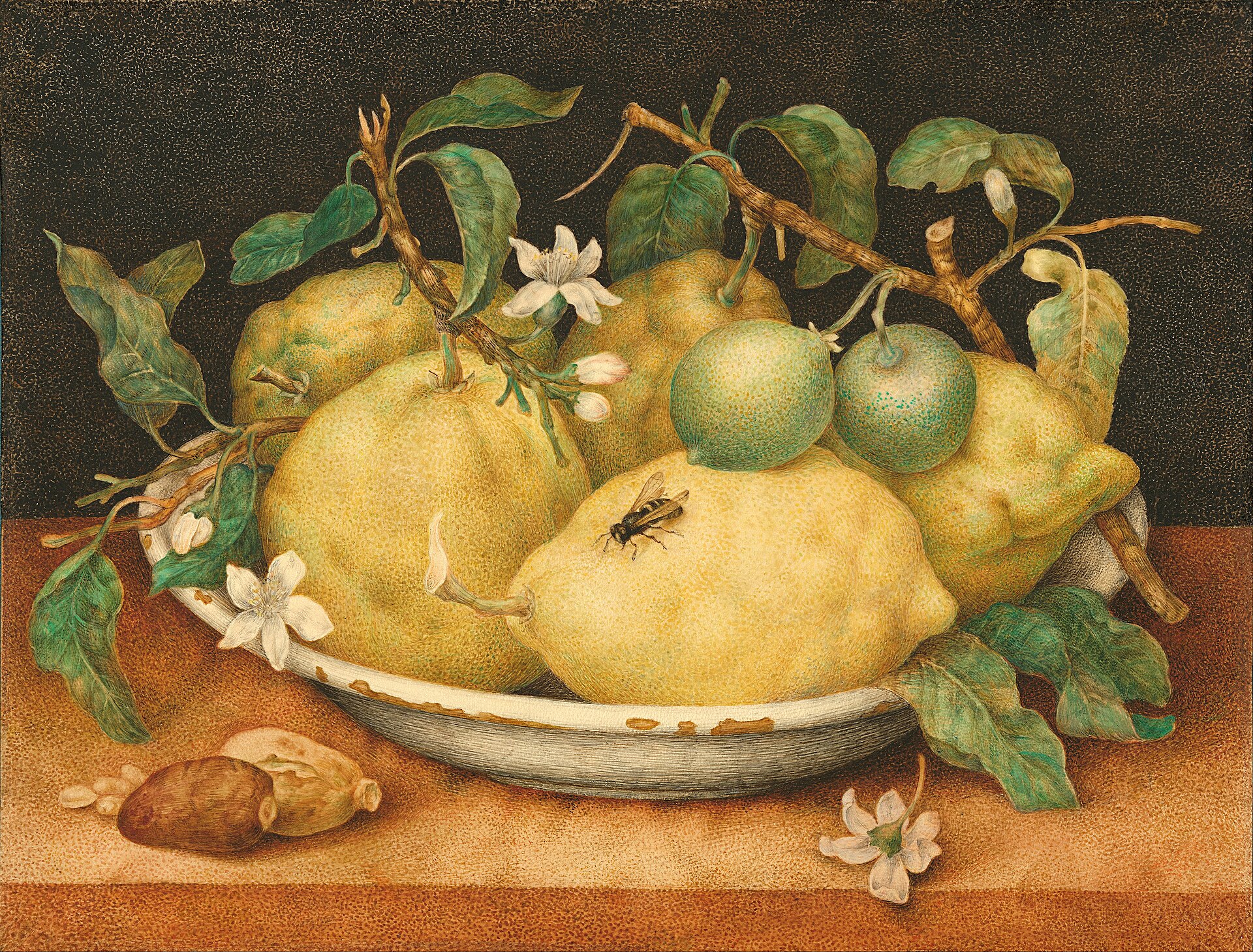
| J. Paul Getty Museum | Los Angeles | Still Life with Bowl of Citrons, late 1640s, tempera on vellum. | Not in the 2020 Pitti show. |
| Allen Memorial Art Museum, Oberlin College | Oberlin, Ohio | Portrait of Zaga Christ, 1635 (2021.21). | Listed as not on view on the museum's object page. |
| Museo della Natura Morta, Poggio a Caiano | Poggio a Caiano | Paintings by Garzoni in a Commons category; a commenter on Art Herstory said it was temporarily closed in 2022. | Closed status not verified. |
Forgeries and misattributions
- No forgery case is documented in the sources I opened; the recorded problems are misattribution, imitation and mislabelling.
- Cleveland's bird and fruit still life was thought to be by Ligozzi. A Dorotheum lot of May 2023 was traditionally given to Octavianus Monfort. A Bonhams lot of 2019 was catalogued as manner of Garzoni and twentieth century, according to the aggregator. The Zaga Christ miniature was sold in 2018 without its sitter's name. By connoisseurship and by documents: a 1752 sale entry names the sitter; Gregori reattributed the Cleveland sheet by comparison; Barker and Casale confirm lots from images. No technical examination is reported in the sources I opened.2461415
- The self-portrait label on the Dumbarton Oaks portrait.
- Commons and Wikipedia call the drawing a self-portrait. Letvin gives it to Pier Leone Ghezzi, after 1698, a posthumous portrait; Fusani attributes it to Ghezzi too. Ghezzi was born in 1674, four years after her death, so the sitter cannot have been drawn from life by him.35
- Medium given as oil on canvas on a Commons file of the dog picture.
- The Commons file data from Web Gallery of Art calls the Palatine dog picture oil on canvas, 39.5 by 27.5 cm; Fusani gives tempera on parchment, 27.5 by 39.5 cm. Compare the museum-style data in Fusani's caption with the Commons page.3
The essay
Chapter 1The number nobody has published
No source I opened gives a total of accepted works by Garzoni.
No source I opened gives a total of accepted works by Garzoni. What exists is a set of partial counts that do not add up to one figure. The Pitti exhibition of 2020 showed roughly one hundred paintings, illuminations on parchment and drawings, plus a large floral altar frontal more than four metres long, according to the Flora Journal's report of the press release. The Medici fruit series in the Palatine Gallery is described as twenty miniatures by the Treccani biography ("at least twenty" dishes of fruit, completed by 1662) and by the National Gallery of Art's Flowering of Florence catalogue, yet Christie's catalogue note for a Plate of Figs quotes her letter of 28 October 1662 in which she encloses "another Tazza" to add to the twenty others, and says only six of the original suite are in private hands.
Casale's monograph, Giovanna Garzoni, Insigne miniatrice, 1600-1670 (Milan and Rome, 1991), is called the standard monograph and complete by the Salem Press research starter in the EBSCO database, a tertiary source. Auction catalogues cite its entries by number: the Pohl-Stroher Zaga Christ portrait is Casale no. A5 and Christie's Plate of Figs is no. A34. I did not see the book and cannot say what the A prefix denotes or how many entries the catalogue has.
The honest position is that the corpus is open. The Colnaghi note on a still life with pumpkins states that Sheila Barker confirmed the attribution from a digital photograph, and Christie's recorded in 2007 that Casale confirmed a hedgehog from a transparency. When the people who rule on a picture can do so from an image, a collector should expect that a later, better look can move a work in or out.
Chapter 2A birth year that rests on one inscription
Treccani's entry (Gerardo Casale, 1999) says she was born almost certainly at Ascoli Piceno in 1600 to Giacomo and Isabetta Gaia, and that the date comes only from a Holy Family in a private...
Treccani's entry (Gerardo Casale, 1999) says she was born almost certainly at Ascoli Piceno in 1600 to Giacomo and Isabetta Gaia, and that the date comes only from a Holy Family in a private collection, signed and dated 1616 and inscribed to say she was sixteen. A document of 1603 in the Ascoli state archive shows the parents living in the city and that her father was Venetian (Treccani names him Giacomo; Fusani calls the father who sued Tinelli Giovanni, a discrepancy no source resolves); her mother, probably born in Ascoli, had Venetian parents. Her maternal grandfather Nicola Gaia and his son Vincenzo were goldsmiths who had come from Ferrara in the 1570s, and her uncle Pietro Gaia painted at Ascoli through the first twenty years of the century.
That is the whole documentary foundation for her childhood. Treccani offers the relatives as her likely first teachers and then points to Venice, where her two earliest known works, the Holy Family and a large canvas of Saint Andrew now in the Gallerie dell'Accademia depositories, show close knowledge of Palma Giovane. The similarity is strong enough, Treccani says, to suggest an apprenticeship with him. That is an inference from style; the Koller 2024 review, a dealer source, says only that little is known of her formation and that it is assumed she trained under her uncle. The Colnaghi sales note goes further and says she trained in the studios of Palma and of Tiberio Tinelli, but it cites nothing.
Her own contemporaries could not place her. Fusani writes in Finestre sull'Arte in 2026 that she was identified in her lifetime as being from Lucca, Genoa or L'Aquila, and even as French or Flemish, and the Colnaghi note says the same of French and Flemish.
Chapter 3Marriage, a lawsuit and a widow's black
Older books say she took a vow of chastity to escape a prophecy that she would die in childbirth, which ended an unconsummated marriage to the Venetian portrait painter Tiberio Tinelli.
Older books say she took a vow of chastity to escape a prophecy that she would die in childbirth, which ended an unconsummated marriage to the Venetian portrait painter Tiberio Tinelli. Sara Matthews-Grieco's review of the Pitti exhibition repeats a version: the marriage was quickly annulled because of her vow and the purported magical practices of Tinelli, after which she travelled with her brother as chaperone. Wikipedia, a tertiary source, dates the marriage to 1622 and its end to about 1624, citing Francesca Bottacin's article in Arte Veneta (1998), which I did not open.
Fusani, writing from recently rediscovered documents, tells a different story. The marriage had lasted less than two years. Her father filed a suit against his son-in-law accusing him of having bewitched his future wife with magic to persuade her to marry him, and the documents speak of the young Tinelli's debts and the risk that his creditors would seize her dowry. Fusani adds that the situation remains murky. Tinelli died in 1639.
Sheila Barker has published a chapter on Garzoni and Venetian witchcraft ("Still Lifes as Natural Enchantments") in Tracy Cooper's open-access volume of 2024; a search result I read describes it as arguing that Venice gave Garzoni exposure to ideas of natural magic. I could not open the chapter (the repository's bot check blocked every route I tried), so I cannot say whether she reads the still lifes as magical, and I make no claim for her. What is established is narrower: the marriage was short and a suit was brought. Fusani describes the posthumous Ghezzi portrait as showing her in austere, almost monastic attire, and separately writes that her status as a widow, with an aura of moral integrity around her vow of chastity, let her move confidently in European court circles.
Chapter 4Calligraphy first, then Naples, Rome and the Lincei
Her earliest known miniature work is a capital G with plants and animals at the head of a manuscript, the Libro de' caratteri cancellereschi corsivi, now in the library of the Accademia di San Luca...
Her earliest known miniature work is a capital G with plants and animals at the head of a manuscript, the Libro de' caratteri cancellereschi corsivi, now in the library of the Accademia di San Luca in Rome. Treccani says she made it in Venice while studying calligraphy under Giacomo Rogni and describes its contents as letters and short apologues in a correct and varied hand. Mary Garrard dates the book to about 1617-22 and says she sent such pages with birds, flowers and insects among the lettering to prospective patrons; a one-line galleon at sea from the book was shown in 2020. The Salem Press summary places her in Rogni's school by a document of February 1630, so the date of the calligraphy is not agreed.
She left Venice for Naples in 1630 with her brother and entered the service of the viceroy, the Duke of Alcala. Treccani says she stopped in Rome on the way and made contact with Cassiano dal Pozzo the younger and with Anna Colonna, wife of Taddeo Barberini; a letter of 15 June 1630 to Dal Pozzo from Naples is cited in the EBSCO summary. No works are known from Naples. When Alcala was recalled after about a year she asked Dal Pozzo to find her a place in Rome, and by the end of 1631 she was there.
Whether she had been in Rome as early as 1616 is disputed. The National Gallery of Art catalogue (Tongiorgi Tomasi) says she went to Rome in 1616 and found herself in the circle of the Accademia dei Lincei, and that the pharmacist Enrico Corvino told her to study the engravings in Mattioli's Commentarii, particularly the Venice edition of 1565. Wikipedia names a chemist Giovanni Vorvino and a commission for a herbal in the same year. The EBSCO summary says scholars have speculated about a Roman visit in 1616 but that she more likely met Dal Pozzo only on the way to Naples. I give the 1616 date as one scholar's account, not as settled.
Chapter 5Turin: a miniaturist to Madama and an Ethiopian claimant
Christine of France, Duchess of Savoy, asked for her after hearing of her fame as a portraitist, and she arrived at Turin in November 1632.
Christine of France, Duchess of Savoy, asked for her after hearing of her fame as a portraitist, and she arrived at Turin in November 1632. Treccani says the Savoy inventories list several of her miniatures, sacred, mythological and portraits, and that the early portraits of Duke Emanuele Filiberto and Carlo Emanuele I at the Palazzo Reale were copied from older paintings. Alexandra Letvin of the Allen Memorial Art Museum gives her title there as "La Miniatrice di Madama Reale". Her first known still life, a ceramic dish of fruit signed on the vine tendril, also dates from Turin, and Treccani says it shows the pull of Flemish still life and of Fede Galizia's Lombard unity of composition. The duke died in 1637 and she left.
The most famous work of the Turin years is a portrait on vellum, 5.7 by 4.8 centimetres, of an Ethiopian traveller. The Allen Memorial Art Museum, Oberlin, which bought it in 2021 (accession 2021.21), calls it the earliest known European portrait miniature to depict a Black sitter and says it shows Zaga Christ (about 1616-1638), a pretender to the Ethiopian throne who came to Turin in the winter of 1634-35. On the back it is signed in Italian and, above, in the Ethiopian language Amharic. Philip Mould's note, with translations by two professors of the language, says the poorly executed letterforms suggest the writer was unfamiliar with Ethiopic script, most likely the artist herself.
The identification of the sitter is documented in an unexpected place. The Allen's provenance note records that in the 1752 Paris sale of the banker Jean Cottin the miniature appears, as lot 505, as "Le Portrait de Zaga Christ" by "Jeanne Gaizoni", and that it was bought for Gilbert Paignon-Dijonval. In 2018 Sotheby's London offered it at the Pohl-Stroher sale as "Portrait of a North African, possibly an Abyssinian", with an estimate of GBP 5,000 to 8,000, signed and dated on the back "Giovanna Garzoni F. / Torino 1635", and said the sitter's identity was unknown. Its previous sale was Christie's Geneva, 14 November 1989, lot 209. Two years later it was exhibited by Philip Mould at the Pitti as Zaga Christ. I did not find the Sotheby's result, the price Mould asked or the price Oberlin paid.
Zaga Christ's own status is contested. Letvin writes that historians have since accepted he was an impostor, and she quotes his gravestone verse asking whether he was king or not. Letvin quotes the 1634 description of him by Maiolino Bisaccioni as of a colour between black and olive, with sparse facial hair and very black curly hair, and says the miniature records his likeness with unusual care.
Chapter 6The missing years, and a friend
Treccani says nothing is documented from 1637 to 1641 and that, on indications in Casale's work, she probably went to France and perhaps England.
Treccani says nothing is documented from 1637 to 1641 and that, on indications in Casale's work, she probably went to France and perhaps England. The sources disagree on how much is known. Apollo magazine's Christopher Baker says a brief period in Paris is documented in 1640. Mary Garrard says she was in Paris in 1640-41 longing to return to Italy and that she copied a drawing in the collection of Inigo Jones, which Garrard takes as a sign she may have served the Stuart court. Matthews-Grieco says she went to England with Artemisia Gentileschi and on her return spent time at the court of Louis XIII, which she gives as the origin of the miniature of Cardinal Richelieu. Wikipedia places her in Paris from 1640 to 1642. The Richelieu miniature is catalogued by Treccani among the pictures bought or commissioned by the Medici and now in the Uffizi, not as a French commission.
The friendship with Gentileschi is an argument from parallels, and Garrard says so plainly: the two were seven years apart in age, shared patrons (Medici, the Spanish viceroy, the Savoy duchess, Charles I and Henrietta Maria) and moved in matching steps. Garrard writes that the pattern suggests a close personal relationship, citing herself in 1989, Bissell in 1999 and Barker in 2020, and then asks whether it was collaboration, friendship or rivalry and answers that without further evidence we cannot know. Garrard also proposes that the early Self-Portrait as Apollo was modelled on Gentileschi's lute player. That picture is at the Quirinale in Rome; Barker and Garrard date it to about 1618-20, while Treccani puts an Apollo at the Quirinale among works painted in Turin, so the date and even the identification as a self-portrait are not uniform in the literature.
Chapter 7Florence: who paid, for what, and how the series was kept
She worked in Florence from 1642 to 1651 and for the Medici for the rest of her life, from Rome.
She worked in Florence from 1642 to 1651 and for the Medici for the rest of her life, from Rome. Treccani names the patrons as Grand Duke Ferdinando II, his wife Vittoria della Rovere, and Don Lorenzo and the cardinals Leopoldo and Giovan Carlo. The Tongiorgi Tomasi essay for the National Gallery of Art says the patron above all was Giovan Carlo, whose favourite flower was the anemone, and that most of the works the grand duke commissioned were intended for Vittoria. The best-documented payment is a receipt dated 12 February 1642, which Christie's cites from Casale for a pair of small ovals after Raphael and Orazio Gentileschi made in Florence for Vittoria. It shows she made reproductive miniatures as well as still lifes, and Christie's argues that the Gentileschi copy proves the Florentine provenance of the original now at Lucca. The date sits awkwardly with the EBSCO summary, which has her taking up residence in Florence in the summer of 1642, and the sources do not reconcile it. In January 1649 she was lent Raphael's Madonna of the Chair to copy at home, and it came back damaged, as Fusani notes.
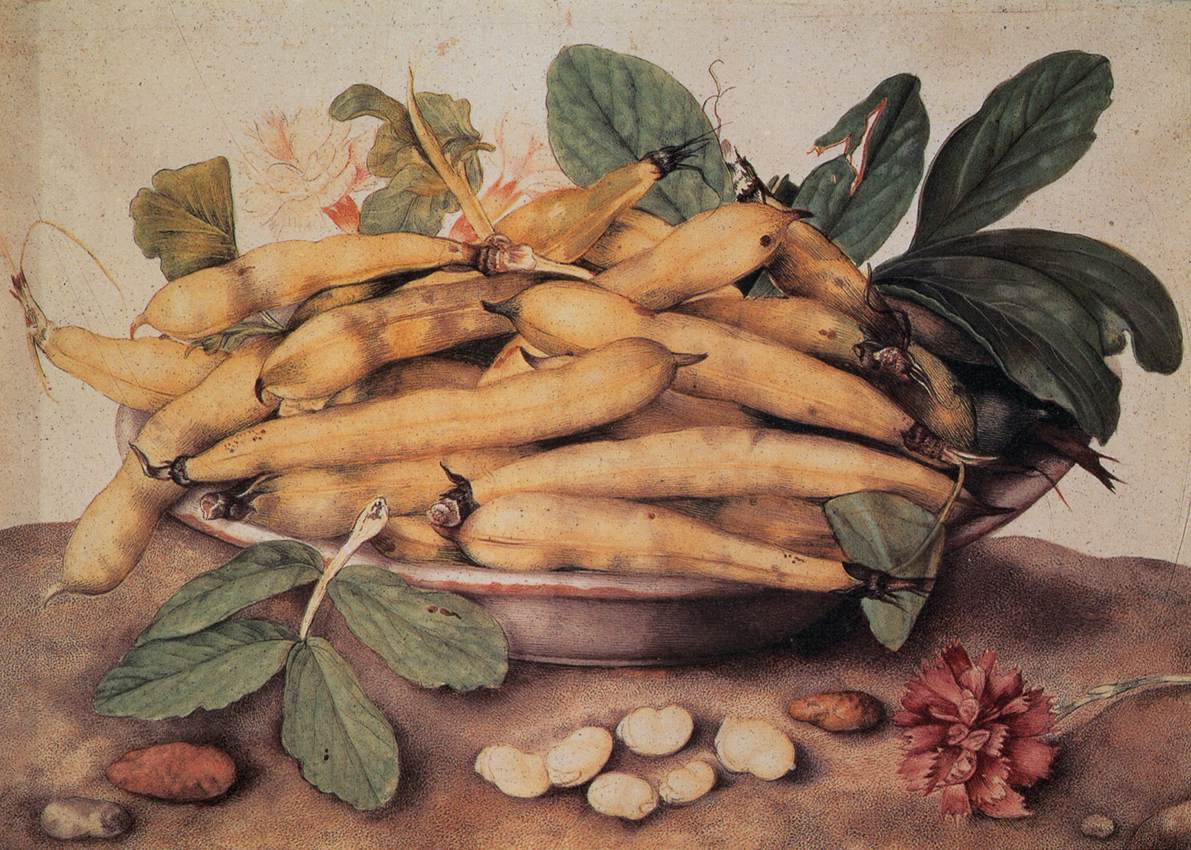
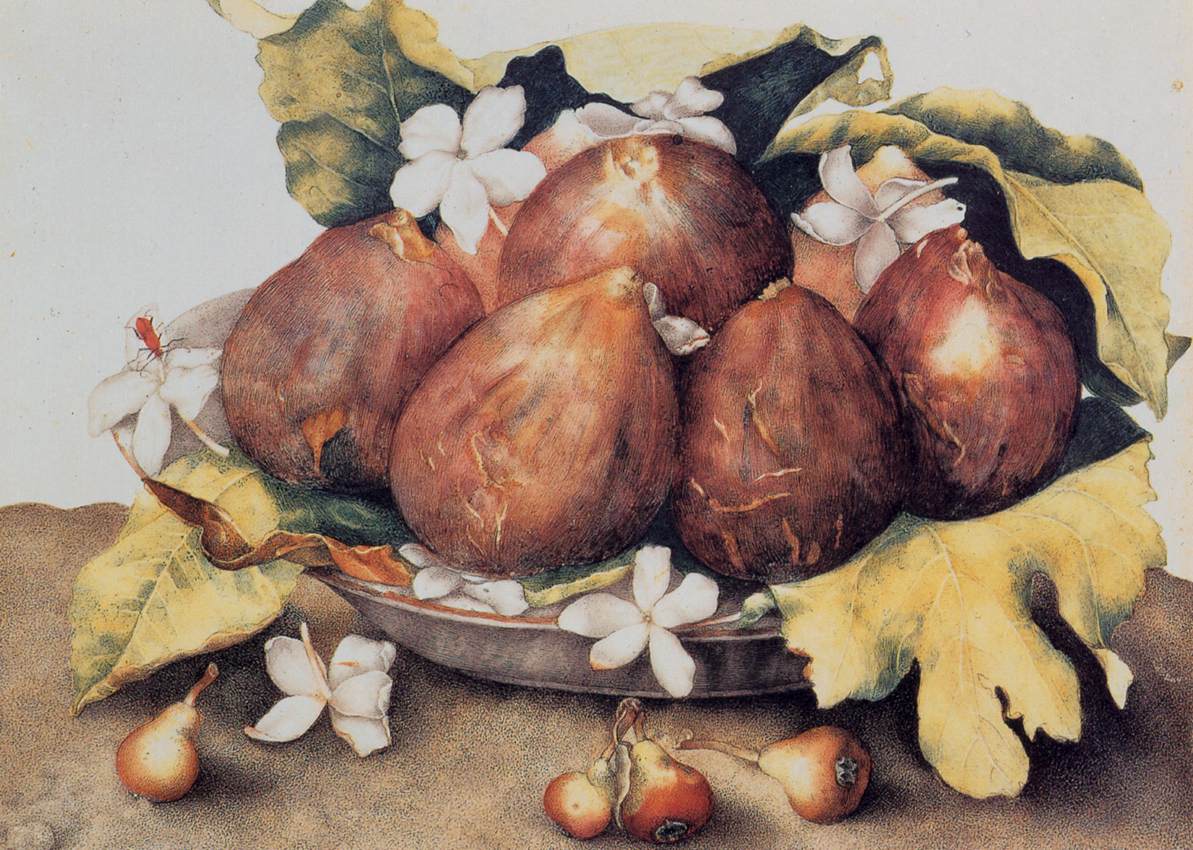
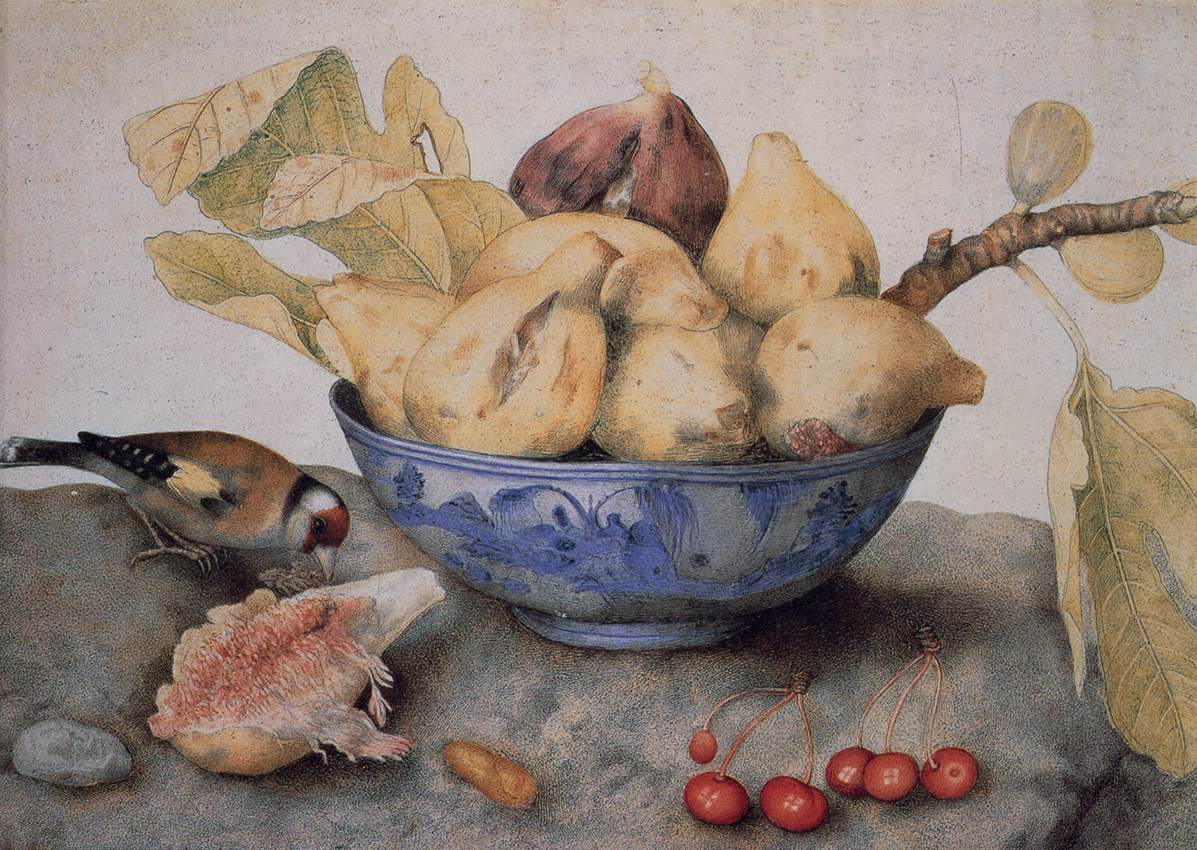
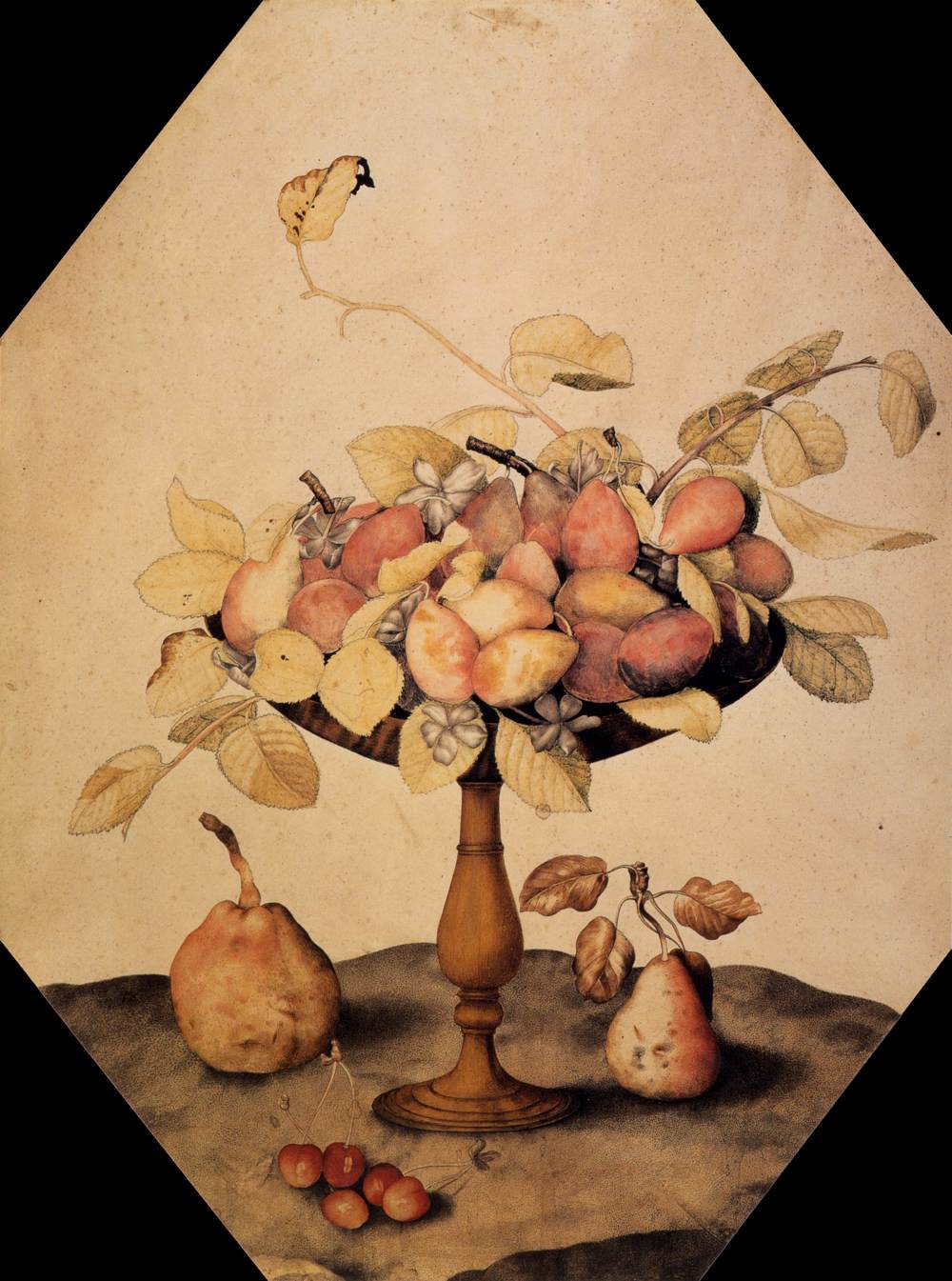
The core of the Florentine work is the series of about twenty fruit and vegetable dishes now in the Palatine Gallery at Pitti, made between about 1650 and 1662 and later hung at Poggio Imperiale. Fusani describes the 1768 inventory of that villa, where Vittoria's porcelain cabinet carried at least thirty-eight of her miniatures, set among Chinese porcelain, small bronzes and ivories. The five dishes Fusani lists from the Palatine Gallery are all 23.5 by 38.5 centimetres in tempera on parchment. Christie's says the series was recorded in the Poggio Imperiale inventory of 1692, and that she wrote on 28 October 1662 to thank the grand duke for his generous compensation for her fruit miniatures.
The money is a gap. I found no figure for any payment to her, in scudi or any other unit, and no comparison with a Medici salary or a Florentine craftsman's wage. What the sources do give is indirect: the Salem Press summary reasons from her will that she was wealthy, Colnaghi and Christie's call her wealthy and renowned, and a Bassenge sale note says contemporary reports have it that she could demand any price. The first two are modern inferences and the third reports reports, so none is a fact about what she was paid.
Chapter 8How a Garzoni is made, and how it fails
The support is almost always vellum; the title of her bound album of miniatures uses the term carta pecora (sheepskin parchment).
The support is almost always vellum; the title of her bound album of miniatures uses the term carta pecora (sheepskin parchment). The National Gallery of Art essay states that her still lifes were almost always on vellum, never on canvas, and that she became known as the illustrious miniaturist. Exceptions are early: the Saint Andrew and the Holy Family of 1616 are on canvas. She also made one known work in textile, a more than four-metre altar frontal in taffeta with applied cut silk, commissioned as a gift for the church of Santa Maria Novella, and the Matthews-Grieco review says records show she often worked with such materials.
The method, per the National Gallery essay, began with a rapid pencil sketch finished in gouache, perhaps mixed with gum arabic, applied in firm strokes or light small touches and often with tiny closely spaced dots of different colours. Christie's condition and medium line for the pair of ovals reads "traces of black chalk, bodycolor and gum Arabic on vellum". Treccani says the stippling is what lets her reach extreme luminosity and a vibration that makes surfaces almost pulse. Her own words, as the catalogue gives them, were that the slowness of the process made them "works of great labor".
The tells a viewer can check: she signs Giovanna Garzoni F. at lower right on the Palatine dog picture; the Uffizi's botanical sheets float the plant in empty space without shadow while the small insects and pods cast shadows on the parchment, as Fusani describes; and the surviving damage is characteristic. The National Gallery essay says the greens of her leaves have faded from exposure to light, "an all too frequent occurrence" in her gouaches, and the Sotheby's condition report on the Zaga Christ mentions crazing and flaking in the red doublet and loss to the blue ground.
Replication matters for attribution and for the market. Treccani, citing Casale 1991, says it was her habit to copy and replicate her own parchments, which she did when she could not paint flowers from life, and that other parchments matching the Ferdinando series in size and subject have surfaced in private hands or the trade. A convincing second version is therefore not proof of a follower.
Chapter 9Plants that ask to be read, and what the evidence allows
What can be documented is that she moved among people who treated nature as a thing to be observed and recorded.
What can be documented is that she moved among people who treated nature as a thing to be observed and recorded. Treccani, the National Gallery essay and Garrard (who says "probably") place her in contact with the Accademia dei Lincei in Rome and its circle around Dal Pozzo, and the EBSCO summary says the Lincei employed her, though I found no document of membership; the NGA essay adds that an album at Dumbarton Oaks, Piante varie, shows early plates modelled stiffly on Mattioli's engravings and later plates drawn from life. The Salem Press summary says fifty plates in that album were attributed to her only in 1984; Treccani gives the same attribution to Mongan 1984 with a "perhaps". In Florence Fusani reads her carte dei semplici of 1648, sent to Ferdinando II, as herbarium sheets in form (frontal specimen, roots, no shadow) that depart from scientific norms by showing withered leaves, fungus, torn edges and shadow-casting lizards, pods and cherries of impossible scale.
Beyond that the readings are later readers' arguments and graded as such. Fusani writes that readings based on religion, literature and a coded hidden system have been proposed for the juxtapositions, as have natural philosophy and pure whim, and concludes that the riddle is likely to stay unsolved; I found no document stating her intention. Matthews-Grieco, reviewing the 2020 show, proposes that the Yixing vase with flowers, shells and butterflies of 1659-60 evokes the four elements (shell for water, ceramic for fire, flowers for earth, butterflies for air) and states a global reach of the Medici collections: she presents the four-element reading as the show's interpretation, which makes it argued by the reviewer and not documented. Mary Garrard argues that the fruit has bodily associations and that the objects behave like people, and says the play was probably for the artist's own amusement or each other's, not necessarily the patron's. Fusani cites critics who read the fruit as alluding to reproduction and the mystery of birth, without erotic or playful intent. These are modern interpretations with named authors, not a recovered programme.
One documented function is not hidden at all. The Palatine fruit dishes were set among porcelain and natural curiosities in Vittoria della Rovere's cabinet at Poggio Imperiale, which the 2020 show reconstructed from an unpublished inventory. The pictures were part of a display of the grand ducal world reaching to China and the Americas; the Apollo magazine essay makes the same point about shells from the Pacific and flowers from the Americas grown at great expense in Europe.
Chapter 10Rome, the will and what happened to the estate
She settled in Rome in 1651 and kept working for the Medici.
She settled in Rome in 1651 and kept working for the Medici. Treccani says she took part in meetings of the Accademia di San Luca from 1654, though no document of election as an academician has been found, and that the academicians visited her when she was ill at home with sugar loaves and sweets. Fusani, in 2026, says there is no record of her actively participating in meetings and cites the academy's charter of 1617, which allowed women to be admitted only to honour them, not to take part in the congregations. Matthews-Grieco and Garrard call her an honorary member. The sources are not reconciled.
In her will of 1666 she left almost everything to the Accademia di San Luca, according to Treccani, and the academy built her tomb in Santi Luca e Martina, though only in 1698. The Accademia still holds two albums of hers, the Libro de' caratteri and the Libro di miniature e disegni. The NGA essay says the latter consists of twenty sheets bearing twenty-two miniature paintings and seven pen drawings, that three portraits had been removed at some earlier time, and that seven of its drawings copy a Durer sheet that is now at the Clark Art Institute. Whether she copied it in England (Matthews-Grieco says it was presumably in Inigo Jones's collection) or owned it (the NGA's suggestion) is not settled. Fusani says her house was built at her request beside the church and went to the Academy with works of art, and that the monument by Mattia de Rossi carried a portrait by Carlo Maratti which was lost in a theft. The Academy's centenary volume of 1696 called her a famous miniaturist and benefactor.
Chapter 11Forgotten, then found again
Early notices are numerous: Treccani's bibliography lists Ridolfi in 1648, Bocchi and Cinelli in 1677, Baldinucci in 1728 and Pascoli in 1736.
Early notices are numerous: Treccani's bibliography lists Ridolfi in 1648, Bocchi and Cinelli in 1677, Baldinucci in 1728 and Pascoli in 1736. For the modern recovery Christie's catalogue note dates the rediscovery to the 1964 exhibition of Italian still life in Naples, Rotterdam and Zurich, and Apollo magazine quotes Harold Acton in 1973 saying paintings of botanical subjects were overlooked among the spectacular masterpieces of the Florentine galleries. The key modern books are Casale (1991), the 2000 Paris catalogue by Elena Fumagalli and Silvia Meloni Trkulja, and the National Gallery of Art's Flowering of Florence (2002). In 2020 Barker's show at the Pitti, with a catalogue published by Sillabe, was extended after the Covid closure and drew crowds even with distancing, according to Matthews-Grieco.
Her reception is also a story of how she was filed. A bird and fruit still life at the Cleveland Museum of Art was once thought to be by Jacopo Ligozzi and has since been correctly attributed to her, the NGA catalogue reports, citing a catalogue entry by Mina Gregori of 1989. Wikipedia says recent writing sees proto-feminist sentiments in her pictures; that is a modern reading and not a documented stance.
Chapter 12What the market has paid
The record I can source is USD 622,400 for A Hedgehog in a Landscape (bodycolor on vellum, 23.5 by 38 cm) at Christie's New York on 19 April 2007, lot 88, estimated USD 300,000 to 400,000.
The record I can source is USD 622,400 for A Hedgehog in a Landscape (bodycolor on vellum, 23.5 by 38 cm) at Christie's New York on 19 April 2007, lot 88, estimated USD 300,000 to 400,000. Christie's own page shows the lot and the provenance (Silvano Lodi, then Simon Dickinson and Trinity Fine Arts, London) but no price; the figure and the estimate come from Art.Salon, which calls it the most expensive Garzoni it has seen. It is a realised price and I did not see the hammer. Casale confirmed the attribution from a transparency on 20 February 2007 and dated it to her Florentine period, about 1643-1651.
An aggregator profile (Appraisily, tertiary) lists 27 lots from 2001 to 2024 with 19 priced, a median of USD 33,600 and a range from USD 2,880 to 622,400. Beneath the top result it lists USD 374,400 at Christie's on 6 April 2006 for an untitled Garzoni; Christie's lot 56, a Plate of Figs from the Lodi collection, carries the same attribution wording but I could not confirm the two are the same lot; EUR 67,400 at Dorotheum on 14 October 2008; USD 75,000 at Christie's on 24 January 2017 for the pair of ovals after Raphael and Gentileschi; USD 32,500 at Freeman's Hindman on 18 February 2020 for flowers in a lapis lazuli vase; and CHF 40,000 at Koller on 20 September 2024 for a Saint Catherine of Alexandria that Invaluable shows at an estimate of CHF 15,000 to 20,000 with a note that Sheila Barker confirmed it on 5 August 2024. The basis of each aggregator figure is not stated, so I record them as realised prices and do not separate premium.
Two sales cohorts matter for a bidder. The Plate of Figs reappeared on Invaluable in an Arader Galleries listing of 22 April 2023 at USD 600,000 to 900,000; a flower vase listed by the same seller at USD 125,000 to 175,000 in April 2023 appears to be listed again with the same description at USD 60,000 to 80,000 on 3 October 2026. I could not see whether either sold. The Zaga Christ miniature was estimated at GBP 5,000 to 8,000 as an unnamed sitter in 2018; I did not find its result. Both cases show how far an estimate depends on how a lot is titled and attributed at the time of sale.
Chapter 13Who decides attribution now
There is no authentication board or committee.
There is no authentication board or committee. In practice the names that recur in sale catalogues are Sheila Barker, a curator and scholar at the Medici Archive Project and the University of Pennsylvania, who curated the 2020 exhibition and whom Colnaghi and Koller thank for confirmations, and Gerardo Casale, whose 1991 monograph is the base text and who confirmed the Christie's hedgehog in 2007. Mina Gregori issued expertises for Capitolium lots in December 2020 according to the listings; John Spike wrote the Christie's note on the Plate of Figs. Lots offered as "circle of", "follower of", "manner of" and "in the style of" are common in the listings.
Disagreements are documented. The Invaluable text for a Dorotheum lot of 3 May 2023, a still life of peaches, plums, cherries and roses in a metal bowl on vellum, says it had traditionally been given to Octavianus Monfort, active in Piedmont, before the house offered it as attributed to Garzoni at EUR 25,000 to 35,000. Treccani's bibliography also lists a 1985 monograph by Chiapatti and Rosci on Monfort, a Turin painter working in the same field. I did not open it and record only that the line between the two names is a live one.
What is documented
Technique
The surviving work
- What is accepted
- No published total of accepted works exists in the sources I opened. Partial counts: about 100 works in the 2020 Pitti exhibition (Flora Journal, reporting the Uffizi); about twenty fruit dishes in the Palatine Gallery (Treccani, National Gallery of Art), but Christie's cites her own letter of 1662 enclosing a further dish and says six of the suite are in private hands. As of 17 November 2026.
- What is contested
- Zaga Christ miniature sold in 2018 as an unidentified sitter; Cleveland bird and fruit still life thought to be Ligozzi until a Gregori catalogue entry reattributed it; a Dorotheum lot of May 2023 traditionally given to Octavianus Monfort; a self-portrait label on a posthumous portrait drawing by Ghezzi on Commons and Wikipedia; and the dating and identification of the Quirinale Apollo.
- Who rules on attribution
- No board or committee. Working authority rests with Sheila Barker (Medici Archive Project and the University of Pennsylvania) and with Gerardo Casale, whose 1991 monograph is the base text; their confirmations, often from photographs, appear in sale catalogues of Colnaghi, Christie's and Koller.
Catalogue raisonne
- Gerardo Casale, Giovanna Garzoni, Insigne miniatrice, 1600-1670 (Milan and Rome: Jandi Sapi, 1991). Standard monograph with chronology, described as complete by a tertiary source; entries cited as A5, A34 and similar. I did not see the book; what the prefix means and the total of entries are unknown to me.61221
- Elena Fumagalli and Silvia Meloni Trkulja, Giovanna Garzoni: Still Lifes, Geilleben, Natures Mortes (Paris: Bibliotheque de l'Image, 2000). A catalogue of her works, praised for reproductions by the same tertiary source; not a full catalogue raisonne according to it.21
- Sheila Barker (ed.), The Immensity of the Universe in the Art of Giovanna Garzoni (Livorno: Sillabe, 2020), catalogue of the Pitti exhibition. Essays by Garrard, ffolliott, Fumagalli, Tongiorgi Tomasi and others. Not opened; contributors named by Matthews-Grieco.8
- Lucia Tongiorgi Tomasi and Gretchen Hirschauer, The Flowering of Florence: Botanical Art for the Medici (Washington: National Gallery of Art, 2002). Essay on Ferdinando II and Garzoni with catalogue entries 41 to 56; opened in the NGA excerpt.2
Questions about Giovanna Garzoni
Who was Giovanna Garzoni?
Painter; Miniaturist; Botanical illustrator; Calligrapher; Portraitist. 1600-1670.
When did Giovanna Garzoni live?
Born 1600 (year inferred from her own inscription on a Holy Family of 1616 saying she was sixteen; day and month unknown), Ascoli Piceno, Marche (almost certainly, per Treccani); died Between 10 and 15 February 1670, Rome.
How are fakes and misattributions of Giovanna Garzoni detected?
No forgery case is documented in the sources I opened; the recorded problems are misattribution, imitation and mislabelling. Cleveland's bird and fruit still life was thought to be by Ligozzi. A Dorotheum lot of May 2023 was traditionally given to Octavianus Monfort.
Where can you see work by Giovanna Garzoni?
Gallerie degli Uffizi, Galleria Palatina (Palazzo Pitti) (Florence); Gallerie degli Uffizi, Gabinetto dei Disegni e delle Stampe (Florence); Accademia Nazionale di San Luca (Rome); Dumbarton Oaks Research Library and Collection (Washington, DC); Palazzo del Quirinale (Rome); J. Paul Getty Museum (Los Angeles).
What does the market for Giovanna Garzoni look like?
The record I can source is USD 622,400 for a hedgehog on vellum at Christie's New York in 2007, against an estimate of USD 300,000 to 400,000. An aggregator reports a median of USD 33,600 for 19 priced lots from 2001 to 2024.
What is still unresolved about Giovanna Garzoni?
How many works are accepted? No total is published; Casale's A-prefixed entries and Barker's forthcoming monograph (mentioned in a search result I could not open) may settle it.
Open questions
- How many works are accepted? No total is published; Casale's A-prefixed entries and Barker's forthcoming monograph (mentioned in a search result I could not open) may settle it.
- What did the Medici and the Savoy pay her? No price, salary or wage comparison has turned up for any commission, only the receipt of 12 February 1642 and the 1662 letter thanking the grand duke for generous compensation.
- Was the marriage to Tinelli ever consummated or annulled, and what does Barker's chapter on Venetian witchcraft conclude? Fusani's documents show a lawsuit by her father; the full archival record was not opened here.
- Who first recognised the 2018 Sotheby's North African sitter as Zaga Christ, given that the 1752 sale entry named him, and what did the sale and the 2021 purchase cost?
- Did she travel to England, and when did she copy the Durer sheet now at the Clark? Matthews-Grieco and Garrard say England; Treccani says probably France and perhaps England.
- Was she ever elected to the Accademia di San Luca? Treccani reports attendance from 1654 without a document of election; Fusani says there is no record of participation.
- Is the Quirinale Apollo a self-portrait of about 1618-20 (Barker, Garrard) or a work of her Turin years (Treccani)?
- Where are the other Palatine fruit dishes beyond the six Christie's says are in private hands, and where is the line between Garzoni and Octavianus Monfort?
Sources
- 1Gerardo Casale, 'Garzoni, Giovanna', Dizionario Biografico degli Italiani, vol. 52 (1999), Treccani. Opened in full. treccani.it/enciclopedia/...
- 2Lucia Tongiorgi Tomasi and Gretchen A. Hirschauer, The Flowering of Florence: Botanical Art for the Medici (National Gallery of Art, 2002), essay 'Ferdinando II and Giovanna Garzoni' and notes 108-117, excerpt PDF. Read. nga.gov/content/...
- 3Andrea Fusani, 'Giovanna Garzoni's Cabinet of Curiosities: Fruit, Porcelain, and Miniatures', Finestre sull'Arte, 31 July 2026 (English text machine-translated by the site; read in full). finestresullarte.info/en/...
- 4Allen Memorial Art Museum, Oberlin College, object record, Portrait of Zaga Christ (Sagga Krestos), accession 2021.21, with provenance notes. allenartcollection.oberlin.edu/objects/...
- 5Alexandra Letvin, 'Giovanna Garzoni's Portrait of Zaga Christ', Art Herstory, 17 August 2021. artherstory.net/giovanna-garzonis-portrait-of-zaga-christ...
- 6Sotheby's London, The Pohl-Stroher Collection of Portrait Miniatures Part I, 6 December 2018, lot 9, Giovanna Garzoni, Portrait of a North African, possibly an Abyssinian. sothebys.com/en/...
- 7Philip Mould and Company, 'Zaga Christ Portrait Returns Home', 2020 news note. philipmould.com/news/...
- 8Sara Matthews-Grieco, review of 'La grandezza del universo nell'arte di Giovanna Garzoni', Art Herstory, 10 July 2020. artherstory.net/giovanna-garzoni-uffizi-exhibition-review...
- 9Mary D. Garrard, 'Two of a Kind: Giovanna Garzoni and Artemisia Gentileschi', Art Herstory, 20 April 2020. artherstory.net/two-of-a-kind-garzoni-and-gentileschi
- 10Christie's New York, Important Old Master Paintings, 19 April 2007, lot 88, A hedgehog in a landscape (lot page, no price shown). christies.com/en/...
- 11Art.Salon, auction record for the Christie's lot 88 hedgehog, estimate USD 300,000-400,000, price realised USD 622,400 ( price database; replace with Christie's result page). art.salon/artwork/...
- 12Christie's, lot 56, Giovanna Garzoni, A plate of figs, lot essay by John Spike (lot page; sale date and price not shown). christies.com/en/...
- 13Christie's, lot 49, Saint John the Baptist in the Wilderness after Raphael and Mary Magdalen in the Desert after Orazio Gentileschi (lot page; price not shown). christies.com/en/...
- 14Appraisily, Giovanna Garzoni auction profile ( aggregator, 17 November 2026 snapshot; basis of prices not stated; replace with each house's result). appraisily.com/api/...
- 15Invaluable, Giovanna Garzoni sold-at-auction listing page (; estimates and lot descriptions, results not shown). invaluable.com/artist/...
- 16Colnaghi, sales note on Giovanna Garzoni, Still Life with Pumpkins (dealer text, undated PDF). colnaghi.com/storage/...
- 17Sotheby's New York, Collection of Charles Ryskamp sale, 25 January 2011, lot 122, attributed to Giovanna Garzoni, lemons from the dal Pozzo Paper Museum. sothebys.com/en/...
- 18Christopher Baker, 'The sophisticated still lifes of Giovanna Garzoni', Apollo, 29 May 2020. apollo-magazine.com/still-lifes-giovanna-garzoni-pitti-pa...
- 19The Flora Journal, 'The natural universe of Giovanna Garzoni brings Palazzo Pitti back to life', 28 May 2020. theflorajournal.international/2020/...
- 20Finestre sull'Arte, announcement of the Garzoni exhibition at Palazzo Pitti, 14 January 2020. finestresullarte.info/en/...
- 21EBSCO Research Starters, 'Giovanna Garzoni' (Renzo Baldasso, 2024; summary of Salem Press text; primary monographs). ebsco.com/research-starters/...
- 22Wikipedia, 'Giovanna Garzoni' (; used only for claims it attributes to Bottacin 1998 and for the Commons image list). en.wikipedia.org/wiki/...
- 23Koller Auktionen, Koller Review 2024, p. 27, on the Saint Catherine of Alexandria. kollerauktionen.auctioneersvault.com/catalogues/...
- 24Wikimedia Commons file pages and licence data for the plates and portrait (Category:Giovanna Garzoni). commons.wikimedia.org/wiki/...
Last verified