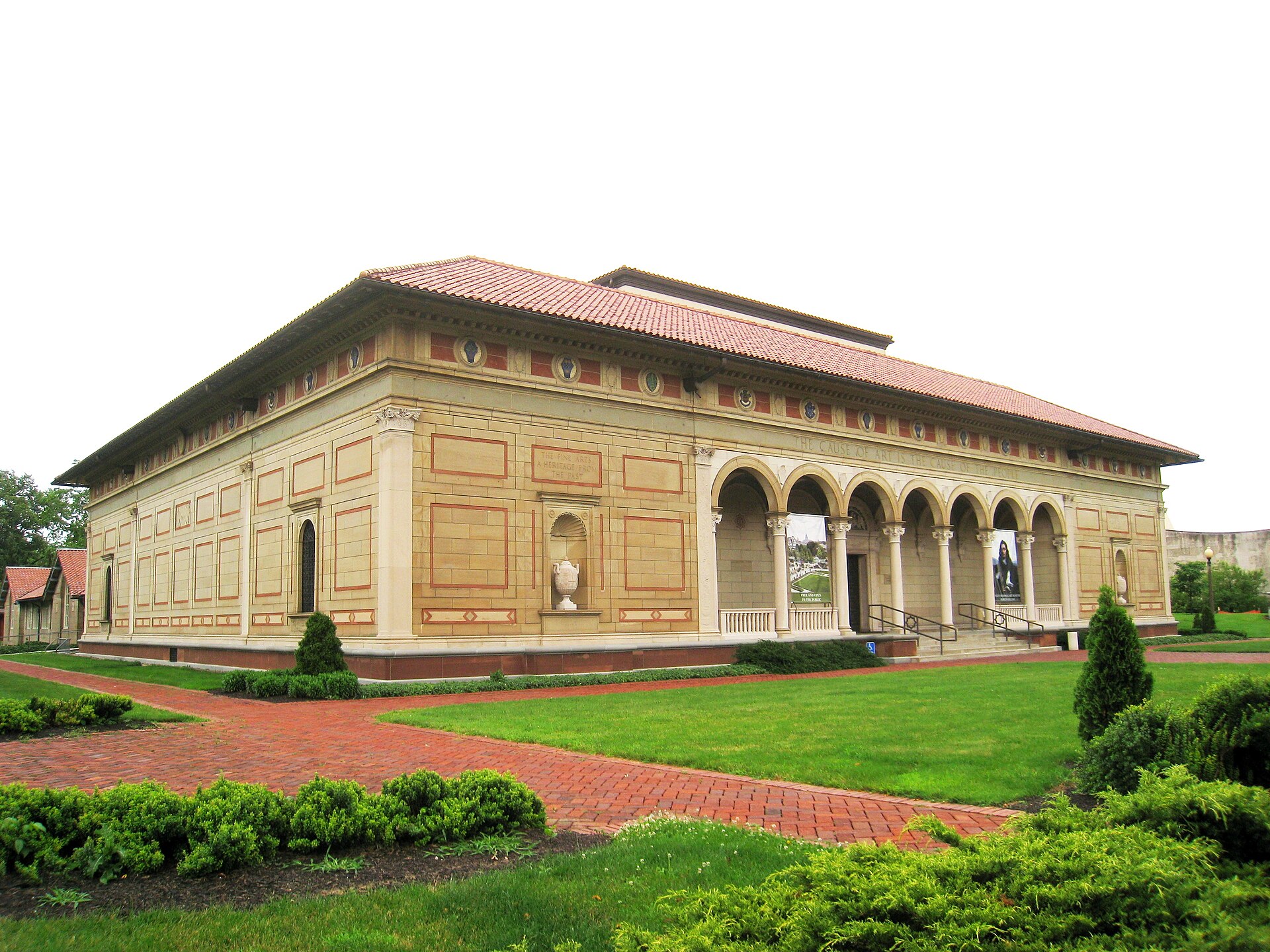
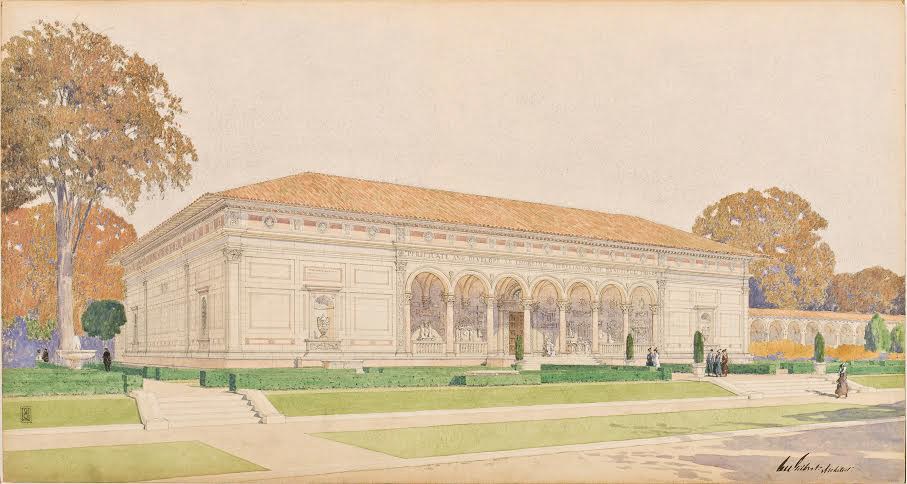
The Cass Gilbert building of 1917, seen from the southeast, with its Italian Renaissance facade, terracotta roof and arcaded loggia
Public domainAllen Memorial Art Museum
Museum · Founded 1917
Open, admission and hours confirmed 27 August 2026 · 11 sources
On this page 15 sections
ContentsClose
The Allen's declared and demonstrated strength is seventeenth-century Dutch and Flemish painting, sitting inside a broader European holding that runs from the fifteenth century to the present. Its second serious strength is Asian art, built substantially on the Mary A. Ainsworth ukiyo-e bequest and extending into Chinese, Persian and South Asian material shown in the Ripin Gallery. Both are unusual depths for a museum of this size, and both exist because a sequence of individual donors -- Olney, the Allens and Prentisses, Ainsworth, Garbaty -- gave collections rather than funds, so the museum's holdings still visibly carry the shape of the people who assembled them a century ago.
| Kind | Museum |
|---|---|
| Founded | 1917 |
| City and country |  Oberlin, United States Oberlin, United States |
| Address | Allen Memorial Art Museum, Oberlin College, 87 North Main Street, Oberlin, OH 44074, United States |
| Website | amam.oberlin.edu |
| Status | Open, confirmed |
| Record last verified |
Visiting
- Hours
- Tue-Sat10:00 to 17:00
- Sun13:00 to 17:00
- Closed
- Monday. Martin Luther King Jr. Day. Easter Sunday. Memorial Day. Juneteenth. July 4. Labor Day. Thanksgiving and the following day. Christmas Eve through New Year's Day. Fridays in July (Oberlin College July Friday office closures).
- Admission
- All visitorsFreeFree admission since the museum opened in 1917
- Do I need to book?
- No for general admission. Community groups, K-12 classes and college courses schedule tours in advance through the museum's Tours and Group Visits program
- Address
- Allen Memorial Art Museum, Oberlin College, 87 North Main Street, Oberlin, OH 44074, United States MapCar Free, ample street parking in front of the museum; overflow parking for evening events off Willard Court behind the building. The museum sits at the southeast corner of Ohio Route 58 (Main St.) and Ohio Route 511 (Lorain St.), about 40 minutes west of Cleveland via I-80, I-90 or I-480
- Website
- amam.oberlin.edu
- Telephone
- 440.775.8665
- [email protected]
Before you go how long, access, photography, bags, eating, shop
- How long to allow
- The museum does not publish a suggested visit length. Reviewers on Tripadvisor describe it as compact next to the major regional museums in Cleveland, Toledo and Columbus, and praise exactly that: a single building that can be seen without museum fatigue
- Access
- An access ramp is on the north side of the building, reached through the courtyard tunnel on Lorain Street. Certified service animals on leashes are welcome. The second-floor gallery is reached only by stairs; visual guides to the exhibitions shown there are available at the welcome desk
- Photography
- Personal, non-flash photography is permitted for non-commercial or educational use; no selfie sticks, tripods or monopods. Objects on loan from other institutions or private lenders may not be photographed or filmed. Equipment beyond a hand-held camera requires prior permission from the museum's Communications Manager
- Bags
- Backpacks, bags and packages are stored in lockers or on hooks at the rear of the museum, at the owner's risk; umbrellas go in umbrella stands or lockers. Food and drink are not permitted in the galleries
- Eating
- The museum's own materials describe no on-site cafe or restaurant; visitors are directed instead to the shops and restaurants of downtown Oberlin, immediately outside
- Shop
- An online museum shop sells exhibition catalogues, scholarly monographs on the collection (including volumes on the Eva Hesse archive, the Mary A. Ainsworth ukiyo-e collection and the Latin American holdings) and back issues of the AMAM Bulletin, the museum's scholarly journal, for ten dollars each while stocks last
Prices and hours change. We take them from the institution's own pages and print the day we read them, and you can check the current position at the source we used. Confirm before you travel.
What is inside
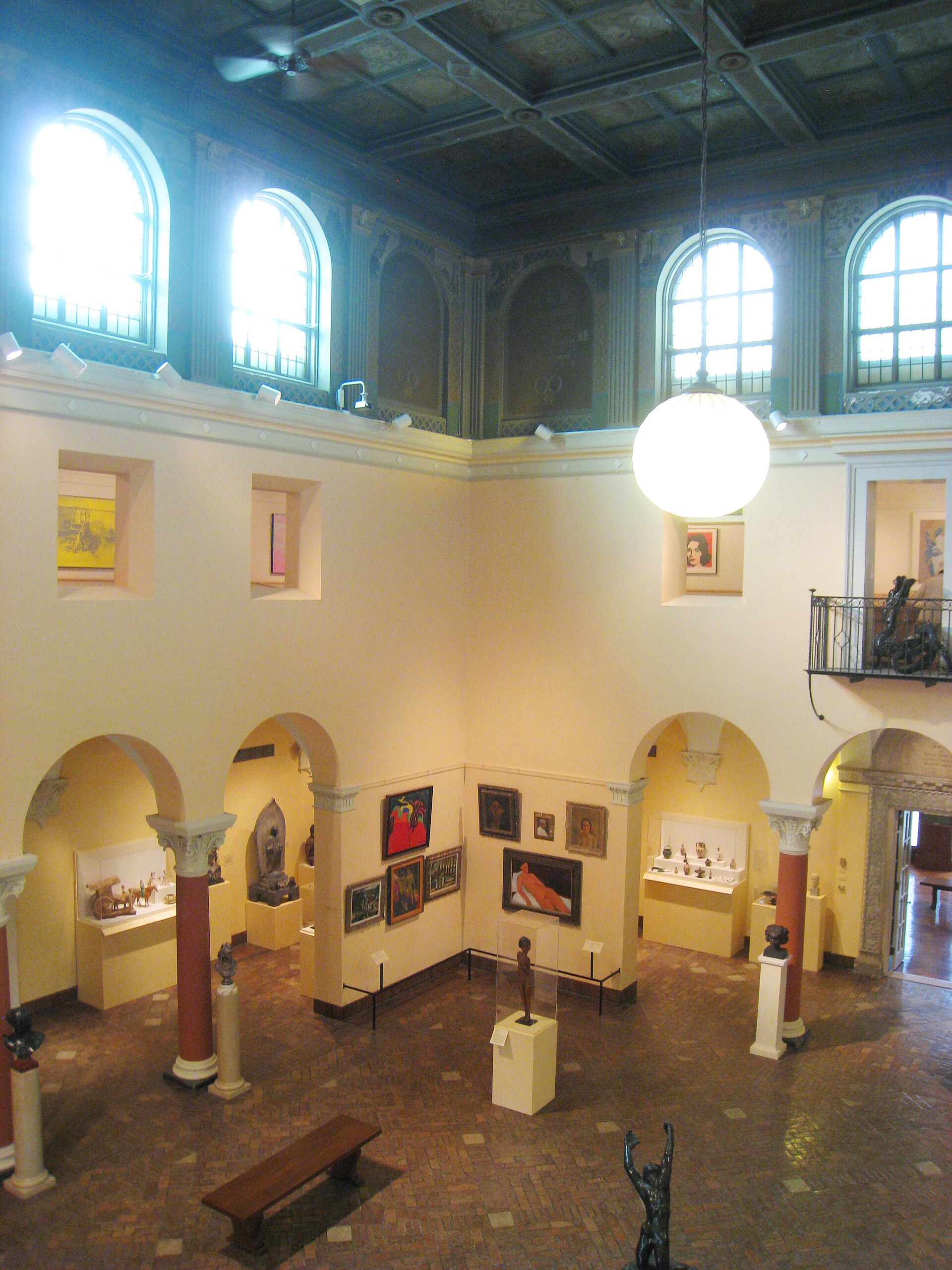
Public domain Ancient (Central Rotunda)
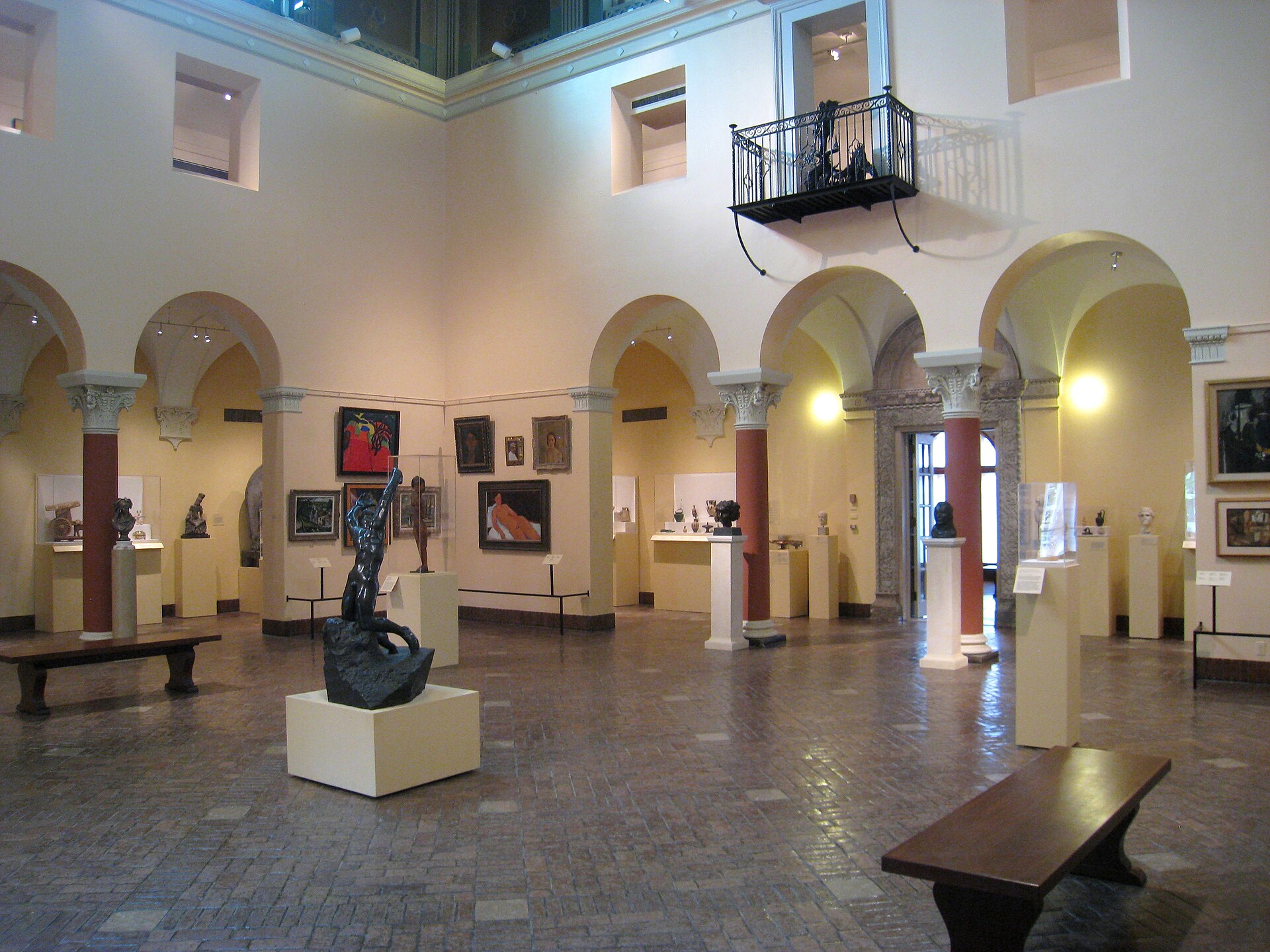
Egyptian, Greek and Roman antiquities, shown in the Cass Gilbert building's central rotunda under its painted, coffered ceiling
European
The museum's strongest holding: seventeenth-century Dutch and Flemish painting, plus European painting and sculpture from the fifteenth century to the twentieth. Named works on view or recorded in the collection include Jan van Goyen's Landscape with Dunes (1647), William Hogarth's Portrait of Theodore Jacobsen (1742), J.M.W. Turner's The Ducal Palace, Dogana and Part of San Giorgio (1841), Gustave Courbet's Castle of Chillon, Evening (1872), Piet Mondrian's Brabant Farmyard and Pompeo Batoni's Portrait of John, 1st Lord Wodehouse
Asian
Japanese, Chinese and Persian and South Asian art, anchored by the Mary A. Ainsworth bequest of ukiyo-e prints, Japanese artists' books and woodblocks. The Ripin Gallery upstairs shows Chinese painting on three walls and Persian and South Asian works, including prayer rugs and pages from the Quran, on the fourth. Chonunsai Eishi's The Courtesan Somenosuke of the Matsubaya House (mid-1790s), from the Ainsworth bequest, is a recorded highlight of the ukiyo-e holding
Africa and Oceania, and the Americas
African and Oceanic art and art of the Americas, shown as separate curatorial categories in the collection. Holdings include work by Horace Pippin, the self-taught African American painter, whose Harmonizing (1944) is in the collection, and Edmonia Lewis, the nineteenth-century sculptor of African American and Native American descent, represented by her Bust of James Peck Thomas (1874)
Modern and Contemporary
Twentieth- and twenty-first century painting, sculpture and works on paper, shown largely in the Ellen Johnson Gallery of the 1977 Venturi addition. The museum holds the Eva Hesse archive: the artist's notebooks, diaries, photographs and letters. Claude Monet's Garden of the Princess, Louvre (1867) is recorded in the collection and reproduced on museum merchandise as one of its best-known paintings
Prints, drawings and photographs
A large works-on-paper collection, including the Ainsworth ukiyo-e prints, that is kept largely in storage for conservation and shown in rotating print exhibitions rather than on permanent view; the Print Study Room allows scheduled close study of individual sheets
What to see first
The Courtesan Somenosuke of the Matsubaya House
Chonunsai EishiA mid-1790s ukiyo-e print from the Mary A. Ainsworth bequest, illustrated on the museum's own collections page as representative of its Japanese print holding, one of the largest teaching collections of ukiyo-e at any American college museum1
Garden of the Princess, Louvre
Claude MonetAn 1867 view painted from the Louvre's colonnade, sold by the museum shop as a magnet and named directly on the museum's own site as one of its recognisable paintings4
Harmonizing
Horace PippinA 1944 painting by the self-taught African American artist, held by the Allen and reproduced by the museum itself as a highlight of its American holdings4
Bust of James Peck Thomas
Edmonia LewisAn 1874 marble bust by the first sculptor of African American and Native American descent to achieve international fame; the museum sells its own reproduction of the piece4
Landscape with Dunes
Jan van GoyenA 1647 Dutch landscape representing the museum's core strength in seventeenth-century Dutch and Flemish painting6
Portrait of Theodore Jacobsen
William HogarthA 1742 portrait by the leading painter of eighteenth-century English satire and society portraiture6
The Ducal Palace, Dogana and Part of San Giorgio
J.M.W. TurnerAn 1841 Venice view by Turner, part of the museum's nineteenth-century European holding6
Castle of Chillon, Evening
Gustave CourbetAn 1872 landscape from Courbet's late period, painted the year before his exile to Switzerland6
Brabant Farmyard
Piet MondrianAn early, representational Mondrian acquired through the Mrs. F.F. Prentiss Fund, useful precisely because it predates his turn to abstraction6
Portrait of John, 1st Lord Wodehouse
Pompeo BatoniAn eighteenth-century Grand Tour portrait acquired through the Prentiss Fund, part of the museum's holding of British sitters painted in Rome6
Exhibitions on now
- On now5 Jul 2026 to 24 Jan 2027Confirmed , 7 weeks ago
- On now25 Jul 2026 to 23 May 2027Confirmed , 7 weeks ago
- On now25 Jul 2026 to 23 May 2027Confirmed , 7 weeks ago
A single bequest becomes a public museum
The Allen Memorial Art Museum traces its origin to 1904, when Charles F. Olney, vice president of the Cleveland School of Art, left Oberlin College roughly 8,000 works of art on his death. The gift outgrew anywhere the college had to show it. Dr. Dudley Peter Allen, an 1875 Oberlin graduate, and his wife Elisabeth Severance Allen (later, in her second marriage, Elisabeth Severance Allen Prentiss) commissioned a purpose-built museum to house and display the Olney bequest to the public rather than let it sit in storage. Allen died before construction finished, and the completed building, opened in 1917, was named in his memory.
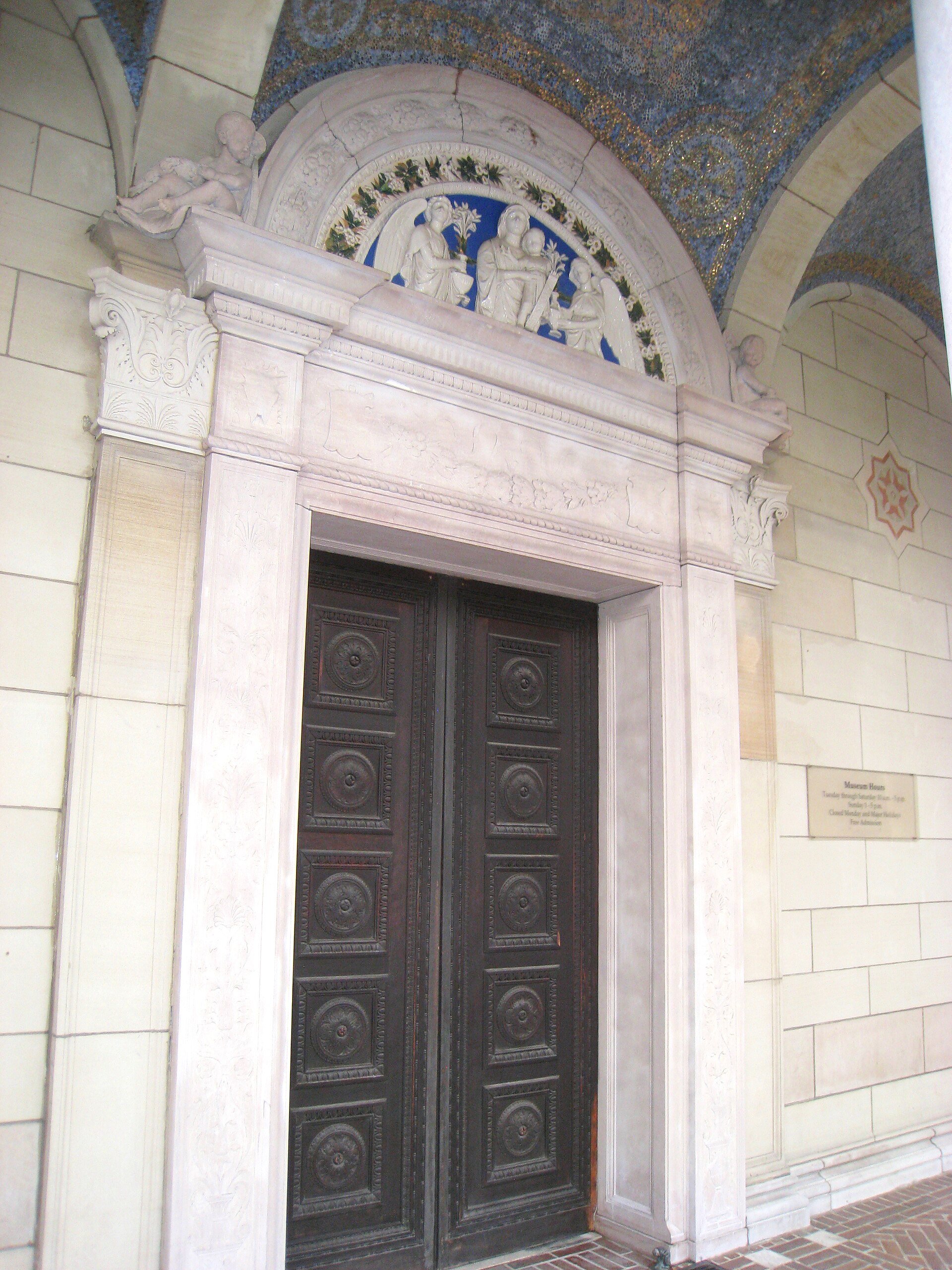
Elisabeth Severance Prentiss was the daughter of Louis H. Severance, a Standard Oil magnate, and her later gifts did as much to shape the collection as her first husband's memorial did to shape the building. In 1937 she funded a teaching wing, still in use today by the college's Art department and as the Fisher Gallery student exhibition space. When she died in 1944 she left the museum a substantial endowment along with part of her own art collection, assembled during her first marriage to Allen. The museum's motto is carved into the facade above the arched entrance: a line from William Morris, 1884, reading The Cause of Art is the Cause of the People. It was written as a statement of purpose, not decoration, and the museum has kept free admission since the day it opened as the literal expression of it.
Cass Gilbert's Renaissance box and Robert Venturi's argument with it
Cass Gilbert designed the original 1917 building in an Italian Renaissance idiom, drawing on Tuscan Renaissance architecture to give a teaching museum the gravity of a European palazzo. The central gallery carries a richly decorated coffered ceiling, painted by Frederick J. Wiley to Gilbert's commission in emulation of French Renaissance ceilings: canvas panels of musical instruments, foliage, animals and boats set into roughly 100 plaster coffers, with stanzas from a poem by the nineteenth-century transcendentalist Christopher Pearse Cranch running along the clerestory. Ironwork throughout the building is by Samuel Yellin. The ceiling and clerestory paintings underwent cleaning and conservation in 2014 and 2015.
By the 1960s the museum and the college's art department had outgrown Gilbert's building. Museum director Richard Spear led the search for an architect for an addition, and the committee settled on Robert Venturi, working with his wife and partner Denise Scott Brown. Their 1977 addition, built in explicit and self-aware dialogue with Gilbert's building, is counted among the earliest and most fully realised examples of postmodern architecture built in the United States, an instance of what Venturi called a decorated shed. The addition holds the Clarence Ward Art Library, the Ellen Johnson Gallery for modern and contemporary art, and studio and classroom space for the art department. From 2009 to 2011, under museum director Stephanie Wiles, both buildings went through a renovation focused on heating, ventilation and air conditioning, expanded art storage, improved lighting and energy efficiency, after which the museum earned USGBC LEED Gold certification. The result is a building that argues with itself on purpose: a 1917 Renaissance-revival block and a 1977 postmodern addition, kept in the same conversation the architects intended.
What is actually inside
The collection holds more than 15,000 objects across paintings, sculpture, decorative arts, prints, drawings and photographs, organized by the museum itself into Ancient, European, Asian, Africa and Oceanic, Americas, and Modern and Contemporary departments, alongside the standalone Eva Hesse archive and the Art Rental program. Its acknowledged strength is seventeenth-century Dutch and Flemish painting, alongside nineteenth- and early twentieth-century European and American work and a substantial Asian holding built around Japanese prints. The Ancient department is shown in Gilbert's central rotunda, under the coffered ceiling, ringed by an arcaded upper gallery.
The Asian collection rests heavily on the bequest of Mary A. Ainsworth, an 1889 Oberlin graduate who gave the museum more than 300 volumes of Japanese artists' books and seven printing woodblocks after her own travels in Japan; the museum's own collections page illustrates Chonunsai Eishi's ukiyo-e print The Courtesan Somenosuke of the Matsubaya House, from that bequest, as a representative highlight. The Ripin Gallery upstairs shows Chinese painting alongside Persian and South Asian material, including prayer rugs and pages from the Quran. The museum's first-ever acquisition, a Chinese vase given by the missionary Dalzell Bunker in 1894, predates the museum building itself by more than two decades.
The Africa, Oceania and Americas holdings include work by two artists whose presence in an early twentieth-century American teaching collection is itself notable: Horace Pippin, the self-taught African American painter, whose Harmonizing is in the collection, and Edmonia Lewis, working a half-century earlier, the first sculptor of both African American and Native American descent to achieve international recognition, represented by her marble Bust of James Peck Thomas. The museum also holds gifts from Eugene Leopold Garbaty, a Jewish industrialist who fled Germany in the 1930s and whose European collection entered the Allen afterward. The Eva Hesse archive, comprising the artist's notebooks, diaries, photographs and letters, sits apart from the display collection as a research holding used directly in teaching.
A Nazi-looted Schiele, held for sixty-six years
Not every object the Allen has held belongs in a highlights list. Egon Schiele's 1911 watercolour Schwarzes Madchen, known in English as Girl with Black Hair, entered the collection in 1958, bought from the New York dealer Galerie St. Etienne, which had itself bought it two years earlier from the Bern dealer Gutekunst and Klipstein. Before that, the picture had belonged to Fritz Grunbaum, an Austrian Jewish cabaret performer and collector of more than 400 works of art, 81 of them by Schiele, whose collection was catalogued by the art historian Franz Kieslinger and impounded into a Nazi-controlled warehouse in 1938. Grunbaum was murdered at the Dachau concentration camp in 1941. His heirs allege he was coerced into signing over power of attorney while imprisoned there, which led directly to the collection's illegal sale and dispersal.
In September 2023 the Manhattan District Attorney's office, whose Antiquities Trafficking Unit had spent years tracing the scattered Grunbaum Schieles, issued a seizure warrant for the Allen's watercolour, valuing it at 1.5 million dollars. The museum surrendered it. On 19 January 2024, in a restitution ceremony in New York, the work was returned to Grunbaum's heirs alongside a Schiele drawing that the Carnegie Museum of Art had held under the same circumstances; both were consigned afterward to Christie's. The Allen did not initiate this outcome. It came from a law enforcement investigation into where the Grunbaum collection had scattered, sixty-six years after the museum had bought the watercolour in good faith from an established New York dealer and asked, on the evidence available, no further questions. The gap between when a museum acquires a picture and when it is made to confront where that picture came from is exactly the kind of record this publication exists to keep, and the Allen's file on this object is now part of it.
A museum built to be used, not just viewed
The Allen was founded to support teaching, and the habit shows most plainly in the Art Rental program, started in the 1940s by Ellen H. Johnson, a professor of art history at Oberlin. At the start of every semester students camp outside the museum's north gate for first pick of original prints and paintings, including etchings and lithographs by artists such as Pierre-Auguste Renoir, Andy Warhol, Salvador Dali and Pablo Picasso, which they can then hang in their dormitory rooms for five dollars a semester. Johnson described the program's purpose as developing students' aesthetic sensibilities and encouraging ordered thinking in other areas of their lives, and it has run continuously since. The Ellen Johnson Gallery in the Venturi wing carries her name for the same reason.
The museum's Print Study Room extends the same principle to its works on paper, which are kept mostly in storage for conservation and made available for scheduled close viewing rather than permanent display. Curators have used the museum's own centenary programming to draw directly on under-shown parts of the collection: a 2017 exhibition built around the Asian holdings traced the collection back to its first Oberlin acquisition, the 1894 Chinese vase donated by the missionary Dalzell Bunker, and a companion show on Ellen Johnson's own legacy examined her role in shaping the modern and contemporary collection as both curator and teacher. A museum whose signature program lends real Picassos to undergraduates for pocket change has made a specific, sustained argument about what a collection is for, and it has kept making that argument for over eighty years.
Visiting
The Allen is open Tuesday through Saturday, 10 a.m. to 5 p.m., and Sunday, 1 to 5 p.m.; it is closed Mondays, major holidays and Fridays in July, in line with the college's own July office closures. Admission has been free to all visitors since the museum opened in 1917. Free street parking sits directly in front of the building, with overflow parking behind it off Willard Court for evening events. The museum is on the Oberlin College campus at the southeast corner of Main Street and Lorain Street, roughly forty minutes west of Cleveland by road.
An access ramp on the building's north side is reached through the courtyard tunnel on Lorain Street; the second-floor gallery is reached only by stairs, and visual guides to what is shown there are available at the welcome desk for visitors who cannot climb them. Personal photography without flash is permitted throughout the permanent collection, though not of works on loan from other institutions, and bags and umbrellas are checked at the rear of the building rather than carried through the galleries. None of this is complicated, which is the point: a free museum with real Old Masters, a serious ukiyo-e collection and a working Frank Lloyd Wright house a mile and a half away asks almost nothing of a visitor before handing over what it has.
What visitors say
Visitors consistently describe the Allen as a small museum with a collection out of proportion to its size: a free, single-building teaching museum that punches well above what its scale would suggest, on a campus most travellers would not otherwise stop at for art. Praise centres on the quality and range of the paintings for a college museum, the intimacy of seeing them without crowds, and the fact that admission has been free since the museum opened its doors in 1917.
What is praised, what is criticised
- Praised: The depth and quality of the collection for a college museum, with visitors naming Monet, Picasso, Modigliani and other canonical names among the paintings on view
- Praised: Free admission to everyone, described repeatedly as remarkable given the quality of the work on the walls
- Praised: The building itself: the Cass Gilbert Renaissance-style structure and, separately, the 1977 Robert Venturi addition, an early and well-regarded example of postmodern architecture in the United States
- Praised: The manageable, uncrowded scale of the galleries, which lets a visitor look closely rather than move through on a schedule
- Criticised: Its size next to the major regional museums of Cleveland, Toledo and Columbus, which some visitors flag directly as a limitation before recommending it anyway
- Criticised: The museum held Egon Schiele's 1911 watercolour Schwarzes Madchen (Girl with Black Hair) from 1958 until 2024. The work had passed through the collection of Fritz Grunbaum, the Austrian Jewish cabaret performer murdered at Dachau in 1941, before being sold in Bern and then New York in 1956; the Allen acquired it from Galerie St. Etienne in 1958. It was seized by the Manhattan District Attorney's Antiquities Trafficking Unit in September 2023 and restituted to Grunbaum's heirs in a ceremony on 19 January 2024, sixty-six years after the museum bought it and seventeen years into the heirs' documented legal campaign for the wider Grunbaum collection. The return followed a criminal seizure warrant, not an unprompted finding by the museum's own provenance research
Ratings on other platforms
Tripadvisor: 4.8 from 116 ratings, read 27 August 2026
A platform average is a tertiary source: it moves, it is not audited, and we quote no visitor's words.
Questions about Allen Memorial Art Museum
Where is Allen Memorial Art Museum?
Allen Memorial Art Museum, Oberlin College, 87 North Main Street, Oberlin, OH 44074, United States.
How much does it cost to visit?
All visitors: free. As confirmed 27 August 2026.
When is it open?
Tue-Sat 10:00-17:00; Sun 13:00-17:00. Closed: Monday. Martin Luther King Jr. Day. As confirmed 27 August 2026.
How do you get there?
Car: Free, ample street parking in front of the museum; overflow parking for evening events off Willard Court behind the building. The museum sits at the southeast corner of Ohio Route 58 (Main St.) and Ohio Route 511 (Lorain St.), about 40 minutes west of Cleveland via I-80, I-90 or I-480.
What should you see first?
The Courtesan Somenosuke of the Matsubaya House (Chonunsai Eishi); Garden of the Princess, Louvre (Claude Monet); Harmonizing (Horace Pippin); Bust of James Peck Thomas (Edmonia Lewis); Landscape with Dunes (Jan van Goyen); Portrait of Theodore Jacobsen (William Hogarth).
What we could not confirm
- Whether the Allen has since reviewed the rest of its European acquisitions from the 1950s and 1960s, the same period and dealer network that produced the Grunbaum Schiele, for comparable gaps in provenance; no published provenance review of that scope was found in the sources checked for this record
- The exact maker and full attribution of some decorative-arts pieces referenced in the museum's own merchandise catalogue, such as the Double Portrait of a Boy and Girl of the Attavanti Family (1850s), which the shop page does not attribute to a named artist
Images
Sources
- 1Allen Memorial Art Museum, Hours, Admission and Directions amam.oberlin.edu/visit/hours-admission-directions
- 2Allen Memorial Art Museum, Our Buildings amam.oberlin.edu/about/our-buildings
- 3Allen Memorial Art Museum, Museum Policies (visitor guidelines) amam.oberlin.edu/visit/visitor-guidelines
- 4Allen Memorial Art Museum, Shop amam.oberlin.edu/shop
- 5Allen Memorial Art Museum, Collections amam.oberlin.edu/art/collections
- 6Wikipedia, Allen Memorial Art Museum en.wikipedia.org/wiki/Allen_Memorial_Art_Museum
- 7Wikidata, Q3816734 (Allen Memorial Art Museum) wikidata.org/wiki/Special:EntityData/Q3816734.json
- 8Wikimedia Commons, file and licence metadata for the images used in this record commons.wikimedia.org/wiki/Category:Allen_Memorial_Art_Museum
- 9The Art Newspaper, by Carlie Porterfield, 19 January 2024, republished by the Commission for Looted Art in Europe lootedart.com/news.php?r=WGOCP4277701
- 10The Oberlin Review, AMAM Celebrates Centennial Season, by Kirsten Heuring, 1 September 2017 oberlinreview.org/13835/arts/amam-celebrates-centennial-season/
- 11Tripadvisor, Allen Memorial Art Museum, Oberlin, Ohio (aggregate rating, read 27 August 2026) tripadvisor.com/Attraction_Review-g50795-d808571-Reviews-Allen_Memorial_Art_Museum-Oberlin_Ohio.html