Adolphe Sax
Belgian, active in Paris from 1842 · 1814-1894
Last verified 16 September 2026 · 30 sources cited
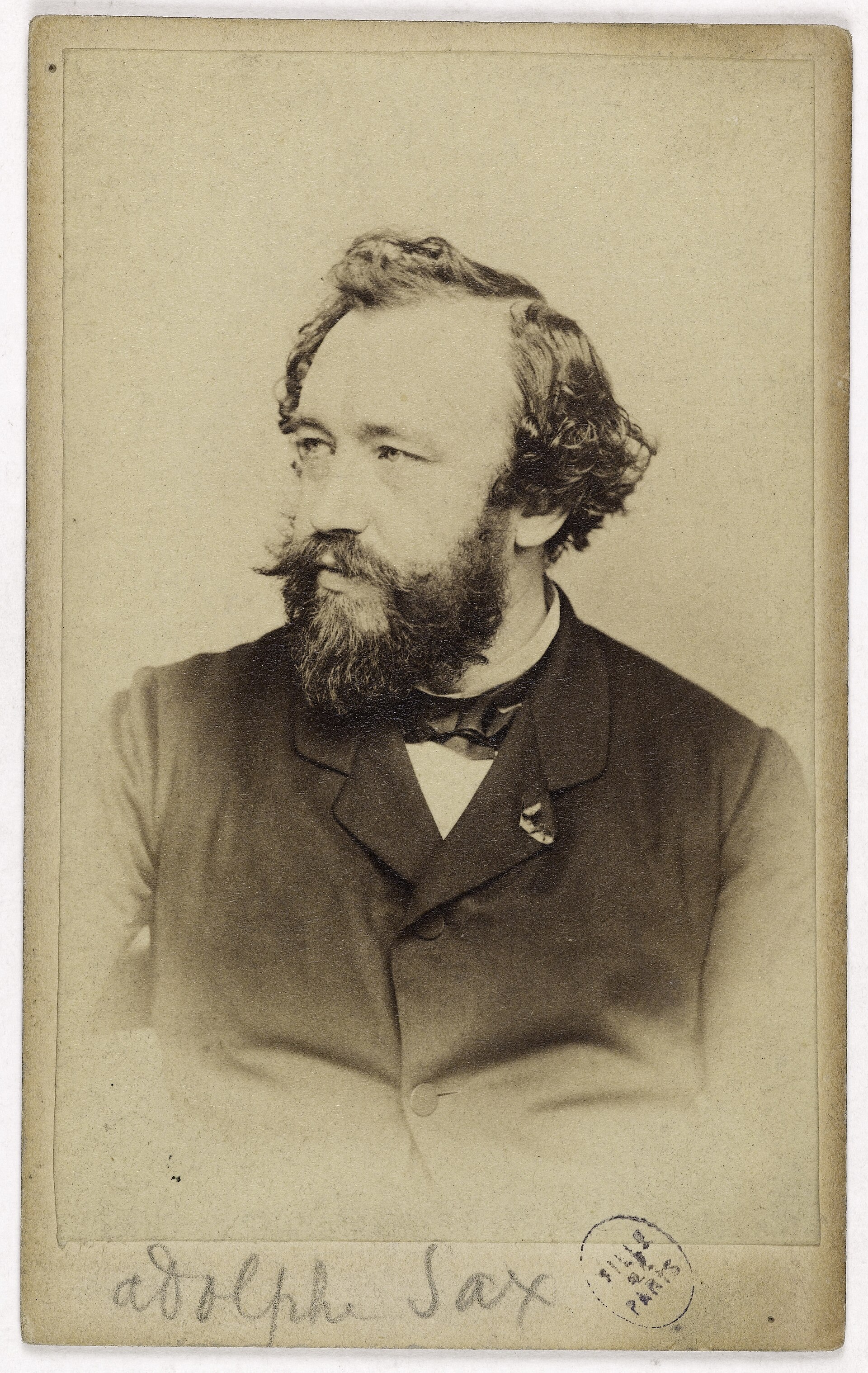
A carte-de-visite portrait photograph of Adolphe Sax, held by the Musee Carnavalet in Paris and catalogued there as taken between 1860 and 1890 by the London photographer Charles Clarkington. Clarkington's own recorded dates, 1826 to 1861, mean the sitting itself must predate his death in 1861 even though the museum's own catalogue date range runs later; this page notes the inconsistency rather than resolve it. The identification of the sitter as Sax is the museum's own and is not disputed in any source consulted for this page.
Musee Carnavalet - Histoire de Paris / Paris Musees, photograph by Charles Clarkington| Full name | Antoine-Joseph Sax, known as Adolphe Sax |
|---|---|
| Worked as | Instrument maker, Inventor, Acoustician, Clarinettist |
| Born | 6 November 1814 · Dinant, in what is now Belgium |
| Died | variously given as 3, 4 or 7 February 1894 in the sources consulted; his grave marker in the Cimetiere de Montmartre reads 7 February · Paris, France |
| Nationality | Belgian, active in Paris from 1842 |
| Last verified | 16 September 2026 |
On this page 13 sections
Adolphe Sax did not think of himself as a craftsman working inside an inherited trade. He presented himself, and was described by his most prominent defender Hector Berlioz, as an acoustician and a calculator who happened to also cast and engrave metal, and he treated instrument design as an engineering problem to be solved and patented rather than a skill to be handed down quietly from master to apprentice. That self-presentation is the reason his Paris rivals fought him for two decades with a persistence that looks, from a distance, disproportionate to one new woodwind: he was not competing for craft reputation inside a shared trade, he was asserting exclusive legal ownership, under French patent law, of an entire family of instruments that a whole industry of established makers could otherwise have built freely.
He held that ownership for twenty years, from the patent of 1846 to its lapse in 1866, and the fight for it ran him into personal bankruptcy three times. He also patented the saxhorn, the saxotromba and the saxtuba in the same decade, redesigned the bass clarinet before he was twenty-five, and was appointed instrument maker to the household troops of Napoleon III. He died in reduced circumstances in 1894, by which time the instrument that carries his name had already outgrown the small orchestral and military niche he had designed it for.
What a reader most needs and rarely finds stated plainly: the vivid stories that now circulate about Sax surviving poisoning, a bomb under his bed and an employee stabbed to death in his place do not appear in the scholarly literature on him at all. What is actually documented is narrower, and in its way just as remarkable: a specific, dated run of patent lawsuits with named defendants, three personal bankruptcies, and a public defence by the most famous composer-critic in France stating in print that Sax's rivals were trying to have him declared insane. This page keeps the two kinds of claim separate throughout.
Images

Chronology
- 1814
Born 6 November in Dinant, eldest son of the instrument maker Charles-Joseph Sax.12
- 1815
The Sax family relocates to Brussels, where Charles-Joseph opens his own instrument workshop.2
- 1828
Enters the Royal School of Music in Brussels to study flute and clarinet.14
- 1838
Completes a redesigned bass clarinet, later patented, his first significant invention.1
- 1841
Presents the saxophone publicly for the first time, at the Brussels industrial exhibition.4
- 1842
Moves his workshop to Paris; Hector Berlioz publishes a substantial defence of his instruments in the Journal des Debats, 12 June.67
- 1844
Berlioz organises a concert on 3 February built entirely around Sax's instruments.7
- 1845
Patents the saxotromba (22 November, French patent 2306); the Battle of the Bands trial is held on the Champ de Mars, 22 April, and a state commission recommends Sax's instruments for French military bands.11215
- 1846
Files the saxophone patent application, 21 March, French patent no. 3226; grant follows that summer, dated in secondary sources as either 22 or 28 June.89
- 1846
Berlioz lends Sax 1,200 francs.7
- 1848
The February Revolution derails the military contracts recommended by the 1845 commission before they can be executed.1
- 1849
Patents the saxtuba, 16 July, French patent 8351.16
- 1852
First personal bankruptcy. The saxtuba makes its first public appearance in Halevy's opera Le Juif errant, 23 April.116
- 1852
Certificate of addition specific to the saxtuba family granted.16
- 1854
Napoleon III appoints Sax instrument maker to the household troops of the Imperial Court.111
- 1858
8 June: the Tribunal de la Seine rules in Sax's own counterfeiting suit against ten named Paris makers.10
- 1859
Sax wins his infringement suit against Pierre-Louis Gautrot over the sarrusophone at first instance.11
- 1862
7 June: the Cour imperiale de Paris hears Kretzschmann against Sax.10
- 1866
The saxophone patent lapses; Millereau et Cie files a competing improved-saxophone patent within weeks, 7 August.11
- 1867
The Gautrot sarrusophone ruling is reversed on appeal, a year after Sax's own patent expired.11
- 1873
Second personal bankruptcy.1
- 1877
Third personal bankruptcy; Sax's personal collection of 467 instruments is sold, with Victor-Charles Mahillon buying a group for the newly founded Musee instrumental du Conservatoire in Brussels.113
- 1894
Dies in Paris, dated 3, 4 or 7 February across the sources consulted; buried in the Cimetiere de Montmartre.1
- 1921
Henri Selmer enters saxophone manufacture in Paris.5
- 1929
The market
Surviving Sax-workshop instruments are concentrated in museum collections rather than in private hands, and this page could not locate a documented, completed public auction sale of an instrument made in Adolphe Sax's own workshop during his lifetime, despite checking the general auction-price databases and the specialist musical-instrument sale rooms reachable for this research. Christie's own results search could not be reached by automated fetch for this page.
The one confirmed completed sale located is a lot catalogued as an Adolphe Sax fils Saxophone, sold at Bonhams in London on 15 December 2009 for GBP 360 including premium. That stamp belongs to the firm run after 1894 by Sax's son Adolphe-Edouard, not to Adolphe Sax himself, and this page does not treat it as evidence of what an autograph Sax-workshop instrument would fetch. Whether a genuine market for autograph Adolphe Sax instruments exists outside museum collections was not established by the sources reachable here.
| Date | Sale | Work | Result | Note |
|---|---|---|---|---|
| 15 December 2009 | Bonhams | Saxophone stamped Adolphe Sax fils (Adolphe-Edouard Sax's post-1894 firm, not an autograph instrument by Adolphe Sax) | Hammer Not published separately in the source consulted With premium GBP 360 total, including buyer's premium GBP | The only completed public sale of a Sax-stamped instrument this page could confirm. Included for completeness and explicitly flagged as NOT an autograph Adolphe Sax object. |
Hammer is the price at which the bidding stopped; with premium adds the fee the house charges the buyer on top. Hammer price and buyer's premium in the glossary.
Where to see the work
| Institution | City | Holdings | Note |
|---|---|---|---|
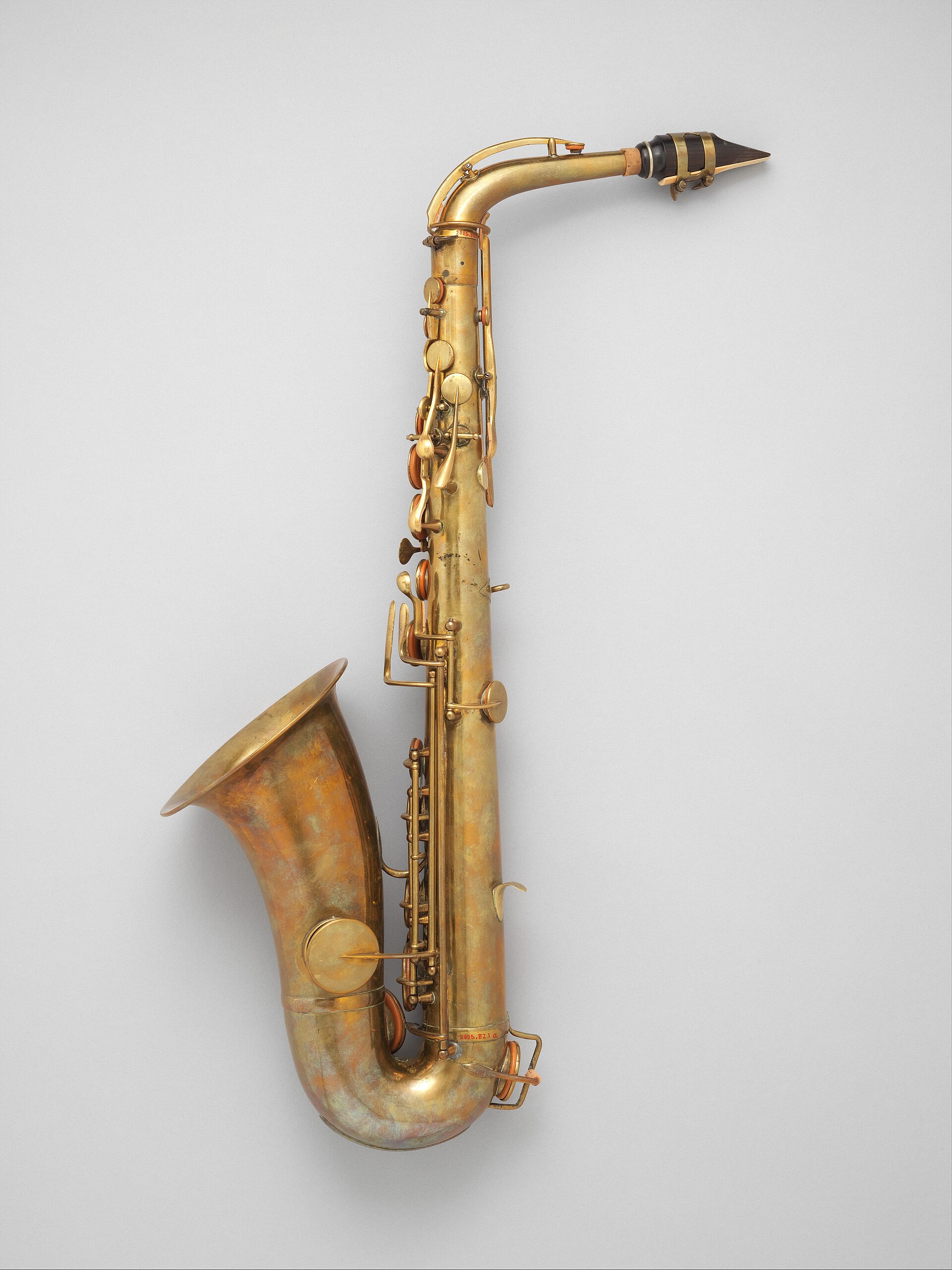
| Metropolitan Museum of Art | New York | Multiple Sax-workshop instruments including an alto saxophone of about 1855 (accession 2005.82.1a-e, .2a-y), a bass saxhorn of 1863 (1993.164), a bass saxtuba in E-flat of 1855 (89.4.1109), a fanfare trumpet in E-flat of 1856 (89.4.1628) and a soprano saxophone in B-flat of 1882 (89.4.2138). | Open access; images released CC0. |
| Musee des Instruments de Musique (MIM) | Brussels | Instruments made by Adolphe Sax and by his father Charles-Joseph Sax, plus 33 instruments from Adolphe Sax's own personal collection sold at his 1877 bankruptcy, including four Egyptian instruments gathered during Napoleon Bonaparte's Egyptian campaign. | Successor institution to the Musee instrumental du Conservatoire founded 1877 by Victor-Charles Mahillon, who bought at the 1877 sale. |
| Edinburgh University Collection of Historic Musical Instruments | Edinburgh | Dated Sax saxhorns, including a tenor horn in E-flat of 1855 and a baritone saxhorn of 1866. | Maintains the published serial-number catalogue of Sax instruments used throughout this page. |
| Museum of Fine Arts, Boston; National Music Museum | Boston; Vermillion, South Dakota | Instruments by Charles-Joseph Sax, per the Metropolitan Museum's own account of the Sax family holdings across institutions. | Not independently verified by this page beyond the Metropolitan Museum's own summary; a future editor should check each collection's own database. |
Forgeries and misattributions
- No documented case of a forged Sax stamp
- No source consulted for this page records a case of a counterfeit Adolphe Sax stamp applied to an instrument not made in his workshop, as distinct from the many lawful competing instruments built by rival makers after the 1866 patent lapse. Absence noted rather than demonstrated; a specialist in nineteenth-century brass and woodwind authentication may know of a case this research did not surface.
- Patent-era copies, not forgeries
- During the patent's protected years, 1846 to 1866, several Paris makers were prosecuted for building unauthorised copies of Sax's patented instruments, most notably in the 8 June 1858 counterfeiting judgment naming ten defendants. These were lawful-market copies contested as patent infringement, not instruments falsely stamped with Sax's own name. Established through the Criminocorpus bibliography of the underlying court cases.10
The essay
A workshop family, not a lone inventor
Sax was born in Dinant on 6 November 1814, the eldest child of Charles-Joseph Sax (1791-1865), an established instrument maker who had opened his own workshop in Brussels in 1815 and went on to hold the title of instrument maker by appointment first to the House of Orange under the United Kingdom of the Netherlands and later to the Belgian court. Charles-Joseph made wind and brass instruments, pianos, harps and guitars, and instruments stamped with his name survive today in the Metropolitan Museum, the National Music Museum and the Museum of Fine Arts, Boston, alongside his son's at the Musee des Instruments de Musique in Brussels. Adolphe trained in that workshop as a child before any formal instruction, which means the manual, metalworking side of his later career was never separate from an inherited family trade even as his own self-image pushed toward the scientific and the patented.
He also studied formally, entering the Royal School of Music in Brussels in 1828 to study flute and clarinet, taking private clarinet lessons from Valentin Bender, and competing in conservatory contests by his mid-teens. By sixteen he was already both making good copies of existing instruments in his father's workshop and designing new ones of his own, and between 1835 and 1840 he worked on a redesigned bass clarinet, patented at twenty-four, that is usually counted as his first significant invention.
A child his mother thought would not live
Sax's first biographer, the French composer and critic Oscar Comettant, published a biography in 1860 (Histoire d'un inventeur au dix-neuvieme siecle) that catalogues a startling run of childhood accidents: a fall of three floors down a stairwell that left him unconscious on a stone floor, a swallowed needle, a bowl of what he thought was milk that was diluted vitriol, a burn from a gunpowder explosion, a second burn from an overturned frying pan, a stone that fell from a roof and left a permanent scar, and a spell of unconsciousness brought on by sleeping in a room full of fresh varnish fumes. Comettant reports his mother as saying he was a child condemned to misfortune who would not live, and gives his childhood nickname in Dinant as the little ghost.
This record treats that list as biography, not as an omen or a symbol. Modern scholarship on Sax, represented here by Stephen Cottrell's 2012 study for Yale University Press, repeats the list while noting plainly that Comettant's biography is romanticised and not fully reliable, and Cottrell's own reading is that the accidents describe an energetic child getting into ordinary scrapes rather than anything more than that. No source consulted for this page claims the accidents were anything other than accidents, and none is treated here as a sign, a portent or a symbolic pattern. It is included because it is what his own first, authorised biography said about him, not because this page finds meaning in it.
Paris, and Berlioz's public defence
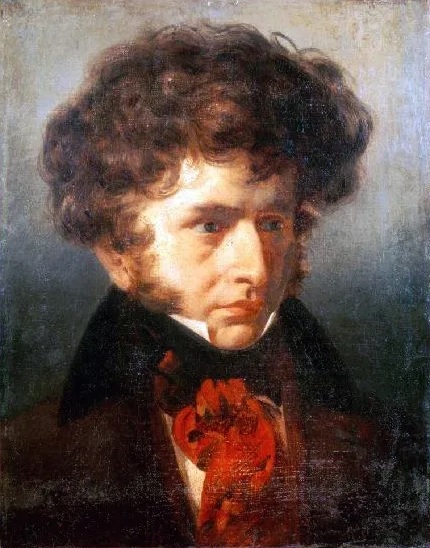
Sax moved his workshop from Brussels to Paris in 1842, arriving with little capital, to work close to the French military-band market and the instrument trade concentrated there. His reputation in Paris owes a specific, documented debt to Hector Berlioz, who gave substantial space in the Journal des Debats of 12 June 1842 to praising Sax's improvements to the clarinet and bass clarinet and to the still-unpatented saxophone; the piece was reprinted in the French and Belgian press and did much to establish the newcomer's standing. Berlioz's support went beyond print: he lent Sax 1,200 francs in late 1846 and organised a concert built entirely around Sax's instruments on 3 February 1844.
Berlioz's public defence of Sax against the Paris trade is itself a primary document of the persecution Sax said he faced, and it is worth quoting exactly rather than summarising, because a softened paraphrase is how legend gets started. Writing in Sax's defence, Berlioz listed what he said Sax's opponents were doing to him: enticing away his workmen, stealing his plans, accusing him of insanity, bringing lawsuits against him, and, at the rhetorical peak of the list, stated that with a little more of the same they would assassinate him. That line is real, published and cited below. It is Berlioz's own hyperbole in a polemical defence, not a police report, and this page treats it as exactly that: documented evidence of how bitterly contemporaries described the conflict, not documentation that anyone actually tried to kill Sax.
The Battle of the Bands, 1845
The instrument family Sax is remembered for exists in the form it does because of a specific state decision, not a gradual adoption. On 22 April 1845 the French Ministry of War staged a public trial on the Champ de Mars in Paris to settle the instrumentation of French military bands: a band of 38 musicians using Sax's instruments against a band of 45 assembled by the composer Michele Carafa on traditional instruments, with four active regimental bands also performing. An estimated 20,000 people attended. A commission that included the composers Fromental Halevy, Daniel Auber, Gaspare Spontini and Adolphe Adam alongside Carafa, two scientists and two colonels, chaired by General de Rumigny, judged the contest and recommended Sax's instruments, including saxophones alongside saxhorns, in a report issued that July.
The contracts that should have followed were not fulfilled, derailed by the February Revolution of 1848 before they could be executed, a specific and documented setback rather than the vaguer financial troubles usually cited for that period. Sax's position with the French military eventually solidified regardless: in 1854 Napoleon III named him instrument maker to the household troops of the Imperial Court, an appointment that helped pull his business back from its first bankruptcy earlier that decade.
The 1846 patent: what it actually covers
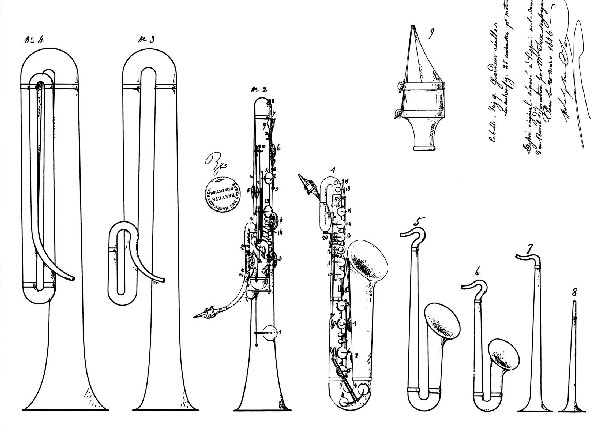
Sax filed his patent application in Paris on 21 March 1846 for un systeme d'instruments a vent, dits saxophones, a system of wind instruments called saxophones, registered as French patent number 3226. The grant followed that summer; secondary sources give the date as either 22 or 28 June 1846, a discrepancy this page could not resolve from the primary document and states rather than papers over. The Horniman Museum in London holds a photostat facsimile of the original brevet, and the American patent directory DATAMP separately catalogues the same filing. The patent's own text, as summarised in both records, covers a wide family of instruments running from sopranino to sub-contrabass, arranged in two parallel sets tuned alternately for orchestral use, in C and F, and for military-band use, in E-flat and B-flat, with fourteen sizes described across the two sets though not all were built to that plan at the time of filing.
The application had a fight built into it before it was ever granted. A trade body of Paris instrument makers argued that because Sax had already demonstrated the instrument in public, it no longer qualified as a new invention eligible for patent protection. Sax withdrew the application and publicly dared any maker in France to build a working saxophone if he believed himself capable of it; when none produced a convincing rival instrument within the year, Sax resubmitted and the patent was granted without further delay. Protection ran for what is usually described as a fifteen-year term but is also described in the same literature as lapsing in 1866, twenty years after filing; this page could not establish from the sources consulted whether that gap reflects one or more renewal patents under French law of the period, and records the arithmetic as unresolved rather than assume an explanation.
The patent wars: what is documented and what is legend
The popular version of Sax's story holds that a single, formally organised guild of Paris makers, sometimes named as l'Association generale des ouvriers en instruments de musique, conspired as one body to destroy him through litigation. Stephen Cottrell's academic study traces that specific claim to two contemporary partisan writers and states plainly that no documentary evidence has been found for a formally constituted body organised to oppose Sax as such. This page follows that correction rather than repeat the conspiracy as settled fact, and separates it from what actually is documented: a long run of individual lawsuits, mostly over patent originality and infringement, running from the late 1840s through the 1860s, naming specific Paris makers including the Buffet family, Gustave Besson, Halary, Pierre-Louis Gautrot and Raoux. Secondary sources describe this litigation as running for more than twenty years; none consulted for this page gives a reliable total count of individual suits, and this page does not repeat the round figures of thirty or more lawsuits that circulate online without a citable source behind them.
Two specific cases survive in detail in the bibliography of French criminal-law history maintained by the Criminocorpus research programme. On 8 June 1858 the 8th correctional chamber of the Tribunal de la Seine ruled in a counterfeiting case Sax had brought against a group of makers, including Besson, Raoux, Halary, Buffet jeune, Buffet-Crampon, Tournier, Goumas, Martin freres, Beauboeuf and Victor Jacob, over unauthorised copies of his patented wind instruments. On 7 June 1862 the Cour imperiale de Paris heard a further case, Kretzschmann against Sax, with Kretzschmann represented by the lawyer and future government minister Jules Favre. Both cases show Sax as an aggressive defender of his own patents rather than only their target, which is the reverse of his usual cast as a passive victim, though the pattern of repeated, expensive litigation on both sides is consistent with the financial drain later writers describe.
The clearest example of Sax losing ground on the legal merits rather than simply on cost is the sarrusophone case. Sax sued Pierre-Louis Gautrot for patent infringement over Gautrot's sarrusophone, a conical double-reed brass instrument competing for the same military-band market; the Tribunal de la Seine ruled for Sax in 1859, ordering an indemnity and requiring Gautrot to mark every instrument as built to Sax's patent. Gautrot did not comply, Sax pursued the matter on appeal, and in 1867, a year after his own saxophone patent had itself expired, the higher court reversed the injunction, holding that the sarrusophone and the saxophone produced sufficiently different tone despite their shared mechanical lineage.
As for the more dramatic claims: no source of scholarly weight consulted for this page, including Cottrell's book itself, documents a bomb placed under Sax's bed, an employee stabbed to death in a case of mistaken identity, a pistol fired at an assistant, or a workshop fire deliberately set by rivals. These specific stories circulate widely on general-interest websites, several of which cite only each other, and this page could not trace any single one of them to a primary account, a contemporary press report or Sax's own correspondence. The 99% Invisible podcast, discussing the same stories, calls them possibly true and suggests they trace to sensational nineteenth-century newspaper reports or biographies whose original source was Sax himself or his close family, rather than to a chain of modern invention; that is a real hedge from a source this page cites, not a dismissal, and it is recorded here rather than smoothed into a flatter verdict either way. They remain undocumented as individual incidents and are separated deliberately from Berlioz's real and citable rhetorical line about assassination quoted above, which those stories may ultimately have grown from.
Three bankruptcies and an emperor's rescue
Sax filed for personal bankruptcy three times, in 1852, 1873 and 1877, driven by the combined weight of litigation costs, the capital intensity of manufacturing a wide family of new instruments, and by his own acknowledged weakness as a businessman rather than by any single ruinous judgment. He was saved from a fourth collapse only by the direct intervention of Napoleon III. The 1852 bankruptcy sits inside the same decade as the sarrusophone litigation and the ongoing fight over the saxophone's own originality, and the 1854 imperial appointment that followed it is best read as patronage extended because the French state had a stake in Sax's instruments succeeding in its own military bands, not as a general act of charity toward an inventor.
The 1877 bankruptcy had a consequence beyond Sax's own business: his personal instrument collection, comprising 467 instruments gathered from different periods and regions of the world, was put up for sale to help meet his debts. Victor-Charles Mahillon, curator of the newly founded Musee instrumental du Conservatoire in Brussels, bought a group of them at that sale. Thirty-three instruments from Sax's own private collection, including four Egyptian instruments originally gathered during Napoleon Bonaparte's Egyptian campaign by the scholar Guillaume-Andre Villoteau, remain today at the successor institution, the Musee des Instruments de Musique in Brussels, alongside instruments made by both Adolphe and his father Charles-Joseph.
Beyond the saxophone: saxhorn, saxotromba and saxtuba
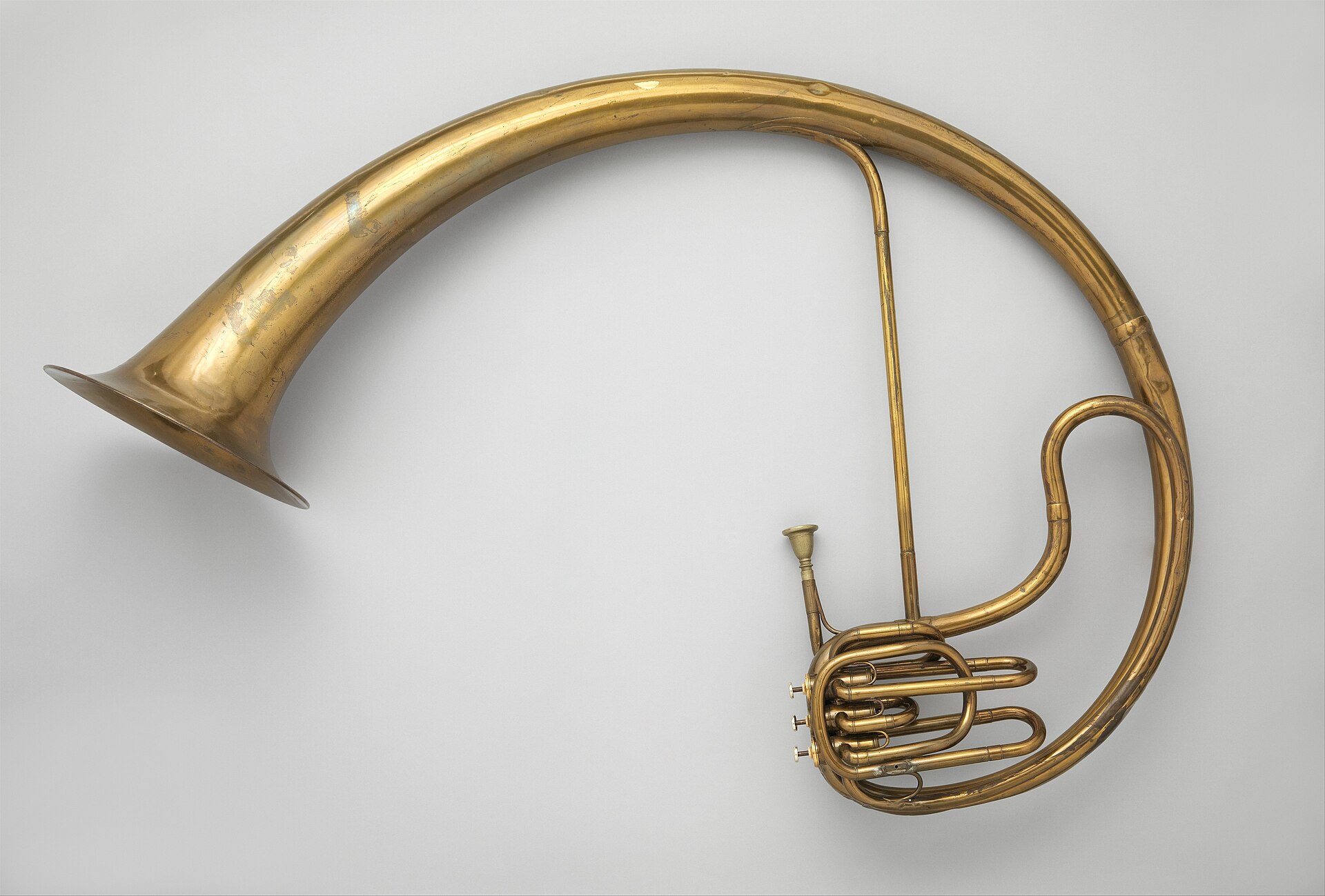
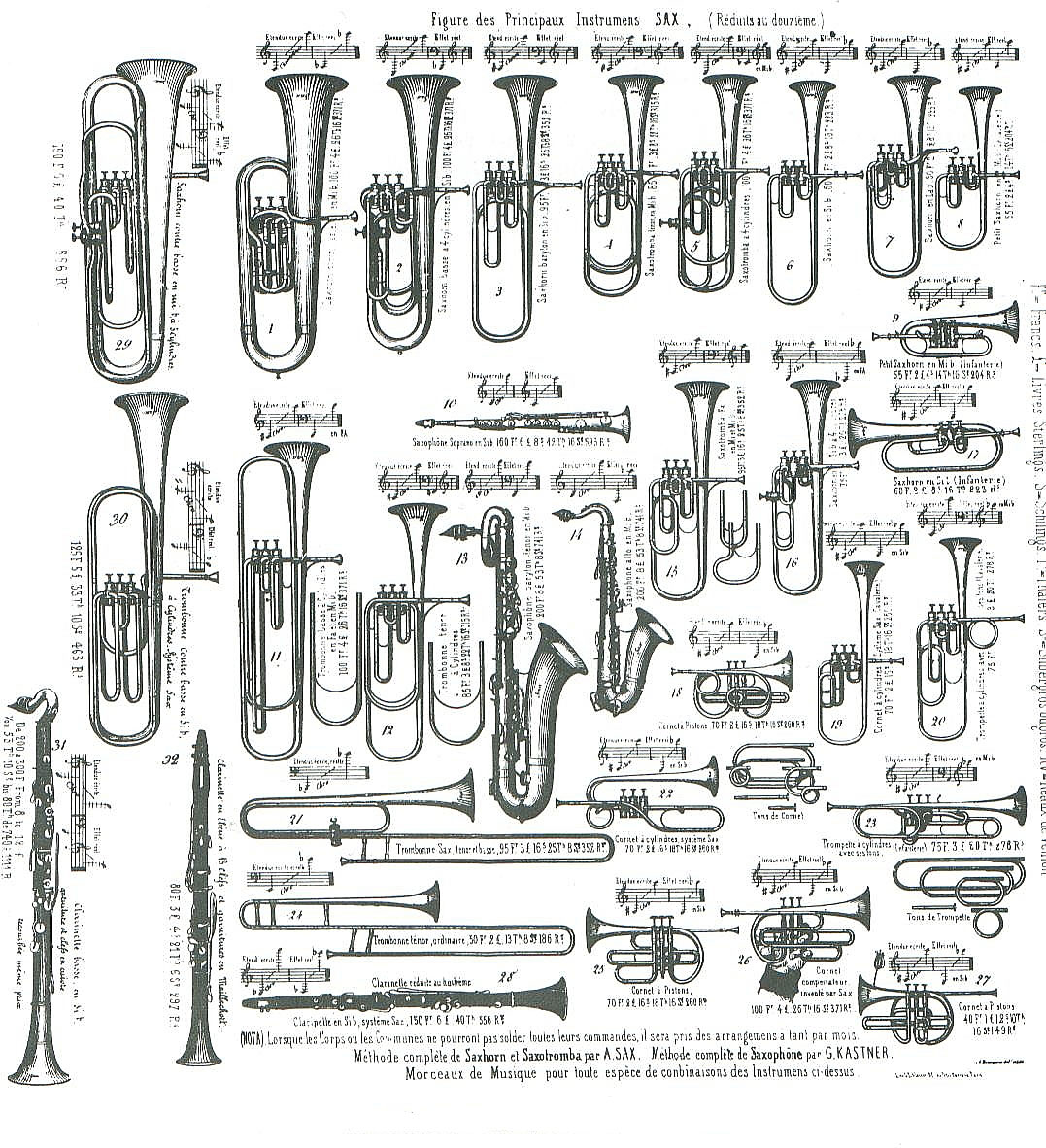
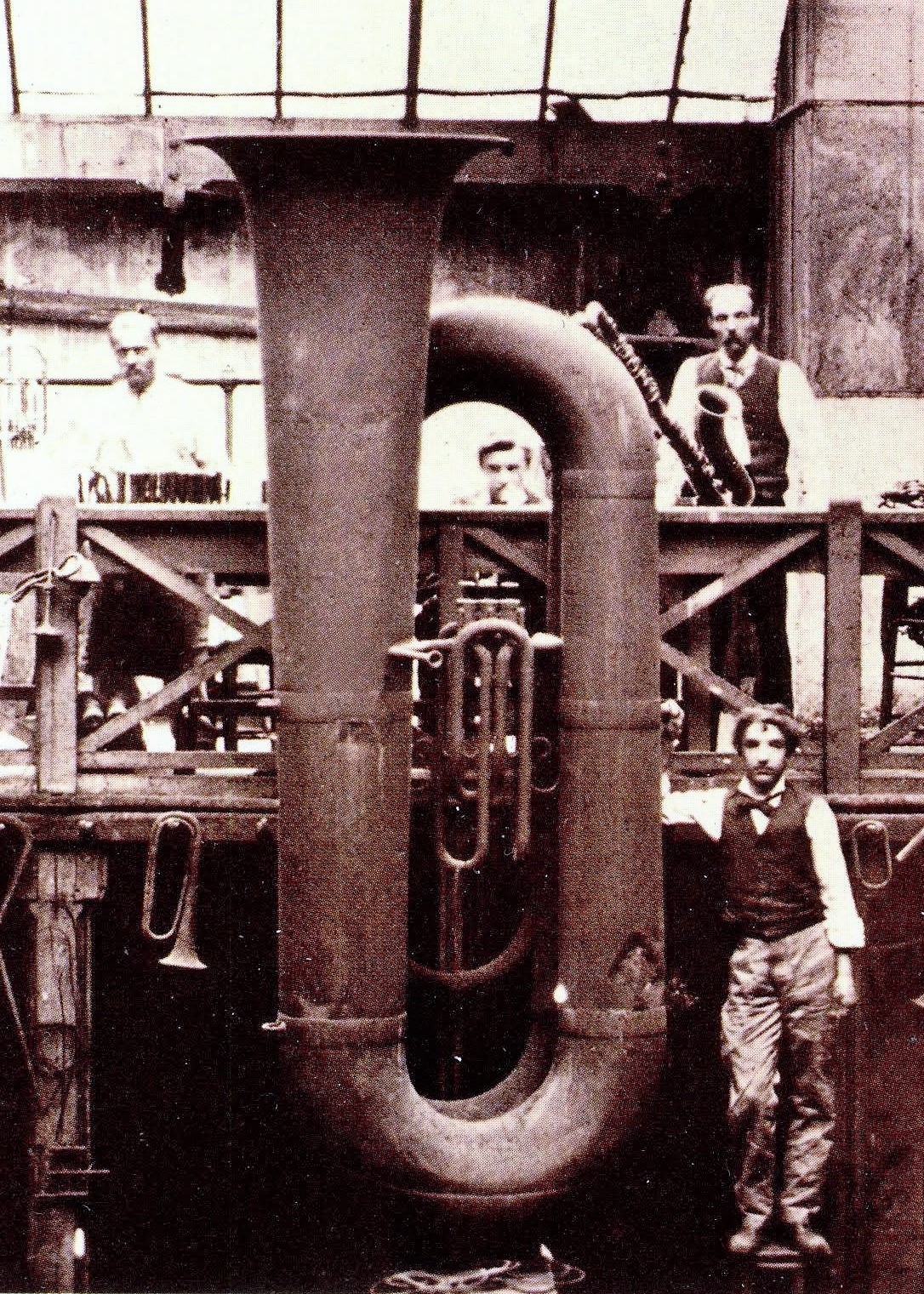
The saxophone was one invention inside a much larger programme of brass redesign that Sax pursued across the 1840s. The saxhorn, a family of valved bugle-derived brass instruments made in seven sizes, developed from 1842 and is the ancestor of the modern flugelhorn and euphonium; it was adopted wholesale by the British brass band movement and remains, in descendant form, in ordinary use today, which makes it arguably a more commercially successful invention than the saxophone was in Sax's own lifetime.
The saxotromba followed on 22 November 1845, granted as French patent 2306 for cylinder valve instruments intermediate between the saxhorn and the cylinder trumpet, intended for French mounted military bands. It is closely enough related to the saxhorn that the musicologist Evgenia Mitroulia has argued the two may be acoustically identical instruments marketed as though they were different families, a claim this page reports as an argued position rather than settled fact. The saxotromba disappeared from French military inventories by 1867 and fewer than a dozen original examples are known to survive.
The saxtuba came later, patented under French patent 8351 of 16 July 1849 with a certificate of addition specific to saxtubas following in 1852. Built with concealed valves to preserve the visual appearance of a natural, valveless trumpet on parade, the saxtuba made its first public appearance in Fromental Halevy's opera Le Juif errant on 23 April 1852 and was used in a twelve-instrument military ceremony at the Champ de Mars that May. Like the saxotromba, it never achieved lasting adoption and survives today mainly as an occasional orchestral colour instrument called for by later composers including Massenet.
1866: the patent lapses and the market opens
Sax's saxophone protection lapsed in 1866. Competitors moved within weeks: on 7 August 1866 the firm of Millereau et Cie filed its own patent for an improved saxophone, adding refinements to the fingering and rod mechanism that reduced key noise, built explicitly on Sax's now-expired design rather than copying it outright. The Buffet firm, which had previously built saxophones under licence from Sax, and other Paris houses followed with their own versions once the field was legally open. This is the point at which an instrument bearing Sax's own stamp stops being commercially unique: for twenty years after 1846, a lawful saxophone made in France had to be Sax's own; after 1866 it was one maker's version of an instrument any competent workshop could now build.
The corpus: how many instruments, and who has catalogued them
No single catalogue raisonne of Sax's total output exists in the sense the phrase carries for a painter, but the nearest equivalent is well established. Sax's workshops are estimated to have produced on the order of twenty thousand instruments between 1843 and 1860 alone, across saxophones, saxhorns, saxotrombas, saxtubas and related brass, a figure repeated by Sax's own successor company and consistent with the scale of the Paris workshop at its height. The organologist Arnold Myers maintains a published list of surviving, catalogued Sax instruments by workshop serial number through the Edinburgh University Collection of Historic Musical Instruments, used throughout this page to date and to place individual objects, and the Belgian musicologists Malou Haine and Ignace de Keyser compiled a study of Sax's life and work alongside a listing of some 400 Sax instruments then traced to public and private collections, published in Brussels in 1980. Neither is a certifying authority in the sense a painter's foundation or catalogue committee would be; there is no single body today that rules on whether a given stamped instrument is an authentic product of Sax's own workshop, and attribution rests instead on the serial number, the wording of the stamp, and comparison against the Myers and Haine-de Keyser lists.
Where the instruments are, and what the market actually shows
Surviving Sax-workshop instruments are concentrated in institutional collections rather than in private hands or the trade. The Metropolitan Museum in New York holds a substantial group across several instrument types and dates, including an alto saxophone of about 1855, a bass saxhorn of 1863, a bass saxtuba of 1855, a fanfare trumpet of 1856 and a soprano saxophone of 1882, made near the end of Sax's active career. The Musee des Instruments de Musique in Brussels holds both Sax-made instruments and, separately, pieces from Sax's own personal collection as described above. The Edinburgh University Collection of Historic Musical Instruments holds further dated examples, including saxhorns of 1855 and 1866. This page did not independently verify holdings at the Smithsonian or at the Musee de la Musique in Paris beyond what is recorded in the Myers catalogue and in secondary sources, and a future editor with direct access to those collections' own databases should check them.
This page could not locate a documented, completed public auction sale, hammer or premium, of an instrument made in Adolphe Sax's own workshop before his death in 1894, despite checking the general auction-price databases and the specialist musical-instrument departments reachable for this page; Christie's own results search could not be reached by automated fetch and was not cleared through the in-app browser for this page, and a future editor with access to it, or to Skinner's and Ingles and Hayday's own archives, may find results this page did not. The one confirmed completed sale this page located is a lot described as an Adolphe Sax fils Saxophone, sold at Bonhams in London on 15 December 2009 for GBP 360 including premium: that stamp belongs to the successor firm run after 1894 by Sax's son Adolphe-Edouard, not to an autograph instrument by Adolphe Sax himself, and this page does not offer it as evidence of what an original Sax-workshop instrument would fetch. Given how few autograph Sax instruments appear to circulate outside museum collections, a genuine documented market for them, if one exists, was not found in the sources reachable here.
Death, and what became of the firm
Sax died in Paris, the exact date given variously as 3, 4 or 7 February 1894 across the sources consulted, with his grave marker in the Cimetiere de Montmartre reading 7 February. Press coverage from the period frames his final years as ones of reduced financial circumstances despite the saxophone's growing use, and one secondary account, sourced to a Musee des Instruments de Musique curator rather than to a primary document this page could verify, adds that he was in poor health and suffering from cancer of the lip; this page reports that detail as tertiary and unverified rather than establishing it as fact.
His son Adolphe-Edouard Sax (1859-1945), previously a brass-band conductor at the Paris Opera from 1888, took over the workshop and continued production under the family name into the twentieth century. The firm was eventually sold in 1929 to the rival Paris maker Henri Selmer, which had entered saxophone manufacture in 1921 and describes the acquisition on its own company history as making Selmer the direct successor to Sax's invention and to what the firm calls the Sax spirit. Selmer remains in business today; no part of the original Sax workshop continued as an independent firm after that sale.
What is documented
Technique
The surviving work
- What is accepted
- No formal acceptance count exists in the sense a painter's catalogue raisonne would give one. Arnold Myers's published list for the Edinburgh University Collection of Historic Musical Instruments catalogues surviving Sax-workshop instruments by serial number, and Malou Haine and Ignace de Keyser's 1980 study lists roughly 400 Sax instruments then traced to public and private collections. Sax's own workshops are estimated to have produced on the order of twenty thousand instruments between 1843 and 1860 alone.
- What is contested
- There is no single dispute over which objects count, unlike a painter's corpus. What is argued is narrower: whether the saxotromba constitutes a genuinely distinct instrument family from the saxhorn, or whether, as the organologist Evgenia Mitroulia has proposed, the two were acoustically the same instrument marketed under two names.
- Who rules on attribution
- No single body rules on the authenticity of a given stamped instrument today. Attribution rests on the workshop serial number, the wording of the stamp, and comparison against the Myers and Haine-de Keyser listings rather than on a certifying committee.
Catalogue raisonne
- Malou Haine and Ignace de Keyser, Adolphe Sax: 1814-1894: sa vie, son oeuvre et ses instruments de musique (Brussels, 1980). The nearest thing to a catalogue raisonne: a biography combined with a listing of surviving instruments in public and private hands as of publication. This page could not obtain direct access to the volume itself and relies on secondary description of its scope; flagged for replacement with the primary text.4
- Arnold Myers, 'List of Adolphe Sax Instruments,' Edinburgh University Collection of Historic Musical Instruments. An online, serial-number-ordered catalogue of located Sax-workshop instruments with current holding institutions, used throughout this page to date and place individual objects.14
Questions about Adolphe Sax
Who was Adolphe Sax?
Instrument maker; Inventor; Acoustician; Clarinettist. 1814-1894.
When did Adolphe Sax live?
Born 6 November 1814, Dinant, in what is now Belgium; died variously given as 3, 4 or 7 February 1894 in the sources consulted; his grave marker in the Cimetiere de Montmartre reads 7 February, Paris, France.
How are fakes and misattributions of Adolphe Sax detected?
No documented case of a forged Sax stamp. No source consulted for this page records a case of a counterfeit Adolphe Sax stamp applied to an instrument not made in his workshop, as distinct from the many lawful competing instruments built by rival makers after the 1866 patent lapse.
Where can you see work by Adolphe Sax?
Metropolitan Museum of Art (New York); Musee des Instruments de Musique (MIM) (Brussels); Edinburgh University Collection of Historic Musical Instruments (Edinburgh); Museum of Fine Arts, Boston; National Music Museum (Boston; Vermillion, South Dakota).
What does the market for Adolphe Sax look like?
Surviving Sax-workshop instruments are concentrated in museum collections rather than in private hands, and this page could not locate a documented, completed public auction sale of an instrument made in Adolphe Sax's own workshop during his lifetime, despite checking the general auction-price databases and the specialist musical-instrument sale rooms reachable for this research. Christie's own results search could not be reached by automated fetch for this page.The one confirmed completed sale located is a lot catalogued as an Adolphe Sax fils Saxophone, sold at Bonhams in London on 15 December 2009 for GBP 360 including premium.
What is still unresolved about Adolphe Sax?
Whether the saxophone patent was granted on 22 or 28 June 1846: secondary sources give both dates and this page could not resolve the discrepancy from a primary record.
Open questions
- Whether the saxophone patent was granted on 22 or 28 June 1846: secondary sources give both dates and this page could not resolve the discrepancy from a primary record.
- Whether the gap between the patent's usually cited fifteen-year term and its documented 1866 lapse, twenty years after filing, reflects one or more renewal patents under French law of the period.
- What became of the stories of a bomb under Sax's bed, an employee killed in his place, and a deliberately set workshop fire: these circulate widely online but could not be traced past a chain of general-interest websites to any primary account, contemporary press report or academic study, including Stephen Cottrell's own book-length study.
- The exact total number of lawsuits Sax was party to over his patents: secondary sources describe litigation running for more than twenty years but none consulted gives a reliable total count, and this page does not repeat the round figures that circulate without a citable source.
- What price the Fondation Roi Baudouin paid in 2019 for the earliest known surviving Sax saxophone, serial 2686, now on display at the Musee des Instruments de Musique in Brussels, and who the seller was; covered on this record's companion object page for that instrument.
- Whether a genuine public-auction market for autograph Adolphe Sax instruments exists at all: this page located no completed sale of one, only a 2009 sale of an instrument stamped by his son's later firm.
Sources
- 1Wikipedia, 'Adolphe Sax'. Tertiary; flagged for replacement with a scholarly biography such as Malou Haine's Adolphe Sax (1814-1894): sa vie, son oeuvre, ses instruments de musique. en.wikipedia.org/wiki/...
- 2Wikipedia, 'Charles-Joseph Sax'. en.wikipedia.org/wiki/...
- 3The Metropolitan Museum of Art, 'The Sax Family: Three Generations of Genius'. metmuseum.org/perspectives/...
- 4Adolphe Sax & Cie (official company website), biography of Adolphe Sax. adolphesax.be/en/...
- 5Henri Selmer Paris, 'The invention of the saxophone by the great Adolphe Sax'. selmer.fr/en-int/...
- 699% Invisible, episode 651, 'Sax Appeal', transcript, featuring Stephen Cottrell (City, University of London) and reporter Jay Cockburn. 99percentinvisible.org/episode/...
- 7Stephen Cottrell, The Saxophone (New Haven and London: Yale University Press, 2012). Consulted via an online host; flagged for replacement with the printed book. ebin.pub/the-saxophone-9780300190953.html
- 8Horniman Museum and Gardens, object record ARC/CAR/001/020, photostat facsimile of French patent no. 3226 of 21 March 1846. horniman.ac.uk/object/...
- 9DATAMP (Directory of American Tool and Machinery Patents), patent record for FR 3,226, 'A system of wind instruments, known as Saxophone'. datamp.org/patents/...
- 10Criminocorpus (French research programme for the history of criminal justice), bibliography database, entries for the 1858 Sax counterfeiting case against Besson, Raoux, Halary, Buffet jeune and others, and for Kretzschmann v. Sax, 1862. criminocorpus.org/fr/...
- 11Encyclopedia.com, 'Adolphe Sax', adapted from a published biographical dictionary. Tertiary; flagged for replacement with the underlying dictionary entry or a primary court record. encyclopedia.com/people/...
- 12Wikipedia, 'The Battle of the Bands (event)'. Flagged for replacement with a primary French Ministry of War record where one can be located. en.wikipedia.org/wiki/...
- 13Musee des Instruments de Musique (MIM), Brussels, 'Adolphe Sax's collection'. mim.be/en/...
- 14Arnold Myers, Edinburgh University Collection of Historic Musical Instruments, 'List of Adolphe Sax Instruments'. euchmi.ed.ac.uk/am/...
- 15Wikipedia, 'Saxotromba', including the argument by Evgenia Mitroulia that the saxotromba and saxhorn may be acoustically identical. en.wikipedia.org/wiki/...
- 16Wikipedia, 'Saxtuba'. en.wikipedia.org/wiki/...
- 17Archive.org, full text of 'Adolphe Sax and His Saxophone', for the fuller English rendering of Berlioz's 1842-43 defence of Sax and for the total of 35 patents granted to Sax across his career. Tertiary; flagged for replacement with a scholarly edition. archive.org/stream/...
- 18The Metropolitan Museum of Art, object record, 'Alto saxophone in E-flat', accession 2005.82.1a-e, .2a-y, ca. 1855. metmuseum.org/art/...
- 19The Metropolitan Museum of Art, object record, 'Bass saxhorn in B-flat', accession 1993.164, 1863. metmuseum.org/art/...
- 20The Metropolitan Museum of Art, object record, 'Bass saxtuba in E-flat', accession 89.4.1109, 1855. metmuseum.org/art/...
- 21Bonhams, 'The Music Room' sale, London, 15 December 2009, lot for 'An Adolphe Sax fils Saxophone', sold GBP 360 including premium. bonhams.com/auctions/...
- 22The Metropolitan Museum of Art, object record, 'Soprano saxophone in B-Flat', accession 89.4.2138, 1882. metmuseum.org/art/...
- 23Wikimedia Commons, File:Portrait de Sax Adolphe PH56339.jpg, Musee Carnavalet / Paris Musees, CC0, photograph by Charles Clarkington. commons.wikimedia.org/wiki/...
- 24Wikimedia Commons, File:MIMEd 4543. Tenor horn in E-flat.png, CC BY 3.0, Edinburgh University Collection of Historic Musical Instruments. commons.wikimedia.org/wiki/...
- 25Wikimedia Commons, File:MIMEd 6423. Baritone saxhorn 1866.png, CC BY 3.0, Edinburgh University Collection of Historic Musical Instruments. commons.wikimedia.org/wiki/...
- 26Wikimedia Commons, File:Trombone with seven bells by Adolphe Sax (1876, Paris) - MIM Brussels (2015-05-30 07.22.00 by chibicode).jpg, CC BY-SA 2.0. commons.wikimedia.org/wiki/...
- 27Wikimedia Commons, File:Adolphe-Sax-Horns-From-Patent-Drawing.jpg, Public domain. commons.wikimedia.org/wiki/...
- 28Wikimedia Commons, File:Adolphe Sax instrument catalogue.jpg, Public domain. commons.wikimedia.org/wiki/...
- 29Wikimedia Commons, File:Berlioz young.jpg, by Emile Signol, Public domain. commons.wikimedia.org/wiki/...
- 30Wikimedia Commons, File:Saxhorn bourdon geant Adolphe Sax 1851.jpg, Public domain. commons.wikimedia.org/wiki/...
,_(facteur_d%27instruments,_cr%C3%A9ateur_du_saxophone),_PH56339.jpg)


_-_MIM_Brussels_(2015-05-30_07.22.00_by_chibicode).jpg)


Last verified 16 September 2026