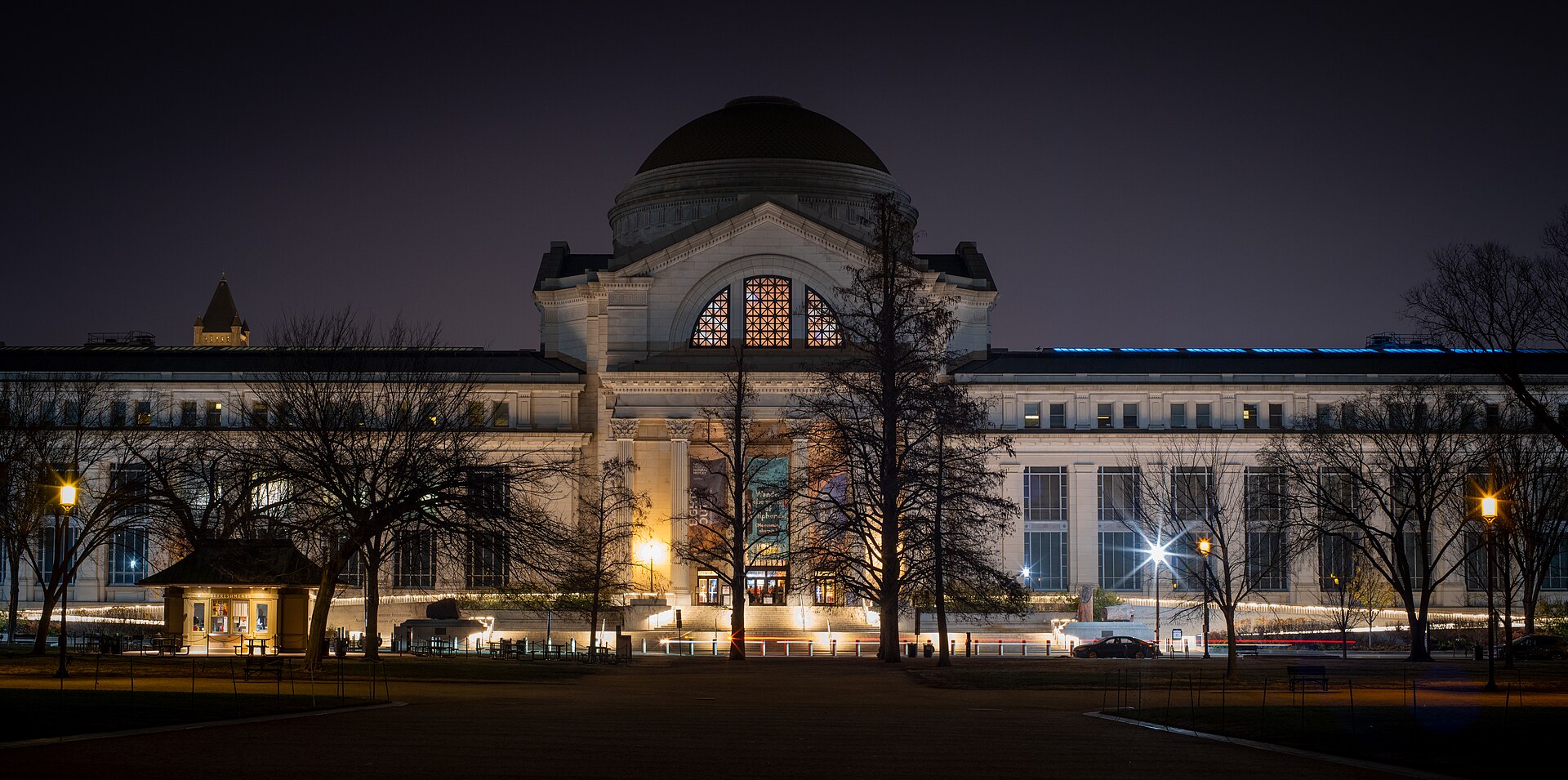
The museum's National Mall facade, with the McKim-designed dome and Corinthian portico completed in 1911.
John Brighenti, CC BY 2.0 · Photograph by John Brighenti from Rockville, MD, United StatesSmithsonian National Museum of Natural History
Museum · Founded 1910
Open, admission and hours confirmed 12 September 2026 · 26 sources
On this page 15 sections
ContentsClose
The museum's declared holdings run to roughly 148 million specimens and artifacts, spanning geology, paleontology, biology, anthropology and the National Gem and Mineral Collection; the great majority is research material held off public view at the Mall building and at the Museum Support Center in Suitland, Maryland, with only a small fraction on exhibit across the three public floors at any time.
| Kind | Museum |
|---|---|
| Founded | 1910 |
| City and country |  Washington, D.C., United States Washington, D.C., United States |
| Address | 10th Street and Constitution Avenue NW, Washington, D.C. 20560, United States |
| Website | naturalhistory.si.edu |
| Status | Open, confirmed |
| Record last verified |
Visiting
- Hours
- Daily10:00 to 17:30Including most holidays
- Closed
- December 25.
- Admission
- General admissionFreeFree to all visitors. No tickets or timed passes required.
- Do I need to book?
- No. Admission is free and no ticket or timed pass is needed for general entry.
- Address
- 10th Street and Constitution Avenue NW, Washington, D.C. 20560, United States MapMetro Federal Triangle station (Blue, Orange, Silver lines) is closest to the accessible Constitution Avenue entrance
Metro Archives-Navy Memorial station (Green, Yellow lines) and Metro Center (Red line) are also within walking distance - Website
- naturalhistory.si.edu
- Telephone
- +1 202-633-1000
- [email protected]
Before you go how long, access, photography, bags, eating, shop
- How long to allow
- The building covers roughly 1.5 million square feet, with about 325,000 square feet of public exhibition space on three floors; a half day is a realistic minimum to see the major halls, and the museum's own materials describe repeat visits as normal given the scale of the collection.
- Access
- All entrances and exits are step-free, all public floors are reachable by elevator, and courtesy manual wheelchairs can be borrowed free of charge at the Evans Gallery Information Desk. Tactile objects are available at Information Desks, video presentations are open-captioned, induction loops are installed at the Rotunda desk and the Hall of Human Origins theater, and verbally-described tours for blind and low-vision visitors are available with two weeks' notice by calling the museum's access line.
- Bags
- Outside food is not permitted inside the museum.
- Eating
- Two dining venues: the Ocean Terrace Cafe on the First Floor (11:00-15:00, coffee bar to 17:00) with a farm-to-table, vegetable-forward menu, and the larger Atrium Cafe on the Ground Floor (11:00-17:00) with family-style options including burgers and a seasonal market table.
- Shop
- Five shops: the Nature Store and Gem and Mineral Store, the Gallery Store and Family Store in the Evans Gallery, and the Dinos and More store near the Hall of Mammals, all open during museum hours.
Prices and hours change. We take them from the institution's own pages and print the day we read them, and you can check the current position at the source we used. Confirm before you travel.
What is inside
David H. Koch Hall of Fossils - Deep Time (First Floor)
Around 700 fossil specimens spanning 4.6 billion years, built around a face-off mount of a Tyrannosaurus rex attacking a Triceratops, plus a woolly mammoth, early reptiles and mammals, and a section connecting past climate change to the present. Reopened in June 2019 after a five-year renovation funded in part by a $35 million gift from David H. Koch.
David H. Koch Hall of Human Origins (First Floor)
An exhibition on human evolution built around reconstructed early-human relatives and a Worldwide Theater installed with an induction hearing loop; part of the same donor-funded renovation programme as the fossil hall next door.
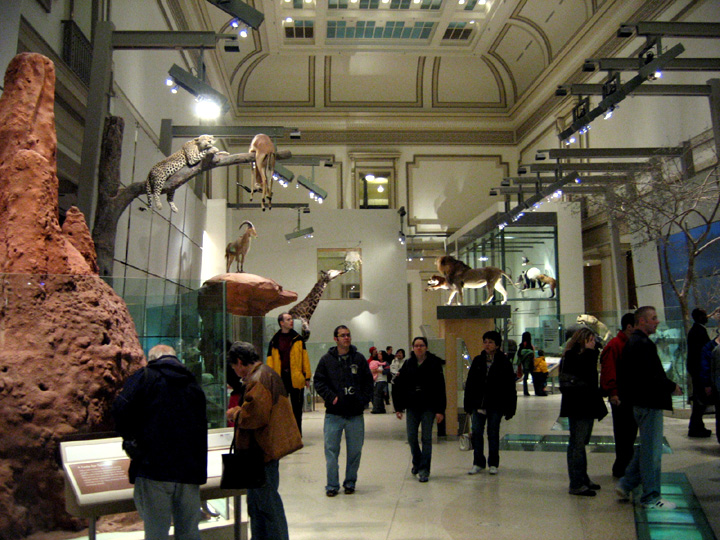
Photograph by Postdlf · CC BY-SA 3.0 Kenneth E. Behring Family Hall of Mammals (First Floor)
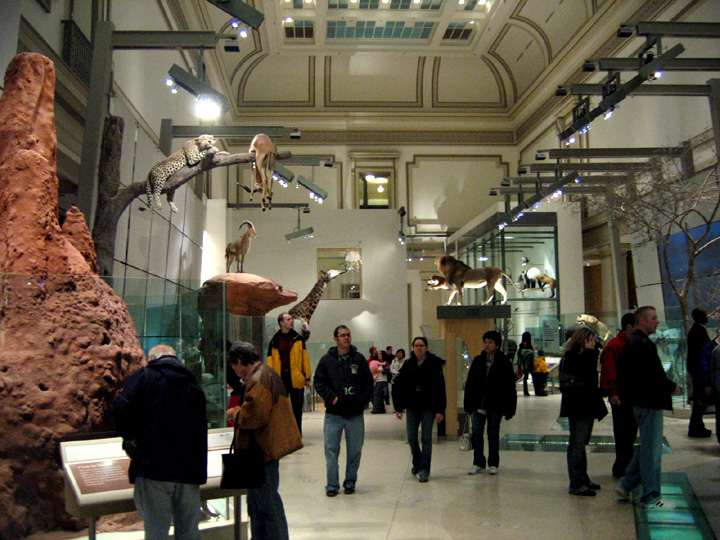
Taxidermied mammals from every continent arranged by habitat and evolutionary relationship, from a leaping tiger to a pink fairy armadillo, illustrating the diversity of the mammal family.
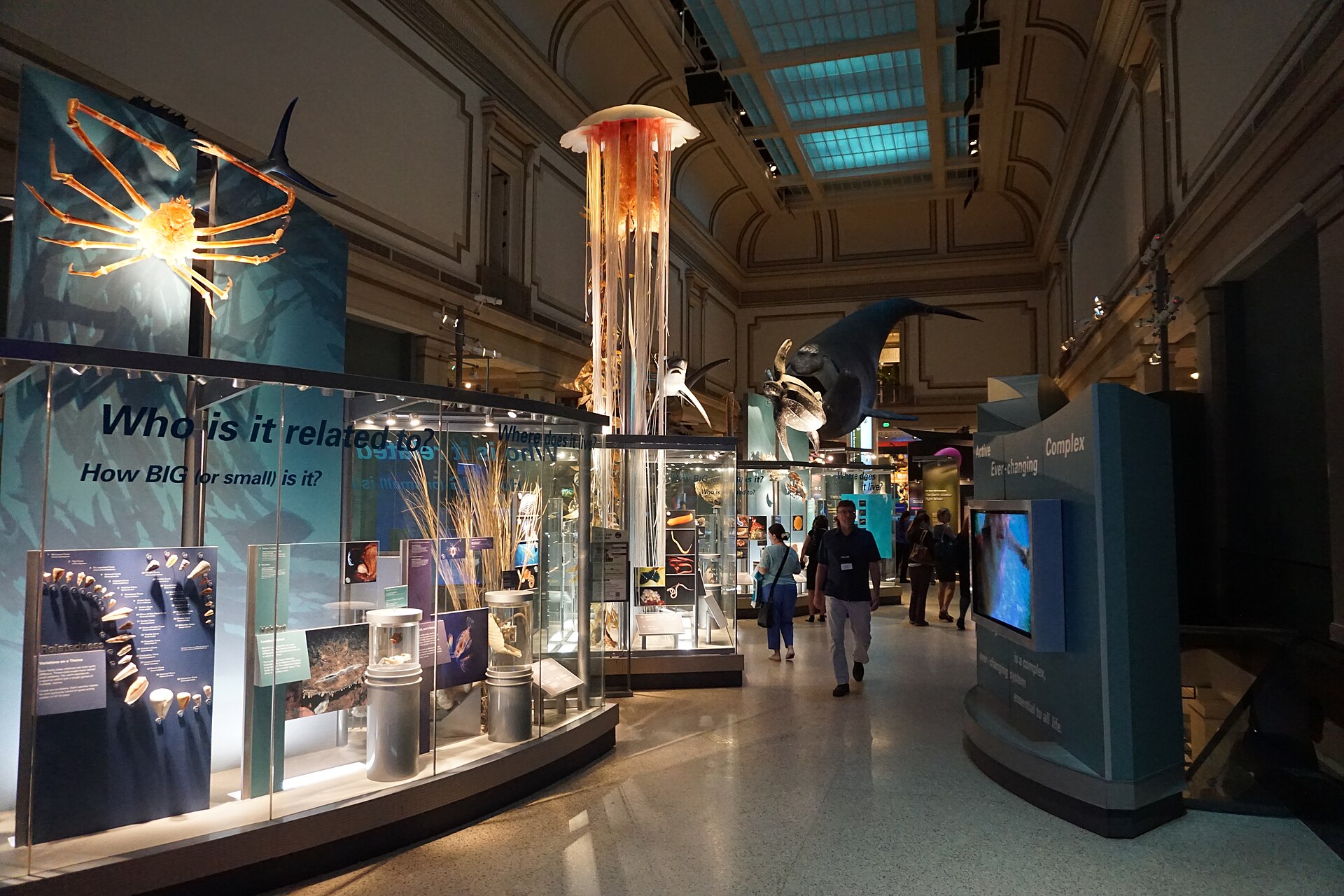
Photograph by Michael Barera · CC BY-SA 4.0 Sant Ocean Hall (First Floor)
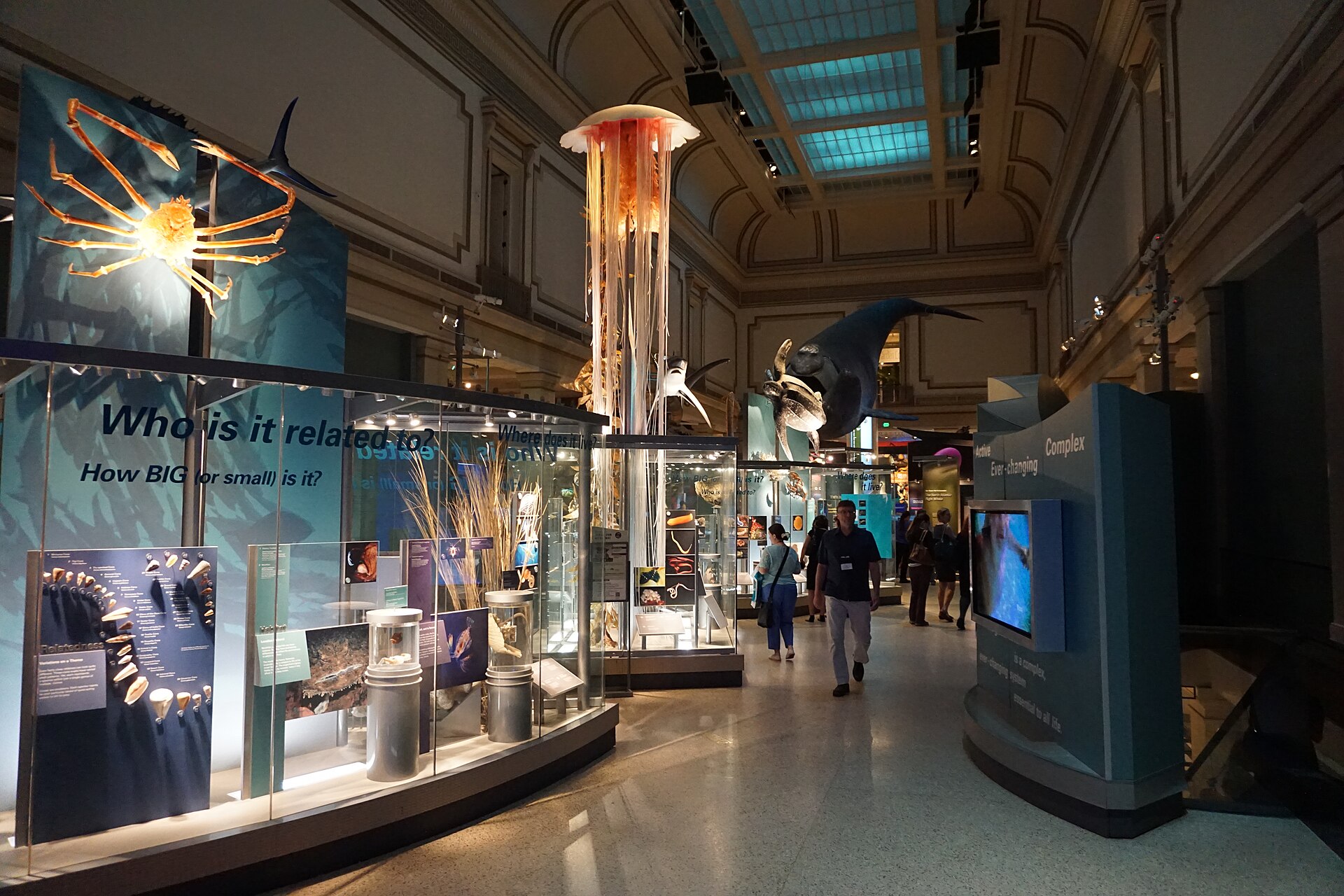
The museum's largest single hall: 674 marine specimens and models across 23,000 square feet, centred on Phoenix, a 45-foot, 2,300-pound life-size model of a North Atlantic right whale tracked by biologists since her birth in 1987, alongside a 24-foot giant squid in a fluid-filled tank. Opened in 2008 with a $15 million gift from Roger and Vicki Sant, developed in partnership with the National Oceanic and Atmospheric Administration.
Janet Annenberg Hooker Hall of Geology, Gems, and Minerals (Second Floor)
The National Gem Collection, including the Hope Diamond, the 168-carat Mackay emerald and diamond necklace, the Carmen Lucia ruby and the Whitney Flame Topaz, alongside touchable meteorites, a walk-through mine exhibit on ore-forming processes, volcanic samples and a real-time global earthquake display.
Eternal Life in Ancient Egypt (Second Floor)
Four mummies more than 2,000 years old, shown with the ceramics, tools and jewelry excavated from their tombs and examined using modern imaging technology.
African Voices (First Floor)
A permanent exhibition on the diversity and global influence of Africa's peoples and cultures across family, work, community and environment.
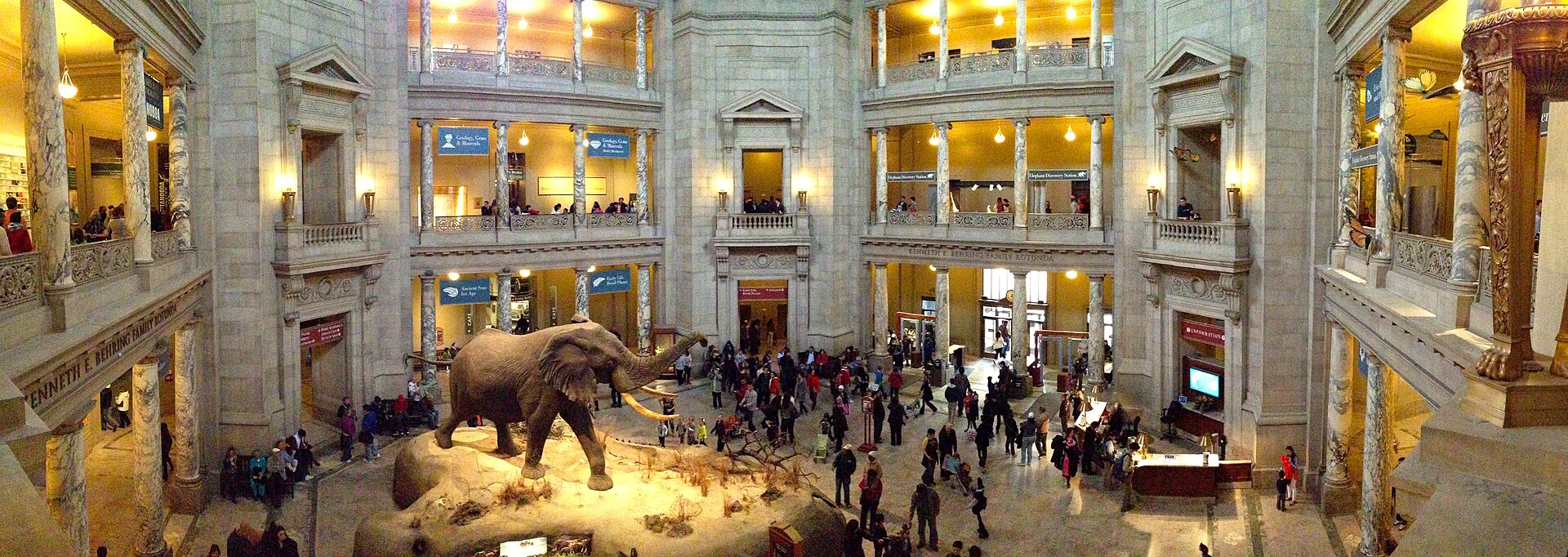
Photograph by Blake Patterson · CC BY 2.0 The Rotunda (Ground/First Floor)
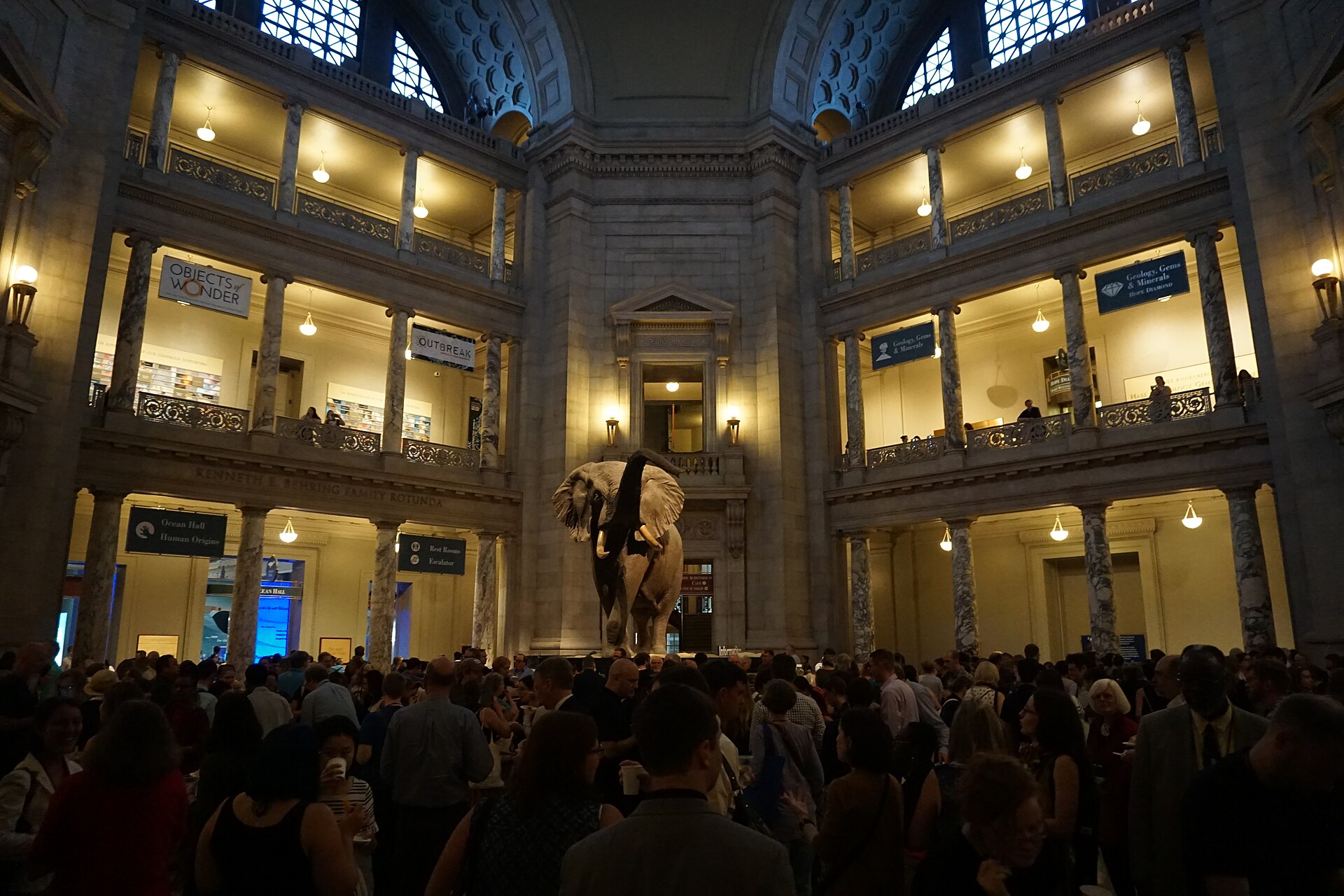
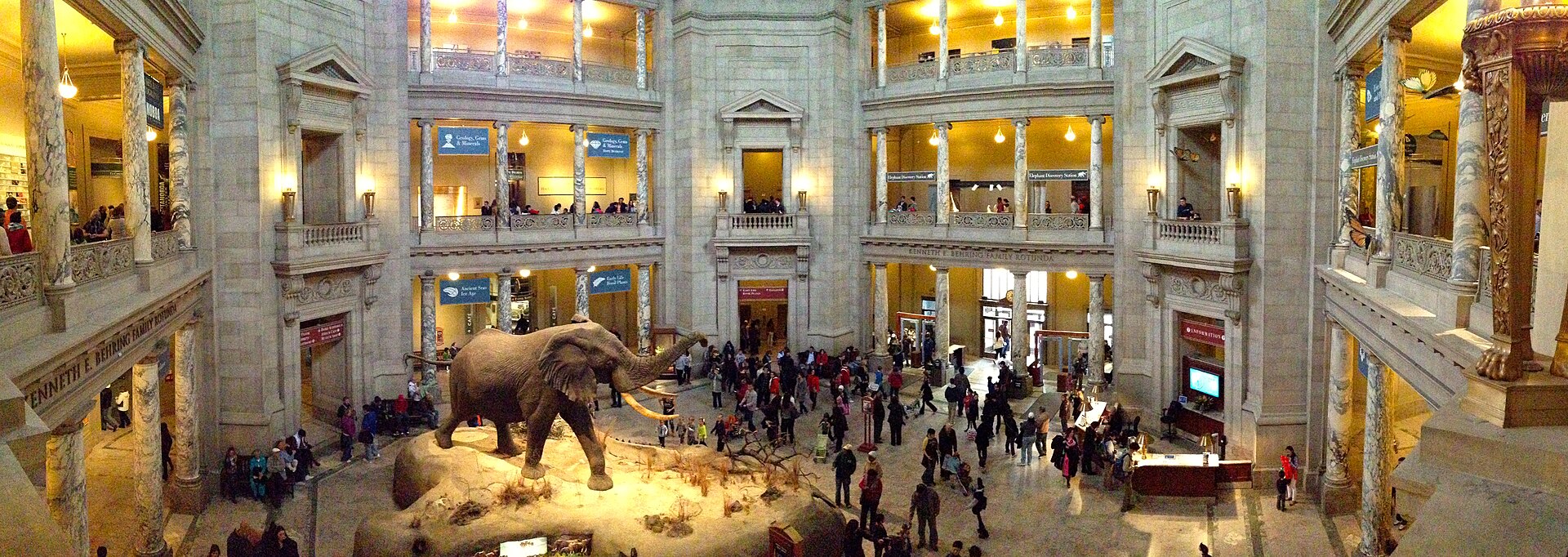
The domed entrance hall under the building's central dome, presided over since 1959 by Henry, an 11-ton, 13-foot-tall taxidermied African bush elephant collected in Angola by the Hungarian hunter Josef Fenykovi and cleaned and remounted in 2015; the Rotunda and its surrounding halls were individually added to the National Register of Historic Places in March 2023.
What to see first
The Hope Diamond
Cut stone of Indian origin, present cut early 19th century, given to the Smithsonian by Harry Winston in 1958The single most requested object in the museum, a 45.52-carat fancy deep greyish-blue diamond displayed in the Hooker Hall of Geology, Gems, and Minerals; this archive holds a full record of the stone.18
Full record in this archiveThe Carmen Lucia Ruby
Mogok, MyanmarDescribed by the museum as one of the largest fine rubies ever found, set as a pendant and shown in the same hall as the Hope Diamond.18
The Whitney Flame Topaz
BrazilOne of the finest large precious topaz gems known, cut into a flame shape and lit for close viewing in the Hooker Hall.18
The Mackay Emerald and Diamond Necklace
Cartier, early 20th centuryA 168-carat Colombian emerald set with diamonds, part of the National Gem Collection alongside the Hope Diamond.18
Tyrannosaurus rex versus Triceratops mount
Fossil specimens, Cretaceous periodThe centerpiece confrontation of the Deep Time hall, a mounted T. rex attacking a Triceratops among roughly 700 fossils tracing 4.6 billion years of life on Earth.17
Phoenix, the North Atlantic right whale model
Full-scale fabricated model, 2008A 45-foot, 2,300-pound suspended model of a real, individually tracked right whale, the centerpiece of the Sant Ocean Hall and, per the Smithsonian, the exhibit's 'ambassador'.9
Henry, the Fenykovi elephant
Taxidermy mount, elephant collected in Angola, 1955The largest elephant mount in the world, greeting visitors from the center of the Rotunda since 1959 and one of the most photographed single objects in any Smithsonian museum.16
The mummies of Eternal Life in Ancient Egypt
Ancient Egypt, more than 2,000 years oldFour mummies shown with grave goods and analyzed with modern scanning technology, forming the museum's Egyptology hall.7
Exhibitions on now
- On now18 Jun 2026 to 31 Dec 2029Confirmed , 7 weeks ago
A rotunda built twice: the museum Congress paid for and the one it actually got
The Smithsonian's founding legislation of 1846 already provided for a National Museum, and the collections that would eventually fill this building started out crowded into the Smithsonian Institution Building, the red sandstone 'Castle' on the Mall. By 1881 they had outgrown even a move to the first purpose-built National Museum building, now known as the Arts and Industries Building, and by 1882 the museum's director was already asking Congress for a third building.
Congress appropriated funds on 30 January 1903, based on a study by the anthropologist William Henry Holmes, and the local firm Hornblower and Marshall was hired to design it; ground was broken on 15 June 1904. Partway through construction, in 1905, Smithsonian Secretary Samuel Langley halted work because the Institution disliked the architects' ornate French Baroque rotunda. Charles Follen McKim of McKim, Mead and White, working alongside Daniel Burnham, was quietly brought in to simplify the design into a plainer Roman profile, a change consistent with the neoclassical vision for Washington that both men had helped set as members of the 1901-02 Senate Park (McMillan) Commission. Construction proceeded on the revised design; by August 1909 staff were already moving roughly ten million objects into the new building by horse-drawn cart, and the museum opened to the public on 17 March 1910, though the building itself was not structurally complete until June 1911. The finished building centers on an octagonal rotunda with Doric columns at ground level and Ionic columns above, topped by a Guastavino-tiled dome with an oculus, with three wings running north, east and west and a Corinthian-columned portico facing the Mall.
From the U.S. National Museum to natural history alone
The building did not start out as a natural history museum; it opened housing art, history and natural history collections together under the single administrative roof of the U.S. National Museum. The First World War interrupted its public life directly: the Bureau of War Risk Insurance occupied the building from 1917 to 1919 and it was closed to visitors. Congress authorized an expansion in 1930 but did not fund it until 1960; the firm Mills, Petticord and Mills then designed matching six-story east and west wings, completed by 1965, connected to the original building at alternating floors and used mainly for offices and collection storage rather than public galleries.
The institutional split that gave the building its present identity came in 1957, when the U.S. National Museum was administratively divided into the Museum of Natural History and the Museum of History and Technology. The history collections moved out to a new building in January 1964 (today the National Museum of American History), and the art and portrait collections followed to new quarters in 1968. With the U.S. National Museum eliminated as an entity in 1967, the natural history holdings became a free-standing unit, formally renamed the National Museum of Natural History on 24 March 1969. As the collection kept growing beyond gallery capacity, the Smithsonian opened the Museum Support Center in Suitland, Maryland, in 1983 to hold specimens and run conservation labs off-site. The Mall building itself, already listed in the D.C. Inventory of Historic Sites since 1964, was individually added to the National Register of Historic Places on 30 March 2023, within the National Mall Historic District.
148 million objects, and the halls that show a sliver of them
The museum's own figure for its holdings is roughly 148 million specimens and artifacts, the large majority never on public display and housed instead in research collections at the Mall building and the Suitland support center. What visitors actually walk through is a fraction of that, arranged across roughly 325,000 square feet of exhibition space on three public floors inside a 1.5-million-square-foot building.
The two most heavily renovated halls carry a shared donor's name. The David H. Koch Hall of Fossils, subtitled Deep Time, reopened in June 2019 after a five-year renovation funded in part by a $35 million gift from David H. Koch, and now walks visitors through roughly 700 fossils spanning 4.6 billion years, built around a mounted confrontation between a Tyrannosaurus rex and a Triceratops. The adjoining David H. Koch Hall of Human Origins, part of the same donor-funded renovation programme, covers human evolution. Two floors up, the Janet Annenberg Hooker Hall of Geology, Gems, and Minerals holds the museum's most photographed single object, the Hope Diamond, alongside the 168-carat Mackay emerald and diamond necklace, the Carmen Lucia ruby, the Whitney Flame Topaz, a walk-through mine exhibit and a live global earthquake feed.
The Sant Ocean Hall, opened in 2008 with a $15 million gift from Roger and Vicki Sant and built in partnership with the National Oceanic and Atmospheric Administration, is the museum's single largest exhibition space at 23,000 square feet, its centerpiece a 45-foot suspended model of Phoenix, a real North Atlantic right whale tracked by marine biologists since her birth in 1987. Nearby, the Kenneth E. Behring Family Hall of Mammals arranges taxidermied specimens from every continent, and Eternal Life in Ancient Egypt displays four mummies more than two thousand years old with their grave goods. None of it competes for attention with the Rotunda's own permanent resident: Henry, an 11-ton, 13-foot taxidermied African bush elephant that has stood at the building's center since 1959.
Free admission and what it means to run a building at this scale
Entry has been free since the museum opened, and it remains free today, seven days a week from 10:00 to 17:30, with the museum closed to the public only on 25 December. No advance ticket or timed pass is required for general admission, a rarity among museums that draw millions of visitors a year, and the museum's own historical materials note that the collections that filled the building on opening day already ran to roughly ten million objects, a figure that has grown to 148 million in the century since. The building's scale creates its own visiting rhythm: multiple gift shops, two cafes, courtesy wheelchairs, tactile-object stations and induction hearing loops in several theaters are all built into the day-to-day operation of a museum sized more like a small campus than a single gallery.
Collecting, and what it cost: the human remains reckoning
This publication treats a museum as a party to provenance, not a neutral host, and this museum's own recent history makes that unavoidable. A Washington Post investigation, summarized in the Smithsonian's own magazine, found that the Institution holds the remains of more than 30,000 individuals, including roughly 250 brains, the great majority acquired without consent during the 19th and early 20th centuries. A significant share came through the work of Ales Hrdlicka, the museum's first curator of physical anthropology, who used the collection in pursuit of now-discredited theories of racial hierarchy sometimes called scientific racism.
The Smithsonian's Secretary, Lonnie Bunch, published a public apology in the Washington Post in 2023, describing Hrdlicka's work as 'abhorrent and dehumanizing' and stating that the Institution bears responsibility both for the original collecting and for decades of failing to return the remains afterward. A Human Remains Task Force, formed in April 2023 with Smithsonian staff and outside experts, published its recommendations in February 2024: that the Smithsonian never again collect, display or use human remains without informed consent from the deceased or their descendants, that it make active efforts to locate descendants of those already held, and that a new repatriation team be created at this museum specifically, since it holds the majority of the Institution's human remains (the rest sit at the National Museum of the American Indian). More than 5,000 individuals' remains have been returned to date under earlier, narrower legal obligations tied to Native American repatriation law; many thousands more remain to be processed under the new policy.
Science and its funders: two exhibits under scrutiny
Two separate episodes, thirteen years apart, show this museum's science running into the politics of who pays for it and who oversees it. In 2006 the museum opened 'Arctic: A Friend Acting Strangely,' an exhibit on Arctic climate change based partly on federal scientific reporting; it had already been delayed six months by internal review. Robert Sullivan, then the museum's associate director for exhibitions, said afterward that the exhibit's text had been rewritten to inject uncertainty into the documented link between human activity and Arctic warming, that scientists' interpretations of some research were omitted, and that graphs were altered to appear more ambiguous than the underlying data supported. He resigned after sixteen years at the museum, saying the changes stemmed not from direct White House pressure but from institutional anxiety about angering the Congressional appropriators who fund most of the Smithsonian's roughly $1.1 billion budget. Museum leadership, including then-director Cristian Samper, denied any political motivation and said the changes were made in the interest of scientific objectivity; some outside scientists consulted on the exhibit agreed nothing essential had been cut. CBS News and NBC News both reported the dispute in 2007, noting it was not the Smithsonian's first such episode: a 1995 exhibit of the restored Enola Gay had already been scaled back after veterans' complaints, and a 2003 photo exhibit on the Arctic National Wildlife Refuge had been moved to a less prominent space during the era's oil-drilling debate.
The second episode is quieter and ongoing. The David H. Koch Hall of Fossils - Deep Time, the museum's flagship fossil hall since 2019, carries the name of a donor who gave $35 million toward its renovation and who, through Koch Industries, ran what the trade press has called the largest privately held fossil fuel company in the United States; the broader Koch network has a long record of funding groups that questioned mainstream climate science. A 2019 analysis by Yale Climate Connections found the finished exhibit scientifically accurate about the reality and causes of climate change, but conspicuously quiet on the specific remedy of reducing fossil fuel consumption: only one of the hall's five climate-themed videos touches on carbon reduction, and that one addresses soil management rather than energy use. Museum director Kirk Johnson said there was 'a bright red line' between the exhibit's content and the funder's views and that Koch had no influence over what the hall says; the analysis's author suggested any influence, if it exists, would be indirect, running through the Institution's general caution about a politically charged topic rather than through any specific instruction from the donor.
What visitors say
Reviewers consistently name this among the best free things to do in Washington and one of the most rewarding natural history museums in the world: the scale of the collection, the free admission with no advance ticket, and the signature halls (Deep Time, the Hope Diamond, the Ocean Hall, the mammal dioramas) draw repeat praise from families and specialists alike. The most consistent complaints concern crowding at peak times and the price and quality of on-site food, not the exhibits themselves.
What is praised, what is criticised
- Praised: Free admission with no advance ticket required, unusual for a museum of this scale and prominence
- Praised: The range and quality of signature halls, especially the fossil hall, the gem and mineral collection, and the ocean hall, cited as reasons to return more than once
- Praised: Manageable and engaging for a wide age range, from young children to specialists
- Praised: Helpful, visible staff and clean, well-maintained public spaces
- Criticised: Weekend and midday crowding and noise are the most frequent visitor complaint, with some reviewers saying it detracts from the experience
- Criticised: On-site cafeteria food is repeatedly described by visitors as overpriced for its quality
- Criticised: Independent reporting by The Washington Post, summarized in Smithsonian Magazine's coverage of the Institution's own Human Remains Task Force, documented that the museum holds the remains of more than 30,000 individuals, including roughly 250 brains, most acquired without consent in the 19th and early 20th centuries, in part under the museum's first curator of physical anthropology, Ales Hrdlicka, who sought evidence for now-discredited theories of racial hierarchy; the Smithsonian's Secretary publicly apologized in 2023 and the task force's 2024 report calls for consent-based collecting and prioritized repatriation
- Criticised: CBS News and NBC News reported in 2007 that a former associate director of exhibitions said the museum's 2006 Arctic climate-change exhibit was internally rewritten to soften the documented link between human activity and Arctic warming, attributed by the museum to a wish for scientific 'objectivity' and by the former administrator to institutional caution about angering the museum's Congressional funders
- Criticised: Yale Climate Connections found the Koch-funded David H. Koch Hall of Fossils - Deep Time scientifically accurate on the fact of human-caused climate change but conspicuously silent on reducing fossil fuel consumption as the primary remedy, given that the exhibit's principal donor built his fortune in the fossil fuel industry
Ratings on other platforms
Tripadvisor: 4.6 from 12,688 ratings, read 12 August 2026
A platform average is a tertiary source: it moves, it is not audited, and we quote no visitor's words.
Questions about Smithsonian National Museum of Natural History
Where is Smithsonian National Museum of Natural History?
10th Street and Constitution Avenue NW, Washington, D.C. 20560, United States.
How much does it cost to visit?
General admission: free. As confirmed 12 September 2026.
When is it open?
Daily 10:00-17:30. Closed: December 25. As confirmed 12 September 2026.
How do you get there?
Metro: Federal Triangle station (Blue, Orange, Silver lines) is closest to the accessible Constitution Avenue entrance; Metro: Archives-Navy Memorial station (Green, Yellow lines) and Metro Center (Red line) are also within walking distance.
What should you see first?
The Hope Diamond (Cut stone of Indian origin, present cut early 19th century, given to the Smithsonian by Harry Winston in 1958); The Carmen Lucia Ruby (Mogok, Myanmar); The Whitney Flame Topaz (Brazil); The Mackay Emerald and Diamond Necklace (Cartier, early 20th century); Tyrannosaurus rex versus Triceratops mount (Fossil specimens, Cretaceous period); Phoenix, the North Atlantic right whale model (Full-scale fabricated model, 2008).
What we could not confirm
- How many of the more than 30,000 human remains the Smithsonian holds specifically sit within this museum's own collections versus the Museum Support Center, and what share have been offered to descendant communities since the 2024 task force report.
- Whether the Deep Time hall's climate messaging has been revised since the 2019 Yale Climate Connections critique.
Images
Sources
- 1Smithsonian National Museum of Natural History, Visit page: hours (10:00-17:30 daily, closed 25 December), free admission with no tickets required, address (10th St. and Constitution Ave. NW), and an August 2026 notice restricting access on 22-23 August for the Freedom 250 Grand Prix. Read in the in-app browser on 12 August 2026. naturalhistory.si.edu/visit
- 2Smithsonian National Museum of Natural History, Contact Us page: general email, mailing address, Press Office number, and the Smithsonian Institution's general phone line 202.633.1000. Read in the in-app browser on 12 August 2026. naturalhistory.si.edu/contact-us
- 3Smithsonian National Museum of Natural History, About page: mission statement and the museum's own figure of 148 million specimens and artifacts. Read in the in-app browser on 12 August 2026. naturalhistory.si.edu/about
- 4Smithsonian National Museum of Natural History, 'A Brief History of NMNH': founding legislation of 1846, the 1903 Congressional appropriation, Hornblower and Marshall, the 1905 McKim redesign of the rotunda, the 1909-1911 construction and opening dates, the 1917-19 wartime closure, the 1960-65 east and west wing additions, the 1957 and 1969 administrative splits, and the 1983 opening of the Museum Support Center. Read in the in-app browser on 12 August 2026. naturalhistory.si.edu/about/brief-history-nmnh
- 5Smithsonian National Museum of Natural History, Accessibility Information page: step-free entrances, elevator access, courtesy wheelchairs, tactile objects, induction loops, described tours, and the nearest Metro stations (Federal Triangle, Archives-Navy Memorial, Metro Center). Read in the in-app browser on 12 August 2026. naturalhistory.si.edu/visit/accessibility
- 6Smithsonian National Museum of Natural History, Dining & Shopping page: Ocean Terrace Cafe and Atrium Cafe hours and menus, the five museum stores and their locations, and the outside-food policy. Read in the in-app browser on 12 August 2026. naturalhistory.si.edu/visit/dining-shopping
- 7Smithsonian National Museum of Natural History, Exhibits listing page: the full current roster of permanent and temporary halls, including Deep Time, Human Origins, Hall of Mammals, Sant Ocean Hall, Hooker Hall of Geology Gems and Minerals, Eternal Life in Ancient Egypt, African Voices and Bone Hall, with floor locations and short descriptions. Read in the in-app browser on 12 August 2026. naturalhistory.si.edu/exhibits
- 8Smithsonian Institution, museum overview page for the National Museum of Natural History: hours, free admission, address, and a list of highlights including the Hope Diamond and Egyptian mummies. Read in the in-app browser on 12 August 2026. si.edu/museums/natural-history-museum
- 9Smithsonian Institution newsdesk, press release 'The New Sant Ocean Hall Opens Sept. 27, 2008': hall size (23,000 sq ft), 674 specimens and models, the $15 million Sant gift, the NOAA partnership, and the Phoenix right whale model and giant squid tank. Read in the in-app browser on 12 August 2026. si.edu/newsdesk/releases/new-sant-ocean-hall-opens-sept-27-smithsonian-s-national-museum-natural-history
- 10DC Historic Sites (DC Preservation League), entry on the National Museum of Natural History building: architects Hornblower and Marshall with Charles F. McKim and Daniel H. Burnham, construction 1904-1911, the 1961-65 east and west wing additions by Mills, Petticord and Mills, and Historic Register/Landmark dates (DC Inventory 1964, amended 2023; National Register 30 March 2023). Read in the in-app browser on 12 August 2026. historicsites.dcpreservation.org/items/show/422
- 11Wikidata, item Q148554 (National Museum of Natural History): confirms the museum as part of the Smithsonian Institution, coordinates, and 17 March 1910 opening date. Read 12 August 2026. wikidata.org/wiki/Q148554
- 12Smithsonian Magazine, Ellen Wexler, 'The Smithsonian's Human Remains Task Force Calls for New Repatriation Policies,' 22 February 2024: more than 30,000 individuals' remains held, roughly 250 brains, Secretary Lonnie Bunch's apology for the work of Ales Hrdlicka, the task force's formation and recommendations, and the 5,000+ individuals already repatriated. Read in the in-app browser on 12 August 2026. smithsonianmag.com/smart-news/smithsonian-human-remains-task-force-calls-for-new-repatriation-policies-180983829/
- 13Yale Climate Connections, Michael Svoboda, 'New Koch-funded fossil exhibit at the Smithsonian is curiously quiet on fossil fuels,' July 2019: the $35 million Koch gift, the specific gaps identified in the exhibit's treatment of fossil-fuel reduction, and museum director Kirk Johnson's on-record denial of donor influence. Fetched directly 12 August 2026. yaleclimateconnections.org/2019/07/new-koch-funded-fossil-exhibit-at-the-smithsonian-is-curiously-quiet-on-fossil-fuels/
- 14CBS News/AP, 'Did Smithsonian Alter Climate Change Show?,' 21 May 2007: Robert Sullivan's allegations about the 2006 'Arctic: A Friend Acting Strangely' exhibit, the museum's denial, Sullivan's resignation, the $1.1 billion Smithsonian budget, and the 1995 Enola Gay and 2003 Arctic Refuge precedents. Read in the in-app browser on 12 August 2026. cbsnews.com/news/did-smithsonian-alter-climate-change-show/
- 15Tripadvisor, attraction review page for Smithsonian National Museum of Natural History: aggregate rating 4.6 out of 5 from 12,688 reviews at time of reading, and the recurring praise (free admission, scale, Hope Diamond) and complaints (crowding, noise, cafeteria pricing) drawn directly from the review text. Fetched directly 12 August 2026. tripadvisor.com/Attraction_Review-g28970-d104867-Reviews-Smithsonian_National_Museum_of_Natural_History-Washington_DC_District_of_Columbia.html
- 16Smithsonian National Museum of Natural History, 'African Bush Elephant' exhibit page: Henry the Fenykovi elephant, collected in Angola, on display in the Rotunda since 1959, 11 tons, 13 feet tall, cleaned and remounted in 2015. Read in the in-app browser on 12 August 2026. naturalhistory.si.edu/exhibits/african-bush-elephant
- 17Smithsonian National Museum of Natural History, 'David H. Koch Hall of Fossils - Deep Time' exhibit page: roughly 700 fossil specimens, the T. rex/Triceratops mount, woolly mammoth, and the hall's climate-change section. Read in the in-app browser on 12 August 2026. naturalhistory.si.edu/exhibits/david-h-koch-hall-fossils-deep-time
- 18Smithsonian National Museum of Natural History, 'Janet Annenberg Hooker Hall of Geology, Gems, and Minerals' exhibit page: the Hope Diamond (45.5 carats, given by Harry Winston in 1958), the Mackay emerald and diamond necklace, the Carmen Lucia ruby, the Whitney Flame Topaz, meteorites, and the earthquake display. Read in the in-app browser on 12 August 2026. naturalhistory.si.edu/exhibits/janet-annenberg-hooker-hall-geology-gems-and-minerals
- 19Wikimedia Commons file page, exterior photograph used as the lead image: licence Creative Commons Attribution 2.0 Generic, photographer John Brighenti, taken 16 December 2023. Fetched directly 12 August 2026. commons.wikimedia.org/wiki/File:Smithsonian_Natural_History_Museum_(53409685715).jpg
- 20Wikimedia Commons file page, interior photograph: licence Creative Commons Attribution-ShareAlike 4.0, photographer Michael Barera, taken 16 August 2018. Fetched directly 12 August 2026. commons.wikimedia.org/wiki/File:National_Museum_of_Natural_History_August_2018_01.jpg
- 21Wikimedia Commons file page, Sant Ocean Hall interior photograph: licence Creative Commons Attribution-ShareAlike 4.0, photographer Michael Barera, taken 16 August 2018. Fetched directly 12 August 2026. commons.wikimedia.org/wiki/File:National_Museum_of_Natural_History_August_2018_03_(Ocean_Hall).jpg
- 22Wikimedia Commons file page, Hall of Mammals interior photograph: dual-licensed GFDL and Creative Commons Attribution-ShareAlike 3.0, photographer Postdlf, taken 8 January 2005. Fetched directly 12 August 2026. commons.wikimedia.org/wiki/File:NMNH_Hall_of_Mammals.jpg
- 23Wikimedia Commons file page, Rotunda panorama: licence Creative Commons Attribution 2.0 Generic, photographer Blake Patterson, uploaded via Flickr. Fetched directly 12 August 2026. commons.wikimedia.org/wiki/File:National_Museum_of_Natural_History_Rotunda_pano.jpg
- 24Smithsonian National Museum of Natural History, Visit page, re-checked: hours unchanged (10:00-17:30 daily, closed 25 December only), admission still free with no tickets or timed-entry pass required, no shutdown or closure notice posted, and the August 2026 Freedom 250 Grand Prix access notice from the prior check is no longer present (that event has passed). Read in the in-app browser on 12 September 2026. naturalhistory.si.edu/visit
- 25Smithsonian National Museum of Natural History, Contact Us page, re-checked: general email [email protected] and Smithsonian Institution general phone 202.633.1000 unchanged. Read in the in-app browser on 12 September 2026. naturalhistory.si.edu/contact-us
- 26Smithsonian National Museum of Natural History, Janet Annenberg Hooker Hall of Geology, Gems, and Minerals exhibit page, re-checked: the Hope Diamond is still displayed in this hall (Second Floor), alongside the Whitney Flame Topaz, the Mackay emerald and diamond necklace and the Carmen Lucia ruby; no renovation, relocation or loan notice found. Read in the in-app browser on 12 September 2026. naturalhistory.si.edu/exhibits/janet-annenberg-hooker-hall-geology-gems-and-minerals
.jpg)

.jpg)

