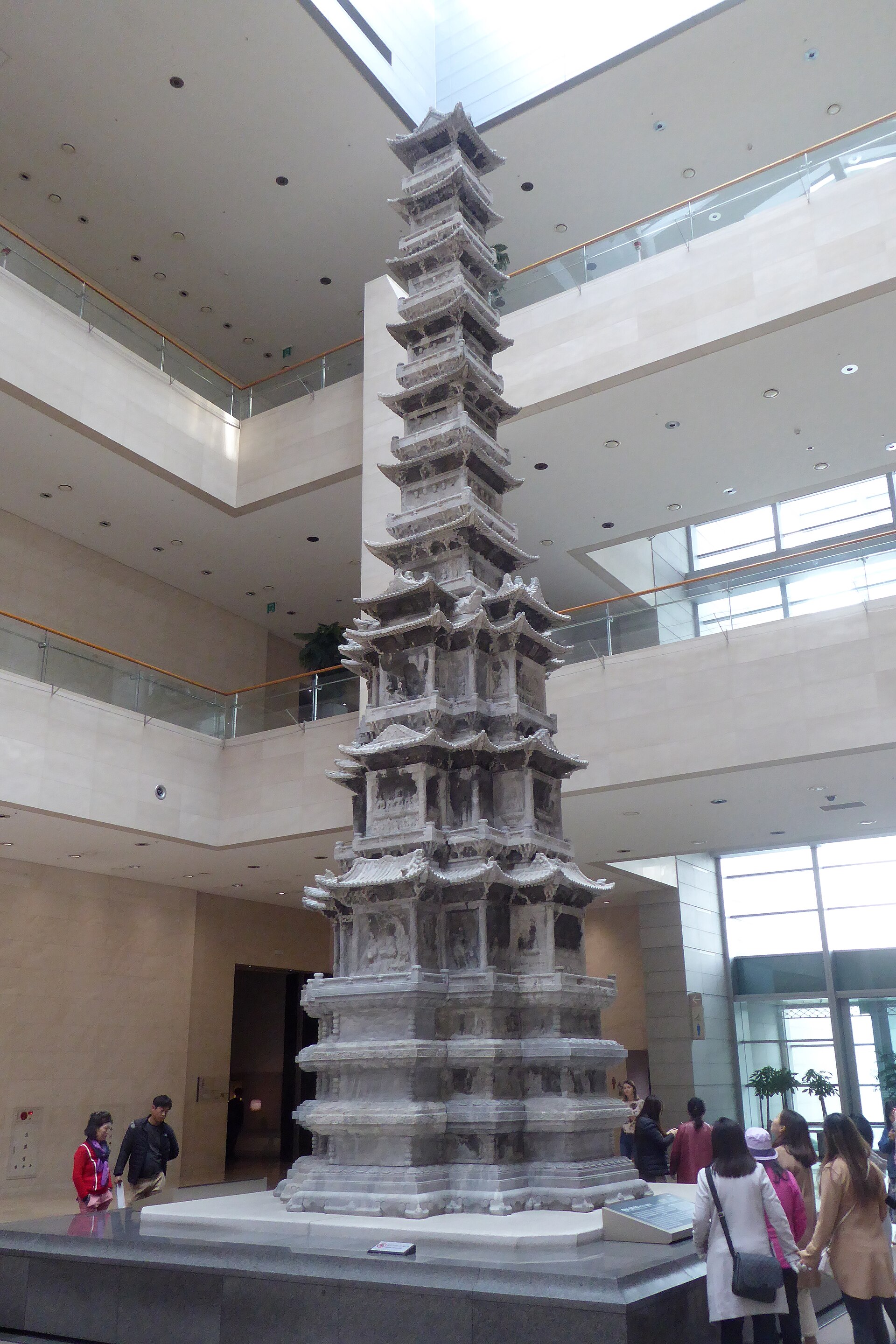
Ten-story Stone Pagoda from Gyeongcheonsa Temple Site
1348 · Marble
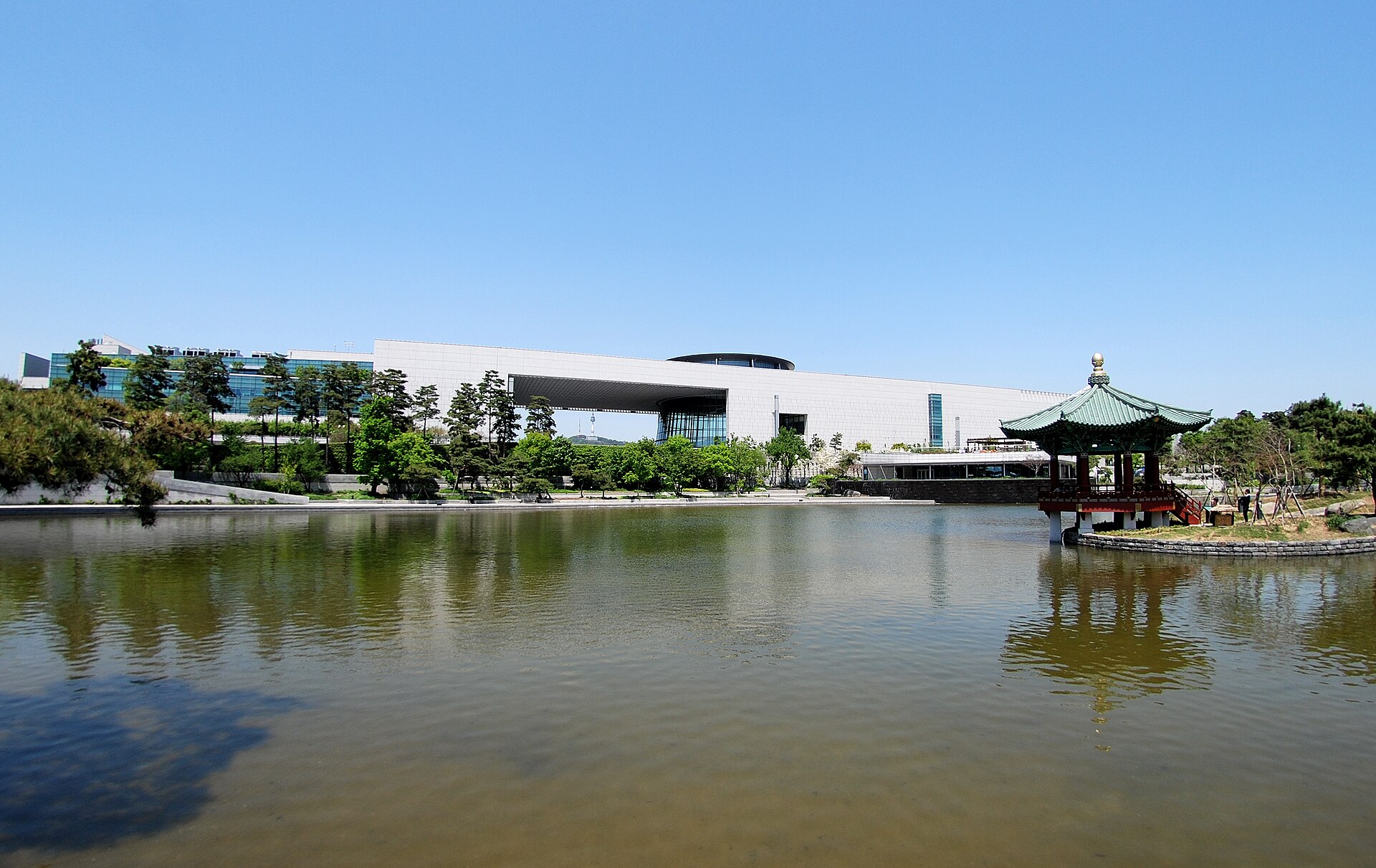
National Museum of Korea, Seoul, standing in one of the main...
Museum · 국립중앙박물관 · Founded 1945
Open, admission and hours confirmed 8 September 2026 · 19 sources
More than 12,044 objects on permanent display at any time, across six sections and 27,090 square metres, running from the Palaeolithic to the Korean Empire of 1897 to 1910, plus a World Art section carrying Chinese, Japanese, Central Asian and Indian material. The depth is in Korean Buddhist sculpture, Goryeo celadon, Joseon buncheong and white porcelain, Joseon painting and calligraphy, Silla goldwork, and the documentary material of the Joseon state. What distinguishes it from a national collection assembled by purchase is that a large share arrived as gifts: more than 12,000 objects were donated between 2000 and 2004 alone, and a whole section of the second floor exists to say so. The state designations are concentrated here too, which is the practical consequence of a register that ranks by rarity being applied to a collection that inherited the colonial-era holdings of the peninsula.
| Local name | 국립중앙박물관 |
|---|---|
| Kind | Museum |
| Founded | 1945 as an institution, on 3 December; the Yongsan building opened 28 October 2005 |
| City and country |  Seoul, South Korea Seoul, South Korea |
| Address | 137 Seobinggo-ro, Yongsan-gu, Seoul, 04383, Republic of Korea |
| Website | museum.go.kr/ENG/main/index.do |
| Status | Open, confirmed 8 September 2026 |
| Record last verified | 11 August 2026 |
Prices and hours change. We take them from the institution's own pages and print the day we read them, and you can check the current position at the source we used. Confirm before you travel.
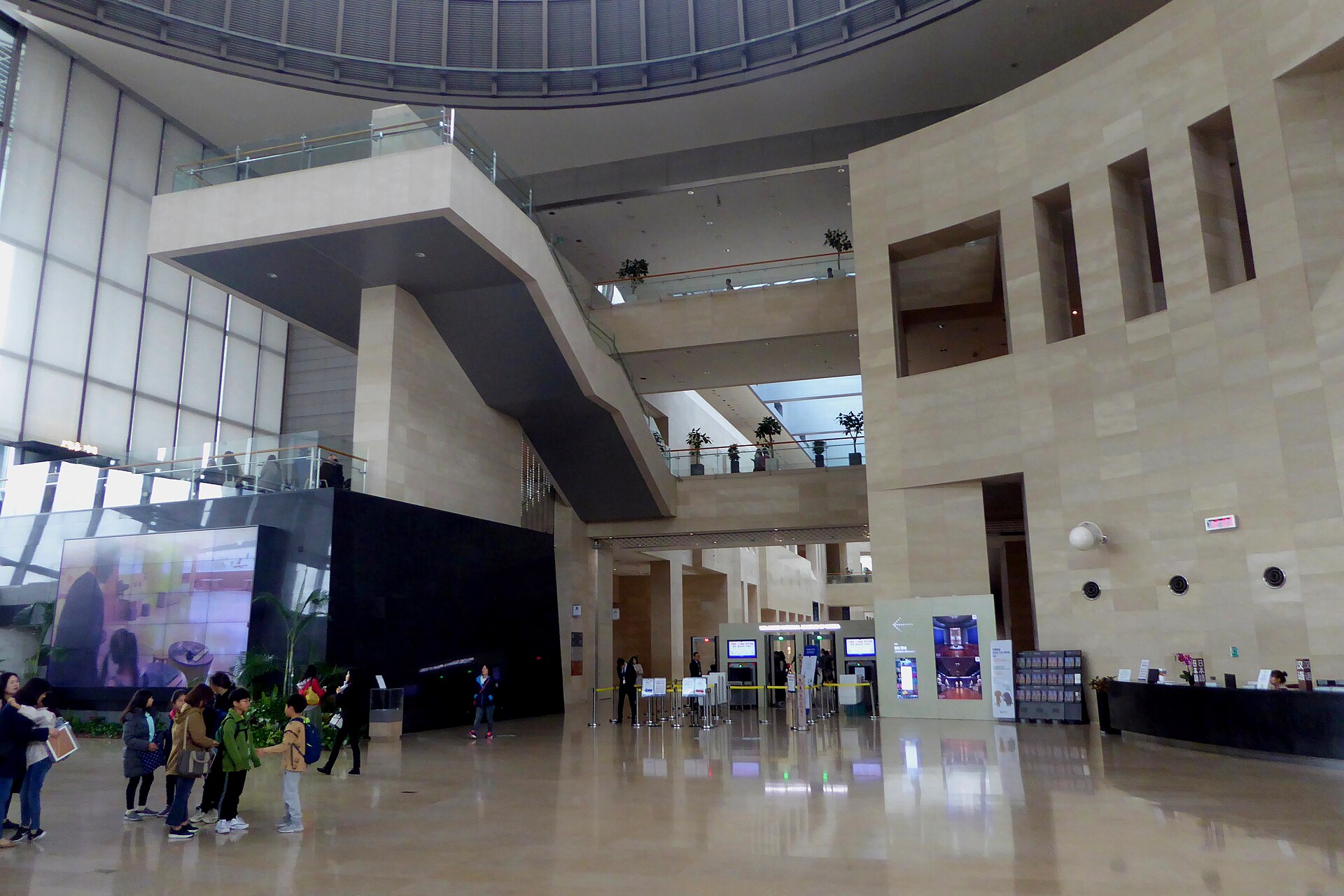
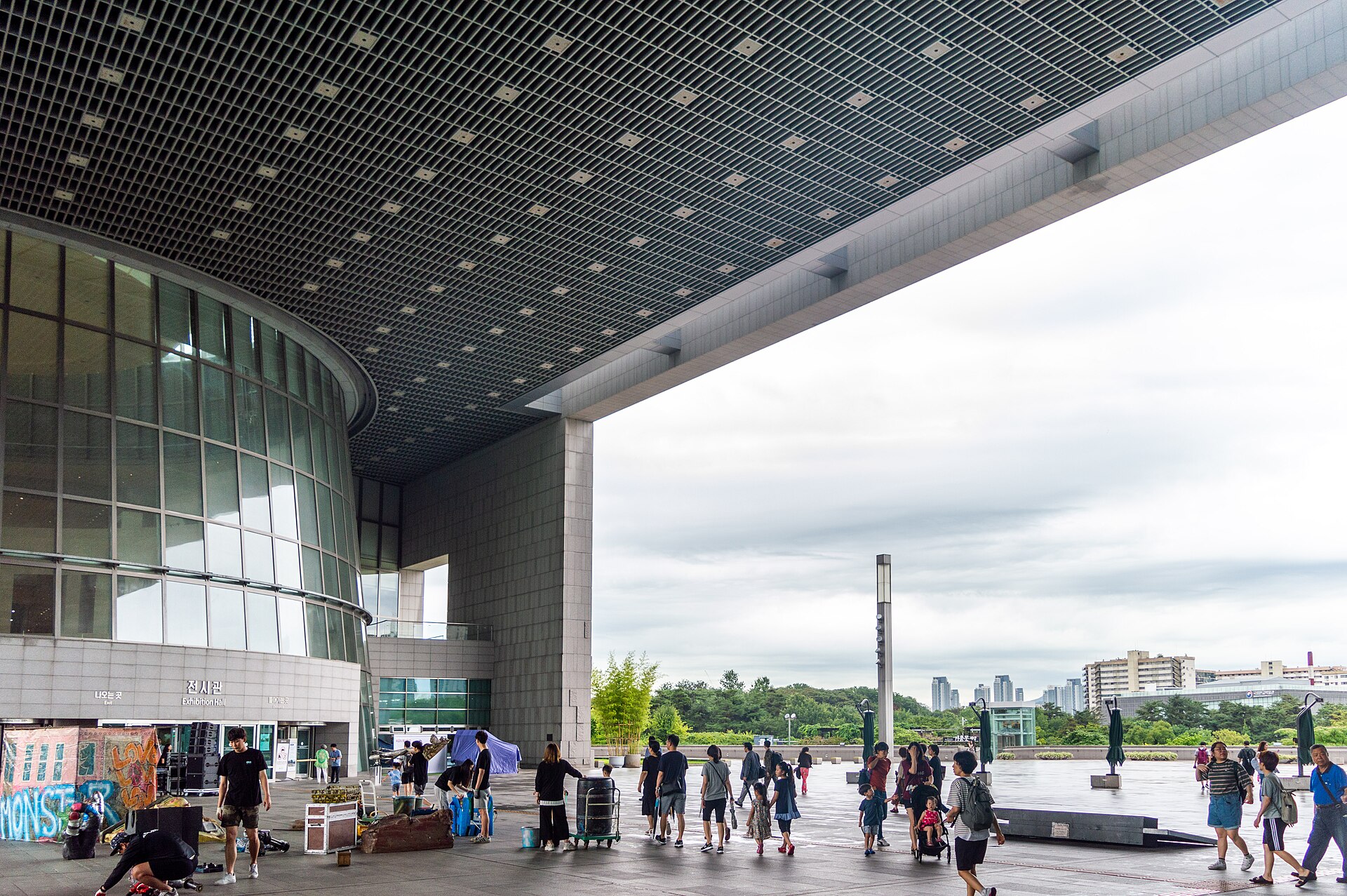
The museum's lobby, on the first floor of the East Wing, and the entrance to the Permanent Exhibition Hall. The museum describes it as a lead-in to the interior, a resting area, a meeting point and the connection between the galleries, and it is where the practical business of a visit happens: the information desk, the free wheelchairs and strollers, the lockers, the lactation room opposite the museum shop. It is a curved, top-lit drum of pale stone rather than a corridor, and because general admission is free there is no ticket queue crossing it.
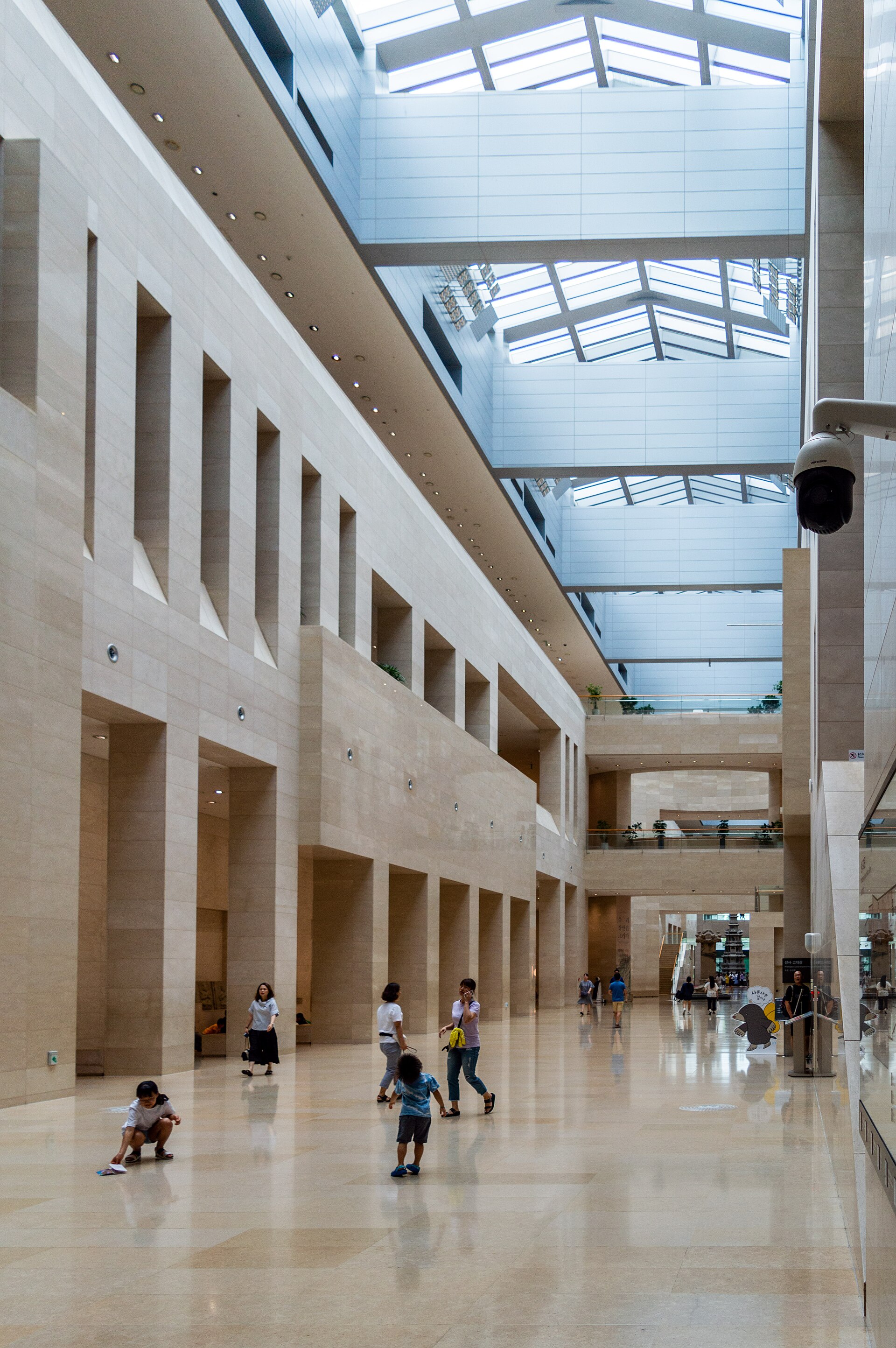
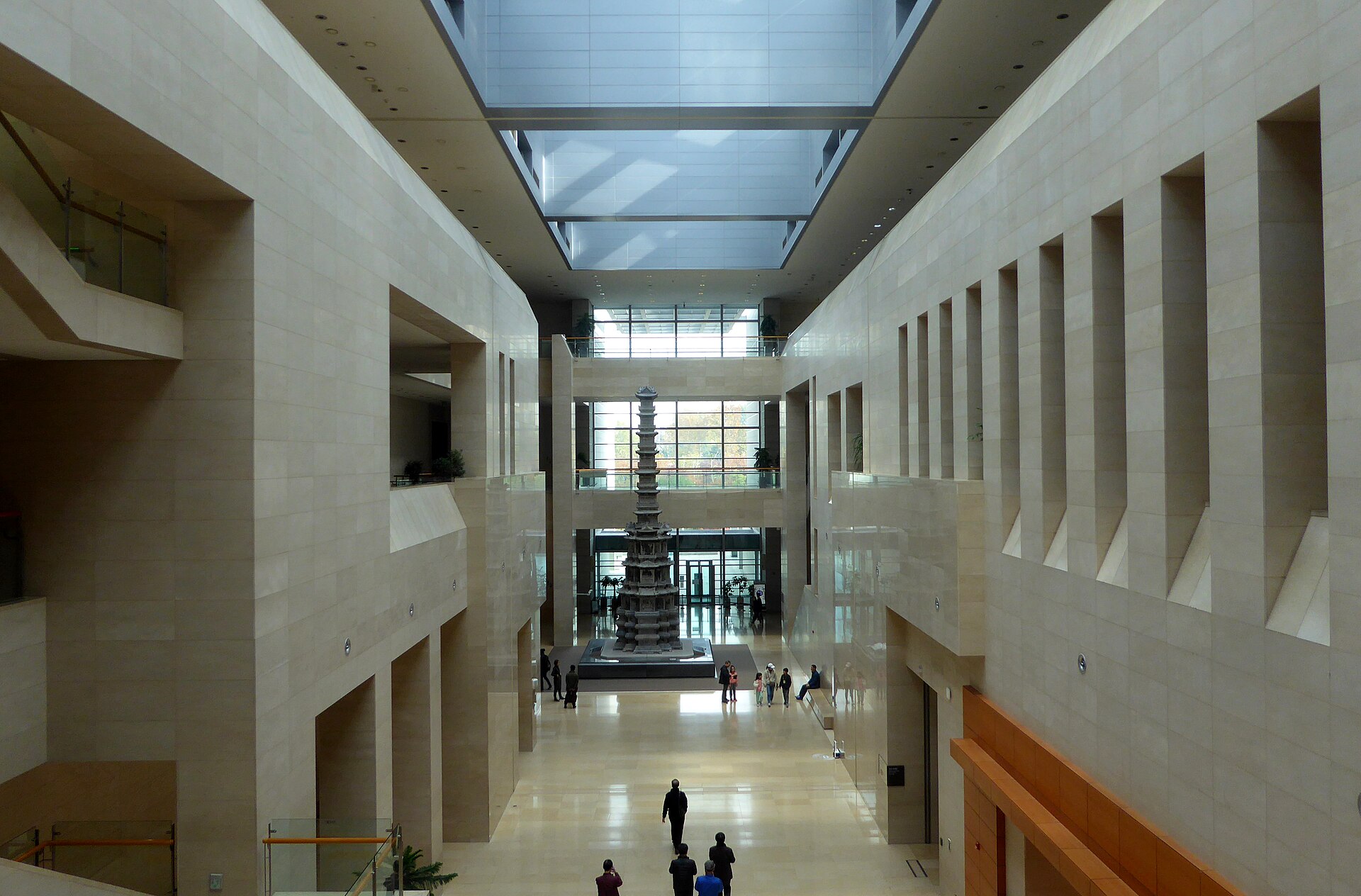
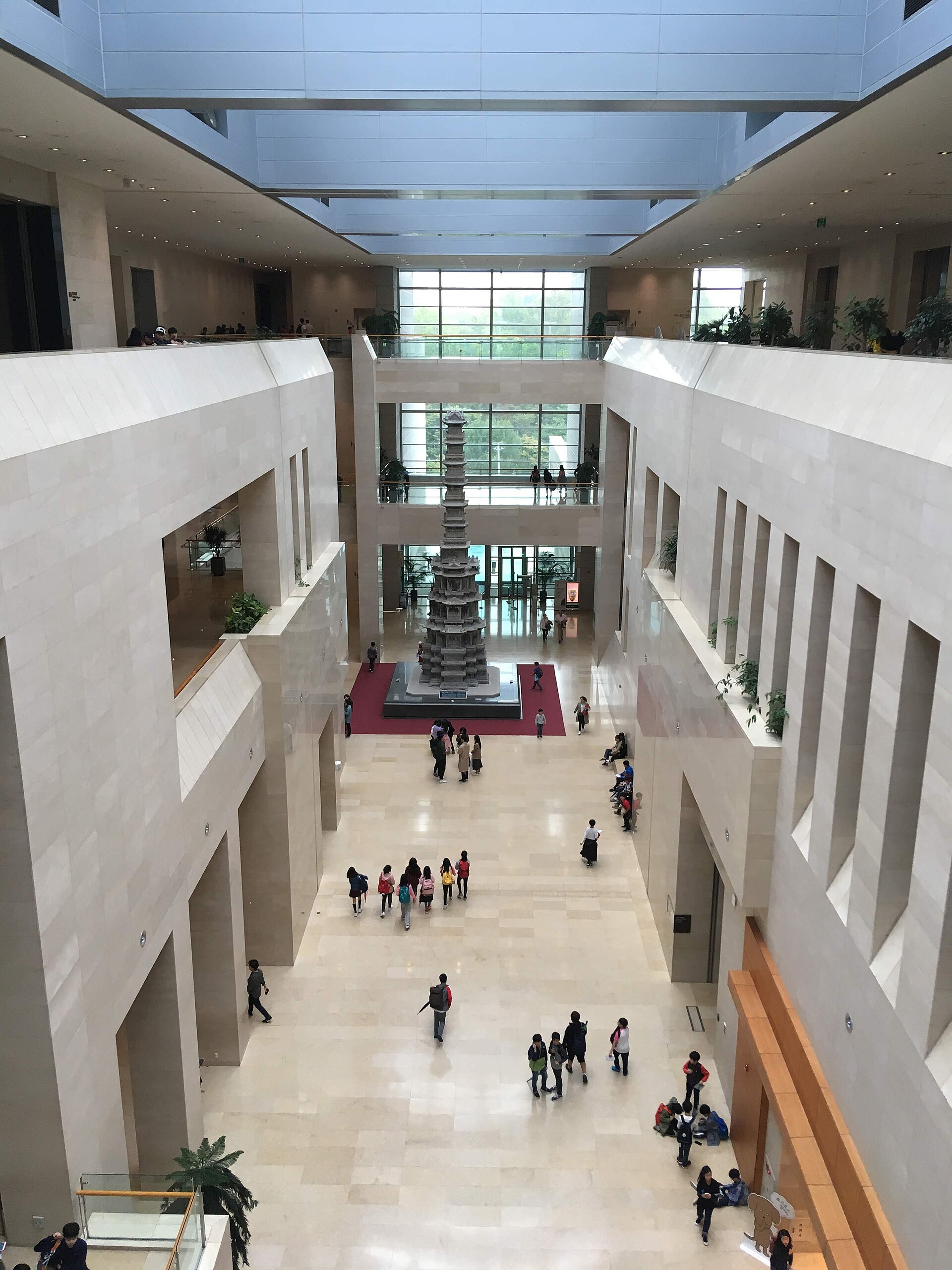
The spine of the building. The Permanent Exhibition Hall is split into a northern and a southern half by this single top-lit avenue, which runs the length of the East Wing and is crossed by bridges in the middle on all three floors, so a visitor can move between the rooms on either side at any level and in any direction rather than being marched through a fixed route. It is a circulation device that doubles as the largest room in the museum.
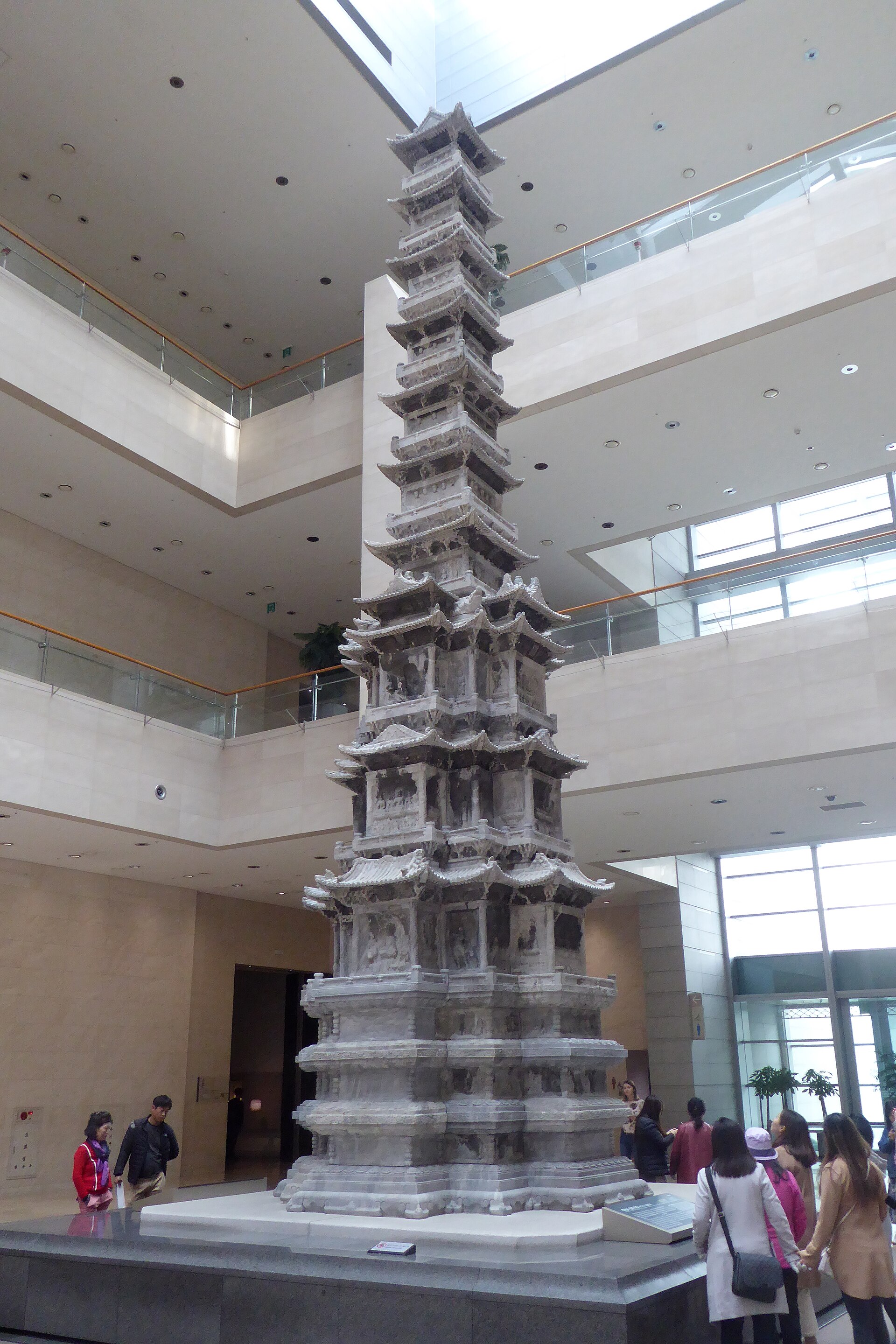
The Path to History terminates in a single object: a marble pagoda of 1348, ten storeys and about 13.5 metres, standing free on a plinth under a roof light with three floors of galleries looking down on it. It is National Treasure No. 86, designated on 20 December 1962. It is also this archive's own Korean record, and it is here because of the history this page has to tell: it was taken to Japan in 1907, returned in 1918, left dismantled at Gyeongbokgung for forty-two years, re-erected outdoors in 1960, and brought inside in 2005 because acid rain was eating the marble.
The earliest material: the museum's own description is artefacts representing some of the earliest evidence of Korean civilisation and culture. In practice this is the Palaeolithic, Neolithic and Bronze Age rooms, then Gojoseon, the Proto-Three Kingdoms, Goguryeo, Baekje, Gaya, Silla and Unified Silla, and it is where the Silla goldwork sits, including the gold crown from Hwangnam Daechong that the state numbers National Treasure No. 191. The July 2010 rehang put the whole floor in chronological order and gave this section its present name; it had been the Archaeological Gallery.

Goryeo from 918 to 1392, Joseon from 1392 to 1897, and the Korean Empire from 1897 to 1910, which the museum presents as the three periods that decided the shape of the Korean state. Rooms 111 to 121 run from Goryeo through the Joseon rooms to the Korean Empire, and the section carries the documents, maps, seals, coinage and court material that a purely art-historical hang would leave out. This was the Historical Gallery until 2010; the Joseon Room was established on 5 August 2010.

The museum's own claim for this section is that it holds many of the world's finest specimens of Buddhist sculpture, metal arts and ceramics. The Buddhist Sculpture Gallery is a dark room with monumental stone and iron Buddhas ranged along both walls and lit figures on a plinth at the end, and the ceramics rooms next to it carry the Goryeo celadon and the Joseon buncheong and white porcelain. This is where the Goryeo celadon openwork incense burner, National Treasure No. 95, is shown. Note the state of the section on the day: Room 301, the Buddhist Sculpture Gallery, and Room 302, the Metal Crafts Gallery, are closed for renovation from 6 July 2026 until 28 January 2027, while the Celadon Gallery in Room 303 and the Buncheong Ware and White Porcelain Gallery in Room 304 stay open.
Traditional Korean painting, Buddhist painting and calligraphy, in rooms that rotate their contents because the material is light-sensitive. The Genre Painting Room was established inside the paintings rooms on 5 May 2011. The section is partly shut in 2026: Room 203, Buddhist Painting, and Room 204, Wood and Lacquer Crafts, closed on 6 July 2026, and Rooms 202-3 and 202-4 close on 10 August 2026, all of them until 28 January 2027, with Rooms 202-1 and 202-2 remaining open.
A single darkened room built for two objects: the two gilt-bronze pensive bodhisattvas, each designated a National Treasure of Korea in its own right, the ones numbered 78 and 83. The museum treats them as the destination they have become rather than as two entries in a sculpture sequence, and gives them a room with nothing else in it. It is the clearest statement the building makes about the difference between a collection and an argument.
Cultural heritage given to the museum rather than acquired by it. The scale of that giving is the point: more than 12,000 objects were donated between 2000 and 2004 alone, in the years when the museum was in temporary quarters and the Yongsan building was going up, which the museum reads as the public endorsing the move. Section 4 of the gallery was closed from 23 to 26 July 2026.
The section the museum describes as reflecting the universal aspects of Asian culture while representing what is particular to each country. It carries Chinese, Japanese, Central Asian and Indian and South-East Asian material, including the wall paintings from Afrosiab at Samarkand and the Bezeklik cave fragments from Turpan, and it is the part of the building where the National Museum of Korea behaves like an encyclopaedic museum rather than a national one. The Japan Gallery was under a temporary closure notice dated 15 July 2026.

A separate hands-on museum in the West Wing with its own entrance, where the exhibits are built to be handled and the subject is Korean history and traditional culture. It is free like everything else, but it is the one part of the building that must be booked: entry runs in timed sessions of about eighty minutes and only 320 online tickets are released per session.

The Yongsan site runs to 307,227 square metres, of which the building covers 45,438, so most of it is park: water, planting, and stone monuments set out in the open, including pagodas and lanterns brought here from temple sites around the country. It opens at seven in the morning and closes at ten at night, three hours before the galleries open and four after they shut, and it needs no ticket of any kind. For a visitor arriving on a day when the galleries are closed, this is still open.
The two Special Exhibition Galleries on the first floor of the West Wing take the charged shows and the loans from abroad, which is where the museum's admission model stops being free. On 5 August 2026 they held Amazing Thailand: Masterpieces of Thai Art, running 23 June to 6 September 2026, and The Korean Table: Food, Nature, and Life, 1 July to 25 October 2026. Above them the Beogeum Hall, a twelve-metre drum a little smaller than the Great Hall, is the lobby to the Yong theatre and the West Wing's answer to the East Wing's axis.
One of the two gilt-bronze bodhisattvas the museum has given a room of their own. The museum names it, alongside No. 78, at the top of its own account of what is on permanent display, and puts the pair in the Room of Quiet Contemplation with nothing else to look at.2
The other half of that room. Two objects of the same subject, both designated at the highest state level, shown together: a comparison the state register makes possible and almost no other museum can stage.2
Thirteen and a half metres of marble at the end of the museum's main axis, and the single object on this page whose provenance chain this archive already holds: removed to Japan in 1907, returned in 1918, left dismantled for forty-two years, re-erected in 1960, designated in 1962, brought indoors in 2005 because acid rain was attacking the stone.2
Full record in this archiveThe museum names it among the four National Treasures it leads with, and it is the argument for the celadon rooms on the third floor: a technical demonstration in a glaze Korea made better than anyone. Room 303 stays open through the 2026 to 2027 renovation.2
The fourth object the museum puts at the head of its own list, and the anchor of the Silla rooms on the first floor. Excavated goldwork rather than a temple survival, so it carries a findspot rather than a chain of owners.2
The museum features it among the collection objects on its own front page. Outdoor ritual scrolls are enormous, are shown rarely because of it, and are the sort of object a visitor will not have anticipated from a gallery plan.9
One of the collection pieces the museum itself puts forward, and the kind of Joseon scholar portrait that carries an identified sitter, which makes it usable as evidence rather than only as a picture.9
Also selected by the museum on its own front page. Geumgangsan is in North Korea, so an eighteenth or nineteenth-century album of its scenery held in Seoul is a record of a landscape the painter could reach and the present audience cannot.9
The National Museum of Korea was established on 3 December 1945, and it did not start from nothing. It started by taking over the Joseon Governor-General Museum, which the Japanese colonial administration had opened inside Gyeongbokgung Palace on 1 December 1915, and which had been running for thirty years by the time Korea regained its independence on 15 August 1945. The museum states this on its own history pages in exactly those terms. Fifteen weeks separate the end of colonial rule from the founding of the national museum, and what happened in that gap was an institutional handover: buildings, collections, catalogues and registers passing from an occupying government's museum to the museum of the state that succeeded it.
That inheritance is the fact from which everything else on this page follows. A collection assembled under an administration that was also removing Korean objects to Japan became the founding collection of the country's national museum, and the museum has spent eighty years both showing it and arguing about where it should be shown. For an archive concerned with how objects come to be where they are, this is not background. It is the provenance of the institution itself.
Almost no museum of comparable standing has moved as often. A branch opened at Gongju in April 1946. In December 1950, with the Korean War running, the collections were evacuated to Busan and kept at an office in Gwangbok-dong; in August 1953 the museum moved to a branch on Namsan. In June 1955 it opened at Seokjojeon inside Deoksugung Palace, after the director Kim Chaewon asked President Syngman Rhee for a building and Rhee ordered part of the war-damaged palace repaired for the purpose. In May 1969 the museum was reorganised and merged with the Deoksugung Art Museum.
On 25 August 1972 it moved again, into its first purpose-built home: a 14,000 square metre building inside Gyeongbokgung, designed and built by the heritage administration as a replica of a national-treasure-grade wooden building, on the site the National Folk Museum occupies today. That is the moment the institution formally took the name National Museum of Korea. Fourteen years later it moved a fourth time, into the converted former Joseon Government-General building, which opened as a museum on 21 August 1986 after an initial investment of 27.7 billion won and showed about 7,500 objects in twenty rooms with new lighting, climate control, and fire and theft systems throughout. Then, in December 1996, it moved to the renovated Social Education Center in Gyeongbokgung, the building that now houses the National Palace Museum of Korea, and stayed there for eight years while Yongsan was built. Seven addresses in sixty years, and the collection was packed and unpacked at every one.
The 1986 move is the episode that decided where the museum is now. Putting the national collection inside the former Joseon Government-General building stirred, in the museum's own published words, a considerable amount of controversy, because many Koreans saw that particular building as a symbol of colonialism. The objection was not to the fabric or the fittings. It was that the state's most valuable Korean objects were being displayed inside the headquarters from which Korea had been governed by Japan.
The government's response was not to relabel the building or to reinterpret it. It demolished it, and commissioned a new museum somewhere else. The site chosen was Yongsan Family Park; the ground was broken on 31 October 1997; the project was expected to take about a decade, and did. Between 1996 and 2004 the museum operated out of temporary quarters, and during those years the public gave it more than 12,000 objects, which the museum reads as an endorsement of the decision to move. On 17 October 2004 the Gyeongbokgung galleries closed for the last time.
It is worth being precise about what was decided here, because museums rarely get to make this choice so plainly. A state weighed the utility of a large, modern, centrally sited museum building against what the building meant, and concluded that the meaning was disqualifying. Nothing on this page matters more to understanding the Yongsan building than the fact that it exists because its predecessor was pulled down on those grounds.
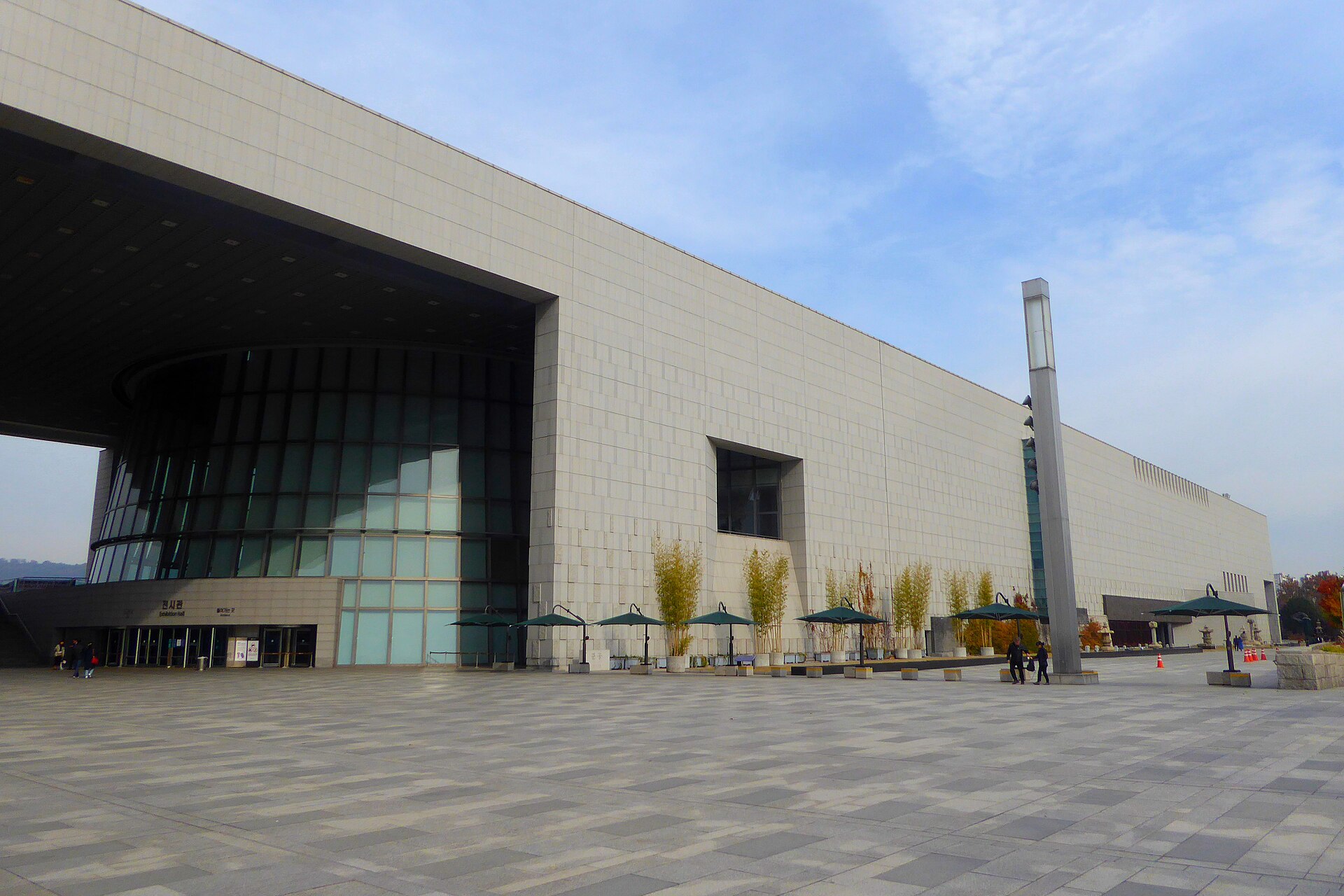
The new museum opened on 28 October 2005 on a site of 307,227 square metres, with a building area of 45,438. The museum sets out its own reasoning for the location: Yongsan is the geographic centre of Seoul, backed by Namsan and fronted by the Han river, sitting south of the Joseon palaces and the war memorial and north of the national library and the arts centre. What that produces in practice is a museum inside a park rather than on a street, which is why the walk in from Ichon Station is a walk across grounds and why the outdoor exhibition area can keep its own hours.
The Permanent Exhibition Hall occupies the first three floors of the East Wing and carries 27,090 square metres of display space, and it is organised around one device: the Path to History, a single top-lit avenue that runs the length of the hall and splits it into a northern and a southern half. Bridges cross it in the middle on every floor, so the galleries on either side can be entered from either direction at any level, and no visitor is committed to a route. The museum's own description is a bridge between past and future that also manages the movement of visitors, which is an unusually candid way of saying that the most impressive room in the building is a corridor. It works because the corridor terminates in the Gyeongcheonsa pagoda, and because the alternative, the forced circuit, is what makes large museums exhausting.
The West Wing carries the two Special Exhibition Galleries and the Children's Museum on its first floor, and the Beogeum Hall above them: a twelve-metre drum, slightly smaller than the Great Hall, forming the lobby to the Yong theatre. The museum treats the Great Hall and the Beogeum Hall as the paired axes of the two wings. The public arrived in numbers immediately: more than 100,000 people in the first three days, a million in forty-four days, ten million in about three and a half years. In 2009 the museum counted 2,730,204 visitors, which it records as the highest attendance in Asia and tenth in the world on the Art Newspaper's ranking, and it was ninth the following year.
General admission to the permanent galleries costs nothing. Not a reduced rate, not a free day, not a free evening: the museum states that it began admitting visitors free to all of its permanent exhibitions in 2008, and its current visitor information page prints the fee for the permanent exhibition halls as free, with charges applying only to special exhibitions. The Children's Museum is free as well, though it runs on timed sessions with 320 online tickets released per session, so that is the one part of the building where a visitor can be turned away. The Pagoda Garden and the outdoor exhibition area are open from seven in the morning until ten at night and require no ticket of any kind.
For one of the largest museums in Asia, holding more than 12,044 objects on permanent display across six sections, this is the single most consequential thing a visitor can know, and it changes how the building should be used. There is no economic reason to try to see it all in one visit, no sunk cost pushing a tired visitor through a seventh gallery, and no ticket queue in the Great Hall. The museum's own framing, in its account of the Yongsan years, is that free admission altered the perception that a museum is somewhere you go once. It also means the honest advice for a first visit is to pick two sections and leave, which is advice a paid museum can never give.
Korean objects carry state designations, and this museum's own account of its collection leads with them: the Pensive Bodhisattva as National Treasure No. 78 or No. 83, the Goryeo celadon openwork burner as No. 95, the Gyeongcheonsa pagoda as No. 86, the Silla gold crown as No. 191. Those are not museum inventory numbers. They are entries in a national register maintained by the Korea Heritage Service and decided by its heritage committee, and the distinction the register draws is one of rarity: the service's own published criteria describe National Treasures as objects that are unprecedented, unique and rare in their field or era, and Treasures as important tangible property of slightly lesser value but still representative, covering buildings, books, paintings, sculpture, archaeological material and weaponry. The service is explicit that the relative importance of a Treasure against a National Treasure is hard to judge.
For an archive built on attribution this is a register worth understanding, because it is one of the few places where a state, rather than a market or a scholar, publishes a ranked judgement on objects and stands behind it. Its own history reads as provenance. The first list of Korean cultural treasures was issued in 1938 by the Governor-General of Korea under the colonial administration's Chosen Treasures Act; in 1955 the South Korean government redesignated as National Treasures the items that had been listed under the occupation's preservation order; and the register in its present form dates from the Cultural Protection Act of 20 December 1962, which is why so many designations, including the Gyeongcheonsa pagoda's, carry December 1962 dates. There were 116 National Treasures then. By May 2026 there were 368 distinct entries.
Then, on 19 November 2021, the numbers were abolished. A new enforcement decree stopped assigning designation numbers to nationally designated heritage of any class, and the reported reason is precise and instructive: the numbers had only ever recorded the order in which things were designated, and the public had read them as a ranking, which produced arguments about which object outranked which. Sungnyemun ceased to be national treasure No. 1 and became simply the national treasure Sungnyemun. The old numbers survive because everyone still uses them, this museum included, and the archive that keeps citing them should know that it is citing a system its own state has retired for being routinely misread.
A great deal of Korean material is not in Korea. The Korea Heritage Service and the Overseas Korean Cultural Heritage Foundation reported in February 2026 that as of 1 January 2026 they had identified 121,143 catalogued records comprising 256,190 Korean artefacts abroad, from surveys of 801 museums, galleries and institutions in twenty-nine countries. Japan holds the largest share, 110,611 items or about 43.2 per cent; the United States 68,961; Germany 16,082; the United Kingdom 15,417. The total rose by 8,472 items in a single year, not because more left, but because more institutions published their holdings. When the foundation started in 2012 the figure stood at about 152,915.
The agencies are careful, and so is this page: some of that material left Korea through purchase, collecting, donation and diplomatic gift, and some was taken by theft and looting during the foreign interventions of the late nineteenth century and the colonial period of 1910 to 1945. Recovery work concentrates on the second category. Through the foundation, 1,299 repatriation cases covering 2,855 objects had been completed as of January 2026, and the split is the striking figure: 96.2 per cent came back as donations and only 3.8 per cent through purchase or negotiated acquisition. Recent returns include a royal signboard from the Seonwonjeon hall at Gyeongbokgung, Goryeo Buddhist manuscripts and early Joseon Buddhist paintings, and Gwanwoldang, an entire building taken to Japan in the colonial period, dismantled, returned after years of negotiation and reinstalled at Paju.
Inside this museum the case that carries the whole argument is the pagoda at the end of the Path to History. It was removed from its temple site to Japan in 1907, returned in 1918, and then lay dismantled on the grounds of Gyeongbokgung for forty-two years before being re-erected in 1960; it was designated in 1962 and brought indoors in 2005 because acid rain was destroying the marble. A visitor who walks the length of the museum's principal axis is walking toward an object that has been removed, restored, reassembled and rehoused, and this archive holds that chain as a record in its own right. The museum has also now put on show two objects recovered from the demolition of the former Japanese Government-General building in 1996, a ridge-beam inscription and the silver plate from its cornerstone, which means the cornerstone of the building the state pulled down for what it symbolised is an exhibit in the museum that building once housed.
Anyone planning a visit in the second half of 2026 needs the closures, because they are extensive and the museum publishes them plainly. A gallery renovation running from 6 July 2026 to 28 January 2027 has shut the Buddhist Sculpture Gallery in Room 301, the Metal Crafts Gallery in Room 302 and the Room of Sense on the third floor, and the Buddhist Painting room 203 and the Wood and Lacquer Crafts room 204 on the second; Calligraphy and Painting rooms 202-3 and 202-4 join them from 10 August 2026. The museum gives 29 January 2027 as the reopening date and lists what stays open: Calligraphy and Painting rooms 202-1 and 202-2, the Celadon Gallery in Room 303 and the Buncheong Ware and White Porcelain Gallery in Room 304. Separate notices closed the Japan Gallery in July 2026 and Section 4 of the Donated Collection between 23 and 26 July. The plain reading is that a visitor arriving in August 2026 for Buddhist sculpture or Buddhist painting will not see it, and the museum's front page says so rather than burying it.
The larger gap is not a closure. When the museum reopened its Korean Empire Gallery on 30 July 2026 it was reported that some hold a dedicated gallery for the Japanese colonial period to be needed, and that the museum's answer is a lack of space and an intention to build one when a second permanent exhibition hall exists. That is a considered position rather than an evasion, and it is also the most significant absence in the building: an institution founded in 1945 by taking over a colonial museum, whose predecessor building was demolished for what it symbolised, and which now displays the cornerstone plate of that building, still has no gallery devoted to the period that produced all three. The same reopening restored the Korean Empire itself to the sequence, with a distinct gallery replacing a third Joseon room, 65 objects including seven Treasures, and Gojong's imperial portrait by Chae Yong-shin brought out after roughly seven years in storage; the museum's director, Yoo Hong-june, made the case at the press conference that a national museum's displays carry more weight than an approved textbook, and that the period should be read as a state attempting its own transition to modernity rather than as a prelude to ruin. The report is an acknowledged translation from Korean and warns that its quotations may not match the original wording, so nothing from it is quoted here.
This page reproduces no visitor review prose and cites no platform average, so what follows is drawn from the museum's own published statements and figures and from named journalism we fetched. The museum is free, very large and heavily used: it records more than 100,000 visitors in its first three days at Yongsan in 2005, a million within forty-four days, ten million in about three and a half years, and 2,730,204 in 2009, which it reports as the highest museum attendance in Asia and tenth in the world on the Art Newspaper's count that year. It puts more than 12,044 objects on permanent display in six sections across 27,090 square metres. It is also, in the second half of 2026, substantially under renovation, with six galleries shut until 29 January 2027, and it publishes that on its own front page rather than at the door.
137 Seobinggo-ro, Yongsan-gu, Seoul, 04383, Republic of Korea.
General admission, permanent exhibition halls: free; Children's Museum: free; Free special exhibitions: free. As confirmed 8 September 2026.
Monday, Tuesday, Thursday, Friday, Sunday 09:30-17:30; Wednesday, Saturday 09:30-21:00; Monday, Tuesday, Thursday, Friday, Sunday 09:00-18:00; Wednesday, Saturday 09:00-21:00; Every day, outdoor exhibition area and Pagoda Garden 07:00-22:00. Closed: 1 January. Lunar New Year's Day, which the museum gives as 17 February in 2026. As confirmed 8 September 2026.
Subway: Line 4 or the Gyeongui-Jungang Line (Munsan to Yongmun) to Ichon Station, Exit 2, then 150 metres on foot toward Yongsan Family Park. An elevator serves Exits 1 and 2; Underground path: The Museum Nadeulgil, an underground passage linking Ichon Station to the grounds, is open 07:00 to 23:00; Information line: The museum publishes separate directions numbers: +82-2-2077-9046 for Korean and English, 9085 for Japanese, 9045 for Chinese.
Pensive Bodhisattva (Korean, Three Kingdoms period; designated National Treasure No. 83); Pensive Bodhisattva (Korean, Three Kingdoms period; designated National Treasure No. 78); Ten-Story Pagoda from the Gyeongcheonsa Temple Site (Korean, Goryeo dynasty, dated by inscription to 1348; designated National Treasure No. 86); Goryeo Celadon Openwork Incense Burner (Korean, Goryeo dynasty; designated National Treasure No. 95); Gold Crown from Silla (Korean, Silla, from the Hwangnam Daechong tomb; designated National Treasure No. 191); Buddhist Hanging Scroll for Outdoor Rituals from Buseoksa Temple (Korean, Joseon dynasty).
One artwork and its story every Tuesday, with the picture: who owned it, what it made, and what closes soon in the exhibition calendar. No promotion, and nothing we cannot cite.
We send one email to confirm the address and keep nothing else. Every letter carries a one-click unsubscribe. How we handle your data.