Ten-story Stone Pagoda from Gyeongcheonsa Temple Site
Unknown marble carvers, Gyeongcheonsa Temple commission · 1348 (the fourth year of King Chungmok, Goryeo)
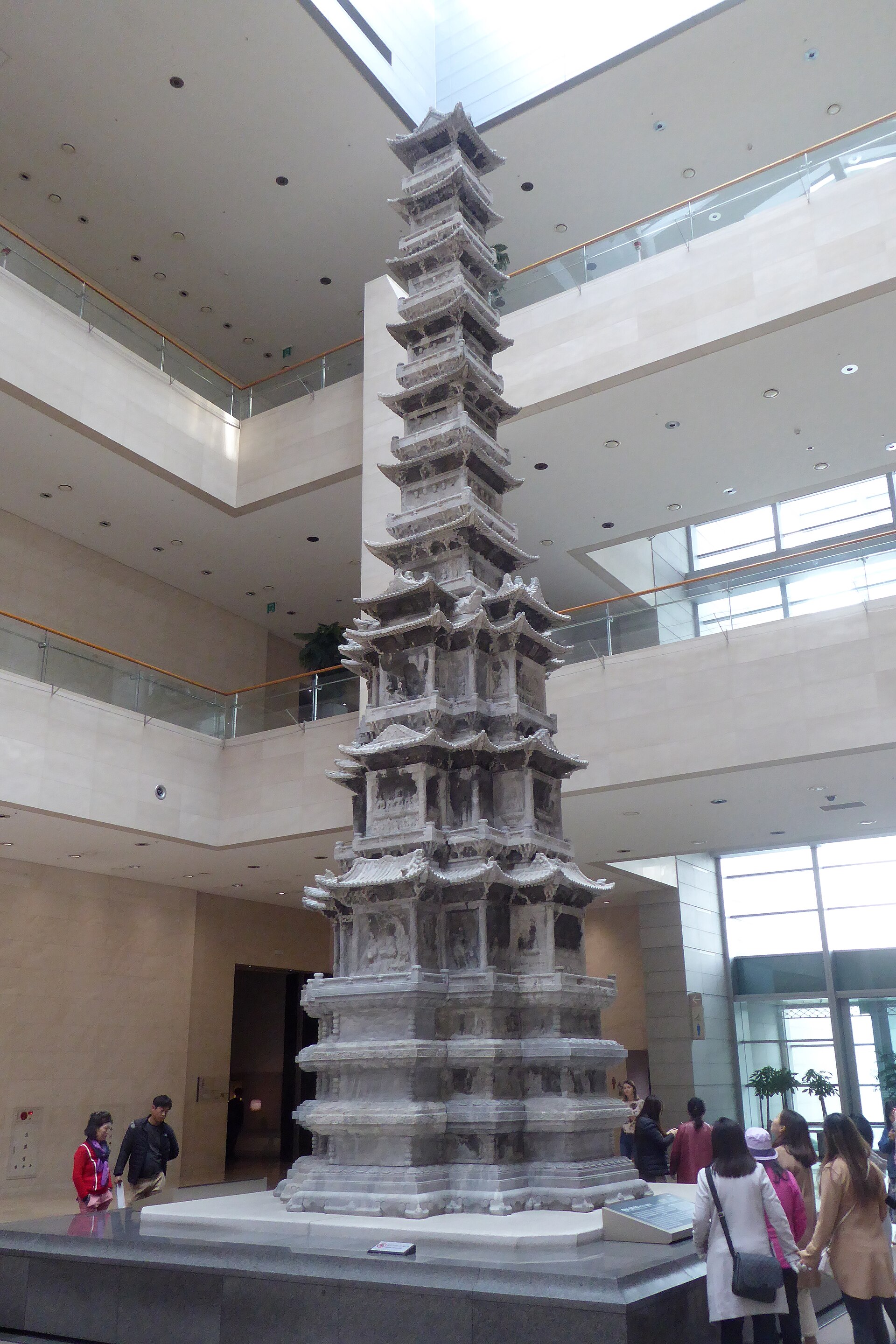
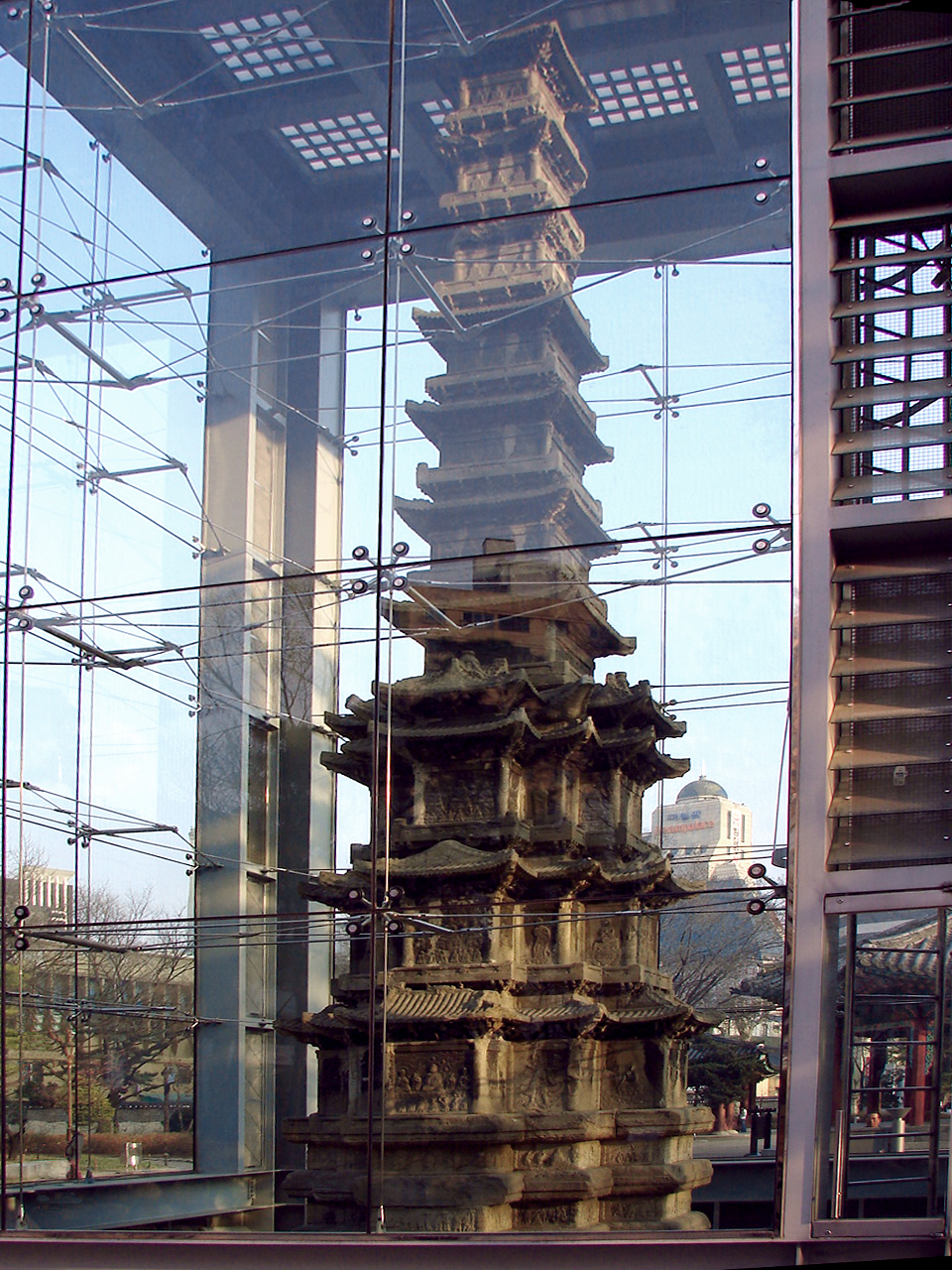
The record subject. The ten-storey marble pagoda of 1348 from the Gyeongcheonsa temple site, standing indoors in the National Museum of Korea, Seoul, where it was installed in 2005. Photographed 10 November 2019.
National Museum of Korea, Seoul · Photograph by Ethan Doyle White · CC BY-SA 4.0| Artist | Unknown marble carvers, Gyeongcheonsa Temple commission |
|---|---|
| Date | 1348 (the fourth year of King Chungmok, Goryeo) |
| Medium | Marble |
| Dimensions | 13.5 m high; ten storeys on a three-tiered cruciform foundation |
| Where it is now | National Museum of Korea, Seoul, standing in one of the main hallslast confirmed 4 August 2026 |
| Inventory number | National Treasure of Korea No. 86, designated 20 December 1962 |
| Attribution | AcceptedThe pagoda dates itself. Full note |
| Object type | Sculpture |
| Period | Korean, Goryeo dynasty |
| Cases | Restituted or repatriated |
| Inscriptions | An inscription on the first storey records the erection of the pagoda in the fourth year of King Chungmok, 1348. |
| Owners on record | 6 links6 documented |
| Sources | 11 cited |
About this record Last verified 23 August 2026 · 11 sources cited · Change log
On this page 10 sections
ContentsClose
A marble pagoda 13.5 metres high, cut in 1348 for a temple in Gyeonggi Province and carved to look as though it were built of wood. In 1907 it was taken apart by an antiques dealer working for Tanaka Mitsuaki, Japan's Minister of Imperial Household Affairs, using some 120 to 130 armed men, and shipped to Japan without authorisation. It was returned in 1918 after an international press campaign run by two foreign journalists working in Korea, the Englishman Ernest T. Bethell and the American Homer Hulbert, who used his platform at the Second Hague Peace Conference to publicise the theft.
The removal, the campaign and the return are documented in sequence and by named people, which is rare for a colonial-era case this early, and Korean-language historical journalism has since filled in most of the mechanism: the dealer's name, the false pretext Tanaka gave for taking it, and the reasoning that a display of colonial legitimacy inside Korea served Japanese administration better than a Japanese trophy would have. What still has no published answer is the single Japanese administrative act, if one existed, that authorised the return.
What came back was a heap of dismantled marble, reportedly still packed exactly as it had been taken apart. The pagoda was not reassembled until 1960, was taken down again in the 1990s because acid rain was eating the stone, and was finally set up indoors at the National Museum of Korea in 2005, where it is now the subject of an evening light-and-sound show as well as a museum highlight. Its temple is gone and its site lies north of the line that has divided the peninsula since 1953.
Provenance
Each link is graded. Documented: a cited source supports it. Disputed: the identification is argued but not established. Unknown: no owner for that span, and the gap is not smoothed into a narrative. The grades in the glossary.
- 1348 - 1907Gyeongcheonsa Temple, Gwangdeok-myeon, Gaepung County, Gyeonggi Provincedocumented
Erected in the fourth year of King Chungmok according to the inscription on the first storey, at a temple at the foot of Mount Buso. The temple is recorded as no longer existing. The site lies north of the line dividing the peninsula since 1953.12
- 1907 - 1918Tanaka Mitsuaki, Japan's Minister of Imperial Household Affairsdocumented
Dismantled and taken to Japan without authorisation during the Japanese occupation, in the year Emperor Gojong was forced to abdicate and three years before formal annexation. Where the pagoda was kept in Japan is not established in the sources consulted.12
- 1918 - 1960Returned to Korea; held dismantled on the grounds of Gyeongbokgung Palacedocumented
Returned in 1918. Two western journalists working in Korea, Ernest T. Bethell and Homer Hulbert, had run an international press campaign denouncing the removal; the sources consulted place the campaign and the return in sequence without establishing the mechanism that produced it. The Japanese colonial authorities intended to install it at their own museum; the outbreak of the Korean independence movement put the plan on hold, and the pagoda remained dismantled for forty-two years.12
- 1960 - 1990sGyeongbokgung Palace grounds, Seouldocumented
Reassembled and re-erected in 1960 under the direction of Lim Cheon, a museum researcher and architect. Stood outdoors at Gyeongbokgung, where acid rain attacked the marble. Designated National Treasure of Korea No. 86 on 20 December 1962.12
- 1990s - 2005Korean state conservation authoritiesdocumented
Taken apart a second time because acid rain was damaging the marble, and conserved. This is the second complete dismantling and reassembly of the monument in a century, the first having been the removal of 1907. The decade of the campaign is given in the sources as the 1990s; no start and end dates, cost or technical account were reachable here.12
- 2005 - presentNational Museum of Korea, Seouldocumented
Installed indoors in one of the main halls of the National Museum of Korea in 2005 following the conservation campaign, a decision driven by acid-rain damage to the marble.12
Prices realised
The pagoda has never been sold, offered, or valued on any published market. It was dismantled and taken to Japan in 1907 by Tanaka Mitsuaki, Japan's Minister of Imperial Household Affairs, an act reported at the time as theft rather than purchase, and no sum is recorded against the removal in the sources consulted. Japan returned it to Korea on 15 November 1918 following an international press campaign, again with no payment or figure recorded; it has remained in Korean institutional hands since, dismantled and conserved twice more, and is now displayed indoors at the National Museum of Korea.
Technical evidence
| Attribution note | The pagoda dates itself. An inscription on the first storey states that it was erected in the fourth year of King Chungmok, 1348. No carver, architect or workshop is named. The attribution question here is not of hand but of model: the structure imitates timber building in marble and departs from the granite tradition of Korean pagoda-building, and the Joseon court had a closely similar pagoda made at Wongaksa about 120 years later, which is generally held to derive from this one. |
|---|---|
| Material | Marble, which is unusual for a Goryeo pagoda. The preferred material of Korean stone-carvers was granite.12 |
| Dimensions | 13.5 m high, ten storeys. Frequently miscounted as thirteen because of the three-tiered foundation.15 |
| Plan | A three-tiered foundation projecting in four directions like a cross (described in Korean sources as an a-ja-character plan); the lowest three storeys repeat that cruciform plan and the remaining storeys are square.110 |
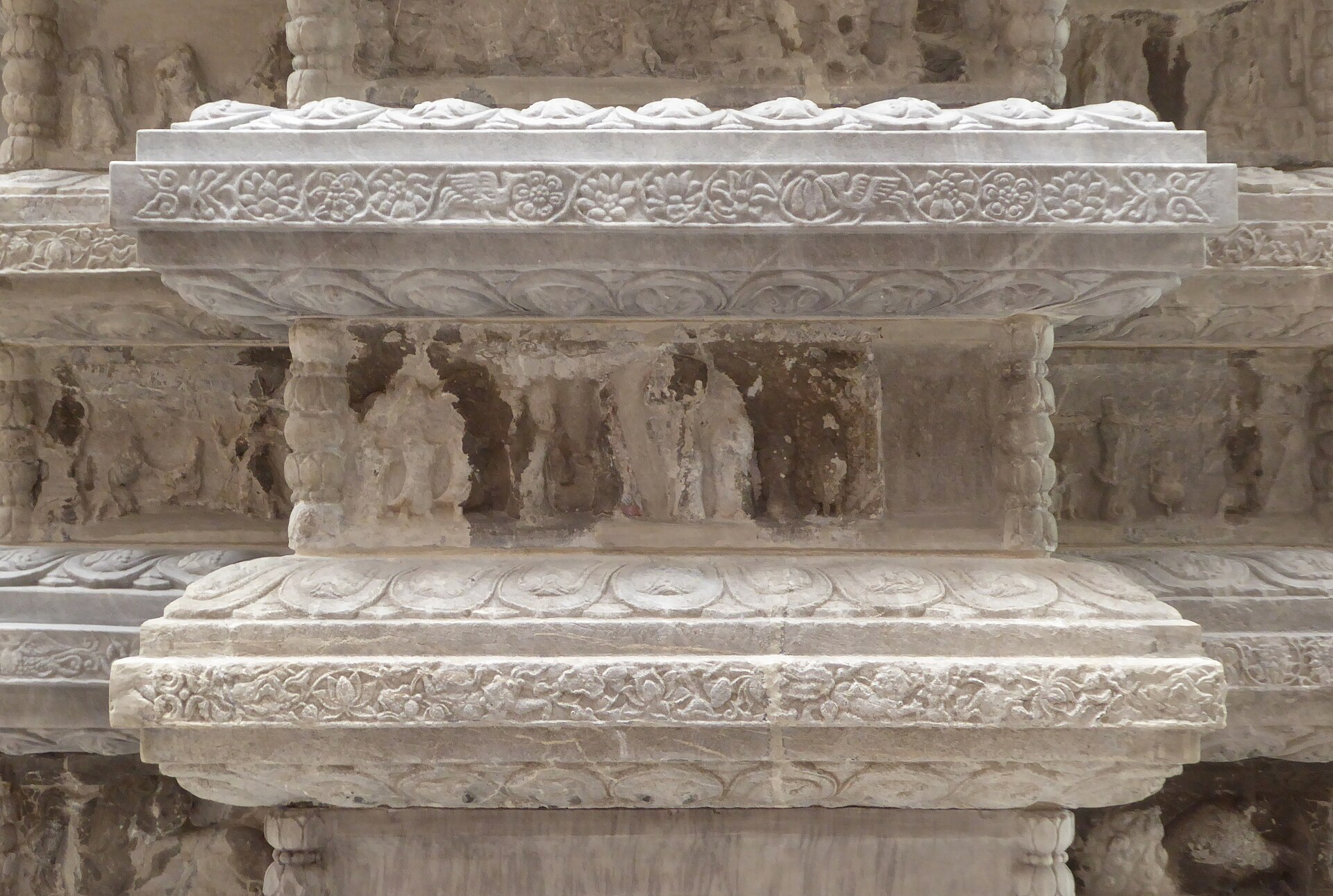
| Carving and iconographic programme | Every panel of the tiered foundation carries Buddhas, bodhisattvas, flowers and arabesque patterns. Per the National Museum of Korea's curatorial account, the base and lowest storeys carry scenes from the Xuanzang pilgrimage cycle later known as Journey to the West, storeys two to four carry Buddhist ceremonial scenes, and storeys five to ten depict a bodhisattva progressing toward enlightenment. The upper storeys additionally carry railings, hip-and-gabled roofs, eaves and carved tiling, worked to make marble read as timber.125 |
| Dating evidence | An inscription on the first storey giving the fourth year of King Chungmok, 1348, recorded under the Yuan reign-name Zhizheng (year 8). The object is self-dated; no external document is required.1210 |
| Patronage and dedication | Commissioned by pro-Yuan Goryeo aristocrats; the dedication is recorded as a prayer for the longevity of the reigning Yuan emperor, consistent with the political alignment of the patrons.1011 |
| Designation | National Treasure of Korea No. 86, designated by the South Korean government on 20 December 1962.1 |
| Conservation and display | Dismantled 4 February 1907, returned 15 November 1918, left dismantled until reassembled in 1960 by Lim Cheon at Gyeongbokgung. Dismantled again in 1995 for a decade-long conservation programme by the National Research Institute of Cultural Heritage because acid rain was damaging the marble, and installed indoors at the National Museum of Korea in 2005.129 |
| Current interpretive display | "Lighting the Sky Pagoda," a twelve-minute media-facade projection show animating the carved narratives, shown Wednesday and Saturday evenings, plus a daily augmented-reality viewing programme. Free, no reservation required.6 |
| Rights status of the photographs | Photographs of the pagoda in the National Museum of Korea are available on Wikimedia Commons under CC BY-SA 4.0 and CC BY-SA 3.0. Attribution to the named photographer is a condition of use. Verified per file against extmetadata LicenseShortName on 4 August 2026 and re-verified resolving on 23 August 2026.4 |
Images
The record in full
Chapter 1What it is, and how many storeys it has
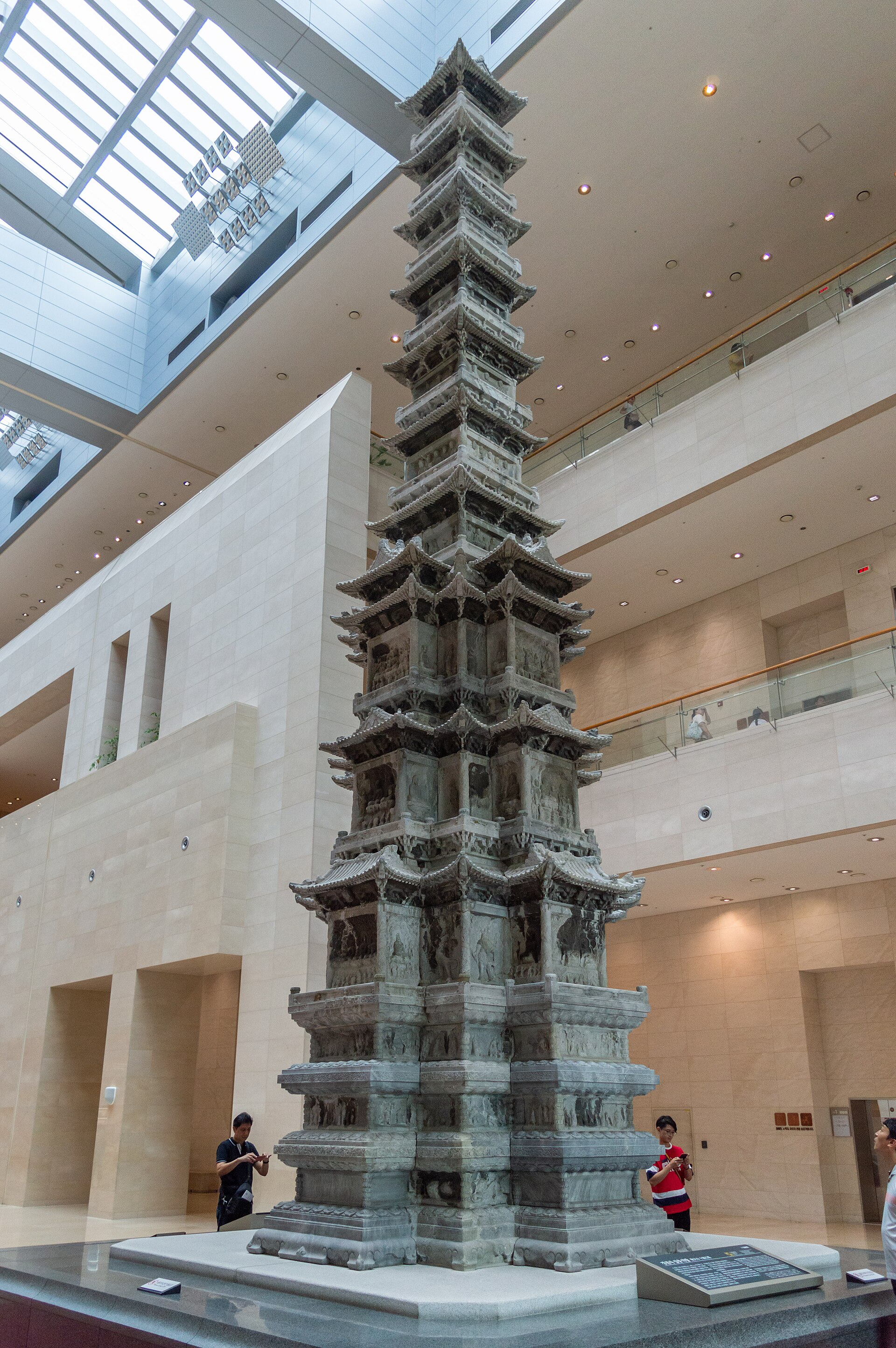
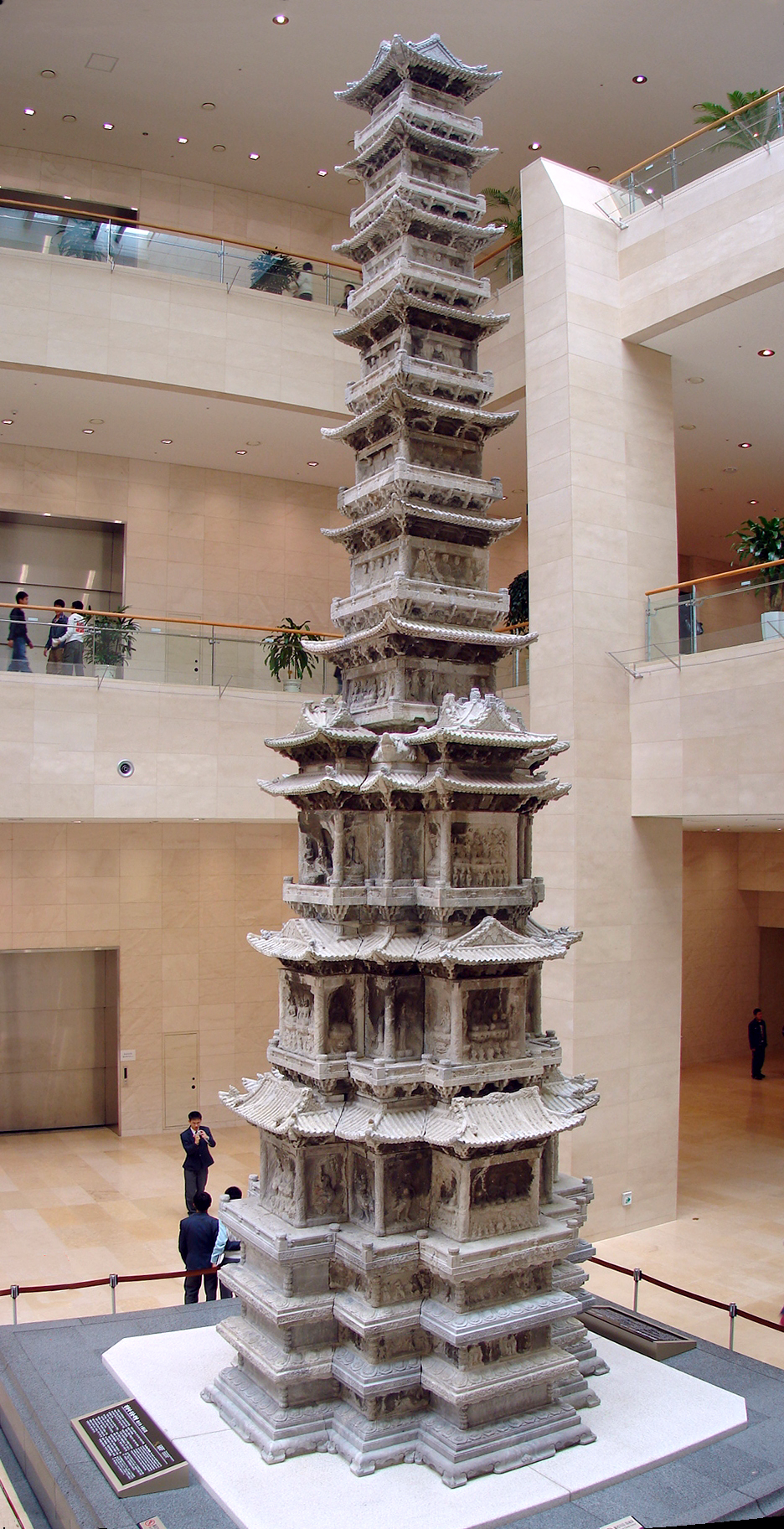
A pagoda of marble, 13.5 metres high, standing on a three-tiered foundation that projects in four directions like a cross - the shape Korean sources describe as an "a-ja-character" plan.
A pagoda of marble, 13.5 metres high, standing on a three-tiered foundation that projects in four directions like a cross - the shape Korean sources describe as an "a-ja-character" plan. The lowest three storeys repeat that cruciform plan; the seven above are square. Each panel of the tiered base is carved with Buddhas, bodhisattvas, flowers and arabesque ornament.
The upper storeys do something odd and deliberate. They carry railings, hip-and-gabled roofs, eaves and carved courses meant to read as roof tiles: the marble is worked to create the illusion of a wooden building. This is a stone monument imitating the timber architecture of its own period, which makes it a source for Goryeo wooden building as well as an object in its own right.
It has ten storeys. It is very commonly said to have thirteen, because the three-tiered foundation reads as three more levels to anyone counting from a photograph. Getting the count right is not pedantry: the name of the object in Korean and in every catalogue is the ten-storey pagoda, and a source that says thirteen has miscounted rather than described a different thing.
Chapter 2What the carvings actually show
The carving is not decorative filler. According to the National Museum of Korea's own curatorial account, the lowest tiers carry scenes connected to the Xuanzang pilgrimage story cycle later known as...
The carving is not decorative filler. According to the National Museum of Korea's own curatorial account, the lowest tiers carry scenes connected to the Xuanzang pilgrimage story cycle later known as Journey to the West, the second through fourth storeys carry Buddhist ceremonial scenes, and the fifth through tenth storeys carry a bodhisattva progressing through practice toward enlightenment. A senior museum researcher, Shin So-yeon, has described the sequence as depicting the path of all living beings seeking enlightenment, read from the base upward.
The pilgrimage story predates the Ming-dynasty novel of the same English title by more than two centuries; a Yuan-era popular cycle of Xuanzang tales was already current in the 1340s, which is the tradition the carvers had to be drawing on, not the later book. That the earliest instalments of an East Asian narrative programme this famous should survive carved on the lowest tier of a 1348 Korean pagoda is a fact the tourist-facing description undersells.
Chapter 3Marble, which is the whole problem
Korean stone-carvers worked in granite. It is the material of the peninsula's pagodas and of most of its sculpture, and it is extremely durable.
Korean stone-carvers worked in granite. It is the material of the peninsula's pagodas and of most of its sculpture, and it is extremely durable. This pagoda is marble, and marble is why almost everything that has happened to it since 1907 has happened.
Marble takes the fine undercutting that produces those imitation eaves and tiles; granite does not, at least not at this scale of detail. The choice buys the illusion of timber. It also buys a stone that acid attacks, and the rain of a twentieth-century industrial city is acidic.
So the material explains the object's ambition and its fragility together. The damage became serious enough that the Korean authorities took the monument apart again and, in 2005, moved it indoors, which is not a step any of Korea's granite pagodas has required.
Chapter 41348, a temple that no longer exists, and a prayer for a Yuan emperor
The inscription on the first storey gives the year: the fourth year of King Chungmok, 1348, recorded in the Yuan reign-name Zhizheng rather than a Goryeo era name alone.
The inscription on the first storey gives the year: the fourth year of King Chungmok, 1348, recorded in the Yuan reign-name Zhizheng rather than a Goryeo era name alone. Goryeo was then in the last decades of its existence and had spent nearly a century under Mongol Yuan overlordship, with its royal house tied to the Yuan court by marriage and its elite serving in Dadu.
The Academy of Korean Studies' Encyclopedia of Korean Culture and a 2026 Korean press account both state what the object was for: it was commissioned by pro-Yuan Goryeo aristocrats, and its dedication prayed for the longevity of the reigning Yuan emperor. That is a documented statement of patron intention, not a modern reading back onto the stone - a court faction advertising its Yuan allegiance in permanent marble, at a scale no granite pagoda in the country matched.
The pagoda stood at Gyeongcheonsa, a temple at the foot of Mount Buso in Gwangdeok-myeon, Gaepung County, Gyeonggi Province. The temple is recorded as lost. Gaepung lies in the northern part of the old Gyeonggi Province, on the far side of the line that has divided Korea since 1953, which means that the findspot of a South Korean National Treasure is not accessible from the country that holds it.
That is worth sitting with, because it changes the meaning of the 1918 return. The pagoda was returned to Korea, and Korea was then one country under Japanese rule. It was never returned to its site, and since 1953 it could not be.
Chapter 5The removal of 1907
In 1907, during the Japanese occupation of Korea, Tanaka Mitsuaki, Japan's Minister of Imperial Household Affairs, had the pagoda dismantled and smuggled to Japan.
In 1907, during the Japanese occupation of Korea, Tanaka Mitsuaki, Japan's Minister of Imperial Household Affairs, had the pagoda dismantled and smuggled to Japan. Korean-language historical journalism, principally a detailed history column in the Kyunghyang Shinmun, has since reconstructed how: Tanaka delegated the operation to Kondo Sagoro, an antiques dealer working in Seoul, who assembled some 120 to 130 armed men at the site on 4 February 1907, with tents and supplies for an extended operation. When local Korean officials and even a Japanese interpreter present objected, the workers responded with gunfire and drawn swords. The pagoda was dismantled within the day into upward of 140 blocks and carted to the railway station at Gaeseong.
The same reporting states that Tanaka's justification - that Emperor Gojong had granted the pagoda to Japan - was false, and was exposed as such; other accounts report that he wanted the monument to decorate his own garden. Neither claim gives him a legal title to the object.
The year matters on its own terms regardless of the mechanics. 1907 is the year the Japanese Resident-General forced the abdication of Emperor Gojong, disbanded the Korean army and reduced the Korean state to a formality. Formal annexation followed in 1910. A senior Japanese court official removing a Korean national monument in 1907, by armed force, against the objections of Korean officials on the ground, was operating in a country whose government could not stop him and whose sovereignty was three years from being extinguished.
Popular Korean historical writing also attaches a piece of folklore to the case: that Tanaka's target had been coveted three centuries earlier by Kato Kiyomasa, the Japanese commander of the 1592-1598 invasions, and that Tanaka completed what Kato was said to have wanted and failed to take. This appears only in historical-interest journalism, not in a primary record read here, and it is reported as legend rather than as an established fact; it is included as what is being said about the object now, not as history that has been verified.
Chapter 6Why it came back
The publicity is documented in more detail than the earlier version of this record credited.
The publicity is documented in more detail than the earlier version of this record credited. Homer Hulbert, an American missionary and journalist, accompanied the Korean emperor's delegates to the Second Hague Peace Conference in 1907 - the same mission remembered in Korean history as the Hague Secret Emissary Affair - and used the international press attention it drew to hold a press conference denouncing the plundering of Korean cultural property, the pagoda among it. Ernest T. Bethell, an Englishman, ran a parallel campaign in the Korean and English-language press. Both men were foreign nationals and so could not simply be silenced by the Resident-General's censorship of the Korean press, which is precisely why their campaign carried internationally where a Korean-run one could not have.
Later Korean historical writing on the case adds an interpretation, not a document: that the colonial administration eventually judged a Korean National Treasure visibly restored to Korean soil, under Japanese rule, served the appearance of orderly, legitimate colonial administration better than the same object sitting in a minister's private garden in Japan under continuing international criticism. That is an argued reading of motive, attributed here to the historians who make it, not a claim this record treats as proven.
In 1918 the pagoda was returned to Korea, on 15 November, reportedly in exactly the dismantled and packaged state in which Tanaka's crew had left it eleven years earlier - no pieces confirmed lost, though the stone had deteriorated across those years in ways that complicated the eventual 1960 reassembly. That is a restitution which predates the 1970 UNESCO Convention by fifty-two years and predates almost every framework restitution arguments now use, and there was no law to invoke.
What remains undocumented in the sources consulted is a single Japanese administrative order or ministerial decision authorising the return. The record now available is a sequence - sustained international press pressure, a change in the administration's calculation of what served it, and a shipment back - not a cited legal instrument, and this record does not manufacture one.
Chapter 7Forty-two years in pieces
The pagoda came back in 1918 and was placed on the grounds of Gyeongbokgung Palace.
The pagoda came back in 1918 and was placed on the grounds of Gyeongbokgung Palace. It was not put up. The colonial authorities intended to install it at their own museum; the Korean independence movement broke out shortly afterwards - the March First Movement of 1919 - and the plan was shelved.
It stayed down for four decades. The reassembly was finally carried out in 1960 under Lim Cheon, a museum researcher and architect, at Gyeongbokgung.
A record that says returned in 1918 and stops there has told about a fifth of the story. For forty-two years the object existed as a stack of numbered marble on palace ground, through a colonial period, a liberation, a partition and a war. The restitution of 1918 restored possession. It did not restore the monument, and nothing in the campaign that won it obliged anyone to.
Chapter 8Taken down a second time, by the weather
Standing in the open in central Seoul, the marble was attacked by acid rain.
Standing in the open in central Seoul, the marble was attacked by acid rain. The surface that carries the Buddhas, the bodhisattvas and the imitation roof tiles is precisely the part a dissolving stone loses first.
The pagoda was dismantled again in 1995 for conservation, and the National Research Institute of Cultural Heritage carried out a decade-long conservation programme; in 2005 the restored monument was moved indoors, to the new National Museum of Korea at Yongsan, where it stands inside one of the main halls. It is the only way this object can now survive, and it is the second time in a century that it has been taken to pieces and put back together.
Two dismantlings, then: one by a foreign official's hired crew in 1907 and one by its own conservators from 1995, both requiring every joint to be opened and every block handled, so the pagoda standing in Yongsan is a modern assembly whichever way the history is read. There is no published figure in the sources consulted for how much of the original jointing and surface survives the two campaigns, and that is a real gap in the record of a National Treasure.
Chapter 9The other marble pagoda in Seoul
About 120 years after this pagoda was made, the Joseon royal court commissioned a closely similar one for Wongaksa Temple.
About 120 years after this pagoda was made, the Joseon royal court commissioned a closely similar one for Wongaksa Temple. It was built in 1467, it is marble, it is twelve metres high, it has ten storeys, it stands in what is now Tapgol Park in central Seoul, and it is National Treasure of Korea No. 2. Since 1999 it has been enclosed in glass to protect it, for the same reason this one was moved indoors.
Two marble ten-storey pagodas, both National Treasures, both in Seoul, one modelled on the other and separated by 119 years and 1.5 metres of height. They are confused constantly, in photograph captions above all, and the confusion runs in both directions. Popular Korean historical writing pairs them further still, attributing to Kato Kiyomasa an interest in taking both to Japan in the 1590s; that pairing is repeated as legend and is not independently documented here.
The distinguishing marks are easy once known. This pagoda stands indoors, in a museum hall, unglazed, on a cruciform base. The Wongaksa pagoda stands outdoors, in a park, inside a glass case. Any photograph showing a pagoda behind glass in the open air is the Wongaksa pagoda and is not this object.
Chapter 10What the museum does with it now
The pagoda is not a static exhibit. The National Museum of Korea runs "Lighting the Sky Pagoda," a twelve-minute media-facade projection onto the monument that animates the carved narratives - the...
The pagoda is not a static exhibit. The National Museum of Korea runs "Lighting the Sky Pagoda," a twelve-minute media-facade projection onto the monument that animates the carved narratives - the Journey to the West scenes and the life of the Buddha among them - shown on Wednesdays and Saturdays in the evening, free and without reservation, alongside a daily augmented-reality programme that lets visitors examine the carving more closely on their own devices. The museum's own material calls it one of the institution's most recognisable highlights.
None of this changes the object's ownership, designation or physical condition, and this record notes it for the same reason it notes the conservation history: a National Treasure that draws crowds for an evening light show is still living an institutional life, seven centuries after it was carved and more than a century after it was taken apart at gunpoint.
Chapter 11What it is worth, and why the question does not arise
There is no sale, no auction record, no valuation and no insurance figure in the public domain.
There is no sale, no auction record, no valuation and no insurance figure in the public domain. The pagoda has been Korean state property since its return and has carried the highest national designation since 20 December 1962. It cannot be sold and never has been.
The only transaction in its history was not a sale either. In 1907 it changed hands by armed removal under a pretext later shown to be false, and no consideration passed to anybody in Korea. The most useful financial statement that can be made about the object is a negative one: it establishes that a monument of this rank has no market and therefore no price, and that the entire commercial apparatus of provenance - hammer, premium, estimate, underbidder - is inapplicable to it. What it has instead is a chain of custody, and that chain is unusually complete.
The artist
The unnamed marble workshop of the Gyeongcheonsa commission, 1348
No carver is named on the pagoda and no workshop is recorded. What the object supplies instead is an unusually precise brief: a date it states itself, a material nobody else in Korea was using at this scale, and a formal decision - to make stone imitate wood - that can only have come from someone who knew Goryeo timber building intimately and wanted a permanent version of it. The makers are anonymous and their intentions are legible, which is the reverse of the usual position.
Related works
| Work | Relation | Where it is |
|---|---|---|
| Wongaksa Pagoda Commissioned by the Joseon royal court | Modelled on this pagoda about 120 years later; the object it is most often confused with 1467. Marble, 12 m, ten storeys. Encased in glass since 1999 for protection. Outdoors and glazed, where this pagoda is indoors and unglazed. | Tapgol Park, Seoul; National Treasure of Korea No. 2 |
| Gyeongbokgung Palace grounds n/a | Where the pagoda lay dismantled from 1918 and stood from 1960 to 1995 The colonial authorities intended to install it at their museum; the March First Movement of 1919 intervened and the plan was shelved. | Seoul |
| The press campaign of Ernest T. Bethell and Homer Hulbert Ernest T. Bethell; Homer Hulbert | The documented public response to the removal An Englishman and an American, both journalists working in Korea and neither a Korean subject, which is why the colonial censorship could not simply silence them. Hulbert used the international press attention around the Second Hague Peace Conference of 1907, which he attended with Korea's special delegates, as a platform to publicise the removal. Bethell died in 1909. | Seoul and The Hague, from 1907 |
| The National Museum of Korea, Yongsan n/a | The building constructed around it The pagoda was installed indoors in one of the main halls in 2005, a decision driven by acid-rain damage to the marble, and is now the subject of the museum's Lighting the Sky Pagoda media-facade show. | Seoul |
Open questions
- What proportion of the original stone and jointing survives the two dismantlings of 1907 and 1995? No published breakdown appears in the sources consulted, and this is a monument that has been taken apart and put back together twice.
- Was the pagoda ever actually erected in Tanaka Mitsuaki's own garden, as Korean-language accounts report he intended, or did it remain crated in storage in Japan for the full eleven years before 1918? The sources consulted report the motive without confirming what happened to the stone once it arrived.
- What single Japanese administrative order or ministerial decision, if any, authorised the 1918 return? The sources consulted document sustained international press pressure and one historian's argument about colonial legitimacy, but no cited legal instrument.
- Is the popular Korean account that Kato Kiyomasa coveted this pagoda (and the Wongaksa pagoda) during the 1592-1598 invasions a documented historical episode or a legend attached retrospectively to the 1907 removal? It appears in historical-interest journalism, not in a primary record read here.
- Who carved it, and where did the marble come from? Neither the workshop nor the quarry is recorded.
- Has the Democratic People's Republic of Korea, which administers the temple site at Gaepung, ever raised a claim or a position on the pagoda? Nothing in the sources consulted addresses it, and nothing new surfaced on re-verification in August 2026.
- What did the 1995-2005 conservation programme by the National Research Institute of Cultural Heritage cost and what did it involve technically, beyond running roughly a decade? No published account was reachable here.
Questions about this object
What is Ten-story Stone Pagoda from Gyeongcheonsa Temple Site?
Ten-story Stone Pagoda from Gyeongcheonsa Temple Site is a sculpture, dated 1348 (the fourth year of King Chungmok, Goryeo). Medium: Marble.
Who made Ten-story Stone Pagoda from Gyeongcheonsa Temple Site, and is the attribution settled?
The attribution to Unknown marble carvers, Gyeongcheonsa Temple commission is recorded here as accepted. The pagoda dates itself. An inscription on the first storey states that it was erected in the fourth year of King Chungmok, 1348. No carver, architect or workshop is named. The attribution question here is not of hand but of model: the structure imitates timber building in marble and departs from the granite tradition of Korean pagoda-building, and the Joseon court had a closely similar pagoda made at Wongaksa about 120 years later, which is generally held to derive from this one.
Where is Ten-story Stone Pagoda from Gyeongcheonsa Temple Site now?
National Museum of Korea, Seoul, standing in one of the main halls. Inventory number National Treasure of Korea No. 86, designated 20 December 1962. Last confirmed 4 August 2026. Returned from Japan in 1918; re-erected 1960; moved indoors 2005.
What is still unknown about Ten-story Stone Pagoda from Gyeongcheonsa Temple Site?
What proportion of the original stone and jointing survives the two dismantlings of 1907 and 1995? No published breakdown appears in the sources consulted, and this is a monument that has been taken apart and put back together twice.
Sources
- 1Wikipedia, 'Gyeongcheonsa Pagoda', read as the raw article text on 4 August 2026: the 1348 inscription on the first storey, the temple site at Mount Buso in Gwangdeok-myeon, Gaepung County, the 1907 removal by Mitsuaki Tanaka, the Bethell and Hulbert campaign, the 1918 return to Gyeongbokgung, the ten-storey count and the thirteen-storey error, the marble against granite point, the cruciform foundation and timber-imitating carving, the Wongaksa descendant, and National Treasure No. 86 designated 20 December 1962. TERTIARY: to be replaced with the Korea Heritage Service record and the National Museum of Korea catalogue entry. Re-verified resolving on 23 August 2026. en.wikipedia.org/wiki/...
- 2The Korea Herald, '[Stories of Artifacts] 14th century pagoda bears witness to Korea's history', 7 May 2023: the 1348 date and the inscription, the marble and 13.5 m height, Tanaka's smuggling of the pagoda to Japan, the return in 1918 following the Bethell and Hulbert press campaigns, the shelving of the colonial museum plan when the independence movement broke out, the 1960 reassembly at Gyeongbokgung under Lim Cheon, the 2005 move indoors because of acid-rain damage, and the iconographic programme by storey (Journey to the West, Buddhist ceremonies, a bodhisattva's path to enlightenment) per senior researcher Shin So-yeon. Re-verified resolving on 23 August 2026. koreaherald.com/view.php
- 3Wikipedia, 'Wongaksa Pagoda', for the 1467 date, the marble, the 12 m height and ten storeys, the Tapgol Park location, National Treasure No. 2, the modelling on the Gyeongcheonsa pagoda and the glass enclosure installed in 1999. TERTIARY. Re-verified resolving on 23 August 2026; no reported change to its enclosed, outdoor display status. en.wikipedia.org/wiki/...
- 4Wikimedia Commons file records for the photographs used, each carrying its LicenseShortName, author and description. Licences read per file on 4 August 2026: CC BY-SA 4.0 for the Ethan Doyle White and Tristan Surtel images, CC BY-SA 3.0 for the Steve46814 images. Re-verified resolving, licence unchanged, on 23 August 2026. commons.wikimedia.org/wiki/...
- 5National Museum of Korea, official highlight page, 'Ten-story Stone Pagoda from Gyeongcheonsa Temple Site', consulted 23 August 2026: the storey-by-storey carving programme (Journey to the West, Buddhist ceremonies, bodhisattva practice), the a-ja-character base plan, and current display in the museum's history gallery. museum.go.kr/site/...
- 6National Museum of Korea, digital/immersive gallery page describing 'Lighting the Sky Pagoda', consulted 23 August 2026: the twelve-minute media-facade projection show, its Wednesday/Saturday evening schedule, and the accompanying daily augmented-reality programme. museum.go.kr/site/...
- 7The Korea Times, 'Unique pagoda with memorable history', 19 January 2021: Tanaka's 1907 removal reportedly to decorate his own garden, Hulbert's press conference at the Second Hague Peace Conference denouncing the plundering of Korean cultural property, and the international press pressure that led to the 1918 return. koreatimes.co.kr/opinion/...
- 8Kyunghyang Shinmun, Lee Ki-hwan history column, '[Hi-story] Japanese minister Tanaka's plunder of the Gyeongcheonsa pagoda, the full story', 19 July 2017 (Korean-language, read via automated translation): Tanaka's delegation of the operation to the antiques dealer Kondo Sagoro, the 120-130 armed men gathered on 4 February 1907, the gunfire and swords used against local objectors, the dismantling into upward of 140 blocks and transport to Gaeseong railway station, the false claim that Emperor Gojong had granted the pagoda to Japan, and the return on 15 November 1918 in the same packaged state as taken. khan.co.kr/article/...
- 9Kyunghyang Shinmun, Lee Ki-hwan history column on Japanese removal of Korean stone pagodas under colonial rule, 13 August 2023 (Korean-language, read via automated translation): the role of Governor-General Terauchi Masatake in policing similar removals from 1912, the National Research Institute of Cultural Heritage's decade-long conservation programme from 1995, and an argument that displaying the pagoda in Korea served Japanese colonial administration better than removing it to Japan permanently. khan.co.kr/article/...
- 10Academy of Korean Studies, Encyclopedia of Korean Culture, entry on the Gaeseong Gyeongcheonsa-ji ten-story stone pagoda, consulted 23 August 2026 (Korean-language, read via automated translation): the a-ja-shaped three-tier base, the storey-by-storey carving, the dedication praying for the longevity of the Yuan emperor, and the pagoda's role as model for the Wongaksa pagoda. TERTIARY (national reference encyclopedia); its stated 1909 removal date conflicts with the 4 February 1907 date given consistently by sources 1, 2, 7, 8 and 9 and is not used here. encykorea.aks.ac.kr/Article/...
- 11Seoul Shinmun (nownews.seoul.co.kr), feature article on the Gyeongcheonsa pagoda's history and the folk tradition of a curse on those involved in its removal, published 1 June 2026 (Korean-language, read via automated translation): the pro-Yuan aristocratic patronage, the legend of Kato Kiyomasa's earlier interest in the pagoda during the 1592-1598 invasions, the folk belief that Japanese workers involved in the removal suffered misfortune, and the observation that Tanaka Mitsuaki himself lived to 95, undercutting the legend. nownews.seoul.co.kr/news/...

Last verified 23 August 2026 · Published 4 August 2026
Change log
23 August 2026 - Record deepened to the house standard: narrative sections, technical evidence, artist dossier, related works and open questions added; provenance chain and auction results replaced with the researched versions; sources rebuilt.
2 August 2026 - Record deepened to the house standard: narrative sections, technical evidence, artist dossier, related works and open questions added; provenance chain and auction results replaced with the researched versions; sources rebuilt.
4 August 2026 - Record created at the house standard: researched narrative, technical evidence, maker dossier, graded provenance chain, prices with hammer and premium separated, related works, open questions and sources.