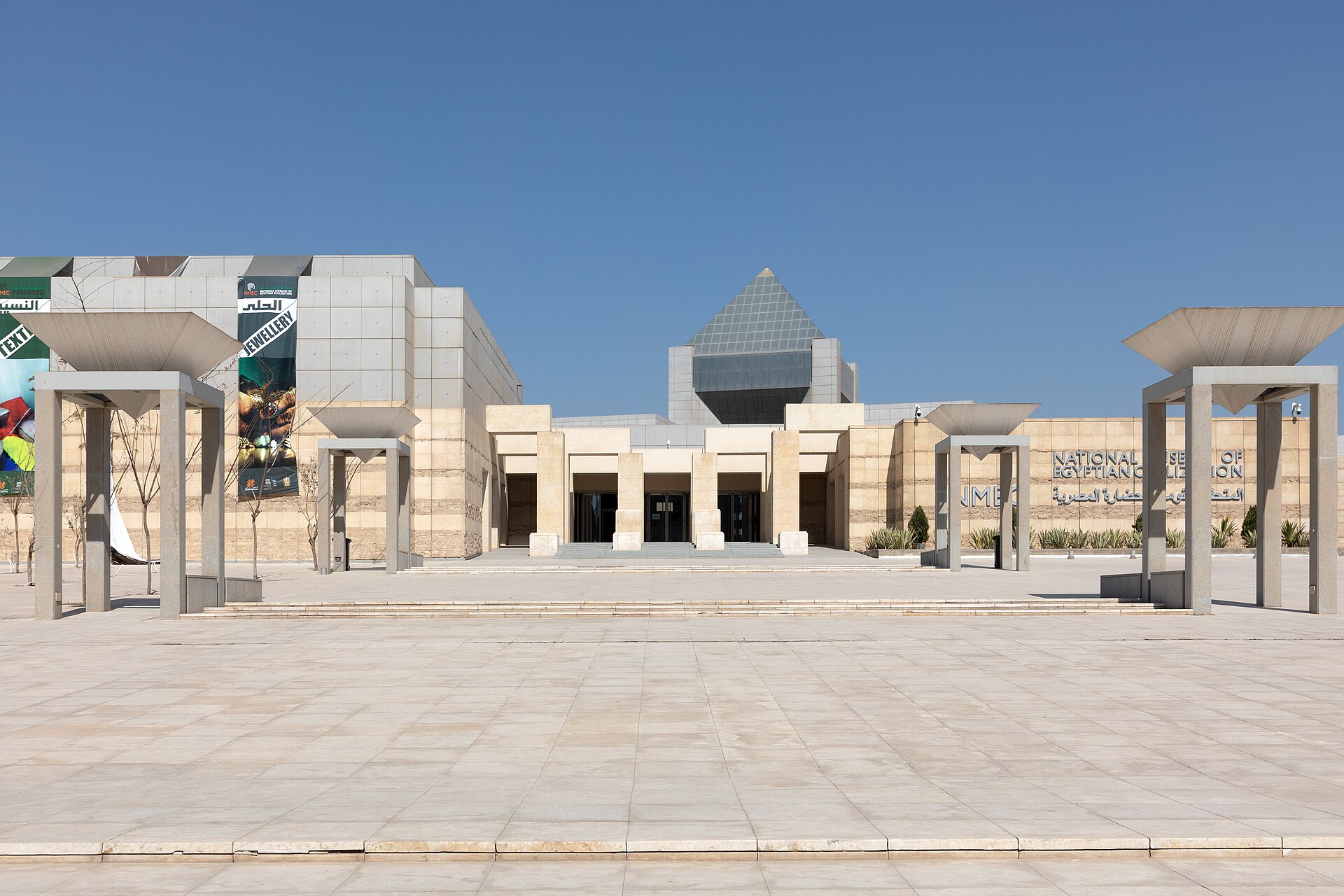
The main entrance and plaza of the National Museum of Egyptian Civilization in el-Fustat, Cairo, showing the building's bilingual signage and its stepped, pyramid-topped facade.
Roland Unger · Photograph by RolandUnger · CC BY-SA 4.0National Museum of Egyptian Civilization
Museum · المتحف القومي للحضارة المصرية · Founded 2021
Open, admission and hours confirmed 18 August 2026 · 24 sources
On this page 13 sections
ContentsClose
NMEC's strength is breadth held in one building rather than depth in any single period. Where the Egyptian Museum at Tahrir still holds the largest concentration of Pharaonic material in the world and the Grand Egyptian Museum at Giza now holds the complete Tutankhamun collection in one hall, NMEC is the only one of Cairo's three big state museums built to run prehistory, the Pharaonic dynasties, Greco-Roman Egypt, the Coptic and Islamic centuries, and the nineteenth and twentieth centuries through a single continuous visit. Its two genuinely singular holdings are the Royal Mummies Gallery, the only place in the world these particular kings and queens are shown together, and the in-situ Fatimid dye house, an excavated industrial site the museum was built around rather than an object brought in from elsewhere. Its Textile Gallery, at roughly 600 pieces, is a specialised strength few general museums attempt at all.
| Local name | المتحف القومي للحضارة المصرية |
|---|---|
| Kind | Museum |
| Founded | 2021, on a project that dates to a 1982 UNESCO campaign and broke ground in 2002 |
| City and country |  Cairo, Egypt Cairo, Egypt |
| Address | El Fustat Road, Ein El Sira, Cairo 17611, Egypt |
| Website | nmec.gov.eg |
| Status | Open, confirmed |
| Record last verified |
Visiting
- Hours
- Saturday to Thursday09:00 to 17:00last ticket sold at 16:00; same hours stated for summer and winter
- Friday09:00 to 17:00last ticket sold at 16:00
- Friday evening18:00 to 21:00second Friday session; last ticket sold at 20:00
- During Ramadan09:00 to 16:00last ticket sold at 15:00; replaces the standard hours for the month
- Admission
- Egyptian, adultEGP 90
- Egyptian, studentEGP 45valid student ID required
- Arab nationality, adultEGP 550priced with foreign visitors, not with Egyptians
- Arab nationality, studentEGP 300valid student ID required
- Foreign, adultEGP 550about 11 US dollars at 2026 exchange rates; one ticket covers the whole museum, including the Royal Mummies Gallery
- Foreign, studentEGP 300valid student ID required
- Child under 6Freefree entry
- Egyptian, 60 and olderFreefree entry
- Egyptian with a disabilityFreefree entry; a companion is not stated as free on the ticketing page
- Tickets
- egymonuments.com/nmec The museum's own ticket page.
- Do I need to book?
- No advance timed ticket is stated as mandatory; tickets are sold on-site or through the Ministry of Tourism and Antiquities' own e-ticketing portal, egymonuments.com
- Address
- El Fustat Road, Ein El Sira, Cairo 17611, Egypt MapMetro Line 1, Mar Girgis (Mar Gerges) station, then a 15 to 20 minute walk through Ain el-Sira or a short taxi; the museum is not next to the station the way the Coptic Museum and Hanging Church are
Car or taxi On-site parking is available with designated accessible spaces; the museum sits on the Fustat road above Ain el-Sira lake, a few minutes' drive from Old Cairo and the Citadel - Website
- nmec.gov.eg
- Telephone
- +20 2 3531 7344
- [email protected]
Before you go how long, access, photography, bags, eating, shop
- How long to allow
- Two to three hours to cover the Main Gallery, the Textile Gallery, the Dye House and the Royal Mummies Gallery without rushing; visitor guides commonly suggest a minimum of 90 minutes for the mummies hall and Main Gallery alone
- Access
- Free wheelchairs are available on request, all galleries are reached by elevator, designated accessible parking is provided, Braille brochures are available on request, and sign-language tours can be booked in advance by writing to the museum
- Photography
- Photography with a mobile phone is free of charge throughout the museum, with one exception: the Royal Mummies Gallery enforces a strict no-photography rule, stated on the ticketing site's terms and repeated by visitor guides
- Bags
- Not stated on the sources consulted
- Eating
- No cafe or restaurant is listed on the museum's own facilities page; the facilities named are a theatre, cinema hall, lecture hall, an open-air Roman theatre, a meeting room and a gift shop
- Shop
- A gift shop on the main floor sells Egyptian souvenirs and handicrafts; the museum's site also describes a wider retail concept, NMEC Experience, covering food and beverage, children's items and accessories
Prices and hours change. We take them from the institution's own pages and print the day we read them, and you can check the current position at the source we used. Confirm before you travel.
What is inside
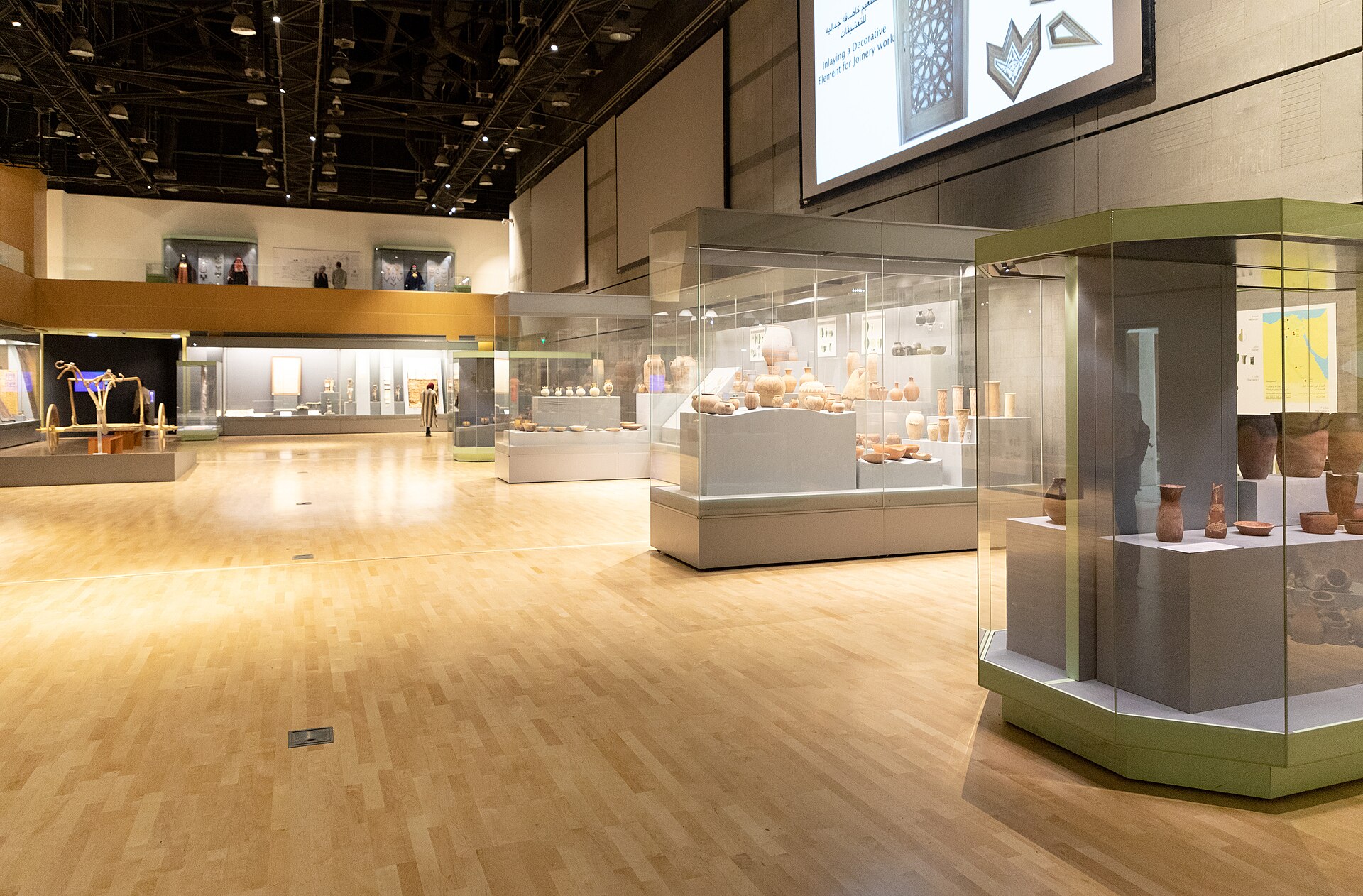
Photograph by RolandUnger · CC BY-SA 4.0 Main Gallery
The museum's central hall, organised both chronologically (prehistoric, Pharaonic, Greco-Roman, Coptic, medieval, Islamic, modern and contemporary) and thematically (the Nile, writing, state and society, material culture, belief). The museum's own page for this gallery names, among others, the Nazlet Khater skeleton, the coffin of Sennedjem, a statue of Akhenaten, the chariot of Thutmose IV, a prosthetic wooden toe, a water clock from the reign of Amenhotep III, the Dush treasure from Roman-period Egypt, the Minbar of Aboubakr ibn Mizhar, the Mahmal of King Farouk, and Mahmoud Mokhtar's sculpture Al-Fallaha (The Peasant Woman).
Royal Mummies Gallery
A darkened, deliberately theatrical hall built to evoke the Valley of the Kings, where the mummies were originally found. The museum's own page for the gallery describes the display as seventeen kings and three queens, including the outer coffin of Queen Ahmose-Nefertari, the mummy of Amenhotep I with its floral garlands and intact mask, the coffin of Thutmose I retaining traces of its gilding, and the canopic chest of Amenhotep II. The twenty-two mummies moved here in the April 2021 Pharaohs' Golden Parade included eighteen kings and four queens; this record does not resolve the two-mummy gap between the parade total and the museum's own displayed count, and says so in the open questions rather than guessing which two are not on view.
Textile Gallery
About 600 textile artefacts spanning Pharaonic linen to Graeco-Roman garments, Islamic-period weaves, and clothing and jewellery from the Muhammad Ali dynasty, arranged to connect everyday cloth-making to the mummy wrappings shown in the Royal Mummies Gallery. Part of the space doubles as a venue for temporary exhibitions and private events.
Fatimid dye house (in-situ archaeological site)
An excavated dye works standing on the museum's own grounds, first found in 1932 and re-exposed during the excavations of 2003 to 2004 that preceded the museum's construction. It dates to at least the first century of the Fatimid period, 969 to 1171 CE, and consists of three double rows of thirteen rounded dyeing basins each, roughly 80 centimetres across and 70 centimetres deep, plus further single and rectangular basins. The museum's own account calls it the only well-preserved dye house of its kind surviving in Cairo.
What to see first
The Royal Mummies Gallery
New Kingdom royal workshops, 17th to 20th DynastiesTwenty-two royal mummies, eighteen kings and four queens including Ramesses II, Hatshepsut, Thutmose III, Seti I and Amenhotep III, were moved here from the Egyptian Museum in the televised Pharaohs' Golden Parade of 3 April 2021; the museum's own gallery page describes the hall as currently showing seventeen kings and three queens in a darkened setting built to recall the Valley of the Kings.5
Gilded coffin of Nedjemankh
Workshop of Herakleopolis, priesthood of Heryshef, late Ptolemaic period, about 150 to 50 BCBought by the Metropolitan Museum of Art in 2017 on a forged 1971 export licence and seized by New York investigators in 2019 after it was traced to looting near Minya in 2011; unveiled at NMEC on 1 October 2019 and independently photographed here as late as May 2022 and described by a visitor blog drawing a crowd around it, which is the closest this record comes to confirming it is still shown rather than merely once unveiled.18
Full record in this archiveNazlet Khater skeleton
Upper Palaeolithic Homo sapiens, about 35,000 years before presentExcavated near Sohag in Upper Egypt, this is among the oldest anatomically modern human skeletons found in Egypt and anchors the Main Gallery's chronology at the very start of human presence on the Nile.4
Coffin of Sennedjem
New Kingdom, Deir el-Medina workshop traditionSennedjem was a craftsman of the royal tomb-building village of Deir el-Medina; his well-preserved painted coffin represents the museum's holdings from the same community whose members decorated the Valley of the Kings tombs the mummies gallery evokes.4
Chariot of Thutmose IV
18th Dynasty royal workshopComplete ancient Egyptian chariots rarely survive; this one is named on the museum's own Main Gallery page as a highlight of its New Kingdom material culture holdings.4
Chair of Queen Hetepheres I
Old Kingdom, 4th DynastyFurniture belonging to the mother of Khufu, builder of the Great Pyramid, is an exceptionally rare survival from the Old Kingdom and is cited among the museum's holdings by Wikipedia's synthesis of the collection.14
The Fatimid dye house
Fatimid-period Cairo textile industry, 10th to 12th centuryAn excavated, in-place dye works with thirty-nine surviving basins, described by the museum itself as the only well-preserved dye house of its kind found in Cairo; it is one of the few exhibits in the building that is the original archaeological find rather than an object brought in from elsewhere.6
Minbar of Aboubakr ibn Mizhar
Mamluk periodA wooden mosque pulpit named among the Main Gallery's highlights, representing the museum's Islamic-period holdings alongside the Pharaonic and Roman material shown in the same hall.4
Textile Gallery collection
Pharaonic to modern, roughly 600 objectsLinen from Pharaonic burials, Graeco-Roman garments, Islamic-period weaves and Muhammad Ali-era court dress and jewellery are shown together, tracing continuous cloth production over four thousand years in one room rather than splitting it by period across separate museums.3
Al-Fallaha (The Peasant Woman)
Mahmoud Mokhtar, 20th centuryA sculpture by Egypt's leading modern sculptor, named on the museum's own Main Gallery page, marking the point at which the collection's chronology runs past antiquity and the Islamic period into the modern national period.4
A museum built to hold all of Egypt, not one period of it
Most museums of ancient Egypt are museums of one slice of it: pyramids and pharaohs, or Coptic textiles, or Islamic metalwork, kept in separate buildings with separate specialists. The National Museum of Egyptian Civilization was built on the opposite premise. Its Main Gallery runs a single chronological line from a 35,000-year-old Upper Palaeolithic skeleton found near Sohag through the Pharaonic dynasties, Greco-Roman Egypt, the Coptic period, the Islamic centuries, the nineteenth-century monarchy and into twentieth-century sculpture, with a second, thematic reading laid across the same objects: the Nile, writing, the state, material culture, belief. A visitor who wants to see how a Fatimid oil lamp and a Ramesside coffin belong to the same country, not two different museums, is the visitor this building was designed for.
That ambition explains why the museum's own Main Gallery page can list, in one breath, a Mamluk mosque pulpit, a Roman-period treasure of gold jewellery from the Kharga Oasis, the chariot of a New Kingdom pharaoh, and a 1920s bronze by the sculptor Mahmoud Mokhtar. It is not a random cabinet of curiosities. It is the argument, made in objects, that Egyptian civilization did not end with the New Kingdom or the Ptolemies, and that the country's Islamic and modern history belongs in the same institution as its ancient one, with the same claim on a visitor's attention.
Forty years from a UNESCO campaign to an opening
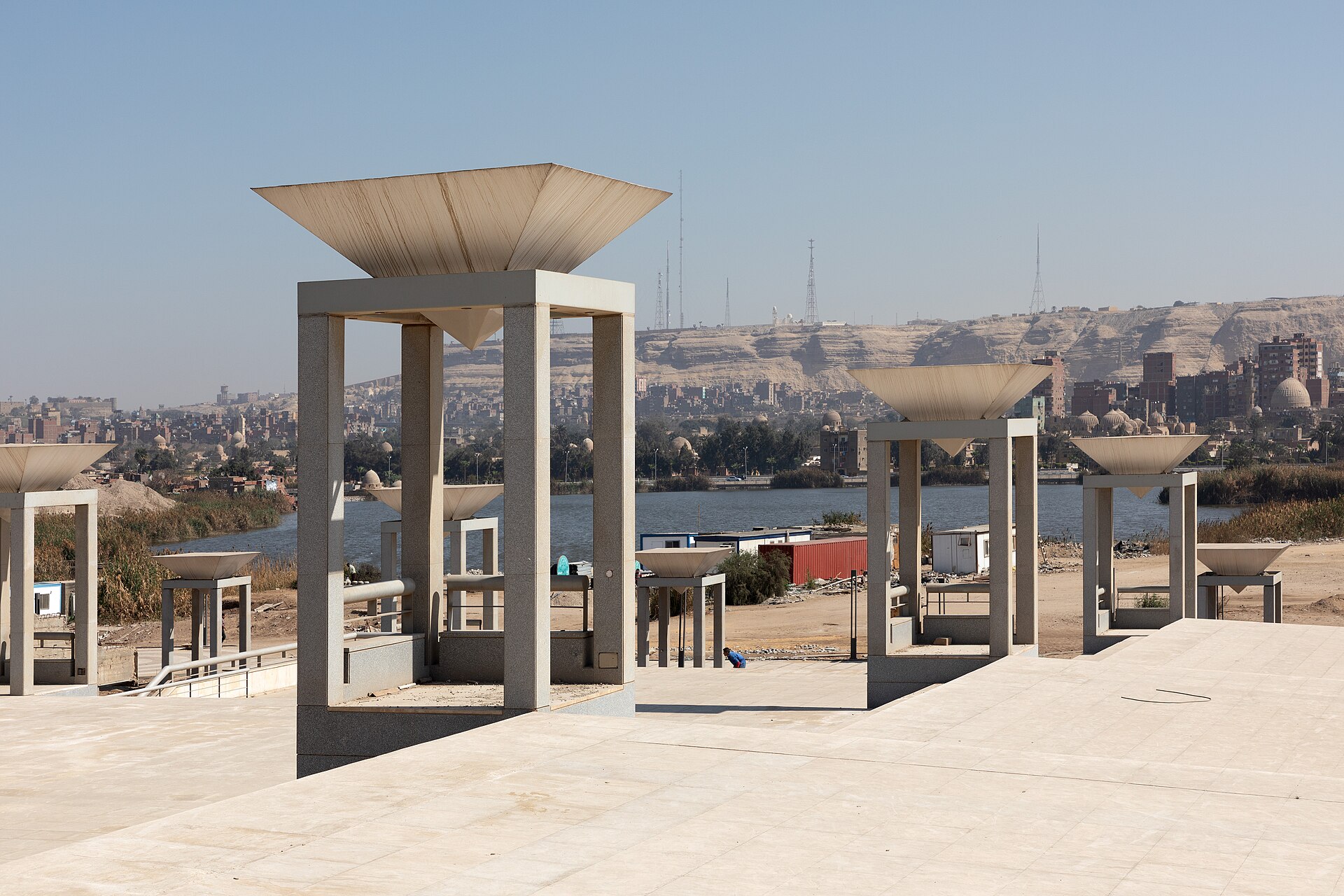
The idea is far older than the building. In 1982, at the Egyptian government's request, UNESCO launched an international campaign for two new museums: the Nubia Museum at Aswan and this one for Cairo. An international design competition followed, won in 1984 by the Egyptian architect Dr Ghazali Ksiba. What took until 2021 to open was not the design but everything after it: a site first earmarked near the Cairo Opera House was abandoned, and in 1999 the government settled instead on a plot at Fustat, in Old Cairo, on the edge of Ain el-Sira lake. NMEC's foundation stone was laid in 2002, with archaeological excavation of the site itself running alongside construction into the early 2000s and turning up, among other things, the Fatimid dye house now preserved on the grounds.
The building opened in stages. A single 1,000 square metre temporary exhibition hall, showing about 400 objects of Egyptian craft under the title Egyptian Crafts through the Different Eras, opened in 2017 with the then director-general of UNESCO, Irina Bokova, in attendance; it was a preview, not the museum. The Main Gallery, the Textile Gallery, the Dye House and the rest of the permanent building opened on 3 April 2021, and that date was chosen for a reason: it is also the date of the event that made the museum's opening a piece of international news, the Pharaohs' Golden Parade.
The Pharaohs' Golden Parade, and what the spectacle covered and cost
On the evening of 3 April 2021, twenty-two royal mummies, eighteen kings and four queens of the New Kingdom, were driven the roughly five kilometres from the Egyptian Museum at Tahrir Square to NMEC in nitrogen-filled, shock-absorbing cases mounted on vehicles built to resemble the funerary boats of ancient Egyptian burial. The route ran past a restored Ramesses II obelisk and sphinxes brought in from Karnak for the occasion; a specially commissioned orchestral score, sung in reconstructed Ancient Egyptian, played as the convoy moved; and President Abdel Fattah el-Sisi received the procession at the museum's door with a twenty-one gun salute from the Republican Guard. Government-aligned media described the event as a surge of national pride, and el-Sisi's own social media post at the time called it proof of the greatness of a unique civilization. The Egyptologist Salima Ikram of the American University in Cairo, asked for comment on the day, called the spectacle extremely moving and said Egyptians were visibly proud of what they were watching.
The event was also, by design, unreachable: no vehicles or spectators were permitted along the route itself, so almost everyone who saw it watched on television. And the staging drew criticism that this record is not going to leave out because it happened at a museum rather than in a legislature. Reporting on the parade noted that barriers were erected to keep Cairo's poorer neighbourhoods along the route out of camera view, and that several informal settlements were demolished and covered with sand ahead of the event. The Egyptian historian Khaled Fahmy criticised the parade's militarised staging as indicative of the regime's true priorities, a line aimed less at the museum's collection than at the choice to fold a national museum opening into a display of state power. A separate academic commentary published days later raised a second, older objection: some Muslim religious opinion in Egypt has long held that displaying royal mummies at all is undignified to the dead, an argument that surfaced publicly as far back as 1980, when President Anwar Sadat considered reburying them after criticism from Ayatollah Khomeini. None of this is a judgment this record can settle. It is recorded because a museum whose central hall is built around the bodies of named individuals is a museum where the ethics of display are a live question, not a settled one, and a visitor deciding whether to see the Royal Mummies Gallery is entitled to know the argument exists.
The Royal Mummies Gallery
The hall the parade emptied into is deliberately theatrical: low light, a hushed, single-file route, and a stated design intention of recreating the feeling of walking through the Valley of the Kings, where most of these bodies originally lay before nineteenth and twentieth-century archaeologists moved them to Cairo. The museum's own page for the gallery, as read for this record, describes the current display as seventeen kings and three queens, and names specific pieces beyond the bodies themselves: the outer coffin of Queen Ahmose-Nefertari, wife of the pharaoh Ahmose I and mother of Amenhotep I; the mummy of Amenhotep I, kept with its funerary garlands and mask largely undisturbed; the coffin of Thutmose I, which still carries traces of its original gilding; and the canopic chest of Amenhotep II, the sealed container for the internal organs removed during mummification.
That count, seventeen kings and three queens, is twenty individuals, two fewer than the twenty-two who travelled in the 2021 parade. Nothing in the sources read for this record explains where the other two are or whether they rotate in and out of display, and this record is not going to guess. It is left as an open question rather than smoothed into a round number.
Beyond the mummies: textiles, a working dye house, and where the coffin of Nedjemankh actually sits
The Textile Gallery is easy to walk past on the way to the mummies hall, which is a mistake: about 600 pieces trace cloth-making from Pharaonic linen through Graeco-Roman dress to Islamic-period weaving and the jewellery and fashion of the nineteenth-century Muhammad Ali dynasty, and the gallery is built to be read alongside the mummy wrappings next door, so that a visitor sees the same craft tradition used for the living and for the dead across four thousand years. Outside the exhibition halls altogether, on the museum's own grounds, sits the one exhibit here that was not moved in from somewhere else: a Fatimid-period dye house, first uncovered in 1932 and re-exposed during the excavation that preceded the museum's own construction in 2003 and 2004. Thirty-nine surviving dyeing basins, arranged in rows, date to at least the tenth to twelfth centuries and are described by the museum as the only well-preserved dye works of their kind still standing in Cairo.
This archive already holds a full record of one object connected to this museum: the gilded coffin of the priest Nedjemankh, bought by the Metropolitan Museum of Art in 2017 on a forged 1971 Egyptian export licence and seized by New York investigators in 2019 after it was traced to looting near Minya during the chaos that followed the 2011 revolution. Because a 2019 case note from the University of Geneva's Art-Law Centre recorded a plan for the coffin to be shown temporarily at the Egyptian Museum in Tahrir Square before eventually moving to the Grand Egyptian Museum at Giza, and because that plan is repeated in some secondary accounts, this record checked independently where the coffin actually is rather than assume either institution. Ahram Online's own report of the coffin's unveiling, filed by Nevine El-Aref on 1 October 2019, states plainly that it went on display for the first time in Egypt at the National Museum of Egyptian Civilisation, not at Tahrir. A dated photograph taken in May 2022 and uploaded to a public collection shows the coffin still at NMEC, captioned as photographed there. A visitor account of a recent NMEC trip describes a crowd gathered around what it calls the famous gilded coffin of Nedjemankh inside the museum. Three independent sources, three years apart, place the object at NMEC and nowhere else. What this record cannot do is certify that the coffin is a permanent, named fixture the way the Royal Mummies Gallery is: it does not appear among the objects the museum's own Main Gallery and Collection pages currently choose to name as highlights, which are curated top lists rather than full inventories, so its absence there is not evidence against display, only evidence that this record should not overstate how the museum itself markets it.
What visitors say
Two things recur across the sources read for this page. Visitors consistently name the Royal Mummies Gallery as the emotional high point of the visit, describing it as calmer and more staged than a conventional display case room, built deliberately to feel like walking into the Valley of the Kings. And visitors comparing it with the older Egyptian Museum in Tahrir Square consistently describe NMEC as modern, spacious, well labelled in English and Arabic, and far less crowded, though a minority on Tripadvisor's own discussion board say they skip the mummies hall on principle, finding the display of human remains uncomfortable rather than moving. The most repeated practical notes are that the museum is not an easy walk from its own metro station, and that photography, allowed everywhere else with a phone, is banned inside the mummies hall.
What is praised, what is criticised
- Praised: The Royal Mummies Gallery's staged, low-lit presentation, which visitors repeatedly single out as more affecting than seeing mummies in ordinary display cases
- Praised: The building and its labelling: modern galleries, clear English signage and a chronological layout that visitors contrast favourably with the older, denser Egyptian Museum at Tahrir Square
- Criticised: Getting there: Mar Girgis metro station is the nearest stop but is a 15 to 20 minute walk from the museum entrance, longer than visitors researching the trip expect from a station listed as the nearest one
- Criticised: The no-photography rule inside the Royal Mummies Gallery, which some visitor guides flag as a disappointment after the phone-photography allowed everywhere else in the museum
- Criticised: The 2021 inauguration itself drew institutional criticism distinct from ordinary visitor reviews: the Egyptian historian Khaled Fahmy criticised the militarised staging of the Pharaohs' Golden Parade as reflecting the government's true priorities, and reporting from the event noted that barriers were erected along the parade route to keep poorer neighbourhoods out of view, with several informal settlements demolished and covered with sand beforehand
Ratings on other platforms
Tripadvisor: 4.6 from 259 ratings, read 18 August 2026
Google: 4.7 from 30,000 ratings, read 18 August 2026
A platform average is a tertiary source: it moves, it is not audited, and we quote no visitor's words.
Questions about National Museum of Egyptian Civilization
Where is National Museum of Egyptian Civilization?
El Fustat Road, Ein El Sira, Cairo 17611, Egypt.
How much does it cost to visit?
Egyptian, adult: EGP 90; Egyptian, student: EGP 45; Arab nationality, adult: EGP 550; Arab nationality, student: EGP 300; Foreign, adult: EGP 550. As confirmed 18 August 2026.
When is it open?
Saturday to Thursday 09:00-17:00; Friday 09:00-17:00; Friday evening 18:00-21:00; During Ramadan 09:00-16:00. As confirmed 18 August 2026.
How do you get there?
Metro: Line 1, Mar Girgis (Mar Gerges) station, then a 15 to 20 minute walk through Ain el-Sira or a short taxi; the museum is not next to the station the way the Coptic Museum and Hanging Church are; Car or taxi: On-site parking is available with designated accessible spaces; the museum sits on the Fustat road above Ain el-Sira lake, a few minutes' drive from Old Cairo and the Citadel.
What should you see first?
The Royal Mummies Gallery (New Kingdom royal workshops, 17th to 20th Dynasties); Gilded coffin of Nedjemankh (Workshop of Herakleopolis, priesthood of Heryshef, late Ptolemaic period, about 150 to 50 BC); Nazlet Khater skeleton (Upper Palaeolithic Homo sapiens, about 35,000 years before present); Coffin of Sennedjem (New Kingdom, Deir el-Medina workshop tradition); Chariot of Thutmose IV (18th Dynasty royal workshop); Chair of Queen Hetepheres I (Old Kingdom, 4th Dynasty).
What we could not confirm
- The museum's own Royal Mummies Gallery page describes the display as seventeen kings and three queens, twenty individuals, but the twenty-two mummies moved in the 2021 Golden Parade comprised eighteen kings and four queens. No source consulted for this record explains the two-mummy gap or whether the display rotates; this record does not guess which two are absent.
- Whether the gilded coffin of Nedjemankh is named as a permanent fixture by the museum itself, as opposed to being present but uncatalogued on its own public-facing highlight pages, is not resolved by the sources read here. The independent evidence, an October 2019 unveiling report, a May 2022 dated photograph, and a recent visitor account, places it at NMEC across a three-year span and nowhere else; it is not confirmed as a museum-designated highlight object.
- No English-language figure for total annual visitors, comparable to the figures published for Tahrir or Giza, was found on the museum's own site or in the ministry sources consulted.
- The museum's own About page, as read for this record, carries an unfinished timeline (bare years with no descriptive text) and placeholder Latin filler text in the section meant to hold its mission statement; this record used the separate Museum History page instead, which is complete, but the About page's condition is worth a re-check on any future visit to the site.
Images
Sources
- 1National Museum of Egyptian Civilization, official site, homepage: opening hours summary, the four named galleries (Main Gallery, Textile Gallery, Royal Mummies Gallery), and the link to the ministry's own ticketing portal. Read to confirm the museum is open and operating. nmec.gov.eg/
- 2National Museum of Egyptian Civilization, official site, Museum History page: the 1982 UNESCO campaign, the international design competition, the 1999 site selection at Fustat in place of an earlier Opera-district site, the 2002 foundation stone, and the 2017 temporary exhibition hall opening with UNESCO's then director-general present. nmec.gov.eg/museum-history/
- 3National Museum of Egyptian Civilization, official site, Collection page: the four exhibition spaces and a list of named highlight objects including the Kaaba key bag, a lustre bowl, mosque lamps, a water clock, a relief of Maat, a scribe statue, a statue of Khedive Ismail and an astrolabe. nmec.gov.eg/collection/
- 4National Museum of Egyptian Civilization, official site, Main Gallery page: the thirteen named highlight objects of the Main Gallery, including the Nazlet Khater skeleton, the coffin of Sennedjem, the chariot of Thutmose IV, the Minbar of Aboubakr ibn Mizhar, and Mahmoud Mokhtar's Al-Fallaha. nmec.gov.eg/main-gallery/
- 5National Museum of Egyptian Civilization, official site, Royal Mummies Gallery page: the description of the gallery as showing seventeen kings and three queens, the Valley of the Kings design concept, and named pieces including Ahmose-Nefertari's outer coffin and Amenhotep II's canopic chest. nmec.gov.eg/mummies-gallery/
- 6National Museum of Egyptian Civilization, official site, Dye House page: the 1932 discovery, the 2003 to 2004 re-excavation, the Fatimid-period dating, and the basin count and dimensions. nmec.gov.eg/dying-house/
- 7National Museum of Egyptian Civilization, official site, Facilities page: the theatre, cinema hall, lecture hall, open-air Roman theatre, meeting room and gift shop, and the absence of any listed cafe or restaurant. nmec.gov.eg/facilities/
- 8National Museum of Egyptian Civilization, official site, Accessibility page: free wheelchairs, elevator access to all galleries, accessible parking, Braille brochures on request, and sign-language tours by advance booking. nmec.gov.eg/accessibility/
- 9National Museum of Egyptian Civilization, official site, Contact page: the phone number +20 2 3531 7344, the email [email protected], and the Fustat, Ain el-Sira address with postal code 17611. nmec.gov.eg/contact/
- 10National Museum of Egyptian Civilization, official site, Opening Hours page: the Saturday to Thursday and Friday hours, the second Friday evening session, and last-admission times. nmec.gov.eg/opening-hours/
- 11Egyptian Ministry of Tourism and Antiquities, Discover Egypt's Monuments, museum listing for NMEC: a second, independent statement of the 90/45 EGP Egyptian and 550/300 EGP foreign ticket prices and the standard and Ramadan hours, corroborating the ticketing portal. egymonuments.gov.eg/en/museums/national-museum-of-egyptian-civilization-nmec
- 12Ministry of Tourism and Antiquities official e-ticketing portal, NMEC listing: the full price table broken out by Egyptian, Arab and other-nationality visitors, the free-entry policy for children under 6, Egyptians 60 and older and Egyptians with disabilities, the summer, winter and Ramadan hours, and the ministry support phone line, which matches the number given on the museum's own contact page. Fetched directly (curl, TLS certificate warning bypassed as an expired intermediate on a .com government-linked domain, not a redirect or spoofed host). egymonuments.com/nmec
- 13Wikidata, item Q29017001. No P576 dissolution date is set. wikidata.org/wiki/Q29017001
- 14Wikipedia, 'National Museum of Egyptian Civilization'. en.wikipedia.org/wiki/National_Museum_of_Egyptian_Civilization
- 15Wikipedia, 'Pharaohs' Golden Parade'. en.wikipedia.org/wiki/Pharaohs%27_Golden_Parade
- 16Al Jazeera, 'Egypt parades royal mummies in show of pharaonic heritage', 3 April 2021: the quotation from Egyptologist Salima Ikram of the American University in Cairo, President el-Sisi's social media statement on the parade, and the framing of the event as a tourism-revival effort after the 2011 uprising and the pandemic. aljazeera.com/news/2021/4/3/egypt-parades-royal-mummies-in-show-of-pharaonic-heritage
- 17Ethical Entanglements (academic blog), 'Thoughts about Pharaohs' Golden Parade', 7 April 2021: the argument that the parade connected the ancient past to the contemporary Egyptian state and military, the note on Muslim religious objection to mummy display and the 1980 reburial episode under Sadat, and the characterisation of the parade's economic motive as an investment in future tourism revenue. ethicalentanglements.online/2021/04/07/thoughts-about-pharaohs-golden-parade/
- 18Nevine El-Aref, 'Coffin of ancient Egyptian priest Nedjemankh on display for first time in Egypt after repatriation from US', Ahram Online, 1 October 2019: read directly (in-app browser, after a 403 bot block on a direct fetch), confirming the coffin's first Egyptian display was at the National Museum of Egyptian Civilisation, not at the Egyptian Museum in Tahrir Square, with US Charge d'Affaires Thomas Goldberger and Minister of Antiquities Khaled El-Enany named as present. english.ahram.org.eg/NewsContent/9/40/351933/Ancient-Egypt/Antiquities/Coffin-of-ancient-Egyptian-priest-Nedjemankh-on-di.aspx
- 19Photograph, 'Detail of the coffin of Nedjemankh', taken May 2022 and uploaded to a public photo-sharing platform February 2023, captioned as photographed at the National Museum of Egyptian Civilization, Fustat, Cairo. Used as an independently dated confirmation that the coffin remained on display roughly three years after its 2019 unveiling. flickr.com/photos/130870_040871/52711427848/
- 20Mainly Museums, visitor account of a National Museum of Egyptian Civilization visit: describes a crowd gathered around what the author identifies as the famous gilded coffin of Nedjemankh inside the museum, alongside a first-person description of the Main Gallery, Royal Mummies Hall and Textile Gallery route. Used only for the observation that the coffin was seen on display; no visitor prose is reproduced. mainlymuseums.com/post/1021/the-national-museum-of-egyptian-civilization/
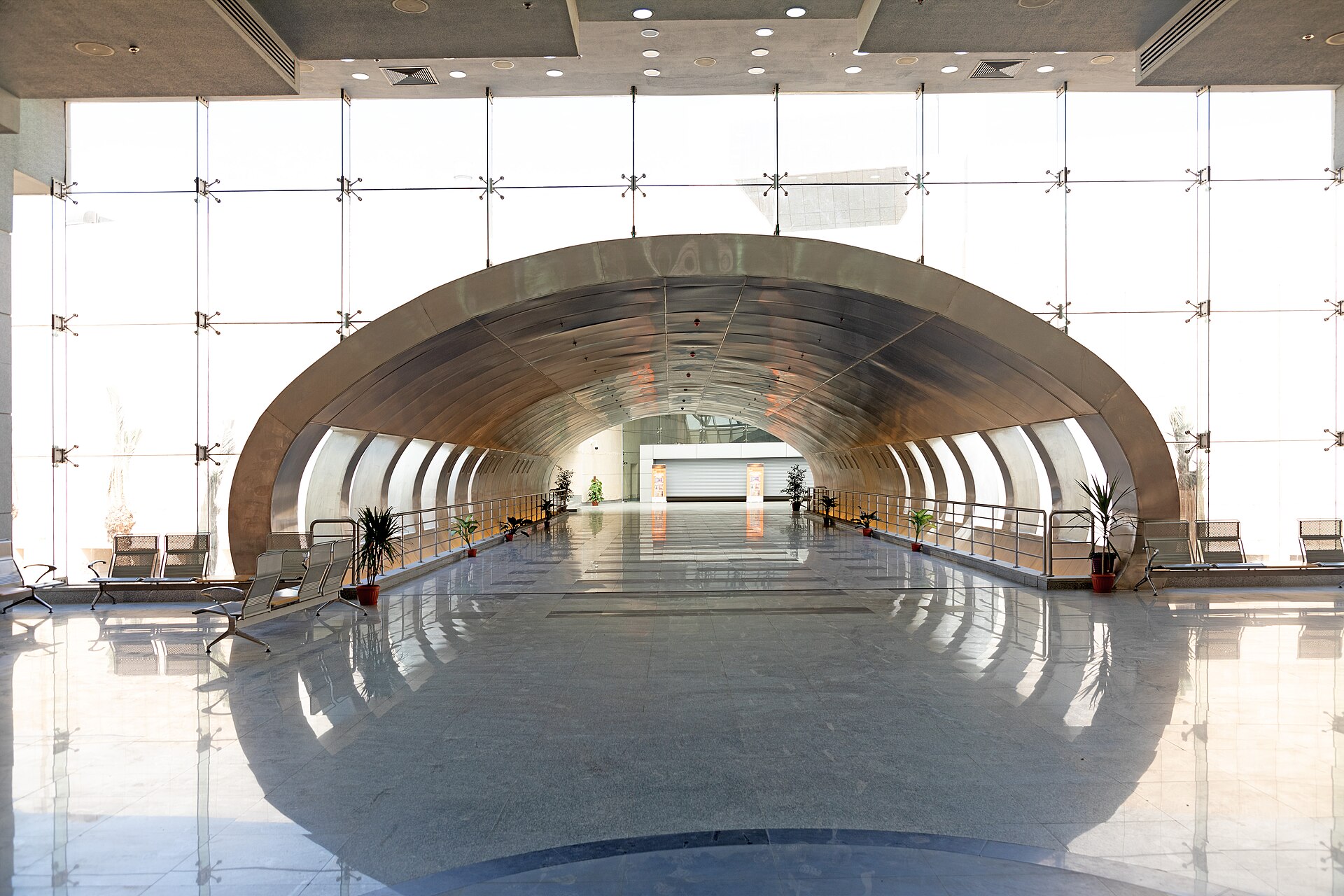
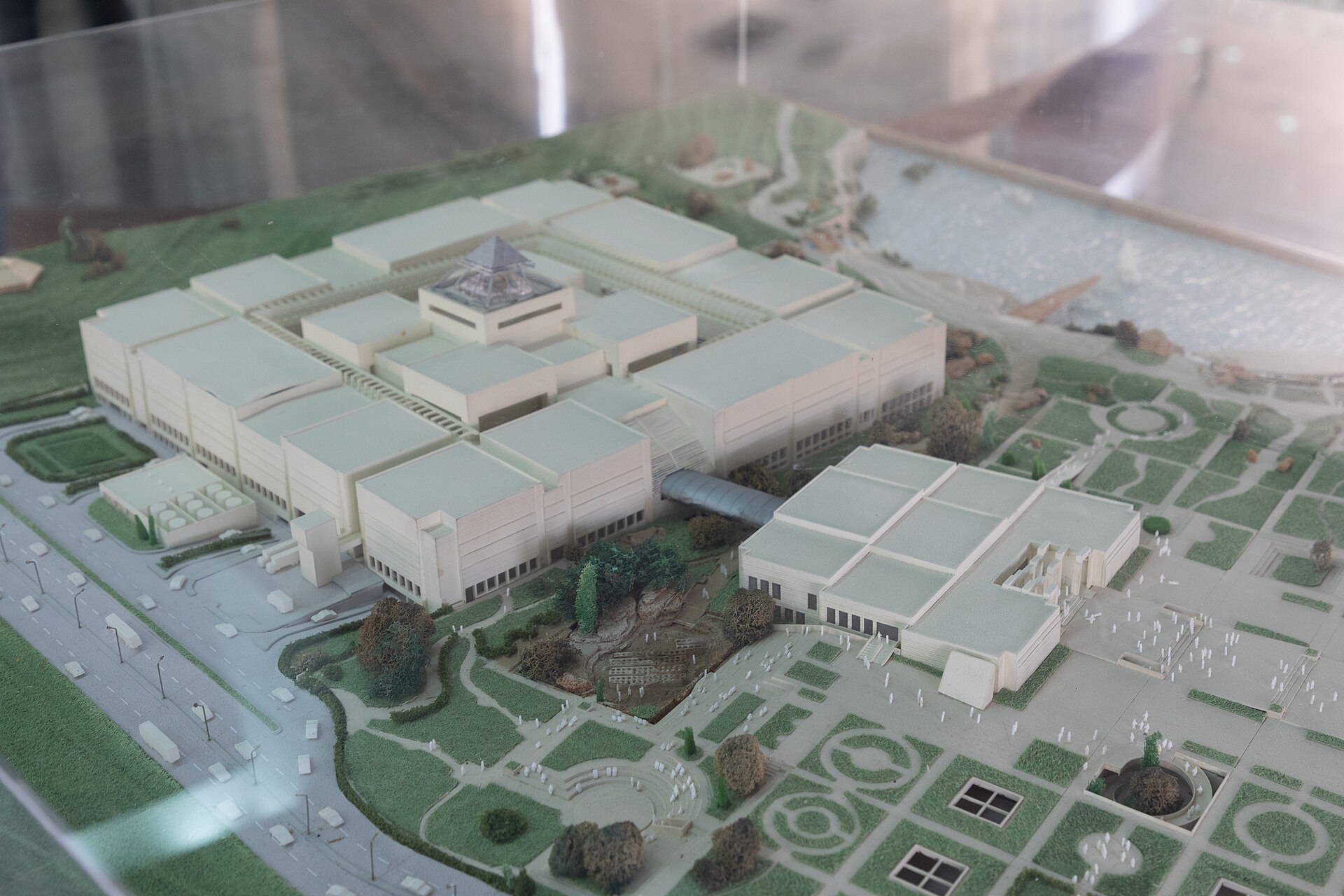
- 21Wikimedia Commons, File:NMEC-MainEntrance.jpg, and the same photographer's File:NMEC-MainHall.jpg, File:NMEC-Tunnel.jpg, File:NMEC-SiraLake.jpg and File:NMEC-Model.jpg: licence (CC BY-SA 4.0) and author (Roland Unger) verified per file from .LicenseShortName, and each thumbnail downloaded and inspected by eye against the building's bilingual entrance signage before use. commons.wikimedia.org/wiki/File:NMEC-MainEntrance.jpg
- 22Wikimedia Commons, Category:National Museum of Egyptian Civilization: confirms at least 145 files under this category, including a large CC BY 4.0 batch and a smaller Flickr-sourced CC BY 2.0 set, establishing that this very recent (2021) building has substantial free-licence photographic coverage. commons.wikimedia.org/wiki/Category:National_Museum_of_Egyptian_Civilization
- 23Tripadvisor, 'National Museum Of Egyptian Civilization NEMC' attraction page: read directly (in-app browser). States a 4.6 out of 5 rating from 259 reviews and a ranking of number 2 of 362 things to do in Cairo, read on the date given. tripadvisor.com/Attraction_Review-g294201-d12166958-Reviews-National_Museum_Of_Egyptian_Civilization_NEMC-Cairo_Cairo_Governorate.html
- 24Google Search results page for the museum's own Google Business Profile listing, read directly (in-app browser): shows a rating in the region of 4.7 out of 5 from approximately 30,000 ratings. google.com/search?q=National+Museum+of+Egyptian+Civilization+google+reviews+rating
