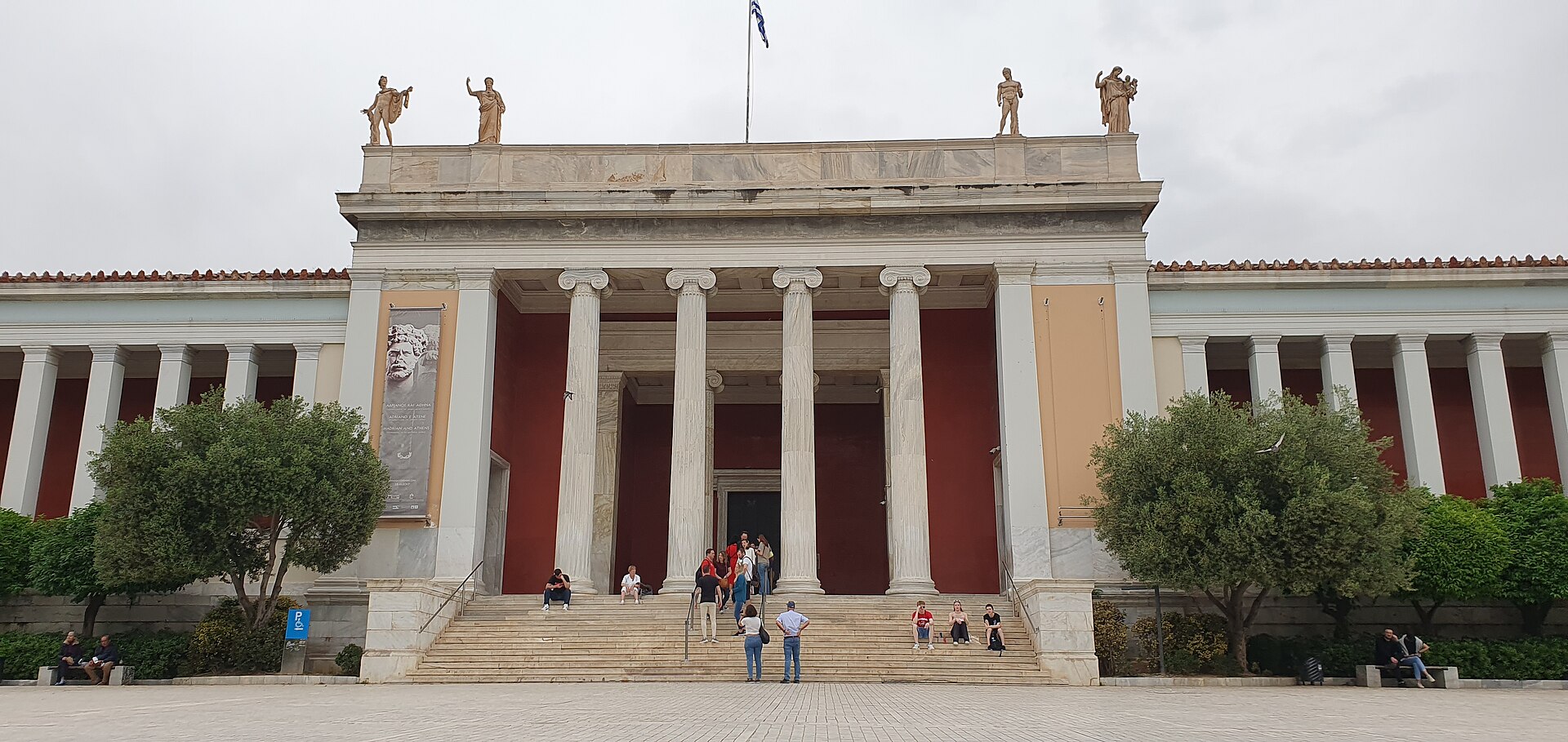
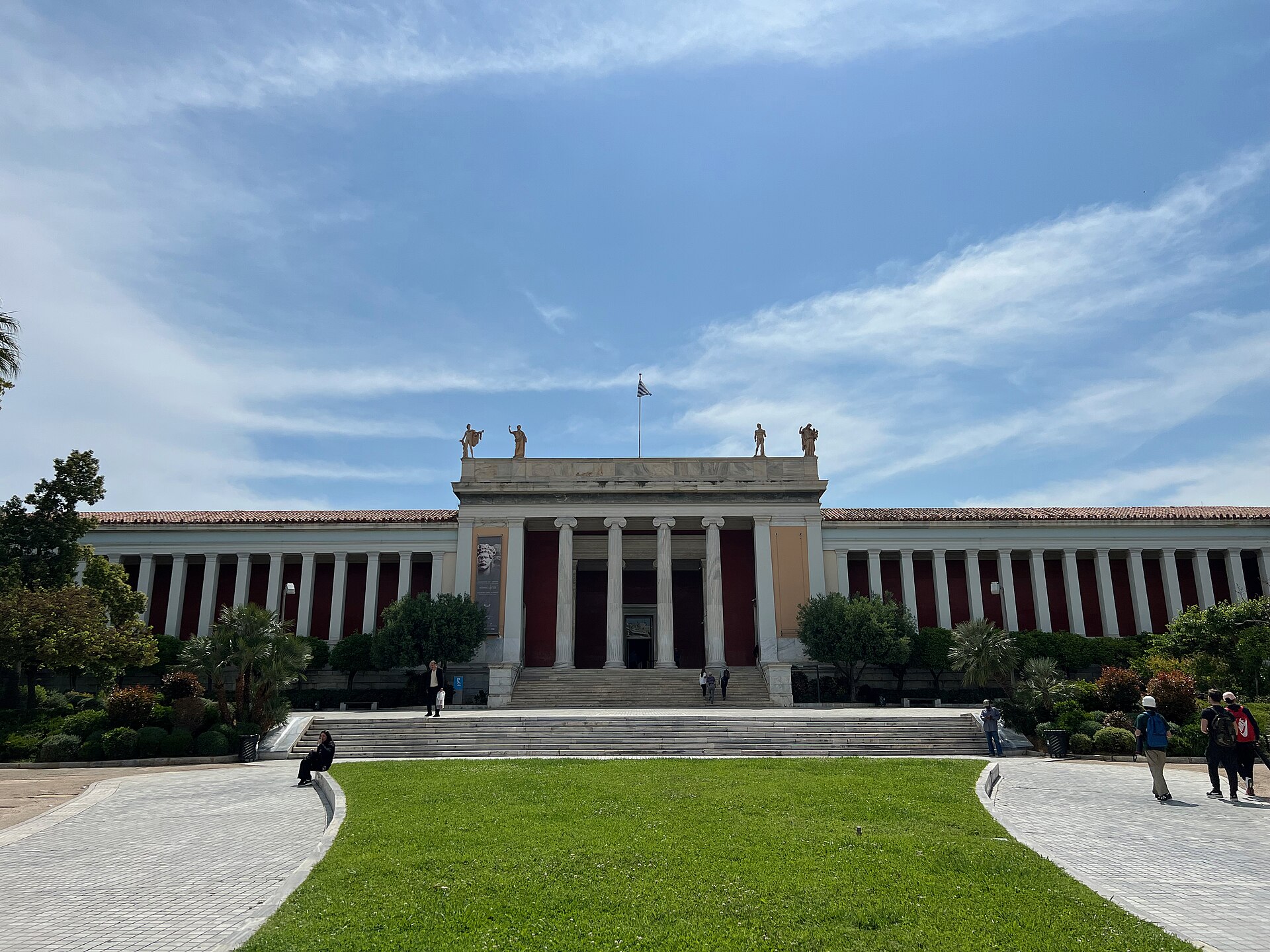
The neoclassical facade on 28th of October (Patission) Street, begun to designs by Ludwig Lange in 1866 and reworked by Ernst Ziller before the building opened in 1889.
Yair Haklai · Photograph by Yair-haklai · CC BY-SA 4.0National Archaeological Museum
Museum · Ethniko Archaiologiko Mouseio · Founded 1829
Open, admission and hours confirmed 10 September 2026 · 21 sources
On this page 14 sections
ContentsClose
The museum's own claim to be organised around five major permanent collections understates how much sits inside each one. The sculpture collection alone runs unbroken from the 7th century BC to the 5th century AD across almost thirty rooms, giving it a continuity few single collections anywhere can match. The metalwork collection is where the two great sea recoveries meet: the Antikythera Mechanism and the Artemision bronzes share space with smaller original bronze statuary and miniature work rarely seen outside Greece in this concentration. The prehistoric holdings, spanning Neolithic, Cycladic, Mycenaean and Theran material from the 6th millennium BC to 1050 BC, are strongest exactly where the popular imagination is weakest: the museum's own Cycladic and Thera rooms make the case, in objects rather than argument, that Aegean civilisation before Classical Greece was neither primitive nor marginal. The Egyptian and Near Eastern collection, small by the standards of Cairo or London, is nonetheless the only collection of its kind and scale in Greece, and the vase and minor arts galleries, fifteen rooms and roughly 5,500 exhibits, are large enough that most visitors, on the evidence of their own accounts, do not reach them on a first visit at all.
| Local name | Ethniko Archaiologiko Mouseio |
|---|---|
| Kind | Museum |
| Founded | 1829, in Aegina, under governor Ioannis Kapodistrias; moved to Athens 1834; present building begun 1866, opened to the public 1889 |
| City and country |  Athens, Greece Athens, Greece |
| Address | 44, 28th of October (Patission) Street, Athens 106 82, Greece |
| Website | namuseum.gr/en |
| Status | Open, confirmed |
| Record last verified |
Visiting
- Hours
- Wed-Mon (winter, 16 Nov 2025 to 3 May 2026)08:30 to 15:30Last admission 15:00
- Tue (winter, 16 Nov 2025 to 3 May 2026)13:00 to 20:00Last admission 19:30
- Wed-Mon (summer, 4 May to 15 Nov 2026)08:00 to 20:00Last admission 19:30
- Tue (summer, 4 May to 15 Nov 2026)13:00 to 20:00Last admission 19:30
- Closed
- 25-26 December. 1 January. 25 March. 1 May. Orthodox Easter Sunday.
- Admission
- General admissionEUR 20Single published general tier on the museum's own visit page and on its official timed-entry ticketing partner. The museum was converted into an independent public-law entity in 2023 and sets its own pricing rather than following the fee schedule used at other state-run sites. Unchanged since the previous check.
- Reduced (50%), single ticketsEUR 10Confirmed 2026-09-10 directly on the museum's own visit page (not available to the earlier check, which could not get this section of the page to load): applies to (a) senior citizens over 65 from Greece or other EU member states, on presentation of ID, (b) parents accompanying a primary-school visit from an EU/EEA member state, and (c) escorting teachers of educational visits from primary, secondary or tertiary institutions.
Free entry: 6 March, in memory of Melina Mercouri. 18 April, International Monuments Day. 18 May, International Museums Day. The last weekend of September, European Heritage Days. 28 October, Greek national holiday. Every first and third Sunday of the month from 1 November to 31 March- Tickets
- tickets.hh.gr/en/venues/national-archaeologic... The museum's own ticket page.
- Do I need to book?
- Not required, but the museum's official ticketing partner (Hellenic Heritage) issues timed-entry tickets for general admission; changes are allowed up to two hours before the visit, a maximum of two changes per ticket, and tickets are non-refundable
- Address
- 44, 28th of October (Patission) Street, Athens 106 82, Greece MapMetro Omonia or Victoria station, both a short walk from the museum on 28th of October (Patission) Street
Electric train (ISAP) Same Omonia or Victoria stations serve the ISAP electric line
Bus Lines B5, A6, B6, E6, A7, B7, E7, A8, B8, A12, B12, G12, E12, 022, 035, 046, 060, 200, 224, 605, 608 and 622 stop near the museum, per the museum's own visit page
Trolley Lines 2, 3, 4, 5, 6, 7, 8, 9, 11, 13 and 14 - Website
- namuseum.gr/en
- Telephone
- +30 213 214 4800, +30 213 214 4856
- [email protected]
Before you go how long, access, photography, bags, eating, shop
- How long to allow
- At least two hours by the museum's own reckoning. Visitors who write about repeat visits describe needing three or four separate two-hour sessions across different trips to feel they have actually seen the collection
- Access
- A separate entrance for visitors with disabilities on the Vasileos Herakleiou Street side of the building, reached either by a ramp from the main forecourt or directly from the pavement; the museum asks that priority on the lift be given to visitors with mobility impairments
- Photography
- Personal photography is allowed; professional photo or film shoots are not, per the official ticketing terms
- Bags
- Large luggage is not permitted inside the museum
- Eating
- A cafe in a renovated garden-patio planted with about 700 species; entry to the cafe alone is free without a museum ticket, and the space doubles as a venue for art exhibitions and music events tied to the Ministry of Culture's annual calendar, including Museums Day and the August full moon evening
- Shop
- The museum shop reopened under new management on 5 August 2025, during the museum's normal opening days and hours
Prices and hours change. We take them from the institution's own pages and print the day we read them, and you can check the current position at the source we used. Confirm before you travel.
What is inside
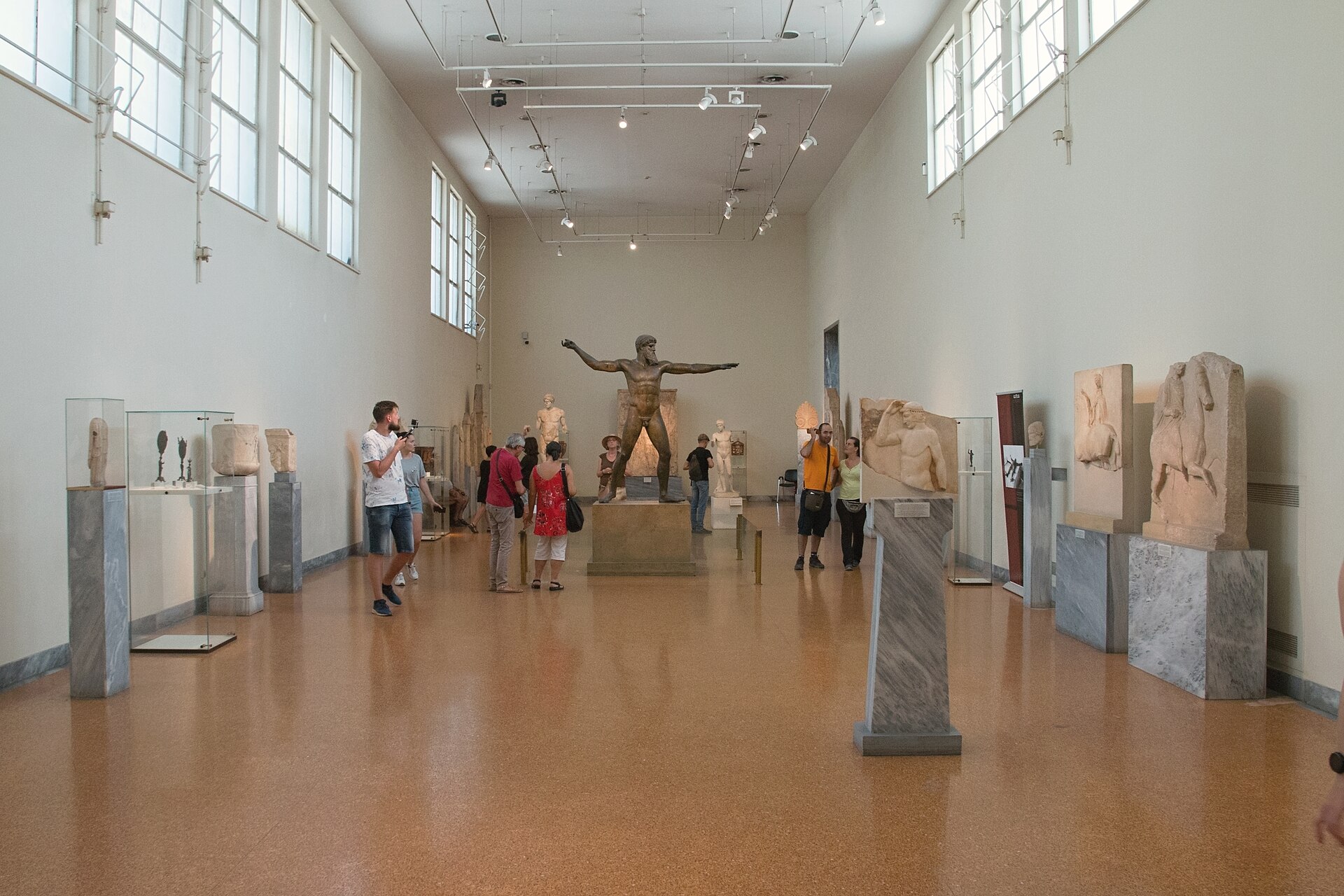
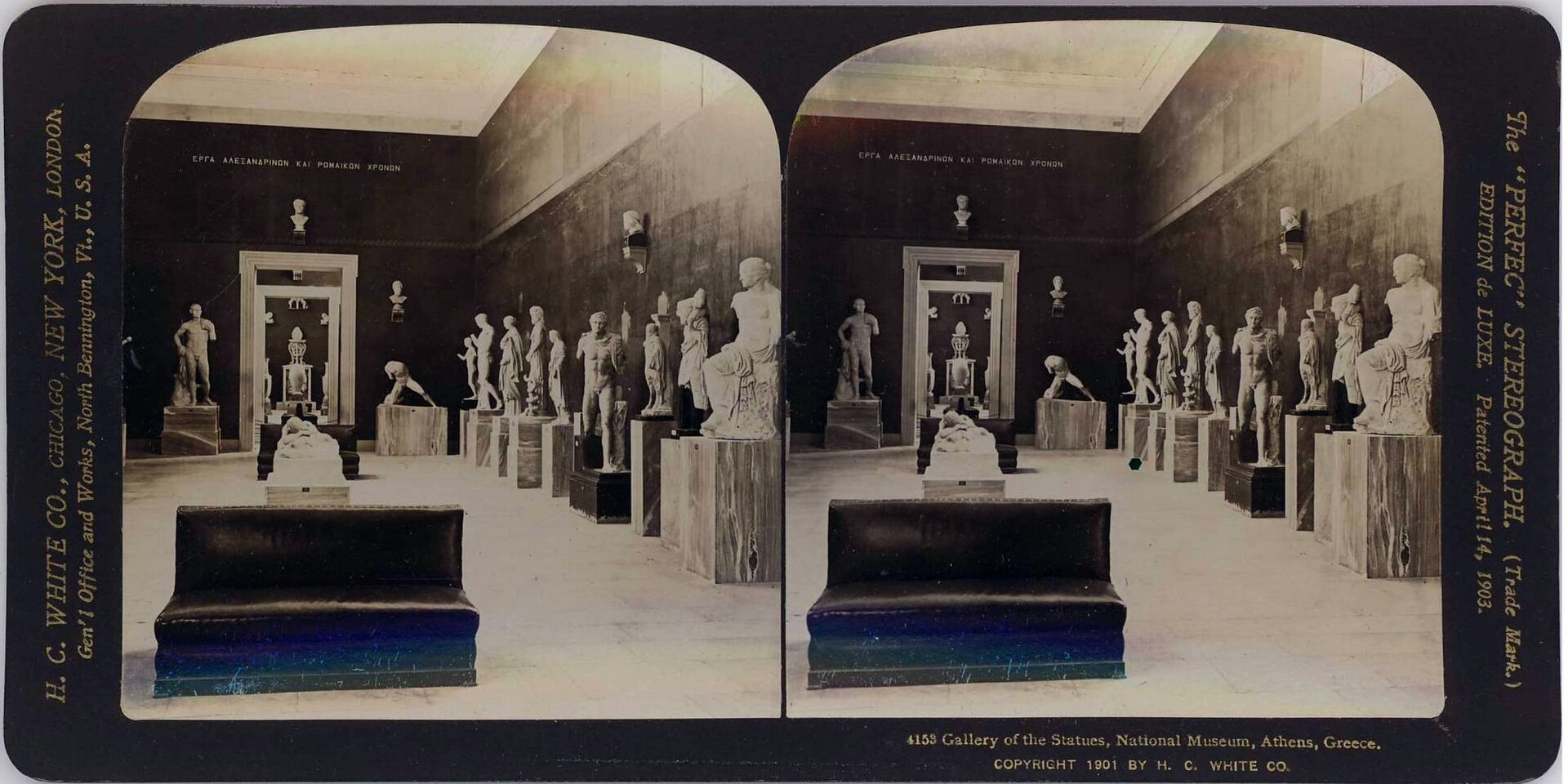
Photograph by Zde · CC BY-SA 4.0 Sculpture Collection (Ground Floor, Halls 7-35)
The largest and one of the most significant collections of ancient Greek sculpture in the world, run chronologically from the 7th century BC to the 5th century AD: kouroi and korai of the Archaic period, grave stelai, and the Severe-style bronze recovered from the Artemision shipwreck, generally read as Zeus or Poseidon, given its own room, the Room of Poseidon.
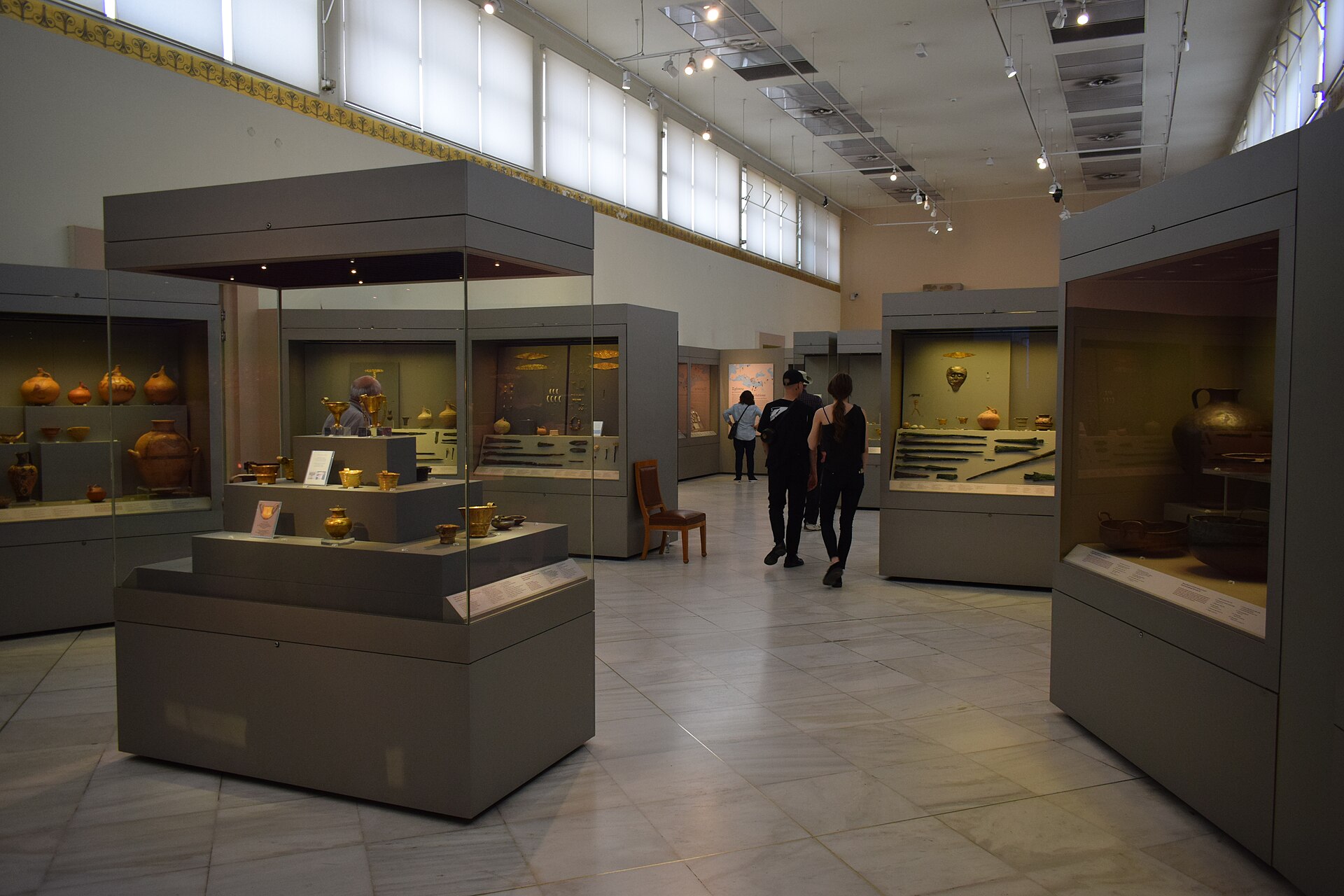
Photograph by Jeanhousen · CC BY-SA 4.0 Collection of Mycenaean Antiquities (Ground Floor, Halls 3-4)
Finds from the Mycenaean shaft graves and beyond, whose influence the museum's own account traces from Asia Minor and the Near East to the western Mediterranean and north-west Europe: the gold funerary masks and cups from Grave Circle A at Mycenae, among them the mask popularly called the Mask of Agamemnon.
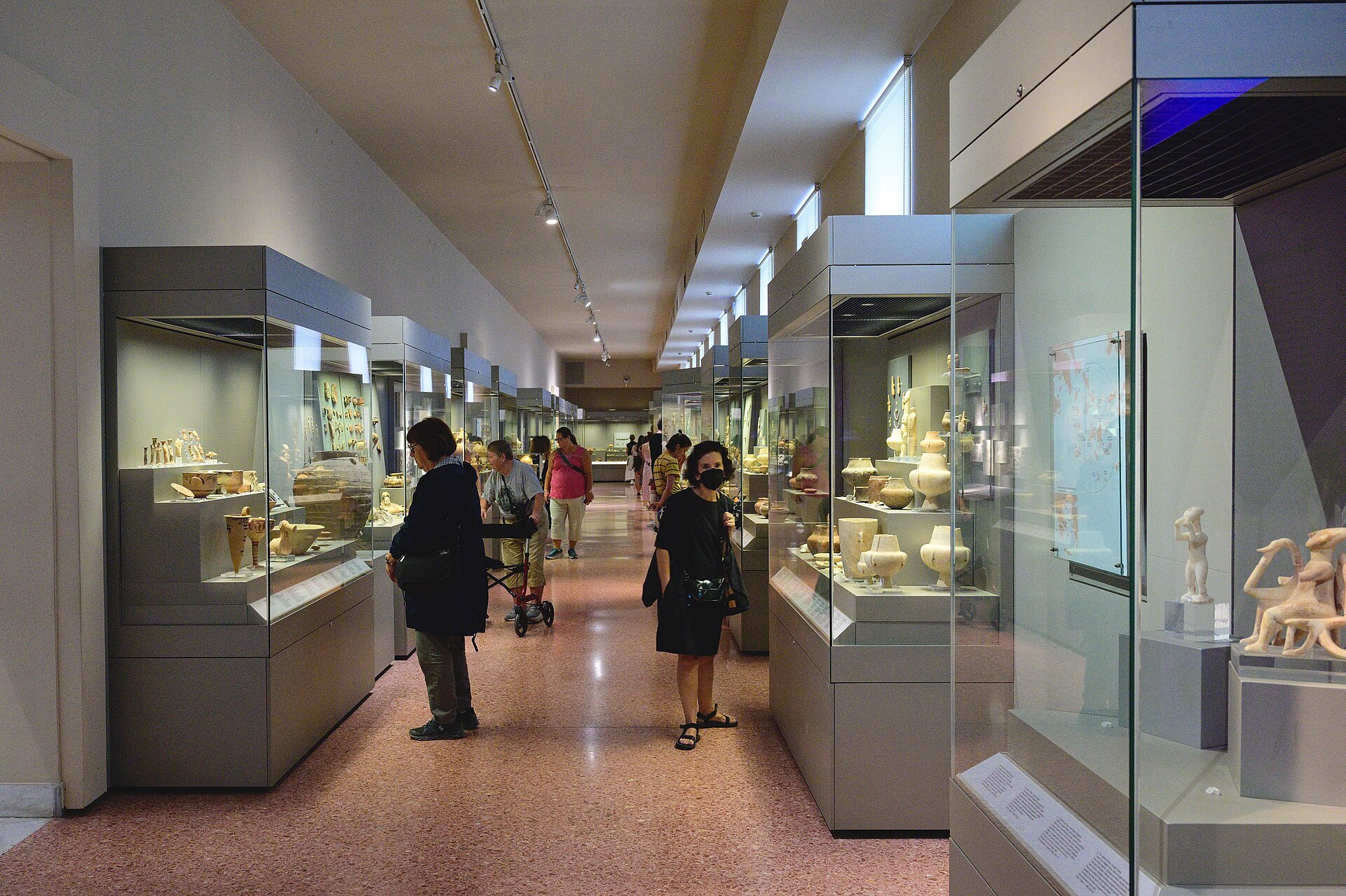
Photograph by Zde · CC BY-SA 4.0 Collection of Cycladic Antiquities (Ground Floor, Hall 6)
Marble figurines and vessels of the Early Cycladic civilisation, mostly third-millennium BC, including the folded-arm figures whose flat geometry later drew the attention of twentieth-century sculptors.
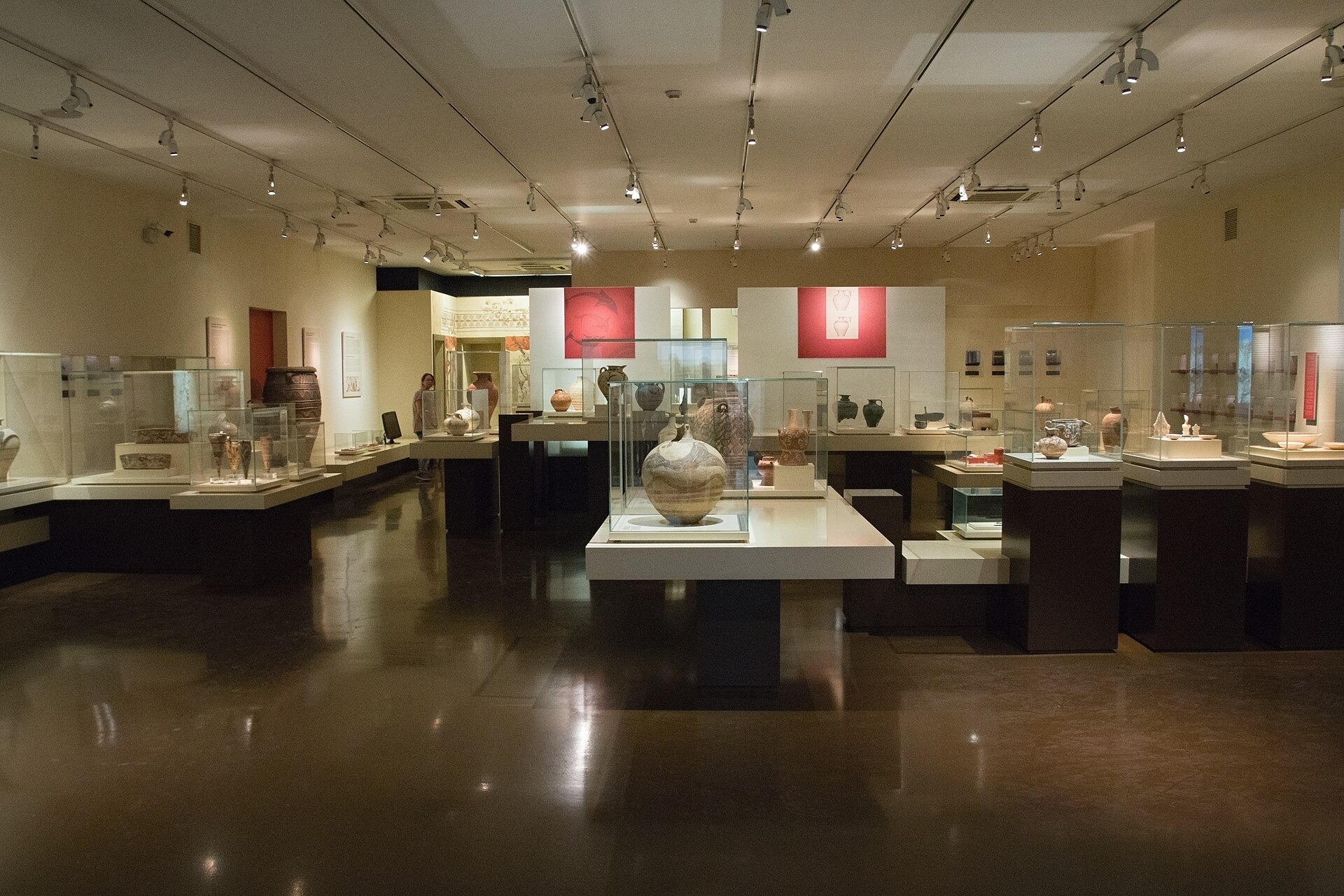
Photograph by Zde · CC BY-SA 4.0 Collection of Antiquities of Thera (1st Floor, Hall 48)
Wall paintings from Late Bronze Age Akrotiri on Santorini, sealed and preserved by the volcanic eruption that buried the settlement: the Spring Fresco with its swallows and lilies, the Boxing Children (or Boxing Boys) fresco, and the Antelope fresco.
Collection of Metalwork (Ground Floor, Halls 36-39)
Bronzes recovered from two ancient shipwrecks share this collection with statuary and miniature work: the corroded fragments of the Antikythera Mechanism, recovered from a wreck off Antikythera in 1900-01, and the bronze Jockey of Artemision and the Marathon Boy, both sea recoveries of the 1920s.
Vase and Minor Arts Collection (1st Floor, Halls 49-57)
Fifteen rooms and roughly 2,000 square metres of Greek ceramics from the 11th century BC to the Roman era, more than 250 cases and pedestals in total, shown beside the museum's own Stathatos Collection of miniature and precious-metal work.
Egyptian and Near Eastern Antiquities (Ground Floor, Halls 40-42)
The only collection of its kind in Greece, spanning the pre-dynastic period to the Roman conquest of Egypt, shown beside the separate Stathatos donation of ancient and Byzantine treasures.
Collection of Neolithic Antiquities (Ground Floor, Hall 5)
Finds from the Neolithic settlements of mainland Greece, the earliest material in the museum's prehistoric holdings, shown immediately before the Cycladic and Mycenaean rooms in the museum's own chronological sequence.
What to see first
The Antikythera Mechanism
Unknown Greek maker, 2nd or 1st century BCA geared bronze astronomical calculator recovered corroded and unrecognised from a shipwreck off Antikythera in 1900-01, not understood for another seventy years, and still the single object with no known peer anywhere in the ancient world. This archive holds a full record of it, cross-checked against the museum's own gallery label, which gives the inventory number 15087.16
Full record in this archiveThe Mask of Agamemnon
Unknown Mycenaean goldsmith, circa 1550-1500 BCA beaten gold funerary mask from Grave Circle A at Mycenae, excavated by Heinrich Schliemann in 1876 and named by him for a king who, if the mask is genuine, it still predates by three to four centuries. Its authenticity has been formally disputed since the late twentieth century by scholars who question Schliemann's own honesty as an excavator.10
Zeus or Poseidon of Artemision
Unknown sculptor, Severe style, circa 460 BCA larger-than-life bronze of a striding god, arm drawn back to throw a now-lost thunderbolt or trident, recovered from a shipwreck off Cape Artemision in 1926 and 1928. Which god it depicts is unresolved on the evidence of the statue alone, since the identifying weapon was never recovered.11
The Jockey of Artemision
Unknown sculptor, Hellenistic, circa 150-140 BCA bronze racehorse at full gallop carrying a boy rider about ten years old, recovered in pieces from the same Artemision wreck as the Zeus or Poseidon between 1928 and 1936-37, and reassembled by welding. It has been on display only since 1972.12
The Akrotiri wall paintings
Unknown Late Cycladic painters, Thera (Santorini)Frescoes sealed under volcanic ash when the Late Bronze Age settlement of Akrotiri was buried, among the best-preserved wall paintings anywhere from the Aegean Bronze Age. The Spring Fresco, the Boxing Children and the Antelope fresco are the pieces the museum's own visit material names as the room's draw.4
Early Cycladic folded-arm figurines
Unknown Cycladic sculptors, mostly circa 2800-2300 BCFlat, minimally carved marble figures, mostly female, found across the Cycladic islands and originally painted, though almost none of that paint survives. Their abstraction later drew the attention of twentieth-century sculptors working in an entirely different tradition.14
The Varvakeion Athena
Roman copyist, circa 200-250 AD, after PheidiasA one-twelfth-scale marble copy of Pheidias's lost chryselephantine Athena Parthenos, and reckoned the most faithful surviving reproduction of it, though it drops the original's Pandora frieze and amazon battle from the shield. Found in 1880 near the old Varvakeion School in central Athens.13
The Marathon Boy
Attributed to the school of Praxiteles, circa 340-330 BCA bronze ephebe recovered from the sea in the Bay of Marathon in June 1925, its raised arm and weight distribution suggesting it once leaned on a support, possibly holding a victor's fillet from an athletic contest.15
Exhibitions on now
- On now26 May to 31 Oct 2026Confirmed · check before you travel
- On now26 May to 31 Oct 2026Confirmed · check before you travel
The building and what it was built to hold
The National Archaeological Museum was founded in 1829, the first museum of the new Greek state, established by governor Ioannis Kapodistrias in Aegina, the country's first capital. When the capital moved to Athens in 1834 the museum moved with it, and for three decades its holdings were scattered across whatever buildings and monuments in the city could hold them. In 1866 the landowner E. Tositsa donated the plot on what is now Patission Street, and the Bernardakis family, Greek merchants based in St Petersburg, funded construction. Ludwig Lange drew the original design; Panagis Kalkos, Harmodios Vlachos and Ernst Ziller reworked it as the building went up, Ziller's changes to the facade the most visible of the three. The museum opened to the public in 1889 with a fraction of what it now holds: parts of the prehistoric collection and part of the sculpture collection, in a building that was already, in effect, too small for its ambitions.
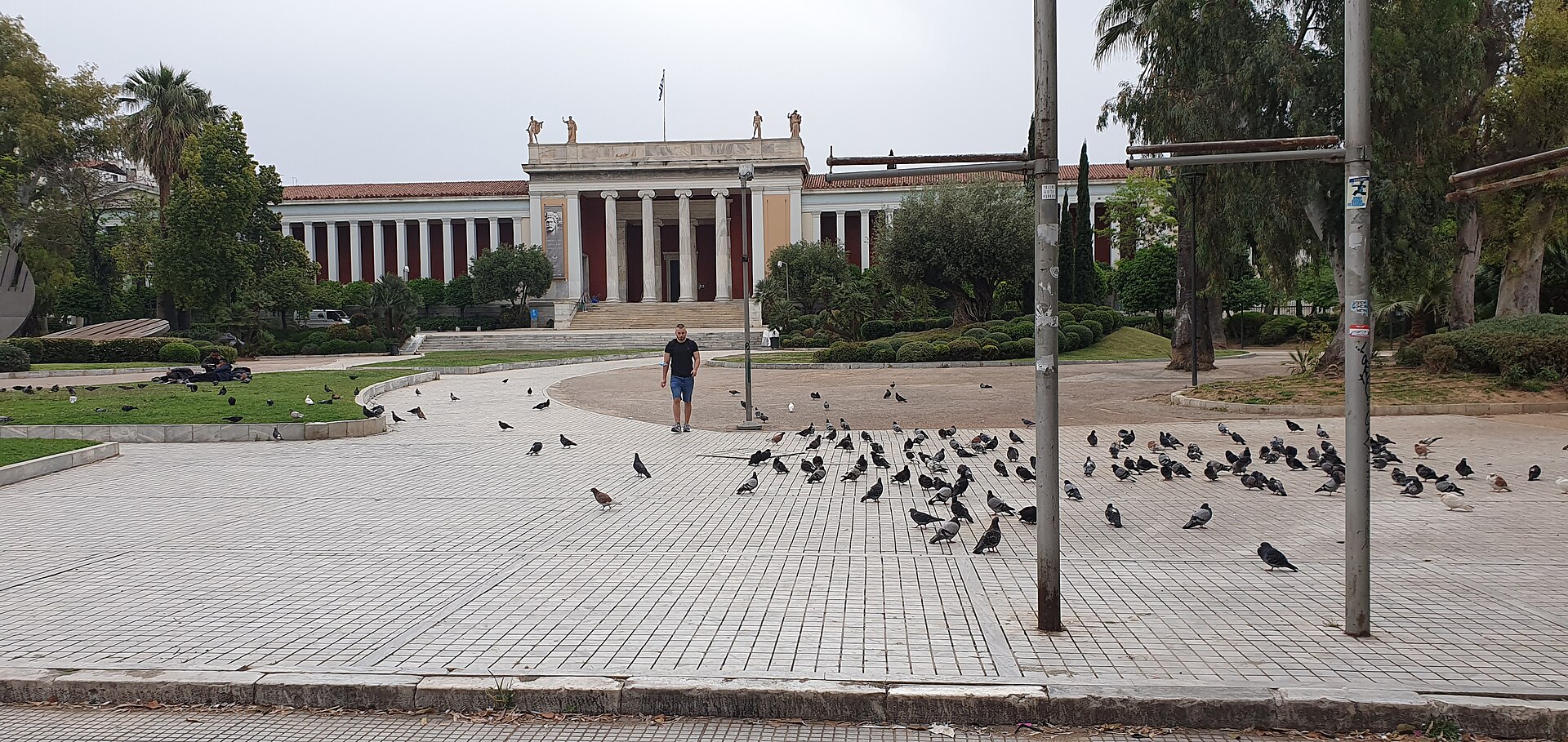
It kept growing. Between 1932 and 1939 the architect G. Nomikos extended the building eastward, a project still underway when the Second World War reached Greece. The museum that stands today, a neoclassical block with a deep colonnaded portico facing Patission Street, is the accumulation of that nineteenth-century start and a twentieth-century extension bolted onto it, which is a large part of why the institution now describes its own layout as disjointed and is in the middle of trying to fix that. The building's exhibition space covers roughly 8,000 square metres across two main floors, organised into the five major collections the museum names as its core holdings: prehistoric antiquities, sculpture, vases and minor arts, metalwork, and Egyptian and Near Eastern antiquities, with more than 11,000 objects on view among them.
What the sea gave up: Antikythera and the Artemision wreck
Two of the building's most important holdings did not come from excavation on land at all. In 1900 and 1901, sponge divers from Symi working off the small island of Antikythera brought up bronze statues, marble figures, and, among the encrusted lumps nobody paid much attention to at first, corroded fragments of a geared mechanism. It went unrecognised for two years until Valerios Stais noticed a gear wheel inside one fragment in 1902, and what the device actually did was not properly established until the 1970s, when Derek de Solla Price and Charalampos Karakalos ran gamma-radiography on it, and then again in 2005, when a dedicated imaging campaign refined the reading further. It remains without a known peer from the ancient world: an astronomical calculator with a differential gear train, more than a thousand years before anything else of comparable mechanical sophistication is known to survive. This archive holds a separate, fully sourced record of the mechanism itself, cross-checked here against the museum's own gallery label, which fixes the inventory number as 15087 and notes that of the eighty-two fragments usually quoted, only seven large pieces and an uncertain handful of the seventy-five smaller ones are confirmed to belong to the device at all.
A second wreck, found off Cape Artemision in northern Euboea in 1926 and worked through 1928 and again in 1936-37, gave the museum two more bronzes with no less of a claim on attention. One is a striding god just over two metres tall, arm drawn back for a throw, identified as either Zeus or Poseidon depending on which weapon, thunderbolt or trident, is imagined filling the missing hand. The other is a boy jockey riding a galloping horse at full stretch, reassembled from pieces recovered eight years apart and not placed on display until 1972. Both wrecks were carrying cargo toward Italy, most likely from Delos or a city on the Asia Minor coast, when they went down; both losses, two millennia later, became gains for a museum that would not exist yet for another eighteen centuries.
Six months underground: hiding the collection, 1940 to 1947
The museum's own account of its wartime years, published to mark the anniversary of Greece's 28 October National Holiday, is a story it tells in the words of the people who did the work. On 11 November 1940, before Italian and then German forces had crossed into Greece, the Directorate of Archaeology issued instructions to protect museum collections from air raids. Over roughly six months, spanning the same period as the Greek army's advance on the Albanian front, staff at the National Archaeological Museum packed and buried the collection. Sculptor Andreas Panagiotakis gave the order to haul marble statues into pits dug in the museum's own floors with the command 'fire up'; by April 1941, when German troops entered Athens, the museum looked deserted. Thirty-five crates went into the cave of the Enneakrounos, twenty-two more into the Prison of Socrates, gold objects into the vaults of the Bank of Greece, and the largest statues into trenches cut directly into the gallery floors.
The occupation did not let the matter rest. In June 1941 Hans Ulrich von Schonebeck, the German officer heading the occupying forces' art-protection unit, pressed repeatedly for the museum to reopen, and compiled a list of 103 statues, including the Poseidon of Artemision and both the Antikythera and Marathon ephebes, that he wanted exhibited. The request was never carried out. Christos Karouzos, the museum's director, and Semni Karouzou, ephor of vases and minor arts, resigned their memberships of the German Archaeological Institute the day after the occupation began rather than lend any appearance of cooperation, and Karouzos later credited the archaeological service's flat refusal to reopen with saving the museum from destruction and looting. The building itself was not untouched: bombs during the December 1944 fighting fell through its wooden roof, though the buried marbles, deep in the ground, were undamaged. Digging the collection back out began only after the war, a process the poet George Seferis described firsthand in his diary on 4 June 1946, watching workmen with pickaxes uncover statues that had lain in soil, some in crates and some bare, for five years. The museum did not reopen fully until 1947, and re-installing everything took until 1964.
The mask and the argument that will not close
Heinrich Schliemann excavated Grave Circle A at Mycenae in 1876 under the close supervision of the Greek archaeologist Panagiotis Stamatakis, who was assigned to watch him precisely because Schliemann's honesty as an excavator was already in question. Among the gold funerary masks Schliemann found there is one that stands apart from the others in style, with a more three-dimensional face and a carefully rendered beard, and it is this one Schliemann named for Agamemnon, the king of Mycenae in Homer. The identification with any historical king does not hold: the mask has been dated, on stylistic and archaeological grounds, to roughly 1550-1500 BC, three to four centuries before the Trojan War was supposed to have been fought. That dating problem is not the controversy that has followed the mask since the late twentieth century, however. Scholars including William Calder III and David Traill have argued that the mask's stylistic divergence from every other known Mycenaean death mask, combined with Schliemann's documented history of embellishing and occasionally fabricating his own finds elsewhere, makes outright forgery a live possibility, planted by Schliemann among genuine grave goods to manufacture a discovery worthy of the name he wanted to give it.
Defenders of the mask's authenticity, including the archaeologist Katie Demakopoulou and Kenneth Lapatin of the Getty, point to Stamatakis's presence as a witness at the moment of discovery as strong evidence against fabrication, and argue the stylistic differences reflect a genuinely exceptional piece of Mycenaean goldwork rather than a modern hand. What has not happened, on the evidence gathered for this record, is a resolution: the dispute remains exactly where it has stood for decades, unsettled between the two camps.
What is happening to the building now
The nineteenth-century building and its 1930s extension were designed for a museum receiving a fraction of today's visitors, and the museum's own language about the structure is unusually blunt for an institution describing itself: it says plainly that the existing spaces are no longer adequate for visitor numbers that have more than doubled, or for the environmental standards modern conservation expects, and that the piecemeal expansions of the past century left the building disjointed rather than unified. In December 2025, Greece's two senior heritage advisory bodies, the Central Archaeological Council and the Central Council of Modern Monuments, unanimously approved preliminary studies for the largest architectural and museological project the museum has undertaken: an expansion and renovation across the entire city block the museum occupies, including the neighbouring Epigraphic Museum, designed by Chipperfield-Tombazis, the team that won an international competition for the commission in 2023.
The scope, as the Ministry of Culture has described it, is substantial. Prehistoric collection space is planned to more than double; temporary exhibition space is set to grow from 429 to roughly 1,033 square metres; conservation laboratories nearly double in size; storage space grows by close to a third; and the project explicitly targets chronic problems the current building has lived with for decades, among them water ingress, inadequate seismic protection, and environmental conditions inside the galleries that fall short of what the museum says its own antiquities need. Funding so far includes a EUR 40 million donation from Spyros and Dorothy Latsis toward the studies phase, ratified in 2024, though at least one architecture professor and press report has put the full project cost closer to EUR 300 million, a figure the Ministry has not confirmed against the December 2025 approval. No firm completion date has been published alongside that approval. What is certain is that a museum whose central holdings were once buried in its own floors to save them from an occupying army is now, eight decades later, planning to dig underneath those same floors again, this time by design rather than under threat.
What visitors say
Visitors consistently describe the National Archaeological Museum as too large to see properly in a single visit and worth returning to. The Antikythera Mechanism, the Artemision bronzes, the Thera frescoes and the Mycenaean gold are named again and again as the pieces people came for; the volume and rarity of what surrounds them is what keeps people writing that two hours was not enough. A smaller but recurring complaint concerns rooms closed on the day of a visit, which staff attribute to understaffing, and occasional lapses in gallery labelling.
What is praised, what is criticised
- Praised: the depth and rarity of the collection, with the Antikythera Mechanism, the Artemision bronzes and the Thera frescoes named most often as reasons to go
- Praised: the scale of the museum, which multiple visitors describe needing three or four separate two-hour visits to properly cover rather than one long one
- Praised: helpful and patient gallery staff, noted specifically in several visitor accounts
- Criticised: a minority of visitors report entire rooms, including a temporary exhibition, closed on the day of their visit, with staff citing a lack of personnel
- Criticised: occasional errors in the Greek-language gallery labels, noted by at least one visitor who read them closely
- Criticised: poor conduct from staff in the ceramics galleries specifically, flagged by one visitor as the one blemish on an otherwise excellent visit
Ratings on other platforms
TripAdvisor: 4.6 from 8,258 ratings, read 12 August 2026
A platform average is a tertiary source: it moves, it is not audited, and we quote no visitor's words.
Questions about National Archaeological Museum
Where is National Archaeological Museum?
44, 28th of October (Patission) Street, Athens 106 82, Greece.
How much does it cost to visit?
General admission: EUR 20; Reduced (50%), single tickets: EUR 10. As confirmed 10 September 2026.
When is it open?
Wed-Mon (winter, 16 Nov 2025 to 3 May 2026) 08:30-15:30; Tue (winter, 16 Nov 2025 to 3 May 2026) 13:00-20:00; Wed-Mon (summer, 4 May to 15 Nov 2026) 08:00-20:00; Tue (summer, 4 May to 15 Nov 2026) 13:00-20:00. Closed: 25-26 December. 1 January. As confirmed 10 September 2026.
How do you get there?
Metro: Omonia or Victoria station, both a short walk from the museum on 28th of October (Patission) Street; Electric train (ISAP): Same Omonia or Victoria stations serve the ISAP electric line; Bus: Lines B5, A6, B6, E6, A7, B7, E7, A8, B8, A12, B12, G12, E12, 022, 035, 046, 060, 200, 224, 605, 608 and 622 stop near the museum, per the museum's own visit page; Trolley: Lines 2, 3, 4, 5, 6, 7, 8, 9, 11, 13 and 14.
What should you see first?
The Antikythera Mechanism (Unknown Greek maker, 2nd or 1st century BC); The Mask of Agamemnon (Unknown Mycenaean goldsmith, circa 1550-1500 BC); Zeus or Poseidon of Artemision (Unknown sculptor, Severe style, circa 460 BC); The Jockey of Artemision (Unknown sculptor, Hellenistic, circa 150-140 BC); The Akrotiri wall paintings (Unknown Late Cycladic painters, Thera (Santorini)); Early Cycladic folded-arm figurines (Unknown Cycladic sculptors, mostly circa 2800-2300 BC).
What we could not confirm
- Whether the Mask of Agamemnon is a genuine Mycenaean funerary mask or, as Calder and Traill have argued, an object Schliemann planted among authentic grave goods remains formally disputed and unresolved.
- The museum's own gallery label for the Antikythera shipwreck states that it is not certain all seventy-five of the mechanism's minor fragments actually belong to the device, a caveat rarely repeated alongside the commonly quoted total of eighty-two fragments.
- The full cost and completion date of the Chipperfield-Tombazis expansion, approved in preliminary form in December 2025, are not yet fixed in any source read for this record: the only confirmed funding is a EUR 40 million donation covering the studies phase, against a press-reported total project estimate of roughly EUR 300 million that the Ministry has not itself confirmed.
Images
Sources
- 1National Archaeological Museum, official website, home page (opening hours banner, admission fee, address, current exhibitions) namuseum.gr/en/
- 2National Archaeological Museum, official website, 'Visit' page: opening hours, admission fee, transport, visitor regulation, disability access, cafe and shop, contact numbers namuseum.gr/en/episkepsi/
- 4National Archaeological Museum, official website, 'Permanent Exhibitions' page: hall-by-hall listing of the five major collections namuseum.gr/en/permanent_exhibition/
- 5National Archaeological Museum, official website, 'The Museum' identity page: collection overview, floor area, visitor and research role namuseum.gr/en/to-moyseio/taytotita/
- 6National Archaeological Museum, official website, 'History' page: founding in 1829, building construction 1866-1889, 1932-39 extension, Second World War, 1999 earthquake, 2002-09 renovations namuseum.gr/en/to-moyseio/istoria-toy-moyseioy/
- 7National Archaeological Museum, official website, 'Memories 1940-1944: The rescue of the statues', primary institutional account with quoted testimony from Semni Karouzou, Christos Karouzos and George Seferis namuseum.gr/en/to-moyseio/istoria-toy-moyseioy/the-rescue-of-the-statues/
- 8Hellenic Ministry of Culture, 'Free admission to archaeological sites, historical sites, monuments and museums owned by the State', naming the National Archaeological Museum explicitly among covered institutions and listing free-admission dates and categories culture.gov.gr/en/service/SitePages/view.aspx?iID=2695
- 9Wikipedia, 'National Archaeological Museum, Athens', source, used for the 1881 renaming under Charilaos Trikoupis and the 2006-07 Getty Museum restitution of looted Greek antiquities en.wikipedia.org/wiki/National_Archaeological_Museum,_Athens
- 10Wikipedia, 'Mask of Agamemnon', source, used for the authenticity dispute raised by William Calder III and David Traill and the defence by Katie Demakopoulou and Kenneth Lapatin en.wikipedia.org/wiki/Mask_of_Agamemnon
- 11Wikipedia, 'Artemision Bronze', source, used for date, size, discovery and the Zeus/Poseidon identification debate en.wikipedia.org/wiki/Artemision_Bronze
- 12Wikipedia, 'Jockey of Artemision', source, used for date, size, discovery and reassembly en.wikipedia.org/wiki/Jockey_of_Artemision
- 13Wikipedia, 'Varvakeion Athena', source, used for material, date, discovery and relationship to Pheidias's Athena Parthenos en.wikipedia.org/wiki/Varvakeion_Athena
- 14Wikipedia, 'Cycladic art', source, used for date range, material and later influence of Cycladic figurines en.wikipedia.org/wiki/Cycladic_art
- 15Wikipedia, 'Ephebe of Marathon', source, used for date, discovery and attribution en.wikipedia.org/wiki/Ephebe_of_Marathon
- 16Wikipedia, 'Antikythera mechanism', source, used to independently confirm the object's present location at the National Archaeological Museum, Athens, cross-checked against this archive's own record for the object en.wikipedia.org/wiki/Antikythera_mechanism
- 17GreekReporter.com, Tasos Kokkinidis, 'Major Upgrade Approved for the National Archaeological Museum of Athens', 16 December 2025: scope, funding and space figures for the Chipperfield-Tombazis expansion greekreporter.com/2025/12/16/major-upgrade-approved-national-archaeological-museum-athens/
- 18David Chipperfield Architects, 'Green light for the extension and refurbishment of the National Archaeological Museum in Athens', project statement confirming the 2023 competition win and December 2025 approval davidchipperfield.com/news/2025/green-light-for-the-the-extension-and-refurbishment-of-the-national-archaeological-museum-in-athens
- 19TripAdvisor, National Archaeological Museum listing, aggregate rating 4.6 of 5 from 8,258 reviews, read in full including visitor text for reception consensus, read 12 August 2026 tripadvisor.com.gr/Attraction_Review-g189400-d198713-Reviews-National_Archaeological_Museum-Athens_Attica.html
- 20Al Jazeera, 'Austerity plan decapitates Greek heritage', 15 April 2012: sector-wide context on Greek state museum security-staff cuts during the debt crisis (not specific to this museum by name) aljazeera.com/features/2012/4/15/austerity-plan-decapitates-greek-heritage
- 21National Archaeological Museum, official website, 'Contact' page: a separate administrative contact line (phone, fax, email) distinct from the visitor-service numbers and address given on the 'Visit' page, read 2026-09-10 namuseum.gr/en/epikoinonia/
- 22National Archaeological Museum, official website, 'News' archive: checked for any 2026 announcement of gallery closures, moved objects or new acquisitions relevant to open_status and highlights; none found beyond routine single-day hour changes and temporary photographic/thematic exhibitions, read 2026-09-10 namuseum.gr/en/new/