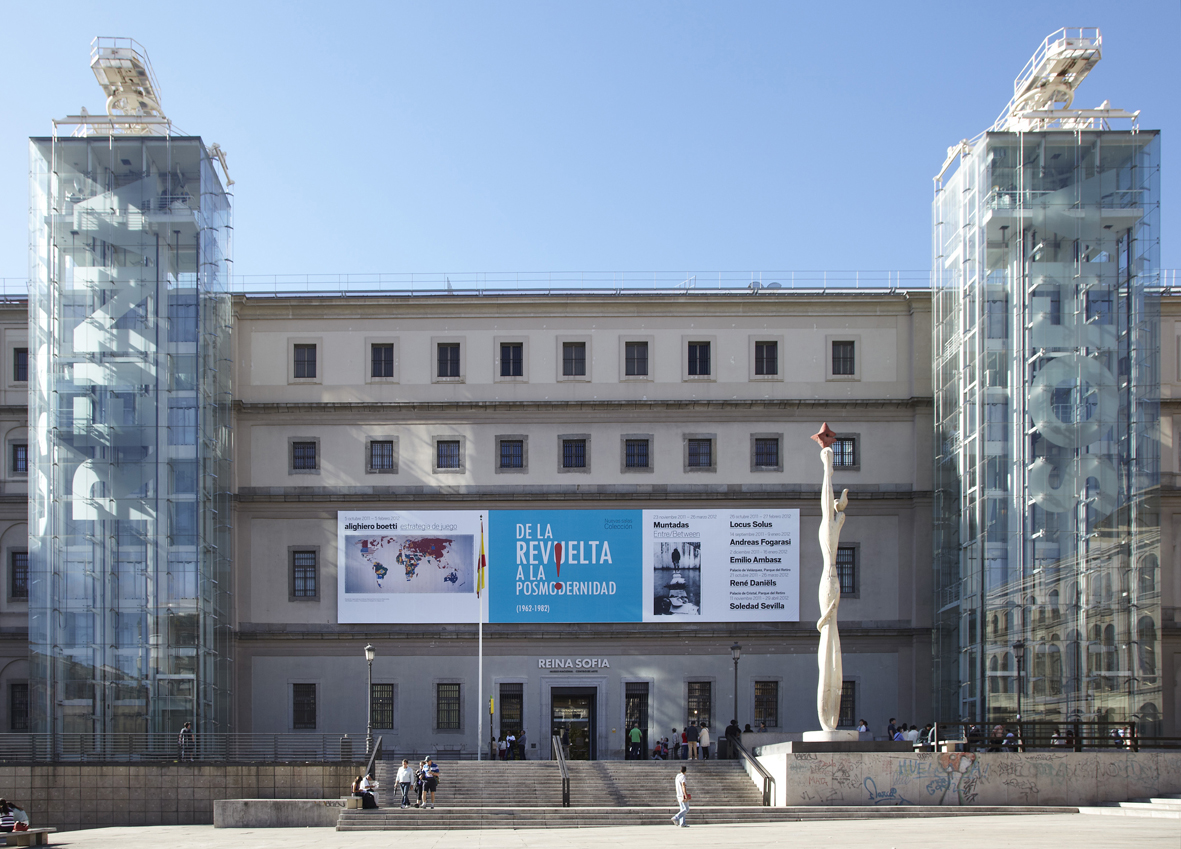
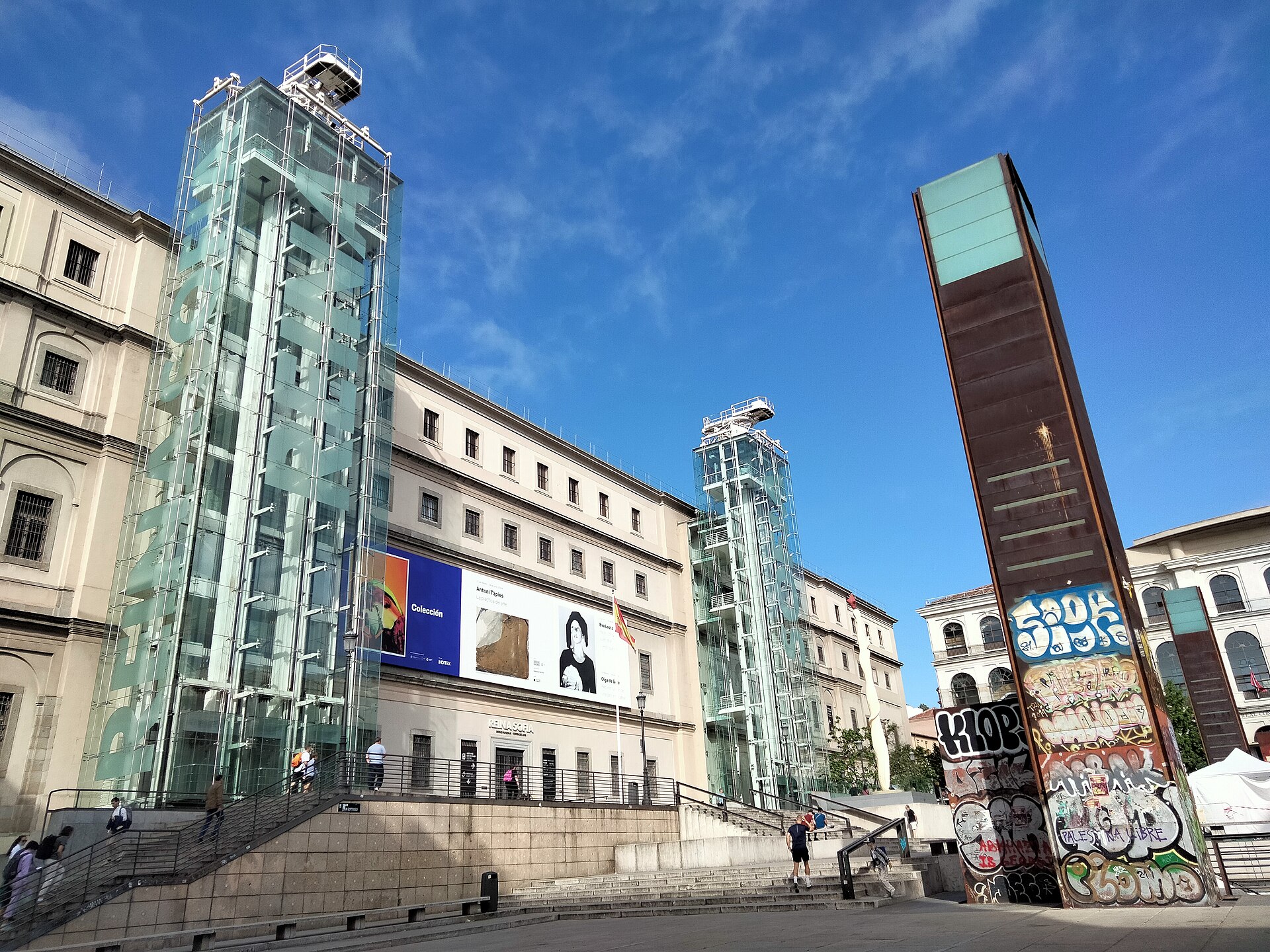
The Sabatini building's main facade on the Plaza de Santa Isabel, with Ian Ritchie's glass circulation towers and the museum's own banners.
Museoreinasofia (Commons account) · CC BY-SA 3.0Museo Nacional Centro de Arte Reina Sofia
Museum · Museo Nacional Centro de Arte Reina Sofía · Founded 1992
Open, admission and hours confirmed 26 August 2026 · 17 sources
On this page 16 sections
ContentsClose
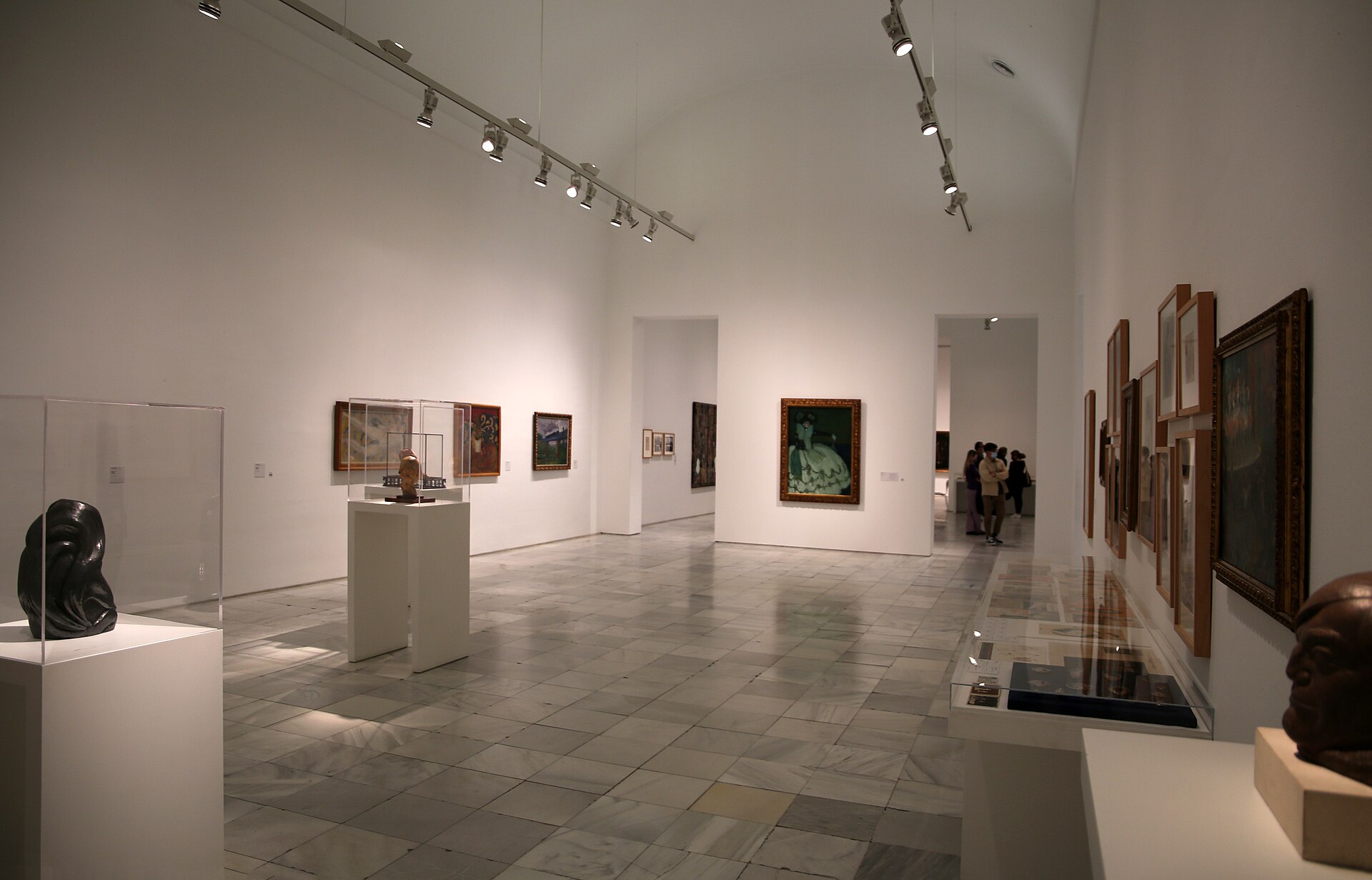
The Reina Sofia's advantage is a legal one as much as a curatorial one: the 1995 line drawn at Picasso's birth year hands it Spain's entire twentieth century, so its Picasso, Dali and Miro holdings sit inside a much broader run of Spanish Civil War-era political art, post-war abstraction and contemporary and video work that a museum built only around a single collector's taste would not have room for.
| Local name | Museo Nacional Centro de Arte Reina Sofía |
|---|---|
| Kind | Museum |
| Founded | 1992 |
| City and country |  Madrid, Spain Madrid, Spain |
| Address | Calle Santa Isabel 52, 28012 Madrid, Spain |
| Website | museoreinasofia.es/en |
| Status | Open, confirmed |
| Record last verified |
Visiting
- Hours
- Monday, Wednesday-Saturday10:00 to 21:00last entry 30 minutes before closing, exhibition rooms close 15 minutes before
- TuesdayClosed
- Sunday10:00 to 14:30last entry 30 minutes before closing
- Closed
- Tuesday. Also closed 1 and 6 January, 1 May, 15 May and 9 November (dates that follow the Community of Madrid business calendar and may vary), and 24, 25 and 31 December.
- Admission
- General (Collection and temporary exhibitions)EUR 12
- General plus audioguideEUR 18
- Audioguide covering the permanent Collection and the current temporary exhibitionEUR 19priced against whichever temporary show is running; not a standing figure
- Two-visit pass, valid one yearEUR 18
- Under 18, over 65, students 25 and under, unemployed, teachers, 33 percent or more disability plus companion, journalists, official guidesFreefree with accreditation, at the ticket office only
- Culture volunteers, large-family members visiting individually, non-Ministry museum staffFree50 percent discount off general admission, at the ticket office only
- Retiro Park galleries (Palacio de Cristal and Palacio de Velazquez)Freealways free, no ticket to the main site required; as of 26 August 2026 the Palacio de Cristal is temporarily closed for architectural improvements (an art installation covers the closure), the Palacio de Velazquez remains open
Free entry: Every open day, the last two hours before closing: Monday and Wednesday-Saturday 19:00-21:00, Sunday 12:30-14:30. Online booking is required and this window is for individual visitors only, not groups. 18 April, 18 and 22 May, 12 October, 6 December: free all day- Do I need to book?
- Not required for a paid ticket; required online for the free admission windows
- Address
- Calle Santa Isabel 52, 28012 Madrid, Spain MapMetro Atocha station is directly across the street; the museum sits between Atocha and the Lavapies/Anton Martin area of central Madrid
- Website
- museoreinasofia.es/en
- Telephone
- +34 91 774 1000
- [email protected]
Before you go how long, access, photography, bags, eating, shop
- How long to allow
- Tripadvisor's own listing gives a suggested duration of 2-3 hours; the Guernica room in particular is described by several visitors as needing an early-morning visit to see the painting without a crowd
- Access
- Facilities are generally described by visitors as well maintained and accessible; the museum publishes accessibility routes and services through its own visitor pages
- Photography
- Photography of the collection generally is permitted without flash. Guernica itself was under a total photography ban for decades; the museum lifted it on 1 September 2023, and personal handheld photography without flash, tripods or selfie sticks is now allowed in the room that holds it
- Bags
- Not established from the pages read for this record
- Eating
- Not established from the pages read for this record
- Shop
- Not established from the pages read for this record
Prices and hours change. We take them from the institution's own pages and print the day we read them, and you can check the current position at the source we used. Confirm before you travel.
What is inside
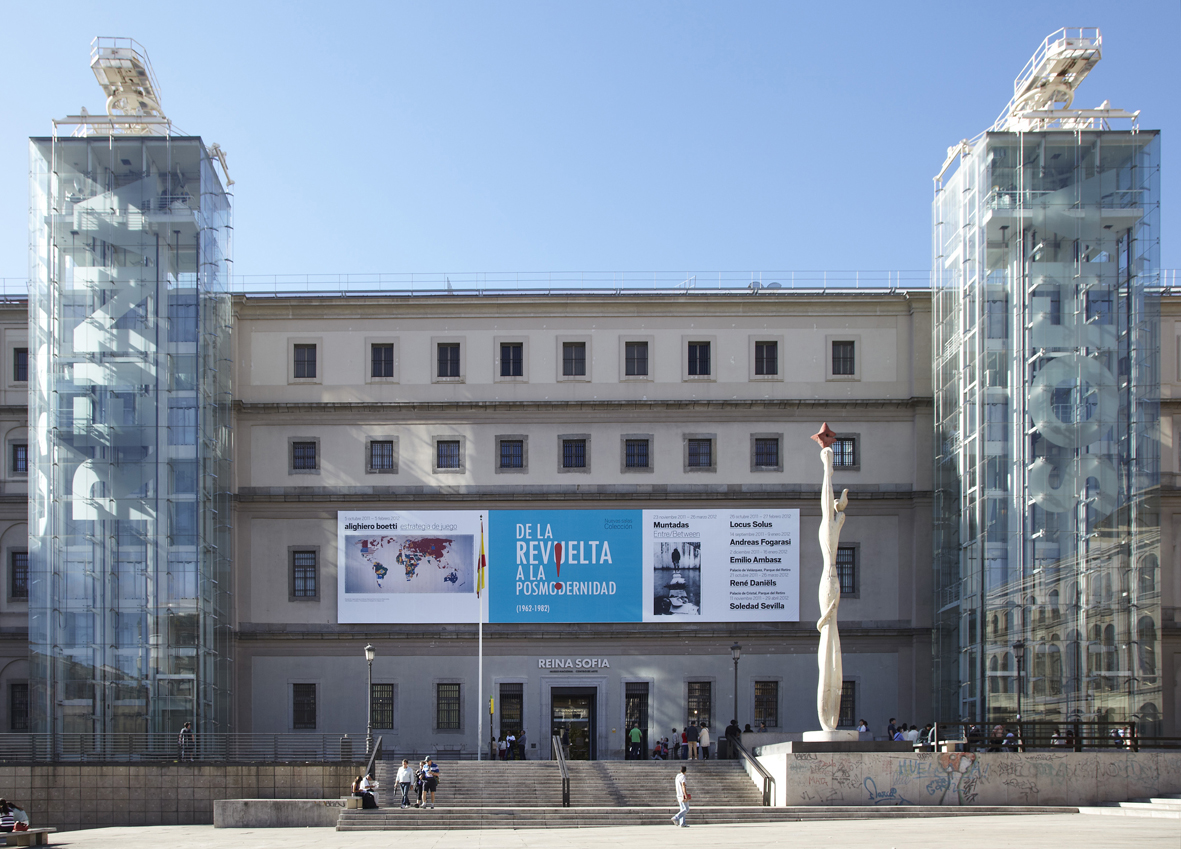
Photograph by Museoreinasofia · CC BY-SA 3.0 Sabatini Building
The museum's original home: Madrid's first General Hospital, begun to a design by Jose de Hermosilla and completed by Francisco Sabatini, in use as a working hospital until 1969. Renovated from 1980 and given three glass circulation towers by architect Ian Ritchie in 1989, it holds the historical collection and the Guernica room, in what was for nearly two centuries a hospital ward.
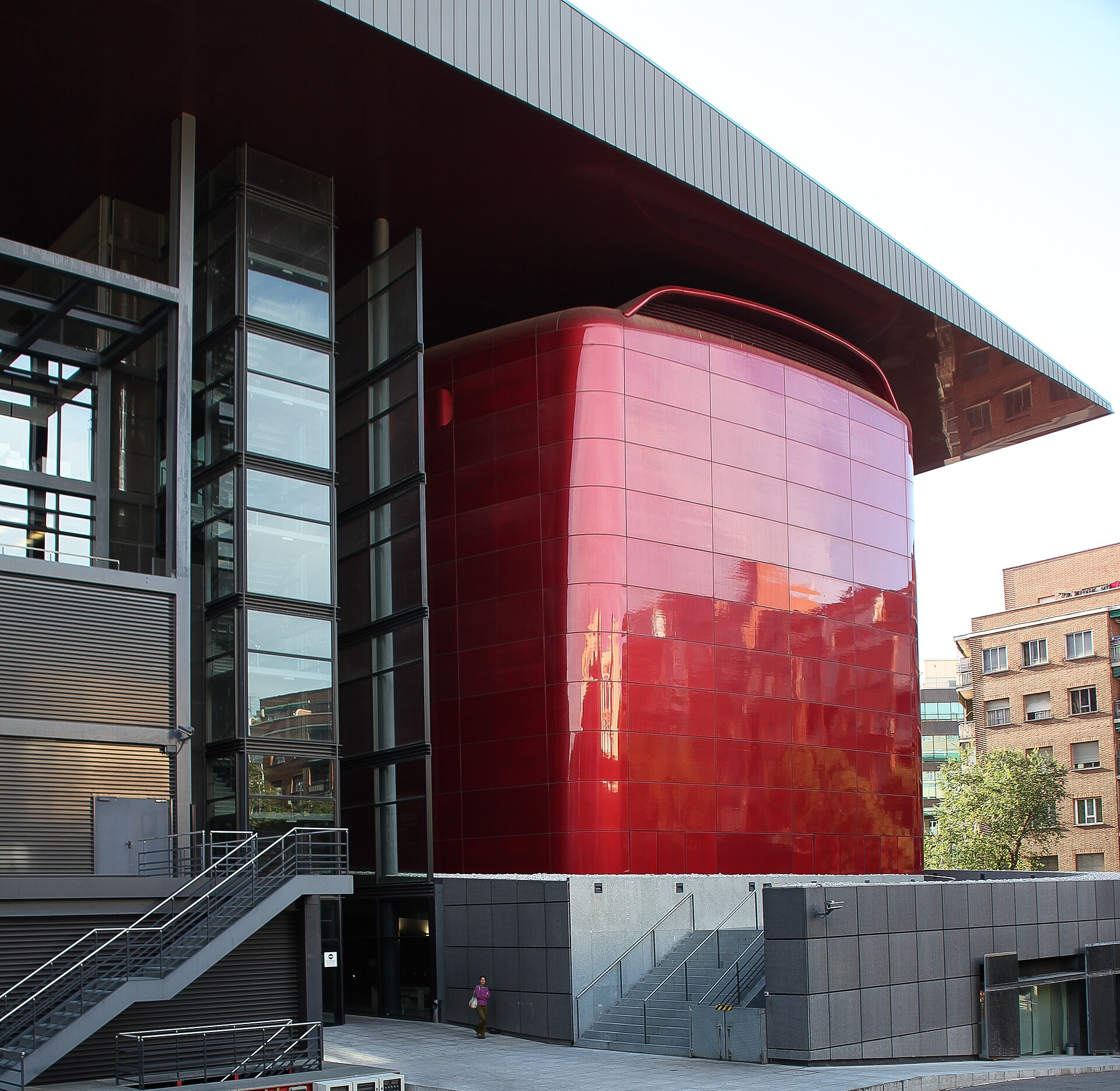
Photograph by Rick Ligthelm from Rotterdam, The Netherlands · CC BY 2.0 Nouvel Building
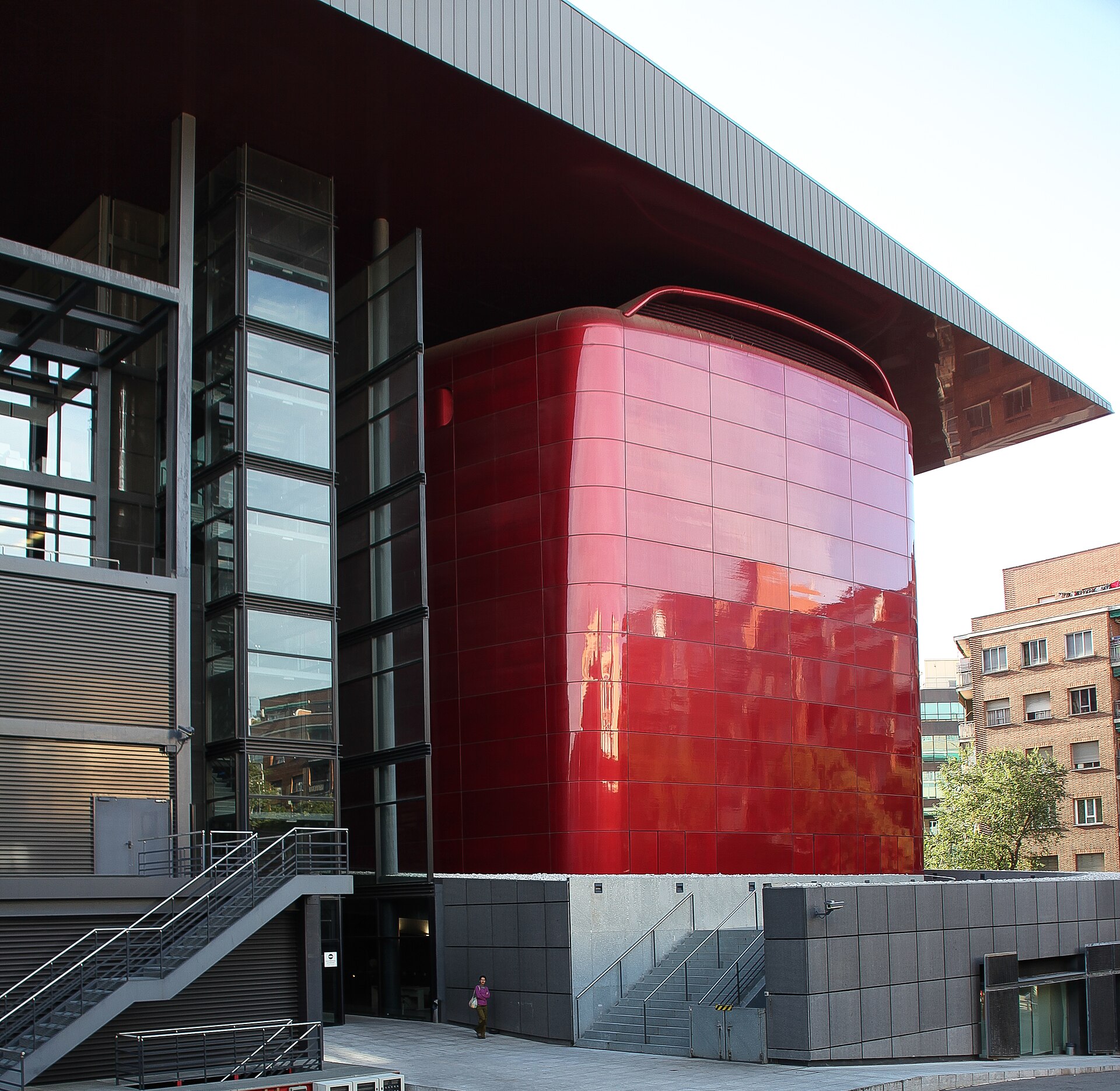
An 8,000 square metre extension by the French architect Jean Nouvel, opened October 2005, its most visible feature a red-lacquered volume cantilevered out from a grey steel canopy. It holds temporary exhibition galleries, an auditorium and administrative space, and is where most of the museum's rotating and loan shows, rather than the historical collection, are seen.
Room 205.10, the Guernica gallery
The room built around Picasso's Guernica specifically, on the second floor of the Sabatini building, surrounded by his own preparatory studies and by other Spanish Civil War-era work. It draws the heaviest crowding of any room in the museum; several visitor reviews specifically advise arriving at opening time to see the painting before tour groups fill the room.
Retiro Park galleries: Palacio de Cristal and Palacio de Velazquez
Two 19th-century exhibition pavilions inside the Retiro park, run by the museum as satellite spaces for large-scale contemporary installations, always free and separate from a ticket to the main site; opening hours run later in summer (10:00-21:00, April-September) than in winter (10:00-18:00, October-March). As confirmed on the museum's own site on 26 August 2026, the Palacio de Cristal is temporarily closed for architectural improvements; visitors can still see an art installation covering the building work, and the Palacio de Velazquez remains open on the same free-admission basis.
What to see first
Guernica
Pablo PicassoCommissioned by the Spanish Republic for its pavilion at the 1937 Paris International Exposition after Picasso learned of the German bombing of the Basque town; kept at MoMA in New York for over 40 years at his own insistence that it not go to Spain until democracy was restored; returned to Madrid in 1981 and moved to this museum in 1992.5
Peinture (Escargot, femme, fleur, etoile) / Snail, Woman, Flower, Star
Joan MiroA 1934 canvas begun as a tapestry design for the collector Marie Cuttoli, using automatic, Surrealist writing folded directly into the painted forms; Miro's wife Pilar Juncosa gave it to the state in 1986 and the museum acquired it in 1992, the same year Guernica arrived.15
The Great Masturbator
Salvador DaliPainted in 1929, the summer Dali fell for Gala while her husband returned alone to Paris; the central profile is drawn from a rock formation at Cap de Creus that Dali called one of the promontories of his own kingdom, made to carry a grasshopper and swarming ants across the face.16
El pueblo espanol tiene un camino que conduce a una estrella
Alberto Sanchez (original); Jorge Ballester (2001 replica)A 12.5 metre totem that stood outside the same 1937 Spanish pavilion as Guernica and Calder's Mercury Fountain, built from cement and bronze and topped with a red star; the original was lost when the pavilion was dismantled after the fair, and the sculpture standing at the museum today is a larger 2001 replica cast from the surviving maquette.17
The Sabatini Building itself
Jose de Hermosilla and Francisco Sabatini (18th century); Ian Ritchie (1989 towers)A working hospital for nearly two centuries before it was a museum, its glass circulation towers added in 1989 as the single most visible sign that the building had changed use; Guernica now hangs in a building that spent most of its history treating the sick rather than showing pictures.13
Preparatory studies for Guernica
Pablo PicassoPicasso dated many of his working studies for the painting day by day through May and June 1937, and a large group of them hang near the finished canvas, letting a visitor trace the bull, the horse and the fallen soldier through successive drawn states rather than seeing only the single finished composition.5
Exhibitions on now
Past exhibitions here
- Closed6 Feb to 10 May 2013Confirmed · check before you travel
A hospital that became a national museum
The building the Reina Sofia occupies was not built to hold art. King Ferdinand VI commissioned Madrid's first General Hospital on the site in the eighteenth century, designed initially by Jose de Hermosilla and completed under Francisco Sabatini after him; the hospital took patients until it closed in 1969. The site sat largely unused through the 1970s before renovation began in 1980, and in 1988 the Spanish government created a national art centre in the building, formally inaugurated as the Museo Nacional Centro de Arte Reina Sofia, named for the then queen, on 10 September 1992. The most visible sign that the building had changed function came in 1989, when the architect Ian Ritchie added three external glass circulation towers to the old hospital facade, towers that now frame the main entrance and carry visitors between floors in full view of the street.
A 1995 Royal Decree drew the line that still separates this museum's collection from the Prado's a few streets away: work by artists born after Picasso, in 1881, belongs to the Reina Sofia; earlier work stays at the Prado. That single date is why a museum sharing a city with one of the world's great encyclopaedic collections can hold Spain's twentieth century almost entirely to itself, from Picasso and Dali through Miro to later conceptual and video work, without the two institutions competing over the same objects.
The Nouvel extension
By the early 2000s the Sabatini building could not hold the museum's growing exhibition programme, and the French architect Jean Nouvel designed an 8,000 square metre addition that opened in October 2005. Its most recognisable feature is a red-lacquered volume, cantilevered out beneath a wide grey steel canopy roof, standing apart from the old hospital's pale stone in both colour and geometry rather than trying to match it. The Nouvel building carries most of the museum's temporary and loan exhibitions, an auditorium and administrative space, which frees the historical Sabatini rooms to hold the permanent collection, including the room built around Guernica, without a temporary show ever displacing it.
Guernica's exile
Picasso was already at work on a mural for the Spanish Republic's pavilion at the 1937 Paris International Exposition when news reached him of the German bombing of Guernica, a Basque town, on 26 April 1937. He abandoned his original studio scene and painted the finished canvas, 3.49 by 7.77 metres, in about three weeks, working in a grisaille palette drawn from newspaper photography rather than the studio's usual colour. Hung near the pavilion's entrance alongside Joan Miro's mural The Reaper and Alexander Calder's Mercury Fountain, it drew mixed reviews at the fair itself; the political and emotional force critics now take for granted was not universally recognised in 1937.
When the Spanish Republic fell to Franco's forces in 1939, Picasso refused to let the painting go to Spain, declaring it would be handed to the government of the Republic only on the day the Republic was restored. He placed it in the safekeeping of the Museum of Modern Art in New York, where it stayed for more than four decades and toured the United States and Europe, growing steadily more famous while remaining, by Picasso's own condition, in exile. Picasso died in 1973 without seeing it return; Franco died two years later. MoMA held the painting even through Spain's new 1978 constitution, on the reasoning that a constitutional monarchy did not meet Picasso's stated condition of a restored republic, before ceding it under sustained pressure in 1981. It reached Madrid that September and went on display behind protective glass at the Cason del Buen Retiro, a Prado annexe, drawing nearly a million visitors in its first year there.
A second move, and a dispute that has never fully closed
In July 1992 the painting moved again, several hundred metres from the Cason del Buen Retiro to its purpose-built room in the newly inaugurated Reina Sofia. The operation was treated as a one-off in the true sense: the canvas travelled unrolled rather than rolled, held aloft by a team of handlers for stretches of the route to avoid any bump or jolt, along a route and on a date, the day after the Barcelona Olympics opening ceremony, chosen specifically to draw as little press attention as possible. Britannica records the move as controversial in Spain, on the grounds that it defied Picasso's own expressed wish that the painting hang among the Prado's masterpieces; this record could not independently confirm the more specific claim, sometimes repeated, that Picasso's heirs formally objected to the move, and states that gap rather than the claim itself.
The argument over where Guernica belongs has never fully settled, and it resurfaced again in 2026. The Basque regional government formally asked Madrid to lend the painting to the Guggenheim Bilbao for the ninetieth anniversary of both the bombing and the first Basque government, from October 2026 to June 2027, with the Basque lehendakari calling refusal a grave political error. The Reina Sofia's own conservation department answered with a technical report, issued 26 March 2026, that catalogues cracks, craquelure, microfissures and paint loss built up over more than 30 relocations since the 1930s, and states the canvas cannot safely be rolled or moved again. Spain's culture ministry rejected the loan on that basis; it is not the first refusal on the same grounds, following earlier requests turned down in 1997, 2000, 2006 and 2007.
A photography ban that ended in 2023
For decades a total photography ban applied to Guernica specifically, held in place to protect the canvas from flash exposure, to keep tripods and selfie sticks out of an already crowded room, and, after a visitor damaged a separate Alberto Sanchez stage-set piece taking a selfie in 2022, on plain safety grounds. The museum lifted the ban on 1 September 2023. Director Manuel Segade said at the time that it made no sense for Guernica alone to be withheld from the phone-camera culture that now mediates most museum visits, and the room's rule today is the same as the rest of the museum's: handheld photography without flash, tripods, selfie sticks or other stabilising equipment is allowed, and the ban survives only in that narrower, equipment-based form.
The totem that disappeared and came back taller
Guernica was not the only large political object at the 1937 pavilion. Outside its entrance stood El pueblo espanol tiene un camino que conduce a una estrella, a 12.5 metre totemic column in cement and bronze by the sculptor Alberto Sanchez, rising to a red star with a dove perched below it, commissioned by the same Republican government as an emblem of the cause the pavilion argued for. When the fair closed and the pavilion was dismantled, the sculpture was not preserved; it disappeared, and no fragment of the original 1937 piece is known to survive. The sculpture visitors see outside the Reina Sofia today is a replica, 18.7 metres tall and cast in cement by Jorge Ballester in 2001 for a temporary exhibition on Alberto's work, built from the surviving maquette rather than from the lost original, larger than what stood in Paris and permanent where the first version was not.
What visitors say
Visitors consistently treat Guernica as the reason to come and are often visibly affected by seeing it in person, while praising the museum overall as calmer and better value than the Prado. A recurring complaint runs the other way: several visitors describe gallery staff as unusually watchful and restrictive, to the point of feeling unwelcoming, and more than one flags the crush of tour groups around Guernica specifically by mid-morning.
What is praised, what is criticised
- Praised: Reasonable ticket prices and a calmer, less crowded experience than Madrid's other major museums
- Praised: The impact of seeing Guernica in person, repeatedly described by visitors as the single most memorable thing they saw in Madrid
- Praised: Depth beyond Guernica, including the museum's political and advertising poster holdings and architectural material
- Praised: Facilities and building maintenance, and the historic Sabatini building itself
- Criticised: Gallery staff described by multiple reviewers as overly watchful, following visitors between rooms and restricting close viewing or conversation in a way more than one visitor called unwelcoming for families
- Criticised: The Guernica room becoming very crowded from mid-morning onward, with several reviewers recommending arrival at opening time specifically to beat tour groups
- Criticised: Online ticketing problems in at least one detailed account, where a ticket order was never delivered by email and support was unresponsive both online and by phone
- Criticised: The plaza outside the museum described as poorly kept on at least one visit
Ratings on other platforms
Tripadvisor: 4.3 from 16,969 ratings, read 7 August 2026
A platform average is a tertiary source: it moves, it is not audited, and we quote no visitor's words.
Questions about Museo Nacional Centro de Arte Reina Sofia
Where is Museo Nacional Centro de Arte Reina Sofia?
Calle Santa Isabel 52, 28012 Madrid, Spain.
How much does it cost to visit?
General (Collection and temporary exhibitions): EUR 12; General plus audioguide: EUR 18; Audioguide covering the permanent Collection and the current temporary exhibition: EUR 19; Two-visit pass, valid one year: EUR 18; Under 18, over 65, students 25 and under, unemployed, teachers, 33 percent or more disability plus companion, journalists, official guides: free. As confirmed 26 August 2026.
When is it open?
Monday, Wednesday-Saturday 10:00-21:00; Tuesday closed; Sunday 10:00-14:30. Closed: Tuesday. Also closed 1 and 6 January, 1 May, 15 May and 9 November (dates that follow the Community of Madrid business calendar and may vary), and 24, 25 and 31 December. As confirmed 26 August 2026.
How do you get there?
Metro: Atocha station is directly across the street; the museum sits between Atocha and the Lavapies/Anton Martin area of central Madrid.
What should you see first?
Guernica (Pablo Picasso); Peinture (Escargot, femme, fleur, etoile) / Snail, Woman, Flower, Star (Joan Miro); The Great Masturbator (Salvador Dali); El pueblo espanol tiene un camino que conduce a una estrella (Alberto Sanchez (original); Jorge Ballester (2001 replica)); The Sabatini Building itself (Jose de Hermosilla and Francisco Sabatini (18th century); Ian Ritchie (1989 towers)); Preparatory studies for Guernica (Pablo Picasso).
What we could not confirm
- Whether Picasso's heirs formally objected to the 1992 move from the Cason del Buen Retiro to the Reina Sofia, sometimes stated as fact in popular accounts, could not be confirmed from the primary and encyclopaedic sources read for this record; Britannica describes the move as defying Picasso's own expressed wish, which is a narrower and better-sourced claim than heirs' objection specifically.
- The 2026 Basque request to loan Guernica to the Guggenheim Bilbao was still unresolved as a live political dispute as of the sources read for this record, rejected by the culture ministry on conservation grounds but kept alive by the Basque government's own public pressure.
Images
Sources
- 1Museo Reina Sofia, Visit (general overview) museoreinasofia.es/en/visit
- 2Museo Reina Sofia, Opening Times - Free Access and Discounts museoreinasofia.es/en/visit/opening-times/discounts/
- 3Museo Reina Sofia, The Main Site (hours and address) museoreinasofia.es/en/visit/main-site/
- 4Museo Nacional Centro de Arte Reina Sofia, official contact page (sede electronica) servicios-museoreinasofia.sede.gob.es/pagina/index/directorio/contactar/language/en
- 5Wikipedia, Guernica (Picasso) en.wikipedia.org/wiki/Guernica_(Picasso)
- 6Wikipedia, Cason del Buen Retiro en.wikipedia.org/wiki/Cas%C3%B3n_del_Buen_Retiro
- 7Encyclopaedia Britannica, Guernica, by Alicja Zelazko britannica.com/topic/Guernica-by-Picasso
- 8Euronews, Reina Sofia museum lifts decades-long ban on photographing Picasso's Guernica, 8 September 2023 euronews.com/culture/2023/09/08/reina-sofia-museum-lifts-decades-long-ban-on-photographing-picassos-guernica
- 9Infobae, El despliegue unico en la historia que hizo falta para mover el Guernica de Picasso por ultima vez, 1 April 2026 infobae.com/espana/cultura/2026/04/01/el-despliegue-unico-en-la-historia-que-hizo-falta-para-mover-el-guernica-de-picasso-por-ultima-vez-es-mas-facil-desmontar-un-templo-egipcio-que-eso/
- 10Democrata, Que hacemos con el Gernika? Euskadi pide su traslado a Bilbao pero el Gobierno se niega democrata.es/cultura/guernica-traslado-euskadi-bilbao-ministerio-cultura-museo-reina-sofia/
- 11Museo Reina Sofia, collection page for Guernica (date, medium, room, curatorial text) museoreinasofia.es/en/collections/artwork/guernica-0/
- 12Museo Reina Sofia, collection page for Tino Calabuig's 1992 documentary film Guernica (1995 Royal Decree, transfer context) museoreinasofia.es/en/collections/artwork/guernica/
- 13Wikipedia, Museo Nacional Centro de Arte Reina Sofia en.wikipedia.org/wiki/Museo_Nacional_Centro_de_Arte_Reina_Sof%C3%ADa
- 14Tripadvisor, Museo Nacional Centro de Arte Reina Sofia attraction page and reviews, read 2026-08-07 tripadvisor.com/Attraction_Review-g187514-d190152-Reviews-Museo_Nacional_Centro_de_Arte_Reina_Sofia-Madrid.html
- 15Museo Reina Sofia, collection page for Miro's Peinture (Escargot, femme, fleur, etoile) museoreinasofia.es/en/collections/artwork/peinture-escargot-femme-fleur-etoile-painting-snail-woman-flower-star/
- 16Wikipedia, The Great Masturbator en.wikipedia.org/wiki/The_Great_Masturbator
- 17Wikipedia (Spanish), El pueblo espanol tiene un camino que conduce a una estrella es.wikipedia.org/wiki/El_pueblo_espa%C3%B1ol_tiene_un_camino_que_conduce_a_una_estrella