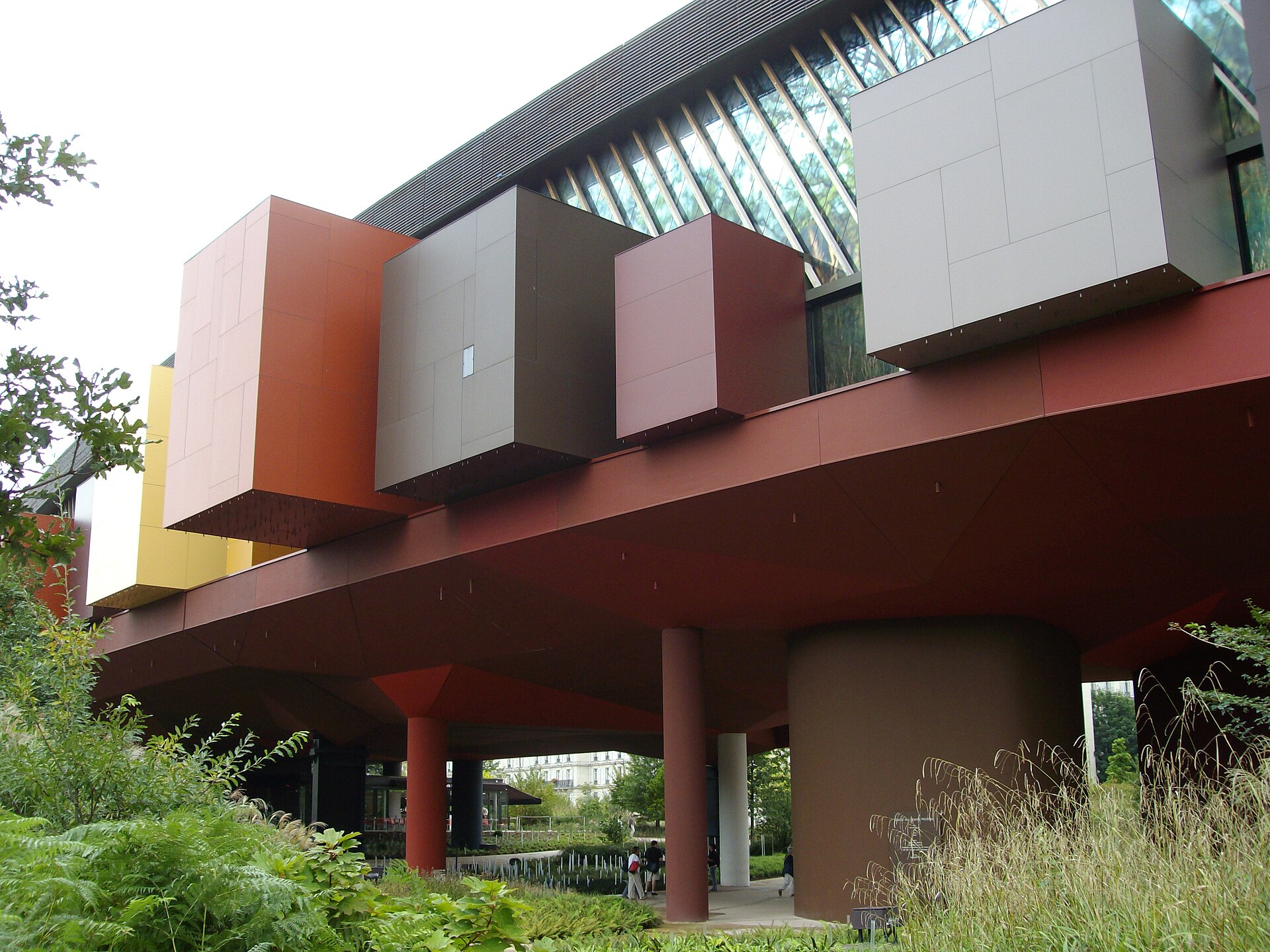
Jean Nouvel's coloured study-room boxes cantilevered off the long north facade of the museum, raised on pilotis above the garden.
Public domainMusee du quai Branly - Jacques Chirac
Museum · Musée du quai Branly – Jacques Chirac · Founded 2006
Open, admission and hours confirmed 19 August 2026 · 26 sources
On this page 15 sections
ContentsClose
The Quai Branly's real strength is coverage: close to 370,000 objects across Africa, Oceania, Asia, the Americas and North Africa/the Near East, formed by merging two older Paris institutions rather than built from a single collector's taste, which is why its Oceania and Africa holdings in particular are cited as being among the deepest outside the countries the objects came from. That same scale is the source of the museum's central and unresolved argument: a collection this large, assembled overwhelmingly during the period of French colonial expansion in Africa, Asia and Oceania, cannot be presented as neutral connoisseurship, and the museum's own leadership and its harshest critics agree on that much even as they disagree completely about what follows from it. Three restitutions in this venue's history, to New Zealand, Benin and Cote d'Ivoire, show the mechanism France uses to return objects; the scale of what has not moved is why every one of those three has been described by the receiving country as a partial answer rather than a settlement.
| Local name | Musée du quai Branly – Jacques Chirac |
|---|---|
| Kind | Museum |
| Founded | Opened 23 June 2006 as the Musee du quai Branly; renamed the Musee du quai Branly - Jacques Chirac in 2016 |
| City and country |  Paris, France Paris, France |
| Address | 37 Quai Branly, 75007 Paris, France |
| Website | quaibranly.fr |
| Status | Open, confirmed |
| Record last verified |
Visiting
- Hours
- MondayClosed, except a special opening 10:30-19:00 during the short French school holiday periods
- Tuesday10:30 to 19:00
- Wednesday10:30 to 19:00
- Thursday10:30 to 22:00Late opening
- Friday10:30 to 19:00
- Saturday10:30 to 19:00
- Sunday10:30 to 19:00
- Closed
- 1 May. 25 December. Early closure at 18:00 on 24 and 31 December, with the ticket office closing at 17:00.
- Admission
- Full price (permanent collections and temporary exhibitions)EUR 14
- Reduced rateEUR 11Concession categories are listed separately by the museum
- Audio-guide, full priceEUR 5
- Audio-guide, reducedEUR 3Free for disabled visitors and their carers
Free entry: First Sunday of every month, for all visitors; a timed ticket is still required- Tickets
- quaibranly.fr/en/useful-information/come/simp... The museum's own ticket page.
- Do I need to book?
- Not compulsory; the museum sells timed tickets online and recommends them, and requires a timed ticket even on the free first Sunday of the month
- Address
- 37 Quai Branly, 75007 Paris, France MapMetro Line 9, Alma-Marceau station, about 7 minutes on foot
RER RER C, Pont de l'Alma station, about 4 minutes on foot
On foot Along the Seine, two blocks from the Eiffel Tower, in the Gros-Caillou neighbourhood of the 7th arrondissement - Website
- quaibranly.fr
- Telephone
- +33 1 56 61 70 00
- [email protected]
Before you go how long, access, photography, bags, eating, shop
- How long to allow
- Tripadvisor's own listing estimates 2 to 3 hours; the museum's four continental galleries and long river-facing gallery cover roughly 10,000 square metres of the 40,600 square metre site
- Access
- The museum publishes a dedicated accessibility and practical-information section; audio-guides are free for disabled visitors and one carer
- Photography
- Not stated as a formal policy on the fetched visit pages
- Bags
- Not stated on the fetched visit pages
- Eating
- Cafe Jacques inside the museum, and the separate restaurant Les Ombres on the roof terrace
- Shop
- A gift and bookshop on site
Prices and hours change. We take them from the institution's own pages and print the day we read them, and you can check the current position at the source we used. Confirm before you travel.
What is inside
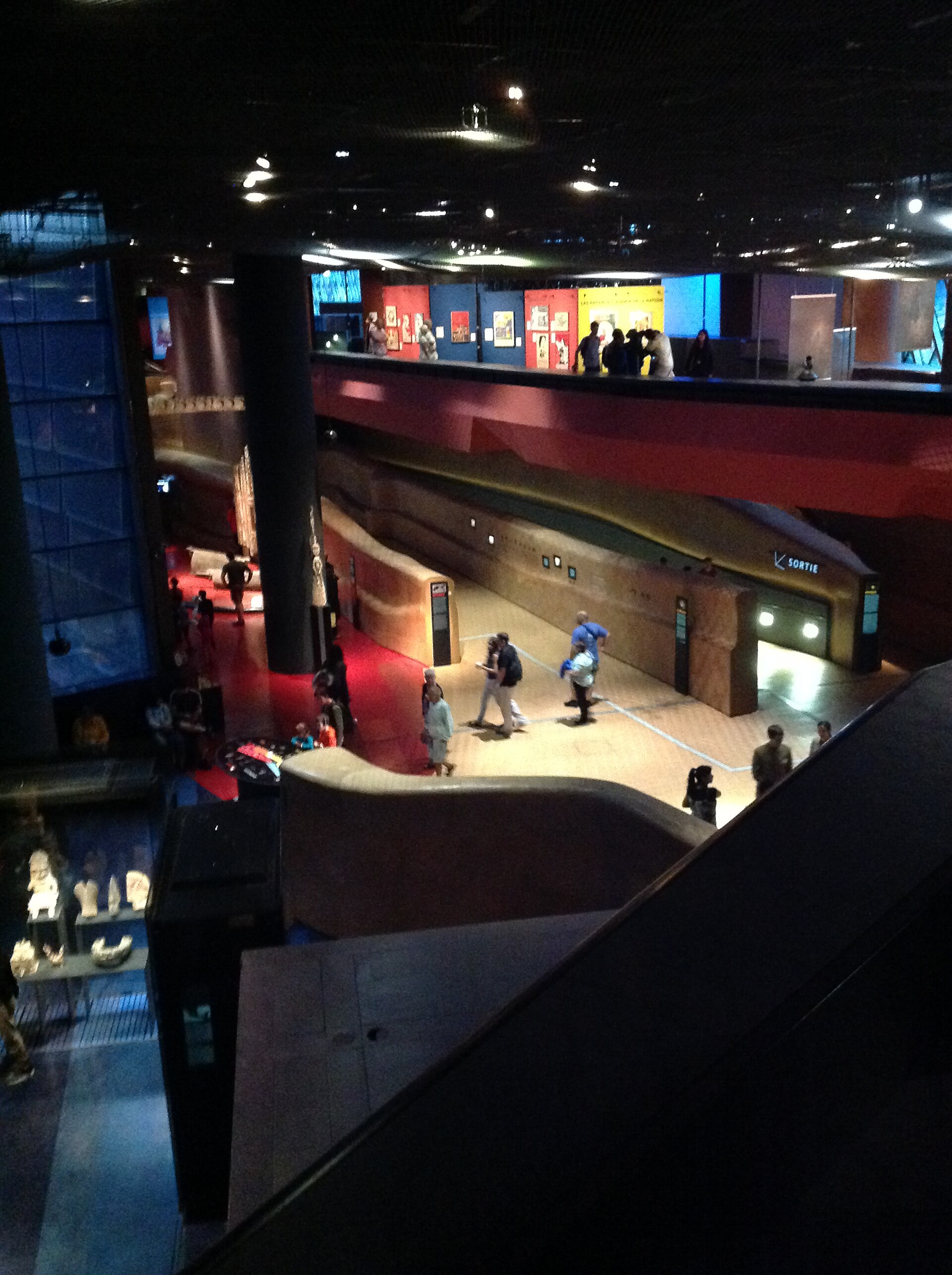
Photograph by SiefkinDR · CC BY-SA 3.0 The river gallery (Galerie des cinq continents)
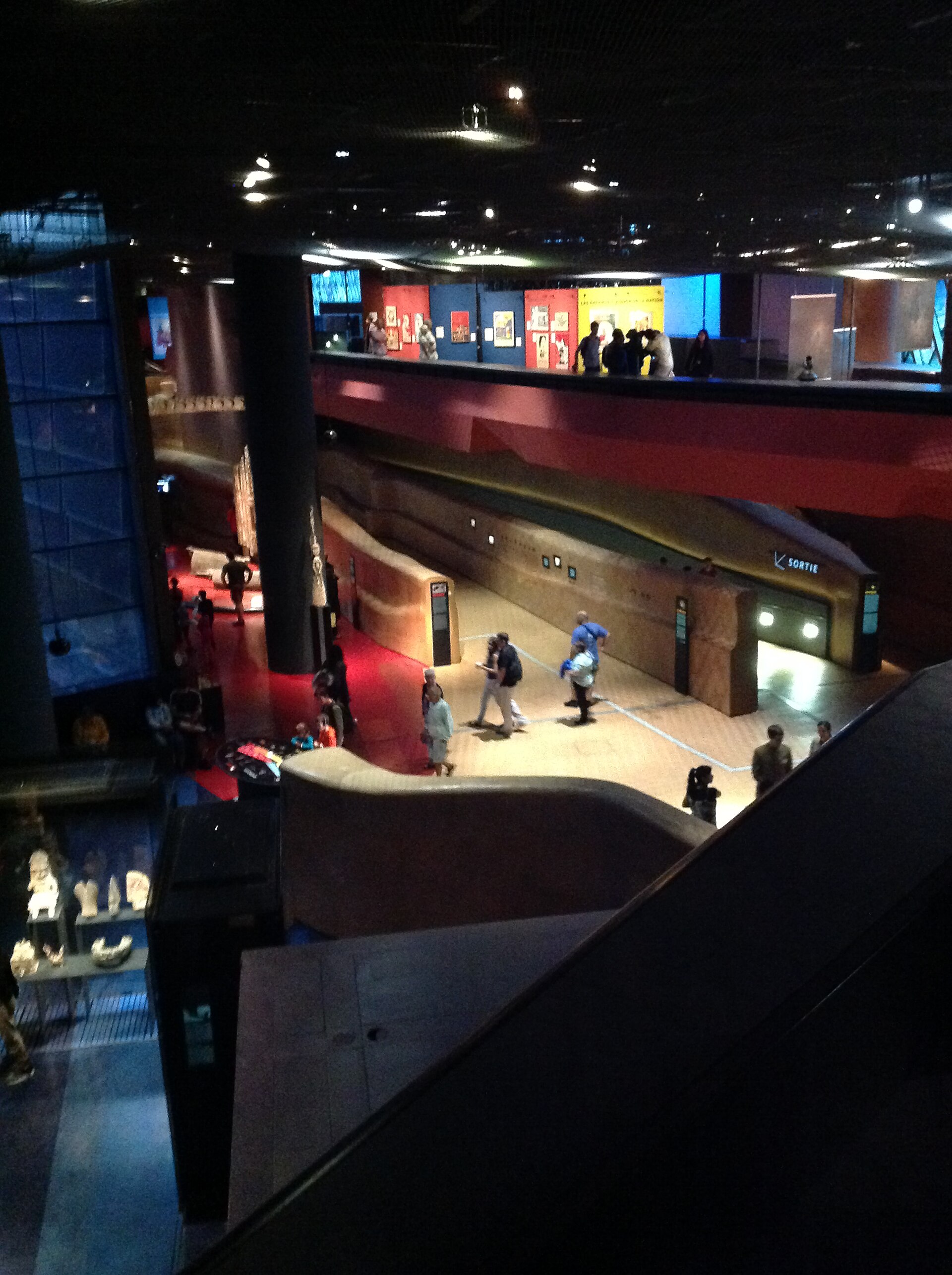
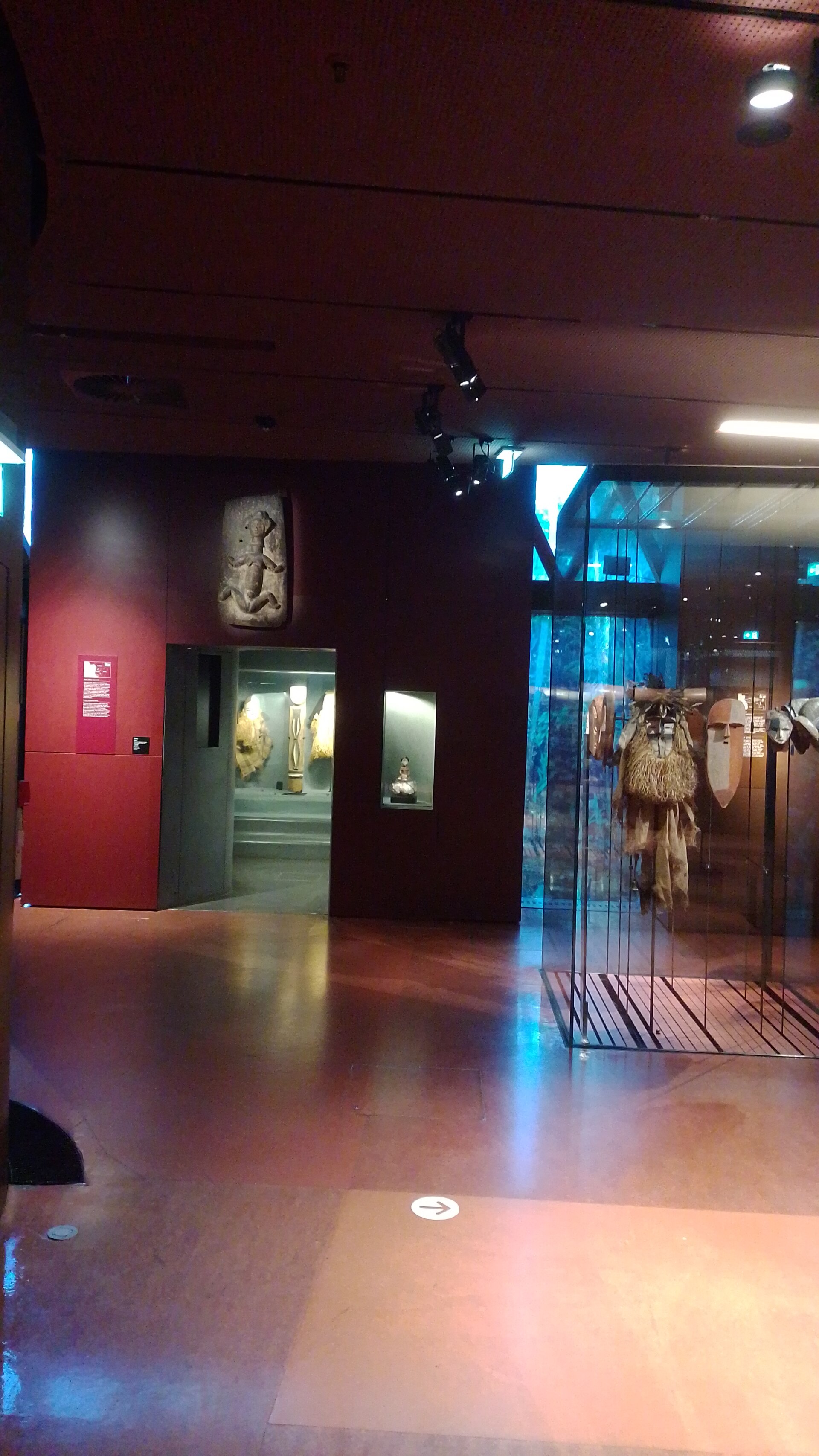
A single continuous mezzanine-level walkway, described by the museum as a river running the length of the building, that visitors follow up from the entrance into the four continental galleries; the display cases and low, dark, curving architecture are original to Jean Nouvel's 2006 design.
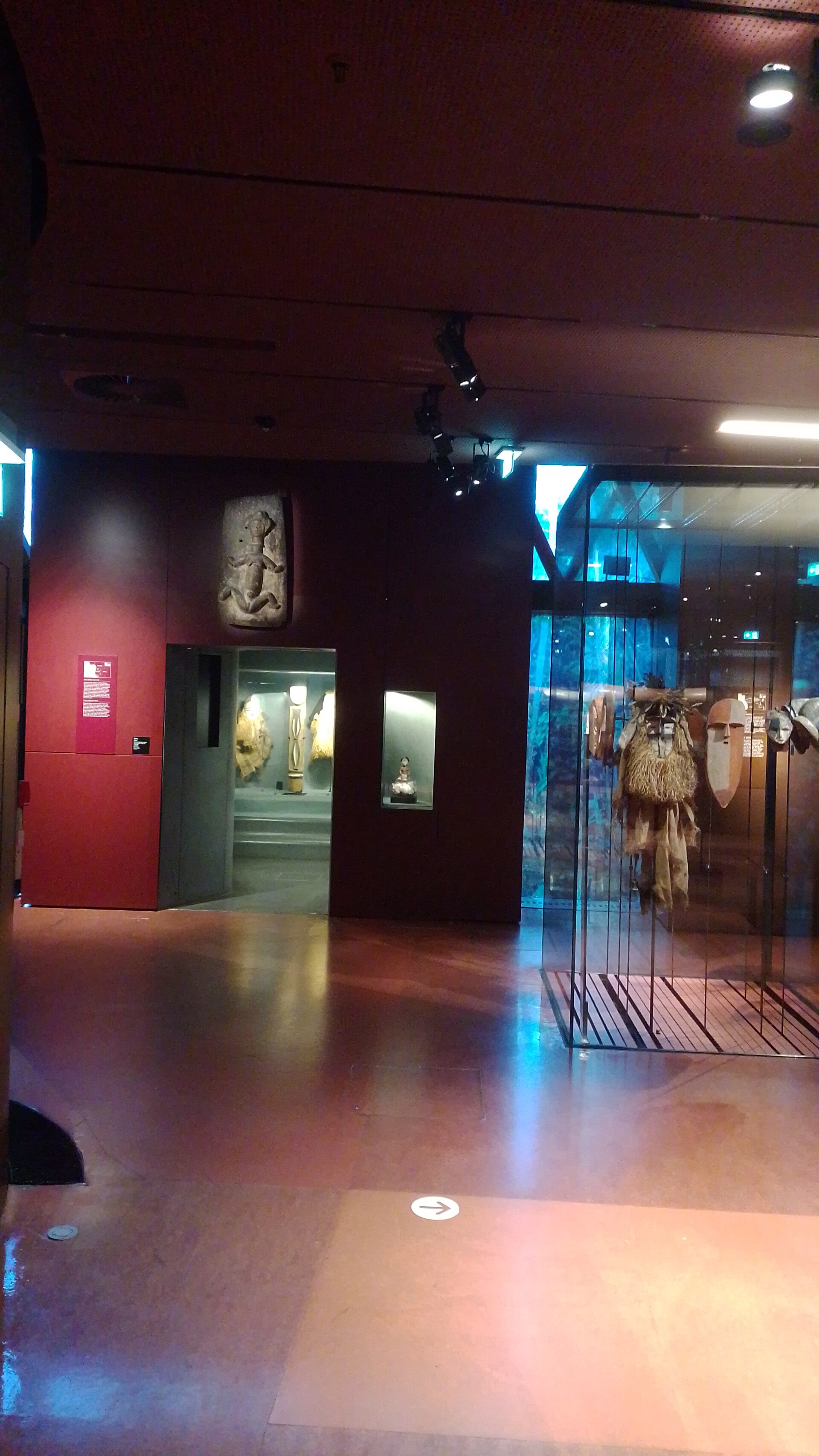
Photograph by Alybnp · CC BY-SA 4.0 Africa gallery
About 70,000 sub-Saharan African objects, formed from the merged Africa and Madagascar holdings of the former Musee de l'Homme and the Musee national des Arts d'Afrique et d'Oceanie, with major additions from 19th-century exploration missions such as Savorgnan de Brazza's expeditions to the Congo and the 1931-33 Dakar-Djibouti ethnographic expedition.
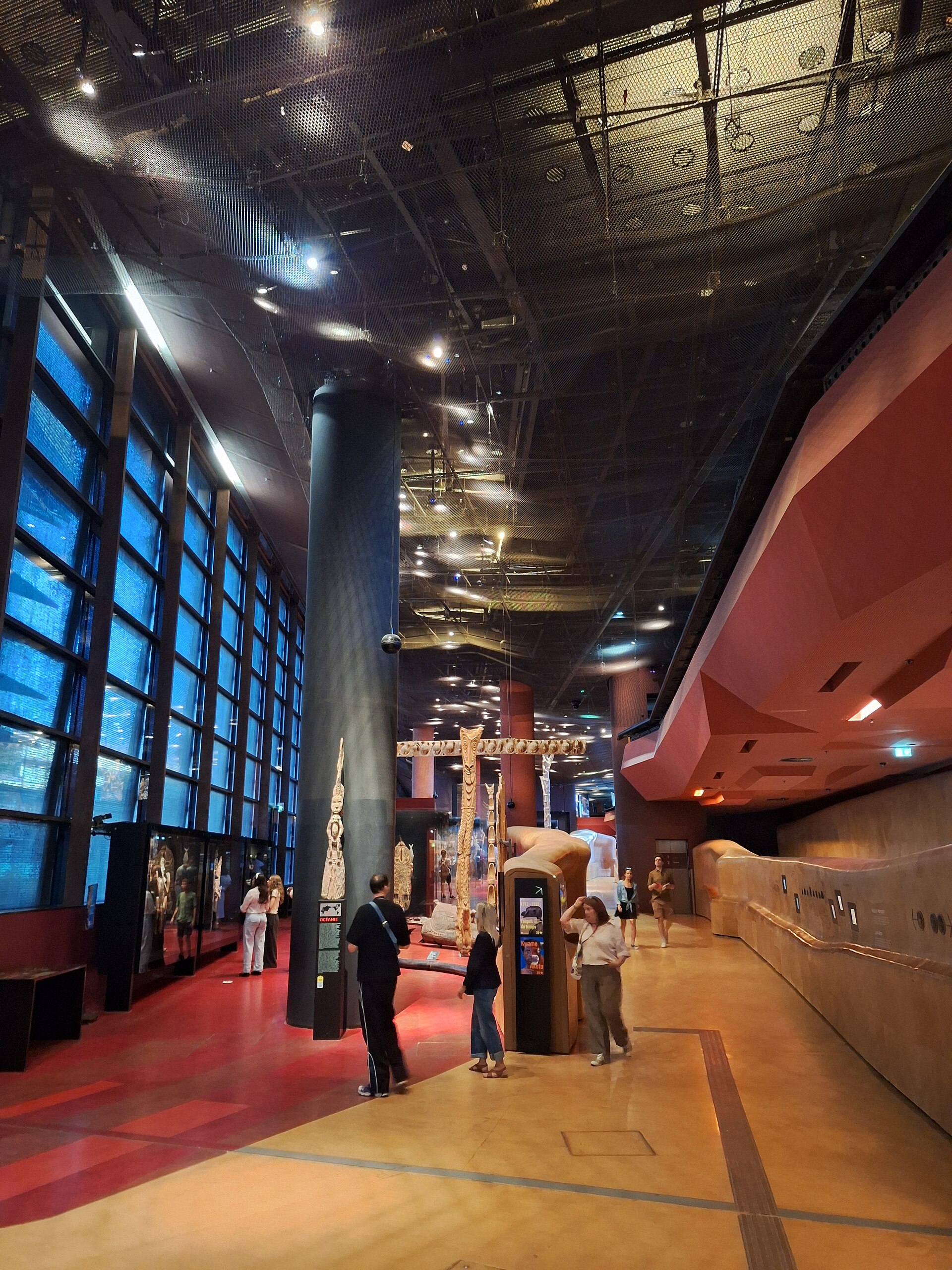
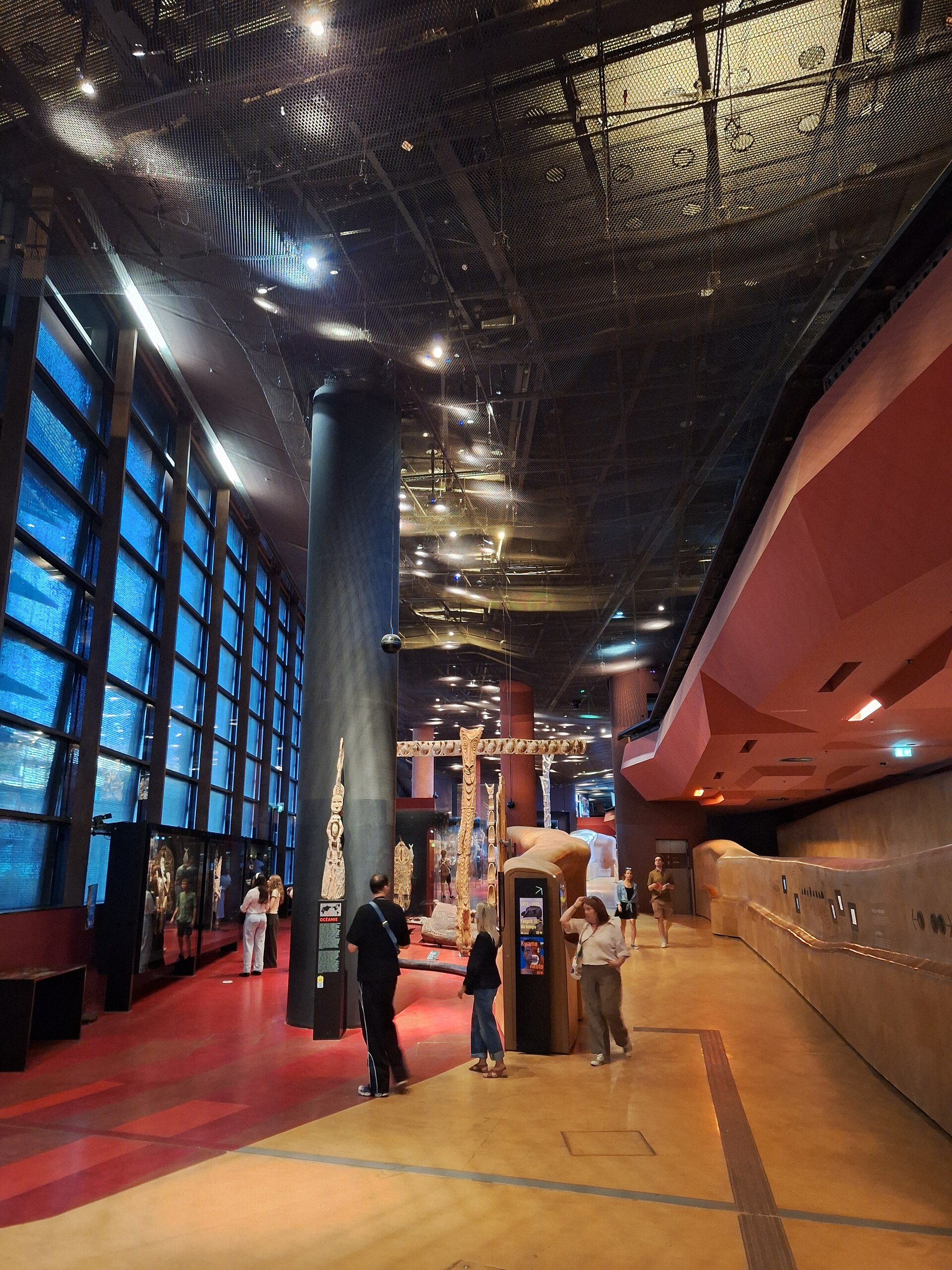
Photograph by Stitchbird2 · CC BY 4.0 Oceania gallery
Holdings concentrated on the Marquesas Islands, Vanuatu and New Caledonia, territories with a French colonial history, built up from late 18th and early 19th century voyages of exploration (Bougainville, Freycinet, Dumont d'Urville) and expanded through 20th-century scientific expeditions, plus an unusually large New Guinea collection and, from the 1990s, contemporary Australian Aboriginal acrylic paintings.
Americas gallery
Objects ranging from the earliest pieces acquired for the French royal Cabinet du Roi, documenting first contact in Brazil and Canada, through 19th-century pre-Hispanic antiquities from Mexico and Peru favoured by explorers of that period, to 20th-century scientific collections covering the Americas as a whole.
Asia gallery
About 55,000 objects spanning Turkey to Japan, weighted toward the popular and minority arts of the recent period rather than the courtly and archaeological material already held by the Louvre and the Musee Guimet; the earliest pieces come from royal cabinets of curiosities and late 19th-century state-sponsored scientific expeditions, with a large intake from the 1931 Paris Colonial Exhibition.
Garden and vegetal wall
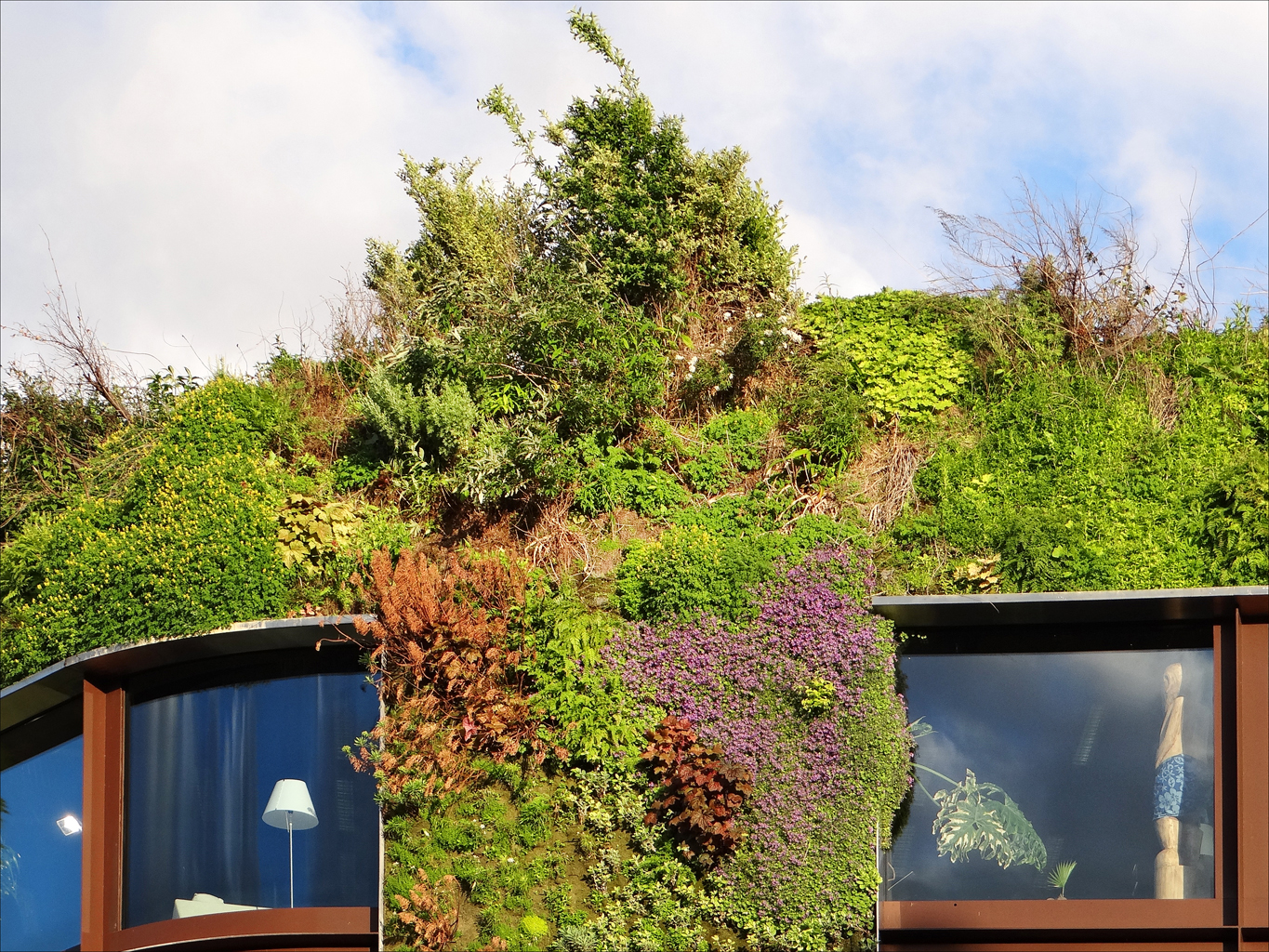
An 18,000 square metre public garden designed by the landscape architect and botanist Gilles Clement, screening the building from the Quai Branly traffic behind dense planting and a glass sound barrier; the administrative building at the entrance carries a 200 by 12 metre soil-free living wall designed by the botanist Patrick Blanc, one of the largest of his vertical gardens.
What to see first
Ceremonial axe, New Caledonia
Kanak maker, New CaledoniaA nephrite blade mounted with wood, shell, seeds, plant fibre and bat fur and wrapped in woven bark cloth, catalogued 71.1946.0.51; the museum names it among the masterpieces of its Oceania collection, the region its current president, a Kanak specialist, has spent his career studying.8
The 26 royal treasures of Abomey, Benin - no longer in the collection
Fon court makers, Kingdom of DahomeyThree anthropomorphic royal statues of kings Ghezo, Glele and Behanzin, thrones, four carved palace doors, six portable altars, three warrior staffs and textiles, seized as war spoils by General Dodds in 1892. Shown at the Quai Branly one last time before the November 2021 transfer of ownership, they are the most concrete outcome to date of the 2018 Sarr-Savoy restitution report and the reason this museum's own galleries are the wrong place to look for them now.12
Djidji Ayokwe talking drum, Cote d'Ivoire - no longer in the collection
Ebrie makers, Cote d'IvoireA single-block iroko log drum carved with a leopard and geometric motifs, seized by the colonial administrator Simon in 1916 specifically to cut off Ebrie communities' ability to coordinate against French forces. The National Assembly voted its deaccession on 7 July 2025; the official restitution ceremony, at which France and Cote d'Ivoire signed the transfer act, was held at the museum in Paris on 20 February 2026, 110 years after the drum was taken. The drum itself was separately welcomed home to its village of origin in the Abidjan district on 7 August 2026, Cote d'Ivoire's independence day, ahead of its intended display at Cote d'Ivoire's own Musee des Civilisations.15
Toi moko, tattooed Maori heads - no longer in the collection
Maori, New ZealandPreserved and tattooed ancestral heads held in French museum collections including this one; a 2010 change in French law allowing deaccession of human remains led to a formal repatriation ceremony returning 20 heads to New Zealand in January 2012, among the earliest complete restitutions this museum's predecessor holdings went through.19
Moai ancestor head, Rapa Nui (Easter Island)
Rapa Nui makerA carved stone ancestor head dated to the 11th-15th century, part of the material that anchors the museum's Oceania displays in deep time rather than only in the colonial-era collecting this page's other highlights are defined by.19
Image of Chicomecoatl, Aztec maize goddess
Aztec maker, MexicoA pre-Hispanic image of the Aztec deity of maize and sustenance, representative of the 19th-century wave of collecting that favoured Mexican and Peruvian antiquities over the ethnographic material that dominates the museum's later Americas acquisitions.19
Exhibitions on now
- On now28 Sep 2026 to 16 Jan 2027Confirmed , 6 weeks ago
Past exhibitions here
- Closed2 Jul to 11 Oct 2026Confirmed · check before you travel
A museum built to answer a question about where art belongs
The immediate cause was a manifesto, not a plan. In 1990 the dealer and collector Jacques Kerchache published Les chefs-d'oeuvre du monde entier naissent libres et egaux, arguing that African, Asian, Oceanian and American work belonged in the same institutions as European art rather than in ethnography museums alone, and that there was no such thing as primitive art, only works. Kerchache took the argument to Jacques Chirac, and Chirac, first as mayor of Paris and then as president, backed it: a preview gallery, the Pavillon des Sessions, opened inside the Louvre itself in 2000 with about 120 objects Kerchache selected, over the objection of curators who worried it would split ethnographic collections in two.
The full museum followed in 2006, merging the non-Western holdings of two older Paris institutions, the Musee de l'Homme and the Musee national des Arts d'Afrique et d'Oceanie, themselves descended from the 1878 Trocadero ethnography museum and the 1931 colonial exposition's Museum of the Colonies. It opened on 23 June 2006 as the Musee du quai Branly, and was renamed the Musee du quai Branly - Jacques Chirac in 2016, while Chirac was still alive. Today it holds close to 370,000 objects, from Neolithic material to work made in the current century, of which a small fraction is ever on display at once.
Jean Nouvel's building and Patrick Blanc's wall
Jean Nouvel's building sits on stilts above Gilles Clement's 18,000 square metre garden, deliberately hidden from the Quai Branly traffic behind dense planting and a glass sound barrier before a visitor ever reaches the entrance. Coloured boxes cantilever off the long north facade, each a separate study room or office; the main collections run along a curved, low-ceilinged gallery Nouvel designed to read as a river cutting through the building, dim enough that individual display cases glow rather than a conventional white-walled gallery lighting the whole room evenly. The administrative building at the entrance carries a 200 by 12 metre living wall, one of the best-known works of the botanist Patrick Blanc, who grows plants without soil on a hydroponic felt-and-PVC system light enough to hang on a vertical surface.
The design has always divided opinion, and not only among visitors: the building's defenders call it an architecture built for the objects inside it rather than a generic museum shell, its critics call the same darkness and curved concealment a way of avoiding the questions the collection raises rather than confronting them, an argument this page returns to below.
The single most contested collection in France
The Quai Branly holds more than two-thirds of the roughly 90,000 African objects in French public collections, which is why every restitution argument about French museums runs through this one first. In November 2017, at the University of Ouagadougou, President Macron said African heritage could not remain only in European private collections and museums, and asked the art historian Benedicte Savoy and the writer and economist Felwine Sarr to study what France should do about it. Their report, delivered in November 2018, recommended returning objects taken without consent during the colonial period on request from the country of origin, and estimated that the great majority of sub-Saharan African material culture held outside Africa sits in a small number of European museums, this one prominent among them.
The museum's own leadership fought the report from the day it landed. Stephane Martin, the Quai Branly's president at the time, told AFP the report had tainted everything collected or bought during the colonial period with what he called the impurity of the colonial crime, and said its recommended legal change would open the door to what he termed complete maximalist restitution. He argued that many objects, including a collection the physician Pierre Harter received as gifts from Cameroonian chiefs he had treated for leprosy, were given freely rather than taken, that a foreign state should not be granted parity with French authorities in determining what counted as its own heritage, and that circulating artworks more widely through loans, not permanent return, was the better answer. He read the French presidency, correctly as it turned out for most of the collection, as having closed the door on wide restitution by describing universal museums as part of France's own common heritage.
What has actually gone back
Against that resistance, three restitutions from this museum's own holdings have gone through in full, each narrower than the Sarr-Savoy report's recommendations but each real. Twenty of the Maori toi moko, tattooed and preserved ancestral heads, went back to New Zealand in a January 2012 ceremony, after a 2010 change to French law permitted deaccessioning human remains from national collections specifically to enable it. The 26 royal treasures of Abomey, taken by General Dodds's forces in 1892 when Dahomey's palaces were sacked, were shown at the Quai Branly one final time in 2021 before a law passed that December authorised their transfer; Presidents Macron and Talon signed the ownership transfer at the Elysee Palace on 9 November 2021, and the objects reached Benin the next day. Benin's own president and culture minister made clear at the time that they considered the 26 objects a fraction of what remains in French collections and kept a list of further claims open.
The most recent case is still unfolding as this page is written. The Djidji Ayokwe talking drum, an iroko log more than three metres long and weighing about 430 kilograms, was seized from Ebrie communities near Abidjan in 1916 specifically to stop them coordinating resistance to French colonial administration; the French Senate voted unanimously for its return in April 2025 and the National Assembly followed in July 2025. Ceremonies in February and March 2026 completed its return to Cote d'Ivoire, 110 years after it was taken, for eventual display at Cote d'Ivoire's own Musee des Civilisations. Each of these three cases required its own single-object law, because French heritage law otherwise treats public collections as inalienable; that legal mechanism, one object and one act of parliament at a time, is itself the practical reason Benin's president said in 2021 that he was not satisfied and expected full restitution rather than a partial one.
A design its own critics call an aestheticized silence
The criticism of this museum was never only about which objects should leave. A 2025 critical essay in Chroniques d'architecture, written by a group of architecture students, argued that Nouvel's low light and glowing cases are not a neutral design choice but a way of overwhelming a visitor's critical faculties, so that a building holding several hundred thousand objects taken during colonisation never has to explain how they got there; the objects, the piece argues, carry almost no maker's name and minimal provenance, continuing a much older assumption that non-Western creativity is anonymous and collective rather than individually authored. The American anthropologist Sally Price made a related argument at greater length in her 2007 book on the museum, subtitled in its French edition le rendez-vous manque, the missed opportunity: that the Quai Branly marginalised ethnographic context in favour of aesthetic display, and passed up the chance to let the source communities' own voices frame their material.
More recent controversy has been narrower but sharper. In 2024 the museum was reported to have relabelled Tibet as the Xizang Autonomous Region on gallery text, a term used by the Chinese state rather than by Tibetan sources, and reversed the change after criticism from Asian-studies scholars. And a pattern shows up unprompted in ordinary visitor reviews written independently of any of this academic or press criticism: several 2026 reviewers, with no connection to each other, describe leaving the galleries uncomfortable at the sheer quantity of African and Oceanian material on show and ask in their own words whether some of it should be in the countries it came from. A museum built to settle where non-Western art belongs has not settled the question for a significant share of the people who walk through it.
What visitors say
Visitors are consistently struck by Jean Nouvel's building and Gilles Clement's garden, and by the sheer scale and variety of the four continental collections, with the Oceania and Africa displays singled out most often. Two complaints recur regardless of how positive the overall review is: the galleries are dark, with several visitors describing the low lighting and reflective glass cases as disorienting or exhausting rather than atmospheric, and object labelling is thin, sometimes French-only. A distinct and more serious thread of recent reviews, unprompted by any museum messaging, describes discomfort at seeing large quantities of African and Oceanian material in Paris at all, several explicitly using words like colonization and asking whether objects belong in their country of origin instead.
What is praised, what is criticised
- Praised: the scale, variety and quality of the non-European collections, especially Oceania and Africa
- Praised: Gilles Clement's garden and Patrick Blanc's living wall as a calm, planted approach to the building, screened from traffic noise
- Praised: children's workshops, described by a regular visitor as sustaining a three-year-old's attention for ninety minutes
- Criticised: low lighting and reflective display cases that several visitors call disorienting rather than atmospheric, with one 2026 review calling the layout 'a labyrinth'
- Criticised: thin object labelling, sometimes in French only, particularly criticised by a January 2026 review over an unlabelled totem pole and Maori carving
- Criticised: a recurring visitor reaction of discomfort at the volume of African material on display and open questions about repatriation, raised by name in multiple independent 2026 reviews rather than by any single campaign
- Criticised: accessibility failures on at least one occasion (a lift reported out of service on a public holiday, stranding wheelchair users on an upper floor)
Ratings on other platforms
Tripadvisor: 4.4 from 3,149 ratings, read 7 August 2026
A platform average is a tertiary source: it moves, it is not audited, and we quote no visitor's words.
Questions about Musee du quai Branly - Jacques Chirac
Where is Musee du quai Branly - Jacques Chirac?
37 Quai Branly, 75007 Paris, France.
How much does it cost to visit?
Full price (permanent collections and temporary exhibitions): EUR 14; Reduced rate: EUR 11; Audio-guide, full price: EUR 5; Audio-guide, reduced: EUR 3. As confirmed 19 August 2026.
When is it open?
Monday closed; Tuesday 10:30-19:00; Wednesday 10:30-19:00; Thursday 10:30-22:00; Friday 10:30-19:00; Saturday 10:30-19:00; Sunday 10:30-19:00. Closed: 1 May. 25 December. As confirmed 19 August 2026.
How do you get there?
Metro: Line 9, Alma-Marceau station, about 7 minutes on foot; RER: RER C, Pont de l'Alma station, about 4 minutes on foot; On foot: Along the Seine, two blocks from the Eiffel Tower, in the Gros-Caillou neighbourhood of the 7th arrondissement.
What should you see first?
Ceremonial axe, New Caledonia (Kanak maker, New Caledonia); The 26 royal treasures of Abomey, Benin - no longer in the collection (Fon court makers, Kingdom of Dahomey); Djidji Ayokwe talking drum, Cote d'Ivoire - no longer in the collection (Ebrie makers, Cote d'Ivoire); Toi moko, tattooed Maori heads - no longer in the collection (Maori, New Zealand); Moai ancestor head, Rapa Nui (Easter Island) (Rapa Nui maker); Image of Chicomecoatl, Aztec maize goddess (Aztec maker, Mexico).
What we could not confirm
- Benin's government stated in 2021 that a full inventory of Beninese-origin objects in French collections was being compiled jointly with France; whether that inventory has been published, and what if anything it has led to since, was not found in the sources used here.
- Neither the museum's own site nor the sources read here name a single object as the institution's official emblem; a visitor review naming a Chupicuaro statuette as such could not be corroborated and is not used on this page.
Images
Sources
- 1Wikidata, Q167863, Musee du quai Branly (identity, coordinates) wikidata.org/wiki/Special:EntityData/Q167863.json
- 2Musee du quai Branly, homepage (live status, hours snippet, phone) quaibranly.fr/en/
- 3Musee du quai Branly, Opening times m.quaibranly.fr/en/useful-information/come/schedules-rates-and-access/opening-times
- 4Musee du quai Branly, Tariffs / Rates m.quaibranly.fr/en/useful-information/come/schedules-rates-and-access/tariffs
- 5Musee du quai Branly, Access to the museum (address) m.quaibranly.fr/en/useful-information/come/schedules-rates-and-access/maps/access-to-the-museum
- 6Musee du quai Branly, An architecture for a dream m.quaibranly.fr/en/public-areas/une-architecture-une-histoire
- 7Musee du quai Branly, History of the collections (overview) m.quaibranly.fr/en/collections/all-collections/history-of-the-collections
- 8Musee du quai Branly, The Oceania collections m.quaibranly.fr/en/collections/all-collections/history-of-the-collections/the-oceania-collections
- 9Musee du quai Branly, The Africa collections m.quaibranly.fr/en/collections/all-collections/history-of-the-collections/the-africa-collections
- 10Musee du quai Branly, The Americas collections m.quaibranly.fr/en/collections/all-collections/history-of-the-collections/the-americas-collections
- 11Musee du quai Branly, The Asia collections m.quaibranly.fr/en/collections/all-collections/history-of-the-collections/the-asia-collections
- 12Musee du quai Branly, Restitution of 26 works to the Republic of Benin m.quaibranly.fr/en/collections/living-collections/news/restitution-of-26-works-to-the-republic-of-benin
- 13The Art Newspaper, Benin pushes for full restitution as 26 looted objects destined to return to the country go on show at the Quai Branly in Paris, 25 October 2021 theartnewspaper.com/2021/10/25/benin-pushes-for-full-restitution-as-26-looted-objects-destined-to-return-to-the-country-go-on-show-at-the-quai-branly-in-paris
- 14France 24 (AFP), Musee du quai Branly head criticises report urging return of African art, 27 November 2018 france24.com/en/20181127-france-museum-quai-branly-report-return-african-art-macron-benin
- 15Ministere de la Culture, Restitution par la Republique francaise du tambour parleur dit Djidji Ayokwe a la Republique de Cote d'Ivoire culture.gouv.fr/presse/communiques-de-presse/restitution-par-la-republique-francaise-du-tambour-parleur-dit-djidji-ayokwe-a-la-republique-de-cote-d-ivoire
- 16Wikipedia (French), Djidji Ayokwe (, for object dimensions and timeline detail not in the ministry release) fr.wikipedia.org/wiki/Djidji_Ayokwe
- 17Chroniques d'architecture, Quai Branly - Un musee bati sur le silence et l'amnesie coloniale, 14 May 2025 chroniques-architecture.com/quai-branly-un-musee-bati-sur-le-silence-et-lamnesie-coloniale/
- 18Aica Caraibe du Sud, Baj Strobel, review of Sally Price's Paris Primitive: Jacques Chirac's Museum on the Quai Branly, 13 July 2013 aica-sc.net/2013/07/13/sally-price-paris-primitive-jacques-chiracs-museum-on-the-quai-branly-reviewed-by-baj-strobel/
- 19Wikipedia (English), Musee du Quai Branly - Jacques Chirac (, for the Kimmelman NYT quote, Maori toi moko repatriation, 2024 Tibet/Xizang controversy, and the Moai head and Chicomecoatl objects) en.wikipedia.org/wiki/Mus%C3%A9e_du_Quai_Branly_%E2%80%93_Jacques_Chirac
- 20Tripadvisor, Musee du quai Branly - Jacques Chirac attraction page (aggregate rating, review themes, address, transit), read 7 August 2026 tripadvisor.com/Attraction_Review-g187147-d500272-Reviews-Musee_du_quai_Branly_Jacques_Chirac-Paris_Ile_de_France.html
- 21Ministere de la Culture, Nomination a la presidence du musee du quai Branly - Jacques Chirac (Emmanuel Kasarherou, 27 May 2020) culture.gouv.fr/presse/communiques-de-presse/Nomination-a-la-presidence-du-musee-du-quai-Branly-Jacques-Chirac
- 22Abidjan.net Flash Infos, La Cote d'Ivoire a signe ce 20 fevrier 2026 a Musee du quai Branly-Jacques Chirac l'acte officiel de restitution du tambour sacre Djidji Ayokwe, read 19 August 2026 news.abidjan.net/flash-infos/82291-la-cote-divoire-a-signe-ce-20-fevrier-2026-a-musee-du-quai-branly-jacques-chirac-lacte-officiel-de-restitution-du-tambour-sacre-djidji-ayokwe-arrache-en-1916-pendant-la-colonisation
- 23Culture et Plus, Le tambour parleur, le Musee des Civilisations a Abidjan (welcome-home ceremony in the drum's village of origin, 7 August 2026), read 19 August 2026 cultureetplus.over-blog.com/2026/08/le-tambour-parleur-le-musee-des-civilisations-a-abidjan.html
- 24Musee du quai Branly, Restitution du tambour parleur dit Djidji Ayokwe a la Cote d'Ivoire (museum's own account), read 19 August 2026 m.quaibranly.fr/fr/collections/provenances/restitution-du-tambour-parleur-dit-djidji-ayokwe-a-la-cote-divoire
- 25Musee du quai Branly, Contact (general inquiries email [email protected]), read 19 August 2026 m.quaibranly.fr/en/lets-stay-in-touch/contact/
- 26Maitre Reda Kohen (Kohen Avocats), Decret du 22 juillet 2026 portant nomination du president de l'Etablissement public du musee du quai Branly-Jacques Chirac - M. Kasarherou (Emmanuel), confirming a third term, read 19 August 2026 kohenavocats.fr/2026/07/23/decret-du-22-juillet-2026-portant-nomination-du-president-de-letablissement-public-du-musee-du-quai-branly-jacques-chirac-m-kasarherou-emmanuel/