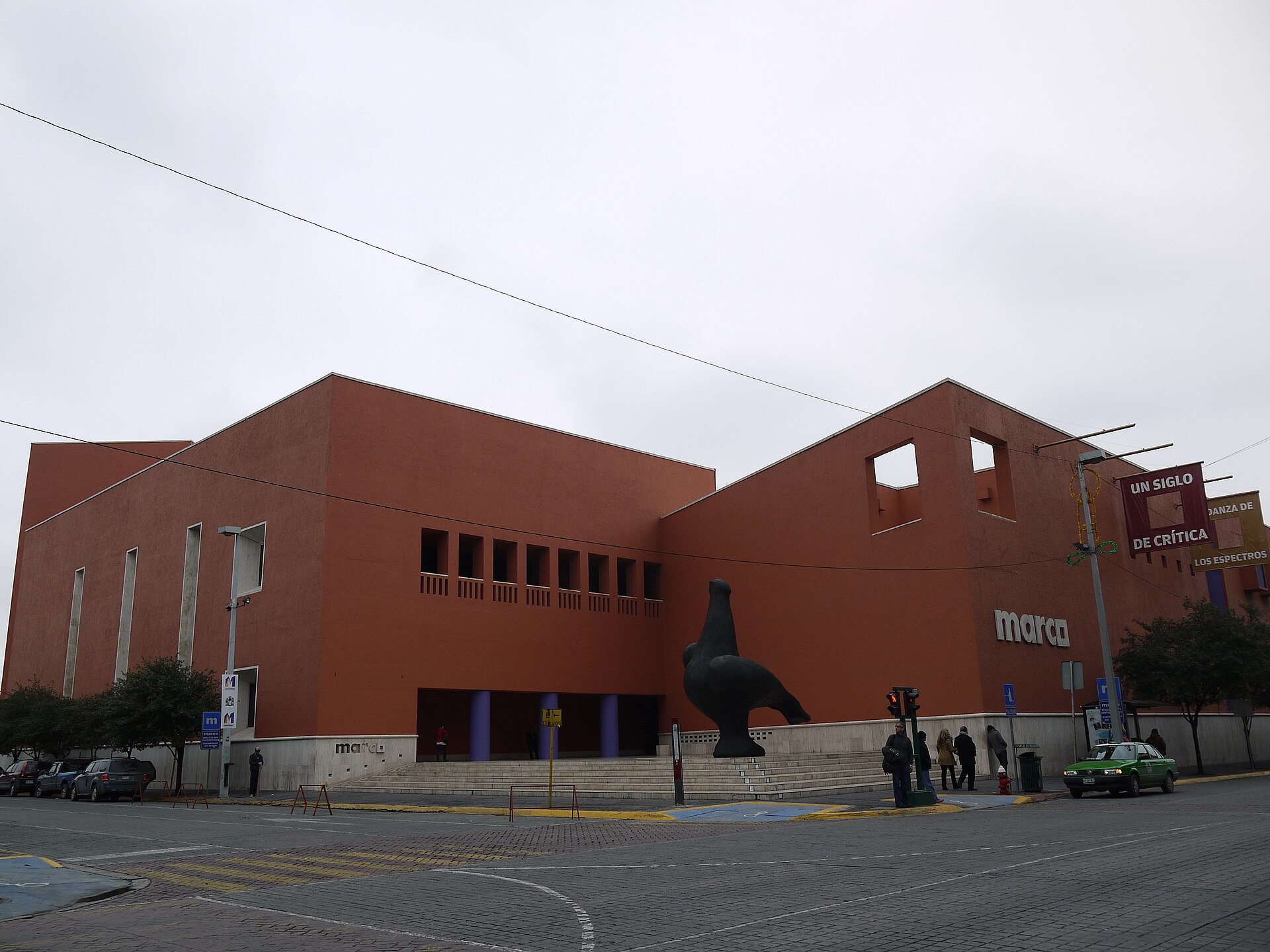
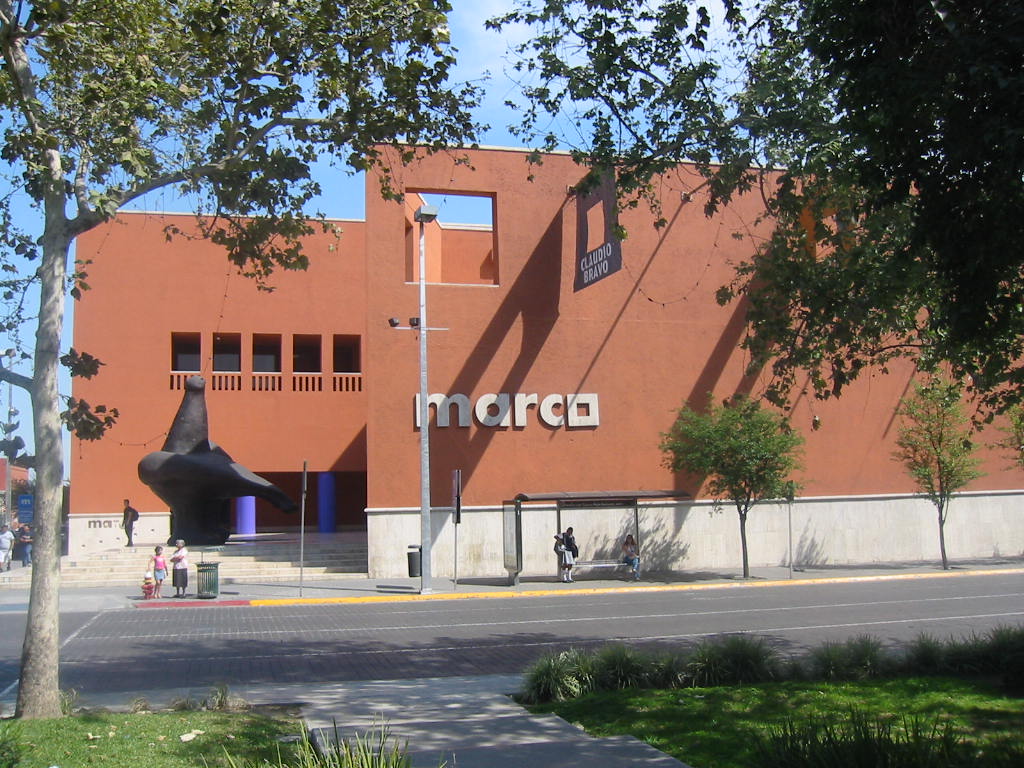
The burnt-orange corner of the building where Juan Soriano's bronze dove, La Paloma, stands at the entrance plaza beside the museum's marco signage.
Photograph by JavierDo, CC BY-SA 3.0MARCO (Museo de Arte Contemporaneo de Monterrey)
Museum · Museo de Arte Contemporáneo de Monterrey · Founded 1991
Open, admission and hours confirmed 18 September 2026 · 16 sources
On this page 16 sections
ContentsClose
MARCO's real strength has never been depth of ownership. The museum opened in 1991 without a collection, began building one only in 1994, and what it has assembled since, roughly a hundred paintings in its Sala Mexico room plus a further group of contemporary Latin American and international works acquired piecemeal, is modest set against the scale of the building and the ambition of its exhibition history. What the museum actually offers is Ricardo Legorreta's building, an inseparable part of any visit, and more than three decades of a changing, loan-driven programme that has brought Frida Kahlo, Henry Moore, Isamu Noguchi and, most recently, a major Dan Flavin retrospective through its eleven galleries. A reader should come to MARCO for the architecture and for whatever happens to be on show, not for a deep permanent holding.
| Local name | Museo de Arte Contemporáneo de Monterrey |
|---|---|
| Kind | Museum |
| Founded | 1991 (announced 3 June 1989; inaugurated 28 June 1991) |
| City and country |  Monterrey, Mexico Monterrey, Mexico |
| Address | Zuazua y Padre Raymundo Jardon s/n, Centro, 64000 Monterrey, Nuevo Leon, Mexico |
| Website | marco.org.mx |
| Status | Open, confirmed |
| Record last verified |
Visiting
- Hours
- Tuesday, Thursday, Friday, Saturday, Sunday10:00 to 18:00Last admission 45 minutes before closing
- Wednesday10:00 to 20:00Last admission 45 minutes before closing
- MondayClosed
- Closed
- Monday.
- Admission
- General admissionMXN 150
- Teachers, students, seniors and children age 5 to 15MXN 120Valid ID or credential required
- Free entry, general publicFreeSundays only
- Free entry, students and teachers with valid credentialFreeWednesdays only
Free entry: Sunday, general public. Wednesday, students and teachers with a valid current credential only- Tickets
- marco.org.mx/boletos The museum's own ticket page.
- Do I need to book?
- No advance booking for general admission; the museum's own ticket page says tickets are bought directly at the box office (taquilla), and no online checkout for single-visit admission was found. Guided tours need a prior reservation, arranged through the museum
- Address
- Zuazua y Padre Raymundo Jardon s/n, Centro, 64000 Monterrey, Nuevo Leon, Mexico MapMetro Metrorrey, Zaragoza station about a 5 minute walk; Padre Mier station about 9 minutes
Car Free on-site parking, per the federal cultural registry's listing for the museum
Walking On the Macroplaza in the Centro district, facing the Cathedral and City Hall and next to the Barrio Antiguo - Website
- marco.org.mx
- Telephone
- +52 81 8262 4500
- [email protected]
Before you go how long, access, photography, bags, eating, shop
- How long to allow
- One to two hours for the permanent Sala Mexico room plus a selection of the eleven temporary galleries; visitors covering the full run of temporary shows and the two courtyards report two to three hours
- Access
- Not published in specific terms in the source material read for this page. The museum's own visit page lists accessible restrooms and baby-changing stations on every floor but does not itemise ramps, lifts or step-free routes
- Photography
- Personal photography is allowed inside the galleries; visitors are asked to follow the specific signage posted beside individual artworks that restrict photographing them
- Bags
- Only small bags and handbags may be carried into the galleries; a free coat check (guardarropa) is provided at the entrance for larger items
- Eating
- The museum's own restaurant serves a contemporary Mexican menu with a salad bar, a hot soup or cream of the day, and a selection of mains and desserts, Tuesday to Sunday 13:00 to 16:00; reservations by phone or email
- Shop
- A museum shop is listed in the federal cultural registry and in the architect's own account of the building, alongside the auditorium, cafeteria and restaurant, though its specific hours and current stock were not detailed in the material read for this page
Prices and hours change. We take them from the institution's own pages and print the day we read them, and you can check the current position at the source we used. Confirm before you travel.
What is inside
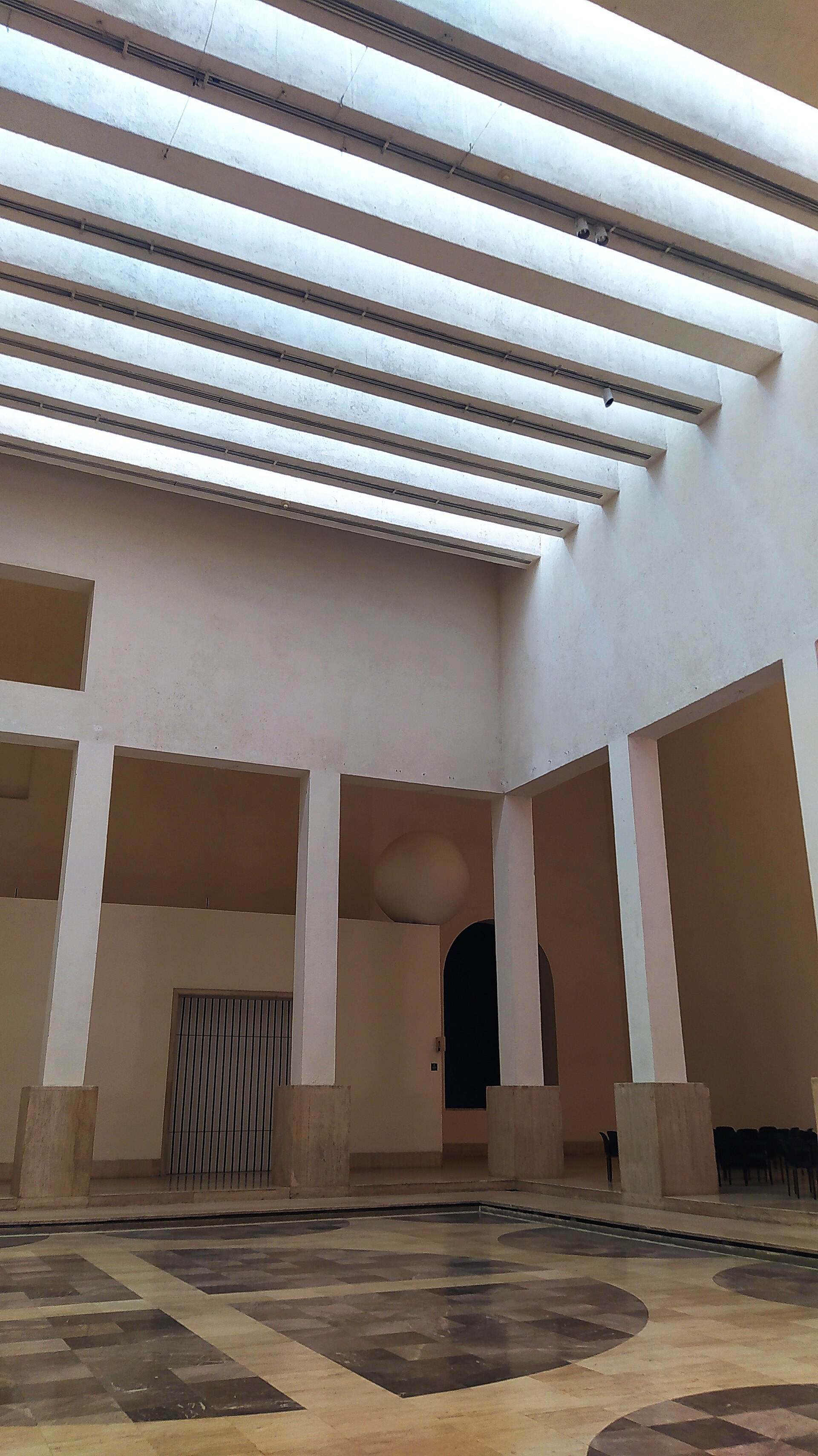
Photograph by Pequeño mar · CC BY-SA 4.0 The Central Patio (covered courtyard)
A tall, skylit central courtyard that distributes visitors to the surrounding galleries and doubles as a venue for concerts and dinners; roughly every 15 minutes a thin flow of water is released to cross its patterned travertine floor, an effect the architect built into the design from the start
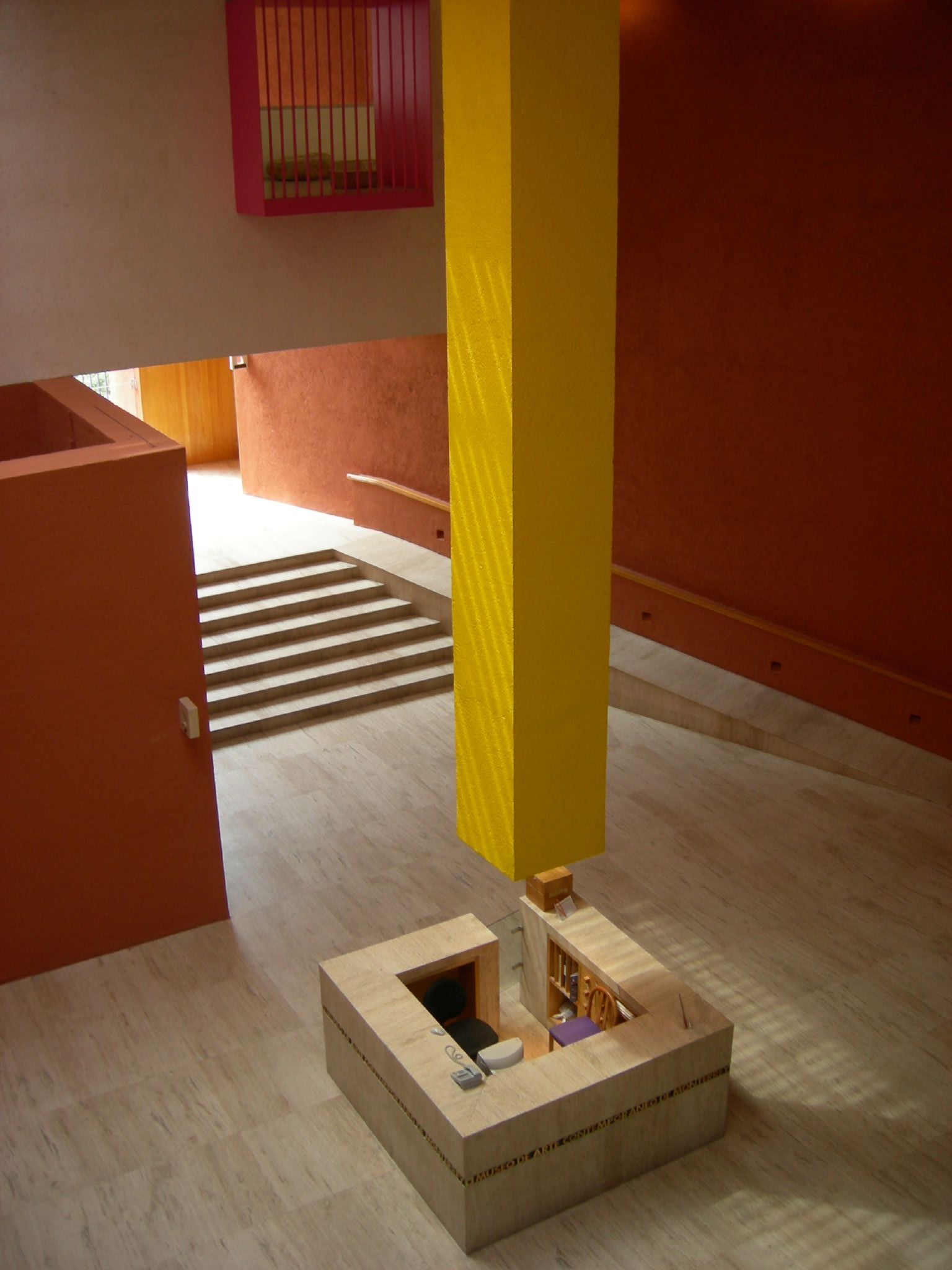
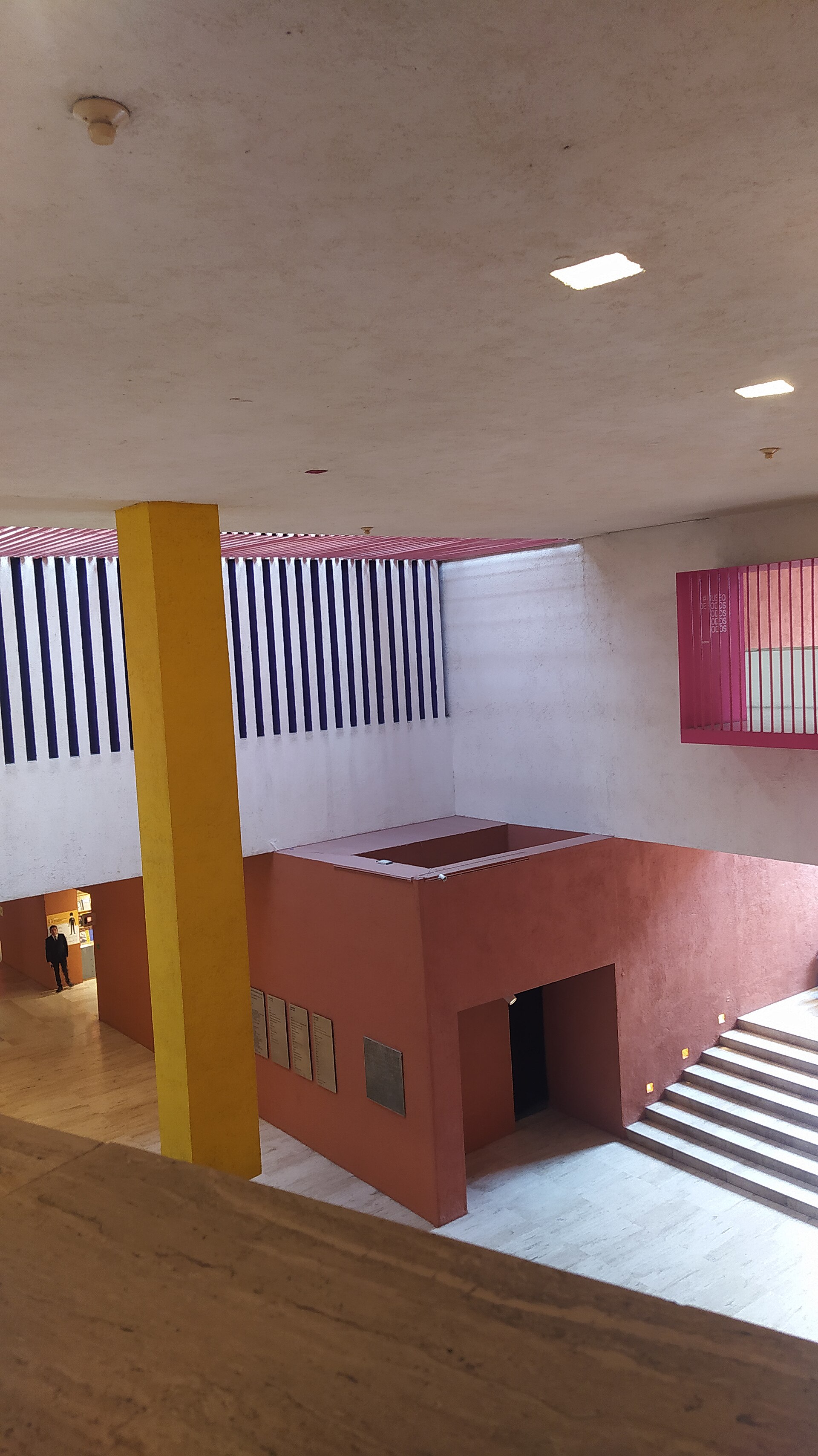
Photograph by Ulises Muñiz · CC BY-SA 2.0 The entrance vestibule
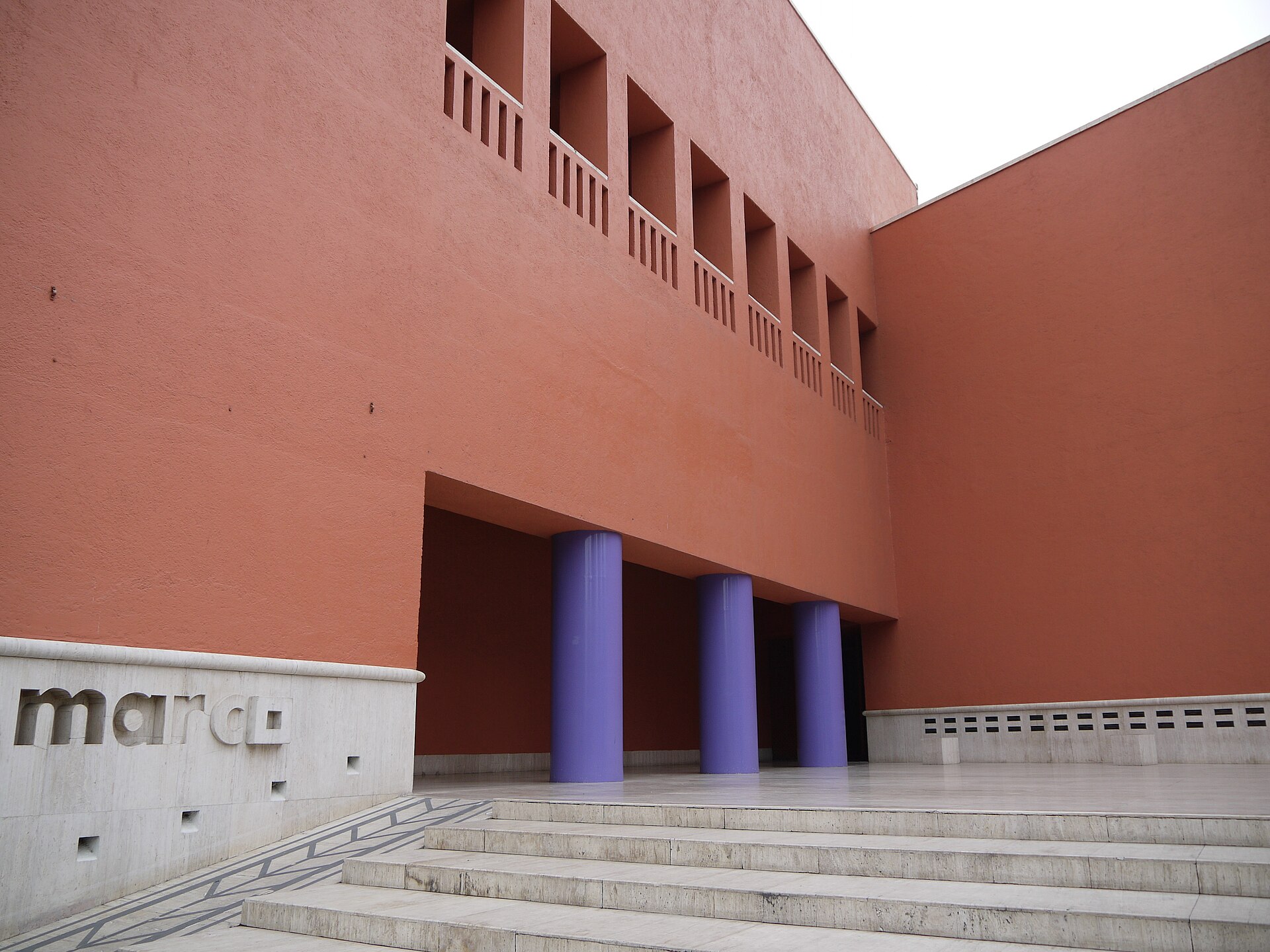
A tall, brightly coloured hall just past the street entrance that Ricardo Legorreta designed as the link between the plaza outside and the museum proper, giving onto the auditorium, cafeteria and shop before a visitor reaches the central courtyard and the galleries beyond
Sala Mexico (the permanent collection room)
The museum's one permanent-collection gallery, holding roughly a hundred paintings by Mexican artists including Diego Rivera, Carlos Merida and Maria Izquierdo; the collection began only in 1994, three years after the museum opened, and has grown slowly since. We could not verify a free-licence photograph of this specific room; it renders as text
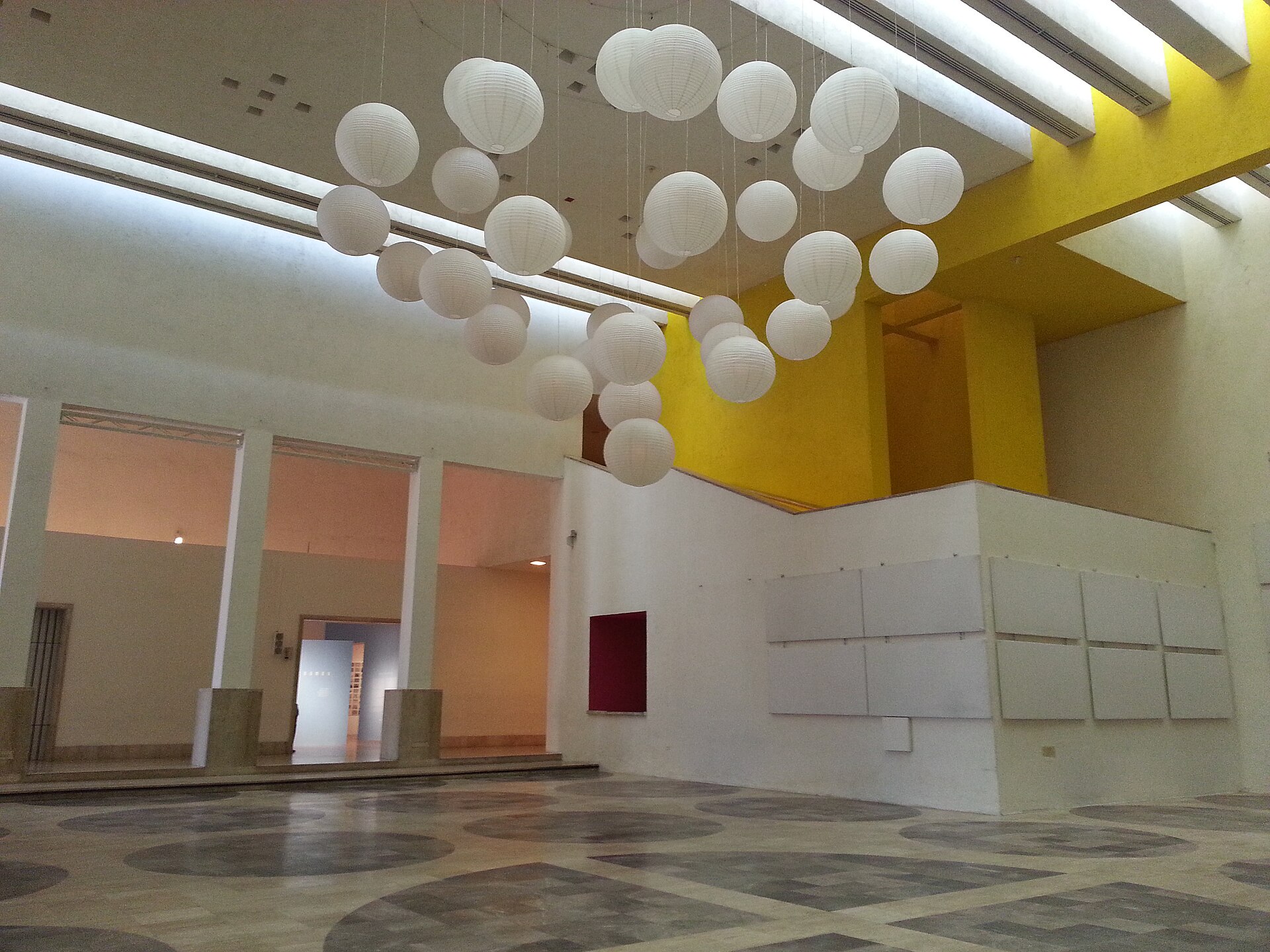
Photograph by JavierDo · CC BY-SA 3.0 The eleven temporary galleries
Eleven exhibition halls across two floors, about 5,000 square metres in total (four ground-floor rooms plus a fifth, and six more on the upper floor), where MARCO's changing programme of Mexican, Latin American and international contemporary art is shown; this is where the great majority of what a visitor sees on any given day actually hangs
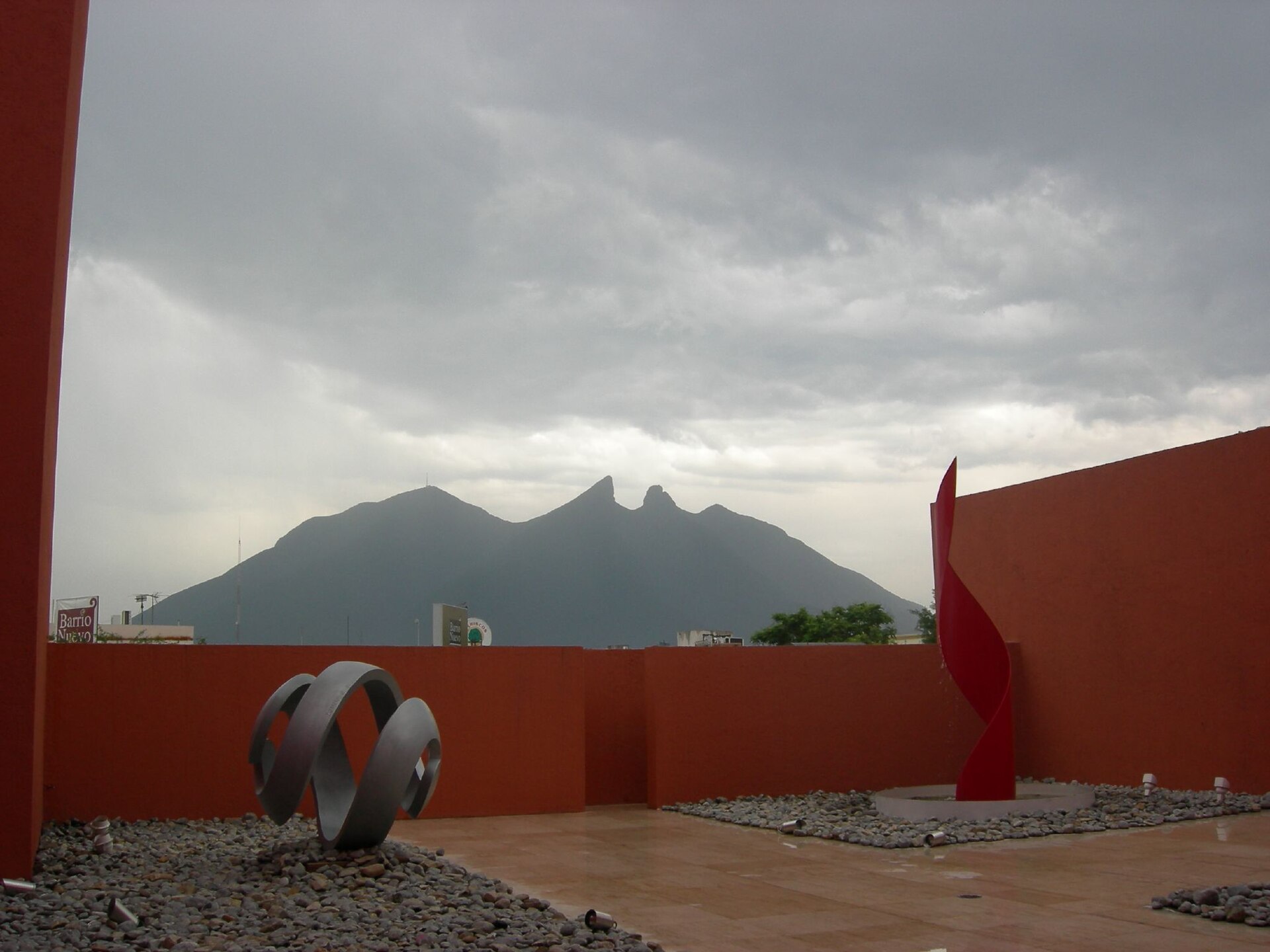
Photograph by Ulisies Muñiz · CC BY-SA 2.0 Patio de las Esculturas (the rooftop sculpture terrace)
An open-air terrace set with sculpture on a bed of river stone, looking out over the Barrio Antiguo toward the jagged silhouette of the Cerro de la Silla; an outdoor counterpart to the covered Central Patio and the only part of the building where the art is seen against the city and the mountain rather than under a roof
What to see first
La Paloma (The Dove)
Juan Soriano, 1991A 4-tonne bronze dove roughly 5.5 to 6 metres tall that greets visitors at the street corner entrance; the architect's own account of the building describes it as a nostalgic homage to Luis Barragan12
Dona Soledad
Nahum B. Zenil, 1981The earliest-dated painting in the museum's own online collection catalogue, an introspective self-portrait by one of Mexico's most sustained painters of domestic ritual and queer identity5
El vuelo de las novias (The Flight of the Brides)
Rodolfo Morales, 1994A large canvas by the Oaxacan painter known for scenes of village life and airborne brides, acquired the same year the museum began building a permanent collection at all5
Mujer de pie (Standing Woman)
Javier Marin, 1994A monumental figure by one of Mexico's leading contemporary sculptors of the human body, part of the collection's small but deliberate sculpture holding5
Animal and La fuente (The Fountain)
Leonora Carrington, undatedTwo of four undated Leonora Carrington paintings in the collection, by the British-born, Mexico City-based Surrealist whose late work MARCO has held since before her death in 20115
Junglrama
Kenny Scharf, 1992A Pop- and graffiti-inflected canvas that is one of the collection's rare non-Latin-American entries, alongside works by Mimmo Paladino and Pierre Alechinsky5
Ordre et Progres
Hector Zamora, 2016The most recently dated work in the museum's own online collection catalogue, an installation by a Mexican artist known for architecture-scale interventions5
Cosmic Thing (2002), shown in a 2023 mid-career survey
Damian OrtegaThe centrepiece of the first exhibition of Ortega's work ever held in his own country; the artist told ARTnews that not having shown at home before was like a writer never publishing in their native language14
Exhibitions on now
- On now5 Jun 2026 to 7 Feb 2027Confirmed , 8 weeks ago
- On now25 Sep 2026 to 18 Apr 2027Confirmed , 8 weeks ago
Past exhibitions here
- Closed20 Mar to 30 Aug 2026Confirmed · check before you travel
A red building on the Macroplaza
MARCO stands at the corner of Monterrey's Macroplaza, across from the city's cathedral and its city hall, its burnt-orange, minimalist postmodern walls unmistakable against the older buildings and the rolling hills around the historic centre. Ricardo Legorreta, one of Mexico's most celebrated architects, designed the building; it opened to the public on 28 June 1991, after roughly two years of construction. The museum occupies about 16,000 square metres in total, with some 5,000 square metres of that given to eleven exhibition halls across two floors. A visitor arrives first at a small plaza where Juan Soriano's La Paloma, a 4-tonne bronze dove roughly 5.5 to 6 metres tall, stands at the street corner; Legorreta's own firm describes it as a nostalgic homage to Luis Barragan, the architect whose colour and light Legorreta had trained under and carried forward into his own practice. From that plaza, discreet doors lead into a tall, colourful vestibule that links the auditorium, cafeteria and shop before opening onto the museum's covered central courtyard and its surrounding galleries.
A courtyard built like a house
Legorreta's own description of the building draws directly on the traditional plan of a Mexican house: a central courtyard surrounded by arcades that give access to the rooms around it, rather than a single corridor threading past a sequence of galleries. At MARCO that courtyard is covered, and roughly every 15 minutes a thin flow of water crosses its patterned travertine floor, an effect built into the design from the outset and repeated often enough that regular visitors plan around it. The galleries themselves are lit by a deliberate mix of natural and artificial light, with windows placed to keep a visitor aware of the city and the courtyard outside rather than sealed into a uniform white box. Legorreta wrote that he wanted a visit to feel less like walking through a laboratory where art happens to be kept, and more like moving through a series of spaces and architectural elements that are themselves a kind of artwork. An open-air rooftop terrace, the Patio de las Esculturas, extends that idea outdoors, setting sculpture on a bed of river stone against a view of the Cerro de la Silla.
Six corporations and a symbolic building
MARCO was announced on 3 June 1989 by the businessman Diego Sada Zambrano, then head of Grupo Alfa, and it opened less than two years later. Total investment in the project ran to about 10.5 million US dollars, with the federal government, the government of Nuevo Leon, and a group of the region's largest industrial conglomerates, Cemex, Grupo CYDSA, Grupo IMSA, Grupo Alfa and Vitro, sharing the cost. The museum sits inside a private trust, or Patronato, whose founding board seated executives from those same sponsoring companies alongside state officials, a structure an academic study of the museum's origins describes as closer to a commercial partnership's board than to a conventional nonprofit's. That same study argues the museum's creation went beyond simple philanthropy: it reads MARCO as part of a broader strategy by Monterrey's industrial elite to project an international, cosmopolitan image just as those companies were expanding across the United States and Latin America ahead of NAFTA, and as a symbolic marker of a new, more cooperative relationship between the companies and the Mexican state after decades of friction. The museum's first director, Fernando Trevino Lozano, opened it with an exhibition he called an unprecedented continental show, Mito y magia en America: los ochenta (Myth and Magic in America: The Eighties).
Sala Mexico and what MARCO actually owns
For an institution of its scale, MARCO's own collection is a comparatively late and modest addition to the building. The museum opened in 1991 with no collection of its own, and only began assembling one in 1994. What it has built since sits mainly in a single permanent-collection room, Sala Mexico, which holds roughly a hundred paintings by twentieth-century Mexican artists including Diego Rivera, Carlos Merida and Maria Izquierdo. The museum's own online catalogue of the wider collection lists further paintings, sculpture and installation work dated between 1981 and 2018, by artists including Leonora Carrington, Nahum B. Zenil, Rodolfo Morales, Javier Marin, Kenny Scharf, Pierre Alechinsky and Hector Zamora, weighted toward painting and toward Mexican and Latin American names, with a smaller group of European and American artists alongside them. That collection is not what fills most of the building on any given visit. The eleven temporary galleries, about 5,000 square metres split across two floors, carry MARCO's real programme: a continuously changing sequence of loan exhibitions that has, over more than three decades, been the museum's actual claim on attention.
Three decades of visiting shows
MARCO's temporary programme has run from the Mexican School of painting to international contemporary art almost since it opened. Mexican artists shown there include Frida Kahlo, Manuel Alvarez Bravo, Julio Galan, Mathias Goeritz and Hermenegildo Bustos; visiting international artists have included Henry Moore, Isamu Noguchi, Antony Gormley, Jenny Holzer, Joan Brossa and the Cuban-American artist Ana Mendieta. The museum has also served as a stop on the itinerary of large travelling shows organised elsewhere, including Mexico: Splendors of Thirty Centuries, which opened at the Metropolitan Museum of Art in New York in 1990 before touring to Mexico, beginning in Monterrey. The building itself has drawn its own notice: it was published in Art in America in October 1991, the same year it opened, and later in Architectural Digest Mexico among Legorreta's most representative works, and the design won recognition at the second Mexican Architecture Biennial in the early 1990s. Three and a half decades on, the combination of a building that is itself an attraction and a programme built almost entirely on loans remains the identity Ruth's brief for this page asks a reader to understand before they plan a visit.
A new direction since 2019
Since Taiyana Pimentel became MARCO's executive director in 2019, the museum's programme has shifted noticeably. Born in Havana and based for years in Mexico City before she began visiting Monterrey in the mid-1990s, Pimentel has built a curatorial line around artists from northern Mexico alongside figures with strong international reputations who had, in several cases, never had a significant museum show in their own country: Mario Garcia Torres, Miguel Calderon, Pedro Reyes and Damian Ortega have all had solo exhibitions at MARCO under her direction. Ortega's 2023 mid-career survey, built around his installation Cosmic Thing, was the first time his work had been shown in Mexico at all, a fact he told ARTnews felt like a writer never publishing in their own language. Pimentel has also pushed the programme toward women artists, with exhibitions for the collective marcelaygina, Melanie Smith, Sofia Taboas, Helen Escobedo and Teresa Serrano, and toward MARCO's partnerships with institutions such as the Dia Art Foundation in New York, whose Dan Flavin retrospective at MARCO drew more than 119,000 visitors, the best-attended show of her tenure so far.
What visitors say
MARCO holds a 4.5-of-5 rating from 462 Tripadvisor reviews, ranking 5th of 175 things to do in Monterrey. Visitors consistently single out Ricardo Legorreta's building itself, and Juan Soriano's dove at the entrance, as being as much the draw as whatever is on the walls, and repeatedly describe the temporary exhibition programme as world-class and international in range. The most consistent reservation, echoed independently in an academic study of the museum's founding, is that its own permanent collection is modest for an institution of this scale and profile, so most of what a repeat visitor sees changes with the current show rather than forming a fixed, deep holding.
What is praised, what is criticised
- Praised: Ricardo Legorreta's building: its colour, the covered central courtyard with its timed water feature, and Juan Soriano's La Paloma sculpture at the entrance, cited by visitors as much as the art inside
- Praised: The range and quality of the temporary exhibition programme, from Dan Flavin and Ron Mueck to Frida Kahlo and Henry Moore, repeatedly described by visitors as world class for a museum of this size
- Praised: Free entry on Sundays for the general public, and on Wednesdays for students and teachers, which repeat visitors credit with making a changing programme genuinely easy to keep up with
- Criticised: The museum's own permanent collection is thin relative to its ambition: MARCO opened in 1991 without a collection, began building one only in 1994, and an academic study of its founding describes what it has since accumulated as small and concentrated mainly on painting, a reading also echoed on Wikipedia's own description of the permanent holding as not very extensive
- Criticised: Some visitors describe the in-gallery supervision as strict for a casual visit, with guards enforcing a set walking direction through the rooms and no food or drink, including coffee, allowed inside once a visitor has entered
Ratings on other platforms
Tripadvisor: 4.5 from 462 ratings, read 13 August 2026
A platform average is a tertiary source: it moves, it is not audited, and we quote no visitor's words.
Questions about MARCO (Museo de Arte Contemporaneo de Monterrey)
Where is MARCO (Museo de Arte Contemporaneo de Monterrey)?
Zuazua y Padre Raymundo Jardon s/n, Centro, 64000 Monterrey, Nuevo Leon, Mexico.
How much does it cost to visit?
General admission: MXN 150; Teachers, students, seniors and children age 5 to 15: MXN 120; Free entry, general public: free; Free entry, students and teachers with valid credential: free. As confirmed 18 September 2026.
When is it open?
Tuesday, Thursday, Friday, Saturday, Sunday 10:00-18:00; Wednesday 10:00-20:00; Monday closed. Closed: Monday. As confirmed 18 September 2026.
How do you get there?
Metro: Metrorrey, Zaragoza station about a 5 minute walk; Padre Mier station about 9 minutes; Car: Free on-site parking, per the federal cultural registry's listing for the museum; Walking: On the Macroplaza in the Centro district, facing the Cathedral and City Hall and next to the Barrio Antiguo.
What should you see first?
La Paloma (The Dove) (Juan Soriano, 1991); Dona Soledad (Nahum B. Zenil, 1981); El vuelo de las novias (The Flight of the Brides) (Rodolfo Morales, 1994); Mujer de pie (Standing Woman) (Javier Marin, 1994); Animal and La fuente (The Fountain) (Leonora Carrington, undated); Junglrama (Kenny Scharf, 1992).
What we could not confirm
- The current composition of MARCO's governing Patronato, or board of trustees, was not confirmed for this page beyond a 2014 academic source naming Nina Zambrano Trevino as director general and board president at that time; whether that holds in 2026 is not established here
- No precise, dated total for the size of the current permanent collection was found on the museum's own site beyond the repeated figure of roughly a hundred works in Sala Mexico
- Specific accessibility provisions, ramps, lifts or step-free routes through the building, were not published in the source material read for this page beyond a general note about accessible restrooms
Images
Sources
- 1Wikidata, 'Museo de Arte Contemporaneo de Monterrey' (Q6940538): label, coordinates (P625, 25.669/-100.310), country (P17), inception (P571, 1991), architect (P84, Ricardo Legorreta), official website (P856) and Commons category (P373). Fetched 2026-08-13. wikidata.org/wiki/Q6940538
- 2Wikidata, 'Ricardo Legorreta' (Q732502), confirming the entity linked from MARCO's architect (P84) claim as the Mexican architect (1931-2011). Fetched 2026-08-13. wikidata.org/wiki/Q732502
- 3Wikimedia Commons, Category:Museum of Contemporary Art, Monterrey: category membership and wikitext, confirming the architect credit and carrying no freedom-of-panorama or deletion warning. Fetched 2026-08-13. commons.wikimedia.org/wiki/Category:Museum_of_Contemporary_Art,_Monterrey
- 4MARCO, official site, 'Visita' (hours, admission prices, address, phone, and visitor policies on bags, photography and restrooms). Read 2026-08-13. marco.org.mx/visita/
- 5MARCO, official site, 'Coleccion' (searchable catalogue of the permanent collection, works dated 1981-2018). Read 2026-08-13. marco.org.mx/coleccion/
- 6MARCO, official site, home page. Read 2026-08-13. marco.org.mx/
- 7MARCO, official site, 'Restaurante' (restaurant hours, menu description and reservation contact). Read 2026-08-13. marco.org.mx/restaurante/
- 8MARCO, official site, 'Boletos' (ticket prices and free-entry days). Read 2026-08-13. marco.org.mx/boletos/
- 9MARCO, official site, 'Membresias' (membership tiers and contact emails, including [email protected]). Read 2026-08-13. marco.org.mx/membresias/
- 10Wikipedia (Spanish), 'Museo de Arte Contemporaneo (Monterrey)', including the note that the permanent collection 'no es muy extensa' (is not very extensive). Read 2026-08-13. es.wikipedia.org/wiki/Museo_de_Arte_Contempor%C3%A1neo_(Monterrey)
- 11Wikipedia (English), 'Museo de Arte Contemporaneo de Monterrey'. Read 2026-08-13. en.wikipedia.org/wiki/Museo_de_Arte_Contempor%C3%A1neo_de_Monterrey
- 12Legorreta Arquitectos, 'MARCO Contemporary Art Museum' project page, architect's own account of the building's design, materials, collaborators and the La Paloma sculpture. Read 2026-08-13. legorreta.mx/en/proyecto-marco-museo-de-arte-contemporaneo
- 13Secretaria de Cultura, Sistema de Informacion Cultural, ficha 'Museo de Arte Contemporaneo de Monterrey (MARCO)': hours, prices, gallery floor areas, services and founding date, last modified by the registry 5 June 2026. Read 2026-08-13. sic.cultura.gob.mx/ficha.php?table=museo&table_id=356
- 14ARTnews, Silvia Benedetti, 'At the Museo de Arte Contemporaneo de Monterrey, a New Vision of Mexico's Contemporary Art Landscape Rises', 27 February 2025. artnews.com/art-news/news/museo-de-arte-contemporaneo-de-monterrey-mexico-taiyana-pimentel-1234733626/
- 15Tripadvisor, 'Museo de Arte Contemporaneo de Monterrey (MARCO)' aggregate rating (4.5 of 5, 462 reviews, ranked 5th of 175 things to do in Monterrey). Read 2026-08-13. tripadvisor.com/Attraction_Review-g150782-d151189-Reviews-Museo_de_Arte_Contemporaneo_MARCO-Monterrey_Northern_Mexico.html
- 16Georgina Sanchez Celaya, 'Mas alla de la filantropia: el nacimiento del Museo de Arte Contemporaneo de Monterrey' (Beyond Philanthropy: The Birth of the Museum of Contemporary Art in Monterrey), Discurso Visual, no. 34 (July-December 2014). discursovisual.net/dvweb34/TT_03Georgina.html