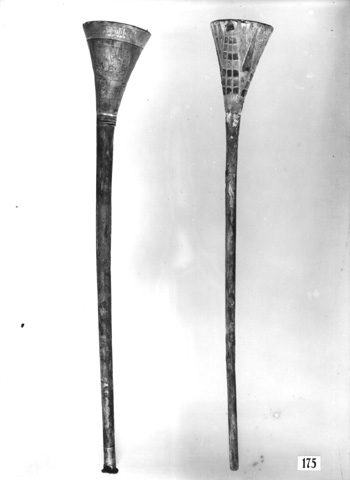
The Trumpets of Tutankhamun
c. 1336-1327 BC · Silver trumpet
Grand Egyptian Museum, Giza
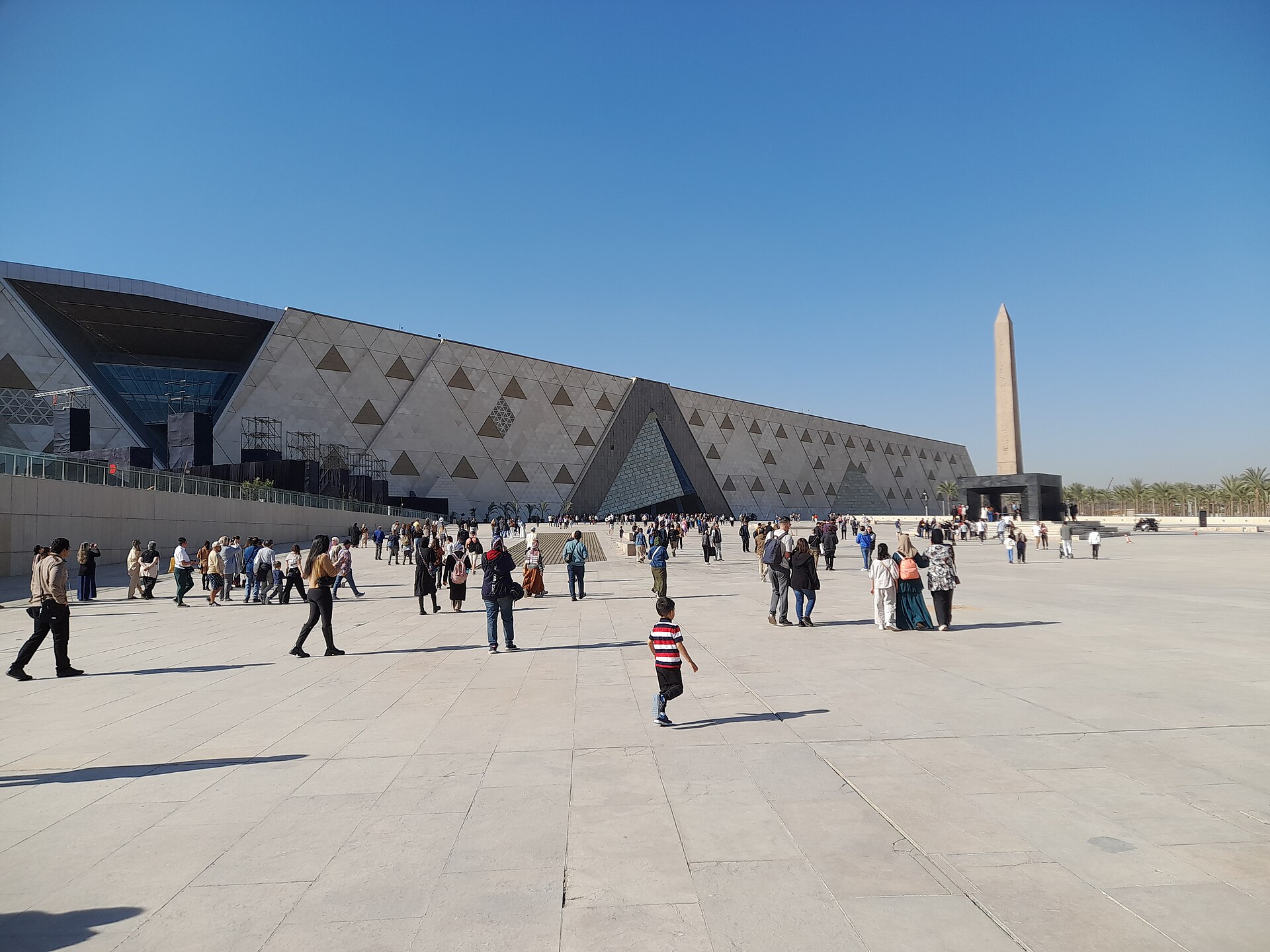
The triangular, alabaster-faced entrance facade and forecourt obelisk, photographed in 2025 as part of an Egypt Wikimedians User Group visit.
Amr F. Nagy · Public domainMuseum · Al-Mathaf al-Masri al-Kabir · Founded 1992
Open, admission and hours confirmed 17 August 2026 · 7 sources
More than 100,000 objects, upward of half never exhibited before, spanning roughly 3100 BC to 400 AD across twelve main galleries, with three purpose-built set pieces beyond the general run of cases: the Grand Staircase's more than sixty chronologically arranged statues, the complete 5,398-piece Tutankhamun collection in its own halls, and Khufu's two Fourth Dynasty solar boats in a dedicated museum within the museum. It is, on the scale of the building alone, the largest museum anywhere dedicated to a single civilisation.
| Local name | Al-Mathaf al-Masri al-Kabir |
|---|---|
| Kind | Museum |
| Founded | Proposed 1992; competition won 2003; opened fully 1 November 2025 |
| City and country |  Giza, Egypt Giza, Egypt |
| Address | Grand Egyptian Museum, Kafr Nassar, Al Haram, Giza Governorate, Egypt |
| Website | gem.eg |
| Status | Open, confirmed |
| Record last verified |
Prices and hours change. We take them from the institution's own pages and print the day we read them, and you can check the current position at the source we used. Confirm before you travel.
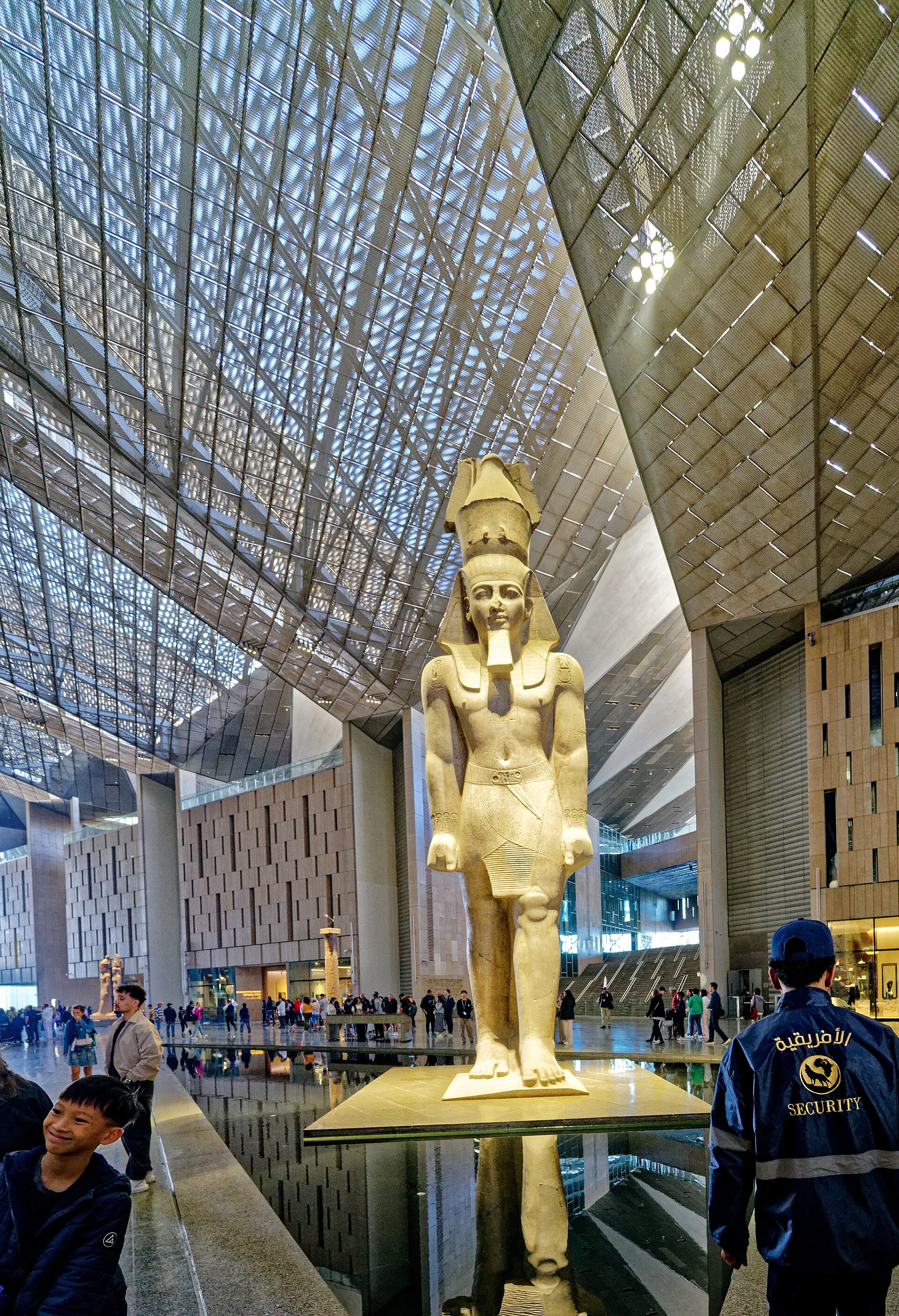
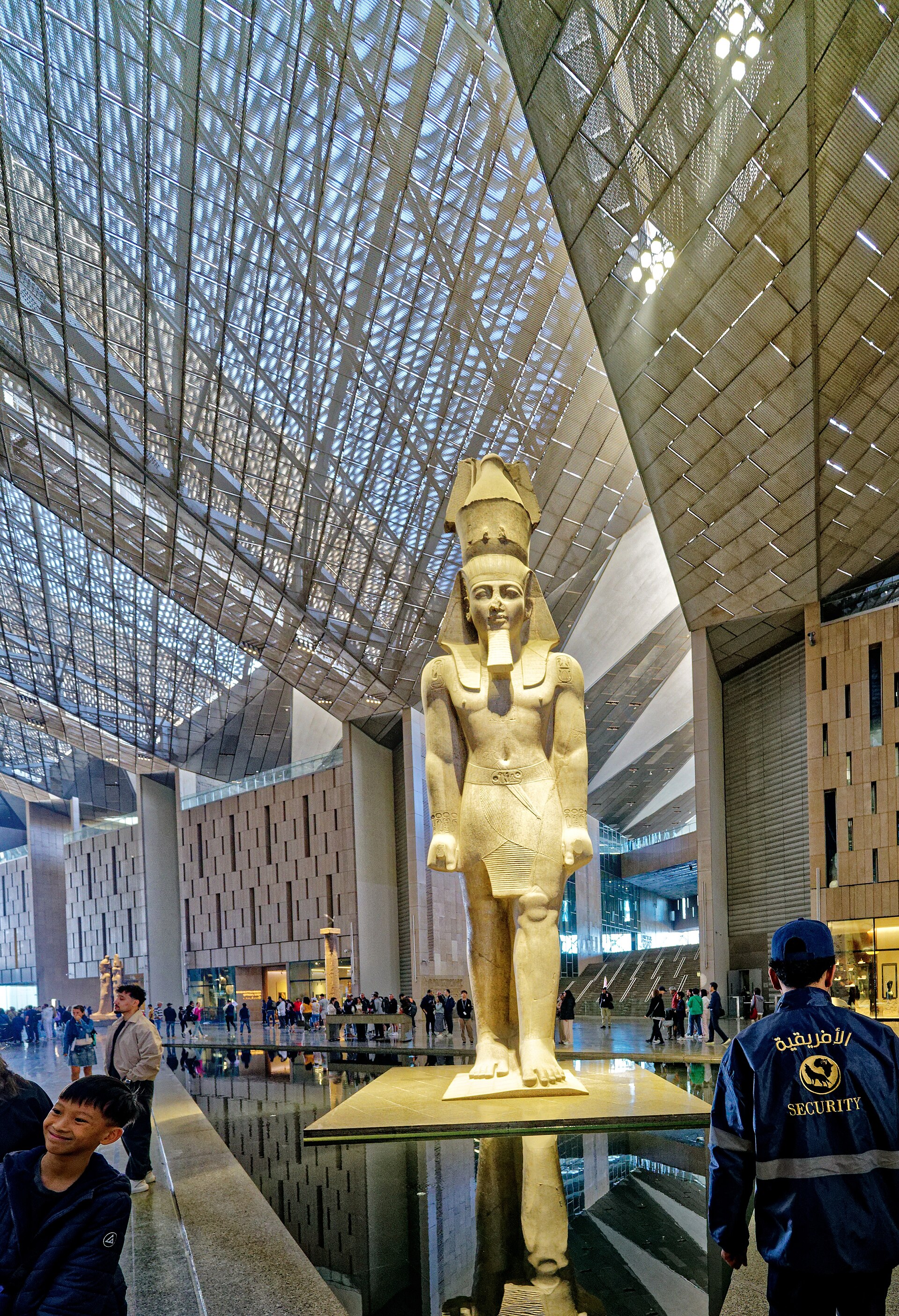
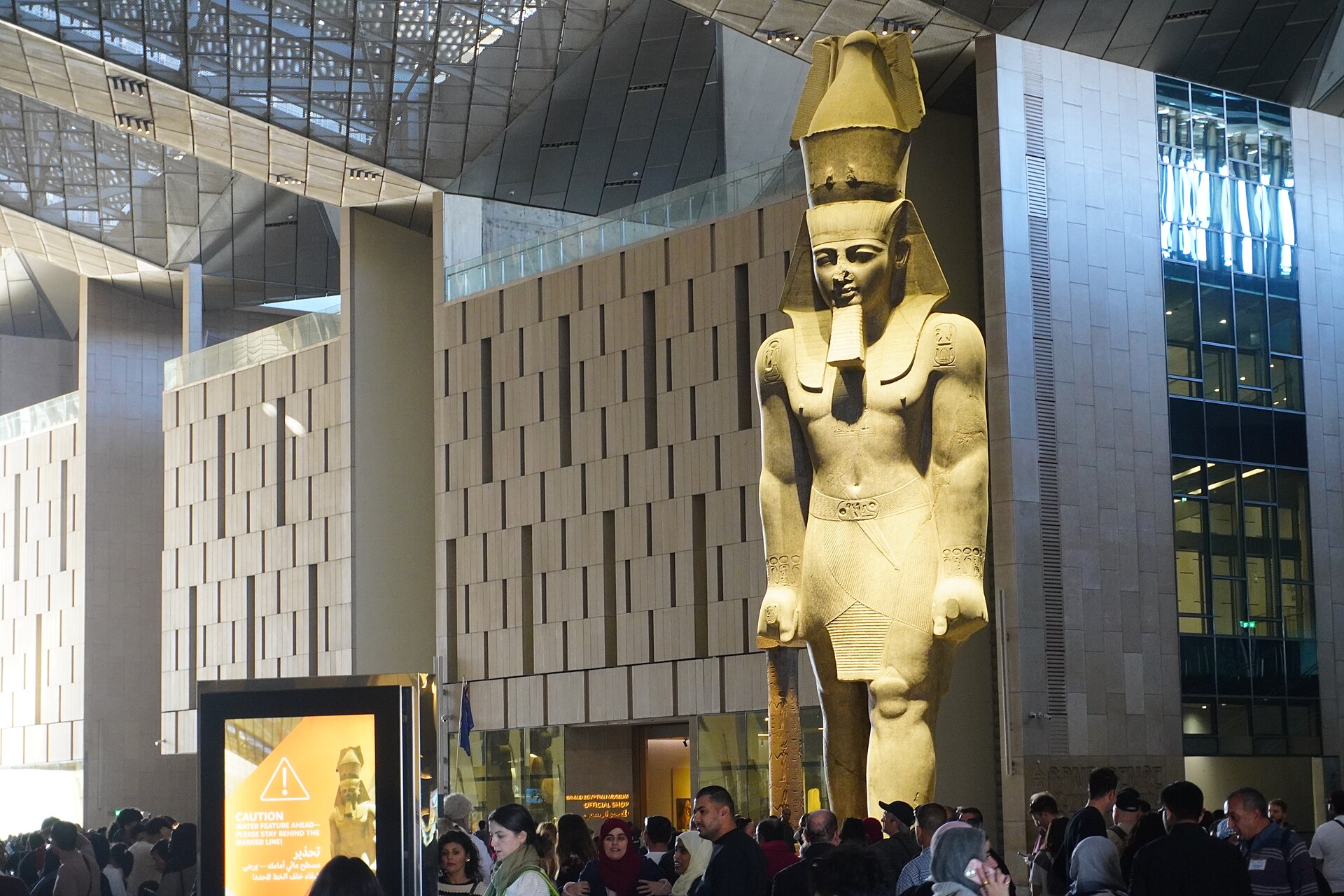
The entrance hall beneath the museum's angled glazed roof holds the first colossal object a visitor meets: an 83-tonne, 11-metre granite statue of Ramesses II, moved here after decades standing in Cairo's Ramses Square and then Tahrir Square. An obelisk of Ramesses II stands nearby in the same space.
A six-storey staircase of roughly 6,000 square metres climbing from the main lobby to the upper terrace, lined with more than sixty statues and architectural fragments arranged thematically - royal images, temple material, divine figures and funerary pieces - so that the ascent itself runs in loose chronological order, ending on a terrace framing a direct view of the Giza pyramids.
Two dedicated halls covering some 7,000-7,500 square metres, designed to evoke the shape of the young king's tomb in the Valley of the Kings. They hold the complete Tutankhamun collection of 5,398 objects, including the golden burial mask, shown together in one place for the first time; the king's mummy itself remains in his tomb in the Valley of the Kings and was not moved.
A dedicated hall for the two Fourth Dynasty solar boats of King Khufu, among the oldest intact wooden vessels known, moved here from the old Giza Solar Boat Museum beside the Great Pyramid in August 2021 after decades on that site.
Twelve chronological and thematic galleries display more than 24,000 objects spanning roughly 3100 BC to 400 AD, drawn substantially from storerooms and never previously exhibited; museum figures put more than half the total collection of over 100,000 artefacts into this category.
The museum's own signature object: an 83-tonne granite statue that stood for decades in central Cairo before its move here, now the first thing a visitor sees on entering the Grand Hall.5
5,398 objects from the 1922 tomb discovery, shown together in dedicated halls for the first time; previously only part of the find was on permanent display, at the Egyptian Museum in Tahrir Square.5
Named by the museum itself among its own headline objects on its homepage; the single most reproduced object from the 1922 discovery, now on view in the Tutankhamun Galleries rather than at Tahrir.1
Two of the oldest intact wooden ships known, buried beside the Great Pyramid and moved into a purpose-built hall here in August 2021, ending decades on their original excavation site.5
Named among the museum's own highlighted objects and displayed with the Ramesses II colossus in the Grand Hall.1
One of the objects the museum itself features on its homepage rotation of highlights, representative of the smaller bronze and stone material shown across the twelve main galleries.1
Named by the museum among its own highlighted objects; a funerary boat model of a type distinct from the full-size Khufu boats shown in their own hall.1
The idea predates its opening by more than three decades. Culture Minister Farouk Hosni proposed a new national museum in the early 1990s, judging the century-old Egyptian Museum in Tahrir Square inadequate for a collection that had long outgrown it; the government under President Hosni Mubarak formally launched the project in 1992. Nothing built followed for a decade. An international design competition opened on 7 January 2002 and drew 1,557 entries from 82 countries, at the time the second-largest architectural competition ever held; the Irish practice of Roisin Heneghan and Shih-Fu Peng won in 2003. A foundation stone was laid in 2002 and construction began in earnest in 2005, carried out by a joint venture of Egypt's Orascom Construction and Belgium's BESIX Group, with Buro Happold and Arup as structural engineers, West 8 as landscape architects and the German firm Atelier Brueckner designing the exhibitions.
What followed was two decades of slippage. A 2020 target became 2021 under COVID-19 disruption; logistical and construction problems pushed the date further; a May 2024 opening announced by Minister Ahmed Issa did not happen, and trial operations began instead in October 2024, drawing roughly 1.5 million visitors over ten months at an average of 4,000 a day. A July 2025 opening date was itself postponed, with Prime Minister Mostafa Madbouly citing regional conflict in the announcement. The museum finally opened in full on 1 November 2025, construction having been physically complete since 2023, at a reported total cost of 1.2 billion US dollars.
The chamfered triangular building stands about two kilometres from the Giza pyramid complex, and the alignment is not accidental: the museum's own north and south walls run parallel to the Great Pyramid of Khufu and the Pyramid of Menkaure respectively, so that the building reads as addressed to the monuments it was built to serve rather than merely sited near them. The facade is faced in translucent alabaster carved with cartouches and hieroglyphic royal names, lit from within after dark. Inside, the angled glazed roof over the Grand Hall and the tiered Grand Staircase are engineered to end the ascent on an upper terrace that frames a direct sightline to the pyramids themselves - the building's one unambiguous design argument, repeated in nearly every account written of it since it opened.
The museum's opening changed, at a stroke, where a large share of Egypt's best-known antiquities can be seen. The complete Tutankhamun collection - 5,398 objects recovered from the 1922 discovery of the tomb, including the golden burial mask - is now shown together in two dedicated halls here for the first time; previously the Egyptian Museum in Tahrir Square held only part of the find on permanent display, with other pieces in storage or on loan abroad over the decades. A reader relying on anything written before November 2025 about where to see the Tutankhamun material is reading an account of a location that has since changed. One thing did not move: Tutankhamun's mummy remains in his tomb, KV62, in the Valley of the Kings, and was never brought to Giza. The Grand Egyptian Museum displays the funerary goods and the golden mask, not the body the mask was made to cover.
Two of the museum's spaces are effectively museums within the museum. The Grand Staircase - six storeys, some 6,000 square metres - is not simply circulation space: more than sixty statues and architectural fragments are arranged along it in loose chronological groups covering royal imagery, temple material, divinities and funerary pieces, so the climb to the upper terrace doubles as a compressed history of the material below. Khufu's Boats Museum, meanwhile, holds two Fourth Dynasty solar boats - among the oldest intact wooden vessels known anywhere - which spent decades in a smaller, purpose-built museum next to the Great Pyramid after their 1954 discovery, until both were moved into this new dedicated hall in August 2021, four years before the wider museum opened around them.
GEM's own site is unusual for stating plainly that it does not publish a fixed price list: its FAQ page says admission 'varies depending on the selected experience, the visitor's nationality, and age category' and directs visitors to the online booking platform rather than to a table. Tiers reported by named press at the time of the November 2025 opening ran from 350 Egyptian pounds for an Egyptian adult to 1,700 pounds for a foreign or non-resident Arab adult, with reduced tiers for students, children and Egypt-resident foreigners in between; all tickets have been sold online only, with a timed entry slot, since 1 December 2025. On Tripadvisor the museum runs at 4.6 out of 5 across 210 reviews as of this research, a strong score, and the praise in both press coverage and visitor reports concentrates on the same things: the scale of the Grand Hall, the assembled Tutankhamun collection, and the pyramid view from the staircase terrace. The recurring complaint is practical rather than curatorial - the building's size makes it easy to lose a sense of route without a plan or a guide, and the Grand Staircase, despite a bypass walkway, is not an easy climb for visitors with limited mobility. Both points appear often enough across independent visitor accounts to read as a genuine pattern rather than isolated complaints.
We publish no visitor review prose and cite no single platform score as fact beyond the aggregate figure below. What is consistent across coverage and visitor reports since the November 2025 opening is that the scale and the pyramid views draw genuine praise, while the museum's size itself is the most common practical complaint: reviewers describe the layout as disorienting without a plan or a guide, and note that the Grand Staircase, though it has a bypass route, is not an easy building for visitors with mobility restrictions.
Tripadvisor: 4.6 from 210 ratings, read 7 August 2026
A platform average is a tertiary source: it moves, it is not audited, and we quote no visitor's words.
Grand Egyptian Museum, Kafr Nassar, Al Haram, Giza Governorate, Egypt.
Egyptian, Adult: EGP 200; Egyptian, Child: EGP 100; Egyptian, Student: EGP 100; Egyptian, Senior: EGP 100; Arab or Other Nationality, Adult: EGP 1500. As confirmed 17 August 2026.
Sunday, Monday, Tuesday, Thursday, Friday 09:00-18:00; Saturday, Wednesday 09:00-21:00. As confirmed 17 August 2026.
On foot: About 2 km from the Giza Pyramid Complex; the museum's own north and south walls are aligned with the Great Pyramid of Khufu and the Pyramid of Menkaure.
Colossus of Ramesses II (New Kingdom Egypt, reign of Ramesses II); The complete Tutankhamun collection (New Kingdom Egypt, tomb of Tutankhamun); The golden burial mask of Tutankhamun (New Kingdom Egypt); Khufu's solar boats (Old Kingdom Egypt, Fourth Dynasty); Obelisk of King Ramesses II (New Kingdom Egypt); Statuette of a Falcon (Ancient Egypt).
One artwork and its story every Tuesday, with the picture: who owned it, what it made, and what closes soon in the exhibition calendar. No promotion, and nothing we cannot cite.
We send one email to confirm the address and keep nothing else. Every letter carries a one-click unsubscribe. How we handle your data.