The Trumpets of Tutankhamun
Unknown royal metalworkers, workshop of Tutankhamun's reign · c. 1336-1327 BC
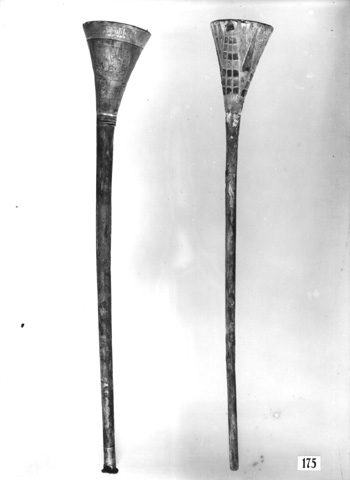
Harry Burton's excavation photograph of the silver trumpet (Carter no. 175, JE 62007), the record subject, made during or shortly after Howard Carter's 1923-1924 season.
| Artist | Unknown royal metalworkers, workshop of Tutankhamun's reign |
|---|---|
| Date | c. 1336-1327 BC |
| Medium | Silver trumpet: sheet silver with a wooden internal core. Bronze trumpet: rolled sheet copper alloy body with a bell of an electrum-like gold alloy, riveted at the mouthpiece ring, with a wooden internal core. |
| Dimensions | Silver trumpet: length 57.2 cm (22.5 in). Bronze trumpet: length approximately 49.6 cm (19.5 in), about 7.6 cm shorter than the silver trumpet. Both instruments taper from a bore of about 1.3 cm at the mouth end, widening to about 2.5 cm, before flaring to a bell diameter of about 10.2 cm. |
| Where it is now | Grand Egyptian Museum, Gizalast confirmed |
| Inventory number | Silver trumpet: Carter no. 175, Egyptian Museum Cairo JE 62007, old exhibition no. 186. Bronze trumpet: Carter no. 050gg, Egyptian Museum Cairo JE 62008, old exhibition no. 125, Grand Egyptian Museum inventory GEM 323. |
| Attribution | UnknownNo maker's name, workshop mark or signature survives on either trumpet, which is normal for New Kingdom royal tomb goods; production is dated to the reign of Tutankhamun (c. Full note |
| Object type | Musical instrument |
| Period | Egyptian, New Kingdom, 18th Dynasty |
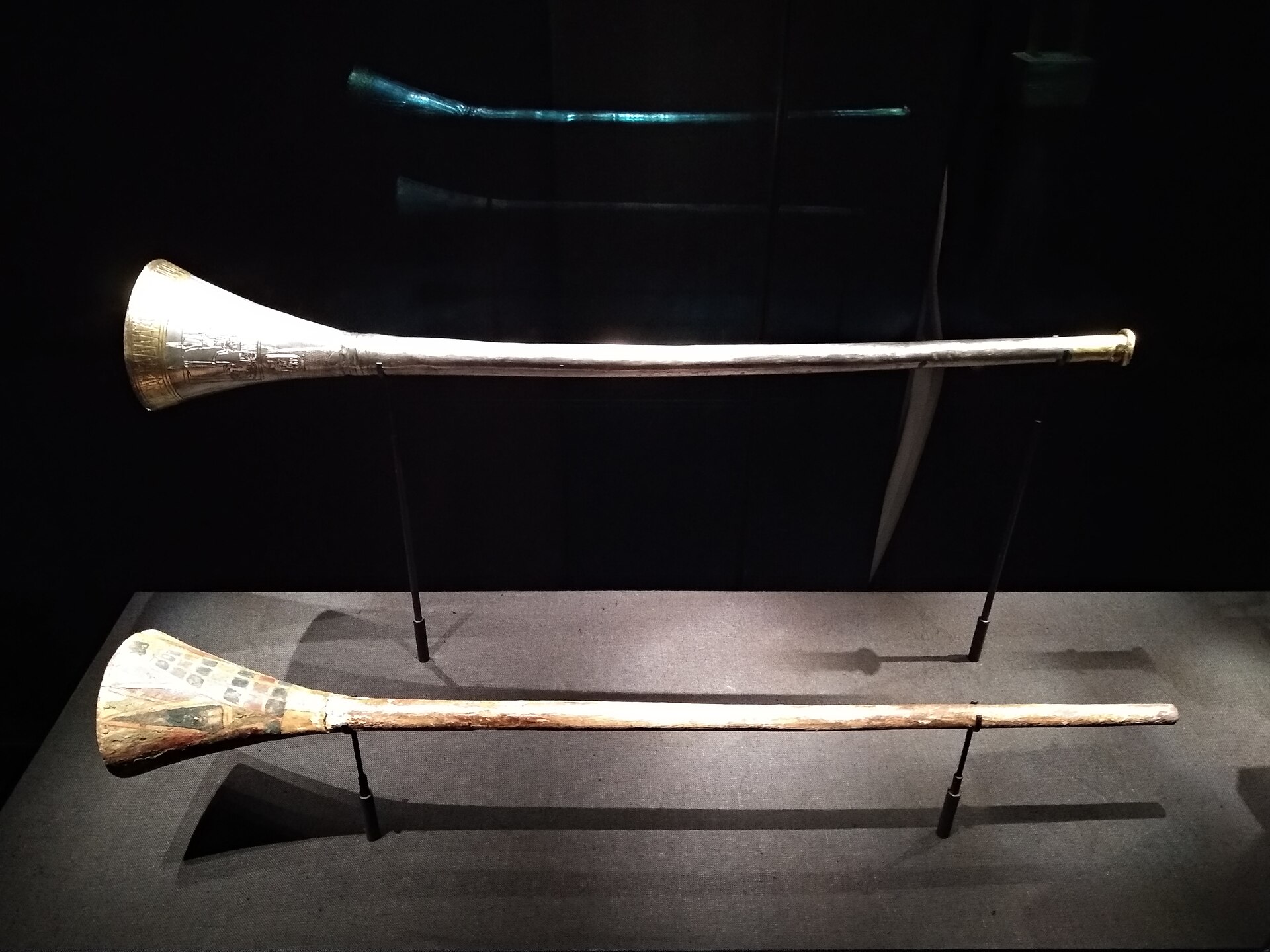
| Inscriptions | Both bells carry a decorated panel naming Tutankhamun in cartouches (his praenomen and nomen) alongside images of the gods Amun, Re-Horakhty and Ptah. On the bronze trumpet the king himself is shown joining the three gods in the register. On the silver trumpet the panel replaced, in part, an earlier engraved motif of a lotus flower (a whorl of sepals and calices), traces of which remain visible around the cartouche panel. |
| Owners on record | 4 links4 documented |
| Sources | 17 cited |
About this record Last verified · 17 sources cited · Change log
On this page 9 sections
ContentsClose
Two small straight trumpets, one silver and one bronze or copper with a gilded bell, were found in Tutankhamun's tomb in 1922-1923 and are the only trumpets to survive from ancient Egypt. On 16 April 1939 the silver trumpet was played live on BBC radio to an estimated 150 million listeners, five months before the outbreak of the Second World War, a coincidence that has followed the instruments ever since as a reported omen rather than a documented fact.
The silver trumpet cracked during rehearsal for that broadcast and was played on air only after emergency repair. A single, disputed claim by a museum curator in 2011 extended the omen story backward to 1967 and 1990, though no independent record of either playing has been found. What is documented is that the bronze trumpet was stolen during the 2011 revolution and recovered weeks later, and that conservators now regard playing either instrument again as too dangerous to the fragile 3,000-year-old metal to attempt.
Both trumpets have moved with the rest of Tutankhamun's grave goods from the Egyptian Museum in Cairo to the Grand Egyptian Museum at Giza, which opened in November 2025, where they are held in a humidity- and temperature-controlled case together with the original painted wooden cores that once lined their tubes.
Provenance
Each link is graded. Documented: a cited source supports it. Disputed: the identification is argued but not established. Unknown: no owner for that span, and the gap is not smoothed into a narrative. The grades in the glossary.
- c. 1336-1327 BC - 1922Sealed inside the tomb of Tutankhamun (KV62), Valley of the Kingsdocumented
Both trumpets were placed in the tomb at the time of Tutankhamun's burial and remained sealed and undisturbed, along with the rest of the grave goods, until Howard Carter's excavation team opened the tomb in November 1922.123
- 1922 - 1924Excavated by Howard Carter's team, on behalf of the Egyptian governmentdocumented
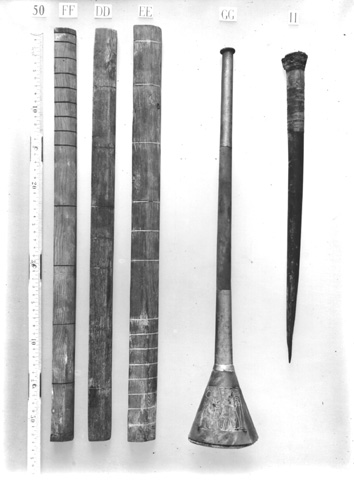
Bronze trumpet (Carter no. 050gg) found in the Antechamber in the first season, 1922-1923. Silver trumpet (Carter no. 175) found in the Burial Chamber in the second season, 1923-1924. Both were photographed in situ and in the excavation laboratory by Harry Burton and recorded on Carter's object cards, now held by the Griffith Institute, Oxford.23
- 1924 - 2025Egyptian Museum, Cairo (Egyptian state collection)documented
Both trumpets entered the Egyptian Museum on Tahrir Square as JE 62007 (silver) and JE 62008 (bronze) and remained there, with one significant interruption, until the collection began transferring to the Grand Egyptian Museum. On 28 January 2011, during the Egyptian revolution, the bronze trumpet and its wooden core were among roughly eighteen objects stolen from the Tutankhamun galleries; it was recovered some weeks later, found in a bag left at a Cairo metro station, and returned to the museum.19
- 2025 - presentGrand Egyptian Museum, Giza (Egyptian state collection)documented
Both trumpets moved to the Grand Egyptian Museum as part of the transfer of Tutankhamun's tomb assemblage to the new museum, which opened to the public in November 2025. As of the CNN report of 10 August 2026, both are held in a single climate-controlled case, together with their original wooden cores, maintained between 18 and 22 degrees Celsius.43
Technical evidence
| Attribution note | No maker's name, workshop mark or signature survives on either trumpet, which is normal for New Kingdom royal tomb goods; production is dated to the reign of Tutankhamun (c. 1336-1327 BC) by find context inside his sealed tomb, not by any inscription naming a craftsman. |
|---|---|
| Silver trumpet: catalogue numbers | Carter no. 175; Egyptian Museum Cairo JE 62007; old exhibition no. 186.2 |
| Bronze trumpet: catalogue numbers | Carter no. 050gg; Egyptian Museum Cairo JE 62008; old exhibition no. 125; Grand Egyptian Museum no. GEM 323.3 |
| Silver trumpet: findspot | Burial Chamber, on the floor in a corner between the chamber wall and the outermost of the four gilded shrines, found in the second excavation season (1923-1924).2 |
| Bronze trumpet: findspot | Antechamber, in a chest with other military-associated equipment, found in the first excavation season (1922-1923).31 |
| Dimensions | Silver trumpet 57.2 cm long; bronze trumpet approximately 49.6 cm long. Both taper from a bore of about 1.3 cm at the mouth end to a bell diameter of about 10.2 cm.1 |
| Bronze trumpet: construction | Body of rolled sheet copper alloy, 0.2-0.25 mm thick; bell of an electrum-like gold alloy, 0.1-0.13 mm thick; mouthpiece ring about 3.25 mm thick, probably also electrum.1 |
| Silver trumpet: construction | Sheet silver body with a wooden internal core; the bell's cartouche-and-deity panel appears to have been engraved over, and to have partly erased, an earlier lotus-flower motif.1517 |
| Acoustic range | Modern reproductions sound at most three natural notes without a mouthpiece: a weak low note, a usable middle tone, and a high note whose pressure risks damaging the tube; the middle tone alone is thought to have been used, in a rhythmic signalling pattern.1 |
| Wooden cores | Both trumpets retain an original painted wooden core inside the metal tube; sources differ on whether its function was structural support for the fragile metal or an acoustic mute inserted by a player.115 |
| Current display environment | Climate-controlled case at the Grand Egyptian Museum, maintained between 18 and 22 degrees Celsius, displayed together with the wooden cores.4 |
Images
The record in full
Chapter 1Two trumpets, not one
Tutankhamun's tomb produced two trumpets, and they are physically distinct objects that are routinely run together in popular retelling.
Tutankhamun's tomb produced two trumpets, and they are physically distinct objects that are routinely run together in popular retelling. One is silver, 57.2 centimetres long, catalogued by Howard Carter as object 175 and by the Egyptian Museum as JE 62007. The other is bronze or copper with a gilded bell, about 49.6 centimetres long, catalogued as Carter object 050gg and JE 62008. They were found a full excavation season apart, in different rooms of the tomb, and they are decorated differently. This record treats them together because they were excavated as a functional pair and have shared almost their entire modern history, including the 1939 broadcast that made them famous, but it keeps their separate identities distinct throughout.
Both are described in scholarship as the oldest playable metal trumpets known to survive anywhere, and the only trumpets to survive from ancient Egypt at all. That claim rests on absence of a competing find rather than on any inscription saying so, and it is treated here as the current state of the evidence, not a settled fact for all time.
Chapter 2Discovery: two seasons, two rooms
The bronze trumpet came first. Howard Carter's team found it in the first excavation season, 1922-1923, in the tomb's Antechamber, inside a chest of military-associated equipment.
The bronze trumpet came first. Howard Carter's team found it in the first excavation season, 1922-1923, in the tomb's Antechamber, inside a chest of military-associated equipment. The Griffith Institute's record of Carter's own object card lists the find location simply as the Antechamber and gives the excavation season as the first, 1922-1923.
The silver trumpet was found later, in the second season, 1923-1924, and in a very different setting: on the floor of the Burial Chamber itself, in a corner between the chamber wall and the outermost of the four gilded shrines that surrounded the king's sarcophagus. That findspot, at the heart of the tomb rather than among stored military gear, is itself a piece of evidence about how the two instruments were regarded, even though no text explains the distinction.
Both objects were photographed in the tomb and in the Cairo laboratory by Harry Burton, the excavation's official photographer, whose glass-plate negatives remain the primary visual record of the trumpets in the condition in which Carter's team first encountered them. Two of those Burton photographs, both long since in the public domain, are the lead plates for this record.
Chapter 3How the bronze trumpet was made
The bronze (or copper alloy) trumpet's slightly conical tube is a rolled sheet of copper alloy between 0.2 and 0.25 millimetres thick, a wall thickness thin enough that the instrument's survival at...
The bronze (or copper alloy) trumpet's slightly conical tube is a rolled sheet of copper alloy between 0.2 and 0.25 millimetres thick, a wall thickness thin enough that the instrument's survival at all is a small piece of luck. Its bell is not the same metal as its tube: the bell is an electrum-like gold alloy between 0.1 and 0.13 millimetres thick, and the ring at the mouthpiece end, about 3.25 millimetres thick, was probably also electrum. That is a deliberate, expensive design choice: a cheaper metal for the body of the instrument and a precious-metal bell and mouthpiece ring for the parts that would be seen and touched.
The decorated panel on the bell places Tutankhamun's cartouches beside images of Amun, Re-Horakhty and Ptah, and on this trumpet the king himself is shown joining the three gods in the register, rather than appearing only by name. Those three gods were, individually, among the most important state deities of the New Kingdom, and modern commentary connects them to the reported association of each with one of the army's major divisions, which if correct would make the decoration a compact statement of the whole New Kingdom military establishment on a single object small enough to hold in two hands. That specific reading is argued rather than inscribed; this record reports it as an argument, not as the ancient maker's stated intention.
Chapter 4How the silver trumpet was made
The silver trumpet is described in the sources consulted with less of the metallurgical precision available for the bronze instrument, but its decoration is recorded in more specific detail.
The silver trumpet is described in the sources consulted with less of the metallurgical precision available for the bronze instrument, but its decoration is recorded in more specific detail. Its bell carries the same kind of cartouche-and-deity panel as the bronze trumpet, naming Tutankhamun and showing the gods, but the panel appears to have been added over, and to have partly erased, an earlier decorative scheme: a whorl of sepals and calices forming a stylised lotus flower, traces of which are still visible flanking the later panel.
That sequence, an original lotus motif partly cut away to make room for the royal cartouche panel, is worth pausing on. It suggests either a change of decorative plan during manufacture or a re-decoration of an object that already existed in a simpler form, and no source consulted for this record explains which. It is recorded here as an open question rather than resolved either way.
Chapter 5What they were for
The instruments are short, straight, largely cylindrical trumpets with no valves and no means of altering pitch beyond the player's lips, and modern acoustic testing on reproductions, described by...
The instruments are short, straight, largely cylindrical trumpets with no valves and no means of altering pitch beyond the player's lips, and modern acoustic testing on reproductions, described by the musicologist Jeremy Montagu, found that they can produce at most three natural notes: a low note of little carrying power, a normally usable middle tone, and a top note that puts so much strain on the tube that sounding it risks destroying the instrument. Montagu's conclusion, as reported in the secondary literature surveyed for this record, is that in practice only the single middle tone was likely used, sounded in a rhythmic pattern functioning as a signalling code rather than as music in the sense of a melody.
That reading is consistent with the trumpets' military associations: their find contexts (one among a chest of martial equipment, the other in the burial chamber itself, an unusually honoured placement) and their decoration (state gods with reported army-division associations) both point toward the instrument's function as army signalling equipment that had also acquired a place among the king's most personal grave goods. Whether the trumpets were ever used for ceremonial, as opposed to strictly military, signalling in life is not established in any source consulted, and is recorded as unresolved.
Chapter 6The wooden cores, and what they were for
Both trumpets retain a wooden core inside the metal tube, and what that core was for is itself unsettled in the sources surveyed.
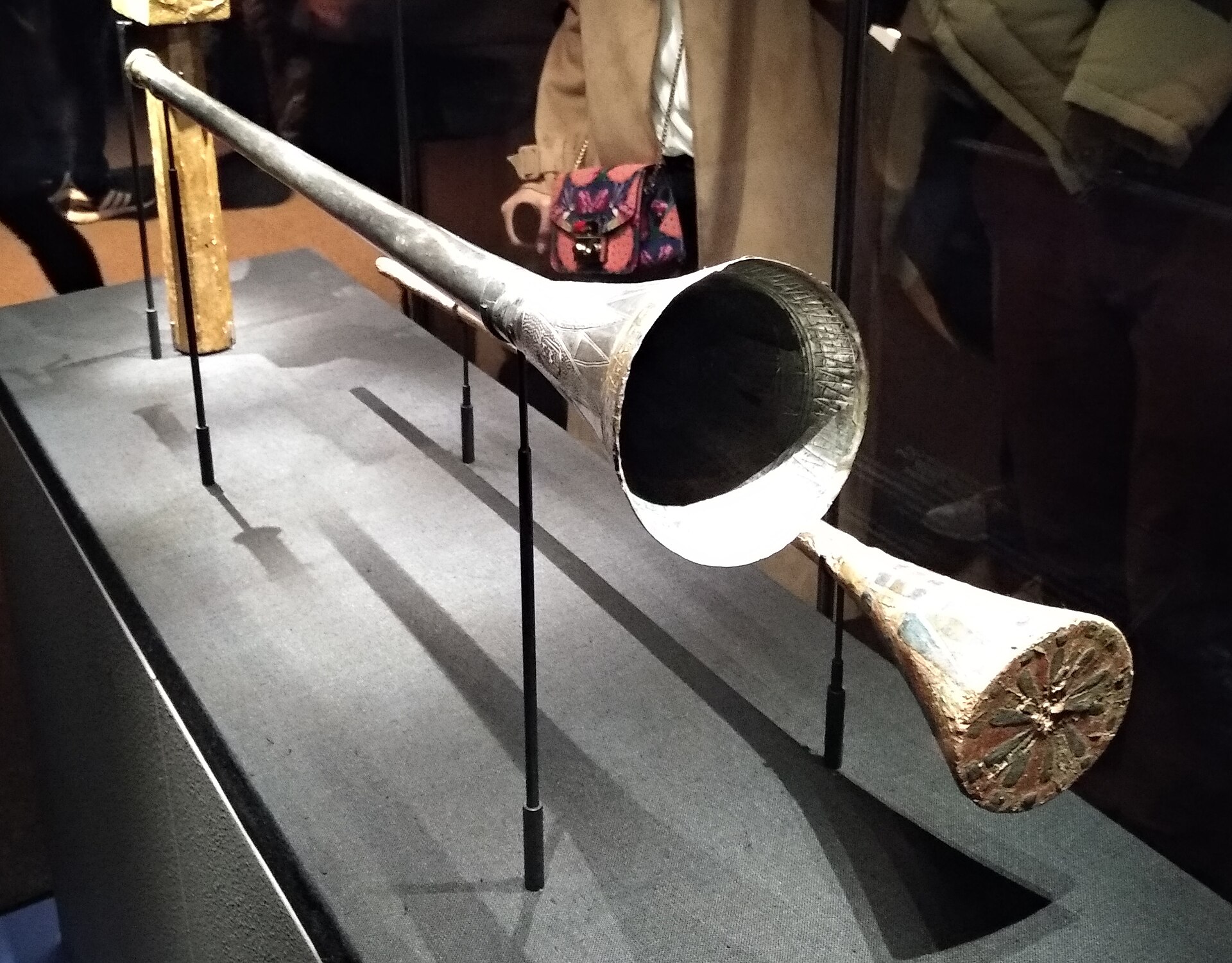
Both trumpets retain a wooden core inside the metal tube, and what that core was for is itself unsettled in the sources surveyed. One line of description treats the wood as a structural liner: internal support that helped the fragile metal tube keep its shape, whether during use, in storage during the king's life, or simply while packed away in the tomb for three thousand years. A different line of description, attached to a modern museum photograph of the silver trumpet and its core, calls the wooden piece a sourdine, a mute, and states that a player used it, painted in bright colours, to modulate the trumpet's tone while playing.
Those two explanations are not automatically compatible: a structural liner that stays in the tube at all times is a different object, functionally, from a mute a player inserts and withdraws to change the sound. This record has not found a source that reconciles them, and reports both as they were found rather than picking one. What is agreed across every source is that the wooden cores are fragile, are original to the tomb rather than modern replacements, and now travel and are displayed with their trumpets rather than separately.
Chapter 716 April 1939: the BBC broadcast
On 16 April 1939 both trumpets were played live for a BBC radio broadcast transmitted from the Egyptian Museum in Cairo, reaching, by widely repeated estimate, some 150 million listeners worldwide.
On 16 April 1939 both trumpets were played live for a BBC radio broadcast transmitted from the Egyptian Museum in Cairo, reaching, by widely repeated estimate, some 150 million listeners worldwide. The broadcast was arranged by the BBC's Rex Keating, and its best-documented modern retelling rests on Keating's own account, later given for the BBC Radio 4 documentary Ghost Music (2011).
Press accounts agree on the outline and disagree on some detail. During rehearsal, a modern brass mouthpiece, packed to fit the ancient oversized mouth end because the original mouthpiece could not be used safely, was fitted to the silver trumpet; the attempt produced, in Keating's phrase, an ear-splitting discord, and the crystallised ancient silver fractured, with one account specifying that the bell came away from the stem entirely. Alfred Lucas, the chemist who had worked on conserving finds from the tomb since Carter's original excavation, is reported in multiple accounts to have been so distressed by the damage that he required hospital treatment. Some retellings place an unnamed Hussar Regiment bandsman at the mouthpiece during this rehearsal mishap, with the trumpeter who actually performed on air, James Tappern of Prince Albert's Own 11th Royal Hussars, brought in afterward; other, shorter accounts simply attribute the whole episode to Tappern without distinguishing a rehearsal player from the broadcaster. This record has not been able to resolve that discrepancy and reports it as an open question rather than silently picking the more dramatic version.
The broadcast itself went ahead, by more than one account after a power failure forced the museum to fall back on candlelight, with a mended silver trumpet and the bronze trumpet both played by Tappern before the microphone. Reporting from 2026 records Tappern (understood in context as describing the experience, whether at the time or in later recollection drawn on by CNN's coverage) calling the moment one in which the intimacy is extraordinary, and quotes the Egyptologist Salima Ikram characterising the recording as an auditory and sensory bridge between the time of Tutankhamun and now, and suggesting that the pairing of a silver, moon-associated trumpet with a golden, sun-associated one could be read as standing for the twelve hours of day and twelve of night that make up the king's journey through the afterlife, a reading offered by a named scholar and reported here as her argument, not as an ancient text's statement.
Chapter 8The war-omen legend, and who actually said it
The idea that playing the trumpets calls up war followed directly from timing: the 1939 broadcast preceded the outbreak of the Second World War by five months, and that coincidence alone was enough...
The idea that playing the trumpets calls up war followed directly from timing: the 1939 broadcast preceded the outbreak of the Second World War by five months, and that coincidence alone was enough to attach a folk association to the instruments that has outlasted every person present at the original event. This record states plainly that no source consulted offers evidence of a causal link, only a sequence of dates, and that the claim is reported here as a belief people have held and repeated, not as an established fact.
The claim that the trumpets were sounded again in 1967, shortly before the Six-Day War, and again in 1990 or 1991, around the Gulf War, traces in the sources surveyed for this record to a single identifiable origin: a 2011 Al-Ahram Online report by the journalist Nevine El-Aref, covering the recovery of artefacts stolen from the Egyptian Museum during that year's revolution, in which Hala Hassan, curator of the Tutankhamun collection, is quoted as saying the bronze trumpet has magical powers and that whenever someone blows into it, a war occurs, and as citing the 1967 and 1990-91 instances by way of illustration, alongside a further claim that a staff member had blown into the trumpet during a documentation session shortly before the 2011 revolution itself. No source consulted for this record independently corroborates that any of the 1967 or 1990-91 playings took place, on what date, or who performed them; the claim rests entirely on one curator's account in one 2011 newspaper report. It is reported here as a curator's stated belief, attributed by name and by publication, not as a documented event.
Chapter 9The 2011 theft, which is documented
Separately from the omen legend, and considerably better documented, is the theft of the bronze trumpet during the unrest that accompanied the January 2011 revolution.
Separately from the omen legend, and considerably better documented, is the theft of the bronze trumpet during the unrest that accompanied the January 2011 revolution. Among roughly eighteen objects taken from the Tutankhamun galleries of the Egyptian Museum when rioters entered the building on 28 January 2011, the gilded bronze trumpet and its wooden core were reported missing. The trumpet was recovered some weeks later, together with other stolen pieces, found in a bag left at a Cairo metro station, and returned to the museum. This episode, unlike the war-omen claims, is corroborated across the contemporary press coverage of the 2011 museum theft consulted for this record, and it is the actual, verifiable event that the curator's 2011 comment to Al-Ahram was made in the context of discussing.
Chapter 10Why they will probably never sound again
The 1939 rehearsal damage to the silver trumpet is the earliest documented evidence that playing these instruments risks destroying them, and every account of the instruments' subsequent handling...
The 1939 rehearsal damage to the silver trumpet is the earliest documented evidence that playing these instruments risks destroying them, and every account of the instruments' subsequent handling treats that risk as settled rather than debatable. Montagu's acoustic finding that the instruments' highest natural note applies enough pressure to the tube to risk destroying it independently supports the same conclusion from a different angle: these are not modern brass instruments built to withstand repeated use, but 3,000-year-old sheet-metal objects whose structural margin was already thin when new.
Speaking in 2026, Salima Ikram put the conservation judgment plainly: in an ideal world a replica would have been made and tested first, and playing the originals in 1939 was, in her words, quite dangerous, and taught us a lesson. The Museum of World Treasures, summarising the instruments' later custodial history, reports that historians (in context, the museum's own conservators and curators) have vowed the trumpets are never to be played again, on the combined grounds of fragility and historical significance. No source consulted for this record documents a formal, published conservation policy by name, only this consistent informal consensus reported by curators and commentators; that absence of a citable written policy is recorded here as a gap, not filled with an assumption that one exists.
Chapter 11From Cairo to Giza
For most of their modern history, both trumpets were displayed in the Egyptian Museum on Tahrir Square in Cairo, the museum from which the bronze trumpet was briefly stolen in 2011.
For most of their modern history, both trumpets were displayed in the Egyptian Museum on Tahrir Square in Cairo, the museum from which the bronze trumpet was briefly stolen in 2011. The Grand Egyptian Museum at Giza, built over roughly two decades at a reported cost of more than a billion dollars, opened to the public in November 2025, and Tutankhamun's grave goods, including the trumpets, have moved there as part of the wholesale transfer of the boy king's tomb assemblage to the new site.
CNN's August 2026 report on the trumpets describes them as now held in a climate-controlled display case at the Grand Egyptian Museum, maintained between 18 and 22 degrees Celsius, a range chosen because the wooden cores inside the metal tubes, which once helped the instruments keep their shape, now complicate their preservation by responding differently to humidity and temperature than the surrounding metal. The museum's curator, Jasmien Abdalraouf, is quoted describing the security and climate measures in place. The Griffith Institute's own archival record for the bronze trumpet already lists a Grand Egyptian Museum inventory number, GEM 323, alongside its historic Cairo JE number, consistent with a completed rather than a merely planned transfer.
Chapter 12What is still unresolved
Two gaps run through every source consulted for this record.
Two gaps run through every source consulted for this record. First, no source gives a reliable, checkable account of who exactly stood at the microphone during the 1939 rehearsal mishap, whether it was Tappern himself or an unnamed predecessor whose error Tappern then had to make good on air. Second, no source offers independent verification, beyond one curator's 2011 recollection, that the trumpets were sounded at all in 1967 or 1990-91; both dates may be entirely real and simply undocumented outside that single account, or they may be later elaborations of the 1939 story attached retroactively to convenient historical dates. This record states both as open rather than guessing at an answer either way.
A third, smaller gap concerns the bronze trumpet's own early paperwork: the Griffith Institute's archival caption for Carter object 050gg reads, in full, Trumpet (called mace), which implies that Carter's team either considered or briefly used a different identification for the object before settling on trumpet. No source consulted explains that earlier label or when the identification changed, and it is recorded here rather than smoothed over.
The artist
Unknown royal metalworkers, workshop of Tutankhamun's reign
No name survives for whoever made either trumpet. That is the ordinary condition of New Kingdom royal tomb goods rather than an unusual gap: metalworkers producing objects for a king's burial did not sign their work, and nothing in the tomb's contents identifies a workshop. What can be described is the work itself: two different metal recipes used for two closely related objects, a decorative programme carried out on both bells with a variation between them, and a level of skill and material cost, in the electrum bell alone, well beyond a purely functional instrument. This dossier covers the workshop's evident practice, not an individual, because no individual is recoverable from the evidence.
Related works
| Work | Relation | Where it is |
|---|---|---|
| The Bronze Trumpet of Tutankhamun (JE 62008) Unknown royal metalworkers, workshop of Tutankhamun's reign | Companion object catalogued and excavated separately, covered fully within this same record Found a full excavation season apart from, and decorated differently to, the silver trumpet that is the primary subject of this record; treated here as a distinct object, not a duplicate finish of the same instrument. | Grand Egyptian Museum, Giza |
| Painted trumpets, Kazanlak tomb Unknown Thracian workshop | Proposed comparandum for size, bore shape and funerary function of ancient straight trumpets Known only from a fresco depicting two female trumpet players; a scholarly comparison of instrumental and performance hypotheses uses acoustic evidence from Tutankhamun's trumpets to model the Kazanlak instruments, rather than the reverse. | Kazanlak, Bulgaria (tomb fresco; no metal instrument survives) |
| The silver trumpets of the Israelite tabernacle (hatsotserot) Not applicable (textual, not a surviving object) | Proposed textual and functional comparandum for a pair of state-associated metal signalling trumpets in the wider Near East Cited by the musicologist Jeremy Montagu, who worked directly on Tutankhamun's trumpets, as a point of comparison in an article on their function; a textual rather than an archaeological parallel. | Described in the Hebrew Bible, Numbers 10; no physical example survives |
| Bronze Age lurs Unknown Nordic Bronze Age workshops | Comparandum for early metal wind instruments made without valves Long curved bronze horns of a later prehistoric tradition, cited in the specialist literature on ancient trumpets as a point of comparison for construction and acoustic limitations rather than for any direct historical connection to Egypt. | National Museum of Denmark, Copenhagen, and other Scandinavian collections |
Open questions
- Was it James Tappern himself, or an unnamed bandsman before him, who fitted the modern mouthpiece and fractured the silver trumpet during the 1939 rehearsal? Press accounts of the incident disagree.
- Did the trumpets sound again in 1967 and 1990-91, as a single 2011 curator's account to Al-Ahram claims? No independent record of either event has been found.
- What was the wooden internal core actually for: a structural liner supporting the fragile metal tube, or a mute a player inserted and withdrew to modulate tone? Sources describe both functions without reconciling them.
- Why does the Griffith Institute's own archival caption for the bronze trumpet read 'Trumpet (called mace)'? No source consulted explains the earlier identification or when it changed.
- Why was the silver trumpet's bell re-engraved with the royal cartouche-and-deity panel over a partly erased lotus motif? No source explains whether this reflects a change of plan during manufacture or a later re-decoration.
- Is the claim that each of the three deities on the bell corresponds to a specific army division a documented ancient practice or a modern scholarly inference? The sources surveyed present it as an argument, not as an inscribed fact.
Questions about this object
What is The Trumpets of Tutankhamun?
The Trumpets of Tutankhamun is a musical instrument, dated c. 1336-1327 BC. Medium: Silver trumpet: sheet silver with a wooden internal core. Bronze trumpet: rolled sheet copper alloy body with a bell of an electrum-like gold alloy, riveted at the mouthpiece ring, with a wooden internal core.
Who made The Trumpets of Tutankhamun, and is the attribution settled?
The attribution to Unknown royal metalworkers, workshop of Tutankhamun's reign is recorded here as unknown. No maker's name, workshop mark or signature survives on either trumpet, which is normal for New Kingdom royal tomb goods; production is dated to the reign of Tutankhamun (c. 1336-1327 BC) by find context inside his sealed tomb, not by any inscription naming a craftsman.
Where is The Trumpets of Tutankhamun now?
Grand Egyptian Museum, Giza. Inventory number Silver trumpet: Carter no. 175, Egyptian Museum Cairo JE 62007, old exhibition no. 186. Bronze trumpet: Carter no. 050gg, Egyptian Museum Cairo JE 62008, old exhibition no. 125, Grand Egyptian Museum inventory GEM 323.. Last confirmed 28 August 2026. Carter and JE numbers and findspots documented in the Griffith Institute's Tutankhamun Spatial Archive object records for 175 and 50.gg. Transfer to and current display at the Grand Egyptian Museum, in a climate-controlled case maintained between 18 and 22 degrees Celsius, reported by CNN Style on 10 August 2026, quoting Grand Egyptian Museum curator Jasmien Abdalraouf; the museum opened to the public in November 2025. The GEM inventory number for the bronze trumpet (GEM 323) is already recorded in the Griffith Institute's own object entry.
What is still unknown about The Trumpets of Tutankhamun?
Was it James Tappern himself, or an unnamed bandsman before him, who fitted the modern mouthpiece and fractured the silver trumpet during the 1939 rehearsal? Press accounts of the incident disagree.
Sources
- 1Wikipedia, 'Tutankhamun's trumpets'. en.wikipedia.org/wiki/...
- 2Griffith Institute, Tutankhamun Spatial Archive, object record 175 (silver trumpet): findspot, Carter number, JE number, exhibition number and excavation season, citing Howard Carter, The Tomb of Tut.ankh.Amen, vol. 2 (1927), pp. 19, 30-31, pl. ii. tutankhamun.griffith.ox.ac.uk/object-records/...
- 3Griffith Institute, Tutankhamun Spatial Archive, object record 50.gg (bronze trumpet): findspot, Carter number, JE number, exhibition number, Grand Egyptian Museum number and excavation season. tutankhamun.griffith.ox.ac.uk/object-records/...
- 4Sheena McKenzie, CNN Style (CNN Newsource), 'The Egyptian trumpets that lay silent for over 3,000 years', 10 August 2026, quoting Salima Ikram and Grand Egyptian Museum curator Jasmien Abdalraouf. ktvz.com/entertainment/...
- 5Egypt Museum, 'Trumpets of Tutankhamun'. egypt-museum.com/trumpets-of-tutankhamun
- 64barsrest.com, 'The Pharaoh's Curse? The tale of Tutankhamun's trumpets...' (2020), on James Tappern, Rex Keating and the 1939 broadcast. 4barsrest.com/articles/...
- 7Museum of World Treasures, 'The Curse of Tut's Trumpets'. worldtreasures.org/blog/...
- 8Ancient Origins, 'Instruments of Mass Destruction: Do Tutankhamun's Trumpets Really Summon War?'. ancient-origins.net/artifacts-other-artifacts/...
- 9Nevine El-Aref, Al-Ahram Online, 'Missing artifacts from the Egyptian Museum retrieved', 12 April 2011, quoting curator Hala Hassan on the trumpet's reported 'magical powers' and the 1967, 1990-91 and 2011 claims; consulted via Wikipedia's citation of this report and corroborating secondary coverage, original article not independently located for direct verification. en.wikipedia.org/wiki/...
- 10Douglas Yeo, 'The Tutankhamun trumpets', The Last Trombone (blog), 13 February 2026, with its own bibliography of Hickmann (1946), Manniche (1976), Montagu (1978, 2007), Reeves (1990), Hawass and Vannini (2007) and Wilkinson (2023), none of which were independently consulted for this record. thelasttrombone.com/2026/...
- 11worldinstruments.org, 'Tutankhamun's Trumpets: The Oldest Operational Trumpets in the World'. worldinstruments.org/instruments/...
- 12Classic FM, 'Tutankhamun's "cursed" trumpet that stirs "deadly conflict" has arrived in London', 6 November 2019, on the 2019-2020 Saatchi Gallery exhibition. classicfm.com/discover-music/...
- 13Wikimedia Commons, File:Silver trumpet from Tutankhamun's tomb.jpg, confirming Public Domain licence and Harry Burton attribution. commons.wikimedia.org/wiki/...
- 14Wikimedia Commons, File:Tutankhamun's bronze trumpet.jpg, confirming Public Domain licence and Harry Burton attribution. commons.wikimedia.org/wiki/...
- 15Wikimedia Commons, File:Trompette d'argent et sa sourdine en bois du tombeau de Toutankhamon.jpg and its companion '2.jpg', confirming CC BY-SA 4.0 licence, photographer Suaudeau, and description of the wooden core as a mute used to modulate the trumpet's sound. commons.wikimedia.org/wiki/...
- 16Academia.edu abstract, 'The painted trumpets in the Kazanlak tomb: parallels with Tutankhamun's trumpets, instrumental and performance hypotheses', consulted for the Kazanlak comparandum in related_works. academia.edu/44462174/...
- 17Margaret Maitland, 'Ghost Music: further thoughts on the trumpets of Tutankhamun', The Eloquent Peasant (blog), 2 May 2011. Maitland, an Egyptologist who worked on the BBC Radio 4 documentary Ghost Music, is the direct source for the claim that the king's figure joins the three gods on the bronze trumpet's panel only (not the silver), and that the silver trumpet's panel was engraved over a partly-erased earlier lotus-flower design; she also quotes Howard Carter's own 1927 description of the silver trumpet's decoration. eloquentpeasant.com/2011/...


Last verified · Published
Change log
28 August 2026 - Record created at the house standard: researched narrative, technical evidence, maker dossier, graded provenance chain, prices with hammer and premium separated, related works, open questions and sources.