Primeval Waters - Lessons from Mesopotamia
Musee du Louvre ·  Paris, France · 20 May 2026 to 15 Mar 2027
Mesopotamian irrigation read as the first large remaking of a landscape: canals, aqueducts, pipe systems and artificial lakes, and what followed for the land and the people on it. Richelieu room 230.
Images
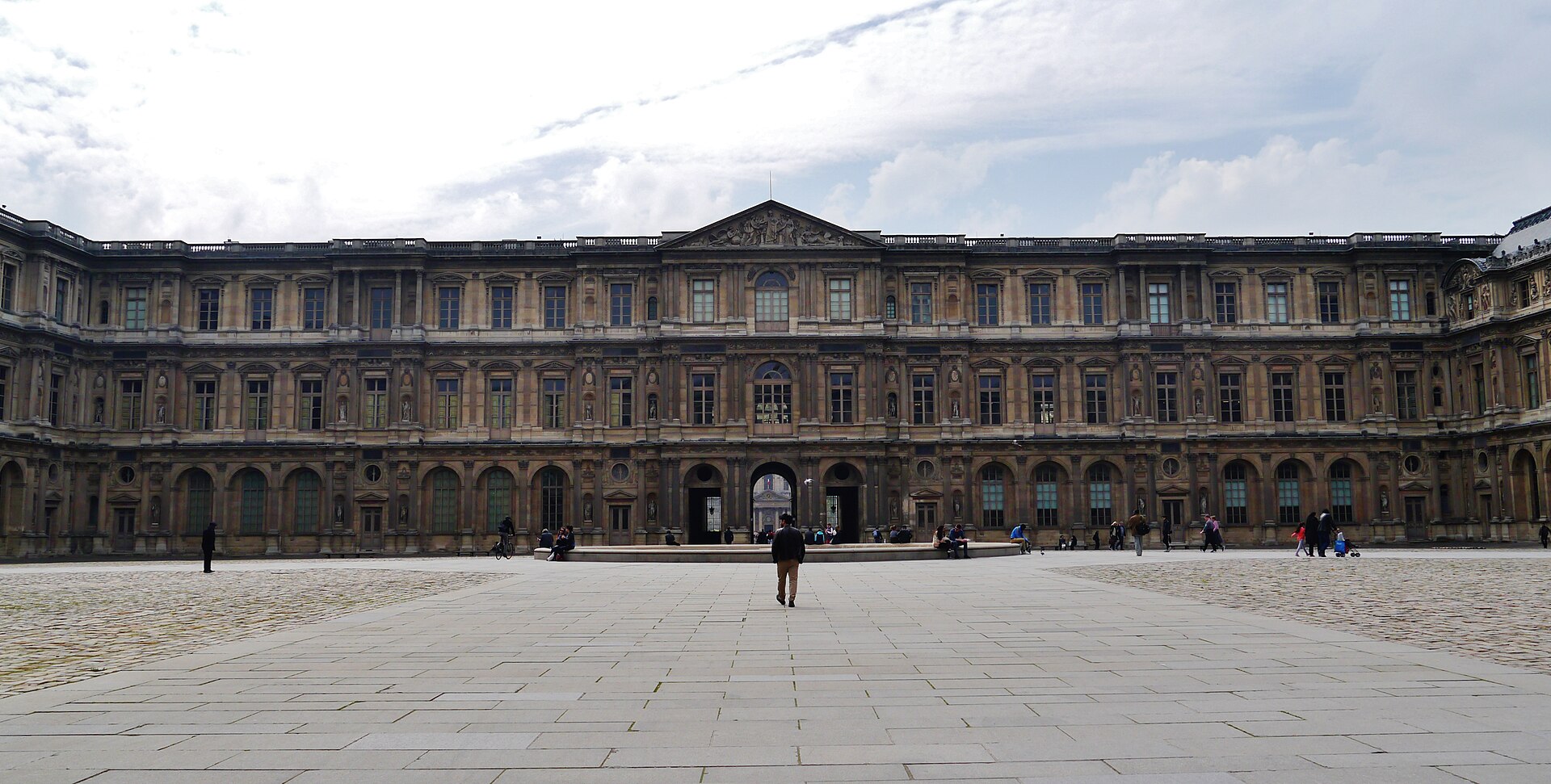 Shown: Musee du Louvre - not the exhibition
An exhibition that leaves its own room
The show is built in two parts. About a hundred Mesopotamian works are gathered in Room 230 of the Richelieu wing, and a further twenty-seven are placed out among the permanent galleries of the Department of Near Eastern Antiquities, across both the Richelieu and Sully wings, to be met in the course of an ordinary visit.
That structure is worth knowing before you go, because a visitor who sees only Room 230 has seen roughly four-fifths of the exhibition and will not know the rest exists. It is also a deliberate argument: water in Mesopotamia is not a special topic that can be quarantined in one room, and putting a quarter of the show out among the standing collection forces the point that almost everything in those galleries was made by a society organised around controlling a river.
Three claims, in three sections
The exhibition is organised under three headings: water at the heart of the divine, water at the heart of the Mesopotamian landscape, and water at the heart of power. Taken together they make a single argument in three registers - that in southern Mesopotamia the same substance was simultaneously a god, a piece of infrastructure, and an instrument of rule, and that these were not three separate facts about water but one fact seen from three sides.
The landscape section is where the archive's own interest sits. Mesopotamian irrigation - canals, aqueducts, piped systems, artificial lakes - constitutes one of the earliest large-scale remakings of a landscape by human decision anywhere, and it came with consequences that are legible in the record: salinisation, silting, the abandonment of fields, and the political consequences of controlling an upstream channel. An exhibition that treats this as the subject rather than as background to the objects is unusual.
The power section makes the connection explicit. Among the works is a relief of the naval expedition of Sargon II from Khorsabad: the state projecting itself by water. Against it, the divine section carries the Stele of Baal with Lightning from Ugarit, the storm god as the source of the water rather than its manager.
What is actually there
Everything on show comes from the Louvre's own Department of Near Eastern Antiquities; this is a collection exhibition rather than a loan show, which is why it can run for ten months. The anchor object is the Gudea statue with the gushing vase, from Tello, of the Neo-Sumerian period - a ruler holding a vessel from which water flows in two streams, which is as direct a statement of the exhibition's thesis as any object could be: the man who governs is shown as the man from whom the water comes.
Also present is a statue in human form from Ain Ghazal in Jordan, one of the earliest large human figures made anywhere, which reaches back well before Mesopotamian state formation and widens the frame beyond the river valleys.
The exhibition was assembled by Ariane Thomas, director of the Department of Near Eastern Antiquities, with Barbara Couturaud and Gregoire Nicolet, the department's Mesopotamian collection managers. The catalogue, co-published by the Louvre and Lienart and directed by Thomas with both co-curators, runs to 240 pages with 150 illustrations at EUR 35 in the French edition.
What is in the show
Room 230, and twenty-seven works outside it
About 100 Mesopotamian works in Room 230 of the Richelieu wing, with a further 27 placed among the permanent galleries of the Department of Near Eastern Antiquities across the Richelieu and Sully wings. A visitor who stays in Room 230 misses roughly a fifth of the exhibition.2
Gudea and the gushing vase
The Gudea statue with the flowing vase, from Tello, of the Neo-Sumerian period: the ruler holding a vessel from which water pours in two streams. It states the exhibition's argument in one object - the person who governs shown as the source of the water.3
Water as divinity, water as state
The Stele of Baal with Lightning from Ugarit in Syria, the storm god as the origin of rain, set against the relief of the naval expedition of King Sargon II from Khorsabad, in which the state projects its power across water. The two poles of the exhibition's three-part structure.3
Reaching back before the river states
A statue in human form from Ain Ghazal in Jordan, among the earliest large-scale human figures made anywhere, included to widen the frame beyond the Tigris and Euphrates valleys and before Mesopotamian state formation.3
Who made it
- Curated by Ariane Thomas, Director of the Department of Near Eastern Antiquities, Musee du Louvre - supervisory curator
- Curated by Barbara Couturaud, Mesopotamian collection manager, Department of Near Eastern Antiquities - co-curator
- Curated by Gregoire Nicolet, Mesopotamian collection manager, Department of Near Eastern Antiquities - co-curator
- Organised by Musee du Louvre
Tickets for this show
- Tickets
- Supplement for this exhibitionFreenone - it is included with the museum admission ticket, which also covers the permanent collections
- Museum admission, visitor from the European Economic AreaEUR 22for residents and citizens of the EEA
- Museum admission, visitor from outside the EEAEUR 32the Louvre charges a higher rate to non-EEA visitors - ten euros more for the same exhibition
- Under 18Freefree, proof of identity required
- Under 26, EEA citizen or residentFreefree with valid photographic identification; residents need a permit
- Audio guideEUR 6in nine languages
- Timed entry
- The Louvre sells timed tickets and this exhibition needs no separate booking of its own - it is on the standard ticket. Note the residency split: an EEA visitor pays EUR 22 and a non-EEA visitor EUR 32 for exactly the same access, which is unusual among the museums in this archive and is worth budgeting for.
- Hours
- Room 230 of the Richelieu wing, with further works placed through the Richelieu and Sully wings in the Department of Near Eastern Antiquities. Because the show is drawn entirely from the Louvre's own collection rather than from loans, it runs for ten months, far longer than a typical loan exhibition.
Prices and timing change. We take them from the page we used and print the day we read it: the source we used. Confirm before you travel.
What critics said
Coverage has been descriptive rather than evaluative, treating the exhibition as a well-made use of the Louvre's own Mesopotamian holdings and picking up its environmental argument about irrigation as an early large-scale remaking of a landscape.
What is praised, what is criticised
- Praised: the decision to run the exhibition partly through the permanent galleries rather than sealing it in one room, so the standing collection is re-read in the light of it
- Praised: the three-part structure, which treats water as divinity, as landscape and as an instrument of power without separating them
- Praised: the Gudea statue with the gushing vase as the anchor object, which carries the argument without needing wall text
No published criticism found
Searched the French and international art press for a published reservation about this exhibition - Le Monde, Liberation, Le Figaro, Beaux Arts Magazine, Connaissance des Arts, The Art Newspaper and Apollo were searched by name, along with the Italian and English-language coverage. Everything located was descriptive or announcement-based. As at 7 August 2026, roughly three months into a ten-month run, we found no published criticism of it.
Recorded as a gap rather than left blank: an absence of criticism is itself a fact about how a show was received, and it is only worth reading if we say where we looked.
No published review found
Searched for a review, as opposed to a listing or a news report, across the French national press, the specialist archaeology press and the English-language art press including The Art Newspaper, Apollo and Hyperallergic. What exists is announcement and photo coverage - Sortiraparis and Finestre sull'Arte both published descriptive pieces in May 2026 - but we found no critic's assessment of the exhibition. Everything on this page therefore comes from the Louvre's own materials and our own reading of them.
Everything on this page is our own research from the sources listed below, not a summary of anybody else's verdict.
Sources
- 1Musee du Louvre, exhibition page for Primeval Waters - Lessons from Mesopotamia: the run dates, Richelieu wing room 230 with trails through the Sully and Richelieu wings, the curators, and the statement that it is included with the museum admission ticket. louvre.fr/en/exhibitions-and-events/exhibitions/primeval-waters
- 2Musee du Louvre press office, Primeval Waters: the count of 100 works in Room 230 plus 27 selected works through the permanent galleries, the three sections - water at the heart of the divine, of the Mesopotamian landscape and of power - the curatorial team of Ariane Thomas with Barbara Couturaud and Gregoire Nicolet, and the catalogue from the Louvre and Lienart at 240 pages, 150 illustrations, EUR 35. presse.louvre.fr/?p=1063000236406
- 3'At the Louvre, an exhibition leads to the discovery of ancient Mesopotamia through the theme of water', Finestre sull'Arte, 13 May 2026: the named objects including the Stele of Baal with Lightning from Ugarit, the human figure from Ain Ghazal in Jordan, the relief of the naval expedition of Sargon II from Khorsabad and the Gudea statue with the gushing vase from Tello, and the account of the exhibition's themes. finestresullarte.info/en/exhibitions/at-the-louvre-an-exhibition-leads-to-the-discovery-of-ancient-mesopotamia-through-the-theme-of-water
- 4Musee du Louvre, hours and admission: the EEA and non-EEA admission rates, the free categories and the audio guide charge. Cross-checked against this archive's own venue record for the Louvre, admission last confirmed 7 August 2026. louvre.fr/en/visit/hours-admission