Musical Bodies
The Metropolitan Museum of Art ·  New York, United States · 7 Jun to 27 Sep 2026
Some 130 instruments, paintings, sculptures and drawings on the body as instrument and the instrument as body, across 4,000 years. Gallery 199. The Met's 1720 Cristofori piano is not in it and stays in Gallery 684.
Images
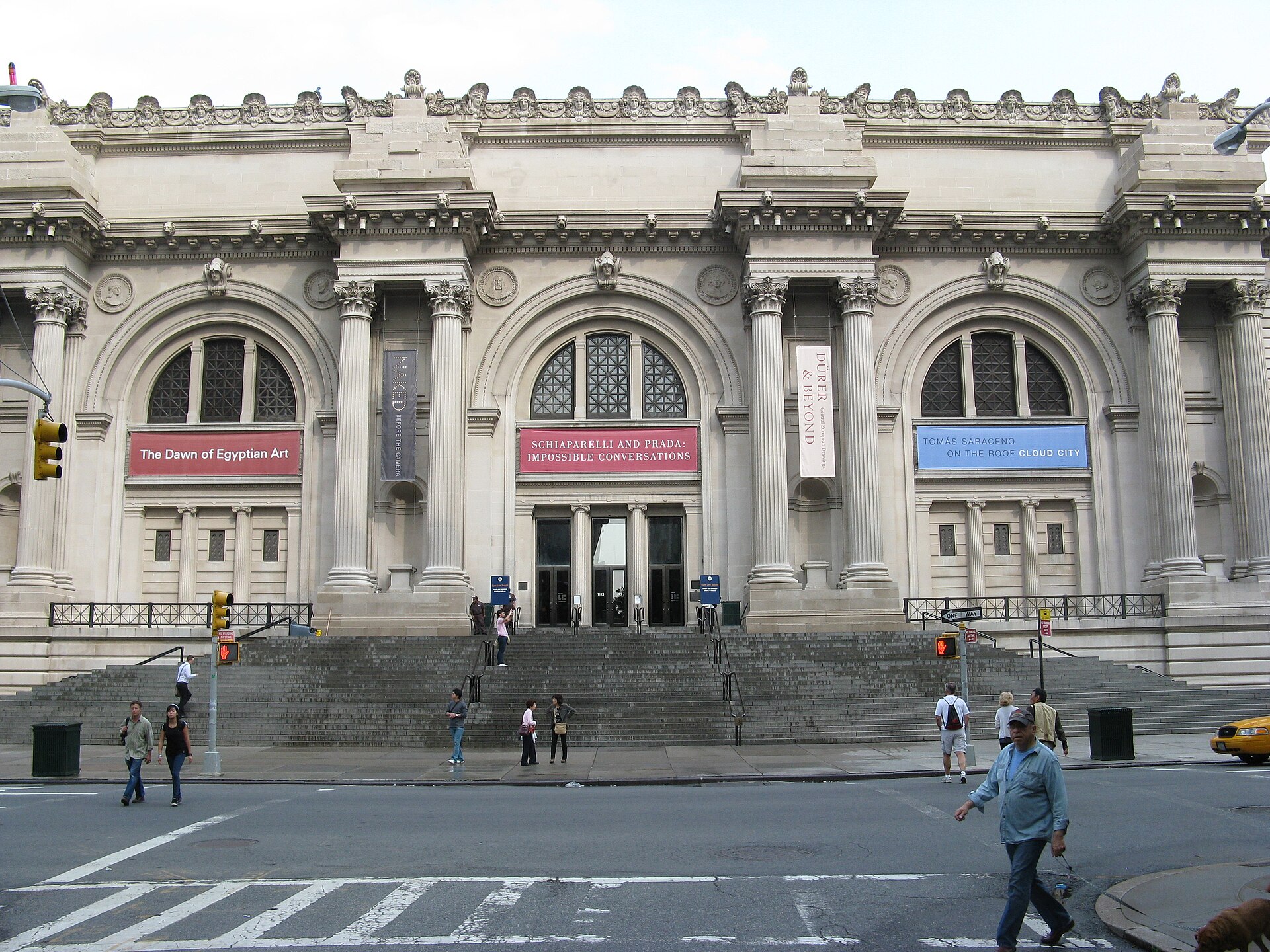 Shown: The Metropolitan Museum of Art - not the exhibition
One question, seven years
The show began as a question its curator has described as deceptively simple: why are so many musical instruments shaped and decorated like the human body? Bradley Strauchen-Scherer, a curator in the Met's Department of Musical Instruments, spent about seven years turning that into an exhibition, assisted by Ava Valentino as research assistant. The answer the show proposes is not a matter of ornament. It argues that the resemblance runs in both directions - that the body has always been used as an instrument, by clapping, tapping, whistling and beatboxing, and that instruments in turn borrow the form, the proportions and the decoration of the body that plays them.
That is a thesis a musical instruments department could have illustrated from its own storerooms alone. The Met chose not to. Objects were drawn from ten of the museum's curatorial departments, and the show's own press release makes the point that the instruments account for only about fifty of the roughly 130 works. The rest are paintings, sculpture, drawings, apparel and objects from ancient Egypt, European painting, and modern and contemporary art. The instruments are the subject; they are not the whole exhibition.
What had to be borrowed
The loans are the measure of how seriously this was taken. Instruments came from the Musee de la musique in Paris, the National Music Museum in Vermillion, South Dakota, and the Royal College of Music in London. Two objects are being shown in the United States for the first time: a rare figural lira da braccio from the Kunsthistorisches Museum in Vienna, which is among the earliest surviving bowed string instruments anywhere, and an elaborate hurdy gurdy from the Victoria and Albert Museum in London.
A first American showing for a Vienna lira da braccio is the kind of fact that does not survive into most listings, and it is the one a reader planning a journey actually needs. Neither object is a household name and neither will tour afterwards on the evidence available. For a visitor who cares about early bowed strings, this is a four-month window in one gallery on Fifth Avenue.
Sex, death, and what an instrument is allowed to say
The six thematic sections are organised around what instruments are for beyond making sound: spirituality, identity, and what the museum describes plainly as the use of instruments to stand in for the body in order to address subjects normally treated as taboo, specifically sex and death. This is the part of the show that justifies the scale of the loan list rather than a display of fine woodwork.
The objects carry the argument more bluntly than the wall text does. A steel guitar was built in the form of a crutch for the country singer Barbara Mandrell while she was recovering from a car crash - an instrument shaped by an injured body, for that body. At the other end, a guitar-shaped coffin by the Ghanaian carpenter Paa Joe, titled For A Musician, is an instrument shape made to hold a body that has stopped playing. Between those two, the claim that an instrument is a proxy for a person stops being a curatorial conceit.
An exhibition that expects you to move
Musical Bodies was built as an experiential show rather than a vitrine survey, and this is where the risk sits. There is an interactive that lets visitors generate music through ordinary movement, and large-scale projections of newly commissioned footage of beatboxing, body percussion and tap dancing by performers including the tap dancer Savion Glover, Beatbox House and the whistler Molly Lewis. Live performances and workshops run in the gallery through the four months, announced piecemeal rather than as a fixed schedule, so what a given visitor sees depends on the day they come.
One factual discrepancy is worth recording rather than smoothing over. The Met's own press release of 15 January 2026 states that the show draws on ten of its curatorial departments; the amNewYork review published on 16 June 2026, after the opening, states that it draws on all seventeen. Both cannot be right, and we have not found a later correction from the museum. We print the museum's own figure and note that a reviewer who walked the installation counted differently.
What is in the show
Earliest bowed strings, first time in the United States
A rare figural lira da braccio lent by the Kunsthistorisches Museum in Vienna, among the earliest surviving bowed string instruments, shown in the United States for the first time. A lavish hurdy gurdy from the Victoria and Albert Museum in London makes its first American appearance in the same show.2
The body dismantled and rebuilt as an instrument
Nam June Paik; Brockett Parsons and PianoArcNam June Paik's TV Cello, and the PianoArc circular keyboard designed with Brockett Parsons, keyboardist for Lady Gaga, which wraps the player rather than sitting in front of them. Both are cited by the museum as works where the boundary between body and instrument has been deliberately blurred.2
Instruments made by injury and for death
Paa JoeA steel guitar built in the form of a crutch for the country singer Barbara Mandrell during her recovery from a car crash, and a guitar-shaped coffin by the Ghanaian carpenter Paa Joe titled For A Musician. The first is an instrument shaped to an injured body; the second is an instrument shape built to contain one.3
Across the collection, not only the instrument store
Ancient Egyptian rattles, paintings by Titian and by Degas, and instrument-inspired apparel, drawn from ten curatorial departments. Just over fifty of the roughly 130 objects come from the Department of Musical Instruments itself; the majority of the show is not instruments at all.2
Popular music as material culture
One of Prince's most notable guitars, singled out by the museum, together with a Liberace suit patterned with piano keys and a Tom Ford ensemble worn by Zazie Beetz at the Met Gala, all picked out by the reviewer who walked the show in June.3
Who made it
- Curated by Bradley Strauchen-Scherer, Curator, Department of Musical Instruments, The Met - conceived and organised the exhibition
- Curated by Ava Valentino, Research Assistant, Department of Musical Instruments, The Met
- Organised by The Metropolitan Museum of Art
Tickets for this show
- Tickets
- AdultUSD 30general admission; all tickets include the exhibitions
- Senior, 65 and overUSD 22
- Visitor with a disabilityUSD 22in person only; a care partner is admitted free
- StudentUSD 17
- Child, 12 and underFreefree
- New York State residents, and students of New York, New Jersey and ConnecticutFreepay what you wish, minimum one cent; online purchase requires a New York State billing address, and New Jersey and Connecticut students must buy in person with student ID
- Members and PatronsFreefree and unlimited; membership starts at 90 USD a year
- Timed entry
- No timed entry and no advance booking required. Tickets can be bought online, which lets a visitor go straight to any gallery entrance. Groups of ten or more, and third-party guided tours of any size, must register in advance.
- Hours
- Sunday to Tuesday and Thursday 10am to 5pm, Friday and Saturday 10am to 9pm, closed Wednesdays. There is no separate charge for this exhibition: a Met ticket covers it, and covers same-day entry to both Met locations. Note that the Modern and Contemporary galleries and the Ancient West Asia and Ancient Cyprus galleries are closed for renovation, which affects what else can be seen on the same ticket.
Prices and timing change. We take them from the page we used and print the day we read it: the source we used. Confirm before you travel.
What critics said
The show opened to warm coverage that has concentrated on its range and on the interactive and performance elements rather than on the scholarship, with reviewers treating the sheer spread of four thousand years and ten departments as the achievement.
What is praised, what is criticised
- Praised: the breadth, described by one reviewer as sprawling and as a triumph, covering more than 130 objects across 4,000 years
- Praised: the decision to treat instruments as live objects rather than as static cabinet pieces, helped by the commissioned performance footage in the gallery
- Praised: specific popular-culture objects, in particular Prince's guitar, the Liberace piano-key suit and Paa Joe's guitar-shaped coffin
No published criticism found
Searched for a published reservation about this show across the New York and national art press and the specialist music press, including searches aimed at the New York Times, the Wall Street Journal, the New Yorker, Hyperallergic, ARTnews, Apollo and The Art Newspaper, alongside the local New York outlets that covered the opening. As at 7 August 2026, two months into a four-month run, everything we located was either preview coverage drawn from the museum's press release or an appreciation; we found no reviewer who published a criticism of the exhibition.
Recorded as a gap rather than left blank: an absence of criticism is itself a fact about how a show was received, and it is only worth reading if we say where we looked.
Sources
- 1The Metropolitan Museum of Art, exhibition page for Musical Bodies: run dates, Gallery 199, and the object count. metmuseum.org/exhibitions/musical-bodies
- 2The Metropolitan Museum of Art, press release, 15 January 2026: the six thematic sections, the curator and research assistant, the count of ten curatorial departments and over fifty instruments, the named loans from the Musee de la musique, the National Music Museum, the Royal College of Music, the Kunsthistorisches Museum lira da braccio and the Victoria and Albert Museum hurdy gurdy, the Barbara Mandrell crutch guitar, Nam June Paik's TV Cello, the PianoArc keyboard, the named performers in the projections, the sponsors and the catalogue. metmuseum.org/press-releases/musical-bodies
- 3Avalon Ashley Bellos, 'Musical Bodies makes The Met vibrate', amNewYork, 16 June 2026: a review of the installation, the objects singled out, and the count of seventeen curatorial departments that conflicts with the museum's own figure of ten. amny.com/new-york/manhattan/musical-bodies-makes-the-met-vibrate/
- 4The Metropolitan Museum of Art, Plan Your Visit: the admission table, the pay-what-you-wish eligibility rules, opening hours, the statement that all tickets include exhibitions, and the current gallery closures. Read 7 August 2026. metmuseum.org/plan-your-visit