Raft Cup
Zhu Bishan (attributed) · 1300s-1400s; inscribed with the yiyou year of Zhizheng (1345)
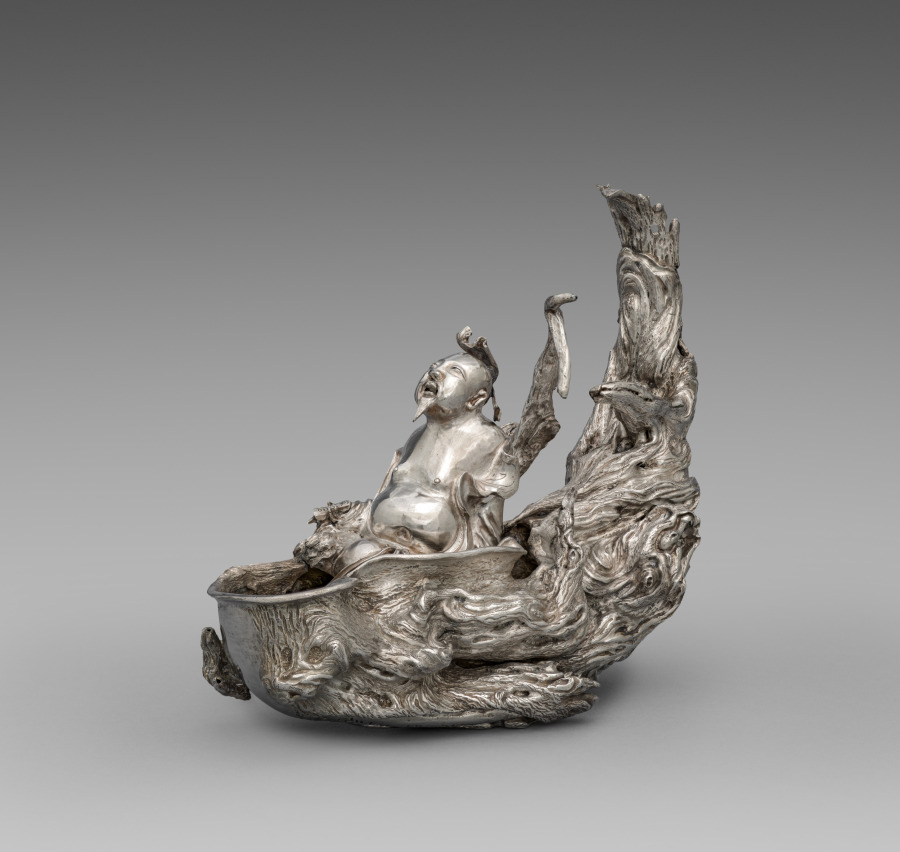
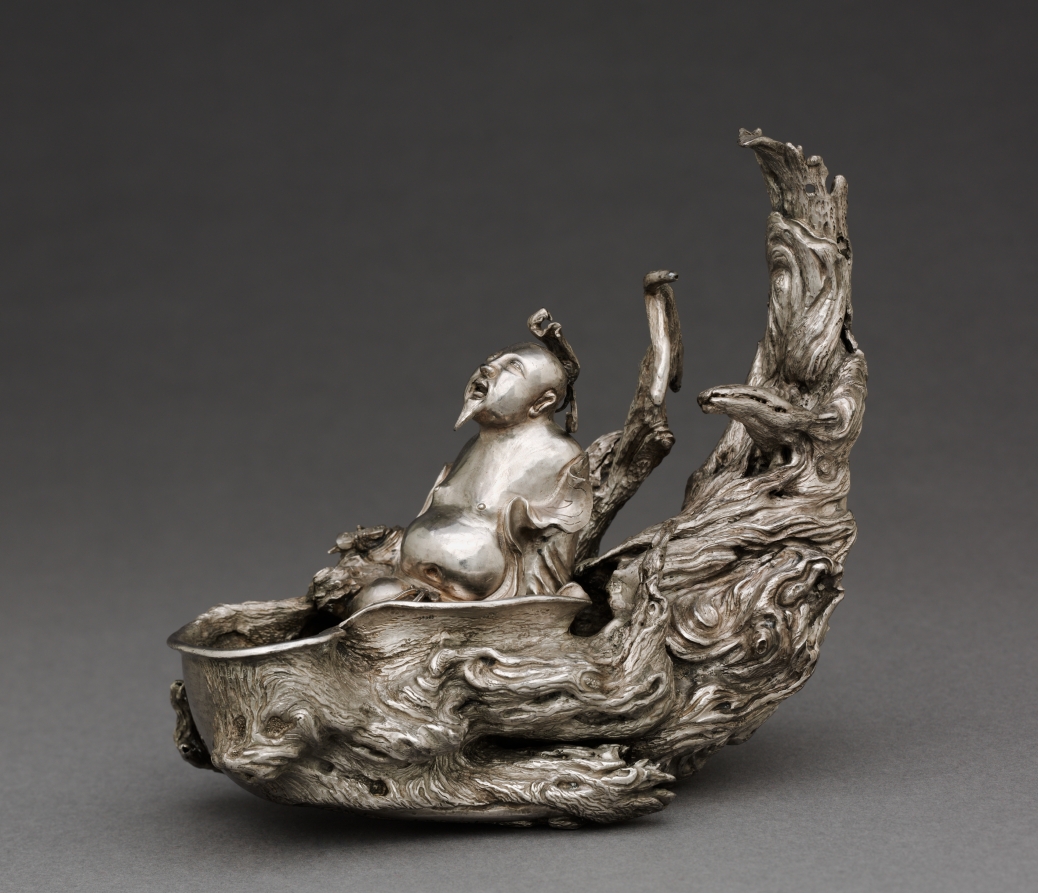
The cup in the museum's primary photograph: a hollow silver log with a laughing seated figure, a basin with a rolled lip at the front and the trunk rising to a broken tip at the back. Cleveland Open Access, CC0.
| Artist | Zhu Bishan (attributed) |
|---|---|
| Date | 1300s-1400s; inscribed with the yiyou year of Zhizheng (1345) |
| Medium | Hammered silver soldered together, with chased decoration |
| Dimensions | Overall height 16 cm (6 5/16 in.); length 20.5 cm |
| Where it is now | The Cleveland Museum of Art, gallery 240B (Chinese Decorative Arts)last confirmed |
| Inventory number | 1977.7 |
| Attribution | DisputedCleveland catalogues the cup as attributed to Zhu Bishan, with a date of the 1300s-1400s, Yuan or early Ming, though its inscription names the yiyou year of Zhizheng (1345). Full note |
| Object type | Silver |
| Period | Chinese, Yuan or early Ming |
| Cases | Disputed attribution · Has a provenance gap |
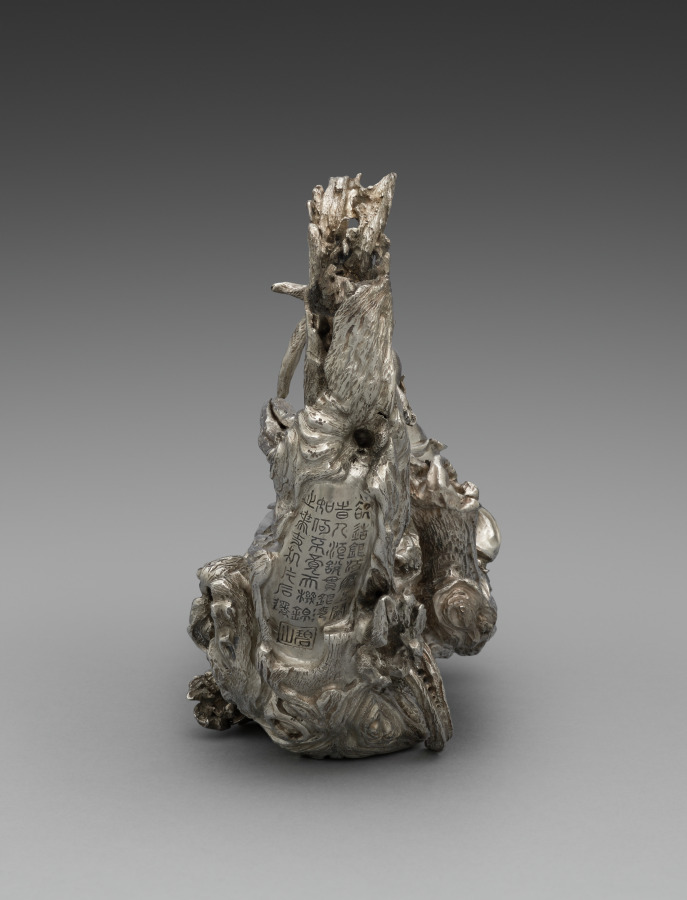
| Inscriptions | Signature Bishan and the yiyou year (1345); a seal-script poem on the log, rendered by Cleveland as: Raft cup, made in the yiyou year of Zhizheng [1345]. Whoso wishes to reach the Milky Way is obstructed by the sky; once there was a man, restless and valiant, who penetrated into the silver sea. Alas, why did he not seek for some embroidery from the celestial loom? He only brought back in his arms a slab of stone used to prop up the loom. The figure holds a slab inscribed loom stone. |
| Owners on record | 10 links4 documented, 4 disputed, 2 unknown |
| Sources | 13 cited |
About this record Last verified · 13 sources cited · Change log
On this page 9 sections
ContentsClose
A hollow silver log 16 cm high with a laughing figure seated in it, signed with the seal-like mark Bishan and dated in the yiyou year of Zhizheng (1345), the cup shows the traveller who floated to the Milky Way and came home with a loom stone. Cleveland attributes it to the silversmith Zhu Bishan and dates it Yuan or early Ming, a hedge that matches a live argument: later copies and a family workshop are possible, and no test settled the date.
The chain is part documented and part contested. Cleveland lists the Qianlong palace, General Sir Robert Biddulph, Sir Percival David and Lady David, and a Sotheby's sale of 14 December 1976, lot 224, bought with the John L. Severance Fund. The Yuanmingyuan looting, the identification with a cup shown at a banquet in the 1660s and the price paid are not documented in anything read.
Provenance
Each link is graded. Documented: a cited source supports it. Disputed: the identification is argued but not established. Unknown: no owner for that span, and the gap is not smoothed into a narrative. The grades in the glossary.
- 1345 (inscribed) - ?Zhu Bishan (attributed), workshop in the Lake Tai or Suzhou areadisputed
The cup names the yiyou year of Zhizheng (1345) and a Bishan signature. Cleveland nevertheless dates it 1300s-1400s, Yuan or early Ming, and attributes it to Zhu; a Chinese article suspects a later copy. Date and hand are not fixed by any test seen.127
- c. 1345 - 1660s?Unknownunknown
- late 1660s or early 1670s - 1676 at latestSun Chengze (1593-1676), retired official and collector (identification conditional)disputed
Eberhard says the cup was likely the vessel Zhu Yizun and Li Liangnian saw at Sun's banquet, then phrases it as conditional on the vessel and the Cleveland cup being one. Another Chinese article says it cannot confirm that and names Gao Shiqi (Kangxi period) as an earlier owner. Neither is documented in the sources read.37
- 1766? - 1860?Palace Collection of the Qianlong Emperor, Beijingdisputed
Cleveland's first provenance line, undated and uncited. Eberhard says the cup entered the Qing court collection in 1766 without a document in the pages read.23
- 1860 or 1861 - at least 1915General Sir Robert Biddulph (1835-1918)disputed
Dates are Cleveland's. Eberhard says the cup was likely looted from the Yuanmingyuan in 1860 and acquired by Biddulph at auction; a 2018 Chinese article says a general took it out of China. The route is unresolved.23812
- 1915 or later - by 1935Unknownunknown
Nothing records how the cup passed from Biddulph to Sir Percival David.2
- by 1935 - 1964Sir Percival David (1892-1964), Londondocumented
Cleveland's third line, by descent to his wife. The cup was in the International Exhibition of Chinese Art, London, 1935-36, no. 1034 per the museum's list; that catalogue was not seen.211
- 1964 - 1976?Lady Sheila Jane Yorke Hardy David (b. 1914), Londondocumented
Cleveland's line; the end date carries a query in the museum's data.2
- 14 December 1976 - 1977Sotheby's, London, lot 224documented
Sale Early Chinese Ceramics; Sung, Ming and Ch'ing Wares; Lacquer; Works of Art, sold to the Cleveland Museum of Art. No price was found.2
- 1977 - presentThe Cleveland Museum of Artdocumented
Technical evidence
| Attribution note | Cleveland catalogues the cup as attributed to Zhu Bishan, with a date of the 1300s-1400s, Yuan or early Ming, though its inscription names the yiyou year of Zhizheng (1345). A Chinese-language article suspects a late Ming or early Qing imitation, the Taipei museum leaves the maker of its own cup open between Zhu and another smith in his manner, and Eberhard notes that a family workshop may have stamped his name into the Ming. No examination that fixes the date was readable. |
|---|---|
| Object | Raft Cup; Cleveland Museum of Art 1977.7; John L. Severance Fund; accessioned 23 February 197712 |
| Attribution and date | Attributed to Zhu Bishan; museum date 1300s-1400s; culture China, Yuan (1271-1368) or early Ming (1368-1644); inscription names the yiyou year of Zhizheng (1345)12 |
| Technique | Hammered silver soldered together, with chased decoration; formed from small pieces of sheet silver, seams disguised by chasing12 |
| Dimensions | Overall height 16 cm (6 5/16 in.); length 20.5 cm in the museum's dimension field2 |
| Composition | XRF analysis 1999: 98.4 percent silver, 1.1 percent copper, 0.2 percent gold, 0.04 percent lead by weight2 |
| Separately cast parts | Sash at the figure's waist and the lock of hair, attached with small tangs through openings in the silver (examination of 1994)2 |
| Surface | Protected by a cellulose nitrate lacquer2 |
| Inscriptions | Signature Bishan with the yiyou year (1345); a seal-script poem on the log; a tablet in the figure's hand reading loom stone23 |
| Subject | Seated bare-chested figure in a hollow log; museum's reading: Zhang Qian (died 114 BCE) and the Milky Way raft legend123 |
| Function | Wine cup, filled through the hole in the upturned tip and drunk from the rolled lip, per Cleveland and its AMICO record16 |
| Alternate titles | Raft Cup (title in the original language rendered in Chinese characters in the museum data); Raft-Cup with Taoist Immortal2 |
| Location | Gallery 240B, Chinese Decorative Arts; legal status accessioned; not on loan12 |
| Licence | Images and data CC0 (Cleveland Open Access); 3D model published2 |
Images
The record in full
Chapter 1A silver log 16 centimetres high with a laughing man in it
The Cleveland Museum of Art catalogues this as the Raft Cup, accession 1977.7, hammered silver soldered together with chased decoration, attributed to Zhu Bishan and dated 1300s to 1400s, Yuan...
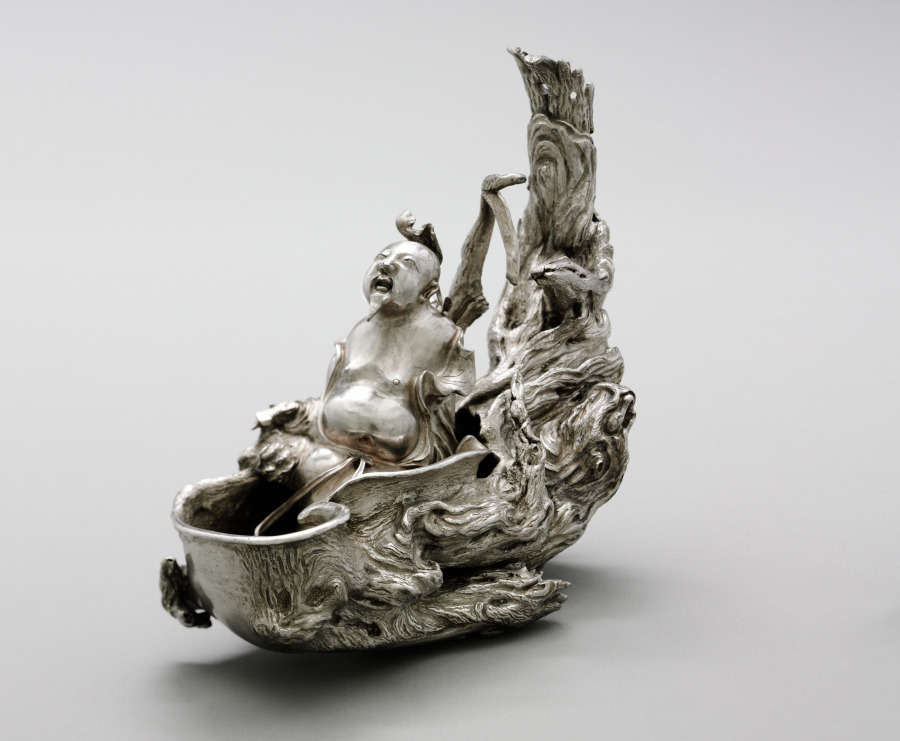
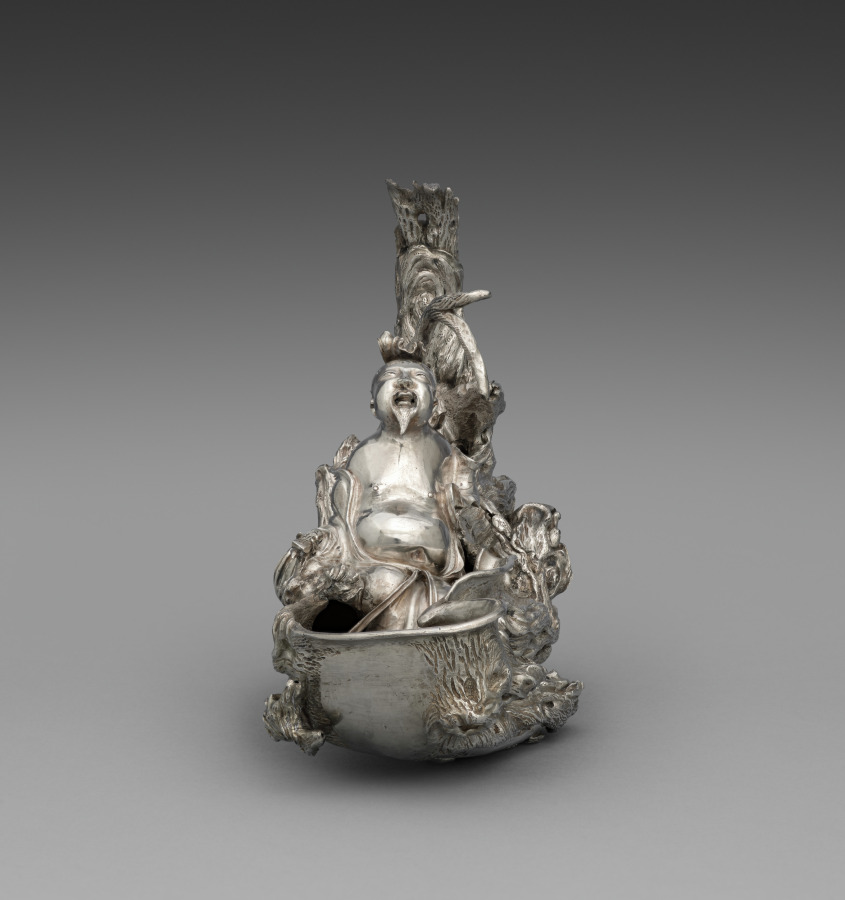
The Cleveland Museum of Art catalogues this as the Raft Cup, accession 1977.7, hammered silver soldered together with chased decoration, attributed to Zhu Bishan and dated 1300s to 1400s, Yuan (1271-1368) or early Ming (1368-1644). Its overall height is 16 cm and the museum's dimension field gives a length of 20.5 cm. It is shaped as a hollow, gnarled log. A bare-chested man with an upturned face and open mouth sits in it, and the museum's text says he holds a slab inscribed with the words for loom stone.
The Cleveland museum's own description reads the figure as the envoy Zhang Qian (died 114 BCE) watching the stars. The photographs show a basin with a rolled lip at the front, the figure seated behind it, and the trunk rising at the back in a curved, broken tip with a small animal clinging to it. A record of the object that Cleveland supplied to the AMICO consortium says the cup is filled through a hole in the upturned tip and drunk from the rolled lip in front of the man.
Chapter 2How it was made, and what the metal is
Cleveland's conservation statement says the cup is largely formed from small pieces of sheet silver, hammered into shape and joined with solder, and that the surfaces were then chased to create much...
Cleveland's conservation statement says the cup is largely formed from small pieces of sheet silver, hammered into shape and joined with solder, and that the surfaces were then chased to create much of the decoration and to disguise the seams. An examination in 1994 found that the sash at the figure's waist and the lock of hair are separately cast pieces attached with small tangs inserted through openings in the silver. X-ray fluorescence analysis in 1999 gave the composition as 98.4 percent silver, 1.1 percent copper, 0.2 percent gold and 0.04 percent lead by weight. The silver is protected by a cellulose nitrate lacquer to reduce silver oxidation products.
A technical note on the cup by Bruce Christman appeared in the museum's Bulletin in December 1994 (pp. 402-407), but its text could not be read for this record, so nothing here goes beyond the museum's own summary. The museum's phrase hammered and soldered also marks a difference from the Chinese-language descriptions of other raft cups, which speak of casting; no source consulted compares the construction of the cups directly.
Chapter 3What the cup says about itself
The Cleveland data records two groups of inscription.
The Cleveland data records two groups of inscription. The first is a signature of two characters, Bishan, and a date in the yiyou year, which the museum gives as 1345. The second is a poem in seal script style (zhuanshu) that the museum renders: Raft cup, made in the yiyou year of Zhizheng [1345]. Whoso wishes to reach the Milky Way is obstructed by the sky; once there was a man, restless and valiant, who penetrated into the silver sea. Alas, why did he not seek for some embroidery from the celestial loom? He only brought back in his arms a slab of stone used to prop up the loom.
A second translation, in Susan Eberhard's 2023 Berkeley dissertation after J. Keith Wilson's 1994 Bulletin article, lists three short inscriptions (raft cup; Made by Zhu Huayu; the yiyou year of Zhizheng) beside a seal-like mark and a seven-character quatrain. It reads the quatrain as wishing to visit the Milky Way but finding the early crescent moon in the way, people talking in vain about crossing the Silver Bay, and the traveller returning home with only the slab of the loom-supporting stone and no brocade of the celestial maid. The two renderings agree on the shape of the joke: a man reaches the sky river and comes home with a stone instead of silk.
The date is the reign period Zhizheng, year yiyou, which corresponds to 1345. The cup's own text therefore names a year; whether that makes the cup a work of 1345 is a separate question treated below.
Chapter 4The traveller: a raft to the Milky Way
The subject belongs to a story with more than one form.
The subject belongs to a story with more than one form. In the version Eberhard attributes to Wilson, who read the poems on the cup, the figure is the traveller of the Bowuzhi of Zhang Hua (232-300 CE) who floated down a river on a log raft, met a weaving maid and a herdsman, was given the maid's shuttle and was told to show it to an astrologer, who then understood that the man had been a wandering star between Vega and Altair. The cup's own poem and its loom-stone tablet follow that pattern. Zhu Yizun's poem on a raft cup, which Eberhard reads as the poem of the banquet described below, named the traveller as the Han envoy Zhang Qian, and Eberhard adds that raft cups in other media had been linked with Zhang Qian since at least the Tang period.
Zhang Qian was sent by the Han emperor in 138 BCE to seek an alliance with the Yuezhi against the Xiongnu; he was held captive about thirteen years and returned in 125 BCE. None of that is on the cup. The merging of the envoy with the raft traveller is a later literary habit, and Cleveland words its own identification as belief: the figure is believed to be Zhang Qian.
What the figure meant to the man who bought or drank from it is a matter of argument and the record grades it that way. Daoist immortals were said to seek the Milky Way at the source of the Yellow River; a plying immortal is one reading (argued, in Howard Rogers's Circa 1492 entry as cited by Eberhard). The AMICO record of the cup suggests the escapism of the tale was likely to appeal to educated gentry shut out of office under Mongol rule (a suggestion by that record, not documented intention). Eberhard adds that scholars have proposed the figure was developed with Daoists and scholars at the Yuan court, and that Zhang Qian may have had special resonance for the Mongols (speculative, per Rogers). Nothing consulted says who commissioned the cup or what it was for beyond drinking wine.
Chapter 5A cup or a sculpture
Cleveland's visitor note says the traditional understanding of the vessel's function is that it was supposed to hold wine.
Cleveland's visitor note says the traditional understanding of the vessel's function is that it was supposed to hold wine. The AMICO record gives the working: filled through the hole in the upturned tip, drunk from the rolled lip. Eberhard says raft cups are based on horn cups for sipping wine and that Zhu's form takes the shape of a gnarled and broken tree trunk with a bare-chested man sitting inside.
The object works best as a sculpture that can be used as a cup. The surface of the trunk is deeply contoured with ridges and graining, and the figure is smooth and glossy against it; Eberhard describes the contrast in just those terms. Its small size, 16 cm high, suggests an object handled and passed at a table, which matches the one fully documented use of a raft cup in the sources, the banquet described below.
Chapter 6Zhu Bishan: a named silversmith and a trademark
Cleveland states that Zhu Bishan came from Zhejiang province and ran a workshop in the Lake Tai area near Suzhou, that he is one of the few Chinese silversmiths known by name, and that his silverware...
Cleveland states that Zhu Bishan came from Zhejiang province and ran a workshop in the Lake Tai area near Suzhou, that he is one of the few Chinese silversmiths known by name, and that his silverware was so desirable that competitors and followers used his name like a trademark. The AMICO record says he was born in Weitang, moved to Suzhou, studied silversmithing and opened a shop at Mudu near Lake Tai. A Taipei museum text calls him a silversmith of Jiaxing. Eberhard writes that he was born in Jiaxing and moved to Suzhou, and that his first recorded commission is dated 1328 or 1329.
The earliest written record Eberhard cites is by Tao Zongyi (c. 1316-c. 1402), who lists Zhu as a craftsman with a reputation in silverwork beside two brothers, Xie Junyu and Xie Junhe. Eberhard, following Craig Clunas, notes that later Ming writers repeat the same few names and that Zhu is the only silversmith who gets connoisseurship at all. She also observes that the mark Bishan on the Cleveland cup takes the form of a painter's or collector's seal, and that so far as she knows Zhu is the only Chinese silversmith with an authorial seal on his work. The signature Huayu is a courtesy name per a Chinese-language article; the cup's inscriptions name Zhu Huayu.
The same sources are the reason for care. A name that worked as a brand for centuries means that a cup bearing it was not necessarily made by the man in the year it says.
Chapter 7The other raft cups, and why none of them is this one
No fact in this record is taken from another cup.
No fact in this record is taken from another cup. The sources do not agree even on how many Zhu Bishan raft cups survive. A 2025 Chinese news article counts four: one in the Palace Museum in Beijing, one in the Palace Museum in Taipei, one in the Wuzhong Museum in Suzhou (excavated from a Ming tomb in Wu County) and the Cleveland cup. Eberhard counts three extant, a fourth known only from a woodcut and a fifth recorded as lost in the later seventeenth century, and says the extant examples are all slightly different. The AMICO record says only two other works by Zhu are known, both once in the Qianlong emperor's collection.
The Taipei cup is catalogued as a silver raft cup of Zhang Qian riding a raft with the mark of Zhu Bishan, 23.6 cm long, 11.6 cm wide and 14.8 cm high (a second Chinese article gives 15.2 by 19.8 cm; the figures differ). Its stone is inscribed with two seal-script characters for loom weight, its underside carries Bishan zi and a 1345 date, and the museum says it may be by Zhu Bishan or another smith skilled in his chiselling. A cup in Beijing is described as inscribed Dragon Raft with a poem by Du Ben and a stern inscription naming Zhu Bishan, year Zhizheng yiyou, seal Huayu; the Baidu page that gives these details contradicts itself about where the cup is, and it is cited only for the inscription wording. Several of these cups carry the same year. A shared year is a fact about a type, not about 1977.7.
Nothing was found for a Zhu Bishan raft cup in Nanjing, Shanghai or the Freer and Sackler galleries, and none is named here.
Chapter 8Is it really 1345? The dispute over date and hand
The inscription says 1345 and the museum nevertheless dates the cup 1300s to 1400s and calls it Yuan or early Ming, attributed to Zhu Bishan, with life dates c.
The inscription says 1345 and the museum nevertheless dates the cup 1300s to 1400s and calls it Yuan or early Ming, attributed to Zhu Bishan, with life dates c. 1300 to after 1362. The wording is the museum's hedge, and its page does not state its reasons.
Other readers go further. The 2025 Chinese article suspects the Cleveland cup of being a late Ming or early Qing imitation because its exaggerated tree form resembles Ming-Qing literati painting, and it also floats that the Suzhou cup is a Qianlong-era copy; the article is journalism and cites no examination. The Taipei museum applies the same caution to its own cup, saying it may be by Zhu Bishan or by another smith skilled in his chiselling, and records that a Qing replica of a Zhu Bishan cup was made around 1766 at the court. Eberhard says it is possible that Zhu's family was producing wares stamped with his name into the Ming period. Wilson's 1994 Bulletin article, cited by the museum for the cup, was not readable here, so this record cannot say what the curator himself concluded about date.
Positions: Cleveland holds a Yuan or early Ming date with an attribution to Zhu; a Chinese-language article holds a late Ming or early Qing suspicion; the Taipei museum holds an open attribution for its own cup; Eberhard holds the possibility of a family workshop. None of them reports a test that fixes the date of this cup. The record does not arbitrate.
Chapter 9A banquet in the 1660s: the cup in the seventeenth century
Eberhard opens her chapter on silver with a scene from the late 1660s or early 1670s.
Eberhard opens her chapter on silver with a scene from the late 1660s or early 1670s. The poet Zhu Yizun (1629-1709) saw a remarkable silver vessel at a banquet given by the retired official and collector Sun Chengze (1593-1676): a gnarled and broken tree trunk with a bare-chested man sitting in it. Eberhard writes that the guests identified its maker as Zhu Bishan from several carved inscriptions. She cites Zhu's poem Zhu Bishan yincha ge from his collected works and a poem by Li Liangnian on the same vessel.
In her note the cup is now at the Cleveland Museum, and she says it was likely the same one. She later phrases the identification as a conditional: if Sun's vessel and the Cleveland cup are one and the same. Her note adds that Liu Yue (Forbidden City, 2007) wrote that Sun owned two silver raft cups. Another Chinese article reads the same poem and says it describes figures that differ from the Beijing and Taipei cups, so that it cannot confirm whether the poem describes the Cleveland cup or another one. The identification is therefore argued by one scholar with a caveat and not documented.
The poems also supply a history of survival. Zhu Yizun wrote that the vessel had been among the loot of the Li Zicheng rebels in 1644 and had been thrown away by a road; Li Liangnian wrote that its Yuan history had been handed down. These are the poets' accounts and are not independent evidence of ownership.
Chapter 10Court, loot and a general: the chain before 1935
Cleveland's provenance lists first the Palace Collection of the Qianlong Emperor, Beijing, undated and without a citation.
Cleveland's provenance lists first the Palace Collection of the Qianlong Emperor, Beijing, undated and without a citation. Eberhard says the cup entered the Qing court collection in 1766, but she gives no document for the year in the pages read. The Taipei museum's own text separately records a Qing court replica of around 1766, and that coincidence of year is noted here only so that the two are not confused.
The next link is the general Sir Robert Biddulph (1835-1918), recorded by Cleveland as owner from 1860 or 1861 to at least 1915. Wikipedia gives his career as Royal Artillery from 1853, the Crimean War, the Indian Mutiny, Cyprus in 1879, Quartermaster-General in 1893 and Governor of Gibraltar from 1893 to 1900, and says nothing of China or collecting. How the cup left the palace is the contested part. Eberhard says it was likely looted from the Yuanmingyuan during the war of 1860 and acquired by Biddulph at auction. A 2018 Chinese article says it was kept in the Yuanmingyuan and a general Bidoff took it abroad. A 2025 article adds that it belonged to Gao Shiqi in the Kangxi period before the palace. These accounts differ on whether he took it or bought it and on the earlier owner.
No document consulted shows an auction, a looting inventory or a letter. R. L. Hobson published a note titled A Silver Cup of the Yuan Dynasty in The Burlington Magazine in December 1912, which Cleveland's bibliography lists as a mention, but its text could not be read, and the reasons it was published under that title are not known here.
Chapter 11The David collection and the sale of 1976
After Biddulph the chain goes quiet. The museum names Sir Percival David (1892-1964), London, as owner from by 1935 until 1964, and then by descent to his wife Lady David until 1976 (marked with a...
After Biddulph the chain goes quiet. The museum names Sir Percival David (1892-1964), London, as owner from by 1935 until 1964, and then by descent to his wife Lady David until 1976 (marked with a query). Between Biddulph's death in 1918 and 1935 no owner is recorded; the Burlington Fine Arts Club exhibition of 1915 and the Royal Academy exhibition of 1935-36 (catalogue 1034) both appear in the museum's list, so the cup was publicly exhibited at either end of that gap.
Percival David is described by Wikipedia as a Bombay-born financier and scholar who began collecting Chinese art in about 1913 and helped organise the 1935 Royal Academy exhibition. His ceramics went to the University of London in 1950 and are now on loan to the British Museum. Cleveland's chain does not place this cup in that foundation but with the family, which is why it was on the market in 1976.
The cup was sold at Sotheby's, London, on 14 December 1976, lot 224, in the sale Early Chinese Ceramics; Sung, Ming and Ch'ing Wares; Lacquer; Works of Art, to the Cleveland Museum of Art. The price, the estimate, the underbidder and the buyer's premium are not in any source consulted, so no hammer or premium is given and the auction results are left empty. The Cleveland museum accessioned it on 23 February 1977 from the John L. Severance Fund, which means it was bought, not given, and no tax relief is involved on the face of the record. Whether a UK export licence was applied for is not recorded.
Chapter 12Where it has been shown, and what is written about it
The Cleveland data lists these exhibitions: Burlington Fine Arts Club, London, 1915; the International Exhibition of Chinese Art, Royal Academy, London, 28 November 1935 to 7 March 1936; La...
The Cleveland data lists these exhibitions: Burlington Fine Arts Club, London, 1915; the International Exhibition of Chinese Art, Royal Academy, London, 28 November 1935 to 7 March 1936; La Decouverte de l'Asie, Musee Cernuschi, Paris, 1954; and at Cleveland, Year in Review 1977; Realm of the Immortals: Daoism in the Arts of China, 10 February to 10 April 1988; All That Glitters: Great Silver Vessels in Cleveland's Collection, 23 November 1994 to 8 January 1995; Streams and Mountains Without End, 27 June to 23 August 2009; Power and Possession: Chinese Calligraphy and Inscribed Objects, 13 August 2018 to 3 February 2019; and China's Southern Paradise: Treasures from the Lower Yangzi Delta, 10 September 2023 to 7 January 2024.
The bibliography the museum lists runs from Hobson (1912) and the 1915 club catalogue through Cheng Chen-to's Chinese article on the dragon rafts (1960), Lee and Ho's Chinese Art Under the Mongols (Cleveland, 1968, no. 37), Wilson's Bulletin article of 1994 (pp. 380-401) and the 2023 exhibition catalogue (nos. 142, pp. 300-301). The two 1994 Bulletin articles by Wilson and Christman are the studies to read first; neither could be fetched for this record.
Chapter 13Where it is now
The cup is in the Cleveland Museum of Art, gallery 240B, Chinese Decorative Arts, and the museum marks it as a highlight, legal status accessioned, not on loan.
The cup is in the Cleveland Museum of Art, gallery 240B, Chinese Decorative Arts, and the museum marks it as a highlight, legal status accessioned, not on loan. The museum publishes the object's images and data as CC0, and it has a three-dimensional model. The museum's last recorded exhibition of it is the 2023-24 China's Southern Paradise show, whose catalogue entry is no. 142. No sale, loan or restitution claim after 1977 was found, and the museum flags no Nazi-era provenance concern, which is a museum field and not a finding.
The artist
Zhu Bishan (Huayu), silversmith of Jiaxing and Suzhou
Zhu Bishan is one of the few Chinese silversmiths known by name, and the name has outlived the man. The few facts about his life come from one early note by Tao Zongyi, a signature that reads like a scholar's seal and a handful of cups whose date and hand are still being argued. Later Ming writers treated him as the silversmith, which is why a cup that bears his mark has to be read as a record of his reputation as well as of his work.
Related works
| Work | Relation | Where it is |
|---|---|---|
| Silver raft cup of Zhang Qian Riding a Raft with the mark of Zhu Bishan Attributed to Zhu Bishan, or another smith in his manner | Same subject and maker's mark, a different cup; no fact here is taken from it 23.6 x 11.6 x 14.8 cm per the museum; stone inscribed loom weight; underside Bishan zi and a 1345 date; held by Chengde and moved to Taiwan in 1947 per a Chinese article. | National Palace Museum, Taipei |
| Dragon Raft (Longcha) silver raft cup Zhu Bishan (per its inscription) | Beijing cup; same subject, a different cup Inscription includes Dragon Raft, a poem by Du Ben and a Zhizheng yiyou stern inscription with the seal Huayu, per two Chinese-language pages that disagree about parts of its description. | Palace Museum, Beijing |
| Silver raft cup excavated from a Ming tomb Attributed to Zhu Bishan | Suzhou cup; the 2025 article suspects a Qianlong-era copy Inscribed Made by Zhu Bishan in Zhizheng yiyou, per a Chinese article. | Wuzhong Museum, Suzhou |
| Qing court replica of a Zhu Bishan raft cup, c. 1766 Qing court workshop | Evidence that raft cups were copied at the Qing court; not this object Dated by the museum to around 1766. | Displayed alongside the Taipei cup per the Taipei museum |
| A Han Dynasty Envoy Navigating on a Tree-Raft (1696) Yu Zhiding | Painted treatment of the same raft story, cited by Eberhard Used by Eberhard to show that an early Qing viewer read such a figure as the celestial traveller; the museum page itself could not be fetched. | University of Michigan Museum of Art |
Open questions
- Did the museum or Wilson date the cup to 1345, to the Yuan, or later, and on what evidence? The museum's 1300s-1400s range and the Chinese-language suspicion of a late Ming or early Qing copy rest on no published test that could be read here.
- Is the cup the one Zhu Yizun and Li Liangnian saw at Sun Chengze's banquet in the 1660s or 1670s? Eberhard says likely and conditional; another Chinese article says the poem's figures differ.
- Who owned it between Sun Chengze and the Qianlong court, if anyone did? One Chinese article names Gao Shiqi; no document was seen.
- On what record does Cleveland state that it was in the Qianlong collection, and where does the year 1766 come from? No inventory was seen.
- How did it pass from the Yuanmingyuan to Biddulph: taken by an officer, or bought at auction? The accounts conflict and no sale record, letter or prize list was found.
- Who held it between Biddulph's death in 1918 and Sir Percival David's ownership by 1935, and is Hobson's 1912 article the first modern record of it?
- What did Cleveland pay at Sotheby's on 14 December 1976, who bid against it, and was a UK export licence sought?
- What do the 1994 Bulletin articles by Wilson and Christman conclude about construction and authenticity, and how does the cup compare with the Taipei, Beijing and Suzhou cups in a side-by-side study?
Questions about this object
What is Raft Cup?
Raft Cup is a silver, dated 1300s-1400s; inscribed with the yiyou year of Zhizheng (1345). Medium: Hammered silver soldered together, with chased decoration.
Who made Raft Cup, and is the attribution settled?
The attribution to Zhu Bishan (attributed) is recorded here as disputed. Cleveland catalogues the cup as attributed to Zhu Bishan, with a date of the 1300s-1400s, Yuan or early Ming, though its inscription names the yiyou year of Zhizheng (1345). A Chinese-language article suspects a late Ming or early Qing imitation, the Taipei museum leaves the maker of its own cup open between Zhu and another smith in his manner, and Eberhard notes that a family workshop may have stamped his name into the Ming. No examination that fixes the date was readable.
Where is Raft Cup now?
The Cleveland Museum of Art, gallery 240B (Chinese Decorative Arts). Inventory number 1977.7. Last confirmed 24 November 2026. John L. Severance Fund; accessioned 23 February 1977; bought at Sotheby's London, 14 December 1976, lot 224.
What is still unknown about Raft Cup?
Did the museum or Wilson date the cup to 1345, to the Yuan, or later, and on what evidence? The museum's 1300s-1400s range and the Chinese-language suspicion of a late Ming or early Qing copy rest on no published test that could be read here.
Sources
- 1The Cleveland Museum of Art, collection page, Raft Cup, 1977.7 (tombstone, description, visitor note; provenance and bibliography fields blank on the rendered page). clevelandart.org/art/...
- 2Cleveland Museum of Art Open Access API, record 149146 (inscriptions, provenance lines, exhibitions, bibliography, conservation statement, dimensions, accession date, CC0). openaccess-api.clevelandart.org/api/...
- 3Susan I. Eberhard, Metamorphic Medium: Materializing Silver in Modern China, 1682-1839, PhD dissertation, University of California, Berkeley, 2023, chapter 1 and notes (read in full from the PDF; secondary source citing Wilson 1994, Rogers, Clunas and Liu Yue). escholarship.org/uc/...
- 4National Palace Museum, Taipei, Silver raft cup of Zhang Qian Riding a Raft with the mark of Zhu Bishan (a different cup; comparandum). theme.npm.edu.tw/selection/...
- 5Google Arts and Culture, Silver raft cup of Zhang Qian Riding a Raft with the mark of Zhu Bishan, National Palace Museum, Taipei (dimensions of the Taipei cup; a different cup). artsandculture.google.com/asset/...
- 6AMICO record, Zhu Bishan, Raft Cup (Chabei), 1345, Cleveland Museum of Art, via David Rumsey Map Collection (description of function, biography of Zhu; undated record). amica.davidrumsey.com/amico1100593-36931.html
- 7Sina Finance, Qiqiao juelun de Zhu Bishan yincha, 23 January 2025 (Chinese-language news feature on the four raft cups; journalism, cites no examination). finance.sina.com.cn/jjxw/...
- 8Sohu, Qiwu jingshang: Zhu Bishan zhi yincha, 28 June 2018, credited to Dazhong Kaogu (Chinese-language; no named author). sohu.com/a/...
- 9Baidu Baike, Silver Dragon Raft (Chinese encyclopaedia, ; internally contradictory about the Beijing cup's location; used only for its inscription wording). baike.baidu.com/en/...
- 10Wikipedia, Zhang Qian (; career and the disagreement over his dates). en.wikipedia.org/wiki/...
- 11Wikipedia, Percival David (; dates and collecting). en.wikipedia.org/wiki/...
- 12Wikipedia, Robert Biddulph (British Army officer) (; career). en.wikipedia.org/wiki/...
- 13Art of the Ancestors, China's Southern Paradise at the Cleveland Museum of Art (2023 exhibition dates). artoftheancestors.com/blog/...
Last verified · Published
Change log
24 November 2026 - Record created at the house standard: researched narrative, technical evidence, maker dossier, graded provenance chain, prices with hammer and premium separated, related works, open questions and sources.