Twin Pines, Level Distance
Zhao Mengfu · ca. 1310
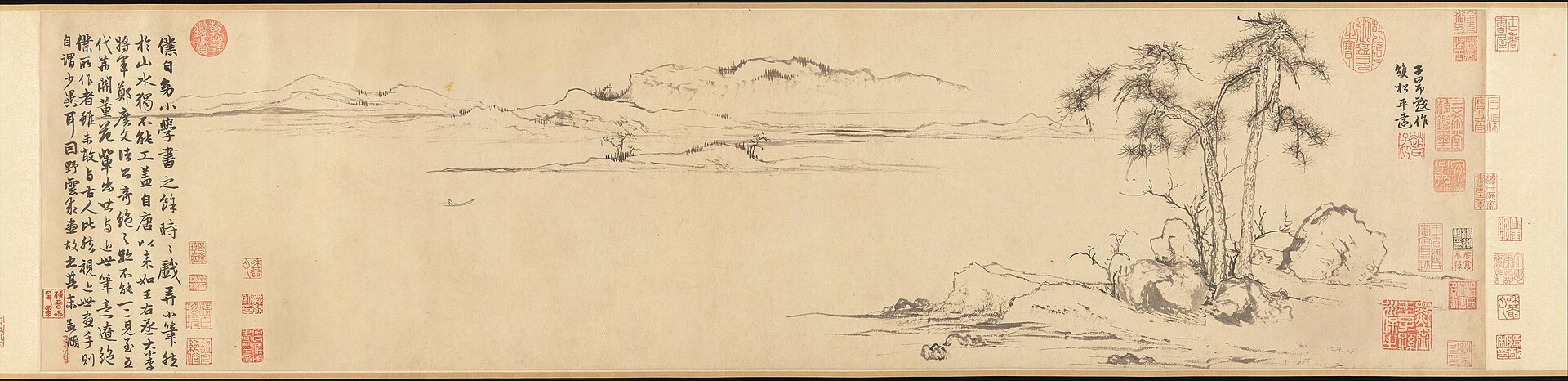
The record subject. Handscroll, ink on paper, ca. 1310, image 26.8 x 107.5 cm. Metropolitan Museum photography of the full scroll.
| Artist | Zhao Mengfu |
|---|---|
| Date | ca. 1310 |
| Medium | Handscroll, ink on paper |
| Dimensions | Image 26.8 x 107.5 cm (10 9/16 x 42 5/16 in); overall with mounting 27.8 x 781.5 cm (10 15/16 in x 25 ft. 7 11/16 in) |
| Where it is now | The Metropolitan Museum of Art, New York, Department of Asian Artlast confirmed |
| Inventory number | 1973.120.5 (Object ID 40508) |
| Attribution | AcceptedThe Metropolitan Museum catalogues this scroll as an autograph work by Zhao Mengfu without an attributed-to hedge. Full note |
| Object type | Painting |
| Period | Chinese, Yuan dynasty (1271-1368) |
| Cases | Has a provenance gap |
| Inscriptions | Two inscriptions by Zhao Mengfu himself: a short two-column note stating that Zi'ang (Zhao) 'playfully painted this Twin Pines, Level Distance,' and a longer six-column passage reflecting on his own landscape practice, naming the Tang masters Wang Wei, the Li generals, and Zheng Qian, and the Five Dynasties masters Jing Hao, Guan Tong, Dong Yuan, and Fan Kuan as working from a different 'brush idea' than recent painters, and recording that he made the scroll for the official Dong Yeyun. A colophon by Yang Zai (1271-1323), an eight-line poem followed by prose confirming the commission, carries three of his seals. A second colophon by the Ming scholar Tong Xuan (1425-1498) praises the scroll and Zhao's range of talents and engages directly with Zhao's position as a Song imperial descendant who served the conquering Yuan court; it carries three more seals. |
| Owners on record | 11 links9 documented, 2 unknown |
| Sources | 15 cited |
About this record Last verified · 15 sources cited · Change log
On this page 9 sections
ContentsClose
A nearly bare handscroll, ink on paper only, two pine trees and a stretch of empty water, painted around 1310 by Zhao Mengfu: a Song prince by birth who served the Mongol Yuan court that had ended his family's dynasty, and who used scrolls like this one to argue, in his own words written on the paper, for a return to painting styles centuries older than the Southern Song academy manner he had grown up around. Two of his own inscriptions, a near-contemporary colophon by Yang Zai, and a fifteenth-century colophon that directly addresses his conflicted position as a Yuan official of Song blood, sit on the scroll alongside twenty-three collectors' seals reaching from a Ming general through the Qing imperial collection to the twentieth-century connoisseur C. C. Wang.
It reached the Metropolitan Museum in 1973 as one of twenty-five paintings given by The Dillon Fund from the Wang family collection, a single gift that helped establish the Museum's Chinese painting department and later funded the galleries built to house it. What is not established, in the sources available for this record, is exactly how the scroll travelled from the Qing court to Wang's hands, or whether any specialist has published an authentication study of this particular object rather than of Zhao Mengfu's archaism in general.
The gaps are recorded as gaps. What survives is a painting that argues, on its own surface, for the very principle it embodies: that old models, reread rather than copied, are where the real content of a picture lives.
Provenance
Each link is graded. Documented: a cited source supports it. Disputed: the identification is argued but not established. Unknown: no owner for that span, and the gap is not smoothed into a narrative. The grades in the glossary.
- ca. 1310 -Zhao Mengfu, painted for the official Dong Yeyundocumented
Established by the artist's own two inscriptions on the scroll, naming himself and recording the commission for Dong Yeyun.12
- early 14th century -Colophon added by Yang Zai (1271-1323)documented
Yang Zai's colophon confirms the commission for Dong Yeyun; Yang died within a year of Zhao Mengfu, placing the colophon close to the painting's creation.2
- late 14th century -Mu Ying (1344-1391)documented
A seal identified as Mu Ying's, a Ming general and adopted general of the Hongwu Emperor, is among the collectors' marks catalogued on the scroll. A matched seal is strong evidence of ownership but not an independently corroborated chain-of-custody record.2
- mid-to-late 15th century -Yang Zun (jinshi degree 1469)documented
Yang Zun's seal appears on the scroll, and Tong Xuan's colophon from this period discusses Zhao Mengfu's position as a Song descendant who served the Yuan.2
- late 15th century - 17th century (before 1691)unknownunknown
No owner is documented in the sources consulted between Yang Zun's ownership and Liang Qingbiao's, a gap of roughly a century and a half.2
- 17th century - 1691Liang Qingbiao (1620-1691)documented
A seal identified as Liang Qingbiao's is among the collectors' marks on the scroll. Liang was a senior Qing official who at times managed acquisitions for the imperial collection itself.210
- late 17th to mid-18th century -An Qi (1683-after 1742)documented
A seal identified as An Qi's is among the collectors' marks. An Qi built his collection partly on material that had passed through Liang Qingbiao and other seventeenth-century collectors before him.210
- 18th century -Qing imperial collection (Qianlong Emperor, r. 1736-1795)documented
A seal identified as belonging to the Qianlong Emperor places the scroll inside the Qing imperial collection at some point during his reign.2
- 18th/19th century - 20th centuryunknownunknown
The mechanism and date by which the scroll left the Qing imperial collection and re-entered private hands is not established in the sources consulted for this record.
- 20th century (by 1973) - 1973C. C. Wang (Wang Jiqian, 1907-2003) and familydocumented
Established by C. C. Wang's own seal on the scroll and by the Metropolitan Museum's credit line, 'Ex coll.: C. C. Wang Family.' The date and source of Wang's own acquisition of this particular scroll are not given in the sources consulted.12
- 1973 - presentThe Metropolitan Museum of Art, New Yorkdocumented
Gift of The Dillon Fund, 1973, one of twenty-five Song- and Yuan-dynasty paintings acquired from the C. C. Wang family in that transaction.148
Technical evidence
| Attribution note | The Metropolitan Museum catalogues this scroll as an autograph work by Zhao Mengfu without an attributed-to hedge. The basis is internal to the object: two inscriptions in the artist's own hand naming himself (Zi'ang, Zhao Mengfu's courtesy name) and stating he painted the work at the request of an official named Dong Yeyun, two of his own seals (Zhao shi Zi'ang; a partial Zhao Mengfu yin), and a colophon by Yang Zai (1271-1323), who died within a year of Zhao himself and confirms the commission. No dispute of this specific scroll's authenticity was found in the sources consulted for this record. That is a real gap in the record, not evidence of consensus: Zhao Mengfu is among the most copied and forged painters in Chinese history, general Zhao Mengfu attribution scholarship (James Cahill and others) is extensive, and this record did not locate a publication that puts this exact scroll, rather than Zhao's archaism generally, through that scrutiny in the sources available. See Open Questions. |
|---|---|
| Support | Paper, mounted as a handscroll with attached colophon sheets following the painted section.12 |
| Medium | Ink only; no colour is used anywhere in the painted image.17 |
| Dimensions | Image 26.8 x 107.5 cm (10 9/16 x 42 5/16 in); overall with mounting 27.8 x 781.5 cm (10 15/16 in x 25 ft. 7 11/16 in).1 |
| Pine trunks | Drawn in a single unmodulated outline close in character to seal-script calligraphy, without tonal shading.7 |
| Rock texture | Built from flying-white (feibai) brushwork, a dry, split-bristle stroke drawn from cursive calligraphy rather than from landscape painting convention.7 |
| Artist's seals | Two identified: Zhao shi Zi'ang, and a partial impression of Zhao Mengfu yin.2 |
| Colophon seals | Three seals accompany Yang Zai's colophon (Zai; Zhonghong fu yin; Pucheng Yang shi) and three accompany Tong Xuan's colophon (Shi'ang; Jinmen guli; Qingfeng Ting).2 |
| Collectors' seals | Twenty-three separate collectors' seals identified on the scroll, spanning the Ming collectors Mu Ying and Yang Zun through the Qing collectors Liang Qingbiao, An Qi, and the Qianlong Emperor to C. C. Wang; several further seals remain unidentified.2 |
| Copyright status | Public domain. The Metropolitan Museum's own collection API records isPublicDomain as true for this object, and the Museum's photography of the scroll is published on Wikimedia Commons under CC0.19 |
Images


The record in full
Chapter 1A handscroll built from almost nothing
Unrolled, the painted image runs 26.8 by 107.5 centimetres, ink on paper, no colour anywhere on it.
Unrolled, the painted image runs 26.8 by 107.5 centimetres, ink on paper, no colour anywhere on it. Two pine trees stand at the right on a spit of land; low hills recede across an open, largely empty middle ground toward a further shore; a scatter of dry, angular rocks anchors the foreground. That is close to the entire visual content. There is no figure, no boat, no building, no bridge, and almost no ink wash to soften a single edge.
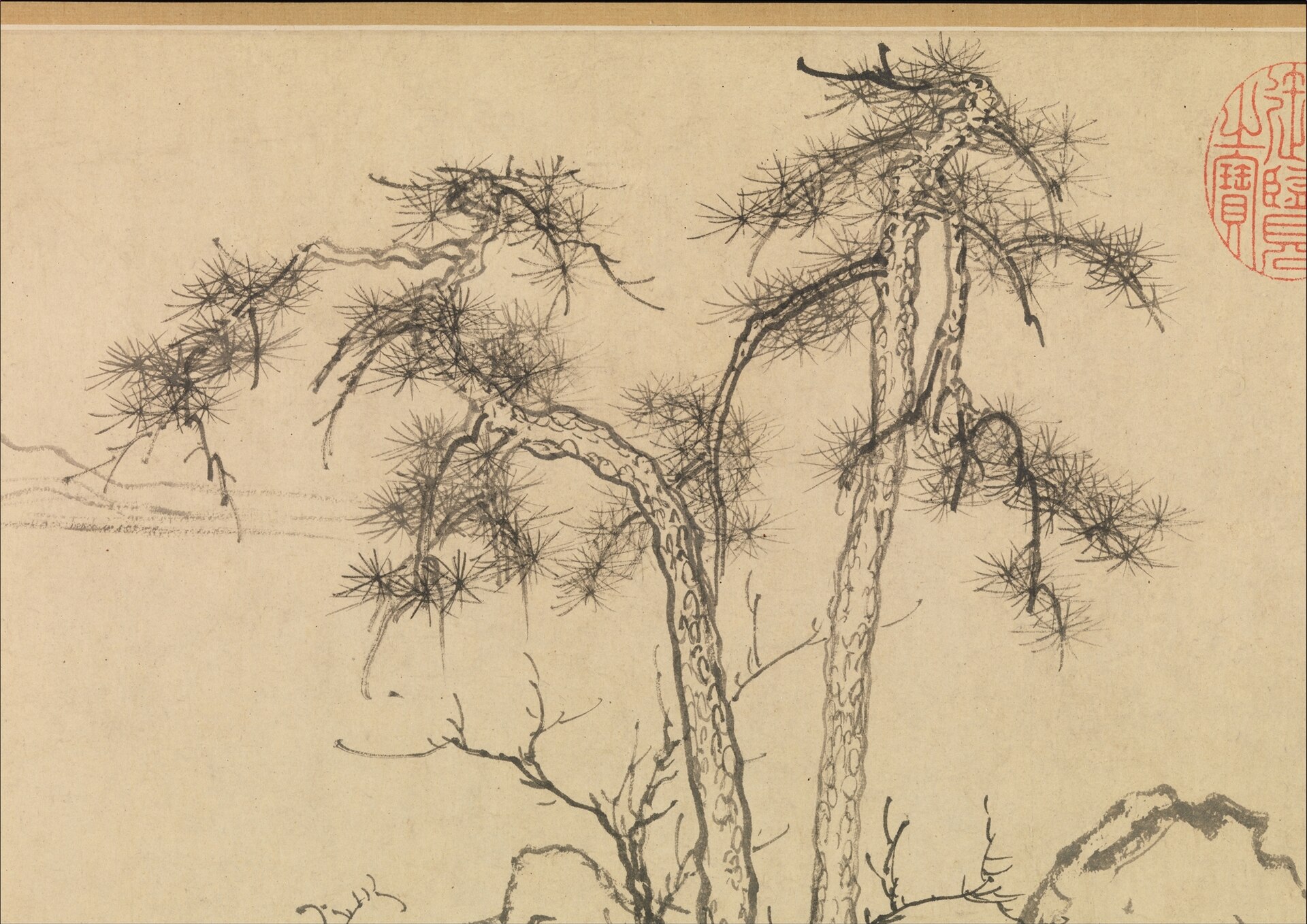
The emptiness is the point. Zhao Mengfu was not failing to fill the paper. He was refusing the fully worked, atmospherically shaded landscape that the Southern Song painting academy had perfected, and replacing it with a landscape built almost entirely out of calligraphic line: the pine trunks drawn as unmodulated outline in a manner close to seal-script calligraphy, the rocks built from the same dry, broken, semi-abraded stroke that calligraphers call flying-white. A viewer trained to read Chinese calligraphy is meant to recognise the brush before recognising the pine tree.
Chapter 2The commission
Zhao's own inscription states plainly that he made the scroll for a man named Dong Yeyun, whose title is recorded as a judicial post, a 'Penal Associate.' Nothing further about Dong has surfaced in...
Zhao's own inscription states plainly that he made the scroll for a man named Dong Yeyun, whose title is recorded as a judicial post, a 'Penal Associate.' Nothing further about Dong has surfaced in the sources consulted for this record: no other work commissioned by him, no independent biography, no dates beyond his connection to this one scroll. He exists, in what can currently be verified, only as the name in Zhao's inscription and in the colophon that follows it.
That colophon was written by Yang Zai (1271-1323), who confirms in an eight-line poem and a prose note that Zhao made 'this landscape handscroll' for Dong Yeyun. Yang died within a year of Zhao Mengfu himself, which places his colophon about as close to the moment of creation as any documentary evidence on a Yuan-dynasty scroll is likely to get.
Chapter 3A Song prince at a Mongol court
Zhao Mengfu was, by birth, exactly the kind of man who was not supposed to serve the dynasty that had just conquered his family's empire.
Zhao Mengfu was, by birth, exactly the kind of man who was not supposed to serve the dynasty that had just conquered his family's empire. He was an eleventh-generation descendant of Zhao Kuangyin, the founding emperor of the Song dynasty, tracing his line through a brother of the Song emperor Xiaozong. In 1286, seven years after the Song collapse, the Yuan official Cheng Jufu recommended him to Kublai Khan, and Zhao travelled to the Mongol capital at Dadu to serve the court that had ended his family's rule. He went on to hold office through several reigns, gaining particular favour under Emperor Renzong, and became one of the most senior and most visible Chinese officials in the Yuan administration.
To Song loyalists, this was not a neutral career move. Many aristocratic and literati Chinese of Zhao's generation refused Yuan service outright and withdrew into private life rather than work for the conquest dynasty; that refusal is itself well documented among Zhao's own circle; his friend Zhou Mi, for whom Zhao painted a different scroll discussed below, was one of the men who declined to serve. Zhao's decision to accept office instead drew criticism in his own lifetime and after it, from writers who read it as disloyalty to the fallen house he was born into.
This scroll carries that argument in its own physical history, not only in modern scholarship about Zhao. A colophon added by the Ming scholar Tong Xuan (1425-1498), more than a century after the painting was made, praises the work and Zhao's range of talents and engages directly with what has been catalogued as Zhao's 'complicated position as a Song descendant serving Yuan rulers.' A fifteenth-century reader, looking at this specific object, was already writing about the tension. That is a documented instance of the reception history, not a modern art-historical reading imposed on the object from outside it.
Chapter 4Archaism as a stated programme, not a modern label
Zhao Mengfu is credited, more than any other single figure, with turning early Yuan painting away from the Southern Song academy manner and back toward Tang, Five Dynasties, and Northern Song models...
Zhao Mengfu is credited, more than any other single figure, with turning early Yuan painting away from the Southern Song academy manner and back toward Tang, Five Dynasties, and Northern Song models, a programme generally called fugu, return to antiquity, or valued for its guyi, antique spirit. On this scroll the programme is not something scholars have inferred from the brushwork after the fact. Zhao states it himself, in his own inscription on the object: he names the Tang masters Wang Wei, the Li generals, and Zheng Qian, and the Five Dynasties masters Jing Hao, Guan Tong, Dong Yuan, and Fan Kuan, and says their 'brush idea' differs fundamentally from that of recent painters, meaning the Southern Song academy tradition he and his circle were reacting against.
The composition backs the words. The tripartite structure, near bank, open water, far shore, descends from the eleventh-century Northern Song masters Li Cheng and Guo Xi, and specifically echoes the general compositional type of Guo Xi's own hanging on the theme of trees and a level, distant view. But Zhao strips out everything Guo Xi's generation would have included as narrative incident: no pavilion, no bridge, no traveller, no woodcutter. What is left is close to a diagram of the idea of the older painting rather than a picture in its manner, which is exactly what fugu meant for Zhao: not copying an old master's surface, but re-arguing his structure in a new hand.
Chapter 5Calligraphy as the technique, not the metaphor
Zhao Mengfu is remembered as much for calligraphy as for painting, and this scroll is where the two disciplines are hardest to separate.
Zhao Mengfu is remembered as much for calligraphy as for painting, and this scroll is where the two disciplines are hardest to separate. The pine trunks are drawn in a single unmodulated line close to the character of seal-script calligraphy, without the tonal shading a landscape painter would normally use to suggest bark or volume. The rocks are built from flying-white strokes, a dry, split-bristle technique that Chinese calligraphers use for cursive script and that Zhao imports wholesale into a landscape context.
The effect is deliberately anti-illusionistic. A viewer is not invited to believe in the depicted space the way a Southern Song fan painting asks to be believed in; a viewer is invited to read the brushwork the way a viewer reads calligraphy, as a record of a specific hand moving at a specific moment. That equivalence between painting and writing became one of the defining claims of literati painting after Zhao, and this scroll is one of the plainest demonstrations of it that survives in an American collection.
Chapter 6The seal chain, seal by seal
Handscrolls of this kind carry their ownership history as a physical layer on the paper itself, in the form of collectors' seals stamped at the start, the end, and across every join between viewer...
Handscrolls of this kind carry their ownership history as a physical layer on the paper itself, in the form of collectors' seals stamped at the start, the end, and across every join between viewer and owner. A specialist cataloguing project at Miami University Libraries has identified twenty-three separate collectors' seals on this scroll, in addition to Zhao's own two seals and the seals attached to the two colophons. Not all twenty-three have been matched to a named owner; several remain unidentified in that catalogue.
Among the identified seals, the earliest datable collector is Mu Ying (1344-1391), a Ming general and one of the Hongwu Emperor's adopted generals, entrusted with securing Yunnan for the new dynasty; his descendants held the title Duke of Qian for ten generations. After him comes Yang Zun, who took the jinshi examination degree in 1469, whose ownership corresponds to the period in which Tong Xuan added his colophon. The chain then jumps, with an undocumented gap of roughly a century and a half in the sources consulted, to the great seventeenth-century collector-official Liang Qingbiao (1620-1691), who at one point managed acquisitions for the imperial collection itself, and then to An Qi (1683-after 1742), a salt-trade fortune who built one of the eighteenth century's most important private collections partly by absorbing material from Liang Qingbiao and other predecessors. A seal identified as belonging to the Qianlong Emperor (r. 1736-1795) places the scroll, at some point, inside the Qing imperial collection.
A matched seal is strong evidence of ownership, not proof beyond question: seals can be added later by a subsequent owner asserting a false pedigree, or misattributed by a cataloguer working from an imperfect impression. Nothing in the sources consulted for this record raises a specific doubt about any individual seal on this scroll. That absence of a raised objection is itself the finding available here; it is not the same claim as a scholar having actively tested and confirmed each seal.
Chapter 7From the Forbidden City to a private collection: an unresolved gap
How the scroll left the Qing imperial collection is not established in the sources consulted for this record.
How the scroll left the Qing imperial collection is not established in the sources consulted for this record. Qianlong-period imperial paintings reached the private market by several well-documented routes over the following two centuries: gifts from the throne, removals during the political chaos of the early twentieth century, and sales connected to the last emperor Puyi's household in the 1920s among them. Any of these is plausible in general terms for a painting bearing a Qianlong seal that later surfaced in private, and eventually overseas, hands. None of them is confirmed for this specific scroll here, and this record does not assert one.
Chapter 8C. C. Wang: connoisseur before collector
The next documented owner is Wang Jiqian, known in the West as C.
The next documented owner is Wang Jiqian, known in the West as C. C. Wang (1907-2003), and his ownership is attested both by his own seal on the scroll and by the Metropolitan Museum's own credit line, 'Ex coll.: C. C. Wang Family.' Wang was born in Suzhou into a family of scholar-officials at the end of the Qing dynasty, trained in law in Shanghai, and in 1936 turned instead to painting and connoisseurship, studying under the scholar-painter Wu Hufan. He began collecting Chinese paintings in Shanghai in the 1930s. In 1949 he emigrated to New York with his wife and two youngest daughters to escape the Chinese Communist revolution, and remained based there for the rest of his life.
Wang's reputation rests on two things that reinforced each other. As a painter working in ink and brush in the classical tradition, he understood from the inside what a genuine hand looked like. As a connoisseur, he became one of the twentieth century's most trusted authenticators of pre-modern Chinese painting, in part through his study of seals; in the late 1940s he helped the Metropolitan Museum itself determine that a group of Chinese paintings it had recently acquired were forgeries. A painting passing through C. C. Wang's collection functioned, for other collectors and for museums, as an informal certificate: it meant a leading eye had examined the object and judged it real.
Chapter 9The Dillon Fund gift of 1973
In 1973 the Metropolitan Museum acquired twenty-five Song- and Yuan-dynasty paintings from the C.
In 1973 the Metropolitan Museum acquired twenty-five Song- and Yuan-dynasty paintings from the C. C. Wang family as the gift of The Dillon Fund, a single transaction that the Museum itself describes as a first step toward building one of the world's most comprehensive collections of Chinese painting outside China. This scroll, accession 1973.120.5, was one of the twenty-five.
The gift is named for Douglas Dillon, a former US Treasury Secretary and diplomat who served as president of the Metropolitan Museum from 1970 to 1977 and then as its chairman. The Dillon Fund's support for Chinese painting did not end with the 1973 gift: it went on to endow the Douglas Dillon Galleries for Chinese Painting and Calligraphy, which opened at the Museum in 1981, giving this scroll and its companions from the 1973 gift a permanent home built specifically for them.
The 1973 transaction should not be confused with a separate, later gift from the same family. In 1999 the Museum mounted an exhibition, The Artist as Collector: Masterpieces from the C. C. Wang Family Collection, built around a promised gift of twelve further paintings from the Wang collection, this time from the Oscar Tang family and catalogued in the volume Along the Riverbank. That is a different set of works, given at a different date, by a different route, and this scroll was not part of it; it had already been at the Museum for over two decades by 1999.
Chapter 10What the scholarly record for this scroll actually consists of
The primary published account of this specific object is Richard M.
The primary published account of this specific object is Richard M. Barnhart's 1983 Metropolitan Museum catalogue of the 1973 gift, Along the Border of Heaven: Sung and Yuan Paintings from the C. C. Wang Family Collection, which carries a foreword by C. C. Wang himself. That catalogue is the source for the modern English translation of Yang Zai's colophon, the poem rendered by Barnhart and the accompanying prose by Maxwell K. Hearn, later the Museum's own curator of Chinese painting.
What this record could not establish, in the sources available to it, is a published technical or connoisseurial study that puts this exact scroll through the kind of scrutiny Zhao Mengfu's oeuvre has received in general. James Cahill, the scholar most associated with skeptical, technically grounded attribution work on Yuan painting, published specifically on archaistic elements in the paintings of Qian Xuan and Zhao Mengfu, but this record did not find that essay, or any other publication by Cahill, addressing this scroll by name. The Museum's own presentation of the work, with no attribution hedge, functions as the institutional judgment. This record cannot currently point to a named specialist's independent published argument for or against that judgment specific to this object, and says so rather than implying one exists.
Chapter 11What survives around it: the comparanda
Zhao Mengfu's surviving handscrolls are scattered across several institutions, and each has its own separately documented history; none of the following should be read as sharing a provenance with...
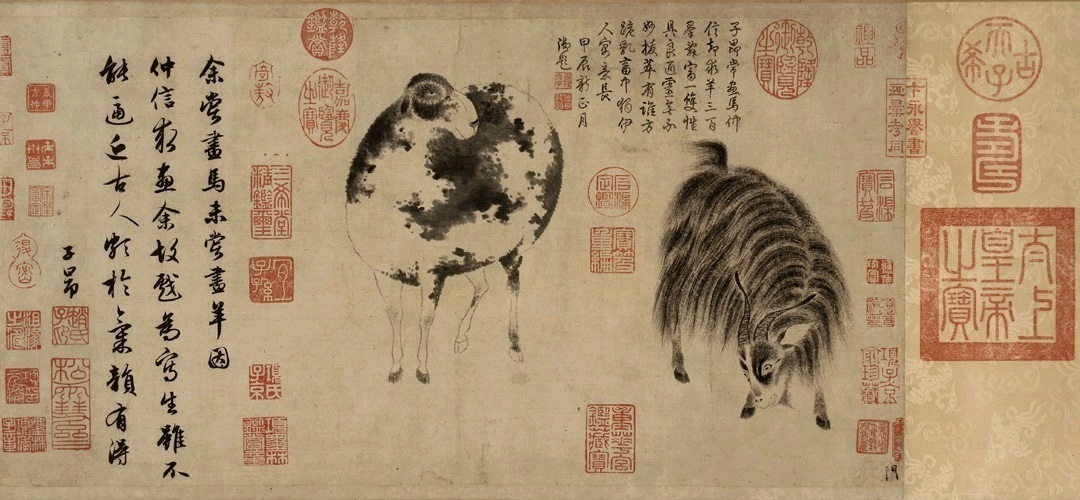
Zhao Mengfu's surviving handscrolls are scattered across several institutions, and each has its own separately documented history; none of the following should be read as sharing a provenance with this scroll. Sheep and Goat, ink on paper, is in the Smithsonian's National Museum of Asian Art (formerly the Freer Gallery, accession F1931.4); Zhao's own inscription says he painted it, after his 1295 retirement, for a friend named Zhongxin, playfully, having never painted sheep or goats before. Autumn Colors on the Que and Hua Mountains, ink and colour on paper and dated 1295, is in the National Palace Museum, Taipei; Zhao made it for his friend Zhou Mi, the very Song loyalist who had refused Yuan service, after returning from a magistracy in Shandong where the two mountains stand. Water Village, dated 1302, is in the Palace Museum, Beijing, and depicts a friend's rural retreat. Two further Zhao Mengfu handscrolls hang in the Metropolitan Museum's own galleries, Four Anecdotes from the Life of Wang Xizhi and Grooms and Horses, but both reached the Museum by an entirely separate route, the bequest and gift of John M. Crawford Jr. in 1988, fifteen years after this scroll and unconnected to the C. C. Wang family or the Dillon Fund.
Set against that group, this scroll is the most reduced. Autumn Colors uses colour and a far busier compositional field; Sheep and Goat is an animal study, not a landscape; Water Village retains more incident. Twin Pines, Level Distance is closer to a landscape argued in pure line than a landscape described.
Chapter 12The object today
The scroll has been part of the Metropolitan Museum's permanent Asian art collection since 1973.
The scroll has been part of the Metropolitan Museum's permanent Asian art collection since 1973. As of the Museum's own current online catalogue record, it is not currently assigned to a gallery number, meaning it is not on continuous public display, consistent with standard conservation practice for works on paper of this age and fragility, which are typically rotated rather than kept permanently exposed to light.
The artist
Zhao Mengfu, courtesy name Zi'ang, sobriquet Songxue (Pine-and-Snow)
Zhao Mengfu was, at the same time, one of the last direct links to the fallen Song imperial house and one of the most senior Chinese officials to serve the Mongol dynasty that had ended it. Almost everything distinctive about his art, the deliberate archaism, the calligraphic transposition of painting technique, the reduction of landscape to a small set of legible brush ideas, developed inside that unresolved political position, not apart from it. He remains the single figure most credited with redirecting Chinese painting away from the Southern Song academy manner and toward the literati tradition that dominated the following six centuries.
Related works
| Work | Relation | Where it is |
|---|---|---|
| Sheep and Goat Zhao Mengfu | Another surviving Zhao Mengfu handscroll, ink on paper, painted for a different patron after his 1295 retirement; a separately documented object with its own provenance, not part of the C. C. Wang or Dillon Fund history. Zhao's own inscription says he had never painted sheep or goats before and did so playfully, at a friend's request, after leaving office. | National Museum of Asian Art (Freer Gallery of Art), Smithsonian Institution, Washington, D.C., accession F1931.4 |
| Autumn Colors on the Que and Hua Mountains Zhao Mengfu | Another archaist landscape handscroll of the same decade, in colour rather than ink alone, made for Zhao's friend Zhou Mi, a Song loyalist who refused Yuan service. Dated 1295. Its own provenance and colophon history are separate from this scroll's and are not covered by this record. | National Palace Museum, Taipei |
| Water Village Zhao Mengfu | Another Zhao Mengfu handscroll from the same general period, depicting a friend's rural retreat, often paired with this work in discussions of his mature calligraphic landscape style. Dated 1302. A separate object with its own separately documented history. | Palace Museum, Beijing |
| Four Anecdotes from the Life of Wang Xizhi Zhao Mengfu | Another Zhao Mengfu handscroll in the Metropolitan Museum's own collection, but acquired by a wholly separate route. Bequest of John M. Crawford Jr., 1988, fifteen years after this scroll entered the Museum and unconnected to the C. C. Wang family or the Dillon Fund. | The Metropolitan Museum of Art, New York |
| Grooms and Horses Zhao Mengfu, with later additions by his son Zhao Yong and a descendant, Zhao Lin | A third Zhao Mengfu handscroll at the Metropolitan Museum, again reaching the Museum through the Crawford gift rather than the 1973 Wang family gift. Dated 1296 and 1359. Gift of John M. Crawford Jr., 1988. | The Metropolitan Museum of Art, New York |
Open questions
- When, and from whom, did C. C. Wang acquire this scroll? No source consulted for this record gives a date or a prior owner's name for that transaction.
- By what route did the scroll leave the Qing imperial collection? A Qianlong-period seal places it inside that collection at some point; how and when it left is not established in the sources consulted.
- Who were the owners behind the several unidentified seals among the twenty-three collectors' marks catalogued on the scroll?
- Who was Dong Yeyun, the official for whom Zhao Mengfu made the painting? Beyond his title and his appearance in Zhao's inscription and Yang Zai's colophon, no independent biography was found.
- Has any named specialist in Yuan painting published an authentication study addressing this specific scroll, rather than Zhao Mengfu's archaism or attribution problems in general? This record did not locate one.
Questions about this object
What is Twin Pines, Level Distance?
Twin Pines, Level Distance is a painting, dated ca. 1310. Medium: Handscroll, ink on paper.
Who made Twin Pines, Level Distance, and is the attribution settled?
The attribution to Zhao Mengfu is recorded here as accepted. The Metropolitan Museum catalogues this scroll as an autograph work by Zhao Mengfu without an attributed-to hedge. The basis is internal to the object: two inscriptions in the artist's own hand naming himself (Zi'ang, Zhao Mengfu's courtesy name) and stating he painted the work at the request of an official named Dong Yeyun, two of his own seals (Zhao shi Zi'ang; a partial Zhao Mengfu yin), and a colophon by Yang Zai (1271-1323), who died within a year of Zhao himself and confirms the commission. No dispute of this specific scroll's authenticity was found in the sources consulted for this record. That is a real gap in the record, not evidence of consensus: Zhao Mengfu is among the most copied and forged painters in Chinese history, general Zhao Mengfu attribution scholarship (James Cahill and others) is extensive, and this record did not locate a publication that puts this exact scroll, rather than Zhao's archaism generally, through that scrutiny in the sources available. See Open Questions.
Where is Twin Pines, Level Distance now?
The Metropolitan Museum of Art, New York, Department of Asian Art. Inventory number 1973.120.5 (Object ID 40508). Last confirmed 19 August 2026. Ex coll. C. C. Wang Family; gift of The Dillon Fund, 1973.
What is still unknown about Twin Pines, Level Distance?
When, and from whom, did C. C. Wang acquire this scroll? No source consulted for this record gives a date or a prior owner's name for that transaction.
Sources
- 1The Metropolitan Museum of Art, collection record for 'Twin Pines, Level Distance,' accession 1973.120.5, Object ID 40508, including the Museum's public collection API (isPublicDomain, credit line, dimensions, department). metmuseum.org/art/...
- 2InscrChArt (Inscriptions and Colophons in Chinese Art), Miami University Libraries, catalogue entry for 'Twin Pines, Level Distance,' listing and translating the artist's inscriptions, the Yang Zai and Tong Xuan colophons, and the twenty-three identified collectors' seals. inscrchart.lib.miamioh.edu/s/...
- 3Richard M. Barnhart, Along the Border of Heaven: Sung and Yuan Paintings from the C. C. Wang Family Collection (New York: The Metropolitan Museum of Art, 1983), foreword by C. C. Wang; source, via InscrChArt, for the translation of Yang Zai's colophon (poem by Barnhart, prose by Maxwell K. Hearn) at p. 120. archive.org/details/...
- 4The Metropolitan Museum of Art, press release, 'The Artist as Collector: Masterpieces from the C. C. Wang Family Collection' (1999 exhibition), for C. C. Wang's biography and the later, separate Oscar Tang family gift. metmuseum.org/press-releases/...
- 5Wikipedia, 'C. C. Wang,' for biographical detail on Wang Jiqian, his training under Wu Hufan, his 1949 emigration, and his role authenticating a group of forgeries for the Metropolitan Museum. en.wikipedia.org/wiki/...
- 6Wikipedia, 'Zhao Mengfu,' for the artist's Song imperial genealogy, his 1286 recruitment by Cheng Jufu, his Yuan court career, his marriage to Guan Daosheng, and his descendants. en.wikipedia.org/wiki/...
- 7Apollon Undergraduate Journal, 'Call of the Distant Mountains,' for style analysis specific to this scroll: the calligraphic pine trunks, the flying-white rock texture, and the composition's relationship to Guo Xi's tripartite landscape structure. apollonejournal.org/apollon-journal/...
- 8The Metropolitan Museum of Art, press materials on 'The Douglas Dillon Legacy: Chinese Painting for the Metropolitan Museum,' for Douglas Dillon's Museum presidency (1970-1977), the Dillon Fund's support, and the 1981 opening of the Douglas Dillon Galleries for Chinese Painting and Calligraphy. metmuseum.org/press/...
- 9Wikimedia Commons, Category: Paintings by Zhao Mengfu, and the individual Metropolitan Museum photography file pages for 'Twin Pines, Level Distance' (MET DP153682 and MET DP153739), for CC0/public domain licence verification specific to this object. commons.wikimedia.org/wiki/...
- 10Biographical detail on the Qing collectors Liang Qingbiao (1620-1691) and An Qi (1683-after 1742), consolidated from museum artist/maker authority pages. art.nelson-atkins.org/people/...
- 11National Museum of Asian Art (Smithsonian Institution), object page for 'Sheep and Goat,' accession F1931.4, for comparanda. asia-archive.si.edu/object/...
- 12Wikipedia, 'Autumn Colors on the Que and Hua Mountains,' for comparanda detail on the 1295 handscroll made for Zhou Mi. en.wikipedia.org/wiki/...
- 13The Metropolitan Museum of Art, collection record for 'Four Anecdotes from the Life of Wang Xizhi,' Object ID 40509, for comparanda and provenance contrast (Bequest of John M. Crawford Jr., 1988). metmuseum.org/art/...
- 14The Metropolitan Museum of Art, collection record for 'Grooms and Horses,' Object ID 40507, for comparanda and provenance contrast (Gift of John M. Crawford Jr., 1988). metmuseum.org/art/...
- 15China Online Museum, 'Zhao Mengfu: Twin Pines, Level Distance,' for general description. comuseum.com/painting/...
Last verified · Published
Change log
19 August 2026 - Record created at the house standard: researched narrative, technical evidence, maker dossier, graded provenance chain, prices with hammer and premium separated, related works, open questions and sources.