Codex Amiatinus
Wearmouth-Jarrow scriptorium, under Abbot Ceolfrith · c. 700-716 (before Ceolfrith left for Rome in 716)
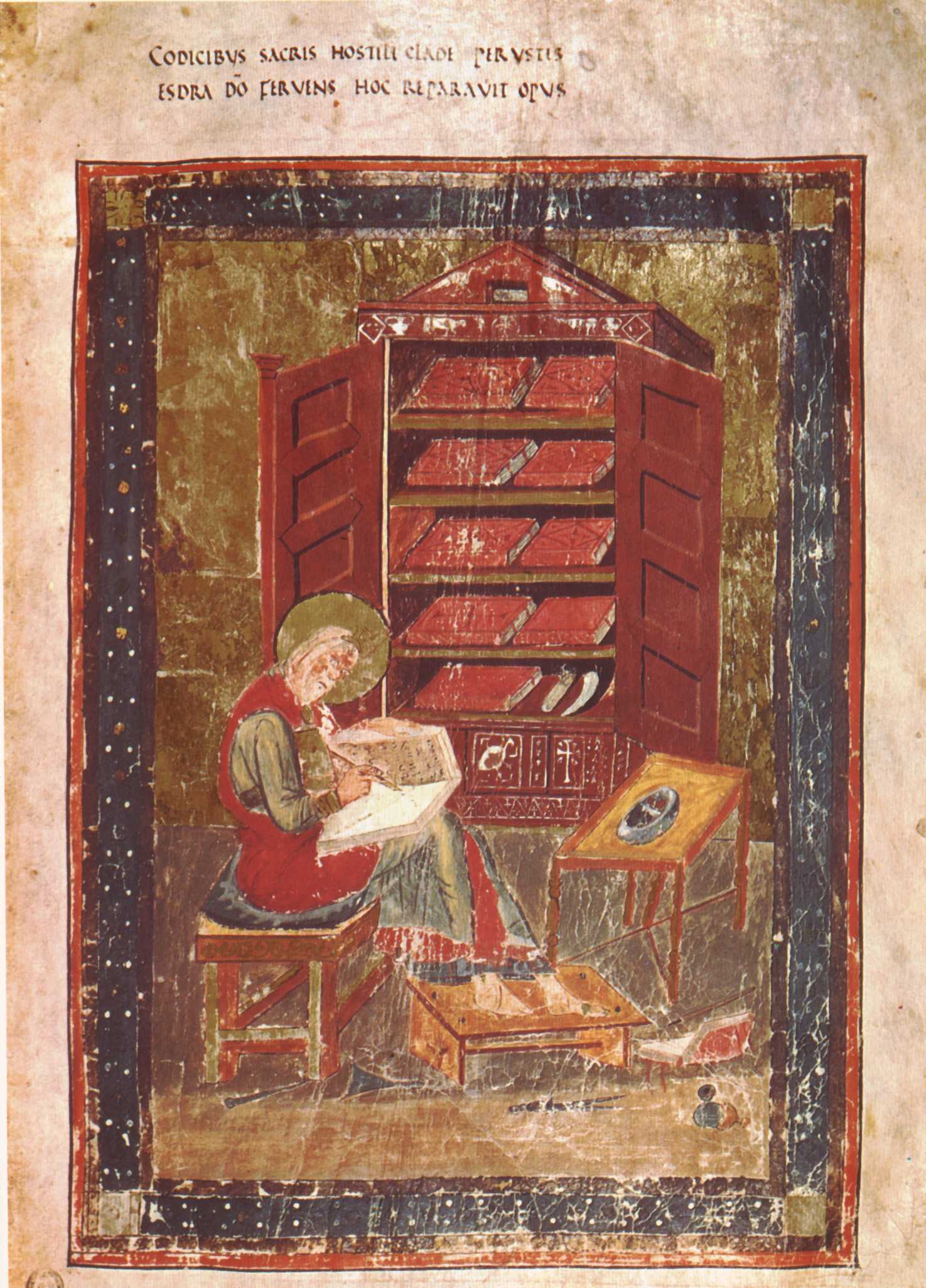
The full-page Ezra miniature at the opening of the Old Testament. The Commons file is a photograph of the Laurentian codex.
| Artist | Wearmouth-Jarrow scriptorium, under Abbot Ceolfrith |
|---|---|
| Date | c. 700-716 (before Ceolfrith left for Rome in 716) |
| Medium | Ink and pigments on vellum, uncial script, two full-page miniatures |
| Dimensions | About 49 x 34 x 18 cm per Wikipedia and the 1908 Catholic Encyclopedia (540 x 345 x 253 mm per the Laurentian-derived summary in Finestre sull'Arte); 1,029 or 1,040 leaves depending on the count; weight given as over 34 kg or over 50 kg depending on the source. See the technical block. |
| Where it is now | Biblioteca Medicea Laurenziana, Florencelast confirmed |
| Inventory number | MS Amiatino 1 (Cod. Amiat. 1) |
| Attribution | AcceptedMade at the twin monasteries of Wearmouth and Jarrow in Northumbria on the order of Abbot Ceolfrith, as one of three single-volume Bibles. Full note |
| Object type | Manuscript |
| Period | Anglo-Saxon, Northumbrian, early eighth century |
| Cases | Has a provenance gap · Seized, looted or confiscated |
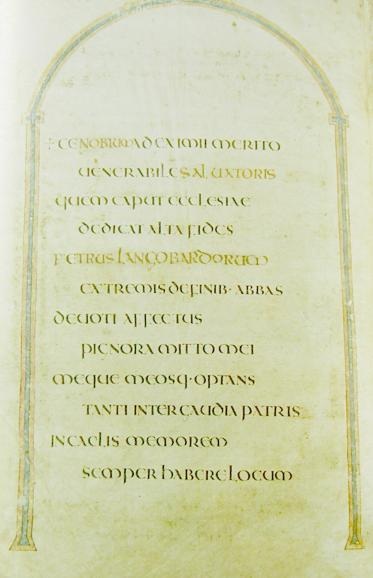
| Inscriptions | Dedicatory verses on the opening leaves, naming Ceolfrith of the English as donor to St Peter, overwritten in Italy with the names of a Lombard donor (Petrus Langobardorum) and a monastery of the Saviour. Greek and Latin text headings throughout. |
| Owners on record | 7 links5 documented, 1 disputed, 1 unknown |
| Sources | 16 cited |
About this record Last verified · 16 sources cited · Change log
On this page 9 sections
ContentsClose
The oldest surviving complete Latin Bible in one volume, made at Wearmouth-Jarrow in Northumbria around 700 on the order of Abbot Ceolfrith as one of three pandects, and carried toward Rome in 716 as a gift for the Pope. Ceolfrith died at Langres on the way. Whether the book reached Rome, and how it came to Monte Amiata by 1036, is not documented.
Its dedication was erased and rewritten in Italy so that it read as a Lombard gift. The original, recovered by Bandini's suspicion, Anziani's objection and de Rossi's reading, put the book back in England. It entered the Laurentian after the abbey was suppressed in 1782 (the year of arrival is disputed between 1784 and 1789) and went to the British Library on loan for the winter of 2018 and 2019.
It is not the lost Codex Grandior that served as its model, not the Lindisfarne Gospels and not the Ceolfrid Bible leaves, Add MS 45025 and 37777, which belong to a sister pandect.
Provenance
Each link is graded. Documented: a cited source supports it. Disputed: the identification is argued but not established. Unknown: no owner for that span, and the gap is not smoothed into a narrative. The grades in the glossary.
- c. 690 - 716Wearmouth-Jarrow, Abbot Ceolfrithdocumented
One of three pandects ordered by Ceolfrith, according to Bede and the anonymous Life of Ceolfrith. Made for the Pope. Wikipedia dates the order to 692.110
- 716 - 716Ceolfrith, on the road to Romedocumented
Ceolfrith left to deliver it to Pope Gregory II and died at Langres on 29 September 716 (25 September in one source).12614
- 716 - before 1036Unknownunknown
Whether it reached Rome and when it came to Monte Amiata is not documented. The ninth-century presence at Amiata asserted by Wikipedia and the Catholic Encyclopedia is unsupported in the sources consulted, and a self-published page argues the abbey did not exist in 716.1251415
- before 1036 - 1782Abbey of San Salvatore, Monte Amiatadocumented
Listed among the relics in 1036 (1035 in one source) as written in the hand of Pope Gregory. The dedication had been altered to a Lombard donor and a monastery of the Saviour, at a date not established.11113
- 1587 - 1590 or 1592Rome, commission for the Sistine Vulgatedocumented
Sixtus V had it sent to Rome in 1587. Return dated 19 January 1590 (Simanaitis), 1590 (Omnia brochure) or January 1592 (Finestre sull'Arte guard-sheet note).1111213
- 1782 - 1784 to 1789Grand Duke Leopold of Tuscany (state of Tuscany)disputed
Confiscated in 1782 on the suppression of San Salvatore. The Laurentian date is 1784 (Omnia), 1785 (Finestre sull'Arte, Arte.it), 1786 (Wikipedia, Catholic Encyclopedia) or an 1789 order (Simanaitis). The Medici family as such did not buy it: it entered a Medici-founded library by state action.15111213
- 1784 to 1789 - presentBiblioteca Medicea Laurenziana, Florencedocumented
MS Amiatino 1. Lent to the British Library for Anglo-Saxon Kingdoms: Art, Word, War, 19 October 2018 to 19 February 2019, and scheduled to return in February 2019.167813
Technical evidence
| Attribution note | Made at the twin monasteries of Wearmouth and Jarrow in Northumbria on the order of Abbot Ceolfrith, as one of three single-volume Bibles. The attribution rests on the dedicatory verses, which survive in a copy in the anonymous Life of Ceolfrith, on Bede's account of the three pandects, and on the script and text shared with the leaves of a sister Bible now in the British Library. The dedication in the codex itself was altered in Italy and had to be recovered by reading the erasures. |
|---|---|
| Support | Vellum, in quires of four sheets (quaternions). Estimates of the animals used vary from about 500 to about 1,550 (see narrative); no measurement exists.11114 |
| Leaves | 1,040 per Wikipedia; 1,029 per the 1908 Catholic Encyclopedia, Finestre sull'Arte and the Omnia brochure; up to 1,030 per the Biographical Dictionary quoted on a self-published page. The counts differ and are not reconciled.15111214 |
| Dimensions | About 49 x 34 x 18 cm (Wikipedia); 19 1/4 x 13 3/8 x 7 in (Catholic Encyclopedia, 1908); 540 x 345 x 253 mm (Finestre sull'Arte); 34.5 x 54 cm for the page (Omnia brochure).151112 |
| Weight | Over 34 kg (Wikipedia, IBTimes) or over 50 kg (Finestre sull'Arte, Omnia brochure). Not reconciled.181112 |
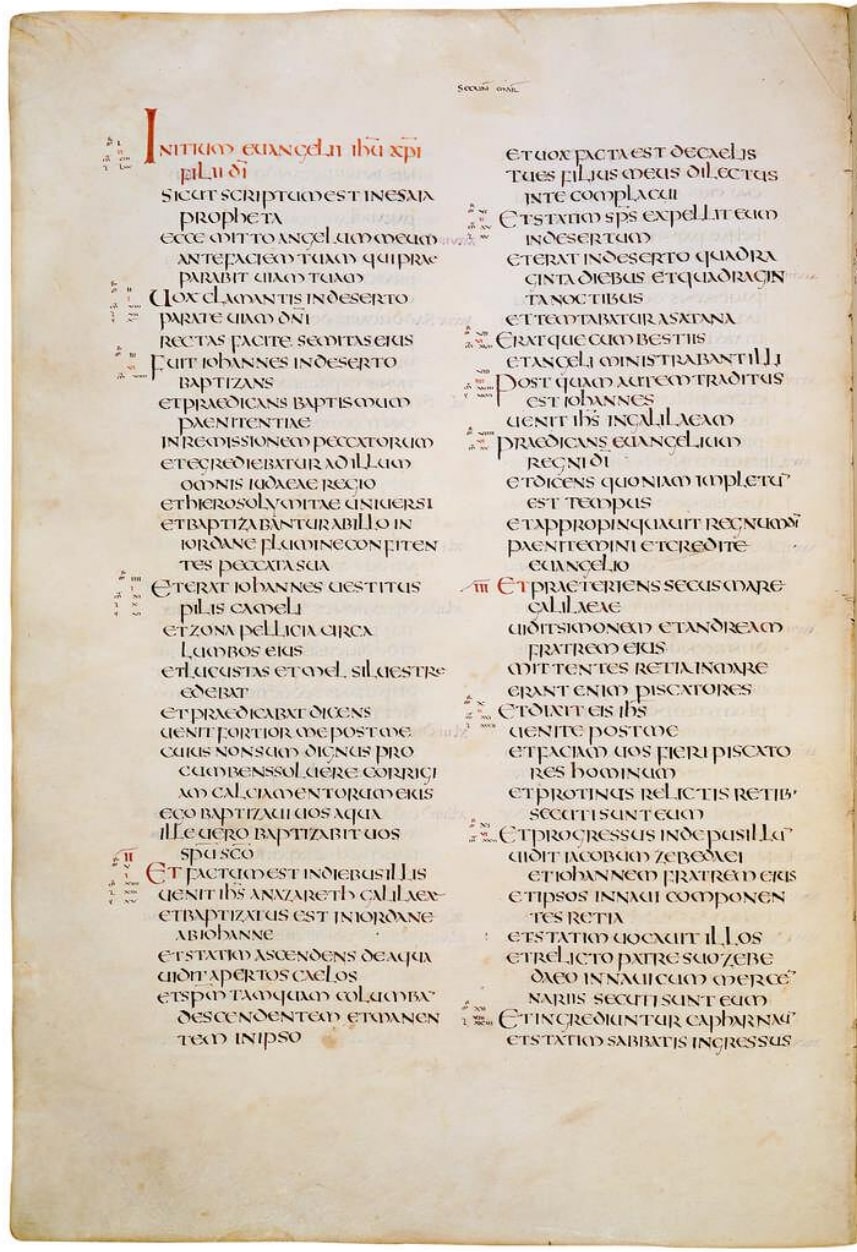
| Script and layout | Large regular uncial, two columns, 43 or 44 lines per column; sparse word spacing, no punctuation; text laid out per cola et commata.15 |
| Scribes | Seven or eight hands reported (seven or eight, Omnia brochure; eight, Finestre sull'Arte).1112 |
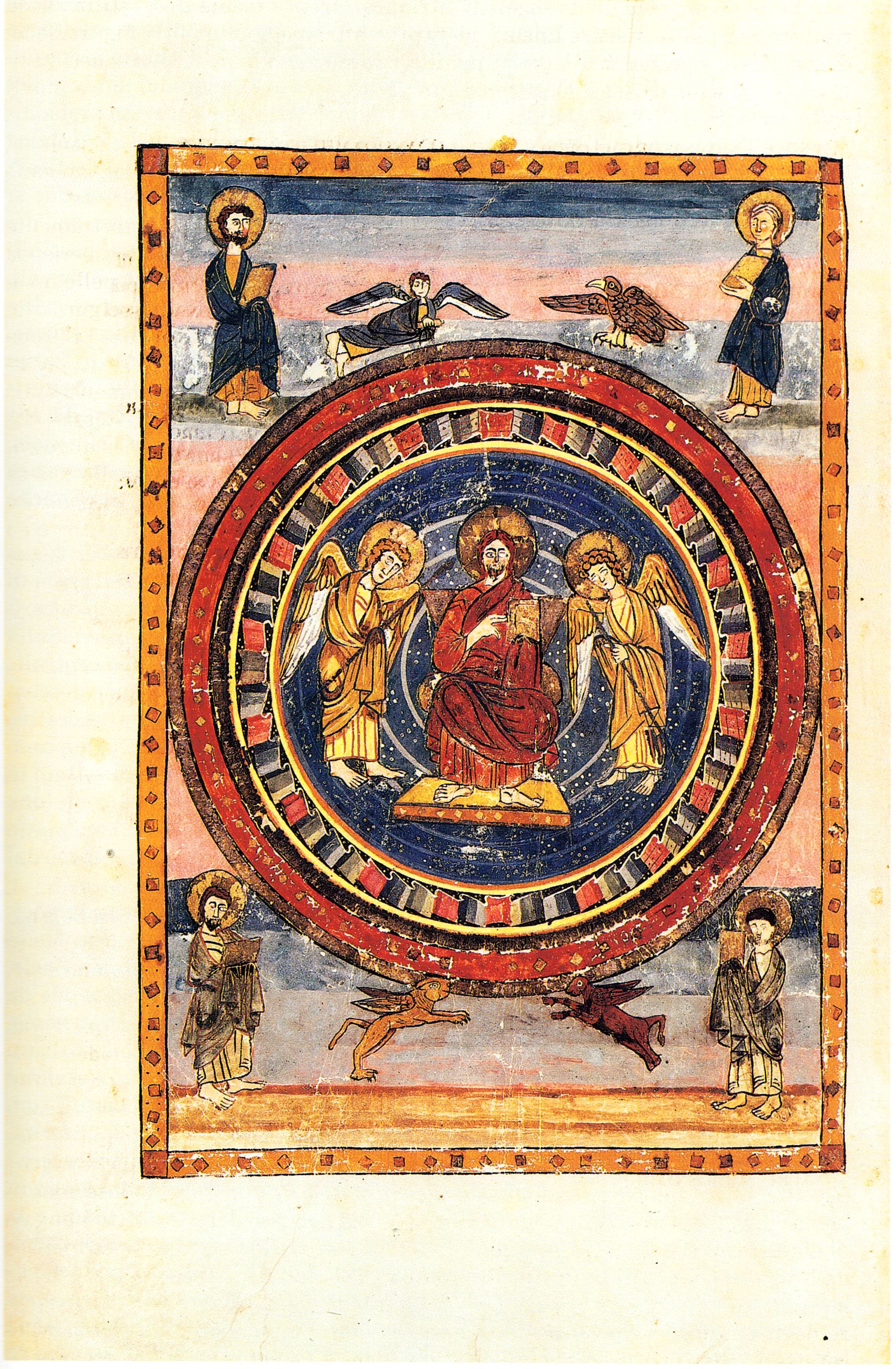
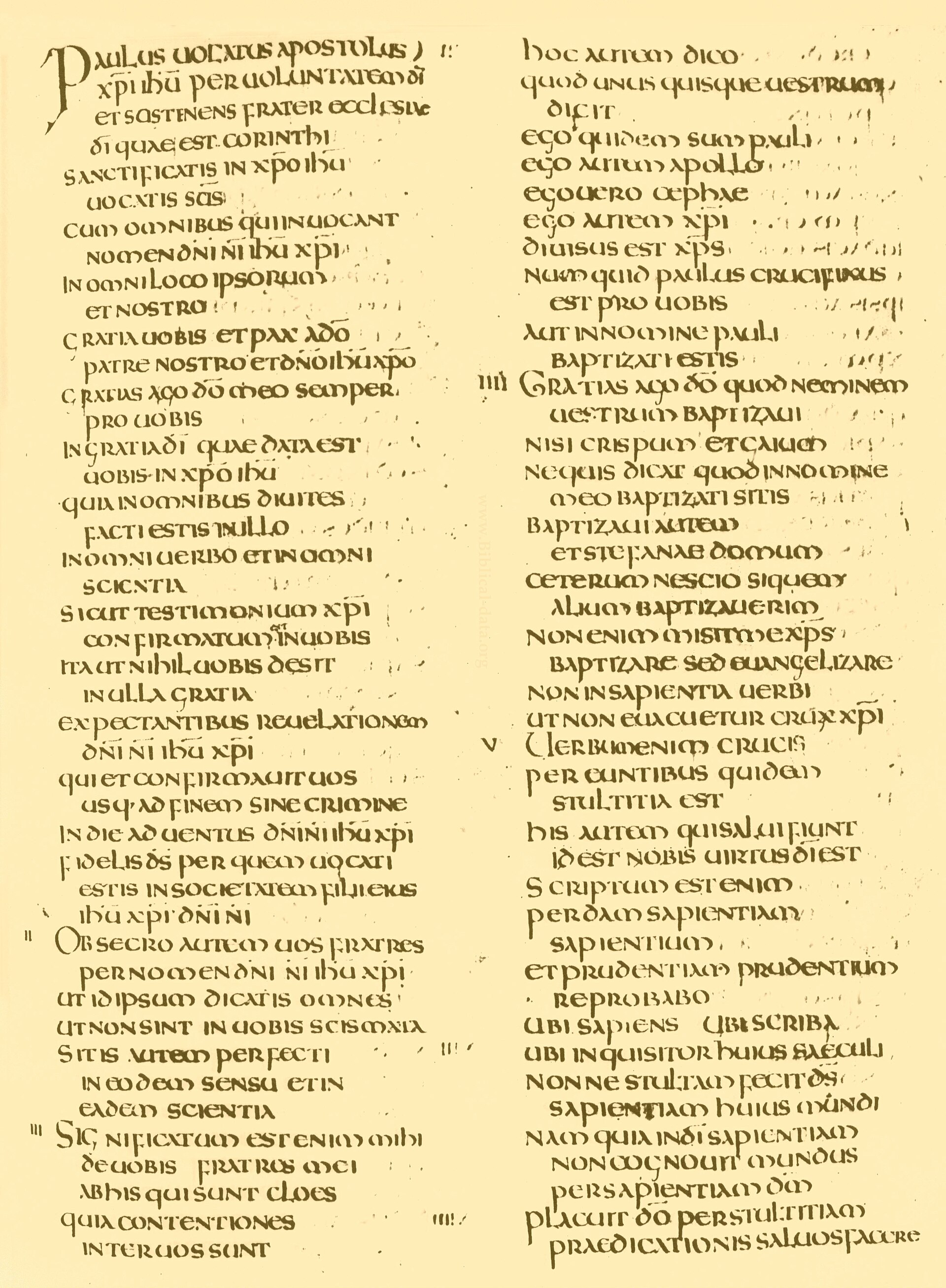
| Miniatures | Ezra at fol. 5r and Maiestas Domini at fol. 796v, plus a double-folio Tabernacle plate in the first gathering. The two miniatures show little insular style and appear copied from late antique originals.110 |
| Canon tables | Seven folios, fols. 798r to 801r, of the ten Eusebian tables (Lindisfarne Gospels: sixteen).10 |
| Text | Jerome's Vulgate, complete. Baruch and the Letter of Jeremiah absent. Psalter in Jerome's third version (from the Hebrew), with Columba headings found also in the Cathach of St Columba.1 |
| Dedication | Verses recovered from under erasure; the original Ceolfrith text confirmed by the copy in the anonymous Life of Ceolfrith. Fifth line read Britonum by de Rossi and Anglorum in later accounts (see open questions).15611 |
| Shelfmark | Florence, Biblioteca Medicea Laurenziana, MS Amiatino 1 (Cod. Amiat. 1).11316 |
| Facsimile and conservation | Work of 1999-2000 enabled reproductions and diagnostic study; full-size copy in the San Salvatore museum for the Jubilee of 2000. Binding revised several times, the first gathering restored to its pre-1784 order.1112 |
Images
The record in full
Chapter 1The oldest surviving complete Latin Bible in one volume
The Codex Amiatinus is a Latin Bible, Jerome's Vulgate, written in Northumbria around 700 and finished before the abbot who ordered it left England for Rome in 716.
The Codex Amiatinus is a Latin Bible, Jerome's Vulgate, written in Northumbria around 700 and finished before the abbot who ordered it left England for Rome in 716. It is the earliest complete one-volume Latin Bible to survive. Only the Leon palimpsest is older, and that is not complete in the same sense. It is a pandect: Old and New Testament together, in a single book, which in the late seventh century was a novelty. It is shelved in Florence as Amiatino 1 and is cited in critical editions by the siglum A or am.
It is also a physical monster. The sources give it as about 49 cm high, 34 cm broad and 18 cm thick, with over 1,000 leaves of vellum. The weight is quoted as over 34 kg in one set of sources and over 50 kg in another, and no source consulted resolves the difference. This record gives both and does not choose.
A note on identity, because this object is routinely confused with its relatives. The Amiatinus is not the Codex Grandior, the lost Old Latin Bible from Cassiodorus's monastery that served as its model. It is not the Lindisfarne Gospels, a four-Gospel book made at a different house. And it is not the leaves in the British Library known as the Ceolfrid Bible or the Greenwell and Middleton leaves, which are fragments of one of the Amiatinus's two sister pandects. All of these are named below and kept apart.
Chapter 2Ceolfrith and the three pandects
Ceolfrith, born about 642, was abbot of Jarrow from 682 and of Monkwearmouth from 690 until he left for Rome in 716 or 717 (Wikipedia on Ceolfrith gives the end of his abbacy as 716/717).
Ceolfrith, born about 642, was abbot of Jarrow from 682 and of Monkwearmouth from 690 until he left for Rome in 716 or 717 (Wikipedia on Ceolfrith gives the end of his abbacy as 716/717). Bede, who entered his care at the age of seven and spent his life at Jarrow, records in his account of the abbots of Wearmouth and Jarrow that Ceolfrith had three pandects made. Two were to stand in the churches of the twin monasteries. The third was to go to the Pope. The anonymous Life of Ceolfrith, written independently, describes the same project with some differences in detail.
Wikipedia's article on the codex dates the order to 692 and says the monastery acquired extra land to raise the roughly 2,000 cattle needed to supply vellum for the three books. The estimates for the single codex vary: 515 cattle (a figure from Christopher de Hamel, quoted by Wikipedia, who warns that more than a third of the quires have two single sheets in place of a folded pair, which makes the count approximate), about 500 sheep (Finestre sull'Arte) or about 1,550 calves (the Biographical Dictionary of the Middle Ages, quoted on a self-published page). These are three different animals and three different methods. None is a measurement.
The scribal work was done by a team. Seven or eight hands are reported (seven or eight in the Omnia facsimile brochure, eight in Finestre sull'Arte, seven in the dictionary quoted on the self-published page). Wikipedia notes that de Hamel suggests Bede may have helped prepare the pandects and corrected passages, and that his handwriting may be present. Richard Marsden's article Manus Bedae: Bede's contribution to Ceolfrith's bibles (Anglo-Saxon England 27, 1998, pp. 65-85) is the dedicated study of that question. Only its opening extract could be read for this record, so its conclusion is not reported here.
Chapter 3The model: Cassiodorus and the Codex Grandior
The Amiatinus was not designed from scratch.
The Amiatinus was not designed from scratch. According to the article on the Codex Grandior, that book was a large single-volume Old Latin Bible made for or by Cassiodorus in the early 500s and kept at his monastery of Vivarium near Squillace. Benedict Biscop or Ceolfrith is said to have brought it to Northumbria from Italy in 678 or thereabouts, for the library of the new abbey. Bede, the article says, later recognised it as the Codex Grandior by its illustrations. It is lost.
The argument that it was the pattern for the Amiatinus is made by scholars rather than by a surviving document. Paul Meyvaert, in a 1996 article in Speculum, Bede, Cassiodorus, and the Codex Amiatinus, argued that the Old Latin pandect Bede mentions was likely the Codex Grandior, and the earlier line goes back to John Chapman in 1908. Rupert Bruce-Mitford's 1967 Jarrow Lecture on the art of the codex linked its canon tables to Cassiodorus. Barbara Apelian Beall, who reviews this work in a 2005 chapter on the canon tables, cautions against leaning too hard on the Cassiodorus connection and notes that the Codex Grandior (Old Latin) and the Novem Codices (Vulgate) are both candidates, and that another scholar has proposed a non-Cassiodorean Neapolitan model. The honest position is that the Cassiodorus link is argued, not documented, and the argument is respected.
One internal detail shows the mixed ancestry. Wikipedia reports that the Psalter is Jerome's third version, translated from the Hebrew, and that its Psalm headings, the so-called Columba headings also found in the Cathach of St Columba, point to an Irish source. The book is a Vulgate with Irish and Italian inheritances in the same binding.
Chapter 4What is on the leaves
The text is in a large, regular uncial, in two columns of 43 or 44 lines, with sparse word spacing and no punctuation.
The text is in a large, regular uncial, in two columns of 43 or 44 lines, with sparse word spacing and no punctuation. Sense is carried by a layout in cola and commata, short lines broken at sense units, which the Ceolfrid Bible leaves in London share. The Gospel sections follow the Ammonian sections. The Book of Baruch and the Letter of Jeremiah are absent, Lamentations follows Jeremiah without a break, and Ezra-Nehemiah, Samuel, Kings and Chronicles each stand as single books. The New Testament is preceded by Jerome's letter to Pope Damasus and the Gospel prologues.
The canon tables of the Eusebian system fill seven folios (798r to 801r), against sixteen in the Lindisfarne Gospels, according to Beall. There are two full-page miniatures: Ezra at the opening of the Old Testament on folio 5r, and the Maiestas Domini at the start of the New Testament on folio 796v. Wikipedia observes that both show little insular style and appear to have been copied from late antique originals. Beall adds a double-folio image of the Tabernacle in the first gathering.
The text has mattered to editors far more than the pictures. It is the principal witness to Jerome's Vulgate. Wikipedia records that Tischendorf's 1854 Latin New Testament was edited from it, that it does not carry the Johannine Comma at 1 John 5:7, that Oxford took up John Wordsworth's proposal in 1878 for a critical New Testament that appeared in three volumes between 1889 and 1954 with H. J. White, and that Pius X in 1907 commissioned the Benedictine edition of the Old Testament that took the Amiatinus as its primary witness, except for the Psalms, where it is generally regarded as an inferior witness.
Chapter 5The Ezra page
Folio 5r is a full-page picture of Ezra the scribe, seated, with a book cupboard open behind him and the tools of a scriptorium around him.
Folio 5r is a full-page picture of Ezra the scribe, seated, with a book cupboard open behind him and the tools of a scriptorium around him. The Commons caption for the plate carries the line, When the sacred books had been consumed in the fires of war, Ezra repaired the damage. Wikipedia calls it the oldest English painting to which an absolute date can be assigned, no later than 716.
Whom the picture shows is the live question. Finestre sull'Arte describes it as Ezra writing, possibly from memory, in a room with a library behind him, and reports that some scholars instead identify the figure as Cassiodorus. The case for a link to Cassiodorus is argued, not documented. The author of the self-published page goes further and calls the portrait doubly that of Cassiodorus, and that is one author's interpretation, not an established reading. The plain statement is: the page shows Ezra, restorer of the scriptures, and whether a Cassiodorian patron or exemplar stands behind the image is argued by named scholars with opposite conclusions. Francesca Arduini, director of the Laurentian from 1996 to 2009, called it one of the most famous and most reproduced images in manuscript art.
Chapter 6The dedication and the erased names
The dedicatory verses on the opening leaves originally gave the book to St Peter from Ceolfrith.
The dedicatory verses on the opening leaves originally gave the book to St Peter from Ceolfrith. That text was erased and written over in Italy so that it read as a gift from a Lombard. Wikipedia's caption puts the change as Ceolfrith of the English altered into Peter of the Lombards. The 1908 Catholic Encyclopedia reports that a second hand overwrote the donor and recipient names, and that erasure marks and mismatched metre exposed it. Finestre sull'Arte gives the alteration as three words: corpus became cenobium, Petri became Salvatoris, and Ceolfridus Anglorum became Petrus Langobardorum, so that the gift now read as made to the monastery of the Saviour by a Peter of the Lombards.
The recovery of the original is a sequence. Angelo Maria Bandini, the Laurentian librarian who described the book in 1784, saw that the names did not belong to the original inscription and proposed that the codex was written by a Servandus at Monte Cassino in the 540s. Tischendorf endorsed that reading in his 1854 edition, and the Monte Cassino origin was accepted for about a century. A scholar named Anziani objected that the erased space was larger than Bandini's reconstruction needed. Giovanni Battista de Rossi then read the original verses. Wikipedia and Finestre sull'Arte place his reading in 1888, and Simanaitis, summarising de Hamel, says the news broke in February 1887 and caused a sensation in Britain. F. J. A. Hort then found the same verses in the anonymous Life of Ceolfrith, which tied the book to Ceolfrith, Northumbria and the Roman journey. The first line of the original verses reads Corpus ad eximii merito venerabile Petri (the 1908 Catholic Encyclopedia, reporting Hort's find).
The fifth line is still reported two ways. De Rossi's own conjecture, as the 1908 Catholic Encyclopedia has it, was Ceolfridus Britonum extremis de finib. abbas, Ceolfrith abbot of the Britons from the ends of the earth. The Wikipedia caption, Aleteia and Simanaitis give Ceolfridus Anglorum, Ceolfrith abbot of the English. Which word the verses carried in the Life and which word de Rossi read under the erasure are not the same question, and no source consulted separates them.
When the alteration was made, and by whom, is not established. Aleteia names a Peter the Lombard of the late ninth century as the person who partly scratched out the inscription and wrote his own name in its place. No other source consulted supports that name or date, and this record does not adopt it.
Chapter 7The journey to Rome that cannot be proved
Ceolfrith left England in 716, in his seventies (the sources say 74), intending to spend the rest of his life in Rome.
Ceolfrith left England in 716, in his seventies (the sources say 74), intending to spend the rest of his life in Rome. He took the third pandect as a gift for the Pope, Gregory II. He died at Langres in Burgundy. Wikipedia and Aleteia give the date as 29 September 716. The self-published page gives 25 September, and Aleteia puts his arrival at Langres on 25 September. Aleteia says he reached Gaul on 12 August and boarded ship at the mouth of the Humber on 4 July.
What happened to the book next is a gap. The Article says it is almost certain that Ceolfrith's retinue carried the book on to Rome, and says plainly that this is not documented. The Wikipedia article on Ceolfrith says no records confirm that it reached Rome. Aleteia says the Life preserves the Pope's letter of thanks and a mention of a gift, probably this book, and treats the arrival as established. The self-published page reports that some sources say the book was lost in France, and argues that the abbey of San Salvatore on Monte Amiata did not yet exist in 716, since its documents date its foundation to 742. Finestre sull'Arte says the Bible reached Rome and was soon moved to Amiata. None of these statements is sourced to a document in the pages consulted.
The next secure fact is late. The book appears in a list of the relics of San Salvatore on Monte Amiata in 1036, where it is described as written in the hand of the blessed Pope Gregory (Wikipedia, Simanaitis and The Article give 1036, Finestre sull'Arte gives 1035). Wikipedia and the Catholic Encyclopedia place it at Amiata from the ninth century, and the Omnia brochure says only that it was there at an undetermined date before the eleventh century. The seven or eight hundred years from 716 to 1036 are, in provenance terms, a gap. That the book was later credited to Gregory the Great and later still to a Servandus is a record of what Amiata, and then Bandini, believed, and shows how completely its English origin had been lost.
Chapter 8Monte Amiata, Rome again and the Vulgate
At San Salvatore the book stayed for at least seven centuries.
At San Salvatore the book stayed for at least seven centuries. Simanaitis, following de Hamel, records that advisers to Pope Gregory XIII asked for it in 1572 and the monastery refused. Pope Sixtus V demanded it for the revision of the Vulgate. The sources disagree on how long it was away: Simanaitis dates its journey to Rome from 12 July 1587 and its return from 19 January 1590, Finestre sull'Arte gives 1587 to 1591 with a note on a guard sheet recording its return to the monks in January 1592, and the Omnia brochure speaks of a brief period in Rome in 1590. The Sistine Vulgate and the Clementine revision of 1592 followed. Wikipedia adds that Catholics valued it as the main Vulgate witness at a time when Protestant translators drew on Hebrew, and that little use was in the end made of its readings in the Sistine text.
Chapter 9The Laurentian
The abbey was suppressed in 1782 under the policy of Grand Duke Leopold (Pietro Leopoldo) of Tuscany, and the book was confiscated that year (the Omnia brochure and Simanaitis agree on 1782).
The abbey was suppressed in 1782 under the policy of Grand Duke Leopold (Pietro Leopoldo) of Tuscany, and the book was confiscated that year (the Omnia brochure and Simanaitis agree on 1782). The date of its arrival in the Laurentian Library is where the sources split. The Omnia brochure says it was assigned to the library in 1784 and that Bandini described it fully in 1784. Arte.it and Finestre sull'Arte give 1785. Wikipedia and the 1908 Catholic Encyclopedia give 1786. Simanaitis, following de Hamel, says that seven years after the suppression, in 1789, the Grand Duke ordered it moved to Florence, first to a seminary and then to the Laurentian as Cod. Amiat. 1. The self-published page dates the decree to 1780. This record states the 1782 confiscation as documented and the date of arrival as disputed between 1784 and 1789. It was a Medici library by foundation, designed by Michelangelo, and de Hamel calls it probably the library's most famous manuscript.
Finestre sull'Arte reports that the first gathering was found, when the book was unbound for reproduction, to be in a different order from the one then known, and that the new order matched the arrangement it had before a rebinding made before 1784. Between 1999 and 2000 the codex underwent work that allowed faithful reproductions and diagnostic study, and a full-size copy was placed in the museum at San Salvatore for the Jubilee of 2000.
Chapter 10The sister leaves in the British Library
Of the three pandects, the Amiatinus is the only one that survives complete.
Of the three pandects, the Amiatinus is the only one that survives complete. Marsden's opening extract says one of the other two is lost and the other survives as scattered leaves in the British Library. Those leaves, as they stand in the Wikipedia article on the Ceolfrid Bible, are of three kinds. The main group, British Library Add MS 45025, is eleven leaves with portions of the third and fourth Books of Kings. They measure mostly 430 by 340 mm and are in two columns of 44 lines in an uncial that closely resembles the Amiatinus, with some corrections the Amiatinus lacks. They were reused in the sixteenth century as covers for the cartulary of the Willoughby family of Wollaton Hall, Nottinghamshire. A single further leaf, Add MS 37777, with another portion of the third Book of Kings, was found, according to Wikipedia, by the Rev. William Greenwell in a shop in Newcastle in 1882. A third leaf, with Sirach 3 and 4, was found in 1982 at Kingston Lacy in Dorset, was used as a covering for documents from the same Willoughby family, and is on long-term loan to the British Library.
These are leaves of one of the sister Bibles, not of the Amiatinus. The scholarly term Middleton leaves is used for the main group in some of the literature, and the shelfmark for that group is Add MS 45025. Another account puts Greenwell's gift to the British Museum in 1909, and the date of the Greenwell find is therefore flagged below.
Chapter 11Coming home for a winter: the 2018 loan
The British Library announced on 30 November 2017 that the Laurentian would lend the codex for its exhibition Anglo-Saxon Kingdoms: Art, Word, War.
The British Library announced on 30 November 2017 that the Laurentian would lend the codex for its exhibition Anglo-Saxon Kingdoms: Art, Word, War. The exhibition ran from 19 October 2018 to 19 February 2019 (dates from Aleteia and the Trinity College Dublin notice it cites). Press coverage called it the first return to England in over 1,300 years, and IBTimes put the figure at 1,302 years. That figure counts from the departure of 716 and is press framing, not a calculated fact about the book's whereabouts in between, which are largely unknown. Claire Breay, the exhibition's lead curator, called it a once-in-a-generation opportunity to see an outstanding array of Anglo-Saxon manuscripts. The show was billed as the largest ever held on the history, literature and culture of Anglo-Saxon England. Simanaitis reports that de Hamel was first refused access to the book in Florence on the ground that it was too fragile, and then shown it.
The loan did not change title or location. Simanaitis reports that it was scheduled to return to the Laurentian in February 2019.
The artist
The Wearmouth-Jarrow scriptorium, under Abbot Ceolfrith
No scribe's name is recorded for the Amiatinus. It is the product of a house, not a hand: the twin monasteries of Monkwearmouth and Jarrow in Northumbria, which in the abbacy of Ceolfrith produced three single-volume Bibles and, under Bede, a body of learning that reached the Continent. The record of what the scriptorium did comes from two near-contemporary texts, Bede's history of the abbots and the anonymous Life of Ceolfrith, and from the objects themselves.
Related works
| Work | Relation | Where it is |
|---|---|---|
| Ceolfrid Bible (Middleton leaves), Add MS 45025 Wearmouth-Jarrow scriptorium | Eleven leaves of a sister pandect, Kings III and IV Reused as covers for a Willoughby cartulary in the sixteenth century. Not part of the Amiatinus. | British Library, London |
| Greenwell leaf, Add MS 37777 Wearmouth-Jarrow scriptorium | Single leaf of the third Book of Kings from the same group Found in Newcastle in 1882 per Wikipedia; the date is contested in other accounts. | British Library, London |
| Kingston Lacy leaf (Sirach 3-4) Wearmouth-Jarrow scriptorium | Leaf of a sister pandect, found 1982 Used as a covering for Willoughby documents. | British Library (long-term loan) |
| Codex Grandior Cassiodorus (Vivarium) | Proposed model, lost Old Latin single-volume Bible; not this object. | Unlocated |
| Lindisfarne Gospels Lindisfarne scriptorium | Contemporary insular book, different house and text Has sixteen canon tables against the Amiatinus's seven. Not this object. | British Library, London |
| St Cuthbert Gospel Wearmouth-Jarrow scriptorium | Same house, early eighth century Oldest intact European book with its original binding. | British Library, London |
Open questions
- Did the Amiatinus reach Rome in 716 or soon after? The sources say it is almost certain or that records do not confirm it, and none cites a document.
- Where was the book between 716 and the 1036 relic list at San Salvatore? The ninth-century presence at Amiata asserted in some reference works is not supported by a source seen here.
- When was the dedication altered into Petrus Langobardorum, and by whom? A single account names a late ninth-century Peter the Lombard, which no other source supports.
- Was the fifth line of the original dedication read Anglorum or Britonum by de Rossi, and which reading does the Life of Ceolfrith itself carry?
- On what date did the book enter the Laurentian: 1784, 1785, 1786 or 1789? Confiscation in 1782 is consistent across sources; the transfer is not.
- How long was the book in Rome for the Sixtine Vulgate: returned January 1590, in 1590, or on a guard-sheet note of January 1592?
- How many leaves and how much does it weigh: 1,029 or 1,040 leaves, and over 34 kg or over 50 kg? These are published as unreconciled figures.
- When and where was the Greenwell leaf found: Newcastle in 1882, or presented in 1909? Accounts differ.
- Is the Ezra figure Ezra alone, or Ezra with the features or role of Cassiodorus? Named scholars hold both views, and the picture decides neither.
- Is the alteration of 'qui egrediabatur et revertebatur' by a later hand adding 'NON' in Genesis 8, which one commentator attributes to Bede, a fact of the manuscript or one author's speculation? Only one source was found for it.
Questions about this object
What is Codex Amiatinus?
Codex Amiatinus is a manuscript, dated c. 700-716 (before Ceolfrith left for Rome in 716). Medium: Ink and pigments on vellum, uncial script, two full-page miniatures.
Who made Codex Amiatinus, and is the attribution settled?
The attribution to Wearmouth-Jarrow scriptorium, under Abbot Ceolfrith is recorded here as accepted. Made at the twin monasteries of Wearmouth and Jarrow in Northumbria on the order of Abbot Ceolfrith, as one of three single-volume Bibles. The attribution rests on the dedicatory verses, which survive in a copy in the anonymous Life of Ceolfrith, on Bede's account of the three pandects, and on the script and text shared with the leaves of a sister Bible now in the British Library. The dedication in the codex itself was altered in Italy and had to be recovered by reading the erasures.
Where is Codex Amiatinus now?
Biblioteca Medicea Laurenziana, Florence. Inventory number MS Amiatino 1 (Cod. Amiat. 1). Last confirmed 16 November 2026. In the Laurentian Library since the suppression of the abbey of San Salvatore on Monte Amiata in the 1780s (the exact year of transfer differs between sources, 1784 to 1789). Lent to the British Library for Anglo-Saxon Kingdoms: Art, Word, War, 19 October 2018 to 19 February 2019, and returned to Florence.
What is still unknown about Codex Amiatinus?
Did the Amiatinus reach Rome in 716 or soon after? The sources say it is almost certain or that records do not confirm it, and none cites a document.
Sources
- 1Wikipedia, 'Codex Amiatinus' (: physical description, Ezra and Maiestas folios, scholarly attribution history, editions). en.wikipedia.org/wiki/...
- 2Wikipedia, 'Ceolfrith' (: dates of abbacy, death at Langres, three copies, Bede's life). en.wikipedia.org/wiki/...
- 3Wikipedia, 'Ceolfrid Bible' (: British Library Add MS 45025, Add MS 37777, Kingston Lacy leaf). en.wikipedia.org/wiki/...
- 4Wikipedia, 'Codex Grandior' (: Cassiodorus, Vivarium, acquisition, Meyvaert 1996 and Chapman 1908). en.wikipedia.org/wiki/...
- 5J. F. Fenlon, 'Codex Amiatinus', Catholic Encyclopedia vol. 4 (1908): dedication verses, erasure, Bandini, de Rossi, Hort, dimensions. newadvent.org/cathen/...
- 6J-P Mauro, Aleteia, 'The British Library traces the history of the world's oldest Latin Bible', 6 June 2018 (popular, draws on a British Library blog post). aleteia.org/2018/...
- 7Christian Today, 'Ancient Bible returns to England's shores for the first time in 1,300 years', 24 October 2018. christiantoday.com/news/...
- 8IBTimes UK, 'Codex Amiatinus: oldest Latin Bible set for spectacular return to UK after 1,300 years away', 1 December 2017. ibtimes.co.uk/oldest-latin-bible-set-spectacular-return-u...
- 9Richard Marsden, 'Manus Bedae: Bede's contribution to Ceolfrith's bibles', Anglo-Saxon England 27 (1998), pp. 65-85. Only the opening extract was available. cambridge.org/core/...
- 10Barbara Apelian Beall, 'Entry point to the Scriptorium Bede knew at Wearmouth and Jarrow: The Canon Tables of the Codex Amiatinus', in Bede le Venerable (2005), pp. 187-197. books.openedition.org/irhis/...
- 11Finestre sull'Arte, 'The Amiatine Bible, the oldest copy of the Scriptures in the Latin version by St. Jerome' (popular, derived from Laurentian material). finestresullarte.info/en/...
- 12Omnia (facsimile publisher) brochure, 'La Bibbia Amiatina' (commercial facsimile material). omifacsimiles.com/brochures/...
- 13Dennis Simanaitis, 'The Codex Amiatinus, a Bible with Legs, Part 2', 19 January 2019, summarising Christopher de Hamel, Meetings with Remarkable Manuscripts (2017). simanaitissays.com/2019/...
- 14Umilta.net, 'The 1,300 Year Pilgrimage of the Codex Amiatinus' (self-published, weak; cited only where flagged). umilta.net/pandect.html
- 15The Article, 'Bede and the Codex Amiatinus' (popular essay; the Genesis 8 note is one author's speculation). thearticle.com/bede-and-the-codex-amiatinus
- 16Wikimedia Commons file pages: File:CodxAmiatinusFolio5rEzra.jpg; File:Codex Amiatinus (dedication page).jpg; File:Amiatinus Maiestas Domini.jpg; File:Codex Amiatinus - Gospel of Mark, chapter 1.jpg; File:Codex Amiatinus (1 Cor 1,1-21).jpg (all marked public domain). commons.wikimedia.org/wiki/...
Last verified · Published
Change log
16 November 2026 - Record created at the house standard: researched narrative, technical evidence, maker dossier, graded provenance chain, prices with hammer and premium separated, related works, open questions and sources.