The Water Newton Treasure
Unknown Romano-British silversmith(s); silver donated by named and unnamed members of a Christian congregation at or near Durobrivae · Second half of the 4th century to the early 5th century AD
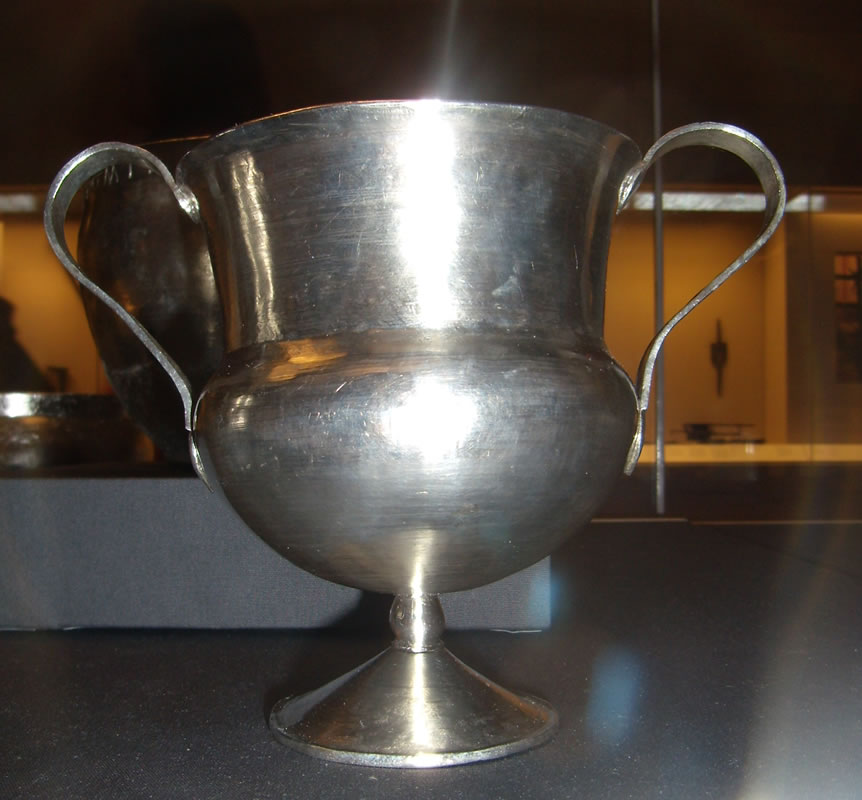
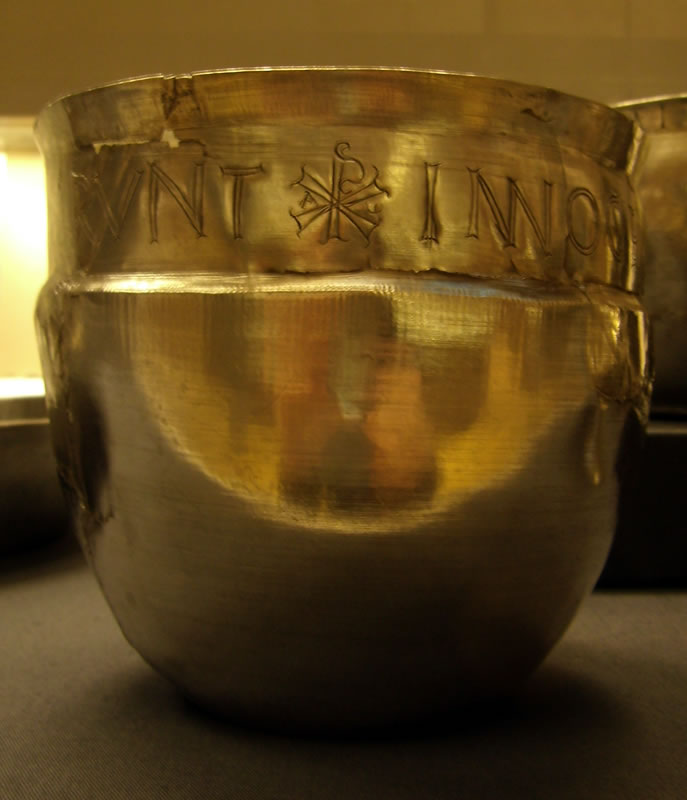
The treasure's unengraved two-handled cup, in the classical cantharus form, 316 g (inv. 1975,1002.6). Undecorated but the vessel most often discussed as a candidate for the earliest surviving object that could plausibly be called a Christian chalice, on the strength of later parallels rather than certainty about this cup itself.
The British Museum, London; photograph by Udimu (CC BY-SA 3.0)| Artist | Unknown Romano-British silversmith(s); silver donated by named and unnamed members of a Christian congregation at or near Durobrivae |
|---|---|
| Date | Second half of the 4th century to the early 5th century AD |
| Medium | Silver (hammered, repousse, incised and partly gilded sheet and vessels) and gold (one sheet disc) |
| Dimensions | A hoard of 27 objects of varying size, from votive plaques a few centimetres across to the large flat dish in which the group was found; see technical block for key vessel measurements |
| Where it is now | The British Museum, London (Room 49, Roman Britain gallery). A group of the objects was lent to Peterborough Museum and Art Gallery for the exhibition Peterborough Treasures: Coming Home, on display there until January 2019; replicas are otherwise shown at Peterborough Museum.last confirmed |
| Inventory number | 1975,1002.1 to 1975,1002.27 |
| Attribution | UnknownNo maker, workshop or silversmith is named or otherwise identifiable for any object in the hoard. Full note |
| Object type | Silver |
| Period | Roman Britain, Late Roman (4th - early 5th century AD) |
| Cases | Has a provenance gap |
| Inscriptions | A Latin hexameter dedication by Publianus on one bowl (sanctum altare tuum, Domine, subnixus honoro); a fragmentary joint dedication naming Innocentia and Viventia on a second bowl; a votive formula on one plaque reading amcilla votum quo[d] promisit complevit; chi-rho monograms, in several cases combined with alpha and omega, on nine of the seventeen plaques and on the gold disc |
| Owners on record | 5 links4 documented, 1 unknown |
| Sources | 14 cited |
About this record Last verified · 14 sources cited · Change log
On this page 9 sections
ContentsClose
Found by a metal detectorist in a Cambridgeshire field in February 1975, on the site of the Roman town of Durobrivae, the Water Newton Treasure is twenty-six silver objects and one gold disc: vessels, a strainer, and seventeen small votive plaques, several bearing the chi-rho monogram of Christ. Dated to the second half of the fourth century or the early fifth, it is, on current evidence, the earliest surviving group of Christian liturgical and votive silver known from anywhere in the Roman Empire.
Two of its bowls carry named donor inscriptions, Publianus, who dedicated his gift directly to a sanctum altare, and Innocentia and Viventia, who gave jointly; a third donor, read as Amcilla or Anicilla, is named on one of the plaques. Whether the group furnished a communal church altar or belonged to individual Christians as private devotional silver remains an open, specialist debate, argued on both sides by named scholars and not resolved by the objects themselves. Acquired by the British Museum in the year of its discovery under the treasure trove law then in force, the treasure has remained in the Museum's collection since, and continues to generate active, peer-reviewed research fifty years on.
Provenance
Each link is graded. Documented: a cited source supports it. Disputed: the identification is argued but not established. Unknown: no owner for that span, and the gap is not smoothed into a narrative. The grades in the glossary.
- c. 350 - c. 400-425Individual Christian donors at or near Durobrivae, including Publianus, Innocentia, Viventia, and a fourth read as Amcilla (or Anicilla), plus unnamed othersdocumented
The vessels and plaques were made and, on the inscriptions' own wording, individually donated to a Christian sacred use over what Charles Thomas has proposed was an extended period, possibly years or decades, rather than as a single gift. Only four donors are legible; most pieces in the group carry no name.1
- - early 5th century (exact date unknown)Unknowndocumented
The objects were found carefully packed in and around the treasure's large dish, evidence read as deliberate concealment rather than accidental loss. Whether the motive was hiding against a threat or a permanent votive deposit is disputed among specialists and not resolved here.1
- early 5th century - 1975Unknown; the treasure remained buried and undisturbedunknown
No record survives of what became of the person or people who concealed the treasure, or of why it was never recovered, for roughly fifteen hundred years.23
- 1975-02 - 1975Alan Holmes (finder), reported to the Crown via the treasure trove processdocumented
Found during ploughing in February 1975 near Durobrivae by metal detector user Alan Holmes, who kept the group together uncleaned; the local archaeologist John Peter Wild was brought in and recognised its significance. A coroner's inquest declared the find Treasure Trove under the pre-1996 English common law, vesting ownership in the Crown. The exact inquest date and the ex gratia reward figure reported in some secondary sources are not confirmed to this record's sourcing standard and are treated as open questions rather than stated as fact.23467
- 1975 - presentThe British Museum, Londondocumented
Acquired by the British Museum in 1975, inv. 1975,1002.1-27. Normally displayed in Room 49 (Roman Britain gallery). A group of the objects was lent to Peterborough Museum and Art Gallery for the exhibition Peterborough Treasures: Coming Home, on display there until January 2019; replicas of the treasure are otherwise shown at Peterborough Museum on a continuing basis.246
Technical evidence
| Attribution note | No maker, workshop or silversmith is named or otherwise identifiable for any object in the hoard. What survives is a record of donors, not of makers: four individuals are named or partly legible in the votive inscriptions, Publianus, Innocentia, Viventia and a fourth read as Amcilla (or, in some renderings, Anicilla), but nothing in the surviving evidence ties any of them, or anyone else, to the actual manufacture of the silver. The plain, uninscribed pieces cannot be attributed to anyone at all. |
|---|---|
| Composition of the hoard | 27 objects in total: eight silver vessels, one silver strainer, seventeen silver votive plaques and one gold disc. Some tertiary sources round this to nine silver vessels by counting the strainer as a vessel, and give a total of 28 objects; this record follows the figure tied to the museum's own inventory range of 27 numbered items.12 |
| Inventory | British Museum, inv. 1975,1002.1 to 1975,1002.27.12 |
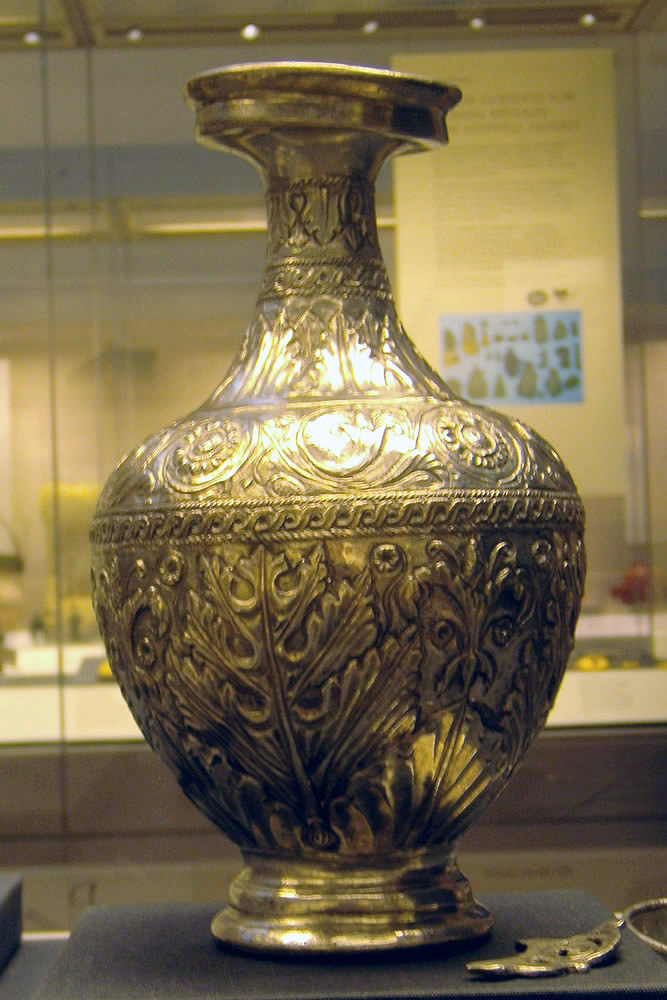
| Material and technique | Silver, mostly hammered and burnished, with repousse and incised vegetal and geometric decoration on the more elaborate jug and hanging bowl; the votive plaques are incised or repousse sheet silver, two with traces of gilding; one item, the disc, is sheet gold.1 |
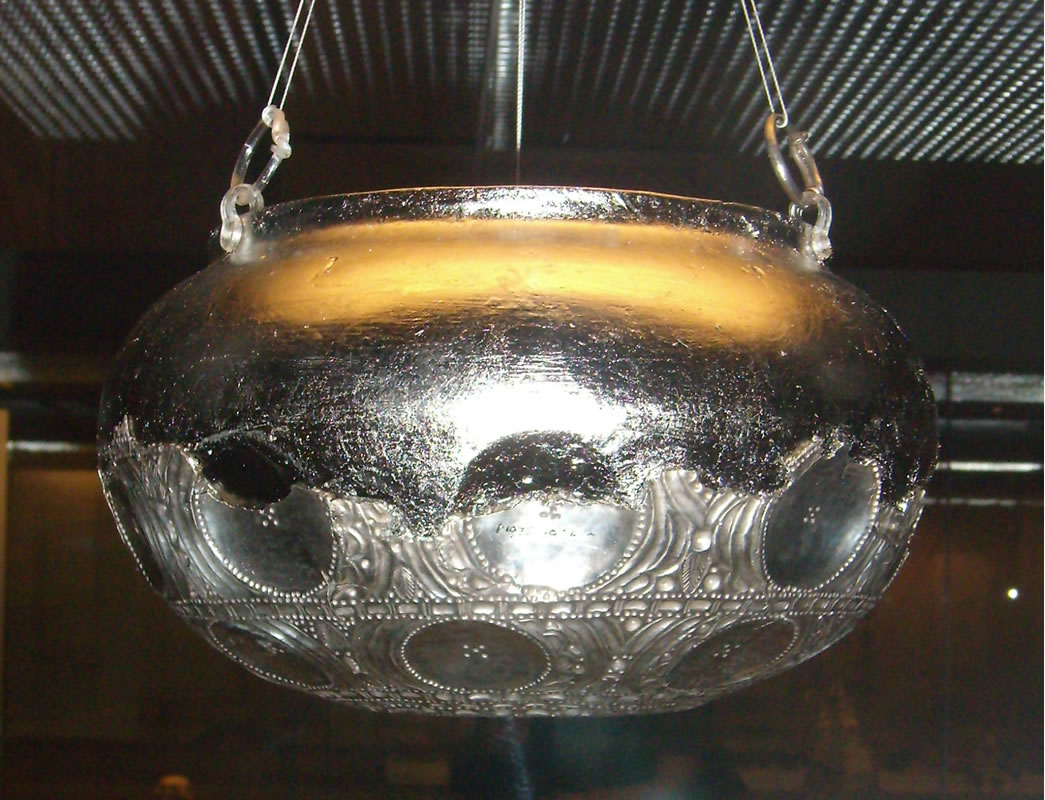
| Key vessel dimensions and weights | Cantharus (two-handled cup), 12.5 cm tall, 316 g (inv. 1975,1002.6); inscribed bowl bearing the Publianus dedication, 11.5 cm high, 17 cm wide, 663 g; decorated jug, 20.3 cm high, 534 g; fragmentary hanging bowl, 18-19 cm wide, 220.4 g.2 |
| Dating basis | Second half of the 4th century to the early 5th century AD, established from the shape of the vessels, the content and lettering of the votive inscriptions, and comparison with vessels in the Hoxne hoard, buried between AD 407 and 450. No coin was found with the group to provide an independent fixed date.1 |
| Inscriptions | A Latin hexameter dedication by Publianus on one bowl (sanctum altare tuum, Domine, subnixus honoro); a fragmentary joint dedication naming Innocentia and Viventia on a second bowl; a votive formula on one plaque reading amcilla votum quo[d] promisit complevit; chi-rho monograms, in several cases combined with alpha and omega, on nine of the seventeen plaques and on the gold disc.1 |
| Condition and burial arrangement | The objects were found packed in and around the treasure's large flat dish, read by Kenneth Painter as evidence of concealment with intent to recover rather than accidental loss. Two jugs and some of the votive plaques show wear consistent with use and handling before burial; several pieces sustained further damage from the plough in 1975.1 |
Images
The record in full
Chapter 1What it is
The Water Newton Treasure is a hoard of Roman silver, twenty-six silver objects and one small gold disc, twenty-seven pieces in all, found together near the site of the Roman town of Durobrivae in...
The Water Newton Treasure is a hoard of Roman silver, twenty-six silver objects and one small gold disc, twenty-seven pieces in all, found together near the site of the Roman town of Durobrivae in Cambridgeshire. It is not one object but a group: eight silver vessels of varied shape (a two-handled cup, three bowls, two jugs, a hanging bowl and a large flat dish), a silver strainer, seventeen small triangular silver votive plaques, and the gold disc, most of the smaller pieces carrying the chi-rho monogram, the crossed Greek letters that stand for the first two letters of Christ's name.
Dated on the shape of the vessels and the content of the inscriptions to the second half of the fourth century or the early fifth, it is, on the current evidence, the earliest surviving group of Christian liturgical and votive silver from anywhere in the Roman Empire, not merely from Roman Britain. That claim rests on two things together: the objects are securely early, and several of them are inscribed with unambiguous Christian dedications naming real people. Most fourth-century Christian material that survives from the wider empire is architectural or is known only from later written inventories. Water Newton is the silver itself, put into the ground by the people who owned it.
Chapter 2The discovery, February 1975
The hoard was found during ploughing in February 1975, in a field on the site of Durobrivae, the walled Roman town at the point where Ermine Street crossed the River Nene, about seven kilometres west...
The hoard was found during ploughing in February 1975, in a field on the site of Durobrivae, the walled Roman town at the point where Ermine Street crossed the River Nene, about seven kilometres west of Peterborough. Several pieces were damaged by the plough before the find was recognised for what it was. The finder was Alan Holmes, a metal detector user with an existing interest in archaeology, who spotted what he first took for a lump of lead or pewter and realised, on closer inspection, that it was a mass of silver objects packed together around a large shallow dish.
Holmes did the one thing that mattered most for what came after: he kept the objects together, uncleaned, rather than separating or scrubbing them. That decision preserved the physical evidence of how the group had lain in the ground, evidence the British Museum was later able to use, once the treasure was in its laboratories, to confirm that the pieces had genuinely been buried together rather than assembled from different find-spots. Holmes brought in the local archaeologist John Peter Wild, who recognised the significance of the chi-rho monograms and the inscriptions and ensured the group was reported and treated as a coherent archaeological assemblage rather than picked over piece by piece.
The find was declared Treasure Trove at a coroner's inquest in 1975, the process then in force under English common law for buried gold or silver of unknown ownership, and the British Museum acquired the group the same year. The exact date of the inquest and the figure of the ex gratia reward paid are given differently, and sometimes not at all, across the secondary literature consulted for this record; neither is confirmed here, and both are flagged as open questions rather than stated as fact.
Chapter 3Durobrivae, and the world the hoard came from
Durobrivae was a walled, garrison-founded Roman town at a river crossing on Ermine Street, and by the fourth century the surrounding Nene valley was one of the most productive pottery-manufacturing...
Durobrivae was a walled, garrison-founded Roman town at a river crossing on Ermine Street, and by the fourth century the surrounding Nene valley was one of the most productive pottery-manufacturing regions in Roman Britain, the source of the distinctive Nene Valley colour-coated wares that were traded across the province from around AD 150 until the end of the fourth century. This was not a marginal backwater. It was a working, prosperous, well-connected part of late Roman Britain, and that prosperity is the plain, unglamorous explanation for why a Christian community here could afford to accumulate a set of silver vessels and plaques of genuine value rather than the cheaper base-metal or ceramic equivalents used elsewhere.
No church building of the fourth century has been securely identified at Durobrivae or anywhere else in Roman Britain. Early Christian meeting spaces in this period, in Britain and generally, are often archaeologically indistinguishable from ordinary domestic rooms, and it has been proposed, without being proven, that British Christians of this date met in adapted private houses or in re-purposed older buildings rather than in structures built for the purpose from the ground up. Whatever building this treasure furnished, if it furnished a building rather than a household at all, has not been found, and this record does not claim otherwise.
Chapter 4The vessels: shape, and how they may have been used
The largest single piece is a plain, flat silver dish, inside and around which the rest of the group was found packed, a detail that matters because it shows the treasure was concealed as one...
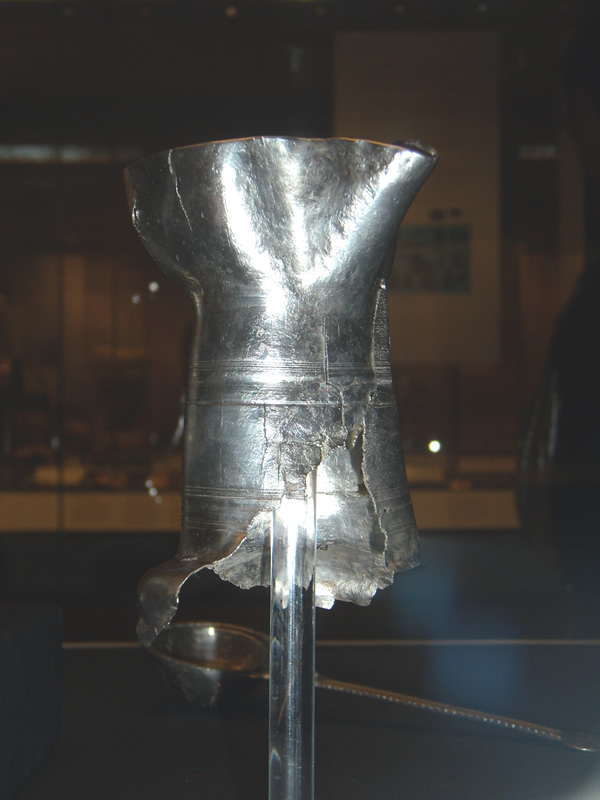
The largest single piece is a plain, flat silver dish, inside and around which the rest of the group was found packed, a detail that matters because it shows the treasure was concealed as one considered act rather than scattered by chance. Around it stood two jugs, one decorated with vegetal repousse ornament and standing 20.3 centimetres high, the other plainer and more fragmentary; three bowls, two of them carrying the group's main inscriptions; a hanging bowl with pierced suspension rings, corroded and fragmentary; a richly decorated strainer with dolphin ornament and a chi-rho terminal on its handle; and an unengraved two-handled cup in the classical cantharus form, 12.5 centimetres tall and weighing 316 grams.
None of these shapes was invented for Christian use. The cantharus descends directly from the Greco-Roman kantharos, a handled wine cup with a long association with Dionysus and convivial wine-drinking, a form that carried on being made and used with no polytheistic content at all once its owners were Christian. What identifies the Water Newton vessels as sacred is not their form but their inscriptions, their find context and, in a handful of cases, their later ritual afterlife: the cantharus shape recurs in later, securely liturgical Christian silver, including the Chalice of Gourdon in Paris and mosaic depictions of the Eucharistic chalice at San Vitale in Ravenna, which is part of why some specialists read the Water Newton cantharus as, on present evidence, the earliest object of its kind that could plausibly be called a chalice, while stressing that the identification is an inference from later comparanda rather than a certainty about this specific cup.
The hanging bowl has had two competing explanations. Kenneth Painter, the scholar who first catalogued the hoard, originally read it as a suspended lamp. Anthea Harris and Martin Henig have since argued instead that its size and decoration fit a hand-washing vessel, tied to the ritual washing of the celebrant's hands before handling the sacred elements, a practice rooted in both Jewish and Roman domestic custom and later built into Christian liturgy. Neither reading has been shown to be simply wrong; both remain live in the literature, and this record reports them as the argued alternatives they are, not as a settled fact.
Chapter 5The donor inscriptions: reading the epigraphy
Two of the bowls, and one of the plaques, carry inscriptions long enough to name a donor and say something about intent, and this is the treasure's central piece of evidence, not a footnote to it.
Two of the bowls, and one of the plaques, carry inscriptions long enough to name a donor and say something about intent, and this is the treasure's central piece of evidence, not a footnote to it. On the base of one bowl is inscribed the single name Publianus; around its rim runs a Latin hexameter that reads sanctum altare tuum, Domine, subnixus honoro, rendered by specialists as, approximately, prostrating myself, O Lord, I honour your holy altar (or sanctuary). This is the fullest surviving statement of intent from any donor anywhere in the group, and it is the single piece of textual evidence that has done the most work in the argument that the treasure served, or was meant to serve, an altar.
A second bowl carries a fragmentary inscription naming two women, Innocentia and Viventia, in a joint dedication; the surviving letters have been read, with the missing portion restored, as recording that the two women gave the object willingly. That two of the four legible donors in this group are women, donating either together or independently, is itself worth stating plainly: it is direct, named evidence of women's active material patronage of Christian worship in fourth-century Roman Britain, not an inference from silence.
A third inscription, on one of the seventeen triangular plaques, reads amcilla votum quo[d] promisit complevit, meaning, roughly, the handmaid has fulfilled the vow that she promised, or, if amcilla functions here as a personal name rather than a common noun, (a woman called) Amcilla has fulfilled the vow she promised. Secondary sources differ on how to render this: some give the donor's name as Anicilla, treating it unambiguously as a proper name; the primary catalogue and the most recent peer-reviewed study of the treasure transcribe the word as amcilla and note the ambiguity between an inscriptional spelling of the Latin common noun ancilla, meaning female servant or handmaid, used here as a self-description, and its use as an actual personal name. This record does not resolve that ambiguity, because the surviving sources do not resolve it either, and it is recorded here as an open question rather than smoothed into a single reading.
Weight and workmanship vary noticeably between the inscribed pieces, and Painter has pointed to this variation as a plausible sign of differing means among the donors, some able to give a substantial, carefully worked bowl, others a small plaque of thin sheet silver. If that reading is right, the treasure is not the gift of one wealthy patron but an accumulation from a community of varying, and in places modest, resources, gathered, on Charles Thomas's proposal, over a period of years or decades rather than in a single act of giving.
Chapter 6The votive plaques and the gold disc
Beyond the two inscribed bowls, the treasure includes seventeen small triangular silver plaques, most decorated with an incised or repousse leaf-and-feather pattern, two showing traces of gilding...
Beyond the two inscribed bowls, the treasure includes seventeen small triangular silver plaques, most decorated with an incised or repousse leaf-and-feather pattern, two showing traces of gilding, and a single gold disc. Nine of the plaques and the gold disc carry the chi-rho monogram, in some instances combined with the Greek letters alpha and omega. One plaque and the gold disc were pierced to be joined back to back, meant, on the surviving physical evidence, to be visible from both sides at once, which argues for some form of suspended or otherwise fully exposed display rather than storage flat in a box.
The triangular leaf shape of these plaques was not new. It is well attested at pre-Christian Roman temples, where comparable plaques were dedicated to deities such as Mars, Minerva and Jupiter as part of an established custom of votive giving; Kenneth Painter and, following him, Ernst Kunzl have set the Water Newton plaques directly against that pagan votive tradition. What is new at Water Newton is the addressee: the same practice of donating a small precious-metal plaque as a personal act of devotion, redirected, in a Christian idiom and under a Christian sign, to the god of a monotheistic congregation rather than to one deity among many. Several of the plaques carry pierced holes whose function is not certain; proposals include pinning to a wooden support, hanging from a beam or branch within the sacred space, or, for at least one plaque, sewing to an altar cloth or curtain, and more than one method may have coexisted within the group.
Chapter 7Continuity with older custom, given new meaning
The strongest thread running through recent scholarship on this hoard is not a hidden or esoteric meaning but a documented, ordinary one: this is late Roman society continuing its existing material...
The strongest thread running through recent scholarship on this hoard is not a hidden or esoteric meaning but a documented, ordinary one: this is late Roman society continuing its existing material vocabulary of devotion, the votive plaque, the handled wine cup, the vessel donated to a sacred space, and re-addressing that vocabulary to a new god, without inventing new forms to do it. The cantharus shape's link to wine and, through wine, to a specific god of the old pantheon did not disqualify it for Christian use; if anything, the shared association between a handled cup and wine made the form an intuitively legible vessel for the wine of the Eucharist once the underlying belief had changed. The same argument applies to the votive plaque: a Christian congregation at Durobrivae used a form their pagan neighbours would have recognised instantly, because the act of giving a small precious object in thanks or petition to a god was already a shared cultural habit, and Christianity did not need to abolish the habit, only its object.
This is, in the terms this publication uses to weigh such claims, an argued continuity, made by named specialists working from the objects and from parallel material (temple votive assemblages, later church silver, the pattern of Roman religious donation generally), not a speculative or resemblance-based one. Where the sources report the continuity as established, this record reports it as established; where an individual scholar goes further, for instance into which specific ritual moment a given vessel served, that step is reported as that scholar's argument and named as such.
Chapter 8Altar plate, or private devotional silver: the debate
Whether this group functioned as the furnishings of a communal Christian altar or as devotional silver belonging to individual Christians, kept and used privately, is a genuine, unresolved question...
Whether this group functioned as the furnishings of a communal Christian altar or as devotional silver belonging to individual Christians, kept and used privately, is a genuine, unresolved question among specialists, and this record takes no side in it.
Kenneth Painter, who produced the first full catalogue of the treasure in 1977 and has written on it repeatedly since, reads the group as liturgical and votive: the Publianus inscription's direct address to an altare is, for Painter, the decisive piece of evidence, and he has argued that the Eucharist, an offertory rite, or baptism could all plausibly have involved the treasure's vessels without excluding one another, since the objects need not have served only a single fixed function. Painter has also directly and explicitly rejected an alternative proposed by Beat Brenk, who suggested the hoard represented the private silver of a wealthy individual household rather than a congregation's shared plate; Painter's rejection of Brenk's private-ownership reading is on record in the specialist literature, though it has not ended the wider debate about function.
A further, distinct proposal comes from William H. C. Frend, who suggested reading the Publianus bowl specifically as evidence of a cult of relics in the Romano-British church, an argument Painter has also examined and, on the current secondary literature, not accepted. Charles Thomas, meanwhile, has offered a context rather than a verdict: he proposes that a local Christian community reused an existing building at Durobrivae, tentatively suggesting a former temple, as its shrine, and that the treasure's objects were donated into that shrine over an extended period as individual acts of piety, which would be consistent with either the altar-plate or the private-devotion reading and does not itself decide between them.
No consensus resolves this. The honest state of the scholarship, reported here rather than adjudicated, is that the treasure's link to Christian worship is not in question, while the precise institutional setting, a functioning communal altar, a private household chapel, or something in between the two, remains open, and the objects themselves do not carry enough information to close the question.
Chapter 9Why it was buried, and why it was never recovered
The manner of burial argues for deliberate concealment with the intention of recovery, rather than loss, careless disposal, or ritual deposit meant to be permanent: the objects were found carefully...
The manner of burial argues for deliberate concealment with the intention of recovery, rather than loss, careless disposal, or ritual deposit meant to be permanent: the objects were found carefully packed in and around the treasure's large dish, a stacking Painter reads as evidence of an owner, or owners, hiding the group to keep it safe rather than giving it up. That reading underlies the conventional explanation for why the treasure went into the ground at all: concealment against some perceived threat, in a period, the early fifth century, associated in Roman Britain generally with instability at the end of formal imperial control.
An alternative explanation, preferred by some specialists working specifically on this group, reads the burial instead as a votive deposit, an intentional, permanent dedication of a shrine's accumulated silver to the ground rather than a hiding place meant to be reopened. On this reading the object of comparison is not a bandit raid or a barbarian threat but the broader ancient and late antique practice of permanently depositing votive material within or beneath a sacred site. Both explanations remain live in the literature on this specific hoard, and neither has produced the kind of decisive physical evidence, for instance, a securely dated destruction layer at a nearby building, that would settle the matter. Why the treasure was never recovered is, on the current evidence, simply unknown: no record identifies what happened to whoever buried it.
Chapter 10Dating the treasure
The dating rests on three converging strands rather than one.
The dating rests on three converging strands rather than one. First, the shape of the vessels: the cantharus, the jugs and the bowls sit comfortably within known fourth-century Roman silver typology. Second, the content and lettering of the votive inscriptions, which specialists read as consistent with fourth-century Latin epigraphic practice. Third, and most specifically, direct comparison with vessels in the Hoxne hoard, a much larger and later Romano-British treasure buried between AD 407 and 450, whose overlapping vessel forms have been used to anchor Water Newton's own date within the second half of the fourth century, extending, on the burial evidence, into the early years of the fifth. No coin was found with the Water Newton group to give an independent, fixed terminus, which is why the dating is expressed as a range rather than a single year, and why it depends on comparative typology rather than a numismatic anchor.
Chapter 11Water Newton in the wider picture of Christianity in Roman Britain
Set beside what else survives of fourth-century British Christianity, Water Newton is unusual for being silver rather than paint or stone, and for naming real individuals rather than showing an...
Set beside what else survives of fourth-century British Christianity, Water Newton is unusual for being silver rather than paint or stone, and for naming real individuals rather than showing an anonymous image. The Edict of Milan in 313 ended imperial persecution across the empire, and the following year Constantine convened the Council of Arles, the first Church council summoned by a Roman emperor, at which three British bishops are recorded as present, Eborius of York, Restitutus of London and a third, Adelfius, associated with a British provincial capital, possibly Lincoln, evidence that the British church was organised on a formal, regional basis with metropolitan sees within a generation of legalisation.
The best-known other survivals are visual rather than textual: the chi-rho wall painting from the house-church at Lullingstone Roman Villa in Kent, of the mid-fourth century and now displayed in the British Museum, and the chi-rho mosaic bust identified as a depiction of Christ at Hinton St Mary in Dorset, also fourth-century and also in the British Museum's collection. Both show the same symbol that dominates the Water Newton plaques and the gold disc. What Water Newton adds that neither of those sites can, is named people: Publianus, Innocentia, Viventia and the donor read as Amcilla or Anicilla are, on present evidence, among the earliest individually named lay Christians known from Roman Britain by their own dedicatory words rather than by later record.
Chapter 12Acquisition, and where it stands now
The treasure passed to the British Museum in 1975, the year of its discovery, following the treasure trove inquest that vested ownership in the Crown and gave the Museum first right to acquire it...
The treasure passed to the British Museum in 1975, the year of its discovery, following the treasure trove inquest that vested ownership in the Crown and gave the Museum first right to acquire it, with an ex gratia reward due to the finder under the law then in force; under that pre-1996 common law regime, the legal entitlement to the reward rested with the finder, and any sharing with the landowner was a matter of private, unenforced convention rather than statutory right. The precise figure paid in this case is not confirmed in the sources consulted for this record.
Since then the group has remained in the British Museum's permanent collection, normally shown in Room 49 among the Museum's Roman Britain material, with the exception of a temporary loan of part of the group back to Peterborough Museum and Art Gallery, on public display there until January 2019 as part of an exhibition bringing regional finds home for a period; replicas of the treasure are otherwise kept on permanent view at Peterborough Museum. Scholarly attention to the group has not stopped: the fullest technical study remains Kenneth Painter's 1977 catalogue, revisited and extended in his own later articles, and the treasure continues to generate new peer-reviewed research into the twenty-first century, most recently a 2026 study reassessing its vessels object by object against the wider written and material evidence for how the late antique Christian altar was furnished, a reminder that a find fifty years old is still an active subject of research rather than a settled museum label.
The artist
The votive donors of the Water Newton congregation
No maker's name survives for any object in this hoard, and none is likely to. What survives instead, and what this dossier covers in place of a silversmith's biography, is the record of the people who gave the silver: four individuals named or partly legible in the inscriptions, set against everything that can be established about the wider custom of Christian and pre-Christian votive giving that their gifts belong to.
Related works
| Work | Relation | Where it is |
|---|---|---|
| Chalice of Gourdon Unknown Gallo-Roman workshop | Closest later Western European parallel in the handled, cantharus-derived chalice form Late 5th century, found in a treasure near Gourdon in south-eastern France; proposed by Marco Aimone as private communion silver for its owner, its vine-and-griffin decoration read as evoking both wine and Christ. | Bibliotheque nationale de France, Paris |
| Ardaburius and Anthousa Chalice Unknown Eastern Mediterranean workshop | 5th-century parallel handled chalice, closer to a classical scyphus than to the Water Newton cantharus form inv. BZ.1959.66. | Dumbarton Oaks Collection, Washington DC |
| Chi-rho wall painting from the house-church Unknown | The other principal survival of named, material Christian devotion in 4th-century Roman Britain, from a domestic rather than a hoarded context Mid-4th century; among the only known Christian paintings surviving from Roman Britain. | British Museum, London (excavated at Lullingstone Roman Villa, Kent) |
| Hinton St Mary Mosaic Unknown | Another 4th-century British find carrying the chi-rho monogram, in mosaic rather than silver A roundel generally read as showing a bust of Christ, found in a Roman villa pavement in Dorset. | British Museum, London |
| Chaourse Treasure Unknown Gallo-Roman workshop | Form parallel only, not a Christian object: cited by Painter for comparison with the Water Newton hanging bowl's facetted shape A secular Gallo-Roman silver hoard of the mid-3rd century; included here as a comparandum for vessel shape, not for religious content, and should not be read as evidence of the same kind of assemblage as Water Newton. | British Museum, London |
Open questions
- Did this group furnish a communal Christian altar, or was it private devotional silver belonging to one or more individual Christians? Named specialists hold both positions and the objects themselves do not settle it.
- Why was the treasure buried, and why was it never recovered: concealment against a perceived threat, or a permanent votive deposit? Both readings remain current in the specialist literature on this specific hoard.
- Where did the sanctuary or household this treasure served actually stand? Charles Thomas has proposed a re-purposed building at Durobrivae, tentatively a former temple, but no such building has been archaeologically identified.
- Is the donor named on the votive plaque a person called Amcilla (or Anicilla), or is amcilla the common Latin noun ancilla, handmaid, used there as a self-description rather than a proper name? The primary catalogue records the ambiguity; it is not resolved in the sources consulted.
- How many individual donors does the treasure as a whole represent? Only four are named or partly legible (Publianus, Innocentia, Viventia, and the donor read as Amcilla); the plain vessels and eight of the plaques carry no name at all.
- What was the exact date of the 1975 treasure trove inquest, and what ex gratia reward was actually paid to the finder? Figures and dates given across secondary sources for this were not confirmed to this record's standard and are not stated as fact here.
- What was the total weight of the assembled hoard? Individual vessel weights are recorded in the literature consulted; a combined total was not found.
Questions about this object
What is The Water Newton Treasure?
The Water Newton Treasure is a silver, dated second half of the 4th century to the early 5th century AD. Medium: Silver (hammered, repousse, incised and partly gilded sheet and vessels) and gold (one sheet disc).
Who made The Water Newton Treasure, and is the attribution settled?
The attribution to Unknown Romano-British silversmith(s); silver donated by named and unnamed members of a Christian congregation at or near Durobrivae is recorded here as unknown. No maker, workshop or silversmith is named or otherwise identifiable for any object in the hoard. What survives is a record of donors, not of makers: four individuals are named or partly legible in the votive inscriptions, Publianus, Innocentia, Viventia and a fourth read as Amcilla (or, in some renderings, Anicilla), but nothing in the surviving evidence ties any of them, or anyone else, to the actual manufacture of the silver. The plain, uninscribed pieces cannot be attributed to anyone at all.
Where is The Water Newton Treasure now?
The British Museum, London (Room 49, Roman Britain gallery). A group of the objects was lent to Peterborough Museum and Art Gallery for the exhibition Peterborough Treasures: Coming Home, on display there until January 2019; replicas are otherwise shown at Peterborough Museum. Inventory number 1975,1002.1 to 1975,1002.27. Last confirmed 28 September 2026. Declared Treasure Trove after the February 1975 discovery near Durobrivae and acquired by the British Museum the same year under the pre-1996 English common law of treasure trove, which vested ownership of such finds in the Crown.
What is still unknown about The Water Newton Treasure?
Did this group furnish a communal Christian altar, or was it private devotional silver belonging to one or more individual Christians? Named specialists hold both positions and the objects themselves do not settle it.
Sources
- 1Samaretz, Nicolas. "Altar Space in Late Antiquity: The Water Newton Treasure and the Construction of the Sacred Space." Eikon Imago 15, e98767 (2026), Masaryk University / University of Fribourg. dx.doi.org/10.5209/...
- 2Painter's 1977 catalogue where a library copy can be consulted directly. en.wikipedia.org/wiki/...
- 3Peterborough Archaeology, "The Water Newton Treasure." peterborougharchaeology.org/water-newton-treasure
- 4Discover Peterborough, "The Water Newton Treasure: Roman Peterborough's Christian Silver." discoverpeterborough.co.uk/peterborough-objects/...
- 5Fenland Heritage Network, "FenArch Talk - The Water Newton Treasure" (talk by Phil Hill, FRAG Site Officer, Oxford Archaeology East, 23 March 2022). fenlandheritagenetwork.co.uk/all-events/...
- 6Metal Detecting UK (detecting.org.uk), "The Water Newton Treasure." detecting.org.uk/html/...
- 7Valentine (Tartanplace), "Treasure Trove Law In England and Wales," for the pre-1996 common law regime under which the 1975 find was processed. valentine.tartanplace.com/tartanillus/...
- 8Wikipedia, "Christianity in Roman Britain." source, used for general context (Council of Arles, 314) rather than for any fact specific to this object. en.wikipedia.org/wiki/...
- 9Wikipedia, "Lullingstone Roman Villa," for the display location of the site's chi-rho wall paintings. en.wikipedia.org/wiki/...
- 10Wikimedia Commons, File:Water newton cantharus.jpg, description page (inventory, dimensions, licence and photographer credit). commons.wikimedia.org/wiki/...
- 11Wikimedia Commons, File:Silver vessel hanging.jpg, description page (category: Hanging bowls; licence and photographer credit). commons.wikimedia.org/wiki/...
- 12Wikimedia Commons, File:Vase 1.jpg, description page (licence and photographer credit). commons.wikimedia.org/wiki/...
- 13Wikimedia Commons, File:Head of vessel.jpg, description page (licence and photographer credit). commons.wikimedia.org/wiki/...
- 14Wikimedia Commons, File:Cup-text.jpg, description page (licence CC BY 3.0 and photographer credit). commons.wikimedia.org/wiki/...


Last verified · Published
Change log
28 September 2026 - Record created at the house standard: researched narrative, technical evidence, maker dossier, graded provenance chain, prices with hammer and premium separated, related works, open questions and sources.