The Hunt-Lenox Globe
Unknown maker · c. 1504-1510 (disputed). The New York Public Library and most secondary sources give c. 1508 or c. 1510. A narrower c. 1504-1506 date is cited only in connection with Stefaan Missinne's contested 2013 claim that the globe was cast from his privately owned Ostrich Egg Globe.
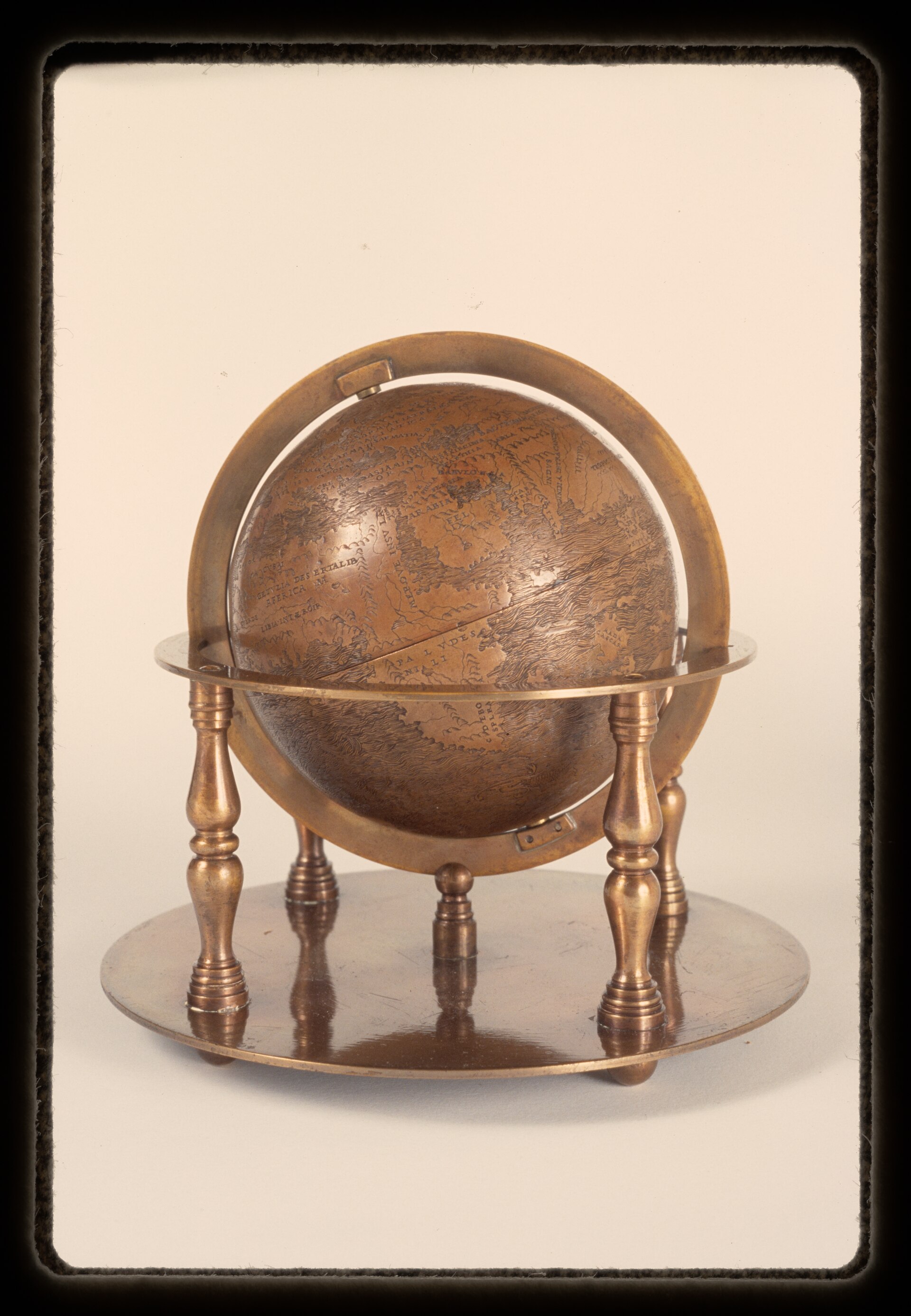
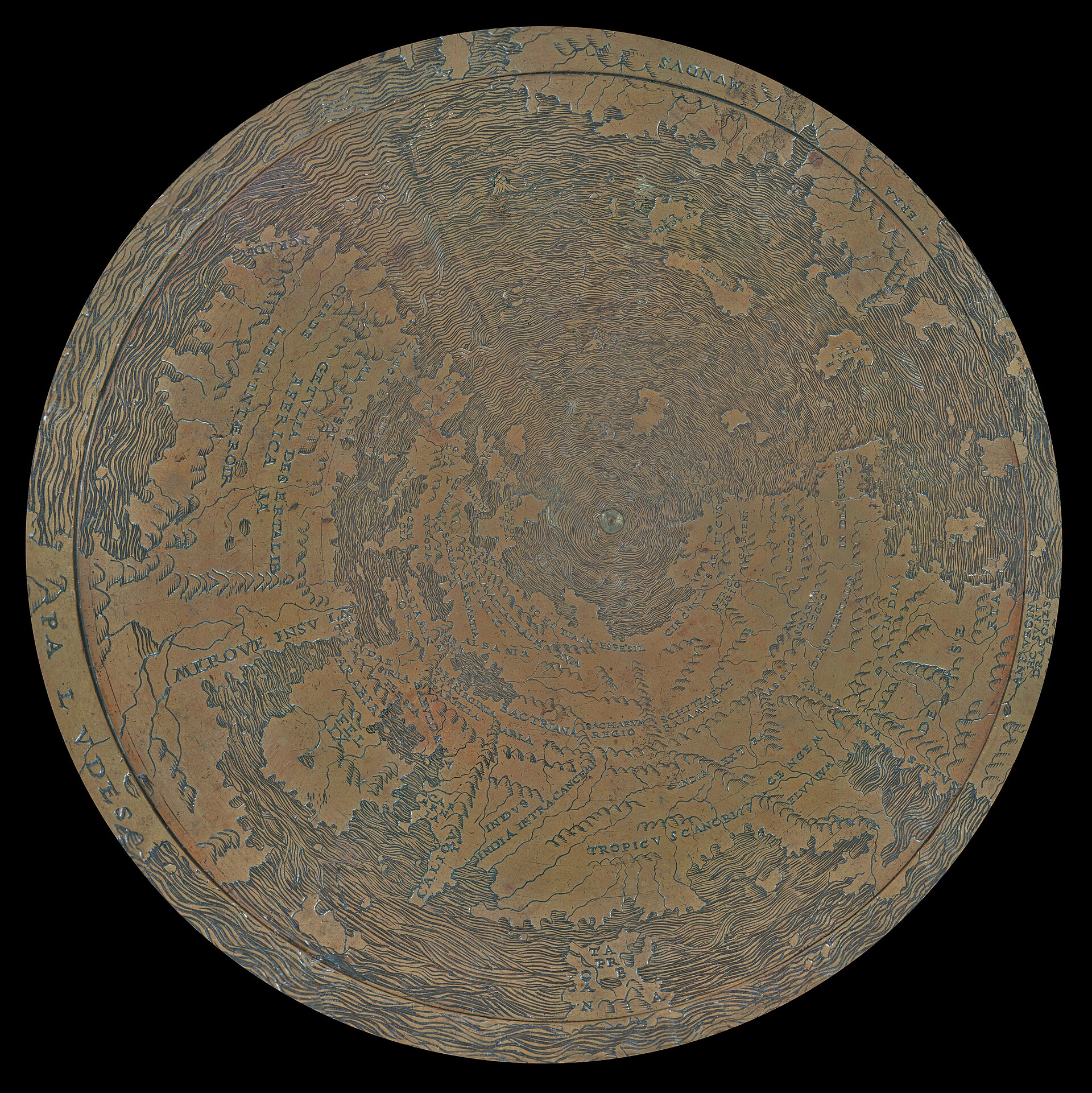
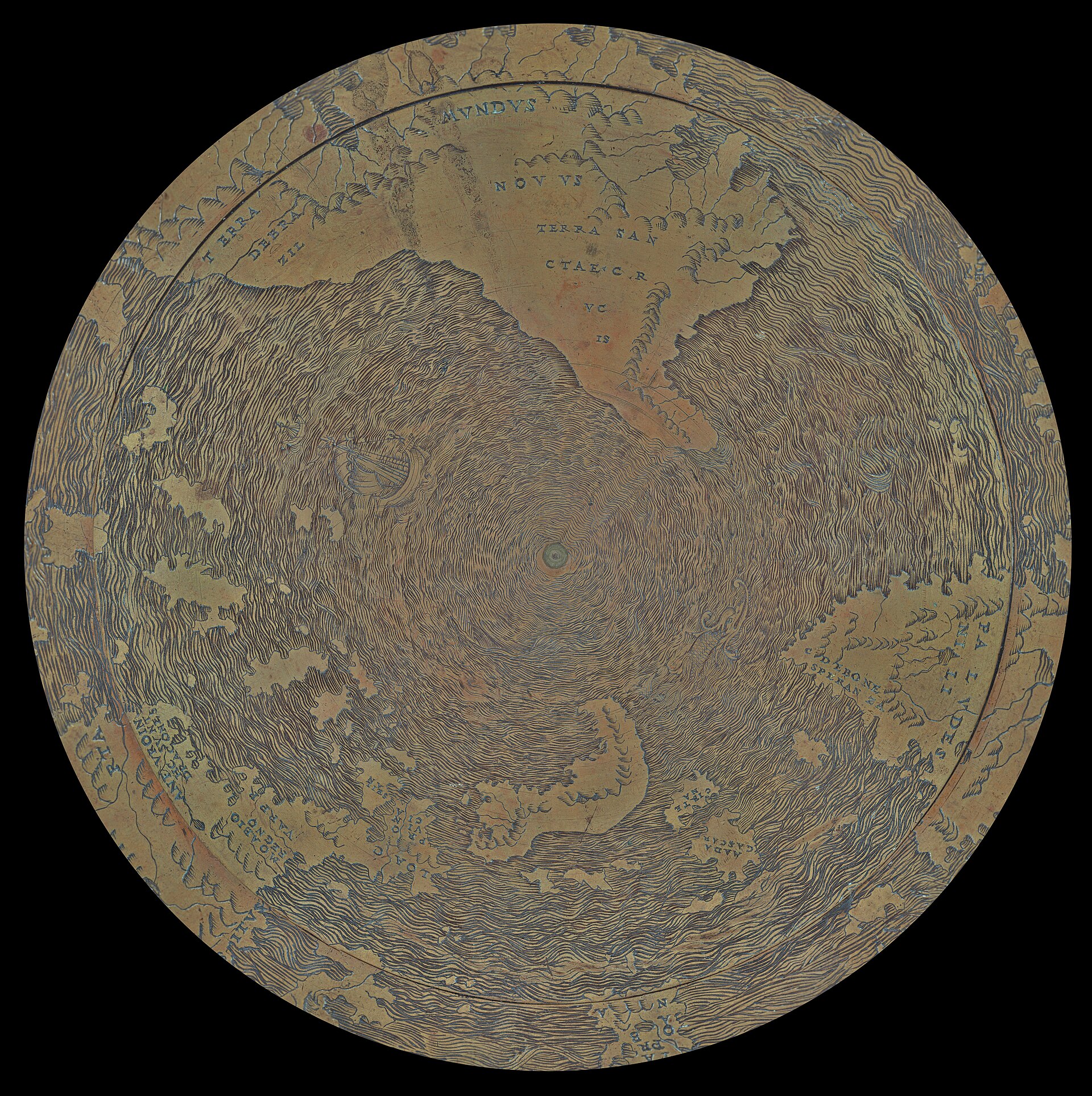
Full color view of the globe on its modern display stand. The engraved copper surface, worn dark with age, is visible across both hemispheres.
| Artist | Unknown maker |
|---|---|
| Date | c. 1504-1510 (disputed). The New York Public Library and most secondary sources give c. 1508 or c. 1510. A narrower c. 1504-1506 date is cited only in connection with Stefaan Missinne's contested 2013 claim that the globe was cast from his privately owned Ostrich Egg Globe. |
| Medium | Copper, engraved (or, per a contested theory, cast); two hollow hemispheres of a reddish copper alloy roughly 2 mm thick, joined at the equator and pierced at the north and south poles |
| Dimensions | c. 112 mm (4.4 in) diameter |
| Where it is now | New York Public Library, Rare Book Division, New Yorklast confirmed |
| Inventory number | Hunt-Lenox Globe, NYPL Digital Collections; held among the founding Lenox Library holdings |
| Attribution | UnknownNo maker's mark, signature, or contemporary document names an individual or workshop. Full note |
| Object type | Map |
| Period | Age of Discovery, early sixteenth century |
| Cases | Has a provenance gap |
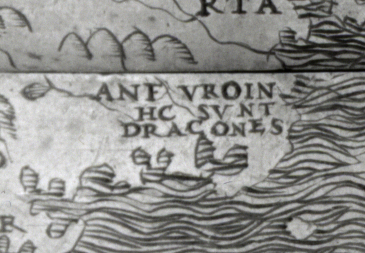
| Inscriptions | HC SVNT DRACONES (HIC SVNT DRACONES), engraved just below the equator on the east coast of Asia. New World toponyms include ISABEL (Cuba), SPAGNOLLA (Hispaniola), and, for South America, TERRA DE BRAZIL, MVNDVS NOVVS, and TERRA SANCTAE CRVCIS. |
| Owners on record | 5 links3 documented, 2 unknown |
| Sources | 10 cited |
About this record Last verified · 10 sources cited · Change log
On this page 9 sections
ContentsClose
A small hollow copper globe, about 112 millimetres across, engraved in the early sixteenth century by a maker no source names and dated by disputing scholars anywhere from about 1504 to about 1510. It is held today by the New York Public Library, and it carries, near the coast of eastern Asia, the only confirmed historical use of the Latin phrase HC SVNT DRACONES, here are dragons, on any surviving map or globe.
It reached the library by an accident of two names: bought for a trifle in Paris in 1855 by the architect Richard Morris Hunt, who let his children play with it, and recognized as significant only fifteen years later by the bookdealer Henry Stevens, who placed it with the library James Lenox was building and Hunt himself was designing. Who actually made it remains unresolved. A twentieth-century historian linked its workmanship to a globe in Krakow without naming a maker; a twenty-first-century collector has argued, more dramatically and more controversially, that it was cast from a privately owned globe engraved on an ostrich egg, by a hand connected to Leonardo da Vinci's workshop. That claim has drawn direct, named criticism and has not been accepted.
It is not the Waldseemuller 1507 world map already recorded on this site, a separate, flat, printed object with no documented connection to this globe beyond sharing a decade. What the two do share is the argument this record makes throughout: where the evidence stops, the record says so, rather than filling the gap.
Provenance
Each link is graded. Documented: a cited source supports it. Disputed: the identification is argued but not established. Unknown: no owner for that span, and the gap is not smoothed into a narrative. The grades in the glossary.
- Unknown, unrecordedunknown
No maker, patron, or first owner is documented anywhere in the sources consulted for this record. The date of manufacture is itself disputed, generally placed between about 1504 and 1510.12
- c. 1504-1510 - 1855Unrecordedunknown
No owner, location, or intermediate event is documented between the globe's disputed date of manufacture and its purchase in Paris in 1855, an undocumented gap of roughly three and a half centuries.1
- 1855 - c. 1870Richard Morris Hunt (1828-1895), American architectdocumented
Purchased in Paris in 1855. Hunt later recalled buying it 'for a song' and treated it as a household curiosity for roughly fifteen years, at one point allowing his own children to handle it as a toy.1
- c. 1870 - 1895James Lenox and the Lenox Library, New Yorkdocumented
Bookdealer Henry Stevens, dining with Hunt in 1870, recognized the globe's significance and urged him to place it in the Lenox Library, which Hunt was then designing as its architect for collector James Lenox. Stevens subsequently borrowed the globe and consulted Julius Erasmus Hilgard of the U.S. Coast Survey to help establish its age.1
- 23 May 1895 - presentNew York Public Library, Rare Book Divisiondocumented
The Lenox Library was consolidated with the Astor Library and the Tilden Trust on 23 May 1895 to form the New York Public Library. The globe passed into the new institution as part of the Lenox Library's contribution and remains there, now digitized and displayed in the Rare Book Division.15
Technical evidence
| Attribution note | No maker's mark, signature, or contemporary document names an individual or workshop. Two attribution lines appear in the literature and neither is settled. Edward L. Stevenson, in his early twentieth-century survey of terrestrial and celestial globes, judged the Hunt-Lenox Globe and the Jagiellonian Globe in Krakow to 'appear to be the work of the same globe maker or copies of a common original,' without naming that maker; a French origin for the globe is separately cited in the literature without a supporting argument. Separately, globe collector and researcher Stefaan Missinne argued in 2013 that the Hunt-Lenox Globe was not engraved at all but cast from a privately owned globe engraved on an ostrich egg, itself linked by Missinne to the workshop tradition of Leonardo da Vinci. That claim is disputed: it has been characterized as a fringe theory, criticized on methodological grounds by reviewer Wouter Bracke, questioned on provenance grounds by Library of Congress curator John Hessler, and Missinne was expelled from the International Coronelli Society for the Study of Globes in 2024 after disputes with other researchers over it. |
|---|---|
| Material | Reddish copper alloy, hollow, cast or engraved in two hemispheres roughly 2 mm thick, joined at the equatorial seam.2 |
| Dimensions | c. 112 mm (4.4 in) diameter.12 |
| Surface condition | A 1904 New York Public Library bulletin described the globe as hollow red copper without any green or black patina.1 |
| Construction detail | Pierced at the north and south poles for an axis, taken by early researchers as evidence it was made for, or later adapted for use within, an armillary sphere.1 |
| Principal inscription | HC SVNT DRACONES, engraved just below the equator on the east coast of Asia.14 |
| New World toponyms | ISABEL (Cuba), SPAGNOLLA (Hispaniola), and on South America simultaneously TERRA DE BRAZIL, MVNDVS NOVVS and TERRA SANCTAE CRVCIS.2 |
| Closest documented comparanda | Edward L. Stevenson judged the globe closely related to the Jagiellonian Globe (Krakow, c. 1510) in his history of terrestrial and celestial globes, describing them as possibly by the same maker or copies of a common original.2 |
| Dating investigations | Assessed informally in the 1870s by Julius Erasmus Hilgard of the U.S. Coast Survey at Henry Stevens's request; imaged and 3D-modeled in 2020 by the University of Rochester's Lazarus Project (Gregory Heyworth, director; Chet Van Duzer, cartographic historian) for condition documentation.13 |
Images
The record in full
Chapter 1What it is
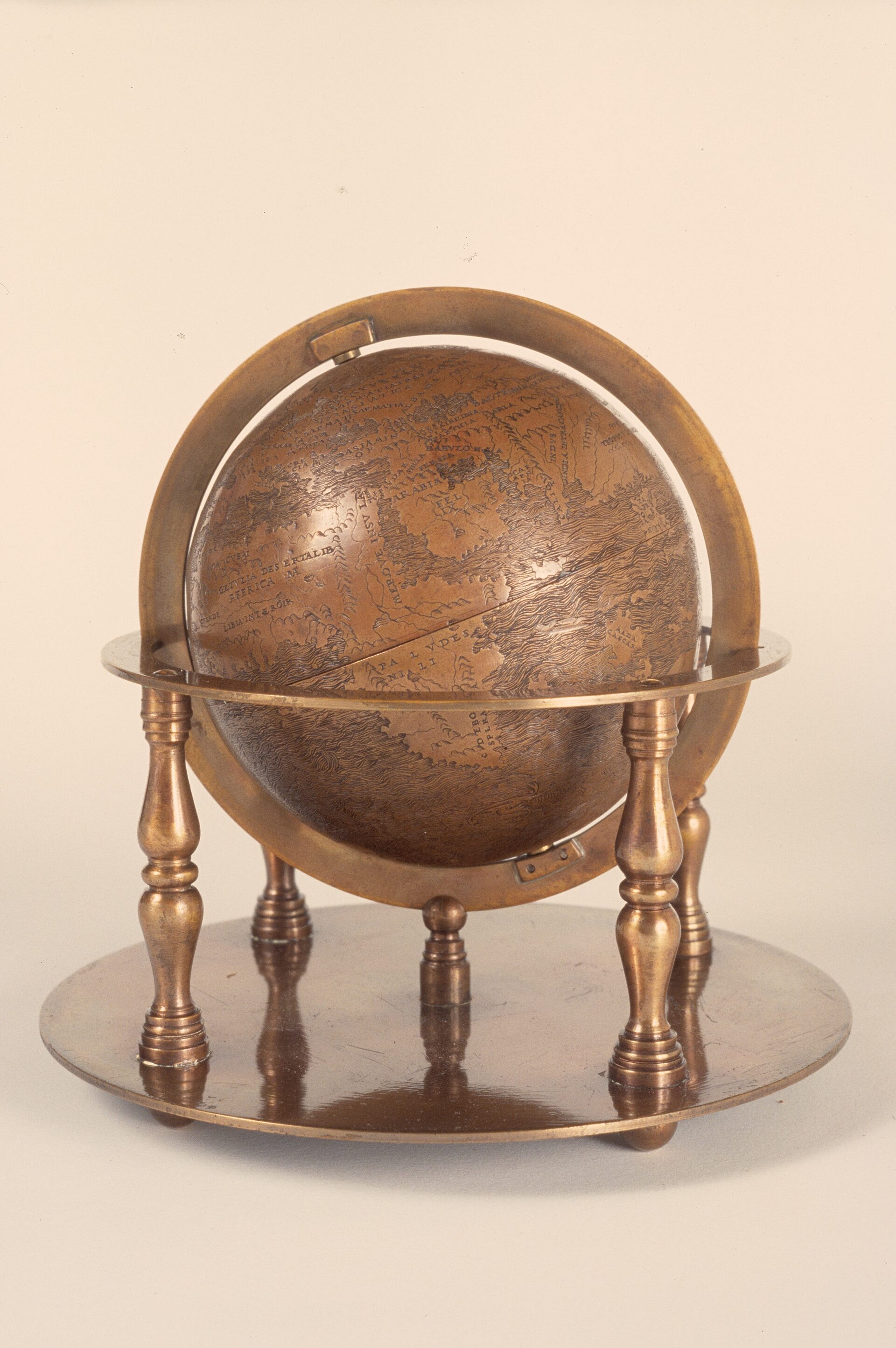
The Hunt-Lenox Globe is a small hollow sphere of reddish copper, about 112 millimetres in diameter, close to the size of a grapefruit and small enough to sit in one hand.
The Hunt-Lenox Globe is a small hollow sphere of reddish copper, about 112 millimetres in diameter, close to the size of a grapefruit and small enough to sit in one hand. It is made of two hemispheres, each roughly 2 millimetres thick, joined along the equator, and pierced at the north and south poles. Early cataloguers took that piercing as a sign it was made for, or later fitted into, an armillary sphere, an astronomical instrument that holds a terrestrial globe inside a set of rotating rings.
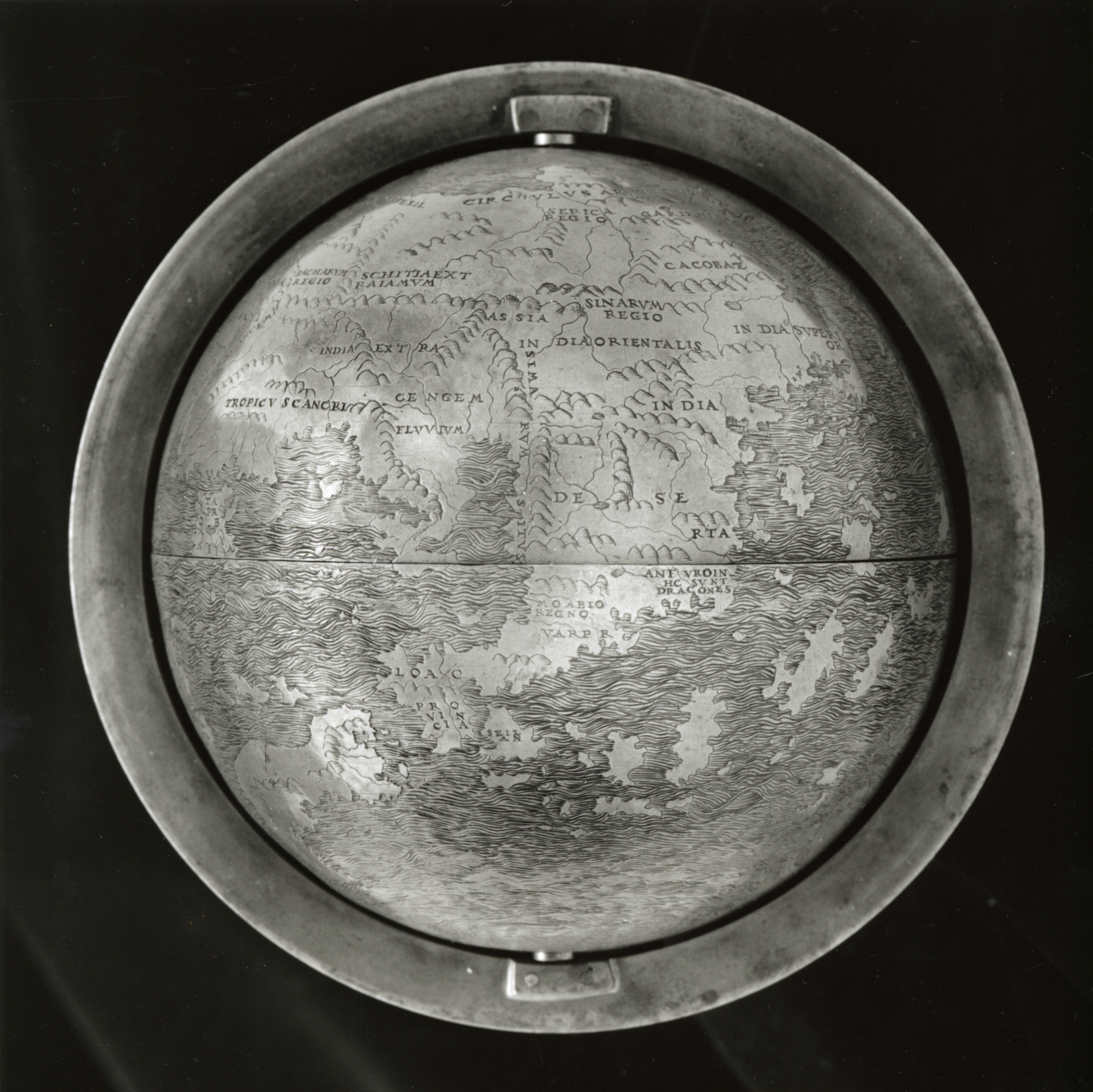
Engraved into the copper is a map of the known and imagined world as of the very early sixteenth century: the coastlines of Europe, Africa and Asia drawn from the Ptolemaic tradition, and, in the west, a tentative and incomplete rendering of the lands reached by Columbus and the voyages that followed him. It now stands on a modern mount for display and study at the New York Public Library, which holds it in the Rare Book Division.
Chapter 2How it was made
The conventional and long-unquestioned account is that the globe was engraved directly into the copper by hand, hemisphere by hemisphere, before the two halves were joined.
The conventional and long-unquestioned account is that the globe was engraved directly into the copper by hand, hemisphere by hemisphere, before the two halves were joined. That account has been challenged only once, by Stefaan Missinne in 2013, who argued instead that the globe was cast, using a specific and unusual lost-wax technique, from a wax intermediate model taken off a different object entirely: a globe he owns that is engraved on the conjoined lower halves of two ostrich eggs. That claim is examined on its own terms further in this record, because it remains disputed rather than accepted.
Whichever process produced it, the polar piercing is a separate and better-attested physical fact: the globe carries the marks of having been mounted on an axis, whether from the outset or in a later adaptation, and that detail is part of what early researchers used to judge its age and function.
Chapter 3The only confirmed use of a phrase now world-famous
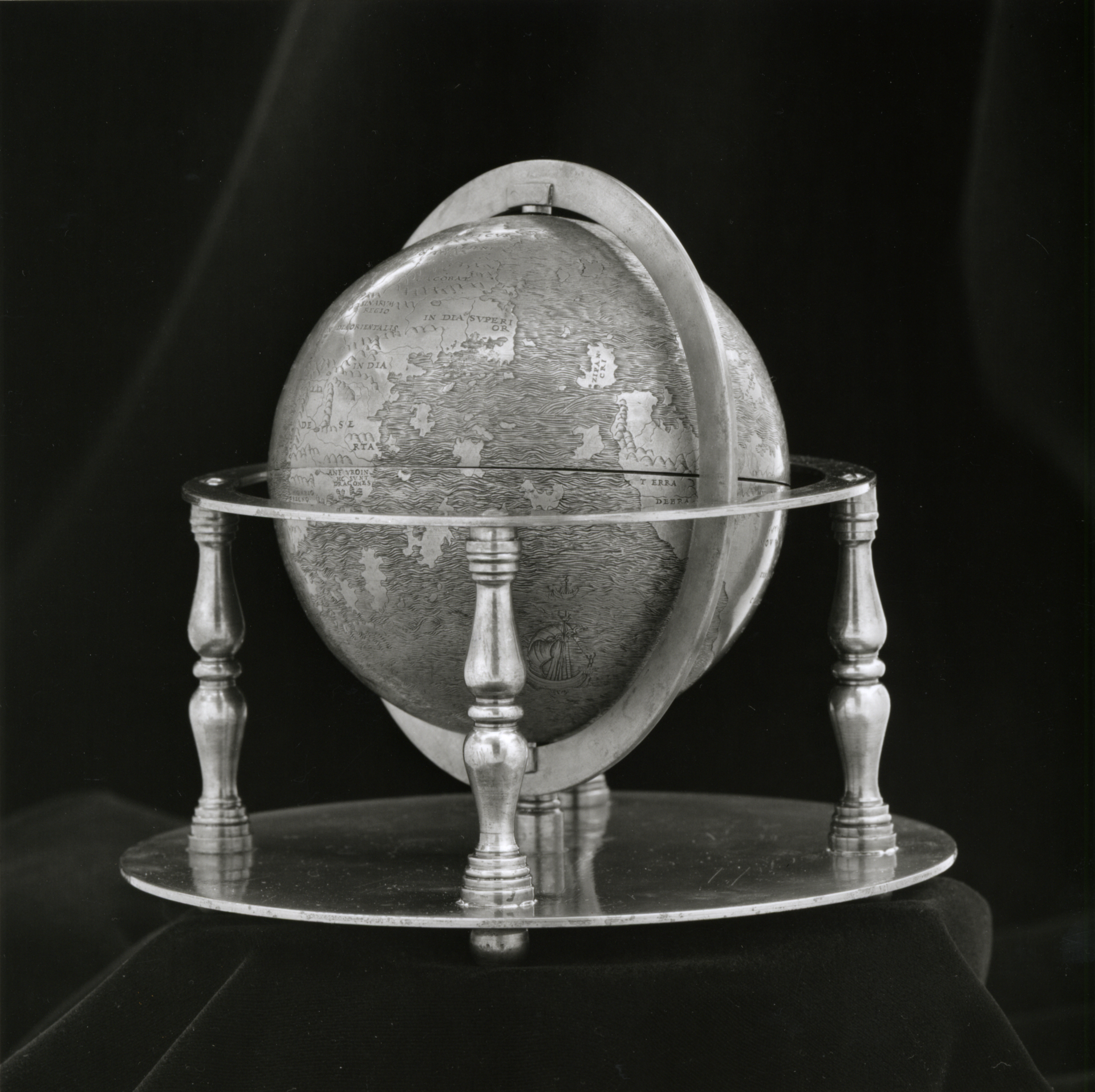
Just below the equator, on the eastern coast of Asia, the globe carries the words HC SVNT DRACONES, an abbreviated Latin rendering of HIC SVNT DRACONES, 'here are dragons.' Of every surviving...
Just below the equator, on the eastern coast of Asia, the globe carries the words HC SVNT DRACONES, an abbreviated Latin rendering of HIC SVNT DRACONES, 'here are dragons.' Of every surviving medieval and Renaissance map or globe examined by cartographic historians, this is the only one confirmed to use that exact phrase. The far more common convention on maps of the period marking unknown or dangerous territory was HIC SVNT LEONES, 'here are lions,' a formula with roots in older, non-cartographic Latin usage for marking the edge of the known world.
A second, separate claim, associated with Stefaan Missinne's Ostrich Egg Globe, holds that an equivalent inscription appears on that object too, which would make it the second known instance. That claim depends on accepting the Ostrich Egg Globe's own disputed dating and its disputed relationship to the Hunt-Lenox Globe, discussed below, and this record does not treat it as independently confirmed.
Chapter 4What the dragons may have meant
What HC SVNT DRACONES was actually meant to warn of is not settled, and the earliest scholarship on the globe did not even read it as a reference to dragons.
What HC SVNT DRACONES was actually meant to warn of is not settled, and the earliest scholarship on the globe did not even read it as a reference to dragons. B. F. De Costa, writing the first known article on the globe in 1879, read the inscription as a garbled reference to the Dagroians, a people described by Marco Polo as inhabiting the Kingdom of Dagroian and, in Polo's account, given to eating the flesh of the recently dead. Gabriel Gravier, translating and annotating De Costa's article for a French journal later that year, added that Polo's Dagroian was actually located in Java Minor or Sumatra, well away from the spot marked on the globe, a correction that undercuts De Costa's reading without resolving what the inscription does refer to.
A separate and more recent explanation, repeated widely in institutional and popular accounts of the globe including the New York Public Library's own descriptions, proposes that the phrase may echo early Portuguese and Chinese trade reports of the Komodo dragon and other large reptiles native to the Indonesian archipelago, roughly the region where the inscription sits on the globe's Asian coastline. This record has not located a named academic study making that specific case in the sources consulted; it circulates as an institutional and popular explanation rather than a documented scholarly argument, and is presented here as such. A third, more general possibility, consistent with the rarity of the exact phrase, is that it functioned simply as a stock cartographic warning device, a variant of HIC SVNT LEONES adapted for a mapmaker's own purposes, without any specific animal or region in mind. None of these three explanations has displaced the others.
Chapter 5A date nobody fully agrees on
The globe's date is disputed across a real range, not a rounding difference.
The globe's date is disputed across a real range, not a rounding difference. The New York Public Library's own materials and most secondary accounts give c. 1508 or c. 1510. A narrower window of c. 1504 to 1506 appears only in Stefaan Missinne's 2013 argument, in which he reports that Rudolf Schmidt, then president of the International Coronelli Society for the Study of Globes, examined the Ostrich Egg Globe in June 2012 and judged its likely closeness in date and workmanship to the Hunt-Lenox Globe.
The dating history itself has two distinct episodes. In the 1870s, bookdealer and bibliographer Henry Stevens borrowed the globe and consulted Julius Erasmus Hilgard, a scientist with the U.S. Coast Survey, to help establish its approximate age, a study that underlies the broad early consensus placing it in the first decade of the sixteenth century. In 2020, the University of Rochester's Lazarus Project applied multispectral imaging and structure-from-motion photography to the globe under the direction of Gregory Heyworth, with cartographic historian Chet Van Duzer, and produced a detailed 3D model and condition record; this project documented the object at high resolution but is not reported, in the sources consulted for this record, to have resolved the underlying dating dispute on its own.
Chapter 6Who made it: an absence, not just a mystery
No maker's mark appears on the globe, and no contemporary document names an engraver, caster, patron, or workshop.
No maker's mark appears on the globe, and no contemporary document names an engraver, caster, patron, or workshop. That absence is itself the finding: more than a century and a half of scholarship, beginning with De Costa in 1879, has not produced a named individual accepted by the field. What exists instead are two weakly supported directional claims. Edward L. Stevenson, in his early twentieth-century history of terrestrial and celestial globes, compared the Hunt-Lenox Globe to the Jagiellonian Globe held in Krakow, and concluded the two 'appear to be the work of the same globe maker or copies of a common original,' again without naming that maker. Separately, a French origin for the Hunt-Lenox Globe is cited in the literature, again without an argument attached to it in the sources this record was able to consult.
Neither claim rises to a named maker, and this record treats the question as genuinely open rather than resolving it toward either the French suggestion or the Italian-workshop theory discussed next.
Chapter 7The Ostrich Egg Globe claim
In 2013, globe collector and researcher Stefaan Missinne published, in The Portolan, the journal of the Washington Map Society, an account of a globe he had acquired at the London Map Fair in 2012...
In 2013, globe collector and researcher Stefaan Missinne published, in The Portolan, the journal of the Washington Map Society, an account of a globe he had acquired at the London Map Fair in 2012, engraved on the conjoined lower halves of two ostrich eggs and, he argued, datable to around 1504. Missinne reported that laboratory analysis of the eggshell, including computed tomography scans and a regression analysis of shell density against known comparanda, supported an early sixteenth-century date for the shell itself, and that a sample of resin-like material inside the egg was consistent with a period varnish.
Missinne's central claim goes further than dating the egg: comparing the geography engraved on his globe with photographs and, later, a direct inspection of the Hunt-Lenox Globe at the New York Public Library, he concluded that the resemblance between the two was closer than either object's resemblance to the Jagiellonian Globe or to a set of globe gores attributed to Louis Boulengier, also held at the New York Public Library and generally dated to around 1514. From that resemblance, Missinne argued that the Hunt-Lenox Globe was cast, not engraved, from his ostrich-egg globe, using a wax intermediate model taken before the egg's two halves were finally joined, and that the ostrich-egg globe itself shows evidence of the workshop tradition of Leonardo da Vinci.
Chapter 8Why the claim is disputed
The Leonardo attribution and the casting claim built on it have not been accepted by the field.
The Leonardo attribution and the casting claim built on it have not been accepted by the field. Wikipedia's own summary of the Hunt-Lenox Globe explicitly labels Missinne's theory a fringe theory. Wouter Bracke, reviewing Missinne's later book-length treatment, The Da Vinci Globe, in 2019, wrote that it should be read as 'a report on the author's research into the globe' rather than 'a final scientific and academic publication,' and noted that the publisher's lack of an editorial board 'clearly failed to guide the author in the preparation of his publication.' Library of Congress curator John Hessler has raised a more basic concern: the ostrich-egg globe's own ownership history before Missinne acquired it in 2012 is undocumented, and Missinne is simultaneously the object's owner and its principal researcher, a structural conflict this record notes without resolving.
Other researchers, per general reporting on the dispute, have pointed to inconsistencies revealed by X-ray imaging and to imprecision in the egg globe's equatorial detail as further grounds for skepticism. In 2024, Missinne was expelled from the International Coronelli Society for the Study of Globes after disparaging scientists who had contradicted his conclusions. This record treats the casting and Leonardo claims as disputed, names Missinne as the sole author of both, and names Bracke and Hessler as the two specific critics whose objections could be traced to a documented source.
John Hessler, curator of the Geography and Map Division at the Library of Congress, has been among the most direct skeptics: he has said he has heard from several sources that Missinne is himself the anonymous owner of the ostrich-egg globe, a possible conflict of interest given that Missinne is also the discovery's principal promoter, and Missinne has declined to comment on whether he owns it. Hessler has also called the Leonardo connection specifically 'nonsense'. Separately, an international research team examining the ostrich-egg globe's authenticity concluded it is a modern synthetic replica, apparently produced during a facsimile campaign of the Hunt-Lenox Globe itself in 1984-1985 - a finding that, if it holds, would undercut Missinne's entire casting argument rather than merely dating or attributing it differently. This record does not resolve that authenticity question, which concerns the egg object rather than the Hunt-Lenox Globe directly, but notes it as the most serious outstanding challenge to the claim.
Chapter 9A different Waldseemuller object entirely
Martin Waldseemuller, whose 1507 world map Universalis Cosmographia is a separate, published record on this site, produced two distinct works that year, not one.
Martin Waldseemuller, whose 1507 world map Universalis Cosmographia is a separate, published record on this site, produced two distinct works that year, not one. The twelve-sheet wall map is a large printed flat map, the first to apply the name America to the New World. Separately, Waldseemuller and his collaborators also issued a set of printed globe gores, printed sheets meant to be cut out and pasted around a small wooden or plaster ball to form an assembled globe. Only three copies of those gores are known to survive, and none of the three was ever cut and assembled; all three remain flat printed sheets held in library collections. Had a copy been assembled, the resulting globe would have measured roughly 4.5 inches in diameter, close to the Hunt-Lenox Globe's 4.4 inches, a coincidence of scale typical of globes made to sit on a desk or within an armillary sphere rather than evidence of any connection between the two objects.
No source consulted for this record documents a shared engraver, a workshop connection, or any direct influence running between the Hunt-Lenox Globe and either of Waldseemuller's 1507 works. The two belong to the same decade and the same excitement over the newly reported Atlantic coastline, and nothing more specific than that has been established between them. Readers should not infer a maker-to-maker relationship from the coincidence of date; this record found none documented.
Chapter 10How an architect's souvenir became a named object
The globe was purchased in Paris in 1855 by Richard Morris Hunt, the American architect.
The globe was purchased in Paris in 1855 by Richard Morris Hunt, the American architect. For roughly fifteen years afterward it appears to have been treated within Hunt's household as a curiosity rather than a scholarly object. In his own later recollections, bookdealer Henry Stevens described dining with Hunt in 1870 and finding him casual about the purchase, which Hunt said he had bought 'for a song,' with Hunt at the time allowing his own children to handle it as a toy.
Stevens recognized its potential significance and urged Hunt to place it for safekeeping in the Lenox Library, the private research library that Hunt himself was then designing as its architect, for the collector and bibliophile James Lenox. Stevens subsequently borrowed the globe in order to help establish its age, consulting Julius Erasmus Hilgard, a scientist with the U.S. Coast Survey, a predecessor agency to today's National Geodetic Survey. The object's compound name records this exact chain: Hunt, who bought and initially undervalued it, and Lenox, whose library ultimately preserved it. This record found no documented evidence for any other named purchaser or intermediate owner in this period.
Chapter 11From private library to public institution
The Lenox Library did not remain independent.
The Lenox Library did not remain independent. On 23 May 1895, it was consolidated with the Astor Library and the Tilden Trust to form the New York Public Library, formally titled The New York Public Library, Astor, Lenox and Tilden Foundations. The Astor Library brought roughly 266,000 volumes, the Lenox Library about 86,000, and the Tilden Trust some 20,000, along with substantial endowments from each founding source. The Hunt-Lenox Globe passed into the new institution as part of the Lenox Library's contribution and has remained there since, now catalogued and digitized within the New York Public Library's Rare Book Division and its Digital Collections.
Chapter 12Recognition in scholarship
The earliest known publication devoted to the globe is B.
The earliest known publication devoted to the globe is B. F. De Costa's article 'The Lenox Globe,' published in the Magazine of American History in September 1879, more than two decades after Hunt's purchase and roughly a decade after Stevens first drew attention to it. Gabriel Gravier reprinted De Costa's article with additional commentary in the Bulletin de la societe normande de geographie later the same year, adding the correction about the location of Marco Polo's Dagroian discussed above. De Costa also noted, with what he called 'extreme diffidence,' a large unnamed landmass in the southern part of the eastern hemisphere on the globe, and tentatively suggested it might represent a misplaced early knowledge of Australia, a suggestion that has not been confirmed or widely adopted since.
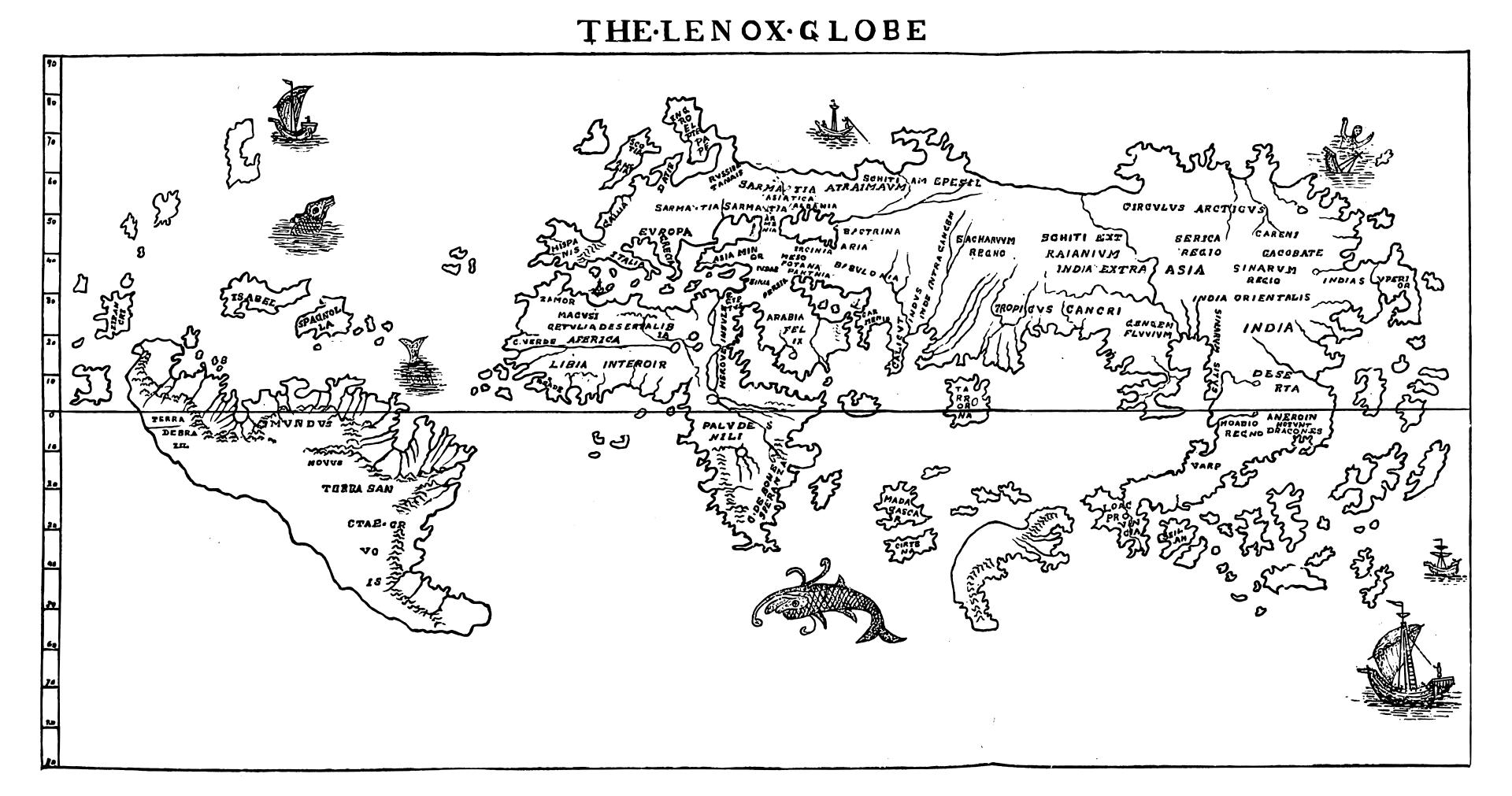
The flat diagram of the globe's surface that accompanied these early articles was later reproduced as a plate in Emerson D. Fite and Archibald Freeman's A Book of Old Maps Delineating American History, and again as a figure in A. E. Nordenskiold's Facsimile-Atlas to the Early History of Cartography, placing the globe within the standard reference literature of the history of cartography well before its late twentieth and twenty-first century digital documentation. R. W. Hill's 1937 article in the Bulletin of the New York Public Library remains cited as a further point of reference in the object's twentieth-century scholarly history.
Chapter 13Modern imaging
In 2020, the University of Rochester's Lazarus Project, directed by Gregory Heyworth and working with cartographic historian Chet Van Duzer, applied multispectral imaging alongside conventional...
In 2020, the University of Rochester's Lazarus Project, directed by Gregory Heyworth and working with cartographic historian Chet Van Duzer, applied multispectral imaging alongside conventional photography to the Hunt-Lenox Globe, principally to document its current condition for conservation monitoring. Working with the university's Digital Scholarship Lab, Joshua Romphf used structure-from-motion photographic techniques to build a detailed three-dimensional digital model of the globe's surface, making its engraved detail accessible online at a level of resolution the object's small size and dark, worn surface had previously made difficult to study directly. That model became the first project hosted on Resurrect3D, an open platform built for visualizing damaged cultural heritage objects. Separately, the New York Public Library provides its own high-resolution flat scans of the globe's northern and southern hemispheres through its Digital Collections.
Chapter 14What the globe shows of the New World
The New World appears on the globe in a form that reflects how little of it was understood at the presumed date of manufacture.
The New World appears on the globe in a form that reflects how little of it was understood at the presumed date of manufacture. Cuba is named ISABEL and Hispaniola SPAGNOLLA. North America does not appear as a continental landmass; one small, unnamed island is placed in the region of Newfoundland, generally read as a reflection of the voyages of the Portuguese brothers Miguel and Gaspar Corte-Real rather than of any specific named discovery. South America is shown and, unusually, carries three different names at once on the same landmass: TERRA DE BRAZIL, MVNDVS NOVVS, the Latin phrase meaning 'New World' that entered circulation through accounts attributed to Amerigo Vespucci, and TERRA SANCTAE CRVCIS, 'Land of the Holy Cross,' an early Portuguese name for the same coast. That triple naming on one landmass is itself evidence of how unsettled the geography and its vocabulary still were when the globe was made, regardless of which exact year within the disputed range that turns out to be.
The artist
Unknown maker
No maker's mark appears anywhere on the globe, and no contemporary document names an engraver, caster, patron or workshop for it. More than a century and a half of scholarship, beginning with De Costa in 1879, has not produced a named individual accepted by the field. What this dossier records is not a biography but the shape of that absence: the two weak directional claims that exist, the disputed fringe theory that has tried to fill the gap with a named artist, and why the field has not accepted it.
Related works
| Work | Relation | Where it is |
|---|---|---|
| Ostrich Egg Globe Unknown maker (privately owned and researched by Stefaan Missinne) | Proposed by Missinne in 2013 as the object the Hunt-Lenox Globe was cast from; a disputed claim, not an accepted one Engraved on the conjoined lower halves of two ostrich eggs; Missinne dates it to c. 1504-1506. Its own ownership history before Missinne's 2012 acquisition is undocumented. | Private collection (Stefaan Missinne) |
| Jagiellonian Globe Unknown maker | Compared directly to the Hunt-Lenox Globe by historian Edward L. Stevenson, who judged the two may be by the same maker or copies of a common original Generally dated to around 1510; smaller in diameter than the Hunt-Lenox Globe but carries richer place-name detail. | Jagiellonian University Museum, Krakow |
| Erdapfel (Behaim Globe) Martin Behaim | The oldest surviving terrestrial globe, predating the Hunt-Lenox Globe Completed 1492, before European contact with the Americas; does not show the New World, which is what makes the Hunt-Lenox Globe's later depiction of it significant by comparison. | Germanisches Nationalmuseum, Nurnberg |
| Universalis Cosmographia (the 1507 Waldseemuller world map) Martin Waldseemuller | Contemporary printed flat map, not a globe; a separate published record on this site No documented workshop connection, shared engraver, or direct influence has been found between this map and the Hunt-Lenox Globe. | Library of Congress, Washington, D.C. |
| Waldseemuller 1507 globe gores Martin Waldseemuller and collaborators | A separate 1507 work by the same cartographer as the wall map above, printed as gores meant to be assembled into a globe Only three copies survive and none was ever cut and assembled into an actual sphere. If assembled, the resulting globe would measure about 4.5 inches, close in scale to the Hunt-Lenox Globe's 4.4 inches, a coincidence of period practice rather than documented evidence of a connection. | Surviving copies held in institutional collections including the Library of Congress and the James Ford Bell Library, University of Minnesota |
| Boulengier globe gores Attributed to Louis Boulengier | Compared by Missinne to both the Hunt-Lenox Globe and his Ostrich Egg Globe; found by him to resemble the Jagiellonian Globe more closely than either resembles the Hunt-Lenox Globe Generally dated to around 1514. | New York Public Library |
Open questions
- Who made the globe. No individual or named workshop has scholarly consensus; the two directional claims in the literature (a French origin, and Stefaan Missinne's Italian workshop and Leonardo da Vinci theory) are each unproven.
- What the globe's exact date of manufacture is. Sources in circulation range from c. 1504 to c. 1510, and the narrowest end of that range depends entirely on accepting Missinne's contested claim about the Ostrich Egg Globe.
- Where the globe was, and who owned it, between its manufacture and Richard Morris Hunt's 1855 purchase in Paris. No owner, location or event is documented for this interval.
- Whether the globe was engraved directly or cast from another object. This remains genuinely contested rather than resolved in either direction by the sources consulted for this record.
- What HC SVNT DRACONES specifically referenced when it was engraved: a Komodo dragon report, a generic cartographic warning device, or something closer to De Costa's 1879 reading involving Marco Polo's Dagroians. No single explanation has displaced the others.
- What the piercing at the globe's poles was originally for: whether the globe was designed from the outset to sit inside an armillary sphere, or was adapted for that purpose after being made as a standalone object.
Questions about this object
What is The Hunt-Lenox Globe?
The Hunt-Lenox Globe is a map, dated c. 1504-1510 (disputed). The New York Public Library and most secondary sources give c. 1508 or c. 1510. A narrower c. 1504-1506 date is cited only in connection with Stefaan Missinne's contested 2013 claim that the globe was cast from his privately owned Ostrich Egg Globe.. Medium: Copper, engraved (or, per a contested theory, cast); two hollow hemispheres of a reddish copper alloy roughly 2 mm thick, joined at the equator and pierced at the north and south poles.
Who made The Hunt-Lenox Globe, and is the attribution settled?
The attribution to Unknown maker is recorded here as unknown. No maker's mark, signature, or contemporary document names an individual or workshop. Two attribution lines appear in the literature and neither is settled. Edward L. Stevenson, in his early twentieth-century survey of terrestrial and celestial globes, judged the Hunt-Lenox Globe and the Jagiellonian Globe in Krakow to 'appear to be the work of the same globe maker or copies of a common original,' without naming that maker; a French origin for the globe is separately cited in the literature without a supporting argument. Separately, globe collector and researcher Stefaan Missinne argued in 2013 that the Hunt-Lenox Globe was not engraved at all but cast from a privately owned globe engraved on an ostrich egg, itself linked by Missinne to the workshop tradition of Leonardo da Vinci. That claim is disputed: it has been characterized as a fringe theory, criticized on methodological grounds by reviewer Wouter Bracke, questioned on provenance grounds by Library of Congress curator John Hessler, and Missinne was expelled from the International Coronelli Society for the Study of Globes in 2024 after disputes with other researchers over it.
Where is The Hunt-Lenox Globe now?
New York Public Library, Rare Book Division, New York. Inventory number Hunt-Lenox Globe, NYPL Digital Collections; held among the founding Lenox Library holdings. Last confirmed 25 August 2026. Documented on the New York Public Library's own digital collections and exhibition pages. The Lenox Library's holdings passed into the newly consolidated New York Public Library on 23 May 1895.
What is still unknown about The Hunt-Lenox Globe?
Who made the globe. No individual or named workshop has scholarly consensus; the two directional claims in the literature (a French origin, and Stefaan Missinne's Italian workshop and Leonardo da Vinci theory) are each unproven.
Sources
- 1F. De Costa (1879), Henry Stevens's Recollections of Mr. James Lenox of New York (1886), Gabriel Gravier (1879), R. W. Hill (1937), and the Wouter Bracke 2019 review of Missinne's The Da Vinci Globe. en.wikipedia.org/wiki/...
- 2Missinne, Stefaan, 'A Newly Discovered Early Sixteenth-Century Globe Engraved on an Ostrich Egg: The Earliest Surviving Globe Showing the New World,' The Portolan: Journal of the Washington Map Society, Issue 87 (Fall 2013), pp. 8-24. Read directly from the journal PDF. This is the primary source for the Ostrich Egg Globe claim and is treated in this record as Missinne's own argument, not as an accepted finding. washmapsociety.wildapricot.org/resources/...
- 3McGarvey, Kathleen, 'One of the world's oldest globes is ready for its close-up,' University of Rochester Newscenter, 26 February 2020, on the Lazarus Project's multispectral imaging and 3D modeling of the Hunt-Lenox Globe. rochester.edu/newscenter/...
- 4Wikipedia, 'Here be dragons,' for the cartographic history of the phrase, its status as an anachronism in general medieval usage, and the more common HIC SVNT LEONES convention. en.wikipedia.org/wiki/...
- 5The Encyclopedia Americana (1920), 'New York Public Library,' via Wikisource, for the 23 May 1895 consolidation of the Astor, Lenox and Tilden libraries into the New York Public Library, with founding volume counts and endowment figures for each constituent library. en.wikisource.org/wiki/...
- 6GeographyRealm.com, 'The Map Myth of Here Be Dragons: The Facts and Fictions of Mapmakers,' for the Hunt-Lenox Globe's physical description and its status as the sole confirmed historical use of HC SVNT DRACONES. geographyrealm.com/here-be-dragons
- 7James Ford Bell Library, University of Minnesota, exhibition pages on Martin Waldseemuller's 1507 globe gores, for the gores' survival rate, physical dimensions, and the fact that none of the three surviving copies was ever assembled into an actual globe. apps.lib.umn.edu/bell/...
- 8Wikimedia Commons, file records and (LicenseShortName field) for each image used in this record, retrieved directly via the Commons API to verify CC0 or public domain status. commons.wikimedia.org/wiki/...
- 9 en.wikipedia.org/wiki/...
- 10 openculture.com/2021/...
Last verified · Published
Change log
25 August 2026 - Record created at the house standard: researched narrative, technical evidence, maker dossier, graded provenance chain, prices with hammer and premium separated, related works, open questions and sources.