The Trinity College Harp
Unknown maker, Gaelic harp-making tradition · c. 1350-1500 (14th-15th century)
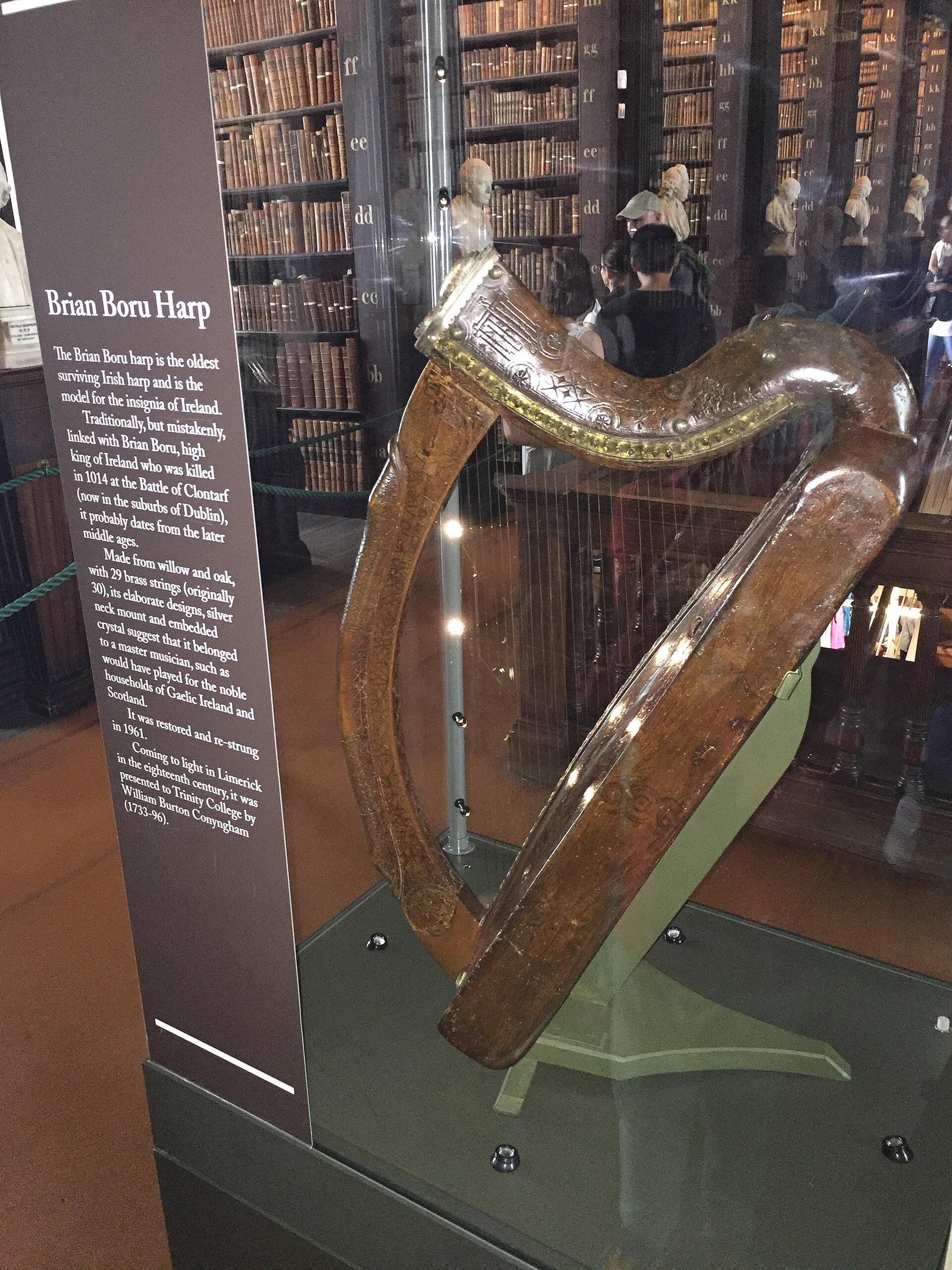
The harp as displayed in the Long Room of the Old Library, Trinity College Dublin, photographed in July 2017. Licence and named photographer verified directly against the Wikimedia Commons file description page at time of writing.
Photograph by JackGavin, via Wikimedia Commons, CC BY-SA 4.0| Artist | Unknown maker, Gaelic harp-making tradition |
|---|---|
| Date | c. 1350-1500 (14th-15th century) |
| Medium | Carved willow soundbox, forepillar and neck; brass tuning pins and wire strings |
| Dimensions | H. 85 cm (33.5 in) in its current reconstructed form; soundbox max. width c. 32 cm (12.5 in); longest string c. 62 cm |
| Where it is now | Long Room, Old Library, Trinity College Dublin, Irelandlast confirmed |
| Inventory number | No published accession or catalogue number was identified in the sources consulted |
| Attribution | UnknownNo maker is recorded and none can be identified from surviving evidence; the harp is anonymous, like the two related Scottish instruments closest to it in style and scheme. Full note |
| Object type | Musical instrument |
| Period | Gaelic Ireland/Scotland, 14th-15th century |
| Cases | Has a provenance gap |
| Inscriptions | No maker's inscription survives. A now-lost silver-plated bronze badge once fixed to the forepillar carried a Red Hand and two addorsed animals, possibly lions, tentatively read as O'Neill heraldry. |
| Owners on record | 8 links3 documented, 4 disputed, 1 unknown |
| Sources | 24 cited |
About this record Last verified · 24 sources cited · Change log
On this page 9 sections
ContentsClose
A small, low-headed wire-strung Gaelic harp of the 14th or 15th century, carved from willow, one of only three surviving medieval instruments of its kind anywhere and the model, three or four hundred years after the fact, for the Irish state's official harp emblem and for the Guinness trademark. It has stood at Trinity College Dublin since 1782 and is popularly, but wrongly, known as Brian Boru's harp: a legend published in 1786 and dismissed as 'a clumsy forgery' by the antiquarian George Petrie as early as 1840.
Its documented ownership history does not reach back nearly as far as its fame suggests. The chain that is genuinely traceable begins only in the 18th century, with the MacMahon family of County Clare; everything reported before that, including the popular Clanricarde and Henry VIII story, rests on the same family of antiquarian sources that produced the discredited Boru legend. A separate piece of physical evidence, a now-lost heraldic badge suggesting O'Neill ownership, points toward Ulster and has never been reconciled with the Clare and Connacht chain reported elsewhere. The harp has also been substantially rebuilt at least twice, most recently in 1961, in ways current researchers are still questioning for accuracy.
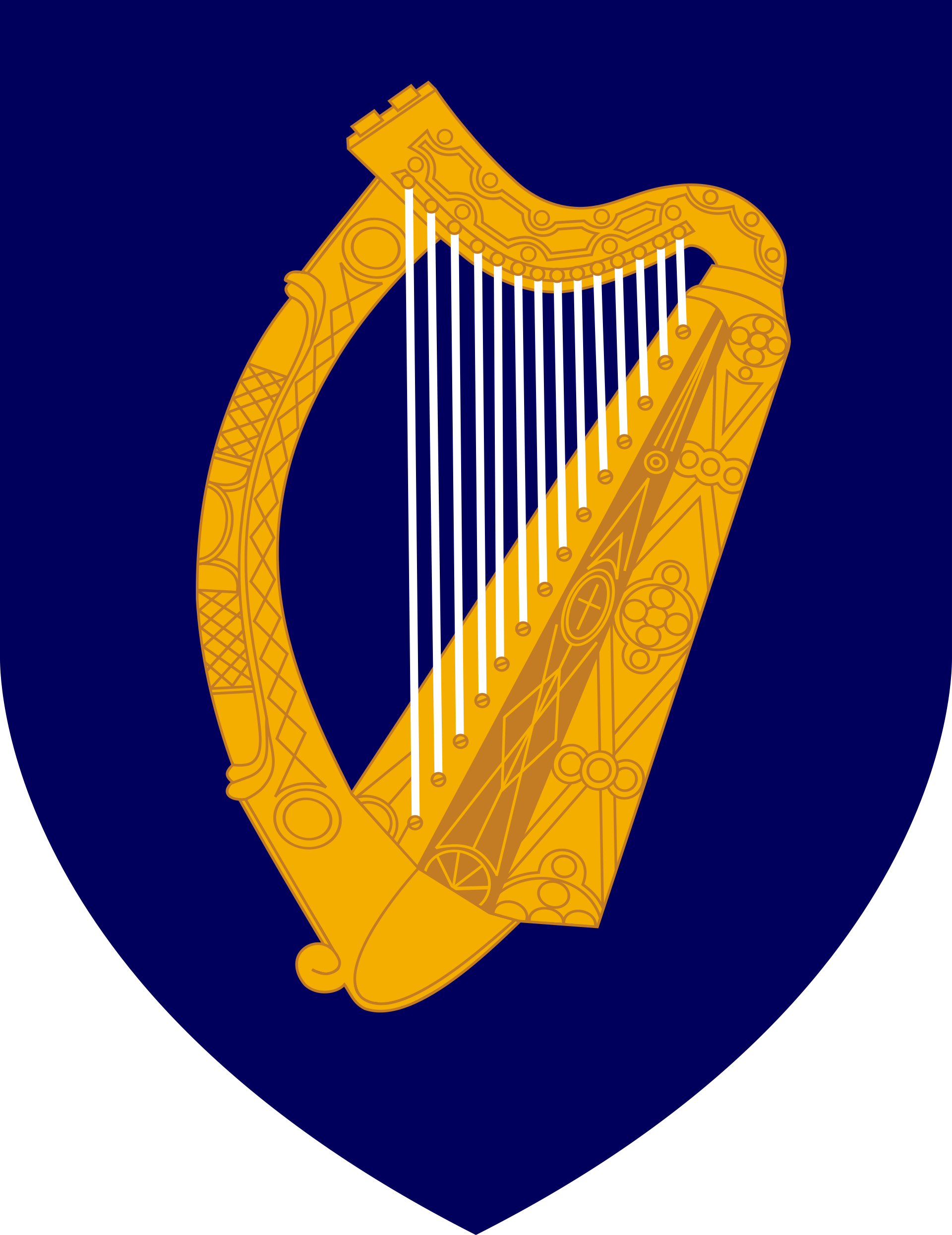
None of that has stopped its outline from becoming one of the most reproduced images to come out of Ireland: adopted by Guinness in 1862 and trademarked in 1876, then adopted independently by the Irish Free State in 1923 as the model for its Great Seal, coinage, presidential and government seals, and passport, in a design specifically based on this instrument rather than on the older, generic harp motif that had circulated in Irish heraldry for centuries before either version existed.
Provenance
Each link is graded. Documented: a cited source supports it. Disputed: the identification is argued but not established. Unknown: no owner for that span, and the gap is not smoothed into a narrative. The grades in the glossary.
- c. 1350-1500 -Unknown maker and first owner(s)unknown
Made somewhere in the Gaelic-speaking world of Ireland or the Scottish Highlands and Islands, on the evidence of comparative stylistic dating against the Queen Mary and Lamont harps. No maker, patron or first owner is documented. The widely repeated attribution to Brian Boru (d. 1014) is chronologically impossible and rejected by every scholarly source consulted.14
- Legendary chain: Donnchad son of Brian Boru, then the papacy, then Henry VIIIdisputed
First published in 1786 by Charles Vallancey on information from Chevalier Thomas O'Gorman. Dismissed by George Petrie in 1840 as 'a clumsy forgery.' Eugene O'Curry in 1873 suggested the legend may have arisen from a genuine but garbled association with Donnchadh Cairbreach O'Brien (d. 1242), a real descendant of Brian Boru, rather than being invented from nothing. Recorded here as the origin of the harp's popular name, not as a real ownership event.1212
- 1543 - early 18th centuryUlick de Burgh, 1st Earl of Clanricarde, and his descendantsdisputed
Reported in 19th-century antiquarian sources as a gift from Henry VIII on 1 July 1543, the day de Burgh was created Earl of Clanricarde. No primary Tudor-era record of this gift was located for this record; it appears only within the same family of antiquarian retellings that produced the discredited Brian Boru legend, and is graded disputed rather than documented on that basis, even though it is the point at which most popular summaries of the harp's history begin.212
- early 18th century - c. 1756MacMahon family of Clenagh, Co. Claredisputed
Reported consistently across secondary antiquarian sources, but no primary documentation of the transfer itself was located.124
- c. 1756 - 1770s or 1781Commissioner (Counsellor) MacNamara of Limerickdocumented
Reported independently by multiple secondary sources with a consistent date of approximately 1756. By this point the harp had already lost its silver strings and some of its plate ornament, reportedly to theft or careless handling by servants.124512
- 1770s - 1781Ralph Ousley of Limerick (disputed intermediate step)disputed
Reported only by the Early Gaelic Harp Info project; not corroborated by History Ireland's account or by the 1832 Dublin Penny Journal article, both of which go directly from MacNamara to Thomas O'Gorman. Included here as a genuine, unresolved discrepancy between sources rather than silently dropped.4
- 1781 - 1782Chevalier Thomas O'Gorman, then Colonel William Burton Conynghamdocumented
O'Gorman delivered the harp to Conyngham, the leading Irish antiquarian collector of his generation and a founding treasurer of the Royal Irish Academy. O'Gorman is the same individual who supplied Vallancey with the Brian Boru legend published in 1786.21220
- 1782 - presentTrinity College Dublindocumented
Conyngham deposited the harp at Trinity College Dublin in 1782, where it has remained on display, latterly in the Long Room of the Old Library, ever since. Its future physical location beyond the Old Library Redevelopment Project's currently stated closure date (end of 2027, per Trinity's own FAQ; an earlier press account gave December 2024) is not specified in any source consulted.11718
Technical evidence
| Attribution note | No maker is recorded and none can be identified from surviving evidence; the harp is anonymous, like the two related Scottish instruments closest to it in style and scheme. It is popularly, but wrongly, called 'Brian Boru's harp' - a provenance legend about a supposed royal owner, not a maker attribution. That legend was first published in 1786, communicated by the Dublin antiquarian Chevalier Thomas O'Gorman, and was dismissed as early as 1840 by George Petrie, who called it 'a clumsy forgery, which will not bear for a moment the test of critical antiquarian examination.' Construction and decorative evidence places the instrument in the 14th or 15th century, two to four hundred years after Brian Boru's death in 1014. |
|---|---|
| Overall height | c. 85 cm (33.5 in) in the harp's current, 1961-reconstructed form. Earlier documented forms differed, most notably a longer plaster foot and scroll added in a late 19th-century rebuild and later removed.358 |
| Soundbox | Hollowed from a single block of willow rather than built up from staves; maximum width approximately 32 cm (12.5 in).413 |
| Strings and tuning pins | 29 brass tuning pins in the current form, with evidence the instrument at one point carried 30; longest string approximately 62 cm. Historical stringing metal (brass versus silver for different registers) is debated and not fixed by direct evidence; no historical stringing scheme for this specific instrument is documented with confidence.3913 |
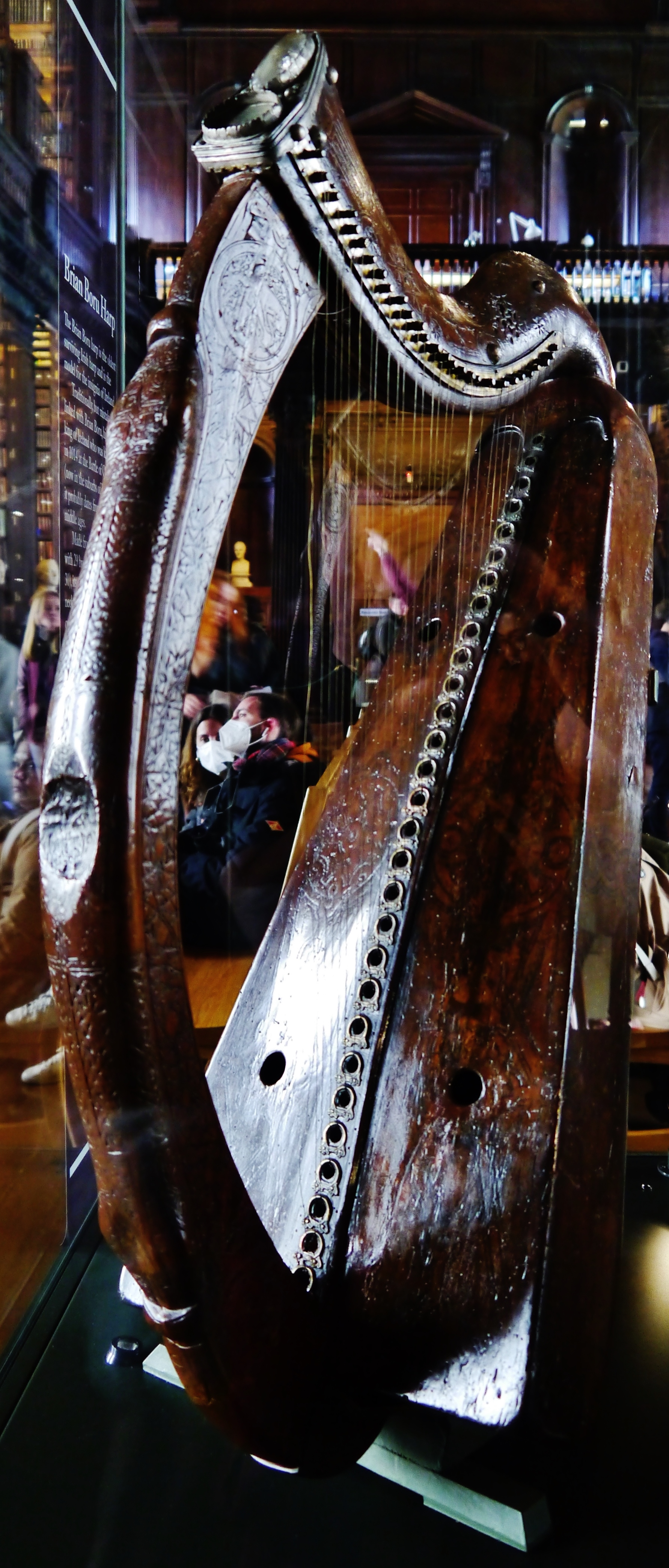
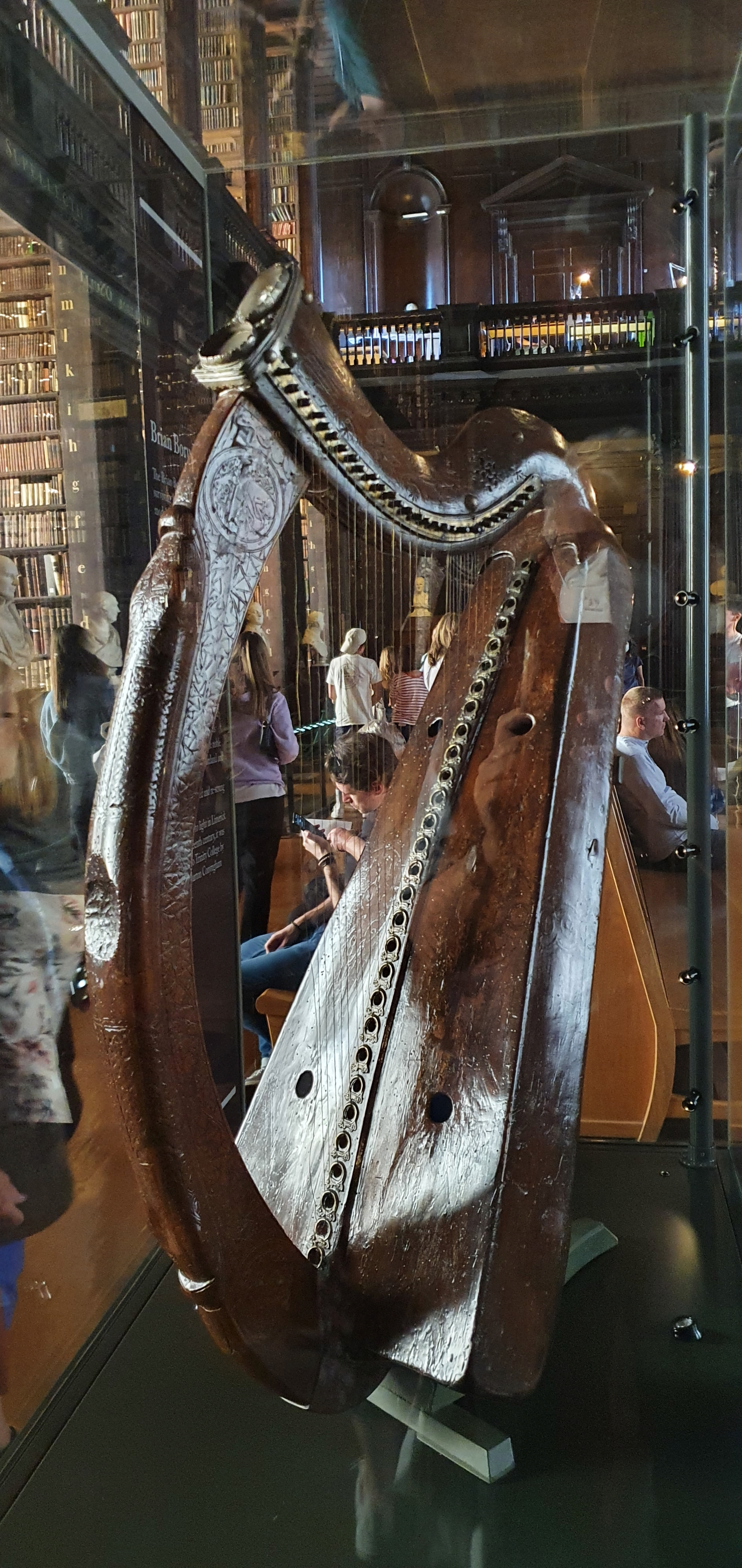
| Decoration | Carved and originally coloured decoration on the forepillar and neck, comparable in overall scheme and fineness to the Queen Mary Harp, though differing in specific motifs. The carving is worn, multiply superimposed in places, and described by its most recent cataloguer as under-studied as a body of evidence. First published drawings of the forepillar scheme appeared in 2013 and of the neck scheme in November 2015.7 |
| Forepillar badge (now lost) | A silver-plated bronze badge bearing a Red Hand and two addorsed animals, possibly lions, tentatively read as O'Neill heraldry. Documented in Vallancey (1786), Rees (1808) and Bunting (1840); went missing mid-19th century; briefly recovered and matched to the harp around 1881 by Trinity librarian T. H. Longfield after being misidentified by antiquarian Robert Day; not photographed reattached after roughly 1902; present location unknown.6 |
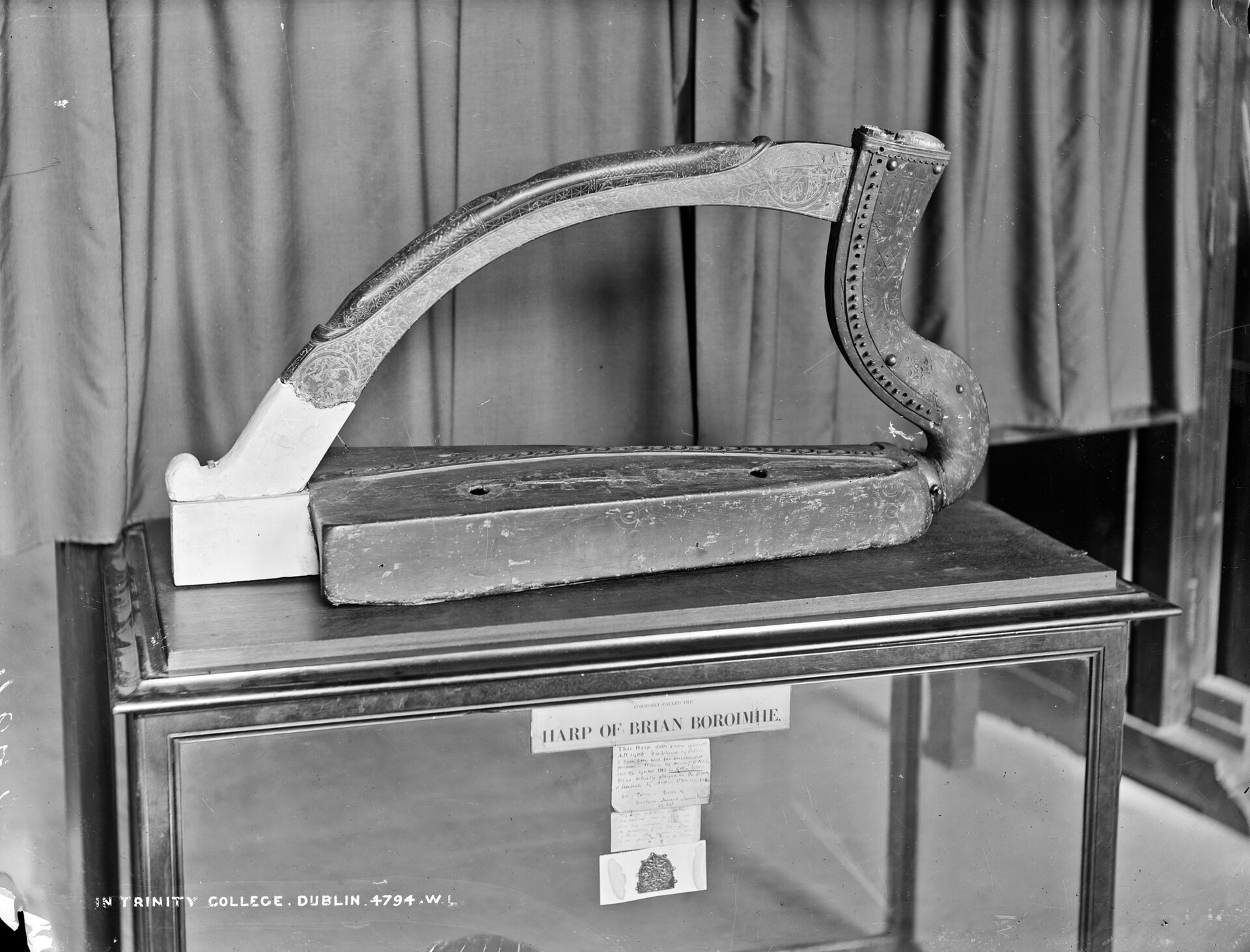
| Condition and repair history | Documented losses and repairs include: lost silver strings and plate ornament by c. 1756; a broken, rotten foot by 1786; a badly rotted soundbox/pillar base, a large soundboard crack repaired with butterfly cleats, a repaired pillar crack, and iron straps at the neck-pillar and box-pillar joints by 1808; straps still present in 1832; a late 19th-century rebuild replacing the rotten base with white plaster; and a 1961 British Museum dismantling and reconstruction under Joan Rimmer, which gave the harp its present wider shape and restrung it.158 |
| Dating method | No radiocarbon or dendrochronological analysis of this specific harp has been published in the sources consulted. The accepted 14th-15th century range rests on comparative stylistic analysis of the carved decoration against the Queen Mary Harp, the Lamont Harp, the Keills cross-slab, and other West Highland carving, supplemented by radiocarbon work performed on the Queen Mary Harp's frame rather than on this instrument.14 |
| Comparanda | The Queen Mary Harp and Lamont Harp (both National Museums Scotland) are the only two other surviving medieval Gaelic harps of this type and the primary evidentiary basis for the instrument's date and possible South Argyll origin.4 |
| 19th-century plaster casts | Robert Ball produced plaster casts of the harp in the 1840s, in its pre-1961, long-footed form. Copies are recorded at the National Museum of Scotland (dated 1847), at Collins Barracks in the National Museum of Ireland, and formerly at the Metropolitan Museum of Art, New York, deaccessioned and sold in the 1980s. The Dublin cast is reported to be the specific model behind the harp shape used on the Irish state emblem, rather than the harp itself.824 |
Images
The record in full
Chapter 1What it is
A small, low-headed wire-strung Gaelic harp, a clairseach, carved from willow and standing about 85 centimetres high in its current, several-times-reconstructed form.
A small, low-headed wire-strung Gaelic harp, a clairseach, carved from willow and standing about 85 centimetres high in its current, several-times-reconstructed form. The soundbox was hollowed from a single block of wood rather than built up from staves, in the manner of every surviving instrument of this family. It originally carried around 29 or 30 brass strings run over brass tuning pins set into the neck, tuned diatonically and plucked with the fingernails rather than the fingertips, which is the technique that distinguishes the historical Gaelic harp tradition from the gut-strung harps of continental Europe.
The instrument is covered in carved and once-coloured decoration on the forepillar and neck, worn and, by the account of the researcher who has drawn it in the most detail, still under-studied as a body of evidence. It is one of only three medieval harps of this type known to survive anywhere, the other two being in Scotland. That scarcity, more than any single fact about ownership, is why this object matters: it is not a fine example of a common thing, it is one of three known examples of anything at all.
Chapter 2How such harps were made, and by whom no one now knows
Nothing about the harp's manufacture is documented.
Nothing about the harp's manufacture is documented. No maker's name, workshop mark, or contract survives, and none should be expected to: harp making in later medieval Gaelic Ireland and the Hebrides was a craft practice, not one that generated the kind of paper trail altarpiece commissions did. What can be said comes entirely from the object itself and from comparison with its two surviving relatives.
The closest instrument in date, construction and decorative scheme is the Queen Mary Harp, now in the National Museum of Scotland, with the related Lamont Harp a further point of comparison. The similarities are close enough that the researchers Keith Sanger and Alison Kinnaird proposed in their 1992 study Tree of Strings that the Trinity harp may have been made in South Argyll in the 15th century, placing it in the same workshop milieu as its Scottish siblings rather than treating it as a purely Irish product. It is a named scholarly hypothesis built on stylistic comparison, not a proven fact, and it has not been superseded by any scientific test of the wood itself.
Chapter 3The name it does not deserve
The story that gave the harp its popular name was first set down in print in 1786 by the antiquarian Charles Vallancey, on information supplied by Chevalier Thomas O'Gorman, the same man who a few...
The story that gave the harp its popular name was first set down in print in 1786 by the antiquarian Charles Vallancey, on information supplied by Chevalier Thomas O'Gorman, the same man who a few years earlier had delivered the harp itself to Trinity College. The tale ran that Brian Boru's son Donnchad carried the harp to Rome to seek papal absolution for fratricide after his father's death at Clontarf in 1014, that it remained with the papacy, and that it eventually passed via Henry VIII to an Irish earl, from whom the documented chain of ownership is supposed to begin.
The story did not survive contact with the next generation of Irish antiquarian scholarship. George Petrie examined it in 1840 and rejected it outright, writing that it was 'a clumsy forgery, which will not bear for a moment the test of critical antiquarian examination.' Eugene O'Curry returned to the question in 1873 and offered a more charitable explanation for how the legend could have arisen without O'Gorman simply inventing it from nothing: he suggested that when the harp was associated with the Clanricarde family, it may have been correctly identified as the harp of Donnchadh Cairbreach O'Brien, a real king of Thomond who died in 1242 and was the sixth in descent from Brian Boru, and that later retellings quietly dropped five generations and several centuries, turning 'a harp of a descendant of Brian Boru' into 'the harp of Brian Boru's son.' Whether that reconstruction is right or not, the point on which every serious source agrees is that the instrument itself cannot be Brian Boru's, because it was not made in his lifetime.
Chapter 4What the evidence for its actual date looks like
No radiocarbon dating or dendrochronological analysis of the Trinity harp itself has been published in any source consulted for this record.
No radiocarbon dating or dendrochronological analysis of the Trinity harp itself has been published in any source consulted for this record. The dating in circulation rests entirely on comparative stylistic analysis: setting the carved decoration of the forepillar and neck against the decoration of the Queen Mary Harp, against the Keills cross-slab, and against other surviving West Highland carving of known or better-established date.
That method has produced a range rather than a single date. Petrie in 1840 favoured the 14th century or the early part of the 15th. The musicologist Joan Rimmer, writing in 1969 and overseeing the harp's 1961 reconstruction, judged it 'probably from the fourteenth century.' Sanger and Kinnaird's 1992 South Argyll hypothesis points to the 15th century specifically. Some later summaries stretch the plausible window as late as the 16th century. Simon Chadwick, who has produced the most detailed published drawings of the decoration to date, is explicit that the underlying evidence base is thin: the decoration, in his words, 'is very under-studied,' and comparative radiocarbon work on the related Queen Mary Harp's frame is used to reinforce the general period rather than to fix an exact year for this instrument. Every figure in this section should be read as a scholarly estimate, not a laboratory result, and no source consulted claims otherwise.
Chapter 5A badge that may point to a different family entirely
At some point in its history the harp carried a small badge, described as silver-plated bronze, fixed to the forepillar.
At some point in its history the harp carried a small badge, described as silver-plated bronze, fixed to the forepillar. Its design showed a Red Hand and two addorsed animals, possibly lions. Late 18th- and early 19th-century antiquarian sources depict it clearly: Vallancey's Collectanea of 1786, Abraham Rees's Cyclopaedia of 1808, and Edward Bunting's The Ancient Music of Ireland of 1840 all show or describe it. The Red Hand device has led to the suggestion that this is an O'Neill badge, pointing to ownership at some point by the O'Neill dynasty of Ulster, one of Gaelic Ireland's most powerful families.
The badge itself did not survive to be examined alongside the harp for long. It went missing by the mid-19th century, later surfaced in the hands of the antiquarian Robert Day, who at first misidentified it as part of a mail shirt, and was recognised from Day's own illustrations by the Trinity College librarian T. H. Longfield, who confirmed around 1881 that it fitted the harp. Despite a reported donation back to Trinity, no photographic evidence shows it reattached to the instrument after roughly 1902, and its present location is unknown. This detail matters for more than antiquarian colour: an O'Neill badge points toward Ulster, while the documented ownership chain that other sources report for the 18th century runs instead through the Clanricarde and de Burgh families of Connacht and the MacMahons of County Clare. No source consulted reconciles the two. This record does not attempt to invent a bridge between them; it records both and leaves the contradiction standing as a contradiction.
Chapter 6The chain that is actually documented, so far as it goes
The earliest link claimed for the harp is itself part of the discredited legend: that Henry VIII, having received the harp from the papacy, gave it to Ulick de Burgh on 1 July 1543, the day he...
The earliest link claimed for the harp is itself part of the discredited legend: that Henry VIII, having received the harp from the papacy, gave it to Ulick de Burgh on 1 July 1543, the day he created him first Earl of Clanricarde. This claim appears only in 18th- and 19th-century antiquarian retellings, the same family of sources that produced the Brian Boru story Petrie rejected, and no primary Tudor-era record of the gift was located for this record. It should be graded disputed, not documented, even though it is the point at which most popular accounts of the harp's history begin.
From there the accounts converge on a more plausible, though still thinly sourced, run: the harp remained with the Clanricarde and de Burgh family until the early 18th century, when a lady of that family passed it to the MacMahon family of Clenagh, County Clare. On MacMahon's death, reported as around 1756, it was bequeathed to Commissioner (also styled Counsellor) MacNamara of Limerick. One source, the Early Gaelic Harp Info project, adds an intermediate step in which MacNamara passed the harp to Ralph Ousley of Limerick in the 1770s before it reached Trinity; two other independent accounts, History Ireland's summary and the 1832 Dublin Penny Journal article reprinted by Library Ireland, go directly from MacNamara to Chevalier Thomas O'Gorman without mentioning Ousley at all. This record treats the Ousley step as reported by only one of three sources consulted and grades it accordingly. What all three sources agree on is the end of the chain: in 1781 or 1782, O'Gorman delivered the harp to Colonel (later Right Honourable) William Burton Conyngham, who in 1782 deposited it at Trinity College Dublin, where it has remained ever since.
Conyngham himself is a documented figure independent of the harp. A Cambridge- and Lincoln's Inn-educated Irish politician and the leading antiquarian collector of his generation, he assembled more than 600 topographical drawings of Irish antiquities, founded the short-lived Hibernian Antiquarian Society in 1779, and was a founding member and long-serving treasurer of the Royal Irish Academy from its establishment in 1785 until his death in 1796. Depositing the harp at Trinity was one gift among many from a man whose collecting activity is otherwise well attested; it was not an isolated transaction invented after the fact.
Chapter 7Two centuries of repair
The physical record of decay and mending is more securely documented than the chain of owners.
The physical record of decay and mending is more securely documented than the chain of owners. By around 1756, at the point MacNamara is said to have acquired it, an account describes silver strings and 'some more ornaments of plate than are now to be seen,' already lost, reportedly stolen or damaged by servants or others handling the instrument. An illustration made by Walker in 1786 shows a broken and rotten foot. An engraving published in Rees's Cyclopaedia in 1808 shows the base of the soundbox and pillar badly eaten away and rotten, a large crack across the left face of the soundboard repaired with butterfly cleats, a similarly repaired crack in the pillar, and iron or metal straps joining the neck to the pillar and the soundbox to the pillar. An 1832 illustration in the Dublin Penny Journal shows the straps still in place.
Sometime later in the 19th century the instrument was substantially rebuilt: the metal straps were removed, and the rotten, missing sections of the base were replaced with a white plaster compound, producing what one researcher describes as 'a strangely long foot and scroll' unlike the instrument's original form. The forepillar badge was already missing by this stage. In 1847 the naturalist Robert Ball made a plaster-cast model of the harp, signed and dated, later described in a broadsheet Ball published in July 1853 under the title 'The Harp of Brian Boroimhe - Restoration of the ancient harp.' Ball's cast shows a rounded projecting foot block that differs from the square-ended foot the harp has carried since 1961, raising the possibility, noted by Simon Chadwick, that Ball's reconstruction actually preceded and may have influenced the later physical rebuilding of the real object, rather than simply recording it.
The most recent major intervention came in 1961, when the British Museum dismantled and reconstructed the harp into the wider shape it has today, under the supervision of the musicologist Joan Rimmer, and restrung it. The soundbox was restored to 29 'shoes' for the tuning pins. Chadwick's more recent research argues that this 1961 shape may not be fully faithful to the medieval original, based on comparing early illustrations against Ball's earlier cast; the point remains an open scholarly question rather than a settled one, and no source consulted claims the 1961 work is either definitively accurate or definitively wrong.
Chapter 8Cast in plaster before it was copied onto a coin
Robert Ball, the same naturalist who documented the harp's rotten base in the 1840s, did not stop at illustration.
Robert Ball, the same naturalist who documented the harp's rotten base in the 1840s, did not stop at illustration. In the 1840s he had plaster casts of the harp made, in what one researcher describes as a handsome and fairly realistic finish. Copies are recorded at the National Museum of Scotland in Edinburgh (dated 1847), at Collins Barracks in the National Museum of Ireland, and formerly at the Metropolitan Museum of Art in New York, which deaccessioned and sold its copy in the 1980s. Every one of these casts freezes the harp in its pre-1961 appearance, complete with the long projecting plaster foot and scroll that the British Museum's later reconstruction removed.
This matters for more than the history of museum reproductions. According to the same source, it is specifically the Dublin cast, not the harp itself, that formed the basis for the version of the harp used as the national emblem of Ireland on the coinage and the presidential seal. If that is correct, the shape enshrined on every Irish coin and passport traces back not to the medieval object nor even to its current, 1961-corrected form, but to a mid-19th-century plaster reproduction of an already-altered 19th-century repair. Instrument makers attempting to build playable working copies of the harp since the 19th century have faced the same problem from the opposite direction: a persistent lack of good measurements and close study of the original has meant that most working replicas, in the same researcher's judgement, differ from the real object in significant ways.
Chapter 9How this one harp became a national emblem, twice over
The harp as a generic heraldic device is far older than this particular instrument's fame.
The harp as a generic heraldic device is far older than this particular instrument's fame. Irish coinage under Henry VIII and later Stuart-era grants had already used a harp motif as a symbol associated with Ireland well before 1782. What is specific to the Trinity College harp, and worth stating precisely rather than folding into that older generic history, is that its actual outline became the visual template for official Irish emblems only in the 20th century, and that this happened twice, independently, for two different institutions.
Arthur Guinness's brewery began using a harp device on its bottle labels in 1862 as a mark of Irish origin and quality, and formally registered it as a United Kingdom trademark in 1876, the first year trademark registration existed in the UK. Guinness's own historical material identifies the design specifically with the Trinity College, or 'Brian Boru,' harp, not with a generic harp shape. Six decades later, the newly founded Irish Free State needed its own official version and could not simply reuse Guinness's, because the trademark predated the state by decades. The state commissioned the English sculptor Percy Metcalfe, whose harp design, based on the Trinity College harp specifically, was adopted for the Great Seal of the Irish Free State in 1923 and has remained the model for the state's coat of arms, official seals, and coinage ever since, including Metcalfe's own 1928 Irish Free State coin designs. Because Guinness's harp faces right, on its straight edge, the state was advised it could only secure trademark protection for a left-facing version, and flipped its own design accordingly; every subsequent official use of the harp, on stamps, coins, the presidential and Taoiseach's seals, and the cover of the Irish passport, carries that flip forward. According to Wikipedia's account, which should be replaced with a citation to the actual grant, the Chief Herald of Ireland formally confirmed the arms on 9 November 1945. All of this rests on the specific silhouette of this one instrument, filtered through Metcalfe's 1923 drawing, not on the older and vaguer tradition of 'a harp' as an Irish symbol that had circulated for centuries before either version existed.
Chapter 10Not the other Irish harps
Several other historic harps are easily and wrongly conflated with this one, and the confusion runs in both directions: some are close relatives by design, others share only a name.The Queen Mary...
Several other historic harps are easily and wrongly conflated with this one, and the confusion runs in both directions: some are close relatives by design, others share only a name.
The Queen Mary Harp and the Lamont Harp, both held by National Museums Scotland, are the two instruments genuinely closest to the Trinity harp in date, construction and decorative scheme, and are the primary basis for the South Argyll dating hypothesis discussed above. They are nonetheless separate, physically distinct objects in a different country's national collection, not other names for this harp.
The Downhill Harp is a different instrument by three centuries: it is dated to 1702, made by Cormac O'Kelly of Ballinascreen for the blind harper Denis O'Hampsey, known as Hempson. Guinness bought it in 1963 to secure its preservation and displays it in the Guinness Storehouse's advertising gallery in Dublin. Notably, despite owning it, Guinness has never used the Downhill Harp in its own advertising; every Guinness harp image, from the 1862 label onward, depicts the Trinity College harp instead.
The O'Neill Harp, also called the Carolan Harp, is a third and again separate instrument, dated to the 17th or 18th century and held by the Ulster Museum in Belfast. Despite the name, no source consulted establishes that either the composer-harper Turlough O'Carolan or the harper Arthur O'Neill (1737-1818) actually owned it; the attribution to either man is itself unproven. The similarity of name to the Trinity harp's own 'O'Neill' nickname, discussed above in connection with the lost badge, is coincidental and should not be read as evidence linking the two instruments.
A fourth instrument, the Kildare or Fitzgerald Harp, said to have been made in 1672 for Robert FitzGerald, is held by the National Museum of Ireland at Collins Barracks, currently in storage rather than on public display. It, too, is a wholly separate object.
Chapter 11What the harp was for, in a world that left no record of this instrument in particular
Harpers held a formally recognised and near-aristocratic status within the wider learned class of later medieval and early modern Gaelic society, ranked in the bardic schools alongside the poets and...
Harpers held a formally recognised and near-aristocratic status within the wider learned class of later medieval and early modern Gaelic society, ranked in the bardic schools alongside the poets and genealogists who served chiefly households. A fine harp of the kind this instrument once was would have functioned as an emblem of its owner's rank and patronage as much as a musical tool, played in the hall of a lord who retained a hereditary harper much as he retained a poet.
That is documented general knowledge about the world this harp came from. It is not, and should not be presented as, documented knowledge about this harp specifically. No source consulted names a 14th- or 15th-century owner, patron, or commissioning household for this instrument; the earliest even loosely reported owner is the Clanricarde family, itself only reached through the discredited Brian Boru legend, and the first owner reported through an independent, non-legendary chain is the MacMahon family of Clenagh in the 18th century, three or four hundred years after the harp was made. The gap is total. Rather than filling it with plausible-sounding colour about 'its' patron or 'its' first hall, this record states the gap as a finding: for roughly three centuries after its construction, nothing at all is known about whose harp this was.
Chapter 12On display, then off it
The harp has stood at Trinity College Dublin continuously since Conyngham's 1782 gift, moving over time from the college's original museum arrangement into its long-standing position in the Long Room...
The harp has stood at Trinity College Dublin continuously since Conyngham's 1782 gift, moving over time from the college's original museum arrangement into its long-standing position in the Long Room of the Old Library, where generations of visitors have seen it beside the Book of Kells. In 2014 it was given a particular prominence in the exhibition 'Emperor of the Irish: Brian Boru and the Battle of Clontarf, 1014,' mounted jointly with the National Museum of Ireland to mark the millennium of the battle in which Brian Boru died. The harp was displayed there alongside the Book of Armagh, the Book of Leinster, and the Annals of Ulster as one of roughly forty items illustrating Brian's life and legend, even though Trinity's own account of the exhibition acknowledges in the same breath that the harp's early history is uncertain and that it has 'incorrectly become associated with Brian Boru.' The college used the anniversary to give the object its moment in the sun while stating plainly, in its own published material, that the association driving the anniversary framing is wrong. Both things are true at once, and this record treats that as worth saying rather than smoothing over.
The harp's future display is currently unsettled. Trinity's Old Library Redevelopment Project FAQ, current at the time this record was written, states that the Old Library and Long Room will remain open to visitors until the end of 2027, when restoration work begins and the Book of Kells moves temporarily to the restored Printing House. A February 2024 report in The Art Newspaper had instead described a December 2024 closure already under way, with all 200,000 volumes in the Long Room being packed into roughly 20,000 crates and moved to secure storage north of Dublin, as part of a 90 million euro project funded partly by a 25 million euro Irish government grant made in 2021 and partly by proceeds from the Book of Kells Experience digital exhibition. The two accounts do not agree on when the closure starts, which may reflect a genuine rescheduling of the project rather than an error in either source. No source consulted, of either date, specifies what happens to the harp physically once the Long Room does close: whether it goes into conservation, into storage with the manuscript collection, or into some interim public display elsewhere on campus.
Chapter 13What is still unresolved
The honest state of knowledge about this object is: a manufacture date known only within a century or two, resting on comparative art history rather than any laboratory test performed on the object...
The honest state of knowledge about this object is: a manufacture date known only within a century or two, resting on comparative art history rather than any laboratory test performed on the object itself; an owner and a place of manufacture that are both simply unknown for roughly the first three hundred years of the harp's existence; two candidate ownership chains, one running through Ulster by way of a lost heraldic badge and one running through Connacht and Clare by way of antiquarian tradition, that have never been reconciled with each other in any source consulted; a physical form that has been substantially rebuilt at least twice, most recently in a way that is itself now disputed by current researchers; and a legendary royal attribution that was demonstrated to be false within a lifetime of its first being printed, yet remains the name by which almost everyone still knows the object. None of that diminishes the harp's importance. It is one of three surviving instruments of its kind on earth, and the specific line of its silhouette sits, whether accurately transmitted or not, on every Irish coin, passport and state seal produced for the last century. The gaps are simply part of what the object is, and a record that papered over them in favour of the more comfortable Brian Boru story would be less useful, not more, to the next person who needs to know what is actually known.
The artist
Unrecorded maker, within the Gaelic harp-making tradition of Ireland and the Scottish Highlands and Islands
No name survives for whoever built this harp, and none should be expected to. Harp making in later medieval Gaelic society was a specialist hereditary craft serving an aristocratic patronage system, not a practice that generated the kind of signed, dated or contracted record that survives for a goldsmith or a panel painter working for a documented church commission. Everything said here about the maker's world is drawn from the object itself, from its two Scottish relatives, and from the broader documented structure of Gaelic learned and craft classes; nothing here is a documented fact about a named individual.
Related works
| Work | Relation | Where it is |
|---|---|---|
| Queen Mary Harp (Clarsach na Banrighinn Mairi) Unknown maker, Gaelic harp-making tradition | Closest surviving instrument in date, construction and decorative scheme; central to the dating and origin arguments made for this harp A separate, physically distinct instrument in a different national collection, not another name for the Trinity harp. | National Museum of Scotland, Edinburgh |
| Lamont Harp Unknown maker, Gaelic harp-making tradition | Second of the two surviving Scottish sister instruments used for comparative dating Separate object from the Trinity harp; part of the same small surviving group of three medieval Gaelic harps. | National Museum of Scotland, Edinburgh |
| Downhill Harp Cormac O'Kelly of Ballinascreen | A later, unrelated Gaelic harp, three centuries younger, whose Guinness ownership is often confused with Guinness's use of the Trinity harp's image Dated 1702, made for the blind harper Denis O'Hampsey (Hempson). Bought by Guinness in 1963 for preservation. Guinness has never used it in its own advertising, always depicting the Trinity College harp instead. NOT the object described in this record. | Guinness Storehouse, Dublin |
| O'Neill Harp (also called the Carolan Harp) Unknown maker | A different instrument whose 'O'Neill' name is easily and wrongly conflated with this harp's own colloquial O'Neill nickname Dated to the 17th or 18th century. No source consulted confirms ownership by either Turlough O'Carolan or the harper Arthur O'Neill (1737-1818). A separate, later instrument. NOT the object described in this record. | Ulster Museum, Belfast |
| Kildare Harp (Fitzgerald Harp) Unknown maker | A third, unrelated historic Irish harp sometimes confused with the medieval instruments Said to have been made in 1672 for Robert FitzGerald. A separate, later object, not currently on public display. NOT the object described in this record. | National Museum of Ireland, Collins Barracks (in storage) |
Open questions
- Where was the harp, and in whose hands, between its manufacture in the 14th or 15th century and its first independently reported owner, the MacMahon family of Clenagh in the 18th century? No source consulted names an owner across that three-hundred-year span.
- Does the O'Neill heraldic badge once fixed to the forepillar establish real ownership by the O'Neill dynasty of Ulster, and if so, how does that fit with the separately reported Clanricarde and de Burgh chain running through Connacht and County Clare? No source consulted reconciles the two.
- What became of the forepillar badge after it was last confirmed matched to the harp around 1881-1902? Its present location, and whether it survives at all, is unknown.
- Was the Henry VIII-to-Clanricarde gift of 1543 itself a genuine, if now undocumented, transaction involving some older harp, or was it invented wholesale as part of the same legend-building that produced the Brian Boru story Petrie called a forgery in 1840?
- Would direct radiocarbon or dendrochronological testing of the Trinity harp itself, which has apparently never been performed, narrow the 14th-to-16th-century range currently produced only by comparative stylistic dating?
- What is the wood species of every structural component (forepillar and neck specifically, as distinct from the soundbox), given that comprehensive published identification exists for the harp's Scottish relatives but not, so far as located, for this instrument in full?
- How faithful is the harp's current, 1961-reconstructed shape to its original medieval form, given that the same researcher who has studied the decoration most closely argues the 1961 British Museum reconstruction may have been influenced by an 1847 plaster cast that itself preceded, rather than recorded, the surviving object's actual 19th-century rebuild?
- What is the true intermediate step, if any, between Commissioner MacNamara and Thomas O'Gorman: did Ralph Ousley of Limerick hold the harp in the 1770s, as one source states, or did it pass directly, as two other independent sources report?
- What will happen to the harp physically when the Long Room closes for the Old Library Redevelopment Project? No source consulted, whether reporting a 2024 or a 2027 closure date, specifies where the harp will go or how it will be cared for during the works.
Questions about this object
What is The Trinity College Harp?
The Trinity College Harp is a musical instrument, dated c. 1350-1500 (14th-15th century). Medium: Carved willow soundbox, forepillar and neck; brass tuning pins and wire strings.
Who made The Trinity College Harp, and is the attribution settled?
The attribution to Unknown maker, Gaelic harp-making tradition is recorded here as unknown. No maker is recorded and none can be identified from surviving evidence; the harp is anonymous, like the two related Scottish instruments closest to it in style and scheme. It is popularly, but wrongly, called 'Brian Boru's harp' - a provenance legend about a supposed royal owner, not a maker attribution. That legend was first published in 1786, communicated by the Dublin antiquarian Chevalier Thomas O'Gorman, and was dismissed as early as 1840 by George Petrie, who called it 'a clumsy forgery, which will not bear for a moment the test of critical antiquarian examination.' Construction and decorative evidence places the instrument in the 14th or 15th century, two to four hundred years after Brian Boru's death in 1014.
Where is The Trinity College Harp now?
Long Room, Old Library, Trinity College Dublin, Ireland. Inventory number No published accession or catalogue number was identified in the sources consulted. Last confirmed 23 August 2026. On continuous display at Trinity College Dublin since William Burton Conyngham's donation in 1782. It is due to leave display when the Long Room closes for the Old Library Redevelopment Project. Trinity's own project FAQ, checked at time of writing, states the Old Library and Long Room remain open to visitors until the end of 2027, when restoration work begins and the Book of Kells relocates to the Printing House. An earlier press account from February 2024 had instead reported a December 2024 closure already under way, with 200,000 volumes being moved into storage as part of a 90 million euro project. The two timelines do not agree, and no source consulted specifies what will happen to the harp itself (removal to conservation, temporary display elsewhere, or storage) during the closure.
What is still unknown about The Trinity College Harp?
Where was the harp, and in whose hands, between its manufacture in the 14th or 15th century and its first independently reported owner, the MacMahon family of Clenagh in the 18th century? No source consulted names an owner across that three-hundred-year span.
Sources
- 1Wikipedia, 'Trinity College harp'. en.wikipedia.org/wiki/...
- 2History Ireland, 'The Brian Boru harp'. historyireland.com/brian-boru-harp
- 3Simon Chadwick, Early Gaelic Harp Info, 'the Trinity College harp' (overview page). earlygaelicharp.info/harps/...
- 4Simon Chadwick, Early Gaelic Harp Info, 'the Trinity College harp: dating'. earlygaelicharp.info/harps/...
- 5Simon Chadwick, Early Gaelic Harp Info, 'the Trinity College harp: damage'. earlygaelicharp.info/harps/...
- 6Simon Chadwick, Early Gaelic Harp Info, 'the Trinity College harp: badge'. earlygaelicharp.info/harps/...
- 7Simon Chadwick, Early Gaelic Harp Info, 'the Trinity College harp: decoration'. earlygaelicharp.info/harps/...
- 8Simon Chadwick, 'Restoration of the Brian Boru harp', blog post, 1 November 2015. simonchadwick.net/2015/...
- 9Simon Chadwick, 'Trinity College harp stringing and tuning', blog post, March 2016. simonchadwick.net/2016/...
- 10Early Gaelic Harp Info, 'the O'Neill harp'. earlygaelicharp.info/harps/...
- 11Early Gaelic Harp Info, 'the Kildare harp'. earlygaelicharp.info/harps/...
- 12Library Ireland, 'Brian Boroihme's Harp', reprinting an article from the Dublin Penny Journal, 1832. libraryireland.com/articles/...
- 13Wirestrungharp.com, 'Trinity College Harp' (technical measurement table). wirestrungharp.com/harps/...
- 14Wirestrungharp.com, 'Guinness Fact Sheet: Downhill Harp'. wirestrungharp.com/culture/...
- 15Guinness Storehouse, 'Learn the History of the Guinness Harp'. guinness-storehouse.com/en/...
- 16The Irish Times, 'Tuning the harp to suit a changing Ireland'. irishtimes.com/culture/...
- 17The Art Newspaper, 'Trinity College Dublin turns a page on Old Library conservation', 1 February 2024. theartnewspaper.com/2024/...
- 18Trinity College Dublin, Old Library Redevelopment Project, FAQ page. tcd.ie/old-library-campaign/...
- 19Trinity College Dublin, News & Events, 'Trinity College Dublin in conjunction with the National Museum of Ireland Celebrate Brian Boru and the Battle of Clontarf'. tcd.ie/news_events/...
- 20Dictionary of Irish Biography, 'Conyngham, William Burton'. dib.ie/biography/...
- 21Karen Loomis, 'Research' (wood identification methodology and publication list for early Irish and Scottish harps). karenloomis.com/research
- 22Wikimedia Commons, file description page for the lead image, directly. commons.wikimedia.org/wiki/...
- 23Wikimedia Commons, file description page for the historic Lawrence Collection photograph, licence and attribution verified directly. commons.wikimedia.org/wiki/...
- 24Simon Chadwick, Early Gaelic Harp Info, 'the Trinity College harp: replicas'. earlygaelicharp.info/harps/...

.jpg)
Last verified · Published
Change log
23 August 2026 - Record created at the house standard: researched narrative, technical evidence, maker dossier, graded provenance chain, prices with hammer and premium separated, related works, open questions and sources.