The Cloisters Cross
Unknown carver (attributed by Hoving to the Bury St Edmunds circle of Master Hugo) · ca. 1150-60 (Met); proposals from c. 1050 to c. 1190
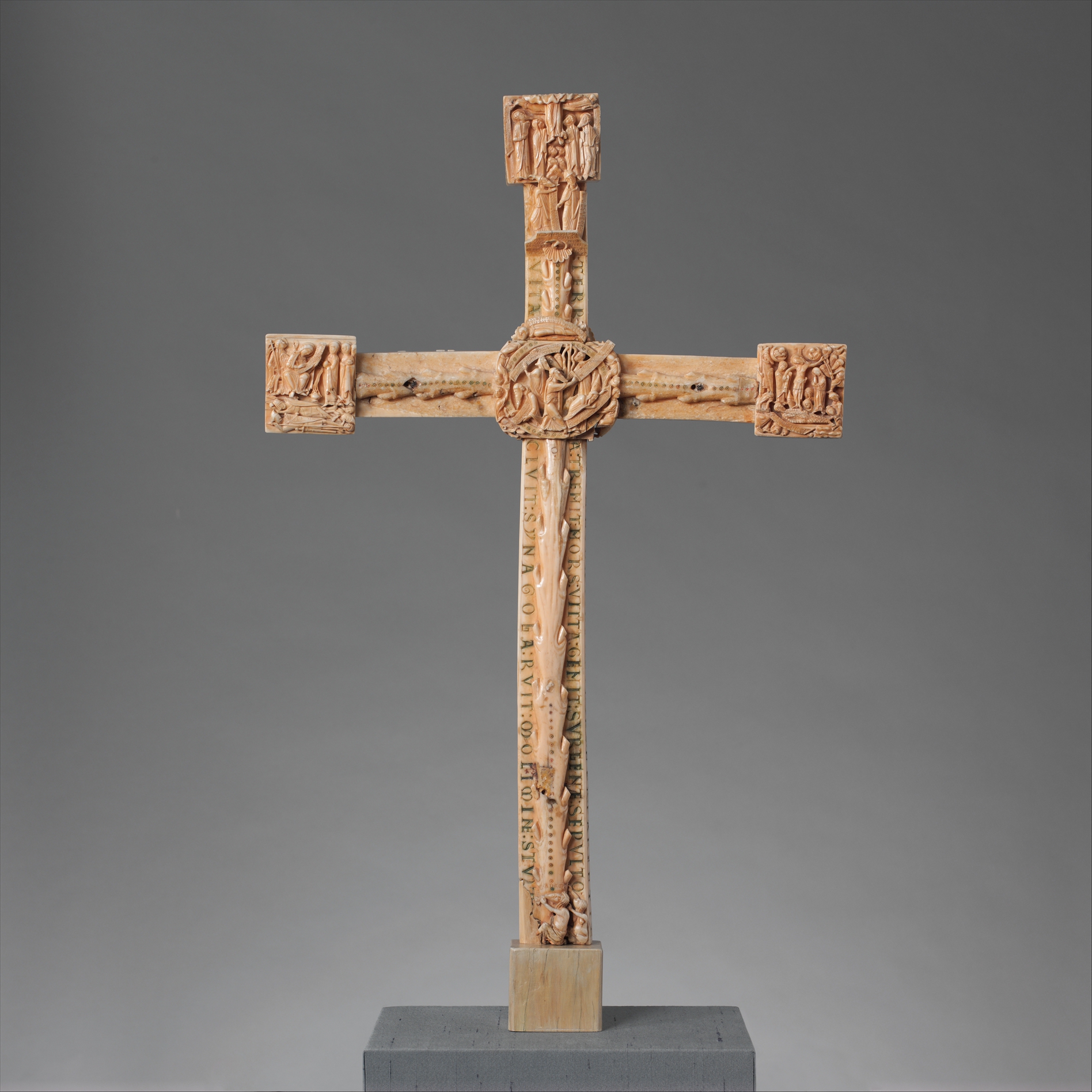
The cross as it stands, front face: Ascension at the top, Resurrection and Crucifixion on the arms, Moses and the Brazen Serpent in the central medallion. Walrus ivory, accession 63.12; the front shaft stands in a modern wooden base.
| Artist | Unknown carver (attributed by Hoving to the Bury St Edmunds circle of Master Hugo) |
|---|---|
| Date | ca. 1150-60 (Met); proposals from c. 1050 to c. 1190 |
| Medium | Walrus ivory |
| Dimensions | 57.5 x 36.2 cm (22 5/8 x 14 1/4 in.); shaft 31.4 x 4.3 cm |
| Where it is now | The Cloisters, Metropolitan Museum of Art, New York, Gallery 014last confirmed |
| Inventory number | 63.12 |
| Attribution | DisputedThe Met catalogues it as British, ca. Full note |
| Object type | Sculpture |
| Period | Romanesque, twelfth century |
| Cases | Disputed attribution · Has a provenance gap |
| Inscriptions | Latin and Greek tituli, including Cham ridet dum nuda videt pudibunda parentis / Iudei risere Dei penam mor[ientis]; Terra tremit mors victa gemit surgente sepulto / Vita cluit Synagoga ruit molimine stult[o]; and the placard altered to Rex confessorum. |
| Owners on record | 6 links4 documented, 1 disputed, 1 unknown |
| Sources | 18 cited |
About this record Last verified · 18 sources cited · Change log
On this page 9 sections
ContentsClose
A walrus-ivory cross of about 92 carved figures and 98 inscriptions, under two feet high, bought by the Met for The Cloisters in early 1963 from the Croatian dealer Ante Topic Mimara. Nothing about it before Mimara can be shown: his own account, Thomas Hoving's and a Hungarian witness's disagree. The Met catalogues it as British, ca. 1150-60, and often suggests Bury St Edmunds, but a 2026 Courtauld volume treats place, maker and patron as open.
The price is reported as $600,000 in Hoving's own account as reviewed, with no primary document seen; the figure of GBP 200,000 that circulates was Mimara's asking price to the British Museum, which could not buy it because title was never established. The inscriptions, which turn the Old Testament into an argument against the Jews, are on the Met's own label.
Provenance
Each link is graded. Documented: a cited source supports it. Disputed: the identification is argued but not established. Unknown: no owner for that span, and the gap is not smoothed into a narrative. The grades in the glossary.
- c. 1150 - c. 1190Unknown maker and patrondisputed
Made in the later twelfth century. Place, maker and patron are disputed: Bury St Edmunds Abbey (Hoving 1964; Parker and Little 1994), St Albans (Nilgen 1985), Hildesheim and Saxony (Munns 2013; Hennessy 2026), Denmark (Heslop 2026). The Met dates it ca. 1150-60.137814
- c. 1190 - c. 1948Unknownunknown
No owner is documented. Stories: Zirc abbey in Hungary c. 1930-33 (Kugler, recalled 1981 and 1986; unconfirmed by Zirc); a monastery of Eastern Europe, acquired 1938 (Hoving 1981) or c. 1947-48 (Hoving 1974); Volbach shown part of the cross, dirty, soon after the war (secondary report). A gap recorded as a gap.2349
- c. 1948 - 1963Ante Topic Mimara (Zurich bank vault)documented
Mimara said in 1963 he had owned it fifteen years and refused to name the seller; the start date of his ownership is itself disputed (c. 1948 per his word; early 1950s per the Courtauld introduction). He kept it in a Zurich bank vault and offered it: to Cleveland in late 1959 ($750,000 asked), about November 1960 (about $500,000) and 1961 (GBP 200,000), declined; to the British Museum from December 1960, GBP 200,000.23412
- 1960 - early 1963British Museum (not completed)documented
The Treasury withdrew its grant in early 1963 because title and provenance were never established. The Met purchase followed.23
- early 1963 - 1963The Metropolitan Museum of Art, The Cloistersdocumented
Purchase committee approved 18 October 1962; bought early 1963 out of income from the John D. Rockefeller Jr. fund for The Cloisters. Price not in the Met's own articles; Hoving's account, as reviewed in 1981 and 1982, and Akinsha 2001 give $600,000 (secondary, disputed in detail, no primary document seen).14111213
- 1963 - presentThe Metropolitan Museum of Art, The Cloisters (accession 63.12)documented
The Cloisters Collection, 1963; Gallery 014. A Met highlight.14
Technical evidence
| Attribution note | The Met catalogues it as British, ca. 1150-60, and often suggests Bury St Edmunds. Hoving (1964) argued for Bury and Abbot Samson on stylistic and textual parallels; Parker and Little (1994) largely supported Bury; Munns (2013), Hennessy (2026) and Heslop (1994, 2026) argue for Hildesheim and Saxony or for Denmark. No maker or patron is documented. |
|---|---|
| Support and material | Walrus ivory (Met classification Ivories-Walrus); species and Arctic source inferred, not tested on this object.146 |
| Dimensions | Overall 57.5 x 36.2 cm (22 5/8 x 14 1/4 in.); shaft 31.4 x 4.3 cm, thickness 3.2 cm; cross piece 24.8 cm; top piece 20.6 cm; central medallion 6.7 cm; terminal plaques about 5.7-5.9 x 5.4-5.9 cm; thickness of each about 3.8 cm.14 |
| Construction | Five pieces of tusk per Little (lower shaft 34.4 cm, a single incisor; main arm 25 cm; upper shaft 21 cm), joined by interlocking tongues, sheaths and pegs, without glue. Hoving in 1964 counted seven pieces.41 |
| Figures and inscriptions | About 92 figures and 98 inscriptions per the Met and Little; Hoving in 1964 counted 108 figures and more than sixty inscriptions in Greek and Latin.1641 |
| Lettering | Inscribed lettering on the shafts, terminals and scrolls; no pigment or tool-mark analysis published in the sources consulted.9 |
| Radiocarbon | A 1994 radiocarbon result placing the ivory in the seventh century is treated as erroneous (marine reservoir effect); style dates the cross to the later twelfth century.6 |
| Tusk | Inferred from a single large pair of tusks; the Good Friday plaque appears to be a cross-cut of a tusk 7-8 cm in diameter; an insert above the Lamb of God is a careful patch.6 |
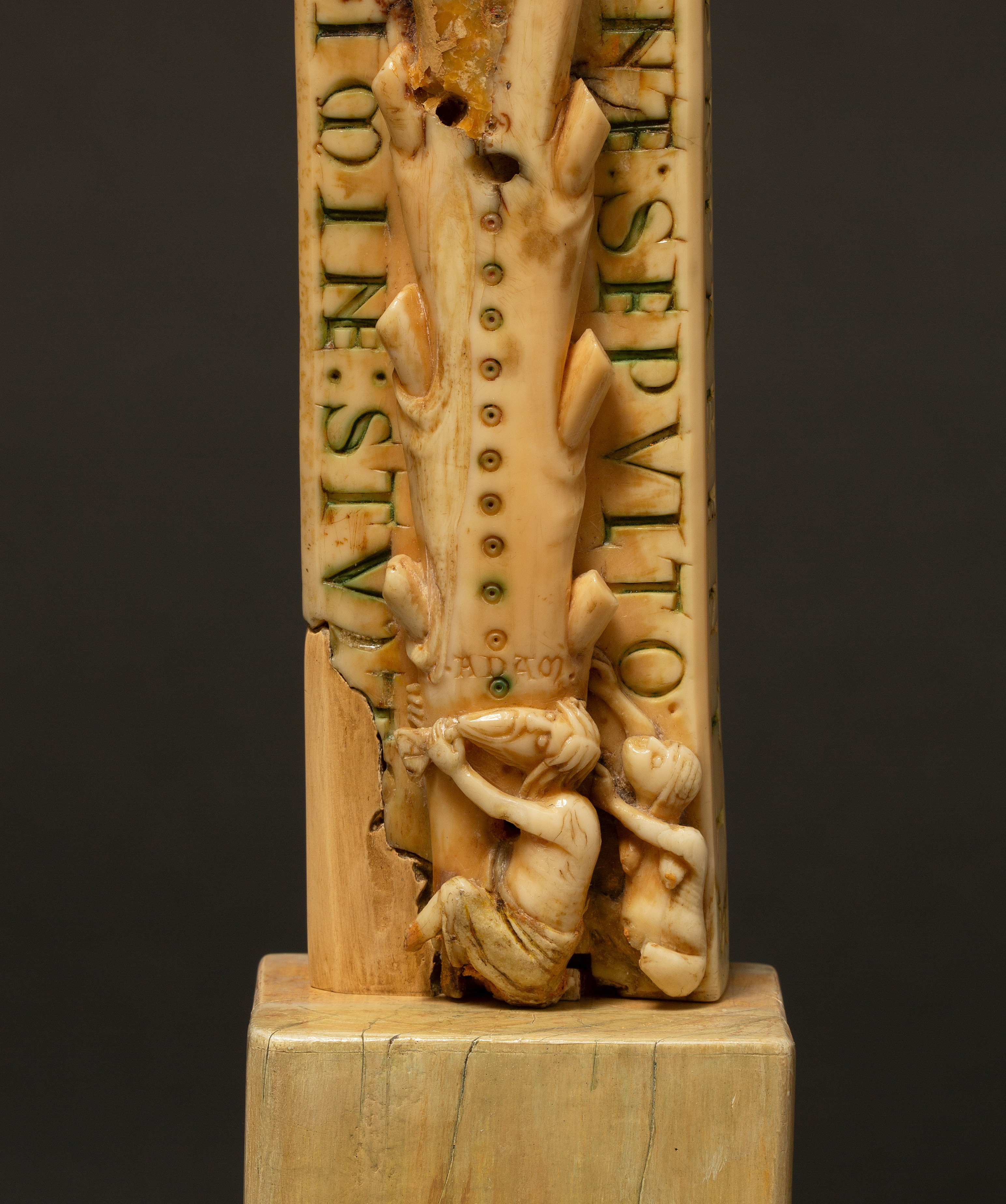
| Missing parts | The base is lost; the plaque 63.127 is a separate object and is not part of this record. The front shaft rests on a modern wooden base.16114 |
| Date and attribution (Met) | Ca. 1150-60; culture British; Met label notes the Bury St Edmunds attribution as often suggested.1415 |
Images
The record in full
Chapter 1A walrus-ivory cross of about 180 carved figures and words, under two feet high
The Cloisters Cross is a Romanesque altar or processional cross in walrus ivory, 57.5 cm high and 36.2 cm across, in the Met's medieval branch at The Cloisters, accession 63.12, credit line The...
The Cloisters Cross is a Romanesque altar or processional cross in walrus ivory, 57.5 cm high and 36.2 cm across, in the Met's medieval branch at The Cloisters, accession 63.12, credit line The Cloisters Collection, 1963 [14]. Its shaft is 31.4 cm long and 4.3 cm wide and its central medallion 6.7 cm across; the three surviving terminal plaques each measure about 5.7 to 5.9 cm by 5.4 to 5.9 cm [14]. Both faces are carved all over: the Met's count is about 92 figures and 98 inscriptions [16][4], where Hoving in 1964 counted 108 figures and more than sixty inscriptions in Greek and Latin [1]. The two counts differ because they were made forty years apart and by different hands; neither source explains the discrepancy, and this record gives both.
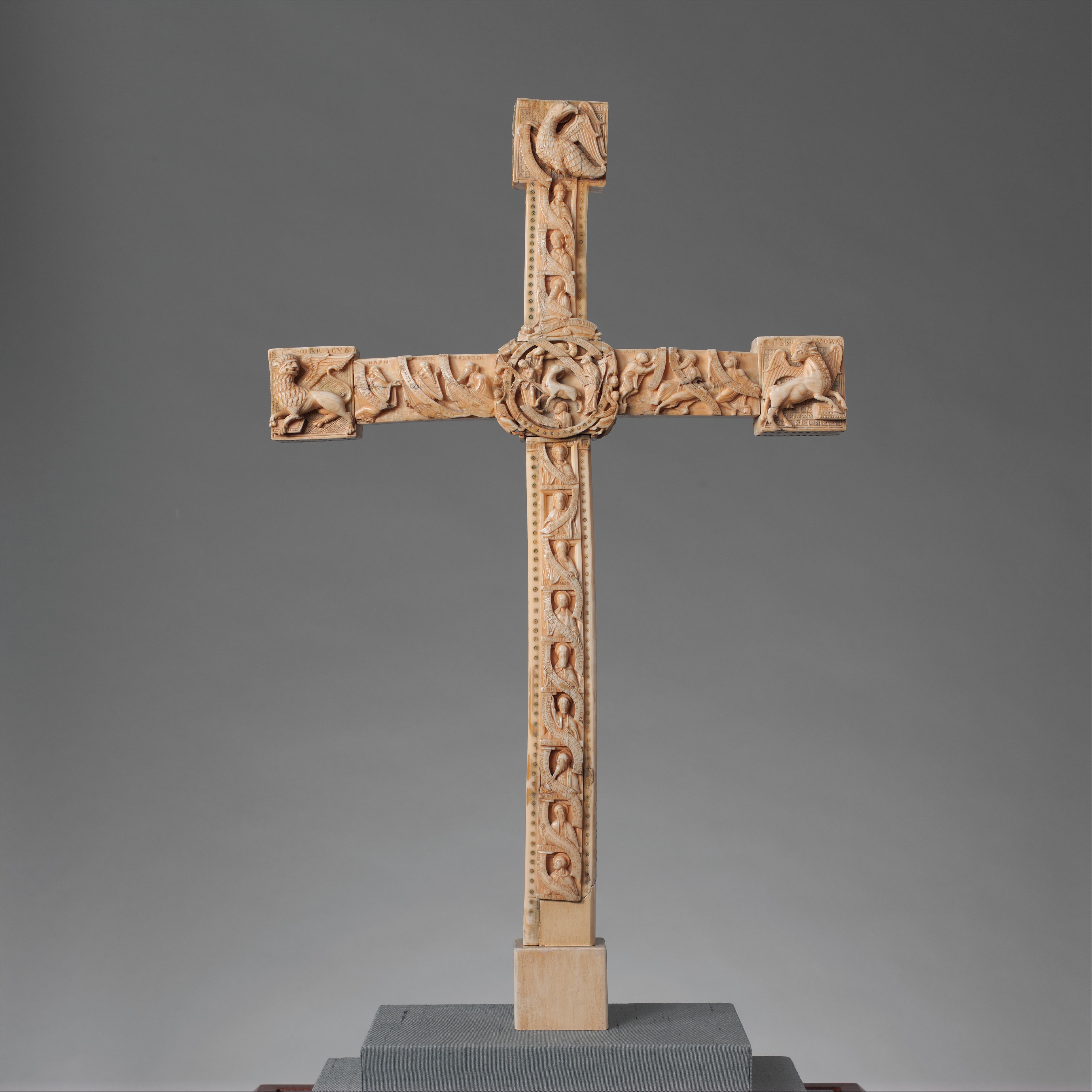
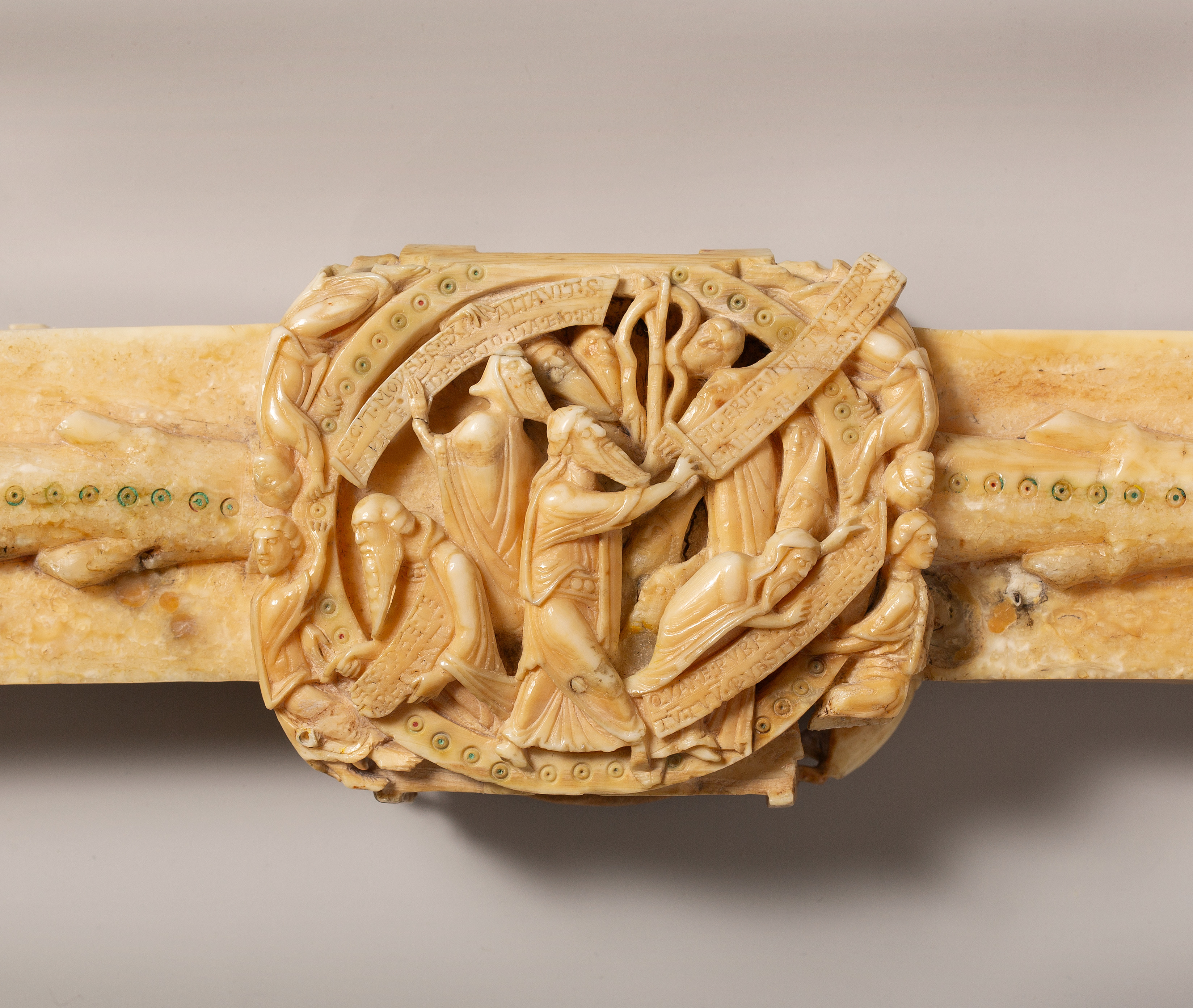
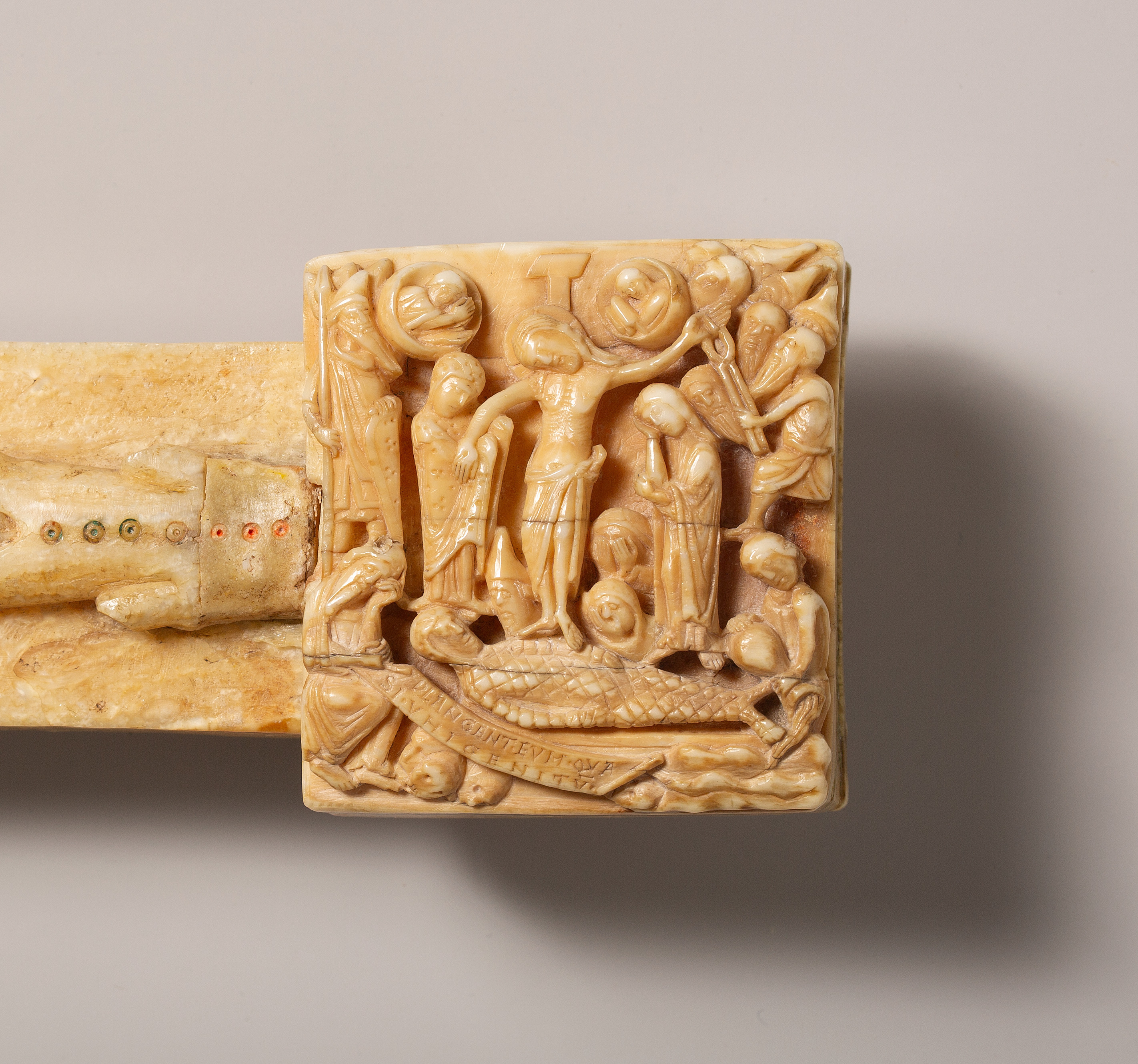
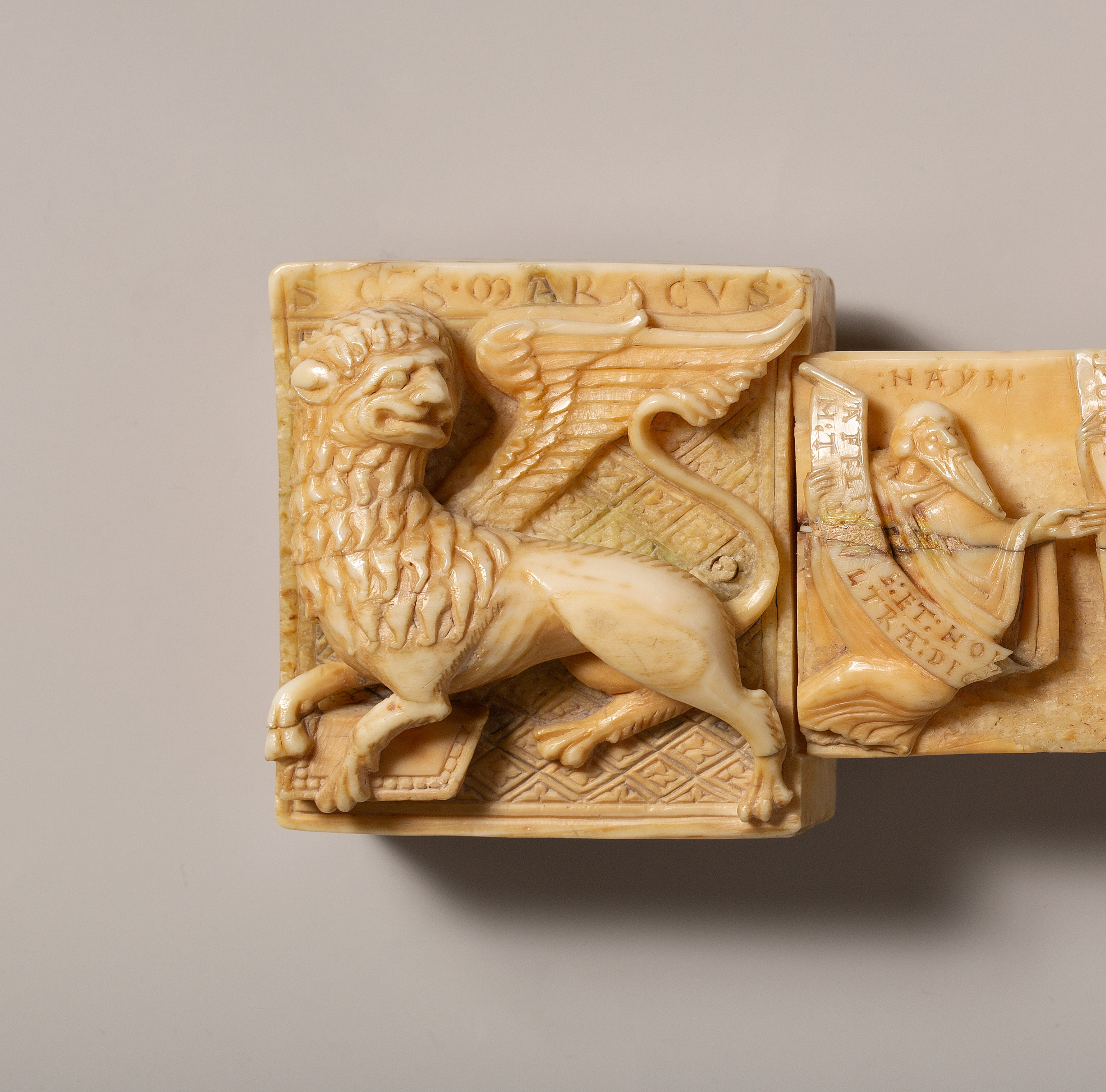
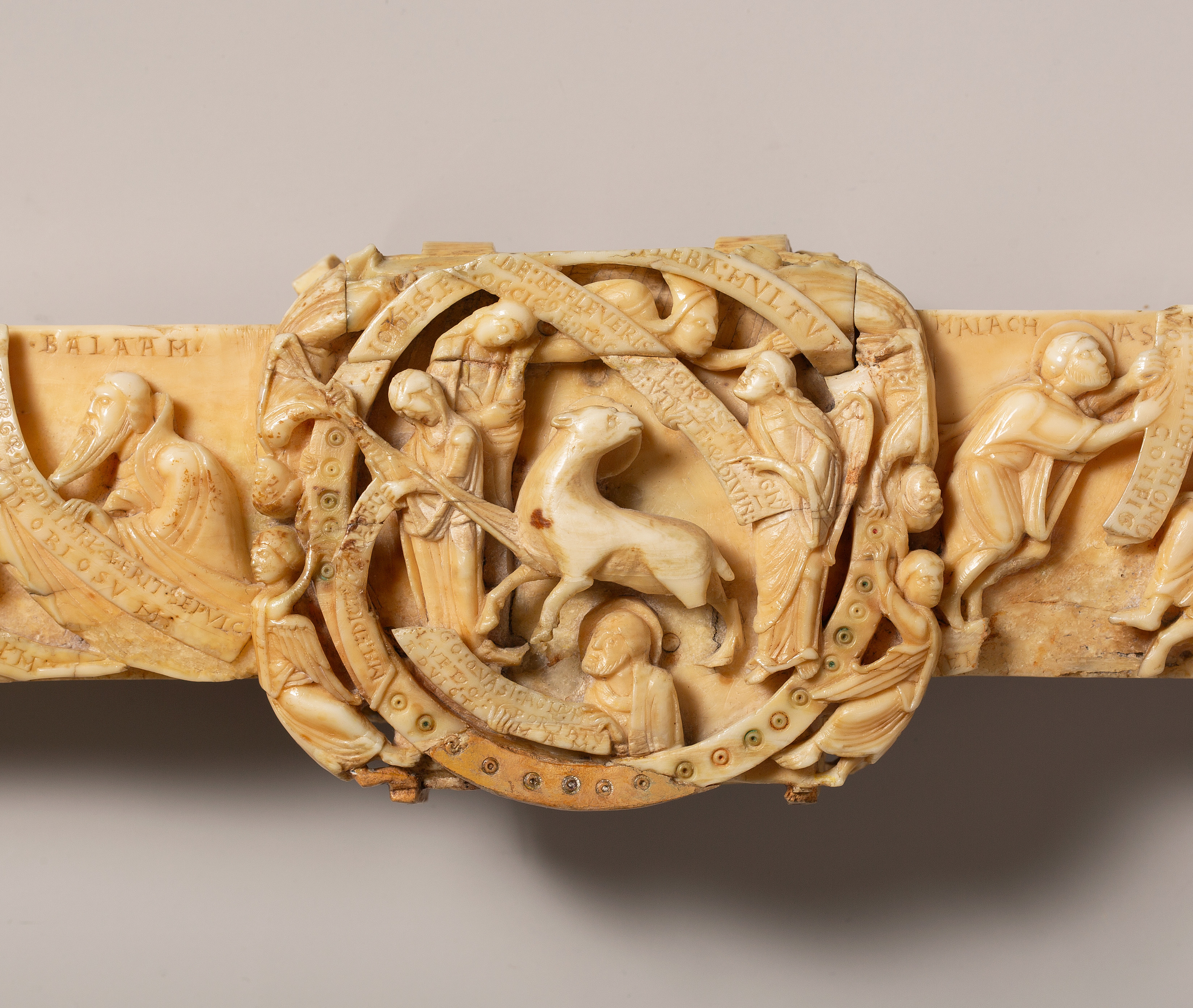
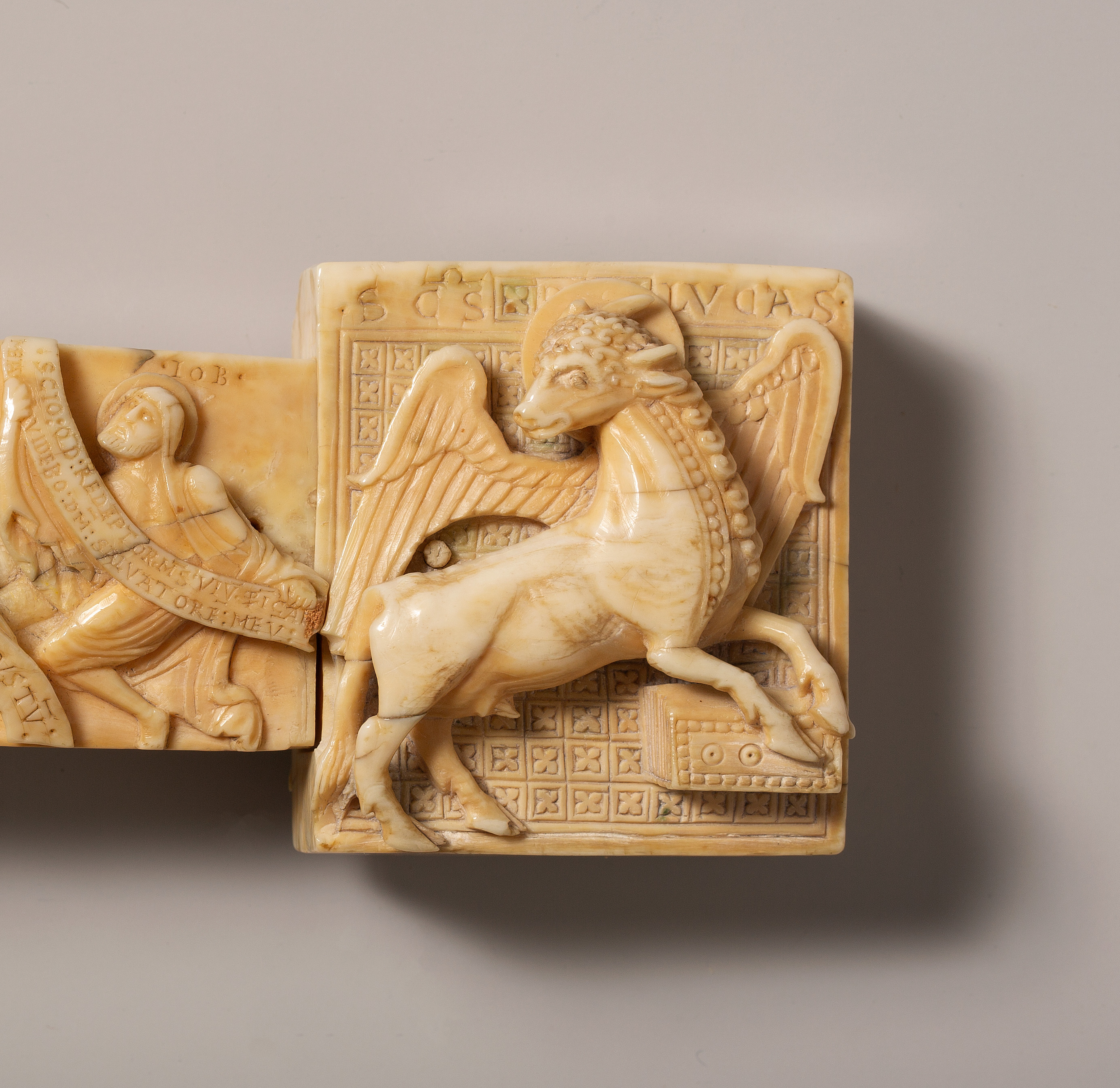
The front carries the Ascension at the top, the Resurrection on the left terminal and the Crucifixion on the right, with Moses and the Brazen Serpent in the central medallion; the back carries the symbols of Mark (lion), Luke (ox) and John (eagle) on the three terminals, the Lamb of God in the medallion with the figure of Synagoga and Old Testament prophets on the shafts holding scrolls inscribed with their words [16][15]. The lowest block is lost, and the front shaft ends in a modern wooden base [14]. What it would have shown is the subject of a separate dispute, treated below under the missing base.
Chapter 2It is five pieces of tusk joined without glue, and what that says about the maker
Hoving described the cross in 1964 as fashioned from seven pieces of walrus tusk fitted together by tongues of ivory that slip into sheaths and are secured by pegs [1].
Hoving described the cross in 1964 as fashioned from seven pieces of walrus tusk fitted together by tongues of ivory that slip into sheaths and are secured by pegs [1]. Little, who handled the Met's 2003-04 replica, counts five pieces: a lower shaft of 34.4 cm that is a single walrus incisor, a main arm of 25 cm and an upper shaft of 21 cm, with the terminals [4]. He sees in the interlocking double-lap joins a resemblance to Viking-age shipbuilding [4]. Whether the count is five or seven depends on whether the separately carved terminal blocks and the small insert behind the monk figure on the back are counted; Hoving himself noted that the monk's head, the top of the border and part of an angel's scroll are on a small separate piece of ivory attached with great skill to the medallion [1].
Barrow, writing in the same 2026 volume, infers from the cross's size, its five solid pieces and the little visible secondary dentine that it was carved from a single pair of large tusks; she is explicit that the tusk count and the original tusk size are inferences and not test results [6]. A rectangular insert above the Lamb of God shows deliberate patching of the material [6]. The Good Friday plaque, about 5.9 cm high and 5.4 cm wide and about 4 cm thick, looks like a cross-cut slice of a tusk of roughly 7 to 8 cm in original diameter [6]. These are the physical facts a student of the object can use; no one has published a tool-mark or pigment study of the surfaces, and the 2026 editors call for one [9].
Chapter 3The scheme: a cross as Tree of Life, with the Old Testament made to testify
The Met's own text reads the cross as a Tree of Life, with Moses and the Brazen Serpent in the central medallion foreshadowing the Crucifixion, and with the richness of its subjects and inscriptions...
The Met's own text reads the cross as a Tree of Life, with Moses and the Brazen Serpent in the central medallion foreshadowing the Crucifixion, and with the richness of its subjects and inscriptions pointing to a major centre of learning [15]. Little, who wrote the 1994 monograph with Elizabeth Parker, argues that the cross was made for devotional and confessional use, that its images and inscriptions are built to show the Old Testament confirming Jesus as the Christ, that its unity suggests a single designer and that it may also have served in ceremonial use [4]. He does not claim a hidden scheme; the programme he reads is a typological argument of the standard twelfth-century kind, put into ivory with unusual density.
Harcourt-Smith goes further and argues that it can be read as a sermon in scriptural typology, perhaps a travelling one, for lay, monastic or scholarly audiences [5]. This is argued, not documented: no text says what the cross was for, and the proposal rests on the verses and on the wider Paris-school habit of teaching by verse [5]. Where the evidence ends the record states it: nothing survives to say who commissioned the cross, for which church, or whether it stood on an altar, went in procession or was shown for teaching.
Chapter 4The tituli: what is written on it, and where else those words are found
The cross carries two verse couplets that matter for both its date and its meaning.
The cross carries two verse couplets that matter for both its date and its meaning. On the shaft: CHAM RIDET DUM NUDA VIDET PUDIBUNDA PARENTIS / IUDEI RISERE DEI PENAM MORIENTIS, which Wikipedia renders as Ham laughing at his parents' shameful nakedness and the Jews laughing at the dying pains of God [16]; and TERRA TREMIT MORS VICTA GEMIT SURGENTE SEPULTO / VITA CLUIT SYNAGOGA RUIT MOLIMINE STULTO, the earth trembling, conquered death groaning as the buried one rises, Life acclaimed and the Synagogue falling through its foolish effort [16][5]. The placard above the Crucifixion has been altered from King of the Jews to King of the Confessors (REX CONFESSORUM) [1][16].
Hoving found two parallels at Bury St Edmunds. A hexameter recorded in a late thirteenth-century manuscript of the abbey's choir-screen verses (College of Arms, Arundel XXX) reads CHAM DUM NUDA RIDET PARENTIS GENITALIA VIDET, which he judged too close to the cross's couplet to be accidental [1]. And a gloss in a twelfth-century Gospel of Mark at Pembroke College, Cambridge (MS 72) uses the form king of the confessors, with the same faulty Greek word exomolisson as the cross [1]. Little adds a further near-parallel, rex confitentium in the Arundel Psalter and cites the inscription Maledictus omnis qui pendet in ligno (Galatians 3:13) [4].
Harcourt-Smith traces the Ham couplet through Isidore, Rabanus Maurus and Richard of Saint-Victor's Allegoriae and finds variants in Peter Comestor's Historia Scholastica marginalia, the Glossa ordinaria, Stephen Langton's Postillae super Genesim and the sermons of Odo of Cheriton; a Reims manuscript is the only exact match she cites [5]. She reports that Christopher Hohler linked the verse form to Bernard of Morlais and that Suger's great cross at Saint-Denis carried a similar couplet to terra tremit; she thinks the cross's couplet may have been composed for it unless a source turns up [5]. She also argues that the harsh wording (nuda, pudibunda, morientis) was probably softened later, perhaps by Langton in the early 1200s and that deus patiens is probably original [5]. This is her argument, and an unusual one: it makes the cross an early witness of verses that the Paris schools later tidied.
Chapter 5Bury St Edmunds and Master Hugo: how the attribution was built, and what it rests on
When the Met bought the cross it knew only that it came from the collection of Ante Topic Mimara and looked English; Hoving wrote that it had absolutely no recorded history [1].
When the Met bought the cross it knew only that it came from the collection of Ante Topic Mimara and looked English; Hoving wrote that it had absolutely no recorded history [1]. The acquisition form of 1962-63 called it simply Northern European, twelfth century; Little thinks that caution may have been wise [4]. The Bury attribution came after the purchase, in the summer of 1963 according to Rorimer's prefatory note [1], and Hoving's 1964 article is its first statement. His case was stylistic and textual: figures such as Amos, Nahum, Haggai and Malachi on the cross against the prophets of the Bury Bible, the damp-fold drapery and the populated medallions as marks of the later twelfth century, the abbey's seal of about 1150, a lead font at Walton-on-the-Hill and a glossed Joshua at Pembroke, plus the two verbal parallels above [1]. The Bury Bible, a great illuminated Bible made at Bury under Abbot Anselm (1121-1148), is now Corpus Christi College, Cambridge, MS 2, and is the work of Master Hugo, recorded at the abbey from before 1136 to after 1148 [1][18].
Three limits on that case need stating. First, in 1964 Hoving tied the cross to Abbot Samson, writing of a conjectural portrait of him in a monk with a clenched fist on the back and proposing inscriptions of 1181 to 1190, perhaps added to figures carved about 1150 [1]. The New York Review's reviewer of Hoving's 1981 book noted that Samson's abbacy post-dates the carving by an inconvenient number of years, that the Met had in 1974 issued a press release refuting the Samson link, and that Cloisters staff found the monk figure an integral part of the ivory [12]. Hoving's own 1964 text had called it a separate attached piece [1]. Second, the claim in popular sources that Hoving concluded Master Hugo carved the cross [16][18] is not what the 1964 article says: it points to Hugo's style and to the Bury house, not to Hugo's hand [1]. Third, Bober, who pointed Hoving to the Bury Bible, is not credited in the 1964 article [4][12].
Parker and Little in 1994 largely supported Bury and a mid-twelfth-century date [3], and the Met's current label reads British, ca. 1150-60 [14]. Little's own 2026 conclusion is that no single criterion is decisive and that the attribution remains open [4]. That is the right grade: argued, with named dissenters, not documented.
Chapter 6The dating and origin debate, in sequence
The dates proposed run from the late eleventh century to about 1200, and each is a person's argument.
The dates proposed run from the late eleventh century to about 1200, and each is a person's argument. Wiltrud Mersmann, the owner's wife, published the cross in 1963 and proposed about 1050, mid-eleventh-century England, possibly Winchester [3]; Hoving said that date could not be maintained [1]. The British Museum's committee of specialists in 1962, led by Rupert Bruce-Mitford, dated it from the late eleventh century to about 1120 and called it English, giving four reasons Hennessy and Heslop call suggestive and not conclusive [2][3]. Hoving and Rorimer in 1964: Bury, about 1150, with inscriptions of 1181-1190 [1][3]. Ursula Nilgen in 1985: St Albans and the Channel Style [3]. Parker and Little in 1994: Bury or England, mid-twelfth century [3]. Heslop in 1994: Germany now needs to be acknowledged as more probable [3]; Neil Stratford in 2014: third quarter of the twelfth century, on either side of the Channel [3]; John Munns in 2013: the circle of the Stammheim Missal at Hildesheim [3][7]; Rainer Kahsnitz in 2022: England [3].
Two 2026 essays now argue away from England. Hennessy builds on a Princeton seminar paper of autumn 1971 by William Stephen Gardner, who found continental elements in the Resurrection plaque and concluded that no firm connection to Henry the Lion could be shown; she proposes the milieu of Hildesheim and Bishop Adelog, about 1188 [7]. Heslop argues that the cross and the Oslo walrus-ivory Corpus (Kunstindustrimuseet, inv. 10 314) belong together and were made about 1188 in Denmark, possibly for the royal mausoleum at Ringsted, in the circle of Cnut VI and Absalon, while allowing the carver was English or German [8]. Sauerländer rejected the pairing in his review of the 1970 exhibition, Kahsnitz dates the Corpus after 1200 or 1210, and Tage Christiansen also doubted it; Heslop notes the link was dropped by many art historians without a detailed rebuttal [8]. Hoving kept the pairing [8][12].
The editors' own conclusion is a range: about 1150 to 1190, with manufacture in north-western Europe or by an artist trained there, and no claim that any of the patrons mentioned (Henry the Lion, Cnut VI, Bela III of Hungary) is established [9]. This record gives the Met's 1150-60 as the museum's date and treats everything narrower as a proposal.
Chapter 7The ivory itself, and the seventh-century radiocarbon date that was never real
The material is walrus tusk and the source is almost certainly the Arctic, but only by inference.
The material is walrus tusk and the source is almost certainly the Arctic, but only by inference. Barrow sets out the twelfth-century background: elephant ivory from sub-Saharan Africa was disrupted in the eleventh and twelfth centuries, Iceland's walrus herds were nearly gone by the tenth century; by the twelfth Greenland tusks, from the Disko Bay grounds, dominated the European trade, with tithes of tusks and hides flowing to the archbishop of Nidaros via Bergen after Greenland's bishopric was founded in 1123 [6]. Tusks were distributed through Dublin, Trondheim, Bergen and Ribe and on to carving centres such as Winchester, Oslo and Cologne [6]. Nothing in the sources consulted says which route the cross's tusk took.
The one published scientific test is a problem. The 1994 monograph reported a radiocarbon date for the ivory in the seventh century; Barrow treats it as erroneous because of the marine reservoir effect, which makes walrus and other marine-animal samples read older unless recalibrated, and says the cross is dated by style to the second half of the twelfth century [6]. The 2026 editors add that a tusk's origin does not tell where it was carved [9]. No isotope, ancient-DNA or CT study of this cross is reported in the sources consulted; Barrow's survey of genetic work on walrus (Barrett and colleagues) concerns other material [6]. The pigments and the green infill of the lettering have not been analysed in anything the record can cite [9].
Chapter 8What the Met bought: the sale of 1962-63, and the British Museum that did not
Mimara, a Croatian dealer whose true name and birth date Stratford calls uncertain, was showing photographs of the cross in London by December 1960, and on 18 May 1961 he visited Rupert...
Mimara, a Croatian dealer whose true name and birth date Stratford calls uncertain, was showing photographs of the cross in London by December 1960, and on 18 May 1961 he visited Rupert Bruce-Mitford, Keeper of British and Medieval Antiquities at the British Museum, with the cross itself left in a Zurich bank vault [2]. His asking price was GBP 200,000 [2]. Bruce-Mitford and Peter Lasko went to Zurich in June 1961 and January 1962 and in July 1962 Bruce-Mitford put the case to the trustees, recording Mimara's claim that the cross came from a Balkan monastery [2]. Sir Frank Francis, the director, said a special grant would be needed and the application had to include full details of the pedigree [2]. In early 1963 the Treasury withdrew its offer of a grant, having never resolved title and provenance, and the museum could not buy [2][3].
Cleveland was offered it earlier: late in 1959 at $750,000 (Harold Parsons to Sherman Lee), about $500,000 in November 1960 and GBP 200,000 in July 1961, and declined in 1961, mainly on price [3]. At the Met, Rorimer's note says the cross was first called to the museum's attention in 1956 and that Hoving and Carmen Gomez-Moreno examined it in a Zurich bank vault in 1959 [1]. Little's chapter cites an examination in Zurich in September 1961 [4]; Rorimer and Margaret Freeman studied it in 1962 and used ultraviolet light to satisfy themselves of its antiquity [1]. The purchase committee approved the purchase on 18 October 1962, subject to the director's approval; it became acquisition 63.12 [4]. The Met says it bought the cross early in 1963 out of income from the fund established by John D. Rockefeller Jr. for The Cloisters [1]. The acquisition form was signed by Freeman, not Hoving [4].
The price the Met paid is not in the Met's own articles [1][4]. Hoving's 1981 book, as reviewed, gives a record price of $600,000 [12][13]; Akinsha in ARTnews in 2001 repeats it [11]. These are secondary reports of Hoving's account, and no primary document (invoice, minutes, ledger) has been consulted. The figure GBP 200,000 that circulates for the Met sale [18] is the asking price Mimara gave the British Museum in 1961, not a Met price [2]; at the then-fixed rate of $2.80 to the pound (a derived figure, not a sourced one) it is about $560,000, which fits the order of magnitude but does not prove the Met's figure. Stratford adds that Hoving had an offer of $900,000 for the cross and four other pieces, with the money held in a Zurich bank, and that a rumoured Cleveland offer of $500,000 was vague [2]. How the 63.12 sale related to those other pieces is not stated in what has been read.
Chapter 9Provenance: a collector in Zurich and nothing before him that anyone can show
The record starts with Ante Topic Mimara, and everything before him is a story.
The record starts with Ante Topic Mimara, and everything before him is a story. In 1963 he said he had owned the cross for fifteen years, which points to about 1948; he said he bought it from an elderly dealer, that it came from Eastern Europe and in 1982 that he had promised the seller never to disclose his name [2]. To Hoving he said it came from a remote monastery, and Hoving's accounts of when are inconsistent: 1938 in the 1981 book, around 1947-48 in a 1974 letter [4]. Hennessy and Heslop write that the 1938 story, with the cross in five pieces, is Hoving's account [9]. Another account, repeated by a tourist page, that it was found in a Zurich vault at the end of the war [18] is not supported: Zurich is where Mimara kept it.
Fritz Volbach, then at the Vatican, was reportedly shown part of the cross, dirty and damaged, soon after the Second World War [3][16]; the report is in the secondary literature and is not firsthand. Josef Kugler told Hoving in 1981 that he saw the cross about 1930, and in an interview of 16 April 1986 placed it in 1932-33, aged twelve, at the Cistercian abbey of Zirc in Hungary, where Father Veit said pieces had been found in an armoire from Zsambek; he recalled that the wrapping papers linked it to a crusader going to Jerusalem and that it was thought cursed [4]. The Zirc community, which the Soviets closed in the autumn of 1950 and which had a house in Texas from 1954 to 1961, did not confirm the story and said it had never known of the cross [4]. Little treats Kugler's account as plausible but unconfirmed, and Hennessy and Heslop question it [4][9]. Mersmann, who worked at the Munich Central Collecting Point from March 1946 to June 1949, wrote on 17 September 1987 that the cross was with a clerical community and that her husband had promised not to reveal its origin; her son recalled in 2010 that her own memory of it went back to about 1955 [4]. The authors of the 2026 volume say the story reads more like a detective story than a settled account and do not rule out a cover-up, nor confirm one [9].
Zagreb and Yugoslavia come into the story through Mimara, not through any recorded claim on the cross. Stratford records that Mimara represented, perhaps genuinely, the Yugoslav government at Munich in 1948 and oversaw shipments of art to Yugoslavia that did not all originate there [2]. Akinsha reports that in 1949 Mimara obtained 166 objects from the Munich Central Collecting Point on claims later found fabricated, only three being Yugoslav property, and his later collection went to Zagreb (the Mimara Museum, opened in 1987) and Belgrade [11][17]. Hoving called the seller a Yugoslav dealer-restorer and a spy for Tito, claims the New York Review reviewer did not verify [12]. In the sources consulted there is no restitution claim by Yugoslavia, Croatia, Hungary or any heir against the cross itself; that absence is recorded here as what was searched for and not found, not as proof that no claim has ever been made.
Chapter 10Ante Topic Mimara and Thomas Hoving, as people in the chain
Mimara is the dealer and first recorded owner, and the sources agree he was an unsafe one.
Mimara is the dealer and first recorded owner, and the sources agree he was an unsafe one. Akinsha, in ARTnews, writes that Hoving pushed the purchase through despite warnings from former Central Collecting Point staff and Swiss police about Mimara's doubtful past, that Rorimer asked the FBI (which said it had no information) and that the museum did not consult the restitution specialist Ardelia Hall, who had followed Mimara since 1949 [11]. Hoving, according to Akinsha, spent the proceeds on Schloss Neuhaus near Salzburg [11]. The Met's director James Rorimer called the cross one of the most important acquisitions the museum had made [11]. In a 30 March 2000 email to the British Museum, Hoving wrote that Mimara had been involved in what he called truly nasty things, including murder and dealing in Holocaust art, and that is Hoving's allegation, not an established finding [3]. The Mimara Museum's collection was described by Hoving, as quoted in a secondary source, as 95 per cent fakes [17]; Akinsha says art historians dismissed most of it as fake or second-rate and that its director said Mimara never disclosed its provenance [11].
Mimara's dates are disputed in the sources. Wikipedia and the Courtauld volume give 7 April 1898 to 30 January 1987 [10][17]; Akinsha gives death in January 1986 and notes a rival account that he was Mirko Maratovic, born in Split in 1897 [11]. This record uses 1898-1987 as the usual dating and flags the conflict.
Hoving (1931-2009), curator of the Medieval Department at The Cloisters from 1959 to 1966 and later director of the Met, wrote of the cross in 1964, in King of the Confessors (1981; a second edition appeared in 2001) and in later memoir writing [10][16]. Hennessy and Heslop call the 1981 book a gripping but less than reliable account of the purchase [3]. Heslop in the Burlington Magazine in 1994 called it an autobiographical romance [16]. Hughes in Time called it overwrought and self-congratulatory [13]. The review in the New York Review said Hoving's account of his trip to Zurich was contradicted by Gomez-Moreno's memories (a different hotel, a different evening) and that Mimara had been offering the cross widely in the late 1950s [12], which undercuts the picture of a lone rediscovery. Hoving's reading of a monk figure on the back as Samson, which he called the pugilist, was rejected by the Met's own staff [12]. Hoving died in 2009; claims about him here are attributed to the writers who made them.
Chapter 11The missing base, the Caiaphas plaque, and why it is not this object
The cross as bought has no base block. The lost lowest terminal presumably bore Matthew's winged man on the back; on the front Christ before Caiaphas has been assumed [16].
The cross as bought has no base block. The lost lowest terminal presumably bore Matthew's winged man on the back; on the front Christ before Caiaphas has been assumed [16]. In 1964 Hoving announced that one of the missing plaques had come to light: Kurt Weitzmann found a photograph of it in the files of Adolf Goldschmidt, annotated as having been in a German private collection in the 1930s, and an old friend of the museum produced the object itself within six months [1]. That plaque is the Met's separate acquisition 63.127, the Caiaphas or Pilate plaque, which the 1964 article reproduced with the cross under a combined caption [1]. Bernice Jones in Gesta in 1991 proposed restoring it to the base; not all scholars accept this [16]. Sauerlander dismissed the idea that the plaque, or the Oslo Corpus, was made for the cross [3].
This record concerns accession 63.12 only. The plaque 63.127 has its own acquisition history, its own provenance and its own catalogue entry, and nothing about its pre-1963 German ownership or its recovery is evidence for the cross, which has none. Equally, the Met's other 1963 acquisitions are not part of this object's history, and nothing in the sources consulted ties the five other pieces of the Zurich offer to the cross [2].
Chapter 12Meaning, harm and reading: antisemitism, then and now
The inscriptions are anti-Jewish, and the Met says so.
The inscriptions are anti-Jewish, and the Met says so. The Met's text states that they include strong invectives against Jews and that the cross reflects the English antisemitism of the period, Jews being expelled from England by the end of the thirteenth century [16]. Hoving built a reading on this in 1964, tying the harsh inscriptions to Abbot Samson's campaign against the Jews of Bury and calling the cross a mark and the explanation of an entire epoch, crusading spirit both good and evil [1]. Parker and Little argue instead that the cross belongs to the tradition of Christian-Jewish debate [16]. Heslop in 1994 criticised Hoving's book for avoiding a direct confrontation with the object's antisemitism, and doubted an English origin from the figure of Synagoga piercing the Lamb and from the conical hats of the Jews, which he thought German or eastern European [16].
Harcourt-Smith, whose chapter does not analyse the antisemitism question, shows that the Ham couplet was a commonplace of the schools [5]. That is evidence about the verse's circulation. It is not an argument that the couplet was harmless on an object that applies it to Jews. Where historians disagree, the record names who holds what and does not arbitrate. What can be said without dispute is that a reader in the twelfth century and one today are reading the same Latin, and that the Met as the owner has put the harm in its public text.
Chapter 13The cross after 1963: exhibition, a replica for Bury, and a 2026 reassessment
The cross went on view at The Cloisters.
The cross went on view at The Cloisters. In 1970 it was shown in The Year 1200 at the Met with the Oslo Corpus and the Pilate plaque [3]. Sauerlander's review questioned whether either was made for the cross [3]. In 2003 the Dean of St Edmundsbury Cathedral, James Atwell, asked for a replica, and Little directed the project; the Met's reproduction studio under Ronald Street made two epoxy-resin copies, one presented to Bury in September 2004 and now shown in the cathedral's treasury, the other used at the 2023 colloquium [4][18]. The cross is still in the Met's Gallery 014 and is a Met highlight, and its images are available through the Met's open access programme [14].
A colloquium on 12 May 2023 at the Courtauld, sponsored by the British Archaeological Association and the Courtauld, produced the 2026 volume Revisiting the Cloisters Cross, edited by Cecily Hennessy and T. A. Heslop, which re-examines the ivory, the acquisition, the dating and origin, and the texts, and aims to widen the argument and not close it [3][9]. It is the best current starting point and the one this record leans on.
The artist
The maker of the Cloisters Cross (unknown; Bury St Edmunds circle proposed)
The cross has no documented maker. The nearest the record comes is a style: the prophets, the drapery and the inscriptions resemble Bury St Edmunds work of the mid and later twelfth century, notably the Bury Bible of Master Hugo, and Hoving drew the line from the cross to that house in 1964. A rival school of scholars now places it in Saxony or Denmark about 1188. This block covers the maker question and not a biography, because there is none.
Related works
| Work | Relation | Where it is |
|---|---|---|
| The Caiaphas plaque (63.127) Unknown | Separate Met acquisition, proposed by Jones (1991) as the lost base of the cross; not accepted by all scholars Its own provenance (a German private collection in the 1930s) is not this cross's. | The Cloisters, Metropolitan Museum of Art |
| The Bury Bible Master Hugo | Principal stylistic comparison for Hoving's 1964 Bury attribution Made 1121-1148 under Abbot Anselm. | Corpus Christi College, Cambridge, MS 2 |
| Oslo Corpus Unknown | Walrus-ivory Crucified Christ argued by Heslop (2026) to have been made for the cross; rejected by Sauerlander and Kahsnitz Shown with the cross at the Met in 1970. | Kunstindustrimuseet, Oslo, inv. 10 314 |
| Stammheim Missal Hildesheim | Comparison for the Maries at the tomb and the conflated Resurrection (Parker and Little 1994; Munns 2013) Cited by Hennessy as the strongest German comparison. | Hildesheim, 1170s |
| Replica of the Cloisters Cross Ronald Street, Met reproduction studio | Epoxy-resin copy made 2003-04 Presented September 2004. | St Edmundsbury Cathedral, Bury St Edmunds |
| Gunhild Cross Liutger (maker named in its inscription) | Comparison used by Hennessy and Heslop for a cross whose inscription names its maker and a Danish princess as patron Cited as a contrast; the Cloisters Cross names neither. | Denmark |
Open questions
- Where was the cross between the twelfth century and about 1948? No owner, no church and no sale is documented for roughly eight centuries.
- Did it come from the Cistercian abbey of Zirc in Hungary, as Josef Kugler recalled in 1986, or from a Balkan or Baltic monastery, as Mimara said, or somewhere else? The Zirc community did not confirm it.
- When did Mimara acquire it: 1938 as Hoving's book has it, around 1947-48 as Hoving's 1974 letter and Mimara's own 1963 'fifteen years' imply, or the early 1950s as the Courtauld volume suggests?
- How much did the Met pay? $600,000 is Hoving's figure as reviewed, with no primary document seen; the Met's own articles give none. Was the 63.127 plaque or any other piece included?
- Was it carved in England at Bury St Edmunds, in Hildesheim and Saxony, in Denmark, or at a Channel Style centre such as St Albans? The 2026 editors agree only on about 1150-1190 and north-western Europe.
- Does the Oslo Corpus belong to the cross, and what stood at the base? Heslop says yes; Sauerlander and Kahsnitz say no; the base block is lost.
- What was the cross for, and who commissioned it? Nothing survives to name a patron or a church.
- Where did the tusk come from, and what are the pigments in the lettering? No isotope, DNA or pigment study of this cross has been published.
- Which twelfth-century source composed the couplet terra tremit mors victa gemit? Harcourt-Smith suggests it may have been composed for the cross.
- Was the Met right to proceed without proof of title, and has any party, including the states in whose territory Mimara worked in 1948, ever made a claim on this object? None is recorded in the sources consulted.
Questions about this object
What is The Cloisters Cross?
The Cloisters Cross is a sculpture, dated ca. 1150-60 (Met); proposals from c. 1050 to c. 1190. Medium: Walrus ivory.
Who made The Cloisters Cross, and is the attribution settled?
The attribution to Unknown carver (attributed by Hoving to the Bury St Edmunds circle of Master Hugo) is recorded here as disputed. The Met catalogues it as British, ca. 1150-60, and often suggests Bury St Edmunds. Hoving (1964) argued for Bury and Abbot Samson on stylistic and textual parallels; Parker and Little (1994) largely supported Bury; Munns (2013), Hennessy (2026) and Heslop (1994, 2026) argue for Hildesheim and Saxony or for Denmark. No maker or patron is documented.
Where is The Cloisters Cross now?
The Cloisters, Metropolitan Museum of Art, New York, Gallery 014. Inventory number 63.12. Last confirmed 19 November 2026. Met collection record; bought early 1963 by the museum (The Cloisters Collection, 1963).
What is still unknown about The Cloisters Cross?
Where was the cross between the twelfth century and about 1948? No owner, no church and no sale is documented for roughly eight centuries.
Sources
- 1Thomas P. F. Hoving, 'The Bury St. Edmunds Cross', with a prefatory note by James J. Rorimer, The Metropolitan Museum of Art Bulletin 22, no. 10 (June 1964), pp. 317-340. Primary source for the acquisition as the Met announced it; read in full. resources.metmuseum.org/resources/...
- 2Neil Stratford, 'The British Museum and the Cloisters Cross', in Cecily Hennessy and T. A. Heslop (eds), Revisiting the Cloisters Cross, Courtauld Books Online, 2026 (from a colloquium of 12 May 2023), chapter 3. Draws on the British Museum's own files. courtauld.ac.uk/research/...
- 3Cecily Hennessy and T. A. Heslop, 'Introduction: Revisiting the Cloisters Cross', Courtauld Books Online, 2026. courtauld.ac.uk/research/...
- 4Charles T. Little, ''Through a Glass Darkly': Understanding and Misunderstanding the Cloisters Cross', Courtauld Books Online, 2026. Little is the former Met curator who co-wrote the 1994 monograph and directed the 2003-04 replica project. courtauld.ac.uk/research/...
- 5Sabrina Harcourt-Smith, 'Reflections on the Cloisters Cross in a Preaching Context', Courtauld Books Online, 2026. courtauld.ac.uk/research/...
- 6Robyn Barrow, 'The Cloisters Cross and the Walrus Tusk', Courtauld Books Online, 2026. courtauld.ac.uk/research/...
- 7Cecily Hennessy, 'The Cloisters Cross and the Sphere of Henry the Lion and Matilda of England', Courtauld Books Online, 2026. courtauld.ac.uk/research/...
- 8T. A. Heslop, 'The Cloisters Cross and the Oslo Corpus Revisited', Courtauld Books Online, 2026. courtauld.ac.uk/research/...
- 9Cecily Hennessy and T. A. Heslop, 'Conclusions', Courtauld Books Online, 2026. courtauld.ac.uk/research/...
- 10'Dramatis personae', Revisiting the Cloisters Cross, Courtauld Books Online, 2026 (life dates and posts of the people in the story). courtauld.ac.uk/research/...
- 11Konstantin Akinsha, 'Ante Topic Mimara, The Master Swindler of Yugoslavia', ARTnews, September 2001 (reprinted at lootedart.com). lootedart.com/MFEU4T15383
- 12'The Mantle of Munchausen', review of Thomas Hoving, King of the Confessors, The New York Review of Books, 21 January 1982. Reviewer's name not captured in the page text consulted; to be added. nybooks.com/articles/...
- 13Robert Hughes, 'Books: Schlockmeister', Time, 16 November 1981, review of King of the Confessors. time.com/archive/...
- 14The Metropolitan Museum of Art, collection record for The Cloisters Cross, accession 63.12, object 470305, via the Met open access API (title, culture, date, medium, dimensions, credit line, gallery, classification; no provenance or essay text in the API). The Met's web catalogue page could not be fetched (access challenge). collectionapi.metmuseum.org/public/...
- 15Google Arts and Culture mirror of the Met's text for the Cloisters Cross (describes the Tree of Life design, the Moses and Brazen Serpent medallion and the terminals, and proposes Bury St Edmunds). artsandculture.google.com/asset/...
- 16Wikipedia, 'Cloisters Cross'. en.wikipedia.org/wiki/...
- 17Wikipedia, 'Ante Topic Mimara'. en.wikipedia.org/wiki/...
- 18Visit Bury St Edmunds, 'Abbey Treasures'. visit-burystedmunds.co.uk/blog/...
Last verified · Published
Change log
19 November 2026 - Record created at the house standard: researched narrative, technical evidence, maker dossier, graded provenance chain, prices with hammer and premium separated, related works, open questions and sources.