Armor (Yoroi) of Ashikaga Takauji
Unknown armorer, Japan · Cuirass, skirt and waidate: early 14th century, before 1333. Associated helmet: mid-14th century, not original to the cuirass. Associated left shoulder guard (no longer displayed with the armor): mid-to-late 14th century, from a different original armor.
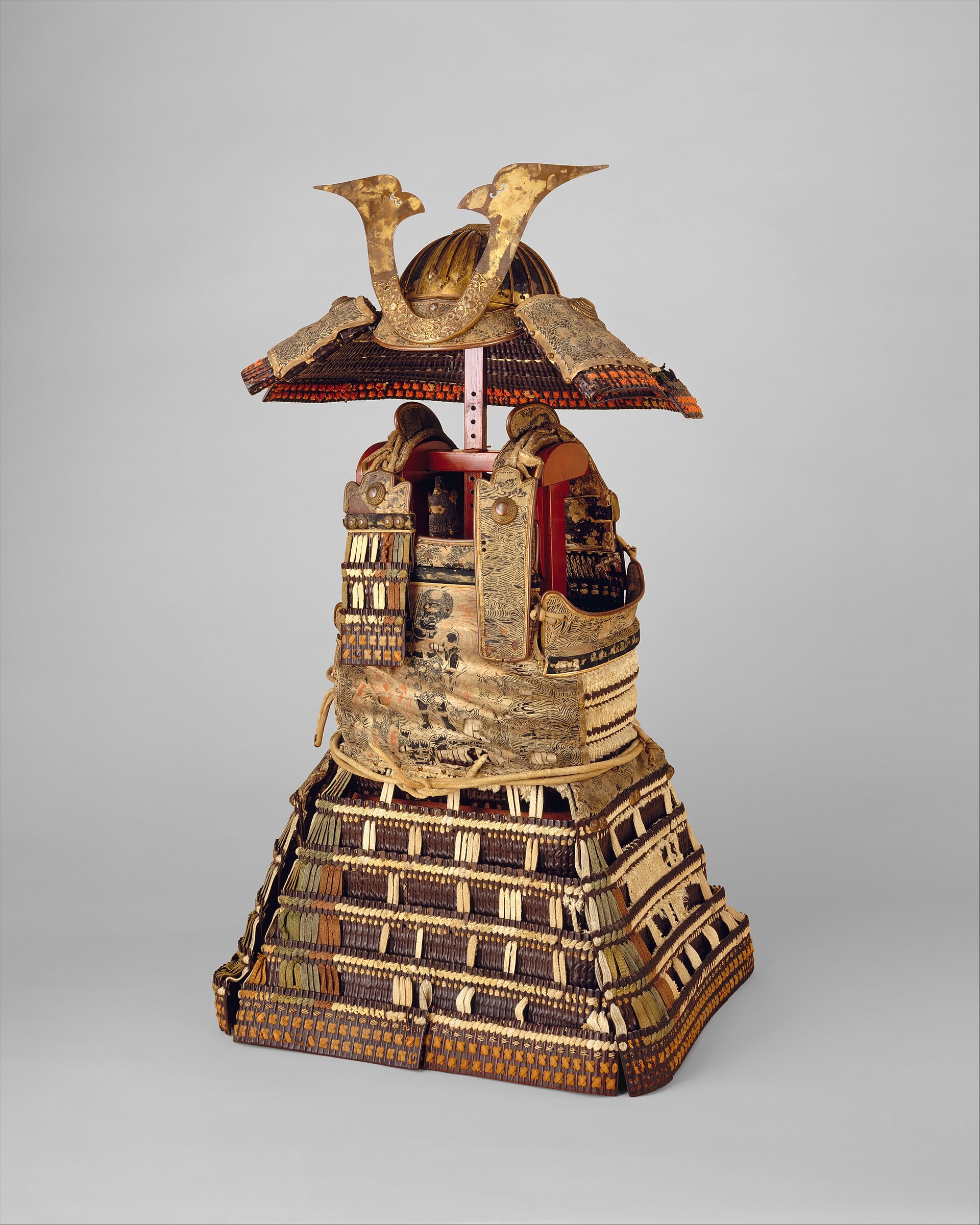
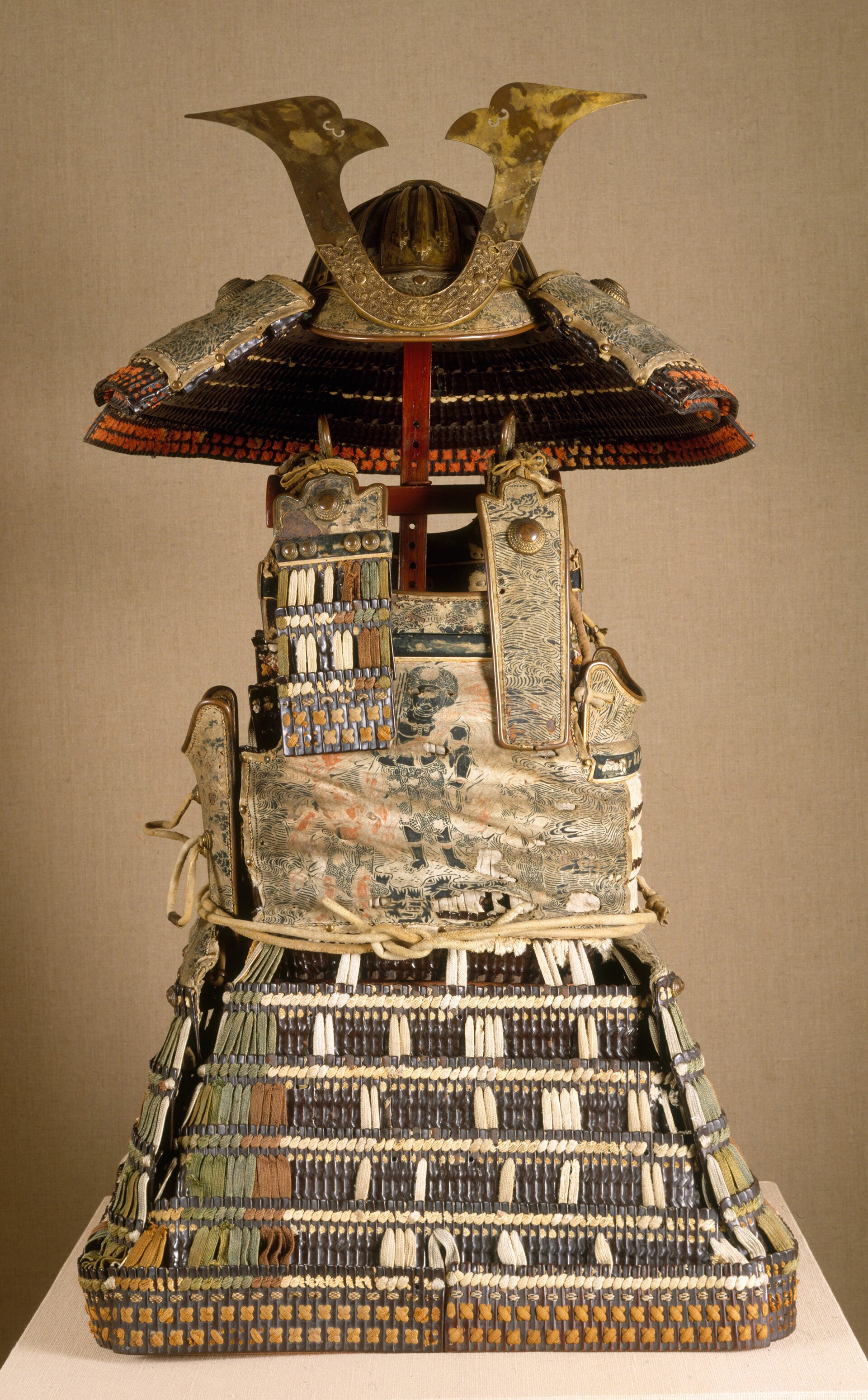
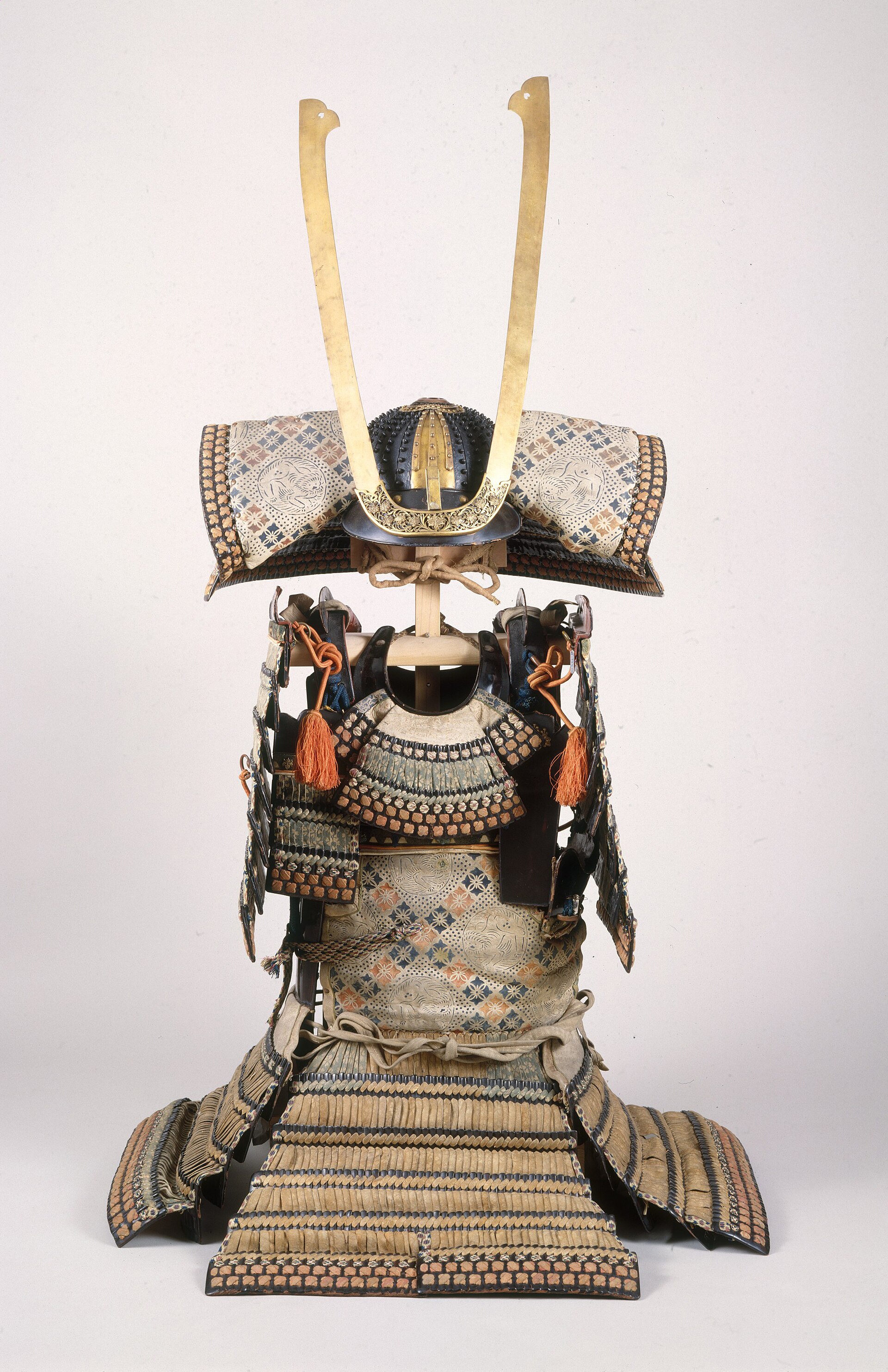
The armor as currently mounted: an early fourteenth-century cuirass, skirt and waidate together with a genuine but non-original mid-fourteenth-century helmet. The front of the cuirass carries the stenciled image of Fudo Myoo described in the Museum's own catalogue text.
| Artist | Unknown armorer, Japan |
|---|---|
| Date | Cuirass, skirt and waidate: early 14th century, before 1333. Associated helmet: mid-14th century, not original to the cuirass. Associated left shoulder guard (no longer displayed with the armor): mid-to-late 14th century, from a different original armor. |
| Medium | Iron, lacquer, leather, silk, gilt copper |
| Dimensions | Cuirass, skirt and waidate as mounted: H. 37 1/2 in. (95.3 cm); W. 22 in. (55.9 cm); Wt. 25 lb. 15 oz. (11.77 kg). Associated helmet: H. of bowl 6 1/16 in. (15.4 cm); L. of bowl 11 1/16 in. (28.1 cm); W. of bowl 10 5/16 in. (26.2 cm); W. of neck defense 24 1/4 in. (61.6 cm); Wt. 12 lb. 4 oz. (5.56 kg). |
| Where it is now | The Metropolitan Museum of Art, New York, Gallery 377last confirmed |
| Inventory number | 14.100.121a-e (helmet, 14.100.121a; cuirass, skirt and waidate, 14.100.121b-e) |
| Attribution | DisputedThe cuirass, skirt and side panel (waidate) are accepted by the Metropolitan Museum and by the Japanese specialist literature as a genuine early fourteenth-century yoroi of the rare shiroito tsumadori odoshi type. Full note |
| Object type | Arms and armour |
| Period | Japanese, late Kamakura period (helmet: Nanbokucho period) |
| Cases | Disputed attribution · Has a provenance gap |
| Inscriptions | None. No maker's signature, dedicatory inscription or owner's mark survives on the armor. The attribution to Ashikaga Takauji and the account of its donation to the Shinomura Hachimangu shrine are shrine and family tradition, transmitted orally and in a set of early nineteenth-century drawings, not text carried by the object itself. |
| Owners on record | 9 links5 documented, 2 disputed, 2 unknown |
| Sources | 13 cited |
About this record Last verified · 13 sources cited · Change log
On this page 9 sections
ContentsClose
A rare early fourteenth-century Japanese yoroi, one of fewer than forty complete examples known to survive, given to the Metropolitan Museum in 1914 by Bashford Dean, the zoologist who became the Museum's founding curator of Arms and Armor and the leading American authority of his generation on Japanese armor. Shrine tradition holds that it was donated by the shogun Ashikaga Takauji to the Shinomura Hachimangu near Kyoto in 1333, on his way to the campaign that would eventually make him ruler of Japan.
The object the Museum shows today is not, however, one continuous fourteenth-century survival. Research by the Museum's own curator Morihiro Ogawa, published in 1989, used Dean's original 1905 photographs, his purchase receipt and a set of early nineteenth-century drawings rediscovered in the Imperial Library in Tokyo to establish that the helmet long mounted with the armor, and at least one of the two shoulder guards recorded with it at the time of Dean's purchase, are themselves genuine armor of the right period, but do not belong to this suit. They were married to the cuirass at an unrecorded date before 1905. Dean's own dealer receipt already distinguishes the two shoulder guards as unmatched items rather than a pair, showing that the composite condition was known, if not fully understood, from the moment of purchase.
This record treats the cuirass, skirt and waidate as the documented early fourteenth-century core of the object, and grades every other component, and the Takauji attribution itself, according to what has actually been established rather than what has long been displayed.
Provenance
Each link is graded. Documented: a cited source supports it. Disputed: the identification is argued but not established. Unknown: no owner for that span, and the gap is not smoothed into a narrative. The grades in the glossary.
- early 14th century -Made for an unrecorded original ownerdocumented
Cuirass, skirt and waidate identified as a shiroito tsumadori odoshi yoroi of the early fourteenth century on construction and lacing evidence (lamellar kozane construction, closure type, and the surviving original silk lacing pattern), not on any inscription. See the technical block for the specific evidence.1
- 1333 (tradition) -Ashikaga Takauji (1305-1358), traditionallydisputed
Shrine and family tradition holds that Takauji donated the armor to the Shinomura Hachimangu, near Kameoka west of Kyoto, during a ten-day stay before his March 1333 campaign against Kamakura forces. The attribution to Takauji by name was first published by the scholar Yamagami Hatiro in 1928; no contemporary fourteenth-century document or inscription names him as donor. Some secondary sources instead give a date of about 1336, apparently conflating this episode with the later Battle of Minatogawa; the Museum's own published research specifies March 1333.1813
- 1333 (tradition) - unknownShinomura Hachimangu shrine, Kameokaunknown
The armor is said to have remained enshrined for over 570 years, but no specific intermediate record locates it within the shrine year by year across this span; continuous custody is asserted by tradition and by modern secondary accounts, not documented at intervals.18
- by ca. 1800 - by ca. 1800Matsui Kyosaku, physician and shrine patron, Kameyamadocumented
A set of ink drawings made in the studio of Matsuoka Tokekata or his son Matsuoka Yukiyoshi (1794-1848), rediscovered by Ogawa in the Imperial Library, Tokyo, is the earliest surviving record of the armor. The drawings show the cuirass, skirt, waidate and the same mismatched helmet already mounted together, and record Matsui Kyosaku as owner at that date, apparently keeping the shrine's armor at his home for safekeeping, a documented practice for valuable shrine property.1
- by ca. 1800 - 1902The Matsui family, Kameokaunknown
Ogawa: 'With the passage of time, the ownership of the armor seems to have been forgotten, as is evident from its sale by members of a later generation of the Matsui family.' No specific intermediate family owner between Matsui Kyosaku and the 1902 sale is named in the sources consulted.1
- 1902 - 1905Ide Zenbei, proprietor of the Jidaiya antiques firm, Shijo Street, Kyotodocumented
On the market the armor drew competing bids from leading Japanese collectors of the day, among them Baron Mitsui, Professor Seki Yasunosuke and the collector Kobori Tomoto, before Bashford Dean prevailed.18
- unknown - by 1905Unrecordeddisputed
Established by Ogawa's 1989 comparison of Dean's 1905 photographs, Dean's dealer receipt and physical examination of the armor and the surviving left shoulder guard. Dean's own 1905 purchase receipt itemizes the two shoulder guards as 'two things' (ni-mai) rather than a matched pair (isso), showing the composite condition was apparent, if not understood, at the point of sale. The date, location and responsible party for the original marriage of the mismatched parts is not recorded.1
- 1905-07-19 - 1914Bashford Dean (1867-1928)documented
Dean's dealer receipt, preserved in the archives of the Museum's Department of Arms and Armor, records the purchase on July 19, 1905, for 1,200 yen, then equivalent to roughly six hundred dollars and, per Ogawa, a record price for an armor sold in Japan at that date.1
- 1914 - presentMetropolitan Museum of Art, New Yorkdocumented
Accessioned as 14.100.121a-e (helmet, a; cuirass, skirt and waidate, b-e), part of Dean's second, larger donated collection of Japanese arms and armor. On permanent view in the Arms and Armor galleries as of the sources consulted.1234
Technical evidence
| Attribution note | The cuirass, skirt and side panel (waidate) are accepted by the Metropolitan Museum and by the Japanese specialist literature as a genuine early fourteenth-century yoroi of the rare shiroito tsumadori odoshi type. The identification of its original owner and donor as the shogun Ashikaga Takauji rests on a shrine tradition first put into print by the Japanese scholar Yamagami Hatiro in 1928, not on any inscription, seal or contemporary document on the object itself. The helmet currently mounted with the armor, and both shoulder guards (sode) recorded with it when Bashford Dean bought it in 1905, have been shown by Metropolitan Museum research (Ogawa, 1989) to be genuine fourteenth-century armor components that do not belong to this suit; they were married to the cuirass, by parties and at a date now unrecorded, before Dean's purchase. |
|---|---|
| Construction | Lamellar cuirass, skirt and waidate built from small lacquered iron and leather scales (kozane), bound into rigid boards and laced together in overlapping horizontal rows; a technique chosen over solid plate for flexibility in mounted combat.1 |
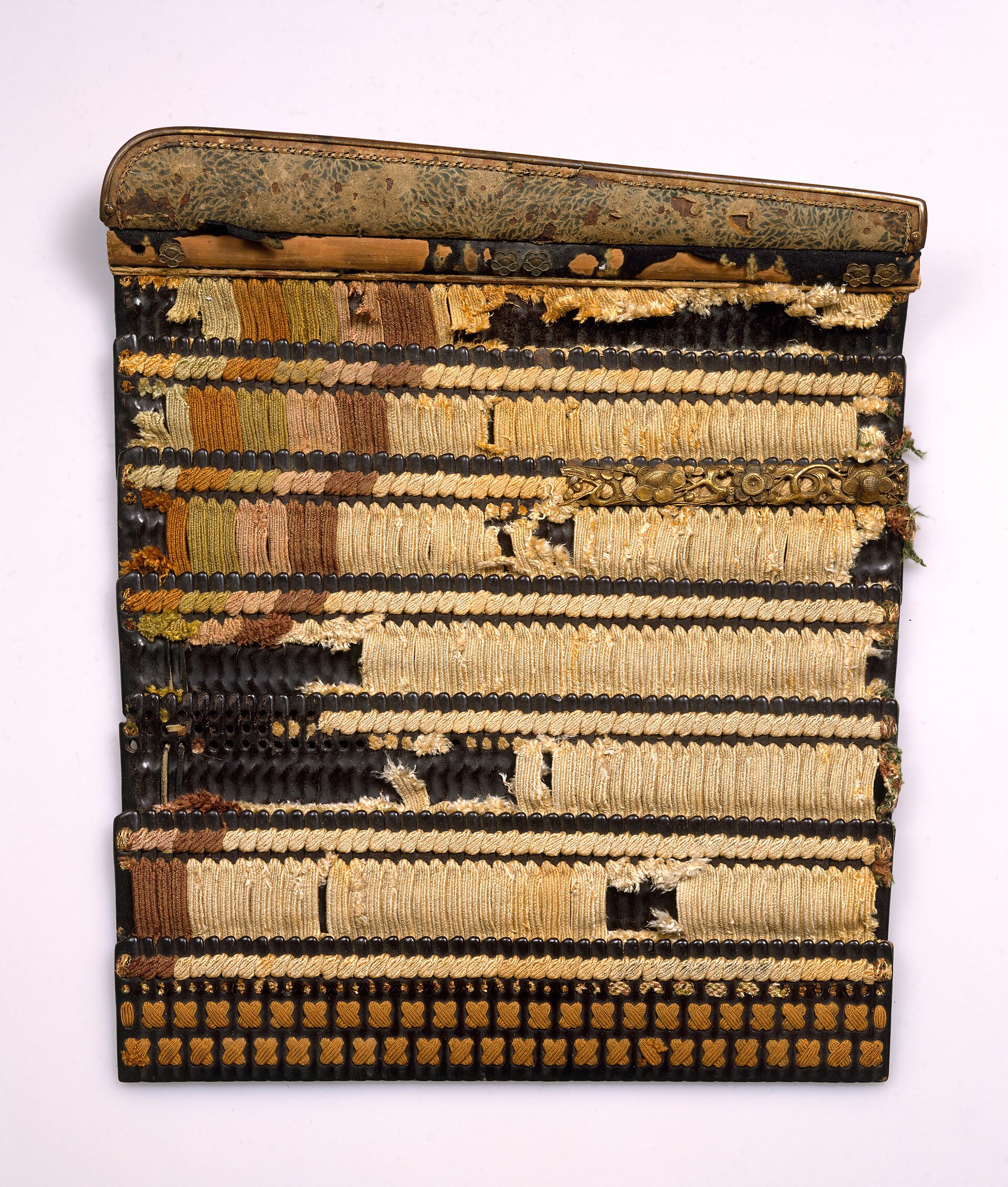
| Lacing pattern | Shiroito tsumadori odoshi: predominantly white silk lacing with diagonal bands of multiple colors at the corners of the skirt and, originally, the edges of the shoulder guards, read as a rainbow motif signifying good fortune and transient beauty. Only about eight surviving armors are known to use this specific pattern.1 |
| Breastplate decoration | The front of the cuirass is faced with stenciled deerskin (tsurubashirigawa) bearing an image of the deity Fudo Myoo flanked by his attendants Kongara-doji and Seitaka-doji.18 |
| Dimensions and weight | Cuirass, skirt and waidate as mounted: H. 37 1/2 in. (95.3 cm); W. 22 in. (55.9 cm); Wt. 25 lb. 15 oz. (11.77 kg). Associated helmet: Wt. 12 lb. 4 oz. (5.56 kg).23 |
| Accession structure | Object number 14.100.121a-e: 14.100.121a is the associated helmet, catalogued separately by the Museum as "Helmet of Ashikaga Takauji"; 14.100.121b-e comprise the cuirass, skirt and waidate, catalogued as "Armor (Yoroi) of Ashikaga Takauji."234 |
| Surviving original lacing | A minority of the visible lacing is original fourteenth-century silk; the majority is later, chemically dyed replacement cord. Ogawa's 1989 examination enumerated the surviving original laces row by row on the skirt and waidate (documented in the narrative above); one lower skirt plate is not original to the armor but a fourteenth-century lame taken from a different, unrelated suit and inserted before the armor left Japan in 1905.1 |
| Comparanda for rarity | The Metropolitan holds only one other complete yoroi, an unrelated example independently acquired through the Fletcher Fund in 1928 (accession 28.60.1a-s); worldwide, Ogawa's 1989 survey counted about thirty-five complete and about twenty incomplete yoroi, the great majority in Japanese shrines and temples.16 |
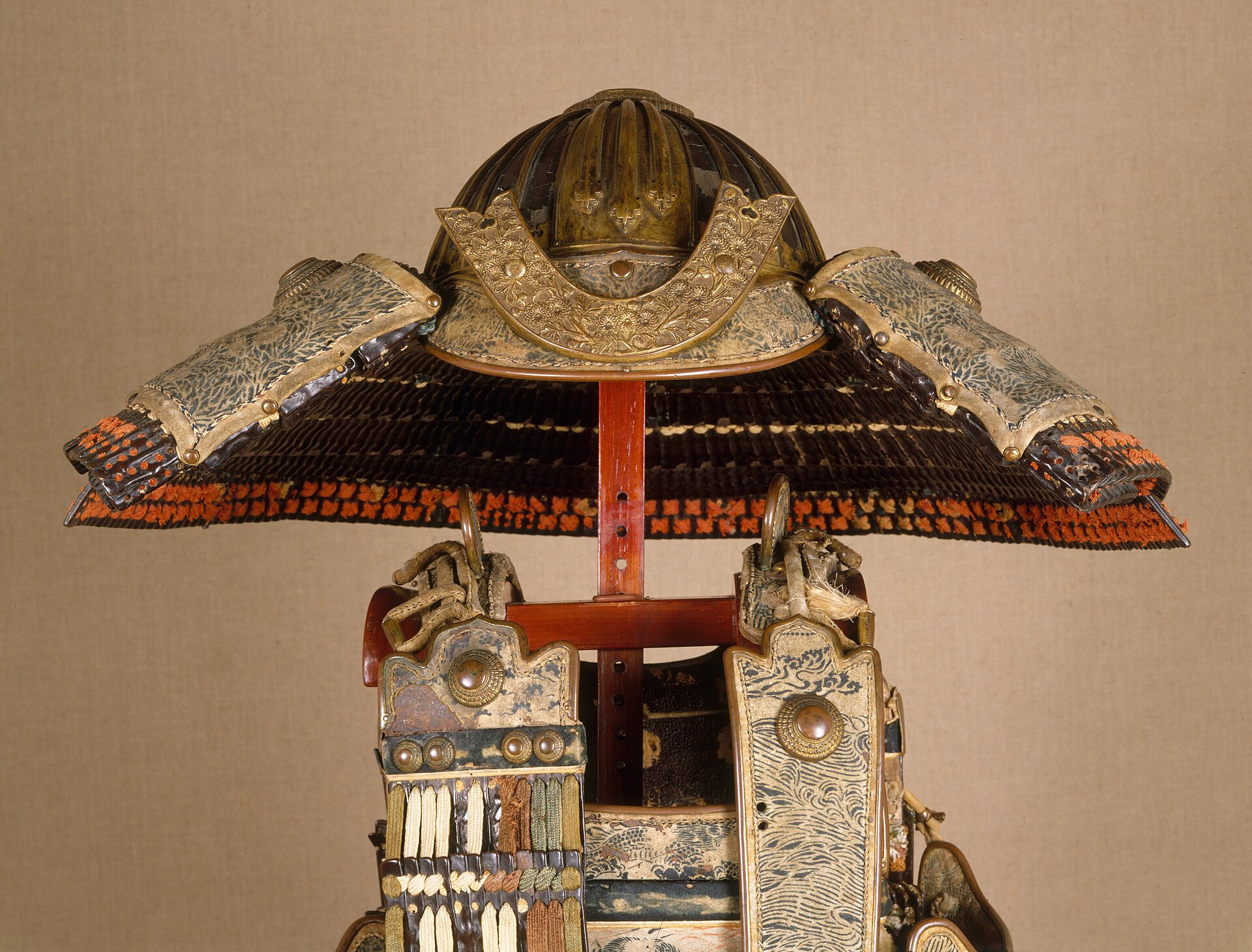
| Associated helmet | Mid-fourteenth-century Japanese work, genuine but not original to the cuirass. It is a suji kabuto (ridged helmet), a type properly associated with do-maru rather than yoroi armor; its lacing pattern does not match the cuirass. It carries chrysanthemum-motif fittings consistent with the cuirass, which is presumably why the association was accepted for so long.13 |
| Associated shoulder guards (sode) | Two shoulder guards were itemized on Dean's 1905 purchase receipt as unmatched (ni-mai, not isso). The left, accession 14.100.50, is genuine mid-to-late fourteenth-century work laced in the same shiroito tsumadori odoshi style but with plum-blossom rather than chrysanthemum fittings and different scale curvature and lacquer color, identifying it as belonging to a different original armor; it remains in the Museum's collection but is not exhibited with the yoroi. The right sode was shown by an old photograph to be unrelated to the yoroi and was deaccessioned and sold at Parke-Bernet Galleries, New York, November 15, 1956, lot 198.15 |
Images
The record in full
Chapter 1What the Museum shows
The object on view in Gallery 377 is a yoroi, the box-shaped body armor worn by mounted samurai of high rank from roughly the tenth to the fourteenth century.
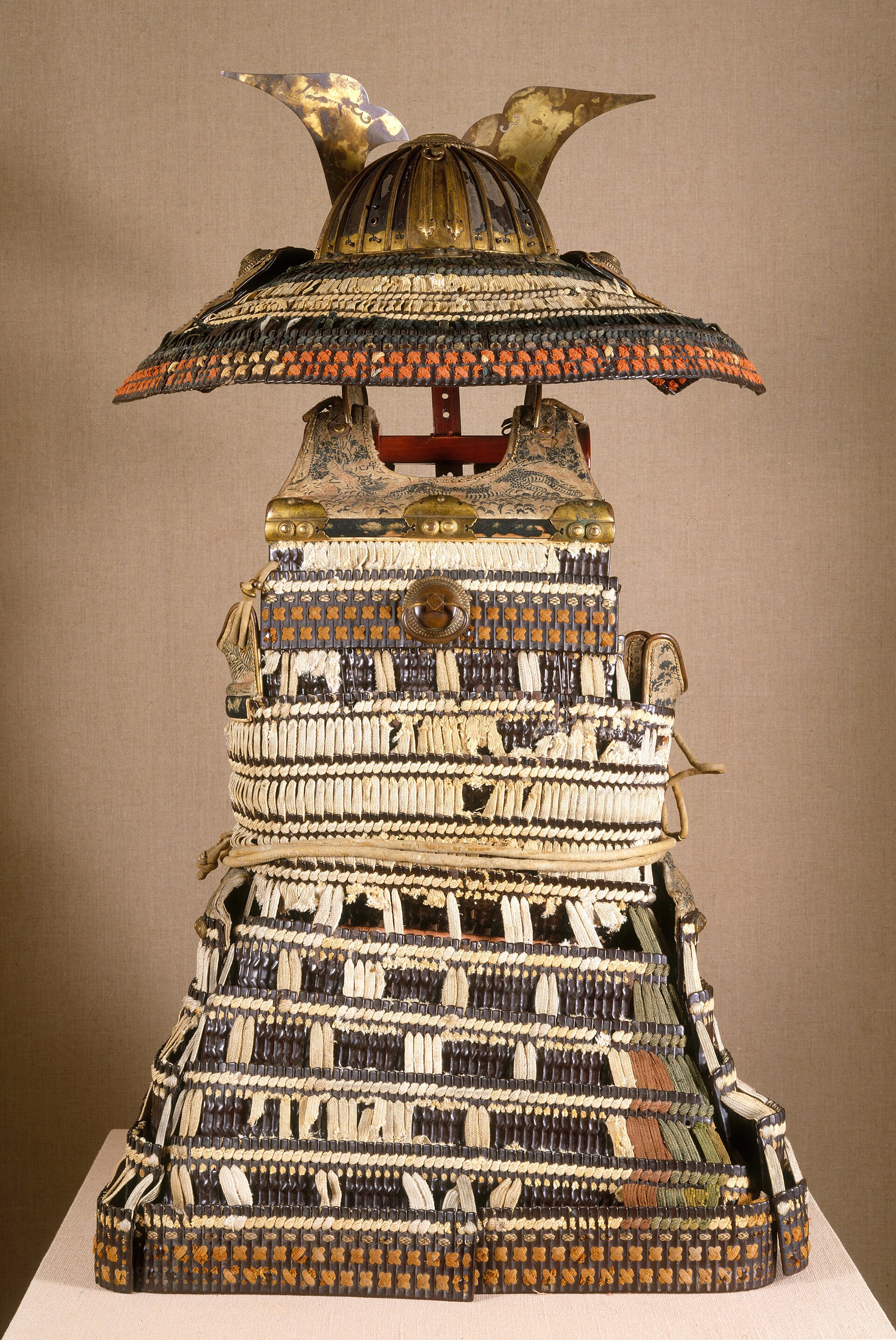
The object on view in Gallery 377 is a yoroi, the box-shaped body armor worn by mounted samurai of high rank from roughly the tenth to the fourteenth century. A yoroi consists of a cuirass (do) that wraps around the torso and closes on the right side with a separate hinged panel, the waidate, so that the wearer does not need a continuous seam under the sword arm. Below the cuirass hangs a deep, four-sided skirt (kusazuri) in a distinctive boxlike form, and the complete armor would originally have included a helmet and a pair of large rectangular shoulder guards (sode). As displayed, the Museum's example combines a cuirass, skirt and waidate of the early fourteenth century with a helmet of the mid-fourteenth century; the shoulder guards are not currently exhibited with it.
The body armor is constructed from small lamellar scales, kozane, of lacquered iron and leather laced together in overlapping horizontal rows to give a combination of flexibility and strength that a solid plate cannot match at this date. The front of the cuirass is faced with a panel of stenciled deerskin, the tsurubashirigawa, bearing an image of the wrathful Buddhist guardian deity Fudo Myoo, flanked by his two attendant boys, Kongara-doji and Seitaka-doji. Fudo's fierce expression and his fixed, unmovable calm were qualities samurai patrons prized and asked their armor to project.
What survives of the original lacing identifies the armor as a shiroito tsumadori odoshi yoroi: predominantly white silk lacing, with diagonal bands of multiple colors picked out at the corners of the skirt and along the edges of the shoulder guards. The coloured lacing is conventionally read as a reference to the rainbow, understood in the period both as a sign of good fortune and, because a rainbow fades almost as soon as it appears, as an emblem of beauty's transience. Only about eight armors laced in this specific pattern are known to survive at all, which is one of the reasons this example, even reduced to its documented core, matters to the field.
Chapter 2How a yoroi like this was made and dated
Japanese body armor of this class is lamellar rather than plate construction: individual scales, each pierced with multiple holes, are bound together with cord or leather thongs into a rigid board...
Japanese body armor of this class is lamellar rather than plate construction: individual scales, each pierced with multiple holes, are bound together with cord or leather thongs into a rigid board, several boards are then joined edge to edge and laced vertically, and the whole is lacquered to bind and waterproof it. The technique gives a garment that moves with the body far better than the large solid breastplates that would come to dominate Japanese armor from the sixteenth century onward, at some cost in weight; the Museum's cuirass, skirt and waidate together weigh almost twelve kilograms.
Because almost no yoroi of this date carries a maker's signature, dating and classification rest on construction and lacing evidence rather than on documentary proof: the shape and closure of the cuirass (yoroi versus the later, lighter do-maru and haramaki types), the form and material of the lamellae, the specific lacing pattern, and the style of the metal mounts and their decorative motifs. This is exactly the evidence Ogawa used in 1989 to separate the genuinely early fourteenth-century cuirass, skirt and waidate from the mid-fourteenth-century helmet and shoulder guards associated with them: the helmet is close in date but is of a ridged type, suji kabuto, that properly belongs with a do-maru rather than a yoroi, and its lacing pattern and colour sequence do not match the surviving original lacing on the body of the armor. A yoroi of this quality would properly have been paired with a large-rimmed, domed helmet built up of overlapping iron segments, a hoshi kabuto or star helmet, of the kind seen on the one other known example of this lacing pattern still in its original state, an armor preserved at the Kushibiki Hachimangu shrine in Aomori Prefecture. No such helmet survives with the Museum's yoroi.
Chapter 3Ashikaga Takauji, and the tradition of a shrine gift
Ashikaga Takauji (1305-1358) was the general who ended the Kamakura shogunate and founded the Ashikaga shogunate that would govern Japan, in name if not always in practice, for more than two...
Ashikaga Takauji (1305-1358) was the general who ended the Kamakura shogunate and founded the Ashikaga shogunate that would govern Japan, in name if not always in practice, for more than two centuries. In the spring of 1333 he was dispatched by the Kamakura shogunate to suppress forces raised by the exiled Emperor Go-Daigo; instead he switched sides at Tanba province, marched on Kyoto, and destroyed the Kamakura deputies there, precipitating the collapse of the shogunate that year and, after the brief Kenmu Restoration of imperial rule collapsed in turn, his own installation as shogun by 1338.
Tradition holds that during a ten-day stay at the Shinomura Hachimangu, a shrine dedicated to Hachiman, the god of war, near present-day Kameoka on the western edge of Kyoto, Takauji donated this armor as an offering to secure victory before marching on the capital in March 1333. The shrine was under the patronage of the Matsui family, and the armor is said to have remained enshrined there for some 570 years. The attribution to Takauji by name was first published in 1928 by the Japanese scholar Yamagami Hatiro, in his Nippon Katchu no Shin Kenkyu (Modern Study of Japanese Armor); nothing on the armor itself, and no surviving contemporary document, names Takauji as the donor. It is a shrine and family tradition given scholarly form in the twentieth century, not a documented fact established at the time of the supposed gift, and this record grades it accordingly.
A secondary date sometimes given for the object, around 1336, appears to conflate this 1333 campaign with the later Battle of Minatogawa, at which Takauji defeated the loyalist general Kusunoki Masashige; the Museum's own published research places the traditional donation specifically in March 1333, before Takauji's break with Go-Daigo had even produced the fighting that the later date would associate it with. Which year belongs with which event is worth resolving from Japanese-language primary literature rather than taken from secondary summaries, including this one.
Chapter 4From a Kameoka shrine to a Kyoto antique shop
A set of ink drawings of the armor, discovered by Ogawa in the Imperial Library in Tokyo in the course of his research and made in the studio of the artist Matsuoka Tokekata or his son Matsuoka...
A set of ink drawings of the armor, discovered by Ogawa in the Imperial Library in Tokyo in the course of his research and made in the studio of the artist Matsuoka Tokekata or his son Matsuoka Yukiyoshi (1794-1848), provides the earliest concrete record of the object, datable to around 1800. The drawings show the cuirass, skirt, waidate and the same mismatched helmet already mounted together, along with the left shoulder guard, which is therefore proven to have already been associated with the armor by that date. They record the owner at that time as Matsui Kyosaku, a physician and a patron of the Shinomura Hachimangu, who is understood to have kept the shrine's armor at his own home for safekeeping, a documented practice for valuable shrine property in the period.
What happened between the 1333 tradition and this circa 1800 record is not documented; the drawings prove the armor's existence and appearance around 1800, not a continuous, traceable custody by the shrine for the intervening centuries. Ownership then passed down within the Matsui family, and by Ogawa's account was eventually forgotten: as he put it, "with the passage of time, the ownership of the armor seems to have been forgotten, as is evident from its sale by members of a later generation of the Matsui family." That sale took place around 1902, to Ide Zenbei, proprietor of the well-known Jidaiya antiques firm on Kyoto's Shijo Street.
Once on the Kyoto art market the armor attracted serious competition among the leading Japanese collectors of the day, among them Baron Mitsui, Professor Seki Yasunosuke and the collector and painter Kobori Tomoto. Bashford Dean prevailed. His dealer's receipt, preserved in the archives of the Museum's Department of Arms and Armor, records the purchase on July 19, 1905, for 1,200 yen, then equivalent to roughly six hundred dollars and, according to Ogawa, a record price for an armor sold in Japan at that date. The same receipt itemizes one helmet, one armor including the waidate, and four skirt lames, and lists the two shoulder guards as ni-mai, two separate things, rather than as isso, a matched pair: evidence that even at the point of sale, the composite nature of what Dean was buying was already apparent, if not yet explained.
Chapter 5Bashford Dean, zoologist and armor scholar
Bashford Dean (1867-1928) is an unusual figure to have shaped an American museum's arms and armor collection: by profession he was a zoologist.
Bashford Dean (1867-1928) is an unusual figure to have shaped an American museum's arms and armor collection: by profession he was a zoologist. He entered City College of New York at fourteen, took his doctorate in zoology and paleontology at Columbia University in 1891, and by 1904 was a full professor there, while simultaneously serving as founding curator of the Department of Reptiles and Fishes at the American Museum of Natural History. His scientific fieldwork took him to Europe, Russia, Alaska and, repeatedly from the 1890s onward, to Japan, where the Japanese government invited him to study the country's fish hatcheries.
It was on these trips, in 1900 and again in 1905, that Dean developed his expertise in Japanese armor, alongside a parallel and equally serious interest in European arms and armor that would later bring the Duc de Dino purchase and the Riggs bequest into the Metropolitan's collection. By about 1900 he had assembled a private collection of roughly 125 pieces of Japanese arms and armor, the most comprehensive of its kind then in the United States, which he lent to the Metropolitan in 1903 and for which he wrote the Museum's Handbook No. 14, Catalogue of the Loan Collection of Japanese Armor, still regarded as a serious scholarly introduction to the subject more than a century later. He sold that first collection to the Museum at cost in 1904, then used the proceeds, together with further acquisitions made on his 1905 trip (the trip on which he bought the Takauji yoroi), to build a second, larger collection that he donated outright to the Museum in 1914. The Department of Arms and Armor was created as an independent curatorial department on October 28, 1912, very largely because of Dean's own drive and scholarship, and he served as its founding curator until shortly before his death in 1928, in the interim also designing helmets and body armor for American troops in the First World War.
Dean gave the Takauji yoroi its first public notice in a short Museum Bulletin piece, "A Specimen of Early Japanese Armor," in 1908, three years after buying it and six years before formally donating it. He photographed the armor himself, both mounted and disassembled, in his study at his house at Misaki near Tokyo in 1905; those photographs, rediscovered in the department's own archives, would become the single most important piece of evidence Ogawa used eight decades later to work out what did and did not belong to the object Dean had bought.
Chapter 6The questions the old photographs raised
Two photographs Dean took in 1905, before the armor was restored and mounted for display, survive in the department's archive.
Two photographs Dean took in 1905, before the armor was restored and mounted for display, survive in the department's archive. One shows the cuirass and skirt mounted with two shoulder guards but with no helmet at all; the skirt is visible with colored lacing surviving on one side and very little on the other, and in different colors from what is now on the armor. The second shows the waidate and the left shoulder guard together, both laced in the shiroito tsumadori odoshi pattern, with a diagonal band of multicolored lacing at the front.
Compared with how the armor had traditionally been displayed at the Metropolitan (mounted with a helmet, but without the sode), these photographs raised questions that, in Ogawa's words, had troubled Japanese scholars examining the piece in print since at least 1928: what had happened to the sode; why the skirt appeared to have been relaced, and in different colors; and where the helmet, otherwise entirely unrecorded before it appeared on the Museum's armor, had come from. Two Japanese specialist publications, Yamagami's 1928 study and a series of notes by Yamagishi Motoo published in Katchu Bugu Kenkyu between 1974 and 1975, addressed these questions without fully resolving them.
Chapter 7What Ogawa established in 1989
Morihiro Ogawa, then a research associate in the Department of Arms and Armor, answered these questions by combining the 1905 Dean photographs, Dean's original purchase receipt, and the rediscovered...
Morihiro Ogawa, then a research associate in the Department of Arms and Armor, answered these questions by combining the 1905 Dean photographs, Dean's original purchase receipt, and the rediscovered circa-1800 Imperial Library drawings with a close physical examination of the armor and of a shoulder guard that had quietly remained in the Museum's own storerooms.
The left shoulder guard, accessioned separately as 14.100.50 and part of the same 1914 Dean gift, proved on inspection to be genuine, well-preserved, unrestored mid-fourteenth-century work, laced (like the yoroi) in the shiroito tsumadori odoshi style. But its metal fittings are decorated with plum blossoms rather than the chrysanthemums used throughout the cuirass, the curvature of its scales differs from the skirt's, and its lacquer is a slightly different color. Ogawa's own verdict, in print, was blunt: "It was disappointing to have to admit that this fine fourteenth-century sode belonged to a yoroi other than the Museum's." The right shoulder guard, no longer in the collection, is documented only in an old photograph showing it to be completely unrelated to the yoroi; it had been deaccessioned for its poor condition and sold at Parke-Bernet Galleries in New York on November 15, 1956, lot 198, and its present whereabouts, if it survives, are not known from the sources consulted for this record.
The skirt's apparent relacing was real, but not, as had been feared, a modern restoration using chemically dyed replacement cord. A photograph Dean took of the armor at his house in Misaki in 1905, showing what is actually the true front of the skirt facing the camera even though the mount reads as the back, proved that the skirt had become detached from the body of the armor, and was reattached the wrong way round, before it was corrected; some replacement lacing and new cord were added at that point to hold the pieces together, and the single missing lower front skirt plate was replaced using genuine fourteenth-century lamellae taken from yet another, unrelated armor, before the yoroi left Japan. Only a small number of the original laces remain, and Ogawa catalogued them row by row: on the right front of the skirt, four dark brown-purple laces and one green lace on the third row, four purple and three green on the fourth, three purple, three green and three orange-red on the fifth; on the back of the skirt, two white and four purple on the third row, thirteen white, four purple and two green on the fourth, three purple, three green and three orange on the fifth; on the waidate, two purple laces on the second row, three purple and one green on the third, three purple and three green on the fourth. Everything else visible today is later, chemically dyed replacement cord, now discolored with age.
The helmet fared no better under examination. It is genuinely old, dating to the middle of the fourteenth century, and it does carry chrysanthemum-motif fittings consistent with the cuirass, which is presumably why it was accepted as belonging with the armor for so long. But it is a suji kabuto, a ridged helmet properly associated with do-maru rather than yoroi armor, and its lacing does not match either the cuirass or the (unrelated) right shoulder guard; if anything, Ogawa suggested, its lacing more closely resembles that of the right sode, raising the possibility that the helmet and the now-deaccessioned right sode came from the same third, still unidentified armor.
Chapter 8What is original, and what is not
Set out plainly, the components that make up the object as displayed break down as follows.
Set out plainly, the components that make up the object as displayed break down as follows. The cuirass, most of the skirt's structure and the waidate are the accepted, documented early fourteenth-century core of the object, secured to the Museum through Bashford Dean's 1905 purchase and 1914 gift. A small number of the original silk laces survive on the skirt and waidate, enumerated above; the great majority of the visible lacing is later replacement cord, added in stages, the last of them before the armor left Japan in 1905 to correct an earlier misassembly. One lower skirt plate is not original to this armor at all, but a genuine fourteenth-century lame taken from an unrelated suit. The helmet, though genuinely mid-fourteenth-century Japanese work, is not original to the cuirass, was already associated with it by around 1800, and is of a type that would not properly have accompanied a yoroi in the first place. Of the two shoulder guards recorded with the armor at purchase, the left is genuine fourteenth-century work from a third, unrelated armor and remains in the Museum's collection though not on display with the yoroi; the right was unrelated to the yoroi on the evidence of an old photograph and was sold out of the collection in 1956.
None of this is unusual for the field. Japanese armor of this age was functional equipment, kept, repaired, refitted and reassembled across centuries of use, damage, storage and later collecting; Ogawa's own opening description of the piece, before he lays out any of these findings, calls it simply "a rare armor of the yoroi type," not a single continuous fourteenth-century artifact, and the caution is deliberate. What makes this particular object worth a dedicated record is not that it turned out to be composite, but that the Museum's own curatorial research, using the collector's own photographs and receipt against later display tradition, is exactly the kind of evidence that lets a cataloguer separate what is proven from what is merely long-displayed.
Chapter 9Rarity and the surviving cohort
Ogawa's 1989 survey put a number on how rare armor of this specific class is: about thirty-five complete yoroi and about twenty incomplete ones were known worldwide at the time of his research.
Ogawa's 1989 survey put a number on how rare armor of this specific class is: about thirty-five complete yoroi and about twenty incomplete ones were known worldwide at the time of his research. Of the thirty-one complete examples then accounted for, thirty-one were in Japanese shrines or temples and only two were in private hands; the remaining two were both at the Metropolitan Museum, this one and a second, unrelated yoroi acquired independently by the Museum in 1928. Within that already small population, only about eight armors are known to preserve the specific shiroito tsumadori odoshi (white ground with rainbow-colored diagonal accents) lacing pattern that this armor's surviving original laces identify it as having used; the closest surviving comparandum still in its original, unaltered lacing is preserved at the Kushibiki Hachimangu shrine in Aomori Prefecture, in northern Japan.
Had the armor remained in Japan, its combination of age, rarity and (however traditional) association with a major historical figure would very likely have qualified it for designation as a Jayo Bunkazai, an Important Cultural Property, under the country's cultural property protection system. Its export in 1905 predates that system by decades: the modern Japanese law under which such designations and export controls operate was not enacted until 1950, so no licence, notification or comparable mechanism was triggered, or could have been triggered, by Ide Zenbei's sale to an American collector.
Chapter 10The two collections and Dean's later career
It matters to the object's history that Dean formed two separate collections of Japanese armor, and that this yoroi belongs to the second.
It matters to the object's history that Dean formed two separate collections of Japanese armor, and that this yoroi belongs to the second. The first, lent to the Museum in 1903 and sold to it at cost in 1904, included the armor Dean himself is photographed wearing in Japan around 1900 and is documented in the Museum's collection as a nineteenth-century gusoku, acquired through the Rogers Fund rather than as a personal gift. The proceeds of that 1904 sale funded the second, larger collection Dean assembled specifically in order to donate it outright; the Takauji yoroi, bought on the same 1905 trip that built this second collection, and given to the Museum with it in 1914, belongs to that later, donated group, alongside roughly a thousand other objects that make the Metropolitan's Japanese holdings, by scholarly consensus, the finest outside Japan itself.
Dean continued to build the department after 1914. In 1905 he had already arranged an exchange of early Egyptian material for a group of Kofun-period Japanese arms and armor with the Tokyo Imperial Museum, finalized in 1906. In 1915 the department moved into new galleries designed by the New York firm McKim, Mead and White, with two galleries specifically built out for the Japanese collection. In 1917 Dean made his last extended trip to Japan, spending some three months visiting dealers, collectors and old associates across Tokyo, Yokohama, Kyoto, Nagoya, Osaka and Nara, and acquiring further material including pieces from the distinguished private collection of Masauji Goda. By his retirement in 1927 and his death the following year, the department he had founded fifteen years earlier held, by general agreement, the most comprehensive collection of Japanese arms and armor outside Japan.
Chapter 11What is still unresolved
Ogawa's 1989 article closed a great deal of the uncertainty that had surrounded this armor since at least 1928, but it did not close all of it.
Ogawa's 1989 article closed a great deal of the uncertainty that had surrounded this armor since at least 1928, but it did not close all of it. No source consulted for this record independently corroborates the 1333 shrine-donation story beyond the tradition itself, as transmitted through the Matsui family, the early nineteenth-century Matsuoka drawings, and Yamagami's 1928 published attribution; nothing on the armor names Takauji, and no contemporary fourteenth-century document recording the gift has been cited by any source used here. The true, original helmet that would have accompanied a yoroi of this quality, presumably a hoshi kabuto, has never been identified and may not survive at all. The date and circumstances under which the mismatched helmet and the two non-matching shoulder guards were first assembled with the cuirass, whether during the armor's time at the shrine, during the Matsui family's custody, or on the Kyoto art market between 1902 and 1905, remain unknown. And the deaccessioned right shoulder guard, sold in 1956, has not been traced in any source consulted for this record; whether it survives, and if so where, is an open question a specialist in the postwar Japanese and American arms and armor trade might be able to answer.
The artist
Unknown armorer or armor workshop, Japan, early fourteenth century
No maker is named on this armor, and none is likely ever to be identified: signed Japanese armor of this age is essentially unknown, and yoroi of the early fourteenth century are catalogued and dated as products of a period and a construction tradition rather than of an individual hand or named workshop. What follows sets out how such armor is actually dated and told apart from later work, including deliberate and unmarked later imitation, since that method is what stands behind every date and classification given elsewhere in this record.
Related works
| Work | Relation | Where it is |
|---|---|---|
| Shoulder Guard (O-sode) Unknown armorer, Japan | One of two shoulder guards recorded with this yoroi when Bashford Dean bought it in 1905, given to the Museum in the same 1914 gift, but established by Museum research to be genuine mid-to-late fourteenth-century work from a different, unidentified original armor Do not treat as part of this armor's original construction despite the shared accession group and gift date; its metal fittings, scale curvature and lacquer color all differ from the cuirass. | Metropolitan Museum of Art, New York (accession 14.100.50; not exhibited with the yoroi) |
| Armor (Yoroi) Unknown armorer, Japan | The Metropolitan's second complete yoroi, acquired independently of Bashford Dean Not part of the Dean gift and not otherwise connected to the Takauji yoroi; useful only as a comparandum for the extreme rarity of complete yoroi in Western collections, of which the Museum holds two. | Metropolitan Museum of Art, New York (accession 28.60.1a-s, Fletcher Fund, 1928) |
| Armor of the shiroito tsumadori odoshi type Unknown armorer, Japan | The closest surviving comparandum for this armor's rare lacing pattern, still in unaltered original condition Illustrated by Ogawa in his 1989 study as the clearest surviving example of how the rainbow-accented lacing pattern would originally have appeared across the skirt and shoulder guards before losses and later relacing. | Kushibiki Hachimangu, Aomori Prefecture, Japan |
| Armor (Do-maru) Unknown armorer, Japan | A separate Japanese armor from the same 1914 Bashford Dean gift, also an explicit composite of parts from two different periods A DIFFERENT object: a do-maru cuirass dated by the Museum to about 1550, mounted with an unrelated eighteenth-century helmet. Included here only to show that composite marriage is an openly acknowledged, recurring condition across Dean's Japanese gift, not a problem unique to the Takauji yoroi; the two armors have no other connection. | Metropolitan Museum of Art, New York (accession 14.100.120a-g) |
| Armor (Gusoku) Unknown armorer, Japan | The armor Bashford Dean is photographed wearing in Japan around 1900, from his first Japanese collection Belongs to Dean's first collection, lent to the Museum in 1903 and sold to it at cost in 1904, distinct from the second collection (including the Takauji yoroi) that he assembled afterward specifically in order to donate it in 1914. | Metropolitan Museum of Art, New York (accession 04.4.2, Rogers Fund, 1904) |
Open questions
- Is there any independent corroboration of the 1333 shrine-donation tradition beyond the Matsui family's account, the circa 1800 Matsuoka drawings, and Yamagami Hatiro's 1928 published attribution? No contemporary fourteenth-century document naming Takauji as donor has been cited in any source consulted for this record.
- When, and by whom, were the mismatched helmet and the two non-matching shoulder guards first assembled with the cuirass: during the armor's time at the Shinomura Hachimangu, during the Matsui family's custody after about 1800, or on the Kyoto art market between the 1902 sale to Ide Zenbei and Dean's 1905 purchase?
- What became of the true original helmet, presumably a hoshi kabuto, that would properly have accompanied a yoroi of this type and quality? No source consulted identifies a surviving candidate.
- Where is the deaccessioned right shoulder guard now, if it survives? It was sold at Parke-Bernet Galleries, New York, on November 15, 1956, lot 198, and has not been traced in any source used for this record.
- Does the circa 1336 date given for the armor in some secondary sources reflect a documented second tradition, or a conflation of Takauji's 1333 shrine visit with his later victory at the Battle of Minatogawa? The Museum's own published research (Ogawa, 1989) specifies March 1333.
- Was the circa 1800 Imperial Library drawing made by Matsuoka Tokekata or by his son Matsuoka Yukiyoshi (1794-1848)? Ogawa's 1989 study could not settle the question from the drawings alone; a firm date for the drawings would tighten the window in which the mismatched helmet was already associated with the armor.
Questions about this object
What is Armor (Yoroi) of Ashikaga Takauji?
Armor (Yoroi) of Ashikaga Takauji is an arms and armour, dated cuirass, skirt and waidate: early 14th century, before 1333. Associated helmet: mid-14th century, not original to the cuirass. Associated left shoulder guard (no longer displayed with the armor): mid-to-late 14th century, from a different original armor.. Medium: Iron, lacquer, leather, silk, gilt copper.
Who made Armor (Yoroi) of Ashikaga Takauji, and is the attribution settled?
The attribution to Unknown armorer, Japan is recorded here as disputed. The cuirass, skirt and side panel (waidate) are accepted by the Metropolitan Museum and by the Japanese specialist literature as a genuine early fourteenth-century yoroi of the rare shiroito tsumadori odoshi type. The identification of its original owner and donor as the shogun Ashikaga Takauji rests on a shrine tradition first put into print by the Japanese scholar Yamagami Hatiro in 1928, not on any inscription, seal or contemporary document on the object itself. The helmet currently mounted with the armor, and both shoulder guards (sode) recorded with it when Bashford Dean bought it in 1905, have been shown by Metropolitan Museum research (Ogawa, 1989) to be genuine fourteenth-century armor components that do not belong to this suit; they were married to the cuirass, by parties and at a date now unrecorded, before Dean's purchase.
Where is Armor (Yoroi) of Ashikaga Takauji now?
The Metropolitan Museum of Art, New York, Gallery 377. Inventory number 14.100.121a-e (helmet, 14.100.121a; cuirass, skirt and waidate, 14.100.121b-e). Last confirmed 11 August 2026. Gift of Bashford Dean, 1914; on permanent view in the Arms and Armor galleries as of the sources consulted.
What is still unknown about Armor (Yoroi) of Ashikaga Takauji?
Is there any independent corroboration of the 1333 shrine-donation tradition beyond the Matsui family's account, the circa 1800 Matsuoka drawings, and Yamagami Hatiro's 1928 published attribution? No contemporary fourteenth-century document naming Takauji as donor has been cited in any source consulted for this record.
Sources
- 1Morihiro Ogawa, "A Famous Fourteenth-Century Japanese Armor," The Metropolitan Museum Journal, vol. 24 (1989), pp. 75-83. resources.metmuseum.org/resources/...
- 2The Metropolitan Museum of Art, "Armor (Yoroi) of Ashikaga Takauji (1305-1358)," collection entry, object number 14.100.121b-e. metmuseum.org/art/...
- 3The Metropolitan Museum of Art, "Helmet of Ashikaga Takauji (1305-1358)," collection entry, object number 14.100.121a. metmuseum.org/art/...
- 4The Metropolitan Museum of Art, "Armor (Yoroi) of Ashikaga Takauji (1305-1358)," combined collection entry, object number 14.100.121a-e. metmuseum.org/art/...
- 5The Metropolitan Museum of Art, "Shoulder Guard (O-Sode)," collection entry, object number 14.100.50. metmuseum.org/art/...
- 6The Metropolitan Museum of Art, "Armor (Yoroi)," collection entry, object number 28.60.1a-s, Fletcher Fund, 1928. metmuseum.org/art/...
- 7The Metropolitan Museum of Art Collection API, object records for 22506, 27272, 35694, 22471, 23025, 22505 and 22498 (accession numbers, credit lines, dimensions, public-domain status). collectionapi.metmuseum.org/public/...
- 8Markus Sesko, "The Ashikaga Takauji Armor," markussesko.com, February 7, 2019. markussesko.com/2019/...
- 9Donald J. La Rocca, "A Look at the Life of Bashford Dean," The Metropolitan Museum of Art, Perspectives, March 4, 2014. metmuseum.org/perspectives/...
- 10Donald J. La Rocca, "Bashford Dean and Japanese Arms and Armor," The Metropolitan Museum of Art, Perspectives, April 8, 2014. metmuseum.org/perspectives/...
- 11Stuart W. Pyhrr, "Of Arms and Men: Arms and Armor at the Metropolitan, 1912-2012," The Metropolitan Museum of Art Bulletin, vol. 70, no. 1 (2012). metmuseum.org/art/...
- 12Wikimedia Commons, file description and licensing pages for the CC0-licensed Metropolitan Museum photographs used in this record ( LicenseShortName verified per file). commons.wikimedia.org/wiki/...
- 13Wikipedia, "O-yoroi Armor of Ashikaga Takauji." source, consulted for the circa-1336 date discrepancy and general orientation; with Japanese-language primary literature (Yamagami 1928, Yamagishi 1974-75) by a specialist reader. en.wikipedia.org/wiki/...
_MET_DT784.jpg)
Last verified · Published
Change log
11 August 2026 - Record created at the house standard: researched narrative, technical evidence, maker dossier, graded provenance chain, prices with hammer and premium separated, related works, open questions and sources.