Sallet in the Shape of a Lion's Head (the Lion Helmet)
Unidentified Italian armourer and goldsmith (workshop attribution) · about 1475-80
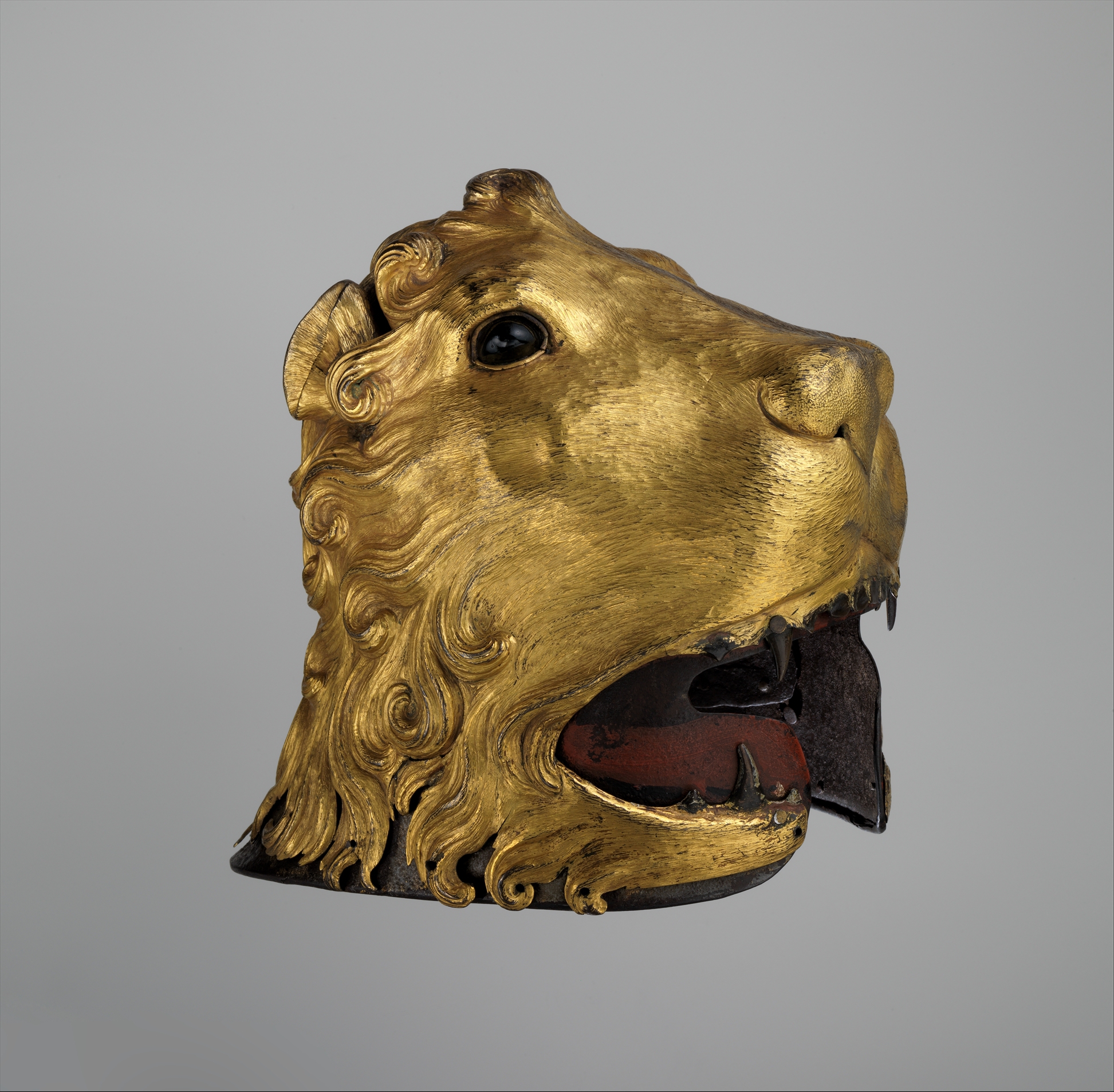
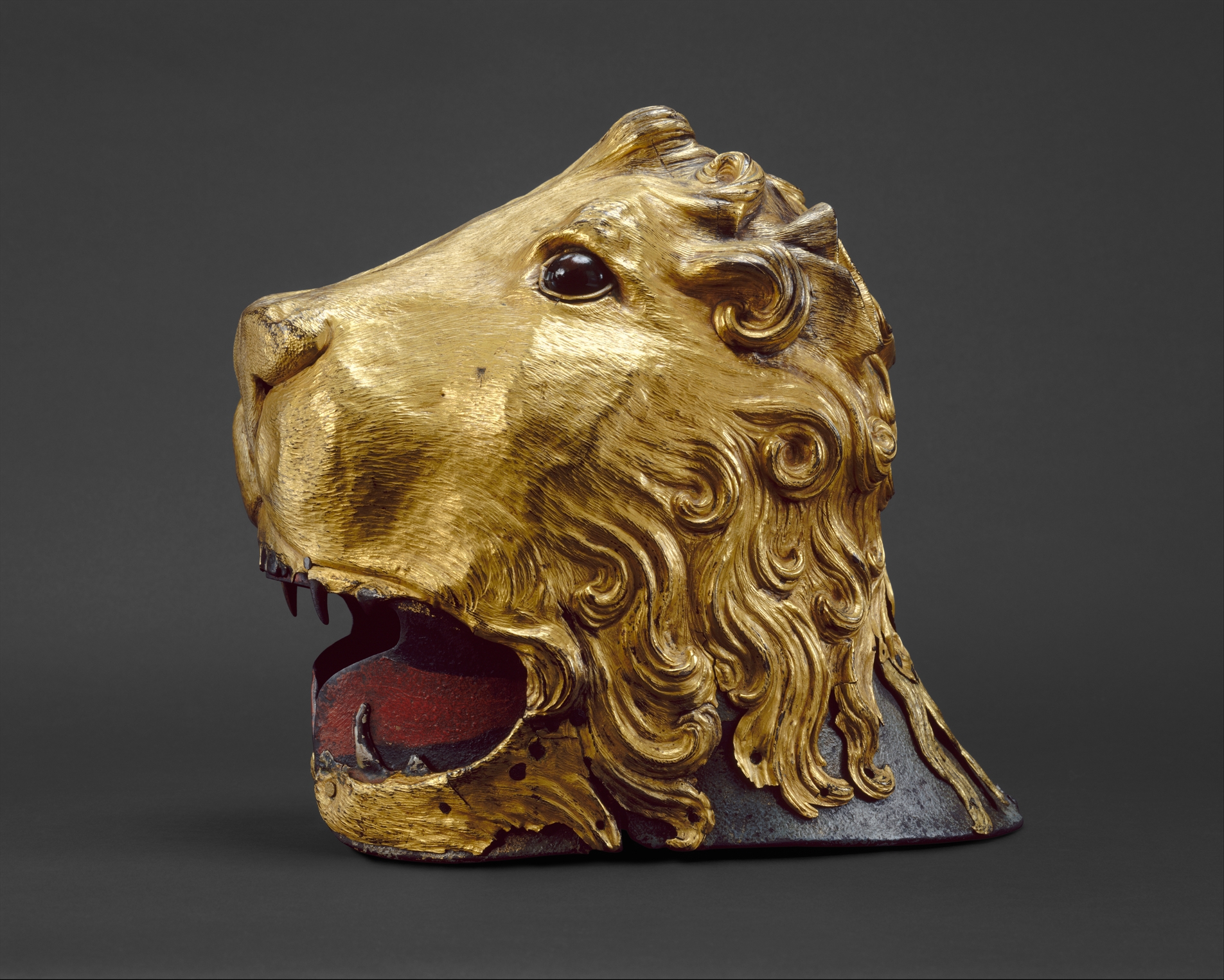
The record subject: the Lion Helmet, Italian, about 1475-80, gilded copper over steel. The Metropolitan Museum of Art, 23.141a-c. Public-domain open-access photograph from the museum.
| Artist | Unidentified Italian armourer and goldsmith (workshop attribution) |
|---|---|
| Date | about 1475-80 |
| Medium | Steel, gilded copper (mercury amalgam), glass, paint, textile |
| Dimensions | H. 29.8 cm (11 3/4 in.); W. 21 cm (8 1/4 in.); D. 31.8 cm (12 1/2 in.); weight 3,574 g (7 lb 14 oz) per the Met (Pyhrr and Godoy 1998 give 3,750 g) |
| Where it is now | The Metropolitan Museum of Art, New York (Gallery 373, The Met Fifth Avenue)last confirmed |
| Inventory number | 23.141a-c |
| Attribution | UnknownThe Met catalogues the helmet as Italian, about 1475-80, with no named maker. Full note |
| Object type | Arms and armour |
| Period | Italian, Renaissance, late fifteenth century |
| Cases | Has a provenance gap |
| Inscriptions | None; no armourer's or goldsmith's mark on the steel or the copper. |
| Owners on record | 9 links5 documented, 2 disputed, 2 unknown |
| Sources | 10 cited |
About this record Last verified · 10 sources cited · Change log
On this page 10 sections
ContentsClose
A steel sallet of the 1470s under a shell of embossed, chased and mercury-gilded copper in the form of a lion's head, made so that the wearer looks out through the beast's open jaws. The Metropolitan Museum calls it the earliest surviving example of Renaissance armour in the antique style and the only surviving Quattrocento parade helmet of its kind; its lion alludes to Hercules and the Nemean lion and may recall the lion-skin headdress of Roman standard-bearers.
Its documented life begins in London in 1816, in the catalogue of the Oplotheca in Bond Street, and runs through the Gothic Hall and Haymarket exhibitions to a sale in 1833. A story told by Laking and by Bashford Dean puts it in an Oxford junk shop and then at Athelhampton in Dorset with the collector A. C. Lafontaine. It was sold to Julius Bohler of Munich, bought by the Germanisches Nationalmuseum in Nuremberg in 1914, sold again in 1922 to a Dutch private collector, and bought by the Met in 1923.
Almost every question about it has been argued. Laking in 1920 allowed that the lion might be seventeenth-century or English; Dean in 1923 first took the lion for a transplant from a statue, then changed his mind and proved the fit; the Met's 1998 catalogue reads steel and lion as made together; and Edward Hunter's 2014 disassembly found the steel to be an older unfinished bowl, the lion to carry repairs and paint from before 1816, and the eyes, the weight and the lining to be described differently by different Met publications.
Provenance
Each link is graded. Documented: a cited source supports it. Disputed: the identification is argued but not established. Unknown: no owner for that span, and the gap is not smoothed into a narrative. The grades in the glossary.
- about 1475-80 -Unidentified armourer (steel sallet) and unidentified goldsmith or sculptor (lion's-head shell)disputed
Italian (Met; Pyhrr and Godoy). The sallet, on Hunter's reading, may be an older unfinished bowl completed for the purpose; Pyhrr and Godoy read steel and lion as designed together. Place of manufacture not fixed; a Sienese origin has been argued (Scalini 1993) and rejected by Pyhrr and Godoy; Laking in 1920 allowed that it might be an English-made head-piece on an Italian model. No patron is documented.346
- about 1475-80 - 1816Unrecordedunknown
Hunter: nothing is known of the helmet before 1816, when it appeared on the London art market. A gap of some three and a half centuries.3
- 1816 - 1833 or 1835Thomas Gwennap, London (named in the Met's provenance); exhibited at the Oplotheca (1816, 1817), Gothic Hall, Pall Mall (1818, 1819, 1820) and the Royal Armoury, Hay-Market (1821, 1835); lot 124 in the sale of Gothic Hall stock by George Robins, 10-11 June 1833documented
The 1816 Oplotheca catalogue entry (no. 107) was read and describes the helmet unmistakably (an open helmet, embossed and gilt, representing the skin of a lion's head as drawn over the scalp). The catalogue does not name an owner; Gwennap's name rests on the Met's provenance file. Whether the helmet was sold, bought in or withdrawn in 1833, and who held it after, is not recorded in the sources read.17
- 1833 or 1835 - before 1914Unrecorded; a tradition recorded by Laking and Dean places it in the garret or armoury of an old manor house near Oxfordunknown
No document connects the London exhibitions with the Oxford shop. The manor-house tradition is a story told in 1920 and 1923; it is not corroborated by an inventory, a sale record or a name. The house is not named in the sources read.56
- date unrecorded - 1914A. C. (Alfred) Lafontaine, England; at Athelhampton, Dorset, according to Deandocumented
Bought in a shop near the Cattle Market, Oxford, on the advice of the painter Seymour Lucas, R.A. (Laking and Dean, who tell the same story). Dean has the dealer asking twenty guineas and Lafontaine offering ten pounds before the purchase; the price paid is not stated. Lafontaine owned Athelhampton from 1890 to 1916 (tertiary source); the date of purchase of the helmet is not given in any source read.15610
- 1914 (Met) or about 1912 (Dean) - 1914Julius Bohler, Munich, antiquarydisputed
The Met dates the sale to 1914 and has Lafontaine as owner until then. Dean writes that about 1912 Bohler visited Lafontaine and took the helmet to Munich. The record follows the Met; Dean's 1912 is a recollection published nine years after the fact.15
- 1914 - 1922Germanisches Nationalmuseum, Nurembergdocumented
Labelled a parade helmet of the middle fifteenth century; the underlying sallet described as unimportant (Dean's account of the published text). Sold in 1922 to a private collector; Dean thought the museum was in need of funds after the war.15
- 1922 - 1923Private collection, Holland (not named)documented
The Met lists the Dutch private collection and the sale through Julius Goldschmidt; Dean names the Goldschmidt brothers, Frankfurt antiquaries. The collector's name and every price are unrecorded in the sources read.15
- 1923 - presentThe Metropolitan Museum of Art, New Yorkdocumented
Accession 23.141a-c. Published by Dean in the Bulletin, October 1923. Disassembled for the first time since acquisition for Hunter's technical study (2014).1235
Prices realised
| Date | Sale | Estimate | Result | Note |
|---|---|---|---|---|
| 1833-06-10 to 1833-06-11 | George Robins, London (Military Antiquities: ancient armour and implements of war, all the specimens formerly exhibited in the Gothic Hall) | Not recorded | Hammer Not recorded in the sources read With premium Not applicable; no premium is recorded for a London sale of this date in the sources read GBP presumed; unconfirmed | The Met's reference list gives the sale catalogue (p. 19, lot 124) as listing the helmet. Whether it sold, to whom, and at what price is not recorded in the sources read, and the 1835 Haymarket catalogue shows the same item number again. The catalogue itself was not seen. |
Hammer is the price at which the bidding stopped; with premium adds the fee the house charges the buyer on top. Hammer price and buyer's premium in the glossary.
Technical evidence
| Attribution note | The Met catalogues the helmet as Italian, about 1475-80, with no named maker. The steel carries no armourer's mark and the lion no goldsmith's mark. Pyhrr and Godoy (1998) attribute the two parts to an armourer's workshop and an unidentified goldsmith or sculptor; Hunter (2014) reads the sallet as an older unfinished bowl completed for the purpose. A Sienese origin has been argued (Scalini 1993) and is rejected by the Met's catalogue authors; Laking (1920) allowed an English-made head-piece on an Italian model as a possibility. |
|---|---|
| Object type | Parade sallet (celata) all'antica, composite: steel sallet, gilded copper lion's-head shell, textile lining. Three accessioned elements, 23.141a-c.123 |
| Date | about 1475-80 (Met, Pyhrr and Godoy, Hunter). Laking in 1920 pronounced the shell contemporary with the helmet; he did not offer a numerical date.1346 |
| Origin | Italian. Place not determined: no marks. Proposals: Sienese workmanship (Scalini 1993, reported by Pyhrr and Godoy, who find it unconvincing); possible English-made head-piece on an Italian model (Laking 1920, as a possibility only).146 |
| Medium | Steel, gilded copper (amalgam gilding), glass, paint, textile. Solder on the shell is a silver-copper alloy (XRF, August 2010).23 |
| Dimensions | H. 29.8 cm (11 3/4 in.); W. 21.0 cm (8 1/4 in.); D. 31.8 cm (12 1/2 in.).23 |
| Weight | 3,574 g (7 lb 14 oz) in the Met record and Hunter 2014; 3,750 g (8 lb 4 oz) in Pyhrr and Godoy 1998. The difference is unexplained in either source.234 |
| Shell construction | Two sheets of copper, raised and chased, soldered along a central front-to-back seam; mane originally riveted through the tips of the locks, now secured by four small threaded bolts; teeth individually formed; some teeth silvered.34 |
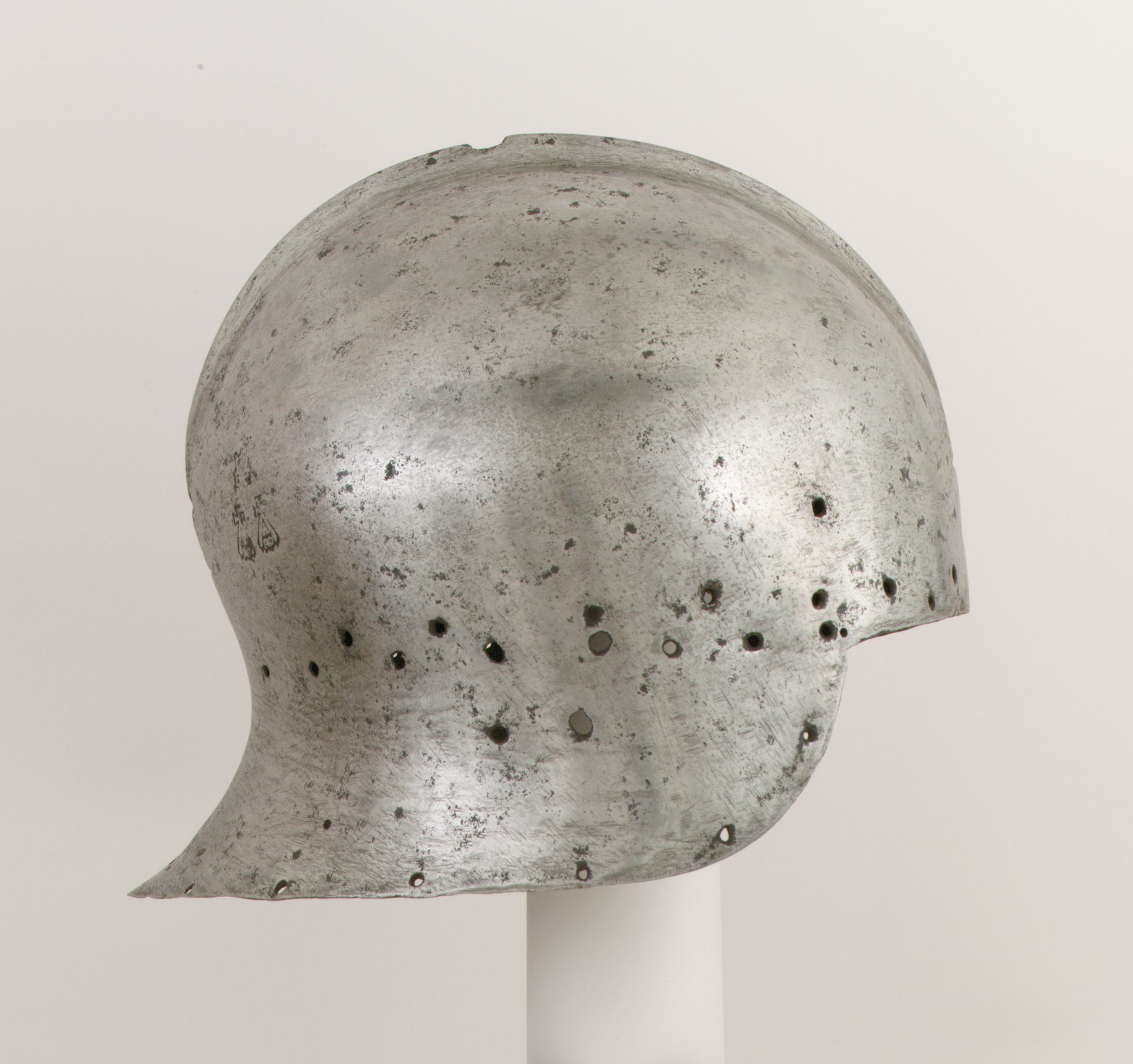
| Sallet construction | Four plates: bowl in one plate with ear extensions, low flat-topped comb with keyhole for a crest; riveted frontal plate with T-shaped opening; two riveted neck lames, the lower sweeping to a pointed tail. Faceplate and main neck lame heat-blued and polished; bowl exterior rough from the forge, rim cut not forged.3 |
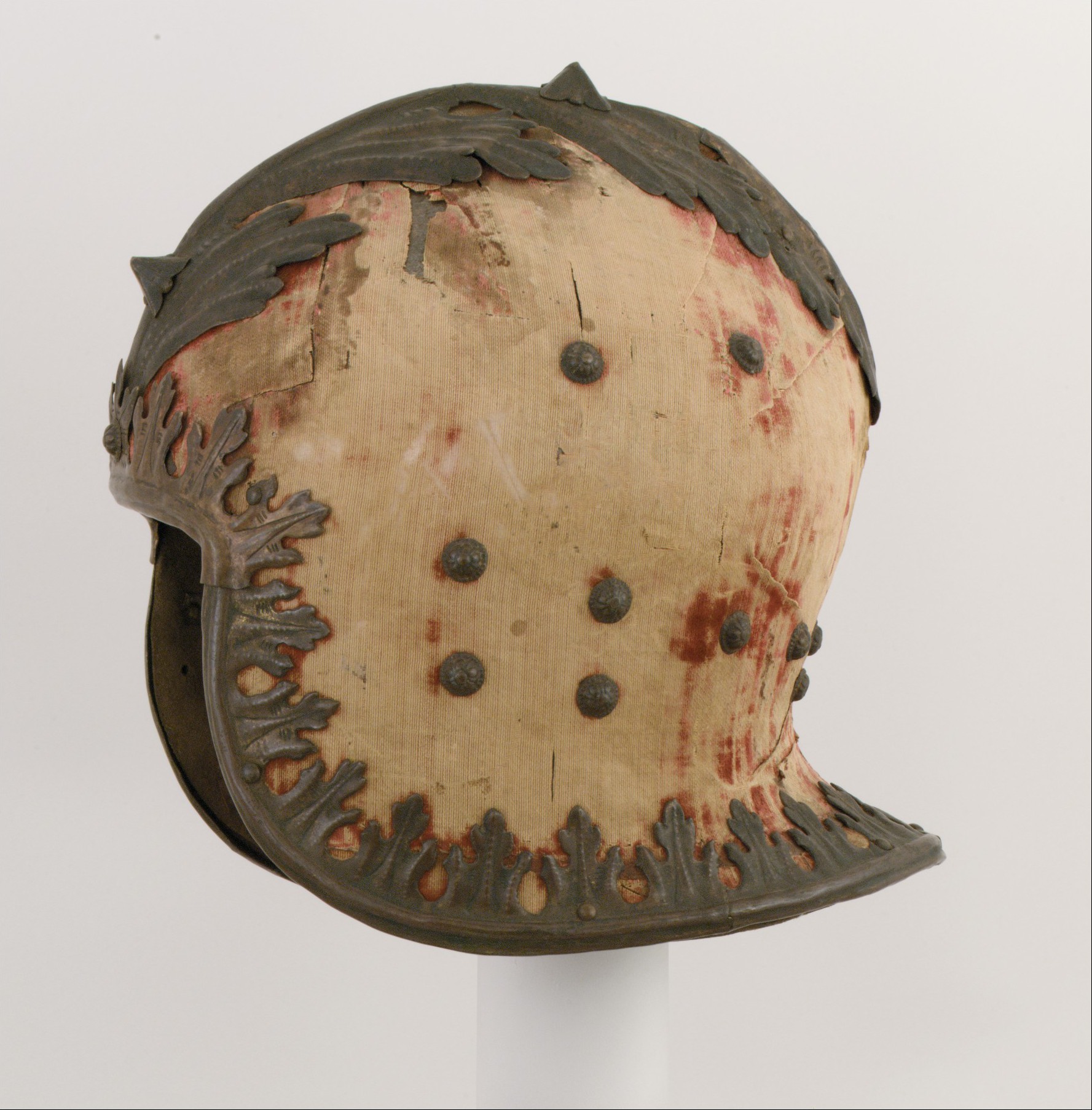
| Lining | Three layers stitched from four sections each and padded with horsehair: plain-weave linen outside, twill (linen warp, cotton weft) in the middle, satin-weave silk inside; quilted in a V pattern; linen tape edging. Originality of the lining is not established.3 |
| Paint and pigments | Mouth: cinnabar and red lead (red), iron-based black; teeth and neck lames: lead white; paint over the gilding darkened to grey by sulphidation. White paint on the lames was probably applied in a restoration, possibly just before the 1816 sale.3 |
| Eyes | Two glass or stone eyes in identical copper bezels. Hunter: left green bubbly glass, right reverse-painted colourless glass (probably replaced). Pyhrr and Godoy: left dark semiprecious stone, right dark-green bubbly glass. The sources conflict.34 |
| Inscriptions and marks | None on the shell or sallet. No armourer's mark and no goldsmith's mark.34 |
| Accession and location | 23.141a-c, Harris Brisbane Dick Fund, 1923; Department of Arms and Armor, Gallery 373, The Met Fifth Avenue. Wrongly cited as 23.144 in the 2022 Iron Men catalogue caption.12 |
Images
The record in full
Chapter 1What the object is
The Lion Helmet is two helmets in one. Underneath is a plain steel sallet, an open-faced fifteenth-century head defence of four riveted plates with a T-shaped opening for the eyes and nose.
The Lion Helmet is two helmets in one. Underneath is a plain steel sallet, an open-faced fifteenth-century head defence of four riveted plates with a T-shaped opening for the eyes and nose. Over it, riveted through the tips of the mane, fits a shell of embossed, chased and gilded copper in the form of a lion's head, the jaws open round the face opening so that the wearer looks out of the beast's mouth. Between the steel and the wearer's skull sits a padded textile lining of three layers that has survived with the helmet. The Metropolitan Museum of Art catalogues the three elements as 23.141a-c, gives the whole as Italian, about 1475-80, and describes it as the earliest surviving example of Renaissance armour all'antica, in the antique style [1][3].
The Met's record gives the dimensions as height 29.8 cm, width 21 cm and depth 31.8 cm, and a weight of 3,574 g (7 lb 14 oz) [2][3]. The 1998 catalogue entry by Stuart Pyhrr and Jose-A. Godoy gives the weight as 8 lb 4 oz (3,750 g) [4]. The two figures are sixteen years apart in print and 176 g apart in the balance, and neither source says why. The difference may be a weighing convention (with or without lining, or after a conservation intervention); that is a guess, and the record carries both numbers rather than choosing.
It hangs in Gallery 373 at the Met Fifth Avenue [1]. The credit line is Harris Brisbane Dick Fund, 1923 [2].
Chapter 2Two workshops, one helmet
Pyhrr and Godoy's reading, which is the Met's own curatorial position, is that the helmet is the product of two different trades: an armourer who made the steel sallet, and a goldsmith or sculptor...
Pyhrr and Godoy's reading, which is the Met's own curatorial position, is that the helmet is the product of two different trades: an armourer who made the steel sallet, and a goldsmith or sculptor who modelled and chased the lion. The two parts "fit together perfectly" and are contemporary; the sallet was the base for which the goldsmith modelled his lion [4]. Stripped of its golden covering the sallet is a practical, battle-ready head defence, though designed specifically to carry the lion. There are no armourer's marks, which is the usual state of Italian armour of the date, so the place of manufacture cannot be fixed from the steel [4].
The lion's head is a different order of object. Pyhrr and Godoy call the maker unidentified but extremely talented and note that in the fifteenth century goldsmith and sculptor were closely allied professions. They describe the shell as a masterpiece of early Renaissance goldsmith's work and say it differs fundamentally in construction, materials and technique from the sixteenth-century parade helmets of the Negroli and their contemporaries. Those were usually forged from one plate of steel (the cheekpieces aside), and the embossing and chasing of that plate seriously weakened the structure and left a surface more likely to catch a blow than deflect it. The Met's sallet is the opposite case: a lightweight applied ornament of gilt copper laid over a practical steel helmet, so that the ornament never compromises the defence [4].
Hunter, the Met's conservator, reaches a more cautious conclusion on the same point. He agrees that the shell was fashioned to fit this specific sallet and that it is unlikely the helmet was intended for anything other than ceremonial use, since a decorative shell over a steel support gives the style of a heroic helmet combined with the strength of an effective head defence [3]. Where he goes further than the 1998 catalogue is the sallet itself, taken up below.
Chapter 3How the lion was made
The shell is constructed from two sheets of copper, raised and chased and then soldered together down the centre from front to back.
The shell is constructed from two sheets of copper, raised and chased and then soldered together down the centre from front to back. X-ray fluorescence spectroscopy run by James Frantz of the Met's Department of Scientific Research in August 2010 found the shell to be copper and the solder a silver-copper alloy [3]. Hunter's computed radiograph shows the central seam and shows that other, smaller seams are probably cuts made to help shape the sheet rather than repairs [3].
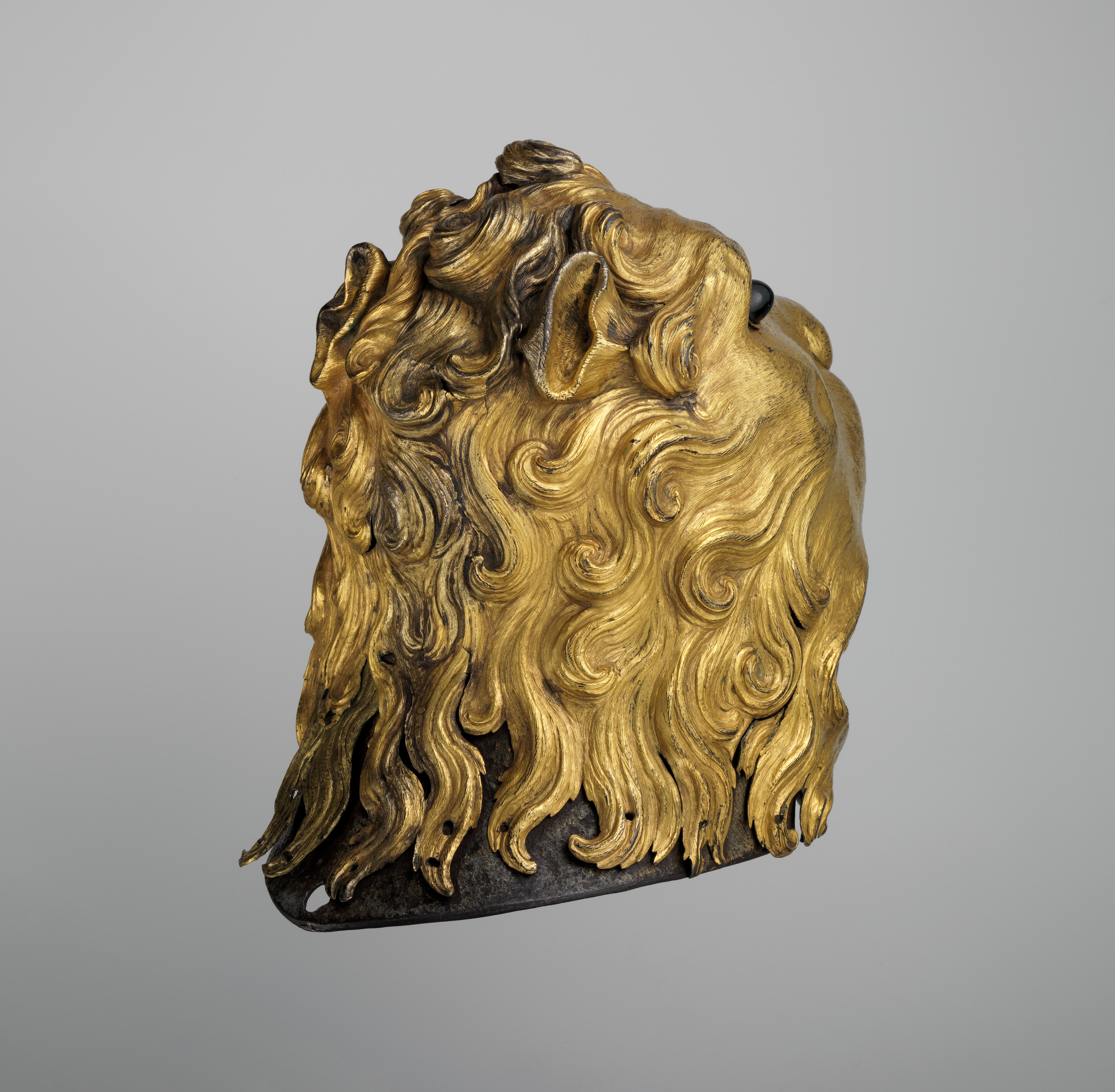
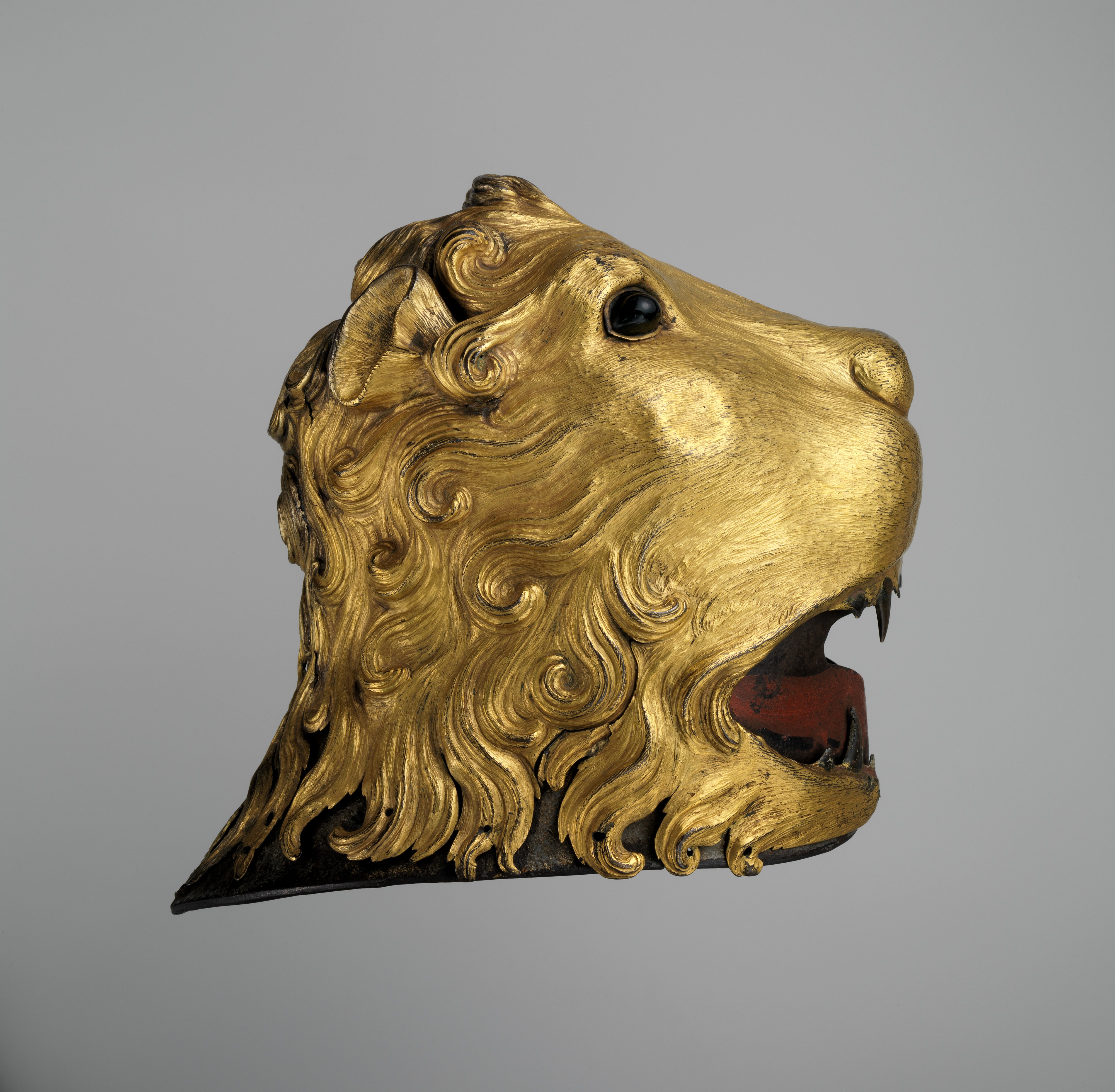
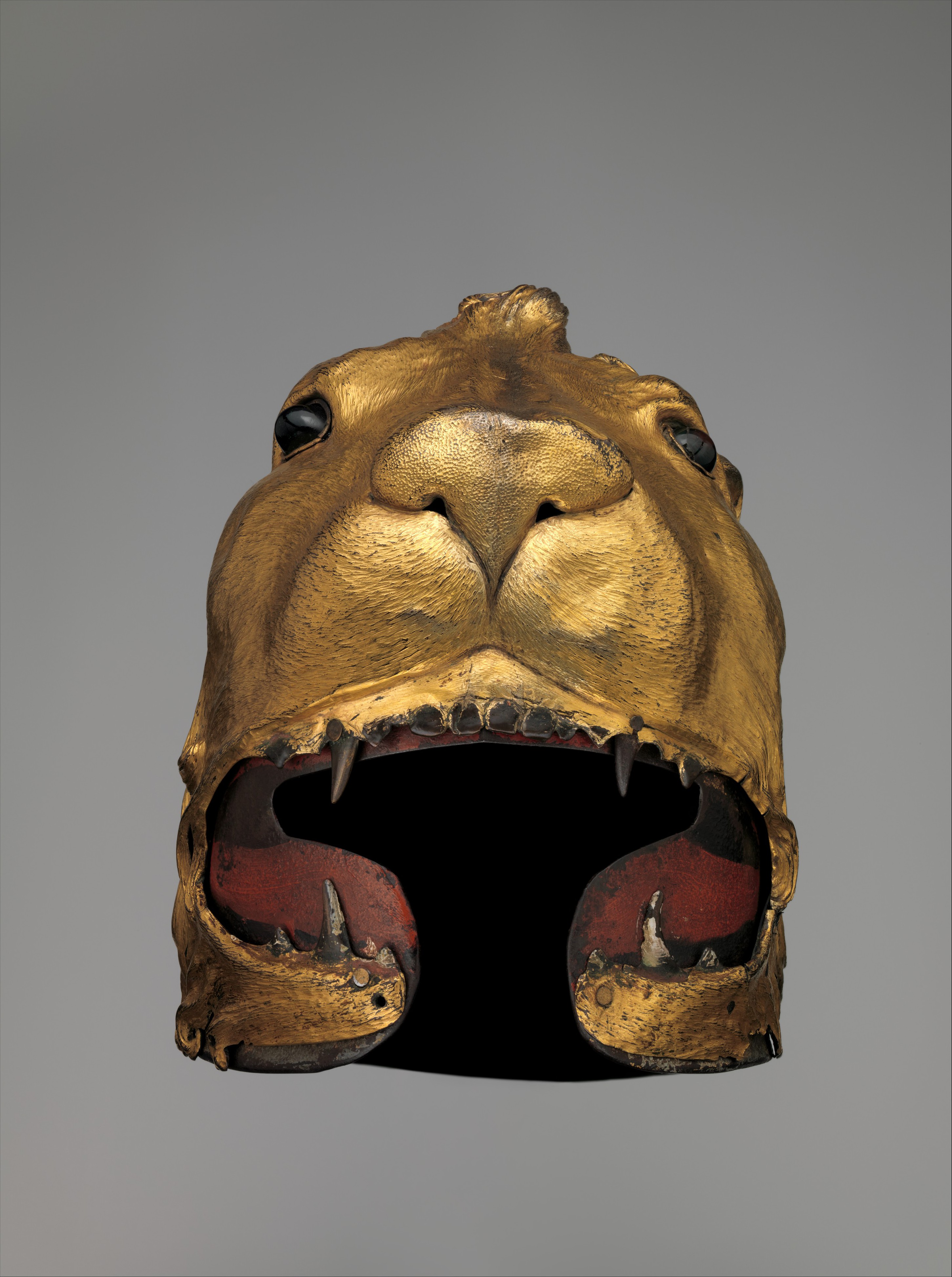
The surface work is exceptional. The hair is chased in closely set parallel lines over much of the face, the nose is dot-punched, the ears are delicate, and the mane has raised whorls and locks sweeping down the back and sides of the neck. The mouth wraps around the T-shaped opening in the sallet's faceplate and carries individually formed teeth. The part of the steel visible inside the opening has been painted black and red to read as the lion's mouth and tongue [3]. Pyhrr and Godoy add that the teeth are covered with hatched silver [4].
The entire exterior is amalgam-gilded: XRF showed residual mercury, which is the signature of the mercury-gold process. The gilding is bright and clean with little wear, with silver tarnish only along the soldered seam. The interior of the shell, by contrast, is extensively corroded. The thickness of the copper is fairly uniform but thin in places, with splits and small holes that Hunter attributes to mechanical stress during the repousse process [3].
The shell was originally riveted to the sallet through the tips of the locks of the mane. Those rivets are lost, but the matching pairs of holes remain, and the shell is now held by four small threaded bolts that reuse some of the original holes [3].
Chapter 4The sallet underneath, and an unfinished bowl
The sallet is built from four plates. The main part is a bowl forged from a single plate with two extensions covering the ears and a low flat-topped comb running from brow to back of head, with a...
The sallet is built from four plates. The main part is a bowl forged from a single plate with two extensions covering the ears and a low flat-topped comb running from brow to back of head, with a keyhole opening in the comb for mounting a crest. The frontal plate is riveted to the bowl and has the wide T-shaped opening, extending round either side of the face to about the halfway point of the bowl. Two lames cover the neck at the back, the second sweeping into a short pointed tail. Hunter observes that the tail does not actually hinge but is riveted into a fixed position, presumably the better to carry the mane [3].
The surfaces tell two different stories. The bowl's exterior is dark and rough from the forge, with file and hammer marks still visible, and its bottom rim is ragged, cut rather than forged to shape. The faceplate and main neck lame, by contrast, show heat-bluing and a fine polish, much reduced by corrosion. From this Hunter draws the hypothesis that the sallet was not newly made as a support for the lion but is older and was apparently incomplete before it was chosen: an older, unfinished bowl with newer, polished and blued parts added. If the bowl had been a fully realised helmet throughout, he reasons, the whole surface would show the same preparation [3].
The shape supports this. The overall form approximates a later sallet, yet the rough cutting of the bowl edge suggests a different original shape. Hunter proposes that the bowl as forged may have resembled the Met's Milanese sallet of 1470-80 (04.3.230), with a low bowl, low medial ridge and flared nape; the nape was cut away so that the faceplate would fit and the shell could wrap round the head to give the impression that the wearer was peering out of the lion's mouth. The added lames may have been meant to give the mane greater length. The keyhole for a crest, now covered by the shell and unused, is a further sign of an earlier intended life. His summary is that the unfinished surface on a modified earlier helmet shape suggests a repurposed but unused bowl, combined with new parts to give the outward appearance of a later sallet [3].
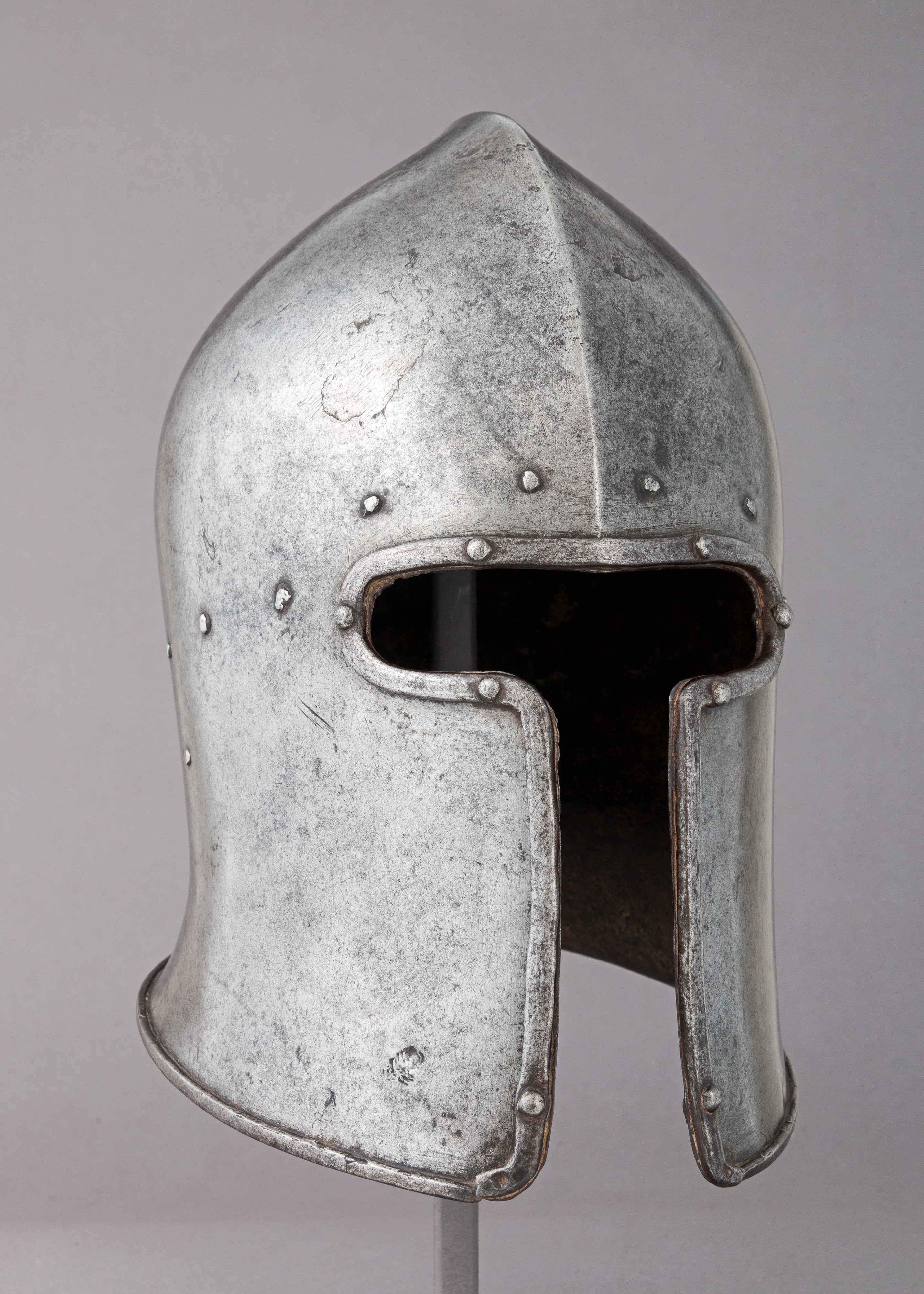
The combination is, in Hunter's words, an unusual mixture: the T-shaped face opening of the early fifteenth-century barbute (he cites the Met's barbute by Jacobo da Cannobio, called Bichignola, of about 1460, 60.151) joined to the low bowl and comb and articulated tail of a later sallet that normally has a visor rather than a T-shaped opening [3]. Pyhrr and Godoy, writing sixteen years earlier, read the same hybrid as the signature of 1475-80: the earlier Venetian-style sallet, in use about 1440-70, with its tall one-piece bowl and T-shaped opening, combined with a later type of the last quarter of the century with a brow plate and sweeping sides [4]. The two readings differ in what they conclude about the maker's intentions. The 1998 text treats the steel and the lion as designed together; the 2014 note treats the steel as an older bowl that someone rescued and completed. That difference is genuine, and the Met's own two publications are the parties to it.
Chapter 5The lining, and why it matters
It is rare for a helmet of this period to keep an intact lining, much less one of such quality.
It is rare for a helmet of this period to keep an intact lining, much less one of such quality. The lining consists of three layers, each stitched together from four sections of fabric to form a bowl shape padded with horsehair. The outer layer, against the steel, is plain-weave linen. The middle layer is a higher-quality twill with a linen warp and cotton weft. The third, which would have been against the wearer's head, is a satin-weave silk. The whole is quilted in a V-shaped pattern, and linen tape attached around the perimeter of the third layer dresses the edges and was also used to sew the lining to the leather band on the inside of the steel bowl. The textile analysis was done by Florica Zaharia of the Met's Department of Textile Conservation, whose report is dated 29 November 2011 [3].
Hunter will not say the lining is original. It has long been assumed to be, because of its quality and good fit, but he states that more research on this and on other helmet linings is necessary before that can be said with certainty. The outer layer also retains evidence of an adhesive used to secure it to the interior of the sallet; photographs taken when the Met acquired the helmet seem to show the lining still attached at that time, probably only with glue, which was not usual practice for helmet linings and is likely a restoration intended to secure the lining in lieu of stitching [3]. Dean, in 1923, had taken the lining to be authentic and cited it as proof of the whole helmet's integrity, as discussed below [5].
Chapter 6The Nemean lion, Hercules and the Roman standard-bearer
The lion is the Nemean lion. Hunter and Pyhrr both read it as an allusion to the hero Hercules, who for one of his Twelve Labours strangled the invulnerable beast and thereafter wore its pelt as a...
The lion is the Nemean lion. Hunter and Pyhrr both read it as an allusion to the hero Hercules, who for one of his Twelve Labours strangled the invulnerable beast and thereafter wore its pelt as a headdress. Pyhrr and Godoy add that the lion was no ordinary animal but had magical properties that made its skin impervious to manmade weapons, so the prince who wore this sallet presumably saw himself as a new Hercules, an embodiment of heroic and leonine virtues, who may even have enjoyed the conceit that he was defended by impenetrable armour [4]. This is argued by the catalogue's authors from the iconography and is not documented by any owner's statement: no contract, inventory entry or letter naming the original wearer is known.
The catalogue offers two further readings and labels them with appropriate caution. The first is a pun: the lion imagery might have played on the owner's name, Ercole or Lionello. No such owner has been identified, so this is a proposal, not a finding [4]. The second is a specifically Roman reference. The sallet may have been modelled on, or at least inspired by, the lion-skin headdress of the Praetorian standard-bearers (signiferi) of the Roman army, a costume well known from Trajan's Column and the Arch of Constantine. The catalogue cites Vegetius, the fourth-century author of a military handbook that fifteenth-century students of Roman warfare knew well, who says the standard-bearers wore a device resembling a severed lion's head, made to render them more ferocious and terrible to the enemy; Pyhrr and Godoy quote the passage in Guillaume Du Choul's 1555 French treatise on Roman military discipline [4].
Hunter adds a third classical image: Alexander the Great is depicted wearing a lion-scalp helmet on the sarcophagus named for him in the Istanbul Archaeological Museums (inv. 370), and King Alfonso I of Naples, his son and a retainer wear lion-headed helmets in the reliefs of the Aragonese Arch [3]. Whether the maker or the wearer knew any of these specific images is not recorded. The lion was the commonest heraldic and heroic beast of the century, and the claim that this helmet declares a Herculean or Roman programme rests on the resemblance of the form to the classical sources and on the catalogue's argument, not on a statement by anyone connected with its making.
Chapter 7The Naples relief and the 1923 identification
Since at least 1920 the helmet has been compared to, and sometimes identified with, a lion-covered sallet on the lower register of the Aragonese Arch at the Castel Nuovo in Naples.
Since at least 1920 the helmet has been compared to, and sometimes identified with, a lion-covered sallet on the lower register of the Aragonese Arch at the Castel Nuovo in Naples. Laking, in the second volume of his Record of European Armour and Arms, pointed to a knight on the left of the central figure whose salade has an outer covering in the form of a lion's scalp, and compared it directly to the Lafontaine helmet [6]. Dean in 1923 went further and wrote that the relief showed "quite the same type of helmet", which in his view indicated that the Met's helmet came from southern Europe [5].
Pyhrr and Godoy take the opposite view. The Met's sallet, they write, has traditionally been compared to and even identified with the lion-covered helmet worn by one of the soldiers in the arch's lower reliefs, but the relief shows a sallet of a different form, one with sweeping cutaway sides that expose a larger portion of the soldier's face. The Met's helmet probably postdates the relief by a decade or two, as the form and construction of the sallet suggest. They still think it reasonable that the helmet on the arch was copied from an existing piece, given the specificity of costume in the reliefs, but that model, they say, was not the Metropolitan's [4].
The date of the relief is itself given three ways in the sources used here. Laking and Dean say the arch was erected in 1470 [5][6]. Hunter says the arch was completed in 1447 [3]. Pyhrr and Godoy say the reliefs were completed by 1457 [4]. The Columbia University entry for the arch, which follows Christoph Frommel, says work began about 1452-1453 to commemorate Alfonso's entry into Naples in 1443 and was completed during the reign of Ferrante; it names Pietro di Martino da Milano, Francesco Laurana, Pere Johan, Paolo Romano and Domenico Gagini among the first sculptors, with Isaia da Pisa and Andrea dell'Aquila joining after 1455 [8]. George Hersey's book on the arch, which the Columbia entry lists, is titled The Aragonese Arch at Naples, 1443-1475, and its title alone indicates how long the campaign ran. A 1447 completion is therefore hard to reconcile with a start around 1452; the record notes the discrepancy and does not adopt any of the three completion dates as its own.
Chapter 8The London years, 1816 to 1835
The first sure fact about the helmet's history is a printed one.
The first sure fact about the helmet's history is a printed one. Hunter writes that nothing is known of it before 1816, when it appeared on the London art market [3]. The Met's provenance gives its earliest owner as Thomas Gwennap, London, 1816-33 [1]. The Met's reference list shows what that means in practice: a run of catalogues of London armour exhibitions, each listing the piece under a number. The Oplotheca at 20 Lower Brook Street, Bond Street, printed one in 1816 (Smith and Davy; the helmet is no. 107, page 15) and another in 1817 (no. 107, page 18). The Gothic Hall catalogues follow: 1818 (no. 125), 1819 (no. 131), 1820 (no. 131). Then the Royal Armoury in the Hay-Market in September 1821 (no. 64), the sale of 10-11 June 1833 conducted by George Robins under the title Military Antiquities, listing all the specimens formerly exhibited in the Gothic Hall (lot 124), and a Royal Armoury Hay-Market catalogue of 1835 (no. 64) [1].
The 1816 Oplotheca catalogue is on the Internet Archive and was read for this record. Entry 107 reads, in full, a very beautiful open helmet, finely embossed and gilt, representing the skin of a lion's head as drawn over the scalp, and adds that it is nearly of the same period as the fine one opposite [7]. The neighbouring entries show the register in which it was sold: entry 104 is a mace of the time of Francis I from the collection of the late J. P. Loutherbourg, entry 108 a state shield that Loutherbourg had supposed painted by Giulio Romano [7]. The title page advertises suits of armour said to have been obtained from the King of Bavaria for Napoleon Bonaparte and a cuirass of scale armour secretly worn by Bonaparte [7]. This was an exhibition of curiosities in a commercial hall, and the helmet is described in a single sentence with no owner's name, no attribution and no place of origin.
Gwennap's name does not appear in the Oplotheca catalogue as digitised. The Met's provenance names him for 1816-33, and the Met's exhibition history lists the 1819 Gothic Hall display as an exhibition of the object [1]; the link between the person named and the objects shown rests on the Met's file, which the record has not been able to compare with a primary document. The 1833 sale of Gothic Hall stock and the reappearance of the same item number in the Haymarket catalogue of 1835 together suggest that the helmet was either bought in at the sale or bought by the Haymarket proprietors. The sources read do not say which, nor who held it afterwards.
Hunter adds a physical observation that dates a restoration to this period: examination of the white paint on the sallet's neck lames found it to be mostly lead white, and given the stratification of the paint over corrosion over gilding, it was most likely applied in a later restoration, possibly just before the 1816 sale [3]. In other words the helmet that was shown in Brook Street in 1816 had already been through at least one campaign of refreshing and repainting before it was exhibited.
Chapter 9The Oxford garret: Lafontaine, Lucas and the account Dean published
Between the sale of 1833 or the Haymarket catalogue of 1835 and the early twentieth century there is a gap of at least sixty years.
Between the sale of 1833 or the Haymarket catalogue of 1835 and the early twentieth century there is a gap of at least sixty years. One account claims to fill it. Bashford Dean, then curator of arms and armour at the Met, published the story in the Bulletin of the Metropolitan Museum of Art for October 1923 under the title A Lion-Headed Helmet. According to Dean, an English art lover, A. C. Lafontaine, who owned Athelhampton in Dorset, happened one day into a little antiquity shop in Oxford near the Cattle Market and noticed in a shadowy corner a gleam of gold, which resolved itself into an extraordinary helmet covered with a gilded copper lion's head. The dealer's price, in the digitised text of Dean's article, was twenty guineas; the dealer said it came with other objects from the garret of an old manor house in the region; Lafontaine bargained and offered ten pounds, went home and wrote a detailed description to his friend the painter Seymour Lucas, R.A. (Dean says that it is from Lucas that he had the story), and Lucas took the train to Athelhampton at once. The next day the two men went to the shop together. When the dealer handed over the helmet, Lucas hissed in his friend's ear, in Dean's telling, Buy it, fool, before I do. The helmet was duly bought and carried to Athelhampton, where it hung in a place of honour for many years [5].
Laking's account, published in 1920, three years before Dean's, agrees on the main points and adds a detail that Dean passes over. Laking says the helmet had been in the collection of Mr A. C. Lafontaine, who purchased it in a shop near the Cattle Market, Oxford, on the advice of Mr Seymour Lucas, R.A., and that the purchaser was told it came originally from a mansion in the neighbourhood. He adds that tradition has it that the helmet was originally part of the original armoury of that house [6]. A helmet exhibited in London from 1816 to at least 1819 and sold by auction in 1833 may well have been bought afterwards for an English house; the tradition of a mansion armoury and the exhibition record are therefore not necessarily in conflict, but the link between them is not documented. The record grades it unknown.
The Oxford story gives no date for the purchase. Alfred de Lafontaine acquired Athelhampton in 1890 and put it up for sale in 1916, the house passing to the Cochrane family about two years later [10]; the record notes this only as a bracket for his tenure, because the sources do not say that the helmet was bought during it. Dean says that about 1912 the Munich antiquary Julius Bohler visited Lafontaine, was vastly taken with the helmet and carried it off to Munich by an alluring price [5]. The Met's provenance dates the sale to Bohler to 1914 and has the helmet in Lafontaine's hands until then [1]. The 1914 date agrees with the Nuremberg publication of that year. Dean's about 1912 is a recollection, and the record prefers the Met's 1914.
Chapter 10Nuremberg, 1914 to 1922
The Germanisches Nationalmuseum at Nuremberg bought the helmet from Bohler and published it in the Anzeiger des Germanischen Nationalmuseums for 1914, issue 3-4, pp.
The Germanisches Nationalmuseum at Nuremberg bought the helmet from Bohler and published it in the Anzeiger des Germanischen Nationalmuseums for 1914, issue 3-4, pp. 46-47, plate I, in the Met's reference list under the name of Fritz Traugott Schulz [1]. Dean, who read the notice, says the museum labelled it a parade helmet of the middle fifteenth century, described the underlying salade as unimportant and said it merely served as a rack for the gilded lion's head, which covered the casque completely so that the wearer could see and breathe only through the open mouth [5]. Dean also infers from the published description that the rivets were not removed at Nuremberg, so the lion was never lifted off in the museum's care [5].
At the end of the First World War, Dean writes, the Nuremberg museum, apparently in need of funds and recalling that the object was Italian, not German, decided to dispose of it [5]. The Met's provenance says the museum sold it in 1922 to a private collector, and records the next owner as a private collection in Holland, 1922-23, whose sale to the Met was made through Julius Goldschmidt [1]. Dean's article names the intermediaries as the Goldschmidt brothers, antiquaries in Frankfurt, and says that from the private collector, whose home he believed to be in Holland, the helmet came into the possession of the Metropolitan Museum [5]. The identity of the Dutch collector is not given in any source read. Neither the price Nuremberg received, nor the price at which the Met bought, nor the date of the 1923 purchase within the year, appears in the Met's record or in Dean's article as digitised.
Chapter 11Dean's change of mind
Dean, who had been the Met's honorary curator of arms and armour from 1906 and its founding curator of the department from 1912 [9], wrote an article that is more than a provenance note; it is an...
Dean, who had been the Met's honorary curator of arms and armour from 1906 and its founding curator of the department from 1912 [9], wrote an article that is more than a provenance note; it is an account of how a specialist's judgement of the helmet moved. He writes that he had known of the casque almost from the time of its discovery but that the object seemed so impossible that he never went out of his way to examine it. From a poorish photograph he had been led to conclude that the copper-gilt lion's head, while genuine, had never belonged to the original casque but had been taken from some heraldic monster, the locks of whose mane had been neatly cut out when the head was found to be about the size of the casque. So firm was his prejudice that even when the object was in his hands in the Museum he could hardly credit his own eyes, and he compares his first reaction to that of a Green Mountain farmer in the old story, who shook his head knowingly and murmured that there ain't no such animal [5]. His published verdict is the reverse: the helmet is right, and it is one of the most important accessions of the Department of Arms and Armor [5].
His reasons are set out with the confidence of a man who has changed his mind and wants the reader to follow. The lion's head fits the sallet perfectly, to such a degree that the anatomy of the lion has been altered to conform to the contours of the casque below: the eyes are displaced, the nose broadened so as to spread over the brow of the helmet, the ears cropped so as to be out of the way when the helmet is in use, the upper rim of the mouth wide and transverse so as not to interfere with the vision. The halves of the lower jaw, which he had earlier supposed to have been cut and spread when the head of a statue was converted into a helmet decoration, turn out not to be conformable to such a use. The mouth is wide open for a structural reason, so that the lower jaw can form a serviceable rim for the front of the helmet, and so that the part of the helmet exposed within the jaw can be coloured red to give the impression of a red tongue and throat. The back of the lion's head conforms to the neck region of the helmet [5].
He then argues for the steel. The sallet, called unimportant in Nuremberg, turns out to be a fine Italian salade of 1450-60, beautiful in line, excellent in workmanship and retaining its original bluing and burnishing, which he calls a unique instance so far as he knows, a state possible only if the object had been covered always and almost hermetically. The cushioned lining he treats as authentic and rarely matched, having recalled only three or four salades that still bear their linings, of coarse canvas, not delicately padded and quilted [5]. He lists other lion-headed helmets, the Paris museum specimen, a second from a half-armour once in the Carrand and Spitzer collections and later in the Economos collection in Paris, one in the Tower of London, a mask only in Vienna and one in the Riggs collection, and notes that all are later, about 1540-1580, with the lion embossed in the steel itself, so that the Met's earlier piece called for a mid-fifteenth-century document, which he found on the Aragonese Arch [5].
Each of Dean's points has since been qualified. Hunter finds heat-bluing on the faceplate and main neck lame, but the bowl exterior was never finished and there is no evidence that the narrow lame was ever blued; he finds the sallet older than the shell, not newly fashioned for it; and he declines to call the lining original [3]. Pyhrr and Godoy date the pair to 1475-80, not 1450-60, and say the Met's sallet is not the one shown on the Naples arch [4]. Dean's essential conclusion, that the lion belongs to this steel and that the object is a genuine fifteenth-century work, has stood. His supporting arguments have been refined or replaced by the two later Met texts. Dean returned to the subject in a second note, Additional Information on the Lion-Headed Helmet, in the Bulletin, volume 19, no. 2, p. 50 [1]; its contents were not available to this record, which is entered as an open question.
Chapter 12The doubters: Laking and the English possibility
The case that the lion is genuine was not always the received view.
The case that the lion is genuine was not always the received view. In 1920 Laking wrote that it had been suggested that the outer covering was a work of the seventeenth century, but that he had no hesitation in pronouncing it contemporary with the helmet; he based the judgement on its very close resemblance to the lion-mask salade sculpted in the relief on the Naples arch and concluded that the Lafontaine salade was most probably of Italian origin. Then he added a qualification that Dean's article never mentions: as the helmet was somewhat crudely fashioned, there was a possibility that it might be an English-made head-piece founded on an Italian model, a theory somewhat strengthened by the tradition that it had been part of the original armoury of the house from which it was obtained [6]. Laking, in other words, regarded the steel as less than refined and the provenance as a point in favour of local manufacture.
Laking also set the helmet in a context that is useful for dating. He says that Italian salades of the middle fifteenth century with applied gilded bronze ornaments are not uncommon, but that in nearly every case the ornamentation was added later, in the sixteenth or even the seventeenth century, when these business-like head defences were sometimes enriched for pageants. He gives the Morgan Williams salade at St Donat's Castle, found to be a fine mid-fifteenth-century salade with the mark of Antonio da Missaglia once seventeenth-century gilt bronze and velvet additions had been removed, as an example [6]. That is the background against which a gilded lion on a salade would be read by a connoisseur of 1920: as the kind of seventeenth-century pageant dressing his readers knew to be frequent, and which the Lion Helmet turned out not to be.
Hunter's technical study speaks to this question indirectly. He found that the shell and sallet were made for each other, that the shell was gilded by the mercury process and that the paint over the gilding is lead-based and attributable to a restoration probably before 1816. That is evidence about a sequence of repairs inside the nineteenth century and says nothing against a late fifteenth-century date for the metalwork. The seventeenth-century and English proposals are recorded here as superseded by the Met's later work, not as refuted by any published scientific dating, because none exists: no dendrochronology is possible on metal, and the record has found no thermoluminescence, metallurgical dating or isotope study of the copper.
Chapter 13Who made it: the Siena proposal
Pyhrr and Godoy record in a footnote a more recent proposal that the helmet may have belonged to the Sienese architect and engineer Francesco di Giorgio Martini, an argument put by Mario Scalini in...
Pyhrr and Godoy record in a footnote a more recent proposal that the helmet may have belonged to the Sienese architect and engineer Francesco di Giorgio Martini, an argument put by Mario Scalini in an article of 1993 on the celata of Borghese Borghesi and other honorific head coverings of the Quattrocento, in OPD Restauro, pp. 137-41 (the Met cites it in its reference list for the helmet, with a figure 15). They call this argument recent and, in their opinion, unconvincing. They add that Scalini also considers the helmet to be of Sienese workmanship about 1470-80 [4]. Hunter cites the same piece for the style and construction of this type of helmet: it is Scalini's contribution to Loretta Dolcini and others, 'Un restauro polimerico: L'Elmo del Capitano del Popolo di Siena', OPD Restauro no. 5 (1993), pp. 126-41 [3].
The record has not seen Scalini's article. The proposal is therefore reported at second hand, through the Met's two publications, and graded speculative. Two points can be said safely. The attribution is to a Sienese context, not to Milan or Venice, which is where the form of the steel would otherwise point; and the catalogue authors who know the object best, the Met's own, do not accept it.
Chapter 14Condition and conservation
Hunter's note is also the most complete condition report published.
Hunter's note is also the most complete condition report published. The ensemble is in good condition despite wear, tarnish and physical damage, some of it repaired. The sallet is well preserved though corroded, with several layers of paint from various restorations. The lining does not attach to the helmet but fits neatly inside [3].
The repairs to the shell are numerous. Both hard-solder and soft-solder repairs are visible, as are mechanical repairs, especially in the extremities that represent the mandible and the curls of the mane. The left side of the lower jaw has been repaired with a sheet-copper backing riveted in place, which secures the break and supports a significant second fracture; the canine tooth in this section is also backed, with a soldered copper strip now thickened by corrosion. One of the large original locks of the mane at the back is missing and has been replaced by a copper facsimile, gilded but noticeably different in surface and less skilled in execution, whose contours do not quite match the outline of the painted decoration directly underneath. Hunter concludes that the repair postdates the final campaigns of gilding and painting and is therefore part of the most recent restoration efforts. The two replaced upper canines, one steel and one brass, are also riveted in place, and several of the original teeth have been overpainted [3].
The eyes are discussed in both Met texts and the two do not agree. Hunter reports that the left eye is green glass with small bubbles easily seen in transmitted light while the right eye is reverse-painted colourless glass, most likely a replacement; because the bezels are identical, he thinks both eyes were remounted at some point, in which case the other eye may be a replacement as well [3]. Pyhrr and Godoy describe the left eye, apparently original, as dark semiprecious stone and the right, of slightly different shape, as dark-green bubbly glass [4]. The sources therefore differ on which side holds the stone and which the glass, and on whether either is stone at all. The Met's materials line lists glass and does not list stone [2]. The record keeps both descriptions and flags the conflict for a direct examination.
The paint is a record in its own right. Where the blued surfaces of the faceplate and neck lames were once gilded, they were later painted white; massive corrosion products under the white paint suggest it was applied to refresh the surface after the gilding was worn or pitted. The white is mostly lead white (cerussite and hydrocerussite). The red in the mouth contains cinnabar (mercury sulphide) and red lead, the black an iron-based pigment possibly magnetite, the white of the teeth lead white. The paint over the gilded decoration, probably also lead white, has darkened to grey through partial conversion to galena by sulphidation [3].
Hunter's occasion for taking the helmet apart was a loan request: to judge the helmet's suitability for travel it had to be disassembled, which gave a rare opportunity to examine and photograph the three components, a gilded copper shell, a steel sallet and a padded textile lining, in their entirety. It was, he says, the first time the helmet had been taken apart since its acquisition in 1923 [3]. Hunter's last paragraph is a measured one: although some details of its puzzling history have been clarified, the picture is not yet complete, and the circumstances that led the armourer to repurpose an earlier, unfinished bowl are far more difficult to reconstruct [3].
Chapter 15Display and reception since 1923
Dean's article says the helmet was already on view in the Department of Arms and Armor at the time of writing [5].
Dean's article says the helmet was already on view in the Department of Arms and Armor at the time of writing [5]. Today it is in Gallery 373 [1]. Dean and Robert Nichol's Handbook of Arms and Armor (4th ed., 1930, p. 92, fig. 50) carried it, as did Grancsay's articles in the Bulletin of 1956 and in Armi Antiche in 1960 [1]. Bruno Thomas and others published it in German and English in 1963-64, and Thomas wrote a short Italian article, L'elmo leonino del Metropolitan, in L'Illustrazione Italiana in 1974 [1]. Within the Met's own file it is the subject of Pyhrr and Godoy's catalogue entry no. 8 for the exhibition Heroic Armor of the Italian Renaissance, held 8 October 1998 to 17 January 1999 [1][4].
Its recorded exhibitions outside the Met are few and recent. The Met lists the Gothic Hall display of 1819 (no. 131); Masterpieces of Fifty Centuries at the Met, 14 November 1970 to 1 June 1971 (no. 201); Heroic Armor, 1998-99 (no. 8); Earth, Sea, and Sky: Nature in Western Art at the Tokyo Metropolitan Art Museum, 6 October 2012 to 4 January 2013, and at the National Museum of China, Beijing, 8 February to 9 May 2013 (both no. 47); and Iron Men: Fashion in Steel at the Kunsthistorisches Museum, Vienna, 29 March to 26 June 2022 (no. 145) [1]. The Met's reference list also records that the Iron Men catalogue (Stefan Krause, 2022) records the incorrect accession number 23.144 in a figure caption [1]. A catalogue caption that carries the wrong number is the sort of error that detaches an object from its literature; this record uses 23.141 throughout, as the Met does.
The Met's web entry calls it the earliest surviving example of Renaissance armour all'antica, and Pyhrr and Godoy call it the only surviving Quattrocento parade helmet all'antica [1][4]. Both are the Met's claims about its own piece, made by the curators who know the corpus best; neither has been tested by an independent census of Italian parade armour of the 1470s, and the record flags them as institutional statements.
Chapter 16What remains unknown
Five things stand between this record and a complete account.
Five things stand between this record and a complete account. The first is the maker, or makers. There is no mark on steel or copper, no document, no signature, and the only proposed attribution, to a Sienese circle, is rejected by the Met's own catalogue authors. The second is the patron. The Hercules, Roman standard-bearer and Ercole or Lionello readings are reasoned from the iconography; no inventory, letter or heraldic device connects any named person with the helmet. The third is the century and a half between the date of manufacture and 1816, for which there is no record at all. The fourth is the period between the Haymarket catalogue of 1835 and the Oxford shop. The fifth is the price: nothing in the sources read states what Lafontaine, Bohler, the Nuremberg museum, the Dutch collector or the Met paid at any stage.
The pattern of what is known is itself informative. The object is visible from 1816 and well documented from 1914, and between those dates there is one anecdote, told in 1920 and again in 1923, by people who were friends of the man who bought it. Everything that the Met knows from the object itself, in the form of Hunter's disassembly, is more reliable than the story of its movements. The helmet's survival, in a state where the gilding is bright and the lining intact, is itself the unexplained fact, and Dean's own explanation of the bright bluing, that the helmet had always been covered and almost hermetically sealed, sits uneasily with the paint stratigraphy, which shows it was handled, repainted and repaired more than once [3][5].
The artist
Unidentified Italian armourer (steel sallet) and unidentified goldsmith or sculptor (gilt copper lion's head)
No name is attached to either part of this object. The Met's catalogue authors say so plainly: there are no armourer's marks, as is usually the case on Italian armour of the date, and the lion is by an unidentified but extremely talented goldsmith or sculptor [4]. The dossier therefore covers what the evidence can say about the two trades, not a biography.
The steel is the ordinary work of an armourer's shop, and its surfaces carry the file and hammer marks, the cut rim and the heat-blued plates that Hunter describes [3]. The copper and gold are another craft entirely, and the Met's catalogue places the maker among the goldsmiths who were then being asked to enrich helmets for the Italian courts [4].
Related works
| Work | Relation | Where it is |
|---|---|---|
| Sallet "in the Venetian Style" (29.158.17) Italian, Venice region | Comparison cited by Hunter for fifteenth-century sallets decorated with gilded copper-alloy appliques and a velvet covering About 1460 for the steel; the decoration is probably seventeenth century and later (Met). Illustrates how gilt ornament was added to older sallets in later pageants, the case Laking had in mind in 1920 and the case the Lion Helmet turned out not to be. | The Metropolitan Museum of Art, New York (Bashford Dean Memorial Collection, 1929) |
| Sallet, Milan (04.3.230) Italian, Milan | Hunter proposes the Lion Helmet's bowl originally resembled this sallet, with a low bowl, a low medial ridge and a flared nape About 1470-80; weight 1,625 g (Hunter fig. 12). | The Metropolitan Museum of Art, New York (Rogers Fund, 1904) |
| Barbute by Jacobo da Cannobio, called Bichignola (60.151) Jacobo da Cannobio, called Bichignola | Hunter's example of the early fifteenth-century T-shaped face opening that the Lion Helmet retains Brescia, about 1460; 2,381 g (Hunter fig. 10). | The Metropolitan Museum of Art, New York (Gift of Mrs George A. Douglass, 1960) |
| Burgonet all'antica (14.25.597) Italian, probably Milan | A later steel parade helmet that Hunter contrasts with the Lion Helmet: thin, with raised forms lacking the smooth weapon-deflecting shape of a combat helmet About 1535-45 (Hunter fig. 6). | The Metropolitan Museum of Art, New York (Gift of William H. Riggs, 1913) |
| Helmet all'antica by Filippo Negroli (04.3.202) Filippo Negroli | The sixteenth-century tradition of heroic parade helmets that Pyhrr and Godoy contrast with the Lion Helmet's applied-copper construction See the Iconotheca record for the Negroli helmet. Forged from one plate of steel, unlike the Lion Helmet. | The Metropolitan Museum of Art, New York |
| Relief of Alfonso I and Ferrante with soldiers, Triumphal Arch Pietro di Martino da Milano, Francesco Laurana and others | The Naples relief long compared to, and by Laking and Dean identified with, the helmet type; Pyhrr and Godoy say the relief shows a different sallet Work began about 1452-53 (Columbia SIIA); the sources disagree on completion (1447, 1457, 1470). | Castel Nuovo, Naples |
| Sarcophagus of Alexander (inv. 370) Unknown | Hunter's classical example of Alexander wearing a lion-scalp helmet Cited by Hunter, note 3; not examined for this record. | Istanbul Archaeological Museums |
| Barbuta alla veneziana with gilded lion masks Italian | A comparable sallet-type helmet with gilded lion masks on either side, cited by Hunter from Barberini and Germoni 2002 Cited by Hunter, note 8; not examined for this record. | Odescalchi Collection, Rome |
Open questions
- Who made the lion and who made the steel, and where? No mark exists; the Siena proposal rests on an article (Scalini, OPD Restauro, 1993) that this record has not read and that the Met's catalogue authors reject.
- For whom was it made? The Hercules, Roman signifer and Ercole or Lionello readings are arguments from the iconography. No inventory, letter or device ties the helmet to a named owner, and nothing is known of it between about 1475-80 and 1816.
- How did a helmet exhibited in London from 1816 and listed in the Robins sale of 1833 and the Haymarket catalogue of 1835 come to an Oxford shop, and does the Oxford manor-house garret tradition, reported by Laking and Dean, describe an English country-house armoury of the nineteenth century? The record has no document for the intervening decades.
- Is Thomas Gwennap's name in the Met's provenance derived from a primary document (a catalogue, a sale record, a letter)? The 1816 Oplotheca catalogue as digitised does not name the owner.
- Is the lion's left eye stone or glass? Hunter and Pyhrr and Godoy describe the two eyes in incompatible ways, and a direct examination would settle it.
- Is the lining original? Hunter will not say so without more research on other helmet linings, and notes that it was probably glued in at some date before 1923.
- What did Nuremberg receive in 1922, what did the Dutch collector pay and who was he, and what did the Met pay in 1923 through the Goldschmidts? None of the sources read states a price or names the collector. The Met's annual report for 1923 and the Nuremberg museum's acquisition register would be the first places to look.
- What does Dean's Additional Information on the Lion-Headed Helmet (Bulletin, vol. 19, no. 2, p. 50) add? It is cited by the Met but was not available to this record.
- What is Francis Cripps-Day's note Zwei weitere Montmorency-Harnische (Zeitschrift fuer Historische Waffen- und Kostuemkunde, p. 164), which the Met lists among its references to the helmet, doing in the literature? The title suggests a link to Montmorency armours that the Met's file does not explain. Not read.
Questions about this object
What is Sallet in the Shape of a Lion's Head (the Lion Helmet)?
Sallet in the Shape of a Lion's Head (the Lion Helmet) is an arms and armour, dated about 1475-80. Medium: Steel, gilded copper (mercury amalgam), glass, paint, textile.
Who made Sallet in the Shape of a Lion's Head (the Lion Helmet), and is the attribution settled?
The attribution to Unidentified Italian armourer and goldsmith (workshop attribution) is recorded here as unknown. The Met catalogues the helmet as Italian, about 1475-80, with no named maker. The steel carries no armourer's mark and the lion no goldsmith's mark. Pyhrr and Godoy (1998) attribute the two parts to an armourer's workshop and an unidentified goldsmith or sculptor; Hunter (2014) reads the sallet as an older unfinished bowl completed for the purpose. A Sienese origin has been argued (Scalini 1993) and is rejected by the Met's catalogue authors; Laking (1920) allowed an English-made head-piece on an Italian model as a possibility.
Where is Sallet in the Shape of a Lion's Head (the Lion Helmet) now?
The Metropolitan Museum of Art, New York (Gallery 373, The Met Fifth Avenue). Inventory number 23.141a-c. Last confirmed 18 November 2026. Harris Brisbane Dick Fund, 1923; on view per the museum's record.
What has Sallet in the Shape of a Lion's Head (the Lion Helmet) sold for?
Hammer Not recorded in the sources read; with premium, Not applicable; no premium is recorded for a London sale of this date in the sources read. George Robins, London (Military Antiquities: ancient armour and implements of war, all the specimens formerly exhibited in the Gothic Hall), 1833-06-10 to 1833-06-11.
What is still unknown about Sallet in the Shape of a Lion's Head (the Lion Helmet)?
Who made the lion and who made the steel, and where? No mark exists; the Siena proposal rests on an article (Scalini, OPD Restauro, 1993) that this record has not read and that the Met's catalogue authors reject.
Sources
- 1The Metropolitan Museum of Art, collection record for Sallet in the Shape of a Lion's Head, 23.141 (object ID 22860): overview, provenance, exhibition history and references tabs, read via the museum's website. metmuseum.org/art/...
- 2The Metropolitan Museum of Art Open Access API, object 22860: accession, credit line, dimensions, medium, department, public-domain flag and image list. collectionapi.metmuseum.org/public/...
- 3Edward A. Hunter, 'A Technical Examination of the Lion Helmet', Metropolitan Museum Studies in Art, Science, and Technology 2 (2014), pp. 189-196 (research note), from the free PDF of the volume at The Met Publications. cdn.sanity.io/files/...
- 4Stuart W. Pyhrr and Jose-A. Godoy, Heroic Armor of the Italian Renaissance: Filippo Negroli and His Contemporaries (New York: The Metropolitan Museum of Art, 1998), cat. no. 8, 'Sallet all'antica in the Form of a Lion Head', pp. 92-94, from the free PDF at The Met Publications. cdn.sanity.io/files/...
- 5Bashford Dean, 'A Lion-Headed Helmet', Bulletin of the Metropolitan Museum of Art 18, no. 10 (October 1923), pp. 224-227. Read from the Internet Archive's scan and its machine-made OCR text, which is imperfect in the columns round the illustrations; every quotation or paraphrase was checked against the passages that read clearly. archive.org/details/...
- 6Guy Francis Laking, A Record of European Armour and Arms through Seven Centuries, vol. 2 (London: G. Bell and Sons, 1920), pp. 13-15, figs. 345-355; Internet Archive scan of the University of Toronto copy and its OCR text. archive.org/details/...
- 7Catalogue of a Most Splendid and Instructive Collection of Antient Armour, Exhibiting at the Oplotheca, No. 20, Lower Brook Street, Bond Street (London: Smith and Davy, 1816), p. 15, no. 107; Google Books scan on the Internet Archive. archive.org/details/...
- 8Columbia University, Studies in Italian Iconography (SIIA), entry for the Triumphal Arch of Alfonso of Aragon at the Castel Nuovo, Naples, following Christoph Luitpold Frommel and citing George L. Hersey, The Aragonese Arch at Naples, 1443-1475 (1973). siia.mcah.columbia.edu/node/...
- 9Wikipedia, 'Bashford Dean'. en.wikipedia.org/wiki/...
- 10Wikipedia, 'Athelhampton House'. en.wikipedia.org/wiki/...
Last verified · Published
Change log
18 November 2026 - Record created at the house standard: researched narrative, technical evidence, maker dossier, graded provenance chain, prices with hammer and premium separated, related works, open questions and sources.