Corinthian Helmet
Unidentified Greek bronzeworker (workshop not recorded) · c. 625-550 BCE
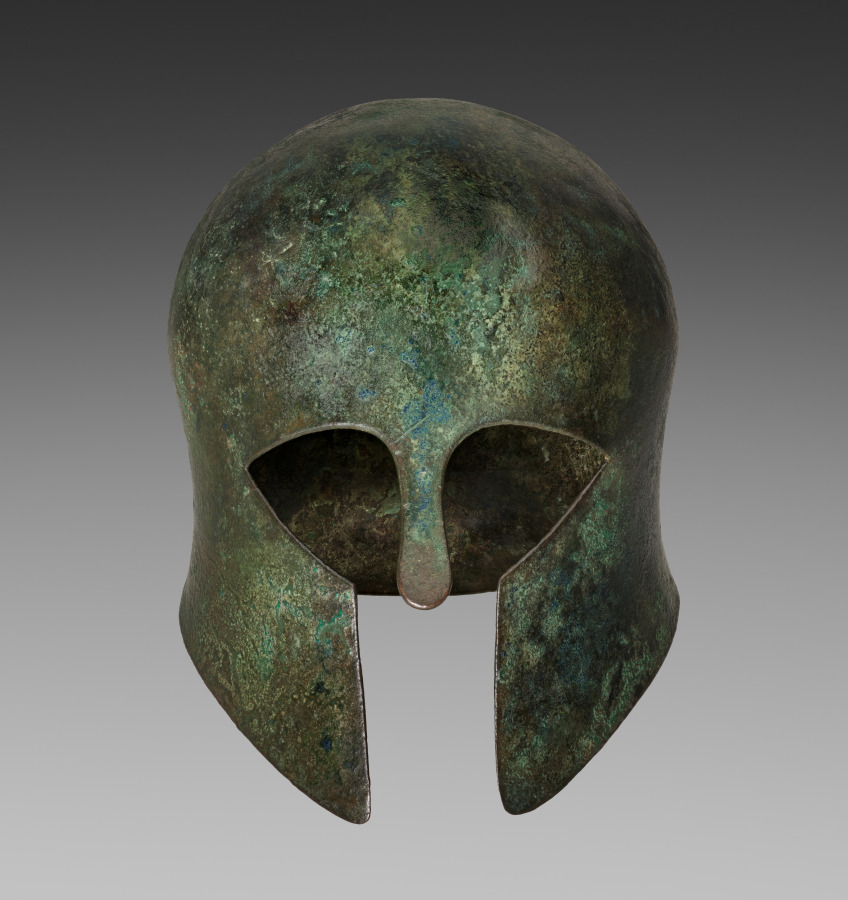
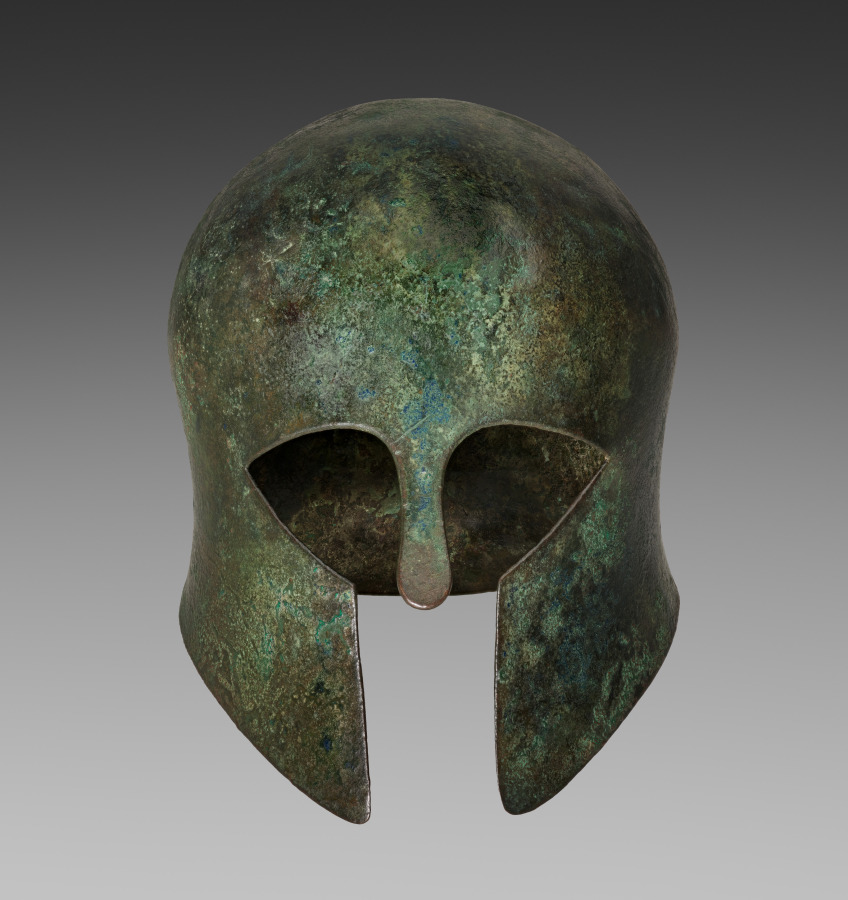
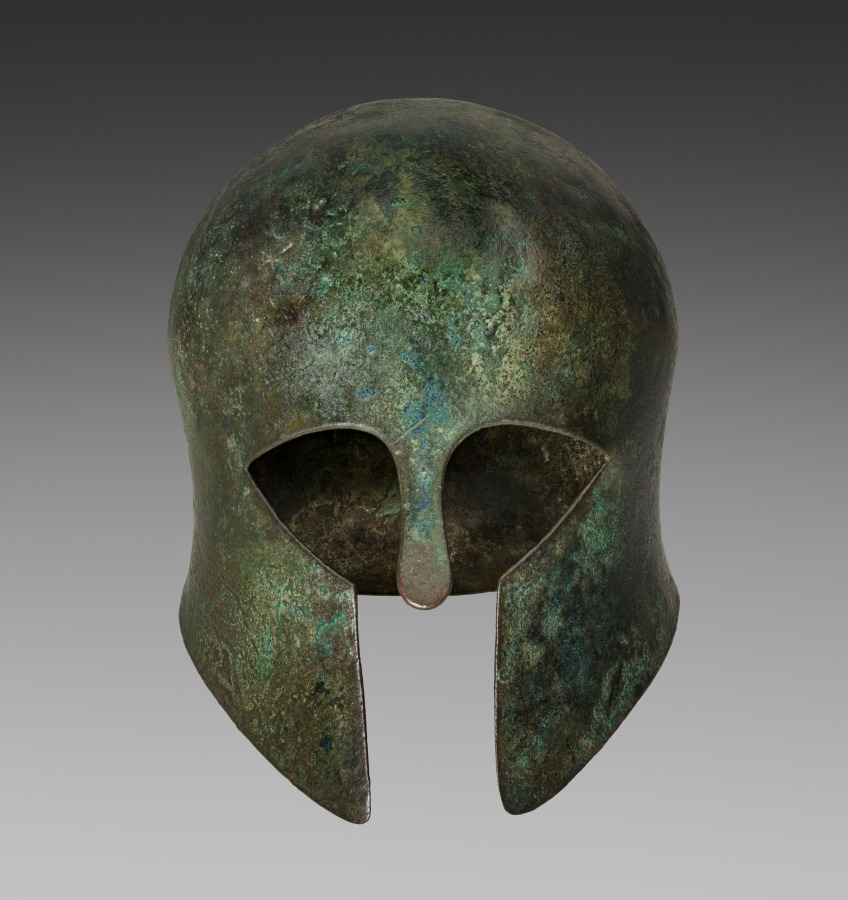
Front view of the helmet showing the nose guard, eye openings and cheekpieces. Cleveland Open Access, CC0.
| Artist | Unidentified Greek bronzeworker (workshop not recorded) |
|---|---|
| Date | c. 625-550 BCE |
| Medium | Bronze |
| Dimensions | Overall 23.5 x 19.5 x 27 cm (9 1/4 x 7 11/16 x 10 5/8 in.) |
| Where it is now | The Cleveland Museum of Art, Dr. John and Helen Collis Family Gallery of Greek Art (102B)last confirmed |
| Inventory number | 2024.63 |
| Attribution | UnknownCleveland records no maker or workshop and lists no artist. Full note |
| Object type | Arms and armour |
| Period | Greek, Archaic |
| Cases | Has a provenance gap |
| Inscriptions | None recorded |
| Owners on record | 13 links10 documented, 3 unknown |
| Sources | 12 cited |
About this record Last verified · 12 sources cited · Change log
On this page 10 sections
ContentsClose
A Greek bronze helmet of the Corinthian type, c. 625-550 BCE, acquired by the Cleveland Museum of Art in 2024 with the Leonard C. Hanna Jr. Fund. It is the museum's first Corinthian helmet. Its find spot is unknown; its documented history begins with a Sotheby's sale in London on 10 April 1934, when it was listed as property of Capt. E.G. Spencer-Churchill.
Cleveland's chain runs through William Permain, a 1967 Christie's sale, Jean-Claude Ciancimino, Seward Kennedy, the dealer Rupert Wace, George Lois and Michael Barrington to his heirs, with several gaps and no published prices. Cleveland also holds a different, doubted Corinthian helmet (1926.54), which this record does not describe.
Provenance
Each link is graded. Documented: a cited source supports it. Disputed: the identification is argued but not established. Unknown: no owner for that span, and the gap is not smoothed into a narrative. The grades in the glossary.
- c. 625-550 BCE - By 1934Unknownunknown
- By 1934 - 1934Captain E.G. Spencer-Churchill, M.C. (1876-1964)documented
Offered at Sotheby's, London, 10 April 1934, lot 105, as property of Capt. E.G. Spencer-Churchill, per Cleveland. The sale catalogue has not been seen; no price was found.1378
- 1934 - ?William Permaindocumented
Bought at the 1934 sale, per Cleveland. The end date is unrecorded and nothing further about Permain was found.1
- ? - 1967Unknown (Christie's: Property of a Lady)unknown
No source links the 1967 consignor to Permain or his family.1
- 1967 - 1967Property of a Ladydocumented
Christie's, London, 6 June 1967, lot 171, per Cleveland; consignor anonymous, price not found.1
- 1967 - ?Jean-Claude Cianciminodocumented
Bought at the 1967 sale, per Cleveland. Nothing further about him was found.1
- ? - early 1970sUnknownunknown
How the helmet passed from Ciancimino to Seward Kennedy is not recorded.1
- Early 1970s - 2000Seward Kennedydocumented
Dates as given by Cleveland, with an approximate start.1
- 2000 - 2002Rupert Wace (dealer)documented
Sold by Seward Kennedy to Rupert Wace in 2000, per Cleveland. No price published.1
- 2002 - 2013George Loisdocumented
Cleveland records the purchase from Wace and a later sale back to Wace. The identity of this George Lois is not established by any source; the art director of that name collected ancient art but no source ties him to the helmet.111
- 2014 - 2022Michael Barringtondocumented
Purchased from Rupert Wace, per Cleveland. No price published.1
- 2022 - 2024Barrington heirsdocumented
By descent, per Cleveland.1
- 2024 - presentThe Cleveland Museum of Artdocumented
Accessioned 9 September 2024; announced 26 September 2024; Leonard C. Hanna Jr. Fund. Price not disclosed.1234
Prices realised
| Date | Sale | Estimate | Result | Note |
|---|---|---|---|---|
| 10 April 1934 | Sotheby's, London | not found | Hammer not found With premium not found GBP (presumed; not stated) | Lot 105, per Cleveland. No result was located. |
| 6 June 1967 | Christie's, London | not found | Hammer not found With premium not found GBP (presumed; not stated) | Lot 171, property of a lady, per Cleveland. No result was located. |
Hammer is the price at which the bidding stopped; with premium adds the fee the house charges the buyer on top. Hammer price and buyer's premium in the glossary.
Technical evidence
| Attribution note | Cleveland records no maker or workshop and lists no artist. The catalogue gives the culture as Greek; the 2024 press release gives the attribution as Greece or Italy, and the Corinthian name is a type label, not a place of manufacture. |
|---|---|
| Object | Corinthian helmet; Cleveland Museum of Art, accession 2024.63, Leonard C. Hanna Jr. Fund12 |
| Date | c. 625-550 BCE12 |
| Origin | Greek; the 2024 press release gives the attribution as Greece or Italy13 |
| Medium | Bronze12 |
| Dimensions | Overall 23.5 x 19.5 x 27 cm (open-access data); the press release gives a height of 23.4 cm23 |
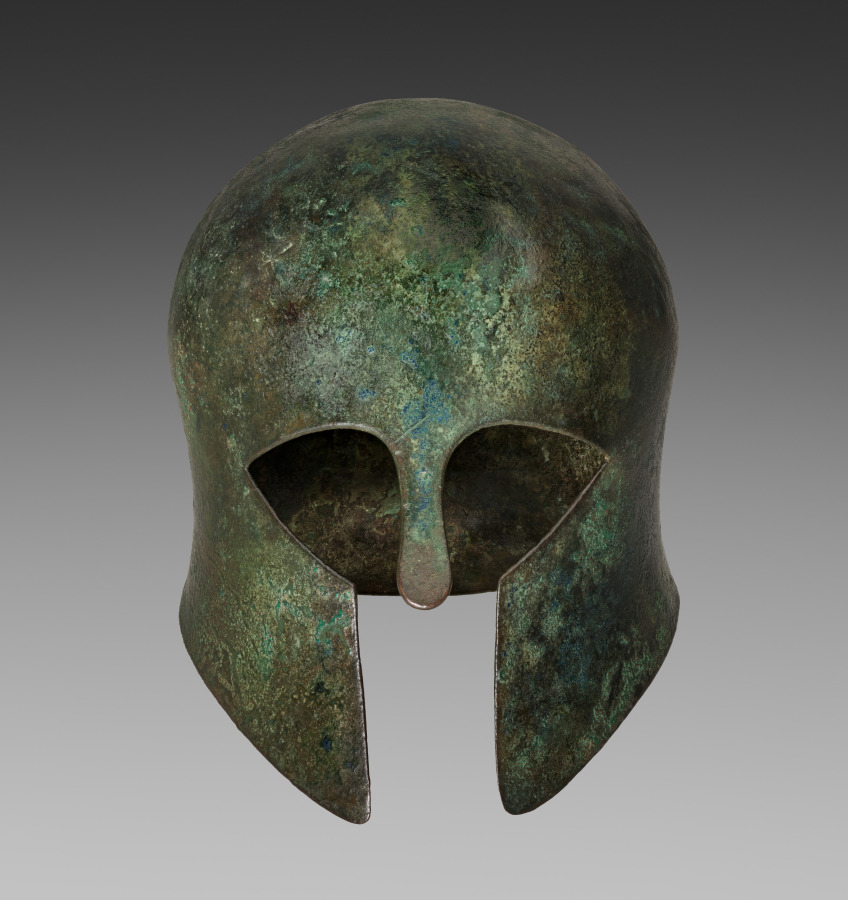
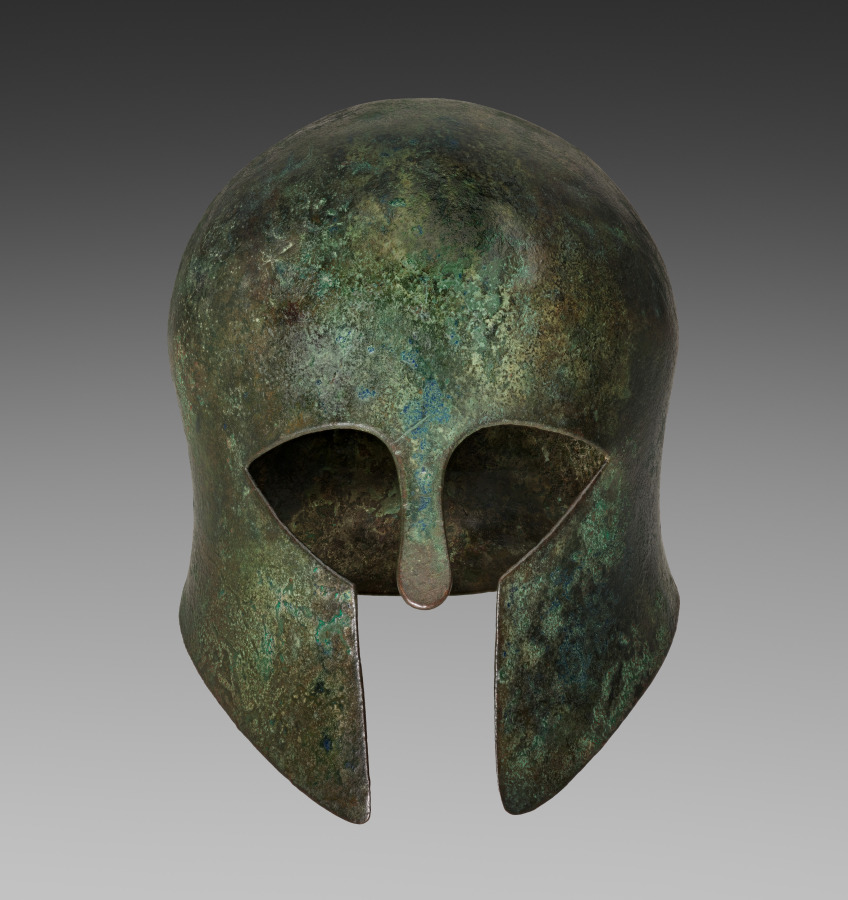
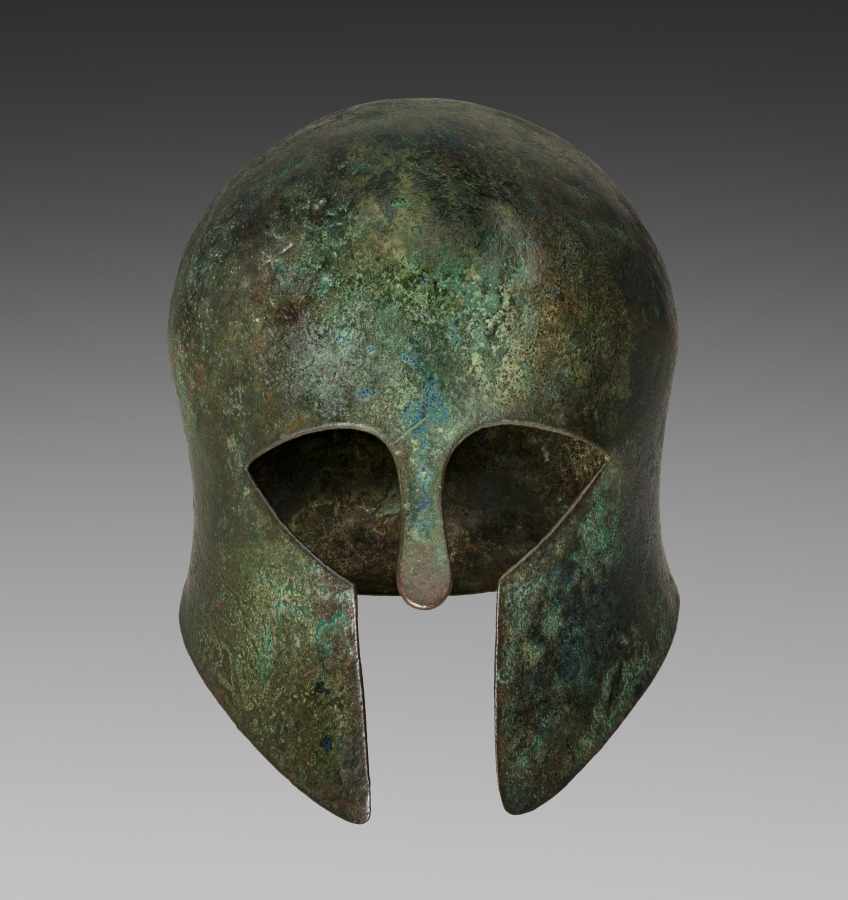
| Construction | Single piece of bronze with a domed top, large nose guard, rounded triangular eyeholes, large cheekpieces and flaring rear neck guard; probably first cast and then hammered into its final shape13 |
| Condition | Described by Cleveland as remarkably well preserved; a small hole above the rear neckline, now repaired, may reflect a fatal blow1 |
| Inscriptions | None recorded in Cleveland's open-access data2 |
| Find spot | Unknown13 |
| Location | Dr. John and Helen Collis Family Gallery of Greek Art, gallery 102B13 |
| Citations in the catalogue | Kukahn 1936; Kunze 1961 (Olympiabericht VII); Hixenbaugh and Waldman 2019, cat. C269; Cleveland Art members magazine 20251 |
| Licence | Images and data CC0 (Cleveland Open Access)2 |
Images
The record in full
Chapter 1A single sheet of bronze made into a face
The Cleveland Museum of Art catalogues this as a Corinthian helmet of c.
The Cleveland Museum of Art catalogues this as a Corinthian helmet of c. 625-550 BCE, bronze, 23.5 by 19.5 by 27 cm overall in the museum's open-access data (the 2024 press release gives a height of 23.4 cm, a rounding difference between two Cleveland texts). Cleveland's release describes a helmet made from a single piece of bronze, with a domed top, a large nose guard, rounded triangular eyeholes, large cheekpieces and a flaring rear neck guard, and calls the type the most familiar and long-lived of ancient Greek helmets.
The museum's catalogue entry adds that the helmet was probably first cast and then hammered into its final shape, and it calls the piece remarkably well preserved. The surface in the museum's photographs is a mottled green and brown patina with no visible crest fittings; Cleveland notes that helmets of this type are often shown in ancient art with crests of horsehair or other organic material that no longer survive.
Chapter 2What it was for
The Corinthian helmet was hoplite equipment, worn by warriors who fought with spears and shields in the shoulder-to-shoulder phalanx.
The Corinthian helmet was hoplite equipment, worn by warriors who fought with spears and shields in the shoulder-to-shoulder phalanx. Cleveland's text states the cost of that design plainly: maximum protection, at the price of limited vision, hearing and movement. The face is covered nearly entirely, which is why the type reads in ancient art as a mask as much as a helmet.
The type also had a life outside battle. Josho Brouwers, writing in Ancient World Magazine, records that Corinthian helmets from about 700 BCE have been found at Olympia and that large numbers were dedicated at sanctuaries through the Archaic period, which he reads as a sign the type was seen as generally Greek rather than specifically Corinthian. Whether this helmet was ever dedicated is not known: its find spot is not recorded, and Cleveland's catalogue gives no inscription.
Cleveland's collection page carries one specific note from the museum: a small hole above the rear neckline, now repaired, may reflect a fatal blow. This is the museum's own cautious wording and nothing in the sources consulted tests it. It is the only trace of a use history on the object itself that Cleveland publishes.
Chapter 3Why it is called Corinthian and why that is a loose label
Herodotus (4.180) uses the word Corinthian for a helmet once, in his account of the Auses of Libya, who dressed a maiden in a Greek panoply with a Corinthian helmet for a festival of Athena.
Herodotus (4.180) uses the word Corinthian for a helmet once, in his account of the Auses of Libya, who dressed a maiden in a Greek panoply with a Corinthian helmet for a festival of Athena. Anthony Snodgrass, in Arms and Armour of the Greeks (1967, p. 51), wrote that there are good reasons for thinking this was the helmet the Greeks called Corinthian, and he gave the type a span of roughly 720 to 450 BCE. Brouwers disputes the reasoning and points out that the helmet was made and dedicated throughout the Greek world.
Cleveland's own text takes the same line: the type is known as Corinthian yet was produced far beyond the city of Corinth. The press release goes further and gives the attribution as Greece or Italy, so the museum does not claim a place of manufacture. The standard study of how Corinthian helmets developed is Hermann Kunze, Korinthische Helme, in the Olympia excavation reports (Olympiabericht VII, 1961); Cleveland cites that volume (p. 85, note 29) in the helmet's bibliography. Which note 29 refers to this helmet, and what it says, has not been checked here.
Chapter 4The first appearance: Sotheby's, London, 10 April 1934
Cleveland's provenance begins with Captain E.G.
Cleveland's provenance begins with Captain E.G. Spencer-Churchill, M.C. (1876-1964), recorded as owner by 1934, and a sale at Sotheby's, London, on 10 April 1934, lot 105. The press release gives the same fact in the museum's own words: the find spot is unknown, and the documented modern history begins with a 1934 Sotheby's London sale where the helmet was listed as property of Capt. E.G. Spencer-Churchill. The museum cites the Sotheby's lot, not the catalogue page, and the sale catalogue has not been seen for this record.
Spencer-Churchill inherited the Northwick Park estate in Gloucestershire in 1912 from his grandmother, the widow of the 3rd Baron Northwick, and he was a first cousin of Sir Winston Churchill. He is best known for the Northwick Rescues, over-painted pictures he cleaned and restored, and he also collected more than 100 Greek vases, according to the DiCamillo Companion. After his death in 1964 the contents of the house were dispersed, with a large Christie's sale in 1965. This helmet is not part of that 1965 dispersal: on Cleveland's chain it had left his hands in 1934, thirty years before his death. Nothing in the sources consulted says when or from whom he acquired it.
Chapter 5Permain, the anonymous lady and the 1967 sale
Cleveland records William Permain as the buyer at the 1934 sale and gives his dates as 1934 to an unknown year.
Cleveland records William Permain as the buyer at the 1934 sale and gives his dates as 1934 to an unknown year. Nothing else about him was found. The next entry is a sale at Christie's, London, on 6 June 1967, lot 171, where the helmet is described as the property of a lady, so the consignor was anonymous at the time and remains so. Cleveland does not say whether the lady was Permain, a relative or an unrelated owner, and the chain should not be read as continuous across these thirty-three years.
The buyer in 1967 is recorded as Jean-Claude Ciancimino. No source consulted says who he was. Hammer price, premium, estimate and currency for both the 1934 and the 1967 sales are unrecorded in the Cleveland entry, and no published price was found; the two auction entries below therefore carry no figures.
Chapter 6Kennedy, Wace, Lois, Barrington
From the early 1970s to 2000 the helmet is recorded with Seward Kennedy.
From the early 1970s to 2000 the helmet is recorded with Seward Kennedy. How it passed from Ciancimino to Kennedy is not recorded. In 2000 Kennedy sold it to the London dealer Rupert Wace, and Cleveland's chain then runs: George Lois, 2002 to 2013, who bought it from Wace and later sold it back to Wace; then Michael Barrington, 2014 to 2022, who bought it from Wace; then the Barrington heirs, by descent, 2022 to 2024.
One caution. Cleveland names George Lois without a description. The American art director George Lois (1931-2022) is documented as a collector of ancient art on his own website, which lists a Greek amphora among his pieces, but no source consulted ties him to this helmet and the identification is not made here. Wace appears throughout only as dealer and seller on Cleveland's own list; nothing in the sources consulted alleges any impropriety by any party in this chain.
Chapter 7Acquisition in 2024
The Cleveland Museum of Art announced the helmet on 26 September 2024 with two other acquisitions, Dorothea Tanning's Musical Chairs (2024.68) and Rembrandt's Saint Francis Beneath a Tree Praying...
The Cleveland Museum of Art announced the helmet on 26 September 2024 with two other acquisitions, Dorothea Tanning's Musical Chairs (2024.68) and Rembrandt's Saint Francis Beneath a Tree Praying (2024.64), all funded by the Leonard C. Hanna Jr. Fund. The release calls it the museum's first Corinthian helmet and announced display in the Dr. John and Helen Collis Family Gallery of Greek Art (102B) later in 2024. The open-access data records the accession date as 9 September 2024. The price was not disclosed in the release or in the ArtDaily reprint of 3 October 2024.
A different object must not be confused with it. Cleveland also holds a Corinthian helmet with silver inlay, accession 1926.54, a gift of J.H. Wade, dated by the museum 500-475 BCE or modern, whose antiquity scholars have doubted. The 2024 helmet is a separate, plain bronze, and nothing said of one applies to the other.
Chapter 8Ownership history and legal status
No ownership-history or due-diligence statement is published on Cleveland's page, in the press release or in the ArtDaily item, and the museum's page lists no exhibitions.
No ownership-history or due-diligence statement is published on Cleveland's page, in the press release or in the ArtDaily item, and the museum's page lists no exhibitions. A search for an entry in the AAMD Object Registry returned nothing for 2024.63, though the registry does carry another Cleveland helmet (2023.106, a Chalcidian helmet), whose entry states the museum's reliance on a documented exception to the AAMD guidelines. That is a statement about a different object and is cited here only to show the registry was checked; the absence of an entry for 2024.63 may reflect search coverage and is not a finding about the object.
What can be said is that the chain Cleveland publishes is documented from at least 1934, that it passes through two public auctions and a London dealer, and that it ends in a family sale by descent. The find spot is unknown, so the period before the 1934 sale cannot be tested against Greek or Italian export or ownership law, and no source consulted states that any state has claimed the helmet.
Chapter 9Where it stands in the literature
Cleveland lists four citations: Erich Kukahn, Der Griechische Helm (Marburg, 1936), p.
Cleveland lists four citations: Erich Kukahn, Der Griechische Helm (Marburg, 1936), p. 70, no. 58; Kunze, Olympiabericht VII (Berlin, 1961), p. 85, note 29; R. Hixenbaugh and A. Waldman, Ancient Greek Helmets (New York, 2019), p. 376, cat. C269; and the Cleveland Art members magazine for 2025, back cover. Hixenbaugh's catalogue, illustrated by Alexander Valdman (the museum spells the name Waldman), covers 2,153 helmets across 738 pages according to the publisher's page. A helmet already in Kukahn in 1936 was therefore known to scholarship two years after the Sotheby's sale and before the Christie's sale of 1967, which is the only evidence in the sources of a recorded life for the helmet between those dates.
The artist
The Corinthian helmet type and its makers
No maker is recorded for this helmet and none can be named. The record therefore treats the type as the subject: a bronze helmet form worn by hoplites and dedicated at sanctuaries, made in many places by workshops whose names are almost never known.
Related works
| Work | Relation | Where it is |
|---|---|---|
| Corinthian Helmet (1926.54) Unidentified | Different object, same museum; not to be confused with 2024.63 Bronze with silver inlay, gift of J.H. Wade; dated 500-475 BCE or modern, and its antiquity has been doubted by scholars. | Cleveland Museum of Art |
| Chalcidian Helmet (2023.106) Unidentified | Other Greek helmet in the Cleveland collection, acquired a year earlier Tinned bronze, c. 350-200 BCE, Black Sea region; its AAMD Object Registry entry sets out a provenance and a due-diligence exception. | Cleveland Museum of Art |
| Kukahn, Der Griechische Helm, no. 58 Erich Kukahn | Earliest publication of this helmet cited by Cleveland Page 70. | Marburg, 1936 |
Open questions
- Where was the helmet found? Cleveland records the find spot as unknown, and the chain begins only in 1934.
- How and when did Captain Spencer-Churchill acquire it, and was it ever in the Northwick Park collection proper?
- Who was William Permain, and who was the lady who consigned it at Christie's in 1967? Is there a link between them?
- Who was Jean-Claude Ciancimino, and how did the helmet pass from him to Seward Kennedy in the early 1970s?
- Is the George Lois on Cleveland's list the American art director of that name? No source consulted says so.
- Why did Lois sell the helmet back to Rupert Wace in 2013, and what price did Barrington pay in 2014 and Cleveland in 2024? None is published.
- Does Kunze's Olympiabericht VII note 29 describe this helmet, and what does it say about its form and date?
Questions about this object
What is Corinthian Helmet?
Corinthian Helmet is an arms and armour, dated c. 625-550 BCE. Medium: Bronze.
Who made Corinthian Helmet, and is the attribution settled?
The attribution to Unidentified Greek bronzeworker (workshop not recorded) is recorded here as unknown. Cleveland records no maker or workshop and lists no artist. The catalogue gives the culture as Greek; the 2024 press release gives the attribution as Greece or Italy, and the Corinthian name is a type label, not a place of manufacture.
Where is Corinthian Helmet now?
The Cleveland Museum of Art, Dr. John and Helen Collis Family Gallery of Greek Art (102B). Inventory number 2024.63. Last confirmed 20 November 2026. Purchased 2024, Leonard C. Hanna Jr. Fund; accessioned 9 September 2024.
What has Corinthian Helmet sold for?
Hammer not found; with premium, not found. Sotheby's, London, 1934-04-10.
What is still unknown about Corinthian Helmet?
Where was the helmet found? Cleveland records the find spot as unknown, and the chain begins only in 1934.
Sources
- 1The Cleveland Museum of Art, collection page and print page, Corinthian Helmet, 2024.63 (description, provenance, citations). clevelandart.org/art/...
- 2Cleveland Museum of Art Open Access API, record 680766 (accession 2024.63; dimensions, accession date, images, CC0). openaccess-api.clevelandart.org/api/...
- 3The Cleveland Museum of Art, press release, 26 September 2024, 'The Cleveland Museum of Art Acquires Ancient Greek Bronze Helmet and Works by Dorothea Tanning and Rembrandt van Rijn'. clevelandart.org/about/...
- 4ArtDaily, 'The Cleveland Museum of Art acquires Ancient Greek helmet and works by Dorothea Tanning and Rembrandt' (reprint of the announcement; no price). artdaily.com/news/...
- 5The Cleveland Museum of Art, Corinthian Helmet, 1926.54 (a different object, for version safety). clevelandart.org/art/...
- 6Wikipedia, 'Northwick Park, Gloucestershire' (: Spencer-Churchill's inheritance in 1912, the 1965 Christie's sale). en.wikipedia.org/wiki/...
- 7The DiCamillo Companion, 'Northwick Park' (Spencer-Churchill, the Northwick Rescues, over 100 Greek vases, death in 1964). thedicamillo.com/house/...
- 8House and Heritage, 'Northwick Park' (Spencer-Churchill 1876-1964, the 1965 dispersal). houseandheritage.org/2019/...
- 9Josho Brouwers, 'How Corinthian is the Corinthian helmet?', Ancient World Magazine, 2016 (typology, Snodgrass, Herodotus, Olympia). ancientworldmagazine.com/articles/...
- 10Hixenbaugh Ancient Art, 'Ancient Greek Helmets: A Complete Guide and Catalog' (publisher page: 2,153 helmets, 738 pages). hixenbaugh.net/ancient-greek-helmets-a-complete-guide-and...
- 11George Lois, 'The Art of Collecting Art' (personal website; mentions a Greek amphora and an ancient-world collection; does not mention a helmet). georgelois.com/12.-the-art-of-collecting-art.html
- 12AAMD Object Registry entry for Cleveland Chalcidian Helmet 2023.106 (a different object; cited for registry practice only). cms.aamd.org/node/...
Last verified · Published
Change log
20 November 2026 - Record created at the house standard: researched narrative, technical evidence, maker dossier, graded provenance chain, prices with hammer and premium separated, related works, open questions and sources.