Priam's Treasure
Unknown Early Bronze Age Anatolian goldsmiths (Troy II) · c. 2550-2250 BC (Early Bronze Age, Troy II period)
Last verified 15 September 2026 · 25 sources cited · Change log
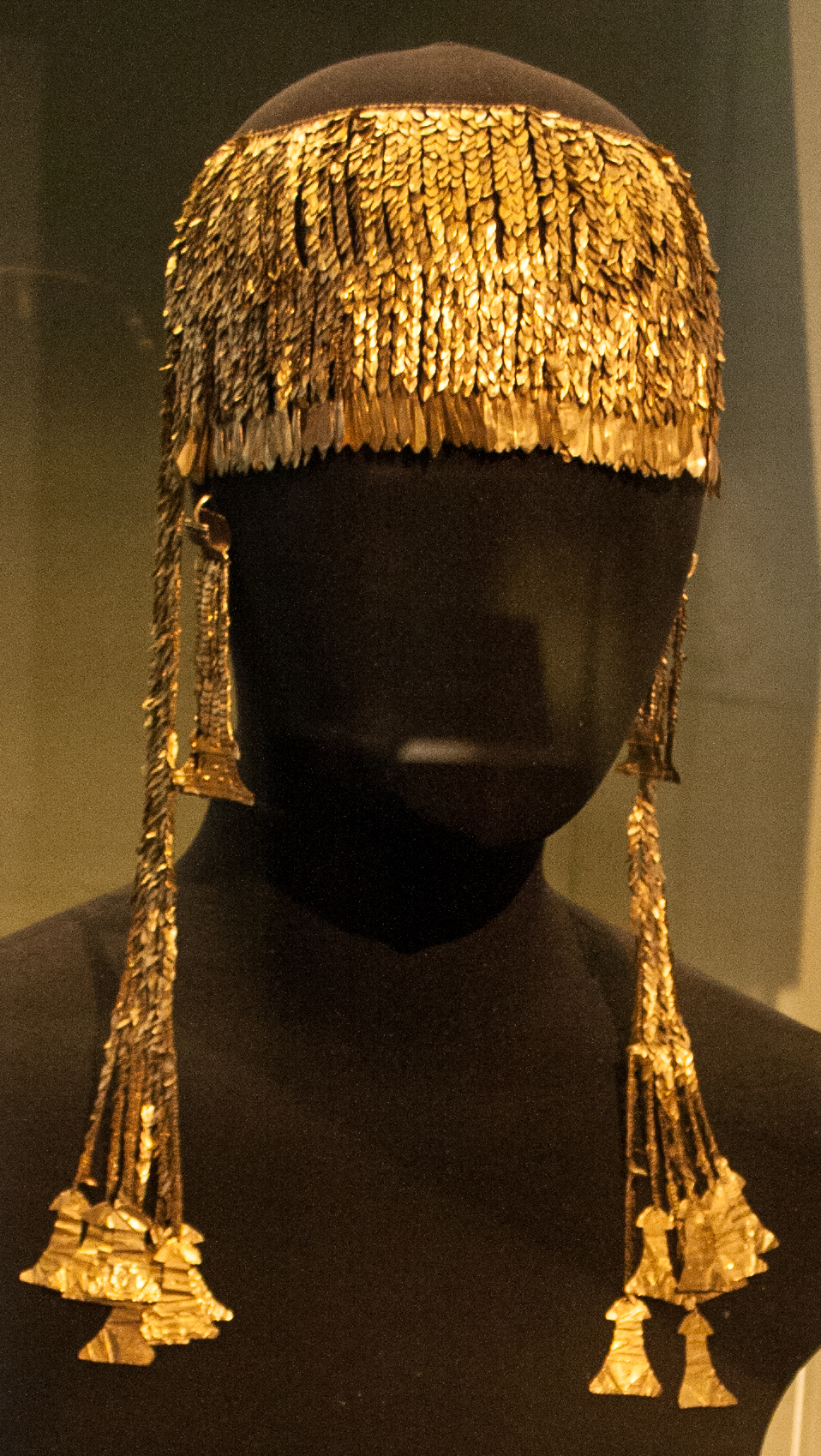
The larger of the two great gold diadems, shown as it would have been worn: a broad band of thousands of tiny linked and stamped gold leaves with long pendant chains falling past both temples, ending in leaf-shaped and pyramidal drops. Schliemann called this pair 'the Jewels of Helen'. Pushkin State Museum of Fine Arts, Moscow, inventory 10 and 13-14.
| Artist | Unknown Early Bronze Age Anatolian goldsmiths (Troy II) |
|---|---|
| Date | c. 2550-2250 BC (Early Bronze Age, Troy II period) |
| Medium | Gold, electrum, silver, copper or bronze and polished stone; a mixed hoard of jewelry, vessels, weapons and tools rather than a single medium |
| Dimensions | Not a single object. Schliemann's own itemised list totals roughly 8,750 small gold rings, buttons and beads plus several dozen larger gold, silver, electrum, copper and stone pieces (see Technical). A commonly repeated figure of about 259-260 catalogued items describes the whole Schliemann Trojan collection held at the Pushkin across several separate find-groups excavated between 1871 and 1890, not Treasure A alone; this record is about Treasure A specifically and the two counts should not be conflated. |
| Where it is now | Pushkin State Museum of Fine Arts, Moscow, Russia, permanent exhibition (Room 7 / the Schliemann collection), Held across multiple accession numbers in the Pushkin's collection of classical antiquities; individual pieces illustrated in this record carry inventory numbers 5 (the sauceboat), 10 and 13-14 (the larger diadem) and 11-12 and 15-16 (the smaller diadem and its earrings). Declared property of the Russian Federation under the 1998 federal law on cultural valuables displaced to the USSR during the Second World War.last confirmed 15 September 2026 |
| Attribution | unknownNo maker's name survives for any part of the hoard; Early Bronze Age Trojan metalworkers left no signed, inscribed or otherwise personally attributable work. Full note |
| Object type | Antiquity |
| Period | Early Bronze Age Anatolia (Troy II); excavated in 1873 in the Ottoman Empire, on the site of Hisarlik in what is now Turkey |
| Cases | Has a provenance gap · Seized, looted or confiscated |
| Inscriptions | None. The objects carry no writing of any kind. Their identification as 'Priam's Treasure' is a modern name given by the excavator, not an ancient inscription or find-label. |
- Where it is now
- Pushkin State Museum of Fine Arts, Moscow, Russia, permanent exhibition (Room 7 / the Schliemann collection)last confirmed 15 September 2026
- Attribution
- unknown
- Provenance
- 11 links11 documented
- Sources
- 25 cited
- Last verified
- 15 September 2026Change log
On this page 9 sections
In 1873 Heinrich Schliemann announced he had found the treasure of Homer's King Priam in a trench at Hisarlik, the mound in northwest Turkey he was excavating as the site of Troy. He smuggled the hoard out of Ottoman territory in violation of his own excavation permit, was sued by the Ottoman government, and eventually gave the treasure to Berlin in 1881. The Red Army seized it from a Berlin bunker in 1945; the Soviet Union then denied for almost fifty years that it still existed. It resurfaced at Moscow's Pushkin State Museum of Fine Arts in 1993-1994 and has been on public display there since 1996.
Archaeology has since corrected Schliemann on nearly everything except the discovery itself. The hoard is now dated to the Early Bronze Age, roughly a thousand years before any Troy a historical Priam could have ruled, and Schliemann's own account of how he found it, including the well-known story of his wife Sophia smuggling the gold out in her shawl, is documented to be substantially invented. What remains real is the object: two great gold diadems, a gold sauceboat, a gold bottle, earrings, bracelets and a set of ceremonial stone axes, still called Priam's Treasure, still in Moscow, still claimed by Germany and Turkey, and still, by Russian federal law, not going anywhere.
No sale has ever taken place. The dispute over this object is not a market dispute; it is a three-way argument between Germany, Turkey and Russia about who owns something none of them made and one of them stole.
Provenance
Each link is graded. Documented: a cited source supports it. Disputed: the identification is argued but not established. Unknown: no owner for that span, and the gap is not smoothed into a narrative. The grades in the glossary.
- c. 2550-2250 BC -Unknown inhabitants of the walled Early Bronze Age settlement of Troy IIdocumented
Established by stratigraphic excavation (Blegen, 1930s) and by radiocarbon-based chronology for the Troy II to Troy III transition, independent of Schliemann's own account. No individual owner or maker is named or nameable.117
- 2550-2250 BC - 1873Buried at Hisarlik, undisturbeddocumented
The hoard's burial context and the roughly four-thousand-year interval before excavation are documented by the archaeological sequence; nothing is known of any activity at the findspot in the interim beyond the later Bronze and Iron Age, classical and Ottoman-era occupation and reoccupation of the Hisarlik mound generally.1
- 1873 - 1873Heinrich Schliemanndocumented
Excavated during Schliemann's third campaign at Hisarlik. The exact date is disputed (see Open questions) and David Traill has argued the find itself may be a composite of material recovered at different times; the fact of excavation by Schliemann's team in 1873 is not in dispute.12111213
- 1873 - 1873Heinrich Schliemanndocumented
Moved out of the Troad by boat to Athens without going through the Ottoman customs and division process required by Schliemann's excavation permit. The permit entitled the Ottoman government to a share of finds; none of Treasure A was surrendered under it.111
- 1873 - 1875Heinrich Schliemann, under Ottoman legal claimdocumented
The Ottoman government revoked Schliemann's excavation permit and sued him for its share of the find. Schliemann paid compensation, reported as an initial 10,000 French gold francs later settled at 50,000 francs, and retained the treasure; his permission to excavate at Hisarlik was later restored.1810
- 1874 - 1874Offered to, and declined by, the Kingdom of Greecedocumented
Schliemann offered the treasure to the Greek state, together with an offer to build and endow a museum for it in Athens at his own expense. The Greek Prime Minister and the Minister of Ecclesiastical Affairs and Public Education told parliament in 1874 that Greece would not accept it.21
- 1881 - 1939Royal Museums of Berlin (Museum fur Volkerkunde, later Museum fur Vor- und Fruhgeschichte)documented
Schliemann donated the treasure to Germany in 1881 on condition it be kept in its entirety in Berlin. Displayed publicly for some sixty years until galleries closed with the approach of war.14
- 1939 - 1945Museum fur Vor- und Fruhgeschichte, Berlin, in wartime storagedocumented
Moved into a Reichsbank vault and then, by 1941, into an anti-aircraft flak tower at the Berlin Zoo for safekeeping under Director Wilhelm Unverzagt.184
- 1945 - 1945Soviet Committee for Arts Affairs / Red Army trophy brigadedocumented
Unverzagt surrendered himself and a full inventory to Soviet forces at the flak tower around 1 May 1945 rather than risk uncontrolled looting. Andrei Belokopytov's trophy brigade moved the crates to eastern Berlin; Igor Grabar's Bureau of Experts selected the collection for removal; a special flight carried it from Tempelhof to Vnukovo airport on 30 June 1945.78
- 1945 - 1993Soviet state, undisclosed location (later confirmed as the Pushkin State Museum of Fine Arts)documented
Placed in a restricted 'Special Collection' from 1949 with no right of publication or exhibition. Soviet authorities denied knowledge of the treasure's survival throughout the Cold War; the Pushkin Museum's holding of it was not publicly acknowledged until 1993.18
- 1993 - presentPushkin State Museum of Fine Arts, Moscowdocumented
Researcher access from December 1994; first public exhibition opened 15 April 1996. Germany asserts restitution rights under a 1990 bilateral treaty on the return of displaced cultural property; Turkey asserts a claim as country of origin; Russia's 1998 federal law declares the material Russian state property and forecloses ordinary restitution claims. The dispute is unresolved and the object remains in Moscow.156715
Technical evidence
| Attribution note | No maker's name survives for any part of the hoard; Early Bronze Age Trojan metalworkers left no signed, inscribed or otherwise personally attributable work. The hoard's link to the Homeric King Priam is Heinrich Schliemann's own naming, announced in 1873, not an ancient identification. Stratigraphic work by Carl Blegen in the 1930s and radiocarbon-based chronology since have placed the Troy II layer in which the hoard was found at roughly 2550-2250 BC, about a thousand years before the Late Bronze Age Troy VI/VIIa layers archaeologists now associate with a possible historical basis for the Trojan War. The 'Priam' attribution is accordingly treated by archaeologists as a settled misattribution, not a live dispute. |
|---|---|
| Composition (Treasure A, as itemised by Schliemann) | Two gold diadems; six gold bracelets; two gold goblets; one wrought gold bottle; two gold cups; one electrum cup; gold basket earrings and roughly 8,750 gold rings, buttons and other small objects; a copper shield, cauldron and vase; thirteen copper lance heads; fourteen copper axes; seven copper daggers; six silver knife blades; three silver vases and additional silver goblets; and a group of red terracotta goblets. Weapons and vessels of stone, including ceremonial hammer-axes, are catalogued alongside the metalwork.1 |
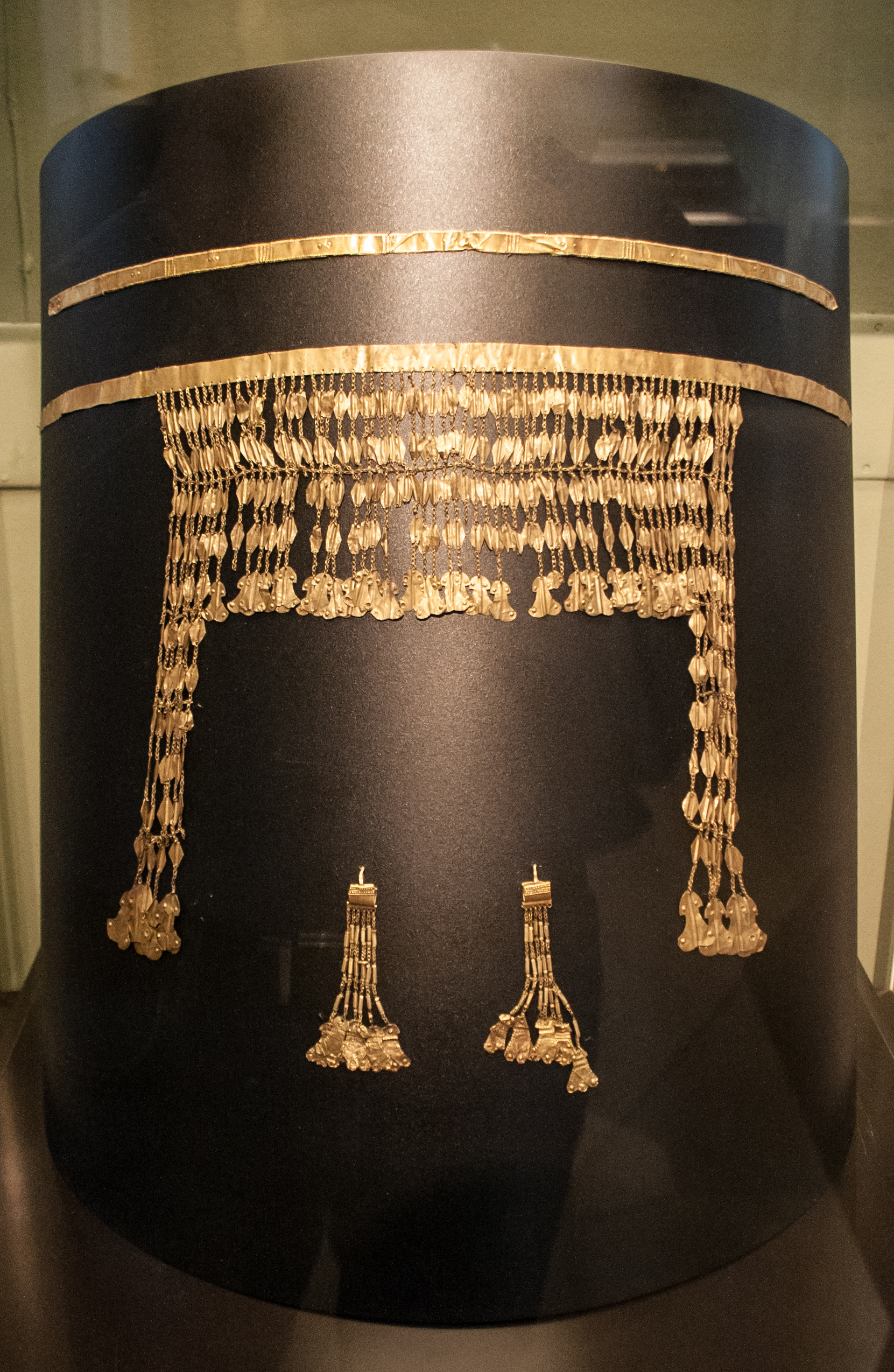
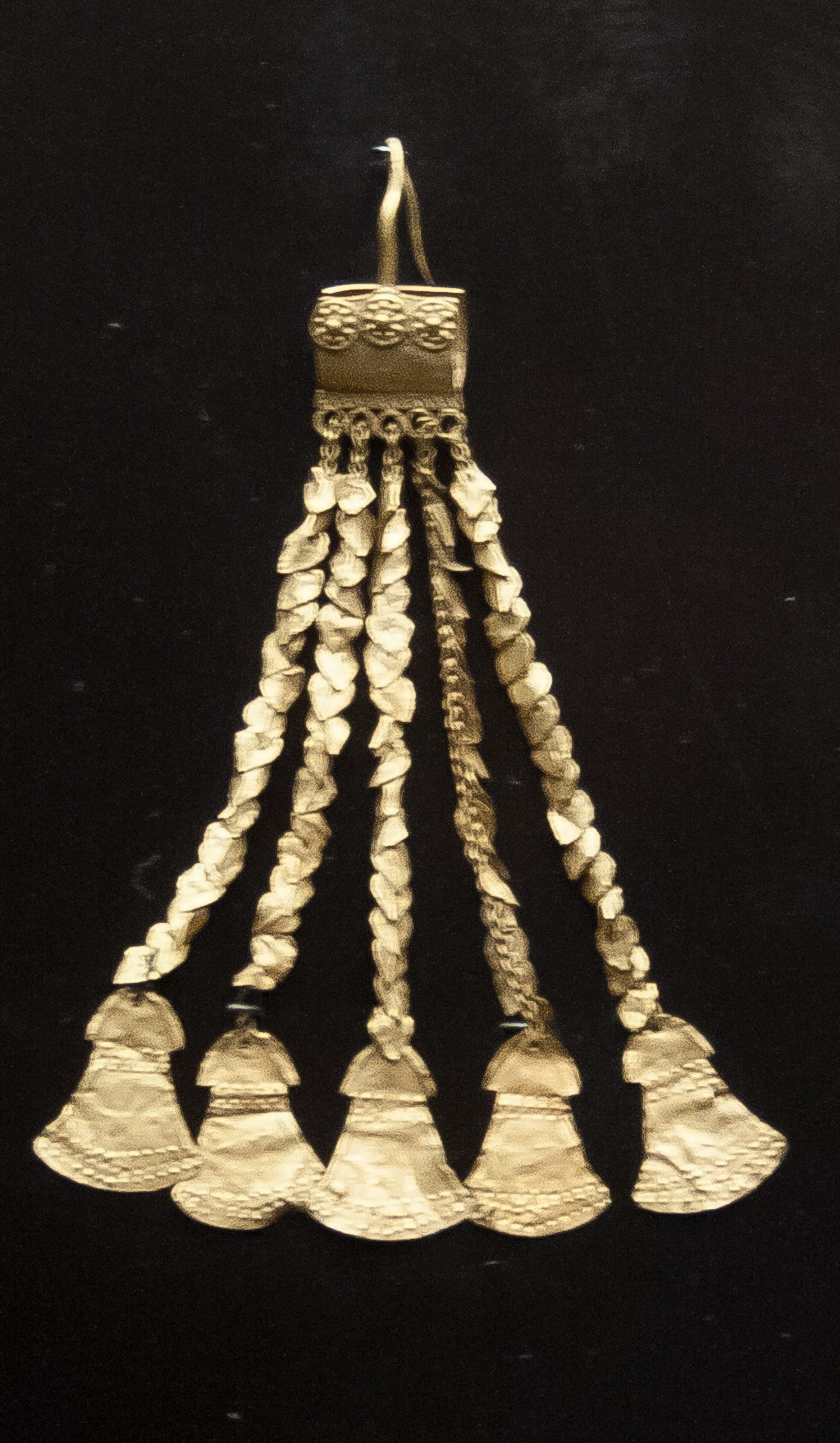
| The two diadems | The larger diadem is a broad band built from many rows of tiny stamped gold leaves, with long pendant chains of linked gold rings ending in leaf-shaped and pyramidal drops, worn so the chains fell past both temples; Schliemann's nickname for the pair was 'the Jewels of Helen'. The smaller diadem is a comparable but less extensive band, displayed with a matching pair of basket-shaped gold earrings. Pushkin State Museum of Fine Arts inventory 10 and 13-14 (larger diadem) and 11-12 and 15-16 (smaller diadem and earrings).11819 |
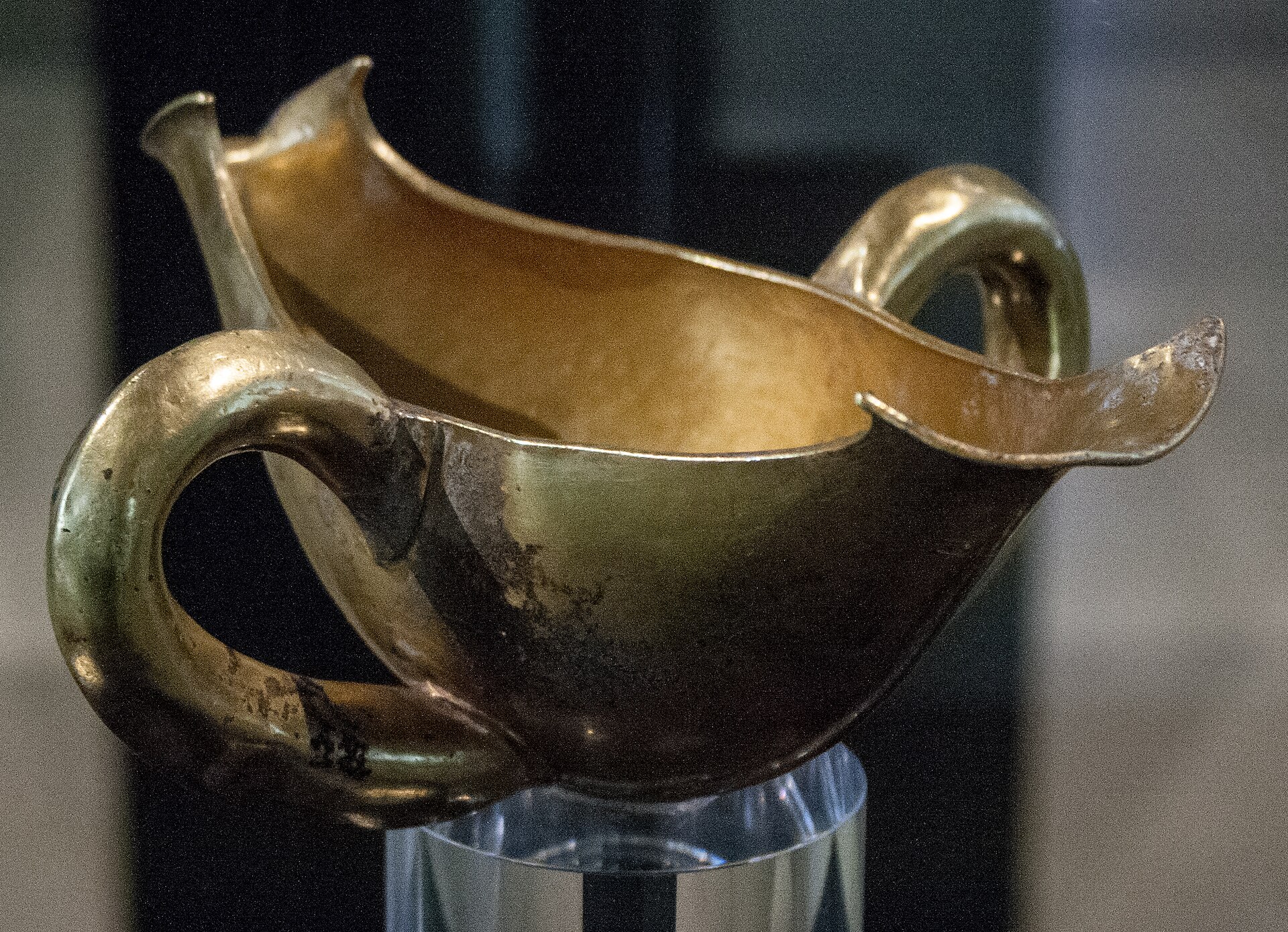
| The gold sauceboat | A boat-shaped vessel with a pinched spout at each end and two curved handles, raised from a single sheet of gold rather than cast. One of the most frequently reproduced single objects from the hoard. Pushkin inventory 5.120 |
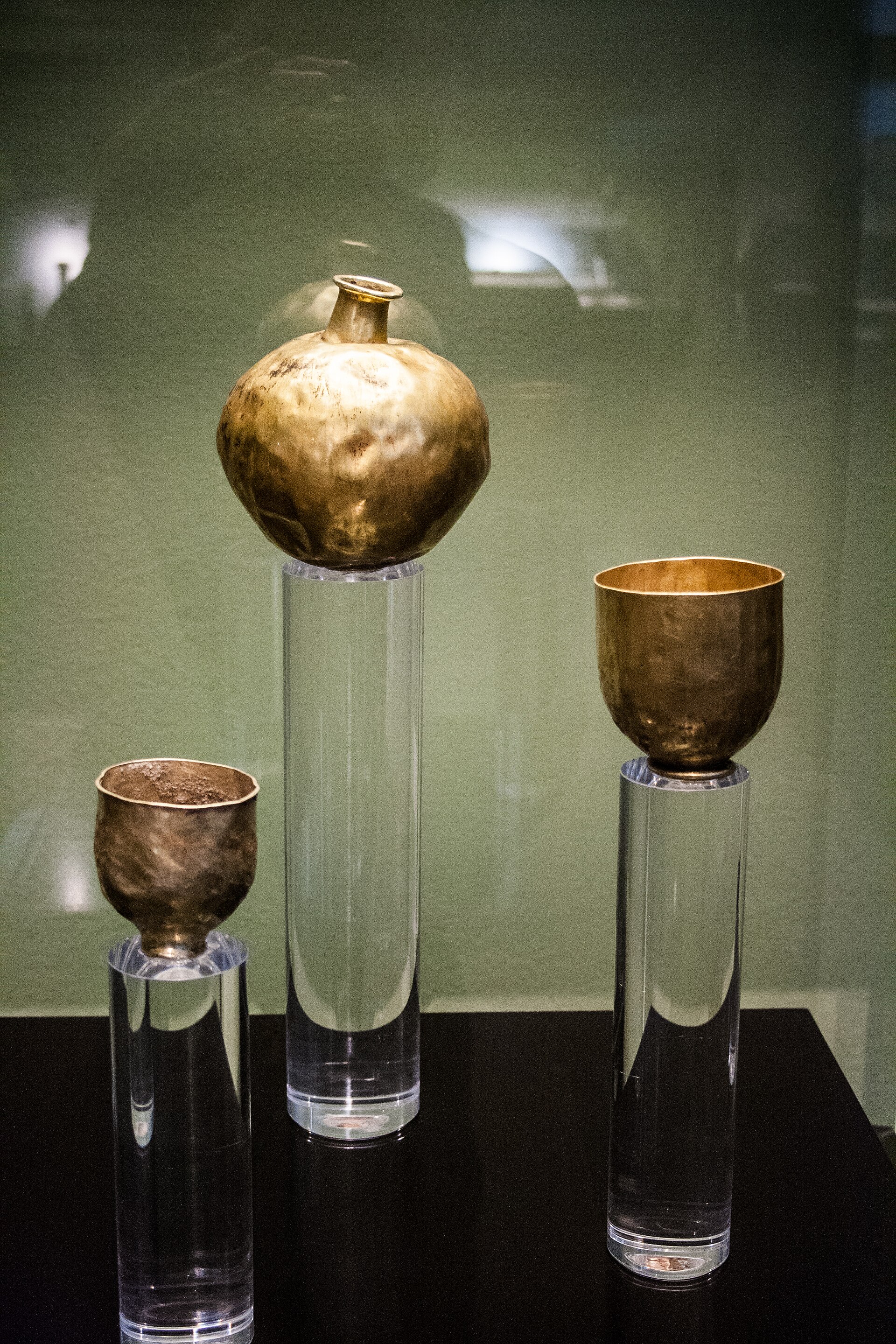
| Gold bottle and goblets | A spherical wrought gold bottle with a narrow neck, displayed with two gold or gold-washed goblets of differing size. Distinct from the sauceboat and separately catalogued.1 |
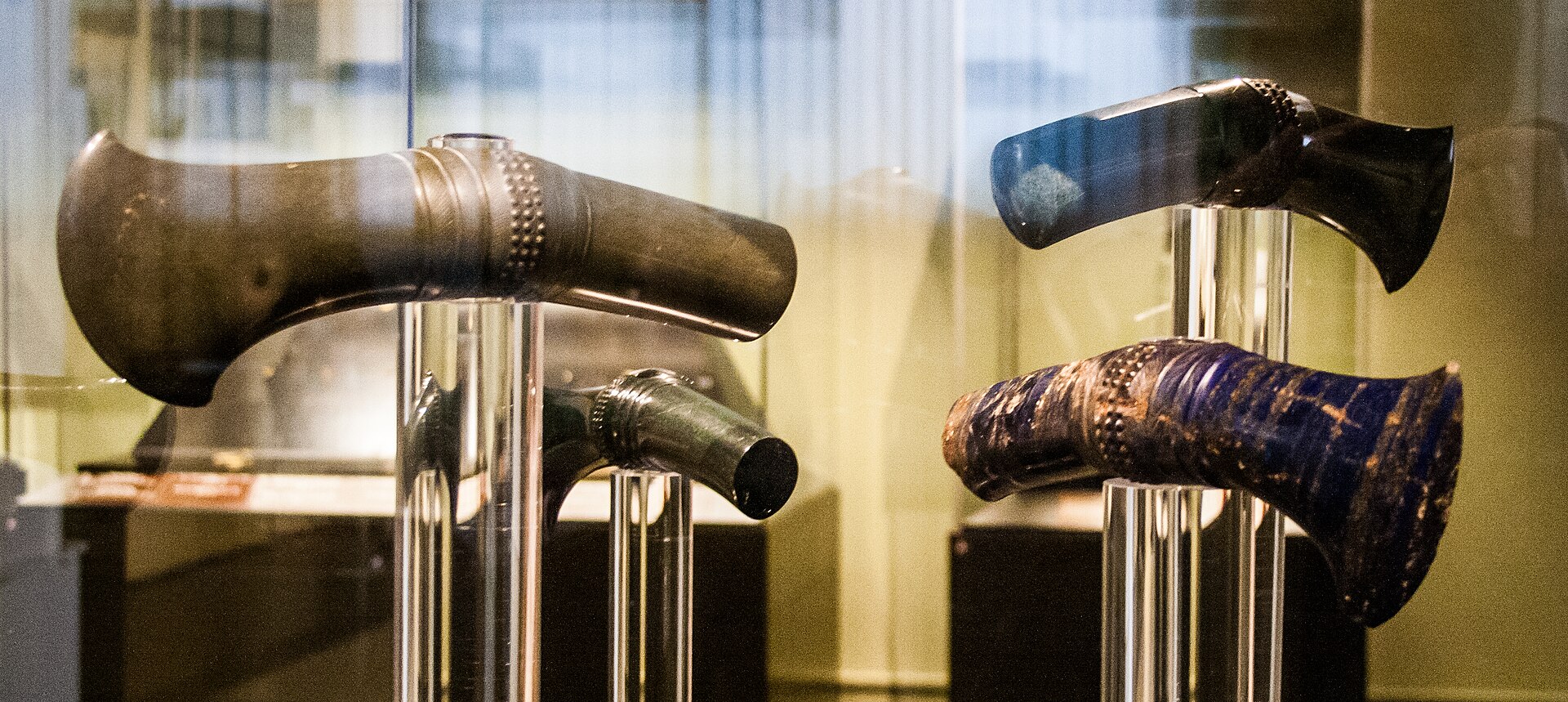
| Weapons, tools and stone objects | Copper lance heads, axes and daggers, a copper shield and cauldron, silver knife blades and a set of ceremonial stone hammer-axes; two of the four surviving hammer-axes retain visible traces of gilding. Objects of this hammer-axe type circulated across Europe and the Caucasus from the Early Bronze Age into the second millennium BC and are not unique to Troy.1 |
| Cataloguing and the two different counts | Two figures circulate for this material and are not interchangeable. Schliemann's own itemised list for Treasure A totals roughly 8,750 small gold pieces plus the named larger objects. A separate, frequently quoted figure of about 259 to 260 catalogued items describes the entire Schliemann Trojan collection at the Pushkin, drawn from several distinct find-groups excavated across Schliemann's 1871-1890 campaigns, not Treasure A in isolation. Reporting on the collection routinely conflates the two.178 |
| Gold provenance and production (context, not confirmed on these specific pieces) | A 2022 portable laser-ablation study by Ernst Pernicka (Curt-Engelhorn Center for Archaeometry, Mannheim) and Barbara Horejs (Austrian Archaeological Institute, Vienna) tested 61 Early Bronze Age gold objects, including 26 described as from Troy, held at the National Archaeological Museum in Athens, alongside comparable gold from Poliochni and the Royal Cemetery at Ur. Trace-element signatures (zinc, palladium, platinum consistent with river-panned gold) matched closely across all three sites and pointed toward standardised, workshop-scale production rather than one-off craftsmanship, with a Georgian Bronze Age source the closest geological match identified. This record cannot confirm whether the specific objects tested were drawn from Treasure A or from other Schliemann-era Trojan gold retained in Greece.23 |
| Current division between Moscow and Berlin | The gold, electrum and silver jewelry and vessels that make up Treasure A proper are held and displayed in Moscow. A smaller residue of Schliemann's wider Trojan finds, described by Germany's own ambassador in 1996 as 'the majority, albeit less glittering part, of the collection', chiefly ceramics, stone tools and utilitarian metal objects, remained in Berlin through the war and is held today by the Museum fur Vor- und Fruhgeschichte, which displays full-scale replicas of the Moscow gold alongside its own genuine holdings.46 |
Images
The record in full
A hoard, not an object
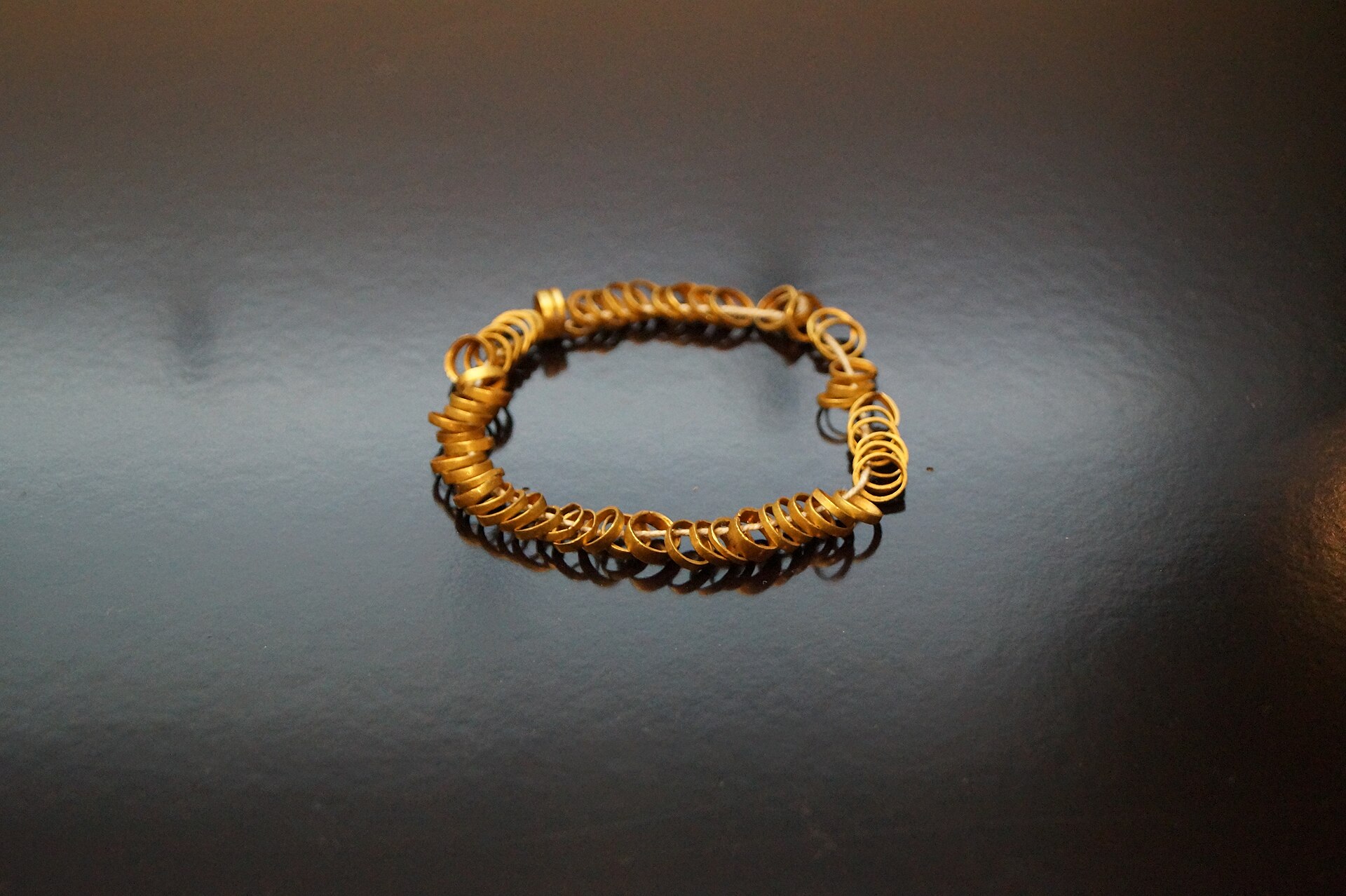
Priam's Treasure is not a single artifact but a hoard: a group of gold, silver, electrum, copper and stone objects that Heinrich Schliemann reported finding together in a single trench at Hisarlik in 1873, and which he catalogued and published as one find. The centrepieces are two elaborate gold diadems, made of thousands of tiny stamped and linked gold pieces strung into a broad headband with long pendant chains falling past the temples, which Schliemann nicknamed the 'Jewels of Helen'. Around them sit a gold sauceboat with two curved handles raised from a single sheet of gold, a wrought gold bottle, gold and electrum cups, gold bracelets and basket-shaped earrings, thousands of small gold rings and beads and a separate group of copper weapons and tools: a shield, a cauldron, lance heads, axes and daggers, alongside silver vessels and knife blades and a set of ceremonial stone hammer-axes, two of which still carry traces of gilding.
Schliemann's own itemised list, as transmitted through his publications, comes to roughly 8,750 small gold rings, buttons and other small objects on top of the named larger pieces. That count belongs to Treasure A alone. It should not be confused with the wider figure of around 259 to 260 catalogued items sometimes quoted for the whole Schliemann Trojan collection held at the Pushkin today, which spans several separate find-groups Schliemann excavated at Hisarlik between 1871 and 1890, not this hoard by itself. This record is about Treasure A specifically.
Schliemann before Troy
Schliemann did not arrive at archaeology as a scholar. He was born on 6 January 1822 in Neubukow, in Mecklenburg-Schwerin, and spent his twenties and thirties as a grocer's apprentice, a cabin boy, a bookkeeper and then a merchant, working first in Amsterdam and then in St Petersburg. He made a substantial fortune as an indigo dye trader and, by his own account, as a military supplies contractor during the Crimean War. He also claimed to have gone to California during the gold rush in 1851, to have opened a bank in Sacramento that bought and resold over a million dollars of gold dust in six months, and to have witnessed the San Francisco fire of that year first-hand.
Independent research, again chiefly by David Traill, has found that several of these claims do not hold up: Schliemann's own account of the San Francisco fire matches the wording of a report already published in the Sacramento Daily Journal rather than an eyewitness description, and his claimed 1851 acquisition of American citizenship is contradicted by immigration records showing he did not naturalise until 1869. He married twice: first Ekaterina Petrovna Lyschin in Russia in 1852, a marriage that ended in divorce in 1869, and then, the same year, the much younger Sophia Engastromenos in Athens, whom he is said to have selected partly for her fluency in ancient Greek. By the time he retired from business at 36 to pursue his conviction that Homer's poems described real places, he had both the capital and, it turned out, the taste for self-promotion that the Troy excavations would make famous.
The 1873 discovery, and what Schliemann said about it
Schliemann's published account places the discovery at the end of May 1873, during his third excavation season at Hisarlik, in a deep trench near what he took to be the remains of a palace. He wrote that he called a break in the digging the moment he glimpsed gold, and that it would have been impossible to get the treasure out of the trench and away from his Ottoman-appointed overseers without the help of his wife Sophia, who he said packed the pieces into her shawl while he distracted the workmen.
The story made Schliemann famous and has been repeated in popular accounts of the find ever since. It is also, in the specific detail of Sophia's involvement, false, and Schliemann later admitted as much. At the time of the discovery Sophia was not at Hisarlik at all; she had returned to Athens after the sudden death of her father and was not present for the find. Scholars who have gone through Schliemann's diaries, correspondence and successive published versions of the story, principally David Traill, have documented that Schliemann rewrote the circumstances of the discovery more than once and that even the date is not settled: his own papers weigh variously toward 27 May, 31 May, 7 June and 15 June 1873 in different tellings, and no single account can be taken at face value without independent corroboration.
Whose Troy: Frank Calvert and the credit Schliemann kept
Schliemann did not identify Hisarlik as the site of Troy on his own. Frank Calvert, a British consular official and amateur archaeologist who had lived and dug in the Troad for fifteen years before Schliemann arrived, had already proposed the identification, bought part of the mound to secure access to it, and conducted preliminary excavations there. When the two men met in 1868, it was Calvert who persuaded a still-sceptical Schliemann that Hisarlik, not the rival candidate site of Pinarbasi, was ancient Troy, and Calvert who gave Schliemann the introduction and local standing to dig on land Calvert's family partly owned.
Schliemann had the money Calvert lacked, and once he began excavating he took sole public credit for identifying and finding Troy, without acknowledging Calvert's prior work or his role in directing Schliemann to the site. The historian Susan Heuck Allen's 1999 study of the two men's correspondence and unpublished papers restored Calvert's role to the record in detail. It is a labour-and-credit story as much as an archaeological one: the site was found by a resident scholar without capital, and the fame went to the visitor who had it.
Smuggled out, and sued for it
Schliemann's excavation permit from the Ottoman government entitled the Ottoman state to a share of whatever he found. He did not offer Priam's Treasure for that division. Instead he had the hoard moved out of the Troad by boat, in stages, to Athens, avoiding the Ottoman customs and excavation-inspection process entirely; Traill's study of the shipping arrangements traces a plan, discussed in Schliemann's own letters from as early as August 1872, to take cargo on clandestinely at a bay several kilometres from the dig rather than through the official channel to Istanbul.
Ottoman officials learned what had happened only after the fact, reportedly once photographs of Sophia wearing pieces of the jewelry began to circulate. The government revoked Schliemann's permission to excavate further at Hisarlik and sued him for its share of the find. Schliemann was required to pay compensation, reported as an initial fine of 10,000 French gold francs later settled at 50,000 francs, in exchange for which the Ottoman state dropped its claim to a physical share of the treasure and, eventually, restored his permission to dig. A number of pieces from Schliemann's wider excavations, distinct from Treasure A, did go to the Ottoman imperial collection in Istanbul under the terms of later, better-supervised campaigns; Treasure A itself did not return to Ottoman or Turkish hands at any point.
Named for a king he never dug up
Schliemann called the hoard Priam's Treasure because he believed the layer he was digging in was the palace of Homer's Troy, destroyed in the war described in the Iliad, and that gold found near what he took for the palace walls must belong to its royal household. Both halves of that reasoning have not held up. Carl Blegen's American excavations at Hisarlik in the 1930s established a clear stratigraphic sequence of nine major settlement phases, and placed the treasure firmly in Troy II, a walled Early Bronze Age town that was violently destroyed centuries before the Late Bronze Age. Manfred Korfmann's later excavations, running from 1988 until his death in 2005, extended and refined that sequence and argued that Troy VI, or possibly the early phase of Troy VII, is the more plausible candidate for a historical war of the kind Homer describes.
Radiocarbon-based chronology puts the Troy II to Troy III transition at approximately 2267 BC. The Late Bronze Age layers associated with a possible Trojan War fall roughly a thousand years later. Priam's Treasure, in other words, predates any king who could plausibly be called Priam by a margin longer than the distance from the Norman Conquest to the present day. This is not a live scholarly argument; it is the settled correction that gives the object its most quoted piece of trivia and its most misleading name.
Whose gold, and where it came from
Anatolia has no gold sources of its own comparable to the alluvial deposits later worked in northern Greece and Bulgaria, and none at all are known in the southern Aegean, which makes the sheer quantity of gold in the Troy II hoards a trade-and-technology question as much as a treasure question. A 2022 archaeometric study led by Ernst Pernicka, of the Curt-Engelhorn Center for Archaeometry in Mannheim and the University of Tubingen's Troy project, together with Barbara Horejs of the Austrian Archaeological Institute in Vienna, used a portable laser-ablation sampling device to test 61 Early Bronze Age gold objects dated to roughly 2500-2000 BC, including 26 gold objects described as being from Troy, alongside comparable material from Poliochni on Lemnos and the Royal Cemetery at Ur in Mesopotamia. The Troy objects sampled for this study were tested at the National Archaeological Museum in Athens; the sources consulted for this record do not establish whether any of the specific pieces sampled came from Treasure A itself as opposed to other Schliemann-era Trojan gold that remained in Greek hands, and this record does not claim that the Moscow-held diadems and sauceboat have themselves been through this analysis.
The finding, regardless of which specific pieces were tested, is nonetheless directly relevant to how the wider hoard should be understood: gold from Troy, Poliochni and Ur showed closely matching trace-element signatures, including zinc, palladium and platinum consistent with river-panned gold, and near-identical composition across supposedly separate pieces suggested standardised, workshop-scale production rather than one-off craftsmanship, with Georgian Bronze Age gold sources the closest geological match found so far. Pernicka and Horejs's team read this as evidence of a long-distance exchange network reaching from the Aegean toward the Caucasus and, by inference from associated seals, weights and stone types found across the same sites, potentially as far as the Indus Valley. The gold in a case like this one is not simply valuable; it is evidence of contact.
What the hoard was for
The instinctive reading of a hoard like this one, encouraged by Schliemann's own dramatic account, is that it was elite portable wealth, hidden in haste as an attacking army closed in. Christoph Bachhuber's 2009 study of the Troy treasure deposits in Anatolian Studies argues that this picture does not survive close attention to where and how the Troy II and III hoards were actually deposited relative to the citadel's architecture. Rather than a single panicked concealment, Bachhuber reads the pattern of deposits, including Treasure A, as two distinct and, in his phrase, 'inherently destabilising' strategies pursued by rival factions of the Troy II elite in a period of internal crisis, tied specifically to the destruction and abandonment of the settlement's central megaron complex rather than to an external siege.
This is an argued position, not a settled one, and it revises rather than replaces Schliemann's instinct that the gold represents concentrated wealth at the top of Trojan society. What it changes is the story behind the burial: not a household grabbing its valuables as the walls fell, but something closer to a political act taken by people who had reason to distrust each other as much as any outside enemy. No contract, inscription or written record survives to confirm either reading, and none ever will; this is archaeological argument from context, graded here as argued rather than documented, and Bachhuber's account is not universally adopted by every specialist who has written on Troy II.
How the treasure became famous
Fame, in this case, was manufactured within a year of the find. Schliemann financed and published Trojanische Alterthumer: Bericht uber die Ausgrabungen in Troja himself in Leipzig in 1874, simultaneously in a French edition, and paired it with a companion volume, Atlas trojanischer Alterthumer, containing 217 large photographic plates in a print run of only four to five hundred copies. An English edition, Troy and Its Remains, followed in London in 1875, using engravings made from the same photographic plates. Every widely reproduced image of the treasure in circulation before its Berlin display, and much of the popular language used to describe it since, including the 'Jewels of Helen' nickname, traces back to this one self-financed publishing effort rather than to any independent scholarly description.
A study published in Hesperia in 2024, titled 'New Light on "Priam's Treasure"', re-examines Schliemann's contemporaneous drawings and draft descriptions of the hoard against the objects themselves; the sources consulted for this record could not access the article's full text, and its specific conclusions are not represented here, but its existence is noted for a future editor with institutional journal access to check against the composite-hoard question raised elsewhere in this record.
One find, or several: the composite question
A separate and less settled question concerns whether Treasure A was ever a single, simultaneous find at all. David Traill argued in a series of studies, most fully in a 2000 paper in Anatolian Studies titled bluntly 'Priam's Treasure: Clearly a Composite', that the hoard as published is not one discovery of 31 May 1873 but an assembly: a core group of pieces genuinely found together on that date, combined by Schliemann in his own subsequent presentation with other gold objects recovered earlier in the same or a prior season, and marketed to the public and to scholars as a single dramatic discovery because that made a better story than an accumulation over months.
Traill's case rests on inconsistencies between Schliemann's field diary, his later published narrative and correspondence with his own publisher, rather than on the metalwork itself; nothing in the physical objects proves or disproves a single find-date. The question therefore remains open in the scholarly literature, argued most forcefully by Traill and not universally accepted by every specialist who has written on Schliemann, and it is treated here as argued rather than settled.
Berlin, 1881 to 1939
After the Ottoman settlement, Schliemann kept the treasure in his own possession for several years, exhibiting parts of it in London and elsewhere, before donating the whole collection to Germany in 1881. His stated condition was that it be kept in its entirety, without dispersal, in the German capital, as a gift to the German people. The Royal Museums of Berlin accepted the gift and displayed it first at the Museum fur Volkerkunde and later, from the 1920s, at the Museum fur Vor- und Fruhgeschichte, then housed on Museum Island. It remained on public view in Berlin for some sixty years, an unbroken run that ended only with the approach of war.
A bunker, a surrender and a flight to Moscow
As Allied bombing of Berlin intensified, the museum's most valuable holdings, including the Trojan gold, were moved first into a Reichsbank vault and then, by 1941, into one of the anti-aircraft flak towers built near the Berlin Zoo, structures solid enough to double as air-raid shelters and treasure stores. Wilhelm Unverzagt, director of the Museum fur Vor- und Fruhgeschichte, remained with the collection through the Battle of Berlin and chose, as Soviet forces closed in on the tower on 1 May 1945, to surrender himself and a full inventory of its contents rather than risk the crates being looted piecemeal by individual soldiers.
Unverzagt handed the three crates containing the Trojan material to the Soviet Committee for Arts Affairs. Andrei Belokopytov, who headed one of the Red Army's dedicated 'trophy brigades' tasked with identifying and removing art and cultural property from occupied Germany, documented the transfer of the flak-tower holdings to eastern Berlin, via temporary storage at Treskow Castle and a municipal abattoir building, ahead of shipment to the Soviet Union. Igor Grabar, the Soviet painter and art historian who chaired the Committee's Bureau of Experts, placed the Trojan gold on the list of objects selected for removal to Moscow. On 30 June 1945 a special flight left Tempelhof Airport carrying the treasure to Vnukovo airport outside Moscow.
Fifty years of official denial
Once in Moscow the treasure was placed, in 1949, into what Soviet museum administration called a Special Collection, held under conditions that explicitly denied any right of publication or public exhibition. For the following four and a half decades the Soviet government's public position, maintained through the Cold War and past the fall of the Berlin Wall, was that it did not know what had happened to Priam's Treasure. In the West this was widely read as an admission by omission that the collection had likely been destroyed, lost in transit, or broken up and dispersed; competing rumours placed it in a Leningrad vault, in private American hands, or melted down.
None of that was true. The treasure had been in a museum storeroom in Moscow the entire time. Access for outside researchers began only in December 1994, when specialists were finally permitted to examine the collection in detail; the Pushkin Museum's public acknowledgement that it held the material came slightly earlier, in 1993.
1996: the treasure resurfaces
The Pushkin State Museum of Fine Arts opened its exhibition 'The Treasures of Troy from the Excavations of Heinrich Schliemann' on 15 April 1996, after its own conservation staff had cleaned and stabilised the collection. It was the first time any part of the hoard had been shown to the public anywhere since Berlin's galleries closed in 1939, a gap of fifty-seven years. Irina Antonova, the Pushkin's long-serving director, told reporters at the opening that the exhibition should have happened long before: 'This show should have been opened long ago.'
Germany's government protested the opening. Ambassador Ernst Jorg von Studnitz said publicly that unveiling the collection should have been done in cooperation with Germany, which he noted still held 'the majority, albeit less glittering part, of the collection' in its own hands, a reference to the ceramics, stone tools and utilitarian metal objects from Schliemann's wider Trojan finds that had stayed in Berlin through the war. Turkey also requested the treasure's return at the time of the 1996 opening. Neither request changed anything about where the gold stayed.
Three claims, and Germany's own complicated title
The dispute since 1996 runs in three directions and has not moved. Germany argues it is the rightful post-war owner, on the basis of Schliemann's 1881 gift, and points to a 1990 treaty between the reunified Germany and the Soviet Union that committed both sides to the mutual return of cultural property displaced by the war. Russia's answer is that the treasure functions as partial, uncatalogued compensation for the vastly larger volume of art and cultural property the Nazi occupation destroyed or looted from Soviet museums, and that the 1990 treaty's return provisions were never made to work in practice by either side. In 1998 the Russian State Duma passed, and President Boris Yeltsin signed, the Federal Law on Cultural Valuables Displaced to the USSR as a Result of the Second World War and Located on the Territory of the Russian Federation, which declares such transferred property to be Russian state property and forecloses ordinary restitution claims against it.
Turkey's position sits outside the German-Russian argument entirely, and is in some ways the harder one to answer: the material was removed from Ottoman territory in the first place in violation of the excavation agreement that produced it, so Germany's own claim of title, however sincerely asserted, sits on top of an original wrong that predates the Soviet seizure by seventy-two years. The Turkish archaeologist Rustem Aslan, drawing on Ottoman state archives largely unused in earlier, German- and English-language accounts of the case, has argued that artifacts of this kind belong at their findspot, where they were excavated, rather than in any of the more than forty museums worldwide that hold pieces from Schliemann's various Trojan campaigns. A separate, older episode belongs in the same file: in 1874 the Greek government was offered the entire treasure, together with Schliemann's offer to build and endow a museum for it at his own expense, and the Greek Prime Minister and Minister of Ecclesiastical Affairs and Public Education told parliament that Greece would decline. Greece has no live legal claim today, but the refusal is part of the object's documented history of near-misses.
What is happening to it now
Priam's Treasure remains on permanent public display at the Pushkin State Museum of Fine Arts in Moscow, in the gallery generally referred to as Room 7. Berlin's Museum fur Vor- und Fruhgeschichte, now housed in the restored Neues Museum on Museum Island, displays full-scale replicas of the principal Treasure A pieces alongside the smaller, genuine portion of Schliemann's non-gold Trojan finds that never left Germany. No export application, no auction and no private sale has ever applied to this object: every move it has made since 1873 has been by state seizure, state gift, or state law, never by the market. As of this record's last verification there is no announced negotiation, exchange or loan between Germany and Russia that would change that, and the political relationship between the two states in 2026 makes any near-term resolution unlikely on either side's own public statements.
The artist
The goldsmiths of Troy II, Early Bronze Age Anatolia, unidentified
No name, inscription or workshop mark attaches to any piece in this hoard, and none ever will. What can be said comes from archaeology and archaeometry rather than a biography: the objects belong to the Troy II citadel layer, roughly 2500-2200 BC, a full millennium before the Trojan War of Homeric tradition, and recent trace-element science has begun to show how, not who, made them.
Related works
| Work | Relation | Where it is |
|---|---|---|
| Mask of Agamemnon Unknown Mycenaean goldsmith; excavated and named by Heinrich Schliemann | Schliemann's other, equally famous instance of naming a find for a Homeric king; the mask is now dated to a period several centuries before any historical Agamemnon could have lived, the same pattern of overreach as the Priam attribution Excavated by Schliemann at Mycenae in 1876; authenticity itself, not only the identification, has been questioned by some scholars. | National Archaeological Museum, Athens |
| Treasure B and the other Hisarlik hoards (Treasures C, D, E, F, G, H, J, K, L, M, N, O, P, Q, R and S in Schliemann's own numbering) Unknown Bronze Age Anatolian metalworkers | Separate hoards Schliemann excavated at Hisarlik across his 1871-1890 campaigns; some contain gold jewelry comparable in type to Treasure A but are physically and chronologically distinct finds. Version note: press and museum copy sometimes uses 'Priam's Treasure' loosely for the whole group; this record covers Treasure A only. Not to be conflated with the object described in this record. | Dispersed; portions in the Pushkin State Museum of Fine Arts, Moscow, the Museum fur Vor- und Fruhgeschichte, Berlin, and other collections |
| Priam's Palace remains Early Bronze Age and Late Bronze Age builders of Hisarlik | Unrelated architectural remains at the same site, sometimes confused in casual references with 'Priam's Treasure' because of the shared name A structure, not a hoard; excavated and reinterpreted across successive campaigns from Schliemann to Korfmann. Not the subject of this record. | Hisarlik (Troy), Canakkale Province, Turkey |
| Shaft Grave gold, Grave Circle A Unknown Mycenaean goldsmiths | The closest comparable body of prehistoric Aegean gold jewelry and metalwork in quantity and craftsmanship, though roughly a thousand years later than Treasure A and from a different culture Also excavated by Schliemann, in 1876, four years before he gave Priam's Treasure to Berlin. | National Archaeological Museum, Athens |
Open questions
- What is the true discovery date? Schliemann's own papers and publications give 27 May, 31 May, 7 June and 15 June 1873 at different points, and no single account has been shown to be reliable on its own.
- Is Treasure A a genuine single find at all, or an assembled composite? David Traill has argued in print that Schliemann combined a core group found on 31 May 1873 with other gold objects recovered earlier, and presented the whole as one dramatic discovery; this argument is not universally accepted.
- What exactly remains in Berlin today, itemised piece by piece, as against what is shown only in replica? Sources agree Berlin holds 'the less glittering part' of the wider Schliemann Trojan collection but no source consulted for this record gives a complete modern inventory of the Berlin holdings.
- Will Germany and Russia ever resolve the restitution dispute, and does either side's current political relationship make that more or less likely than it was in 1998? No announced negotiation was found as of this record's last verification.
- How many individual pieces does Treasure A actually contain once every bead and ring is counted separately, and does that figure match Schliemann's original 1873 inventory piece for piece? Published totals vary depending on whether beads are counted individually or by strand.
- What did the 50,000 gold franc Ottoman settlement actually mean in period terms, against a contemporary wage or a comparable object's price the same year? No source consulted for this record supplied a citable historical-wage comparison with a named method, so none is given here rather than an invented one.
- Were any of the specific gold objects analysed in the 2022 Pernicka and Horejs laser-ablation study drawn from Treasure A itself, or exclusively from other Schliemann-era Trojan gold held in Athens? The published summaries consulted do not specify object by object which hoard each sample came from.
Questions about this object
What is Priam's Treasure?
Priam's Treasure is an antiquity, dated c. 2550-2250 BC (Early Bronze Age, Troy II period). Medium: Gold, electrum, silver, copper or bronze and polished stone; a mixed hoard of jewelry, vessels, weapons and tools rather than a single medium.
Who made Priam's Treasure, and is the attribution settled?
The attribution to Unknown Early Bronze Age Anatolian goldsmiths (Troy II) is recorded here as unknown. No maker's name survives for any part of the hoard; Early Bronze Age Trojan metalworkers left no signed, inscribed or otherwise personally attributable work. The hoard's link to the Homeric King Priam is Heinrich Schliemann's own naming, announced in 1873, not an ancient identification. Stratigraphic work by Carl Blegen in the 1930s and radiocarbon-based chronology since have placed the Troy II layer in which the hoard was found at roughly 2550-2250 BC, about a thousand years before the Late Bronze Age Troy VI/VIIa layers archaeologists now associate with a possible historical basis for the Trojan War. The 'Priam' attribution is accordingly treated by archaeologists as a settled misattribution, not a live dispute.
Where is Priam's Treasure now?
Pushkin State Museum of Fine Arts, Moscow, Russia, permanent exhibition (Room 7 / the Schliemann collection), Held across multiple accession numbers in the Pushkin's collection of classical antiquities; individual pieces illustrated in this record carry inventory numbers 5 (the sauceboat), 10 and 13-14 (the larger diadem) and 11-12 and 15-16 (the smaller diadem and its earrings). Declared property of the Russian Federation under the 1998 federal law on cultural valuables displaced to the USSR during the Second World War. Last confirmed 15 September 2026. In continuous Soviet/Russian physical custody since the Red Army removed it from a Berlin flak tower in May 1945; existence publicly confirmed by the Pushkin Museum in 1993-1994; first public exhibition April 1996; ownership asserted by Russian federal law since 1998. A small residue of non-gold Trojan finds from Schliemann's wider collection, and full-scale replicas of Treasure A, remain on display in Berlin.
What is still unknown about Priam's Treasure?
What is the true discovery date? Schliemann's own papers and publications give 27 May, 31 May, 7 June and 15 June 1873 at different points, and no single account has been shown to be reliable on its own.
Sources
- 1Wikipedia, 'Priam's Treasure'. Tertiary source consolidating the excavation account, the itemised inventory, the Ottoman lawsuit, the Berlin and Soviet custodial history and the 1998 Russian law; flagged for eventual replacement with the Pushkin Museum's own published catalogue. en.wikipedia.org/wiki/...
- 2Wikipedia, 'Sophia Schliemann', for Sophia Engastromenos's actual whereabouts and brief presence at Hisarlik in 1873 and Schliemann's later admission that the shawl story was invented. en.wikipedia.org/wiki/...
- 3Wikipedia, 'Heinrich Schliemann', for biographical dates, business career, the disputed 1851 citizenship and San Francisco fire claims, and the scholarly assessment of his excavation methods. en.wikipedia.org/wiki/...
- 4Staatliche Museen zu Berlin, '150 Jahre Auffindung des "Schatzes des Priamos" in Troja durch Schliemann'. smb.museum/en/...
- 5Noah Charney, 'Lost Art: Homer's Troy and Priam's Treasure', The Art Newspaper, 6 May 2018. theartnewspaper.com/2018/...
- 6Christian Science Monitor, 'Under Protest From Germany, Moscow Displays Ancient Gold Treasures', 17 April 1996. Source for the exhibition opening date, Irina Antonova's and Ambassador Ernst Jorg von Studnitz's quoted statements, and the 1990 bilateral treaty. csmonitor.com/1996/...
- 7Apollo Magazine, 'Haul of shame - the "trophy art" taken from Germany by the Red Army'. Source for the 1996 Turkish request for return and historian Frank Grelka's assessment, and the 1998 Yeltsin legislation. apollo-magazine.com/red-army-trophy-art-germany
- 8gw2ru.com, 'How the Gold of Troy became the USSR's war booty'. Source for Andrei Belokopytov's trophy brigade, Igor Grabar's Bureau of Experts, the Tempelhof-to-Vnukovo flight of 30 June 1945, and the 1949 Special Collection restriction. gw2ru.com/arts/...
- 9Smithsonian Magazine, 'The Many Myths of the Man Who Discovered - and Nearly Destroyed - Troy'. smithsonianmag.com/smart-news/...
- 10Deutschlandmuseum, 'The Treasure of Priam', calendar entry for 31 May 1873. deutschlandmuseum.de/en/...
- 11David A. Traill, 'How Schliemann Smuggled "Priam's Treasure" from the Troad to Athens', Hesperia 57 (1988). ascsa.edu.gr/uploads/...
- 12David A. Traill, '"Priam's Treasure": Clearly a Composite', Anatolian Studies 50 (2000), pp. 17-35. cambridge.org/core/...
- 13David A. Traill, 'Schliemann's Discovery of "Priam's Treasure": Two Enigmas', Antiquity. cambridge.org/core/...
- 14Susan Heuck Allen, Finding the Walls of Troy: Frank Calvert and Heinrich Schliemann at Hisarlik (University of California Press, 1999), as reviewed in Bryn Mawr Classical Review. bmcr.brynmawr.edu/2009/...
- 15Rustem Aslan, lecture, 'The Turks and Troy: The "Treasure of Priam" according to Ottoman Documents', Institute for the Study of Ancient Cultures, University of Chicago. isac.uchicago.edu/article/...
- 16Gastroia: Journal of Gastronomy and Travel Research, 'Atina'da Ne Oldu? "Priamos Hazineleri" ve Osmanli Devleti'nin Tutumu' (Turkish-language study drawing on Basbakanlik Osmanli Arsivi records of the Ottoman lawsuit). dergipark.org.tr/en/...
- 17Academia.edu (preprint), 'Troy III-V: new radiocarbon dates confirm a gap in Blegen's sequence', for the Troy II to Troy III radiocarbon transition date of approximately 2267 BC. academia.edu/107064821/...
- 18Wikimedia Commons, File:Big golden diadem with pendants.jpg, photo by Szilas, Pushkin State Museum of Fine Arts, Moscow, inventory 10 and 13-14. commons.wikimedia.org/wiki/...
- 19Wikimedia Commons, File:Golden diadem with pendants.jpg, photo by Szilas, Pushkin State Museum of Fine Arts, Moscow, inventory 11-12 and 15-16. commons.wikimedia.org/wiki/...
- 20Wikimedia Commons, File:Golden sauceboat with two handles.jpg, photo by Szilas, Pushkin State Museum of Fine Arts, Moscow, inventory 5. commons.wikimedia.org/wiki/...
- 21GreekReporter, 'The Priceless Treasure of Troy Greece Refused to Accept'. General-audience journalism source for the 1874 Greek parliamentary refusal of Schliemann's offer; flagged for replacement with a primary Greek parliamentary record or the Schliemann archive correspondence. greekreporter.com/2026/...
- 22Christoph Bachhuber, 'The Treasure Deposits of Troy: Rethinking Crisis and Agency on the Early Bronze Age Citadel', Anatolian Studies 59 (2009), pp. 1-18. cambridge.org/core/...
- 23Eurasia Review, 'Gold From Troy, Poliochni And Ur All Had Same Origin' (5 December 2022), reporting the portable laser-ablation study by Ernst Pernicka (Curt-Engelhorn Center for Archaeometry, Mannheim and University of Tubingen) and Barbara Horejs (Austrian Archaeological Institute, Vienna). eurasiareview.com/05122022-gold-from-troy-poliochni-and-u...
- 24Universitatsbibliothek Heidelberg digital collections, catalogue entries for Heinrich Schliemann, Trojanische Alterthumer: Bericht uber die Ausgrabungen in Troja (Leipzig, 1874) and Atlas trojanischer Alterthumer: Photographische Berichte uber die Ausgrabungen in Troja (Leipzig, 1874), for publication details and the 217-plate atlas print run; full text not accessible at time of research due to a site access barrier, bibliographic facts taken from search-indexed catalogue metadata and flagged for direct verification. digi.ub.uni-heidelberg.de/diglit/...
- 25Hesperia 93.4 (2024), pp. 701-769, 'New Light on "Priam's Treasure"'. Full text not accessible (subscription/verification barrier); listed here only to flag its existence for an editor with institutional access, not as a source for any claim in this record. ascsa.edu.gr/publications/...


Last verified 15 September 2026 · Published 15 September 2026
Change log
15 September 2026 - Record created at the house standard: researched narrative, technical evidence, maker dossier, graded provenance chain, prices with hammer and premium separated, related works, open questions and sources.