Tipu's Tiger
Unknown makers, Mysore court workshops, for Tipu Sultan · c. 1790 (V&A range 1785-1794; other sources say c. 1795)
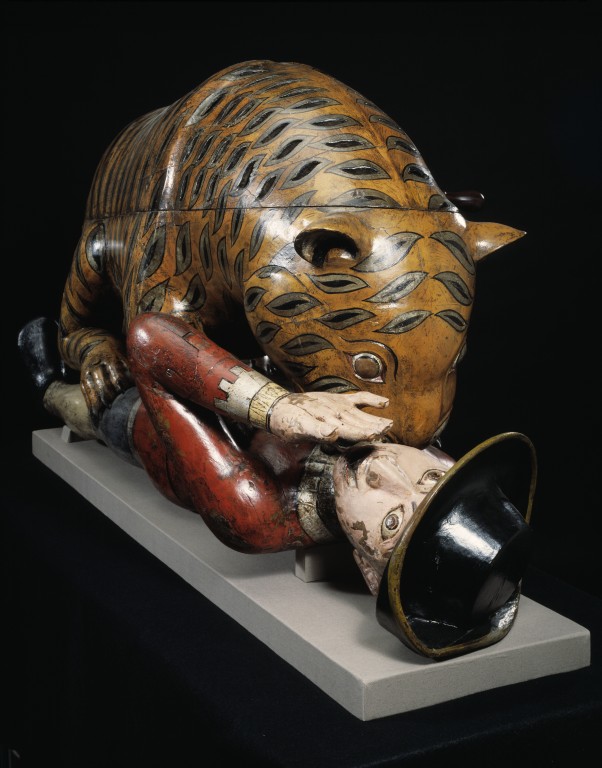
The tiger over the soldier, V&A museum number 2545(IS). Photograph by the Victoria and Albert Museum, licensed CC BY-SA 3.0.
Photograph: Victoria and Albert Museum, London (CC BY-SA 3.0)| Artist | Unknown makers, Mysore court workshops, for Tipu Sultan |
|---|---|
| Date | c. 1790 (V&A range 1785-1794; other sources say c. 1795) |
| Medium | Painted and carved wood with metal fixtures and ivory keys |
| Dimensions | Length 178 cm, height 71 cm, width 61 cm (V&A) |
| Where it is now | Victoria and Albert Museum, London (South & South East Asia Collection)last confirmed |
| Inventory number | 2545(IS) |
| Attribution | UnknownThe V&A record gives the maker as unknown and the production as unique, commissioned by Tipu Sultan. Full note |
| Object type | Clocks and instruments |
| Period | Mysore, late eighteenth century |
| Cases | Seized, looted or confiscated |
| Inscriptions | None recorded in the V&A catalogue entry. |
| Owners on record | 5 links5 documented |
| Sources | 7 cited |
About this record Last verified · 7 sources cited · Change log
On this page 9 sections
ContentsClose
A life-size painted wooden tiger mauling a European soldier, with a pipe organ hidden in its flank, made for Tipu Sultan of Mysore around 1790 and taken after the fall of Seringapatam on 4 May 1799. It reached London in 1800, stood in the East India Company's museum where visitors cranked it, and passed through the India Office and the India Museum to the South Kensington Museum in 1879.
It is catalogued by the V&A as museum number 2545(IS), maker unknown. Its casing was broken by a fall in 1944, its organ was repaired by Henry Willis and Sons in 1953, and it can no longer be operated. No restitution claim for it is recorded in the sources consulted.
Provenance
Each link is graded. Documented: a cited source supports it. Disputed: the identification is argued but not established. Unknown: no owner for that span, and the gap is not smoothed into a narrative. The grades in the glossary.
- c. 1790 - 1799Tipu Sultan, music room of his palace at Srirangapatnam (Seringapatam)documented
Commissioned by Tipu Sultan, probably around 1790, per the V&A object history. Maker unknown.34
- 1799 - 1800British forces at Seringapatam, under the East India Company; sent by Richard Wellesleydocumented
Taken when Seringapatam fell on 4 May 1799 and sent to London in 1800. The role of Governor-General Wellesley rests on a tertiary source.315
- 1800 - 1858East India Company, East India House, Leadenhall Streetdocumented
Public display by at least 1803 per the V&A; listed in the East India Library and Museum in 1808. A popular source gives July 1808 as the start of display.351
- 1858 - 1879The Crown through the India Office; Fife House, King Charles Street, then South Kensingtondocumented
Fife House 1858, India Office 1868, Eastern Exhibition Galleries, South Kensington 1874.36
- 1879 - presentSouth Kensington Museum, now the Victoria and Albert Museumdocumented
Transferred in 1879 on the dissolution of the India Museum; museum number 2545(IS) assigned 1880; in the main V&A building since 1956.36
Technical evidence
| Attribution note | The V&A record gives the maker as unknown and the production as unique, commissioned by Tipu Sultan. No individual maker is named in the sources consulted. Some writers suggest French input into the mechanism because French craftsmen served at Tipu's court; that is a proposal, not a documented fact. |
|---|---|
| Object type | Mechanical organ, semi-automaton (V&A: piano organs and automata).34 |
| Materials | Painted and carved wood with metal fixtures; ivory keys.34 |
| Dimensions | Length 178 cm, height 71 cm, width 61 cm. A tertiary source gives 172 by 71.2 cm; the museum's figures are used.341 |
| Date | c. 1790; the V&A gives a range of 1785-1794. Other sources say c. 1795.341 |
| Production | Unique; commissioned by Tipu Sultan; maker unknown.34 |
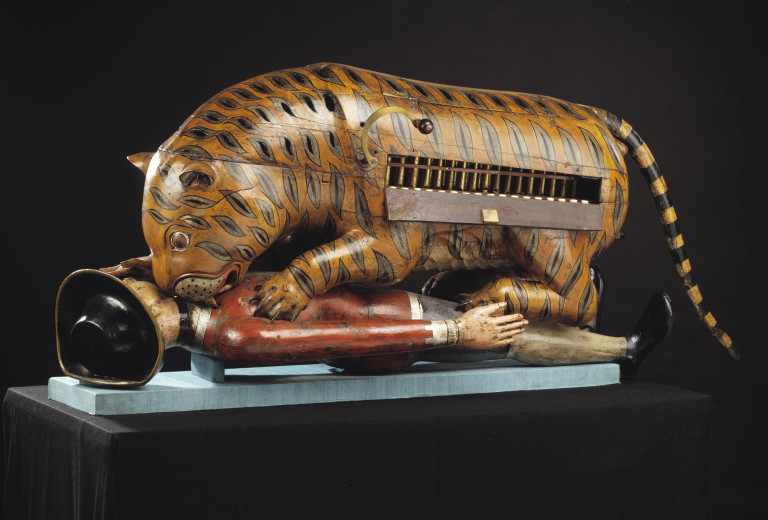
| Mechanism | Crank handle drives bellows, a wailing pipe at the man's mouth, the man's raised and lowered left arm and a grunt pipe in the tiger's head; a flank flap opens on an organ with an ivory keyboard.341 |
| Inscriptions | None recorded in the V&A entry.34 |
| Museum number | 2545(IS), assigned 1880; V&A record O61949.36 |
| Repairs | Damaged by a fall in September 1944 and repaired; organ overhauled by Henry Willis and Sons in March 1953 (13 new pipes, bellows repaired).63 |
Images
The record in full
Chapter 1What it is
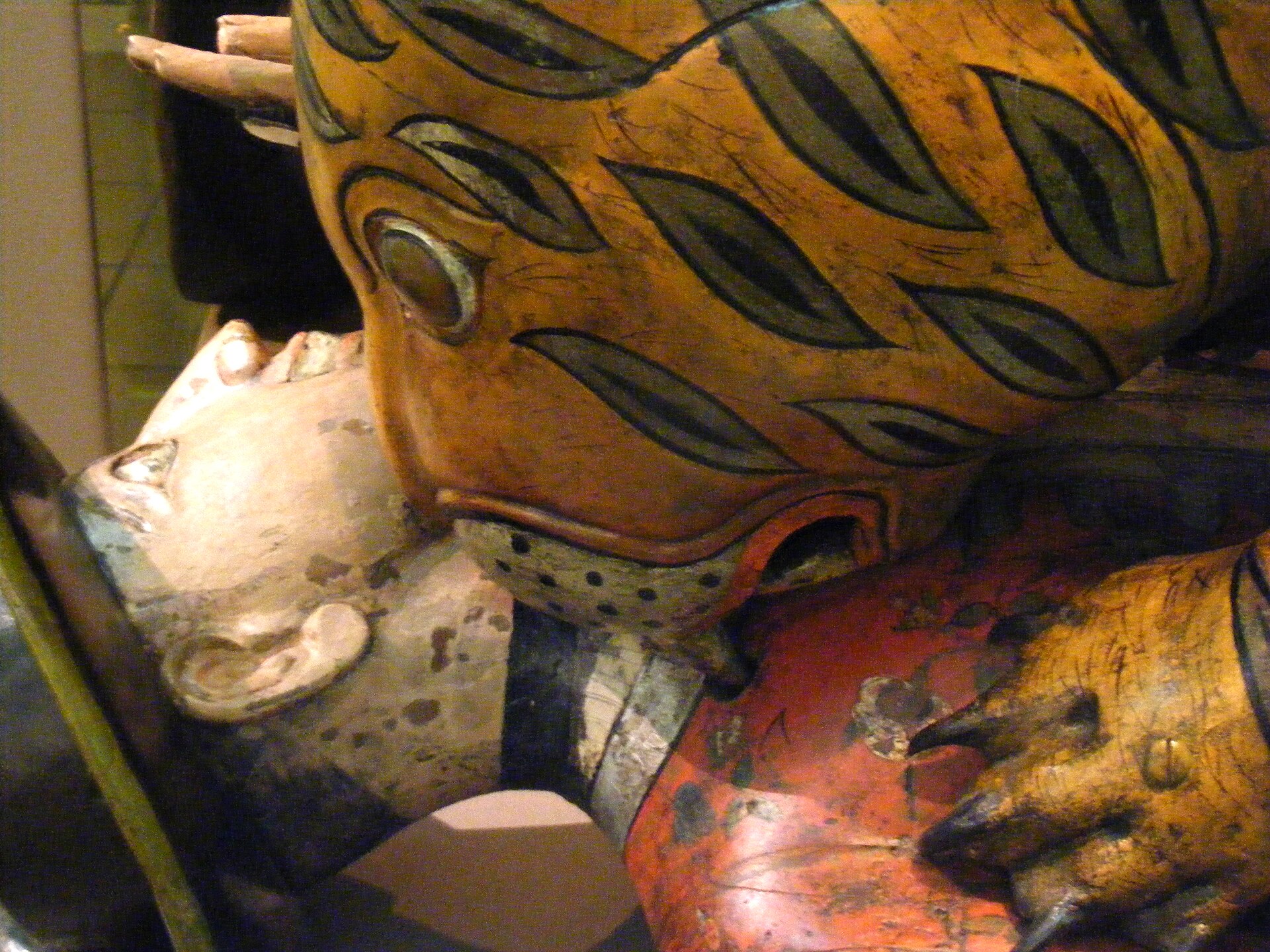
A near life-size semi-automaton in painted and carved wood: a tiger stands over a European man lying on his back and bites at his neck.
A near life-size semi-automaton in painted and carved wood: a tiger stands over a European man lying on his back and bites at his neck. The V&A gives 178 cm in length, 71 cm in height and 61 cm in width, and records the production as unique. The materials are painted wood with metal fixtures and ivory keys.
It is both a sculpture and a musical instrument. A flap in the tiger's flank opens onto organ pipes and a small ivory keyboard, so the object could be played by hand as a conventional organ as well as run by the crank.
Chapter 2How the mechanism works
A crank handle at the side drives everything.
A crank handle at the side drives everything. Turning it works bellows in the man's chest that send air to a pipe at his mouth, so that he emits a plaintive wail, and it raises and lowers his left arm, which also changes the pitch of the sound. A pipe in the tiger's head gives a two-tone grunt. The V&A describes the whole as producing growls from the tiger and whooping from the man, with the organ playing at the same time.
The organ behind the flank is described in one account as a two-stop instrument with 18 notes per rank. That figure comes from a tertiary source and should be checked against the V&A conservation file.
Chapter 3Why it was made
The V&A states that Tipu Sultan commissioned the piece, probably around 1790, for the music room of his palace at Srirangapatnam (Seringapatam).
The V&A states that Tipu Sultan commissioned the piece, probably around 1790, for the music room of his palace at Srirangapatnam (Seringapatam). Tipu ruled Mysore from 1782 until his death in 1799. The tiger was his personal emblem: it appears on his throne finials, his coinage, his weapons and his ordnance, and he was called the Tiger of Mysore.
Interpretation is where the sources divide. Joseph Sramek, cited in a tertiary source, reads the object as Tipu's symbolic triumph over the British, a plain fantasy of victory over the enemy then fighting him in the Anglo-Mysore wars. That is a scholar's reading, graded argued. The V&A catalogue records the commission and the room it stood in, and records nothing about what Tipu said of it. No contract, letter or inscription stating his intention is cited in anything consulted.
Chapter 4The makers and the French question
The maker is unknown. The V&A gives no name, and the tertiary and popular sources agree that no individual is documented.
The maker is unknown. The V&A gives no name, and the tertiary and popular sources agree that no individual is documented. Several writers note that French artisans and engineers were present at Tipu's court, owing to his alliance against the British, and propose French workmanship in the mechanism. Another account says the style and the metal analysis of the original pipes point to local manufacture. Both positions are stated without a documented maker behind either, so this record holds the question open.
Chapter 5Capture at Seringapatam, 1799
Tipu was killed in the British assault on Seringapatam on 4 May 1799, at the end of the Fourth Anglo-Mysore War.
Tipu was killed in the British assault on Seringapatam on 4 May 1799, at the end of the Fourth Anglo-Mysore War. The city was looted. Colonel Arthur Wellesley, later Duke of Wellington, is recorded as reprimanding the troops and ordering ringleaders punished, and the Company divided much of the treasure among the army by rank. The tiger was not divided: it was sent to England.
A tertiary source says the Governor-General, Richard Wellesley, sent it and that an aide-de-camp wrote a memorandum describing it as a royal tyger in the act of devouring a prostrate European, found in a room for musical instruments. The memorandum itself was not seen in this research and the claim stays at that grade. The V&A states that the organ was sent to London in 1800 and went to East India House.
Chapter 6East India House, 1800 to 1858
The V&A object history says the tiger was on public display at East India House by at least 1803 and was listed in 1808 as part of the East India Library and Museum.
The V&A object history says the tiger was on public display at East India House by at least 1803 and was listed in 1808 as part of the East India Library and Museum. A tertiary source says it first went on show in the reading room of the Company's museum in Leadenhall Street in July 1808, after the Company had thought of giving it to the Crown for the Tower of London. The two dates disagree, and both are given here. The 1803 date is the museum's own and the earlier.
Visitors were allowed to turn the crank. A report of 1843 says the machine was getting much out of repair, and a complaint in the Athenaeum is quoted to the effect that its shrieks and growls disturbed students in the library. The crank handle was later removed. The Company's use of the object was as a trophy: in 1808 the Seringapatam medal showed a British lion overcoming a tiger, the same image turned the other way.
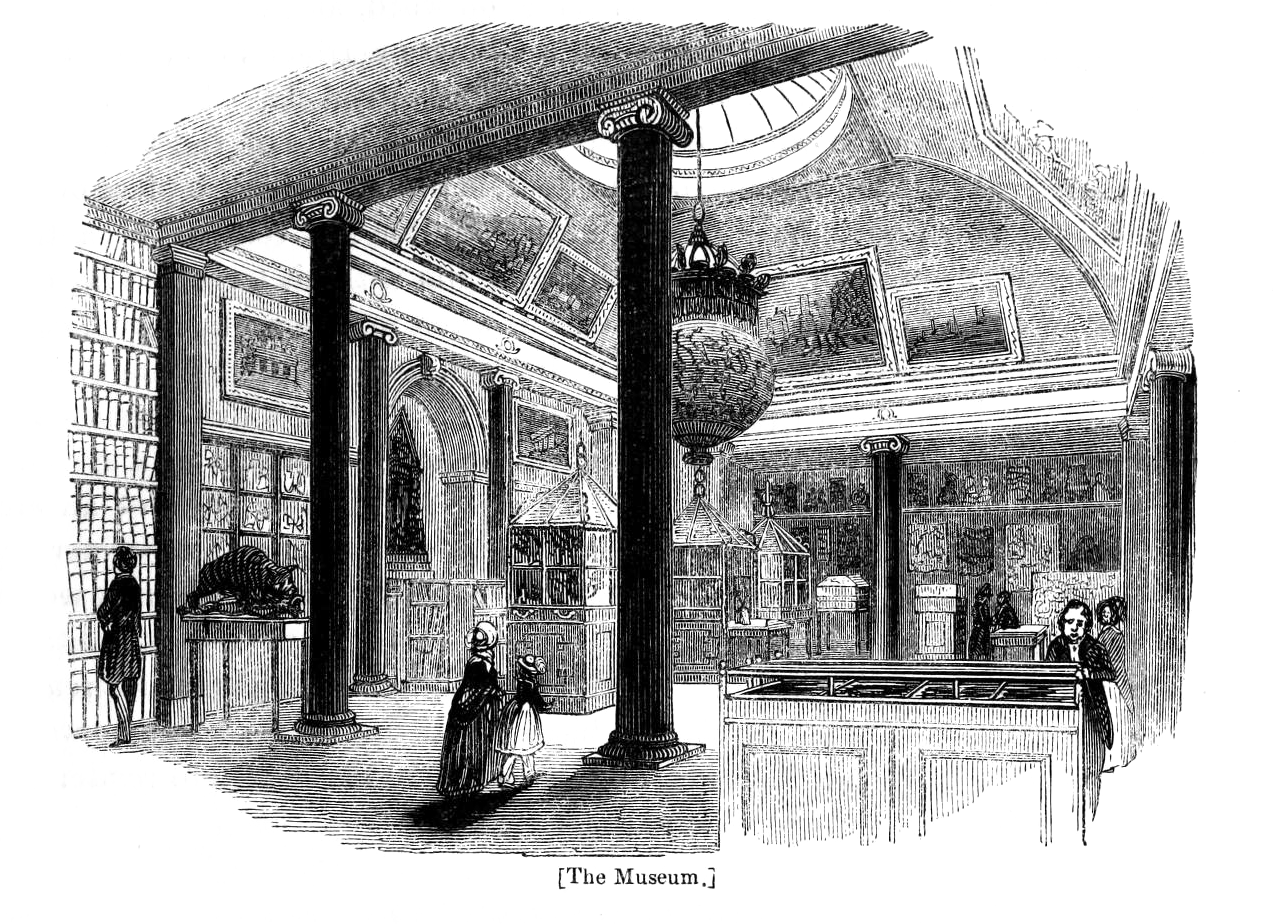
An 1841 wood engraving from Charles Knight's London shows the Leadenhall Street museum with the tiger visible at the left, and is reproduced here as a plate.
Chapter 7From the Company to the Crown, 1858 to 1880
After the Crown took over from the Company in 1858 the tiger went to Fife House, Whitehall.
After the Crown took over from the Company in 1858 the tiger went to Fife House, Whitehall. In 1868 it moved to the India Office in King Charles Street and in 1874 to the Eastern Exhibition Galleries in South Kensington. The India Museum, as the Company's collection had been renamed in 1858, was announced for closure in July 1879 on grounds of cost and low attendance. The India Office required what remained to be kept together and on public display, the South Kensington Museum took responsibility for it, and the tiger was given its museum number, 2545(IS), in 1880.
Chapter 8The Second World War damage
A V&A archive article places the accident in September 1944.
A V&A archive article places the accident in September 1944. According to the Chief Warder's report, two carpenters installing a partition in the Raphael Courts moved the tiger from its plinth to make room for their ladders and it fell. It was taken to the museum's Art Work Room as badly damaged. A tertiary source says the casing broke into several hundred pieces and was reassembled for display by 1947; the V&A record says only that it was quickly repaired. The popular account that a bomb broke it is not supported by the museum's own archive file, which describes a fall. The file with correspondence is MA/70/1/15, though the article's caption date for it conflicts with the text.
Chapter 9The organ and its repairs
In February 1953 the museum received two tenders for a thorough overhaul and repair of the organ.
In February 1953 the museum received two tenders for a thorough overhaul and repair of the organ. The successful bidder was Henry Willis and Sons Ltd, who had repaired the tiger twice before. In March 1953 thirteen pipes were made to replace missing ones and the bellows were repaired, at a total cost of 35 pounds. The letter is MA/70/1/17. One tertiary source states the original brass pipes have been largely replaced and the crank is a nineteenth-century British replacement; another cites the organ historian Arthur Ord-Hume (1987) as saying the mechanism was ruthlessly reworked. Those are reported here as reported, not verified against a conservation report. The tiger is now in a glass case and cannot be operated.
Chapter 10After the Company: display and fame
The tiger went to New York in 1955 for an exhibition and was moved into the main V&A building in 1956 when the separate India Museum premises were cleared.
The tiger went to New York in 1955 for an exhibition and was moved into the main V&A building in 1956 when the separate India Museum premises were cleared. It has stayed on display since, apart from its wartime accident and repair, and is one of the museum's best known objects. Gustave Flaubert is reported to have visited it at East India House in 1851; that is from a tertiary source only. The standard monographs are Mildred Archer, Tippoo's Tiger (V&A, 1983) and Susan Stronge, Tipu's Tigers (V&A Publishing, 2009, pp. 62-63).
Chapter 11Restitution and present status
The sources consulted record no formal restitution request for the tiger.
The sources consulted record no formal restitution request for the tiger. A tertiary source ties this partly to Tipu's contested standing in India, where he is regarded by some as a hero and by others with hostility. Other objects from his possessions have been bought on the market and taken to India. This record does not claim any restitution position by a named government or institution, since none was found.
The artist
Tipu Sultan of Mysore (patron); makers unknown
The makers of the tiger are not documented, so this dossier covers the patron whose emblem it carries and the court that made it. Tipu Sultan ruled Mysore from 1782 until his death at Seringapatam in 1799, and the tiger was the sign of his rule.
Related works
| Work | Relation | Where it is |
|---|---|---|
| Tipu's tiger finial and throne tiger heads Mysore court workshops | Other tiger objects from Tipu's possessions; different objects Not this object. | Various |
| The Bedchamber Sword of Tipu Sultan Mysore | Another Tipu object, separately recorded on this site Sold at Bonhams in 2023. | Private collection, unlocated |
| Seringapatam medal Company issue | The British answer to the tiger emblem, a lion overcoming a tiger Issued 1808. | Various |
| East India Company Museum, Leadenhall Street Wood engraving, 1841 | Where the tiger stood from 1800 Plate in this record. | Published in Charles Knight, London, 1841 |
Open questions
- Who made it? No maker is documented, and the French-input suggestion rests on circumstance.
- What did Tipu intend? No document stating his purpose for the tiger is cited in the sources consulted.
- When was it first shown to the public: by 1803 per the V&A or July 1808 per a popular source?
- Is the Wellesley aide-de-camp memorandum of 1799 preserved, and where?
- How much of the organ and paint is original? The pipes and crank are said to be largely replaced; no conservation report was seen.
- Was the 1944 casing damage a fall only, or did earlier war damage occur as some accounts state?
- Has any restitution request ever been made, formally or informally?
Questions about this object
What is Tipu's Tiger?
Tipu's Tiger is a clocks and instruments, dated c. 1790 (V&A range 1785-1794; other sources say c. 1795). Medium: Painted and carved wood with metal fixtures and ivory keys.
Who made Tipu's Tiger, and is the attribution settled?
The attribution to Unknown makers, Mysore court workshops, for Tipu Sultan is recorded here as unknown. The V&A record gives the maker as unknown and the production as unique, commissioned by Tipu Sultan. No individual maker is named in the sources consulted. Some writers suggest French input into the mechanism because French craftsmen served at Tipu's court; that is a proposal, not a documented fact.
Where is Tipu's Tiger now?
Victoria and Albert Museum, London (South & South East Asia Collection). Inventory number 2545(IS). Last confirmed 2 August 2026. V&A collections record O61949; at the V&A since the 1879 transfer, number assigned 1880, in the main museum building since 1956.
What is still unknown about Tipu's Tiger?
Who made it? No maker is documented, and the French-input suggestion rests on circumstance.
Sources
- 1Wikipedia, 'Tipu's Tiger'. en.wikipedia.org/wiki/...
- 2Victoria and Albert Museum, article 'Tipu's Tiger'. vam.ac.uk/articles/...
- 3Victoria and Albert Museum collections record O61949, 'Tippoo's Tiger', 2545(IS). collections.vam.ac.uk/item/...
- 4Victoria and Albert Museum API record for O61949. api.vam.ac.uk/v2/...
- 5History Hit, 'The Spoils of War: Why Does Tipu's Tiger Exist and Why Is It in London?'. historyhit.com/the-spoils-of-war-why-does-tipus-tiger-exi...
- 6V&A blog, 'The India Museum Archive: cataloguing a colonial collection' (files MA/70/1/15 and MA/70/1/17). vam.ac.uk/blog/...
- 7Wikimedia Commons file metadata for the four plates (licences and credits checked via ). commons.wikimedia.org/wiki/...

Last verified · Published
Change log
15 November 2026 - Record created at the house standard: researched narrative, technical evidence, maker dossier, graded provenance chain, prices with hammer and premium separated, related works, open questions and sources.