Bust of Nefertiti
Workshop of Thutmose · c. 1345 BCE
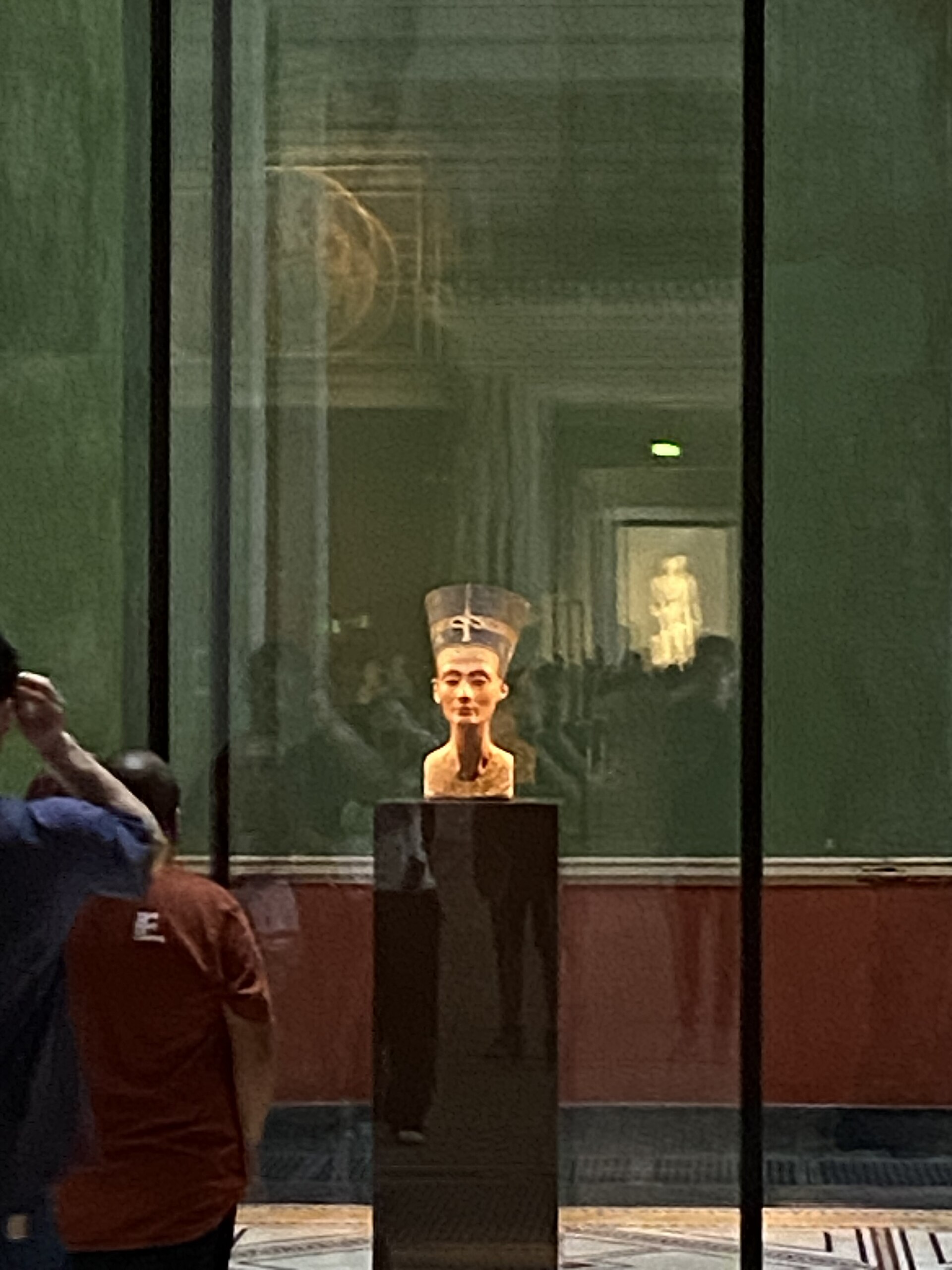
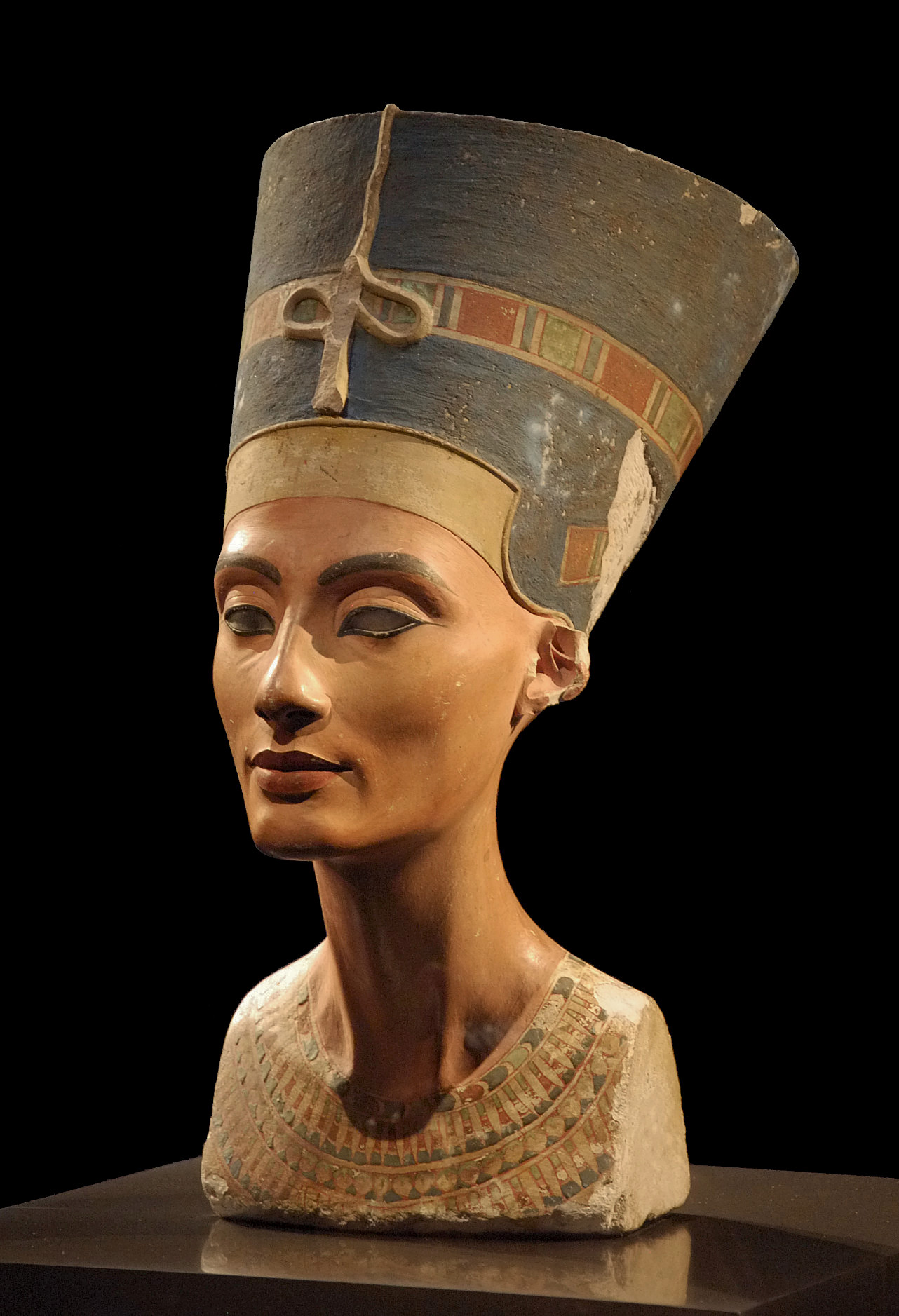
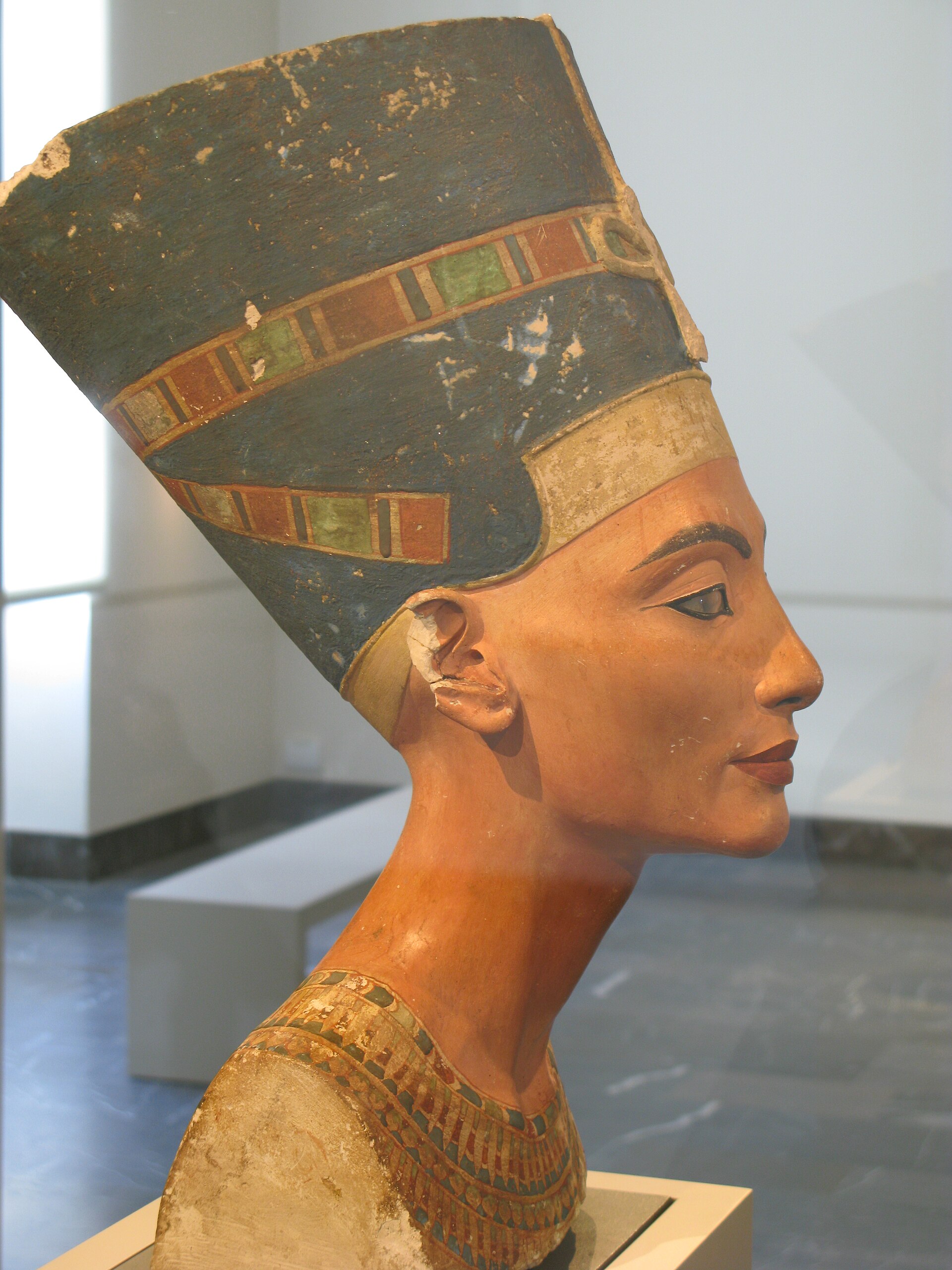
The bust as displayed in the North Dome Room of the Neues Museum, Berlin. A visitor photograph, confirmed CC0-licensed by its uploader, of the object described in this record, inventory AM 21300.
| Artist | Workshop of Thutmose |
|---|---|
| Date | c. 1345 BCE |
| Medium | Painted limestone core with modelled gypsum stucco surface; rock crystal, beeswax and pigment inlay in the right eye |
| Dimensions | 49 x 24.5 x 35 cm; approx. 20 kg (unmounted bust) |
| Where it is now | Neues Museum, Berlin (North Dome Room), part of the Egyptian Museum of Berlin / Staatliche Museen zu Berlin, Stiftung Preussischer Kulturbesitzlast confirmed |
| Inventory number | AM 21300 |
| Attribution | AcceptedAttributed to the royal sculptor Thutmose on the basis of findspot alone. Full note |
| Object type | Sculpture |
| Period | New Kingdom, 18th Dynasty, Amarna Period, reign of Akhenaten |
| Cases | Has a provenance gap |
| Inscriptions | None on the bust itself. The workshop attribution rests on an inscribed ivory horse-blinker found separately in the same courtyard, not on the object. |
| Owners on record | 6 links5 documented, 1 disputed |
| Sources | 21 cited |
About this record Last verified · 21 sources cited · Change log
On this page 10 sections
ContentsClose
A painted limestone-and-stucco portrait model of Queen Nefertiti, made around 1345 BCE in the workshop of the royal sculptor Thutmose at Akhetaten (modern Amarna) and left behind when the city was abandoned. Ludwig Borchardt's German expedition found it on 6 December 1912, and it passed to Berlin the following year under the division-of-finds system then governing foreign excavation in Egypt. It has been the single most contested object in German-Egyptian cultural relations for more than a century, and remains on permanent display in the Neues Museum, Berlin.
Two disputes define the record: whether Borchardt's conduct at the 1913 partage meeting, including a since-recovered account describing an unflattering photograph and a false material description, amounted to deliberate deception of the Egyptian inspector who signed off on the division, and, separately and much more recently, whether the museum that will not let the bust travel can still claim copyright over photographs and 3D scans of a 3,300-year-old public-domain object. Both questions are open in different ways: the first is argued from a single archival document neither side reads the same way, the second was settled in practice in 2019 when the museum released its own scan data under legal pressure.
The object itself is also a lesson in what stucco hides. CT imaging in 2006 showed a different, more careworn face carved into the limestone core beneath the smoothed and idealised painted surface that visitors see, and the bust's own missing left eye, never recovered despite a reward offered at the time, remains unexplained.
Provenance
Each link is graded. Documented: a cited source supports it. Disputed: the identification is argued but not established. Unknown: no owner for that span, and the gap is not smoothed into a narrative. The grades in the glossary.
- c. 1345 BCE - c. 1332 BCEWorkshop of Thutmose, royal sculptordocumented
Made in the sculptor's studio complex at Akhetaten (Amarna), the short-lived capital built by Akhenaten for the cult of the Aten. The bust is generally read as a master model, an approved likeness kept in the studio for apprentices and workshop sculptors to copy so that official images of the queen leaving the workshop matched a sanctioned pattern. It was found alongside numerous other plaster and stone heads and casts of the royal family in varying stages of completion. When the court abandoned Amarna after Akhenaten's death and Tutankhamun's return to Thebes and the old religion, the workshop was left to fall into ruin with its contents inside it.1210
- c. 1332 BCE - 6 December 1912None; buried in the ruined workshopdocumented
The bust lay in the debris of the collapsed workshop building, quadrant P47.1-3 in the modern excavation grid, for roughly thirty-two centuries. It was found lying on the floor of a storeroom, face down according to some accounts, wrapped in effect by its own burial, with the missing left eye already absent. No intervening find, sale or disturbance of the site between the Amarna period and 1912 is documented.123
- 6 December 1912 - 20 January 1913Deutsche Orient-Gesellschaft (German Oriental Society) excavation, under Egyptian Antiquities Service licensedocumented
Excavated under Ludwig Borchardt's direction on a licensed concession of the Egyptian Antiquities Service, financed by the Berlin department-store magnate and patron James Simon. Borchardt's own diary entry for the day records the discovery in the workshop and describes the moment of uncovering the neck, ribbon and wig. The find was kept from Egyptian inspectors' immediate close examination pending the formal division of finds six weeks later.125
- 20 January 1913 - 1913Division between Deutsche Orient-Gesellschaft/James Simon and the Egyptian Antiquities Servicedisputed
At the formal partage meeting, chief Egyptian antiquities inspector Gustave Lefebvre approved a division in which the bust, itemised in German paperwork in terms Egyptian officials later said undersold it, went to the German share against a stela of Akhenaten's family retained by Egypt. An internal Oriental Society memorandum, reported in press accounts as dating to 1924 and recovered and published by German researchers and cited by Egyptian officials including Zahi Hawass from 2009 onward, records that Borchardt 'wanted to save the bust for us,' that it was shown to Lefebvre in a poorly lit setting via a photograph that did not present it to advantage, and that Egyptian partage paperwork described it in terms consistent with a lesser material. The SPK's own current published position states flatly that 'there can therefore be no question of deception during the partage' and that the finds were divided by standard contemporary practice, with pre-divided lots inspected by Egyptian officials before selection. No account from Lefebvre himself, describing what he understood at the time, has surfaced in either position; the dispute rests on reading the same 1924 secondhand memorandum two different ways.456711
- 1913 - 1920James Simon, Berlindocumented
As sole financial sponsor of the excavation, the German finds passed by contract to Simon personally rather than to the state. He kept the bust privately at his villa on Tiergartenstrasse and, at Borchardt's request, did not put it on public display for roughly a decade, reportedly to avoid drawing early attention to it before the political and archaeological situation in Egypt settled.811
- 1920 - presentBerlin State Museums (Staatliche Museen zu Berlin), later the Stiftung Preussischer Kulturbesitz (SPK)documented
James Simon donated his share of the Amarna finds, including the bust, to the Berlin museums in 1920. It went on public display for the first time in 1924 in the reopened Neues Museum's 'Amarna Courtyard.' During the Second World War it was moved for safekeeping (Zoo flak tower, then the Merkers-Kieselbach salt mine), was recovered by US forces in 1945, held at the American Central Collecting Point in Wiesbaden, displayed publicly in Wiesbaden from 1946, then moved to West Berlin (Dahlem, 1956; Egyptian Museum, Charlottenburg, 1967; Altes Museum, 2005) before returning to the rebuilt Neues Museum on Museum Island in October 2009, where it remains.389
Technical evidence
| Attribution note | Attributed to the royal sculptor Thutmose on the basis of findspot alone. The bust was recovered from the ruined mudbrick workshop complex at Amarna (excavation quadrant P47.1-3), identified as belonging to Thutmose because an ivory horse-blinker inscribed with his name and title, 'The King's Favourite and Master of Works, the Sculptor Thutmose,' was found discarded in a rubbish pit in the same courtyard. No inscription on the bust itself names a maker. The building held numerous plaster and stone likenesses of the royal family in various stages of completion, consistent with a working sculptor's studio rather than a private house, which supports the identification without proving that Thutmose personally carved this particular piece rather than a subordinate in his workshop. |
|---|---|
| Core material | A single block of local Amarna limestone, roughly carved to the bust's basic proportions and forming the internal structure.9 |
| Surface modelling | Gypsum-based stucco applied over the limestone core in layers of varying thickness, hand-modelled to render the final naturalistic facial detail and the crown before painting. CT imaging shows the stucco is thicker in some areas than others, used deliberately to correct or refine the underlying stone form.912 |
| Pigments | Natural period pigments including red ochre, yellow orpiment, green frit, carbon black, and multiple shades of synthetic Egyptian blue, applied in multiple layers documented by contact-free testing at the Rathgen Research Laboratory in 2009.9 |
| Right eye | Inlaid with a black-dyed beeswax iris and pupil under a thin polished rock-crystal cornea, set into the carved socket.9 |
| Left eye | Empty socket; no evidence any inlay was ever fitted. Borchardt's own diary states no inlay material was found during excavation of the workshop debris.913 |
| CT imaging, 2007/2009 | A 2007 spiral CT scan by Alexander Huppertz and colleagues at Berlin's Imaging Science Institute, published in Radiology in April 2009, resolved the limestone core beneath the stucco to sub-millimetre precision. It showed a face with wrinkles at the corners of the mouth, creases in the cheeks and a bump on the bridge of the nose, all features smoothed away by the stucco layer applied over the stone, indicating the sculptor idealised the final public-facing image relative to the underlying carved likeness.12 |
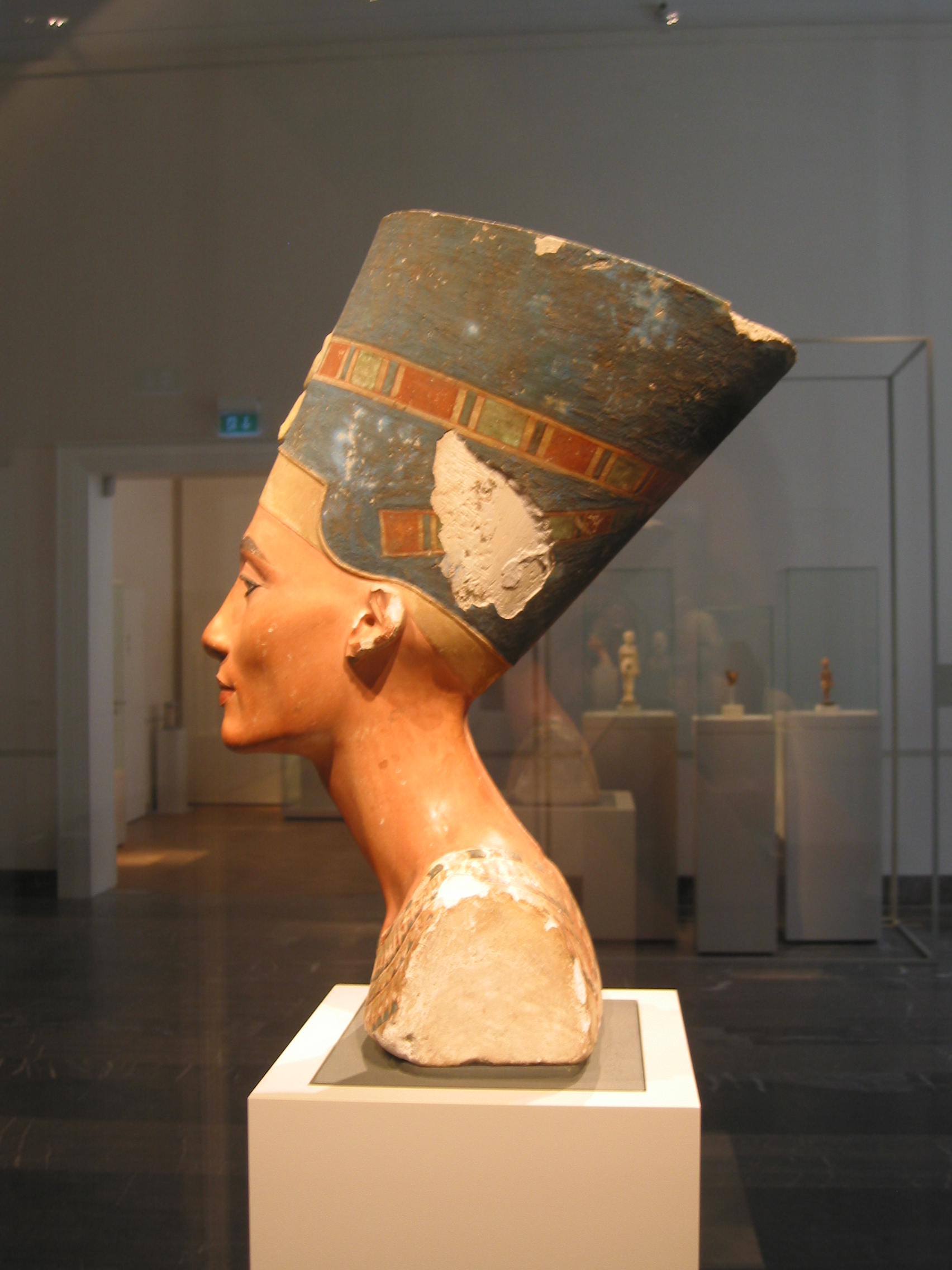
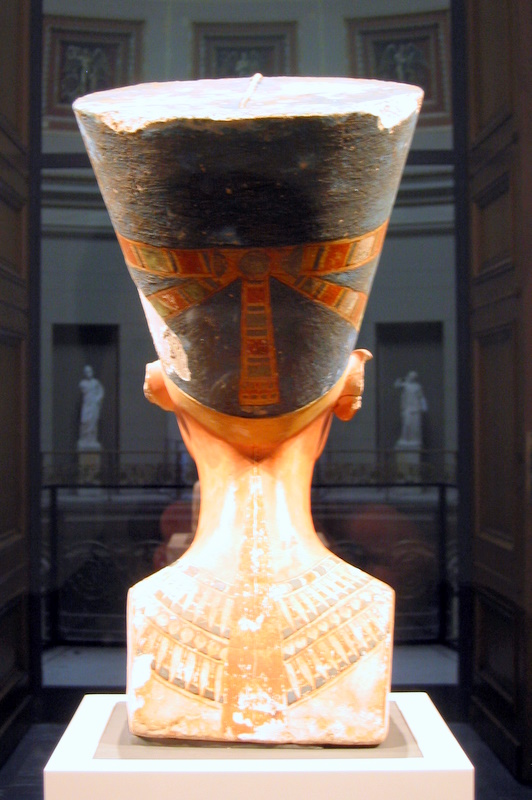
| Condition | Losses to the uraeus (cobra) on the crown, chips to the crown's painted decoration and edge, damage to both ears, and flaking of stucco on the left side of the face and crown, all present since excavation and stabilised rather than restored.9 |
| Transportability | Classified by the museum as non-transportable: air pockets exist between the limestone core and the applied stucco, and the multiple layers of paint are considered too fragile for the vibration and handling any loan or transfer would require.914 |
Images
The record in full
Chapter 1What it is
A painted portrait bust of Queen Nefertiti, chief wife of the pharaoh Akhenaten, standing 49 centimetres tall on its modern mount and carved from a single block of local limestone before being built...
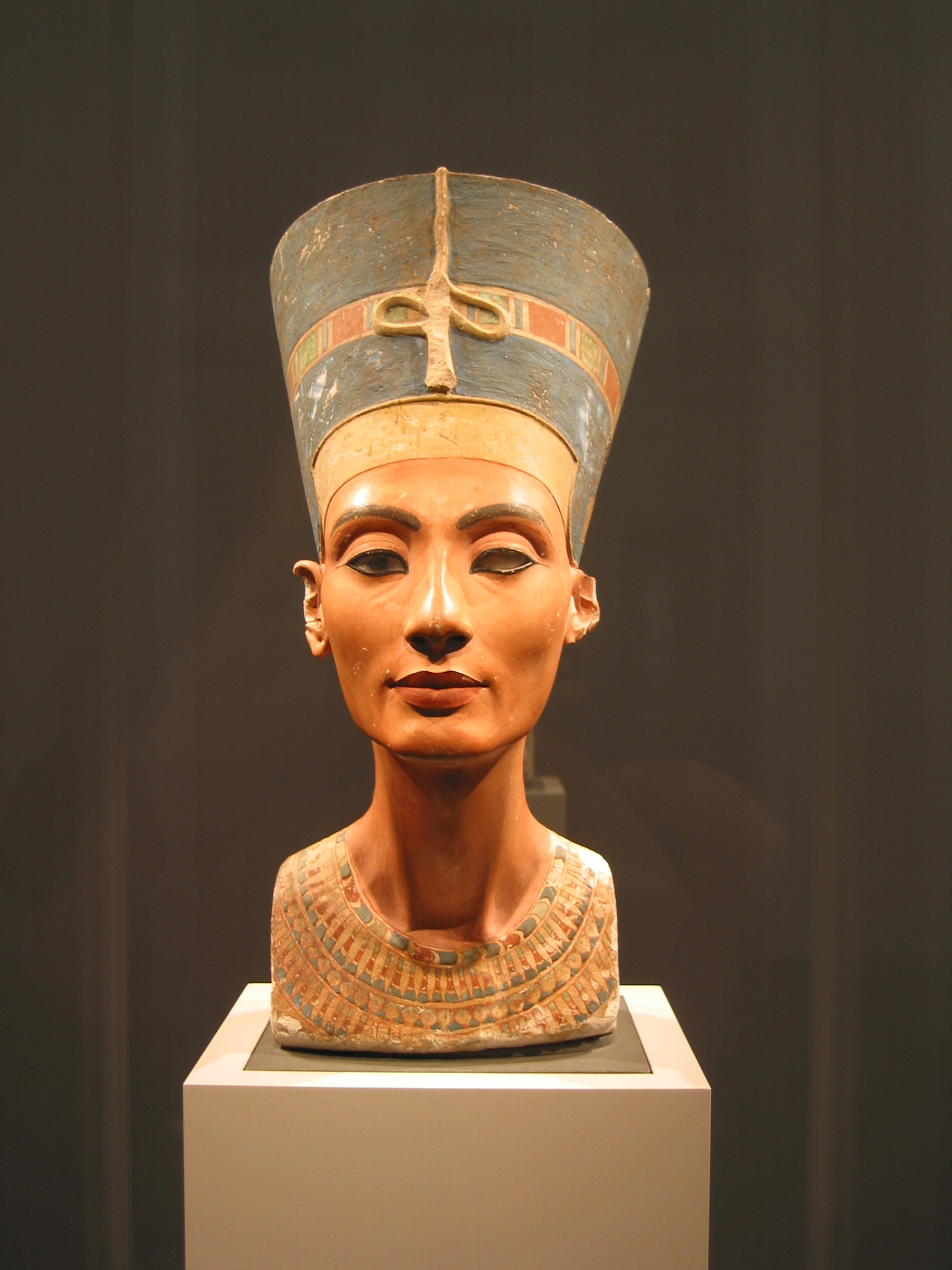
A painted portrait bust of Queen Nefertiti, chief wife of the pharaoh Akhenaten, standing 49 centimetres tall on its modern mount and carved from a single block of local limestone before being built up with a modelled gypsum stucco surface and painted. It shows the queen wearing her distinctive tall, flat-topped blue crown with a broad patterned band, a wide floral collar, and an idealised, symmetrical face with high cheekbones, a long neck and a faint smile.
Only the right eye carries its original inlay: a beeswax iris and pupil under a polished rock-crystal cornea, set into the carved socket with evident care. The left socket is empty and has been empty since the day it was excavated. That asymmetry, on an object otherwise built around exact bilateral balance, is the single most debated physical fact about the bust.
Chapter 2The workshop of Thutmose
The bust was not found in a tomb or a temple.
The bust was not found in a tomb or a temple. It was found on the floor of a storeroom in a collapsed mudbrick building at Akhetaten, the short-lived capital city Akhenaten built for the exclusive cult of the sun disc Aten and abandoned within a generation of its founding. The building has been identified as a working sculptor's studio, and specifically as the workshop of a sculptor named Thutmose, on the strength of a single small object: an ivory horse-blinker, inscribed with his name and the title 'the King's Favourite and Master of Works, the Sculptor Thutmose,' discarded in a rubbish pit in the same courtyard.
The identification is an inference from findspot, not a signature on the bust. The workshop contained dozens of other plaster casts and stone heads of the royal family in every stage of completion, from rough blocked-out forms to finished faces, which is itself the strongest evidence for what the building was: not a display collection, but working stock. The most widely accepted reading, associated with the Berlin museum's longtime director Dietrich Wildung, is that the painted bust was kept as a master model, an officially approved likeness that Thutmose's assistants and pupils copied so that portraits of the queen leaving the workshop conformed to a single sanctioned image, in the queen's own colours and proportions, wherever in Egypt they were destined to stand.
Chapter 3The discovery, 6 December 1912
Ludwig Borchardt directed the German Oriental Society's excavation at Amarna under a license from the Egyptian Antiquities Service, financed entirely by the Berlin department-store patron James Simon.
Ludwig Borchardt directed the German Oriental Society's excavation at Amarna under a license from the Egyptian Antiquities Service, financed entirely by the Berlin department-store patron James Simon. His diary entry for 6 December 1912 describes the moment of uncovering, working down through the debris to first expose a painted neck and ribbon, then the wig, before recognising what the team had found. Accounts of the entry describe him writing that description was useless, that it had to be seen.
The find came at the end of a season in a workshop that had already produced an unusual quantity of royal portrait material, which is part of why its significance was immediately obvious to the excavators on site, whatever was later said to the Egyptian inspectorate about it.
Chapter 4The partage of January 1913, and what is disputed about it
Under the division-of-finds system, or partage, then governing licensed foreign excavation in Egypt, finds from a season's dig were split between the excavating institution and the Egyptian state...
Under the division-of-finds system, or partage, then governing licensed foreign excavation in Egypt, finds from a season's dig were split between the excavating institution and the Egyptian state, with an Egyptian antiquities official inspecting and approving the split. On 20 January 1913 the chief Egyptian inspector, Gustave Lefebvre, approved a division in which the bust went to the German share, matched against a stela of Akhenaten's family retained for Egypt.
The German side's own published position, stated by the Stiftung Preussischer Kulturbesitz in a formal 2023 statement, is unambiguous: finds were pre-divided into equal lots, Egyptian officials inspected the opened boxes before making their selection, and the foundation states plainly that 'there can therefore be no question of deception during the partage.' Set against that is a document recovered from the German Oriental Society's own archive: an internal memorandum, reported in press accounts as dating to 1924 though this record has not independently verified its date or authorship beyond that reporting, recalling the January 1913 meeting between Borchardt and Lefebvre. Reported in German and international press from 2009 onward and cited repeatedly since by Egyptian officials including Zahi Hawass, the memorandum records that Borchardt 'wanted to save the bust for us,' describes the bust as shown to Lefebvre via a photograph that did not present it well, in a dimly lit setting, and notes that German inventory paperwork described its material in terms consistent with a lesser, less valuable substance than the limestone core it actually has.
Neither side's case rests on a document from Lefebvre himself. What exists is a single secondhand internal German memorandum, written more than a decade after the fact, that Egyptian officials read as evidence of deliberate deception and that the German institutional position reads as consistent with an ordinary, procedurally sound division. This record states both positions and does not adjudicate between them, because the primary evidence available does not resolve it.
Chapter 5From private villa to national attraction
Because Simon had personally financed the dig, the German share of the finds passed to him by contract rather than to the state directly.
Because Simon had personally financed the dig, the German share of the finds passed to him by contract rather than to the state directly. He kept the bust at his villa on Tiergartenstrasse in Berlin, and at Borchardt's request it was not shown publicly for roughly a decade, reportedly to avoid provoking scrutiny of the recent find while relations with Egyptian authorities over other matters remained unsettled.
Simon donated his entire share of the Amarna material, the bust included, to the Berlin state museums in 1920. It went on public display for the first time in 1924, in a newly built 'Amarna Courtyard' at the Neues Museum, and was an immediate sensation. Egypt's objections date from that unveiling: the object had been in Germany, privately, for over a decade before most people, in Egypt or anywhere else, knew for certain it existed.
Chapter 6War, salt mines and a divided city
The bust survived the Second World War by a sequence of removals.
The bust survived the Second World War by a sequence of removals. It left Berlin for a Flak tower in the Zoo district in 1941, then in March 1945, as Allied bombing intensified, it was moved again to the Merkers-Kieselbach salt mine in central Germany, where advancing American forces recovered it that same month along with a vast quantity of other looted and evacuated art and Reichsbank gold.
It was held at the American Central Collecting Point in Wiesbaden and displayed there publicly from 1946. When it returned to Berlin the city was already divided, and the bust went to West Berlin: first to the Dahlem museum complex in 1956, then to the Egyptian Museum in Charlottenburg from 1967, and finally to the Altes Museum on reunified Museum Island from 2005, before taking its current position in the rebuilt Neues Museum's North Dome Room when that museum reopened in October 2009, ending a sequence of five different display venues across nearly a century.
Chapter 7What the stucco hides
The painted surface visitors see is not simply the shape of the carved stone underneath it.
The painted surface visitors see is not simply the shape of the carved stone underneath it. A 2007 spiral CT scan by Alexander Huppertz and colleagues at Berlin's Imaging Science Institute, published in the journal Radiology in April 2009, resolved the limestone core to sub-millimetre detail through the overlying stucco. It showed a different face: creases at the corners of the mouth, wrinkles in the cheeks, and a bump on the bridge of the nose, all present in the carved stone and all smoothed away by the layer of stucco built up over it before painting.
Read plainly, this is a sculptor correcting toward an ideal. The underlying stone carving may represent either a more literal likeness of an ageing queen or simply an intermediate working stage the stucco was always meant to refine; the imaging shows the fact of the correction without settling which explanation is right. What it does confirm is that the bust's famous serenity is, in a literal physical sense, a finish applied over a rougher and more particular face.
Chapter 8The missing eye
Borchardt's own excavation diary records that no inlay material for a left eye was recovered in the workshop debris, and he concluded the socket had simply never been filled.
Borchardt's own excavation diary records that no inlay material for a left eye was recovered in the workshop debris, and he concluded the socket had simply never been filled. Rewards were later offered for information leading to a missing iris; none was found. Competing explanations have circulated since: that the piece was left deliberately unfinished as a working model and never needed a second eye fitted, that the queen herself suffered an eye condition later corrected in other portraits, or, from Egyptian commentators including Zahi Hawass, that the iris was fitted and later destroyed or removed. The eye-condition theory is contradicted by other secure portraits of Nefertiti showing both eyes intact and undamaged, which argues against a literal physical basis for the asymmetry. No inlay, damage evidence, or documentary record has settled the question either way; it remains open on the object itself.
Chapter 9A queen recast in stone: what the Amarna style argued
The bust belongs to a deliberate and short-lived break with Egyptian artistic convention, not to an ordinary continuation of it.
The bust belongs to a deliberate and short-lived break with Egyptian artistic convention, not to an ordinary continuation of it. Akhenaten's religious reforms centred worship on a single visible sun disc, the Aten, displacing the traditional pantheon and its priesthoods, and the art commissioned under his reign changed to match: softer, less rigidly frontal bodies, elongated features, and royal figures shown in informal, physically present scenes rather than the timeless, unchanging poses of earlier dynastic art. Scholars connect this shift to Akhenaten's theology of ma'at, of living truth, which called for images that acknowledged the visible, mutable world the Aten's light actually fell on, rather than an eternal idealised afterlife.
Nefertiti's crown is part of that theological programme rather than simple court fashion. The tall, flat-topped blue crown unique to her is argued by specialists to signal an association with the goddess Tefnut and with the mythic role of primeval twin paired with Akhenaten, positioning the royal couple as guardians and offspring of the Aten within the new cult's private cosmology. The bust, made as a workshop reference precisely so that this specific approved image could be reproduced consistently across every portrait leaving the studio, was therefore not only a portrait but an instrument for enforcing a single sanctioned face of the new religion.
Chapter 10A permanent copyright dispute that predates the scan fight
Because the bust is a three-dimensional sculpture rather than a flat image, the narrow legal exception in German copyright law that lets institutions freely photograph and publish two-dimensional...
Because the bust is a three-dimensional sculpture rather than a flat image, the narrow legal exception in German copyright law that lets institutions freely photograph and publish two-dimensional public-domain works does not apply to it. The Neues Museum has for years prohibited ordinary visitor photography of the bust and has separately asserted its own copyright over its official photographs and reproductions of the object, treating images of a 3,300-year-old sculpture as protected content in a way it could not for a public-domain painting.
That claim was tested directly in 2016, when two artists smuggled a portable 3D scanning rig past the museum's photography ban and produced a complete unofficial scan, which they shared online without the museum's consent. The episode revealed that the museum itself possessed a far higher-quality official scan, made years earlier and never released, reportedly withheld partly out of concern for gift-shop and replica revenue.
Chapter 11The Wenman freedom-of-information fight
American artist and researcher Cosmo Wenman filed a German freedom-of-information request for the museum's own official scan data once he had established that a higher-quality scan than the 2016 leak...
American artist and researcher Cosmo Wenman filed a German freedom-of-information request for the museum's own official scan data once he had established that a higher-quality scan than the 2016 leak existed inside the institution. What followed was a three-year legal process against the Prussian Cultural Heritage Foundation, which controls the museum, before the official data was finally released to him in 2019.
Even in releasing it, the museum attached a Creative Commons Attribution-NonCommercial-ShareAlike licence to the files, a claim of ongoing copyright control over a scan of an object with no copyright of its own, since the underlying sculpture is millennia outside any copyright term. Commentators, including intellectual-property writers covering the release, characterised the licence as legally unsupportable: a scan is not an original creative work in the way a photograph's composition can be, and no new copyright plausibly attaches to a faithful, mechanically produced digital copy of an ancient public-domain sculpture. Wenman published the files openly regardless of the museum's licence terms once he received them, and they have circulated freely since. The episode is now a standard example, cited well beyond Egyptology, of a public institution asserting copyright over reproductions of objects it does not itself own any rights to, in order to retain practical control over commercial replica production and image licensing revenue.
Chapter 12Egypt's continuing demand, and Germany's continuing answer
Formal and informal Egyptian requests for the bust's return date to the 1920s, sharpened after the 1924 unveiling made clear how long it had already been in Germany.
Formal and informal Egyptian requests for the bust's return date to the 1920s, sharpened after the 1924 unveiling made clear how long it had already been in Germany. Egyptologist and former antiquities minister Zahi Hawass has led the most sustained modern campaign, petitioning for the bust's return alongside the Rosetta Stone and the Dendera Zodiac and, in recent years, explicitly tying the request to the completion of the Grand Egyptian Museum near Giza as proof Egypt can now display and protect the object to any international standard. Following the museum's opening in late 2025, Hawass renewed the campaign publicly, arguing that the conservation objection Germany had relied on for decades no longer holds given the new museum's facilities.
Germany's position has not moved. The Prussian Cultural Heritage Foundation's president, Hermann Parzinger, restated it in terms he has used for years: the bust is, in his words, the ambassador of Egypt in Berlin, and the foundation's position on its return remains unchanged. Berlin officials asked directly about the bust's legal status in a 2023 state parliamentary session acknowledged that 'different perspectives' exist on the justice of its possession, in both a legal and a moral sense, without committing to any change, and noted that restitution decisions of this kind sit with Germany's federal foreign ministry rather than city authorities. The institutional argument for keeping the object in Berlin has two separate parts that Germany does not always distinguish clearly: that the 1913 acquisition was procedurally lawful, and that the object cannot safely travel today regardless of who owns it. The first argument, if accepted, would still not by itself explain a permanent refusal even to lend the object; the second is the argument institutions have leaned on most consistently in recent public statements.
Chapter 13What is happening now
The bust remains on permanent, undisplaced view in the Neues Museum's North Dome Room, drawing roughly half a million visitors a year and functioning, alongside the Pergamon Altar, as one of the two...
The bust remains on permanent, undisplaced view in the Neues Museum's North Dome Room, drawing roughly half a million visitors a year and functioning, alongside the Pergamon Altar, as one of the two objects most associated with the city's museum landscape and most contested by a source country. No loan, exchange or restitution agreement has been announced. The Grand Egyptian Museum, fully opened as of late 2025, holds no comparable object of Nefertiti in its own collection, a gap Egyptian commentary around the opening pointed to directly. Whether the museum's opening changes the practical calculus on either side of the transportability argument, as distinct from the underlying legal and moral dispute over the 1913 partage, is the live question as of this writing, and neither government has signalled it is about to be resolved.
The artist
Thutmose (also transliterated Djhutmose), royal sculptor
Almost nothing is known of Thutmose beyond his title and the contents of the building identified as his workshop. He left no autobiography, no tomb inscription, and no other securely attributed body of independent work outside the Amarna find. Everything attributed to him rests on a single small inscribed object found discarded near, but not inside, the workshop building itself, and on the working contents of that building, which is itself the strongest evidence of what kind of establishment it was, whatever is true of the individual man who ran it.
Exhibited
- 1924Opening of the Amarna CourtyardNeues Museum, Berlin
- 1946-1956Public display at the American Central Collecting PointLandesmuseum Wiesbaden
- 2003Body of Nefertiti (Little Warsaw installation)Hungarian Pavilion, 50th Venice Biennale
- 2009Reopening of the Neues Museum, North Dome RoomNeues Museum, Berlin
Related works
| Work | Relation | Where it is |
|---|---|---|
| Head of Young Nefertiti Workshop of Thutmose | A separate object from the same workshop assemblage, in brown quartzite rather than limestone and stucco; a distinct piece with its own inventory number, AM 21220. Do not confuse with the painted bust described in this record. Unfinished, and much less widely reproduced than the painted bust. | Neues Museum, Berlin |
| Unfinished quartzite head of Nefertiti Workshop of Thutmose | Life-size quartzite head from the same Thutmose workshop find, inventory AM 21352 Also excavated from the same workshop debris in 1912. | Neues Museum, Berlin |
| Unfinished head of Nefertiti or a princess Workshop of Thutmose | Composite statue head from the same period retained by Egypt at the 1913 partage Inventory JE 59286. | Egyptian Museum, Cairo |
| Stela of Akhenaten, Nefertiti and their daughters beneath the Aten Amarna period, workshop unknown | Comparable Amarna royal-family iconography retained by Egypt in the same 1913 partage as the object opposite the bust Illustrates the kind of object judged 'equal in value' to the bust under the partage system, a comparison at the centre of the deception dispute. | Neues Museum, Berlin (a related house altar; the specific stela retained by Egypt is in the Egyptian Museum, Cairo) |
Open questions
- What did Gustave Lefebvre himself understand about the bust's material and importance when he approved the 1913 division? No first-person account from Lefebvre has surfaced; the case for deception and the case against it both rest on interpreting the same secondhand 1924 memorandum.
- Why is the left eye missing, and was it ever fitted? Borchardt's contemporaneous diary recorded no inlay material found on site, but this does not resolve whether the bust was left deliberately unfinished as a working model, lost its inlay after completion, or was never meant to carry one.
- Who, specifically, within Thutmose's workshop carved this particular bust? Attribution rests entirely on findspot and an inscribed object found separately in the same courtyard, not on any mark on the bust itself; workshop practice with multiple hands working under one named master is undocumented for this piece.
- What became of the fourth royal or comparably significant object the Egyptian side received in the 1913 division, and how did contemporary Egyptian antiquities officials value it relative to the bust at the time, independent of the German paperwork?
- Would modern non-destructive analysis of the missing eye socket and stucco microstructure, beyond the 2006 and 2009 imaging, resolve the intentional-versus-accidental question, and has any museum proposed such a study?
Questions about this object
What is Bust of Nefertiti?
Bust of Nefertiti is a sculpture, dated c. 1345 BCE. Medium: Painted limestone core with modelled gypsum stucco surface; rock crystal, beeswax and pigment inlay in the right eye.
Who made Bust of Nefertiti, and is the attribution settled?
The attribution to Workshop of Thutmose is recorded here as accepted. Attributed to the royal sculptor Thutmose on the basis of findspot alone. The bust was recovered from the ruined mudbrick workshop complex at Amarna (excavation quadrant P47.1-3), identified as belonging to Thutmose because an ivory horse-blinker inscribed with his name and title, 'The King's Favourite and Master of Works, the Sculptor Thutmose,' was found discarded in a rubbish pit in the same courtyard. No inscription on the bust itself names a maker. The building held numerous plaster and stone likenesses of the royal family in various stages of completion, consistent with a working sculptor's studio rather than a private house, which supports the identification without proving that Thutmose personally carved this particular piece rather than a subordinate in his workshop.
Where is Bust of Nefertiti now?
Neues Museum, Berlin (North Dome Room), part of the Egyptian Museum of Berlin / Staatliche Museen zu Berlin, Stiftung Preussischer Kulturbesitz. Inventory number AM 21300. Last confirmed 17 August 2026. Awarded to the German excavation concession's financial sponsor, James Simon, in the 1913 partage of Amarna finds with the Egyptian Antiquities Service; donated by Simon to the Berlin state museums in 1920. On continuous display in various Berlin venues since 1924, moved to the rebuilt Neues Museum in October 2009.
What is still unknown about Bust of Nefertiti?
What did Gustave Lefebvre himself understand about the bust's material and importance when he approved the 1913 division? No first-person account from Lefebvre has surfaced; the case for deception and the case against it both rest on interpreting the same secondhand 1924 memorandum.
Sources
- 1Staatliche Museen zu Berlin, Aegyptisches Museum und Papyrussammlung, 'The Find: Where was the bust of Nefertiti found?' smb.museum/en/...
- 2Wikipedia, 'Thutmose (sculptor).' Flagged as ; corroborated on the workshop identification and ivory blinker by the museum's own discovery page (source 1). en.wikipedia.org/wiki/...
- 3Wikipedia, 'Nefertiti Bust,' consolidating discovery, partage, wartime relocation, display history and repatriation chronology. en.wikipedia.org/wiki/...
- 4Smithsonian Magazine, 'German Archaeologists Discovered the Iconic Bust of Nefertiti in an Ancient Egyptian Sculptor's Studio. Find Out Why Their Discovery Is Now One of Archaeology's Most Controversial.' smithsonianmag.com/smart-news/...
- 5Ferrell's Travel Blog, summarising 2009 press reporting (Times/Spiegel) of the recovered 1924 Deutsche Orient-Gesellschaft memorandum describing the 1913 partage meeting between Borchardt and Gustave Lefebvre. ferrelljenkins.blog/2009/...
- 6Ahram Online, 'Renowned Egyptologist Zahi Hawass launches int'l petition to repatriate Bust of Nefertiti from Berlin.' english.ahram.org.eg/News/...
- 7Al Jazeera, 'Egyptian archaeologist urges German museum to return Nefertiti's bust,' 8 September 2024. aljazeera.com/news/...
- 8The Collector, 'James Simon: Art Collector and Owner of The Nefertiti Bust.' thecollector.com/james-simon-a-generous-patron-of-the-art...
- 9Staatliche Museen zu Berlin, Aegyptisches Museum und Papyrussammlung, 'Description of the bust of Nefertiti.' smb.museum/en/...
- 10Staatliche Museen zu Berlin, Aegyptisches Museum und Papyrussammlung, 'The presentation of the bust of Nefertiti.' smb.museum/en/...
- 11Stiftung Preussischer Kulturbesitz, 'The History of the Finds: Nefertiti and the Pergamon Altar,' official statement, 13 January 2023. preussischer-kulturbesitz.de/en/...
- 12Phys.org, 'Researchers use CT to examine hidden face in Nefertiti bust,' reporting on Huppertz et al., published in Radiology, April 2009. phys.org/news/...
- 13Historical Eve, 'Why is Nefertiti missing an eye?', summarising Borchardt's diary statement and competing theories including Dietrich Wildung's workshop-model reading. historicaleve.com/why-is-nefertiti-missing-an-eye
- 14The Art Newspaper, 'No plans to return Berlin's star museum attractions Nefertiti and Pergamon Altar, German official says,' 20 January 2023. theartnewspaper.com/2023/...
- 15Slate, 'The Neues Museum is claiming copyright over 3D-printing files of the Nefertiti bust,' November 2019. slate.com/technology/...
- 16Hyperallergic, 'Official 3D Scans of Nefertiti Bust Are Released After Three-Year Battle,' November 2019. hyperallergic.com/530400/...
- 17Cosmo Wenman, 'Nefertiti 3D Scan FOIA Project,' project documentation and timeline by the researcher who forced the scan's release. cosmowenman.com/nefertiti-3d-scan-foia-project
- 18Techdirt, 'The Curious Case Of The Bogus CC License On A 3D Scan Of A 3000-Year-Old Bust Of Nefertiti,' November 2019. techdirt.com/2019/...
- 19The Washington Post / Boston Globe (AP wire), 'New Egyptian museum brings fresh pressure for return of Nefertiti's bust,' 26 December 2025. bostonglobe.com/2025/...
- 20ArtNews, 'Egyptian Archaeologist Vows to Bring Bust of Nefertiti Back from Germany,' on Zahi Hawass's renewed campaign after the Grand Egyptian Museum's opening. artnews.com/art-news/...
- 21Wikimedia Commons, File information and license metadata for images used in this record, verified via the Commons API (.LicenseShortName) on 2026-08-17. commons.wikimedia.org/wiki/...
Last verified · Published
Change log
17 August 2026 - Record created at the house standard: researched narrative, technical evidence, maker dossier, graded provenance chain, prices with hammer and premium separated, related works, open questions and sources.