The Egyptian Museum, Cairo
Museum · المتحف المصري · Founded 1902
Open, admission and hours confirmed 1 September 2026 · 14 sources
On this page 14 sections
ContentsClose
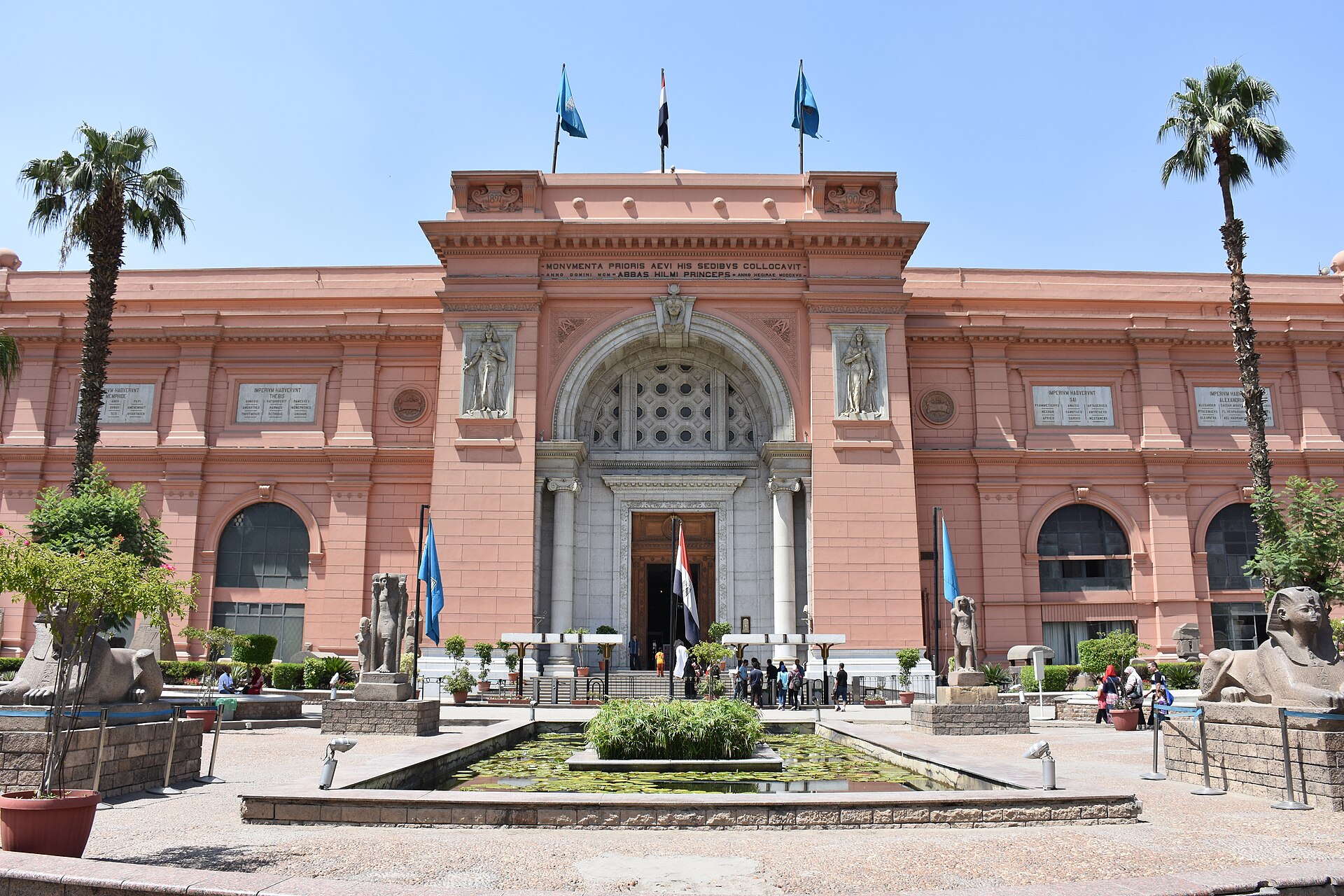
More than 160,000 objects by the museum's own count, spanning the Predynastic period to the Roman, in a building with just over 100 display halls and a basement store holding everything not on show. The ministry still calls it the largest collection of Pharaonic antiquities in the world and the oldest archaeological museum in the Middle East. Its irreplaceable strengths after the transfers of 2021 and 2025 are the Old Kingdom, where the statues of the three Giza pyramid-builders stand; Amarna, where the colossal Akhenaten pillar statues are; the Tanis royal burials, above all Psusennes I; the complete non-royal burial of Yuya and Thuya; the Narmer Palette at the very beginning of the record; and the papyri, coffins and jewellery in bulk. What it no longer holds is the Tutankhamun material and the royal mummies. A reader planning a visit needs both halves of that sentence.
| Local name | المتحف المصري |
|---|---|
| Kind | Museum |
| Founded | 1902 in this building; the collection dates from the Antiquities Service founded in 1858 |
| City and country |  Cairo, Egypt Cairo, Egypt |
| Address | Meret Basha, Tahrir Square, Downtown Cairo, Egypt |
| Website | egymonuments.gov.eg/en/museums/egyptian-museum |
| Status | Open, confirmed 1 September 2026 |
| Record last verified | 8 August 2026 |
Visiting
- Hours
- Sunday to Saturday09:00 to 17:00the ministry publishes the same hours for all seven days
- Ramadan, daily09:00 to 16:00the ministry publishes separate Ramadan hours
- Closed
- The ministry publishes no weekly closing day: the museum is listed as open Sunday to Saturday, and the ministry's ticketing site says All Days. The ticket window closes at 16:00, an hour before the galleries; the ticketing site puts it as last entry 16:00. In Ramadan the ticket window closes at 15:00. The ministry's ticketing site publishes the same 09:00 opening and 16:00 last entry for both its summer and its winter hours, so the season does not change the times. The ministry's own visit regulations ask visitors to arrive at least one hour before a site's closing time.
- Admission
- Foreign visitor, adultEGP 550Egypt prices foreign visitors and Egyptians separately at every state museum and archaeological site, and the ministry's own ticketing site labels the two columns Other Nationality and Egyptian. This is published policy, not a surcharge added at the door. Never converted here: the figure is in Egyptian pounds
- Foreign visitor, studentEGP 275a student must present valid identification and be no older than 24
- Egyptian, adultEGP 30the resident rate, roughly one eighteenth of the foreign rate. The ministry's ticketing rules state that an Egyptian's spouse of another nationality is treated as Egyptian
- Egyptian, studentEGP 10valid identification, aged 24 or under
- Audio tour, foreign visitorEGP 75in addition to admission
- Audio tour, EgyptianEGP 30in addition to admission
Free entry: Egyptian seniors aged 60 and over. Egyptians with special needs. Orphaned children. Government and Al-Azhar primary and preparatory school trips, by prior booking through the Rehla platform. Children under 6- Tickets
- egymonuments.com/locations/details/EgyptianMu... The museum's own ticket page.
- Do I need to book?
- No. Tickets are sold at the window on the day, and the ministry also sells them through its own online ticketing site. The window shuts at 16:00, an hour before the galleries close, and at 15:00 in Ramadan - the single practical fact most likely to cost a visitor the afternoon
- Address
- Meret Basha, Tahrir Square, Downtown Cairo, Egypt MapMetro The museum's own visit page names the Metro as the available public transport and Tahrir Parking as the nearest parking. The museum stands on the north side of Tahrir Square in downtown Cairo.
On foot 1 Meret Basha, on the north side of Tahrir Square, a few minutes from the Nile Corniche and the Qasr al-Nil bridge
Car Nearest parking: Tahrir Parking - Website
- egymonuments.gov.eg/en/museums/egyptian-museum
- Telephone
- +2 (02) 25796948
- [email protected]
Before you go how long, access, photography, bags, eating, shop
- How long to allow
- There are more than 100 display halls on two floors holding more than 160,000 objects by the museum's own count, so no visit sees the collection. Two to three hours covers the ground-floor chronological circuit and the atrium; the upper-floor category rooms need a second visit
- Access
- The museum lists a ramped entrance, a lift, toilets and sign language among its services, and Braille labels. It is a 1902 building and the ministry does not publish a step-free route
- Photography
- Photography with a mobile phone is free. Flash is not allowed. Video recording with a phone or a camera in the galleries requires the appropriate ticket, and filming for commercial use needs permission from the authority and a daily fee. A camera holder needs its own ticket
- Bags
- Bags, backpacks, luggage or parcels larger than 40 by 40 cm are not admitted and go to the cloakroom, as do umbrellas and any sharp or dangerous items. Bags may be searched at any time
- Eating
- Cafe on site
- Shop
- Gift shop on site; there is also a library
Prices and hours change. We take them from the institution's own pages and print the day we read them, and you can check the current position at the source we used. Confirm before you travel.
What is inside
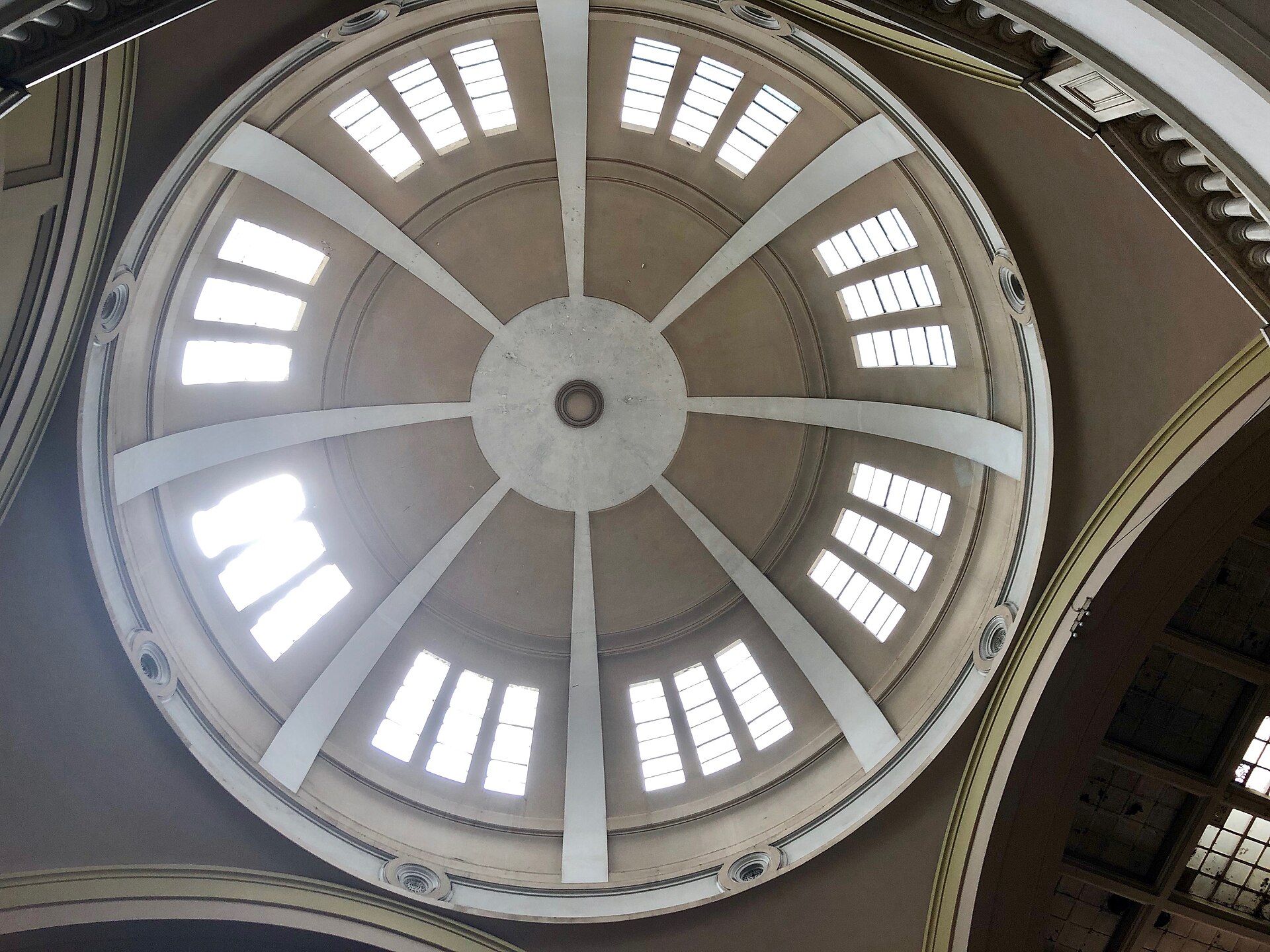
CC0 The entrance rotunda and the dome
Dourgnon put a ribbed dome immediately behind the arched doorway, its drum pierced with ranks of windows, so that the first thing a visitor stands under is daylight rather than electric light. The building is organised throughout around top-lighting, which is what a museum built in 1902 had to do. The dome above the main entrance was one of the elements listed for comprehensive restoration in the second phase of the museum's revival project.
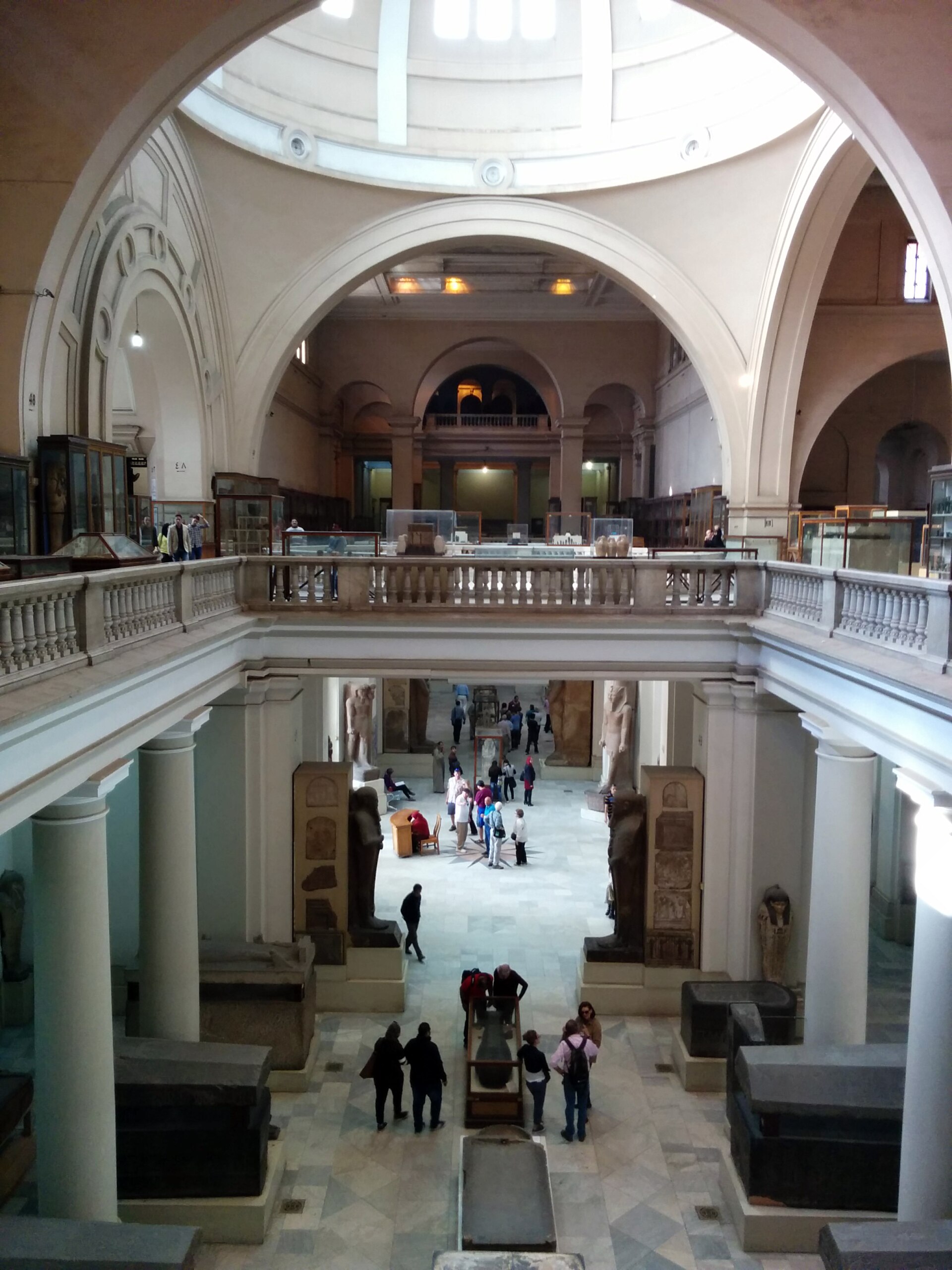
Photograph by Sailko · CC BY 3.0 The atrium and the great gallery
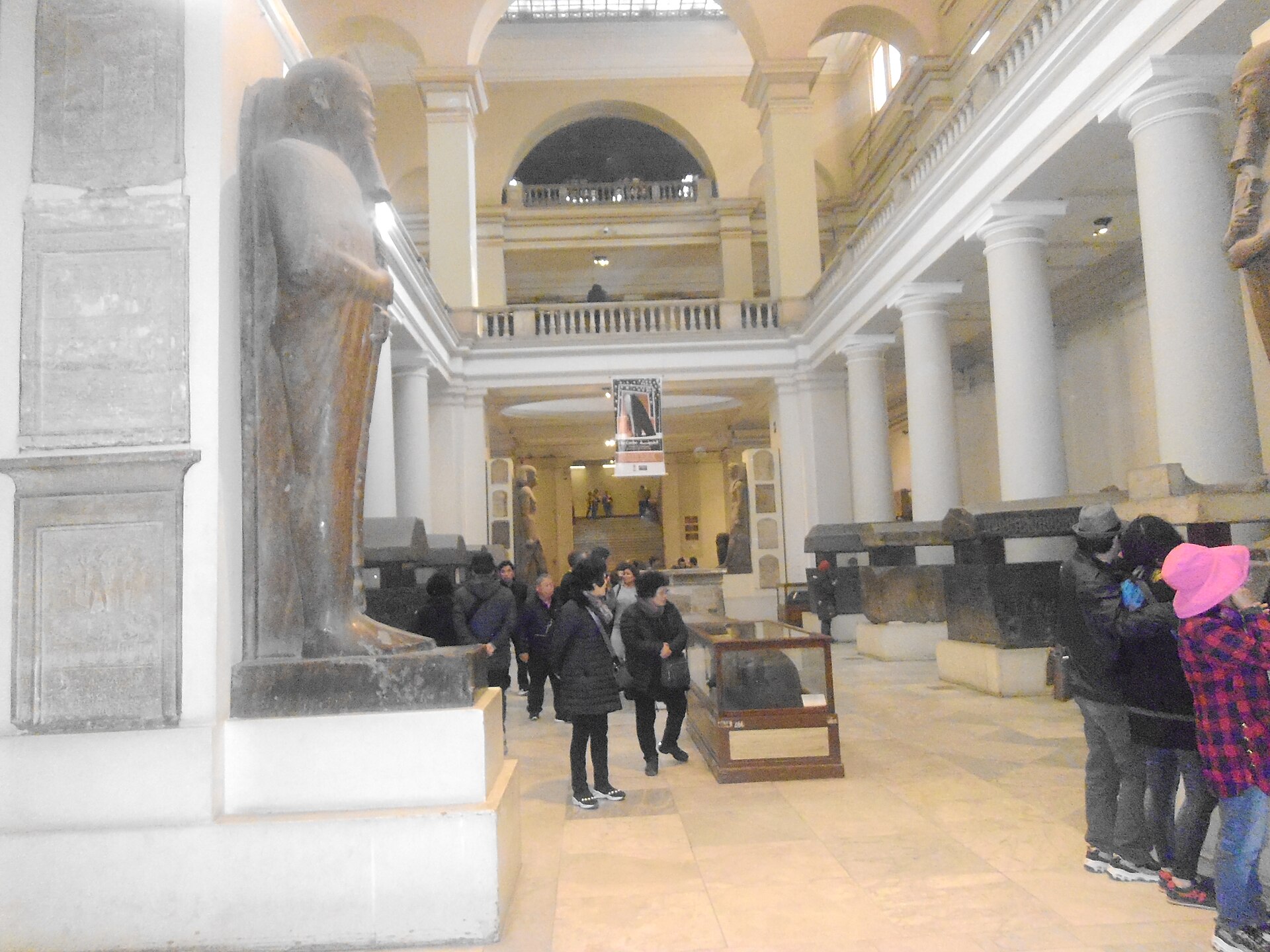
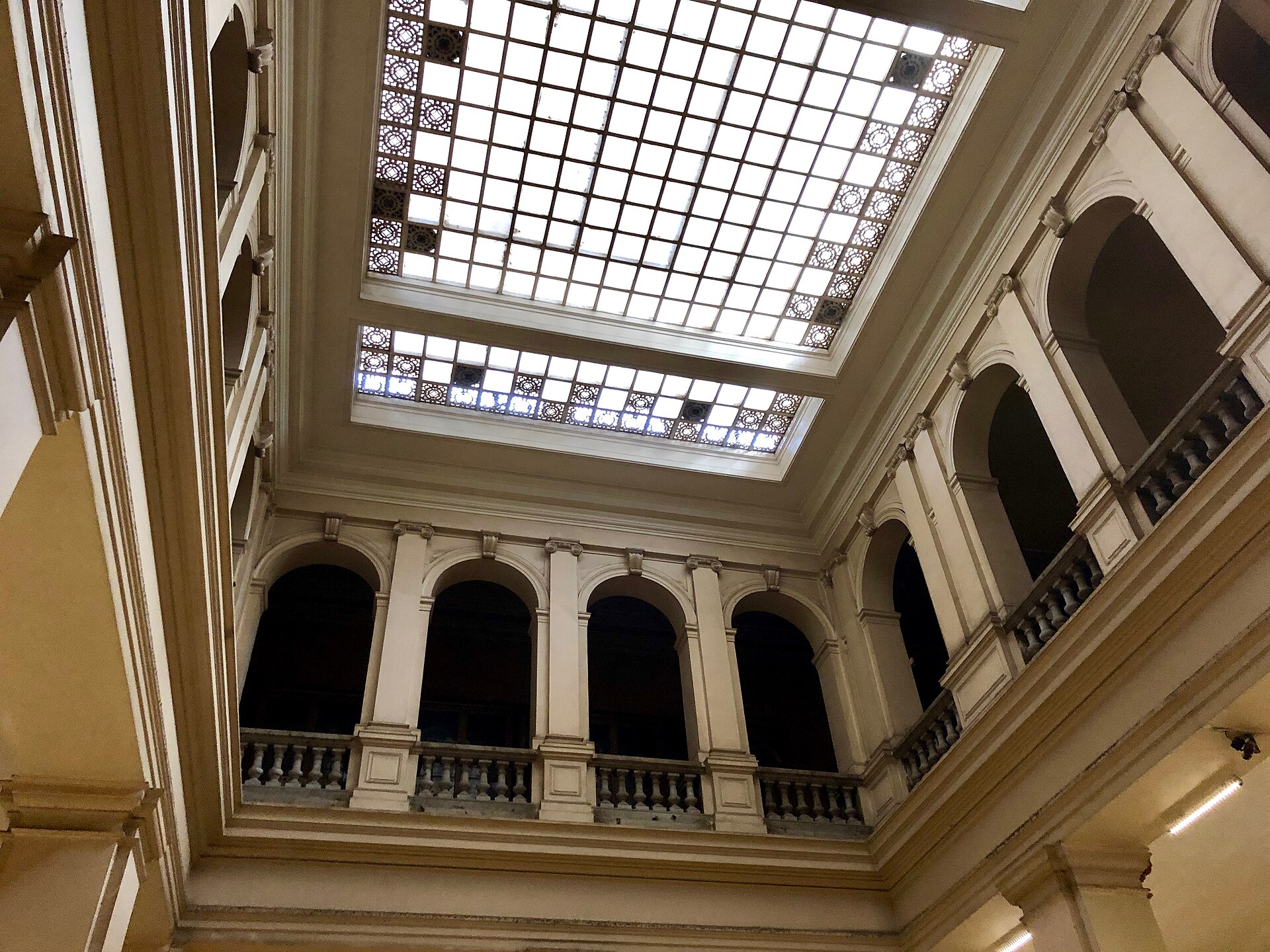
The central axis runs the depth of the building in two storeys: colossal royal statuary and stone sarcophagi stand on the ground floor, and a balustraded gallery runs round the void above, so that the largest objects can be read from below and from above. This is where the museum puts what will not fit in a case - granite colossi, obelisk fragments, false doors, sarcophagus chests. It is also the space that makes the museum's real problem visible: the objects are packed at a density no contemporary museum would choose.
Photograph by Sailko · CC BY 3.0 The ground-floor chronological circuit
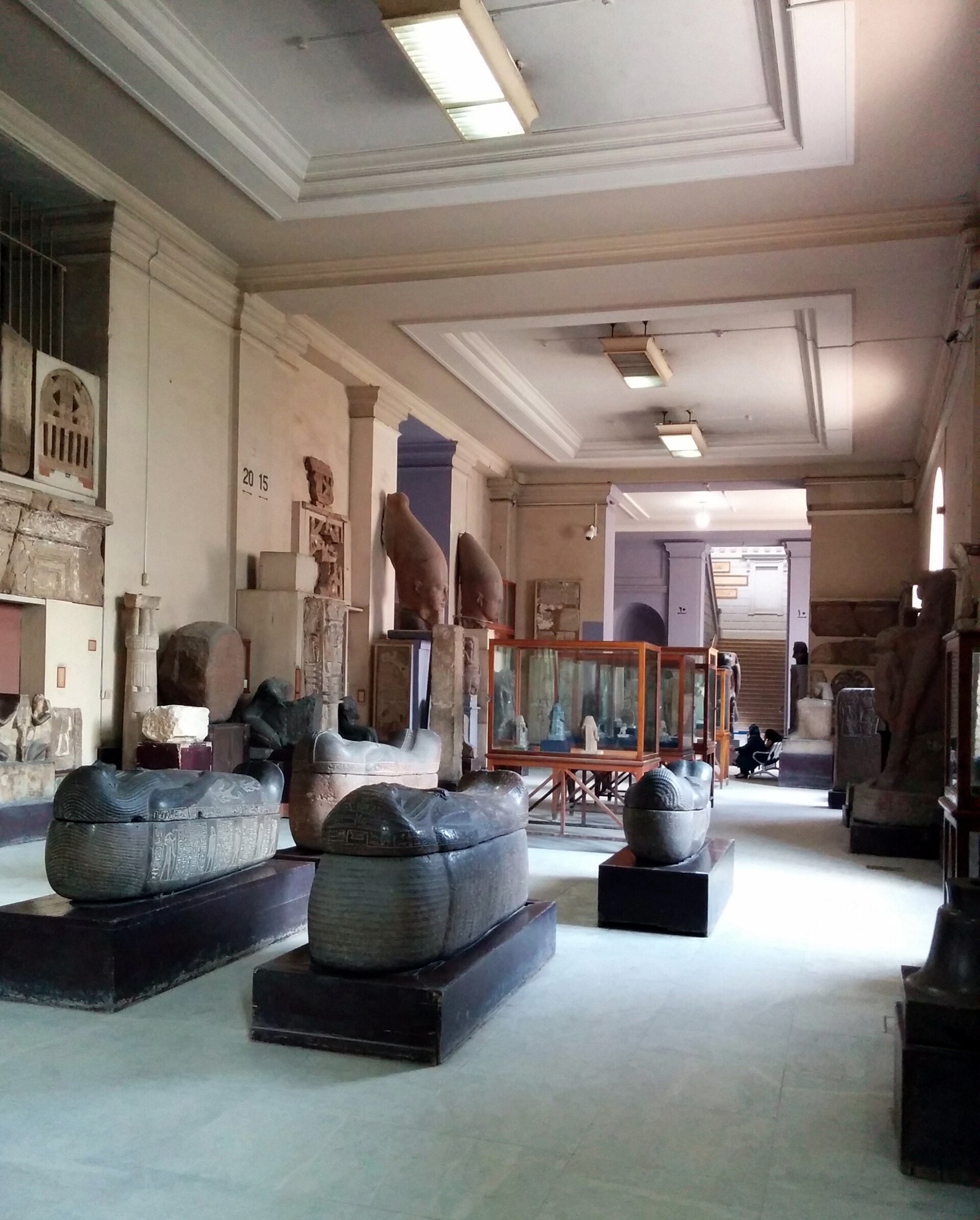
The museum states its own plan plainly: the objects on the ground floor are arranged in chronological order, and there are more than 100 display halls across two floors. The circuit runs clockwise from the Predynastic and Early Dynastic material through the Old, Middle and New Kingdoms to the Late Period and the Greco-Roman era. The side aisles carry stelae, relief blocks and stone anthropoid coffins on low black plinths, many still in the wooden and brass cases of the early twentieth century with hand-lettered labels.
Photograph by Visem · CC BY-SA 4.0 The Old Kingdom rooms
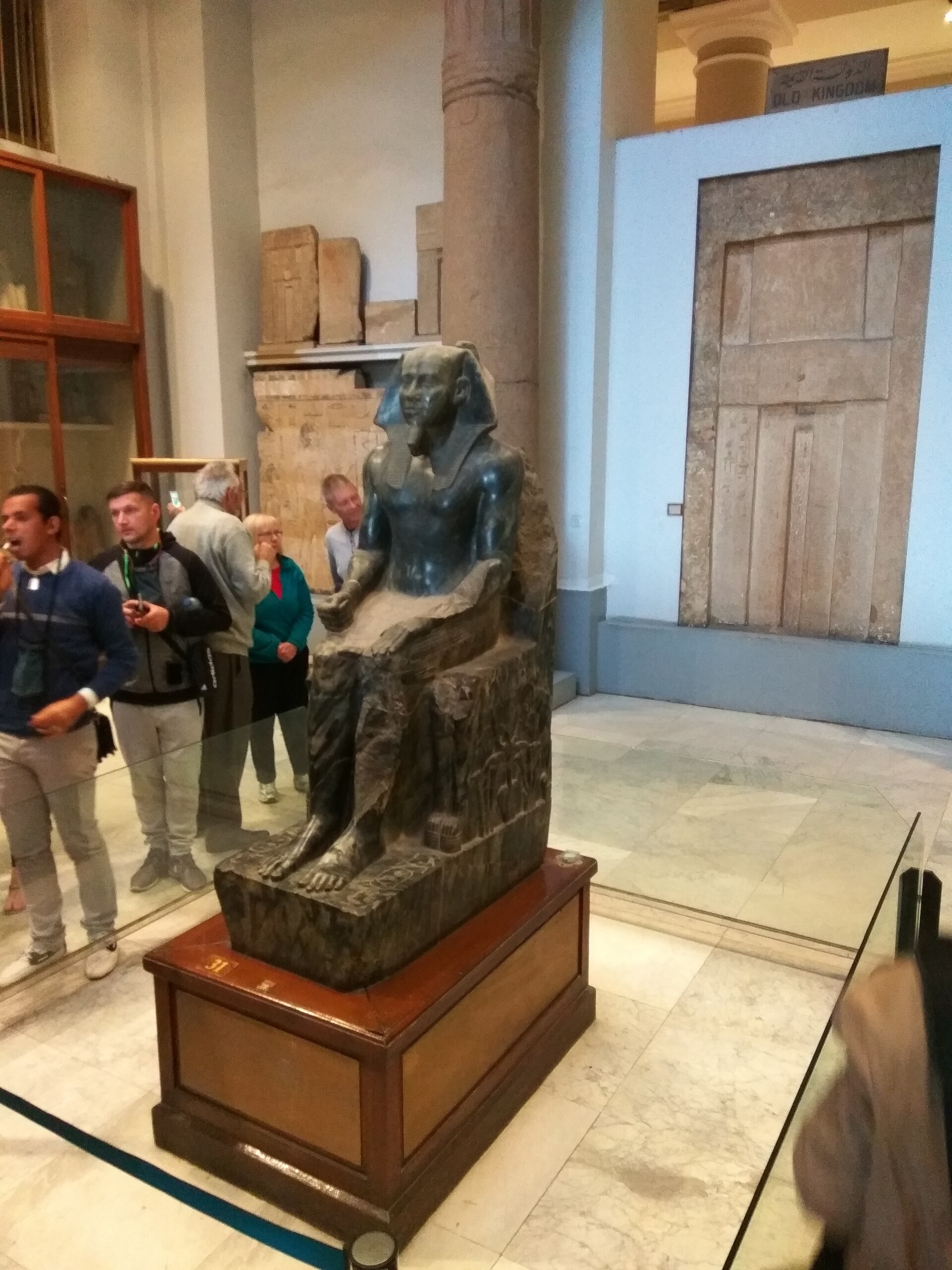
The ministry names the statues of Khufu, Khafre and Menkaure - the builders of the three Giza pyramids - among the museum's own holdings, and they are on the ground floor under signs still lettered OLD KINGDOM in English and Arabic. The seated Khafre in dark stone is the single most reproduced Old Kingdom sculpture in existence. Around it the rooms carry mastaba false doors, painted limestone reliefs and the group statuary of the Fourth to Sixth Dynasties.
Photograph by Sailko · CC BY 3.0 The Amarna gallery
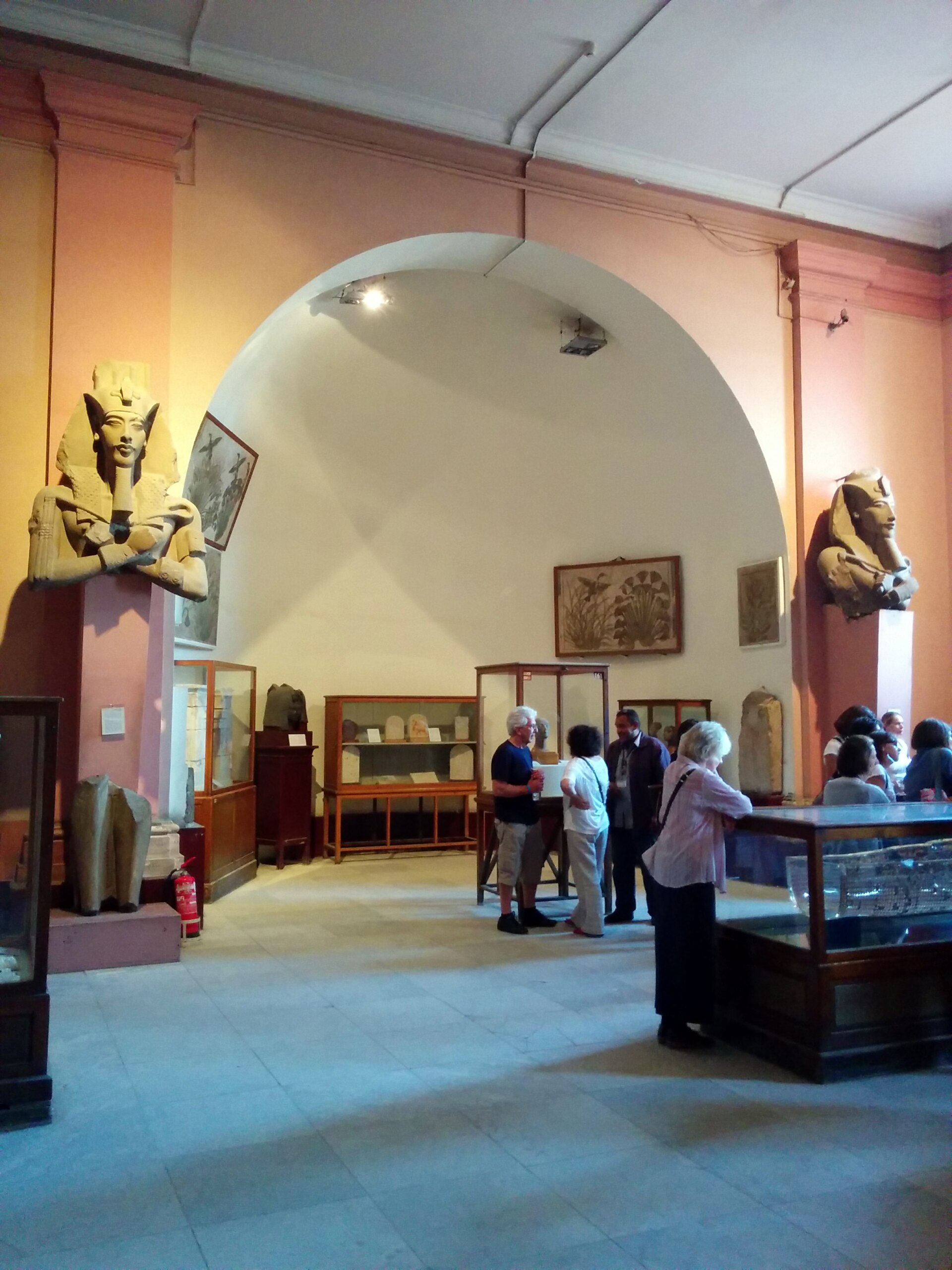
A vaulted room with colossal sandstone pillar-statue busts of Akhenaten set high on the piers flanking the arch, their elongated faces and crossed hands reading from the far end of the gallery, and cases of Amarna sculpture and relief below. The Amarna holding is the part of this museum that cannot be seen anywhere else at this scale, and it is one of the two collections the ministry's own account of the museum does not even need to advertise.
CC0 The upper-floor galleries and the papyri
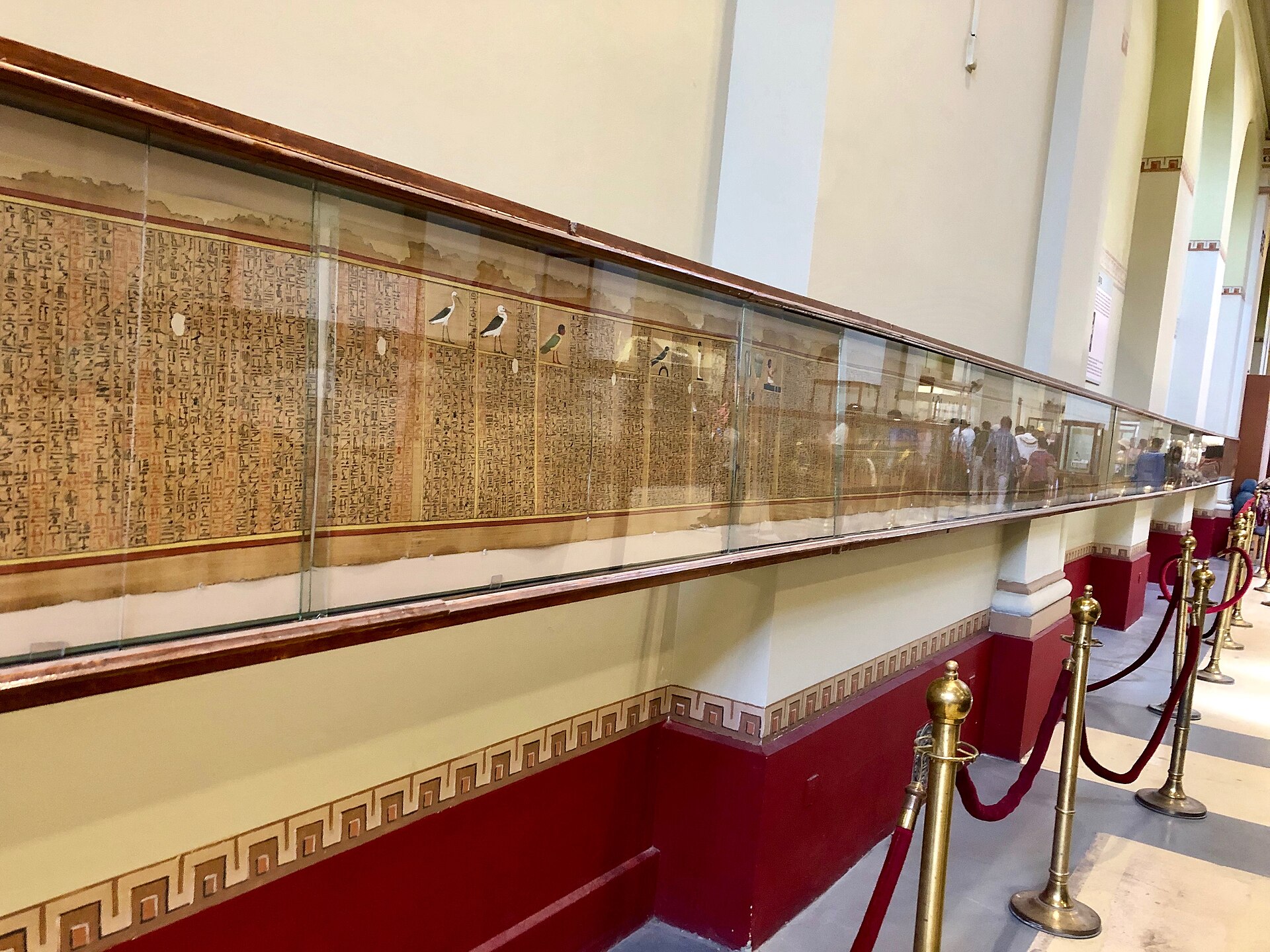
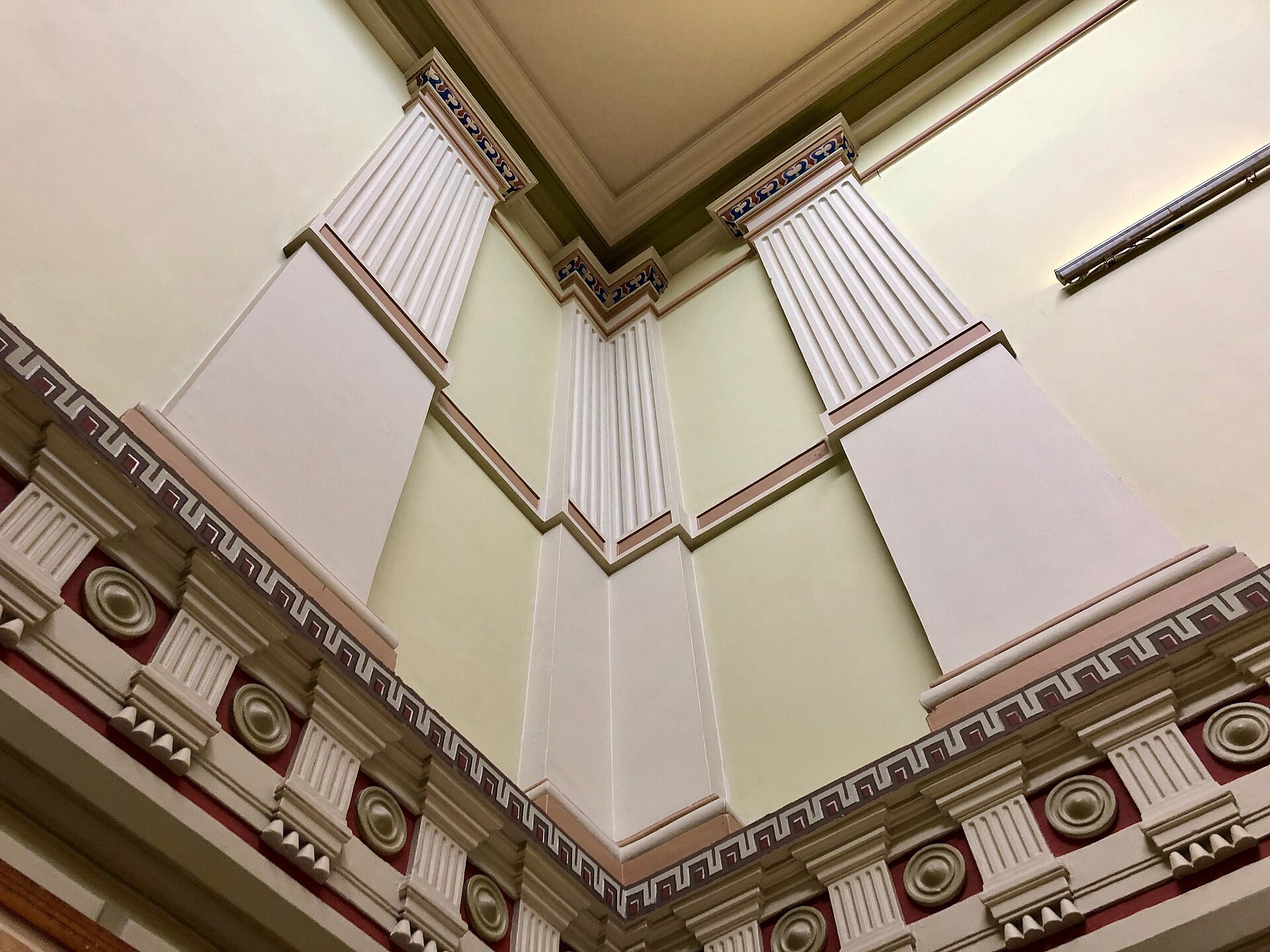
The museum states that objects on the first floor are classified by category or in collections rather than by date. The papyri are shown in long horizontal wall cases running the length of a gallery, which is the only honest way to display a Book of the Dead roll: the text is metres long and the case has to be as long as the roll. Above the red dado and Greek-key band, these are the rooms that once held the Tutankhamun galleries.
CC0 Models, boats and daily life, upper floor
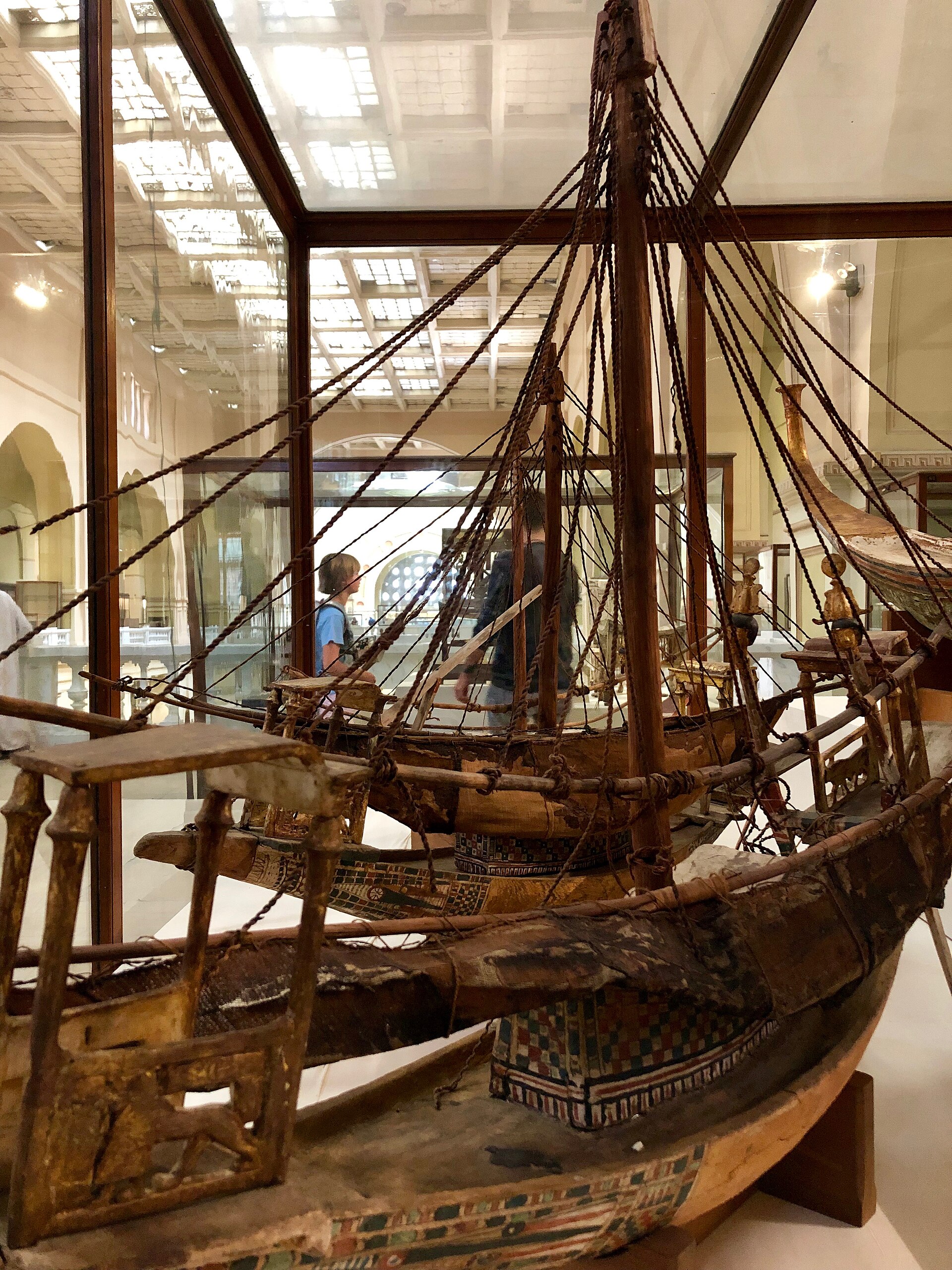
The upper-floor category rooms include the funerary models: wooden boats with rigging, granaries, brewers and bakers, the miniature economy that was buried to keep working after death. They are shown in freestanding glazed cases on the gallery balcony under the light courts, and they are the part of the collection that tells a visitor what ordinary Egyptian life looked like rather than what a king's burial looked like.
CC0 The garden and the forecourt
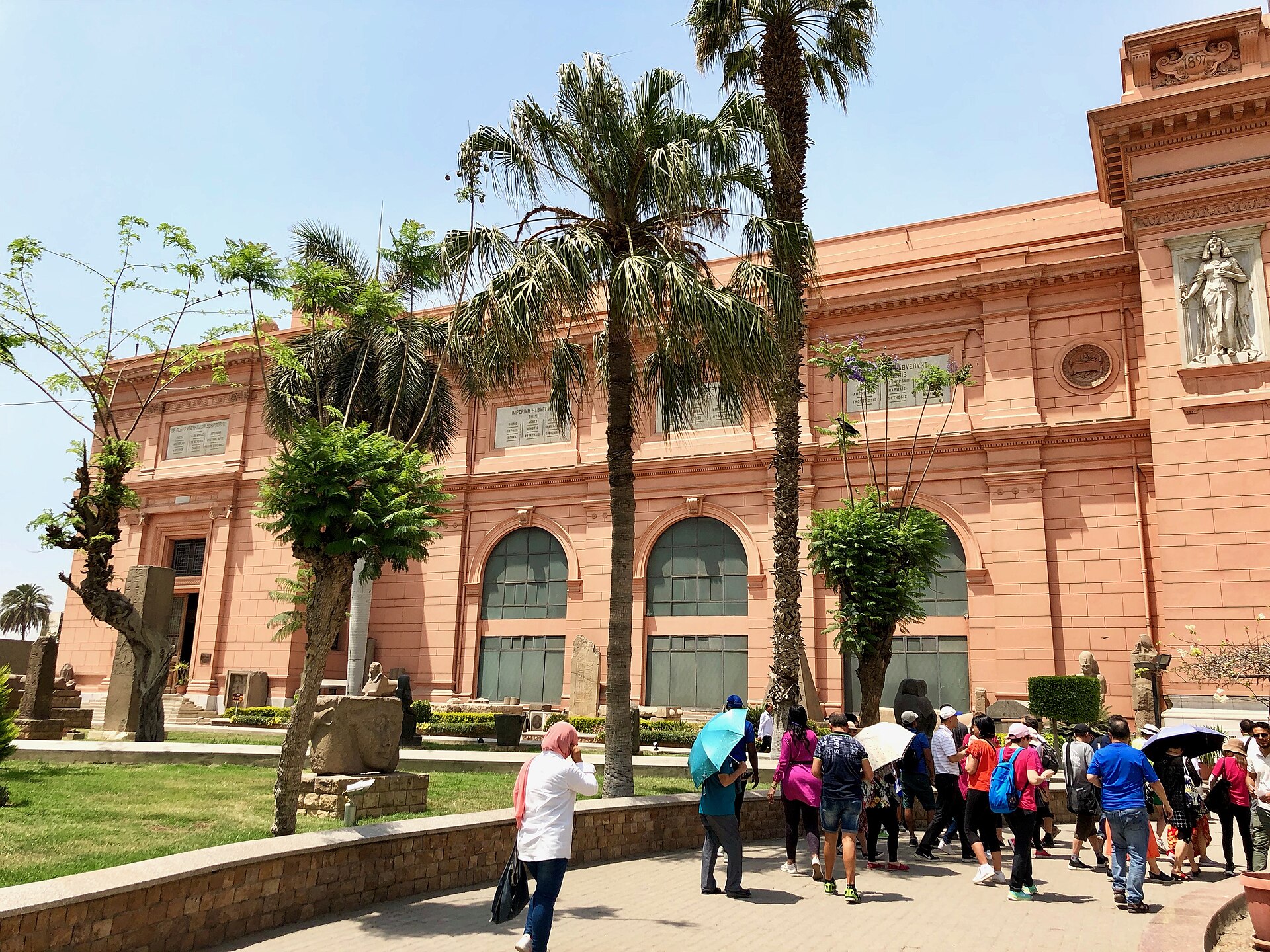
The forecourt is a garden and an open-air lapidarium at once: a lily pond on the axis, palms, and stelae, small sphinxes and architectural fragments set out on the grass, with sphinxes flanking the entrance walk. The end pavilion carries the date 1897, when building began, and the entablature over the doorway carries a Latin dedication in the name of Abbas Helmy II. The garden is free of the ticket barrier in the sense that it is what the queue stands in, and it is the only part of the museum most passers-by on Tahrir Square ever see.
The Yuya and Thuya rooms
The museum's own site gives this burial its own page and it is one of only two galleries the museum singles out. Yuya and Thuya were the parents of Queen Tiye, wife of Amenhotep III, and the grandparents of Akhenaten. The tomb was found by Quibell in 1905 with everything packed into a single undecorated, uninscribed chamber: furniture, objects of daily use, the two bodies still in their coffins in very good condition, and two golden masks found on the mummies. It is the most complete non-royal burial group in the building and the museum describes it as an unrivalled part of the collection. No free-licence photograph of the room itself could be verified.
The Tanis treasure and the jewellery rooms
The ministry names the complete burial of Psusennes I and the treasures of Tanis among the museum's unrivalled holdings, alongside an extensive collection of papyri, sarcophagi and jewellery. This is now the most important gold in the building, and the least famous: with the Tutankhamun collection gone to Giza, the Tanis material is what a visitor comes to Tahrir to see and almost nobody arrives knowing its name. No free-licence photograph that could be verified as this room exists on Commons, so it renders as text; do not substitute a photograph of Tutankhamun material, which is no longer here.
The basement store
The museum says so itself, in one sentence on its own visit page: there is a large basement used to store objects that have not been put on display. The building holds more than 160,000 objects by the museum's own count and has just over 100 display halls, so the store is not an annexe to the museum, it is most of the museum. Nothing in it is visible to a visitor and there is no free-licence photograph of it.
What to see first
The Narmer Palette
Early Dynastic Egypt, c. 3100 BCThe ministry names it among the museum's invaluable artefacts, as the object commemorating the unification of Upper and Lower Egypt under one king. It is the document at the start of Egyptian history, and it did not move to Giza.1
The statues of Khufu, Khafre and Menkaure
Fourth Dynasty, c. 2600-2500 BCThe ministry lists the splendid statues of the three kings who built the Giza pyramids as being in this museum. The seated Khafre stands in an Old Kingdom room on the ground floor, under a sign still lettered in English and Arabic. The pyramids are at Giza; the men who built them are on Tahrir Square.1
The complete burial of Yuya and Thuya
Eighteenth Dynasty, found 1905The parents of Queen Tiye and grandparents of Akhenaten, found by Quibell in 1905 with everything packed into one undecorated chamber: furniture, objects of daily use, both bodies still in their coffins and two golden masks found on the mummies. The most complete non-royal burial group in the building, and one of only two galleries the museum gives its own page.3
The burial of Psusennes I and the treasures of Tanis
Twenty-first Dynasty, from Tanis in the DeltaThe ministry names this among the museum's unrivalled holdings. With Tutankhamun's gold now at Giza, the Tanis material is the most important intact royal burial gold left in this building, and the one almost no visitor arrives able to name.1
The colossal Akhenaten pillar statues
Eighteenth Dynasty, Amarna periodThe Amarna gallery carries the colossal sandstone busts of Akhenaten high on the piers, the sculpture in which an Egyptian king was represented against every convention of Egyptian kingship. This is the deepest holding of Amarna material anywhere and it has never been part of the Tutankhamun transfer.13
The papyri, in wall-length cases
New Kingdom to Late PeriodThe ministry names an extensive collection of papyri among the holdings that complete the museum. They are shown in horizontal cases running the length of an upper-floor gallery, which is the only honest way to display a Book of the Dead roll: as long as the roll actually is.1
The coffins from the royal and priestly cachettes
Twenty-first to Twenty-second DynastiesThe material from the four great hiding places - Deir al-Bahari, found 1881; the tomb of Amenhotep II, 1898; Bab al-Gasus, 1891; and Asasif, found in 2019 - was drawn on for the museum's own cachette exhibition. The Asasif find alone produced thirty painted wooden coffins of priests, priestesses and children.4
The funerary models
Middle KingdomModel boats with rigging, granaries, brewers and bakers, in cases on the upper-floor balcony: the miniature economy buried to keep working after death, and the part of the collection that shows what Egyptian life looked like rather than what a king's funeral looked like.13
The Amarna and Late Period sarcophagi of the ground-floor circuit
Late Period to Greco-RomanThe stone anthropoid coffins ranged along the ground-floor side aisles are the ordinary substance of this museum: not masterpieces on plinths but a mass of comparable objects, still in early twentieth-century cases with hand-lettered labels. For a researcher this density is the reason to come here rather than to a new museum.13
The first building in the world put up to be a museum
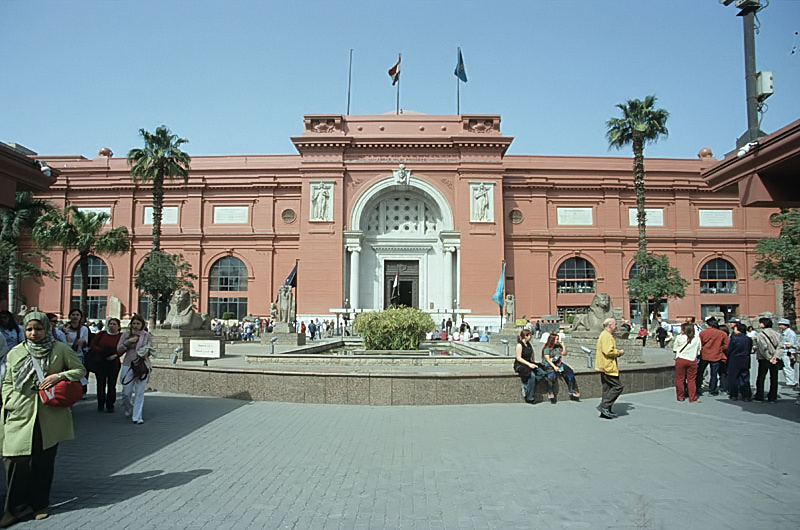
The Egyptian government held an international competition for the design in 1895 - the ministry describes it as the first of its kind - and it was won by the French architect Marcel Dourgnon. Work began in 1897 and the museum opened on 15 November 1902, inaugurated by Khedive Abbas Helmy II, whose name is on the Latin dedication cut into the entablature over the door. The museum's own claim about itself is worth quoting in full because it is the sort of claim that usually turns out to be inflated and here appears not to be: the government decided to build it in the heart of Cairo to be the first building in the world built specifically to serve as a museum.
What Dourgnon built is a European neoclassical shell to hold Egyptian antiquity, and it does not pretend otherwise: fluted pilasters, Greek-key friezes, painted rosettes, a domed rotunda behind the entrance, glazed light courts over an arcaded upper gallery. All of that glazing is the point. This is 1902, before dependable artificial gallery lighting, so the plan is a device for bringing the Cairo sun down onto stone without bringing the Cairo heat with it. The building is pink, free-standing, and set back behind a garden that doubles as an open-air lapidarium, with a lily pond on the axis and stelae and small sphinxes out on the grass.
The internal logic is simple and has not changed. The ground floor runs in chronological order, from the Predynastic material round to the Greco-Roman. The upper floor is arranged by category and by collection instead - papyri here, models there, jewellery, coffins, the burial groups kept together. More than 100 display halls across the two floors. And then the sentence on the museum's own visit page that tells a reader what kind of institution this really is: there is also a large basement used to store objects that have not been put on display. With more than 160,000 objects and a hundred-odd halls, the store is not an annexe to this museum. It is most of it.
What is left after the great dispersal
This is the fact a visitor needs and the hardest one to find, because almost every secondary account of this museum was written before it stopped being true. Over five years the Egyptian state moved the two most famous holdings out of Tahrir Square and into two new museums.
The first move was the royal mummies. The museum's own listing for the Pharaohs' Golden Parade, dated 3 April 2021, describes a solemn procession transporting twenty-two royal mummies of the kings and queens of Egypt out of the Egyptian Museum, and its announcement of the previous day said Tahrir would close its doors temporarily for the event. The National Museum of Egyptian Civilization at Fustat now lists a Royal Mummies Gallery among its own exhibits. Those two institutional statements are what we have; between them they establish that the royal mummies left Tahrir for Fustat in April 2021. The parade announcement is also, five years later, still the most recent item on the Tahrir museum's news feed.
The second move was Tutankhamun. On 12 September 2025 Ahram Online reported that the Tahrir museum would close its Tutankhamun Gallery from 20 October 2025 so that the last of the boy king's treasures could be transferred to the Grand Egyptian Museum at Giza, which opened on 1 November and reopened after a short closure on 4 November, the 103rd anniversary of Howard Carter's discovery. The whole collection, more than 5,000 objects, is now displayed together in a single hall at Giza for the first time since it came out of the ground. The ministry had already been reporting the transfers in batches - 163 pieces in one consignment, including the ceremonial chair and the gilded canopic compartment, moved from Tahrir to their permanent location at Giza. Mohamed Ismail Khaled, Secretary-General of the Supreme Council of Antiquities, was quoted saying that the Egyptian Museum in Tahrir would remain open to the public as usual, with only the Tutankhamun Gallery affected by the closure.
So what is still here? The ministry's own current page for the museum answers that question by what it chooses to name: the complete burials of Yuya and Thuya; Psusennes I and the treasures of Tanis; the Narmer Palette; the statues of Khufu, Khafre and Menkaure; and an extensive collection of papyri, sarcophagi and jewellery. The Amarna gallery, with its colossal Akhenaten pillar statues, has never been part of either transfer. What no authority has published is an object-by-object list of what stayed and what went, and we are not going to invent one. Where the record is thin - the coffins from the royal cachettes, whose mummies went to Fustat - we say so in the open questions rather than imply an answer.
The honest way to put the whole thing: Tahrir has lost the two collections that made it famous and kept the collection that makes it important.
Where the coffin of Nedjemankh actually is
This archive holds a record of the gilded coffin of Nedjemankh, the object the Metropolitan Museum of Art bought in July 2017 for 3.5 million euros on a forged 1971 Egyptian export licence and surrendered to Egypt in 2019 after the Manhattan District Attorney's Antiquities Trafficking Unit established that it had been looted from the Minya region in 2011. Because that record and this page both exist, the question of where the coffin is now has to be answered here rather than assumed.
It is not at Tahrir. Ahram Online, reporting on 1 October 2019, placed the coffin's first display in Egypt at the National Museum of Egyptian Civilization at Fustat, at an inauguration attended by the Minister of Antiquities Khaled El-Enany and the United States Charge d'Affaires Thomas Goldberger. The Museum of Looted Antiquities, the peer-reviewed database of trafficked objects, records as of 2026 that the coffin is displayed at the National Museum of Egyptian Civilization. Two independently fetched sources, six years apart, put it at Fustat.
The point is worth labouring because the plan was different and the plan is what most accounts repeat. The case note published by the Art-Law Centre at the University of Geneva in June 2019 recorded that on its return the coffin would be temporarily displayed at the Egyptian Museum in Tahrir Square before being transferred to the Grand Egyptian Museum after its official opening, then expected in 2020. Neither leg of that plan is what happened. A reader who wants to stand in front of the coffin should go to Fustat, not to Tahrir and not to Giza.
The museum was built to stop the export, and the export is why it has a collection
The provenance of this collection is the whole argument of this publication, and it runs in both directions at once. The Antiquities Service and the museum that grew out of it exist because Egyptian antiquities were leaving the country in bulk in the nineteenth century, and the institution's founding purpose was to stop that and to keep the material in Egypt. The same century's export regime is why the great Egyptian collections of Europe and North America exist at all, and why almost every Egyptological museum outside Egypt is holding objects whose departure the Cairo museum was created to prevent.
The legal line that governs everything after it is Egypt's Law No. 117 of 1983 on the protection of antiquities. Before it, as Ahram Online summarised in reporting the Nedjemankh case, Egyptian law allowed the export of some artefacts; after it, lawful export became practically impossible and ownership vested in the state. That is precisely why the forger who supplied the Metropolitan chose 1971 as the date on the fake licence: a document dated before 1983 places an object on the permitted side of the line. A forger picking a year is picking a legal regime.
Two records in this archive are about objects that went home. The Euphronios krater went back to Italy from the Metropolitan; the coffin of Nedjemankh came back to Egypt from the same museum. Egypt's repatriation campaign is run through an Antiquities Repatriation Department, whose supervisor-general Shaaban Abdel-Gawad is quoted in the reporting on the Nedjemankh case describing the twenty months of investigation during which Egypt supplied the evidence of ownership and the proof that the export licence was fake. The pattern in that case - a looted object, a forged pre-1983 licence, a private collection that cannot be named, a European dealer network, a great museum's due diligence that asked the right question and then accepted the wrong answer - is the pattern this publication exists to record. It is also why the criticism on this page runs both ways. Egypt has a strong claim against the museums that hold its material. It also lost fifty-four objects out of its own national museum in a single night in 2011.
28 January 2011, and what was and was not recovered
The museum stands on Tahrir Square, which is why it is in this story at all. On 28 January 2011, during the uprising, looters and protesters got into the building; reports cited in the Trafficking Culture account suggest as many as a thousand people were involved. They raided the museum shop for jewellery, smashed display cases and ransacked the ticket office. Nine people were reportedly arrested trying to leave through fire exits carrying the heads of two mummies, which had broken into pieces.
What followed was worse for the record than the theft itself, because the account kept changing. Early statements issued through the then Minister of Antiquities said that up to seventy objects had been damaged but that apparently nothing had been stolen; a later statement from the same office confirmed that a number of objects had in fact been taken. Objects then began turning up in the immediate neighbourhood: in mid-February 2011 a statue of Akhenaten was found amid rubbish close to Tahrir Square, and around the same time other pieces, including part of a broken wooden sarcophagus, were found on the ground east of the museum. Lists of the missing were published, first by the University of Pennsylvania's Cultural Heritage Center on 1 March 2011 and then by Egypt's Supreme Council of Antiquities on 15 March 2011, the latter naming fifty-four objects. Further recoveries were made in March, and in May 2011 four statues were recovered in a police action, two of them confirmed as the museum's. In February 2012 the International Council of Museums launched an Emergency Red List of Egyptian Cultural Objects at Risk, compiled with the Supreme Council of Antiquities and the Egyptian Museum, and launched it at the National Museum of Egyptian Civilization.
How many of the fifty-four came back is not a number we will state, because no source we fetched states it authoritatively and the figures in circulation disagree with each other. The scholarly account we relied on is careful not to give a final total either. That gap is recorded in the open questions, where it belongs. What is not in doubt is the connection between this night and the coffin in our own records: the gilded coffin of Nedjemankh was dug out of the ground in the Minya region in the same autumn, in the same collapse of control, and the two events are one event.
The restoration that has been running since 2012
The museum has been under a long, phased programme to put Dourgnon's building back. The initiative was launched in 2012 under the Ministry of Antiquities with the participation of the European Union, with the stated aim of restoring the museum to its original state as the French architect designed it in the late nineteenth century, and it has proceeded floor by floor: walls, floors, ceilings and glass.
The larger intervention is a European partnership. The ministry announced a grant of 3.1 million euros from the European Union, expected to run over three years, creating what it described as a first-time partnership between six of the most important museums in Europe - Turin, the Louvre, the British Museum, Berlin and Leiden are the ones the ministry names - together with the Institut Francais d'Archeologie Orientale. The brief was not decoration: a new strategic vision for the museum, a new display system, restoration and conservation laboratories and other facilities to international standards. The fabric schedule the ministry published is specific to the point of being touching about the state of the place: the roofs, the truss over the pool, the dome above the main entrance, the glass surfaces in the side halls, the replacement of all the museum's glass with laminated glass, repairs to floors and walls, and the restoration of the decoration and colour. An earlier phase had been completed with support from the German Ministry of Foreign Affairs.
Two things are worth saying plainly about this. The first is that a museum needing a foreign grant to rebuild its display cases, while holding the largest collection of Pharaonic antiquities in the world, is a fact about resources rather than about scholarship. The second is that the ministry's own timetable did not hold: in November 2019 it told an audience of forty ambassadors that the museum's 118th anniversary the following year would coincide with the opening of the Grand Egyptian Museum. Giza opened in November 2025, five years late, and the delay is the reason Tahrir kept the Tutankhamun collection for as long as it did. Anyone reading a guidebook printed before then is reading about a museum that no longer exists in that form.
What visitors say
We publish no visitor prose and cite no platform average, so what follows is drawn from the museum's and the ministry's own statements and from named reporting. The honest summary is that this is now a different museum from the one in most guidebooks. Between 2021 and 2025 the two things a first-time visitor arrives expecting were removed: twenty-two royal mummies went to the National Museum of Egyptian Civilization at Fustat in April 2021, and the Tutankhamun collection of more than 5,000 objects went to the Grand Egyptian Museum at Giza, the Tahrir Tutankhamun Gallery closing on 20 October 2025. What is left is not a remainder. It is the deepest collection of Egyptian antiquity on earth outside those two new buildings: the ministry still describes Tahrir as holding the largest collection of Pharaonic antiquities in the world, more than 160,000 objects across more than 100 halls, with a basement store holding what is not displayed. The museum is cheap for Egyptians and expensive for foreigners by published policy, open seven days, and the building is itself a listed monument under a restoration programme that has run in phases since 2012.
What is praised, what is criticised
- Praised: the Old Kingdom rooms and the Amarna gallery, which cannot be substituted at this depth anywhere in the world and were never part of either transfer
- Praised: the resident price: EGP 30 for an Egyptian adult and EGP 10 for an Egyptian student, with free entry for Egyptians over 60, children under 6, orphaned children and state and Al-Azhar school trips
- Praised: the building itself, which the Minister of Antiquities described as a historical monument in its own right rather than a container for one
- Praised: open seven days a week, and photography with a phone costs nothing
- Praised: the density: for a researcher, rooms full of comparable objects in old cases are more useful than a dozen masterpieces on plinths
- Criticised: the dispersal is not explained to the visitor by the museum's own web presence: its subportal news feed stops at an announcement of 2 April 2021 about the mummy parade, and nothing there tells a reader that the Tutankhamun galleries have since closed
- Criticised: the ticket window shuts at 16:00, an hour before the galleries, and at 15:00 in Ramadan - the most common way to lose an afternoon here
- Criticised: the foreign adult rate of EGP 550 is more than eighteen times the Egyptian adult rate of EGP 30; the differential is published policy rather than a surcharge, but it is steep by regional standards
- Criticised: the display is old, dense and thinly labelled, which is the explicit reason a European Union grant of EUR 3.1 million was brought in to rebuild the display system, and that project has been running in phases since 2012
- Criticised: the museum was looted on 28 January 2011 from its own roof and through its own doors, and the account of what was lost was wrong before it was right: the then Minister of Antiquities first said that up to seventy objects were damaged but apparently nothing was stolen, and only later confirmed that objects had in fact been taken
Questions about The Egyptian Museum, Cairo
Where is The Egyptian Museum, Cairo?
Meret Basha, Tahrir Square, Downtown Cairo, Egypt.
How much does it cost to visit?
Foreign visitor, adult: EGP 550; Foreign visitor, student: EGP 275; Egyptian, adult: EGP 30; Egyptian, student: EGP 10; Audio tour, foreign visitor: EGP 75. As confirmed 1 September 2026.
When is it open?
Sunday to Saturday 09:00-17:00; Ramadan, daily 09:00-16:00. Closed: The ministry publishes no weekly closing day: the museum is listed as open Sunday to Saturday, and the ministry's ticketing site says All Days. The ticket window closes at 16:00, an hour before the galleries; the ticketing site puts it as last entry 16:00. As confirmed 1 September 2026.
How do you get there?
Metro: The museum's own visit page names the Metro as the available public transport and Tahrir Parking as the nearest parking. The museum stands on the north side of Tahrir Square in downtown Cairo; On foot: 1 Meret Basha, on the north side of Tahrir Square, a few minutes from the Nile Corniche and the Qasr al-Nil bridge; Car: Nearest parking: Tahrir Parking.
What should you see first?
The Narmer Palette (Early Dynastic Egypt, c. 3100 BC); The statues of Khufu, Khafre and Menkaure (Fourth Dynasty, c. 2600-2500 BC); The complete burial of Yuya and Thuya (Eighteenth Dynasty, found 1905); The burial of Psusennes I and the treasures of Tanis (Twenty-first Dynasty, from Tanis in the Delta); The colossal Akhenaten pillar statues (Eighteenth Dynasty, Amarna period); The papyri, in wall-length cases (New Kingdom to Late Period).
What we could not confirm
- There is no published object-by-object list of what stayed at Tahrir and what moved to Giza and Fustat. The ministry's own museum page names Yuya and Thuya, Psusennes I and the Tanis treasures, the Narmer Palette and the statues of Khufu, Khafre and Menkaure as being here, and Ahram Online carries the Supreme Council of Antiquities' statement that only the Tutankhamun Gallery closed - but the inventory itself is not public, and this page names nothing as still present that those sources do not name.
- The status of the coffins from the royal cachettes is unresolved. Twenty-two royal mummies went to the National Museum of Egyptian Civilization in April 2021; we could not establish from any source we fetched whether their coffins went with them, stayed at Tahrir, or were split.
- How many of the fifty-four objects on the Supreme Council of Antiquities' final missing list of 15 March 2011 were ultimately recovered. Recoveries through 2011 are documented individually; no authoritative final total was found, the figures in circulation disagree, and the scholarly account we used declines to give one.
- No annual visitor figure for the museum was found on any ministry or museum page, and none is published beside the ticket prices. We therefore publish none.
- Whether the phased revival project and the European Union display programme are now complete. The ministry's published schedule ran in phases from 2012 and expected the ground floor to reopen in late 2020; nothing we fetched states a completion.
- The museum's own website, egyptianmuseumcairo.eg, could not be read: it returns HTTP 403 to command-line clients and serves a bot-verification wall in the in-app browser, which we did not attempt to defeat. Everything on this page attributed to the institution comes from the Ministry of Tourism and Antiquities site and its Egyptian Museum subportal instead.
- The museum's subportal news feed has published nothing since 2 April 2021, so the institution's own web presence does not describe its own current state. Prices and hours here come from the ministry's museum page, which is current.
Images
Sources
- 1Ministry of Tourism and Antiquities, The Egyptian Museum: opening hours for all seven days and Ramadan hours, ticket prices for foreign visitors and Egyptians with the audio tour, the free entry policy, the photography and general visitor rules, bag limits, the list of services, the 1895 international competition won by Marcel Dourgnon, the 1902 inauguration by Khedive Abbas Helmy II, and the ministry's own naming of the museum's principal holdings. Fetched 5 August 2026. egymonuments.gov.eg/en/museums/egyptian-museum
- 2Ministry of Tourism and Antiquities, The Egyptian Museum subportal: contact block giving the address at 1 Meret Basha, Tahrir Square, the telephone number and the museum email, and the Pharaohs' Golden Parade entry recording the transfer of 22 royal mummies from the museum on 3 April 2021. egymonuments.gov.eg/en/subportals-group/the-egyptian-museum
- 3Ministry of Tourism and Antiquities, The Egyptian Museum subportal, Our Story, Visit and Tomb of Yuya and Thuya pages: the claim to be the first building in the world built specifically to serve as a museum, work beginning in 1897 and opening on 15 November 1902, more than 160,000 objects from the prehistoric to the Roman period, Dourgnon's design with more than 100 display halls on two floors, the ground floor chronological and the first floor by category or collection, the large basement store, and the Yuya and Thuya burial found by Quibell in 1905. These pages are rendered client-side and were read in the in-app browser; command-line clients receive only the navigation shell. egymonuments.gov.eg/en/subportals-group/the-egyptian-museum/the-egyptian-museum-our-story
- 4Ministry of Antiquities, Celebrating the 117th Anniversary of the Egyptian Museum, on the anniversary of 15 November 2019: the European Union grant of EUR 3.1 million over three years, the partnership with Turin, the Louvre, the British Museum, Berlin and Leiden and the Institut Francais d'Archeologie Orientale, the earlier phase supported by the German Ministry of Foreign Affairs, the fabric schedule down to the dome over the main entrance and the replacement of all the museum's glass, the revival initiative launched in 2012 to restore Dourgnon's interior, the mummy cachette exhibition drawing on Deir al-Bahari, the tomb of Amenhotep II, Bab al-Gasus and Asasif, and the ministry's expectation that the 118th anniversary would coincide with the opening of the Grand Egyptian Museum. egymonuments.gov.eg/news/celebrating-the-117th-anniversary-of-the-egyptian-museum/
- 5Ministry of Tourism and Antiquities, The Grand Egyptian Museum receives 163 pieces from the treasures of the golden king Tutankhamun: the consignment coming from the Egyptian Museum in Tahrir as part of the plan to display the whole collection in one place, and the statement that the remaining Tutankhamun pieces would follow on a set timetable. egymonuments.gov.eg/en/news/the-grand-egyptian-museum-receives-163-pieces-from-the-treasures-of-the-golden-king-tutankhamun-1
- 6Nevine El-Aref, 'Egyptian Museum in Tahrir to shut Tutankhamun gallery as treasures leave for the GEM', Ahram Online, 12 September 2025: the gallery closing from 20 October 2025, the transfer of the last of the treasures, more than 5,000 objects displayed together at the Grand Egyptian Museum for the first time, the Giza opening on 1 November and reopening on 4 November on the 103rd anniversary of Carter's discovery, and Mohamed Ismail Khaled of the Supreme Council of Antiquities stating that Tahrir itself remains open with only that gallery affected. Cloudflare-challenged to curl and to WebFetch; read in the in-app browser. english.ahram.org.eg/News/552900.aspx
- 7Nevine El-Aref, 'Coffin of ancient Egyptian priest Nedjemankh on display for first time in Egypt after repatriation from US', Ahram Online, 1 October 2019: the coffin displayed at the National Museum of Egyptian Civilization, the inauguration attended by Minister Khaled El-Enany and United States Charge d'Affaires Thomas Goldberger, Shaaban Abdel-Gawad of the Antiquities Repatriation Department on the twenty-month investigation, and the point that Egyptian law before Law No. 117 of 1983 allowed the export of some artefacts. Read in the in-app browser. english.ahram.org.eg/NewsContent/9/40/351933/Antiquities/Ancient-Egypt/Coffin-of-ancient-Egyptian-priest-Nedjemankh-on-di.aspx
- 8Museum of Looted Antiquities, 'Gold Coffin of Nedjemankh', contributed by Liv Siefert and peer reviewed by Jason Felch, accessed 5 August 2026: the trafficking chain from the Minya looting through Sharjah and Germany to Paris, the charges brought in France against Kunicki, Semper, Dib, Simonian and the former Louvre director, and the statement that the gold coffin is today displayed at Cairo's National Museum of Egyptian Civilization. mola.omeka.net/exhibits/show/welcome/item/2235
- 9Margaux Sitavanc, Justine Ferland and Marc-Andre Renold, 'Case Nedjemankh and His Gilded Coffin - Metropolitan Museum of Art and Egypt', Platform ArThemis, Art-Law Centre, University of Geneva, June 2019: the chronology of the purchase and return, the forged 1971 export licence and why 1983 is the line that matters, the January 2011 burglary of the Cairo museum during the Tahrir confrontations, and the since-superseded plan to display the coffin temporarily at the Egyptian Museum in Tahrir Square before transferring it to the Grand Egyptian Museum. plone.unige.ch/art-adr/cases-affaires/nedjemankh-and-his-gilded-coffin-2013-metropolitan-museum-of-art-and-egypt
- 10Suzie Thomas, 'Egyptian Museum in Cairo - Thefts and Recoveries in 2011', Trafficking Culture encyclopedia, last modified 21 August 2012: the 28 January 2011 break-in and the reported scale of it, the museum shop and ticket office, the nine arrests with two mummy heads, the contradictory ministerial statements, the objects found discarded near the museum including an Akhenaten statue in rubbish, the Penn Cultural Heritage Center list of 1 March 2011 and the Supreme Council of Antiquities list of fifty-four objects of 15 March 2011, the recoveries through March and May 2011, and the ICOM Emergency Red List launched in February 2012. traffickingculture.org/encyclopedia/case-studies/egyptian-museum-cairo-thefts-and-recoveries-in-2011/
- 11National Museum of Egyptian Civilization, official site: the Fustat and Ain al-Sira address, the Royal Mummies Gallery among its exhibits, and its Main Gallery highlight list, which does not include the coffin of Nedjemankh. Fetched to establish that Fustat is a separate institution from the museum on this page and to check its own published highlights. nmec.gov.eg/
- 12Wikidata, Egyptian Museum (Q201219): used only as machine identity. English label Egyptian Museum, Arabic label used for name_local, coordinates 30.047778 / 31.233333 on Tahrir Square, inception 1902, address given as El Tahrir Sq., Downtown, Cairo, Commons category Egyptian Museum (Cairo), and no dissolution date. Tertiary; every perishable figure on this page comes from the ministry instead. wikidata.org/wiki/Q201219
- 13Wikimedia Commons, Category:Egyptian Museum (Cairo) with Category:Main facade of Egyptian Museum, Cairo, Category:Interior of Egyptian Museum (Cairo), Category:Gardens in the Cairo Egyptian Museum and the by-room and by-gallery subcategories: the plates on this page, each licence verified per file from extmetadata.LicenseShortName and each image inspected by eye before use. commons.wikimedia.org/wiki/Category:Egyptian_Museum_(Cairo)
- 14Ministry of Tourism and Antiquities official ticketing site, Egyptian Museum - Book Your Tickets: an independent confirmation of the four admission tiers, with the two price columns labelled Other Nationality and Egyptian and the note that all prices are in Egyptian pounds; All Days opening from 09:00 with last entry 16:00 for both summer and winter and 15:00 in Ramadan; the free entry policy for children under 6, Egyptians with special needs and Egyptians over 60; that a student must show valid identification and be no older than 24; that an Egyptian's spouse of another nationality is treated as Egyptian; and the instruction to arrive at least an hour before closing. Fetched 6 August 2026. egymonuments.com/locations/details/EgyptianMuseum