Magna Carta, 1297 (the Perot-Rubenstein copy)
Royal Chancery of Edward I of England · 12 October 1297
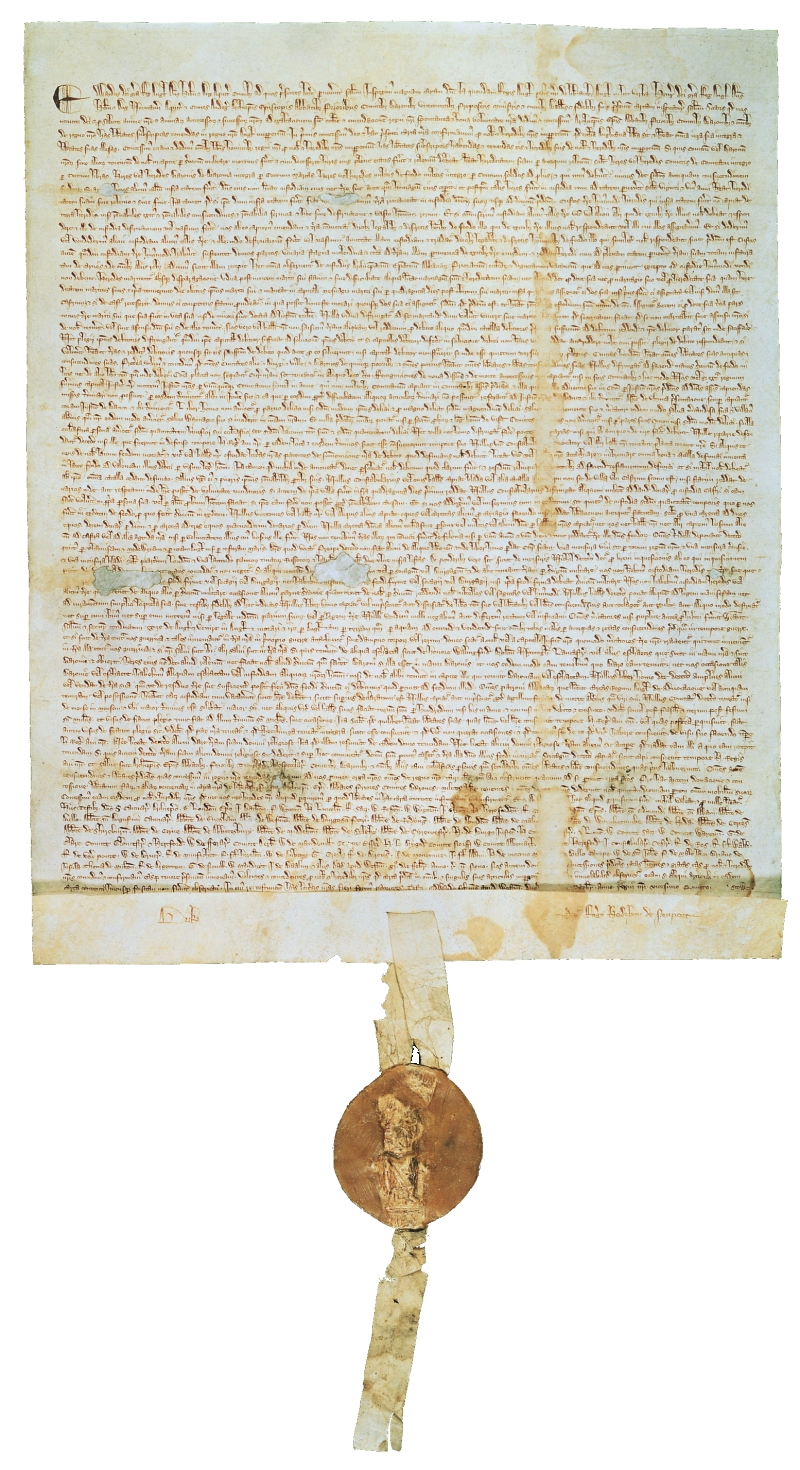
The document itself, with Edward I's small wax seal visible at the foot of the parchment tag. Sourced via Wikimedia Commons directly to the National Archives' own featured-documents exhibit page (archives.gov), the most verifiable origin among the Commons files for this object; a National Archives government hosting rather than Sotheby's or wire-service photography.
| Artist | Royal Chancery of Edward I of England |
|---|---|
| Date | 12 October 1297 |
| Medium | Latin manuscript in a chancery hand on parchment, with the royal seal of Edward I in natural wax on a parchment tag |
| Dimensions | Approximately 370 x 420 mm, plus a 32 mm fold at the foot; margins of 10 mm (left), 28 mm (top) and 15 mm (right); the seal itself is small, about 22 mm wide |
| Where it is now | National Archives Building, Washington, DC, West Rotunda Gallery (David M. Rubenstein Gallery)last confirmed 7 August 2026 |
| Inventory number | Displayed courtesy of David M. Rubenstein; the National Archives holds it on continuous public loan, not as an accessioned federal record |
| Attribution | AcceptedIssued in the name of Edward I as an inspeximus (a confirmation reciting and re-granting an earlier charter) on 12 October 1297, produced and sealed by the royal chancery while the king was campaigning in Flanders. Full note |
| Object type | Manuscript |
| Period | English, late thirteenth century, reign of Edward I |
| Inscriptions | 68 lines of text in a neat chancery-style hand, ruled with faint vertical plumb lines. A near-contemporary docket reads 'tradatur Rogero Hodelyn de Neuport', recording the proclamation of the charter to Roger Hodelyn within the county - a detail Sotheby's called unique among the surviving 1297 exemplifications. |
| Owners on record | 5 links4 documented, 1 disputed |
| Sources | 19 cited |
About this record Last verified 7 August 2026 · 19 sources cited · Change log
On this page 11 sections
ContentsClose
One of only four surviving originals of the 1297 confirmation of Magna Carta, the version of the charter that Edward I entered onto England's official Statute Rolls and that has functioned as living law, not merely historical relic, ever since. It is the only 1297 original ever to have left England, the only one ever in private hands, and - since Ross Perot bought it in 1983-84 - the only one in the United States.
Rediscovered among the Brudenell family papers at Deene Park in the 1970s, it was bought by Perot for 1.5 million US dollars and lent to the National Archives from 1985. The Perot Foundation sold it at Sotheby's on 18 December 2007 for 21.3 million dollars to David M. Rubenstein, who immediately returned it to the National Archives on permanent loan and later gave 13.5 million dollars toward the gallery that now houses it.
This is not the 1215 Magna Carta of popular memory - a different, more famous, and legally superseded text. It is the 1297 confirmation, the version that entered statute law and that historians identify as the specific text that reached the framers of the US Constitution and Bill of Rights.
Provenance
Each link is graded. Documented: a cited source supports it. Disputed: the identification is argued but not established. Unknown: no owner for that span, and the gap is not smoothed into a narrative. The grades in the glossary.
- 1297 -Crown of England, issued to an unrecorded original recipientdocumented
Sealed 12 October 1297 in the name of Edward I, then in Flanders, as one of a chancery run of exemplifications sent out to the counties to be read aloud and entered into local record, part of the process by which the 1297 Confirmatio Cartarum placed Magna Carta onto England's Statute Rolls. The docket 'tradatur Rogero Hodelyn de Neuport' shows this particular exemplar was formally delivered for proclamation, but the original recipient institution or sheriff is not named in any source consulted.123
- 1297 - prior to 1983Brudenell family of Amersham, Buckinghamshire, later of Deene Park, Northamptonshiredisputed
Sotheby's own 2007 catalogue graded this link exactly, and this record follows that grading rather than smoothing it: 'certainly since the nineteenth century, probably since the seventeenth century, and perhaps since the fourteenth century, the property of the Brudenell family.' Popular accounts compress this into 'the Brudenell family owned it for centuries' or 'since the 18th century', but the earliest secure documentation is nineteenth-century; everything before that is Sotheby's own graded probability, not a documented chain of individual owners. The manuscript was rediscovered among family papers at Deene Park in the 1970s (commonly cited as 1974 or 1975) when it was found catalogued in the county record office at Northampton, prompting the family to seek a buyer.4567
- 1983 - 2007The Perot Foundation (H. Ross Perot)documented
Sotheby's 2007 catalogue provenance states the Perot Foundation's ownership 'since 1983'; contemporary US press (the Washington Post, September 1984) covered the purchase as news the following year, and most later reporting cites 1984. This record treats the transaction as agreed and completed in 1983 per the auction house's own provenance statement, publicly reported in 1984, and flags the year discrepancy rather than picking one silently. The price is consistently reported at 1.5 million US dollars, paid to the Brudenell family. It was a private sale, not a public auction. Perot lent the document to the National Archives from 1985, where he gave the keynote address at a Constitution Day naturalization ceremony on 17 September 1985.4568
- 2007-12-18 - 2007-12-18David M. Rubensteindocumented
Sold by the Perot Foundation at Sotheby's, New York, 18 December 2007, lot 1, auctioneer David Redden. Hammer price 19,000,000 US dollars; with buyer's premium the total came to 21.3 million US dollars (variously rounded in press reports to 21.3m or, less precisely, to 21m). Rubenstein has described bidding by phone from a side room after arriving late to the pre-sale reception and being told the document was likely to leave the country if he did not act.891011
- 2007 - presentDavid M. Rubenstein, on permanent loan to the National Archives, Washington, DCdocumented
Rubenstein placed the document on loan to the National Archives immediately after the sale; it returned to public display on 12 March 2008. In 2010 he and the Archives announced a full re-encasement, executed jointly by National Archives conservation staff and the Commerce Department's National Institute of Standards and Technology (NIST) at a cost of 322,800 US dollars, replacing a 1985 encasement designed by Dr Nathan Stolow. The re-encased document was previewed to press on 2 February 2012 and returned to public view on 17 February 2012 in a new titanium-framed case with an inert argon atmosphere, built on the design used for the 2003 re-encasement of the Charters of Freedom. Separately, in 2011 Rubenstein gave 13.5 million US dollars to the Foundation for the National Archives to build the David M. Rubenstein Gallery, which opened 10 December 2013 and now houses the document; this gift funded the gallery and conservation, and is distinct from the 21.3 million dollar purchase price.1112131415
Prices realised
| Date | Sale | Estimate | Result | Note |
|---|---|---|---|---|
| 18 December 2007 | Sotheby's New York, single-lot sale, lot 1, lot 1 | USD 20,000,000 - 30,000,000 | Hammer USD 19,000,000 With premium USD 21,300,000 total including buyer's premium USD | The only privately owned original of Magna Carta ever offered at public auction. Almost all press coverage reports only the single rounded total of 21.3 million dollars without separating hammer from premium; this record separates them using the figures given by Rubenstein and contemporaneous reporting of his winning bid. The underbidder is not named in any source consulted. Auctioneer was David Redden, Sotheby's vice chairman. |
| 1983 | Private treaty sale (not a public Sotheby's auction) Sale of the Brudenell family's Magna Carta to H. Ross Perot | Hammer USD 1,500,000 With premium Not applicable; a private sale, no published buyer's premium USD | Recorded here as a market transaction rather than a public auction result. Sotheby's 2007 catalogue dates the Perot Foundation's ownership from 1983; US press covered the purchase in September 1984, and most later sources cite 1984 as the purchase year. This record could not resolve which date reflects the actual transfer versus its public announcement, and reports the discrepancy rather than picking one. |
Hammer is the price at which the bidding stopped; with premium adds the fee the house charges the buyer on top. Hammer price and buyer's premium in the glossary.
Technical evidence
| Attribution note | Issued in the name of Edward I as an inspeximus (a confirmation reciting and re-granting an earlier charter) on 12 October 1297, produced and sealed by the royal chancery while the king was campaigning in Flanders. The document is not signed or drafted by an individual hand in the modern sense; it is a chancery instrument, and its authenticity as one of the original 1297 exemplifications is accepted without dispute in every source consulted for this record, including the Sotheby's 2007 sale catalogue and the National Archives (US). |
|---|---|
| Support | Single sheet of parchment.4 |
| Dimensions | Approximately 370 x 420 mm, plus a 32 mm fold at the foot; margins 10 mm left, 28 mm top, 15 mm right.4 |
| Text | 68 lines of Latin in a neat chancery-style hand, ruled with faint vertical plumb lines.4 |
| Seal | Small seal of Edward I, natural wax, on a parchment tag, about 22 mm wide, showing the king enthroned with sceptres. Partially damaged and repaired.4 |
| Condition | Sotheby's described it in 2007 as generally good to excellent condition and legible throughout, with rubbing, damp staining and soiling in places, and backing repairs to weakened areas of parchment.4 |
| Distinguishing docket | A near-contemporary annotation, 'tradatur Rogero Hodelyn de Neuport', recording the document's formal delivery for county proclamation - described by Sotheby's as a unique surviving detail among the 1297 exemplifications.4 |
| Current encasement | Titanium-framed case with an inert argon atmosphere, designed by National Archives conservation staff with NIST, built on the technology used for the 2003 re-encasement of the Charters of Freedom; installed and unveiled February 2012, replacing a 1985 case by Dr Nathan Stolow. Cost USD 322,800.1314 |
Images
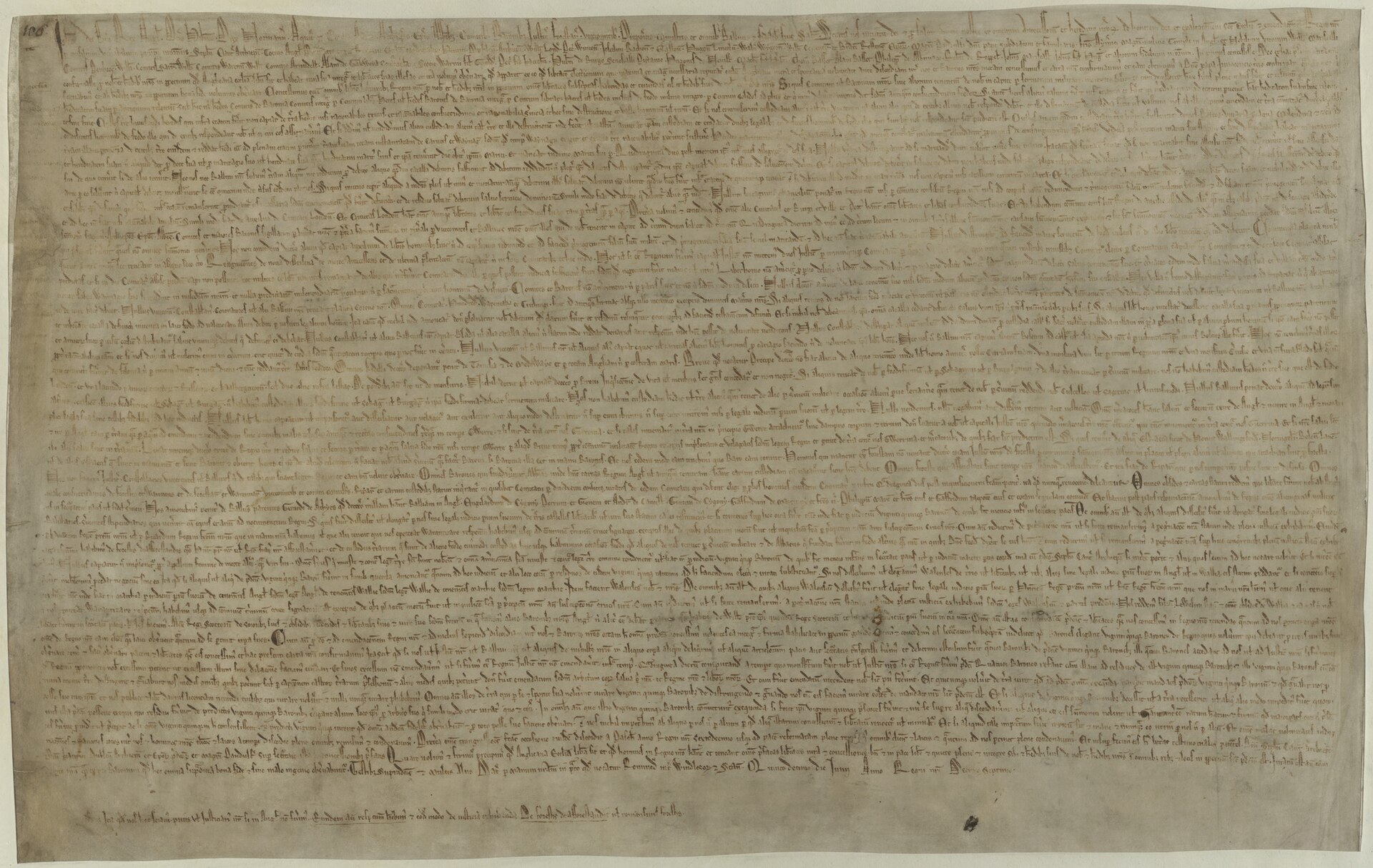
The record in full
Chapter 1Not the famous one
This is the single fact a reader most needs before anything else: this is not the 1215 Magna Carta.
This is the single fact a reader most needs before anything else: this is not the 1215 Magna Carta. The 1215 charter, sealed by King John at Runnymede, is the founding moment of legend - the barons, the meadow, the king forced to yield. It was annulled by the Pope within weeks and reissued, amended, in 1216, 1217 and 1225. Four exemplifications of the 1215 text survive: two at the British Library, one at Lincoln Cathedral, one at Salisbury Cathedral. None of them is this document, and none of them is for sale or in the United States.
This object is a confirmation issued by Edward I, John's grandson, on 12 October 1297 - eighty-two years after Runnymede. It re-grants the substance of the 1225 charter, but its legal act is different and, for American constitutional history, arguably more important: this is the version Edward formally entered onto England's Statute Rolls, converting Magna Carta from a one-off royal concession into a standing piece of the law of the land. Seventeen originals of Magna Carta survive across all reissues between 1215 and 1300. Only four are of this 1297 confirmation, and this is one of them.
Chapter 2What the parchment is
Physically it is a single sheet of parchment, roughly 370 by 420 millimetres with a 32 millimetre fold at the foot, ruled with faint vertical plumb lines and written in 68 lines of a neat...
Physically it is a single sheet of parchment, roughly 370 by 420 millimetres with a 32 millimetre fold at the foot, ruled with faint vertical plumb lines and written in 68 lines of a neat, disciplined chancery hand - the professional script of Edward's writing office, not a scribe working alone on commission. Margins are narrow and even: 10 millimetres on the left, 28 at the top, 15 on the right. Sotheby's, cataloguing it in 2007, called its condition generally good to excellent and legible throughout, noting rubbing, damp staining and soiling in places, and repairs with backing where the parchment had weakened.
Edward's small seal hangs from a parchment tag, natural wax, about 22 millimetres wide, showing the king enthroned with sceptres. It is partially damaged and has been repaired. The seal is the instrument's authority made physical: without it, the document is a copy; with it, even a small and damaged example, it is an original act of the crown.
Chapter 3A confirmation, not a concession
Edward I did not reissue Magna Carta in 1297 out of reforming zeal.
Edward I did not reissue Magna Carta in 1297 out of reforming zeal. He needed money and cooperation for war in Flanders, and English barons and clergy had leverage: they would grant taxation if the king would confirm the charters. The result, the Confirmatio Cartarum, reissued both Magna Carta and the Charter of the Forest and, critically, ordered that both be entered onto the official Statute Rolls and read publicly twice a year in every cathedral. This exemplar carries physical evidence of exactly that distribution process: a near-contemporary docket reading 'tradatur Rogero Hodelyn de Neuport', recording that this specific copy was formally handed over for proclamation to an identified individual, within an identified county. Sotheby's described this as a unique surviving detail among the 1297 exemplifications sent out that year.
Because the king was in Flanders when the confirmation was sealed, the charter was issued and authenticated in his name by the government left behind in England - a reminder that a royal instrument is an institutional act, produced by a chancery, not a personal signature.
Chapter 4Why 1297, not 1215, reached Philadelphia
The line most American accounts draw from Magna Carta to the Constitution and Bill of Rights - due process, no punishment without lawful judgment, government bound by law it did not simply invent as...
The line most American accounts draw from Magna Carta to the Constitution and Bill of Rights - due process, no punishment without lawful judgment, government bound by law it did not simply invent as it went - runs through clause 29 of the 1297 confirmation (numbered clause 39 in 1215), not through the annulled and superseded 1215 text directly. The 1297 confirmation is the version that entered statute law, the version English lawyers of the sixteenth and seventeenth centuries such as Edward Coke actually cited as binding law, and therefore the version whose specific language and legal standing were available to colonial lawyers and the framers. The Fifth Amendment's guarantee that no person shall be deprived of life, liberty or property without due process of law descends from this text's promise of judgment according to the law of the land.
This is a claim about which legal text was operative, not a claim that the framers held this particular parchment in their hands. This exemplar's importance is that it is a physical survival of the specific 1297 statute-roll text, in the country whose founding document it helped shape, rather than a claim of direct physical transmission.
Chapter 5Lost in plain sight
Between 1297 and the twentieth century, this exemplar's ownership is not documented as a clean chain of named individuals.
Between 1297 and the twentieth century, this exemplar's ownership is not documented as a clean chain of named individuals. Sotheby's own 2007 catalogue, cataloguing the object it was about to sell, graded its own knowledge rather than asserting a smooth history: certain ownership by the Brudenell family only from the nineteenth century, probable ownership from the seventeenth, and possible ownership reaching back to the fourteenth. That graded uncertainty is the honest state of the evidence, and this record preserves it rather than compressing it into the tidier but false claim, common in press coverage, that the Brudenells held it continuously 'for centuries' or 'since the eighteenth century.'
The document resurfaced in modern memory in the 1970s, when it was found catalogued at the county record office in Northampton during review of the Brudenell family's papers - not discovered in an attic, but rediscovered in an archive, already known to exist but not understood as a saleable original. The family, once its significance was clear, sought a buyer.
Chapter 6Perot's purchase
H. Ross Perot, the Texas computer-services entrepreneur who had recently sold Electronic Data Systems to General Motors, bought the document from the Brudenell family.
H. Ross Perot, the Texas computer-services entrepreneur who had recently sold Electronic Data Systems to General Motors, bought the document from the Brudenell family. Sotheby's 2007 provenance statement dates the Perot Foundation's ownership from 1983; American newspapers, including the Washington Post, covered the purchase as news in September 1984, and most later accounts cite 1984 as the purchase year. This record has not been able to resolve whether the transaction was agreed privately in 1983 and only became public a year later, or whether the sources simply disagree - it reports both dates rather than silently choosing one. The price is consistently reported at 1.5 million US dollars, and the sale was a private transaction, not a public auction.
Perot's stated motive was patriotic rather than acquisitive in the collector's sense: he considered the charter the intellectual foundation of American liberty and wanted Americans to be able to see it. He lent it to the National Archives beginning in 1985, and on Constitution Day that September he delivered the keynote address at a naturalization ceremony for thirty new citizens held in front of the Declaration of Independence, the Constitution and the Bill of Rights - the document he had just bought standing, in effect, as their shared ancestor.
Chapter 7Why the Perot Foundation sold it
The Perot Foundation ended its long-running loan to the National Archives in 2007 in order to sell the document at auction.
The Perot Foundation ended its long-running loan to the National Archives in 2007 in order to sell the document at auction. Reporting at the time, including the Chronicle of Philanthropy and Al Jazeera, quoted a Foundation representative stating the proceeds would support medical research, public education, and assistance to wounded Iraq war veterans and their families - the conflict in Iraq was then in its fifth year, and veteran medical costs were a live public concern. This record reports that as the Foundation's stated intention, sourced to contemporaneous coverage at the time of the sale; it has not located independent later reporting confirming exactly how the resulting funds were disbursed, and that follow-through remains unverified rather than confirmed.
Chapter 8The only time it was ever auctioned
Sotheby's offered the document in New York on 18 December 2007 as a single-lot sale, lot 1, with an estimate of 20 to 30 million US dollars - deliberately imprecise, reflecting that nothing directly...
Sotheby's offered the document in New York on 18 December 2007 as a single-lot sale, lot 1, with an estimate of 20 to 30 million US dollars - deliberately imprecise, reflecting that nothing directly comparable had ever come to market. David Redden, Sotheby's vice chairman, was the auctioneer. David M. Rubenstein, co-founder of the Carlyle Group, had learned of the sale almost by accident, reviewing accumulated mail on a flight from London, and was told by a curator at a pre-sale reception, with minutes to spare, that the document was likely to leave the United States if an American did not step in. He returned the next evening and bid by telephone from a side room.
The bidding closed at a hammer price of 19 million US dollars; with Sotheby's buyer's premium the total came to 21.3 million dollars. Almost every contemporary report states only the rounded total, without separating the two figures - this record separates them using Rubenstein's own account of his winning bid alongside contemporaneous reporting. No source consulted names the underbidder. It was, and remains, the only time an original Magna Carta of any year has been sold at public auction.
Chapter 9Back on the wall within months
Rubenstein placed the document on loan to the National Archives immediately, and it returned to public display on 12 March 2008, a gift of access rather than a change of legal ownership.
Rubenstein placed the document on loan to the National Archives immediately, and it returned to public display on 12 March 2008, a gift of access rather than a change of legal ownership. In June 2010 the National Archives and Rubenstein announced a full re-encasement, replacing a case designed in 1985 by the conservator Dr Nathan Stolow. National Archives conservation and exhibition staff worked jointly with the Commerce Department's National Institute of Standards and Technology on the new case, at a cost of 322,800 US dollars, underwritten by Rubenstein; the design drew on the technology built for the 2003 re-encasement of the Charters of Freedom - the Declaration of Independence, the Constitution and the Bill of Rights - housed in the same building.
The new case was previewed to press in the National Archives conservation lab on 2 February 2012, in the presence of Archivist David S. Ferriero, Rubenstein himself, conservation deputy director Kitty Nicholson and NIST project engineer Jay Brandenburg, and the document returned to public view on 17 February 2012 in a titanium-framed encasement filled with inert argon gas, engineered to hold parchment at constant humidity and slow oxidative degradation over the long term.
Chapter 10A gallery built around one document
In 2011 Rubenstein gave 13.5 million US dollars to the Foundation for the National Archives, separate from and far smaller than his 21.3 million dollar purchase price, to fund a purpose-built gallery...
In 2011 Rubenstein gave 13.5 million US dollars to the Foundation for the National Archives, separate from and far smaller than his 21.3 million dollar purchase price, to fund a purpose-built gallery and expanded visitor services. The David M. Rubenstein Gallery opened 10 December 2013, and this Magna Carta has been its centerpiece ever since, displayed as part of the Archives' Records of Rights exhibition alongside later American civil-rights documents - a deliberate curatorial argument that this 1297 confirmation is the first chapter of a continuous American story about who gets to claim rights against government power, not a freestanding medieval curiosity.
Chapter 11Three siblings, and what makes this one different
Three other originals of the 1297 confirmation are known to survive, and this record has verified their locations independently rather than repeating an unchecked list: one is held by the UK National...
Three other originals of the 1297 confirmation are known to survive, and this record has verified their locations independently rather than repeating an unchecked list: one is held by the UK National Archives at Kew (catalogued as DL10/197); one by the City of London Corporation, kept at the London Archives and occasionally displayed at Guildhall; and one by the Australian Parliament, on permanent display at Parliament House, Canberra, purchased by the Australian government in 1952 for 12,500 pounds sterling after its own rediscovery at King's School, Bruton, in Somerset.
What distinguishes the Rubenstein-Perot copy from all three is not its parchment or its seal - all four are, so far as scholarship establishes, equally original acts of the 1297 chancery - but its ownership history. It is the only one of the four ever to have been privately owned, the only one ever bought and sold on the open market, and the only one outside the historic dominions of the British Crown. The other three moved between public institutions; this one moved through a private family, a Texan foundation, an auction room, and a private financier's gift of display, before arriving at a fourth kind of custody that is neither fully public ownership nor fully private possession: an indefinite loan to a federal archive, underwritten by its owner's own philanthropy.
Chapter 12What has not been challenged, and what remains open
No source consulted for this record - not Sotheby's own 2007 cataloguing, not National Archives conservation reporting, not later academic or journalistic coverage - records any scholarly challenge...
No source consulted for this record - not Sotheby's own 2007 cataloguing, not National Archives conservation reporting, not later academic or journalistic coverage - records any scholarly challenge to this exemplar's authenticity, its seal, or its identification as a genuine act of the 1297 chancery. That silence is itself worth stating plainly rather than searching for a controversy that is not documented: unlike some other Magna Carta exemplars whose status has been actively debated by scholars in recent years, this one has not been.
Nor has this record found any documented export-licence dispute, heritage-law objection, or litigation over an English constitutional instrument residing permanently in American private and federal custody. Its departure from England predates the modern UK export-licensing regime built around the Waverley criteria in its current form being tested against an object of this kind, and no source consulted shows the British government ever formally objecting to its 1983-84 sale or its continued location in Washington.
The artist
The Royal Chancery of Edward I of England
This instrument has no individual author in the way a painting has a painter. It was produced by the royal chancery, the permanent clerical office that drafted, copied and sealed the king's formal acts. In 1297 that office was executing a specific political bargain: barons and clergy would grant Edward I the taxation he needed for his war in Flanders if he would confirm Magna Carta and the Charter of the Forest and place them formally onto the Statute Rolls. The clerks who wrote and sealed this exemplar were civil servants carrying out that settlement, not artists exercising individual style, and the chancery's institutional discipline is itself part of what makes the document trustworthy as a legal record.
Exhibited
- 1985-2007On loan from the Perot FoundationNational Archives Building, Washington, DC
- 2008-2012Returned to display after the Rubenstein sale, prior to re-encasementNational Archives Building, Washington, DC
- 2012-presentOn display in the newly re-encased case, later moved into the purpose-built David M. Rubenstein Gallery (opened 10 December 2013)National Archives Building, Washington, DC, West Rotunda Gallery
Related works
| Work | Relation | Where it is |
|---|---|---|
| Magna Carta, 1297 (National Archives, UK) Royal Chancery of Edward I | Sibling exemplification of the same 1297 confirmation Remained in continuous English institutional custody; never privately owned or sold. | The National Archives, Kew, UK (DL10/197) |
| Magna Carta, 1297 (City of London Corporation) Royal Chancery of Edward I | Sibling exemplification of the same 1297 confirmation The Corporation also holds a 1300 reissue, a further Edwardian confirmation distinct from this one. | London Archives, occasionally displayed at Guildhall, City of London |
| Magna Carta, 1297 (Parliament House copy) Royal Chancery of Edward I | Sibling exemplification of the same 1297 confirmation Rediscovered at King's School, Bruton, Somerset; purchased by the Australian government in 1952 for 12,500 pounds sterling, its own sale-and-relocation history the closest parallel to this object's. | Parliament House, Canberra, Australia |
| The Charters of Freedom (Declaration of Independence, Constitution, Bill of Rights) Various, 1776-1791 | Displayed in the same building; the 2003 re-encasement of these documents was the direct engineering model for this object's 2012 case The curatorial pairing in the Records of Rights exhibition presents this Magna Carta as the first document in a continuous American rights narrative rather than an isolated medieval artifact. | National Archives Building, Washington, DC |
| Magna Carta, 1215 (four surviving originals) Royal Chancery of King John | Not the same document; the earlier, annulled and superseded charter this 1297 confirmation re-grants Included here specifically to prevent version confusion: this record's subject is the 1297 confirmation, not any 1215 original. | British Library (two), Lincoln Cathedral, Salisbury Cathedral |
Open questions
- Was the Perot Foundation's ownership acquired in 1983, as Sotheby's own catalogue states, or 1984, as US press reported at the time and most later sources repeat? This record could not resolve the discrepancy.
- Which named member or members of the Brudenell family actually sold the document in 1983-84? No source consulted names the seller beyond 'the Brudenell family' or a general reference to relatives of the 7th Earl of Cardigan, who died without surviving legitimate issue in 1868.
- Who was the underbidder at the 18 December 2007 Sotheby's sale, and how close was the contest? No source consulted names any bidder other than Rubenstein.
- Did the Perot Foundation's proceeds from the 2007 sale in fact go toward wounded Iraq-war veterans' medical costs, medical research and public education as stated at the time of sale? This record has found the stated intention but no independent later accounting confirming disbursement.
- Who took the photograph of the document used on the National Archives' own featured-documents exhibit page (the source of this record's lead image) - National Archives staff, or a photograph supplied by the Perot Foundation during its 1985-2007 loan? The credit line on the current version of that page reads only 'Presented courtesy of David M. Rubenstein', which describes the loan, not photographic authorship.
Questions about this object
What is Magna Carta, 1297 (the Perot-Rubenstein copy)?
Magna Carta, 1297 (the Perot-Rubenstein copy) is a manuscript, dated 12 October 1297. Medium: Latin manuscript in a chancery hand on parchment, with the royal seal of Edward I in natural wax on a parchment tag.
Who made Magna Carta, 1297 (the Perot-Rubenstein copy), and is the attribution settled?
The attribution to Royal Chancery of Edward I of England is recorded here as accepted. Issued in the name of Edward I as an inspeximus (a confirmation reciting and re-granting an earlier charter) on 12 October 1297, produced and sealed by the royal chancery while the king was campaigning in Flanders. The document is not signed or drafted by an individual hand in the modern sense; it is a chancery instrument, and its authenticity as one of the original 1297 exemplifications is accepted without dispute in every source consulted for this record, including the Sotheby's 2007 sale catalogue and the National Archives (US).
Where is Magna Carta, 1297 (the Perot-Rubenstein copy) now?
National Archives Building, Washington, DC, West Rotunda Gallery (David M. Rubenstein Gallery). Inventory number Displayed courtesy of David M. Rubenstein; the National Archives holds it on continuous public loan, not as an accessioned federal record. Last confirmed 7 August 2026. On permanent loan since 2007-2008; the loan is a gift of display, not a transfer of title. Ownership remains with David M. Rubenstein.
What has Magna Carta, 1297 (the Perot-Rubenstein copy) sold for?
Hammer USD 19,000,000; with premium, USD 21,300,000 total including buyer's premium. Sotheby's, 2007-12-18.
What is still unknown about Magna Carta, 1297 (the Perot-Rubenstein copy)?
Was the Perot Foundation's ownership acquired in 1983, as Sotheby's own catalogue states, or 1984, as US press reported at the time and most later sources repeat? This record could not resolve the discrepancy.
Sources
- 1The National Archives (UK), 'Magna Carta, 1297', education resource on the National Archives' own 1297 exemplification (DL10/197), for the confirmation's text and its status as re-grant of the 1225 charter. nationalarchives.gov.uk/education/...
- 2US National Archives, 'Magna Carta' featured document exhibit page, for the 1297 confirmation's entry into the Statute Rolls and its constitutional legacy claims. archives.gov/exhibits/...
- 3Parliament House, Canberra, 'The Magna Carta (Great Charter), 1297', for the four-surviving-originals count and the broader 1297 exemplification process. magnacarta.senate.gov.au
- 4Sotheby's New York, sale N08461, lot 1, 'The Magna Carta', 18 December 2007, e-catalogue entry: full graded provenance statement, physical description (dimensions, seal, condition, hand), and the USD 20-30 million estimate. sothebys.com/en/...
- 5The Washington Post, 'Magna Carta Purchase', 27 September 1984, contemporaneous coverage of Perot's purchase. washingtonpost.com/archive/...
- 6US National Archives, Prologue blog, 'Constitution Day 1985 and Ross Perot's Magna Carta', 16 September 2019: the Deene Park rediscovery, Perot's 1984 purchase and motivation, and his 1985 Constitution Day appearance at the National Archives. prologue.blogs.archives.gov/2019/...
- 7Constitution Education Fund Australia, 'How did Australia come to own an original 1297 Magna Carta?', for comparative detail on the sibling 1297 exemplar's own rediscovery and sale, used here only as corroborating context for how these documents surface and change hands. cefa.org.au/ccf/...
- 8NPR, 'Magna Carta Copy Sells At Auction For $21.3 Million', 18 December 2007. npr.org/2007/...
- 9CBC News, 'Magna Carta sold for $21.3M to U.S. businessman', 18 December 2007. cbc.ca/news/...
- 10U.S. News & World Report, 'So How Do You Buy the Magna Carta? Billionaire David Rubenstein Explains', 11 December 2013, for the hammer bid of USD 19 million versus the USD 21.3 million total, and Rubenstein's own account of the auction room. usnews.com/news/...
- 11University of Chicago Magazine, 'Chartered Philanthropy', for Rubenstein's account of learning of the sale and deciding to bid, and his 'down payment on my obligation to repay my country' remark. mag.uchicago.edu/law-policy-society/...
- 12US National Archives, press release nr08-71, 'Magna Carta Returns to Display at the National Archives', 2008, for the 12 March 2008 return to public display and Rubenstein's loan. archives.gov/press/...
- 13US National Archives, press release nr10-112, '1297 Magna Carta on Loan to NARA to be Re-encased', 30 June 2010, for the re-encasement announcement, the USD 322,800 cost, the NIST partnership, and the 1985 Stolow encasement it replaced. archives.gov/press/...
- 14US National Archives, press release 2012-116, 'Exclusive Press Preview of Newly Re-encased 1297 Magna Carta at the National Archives', for the 2 February 2012 press preview, attendees, and the 17 February 2012 public reopening. archives.gov/press/...
- 15Washington Post, 'David M. Rubenstein gives $13.5 million to the National Archives for a new gallery and expanded visitor services', 20 June 2011, and US National Archives Prologue blog, 'The Rubenstein Gallery: Five Years of Celebrating Citizens' Rights', 10 December 2018, for the gallery gift, its purpose, and the 10 December 2013 opening. washingtonpost.com/blogs/...
- 16US National Archives, press kit, '1297 Magna Carta Encasement Project', image gallery, for official conservation photography credits (Sheri Hill for the National Archives; Mark Luce for NIST) documenting the 2010-2012 re-encasement. archives.gov/press/...
- 17Al Jazeera, 'Magna Carta copy sold for $21m', 19 December 2007, for the Perot Foundation's stated charitable purpose in selling and its planned use of proceeds. aljazeera.com/news/...
- 18The Chronicle of Philanthropy, 'Foundation Puts Rare Magna Carta Up for Sale to Benefit Charity', for the Perot Foundation's stated intended uses of the sale proceeds, including medical research, public education and assistance to wounded Iraq war veterans and their families. philanthropy.com/news/...
- 19Wikimedia Commons, 'File:Magna Carta (1297 version with seal, owned by David M Rubenstein).jpg', sourced to the National Archives' own 'featured documents' exhibit page, archives.gov, uploaded 5 November 2007 - the image used as the lead plate for this record. commons.wikimedia.org/wiki/...
.jpg)
Last verified 7 August 2026 · Published 7 August 2026
Change log
7 August 2026 - Record created at the house standard: researched narrative, technical evidence, maker dossier, graded provenance chain, prices with hammer and premium separated, related works, open questions and sources.