The Crosby Garrett Helmet
Unknown maker, Roman cavalry-equipment workshop · Later 2nd to earlier 3rd century AD (comparative dating; no stratified dating evidence survives from the findspot)
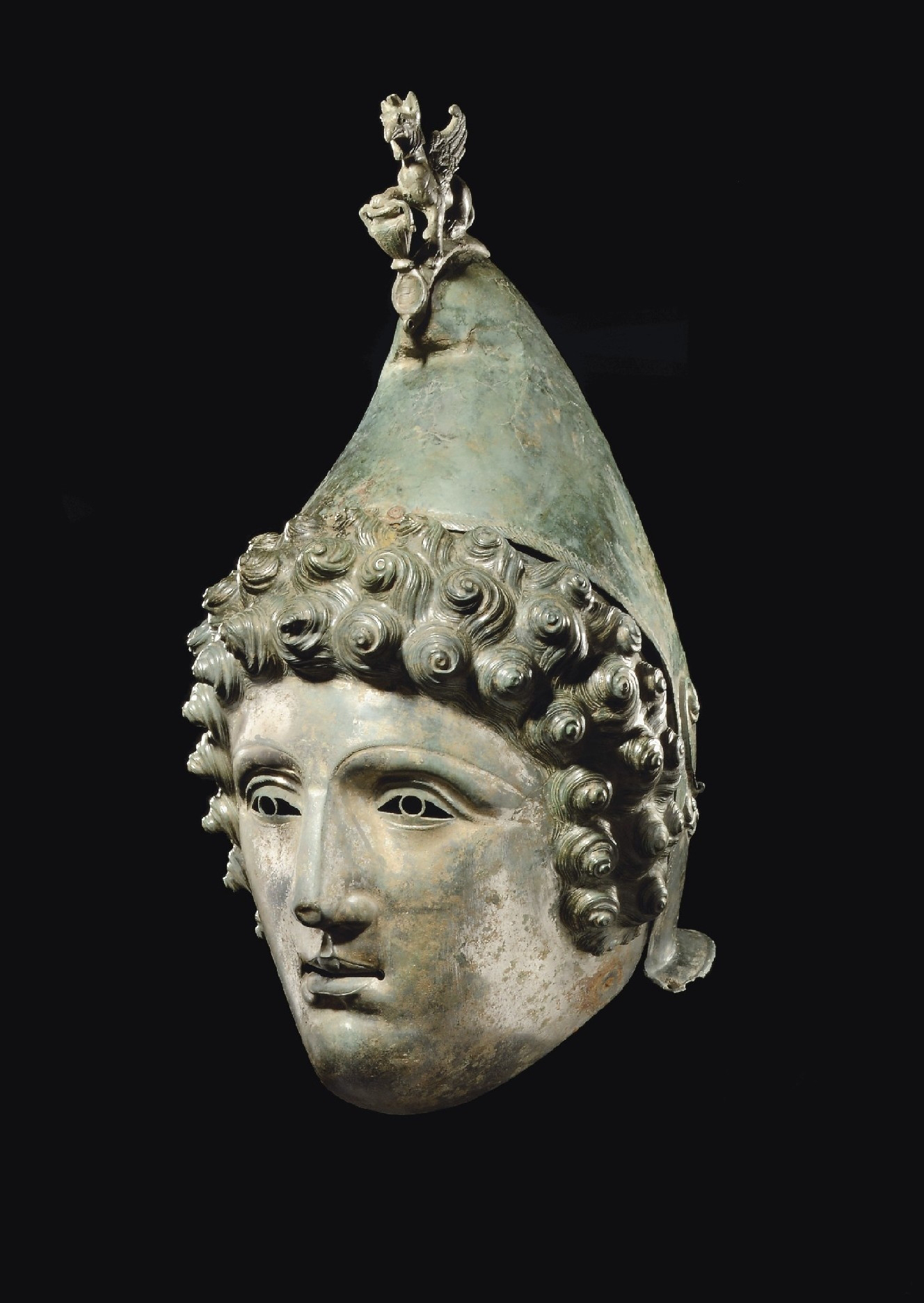
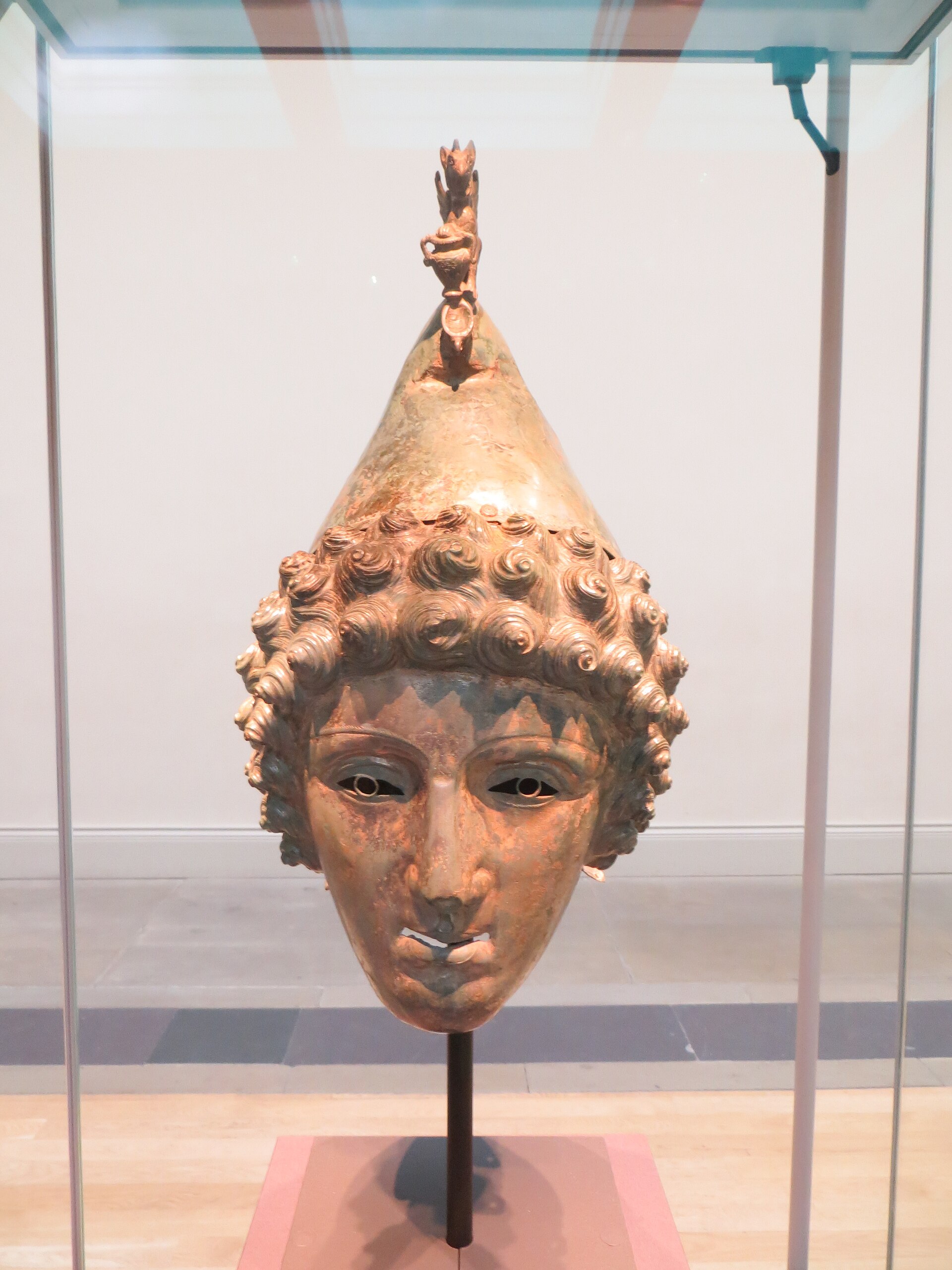
The helmet as photographed by the Portable Antiquities Scheme in 2010, after restoration and before sale. This is the object described in this record.
Portable Antiquities Scheme, London (Flickr set Number 9: The Crosby Garrett Roman cavalry helmet), CC BY 2.0| Artist | Unknown maker, Roman cavalry-equipment workshop |
|---|---|
| Date | Later 2nd to earlier 3rd century AD (comparative dating; no stratified dating evidence survives from the findspot) |
| Medium | Copper alloy (leaded gunmetal/bronze), raised and chased sheet metal for the bowl and mask, cast for the griffin crest; the visor was originally tin-plated |
| Dimensions | 407 mm high, as reconstructed |
| Where it is now | Private collection, United Kingdom; owner not publicly identifiedlast confirmed |
| Inventory number | No museum accession number; not in any public collection |
| Attribution | UnknownNo mark, stamp or inscription survives on the helmet, and none is expected: hippika gymnasia parade helmets of this class are not known to carry maker's marks. Full note |
| Object type | Arms and armour |
| Period | Roman Britain, later 2nd - earlier 3rd century AD |
| Cases | Has a provenance gap |
| Inscriptions | None |
| Owners on record | 7 links4 documented, 1 disputed, 2 unknown |
| Sources | 21 cited |
About this record Last verified · 21 sources cited · Change log
On this page 10 sections
ContentsClose
A copper-alloy Roman cavalry parade helmet, its face-mask visor cast as the calm face of a young man beneath a griffin-crested Phrygian cap, found broken into more than sixty fragments in a Cumbrian field in May 2010. Because it contained no gold or silver, it fell outside the UK's Treasure Act, and the finder and landowner were free to sell it. Christie's restored it, in about 240 hours, and sold it on 7 October 2010 for a hammer price of GBP 2,000,000, more than 2.28 million with premium, to an anonymous telephone bidder, defeating a public campaign by Tullie House Museum in Carlisle that had raised roughly 1.7 million pounds.
It is one of only a handful of Roman face-mask cavalry helmets ever found in Britain, and its case became a byword for a real gap in UK heritage law: an object judged internationally important by the British Museum could still be extracted, restored for sale rather than for scholarship, and sold into private hands, all entirely lawfully. It has been shown four times since, on loan from its anonymous owner, and remains outside public collections.
Provenance
Each link is graded. Documented: a cited source supports it. Disputed: the identification is argued but not established. Unknown: no owner for that span, and the gap is not smoothed into a narrative. The grades in the glossary.
- later 2nd - earlier 3rd century AD -Unknown Roman military owner or workshopdisputed
The helmet was made for hippika gymnasia use in this period and was, at some point, deliberately dismantled, folded and buried near what is reported to be Crosby Garrett, Cumbria. The manufacture date rests on secure comparative typology. The findspot itself is disputed: David Gill's 2014 Journal of Art Crime article argues the reported location was never independently verified, since a precise grid reference was not obtained until three months after discovery and a 2011 trial excavation found the original burial cut already destroyed by the recovery dig.124
- later 2nd/earlier 3rd century AD - May 2010No documented ownerunknown
Roughly seventeen centuries with no documented owner, find, or record of any kind. Nothing was recorded on the local Historic Environment Record for the immediate area of the reported findspot before 2010.3
- May 2010 - June 2010A metal detectorist (or detectorists) from Peterlee, County Durham, and landowner Eric Robinsondocumented
Found in pastureland on Eric Robinson's farm at Crosby Garrett, Cumbria, in May 2010, broken into 33 larger and 34 smaller fragments. The finder brought the fragments, still packed with soil, to Christie's in June 2010. Accounts differ on whether one or two people were involved in the find; see open questions.16
- June 2010 - October 2010Christie's, London, holding on behalf of the finder and landownerdocumented
Restored by the independent conservator Darren Bradbury over approximately 240 hours, using cyanoacrylate and resin repairs retouched to match the surrounding metal. The British Museum's request to delay restoration for scientific conservation was not acted upon. X-ray fluorescence analysis was carried out alongside the restoration by Ruth Fillery-Travis and Sally Worrell.16
- 7 October 2010 - 7 October 2010Anonymous UK-resident private collectordocumented
Sold at Christie's, London, for a hammer price of GBP 2,000,000 (total price paid, including buyer's premium and VAT, reported as approximately GBP 2,330,468.75), defeating a Tullie House Museum-led public campaign that had raised approximately GBP 1.7 million. The buyer's identity has never been made public.678
- 2012 - 2017Same anonymous private collector, so far as documenteddocumented
Lent for public display at the Royal Academy of Arts (Bronze exhibition, 15 September - 9 December 2012), Tullie House Museum, Carlisle (1 November 2013 - 26 January 2014), the British Museum, London (28 January - 27 April 2014, shown with the Ribchester Helmet), and Tullie House again for Hadrian's Cavalry (from 8 April 2017).61011
- 2017 - presentPresumed same anonymous private collector; not independently confirmedunknown
No loan, sale, or public appearance has been documented since the 2017 Hadrian's Cavalry loan, and whether the original 2010 buyer remains the owner is not established in the sources consulted.61011
Prices realised
| Date | Sale | Estimate | Result | Note |
|---|---|---|---|---|
| 7 October 2010 | Christie's, London (South Kensington) Antiquities, King Street, London, lot 176 | GBP 200,000 - 300,000 | Hammer GBP 2,000,000 - DERIVED, not published. See note. With premium GBP 2,281,250 including buyer's premium, published by Christie's as the price realised. The premium component is GBP 281,250, DERIVED from that total. GBP | Lot 176, Antiquities, sale 5488, Christie's London (South Kensington), 7 October 2010, catalogued as A ROMAN BRONZE CAVALRY PARADE HELMET, CIRCA LATE 1ST-2ND CENTURY A.D., and headed The Crosby Garrett Helmet. Six bidders competed; Tullie House Museum's consortium withdrew at GBP 1.7 million with two bidders still active. GBP 2,281,250 is Christie's own published price realised and it is premium-inclusive; the house publishes no hammer price. THE HAMMER IS DERIVED, and the derivation is now proved on the saleroom rather than assumed. Christie's London in October 2010 charged 25 per cent on the first GBP 25,000, 20 per cent from there to GBP 500,000 and 12 per cent above, and on that scale GBP 2,281,250 reduces to a hammer of exactly GBP 2,000,000. The 12 per cent top band is the part that matters and it cannot be tested inside the Antiquities sale itself, because the helmet is the only lot in it above GBP 500,000: the next highest realised GBP 277,250. It was tested instead on Christie's London Post-War and Contemporary Art Evening Auction of the same month, sale 7914, where all nine lots above GBP 600,000 reduce to round increments on the three-band scale and only five of the nine do so without the 12 per cent band. WITH VAT: the total price paid by the buyer, with VAT chargeable on the premium at the rate then in force, is reported as approximately GBP 2,330,468.75. That third figure is still reconciled from several secondary figures rather than confirmed against any Christie's statement, and it keeps that caveat. Most contemporary press coverage quoted a single rounded GBP 2.3 million, or about USD 3.6 million, without distinguishing hammer, total or VAT. ONE FIGURE THAT DOES NOT RECONCILE AND IS REPORTED RATHER THAN SMOOTHED OVER: the 241 published lot prices of sale 5488 sum to GBP 4,608,616 against the GBP 4,801,575 that Christie's own results calendar prints as the sale total, a shortfall of GBP 192,959. The cause is not known and none is invented here. |
Hammer is the price at which the bidding stopped; with premium adds the fee the house charges the buyer on top. Hammer price and buyer's premium in the glossary.
Technical evidence
| Attribution note | No mark, stamp or inscription survives on the helmet, and none is expected: hippika gymnasia parade helmets of this class are not known to carry maker's marks. Date and cultural attribution rest entirely on comparison: the decorated rivet type, the Phrygian-cap profile, the alloy composition and the general typology of two-piece cavalry sports helmets place it in the later 2nd or earlier 3rd century AD, within a small, scattered group of similar finds from Roman Britain and the northwestern provinces. Whether it was made by a workshop attached to a specific fort, by a travelling military craftsman, or in a civilian metalworking centre supplying the army, is not established, and may never be. |
|---|---|
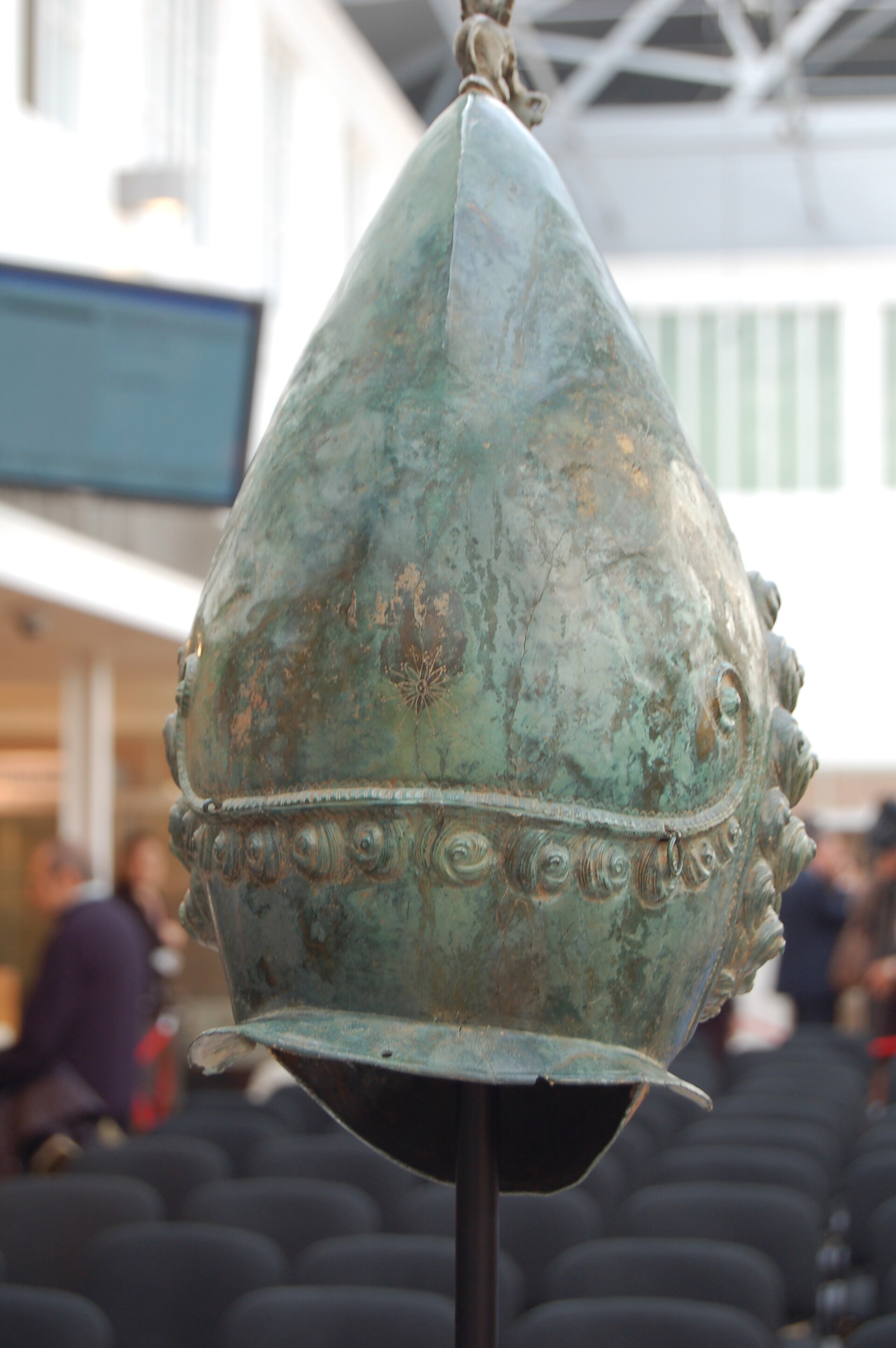
| Construction | Two-piece helmet: a raised and chased sheet-metal bowl in the form of a Phrygian cap, joined by a browline hinge to a separately raised and chased sheet-metal face-mask visor, allowing the mask to be lifted clear of the wearer's face. The griffin crest was cast separately and fixed to the crown of the bowl.16 |
| Alloy, bowl and visor | Copper alloy of approximately 82 percent copper, 10 percent zinc and 8 percent tin, identified by X-ray fluorescence spectrometry.16 |
| Alloy, griffin crest | A different, leaded bronze of approximately 68 percent copper, 4 percent zinc, 18 percent tin and 10 percent lead, better suited to fine casting than the sheet alloy used for the bowl and visor.16 |
| Surface treatment | The visor was originally tin-plated to give it a pale, silvery sheen, contrasting with the warmer coppery-yellow colour of the unplated bowl and crest.6 |
| Dimensions | 407 mm high, as reconstructed.6 |
| Condition at discovery | Recovered broken into 33 larger fragments and a further 34 smaller fragments, according to the Portable Antiquities Scheme's contemporary account; some later secondary sources round this to approximately 40 or approximately 67 pieces.16 |
| Restoration materials and method | Cracks and losses repaired with cyanoacrylate adhesive and resin fills, retouched to match the surrounding metal, by the independent conservator Darren Bradbury, commissioned by Christie's; approximately 240 hours of work between June and September 2010.6 |
| Analytical work | X-ray fluorescence spectrometry carried out at Christie's by Ruth Fillery-Travis and Sally Worrell, confirming an alloy consistent with the Roman period; this analysis took place alongside, rather than ahead of, the cosmetic restoration.1 |
Images
The record in full
Chapter 1What it is
The Crosby Garrett helmet is a two-piece Roman cavalry parade helmet of the type used in hippika gymnasia, ceremonial mounted exercises rather than battlefield equipment.
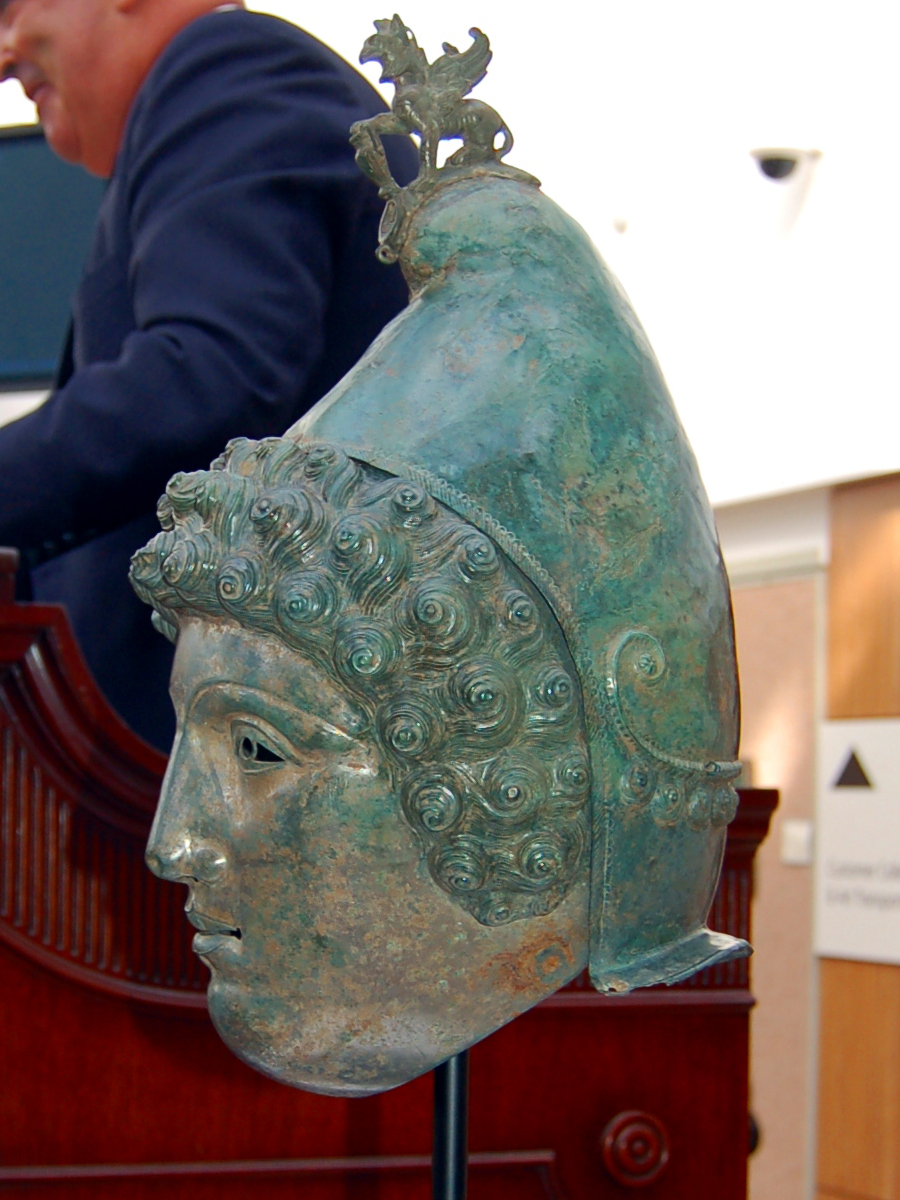
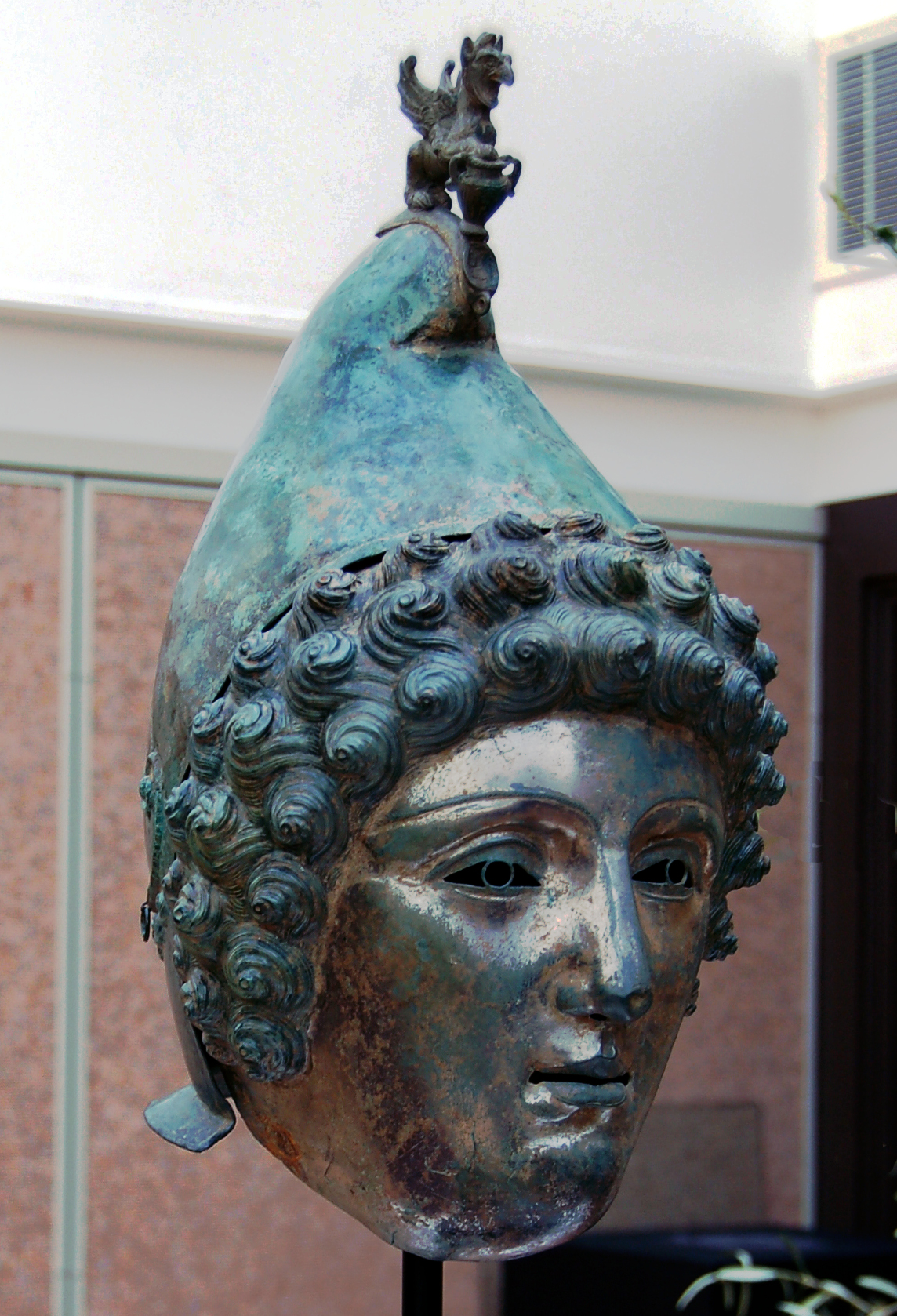
The Crosby Garrett helmet is a two-piece Roman cavalry parade helmet of the type used in hippika gymnasia, ceremonial mounted exercises rather than battlefield equipment. It stands 407 millimetres high in its reconstructed state. The lower part is a face-mask visor, hinged at the browline so it could be raised, cast and chased in the likeness of a clean-shaven young man with elaborately curled hair and a calm, slightly parted-lip expression. The upper part is a domed headpiece shaped like a Phrygian cap, its peak curving forward, on top of which stands a separately cast griffin, one forefoot resting on an amphora, wings raised.
Nothing else found in Britain looks quite like it. The griffin crest in particular has no exact parallel among the surviving British cavalry helmets, though a related face mask that surfaced on the London market in 2019 has been proposed, by the conservator who examined both, as a product of the same workshop or even the same hand.
Chapter 2How it was made
X-ray fluorescence analysis carried out at Christie's identified two different alloys in the object.
X-ray fluorescence analysis carried out at Christie's identified two different alloys in the object. The helmet bowl and the face-mask visor are a copper alloy of roughly 82 percent copper, 10 percent zinc and 8 percent tin. The griffin crest is a different, leaded bronze of roughly 68 percent copper, 4 percent zinc, 18 percent tin and 10 percent lead, a mix better suited to fine casting than to sheet raising.
The bowl and mask were raised and chased from sheet metal over a former, then joined by a hinge so the mask could be lifted clear of the wearer's face. The visor was originally tin-plated, giving it a silvery sheen that would have contrasted with the warmer, coppery-yellow colour of the unplated bowl and crest, a deliberate visual effect built to catch sunlight and draw the eye of spectators at a distance, which is exactly the purpose ancient writers give this class of helmet.
Chapter 3The find
In May 2010 a metal detectorist, a young man in his twenties from Peterlee in County Durham, was searching pastureland at Crosby Garrett in Cumbria, on a farm owned by Eric Robinson, land he and his...
In May 2010 a metal detectorist, a young man in his twenties from Peterlee in County Durham, was searching pastureland at Crosby Garrett in Cumbria, on a farm owned by Eric Robinson, land he and his father had been detecting for several years without finding more than Roman coins and small fittings. Sally Worrell, then the Portable Antiquities Scheme's finds adviser for later prehistoric and Roman finds, later gave the fullest account of what happened next: the helmet came out of the ground broken into 33 larger fragments and a further 34 smaller ones, the visor lying more or less complete and face down, and it reached Christie's in June 2010 still packed with soil, the face-mask resting face-down on cotton wool in a plastic box.
Some secondary press accounts instead describe the find as made by two people, or by a father-and-son pair working together; Worrell's account, based on direct contact with the finder, describes one named-to-PAS individual who had detected the land with his father over preceding years. No finder has ever been named publicly, and this record notes the discrepancy rather than resolving it, since none of the accounts consulted settles it with primary documentation.
Chapter 4Why it was not Treasure
The UK's Treasure Act 1996 protects specific categories of find: hoards of coins, and objects of gold or silver, along with a narrow set of other categories added since.
The UK's Treasure Act 1996 protects specific categories of find: hoards of coins, and objects of gold or silver, along with a narrow set of other categories added since. A single object made of copper alloy, however important, however clearly of the Roman period, however obviously a unique national find, is not Treasure under the Act if it is not gold, not silver, and not part of a qualifying hoard. The Crosby Garrett helmet is bronze. It was found alone, not among other objects. On both counts it failed to qualify, and the finder and landowner were free, entirely lawfully, to keep it, sell it, or dispose of it however they wished.
Archaeologist Paul Barford made the point bluntly at the time: a find that any archaeologist would call nationally important had fallen through what he called a loophole in the law, precisely because the law measures importance by the metal an object is made of rather than by what it is. The case was later cited in official reviews of the Treasure Act as an example of the gap between an object's evident significance and its legal protection, part of the record that eventually fed into proposals to widen the Act's scope beyond precious metal.
Chapter 5The disputed findspot
Because the helmet was not Treasure, there was no legal requirement to report it to the Portable Antiquities Scheme at all, and no legal requirement to reveal precisely where it was found.
Because the helmet was not Treasure, there was no legal requirement to report it to the Portable Antiquities Scheme at all, and no legal requirement to reveal precisely where it was found. Finds Liaison Officers for Cumbria and Lancashire did not obtain a twelve-figure grid reference for the site until 30 August 2010, three months after the find and after the object had already gone to Christie's and been substantially restored. When archaeologist David Gill visited the question in a Looting Matters post that October, he noted that the site had not been independently verified: a hole had been dug and some ground disturbance was visible, but neither could be dated, and no other Roman material from the same field had been recorded on the local Historic Environment Record.
Gill returned to the question in a 2014 article for the Journal of Art Crime, titled, deliberately, Context Matters: The So-called Crosby Garrett Helmet, after further work, including a trial excavation by Minerva Heritage Ltd at the alleged burial spot, failed to remove the doubt: any cut in the ground that might have been made when the helmet was buried had itself been destroyed by the digging that recovered it, and a PAS finds officer for the region, Stuart Noon, questioned whether burial at the reported depth of around 50 centimetres was consistent with the pattern of damage on the object. That reported depth is itself inconsistent across sources: some secondary accounts of the finder's own description put the burial at around 25 centimetres, resting on two flat slabs of rock inside a pit, with a further large stone and more soil packed in above. This record could not reconcile the two depth figures against a single primary account, and lists the inconsistency itself as evidence of how thinly documented the recovery was.
Gill's conclusion was not that the Crosby Garrett findspot was fabricated, but that it had never been, and by 2014 could no longer be, independently confirmed. Commentary on the case since has been split between archaeologists who treat the reported location as probably genuine but poorly recorded, and those who regard the entire question as symptomatic of what a PAS database entry can and cannot actually prove.
Chapter 6What later investigation of the site found
Once the findspot had been identified to the Portable Antiquities Scheme, Tullie House Museum sponsored further investigation of the field, after the helmet itself had already left the ground.
Once the findspot had been identified to the Portable Antiquities Scheme, Tullie House Museum sponsored further investigation of the field, after the helmet itself had already left the ground. That work reportedly identified low earthworks forming part of an enclosure roughly 1,600 feet long, combining ditch-and-bank fortification methods associated with both native British and Roman building traditions, and consistent with a Romano-British farming settlement whose origins may reach back to the Bronze Age. Nothing of this had been visible or recorded before the helmet's discovery prompted archaeologists to look.
The same investigation is reported to have recovered further copper-alloy and iron objects, a bead, and two Roman coins dated to between 330 and 337 AD, found within the same artificial stone feature associated with the helmet's burial. Those coins date roughly a century or more after the helmet's own likely manufacture in the later 2nd or earlier 3rd century, and this record has not found a source that resolves what that gap means: whether the feature was reused or added to well after the helmet was first buried, whether the helmet itself was deposited later than its manufacture date would suggest, or whether the coins belong to a separate phase of activity at the same spot that happens to share the feature. This record states the puzzle rather than resolving it, because no source consulted resolves it either.
Chapter 7From field to saleroom: the restoration
Christie's commissioned an independent conservator, Darren Bradbury, to restore the helmet ahead of sale.
Christie's commissioned an independent conservator, Darren Bradbury, to restore the helmet ahead of sale. The work, which took around 240 hours, involved repairing cracks and holes with cyanoacrylate adhesive and resin fills, retouched to match the surrounding metal's colour and texture, and rejoining the fragments into the substantially complete object now known. The British Museum, whose senior curator of Romano-British collections, Ralph Jackson, examined the piece during this period, asked that full scientific conservation and recording precede the cosmetic restoration. That request was not acted upon, and the restoration went ahead on Christie's timetable rather than a conservation one.
Sally Worrell, who with Ruth Fillery-Travis carried out X-ray fluorescence analysis on the object at Christie's, noted afterward what had likely been lost: formal conservation might have identified impressions of textile or other organic material preserved in the metal's corrosion products, evidence of how the helmet had been wrapped, packed or dressed before burial, and any such evidence is now gone. The restoration achieved what it was commissioned to achieve, an object fit to be sold at its best. Whether it achieved what a national collection would have wanted, a fully documented object with its burial evidence intact, is a different question, and the record on that point is now closed.
Chapter 8The sale at Christie's
Christie's announced the helmet's discovery publicly in mid-September 2010 and made it the centrepiece lot of its 7 October antiquities sale in London, with a pre-sale estimate of GBP 200,000 to...
Christie's announced the helmet's discovery publicly in mid-September 2010 and made it the centrepiece lot of its 7 October antiquities sale in London, with a pre-sale estimate of GBP 200,000 to 300,000. The estimate was passed within seconds of the bidding opening. Six bidders took part; by the time Tullie House Museum's consortium had to withdraw, at 1.7 million pounds, two bidders remained in the room and on the telephones.
The hammer fell at GBP 2,000,000. With Christie's buyer's premium the price came to approximately 2,281,250 pounds, and with VAT chargeable on the premium at the rate then in force, the total paid by the buyer came to approximately 2,330,468.75 pounds, a figure this record derives by reconciling several press reports rather than from a single confirmed Christie's statement, and flags accordingly. Press coverage at the time mostly quoted a rounded 2.3 million pounds, or its dollar equivalent of roughly 3.6 million, without separating hammer from premium; this record separates them because the difference between a 2 million pound hammer and a headline 2.3 million pound sale is exactly the kind of distinction that gets lost in retelling. The buyer was an anonymous UK resident, described by Christie's as an experienced collector of fine art and antiquities, bidding by telephone.
Chapter 9The fight to keep it in Cumbria
Tullie House Museum and Art Gallery in Carlisle led a public campaign to buy the helmet for Cumbria, with the support of the British Museum.
Tullie House Museum and Art Gallery in Carlisle led a public campaign to buy the helmet for Cumbria, with the support of the British Museum. The National Heritage Memorial Fund pledged GBP 1 million toward the purchase. The Art Fund added 200,000 pounds, the Headley Trust and the Monument Trust a further 300,000 pounds between them, and the J Paul Getty Jr Charitable Trust 75,000 pounds. An anonymous overseas benefactor offered 50,000 pounds on condition the public matched it, which the public did, and local fundraising, including a double-your-money pledge from a Carlisle businessman, brought in a further tranche of small donations. Tullie House had assembled roughly 1.7 million pounds by the time of the sale.
It was not enough. The hammer price alone, before premium, was 2 million pounds, and once premium and VAT are added the gap between what Cumbria had raised and what the anonymous buyer paid comes to something over 600,000 pounds. Mike Mitchelson, then leader of Carlisle City Council, called the response overwhelming and the outcome clearly disappointing. Roger Bland, then director of the Portable Antiquities Scheme at the British Museum, was blunter about what the result meant for the object's public future: to have it bought by a U.K. private buyer was the worst possible outcome.
Chapter 10What the finder and the landowner received
There was no statutory reward to divide, because the Treasure Act did not apply and no ex gratia treasure reward was ever in question.
There was no statutory reward to divide, because the Treasure Act did not apply and no ex gratia treasure reward was ever in question. Press reporting at the time described the sale proceeds as split, with the landowner Eric Robinson receiving roughly half and the finder, or finders, receiving the remainder, consistent with the voluntary finder-landowner arrangements long recommended by the National Council for Metal Detecting's code of practice even where the Treasure Act does not bite. This record has not been able to independently confirm the exact split, the contractual terms, or the amounts each party actually received net of Christie's charges, from a primary source, and flags this as unverified in detail even though the broad outline is widely reported.
Chapter 11After the hammer: the loans
The anonymous buyer has, on several documented occasions, lent the helmet back for public display, each time through Christie's or the borrowing institution rather than through any direct public...
The anonymous buyer has, on several documented occasions, lent the helmet back for public display, each time through Christie's or the borrowing institution rather than through any direct public statement by the owner. It was shown for the first time since the sale at the Royal Academy of Arts in London, as part of the Bronze exhibition, from 15 September to 9 December 2012. It returned north to Tullie House in Carlisle from 1 November 2013 to 26 January 2014, then travelled to the British Museum from 28 January to 27 April 2014, where it was displayed alongside the Ribchester helmet, allowing the two most complete British face-mask cavalry helmets to be seen side by side for the first time. It was shown once more at Tullie House from 8 April 2017, as part of Hadrian's Cavalry, a programme spanning ten venues along Hadrian's Wall between April and September 2017 that brought together cavalry equipment from collections across Britain and the near Continent.
No public loan, sale or exhibition has been reported since 2017 in the sources consulted for this record. Whether the helmet remains with the same anonymous owner who bought it in 2010, or has changed hands privately since, is not established.
Chapter 12The face, the cap and the griffin
What the visor's face and the crest's griffin were meant to evoke is argued rather than documented.
What the visor's face and the crest's griffin were meant to evoke is argued rather than documented. The helmet has no inscription and no accompanying text of its own to explain its imagery, so any reading rests on comparison with other Roman material and with what little survives of ancient writing about these helmets and the displays they were made for. Specialists have proposed several identities for the youthful, curly-haired face: a generic idealised soldier or hero, the Trojan prince Paris, the god Attis, or a deliberately ambiguous eastern Mediterranean type meant to signal the exotic, non-Roman opponents that cavalry sports mock combats were often staged to represent. None of these readings is settled, and this record treats each as a proposal rather than a fact, because no ancient source names the figure and no comparable inscribed example survives to confirm any one identification over the others.
The griffin is on firmer ground, if not by much. In Roman visual culture the griffin, a composite of lion and eagle, was a widely used emblem of vigilance, strength and guardianship, and appears elsewhere in military and funerary contexts without needing to be tied to one specific cult. Its presence on a cavalry parade helmet is best read as a general statement of the wearer's ferocity and status in the display, rather than evidence of a specific religious allegiance, though this too is an inference from the way the motif is used elsewhere, not a documented statement of intent by whoever commissioned this particular helmet.
Chapter 13Hippika gymnasia: what the helmet was for
Helmets of this class were made for hippika gymnasia, formal mounted exercises performed by auxiliary cavalry units in front of their commanders and, on occasion, the emperor.
Helmets of this class were made for hippika gymnasia, formal mounted exercises performed by auxiliary cavalry units in front of their commanders and, on occasion, the emperor. The fullest ancient description comes from the Greek writer and Roman cavalry commander Arrian, whose second-century military treatise describes riders competing in javelin-throwing and manoeuvre displays wearing gilded or polished iron and bronze helmets specifically chosen to catch the eye of onlookers, with the most skilled and highest-ranking riders given the most eye-catching equipment. The tin-plated visor and gilt-toned bowl of the Crosby Garrett helmet fit that description precisely: a face built to gleam white against a body built to gleam gold, seen at a gallop from a spectators' stand.
This is a genuinely documented function, not a speculative one; what remains uncertain is only the specific identity of this helmet's original wearer, unit, or garrison, none of which survives in any record.
Chapter 14The narrow company of British face-mask helmets
Only a small number of Roman cavalry helmets with face-mask visors have ever been found in Britain, and the Crosby Garrett helmet takes its place in a short, specific list.
Only a small number of Roman cavalry helmets with face-mask visors have ever been found in Britain, and the Crosby Garrett helmet takes its place in a short, specific list. The Ribchester Helmet, found in Lancashire in 1796 and now in the British Museum, is the oldest known English find of the type and, like Crosby Garrett, was recovered damaged and required reconstruction; it is a different object, found 214 years earlier, in a different county, and has its own separate history and archive. The Newstead Helmet, excavated in 1905 at the Roman fort of Trimontium near Melrose in the Scottish Borders and held by National Museums Scotland in Edinburgh, not Wales, is made of iron rather than copper alloy and is the third member of this small British group; it was shown at Vindolanda, not alongside Crosby Garrett, during the 2017 Hadrian's Cavalry programme.
The Guisborough Helmet, found in North Yorkshire in 1864 and held by the British Museum, is not a face-mask helmet, but it is the closest documented parallel for one specific detail of the Crosby Garrett find: it too had been deliberately folded and dismantled before burial, a pattern that a 2017 technical study argued was consistent with formal, deliberate deposition rather than casual loss or burial for safekeeping ahead of an intended recovery that never happened. A separate, much more fragmentary parade-helmet face-mask, excavated in 1924-25 from a late first-century pit at the Roman fort of Brecon Gaer in Powys and held by National Museum Wales, is sometimes loosely invoked as a Welsh comparandum for the same reason; this record could not verify any distinct object properly identified as a Trawsfynydd Helmet at National Museum Wales, and treats the Brecon Gaer fragment, not a Trawsfynydd find, as the genuine Welsh parallel worth citing.
A further, separate face mask, judged by the conservator who examined it to be from the same workshop as, or closely related to, the Crosby Garrett helmet, was offered for sale by TimeLine Auctions in London in September 2019. It depicts a female or Amazon-type face rather than a young man, is around 95 percent complete, and has an estimate rather than a confirmed hammer price recorded in the trade press consulted; it is a different object, in different, private ownership, with no confirmed findspot of its own, and this record notes the proposed workshop link as the restorer's opinion rather than an established fact.
Chapter 15The Treasure Act reform this case helped drive
The Crosby Garrett helmet became a standing example, cited repeatedly in the years of policy debate that followed, of the central weakness in the Treasure Act 1996: a test based on what an object is...
The Crosby Garrett helmet became a standing example, cited repeatedly in the years of policy debate that followed, of the central weakness in the Treasure Act 1996: a test based on what an object is made of rather than what it means. Official reviews of the Act, and subsequent parliamentary and museum-sector commentary, returned to this case specifically as a demonstration that a copper-alloy object judged by the British Museum's own curators to be of national importance could still leave the country's public collections entirely lawfully, simply because it was not gold, not silver, and not part of a qualifying hoard.
That pressure eventually produced a change in the law. The Treasure (Designation) (Amendment) Order 2023 introduced a new, significance-based category into the Treasure Act's definition, alongside the existing precious-metal and hoard tests, covering finds of outstanding historical, archaeological or cultural significance regardless of the material they are made from. The Order took effect in July 2023, thirteen years after the Crosby Garrett sale. Commentary on the reform, including academic analysis in the Modern Law Review, has repeatedly used the Crosby Garrett helmet as the clearest illustrative case for why the change was needed, on the reasoning that a find with the same facts, made after July 2023, would now very likely qualify as Treasure and be offered first to a public museum at a price fixed by independent valuation rather than sold at open auction to the highest bidder. The helmet itself, sold under the old law thirteen years earlier, gained nothing from the change; its case is part of why the change exists.
Chapter 16What is still unresolved
Four separate gaps run through this object's documented history, and none of them can be closed from the sources available to this record.
Four separate gaps run through this object's documented history, and none of them can be closed from the sources available to this record. The findspot itself, though probably genuine, has never been independently verified to the standard archaeologists would expect of a national find, and the delay before a precise grid reference was recorded means the question can no longer be settled by further fieldwork at the reported site alone. The number and identity of the finder or finders is reported inconsistently across otherwise reliable sources, and no name has ever been made public. The scientific evidence that a properly sequenced conservation, ahead of cosmetic restoration, might have recovered from the corrosion products and fragment positions was not collected, and cannot now be recovered by any later examination of the reassembled object. And the anonymous buyer's identity, and whether the helmet remains in the same hands as in October 2010, are not publicly known and have not changed in any source this record could locate since 2017.
The artist
Unknown maker; a Roman military or provincial bronze-working workshop producing hippika gymnasia parade equipment
No name survives for whoever made this helmet, and for objects of this class none is expected. Cavalry sports helmets are not signed, stamped or inscribed with a maker's name in any securely documented British example, so what can be reconstructed is not a biography but a working tradition: a smith or small workshop equipped to raise and chase sheet copper alloy into a close-fitting bowl and hinged face mask, to cast a separate leaded-bronze crest, and to tin-plate a visor for visual effect, working to equip auxiliary cavalrymen for ceremonial display rather than for combat. That tradition is documented across the western Roman provinces by a scattered handful of surviving examples, of which the Crosby Garrett helmet is one of the most complete and best preserved, whatever the doubts that surround exactly where and how it was found.
Related works
| Work | Relation | Where it is |
|---|---|---|
| The Ribchester Helmet Unknown Roman workshop | The other complete, published face-mask Roman cavalry helmet from Britain; displayed alongside the Crosby Garrett helmet at the British Museum, January to April 2014 Found near Ribchester, Lancashire, in 1796, 214 years before Crosby Garrett; a separate object with its own separate discovery, reconstruction and ownership history. Do not confuse the two objects or their images. | British Museum, London |
| The Newstead Helmet Unknown Roman workshop | The third member of Britain's small group of face-mask cavalry sports helmets Excavated in 1905 at the fort of Trimontium, near Melrose, Scottish Borders. Made of iron, not copper alloy. Held by National Museums Scotland, not, as sometimes loosely stated, National Museum Wales; shown at Vindolanda, not with Crosby Garrett, during the 2017 Hadrian's Cavalry programme. | National Museums Scotland, Edinburgh |
| The Guisborough Helmet Unknown Roman workshop | Closest documented parallel for deliberate folding and dismantling before burial Found in North Yorkshire in 1864; a helmet bowl without a surviving face mask. A 2017 technical study argued its dismantled, folded condition before burial was deliberate, the same pattern inferred at Crosby Garrett. | British Museum, London |
| Roman copper-alloy parade-helmet face-mask fragments, Brecon Gaer Unknown Roman workshop | Fragmentary Welsh comparandum sometimes confused with an unverified Trawsfynydd attribution Excavated 1924-25 from a late-1st-century pit at the Roman fort of Brecon Gaer, Powys; only part of an ear and part of the nose and upper lip survive. This record could not verify a distinct, separately documented Trawsfynydd Helmet at National Museum Wales, and treats this Brecon Gaer fragment as the genuine, verifiable Welsh parallel. | National Museum Wales |
| Face mask sold by TimeLine Auctions, London, September 2019 Unknown Roman workshop, proposed by its restorer to be the same as, or close to, the Crosby Garrett workshop | Possible product of the same or a related workshop, per its restorer's opinion A separate, roughly 95 percent complete female or Amazon-type face mask, not the Crosby Garrett helmet and not part of its findspot or provenance chain. Included here because the stylistic link, if genuine, would be evidence for a specific regional workshop; it has not been independently tested beyond the restorer's stated opinion. | Private ownership, findspot not confirmed |
Open questions
- Is the reported findspot near Crosby Garrett genuine and complete? David Gill's peer-reviewed 2014 article argues the location was never independently verified before the object left the ground, and a 2011 trial excavation found that any burial cut had already been destroyed by the original recovery, leaving the question unresolved rather than settled either way.
- How many people found the helmet, and who are they? The Portable Antiquities Scheme's contemporary academic account describes one finder who had detected the land with his father for years; other secondary press accounts describe two finders or a father-and-son pair. No finder has ever been named publicly, and the sources consulted for this record do not agree.
- What evidence of the helmet's burial was lost by restoring it before full scientific conservation? The British Museum's request to delay cosmetic restoration for scientific examination was not acted upon; any impressions of textile or other organic material that might have survived in the unconserved corrosion products cannot now be recovered from the restored object.
- Who is the anonymous 2010 buyer, and do they still own the helmet? No public sale, loan, or exhibition has been reported since the 2017 Hadrian's Cavalry loan to Tullie House, and this record found no source confirming or denying that the original 2010 buyer remains the current owner.
- What did the exact contractual split between the finder and the landowner Eric Robinson actually amount to? Press reports describe a roughly even division of the sale proceeds, consistent with common voluntary practice, but this record could not independently verify the figures or terms from a primary source.
- What explains the presence of coins dated 330-337 AD in the same feature where the helmet, typologically dated a century or more earlier, was found? Neither this record nor the secondary sources it drew on resolve whether the feature was reused later, whether the helmet's own deposition happened later than its manufacture date implies, or whether the coins reflect a separate phase of activity at the same spot.
Questions about this object
What is The Crosby Garrett Helmet?
The Crosby Garrett Helmet is an arms and armour, dated later 2nd to earlier 3rd century AD (comparative dating; no stratified dating evidence survives from the findspot). Medium: Copper alloy (leaded gunmetal/bronze), raised and chased sheet metal for the bowl and mask, cast for the griffin crest; the visor was originally tin-plated.
Who made The Crosby Garrett Helmet, and is the attribution settled?
The attribution to Unknown maker, Roman cavalry-equipment workshop is recorded here as unknown. No mark, stamp or inscription survives on the helmet, and none is expected: hippika gymnasia parade helmets of this class are not known to carry maker's marks. Date and cultural attribution rest entirely on comparison: the decorated rivet type, the Phrygian-cap profile, the alloy composition and the general typology of two-piece cavalry sports helmets place it in the later 2nd or earlier 3rd century AD, within a small, scattered group of similar finds from Roman Britain and the northwestern provinces. Whether it was made by a workshop attached to a specific fort, by a travelling military craftsman, or in a civilian metalworking centre supplying the army, is not established, and may never be.
Where is The Crosby Garrett Helmet now?
Private collection, United Kingdom; owner not publicly identified. Inventory number No museum accession number; not in any public collection. Last confirmed 21 August 2026. Purchased at Christie's, London, 7 October 2010, by an anonymous UK-resident telephone bidder. Last documented public appearance was on loan to Tullie House Museum and Art Gallery, Carlisle, for the Hadrian's Cavalry exhibition, April to September 2017. No subsequent sale, loan or change of ownership has been found in the sources consulted for this record.
What has The Crosby Garrett Helmet sold for?
Hammer GBP 2,000,000 - DERIVED, not published. See note.; with premium, GBP 2,281,250 including buyer's premium, published by Christie's as the price realised. The premium component is GBP 281,250, DERIVED from that total. Christie's, London (South Kensington), 2010-10-07.
What is still unknown about The Crosby Garrett Helmet?
Is the reported findspot near Crosby Garrett genuine and complete? David Gill's peer-reviewed 2014 article argues the location was never independently verified before the object left the ground, and a 2011 trial excavation found that any burial cut had already been destroyed by the original recovery, leaving the question unresolved rather than settled either way.
Sources
- 1Worrell, S., 'The Crosby Garrett Helmet', Papers from the Institute of Archaeology, vol. 20, no. 1 (2010), pp. 30-32. DOI: 10.5334/pia.338. The PAS finds adviser's own contemporary academic account: finder circumstances, condition of the fragments on arrival at Christie's, the declined request for scientific conservation ahead of restoration, and the X-ray fluorescence analysis she carried out with Ruth Fillery-Travis. student-journals.ucl.ac.uk/pia/...
- 2Gill, D.W.J., 'Context Matters: The So-called Crosby Garrett Helmet', Journal of Art Crime, no. 11 (Spring/Summer 2014), pp. 53-59. Peer-reviewed academic argument disputing the independent verification of the reported findspot. Accessed via summary at ARCAblog. art-crime.blogspot.com/2014/...
- 3Gill, D.W.J., 'The find-spot of the Crosby Garrett helmet', Looting Matters, 3 October 2010. First public raising of the findspot verification question, including the delayed grid reference and the absence of prior Historic Environment Record entries for the area. lootingmatters.blogspot.com/2010/...
- 4Gill, D.W.J., 'The alleged burial place of the so-called Crosby Garrett helmet', Looting Matters, 12 January 2014. Reports the 2011 Minerva Heritage Ltd trial excavation at the alleged findspot, the destroyed burial cut, and Stuart Noon's doubts about burial depth versus damage pattern. lootingmatters.blogspot.com/2014/...
- 5Barford, P., 'The Crosby Garret Helmet is not a national Treasure, cos it ain't gold...', Portable Antiquity Collecting and Heritage Issues, September 2010. Contemporary archaeological critique of the Treasure Act's material-based definition as applied to this find. paul-barford.blogspot.com/2010/...
- 6Wikipedia, 'Crosby Garrett Helmet', consolidating the auction figures, restoration details, alloy analysis, exhibition history and comparanda used throughout this record. en.wikipedia.org/wiki/...
- 7'Heads Won, Tales Lost', Archaeology (Archaeological Institute of America), Digs and Discoveries. Contains direct quotations from Ralph Jackson (British Museum) and Roger Bland (then director, Portable Antiquities Scheme) on the helmet's workmanship and the outcome of the sale. archaeology.org/issues/...
- 8Culture24, 'Tullie House fails in bid to save treasure as Crosby Garrett Roman Helmet sells for GBP 2.3 million'. Contemporary account of the fundraising campaign, the NHMF and Art Fund contributions, and the sale outcome, including a quotation from Carlisle City Council leader Mike Mitchelson. culture24.org.uk/history-and-heritage/...
- 9'Mask 'matches Crosby Garrett find'', Antiques Trade Gazette, print edition, August 2019. Trade-press report on the TimeLine Auctions face mask proposed by its restorer as a product of the same workshop. antiquestradegazette.com/print-edition/...
- 10'Crosby Garrett Helmet On Public Display in Summer 2017', Archaeology Travel. Report on the Hadrian's Cavalry exhibition programme and the helmet's 2017 loan to Tullie House Museum. archaeology-travel.com/news/...
- 11Institute for Archaeo-Metallurgical Studies, University College London, event listing for the Royal Academy of Arts 'Bronze' exhibition, September 2012, confirming the exhibition dates and the helmet's inclusion. ucl.ac.uk/archaeo-metallurgical-studies/...
- 12Wikimedia Commons, file and category metadata for File:Crosby_Garrett_Roman_cavalry_helmet.jpg and related files in Category:Crosby Garrett Helmet, confirming photographer credits (Portable Antiquities Scheme; Daniel Pett; Wikimedia contributor Jononmac46) and licences (CC BY 2.0; CC BY-SA 3.0) used for the image gallery in this record. commons.wikimedia.org/wiki/...
- 13Museum Wales, Collections Online, 'Roman copper alloy parade helmet', accession 25.212/3.42, excavated 1924-25 at Brecon Gaer, Powys. Used to verify the genuine National Museum Wales comparandum and to correct an unverifiable 'Trawsfynydd Helmet' reference. museum.wales/collections/...
- 14Wikipedia, 'Ribchester Helmet'. en.wikipedia.org/wiki/...
- 15Wikipedia, 'Newstead Helmet'. en.wikipedia.org/wiki/...
- 16Sim, D. and Kaminski, J., 'The Production and Deposition of the Guisborough Helmet', Arms and Armour, vol. 14, no. 1 (2017), pp. 1-33. Academic source for the argument that the Guisborough Helmet's folded, dismantled condition before burial was deliberate. tandfonline.com/doi/...
- 17'The Crosby Garrett helmet findspot, the PAS database and rumours about both', The Heritage Journal (Heritage Action), 2 February 2014. Secondary commentary on the findspot dispute and its implications for trusting PAS database entries generally; reports but does not itself substantiate rumours of a false findspot, which this record treats as unverified. heritageaction.wordpress.com/2014/...
- 18Bevan, C., 'A New Definition of 'Treasure' under the Treasure Act 1996: Watershed Reform or Missed Opportunity?', The Modern Law Review (2024), reporting the Treasure (Designation) (Amendment) Order 2023, its significance-based test, and its use of the Crosby Garrett helmet as an illustrative case for the reform. Accessed via publisher abstract and secondary summaries; the full text was not fetched directly and should be consulted for exact wording if this record is revisited. onlinelibrary.wiley.com/doi/...
- 19Museums Association, 'Treasure Act reform will allow museums to acquire thousands more finds', February 2023, and Institute of Art and Law, 'Changes to the Law of Treasure', on the Treasure (Designation) (Amendment) Order 2023 taking effect in July 2023 and its use of copper-alloy finds such as Crosby Garrett as the reform's motivating example. museumsassociation.org/museums-journal/...
- 20Christie's, 'Lot 176, A ROMAN BRONZE CAVALRY PARADE HELMET, CIRCA LATE 1ST-2ND CENTURY A.D., The Crosby Garrett Helmet'. Christie's own lot record for Antiquities sale 5488, London (South Kensington), 7 October 2010: lot number 176, estimate GBP 200,000 to GBP 300,000, price realised GBP 2,281,250 premium-inclusive, and the house's one-line provenance, discovered by a metal detectorist, Crosby Garrett, Cumbria, May 2010. Accessed 2026-09-26. christies.com/en/...
- 21Christie's, 'Antiquities, sale 5488, London (South Kensington), 7 October 2010'. The sale the helmet was sold in, its date and saleroom, and the sale total of GBP 4,801,575 against which the 241 published lot prices were reconciled. Accessed 2026-09-26. christies.com/en/...
Last verified · Published
Change log
21 August 2026 - Record created at the house standard: researched narrative, technical evidence, maker dossier, graded provenance chain, prices with hammer and premium separated, related works, open questions and sources.
27 September 2026 - Prices realised revised by the auction watch of 2026-09-26: the 2010-10-07 Christie's, London row corrected.