The Rosetta Stone
The priestly synod of Memphis (individual scribes and stonecutters unrecorded) · 196 BC
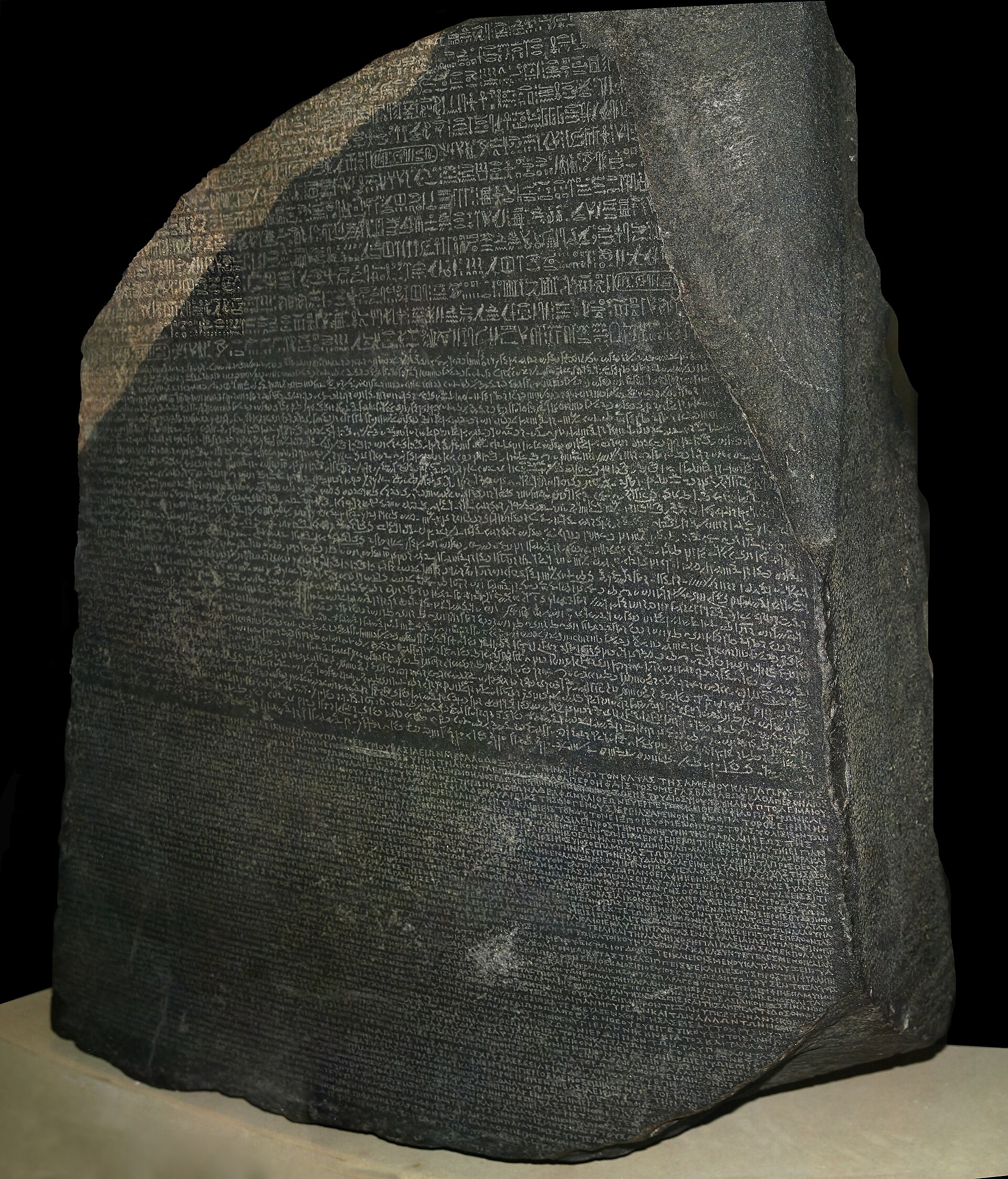
The original stone, granodiorite, on display in the British Museum. Photographed by Hans Hillewaert in 2007; a Wikimedia Commons Valued Image and the most widely reproduced photograph of the actual object.
Photograph by Hans Hillewaert, via Wikimedia Commons · CC BY-SA 4.0| Artist | The priestly synod of Memphis (individual scribes and stonecutters unrecorded) |
|---|---|
| Date | 196 BC |
| Medium | Incised granodiorite stele (formerly, and for most of two centuries wrongly, catalogued as black basalt) |
| Dimensions | 1123 x 757 x 284 mm; approx. 760 kg. The complete stele is estimated to have stood about 149 cm tall; roughly the top third and part of the lower right corner are missing. |
| Where it is now | The British Museum, London, Room 4 (Egyptian Sculpture Gallery), in a specially built case since 2004last confirmed |
| Inventory number | EA 24 |
| Attribution | AcceptedThe text is a fixed, internally dated decree: Year 9 of Ptolemy V Epiphanes, issued by the general synod of priests from every temple in Egypt meeting at Memphis on 27 March 196 BC. Full note |
| Object type | Antiquity |
| Period | Ptolemaic Egypt, reign of Ptolemy V Epiphanes |
| Cases | Has a provenance gap · Restituted or repatriated |
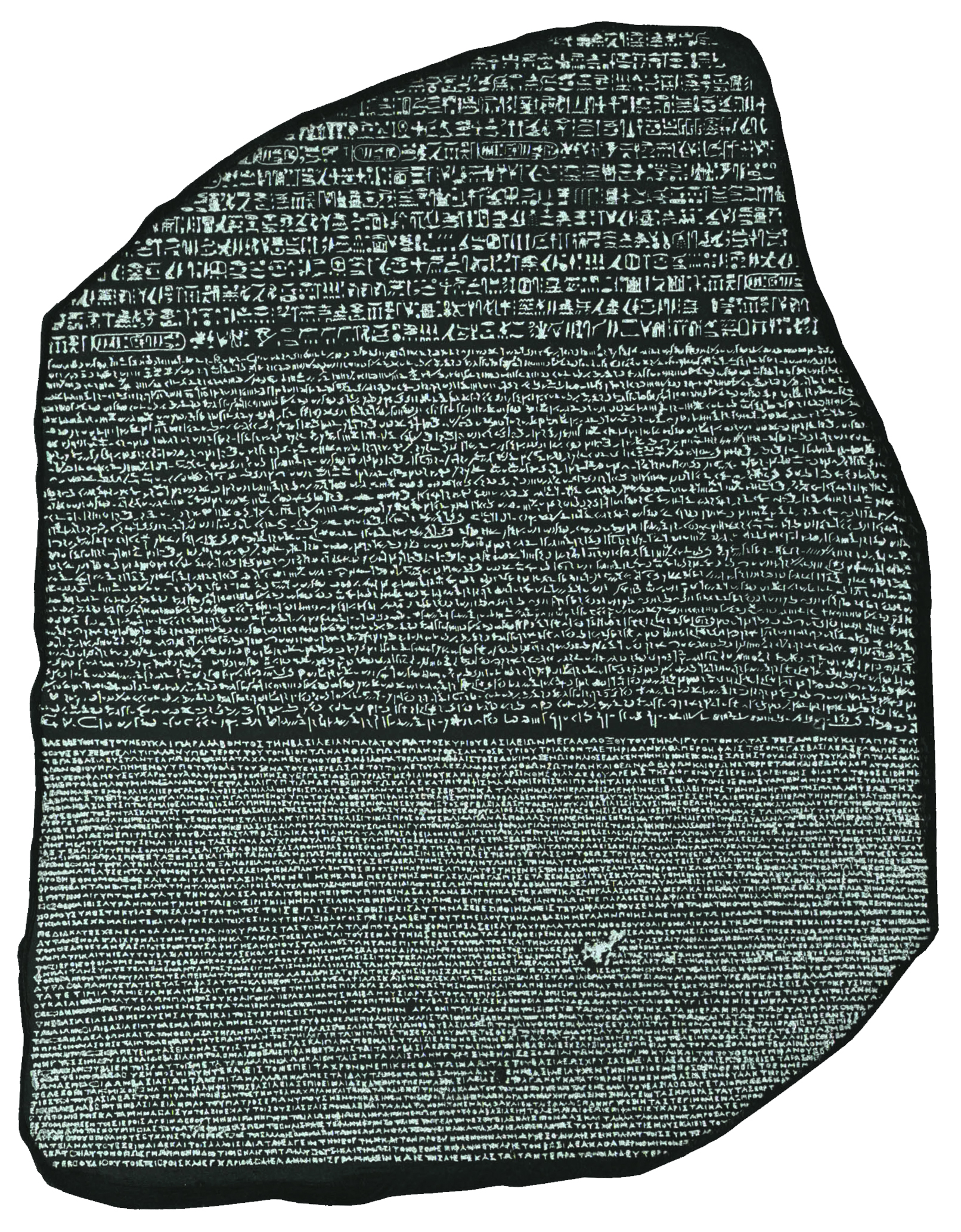
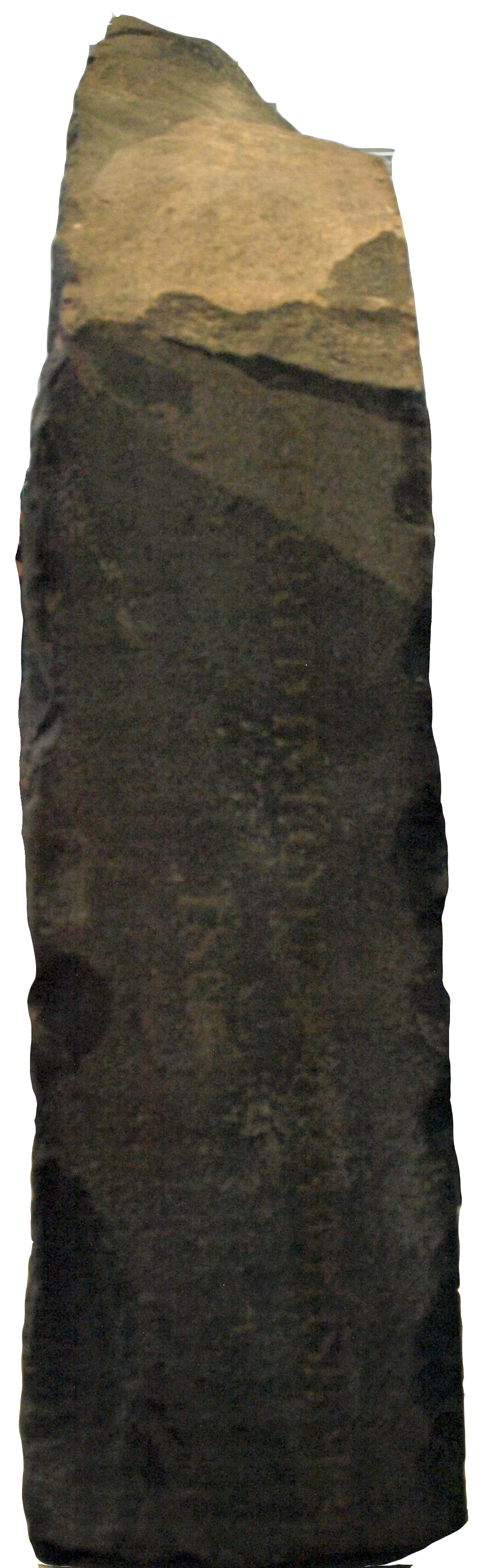
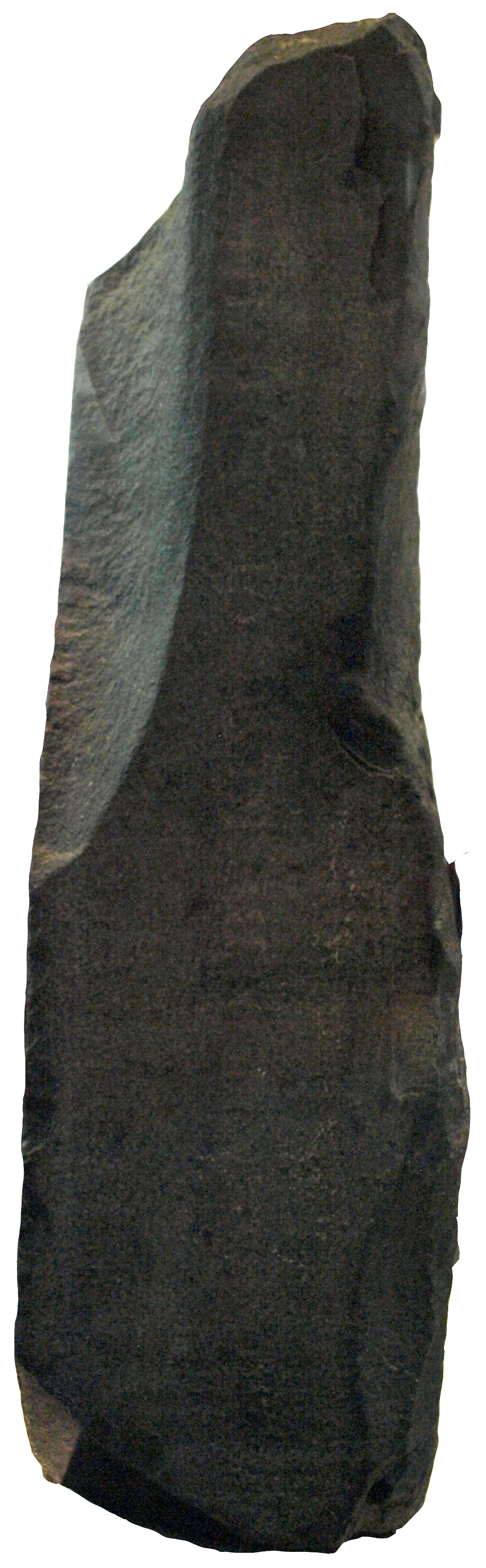
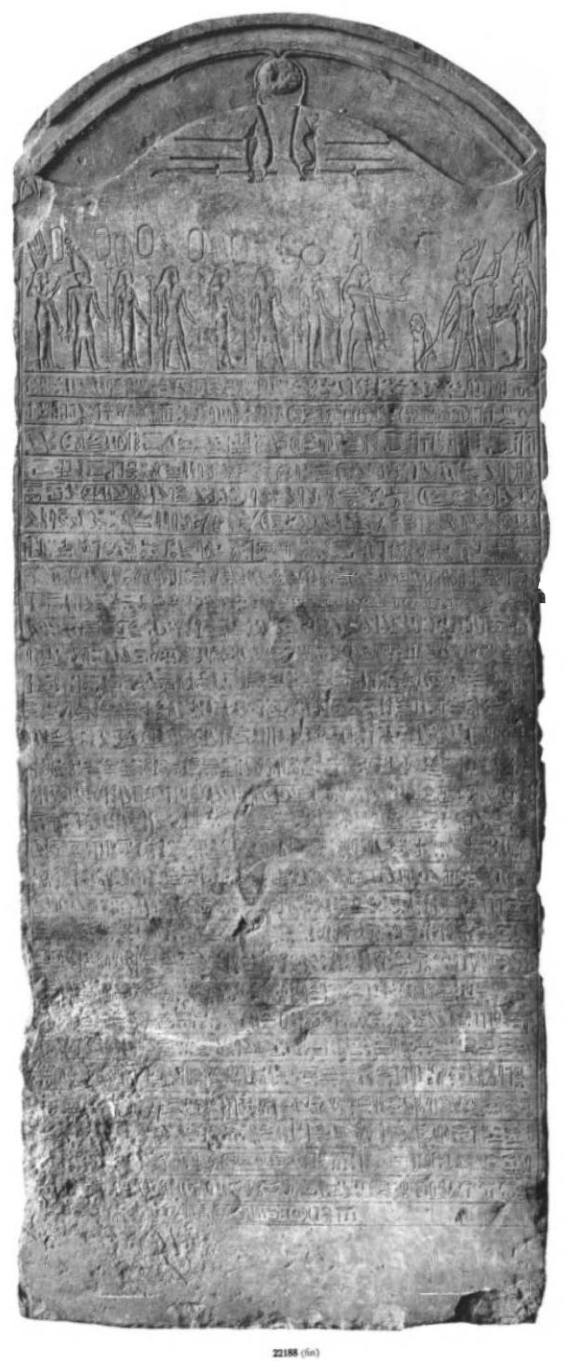
| Inscriptions | The same royal decree in three scripts: 14 surviving (incomplete) lines of hieroglyphic at the top, 32 lines of Demotic in the middle register, 54 lines of Ancient Greek at the bottom, the most complete of the three. Later, non-ancient inscriptions were added to the stone's edges after it reached England: CAPTURED IN EGYPT BY THE BRITISH ARMY IN 1801 on one side, PRESENTED BY KING GEORGE III on the other. |
| Owners on record | 9 links8 documented, 1 unknown |
| Sources | 18 cited |
About this record Last verified · 18 sources cited · Change log
On this page 9 sections
ContentsClose
A broken granodiorite slab carved in 196 BC with a routine priestly tax-and-cult decree, in three scripts, for a 13-year-old Macedonian king who needed the Egyptian priesthood's endorsement more than the priesthood needed his money. It spent most of its life built into a fortress wall as ordinary building stone before French soldiers found it in 1799 and British forces took it in 1801, under Article 16 of the Capitulation of Alexandria, over the object's claim by the French commander Menou that it was his personal property.
It has been in the British Museum, on almost continuous public display, since June 1802, and it gave Thomas Young and Jean-Francois Champollion the key to hieroglyphs by 1822. It is not, contrary to the popular idea, a unique text: at least a few other fragmentary copies of the same decree survive, one of them already in Cairo.
Egypt has asked for it back, formally and repeatedly, since at least 2003, through Zahi Hawass's public campaigns, a 2005 request to UNESCO, petitions, and a parliamentary route pursued from 2023. The British Museum's position has not moved: no formal government request received, and no legal mechanism under the British Museum Act 1963 to give it up even if one were.
Provenance
Each link is graded. Documented: a cited source supports it. Disputed: the identification is argued but not established. Unknown: no owner for that span, and the gap is not smoothed into a narrative. The grades in the glossary.
- 196 BC -The temple(s) of Ptolemaic Egypt, per the decree's own instruction that a copy be erected in every templedocumented
Decree of the Memphis priestly synod, issued 27 March 196 BC (Year 9 of Ptolemy V Epiphanes). This specific stele's original temple of display is not identified in any source consulted; a temple at Sais is the leading unconfirmed candidate.5
- 196 BC - 15th century ADUnknownunknown
No owner, custodian or location is documented for roughly sixteen centuries between the decree's promulgation and the stone's reuse as building material in a Mamluk-era fortification. How and when it was broken and removed from temple use is not recorded.3
- 15th century AD (reign of Sultan Qaitbay, 1468-1496) - July 1799Reused as building stone (spolia) in the walls of Fort Julien (Fort Rashid), near Rosettadocumented
The stone, already broken, was built into the fortification's walls alongside other spoliated ancient masonry, functioning as structural material rather than a legible monument.3
- July 1799 - September 1801The French Republic, via the army of Napoleon's Egypt expedition and the Institut d'Egyptedocumented
Uncovered mid-July 1799 during French military engineering work at Fort Julien. Lieutenant Pierre-Francois Bouchard identified its significance; it was sent to Cairo and examined by scholars of the Institut d'Egypte, whose report was delivered by Michel-Ange Lancret.13
- September 1801 - September 1801Transferred from French to British possessiondocumented
Under Article 16 of the Capitulation of Alexandria (concluded 30 August to 2 September 1801, between General Menou for France and General Hutchinson for Britain, with Admiral Lord Keith and Lt-Col Kempt, and an Ottoman representative present), the antiquities and collections assembled by the French scientific commission were declared public property subject to disposal by the allied generals, overriding Menou's specific claim that the stone was his personal property. The precise physical circumstances of the handover in Alexandria (Clarke's account of a warehouse surrender versus Turner's account of a personal seizure) are disputed between the two British participants' own later accounts.134
- September 1801 - February 1802British Crown, in transitdocumented
Escorted by Colonel Tomkyns Hilgrove Turner aboard the captured French frigate HMS Egyptienne, landing at Portsmouth in February 1802.13
- February 1802 - June 1802British Crown / Society of Antiquaries examinationdocumented
Examined by the Society of Antiquaries on 11 March 1802. King George III directed its placement in the British Museum.1
- June 1802 - presentThe British Museum, London (trustees, under the British Museum Act 1963)documented
On public display almost continuously since June 1802. Exceptions: moved underground to a Postal Tube Railway station near Holborn, 1917-1919, for wartime protection; loaned to the Louvre, Paris, for one month in October 1972, the only peacetime departure on record. Registered under accession number EA 24. Since 2004, displayed in a purpose-built case in Room 4, the Egyptian Sculpture Gallery.12
- 2003 - presentHeld by the British Museum; ownership and legal title publicly and repeatedly disputed by Egyptian campaignersdocumented
A continuing, unresolved public dispute, not a change of custody. Zahi Hawass's campaigns (2003, 2005 UNESCO submission, 2009 loan request and refusal, 2019 committee, 2022 petitions, 2023 UK parliamentary petition route, and renewed calls following the Grand Egyptian Museum's opening on 1 November 2025) have not produced a loan, a restitution, or any documented change in the British Museum's position that it holds clear legal title and has received no formal government-to-government request.7891011121314151617
Technical evidence
| Attribution note | The text is a fixed, internally dated decree: Year 9 of Ptolemy V Epiphanes, issued by the general synod of priests from every temple in Egypt meeting at Memphis on 27 March 196 BC. Authorship of the decree's content is documented in the text itself. The individual scribes who composed the hieroglyphic, Demotic and Greek versions, and the stonecutters who carved this particular stele, are not named in any surviving source, which is normal for temple-decree stelae of the period. |
|---|---|
| Material | Granodiorite. For most of two centuries the stone was catalogued and popularly described as black basalt; petrographic comparison has since corrected this.12 |
| Dimensions and weight | 1123 x 757 x 284 mm; approximately 760 kg.12 |
| Completeness | The complete stele is estimated to have stood about 149 cm tall. The surviving fragment is missing most of its top register and part of its lower right corner; no missing piece has been located.12 |
| Inscription, hieroglyphic register | 14 surviving lines, the most damaged of the three registers, positioned at the top of the stone.12 |
| Inscription, Demotic register | 32 lines, the middle register.12 |
| Inscription, Greek register | 54 lines, the bottom register and the most complete of the three.12 |
| Probable quarry source | Comparison with the Klemm collection of Egyptian rock samples points to a probable source in the granodiorite quarries at Gebel Tingar, on the Nile's west bank near Aswan.1 |
| Conservation history | In 1801 the inscriptions were rubbed with white chalk for legibility and the surface coated in carnauba wax for protection; the wax darkened over two centuries, contributing to the black-basalt misidentification. A 1999 in-gallery cleaning removed the wax and chalk, revealing the true dark grey colour and a pink vein at the upper left corner.1 |
| Accession number | EA 24, assigned as part of the British Museum's Egyptian and Sudanese collections registration system.12 |
| Findspot | Recovered mid-July 1799 built into a wall of Fort Julien (Fort Rashid), a fifteenth-century Mamluk-era fortification near Rosetta, where it had been reused as ordinary building stone (spolia). Its original display location, before reuse, is not documented; a temple at Sais is the leading but unconfirmed candidate.13 |
| Decipherment milestones | 1802: Silvestre de Sacy identifies five Greek names in the Demotic text; Akerblad publishes a partial Demotic alphabet. 1814 onward: Thomas Young identifies the cartouche group spelling Ptolemaios and over 80 hieroglyphic-Demotic correspondences. 14 September 1822: Jean-Francois Champollion recognises the phonetic principle applies generally, not only to foreign names. 27 September 1822: Champollion reads the Lettre a M. Dacier to the Academie des Inscriptions et Belles-Lettres, Paris, the conventional birth date of Egyptology.1318 |
Images

The record in full
Chapter 1What it is
The stone is granodiorite, not the black basalt that guidebooks called it for most of its time in England: dark grey, with a crystalline shimmer and a pink vein visible in the upper left corner once...
The stone is granodiorite, not the black basalt that guidebooks called it for most of its time in England: dark grey, with a crystalline shimmer and a pink vein visible in the upper left corner once wax and old chalk were cleaned off in 1999. It measures 1123 by 757 by 284 mm and weighs roughly 760 kg. It carries the same short decree three times over: 14 surviving lines of hieroglyphic script at the top (the most damaged register), 32 lines of Demotic in the middle, and 54 lines of Ancient Greek at the bottom, the fullest and best preserved of the three.
It is a fragment, not a complete object. The stele is estimated to have stood about 149 cm tall when whole; what survives is roughly the lower two-thirds, missing most of its top and a piece of the lower right corner. No missing piece has ever been located. After it reached England, two further inscriptions were painted, and later incised, into its edges: CAPTURED IN EGYPT BY THE BRITISH ARMY IN 1801 on the left side, PRESENTED BY KING GEORGE III on the right. Those two lines are not part of the ancient object. They are the museum's own account of how it got there, carved onto the artifact itself, and they already contain the dispute this record has to untangle: one line describes a capture, the other a gift.
Chapter 2The decree it carries
Ptolemy V Epiphanes was crowned pharaoh at Memphis, Egypt's old capital, at about thirteen years old.
Ptolemy V Epiphanes was crowned pharaoh at Memphis, Egypt's old capital, at about thirteen years old. On 27 March 196 BC, Year 9 of his reign, a general synod of priests drawn from every temple in the country met at Memphis and issued a decree in his honour. The text explains why: Egypt had been through the Great Theban Revolt (roughly 206 to 186 BC, led first by Horwennefer and then Ankhwennefer), and the decree specifically records Ptolemy's forces putting down a siege at Lycopolis. The priesthood's endorsement of a young Macedonian king as a living Egyptian god was not free, and the decree does not pretend otherwise.
In its own words, translated: "Of the dues and taxes existing in Egypt some he has cut and others he has abolished completely, in order to cause the army and all other people to be happy in his time." It grants amnesty to "the men who had been on the other side in the rebellion which occurred in Egypt, to let them return to their homes and their property belong to them again." It commits royal funds to temple upkeep and priestly stipends, and it orders that a statue of the king be set up in every temple, with a specified cult and festival calendar attached. This is not a hidden programme requiring excavation to see: the stone states plainly what the king bought and what the priesthood sold, and the deal is the point of the object.
The order to copy the text three times was deliberate and specific to its audience: hieroglyphic for the priesthood, Demotic for Egyptian administrative and commercial use, and Greek for the Ptolemaic court and government. A single stele could not be read by all three constituencies in one script; it was designed from the start to be read by all of them in three.
Chapter 3One stone among many, not a unique text
Because the decree ordered a copy set up in every temple in Egypt, the Rosetta Stone was never meant to be the only surviving witness to this text, and it is not.
Because the decree ordered a copy set up in every temple in Egypt, the Rosetta Stone was never meant to be the only surviving witness to this text, and it is not. At least a few other fragmentary copies of the same 196 BC decree are known: the Nubayrah Stele, a badly damaged limestone version found near Damanhur and now in the Egyptian Museum, Cairo (no. 5576), and further fragments from Naucratis, Elephantine and Noub Taha. None is as complete as the Rosetta Stone, which is why it, and not one of the others, became the reference copy scholars used to reconstruct the missing lines.
It is worth being precise about what is and is not part of this same text, because confusing related Ptolemaic priestly decrees is exactly the kind of error this record exists to prevent. The later Philensis I and II decrees and the Asphynis stela, all from the Philae temple complex, are trilingual priestly decrees in the same genre and format, issued in later years of Ptolemy V's reign; they are not copies of the Rosetta Stone's specific text. Nor is the Philae obelisk (the Bankes obelisk, now at Kingston Lacy, Dorset), a separate bilingual Greek-and-hieroglyphic monument that happened to carry the cartouches of Ptolemy and Cleopatra and so played its own, different role in the decipherment. This record treats all of these as related objects, graded and captioned as such, not as versions of the Rosetta Stone itself.
Chapter 4Two thousand years unaccounted for, then a wall
No record identifies which temple first displayed this particular stele, or when it left.
No record identifies which temple first displayed this particular stele, or when it left. The likeliest candidate on stylistic and geographic grounds is a temple at Sais, in the Nile Delta, but this is not confirmed by any source consulted for this record and is recorded here as an open question rather than a fact.
What is documented is where it turned up next: reused as ordinary building stone. By the time the Mamluk sultan Qaitbay (reigned 1468 to 1496) had a coastal fort built near Rosetta in the fifteenth century, later known to the French and British as Fort Julien, the stone had already been broken and was set into the fortification's walls alongside other spoliated ancient masonry, functioning as nothing more than a convenient slab. It sat there, unread and unremarked, doing structural work for a fort, for roughly three centuries. This gap of some two millennia between the decree's promulgation and its rediscovery is recorded here as unknown, not bridged with a guess.
Chapter 5Discovery, July 1799
French engineers under Napoleon's occupying army were rebuilding and reinforcing Fort Julien in mid-July 1799 when the inscribed slab was uncovered in the fortification's walls.
French engineers under Napoleon's occupying army were rebuilding and reinforcing Fort Julien in mid-July 1799 when the inscribed slab was uncovered in the fortification's walls. Lieutenant Pierre-Francois Bouchard recognised that the stone carried the same text in three scripts, including Greek, and had it sent on to Cairo. The Institut d'Egypte, the scientific and scholarly body Napoleon had brought to Egypt alongside his army, examined it; a report by Michel-Ange Lancret announced the find to the Institut, and its scholars had lithographic and plaster copies made and circulated to European academies before the military situation in Egypt collapsed around them.
This distinction matters for what follows: the stone's discoverers and its first serious students were the Institut's civilian scholars, the savants, working on the wider project that became the Description de l'Egypte. Its eventual loss to Britain was a decision made over their heads, by soldiers, as the French military position in Egypt fell apart.
Chapter 6The Capitulation of Alexandria
With Napoleon long since returned to France and the French position in Egypt militarily untenable, General Jacques-Francois (Abdallah) Menou negotiated the surrender of Alexandria.
With Napoleon long since returned to France and the French position in Egypt militarily untenable, General Jacques-Francois (Abdallah) Menou negotiated the surrender of Alexandria. The Capitulation of Alexandria was concluded between 30 August and 2 September 1801: Menou for France; General Sir John Hely-Hutchinson for Britain, with Admiral Lord Keith and Lieutenant-Colonel James Kempt; and, since Egypt remained nominally Ottoman territory, representatives of the Ottoman Kapudan Pasha Kucuk Huseyin Pasha were also party to the agreement. That Ottoman presence is not incidental: the British Museum still cites it today as part of its answer to the argument that Egypt had no party at the table in 1801.
Article 16 of the terms, as printed in Robert Wilson's 1803 History of the British Expedition to Egypt, declared that the antiquities, manuscripts and other collections the French scientific commission had assembled were public property, subject to the disposal of the generals of the combined army, and not the private possessions of individual officers. Menou tried, specifically and by name, to exempt the Rosetta Stone from this by claiming it as his own personal property. The claim did not hold under the article's terms.
How the stone physically changed hands in Alexandria in September 1801 is where the sources genuinely disagree, and this record grades that part as disputed rather than documented. The British antiquarian Edward Daniel Clarke recorded that a French officer, a member of the Institut, secretly led him and William Richard Hamilton through back streets behind Menou's residence and showed them the stone hidden under protective carpets among Menou's baggage in a warehouse, and that it was formally surrendered to them there. Colonel Tomkyns Hilgrove Turner, who went on to escort the stone to England, later gave a different account in which he personally seized it from Menou and carried it off on a gun-carriage. Both men had reason to want the credit; neither account can be fully checked against the other, and this record does not choose between them.
Chapter 7To England
Turner escorted the stone aboard the captured French frigate HMS Egyptienne, landing at Portsmouth in February 1802.
Turner escorted the stone aboard the captured French frigate HMS Egyptienne, landing at Portsmouth in February 1802. The Society of Antiquaries examined it on 11 March 1802. King George III directed that it be placed in the British Museum, and it went on public display there in June 1802, which is also when the two edge inscriptions, CAPTURED IN EGYPT BY THE BRITISH ARMY IN 1801 and PRESENTED BY KING GEORGE III, were added. Its museum registration number, EA 24, was assigned later in the nineteenth century as the Museum's Egyptian collections were formally catalogued; the object itself had already been on view for decades under that later number's predecessor arrangements.
Chapter 8The race to read it
Progress was incremental and international.
Progress was incremental and international. In 1802 the French orientalist Silvestre de Sacy identified five personal names in the Demotic text, and the Swedish diplomat Johan David Akerblad published a Demotic alphabet of 29 signs, partly wrong but a genuine start. From 1814 the English polymath Thomas Young worked out that a cartouche group spelled the name Ptolemaios and catalogued more than eighty points of correspondence between the hieroglyphic and Demotic scripts, but he held, incorrectly, that hieroglyphic writing was not phonetic outside a handful of foreign royal names.
Jean-Francois Champollion, building on Young's work and on other bilingual material, especially the Greek and hieroglyphic cartouches of Ptolemy and Cleopatra recorded from the Philae obelisk by William John Bankes, recognised on 14 September 1822 that the phonetic principle applied generally, not just to foreign names. According to the account that has passed down through his own family and been repeated by the British Museum, Wikipedia and the Smithsonian alike, he ran to his brother Jacques-Joseph's office shouting "Je tiens mon affaire!", I've got it, and collapsed from the excitement. He read his findings, the Lettre a M. Dacier, to the Academie des Inscriptions et Belles-Lettres in Paris on 27 September 1822, conventionally treated as the birth date of Egyptology as a discipline. Exactly how much Champollion's breakthrough owed to Young's prior work has never been fully settled between the two men's national traditions of credit, and British accounts have generally pressed Young's case harder than French ones have.
Chapter 9Two centuries on display
The stone has been on public view at the British Museum almost without interruption since June 1802.
The stone has been on public view at the British Museum almost without interruption since June 1802. The two exceptions are both documented. During the First World War, from 1917 to 1919, concern about bombing raids on London led the Museum to move it, along with other portable valuables, about 15 metres (50 feet) underground into a station of the Postal Tube Railway at Mount Pleasant, near Holborn. In October 1972 it left the Museum for the only peacetime occasion on record, on loan for one month to the Louvre in Paris, to mark the 150th anniversary of the Lettre a M. Dacier's publication, displayed there alongside Champollion's own letter.
In 1801 the inscriptions had been rubbed with white chalk to make them easier to read, and the stone's whole surface coated in carnauba wax to protect it from visitors' fingers. Over the following two centuries the wax darkened, and for most of that time the stone was recorded, wrongly, as black basalt. A 1999 in-gallery conservation programme removed the old wax and chalk and revealed the stone's true dark grey colour and the pink vein at its upper left corner; comparison of the rock with the Klemm collection of Egyptian geological samples points to a probable source in the granodiorite quarries at Gebel Tingar, on the Nile's west bank near Aswan, hundreds of kilometres south of wherever the finished stele was first erected.
Since 2004, for the bicentenary of its arrival, the stone has stood in a specially built case at the centre of the Egyptian Sculpture Gallery, Room 4, and it is consistently reported as the single most visited object the Museum holds.
Chapter 10The replica
In 2005 the British Museum presented Egypt with a full-size fibreglass replica of the stone, which went on display at the newly renovated Rashid National Museum in Rosetta itself; the town the object...
In 2005 the British Museum presented Egypt with a full-size fibreglass replica of the stone, which went on display at the newly renovated Rashid National Museum in Rosetta itself; the town the object is named for has, since then, held only a copy of it. The Museum keeps a second replica of its own, in the King's Library gallery, deliberately displayed without a protective case and free for visitors to touch, a hands-on contrast to the glass-cased original in Room 4 that the Museum uses in its own public-engagement programming. Neither replica should be mistaken for the object described in this record, and both are captioned as such wherever they appear in this record's gallery.
Chapter 11Hawass and the standing claim, 2003 to 2019
Zahi Hawass, then Secretary-General of Egypt's Supreme Council of Antiquities, made his first public call for the stone's return in July 2003, describing it as "the icon of our Egyptian identity." In...
Zahi Hawass, then Secretary-General of Egypt's Supreme Council of Antiquities, made his first public call for the stone's return in July 2003, describing it as "the icon of our Egyptian identity." In July 2005 he raised the case formally at a meeting in Paris of UNESCO's Intergovernmental Committee for Promoting the Return of Cultural Property to its Countries of Origin; Egypt submitted a request to UNESCO naming the Rosetta Stone among five objects it wanted returned, and Hawass told reporters that "if the British want to restore their reputation, they should volunteer to return the Rosetta Stone." The Museum's 2005 replica gift to Rashid followed in the same period.
In 2009 Hawass changed tack and asked the British Museum for a three-month loan, timed to a Grand Egyptian Museum opening then planned for 2013 (a date that would in fact slip by more than a decade), offering to set aside the permanent-return claim in exchange. The Museum's written reply raised the security of the hosting institution as a condition of any loan. Hawass's public response was sharp: "We are not the pirates of the Caribbean. We are a civilised country. If I sign a contract with the British Museum, we will return it." No loan agreement followed, and Hawass reverted to demanding outright return rather than a loan.
In November 2019, at the opening of a Tutankhamun exhibition, Hawass announced he was leading "a committee of intellectual Egyptians and foreigners" pursuing the return of three objects together: the Rosetta Stone, the Dendera Zodiac (Louvre) and the bust of Nefertiti (Neues Museum, Berlin). He said he had approached the Berlin State Museums, the British Museum and the Louvre that year with loan requests; all three declined.
Chapter 12Petitions and the parliamentary route, 2022 to 2023
Hawass revived the campaign publicly between August and October 2022, launching a petition covering the same three objects through Change.org, his own website and social media; it drew more than...
Hawass revived the campaign publicly between August and October 2022, launching a petition covering the same three objects through Change.org, his own website and social media; it drew more than 3,300 signatures within 24 hours of its October launch, with a stated eventual target of one million. Separately, more than two thousand Egyptologists and archaeologists, an initiative associated with the Egyptologist Monica Hanna, signed an open letter specifically calling for the Rosetta Stone's return in time for the Grand Egyptian Museum's then-planned opening, describing the request as a matter of correcting "cultural violence."
Because the British Museum Act 1963 bars the trustees from permanently disposing of collection objects except in narrow, specified circumstances, defined in section 5 as a duplicate, an object unfit to be retained that can be disposed of without detriment to students or the public, an object given or bequeathed after 1963 whose donor consents to its disposal, or an object no longer of use for the Museum's purposes, campaigners increasingly targeted the law itself rather than the Museum's discretion. In February 2023 the British-based Egyptian lawyer Jihan al-Husseini filed a petition to the UK Parliament seeking an amendment to the law governing the recovery of antiquities; under Parliament's petition rules it would need 100,000 signatures from UK nationals or residents to guarantee a House of Commons debate. The Egyptologist Laila Takla said a London contact was seeking a sitting MP to sponsor a bill toward the same end. Neither the petition threshold nor a sponsored bill had produced a change in the law as of the sources consulted for this record.
Chapter 13November 2025: the Grand Egyptian Museum opens
The Grand Egyptian Museum at Giza, delayed repeatedly across two decades of construction, held its full public opening on 1 November 2025.
The Grand Egyptian Museum at Giza, delayed repeatedly across two decades of construction, held its full public opening on 1 November 2025. The opening renewed the campaign at scale. Hawass told the BBC that the three objects, the Rosetta Stone, the Dendera Zodiac and the Nefertiti bust, should "come as a good feeling," framing the request as one for a gesture of goodwill rather than a legal claim, and reported that his combined petitions had passed one million signatures. The Rosetta Stone remained the priority name on that list. It did not travel to Giza, and nothing in the sources consulted for this record indicates the British Museum changed its position as a result of the opening.
Chapter 14The British Museum's position
The Museum's public position has stayed consistent across two decades of requests.
The Museum's public position has stayed consistent across two decades of requests. It states that it has received no formal government-to-government request for either the return or the loan of the stone, a distinction it draws deliberately between Hawass's public campaigns and open letters, on one hand, and a state application it says it would handle differently, on the other. It maintains that it holds clear legal title, tracing that title through the Capitulation of Alexandria of 1801, noting the participation of an Ottoman representative in that agreement as an answer to the argument that Egypt itself had no party to the 1801 negotiation, and through the British Museum Act 1963, which vests ownership of the collection in the trustees and permits disposal only in the narrow circumstances set out in section 5, none of which the Museum considers applicable here.
On the question of uniqueness, the Museum has pointed out that the Rosetta Stone's 196 BC text is not one of a kind: other fragmentary copies of the same decree are known, including the Nubayrah Stele, already held in Cairo's Egyptian Museum. Alongside these legal and textual arguments, the Museum has also noted the stone's standing as one of its principal visitor draws, at a time when it is separately seeking to raise roughly 1 billion pounds for a masterplan redevelopment of its Bloomsbury site, a commercial interest it states as a fact of its situation rather than offers as a legal justification for retention. No litigation over title has been filed by Egypt or any Egyptian institution in the sources consulted for this record, and no loan agreement or restitution has resulted from any of the approaches described above.
The artist
The general synod of Egyptian priests convened at Memphis, 27 March 196 BC (individual scribes and stonecutters unrecorded)
There is no named maker to research here, and inventing one would be exactly the kind of gap-bridging this record exists to avoid. What is documented is the institution that authored the text: a general synod of priests drawn from every temple in Egypt, meeting at Memphis on 27 March 196 BC, in the ninth year of Ptolemy V's reign, to formalise the terms of a political bargain between the Macedonian crown and the Egyptian temple establishment. The stonecutters who carved this particular stele, and the scribes who prepared its Demotic and Greek translations from an original that was probably drafted first in hieroglyphic or a hieroglyphic-influenced register, are not named in any source consulted for this record, which is normal for Ptolemaic temple decrees of this kind.
Related works
| Work | Relation | Where it is |
|---|---|---|
| Nubayrah Stele Unknown; same Memphis synod decree | A second, badly damaged copy of the identical 196 BC decree text carried by the Rosetta Stone Limestone, not granodiorite; found near Damanhur. Already in Egypt, and cited by the British Museum as evidence the Rosetta Stone's text is not unique. | Egyptian Museum, Cairo (no. 5576) |
| Fragmentary copies from Naucratis, Elephantine and Noub Taha Unknown | Further partial copies of the same 196 BC decree Used alongside the Nubayrah Stele to help confirm and, in places, reconstruct missing sections of the Rosetta Stone's text. | Dispersed, fragmentary |
| Philensis I and II decrees; the Asphynis stela Unknown; later Ptolemaic priestly synods | Same genre of trilingual priestly decree, different years and different content, not copies of the Rosetta Stone's text Listed here specifically to prevent the common confusion of treating every trilingual Ptolemaic temple decree as a version of the Rosetta Stone. | Philae temple complex, Egypt |
| Philae obelisk (Bankes obelisk) Unknown, Ptolemaic period | A separate bilingual (Greek and hieroglyphic) monument, not a copy of the Rosetta Stone decree, whose cartouches of Ptolemy and Cleopatra assisted Champollion's decipherment alongside the Rosetta Stone Removed from Philae by Giovanni Belzoni in 1818 for William John Bankes. | Kingston Lacy, Dorset, England |
| British Museum fibreglass replica Modern reproduction, 21st century | Full-size cast of the Rosetta Stone, not the ancient object Displayed without a protective case and free to touch, unlike the original in Room 4. | King's Library gallery, British Museum, London; a second cast at the Rashid National Museum, Rosetta, Egypt (gifted 2005) |
Open questions
- Which temple first displayed the stele, and when it left that temple, is not documented. A temple at Sais is the leading candidate on geographic and stylistic grounds but is not confirmed by any source consulted for this record.
- The exact physical mechanics of the September 1801 transfer in Alexandria are disputed: Clarke's account of a French officer surrendering the stone from Menou's baggage conflicts with Turner's later claim to have personally seized it and hauled it away on a gun-carriage.
- The missing top portion of the hieroglyphic register and the missing piece of the lower right corner have never been located.
- Whether the British Museum has ever produced an internal record evaluating a formal loan or restitution proposal beyond its 2009 security-conditions letter to Hawass has not been found in the sources consulted for this record.
- Whether the government of Egypt, as distinct from Zahi Hawass acting in a public campaigning capacity, has ever lodged a formal state-to-state repatriation request is disputed by the two sides' own public statements: the British Museum says none has been received; no countervailing Egyptian government document has been located in the sources consulted here.
- No insurance valuation, declared value or comparable figure for the stone has been published in any source consulted for this record.
Questions about this object
What is The Rosetta Stone?
The Rosetta Stone is an antiquity, dated 196 BC. Medium: Incised granodiorite stele (formerly, and for most of two centuries wrongly, catalogued as black basalt).
Who made The Rosetta Stone, and is the attribution settled?
The attribution to The priestly synod of Memphis (individual scribes and stonecutters unrecorded) is recorded here as accepted. The text is a fixed, internally dated decree: Year 9 of Ptolemy V Epiphanes, issued by the general synod of priests from every temple in Egypt meeting at Memphis on 27 March 196 BC. Authorship of the decree's content is documented in the text itself. The individual scribes who composed the hieroglyphic, Demotic and Greek versions, and the stonecutters who carved this particular stele, are not named in any surviving source, which is normal for temple-decree stelae of the period.
Where is The Rosetta Stone now?
The British Museum, London, Room 4 (Egyptian Sculpture Gallery), in a specially built case since 2004. Inventory number EA 24. Last confirmed 12 August 2026. Transferred to Britain under Article 16 of the Capitulation of Alexandria, 1801; presented to the British Museum by King George III, June 1802.
What is still unknown about The Rosetta Stone?
Which temple first displayed the stele, and when it left that temple, is not documented. A temple at Sais is the leading candidate on geographic and stylistic grounds but is not confirmed by any source consulted for this record.
Sources
- 1Wikipedia, 'Rosetta Stone' - consolidating physical description, discovery, transfer, decipherment and display history. en.wikipedia.org/wiki/...
- 2British Museum (blog), 'The Rosetta Stone: everything you need to know'. britishmuseum.org/blog/...
- 3Andrew Dalby, 'Rosetta Stone', WikiJournal of Humanities, 2(1), 20 February 2019, doi:10.15347/WJH/2019.001 - peer-reviewed academic article, used for the Fort Julien spolia findspot, the Menou/Clarke/Turner accounts, and the WWI and 1972 display history. en.wikiversity.org/wiki/...
- 4Wikipedia, 'Capitulation of Alexandria' - Article 16 text, officers and dates of the 1801 surrender. en.wikipedia.org/wiki/...
- 5Wikipedia, 'Rosetta Stone decree' - the Memphis synod, the Great Theban Revolt context, the decree's translated content, and the trilingual purpose. en.wikipedia.org/wiki/...
- 6Wikipedia, 'Nubayrah Stele' - findspot, current location and confirmation it carries the same decree text. en.wikipedia.org/wiki/...
- 7thearchaeologist.org, 'Egyptian Archaeologist Zahi Hawass requests Rosetta Stone return from British Museum', October 2022. thearchaeologist.org/blog/...
- 8El-Shai, 'Zahi Hawass Leads A Petition To Return 2 Famed Ancient Egyptian Artifacts, The Rosetta Stone And The Dendera Zodiac, to Egypt', 20 October 2022. el-shai.com/zahi-hawass-rosetta-stone-dendera-zodiac-peti...
- 9Heritage Key (Sean Williams), "'We are not Pirates!' Zahi Hawass Anger at British Museum Rosetta Stone Loan Letter", 9 December 2009. heritage-key.com/blogs/...
- 10Returning Heritage, 'Rosetta Stone: no priority for restitution' - British Museum Act 1963 barriers, lack of formal government request, and museum-community joint statement context. returningheritage.com/rosetta-stone-no-priority-for-resti...
- 11Returning Heritage, 'Why the Rosetta Stone will not be returning to Egypt ... just yet', 11 November 2025 - the November 2025 Grand Egyptian Museum opening, Hawass's renewed campaign, and the British Museum's response including the three-copies-of-the-decree argument and the 1 billion pound redevelopment context. returningheritage.com/why-the-rosetta-stone-will-not-be-r...
- 12designboom, 'renowned archaeologist zahi hawass demands rosetta stone's return to egypt', 24 August 2022 - including the 2007 and 2019 loan-request history and their refusal. designboom.com/art/...
- 13Zahi Hawass, 'Repatriation' (personal website). hawasszahi.com/repatriation
- 14Egypt Independent, 'How do we return the Rosetta Stone to Egypt?', 15 August 2023 - the UK parliamentary petition route, Jihan al-Husseini and Laila Takla. egyptindependent.com/how-do-we-return-the-rosetta-stone-t...
- 15Return The Stone campaign, 'The History of the Rosetta Stone'. returnthestone.org/history
- 16Nevine El-Aref, 'Antiquities wish list', Al-Ahram Weekly, 14-20 July 2005 (archived) - contemporary report of Hawass's 2005 UNESCO submission naming the Rosetta Stone. kooriweb.org/foley/...
- 17GB News, "Rosetta Stone: Egypt issues fresh call for Britain to hand back the 'illegally taken' relic" - Mohamed Ismail Khaled's statement for Egypt's Supreme Council of Antiquities. Flagged: full article text could not be directly fetched (paywall/402 response); the quotation used is drawn from an aggregated search excerpt of this article and should be re-verified against the original before further reuse. gbnews.com/news/...
- 18Wikipedia, 'Jean-Francois Champollion' - the 14 September 1822 breakthrough and the 'Je tiens mon affaire!' account. en.wikipedia.org/wiki/...
Last verified · Published
Change log
12 August 2026 - Record created at the house standard: researched narrative, technical evidence, maker dossier, graded provenance chain, prices with hammer and premium separated, related works, open questions and sources.