Bronze chariot inlaid with ivory (the Monteleone chariot)
Master bronzeworker of the Monteleone chariot and his workshop · 2nd quarter of the 6th century BCE (Metropolitan Museum); about 560-550 BCE (Emiliozzi 2011)
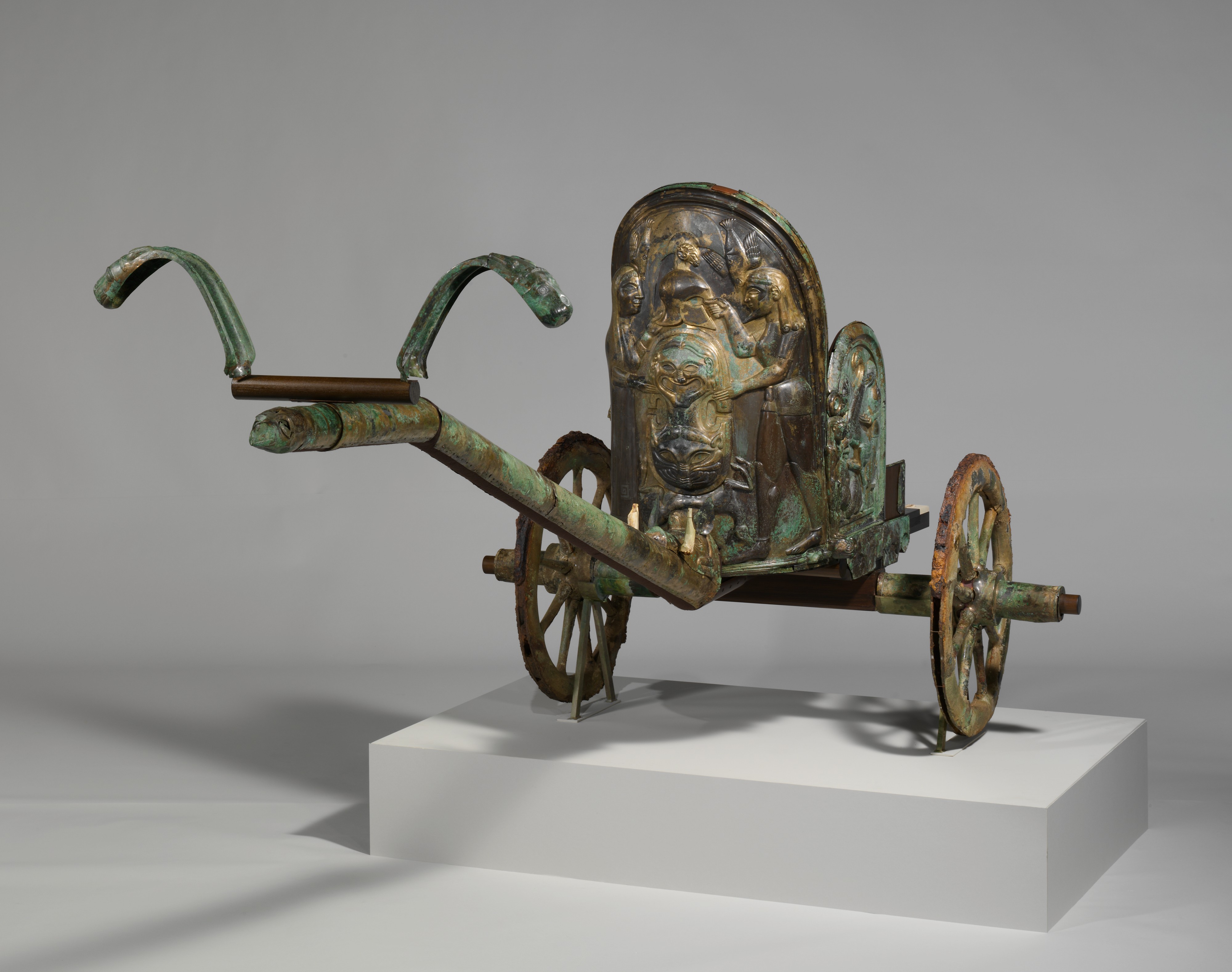
The Monteleone chariot as reconstructed 2002-2007 (Metropolitan Museum primary image, object 247020, accession 03.23.1). Licence CC0, route 1 institutional open access.
| Artist | Master bronzeworker of the Monteleone chariot and his workshop |
|---|---|
| Date | 2nd quarter of the 6th century BCE (Metropolitan Museum); about 560-550 BCE (Emiliozzi 2011) |
| Medium | Bronze sheet worked in repousse and incised, with ivory inlay, over a lost wooden and leather substructure |
| Dimensions | Total height 130.9 cm (51 9/16 in.); length of pole 209 cm (82 1/4 in.) |
| Where it is now | The Metropolitan Museum of Art, New York (Department of Greek and Roman Art)last confirmed |
| Inventory number | 03.23.1 |
| Attribution | DisputedAnonymous. Full note |
| Object type | Antiquity |
| Period | Etruscan, Archaic |
| Cases | Disputed attribution · Has a provenance gap · Seized, looted or confiscated |
| Inscriptions | None recorded. |
| Owners on record | 9 links5 documented, 2 disputed, 2 unknown |
| Sources | 7 cited |
About this record Last verified · 7 sources cited · Change log
On this page 9 sections
ContentsClose
A parade chariot of the second quarter of the sixth century BCE, sheathed in hammered bronze and inlaid with ivory, buried in a stone-lined tomb on the Colle del Capitano above Monteleone di Spoleto in Umbria. Its three main panels tell the story of Achilles: his mother Thetis bringing him new armour, his killing of Memnon and his rise to the afterlife in a chariot drawn by winged horses. Below the side panels run friezes of the boy Achilles with the centaur Chiron and of lions attacking a bull and a stag.
It came to light on 8 February 1902 when a farmer levelled ground for a new house, was sold within weeks to a junk dealer in Norcia for the price of scrap iron, passed through a Roman dealer to Paris and was bought there in 1903 for the Metropolitan Museum of Art by its director Luigi Palma di Cesnola. The Italian authorities knew of the find from the summer of 1902 and failed to stop it leaving. The chariot was assembled in New York in 1903, taken apart and reassembled correctly in 2002-2007, and has been the subject of a restitution request from the municipality of Monteleone di Spoleto, which Italy's Ministry of Culture committee voted to support diplomatically in 2025. The Metropolitan Museum has said it bought the chariot in good faith.
Provenance
Each link is graded. Documented: a cited source supports it. Disputed: the identification is argued but not established. Unknown: no owner for that span, and the gap is not smoothed into a narrative. The grades in the glossary.
- c. 560-550 BCE -Unknown Etruscan-Italic workshop; first owner unknowndisputed
Dated by the Metropolitan Museum to the second quarter of the 6th century BCE and by Emiliozzi to about 560-550 BCE. The city is not documented (Orvieto and Vulci proposed) and the master's background is argued three ways. Emiliozzi proposes a first owner in a major city, a hypothesis resting on ancient repairs.12
- 6th century BCE - 1902A man buried in the Chariot Tomb, Colle del Capitano, Monteleone di Spoletounknown
The chariot was buried with a single male in a stone-lined grave under a mound. His name and the date of the burial are unknown. Emiliozzi argues the chariot had been used and repaired before burial, possibly passing between two owners. (The identity of the occupant is unknown; the inference of earlier use is Emiliozzi's.)2
- 1902-02-08 - 1902-03-23Isidoro Vannozzi and his son Giuseppe, landownersdocumented
Found while levelling ground for a new farmhouse on their own land. Kept at home for several weeks. Source for the date and circumstances is Emiliozzi's use of the Italian state archive and Giuseppe Vannozzi's interview. Some press accounts say a swap for two cows; Emiliozzi gives a sale to pay for roof tiles.26
- 1902-03-23 - 1902Benedetto Petrangeli, junk dealer, Norciadocumented
Bought at the price of scrap iron, six soldi a kilo, total 950 lire. Currency lire; the dollar equivalent given in the source has no stated method and is not adopted. Petrangeli's Norcia photographs are in the Met's archive. The early name Biga of Norcia comes from him.2
- 1902 - 1903-02Roman antiques dealers, then Ortensio Vitalinidocumented
Petrangeli sold through Roman dealers to Vitalini for 150,000 lire (about 158 times Petrangeli's price, derived). Vitalini is described from Ludwig Pollak's memoirs as an intermediary for King Victor Emmanuel III. Dates of the individual sales are not given.2
- 1902-06 - 1903Italian state authorities (Carabinieri, Prefecture of Perugia, Ministry of Public Instruction)documented
Carabinieri took small objects from Vannozzi in June 1902, now in Perugia and Florence. The chariot itself had already left his hands and was not recovered.2
- 1903-02 - 1903-04Vitalini, with the pieces in the vaults of the Credit Lyonnais, Parisdisputed
Moved to Paris in February 1903 without a recorded licence. Negotiations with other museums failed on price and doubts of authenticity. The legality of the export is disputed between the Metropolitan Museum and Monteleone di Spoleto; no route or export document is established. J. P. Morgan is reported by the New York Press (1903) to have offered 60,000 dollars and did not buy.23456
- 1903-04 - presentThe Metropolitan Museum of Art, New Yorkdocumented
Agreed with Vitalini in April 1903 by Luigi Palma di Cesnola for the trustees and paid from the Rogers Fund (Rogers Fund, 1903; accession 03.23.1). Cesnola was quoted giving 235,000 francs plus 15,000 for vases and then a dollar total that does not match; the figure is unverified. The Museum has said it bought in good faith. First shown in New York on 26 October 1903.126
- 1921 - presentThe Metropolitan Museum of Art, New Yorkunknown
A second lot of bronzes bought in 1921 is thought by Emiliozzi to come from the Chariot Tomb or its neighbour, but the association is unproved. It does not include the chariot.2
Technical evidence
| Attribution note | Anonymous. The chariot is accepted as Etruscan-Italic work by the Metropolitan Museum and by Adriana Emiliozzi, who studied it during its 2002-2007 reconstruction, but the cultural background of the master is argued three ways: an Etruscan under Ionian influence, an East Greek working in Etruria, or a mixed Etruscan and East Greek shop. The city of manufacture is not documented; Orvieto and Vulci have been proposed. |
|---|---|
| Accession | 03.23.1, Rogers Fund, 1903. Classified Bronzes; Etruscan, Archaic.1 |
| Medium | Bronze and ivory. The bronze is repousse sheet with incised lines; no cast bronze was used in the revetment.12 |
| Dimensions | Total height 130.9 cm; length of pole 209 cm (Metropolitan Museum database).1 |
| Wheels and axle | Nine spokes; bronze-covered naves. The car is a two-wheeled type with the box balanced on the axle and a pole rising to a yoke for two horses.2 |
| Lost substructure | Wood and leather, now gone. The railing was made from two bent forked branches, stripped of bark and tenoned into the floor frame.2 |
| Ivory | Elephant ivory for many original inlays; hippopotamus ivory in the boar's tusks, which Emiliozzi reads as an ancient replacement. Inlay in eyes, border bands and strips; carved ivory lions are her reconstruction, not surviving.2 |
| Tomb | Rectangular dry-stone grave about 3.8 x 2.8 x 1.45 m under a mound, reopened by Angiolo Pasqui in 1907; one male burial.2 |
| 1903 mounting | Plaster support and walnut frame by Cesnola and Charles Balliard; Chinese paper on the reverse of fractured panels; many nails; later removed.2 |
| 2002-2007 conservation | Disassembly begun March 2002 at the Sherman Fairchild Center for Objects Conservation; ISCIMA-CNR agreement of 2001.2 |
| Ancient repairs | Boots on the proper right kouros, replaced right ear of the boar forepart, two rams moved to the frieze ends, probable replacement tusks.2 |
Images
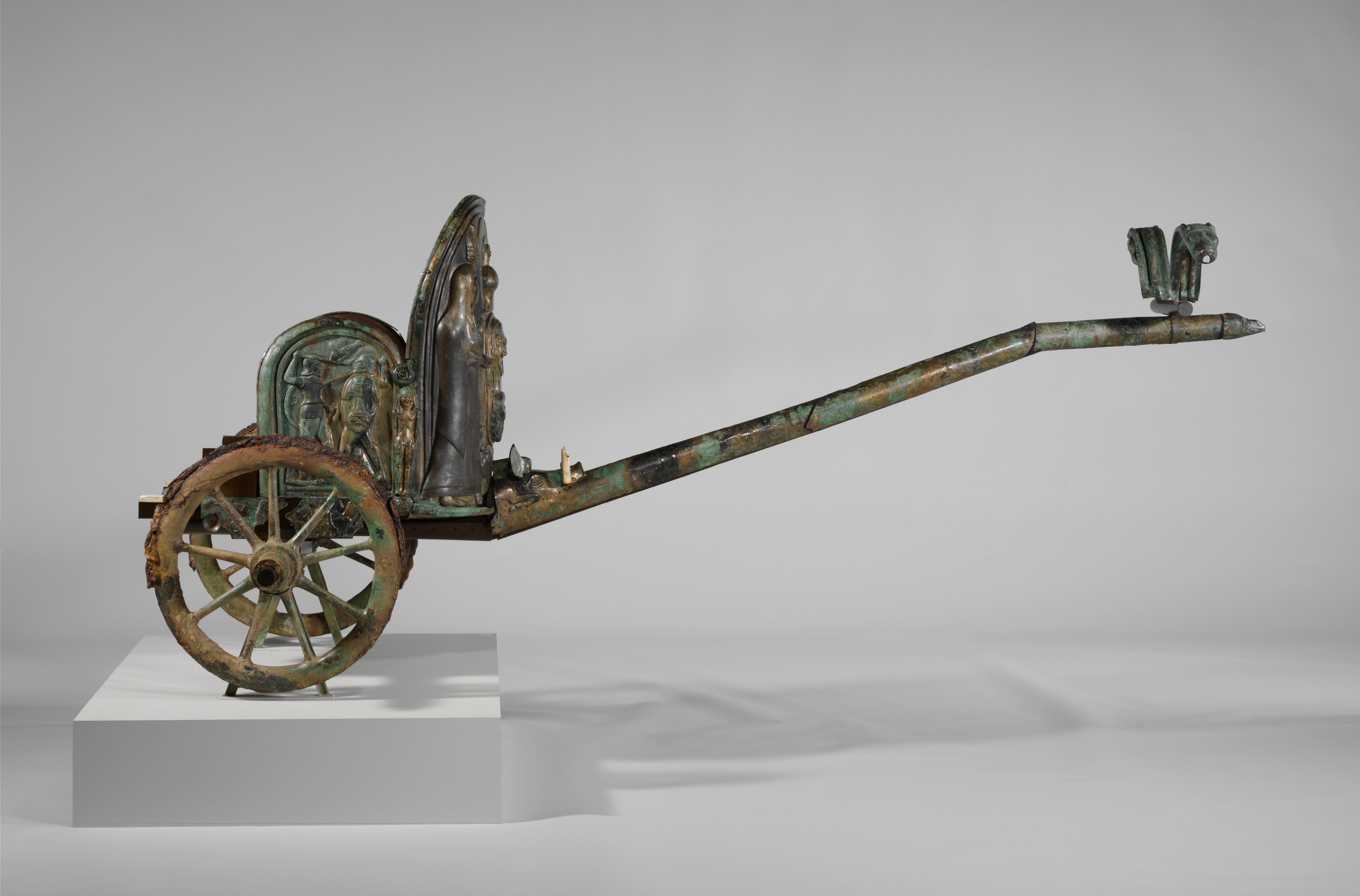
The record in full
Chapter 1A vehicle made to be seen, not to be driven hard
The Metropolitan Museum gives the chariot as bronze and ivory, 130.9 cm high overall with a pole 209 cm long.
The Metropolitan Museum gives the chariot as bronze and ivory, 130.9 cm high overall with a pole 209 cm long. The ancient vehicle was a two-wheeled car whose box is balanced on the axle, with a pole rising to a yoke for two horses. Adriana Emiliozzi, the Italian specialist who coordinated its reconstruction at the Museum, reports that the whole substructure was covered in bronze sheet, from the nine-spoked wheels to the box and the pole, and that no cast bronze was used. The covering, the boar forepart and eagle head on the pole and the lion heads on the yoke arms are all hammered from the back in repousse and finished with incised lines.
The wood and leather underneath are gone. What survives is the sheet, which is why the chariot arrived in New York as a heap of fragments and why its first reconstruction in 1903 was a matter of judgement. All authors since the first notices of 1903 agree, in Emiliozzi's summary, that the thin sheathing means the vehicle could only have served for ceremonies and parades.
Emiliozzi also reports that colour was part of the design. Her study of the ivory fragments leads her to propose that the panels were framed by bands inlaid with ivory, that the eyes of the animals and some figures were ivory and another material, and that carved ivory lions stood at the corners. In her words the aim was a chryselephantine effect. Only bronze and ivory survive; any other inlay such as amber is not documented.
Chapter 2The Colle del Capitano and the man who was buried with it
The hill called Colle del Capitano stands about two miles from the village of Monteleone di Spoleto, in the upper Corno valley in Umbria, at about 3,000 feet.
The hill called Colle del Capitano stands about two miles from the village of Monteleone di Spoleto, in the upper Corno valley in Umbria, at about 3,000 feet. Emiliozzi describes it as the necropolis of a settlement on Monte Pizzoro above the village, with burials of the late second and early first millennium BCE and of the sixth century BCE, and none known from the seventh. The area controlled the routes between the Nera and Corno valleys, the Rieti plain and the Adriatic coast, and Emiliozzi suggests that iron deposits mined later may already have been known.
The tomb was reopened by the archaeologist Angiolo Pasqui in 1907 for the Italian state. Emiliozzi reports a rectangular stone-lined grave about 3.8 by 2.8 metres and 1.45 metres deep set in a plinth under a mound. She concludes from Pasqui's 1904 inquiry that there was a single burial, a man, and that the long-repeated story of a man and a woman rests on a confusion with a second, simple grave that Vannozzi opened at the same time and whose finds were mixed with the first in his house.
Burying the chariot was itself a marker of rank. Emiliozzi notes that the rite was no longer practised in the sixth century BCE in the Etruscan and Latin cities and treats the occupant as a local princeps controlling trade routes in an area without cities. That is her reading, built from the grave goods and the setting; no inscription or burial record names him.
Chapter 3The life of Achilles in three panels
The front panel shows Thetis handing Achilles a shield and a helmet, the two standing in profile.
The front panel shows Thetis handing Achilles a shield and a helmet, the two standing in profile. The proper right panel shows Achilles and Memnon fighting over the body of Antilochos, with a bird of prey that seems to turn the loser's spear. The proper left panel shows an unarmed Achilles rising in a chariot drawn by two winged horses, with a recumbent woman on the ground beneath. Below the side panels the friezes show, on the right, the seated centaur Chiron, a running winged figure carrying a tablet who is taken to be Iris, and a youth gripping a panther, and on the left two lions each attacking a prey animal, one a bull and one a stag. A boar attacked by two birds of prey charges a deer on the front, and the pole emerges from the boar.
The identification is argued, not documented. Roland Hampe and Erika Simon argued in 1964 that these scenes are the first surviving cycle of the life of Achilles, and Emiliozzi reports that most scholars accepted it, with Cristofani adding support in 1996, while some reservations have persisted. She calls the identification incontrovertible. The one point she leaves open is the woman under the winged horses, whom some have called Polyxena, sacrificed at Achilles' tomb, and whom Emiliozzi says may simply stand for the ground. Hampe and Simon, as she summarises them, read the front scene as the arms forged for Achilles by Hephaistos after he lent his own to Patroklos. Hephaistos himself is not shown; the smith god enters only through the armour.
Only the delivery of the arms comes from the Iliad. The Memnon duel belongs to the Aithiopis, the Chiron scenes to the Cypria, and Emiliozzi notes that the epics do not speak of Achilles' translation to the afterlife, so the left panel rests on a little-known tradition of his return to the island of Leuke together with the triumph scenes of contemporary Etruscan and Latin building friezes. Her own conclusion is that the patron chose the programme and presented a paradigm: schooling, physical and moral perfection, victory and divine honours for a ruler. That is a modern argument about what the commissioner wanted, offered by Emiliozzi and drawing on Torelli's reading of the terracotta friezes, and the chariot carries no inscription to confirm it.
The first public reading was different. Scientific American, on 28 November 1903, captioned the panels as Hercules, Minerva and the killing of Laomedon's family, attributing that identification to Cesnola, while Alexander S. Murray identified the principal scene as Achilles and Thetis. The corrected reading is part of the object's history and is the reason early press images of it carry the wrong names.
Chapter 4Who made it, and how many hands
Emiliozzi's technical study concludes that a wheelwright and a bronzeworker built the chariot in tandem, in the same city but each in his own workshop, and that the bronze was made by a master...
Emiliozzi's technical study concludes that a wheelwright and a bronzeworker built the chariot in tandem, in the same city but each in his own workshop, and that the bronze was made by a master craftsman with a chief collaborator and at least two further helpers. She bases that on repeated differences in tool marks and execution: the small lion on one strip, for example, she attributes to the master and its pair to his collaborator, and the ivory work was done by a separate hand whose boar tusks and eye inlays differ in quality from the master's bronze.
On where he came from the literature has three positions, which Emiliozzi sets out and does not hide behind. The master was an Etruscan under Ionian stylistic influence, or an East Greek who worked in Etruria and adapted to local needs, or a member of a mixed shop of Etruscans and East Greeks. She herself argues that the chariot is an Etruscan-Italic vehicle and notes that the tracing technique of the master and his collaborator appears on older Ionian imports into Etruria but not in other Etruscan bronzework before or after. The city is unknown; scholars who accept an Etruscan city have proposed Orvieto or Vulci, and Emiliozzi observes that Vulci evidently specialised in chariots.
These are positions held by named scholars, not facts. Furtwangler (1905), Ducati (1909), Brendel (1978) and Bonamici (1997) are cited by Emiliozzi for a foreign origin of the decoration; Pallottino (1959) and Banti (1964) called the chariot provincial and non-Etruscan, and Torelli (1976-1985) Etruscan but provincial. Ursula Hockmann in 1982, in Emiliozzi's account, settled the debate on Etruscan origin.
Chapter 5Worn, wrecked and mended before it was buried
The 2002 disassembly produced evidence that the chariot had a long working life.
The 2002 disassembly produced evidence that the chariot had a long working life. Emiliozzi reports that the proper right kouros lost his feet to a force that struck from below, that the boots he wears now were fitted in antiquity, that the right ear of the boar forepart is an ancient replacement repaired again with a riveted strap, and that two crouching rams from the rear of the box were moved to the frieze ends to replace lost ivory lions, their hindquarters trimmed to fit.
She reads the damage as an accident in which the right axle arm snapped and the lion head beneath the kouros struck the ground. The boar's tusks are hippopotamus ivory, unlike the elephant ivory she reports for many of the original inlays, and she suggests they were replaced when the pole was re-angled for taller horses. A note in the Museum's archives, which she could not confirm in Italian files, says the chariot lay on its right side when it was unearthed, the damaged side.
From this Emiliozzi argues that the chariot was first owned by the person who commissioned it, who used it for a long time in a major city, and later passed to the local chief buried at Monteleone, possibly with a refurbishment at the change of owner. This is her hypothesis and she labels it as one. If correct, the Achilles programme was not made for Monteleone at all.
Chapter 6Found while building a farmhouse, February 1902
Emiliozzi, working from the Italian state archive and Vannozzi family testimony, reports that Isidoro Vannozzi and his son Giuseppe found the tomb on 8 February 1902 while levelling a hillock for the...
Emiliozzi, working from the Italian state archive and Vannozzi family testimony, reports that Isidoro Vannozzi and his son Giuseppe found the tomb on 8 February 1902 while levelling a hillock for the yard of a new farmhouse on their own land. They did not recognise what they had, kept the objects for several weeks, and stored the chariot in the house where they were living. The earliest Italian newspaper notice, in the Roman Giornale d'Italia of 17 July 1902, drew on a notary in Cascia, Adolfo Morini, and was vague enough to call the chariot a cisium and to describe the front panel as the Three Graces.
The Vannozzis' conduct is described differently in popular accounts. A 2007 newspaper report reprinted by the History News Network says a farmer swapped the chariot for two cows. Emiliozzi cites Giuseppe Vannozzi's own interview, which says the bronzes were sold to pay for roof tiles and pantiles, and she argues that the family's long delay in selling shows they were not tomb robbers, a charge she says was made by authors who had not done serious research.
The documents are as follows. On 23 March 1902 Isidoro Vannozzi sold the bronzes to a Norcia junk dealer, Benedetto Petrangeli, at the price of scrap iron, six soldi a kilo, for a total of 950 lire. Emiliozzi gives that as about 6,000 dollars today without stating a method, and this record does not adopt that equivalent. The facts come from a report of 4 June 1904 by the inspector Guido Scifoni, whom she cites, and from Morini's confirmation of the sale date.
Chapter 7From Norcia to Paris: the price rises 158 times
Emiliozzi reports that Petrangeli, after hesitating over price, sold the pieces through Roman dealers to Ortensio Vitalini for 150,000 lire.
Emiliozzi reports that Petrangeli, after hesitating over price, sold the pieces through Roman dealers to Ortensio Vitalini for 150,000 lire. Dividing her two figures gives a markup of about 158 times in a few months, a derived number and not a quoted one. She identifies Vitalini from the memoirs of Ludwig Pollak as an intermediary for King Victor Emmanuel III, who collected coins and also bronzes and gold. Vitalini sent the chariot and other pieces to Paris in February 1903 and put the best of them in the vaults of the Credit Lyonnais until a sale was made.
Negotiations with other museums collapsed on price and on suspicion that the pieces were fakes, in Emiliozzi's account, which cites the Mariemont museum in Belgium and a letter of 28 January 1903 from the Italian ambassador in Paris to the minister of public instruction. That letter records that the London firm Pitt and Scott, which wanted to buy, asked the ambassador to confirm both that the objects were genuine and that their export was legal. The ambassador, Emiliozzi notes, did not yet know of the find.
The route out of Italy is not documented by Emiliozzi. The Metropolitan Museum's own press line in October 1903, quoted by her from the New York Press, called the means by which it reached Paris more or less a mystery, given strict Italian laws on exporting art.
Chapter 8Cesnola's purchase, the Rogers Fund and the Morgan error
Luigi Palma di Cesnola, the Museum's first director, agreed a price with Vitalini in April 1903, according to Emiliozzi, and the material was shipped to New York.
Luigi Palma di Cesnola, the Museum's first director, agreed a price with Vitalini in April 1903, according to Emiliozzi, and the material was shipped to New York. In the New York Tribune of 18 February 1904 Cesnola said the trustees bought it on his recommendation and paid from the Rogers Fund, that he would never buy anything from Italy because he knew its laws, and that it had come from the Credit Lyonnais in Paris as a mass of fragments in four cases. In the same account he said the price was 235,000 francs for the chariot and 15,000 francs for vases from the same tomb, and then described the total as not quite 250,000 dollars. The figures do not agree in currency, and this record gives only the francs and the dollar figure as he spoke them, as an unverified claim.
The belief that J. P. Morgan bought the chariot and gave or sent it to the Museum appears in several modern sources including the English Wikipedia article. Emiliozzi rejects it and cites the New York Press of 18 October 1903: Paris announced that the chariot had disappeared, Morgan was said to have offered 60,000 dollars, and he told Museum staff when visiting that he wanted it for himself but now nobody knew where it was; he was then shown the pieces in the two boxes in which they had come from Paris. A footnote adds that Vitalini himself had informed Cesnola the bronzes were coming. So Morgan is recorded as an unsuccessful bidder, not a donor.
The chariot went on display at the Museum on 26 October 1903. The accession number 03.23.1 and the credit line Rogers Fund, 1903 are the Museum's own. A second lot of bronzes bought in 1921 is also said by Emiliozzi to come from the same tomb or its neighbour, but whether it does is not settled.
Chapter 9What the Italian state did in 1902 to 1904
The Italian response was real and slow. Emiliozzi reports that the authorities began their investigation about two months after the discovery, that telegrams passed between the Perugia prefecture and...
The Italian response was real and slow. Emiliozzi reports that the authorities began their investigation about two months after the discovery, that telegrams passed between the Perugia prefecture and the Ministry of Public Instruction in Rome from May 1902, and that the archaeologist Giulio Emanuele Rizzo wrote a report on 6 June 1902 after gathering information at Perugia and Norcia to help recover the items and keep them from leaving the country. The Carabinieri at Norcia and Monteleone collected material from Vannozzi in June 1902: a gilded bronze spit-shaped rod now in the Museo Nazionale dell'Umbria in Perugia, fourteen small bronze sheet fragments and other small pieces are listed in the Perugia administration's letter of 16 July 1902.
The chariot was by then in Petrangeli's hands, and Emiliozzi connects the delay to the collapse of the bell tower of St Mark's in Venice on 14 July 1902, which, in the words of the then deputy Felice Barnabei, drove the Norcia chariot from everyone's attention. Barnabei, a former director general of antiquities, wrote about the loss in Nuova antologia in 1904 and raised it in the Chamber of Deputies. Cesnola's reply in the Tribune of 18 February 1904 said the Chamber could do nothing and that the inspector had been punished, which is Cesnola's assertion about Italian discipline, not a finding.
Pasqui's 1904 mission to identify the exact spot and his 1907 excavation followed. In 1924 Antonio Minto published the small fragments that remained in Italy, now in the Museo Archeologico in Florence (inventory numbers 14343 to 14358).
Chapter 10Assembled twice, in 1903 and 2002-2007
Cesnola and his assistant Charles Balliard, a Swiss-born watchmaker turned restorer and photographer who had worked on Cesnola's Cypriot collection since 1879, fitted the fragments in 1903.
Cesnola and his assistant Charles Balliard, a Swiss-born watchmaker turned restorer and photographer who had worked on Cesnola's Cypriot collection since 1879, fitted the fragments in 1903. Cesnola described making a plaster support and then a walnut frame. Balliard stabilised cracks with Chinese paper on the reverse and fixed the sheet with many nails, which in 2002 prevented the conservators from reading which old holes he had used. The Museum's draftsman Paul Bollo made life-size drawings of the panels in the first two weeks of November 1903, and Adolf Furtwangler published them in 1905, so the whole early scholarly literature on the chariot rests on that material.
Doubts about the 1903 arrangement were raised almost at once. Emiliozzi reports the main errors: the side panels sat too low, the two lion heads were mounted as axle finials after Cesnola had seen the Vatican chariot from the Via Appia, they belonged beneath the feet of the kouroi, the boar forepart was in the wrong place and the rear side panels were missing. An agreement between the Museum and the CNR institute ISCIMA of Rome was signed in 2001 and work began in March 2002 in the Sherman Fairchild Center for Objects Conservation, with Kendra Roth and Frederick J. Sager as the principal conservators, Dorothy H. Abramitis collaborating, and Joan R. Mertens curating. The reconstructed chariot was shown as part of the reinstalled Greek and Roman galleries completed in 2007.
The Museum published the results in Emiliozzi's article in the Metropolitan Museum Journal, volume 46, in 2011, including a catalogue of every piece, the reconstruction drawings and the text and translation of the Italian archive documents. It also reports that the pole, boar and eagle were set where the lines scored on the sheet show they belonged.
Chapter 11A century of disagreement, including a charge of forgery
Besides the argument over workshop, the date is not fixed.
Besides the argument over workshop, the date is not fixed. The Museum catalogues it as second quarter of the sixth century BCE, with its database giving -575 to -525. Emiliozzi puts it at about 560 to 550 BCE and calls it the oldest in a group of parade chariots running to the Castro chariot of about 520 BCE, excavated scientifically in 1967 and used as the structural model for the 2002 reconstruction. English Wikipedia gives about 530 BCE, which does not match either figure and is not adopted here.
In August 2007 the archaeologist Jerome M. Eisenberg, in his journal Minerva, argued that the chariot was a forgery: that a master forger had embellished it in the decade before its discovery on the basis of more than seventy artistic and technical features, and that many decorations were copied from ancient objects then in museums such as the Euphorbus plate. He accepted that most peripheral components were authentic. The claim is his, as reported by Italy Magazine. The Museum was not quoted in that report. Emiliozzi's 2011 article, based on the disassembled object, the ancient repairs, the corrosion and metallographic analyses and the Castro comparison, treats the chariot as an ancient Etruscan work, and a search of its text finds no mention of Eisenberg.
A smaller authenticity question is documented and real: a tripod in the Museum's group (03.23.53) is described in its accession file as mostly modern, made from a few ancient pieces by W. Richards at Cesnola's request, and was therefore not exhibited, according to Emiliozzi. It is not the chariot.
Chapter 12The claim for return, 2005 to 2025
The municipality of Monteleone di Spoleto has asked for the chariot back for more than twenty years, according to the news agency ANSA.
The municipality of Monteleone di Spoleto has asked for the chariot back for more than twenty years, according to the news agency ANSA. English Wikipedia, a tertiary source, dates the campaign to 2005. In 2007, as the chariot was about to go on show in the new court, a Museum spokesman, quoted by the Telegraph and reprinted by the History News Network, said the Museum bought it in good faith but admitted there are no papers proving its provenance. The same report quotes the then mayor, Nando Durastanti, as saying the chariot is ours and part of our identity.
In May 2018, according to Wikipedia and a Comune document, the historian Guglielmo Berattino published sixteen letters held in the library at Ivrea. The Comune presented them as showing that the Museum's director and others knew that the export was illegal under the Italian law then in force. A resolution of the Monteleone council recorded in a MEP Radio item of 28 June 2018 resolved to ask the Ministry of Culture to list the chariot among works it would seek to recover, to ask the Museum for voluntary return, and to submit that the director, officials and trustees knew the export was unlawful. That is the municipality's allegation, as stated by the Comune and Mayor Marisa Angelini, not a finding by any court or ministry. The Metropolitan Museum's response to the letters is not recorded in the sources consulted.
On 29 July 2025 ANSA reported that the Ministry of Culture's committee for the recovery and restitution of Italian works abroad, which includes the State Attorney's Office, had voted unanimously on 10 June 2025 to support the municipality's request for voluntary return by diplomatic means, citing historical documents submitted by the Comune that suggest bad faith at the time of purchase. The report gives no position from the Museum. Experts quoted by Italy Magazine in 2007 said the Museum has held the chariot for over a hundred years, before Italy's 1939 law, so a time-barred claim is likely. No court case or Museum decision on the 2025 request is recorded in the sources consulted.
The artist
The master bronzeworker of the Monteleone chariot and his workshop
No name, signature or inscription survives. The maker is a reconstructed hand, identified from tool marks and a body of comparable chariots, not from any document, and the attribution to a workshop, a city or even a people is argued, not proved. The identity of the patron is equally unknown.
Related works
| Work | Relation | Where it is |
|---|---|---|
| Etruscan parade chariot from Castro Etruscan | Same structural type; first parade chariot excavated scientifically (1967) and used as the model for the 2002 reconstruction Dated about 520 BCE by Emiliozzi; current repository not established here. | Castro, near Vulci, Lazio |
| Chariots from Castel San Mariano Etruscan | Two parade chariots; one shares side panel and frieze types Most scholars attribute the oldest to Chiusi. Not to be confused with this chariot. | Castel San Mariano, near Perugia |
| Archaic chariot from Via Appia Antica Etruscan | Seen by Cesnola, who copied its lion-head finials wrongly Its lion heads are cast and pierced for lynchpins, unlike Monteleone's. | Museo Gregoriano Etrusco, Vatican |
| Monteleone fragments and grave goods Etruscan | Small remnants of the same tomb that stayed in Italy Published by Minto in 1924; one spit seized by Carabinieri in 1902 is in Perugia. | Museo Archeologico, Florence (inv. 14343-14358); Museo Nazionale dell'Umbria, Perugia |
| Loeb tripods Etruscan | Once wrongly assigned to Monteleone Found in 1904 at San Valentino di Marsciano; Minto ruled out the Monteleone link in 1935. Not part of this record. | Munich |
| Bronze vessels and cups from the tomb (03.23.2 and others) Etruscan | Other Metropolitan Museum objects reaching New York in 1903 and 1921 Distinct objects with their own accessions, not shown here. | The Metropolitan Museum of Art, New York |
Open questions
- By what route and under what authority did the chariot leave Italy between Roman dealers and the Paris vaults? The Italian ambassador's letter of 28 January 1903 shows legality was queried, but no export document is cited.
- Which Italian law and which export provisions applied in 1902-1903, and was any export licence applied for? The sources consulted do not give the statute text or any application.
- Did Museum officials know the export was unlawful? The claim rests on letters presented by the Comune of Monteleone di Spoleto; their full text and authentication are not in the sources consulted, and no court or ministry has ruled.
- What did the Museum pay? Cesnola's 235,000 francs plus 15,000 francs is followed by an inconsistent dollar total; no Museum ledger figure has been consulted.
- Who commissioned the chariot, and in which city? Emiliozzi proposes a prince or king of a real city and a later owner at Monteleone, but nothing documents either.
- Was the Monteleone chariot found alone, and did the 1921 lot of bronzes come from its tomb? Emiliozzi states the question is unsettled because two graves were mixed in Vannozzi's house.
- Who is the woman beneath Achilles' winged horses: Polyxena or a figure for the ground?
- Will the Museum answer the 2025 request, and has any formal reply been given?
Questions about this object
What is Bronze chariot inlaid with ivory (the Monteleone chariot)?
Bronze chariot inlaid with ivory (the Monteleone chariot) is an antiquity, dated 2nd quarter of the 6th century BCE (Metropolitan Museum); about 560-550 BCE (Emiliozzi 2011). Medium: Bronze sheet worked in repousse and incised, with ivory inlay, over a lost wooden and leather substructure.
Who made Bronze chariot inlaid with ivory (the Monteleone chariot), and is the attribution settled?
The attribution to Master bronzeworker of the Monteleone chariot and his workshop is recorded here as disputed. Anonymous. The chariot is accepted as Etruscan-Italic work by the Metropolitan Museum and by Adriana Emiliozzi, who studied it during its 2002-2007 reconstruction, but the cultural background of the master is argued three ways: an Etruscan under Ionian influence, an East Greek working in Etruria, or a mixed Etruscan and East Greek shop. The city of manufacture is not documented; Orvieto and Vulci have been proposed.
Where is Bronze chariot inlaid with ivory (the Monteleone chariot) now?
The Metropolitan Museum of Art, New York (Department of Greek and Roman Art). Inventory number 03.23.1. Last confirmed 19 November 2026. Purchased 1903, Rogers Fund. Reinstalled after reconstruction as part of the Greek and Roman galleries reopened in 2007.
What is still unknown about Bronze chariot inlaid with ivory (the Monteleone chariot)?
By what route and under what authority did the chariot leave Italy between Roman dealers and the Paris vaults? The Italian ambassador's letter of 28 January 1903 shows legality was queried, but no export document is cited.
Sources
- 1The Metropolitan Museum of Art, Bronze chariot inlaid with ivory, accession 03.23.1, object 247020 (open access collection API record): title, date, dimensions, credit line, culture, subject tags. collectionapi.metmuseum.org/public/...
- 2Adriana Emiliozzi, The Etruscan Chariot from Monteleone di Spoleto, Metropolitan Museum Journal 46 (2011). Primary scholarly source for the find, the Italian archive documents, the 1903 and 2002-2007 reconstructions, the iconography, the workshop and the ancient repairs. resources.metmuseum.org/resources/...
- 3Its statement that Morgan purchased the chariot is contradicted by source 2. en.wikipedia.org/wiki/...
- 4ANSA Umbria, Biga di Monteleone, il ministero affianca il Comune umbro, 29 July 2025. ansa.it/umbria/...
- 5MEP Radio, Comune di Monteleone di Spoleto statement (Mayor Marisa Angelini), 28 June 2018, on the council resolution and the Berattino letters. mepradio.it/news_online.details.php
- 6History News Network, reprint of The Telegraph, Italian villagers fight New York's Met for 2,600-year-old chariot (Malcolm Moore, 2007): Museum spokesman on good faith, Mayor Durastanti, the two-cows account. historynewsnetwork.org/article/...
- 7Italy Magazine, New York Met Etruscan chariot possibly a fake, 14 August 2007: Jerome M. Eisenberg's forgery claim in Minerva, and expert comment on time limits. italymagazine.com/featured-story/...
Last verified · Published
Change log
19 November 2026 - Record created at the house standard: researched narrative, technical evidence, maker dossier, graded provenance chain, prices with hammer and premium separated, related works, open questions and sources.