The Lydian Hoard (Karun Treasure)
Unrecorded Lydian goldsmiths, Sardis region · c. 550-450 BCE, Achaemenid-period Lydia (after the Persian conquest of Sardis in 547/6 BCE)
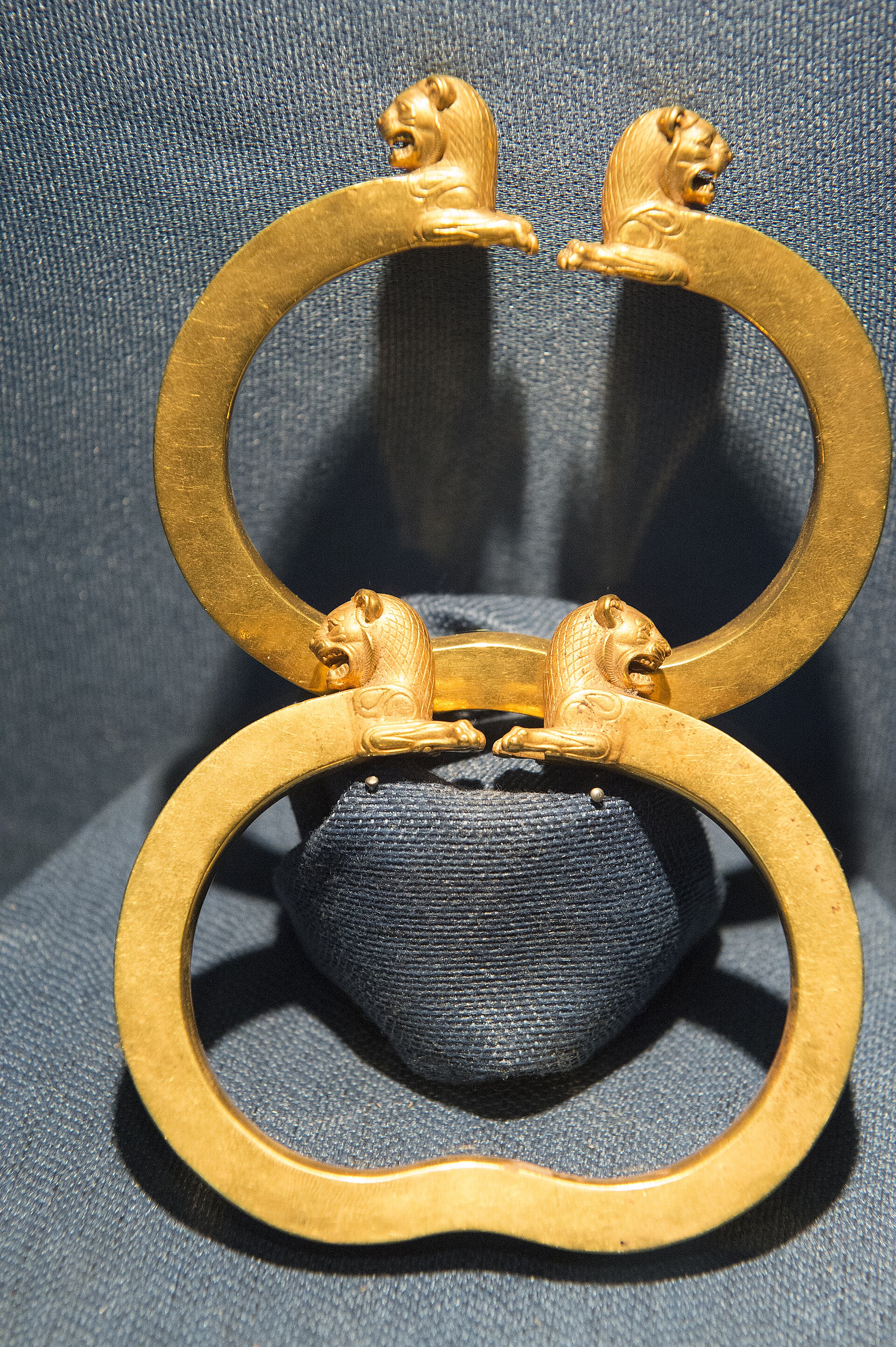
A gold bracelet with lion-protome terminals from the repatriated 363-piece group, photographed on display at the Usak Museum of Archaeology. This is a bracelet, not the hippocamp brooch that is the anchor of this record; no free-licensed photograph of the genuine, recovered hippocamp brooch was located.
Photograph by Dosseman, via Wikimedia Commons · CC BY-SA 4.0| Artist | Unrecorded Lydian goldsmiths, Sardis region |
|---|---|
| Date | c. 550-450 BCE, Achaemenid-period Lydia (after the Persian conquest of Sardis in 547/6 BCE) |
| Medium | Gold, worked in sheet, repousse, filigree and applied wire; the wider hoard also includes silver vessels, gilt silver, bronze, glass, jasper and wall-painting fragments |
| Dimensions | Group of 363 accessioned gold and silver objects as repatriated in 1993, of varying sizes; the gold hippocamp brooch at the center of this record is approximately 3.8 cm (1.5 in) high and weighs 14.3 g |
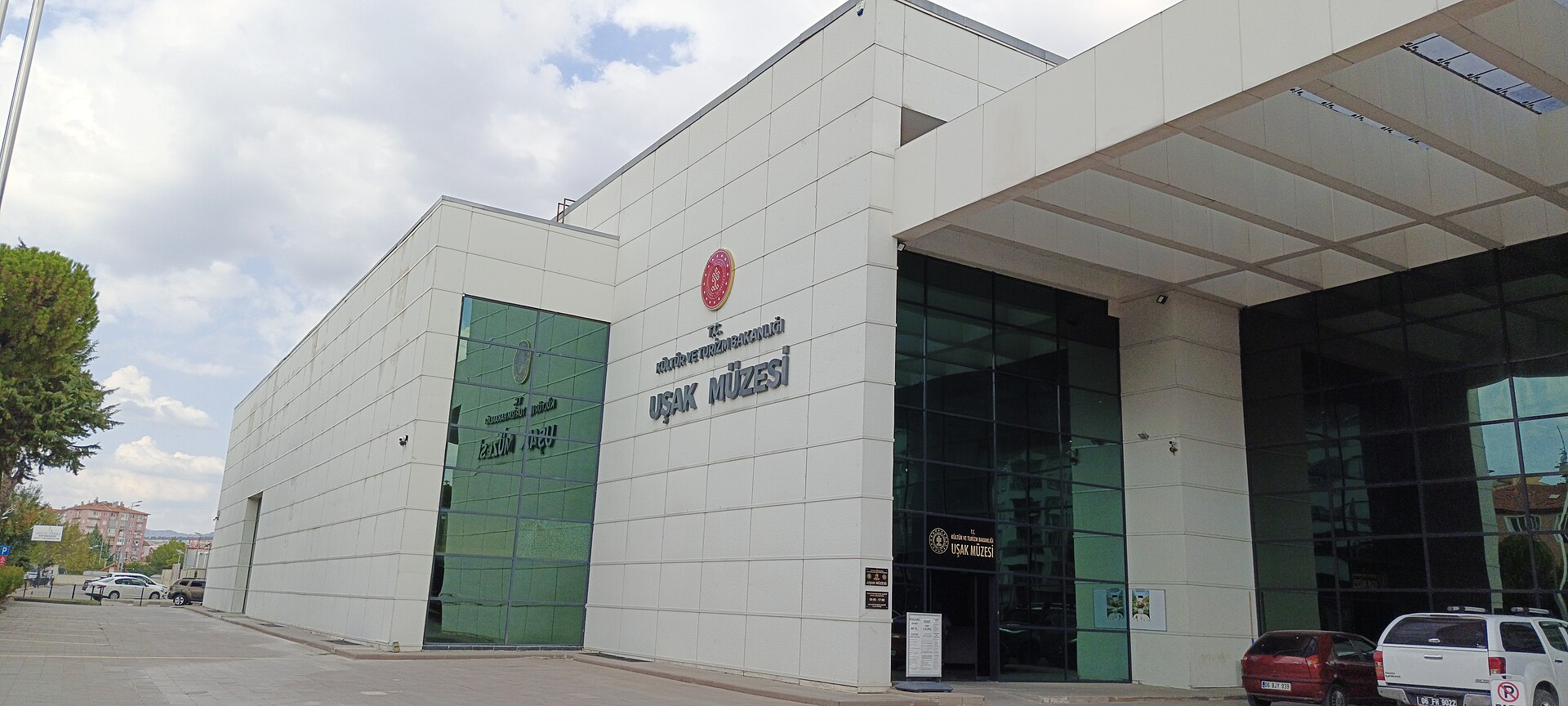
| Where it is now | Usak Museum of Archaeology, Usak, Turkeylast confirmed |
| Inventory number | Inventory numbers for individual pieces are not published in the sources consulted; the group is catalogued in the Usak Museum's Karun Treasure holdings |
| Attribution | UnknownNo maker is named or marked on any piece. Full note |
| Object type | Goldsmith's work |
| Period | Achaemenid Anatolia, Lydian satrapy |
| Cases | Seized, looted or confiscated · Restituted or repatriated · Has a provenance gap |
| Inscriptions | None recorded on the hippocamp brooch. A small number of other pieces in the wider group carry Lydian epigraphic marks, studied by R. Gusmani; none is a maker's signature. |
| Owners on record | 12 links11 documented, 1 unknown |
| Sources | 32 cited |
About this record Last verified · 32 sources cited · Change log
On this page 12 sections
ContentsClose
The Lydian Hoard, also called the Karun Treasure, is a group of 363 gold and silver objects looted from Lydian burial tumuli near Usak, Turkey, in the mid-1960s, sold piecemeal to the Metropolitan Museum of Art between 1966 and 1970, and returned to Turkey in 1993 after a six-year lawsuit that ended when the museum's own internal correspondence, surfaced in discovery, showed its staff had believed from the start that the material was illegally excavated.
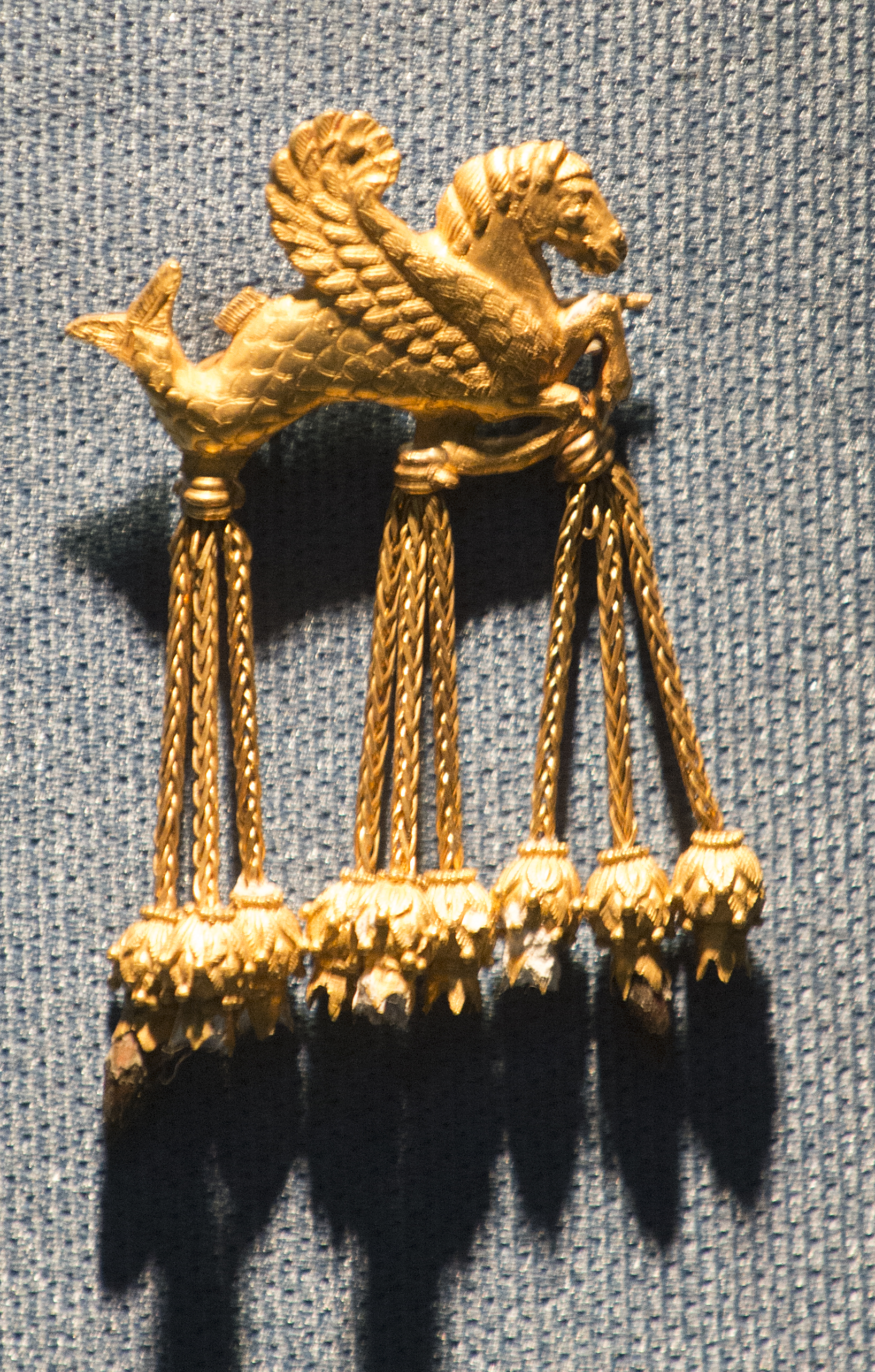
This record anchors on the hoard's smallest and most notorious single piece: a gold brooch in the shape of a winged sea-horse, a hippocamp, barely an inch and a half high. In 2005 the director of the Turkish museum charged with the collection's safekeeping, the same man whose fieldwork had helped win the treasure back from New York, stole the genuine brooch to cover gambling debts and replaced it with a heavier fake. The substitution was exposed in 2006 by a simple weight discrepancy, he was convicted in 2009, and the genuine brooch resurfaced intact in Germany in 2012, its intervening seven years unaccounted for in any source located for this record.
No free-licensed photograph of the genuine, recovered hippocamp brooch could be located. The only Commons image of the piece is explicitly documented, by the photographer's own file notes, as the confiscated fake photographed in 2012 while it was still on display; this record uses it only to illustrate the substitution itself, clearly labeled as such.
The theft
Returned
The Art-Law Centre case note records that the Metropolitan Museum of Art gave the hoard back to Turkey under a settlement in September 1993, and Turkish state media report that one gold brooch was taken from the Usak museum afterwards and came home from Germany in 2013.
- 1965Looted The Usak governorship records that clandestine digging at the Toptepe tumulus near Gure began in 1965, that a second clandestine excavation followed at Ikiztepe in 1966, and that Aktepe was among the mounds emptied; the Art-Law Centre case note records that what came out included a pair of marble sphinxes, tomb paintings, jewellery and gold and silver objects.422
- 1966Found Turkish police recovered part of the material in 1966 and it went into Turkish museums, the Art-Law Centre case note records, and Sharon Waxman reports in Smithsonian Magazine that those recovered pieces later served as the comparison set for the New York case.14
- 1966Sold Waxman reports in Smithsonian Magazine that the diggers sold to Ali Bayirlar, a smuggler working out of Izmir, and that Bayirlar sold on to J. J. Klejman in New York and George Zacos in Switzerland.14
- 1966Bought Waxman reports that Dietrich von Bothmer, the museum's curator of Greek and Roman art, put the material to the acquisitions committee, and that the Metropolitan paid about 1.5 million dollars for successive groups bought between 1966 and 1970.14
- 1984Exhibited The Art-Law Centre case note records that the museum kept the objects in its storerooms for close to twenty years and first displayed pieces in 1984 under the label East Greek Treasure.14
- 1986-07Claimed Turkey made a formal demand for the collection in July 1986 and the museum refused it, the Art-Law Centre case note records, which is the demand and refusal the later limitation argument turned on.14
- 1987-05-29Filed The Republic of Turkey filed suit against the Metropolitan Museum of Art in the Southern District of New York on 29 May 1987, and the reported decision carries the docket number 87 Civ. 3750 and names Lawrence M. Kaye of Herrick and Feinstein for the republic and John J. Loflin of Lord Day and Lord for the museum.42122
- 1990-07-16Judgment Judge Vincent L. Broderick denied the museum's motion for summary judgment on 16 July 1990, the reported decision states, holding that an action against a good faith purchaser does not accrue until the owner demands the property and is refused, that the museum's arguments about Turkey's delay went "solely to whether the defense of laches is available" rather than to the limitation period, and that there were genuine issues of material fact both on prejudice and on whether the museum had bought in good faith.421
- 1993-09Settled The Metropolitan agreed in September 1993 to hand the collection back, and the Art-Law Centre case note records that this was a negotiated settlement and not a judgment, so no court ever ruled on who owned the objects; the agreement also covered conservation, reciprocal loans, excavation in Turkey and study fellowships.14
- 1993-10Repatriated The Usak governorship records that 363 objects were returned to Turkey in October 1993, and Waxman reports that they were shown in Istanbul and Ankara before going anywhere else.122
- 1995Exhibited Waxman reports that the collection was moved to the Usak Museum of Archaeology in 1995, joining the pieces the police had taken off the smugglers in 1966, and that 769 people visited in the five years to 2006.14
- 2005Stolen The Turkish state news agency Anadolu reports that the gold hippocamp brooch alone, and not the rest of the hoard, was taken from its case at the Usak museum in 2005 and a counterfeit left in its place; the accounts consulted do not agree on the window, since Anadolu's report of the appeal instead dates the substitution to June 2006 while the Wikipedia article puts it between March and August 2005; this record dates the step to 2005 because Anadolu's report of the return gives that year and Arkeolojik Haber says the substitution was discovered a year after it happened.22426
- 2006-04Identified Waxman reports in Smithsonian Magazine that by April 2006 the newspaper Milliyet had reported that the brooch standing in the case weighed 23.5 grams against the original's 14.3, which is how the substitution of this one object was caught.1
- 2009-02-14Judgment Hurriyet reported on 14 February 2009 that the Usak Heavy Penal Court sentenced the museum's former director Kazim Akbiyikoglu to twelve years and eleven months, and a co-defendant named as Uguz Saglan to twelve years and six months, over the replacement of the brooch with a copy.23
- 2012-09-14Appeal Anadolu Agency reported on 14 September 2012 that the Fifth Criminal Chamber of the Court of Cassation upheld a total sentence of seventeen years and six months against Akbiyikoglu, after which he was taken to prison.24
- 2012-11Found Arkeolojik Haber reports that German police told Turkish Interpol in November 2012 that the brooch had been located in Hagen, the same article saying only that Interpol had become involved in the case without giving a date or naming a notice, and that two Turkish specialists, Ertekin Doksanalti of Selcuk University and Mahmut Aydin of the Museum of Anatolian Civilizations, examined it at the Essen prosecutor's office on 13 November for three and a half hours and identified it as the original because the genuine brooch was forged where the copy had been cast.25
- 2013-03Restituted Anadolu Agency reported on 11 March 2013 that the German authorities handed the brooch to Osman Murat Suslu, the director general of cultural heritage and museums, that the culture and tourism minister Omer Celik carried it to Turkey, and that it went on show at the Museum of Anatolian Civilizations in Ankara.26
- 2018-05Exhibited Anadolu Agency reported on 6 May 2018 that the brooch had come back to Usak two months earlier and that the Karun Treasure, counted there at 432 pieces, had been installed in the new Usak Archaeology Museum beside the railway station.2728
- 2025-03-01Exhibited The Usak paper Ege'de Yeni Gun reported that the museum shut to visitors on 31 December 2024 while water coming through the building was dealt with, and that it reopened on 1 March 2025 with the Karun Treasure back on show.2830
- 2025-11Exhibited The Usak papers Ege'de Yeni Gun and Usak Port reported on 11 November 2025 that the museum closed to visitors again, this time for climate-control and new display work expected to take about a month before the 2026 tourism season, a year after the roof closure.3132
Provenance
Each link is graded. Documented: a cited source supports it. Disputed: the identification is argued but not established. Unknown: no owner for that span, and the gap is not smoothed into a narrative. The grades in the glossary.
- c. 550-450 BCE -Lydian noble burial, Gure region, Usak province (and one mound near Harta, Manisa province)documented
Deposited as grave goods in tumulus burials of the Lydian elite in the century or so following the Persian conquest of Sardis. The findspot is documented through the tombs themselves and comparison with controlled excavation at Sardis; the hippocamp brooch's specific tomb of origin is not identified in sources consulted.16
- c. 1965 - 1967Illegal excavation by local farmers/treasure huntersdocumented
Tumuli at Ikiztepe, Toptepe, Aktepe and Basmaci, all near Gure in Usak province, plus a further mound near Harta in Manisa province, were dynamited or otherwise breached and looted. Press accounts differ on the exact year each mound was first opened (1965 versus 1966 for the earliest digs); this record states the range rather than resolving the discrepancy.126
- 1965 - 1966Ali Bayirlar, antiquities dealer, Izmirdocumented
Looters sold the material to Bayirlar, who arranged its export from Turkey.1
- 1966 - 1966J. J. Klejman (New York) and George Zacos (Switzerland), dealersdocumented
Bayirlar sold the material on to these two dealers, who supplied it to the Metropolitan Museum of Art.1
- 1966 - 1970Metropolitan Museum of Art, New Yorkdocumented
Purchased in three successive batches presented to the acquisitions committee by curator Dietrich von Bothmer. Total price reported variously as approximately 1.5 million dollars overall or 1.2 million dollars for 200 pieces bought in 1967-1968; not reconciled in sources consulted. Exhibited from 1984 as an undifferentiated group labeled East Greek, without acquisition history that would have identified it as the material Turkey had inquired about in 1970.124
- 1987 - 1993Subject of litigation, Republic of Turkey v. Metropolitan Museum of Art, S.D.N.Y.documented
Turkey sued 29 May 1987. The museum's statute-of-limitations defense failed at summary judgment on 16 July 1990 (762 F. Supp. 44), sending the case to discovery, which produced internal Met correspondence and the director's own later published account acknowledging the museum believed the material was illegally excavated at the time of purchase.45
- 1993 - 1993Republic of Turkeydocumented
Settled in September 1993; the Metropolitan Museum publicly stated that Turkish authorities had provided evidence that most of the material had been clandestinely removed from the tombs. The 363-piece group arrived in Turkey in October 1993 and was initially displayed in Ankara.124
- 1995 - 2005Usak Museum of Archaeology, Usak, Turkeydocumented
Transferred from Ankara to permanent display at the Usak Museum in 1995. Kazim Akbiyikoglu, who had provided the affidavit central to Turkey's case, served as the museum's curator and later director during this period.211
- 2005 - 2005Sold by Kazim Akbiyikoglu, museum director, to an unidentified buyerdocumented
The genuine hippocamp brooch was removed and sold, and a replica weighing 23.5 g against the original's 14.3 g was substituted, probably between March and August 2005. Akbiyikoglu later admitted the sale and was convicted in 2009.2912
- 2005 - 2012Unknownunknown
The genuine brooch's whereabouts between the 2005 theft and its November 2012 recovery in Germany are not documented in the sources consulted. Speculation that it had been melted down to destroy evidence, reported by the journalist Ozgen Acar, was not borne out by its later intact recovery, but the intervening custody chain remains unstated in the sources reviewed.11
- 2012 - 2013Recovered by German authorities; temporarily displayed at the Museum of Anatolian Civilizations, Ankaradocumented
Recovered intact in Germany, reported publicly in late November 2012. How it reached Germany or was located there is not disclosed in the sources consulted. Turkey's Culture Minister stated it would return to Usak by early 2013; a researcher visiting Usak in December 2013 still found only the confiscated fake on public display there, with the genuine piece still in Ankara pending transfer.781017
- 2013 - presentUsak Museum of Archaeology, Usak, Turkeydocumented
The genuine hippocamp brooch is confirmed on permanent display in the Usak Museum's current, larger building by a September 2018 report describing 432 pieces on view. The exact date the museum relocated to this building is not reconciled between a 2013 announcement and a 2018 relocation date given elsewhere; this record states both without resolving them.1314
Technical evidence
| Attribution note | No maker is named or marked on any piece. The workshop attribution to Sardis and its region rests on findspot, on comparison with metalwork excavated in controlled digs at Sardis itself, and on the documented existence of a Sardis gold refinery of the Croesus period. No individual hand or named goldsmith is documented for any object in the group. |
|---|---|
| Construction, hippocamp brooch | Worked gold: a cast or repousse hippocamp body with applied gold wire and three sets of braided gold-wire tassels ending in pomegranate-shaped terminals. No published metallurgical or XRF analysis of the piece was located in the sources consulted.1 |
| Dimensions, hippocamp brooch | Approximately 3.8 cm (1.5 in) in height.1 |
| Weight, genuine versus substituted piece | The genuine brooch weighed 14.3 g. The replica substituted for it between March and August 2005 weighed 23.5 g, a discrepancy of roughly two-thirds that was the technical basis on which the substitution was exposed in 2006.212 |
| Findspot | Not identified to a specific tomb in the sources consulted. The wider group is associated with a cluster of Lydian tumuli in the Gure area of Usak province (Ikiztepe, Toptepe, Aktepe, Basmaci) plus one mound near Harta in Manisa province; which mound produced the hippocamp brooch specifically is not stated in the accounts reviewed.16 |
| Gold source | Attributed by regional and period context, not by direct analysis of this object, to alluvial electrum from the Pactolus river and other Lydian streams, refined at a documented gold refinery excavated at Sardis dating to the Croesus period.1516 |
| Condition on recovery, 2012 | Reported as intact and identifiable as the genuine piece on recovery in Germany in November 2012. No conservation report was located in the sources consulted.78 |
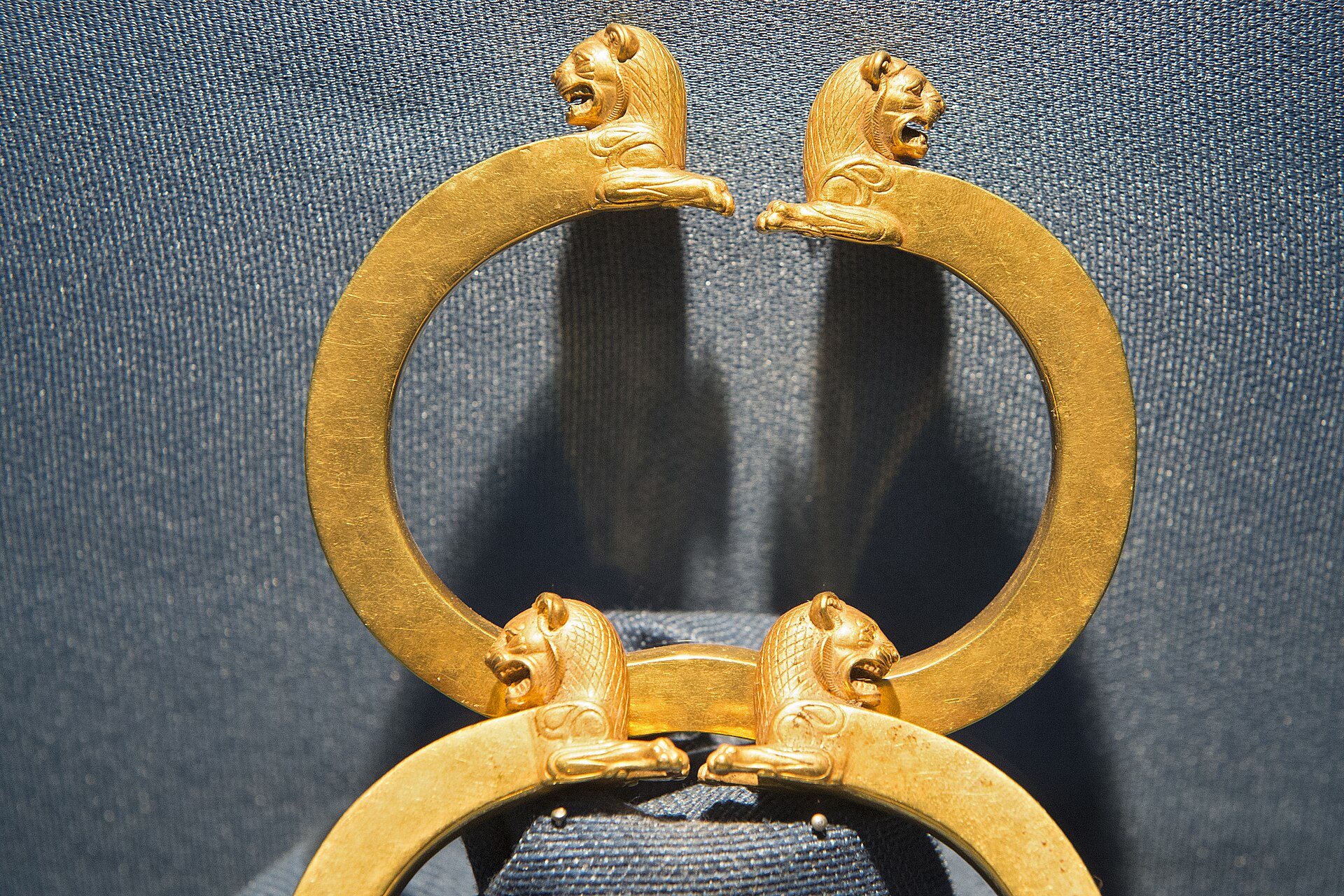
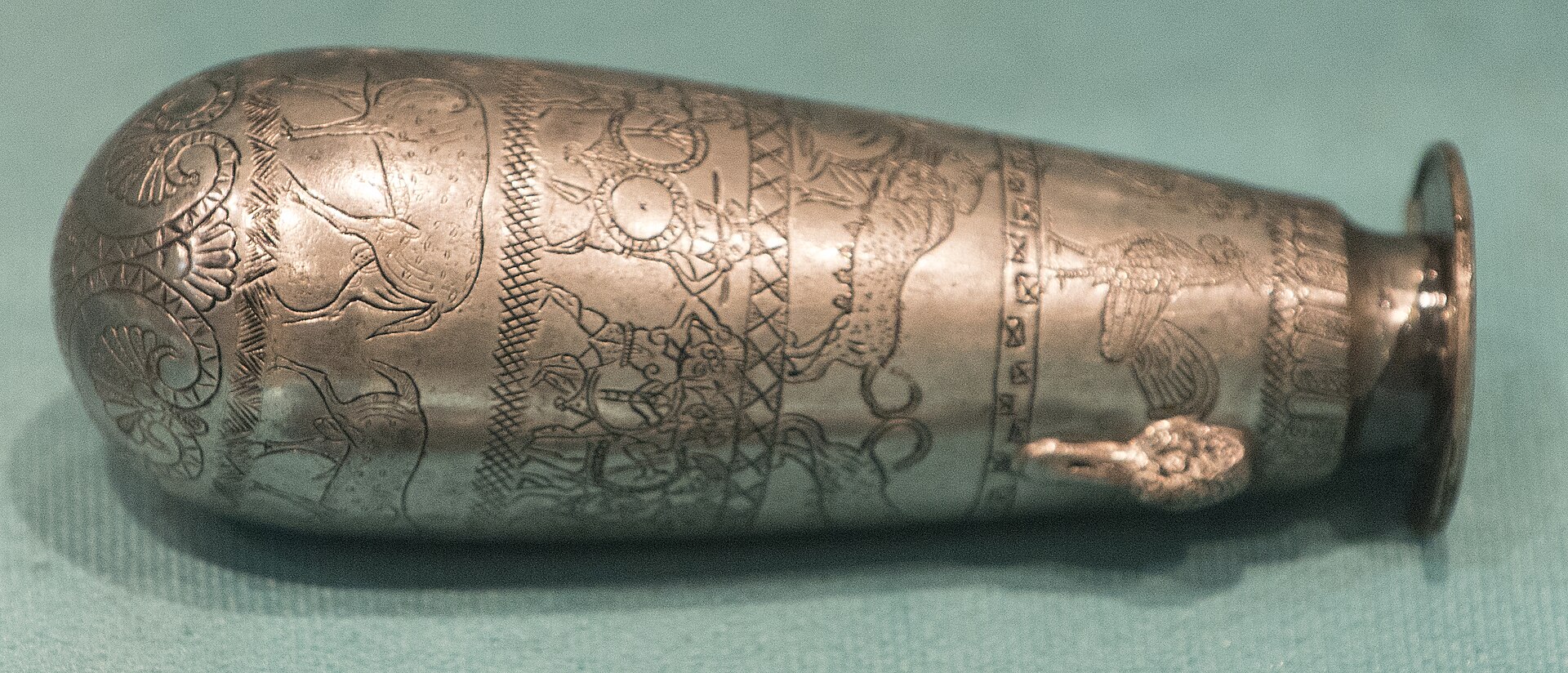
| Comparanda within the same hoard | Kidney-shaped gold bracelets with lion-protome terminals, a gold necklace with acorn and floral pendants, gold appliques with star and floral motifs, and silver oinochoai and phialai with Persian and Anatolian iconography, all from the same 363-piece repatriated group.16 |
| Epigraphic material in the wider group | A small number of objects in the broader hoard carry Lydian inscriptions studied by the epigraphist R. Gusmani; the hippocamp brooch itself is unmarked.6 |
Images
The record in full
Chapter 1What this record covers
This record covers the group of 363 gold and silver objects, looted from Lydian burial tumuli near Usak in western Turkey in the mid-1960s, bought piecemeal by the Metropolitan Museum of Art between...
This record covers the group of 363 gold and silver objects, looted from Lydian burial tumuli near Usak in western Turkey in the mid-1960s, bought piecemeal by the Metropolitan Museum of Art between 1966 and 1970, and returned to Turkey in 1993 after a six-year lawsuit. It is anchored on the single piece that carries the group's second scandal: a small gold brooch in the form of a hippocamp, a winged sea-horse, barely 3.8 centimetres high and weighing 14.3 grams, that was stolen from the Turkish museum meant to be its permanent safekeeping and replaced with a fake by the same institution's own director.
The group is also known in Turkey as the Karun Treasure, after Karun, the Turkish name for Croesus, the legendary last king of Lydia. The objects themselves mostly postdate Croesus's reign, which ended when the Persians conquered Sardis in 547 or 546 BCE. The popular name attaches a specific king's fortune to material made after his fall; this record treats that as a naming convention, not a documented attribution to Croesus personally.
Chapter 2The tumuli and the looting
Illegal digging at the Lydian burial mounds around the village of Gure, in Usak province, began in the mid-1960s.
Illegal digging at the Lydian burial mounds around the village of Gure, in Usak province, began in the mid-1960s. Sources differ on exact sequence: excavation of the Ikiztepe tumulus is dated to 1965 in one account, with police recovering some material in 1966 after most of it had already left the country; a separate account dates the breaching of a Lydian noblewoman's tomb chamber near Toptepe to the night of 6 June 1966, using dynamite to get through the stone entrance, with further digging through 1966 and 1967 at Aktepe and a mound called Basmaci. A further tumulus near Harta, in neighboring Manisa province, was also looted. One looter later described the work: nine or ten days of digging in shifts before reaching the stone chamber, then black powder to breach it. A single tomb chamber could hold well over a hundred objects.
The looters sold what they found to Ali Bayirlar, an antiquities dealer working out of Izmir. Bayirlar sold it on to two dealers with New York and Swiss addresses: J. J. Klejman, who ran a gallery on Madison Avenue, and George Zacos, based in Switzerland. From there the material reached the Metropolitan Museum.
Chapter 3The Met buys, in three batches
The Metropolitan Museum of Art acquired the group across three successive purchases between 1966 and 1970.
The Metropolitan Museum of Art acquired the group across three successive purchases between 1966 and 1970. Curator Dietrich von Bothmer, the museum's authority on Greek and Roman antiquities, presented the pieces to the acquisitions committee. Press accounts of the total price differ: a commonly cited figure across the three purchases is approximately 1.5 million dollars; a separate accounting, based on invoices for 200 of the pieces bought in 1967 and 1968 specifically, gives 1.2 million dollars for that portion. Neither figure has been reconciled against a full itemized invoice in the sources consulted.
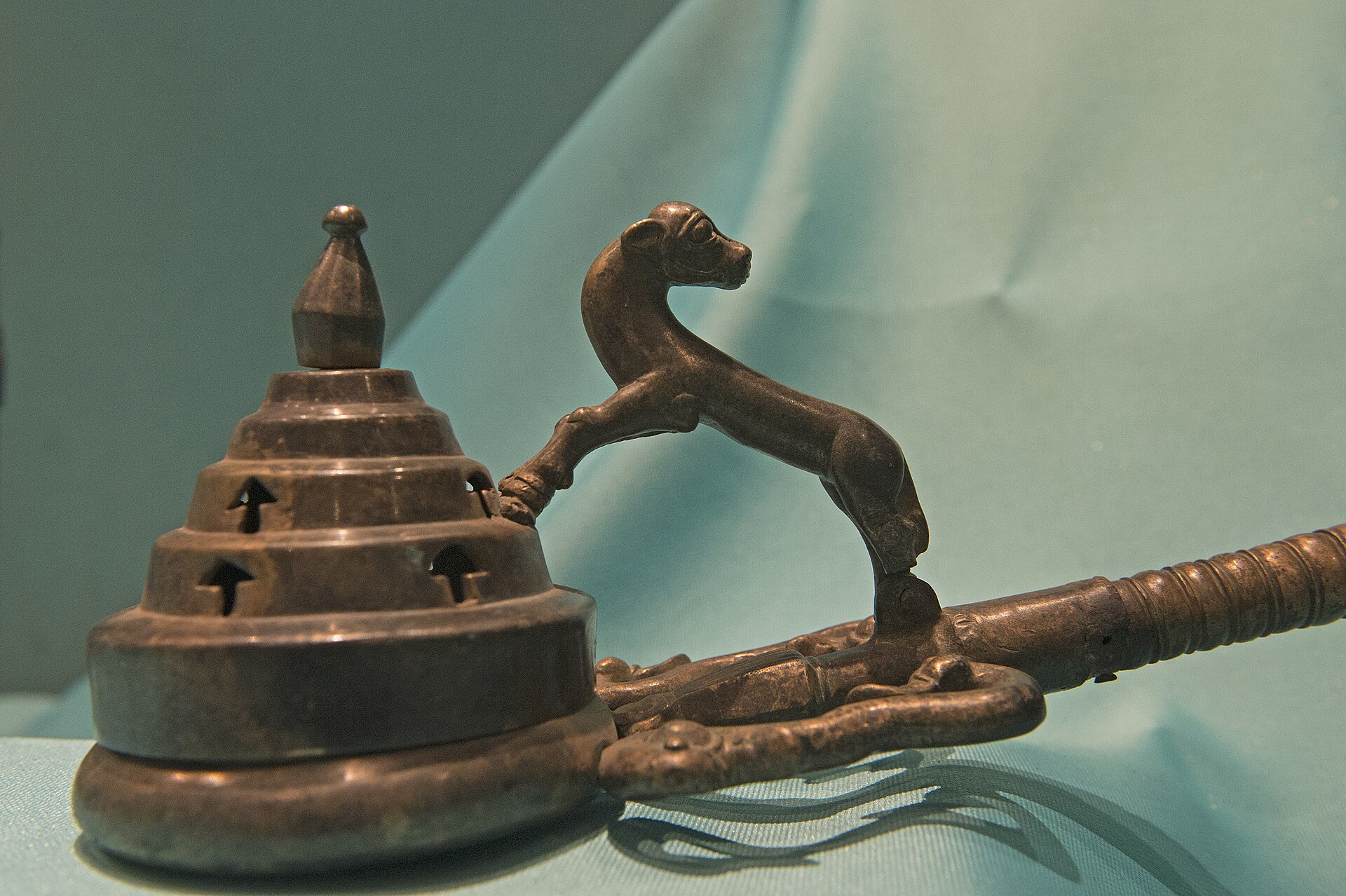
The material included gold necklaces with acorn and floral pendants, kidney-shaped gold bracelets with lion-protome terminals in the Achaemenid manner, silver oinochoai and phialai with Persian and Anatolian decoration, bronze and silver incense burners, appliques stamped with star and floral motifs, fragments of tomb wall paintings showing funerary processions, and the small gold hippocamp brooch, its three sets of braided gold tassels ending in pomegranate-shaped terminals.
Chapter 4A Bulletin, a catalogue, and a journalist's memory
In August 1970 the New York Times printed a dispatch, sourced from the Times of London, reporting that Turkey had formally asked the Metropolitan Museum for details about an allegedly illegally...
In August 1970 the New York Times printed a dispatch, sourced from the Times of London, reporting that Turkey had formally asked the Metropolitan Museum for details about an allegedly illegally exported hoard from tombs near Sardis in the Hermus river valley. The museum did not respond by returning anything.
In 1984 von Bothmer published the material in the Metropolitan Museum of Art Bulletin under the title A Greek and Roman Treasury, exhibiting it as an undifferentiated group of Greek and Roman metalwork labeled East Greek, without the findspot or acquisition history that would have identified it as the Lydian material Turkey had inquired about fourteen years earlier.
Ozgen Acar, a Turkish journalist who had been investigating the hoard's disappearance since 1970, after a British colleague pointed him toward it, recognized around fifty of the pieces in the 1984 Bulletin as matching the profile of what had gone missing from the Sardis region. In 1986 he published a series of articles in the newspaper Milliyet under headlines translating roughly as Turks want the Lydian, Croesus treasures back. Turkey's Ministry of Culture formally demanded the material's return that year. The museum refused.
Chapter 5Turkey sues, and the statute of limitations fails
On 29 May 1987 the Republic of Turkey filed suit against the Metropolitan Museum of Art in the United States District Court for the Southern District of New York, represented by American lawyers...
On 29 May 1987 the Republic of Turkey filed suit against the Metropolitan Museum of Art in the United States District Court for the Southern District of New York, represented by American lawyers including Lawrence M. Kaye. The museum moved for summary judgment, not to dismiss, on the ground that Turkey had waited too long, arguing laches and the statute of limitations.
On 16 July 1990, in a published opinion, Judge Vincent L. Broderick declined to grant the museum's motion. Applying New York's demand-and-refusal rule for stolen property, the court held that the limitations clock started running from Turkey's 1986 demand and refusal, not from the original 1960s purchases, and that genuine disputes of fact about what the museum knew and when precluded summary judgment. The ruling, reported as Republic of Turkey v. Metropolitan Museum of Art, 762 F. Supp. 44 (S.D.N.Y. 1990), sent the case into full discovery rather than ending it.
Chapter 6What discovery uncovered
Discovery produced the museum's own internal correspondence.
Discovery produced the museum's own internal correspondence. Thomas Hoving, the Metropolitan's director through the years of acquisition, later wrote in his own memoir, published after the settlement: We all believe the stuff was illegally dug up. If the Turks come up with the proof from their side, we'll give the East Greek treasure back. The line was his own characterization of the museum's internal position at the time of purchase, not a hostile paraphrase by an opposing lawyer.
Turkey's evidence included an affidavit from Kazim Akbiyikoglu, by then curator of the Usak Museum, who had measured surviving fragments of the tomb wall paintings against the physical gaps in the walls of one of the looted chambers and found that they fit. The match tied specific objects in the Met's holdings to a specific, identifiable, illegally excavated tomb, which is a considerably harder thing for a defendant to argue against than a general claim of illegal export.
Chapter 7Settlement and return, 1993
Around Christmas 1992 the Metropolitan's president, William Luers, and its director, Philippe de Montebello, traveled to Turkey to negotiate a resolution short of full return, proposing a...
Around Christmas 1992 the Metropolitan's president, William Luers, and its director, Philippe de Montebello, traveled to Turkey to negotiate a resolution short of full return, proposing a joint-custody arrangement of five years in New York and five in Turkey. Turkey's Culture Minister, Fikri Saglar, declined to meet them on those terms.
In September 1993 the museum agreed to return the full 363-piece group, stating publicly that Turkish authorities did provide evidence that most of the material in question may indeed have been removed clandestinely from the tombs. The material arrived in Turkey in October 1993, was displayed initially in Ankara, and was transferred to the Usak Museum, in the province where the tombs themselves lie, in 1995.
Chapter 8The curator who brought it home
Kazim Akbiyikoglu was, by the account of the journalist who had spent sixteen years pursuing the case, an ally in the recovery effort: the man whose affidavit and fieldwork helped tie the Met's...
Kazim Akbiyikoglu was, by the account of the journalist who had spent sixteen years pursuing the case, an ally in the recovery effort: the man whose affidavit and fieldwork helped tie the Met's holdings to a specific looted tomb, and who went on to serve as director of the museum built to hold the treasure once it came home.
His personal life deteriorated in the years that followed. His ex-wife left him to marry the mayor of Usak; in 2005 she and her new husband were killed in a traffic accident, reportedly with his own children present. It was in this period, according to what he later admitted, that he sold the museum's genuine hippocamp brooch to cover gambling debts and had a replica put in its place.
Chapter 9A fake in the case, 2005-2006
The substitution is dated by press reporting to sometime between March and August 2005.
The substitution is dated by press reporting to sometime between March and August 2005. It went undetected by the museum's own staff. In April or May 2006, following an anonymous tip, the newspaper Milliyet reported that the hippocamp on display in Usak was not genuine. The proof was mundane and conclusive: the authentic brooch weighed 14.3 grams; the piece in the case weighed 23.5 grams, nearly two-thirds heavier, well outside anything explainable by wear or measurement error. A gold coin from the same collection had also been swapped.
Investigators arrested Akbiyikoglu along with nine other people. He did not contest that he had sold the brooch. His account, given during the investigation, was that gambling debts had left him with no other way out; he was also reported to have blamed his misfortune on a curse popularly associated with the treasure, a piece of folklore this record notes as his stated remark, not as an explanation this record adopts.
Chapter 10Trial and sentence, 2009
The case took roughly three years to reach judgment.
The case took roughly three years to reach judgment. In early 2009 the Usak Heavy Penal Court convicted Akbiyikoglu and, as Hurriyet reported on 14 February 2009, sentenced him to twelve years and eleven months; Anadolu Agency reported on 14 September 2012 that the Fifth Criminal Chamber of the Court of Cassation upheld a total of seventeen years and six months. The nine co-defendants received lesser prison terms than Akbiyikoglu; the exact individual terms are not specified in the sources consulted for this record.
At the time of conviction the genuine brooch's whereabouts remained unknown. Acar, the journalist who had defended his old ally on Turkish television before learning the full truth, speculated publicly that it might have been melted down into bullion to eliminate the evidence. That was speculation, stated as such by the person who made it, not a documented fact, and this record grades it accordingly: unknown.
Chapter 11Recovered in Germany, 2012
In late November 2012, seven years after it disappeared from the display case in Usak, the genuine hippocamp brooch surfaced intact in Germany.
In late November 2012, seven years after it disappeared from the display case in Usak, the genuine hippocamp brooch surfaced intact in Germany. German authorities agreed to return it to Turkey. Contemporary reporting from the Guardian, from Hurriyet Daily News and from other outlets confirmed the recovery and the planned return, but none of the accounts located for this record disclose how the brooch reached Germany, who had held it in the interim, or the specifics of any German legal proceeding connected to its recovery. Turkey's Culture Minister, Ertugrul Gunay, said at the time that the piece would be back in Usak by early 2013.
The recovered brooch was displayed temporarily at the Museum of Anatolian Civilizations in Ankara. A researcher visiting the Usak Museum in December 2013 reported that the fake was still the object on public display there at that date, with a security guard privately confirming to visitors that it was not genuine, while the recovered original remained in Ankara awaiting transfer to a larger Usak building then under construction.
Chapter 12Gold from the Pactolus: materials and workshop context
Lydia's association with gold is not folklore layered on afterward.
Lydia's association with gold is not folklore layered on afterward. Excavation at Sardis itself uncovered a gold refinery of the Croesus period, where naturally occurring electrum from the Pactolus river and other local streams and mines, typically 17 to 30 percent silver by weight, was processed into separated gold and silver of a controlled, reliable purity. That refining capability underwrote Lydia's most famous economic invention: Herodotus records that they were the first of men, so far as we know, who struck and used coin of gold or silver, and also the first retail-traders. Croesus's own coinage, the bimetallic Croeseid series, depended directly on the refining process excavated at Sardis.
The hippocamp brooch and the wider hoard sit inside that documented industry. No single named workshop or goldsmith is recorded for any piece; the attribution to Sardis rests on findspot and on the comparison of technique, granulation and filigree construction consistent with other Achaemenid-period Anatolian goldwork, rather than on a signature or contract. That the region that pioneered gold refining and coinage also produced this level of small-scale goldsmith's work is a documented pattern, not a speculative one; who specifically made this brooch is not.
Chapter 13What is on display now
The Usak Museum of Archaeology has occupied a larger building since sometime between an announced 2013 completion date and a relocation dated by other sources to 2018; this record has not been able...
The Usak Museum of Archaeology has occupied a larger building since sometime between an announced 2013 completion date and a relocation dated by other sources to 2018; this record has not been able to reconcile the two dates and flags it as unresolved. By September 2018, Anadolu Agency reported 432 pieces on display in a dedicated second-floor gallery of a two-story, 14,500-square-meter building, describing the hippocamp brooch, by then returned, as having been stolen twice over its history: once from the tomb in the 1960s, and once from the museum meant to protect it. The piece count of 432, and figures as high as 450 reported elsewhere, exceed the 363 objects that were the subject of the 1993 restitution; this record has not confirmed how much of the difference is additional Lydian material from controlled excavation displayed alongside the restituted hoard, as opposed to further accessions to the hoard itself.
The artist
Unrecorded goldsmiths of Achaemenid-period Sardis
No goldsmith is named for any object in the Lydian Hoard. The attribution to a Sardis workshop tradition is built from three kinds of evidence: the findspot of the looted tombs in the region immediately around the Lydian capital; the documented existence, confirmed by controlled excavation, of a gold-refining operation at Sardis itself in the Croesus period; and stylistic comparison with other Achaemenid-period Anatolian metalwork. None of that adds up to a name, a signature or a workshop mark, and this record does not manufacture one.
Exhibited
- 1993-1995Initial display following restitutionMuseum of Anatolian Civilizations, Ankara
- 1995-2013Permanent Karun Treasure galleryUsak Museum of Archaeology, original building
- 2012-2013Temporary display of the recovered hippocamp brooch pending transferMuseum of Anatolian Civilizations, Ankara
- 2013 or 2018 (unreconciled)Permanent Karun Treasure gallery, current buildingUsak Museum of Archaeology, current building
Literature
- Ilknur Ozgen and Jean Ozturk, 'Heritage Recovered: The Lydian Treasure', Republic of Turkey Ministry of Culture, Istanbul, 1996. Catalogue of the returned material with contributions from Machteld J. Mellink, Crawford H. Greenewalt Jr., Kazim Akbiyikoglu, and Turkey's lawyer Lawrence M. Kaye.
- Dietrich von Bothmer, 'A Greek and Roman Treasury', Metropolitan Museum of Art Bulletin, vol. 42, no. 1 (Summer 1984). The 1984 publication under the misleading label East Greek that led to the material's identification by Ozgen Acar.
Related works
| Work | Relation | Where it is |
|---|---|---|
| Silver oinochoe with lion and panther handle terminals Unrecorded Lydian goldsmiths, Sardis region | Same repatriated group, from the Ikiztepe tumulus Combines Greek, Lydian, Achaemenid and Anatolian decorative traditions on a single vessel. | Usak Museum of Archaeology, Usak, Turkey |
| Gold necklace with acorn and floral pendants Unrecorded Lydian goldsmiths, Sardis region | Same repatriated group Eighteen plain and twenty floral beads with ten gold acorn pendants and glass inlay. | Usak Museum of Archaeology, Usak, Turkey |
| Kidney-shaped gold bracelets with lion-protome terminals Unrecorded Lydian goldsmiths, Sardis region | Same repatriated group Achaemenid-style terminals; several examples survive in the group. | Usak Museum of Archaeology, Usak, Turkey |
| Tomb wall-painting fragments, Aktepe and Harta Unrecorded Lydian painters | Same repatriated group; the fragments whose measurements Kazim Akbiyikoglu matched to a looted tomb chamber, forming key evidence in Turkey's 1987-1993 case Depict funerary processions. | Usak Museum of Archaeology, Usak, Turkey |
| Euphronios krater Euphronios (painter), Euxitheos (potter) | Contemporaneous Metropolitan Museum antiquities controversy involving the same director, Thomas Hoving, and the same curator, Dietrich von Bothmer, bought in 1972 and returned to Italy in 2008 Not part of the Lydian Hoard; included as the closest comparable case of the same institution, the same period, and the same pattern of acquisition first, questions later. | Museo Nazionale Etrusco di Villa Giulia, Rome |
| Lydian electrum and gold Croeseid coinage Sardis mint, under Croesus and predecessors | Product of the same gold-refining tradition documented at Sardis, predating this hoard The bimetallic standard credited by Herodotus as the world's first. | Various collections, including the British Museum |
Open questions
- From which specific tomb or tumulus did the hippocamp brooch itself come? Sources describe the group of looted mounds but do not tie this individual piece to one excavated context.
- How did the genuine hippocamp brooch reach Germany, and through whose hands, between its 2005 theft and its recovery there in November 2012? No source consulted for this record discloses the German-side investigation or chain of custody.
- What exact sentences did the nine co-defendants arrested alongside Kazim Akbiyikoglu receive? Sources describe them only as lesser than his own, which Hurriyet gives as twelve years and eleven months at first instance.
- What is the correct total price the Metropolitan Museum paid across its three purchases, 1966-1970? Sources give both approximately 1.5 million dollars overall and 1.2 million dollars for 200 pieces bought in 1967-1968 specifically, without a reconciling itemized account.
- When precisely did the Usak Museum move into its current larger building? One 2013 report describes a new building as imminent; Wikipedia and a 2018 Anadolu Agency report place the relocation and the return of 432 displayed pieces in 2018. This record could not reconcile the two dates.
- Has any gold-purity or XRF analysis of the genuine hippocamp brooch, as opposed to the confiscated 23.5 g replica, been published? None was located for this record.
- How many of the pieces now displayed at Usak, reported at 432 to 450, belong to the original 363-object hoard subject to the 1993 restitution, as opposed to separately excavated Lydian material shown alongside it?
Questions about this object
What is The Lydian Hoard (Karun Treasure)?
The Lydian Hoard (Karun Treasure) is a goldsmith's work, dated c. 550-450 BCE, Achaemenid-period Lydia (after the Persian conquest of Sardis in 547/6 BCE). Medium: Gold, worked in sheet, repousse, filigree and applied wire; the wider hoard also includes silver vessels, gilt silver, bronze, glass, jasper and wall-painting fragments.
Who made The Lydian Hoard (Karun Treasure), and is the attribution settled?
The attribution to Unrecorded Lydian goldsmiths, Sardis region is recorded here as unknown. No maker is named or marked on any piece. The workshop attribution to Sardis and its region rests on findspot, on comparison with metalwork excavated in controlled digs at Sardis itself, and on the documented existence of a Sardis gold refinery of the Croesus period. No individual hand or named goldsmith is documented for any object in the group.
Where is The Lydian Hoard (Karun Treasure) now?
Usak Museum of Archaeology, Usak, Turkey. Inventory number Inventory numbers for individual pieces are not published in the sources consulted; the group is catalogued in the Usak Museum's Karun Treasure holdings. Last confirmed 17 August 2026. Documented: the 363-piece group was repatriated to Turkey in 1993 under a settlement with the Metropolitan Museum of Art and has been displayed at the Usak Museum of Archaeology since 1995. The gold hippocamp brooch was stolen from the museum and replaced with a fake between March and August 2005, recovered intact in Germany in November 2012, and returned to Turkey; the display building itself changed in the interim.
What is still unknown about The Lydian Hoard (Karun Treasure)?
From which specific tomb or tumulus did the hippocamp brooch itself come? Sources describe the group of looted mounds but do not tie this individual piece to one excavated context.
Sources
- 1Sharon Waxman, 'Chasing the Lydian Hoard', Smithsonian Magazine. smithsonianmag.com/history/...
- 2Wikipedia, 'Karun Treasure'. en.wikipedia.org/wiki/...
- 3Wikipedia, 'Usak Museum of Archaeology'. en.wikipedia.org/wiki/...
- 4Centre du droit de l'art, Universite de Geneve, case note, 'Lydian Hoard - Turkey and Metropolitan Museum of Art'. plone.unige.ch/art-adr/...
- 5Republic of Turkey v. Metropolitan Museum of Art, 762 F. Supp. 44 (S.D.N.Y. 1990). law.justia.com/cases/...
- 6Ilknur Ozgen, 'The Lydian Treasure', Sardis Expedition (Harvard-Cornell). sardisexpedition.org/en/...
- 7Constanze Letsch, 'King Croesus's golden brooch to be returned to Turkey', The Guardian, 25 November 2012. theguardian.com/world/...
- 8David Gill, 'Lydian Hoard brooch recovered in Germany', Looting Matters, November 2012. lootingmatters.blogspot.com/2012/...
- 9David Gill, 'Lydian Hoard Conviction', Looting Matters, February 2009. lootingmatters.blogspot.com/2009/...
- 10ARCAblog, 'Postcard from Turkey: The Archaeological Museum at Usak, The Lydian Hoard and Two Hippocampuses', December 2013. art-crime.blogspot.com/2013/...
- 11The Nation, 'Tales from the Vitrine: Battles Over Stolen Antiquities'. thenation.com/article/...
- 12The History Blog, 'Gold hippocampus from Lydian Hoard found'. thehistoryblog.com/archives/...
- 13Hurriyet Daily News, 'New Usak museum to house renowned Karun treasures'. hurriyetdailynews.com/new-usak-museum-to-house-renowned-k...
- 14Anadolu Agency, 'Priceless Karun Treasures exhibited in Turkey's Usak', 14 September 2018. aa.com.tr/en/...
- 15Crawford H. Greenewalt Jr., 'Gold and Silver Refining at Sardis', Sardis Expedition (Harvard-Cornell). sardisexpedition.org/en/...
- 16Bryn Mawr Classical Review, review of Andrew Ramage and Paul T. Craddock, 'King Croesus' Gold: Excavations at Sardis and the History of Gold Refining' (Archaeological Exploration of Sardis 11). bmcr.brynmawr.edu/2001/...
- 17Herodotus, Histories, Book 1, section 94, G. C. Macaulay translation (public domain). lexundria.com/hdt/...
- 18PRI / The World, 'One of King Croesus's lost treasures found in Germany', 25 November 2012. theworld.org/stories/...
- 19Ilknur Ozgen and Jean Ozturk, with contributions by Machteld J. Mellink, Crawford H. Greenewalt Jr., Kazim Akbiyikoglu and Lawrence M. Kaye, 'Heritage Recovered: The Lydian Treasure', Republic of Turkey Ministry of Culture, Istanbul, 1996. biblio.com/book/...
- 20Wikimedia Commons, Category: Karun Treasure in the Usak archaeological museum, and individual file metadata (photographers Dosseman and Satirdan kahraman). commons.wikimedia.org/wiki/...
- 21Republic of Turkey v. Metropolitan Museum of Art, 762 F. Supp. 44 (S.D.N.Y. 1990), No. 87 Civ. 3750 (VLB), order of Vincent L. Broderick, District Judge, 16 July 1990. Full opinion text read on CourtListener. Used for what the court actually decided: the docket number, counsel on both sides, the demand and refusal rule for a good faith purchaser under CPLR 214(3), the holding that the museum's delay arguments went to laches and not to the statute of limitations following Solomon R. Guggenheim Foundation v. Lubell, and the denial of summary judgment without prejudice on both the conversion claim and the bad faith claim. courtlistener.com/opinion/...
- 22T.C. Usak Valiligi (Governorship of Usak), 'Karun Hazineleri', official provincial government page, read in Turkish. usak.gov.tr/karun-hazineleri
- 23Hurriyet, 'Usak Muze Muduru'ne 12 yil hapis', 14 February 2009, read in Turkish. hurriyet.com.tr/gundem/...
- 24Anadolu Agency, 'Muze mudurunun cezasi onandi', 14 September 2012, read in Turkish. The Turkish state news agency. Used for the appeal: the Fifth Criminal Chamber of the Court of Cassation upholding a total sentence of seventeen years and six months, the imprisonment that followed, and the agency's dating of the substitution to June 2006, which is the date this account records as conflicting with the 2005 window given elsewhere. aa.com.tr/tr/...
- 25Arkeolojik Haber, '2500 yillik Kanatli Denizati brosunun siradisi seruveni', read in Turkish. Used for the detail no other consulted source carries and that the record previously recorded as missing: the location of the brooch in Hagen, the notification to Turkish Interpol in November 2012, the named experts Ertekin Doksanalti and Mahmut Aydin, the three and a half hour examination at the Essen prosecutor's office on 13 November, and the test that settled it, the original being forged where the copy was cast. CAUTION: this is the only source consulted for the Hagen recovery, it is an uncredited reprint of a Sabah feature of 23 September 2018 by Hakan Turpcu, and it dates the original dig to June 1968 against 1965 and 1966 in the Usak governorship and the Art-Law Centre. Replace it with the Essen prosecutor's file or a ministry statement when one can be read. arkeolojikhaber.com/haber-2500-yillik-kanatli-denizati-br...
- 26Anadolu Agency, 'Kanatli Denizati Brosu Ankara'da', 11 March 2013, read in Turkish. aa.com.tr/tr/...
- 27Anadolu Agency, 'Karun Hazineleri yeni muzesinde', 6 May 2018, read in Turkish. Used for where the brooch and the hoard went after Ankara: the brooch returning to Usak two months before publication, the installation of the treasure in the new Usak Archaeology Museum by the railway station, the count of 432 pieces given there against the 363 in the 1993 return, and the quoted remarks of the governor Salim Demir and the museum director Serif Soyler. aa.com.tr/tr/...
- 28Ege'de Yeni Gun, '2 aydir kapali olan Usak Arkeoloji Muzesi yeniden ziyarete acildi', 10 March 2025, read in Turkish. A regional newspaper, used for the current state of the holding as checked on 26 September 2026: the museum closed to visitors on 31 December 2024 for repairs to water coming through the building and reopened on 1 March 2025 with the Karun Treasure on show. The museum closed again on 11 November 2025 for climate-control work, which is carried at sources 15 and 16. egedeyenigun.com/2-aydir-kapali-olan-usak-arkeoloji-muzes...
- 29Usak Olay, 'Usak Muzesi eski muduru Akbiyikoglu vefat etti', 19 October 2017, read in Turkish. Used for one fact only, that Kazim Akbiyikoglu died of a heart attack at his daughter's home in Izmir in October 2017 aged 64, after conditional release. usakolay.com/gundem/...
- 30Ege'de Yeni Gun, '2 aydir kapali olan Usak Arkeoloji Muzesi yeniden ziyarete acildi', Berkay Ozyayla. Cited for the reopening of 1 March 2025 after a closure the paper gives as two months. The 31 December 2024 closure date itself is carried by the same paper's report of 17 February 2025 and by Usak Port of 11 March 2025, not by this article. egedeyenigun.com/2-aydir-kapali-olan-usak-arkeoloji-muzes...
- 31Ege'de Yeni Gun, 'Karun Hazinelerinin sergilendigi Usak Arkeoloji Muzesi, iklimlendirme calismasi icin bir sureligine ziyarete kapandi', 11 November 2025. Cited for the second closure, its stated purpose and its expected length. egedeyenigun.com/karun-hazinelerinin-sergilendigi-usak-ar...
- 32Usak Port, 'Usak Arkeoloji Muzesi bir sureligine kapali!', 11 November 2025. Cited alongside source 15 as the second local report of the same closure. usakport.com.tr/usak-arkeoloji-muzesi-bir-sureligine-kapali
Last verified · Published
Change log
17 August 2026 - Record created at the house standard: researched narrative, technical evidence, maker dossier, graded provenance chain, prices with hammer and premium separated, related works, open questions and sources.
26 September 2026 - Added the account of the theft and what followed, with its current status and the date it was checked.
26 September 2026 - Corrected the 1990 ruling to the motion the opinion records, a motion for summary judgment rather than a motion to dismiss, and replaced the close-to-thirteen-year sentence with the figures Hurriyet and Anadolu Agency report, twelve years eleven months at first instance and seventeen years six months upheld on appeal.