Armor of Emperor Ferdinand I (1503-1564)
Kunz Lochner · dated 1549
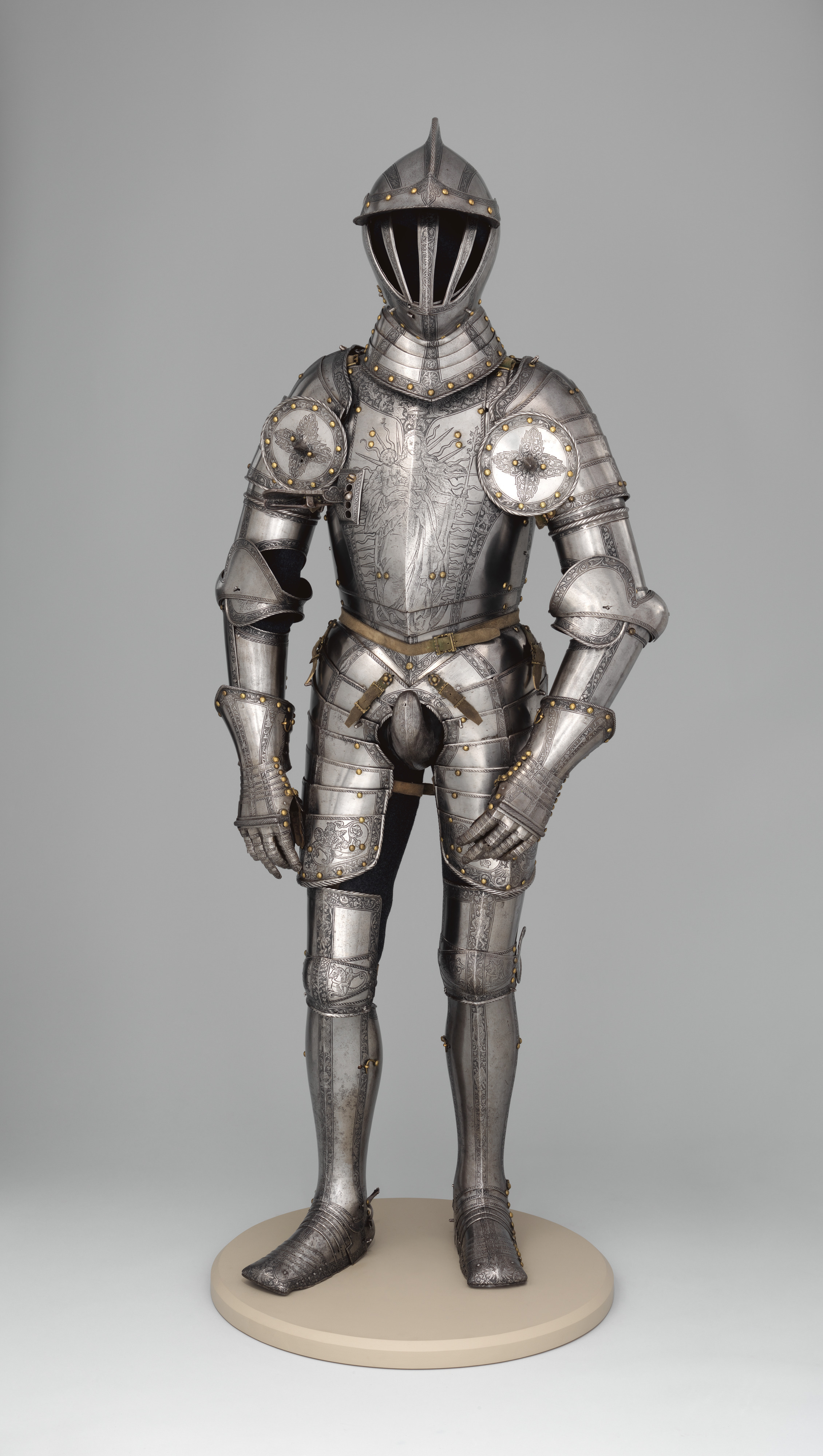
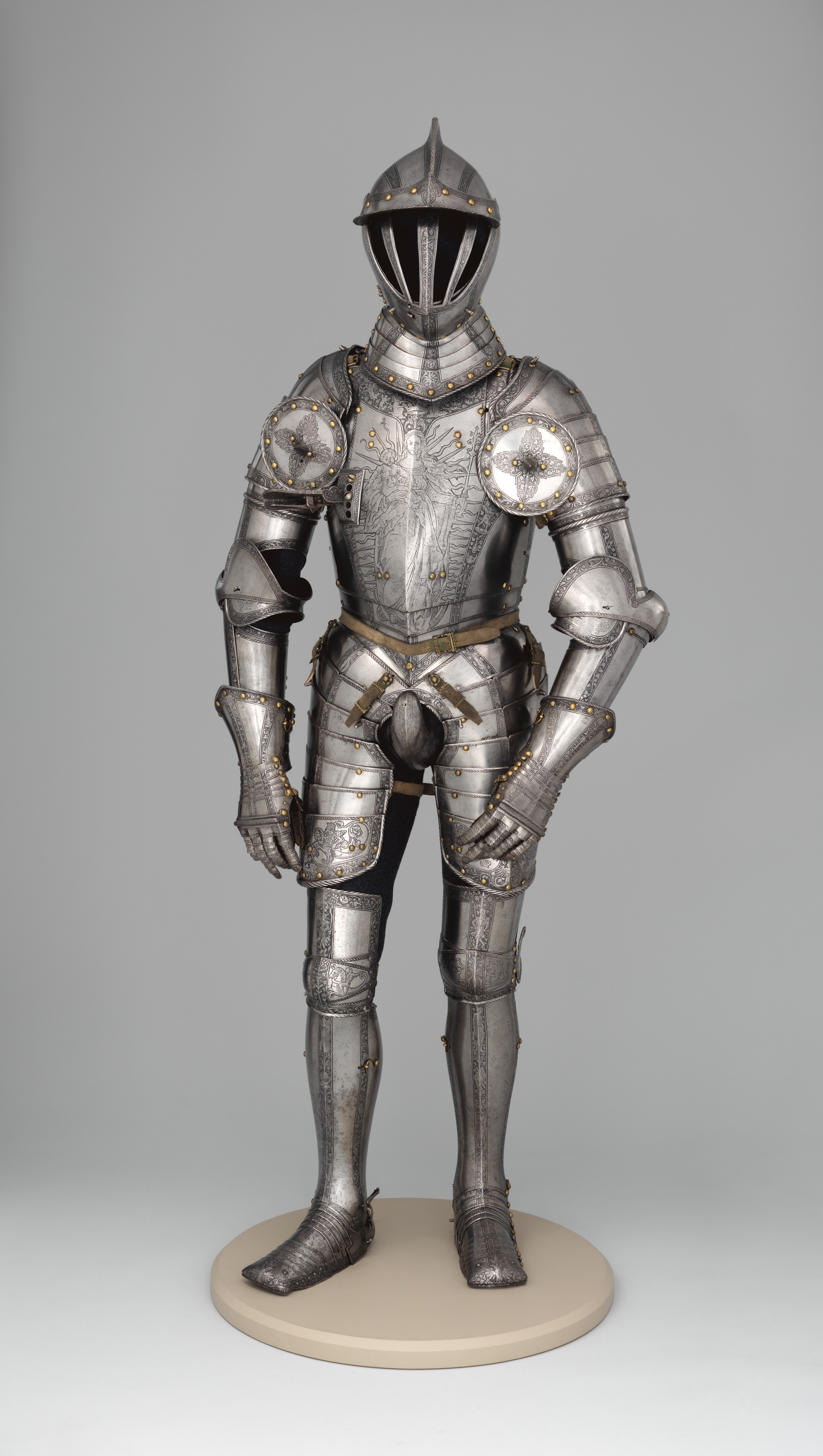
The complete harness as mounted and displayed, accession 33.164a-x. Steel, brass and leather, dated 1549.
| Artist | Kunz Lochner |
|---|---|
| Date | dated 1549 |
| Medium | Steel, brass, leather; etched decoration |
| Dimensions | H. 170.2 cm (67 in) as mounted; weight 24 kg (52 lb. 14 oz.) |
| Where it is now | Metropolitan Museum of Art, New York, Arms and Armor department, Gallery 371last confirmed |
| Inventory number | 33.164a-x |
| Attribution | AcceptedThe armor carries no personal signature. Full note |
| Object type | Arms and armour |
| Period | German, Nuremberg, mid-sixteenth century |
| Cases | Has a provenance gap |
| Inscriptions | Nuremberg city control marks (the letter N and the city's half-eagle stamp) struck into the steel; the date 1549 etched three times among the figural decoration |
| Owners on record | 5 links3 documented, 1 disputed, 1 unknown |
| Sources | 17 cited |
About this record Last verified · 17 sources cited · Change log
On this page 9 sections
ContentsClose
A complete steel field harness made in Nuremberg in 1549 by Kunz Lochner, one of the city's most sought-after armorers, for Ferdinand, King of the Romans, King of Bohemia and Hungary, and future Holy Roman Emperor. In 1549 Ferdinand was not yet Emperor; his brother Charles V still held that title. The armor's etched decoration, a crowned double-headed eagle on the toe caps, the badge of the Order of the Golden Fleece on the back, and a Madonna and Child on the breast, is a statement of Habsburg dynastic and religious authority made in the years immediately after the first Schmalkaldic War.
The armor spent an unrecorded stretch of its history unidentified, misattributed for a period while in the Odenwald collection of the Counts of Erbach-Erbach to Ferdinand's son-in-law Albert V of Bavaria, before a curator at Vienna's Kunsthistorisches Museum reattributed it to Ferdinand on physical and heraldic grounds. It entered the Metropolitan Museum of Art in 1933 by purchase, jointly funded by the Rogers Fund and a gift from the collector and museum trustee George D. Pratt, and was published the following year by the Met's arms and armor curator Stephen V. Grancsay.
Several links in the chain between Ferdinand's own possession and the Erbach collection, and between the Erbach family and the Met's 1933 purchase, are not documented in any source located for this record. Those gaps are recorded here as gaps.
Provenance
Each link is graded. Documented: a cited source supports it. Disputed: the identification is argued but not established. Unknown: no owner for that span, and the gap is not smoothed into a narrative. The grades in the glossary.
- 1549 -Ferdinand, King of the Romans, King of Bohemia and Hungary (later Holy Roman Emperor Ferdinand I)documented
Made by Kunz Lochner in Nuremberg, dated 1549, for Ferdinand's own use. Ferdinand held the titles King of the Romans (from 1531) and King of Bohemia and Hungary (from 1526) at the time the armor was made; he did not become Holy Roman Emperor until 1558. The armor's heraldry (a crowned Reichsadler befitting a King of the Romans, and the Golden Fleece badge of an order to which Ferdinand belonged) is consistent with this ownership.13613
- after 1549 - 19th centuryUnknownunknown
No owner, transaction or location is documented for the armor between Ferdinand's lifetime and its recorded presence in the Erbach-Erbach collection in the nineteenth century. This gap runs roughly three centuries and is not bridged by any source consulted.
- 19th century - early 20th centuryFranz, Count of Erbach-Erbach, and his heirs, Erbach Castle, Odenwald, Germanydocumented
Held at Erbach Castle. A burgonet helmet not original to the harness was added during this period to complete the ensemble. The armor was believed during this period to have belonged to Ferdinand's son-in-law Albert V, Duke of Bavaria, a fellow Golden Fleece knight, rather than to Ferdinand himself; the misattribution assumed the armor was made for Albert as a young man, since he was known to have gained substantial weight later in life. This account is reported in the secondary literature (via Grancsay 1934); the primary Grancsay article was not independently examined for this record.34
- early 20th century - 1933Franz, Count of Erbach-Erbach and heirs; reattributed but ownership route to New York undocumenteddisputed
The armor was reattributed to Ferdinand I by the director of the armory at the Kunsthistorisches Museum, Vienna, on the basis of the wearer's build and the Reichsadler heraldry on the sabatons, matching Ferdinand's documented physique and title rather than Albert V's. Neither the reattributing curator's name, the date of the reattribution, nor the mechanism (dealer, private sale, or other channel) by which the armor left Erbach ownership and reached the New York market in time for the Metropolitan's 1933 purchase is documented in any source consulted. This record does not supply a dealer's name for this step; a separate, unrelated Erbach 'Maximilian armor' is documented as sold to William Randolph Hearst across the 1920s-1950s through named intermediaries, but no source connects that transaction to this armor, and this record treats them as separate.36
- 1933 - presentMetropolitan Museum of Art, New Yorkdocumented
Acquired by purchase, jointly funded by the Rogers Fund and a gift from the collector and museum trustee George D. Pratt. Published by the Metropolitan's arms and armor curator Stephen V. Grancsay in the museum's Bulletin the following year, 1934. Bashford Dean, the department's founding curator, had retired in 1927 and died in December 1928 and had no role in this specific acquisition. On permanent display in Gallery 371 as of the last verification date of this record, and flagged by the museum's own collection database as a highlight object.1251112
Technical evidence
| Attribution note | The armor carries no personal signature. Attribution to Kunz Lochner rests on the Nuremberg city control marks etched into the steel (the letter N and the city's half-eagle stamp), the date 1549 etched three times in the decoration, and stylistic comparison, principally by Stephen V. Grancsay (1934) and Ortwin Gamber (1984), with Lochner's other documented commissions for the Habsburg court, including a closely related pair of armors he made in 1548 for Johann Ernst, Duke of Saxony-Coburg, also now in the Metropolitan Museum. No source consulted for this record confirms that Lochner's own recorded personal hallmark, a shield with a demi-lion, appears on this specific piece; the attribution is scholarly consensus rather than a maker's mark match. |
|---|---|
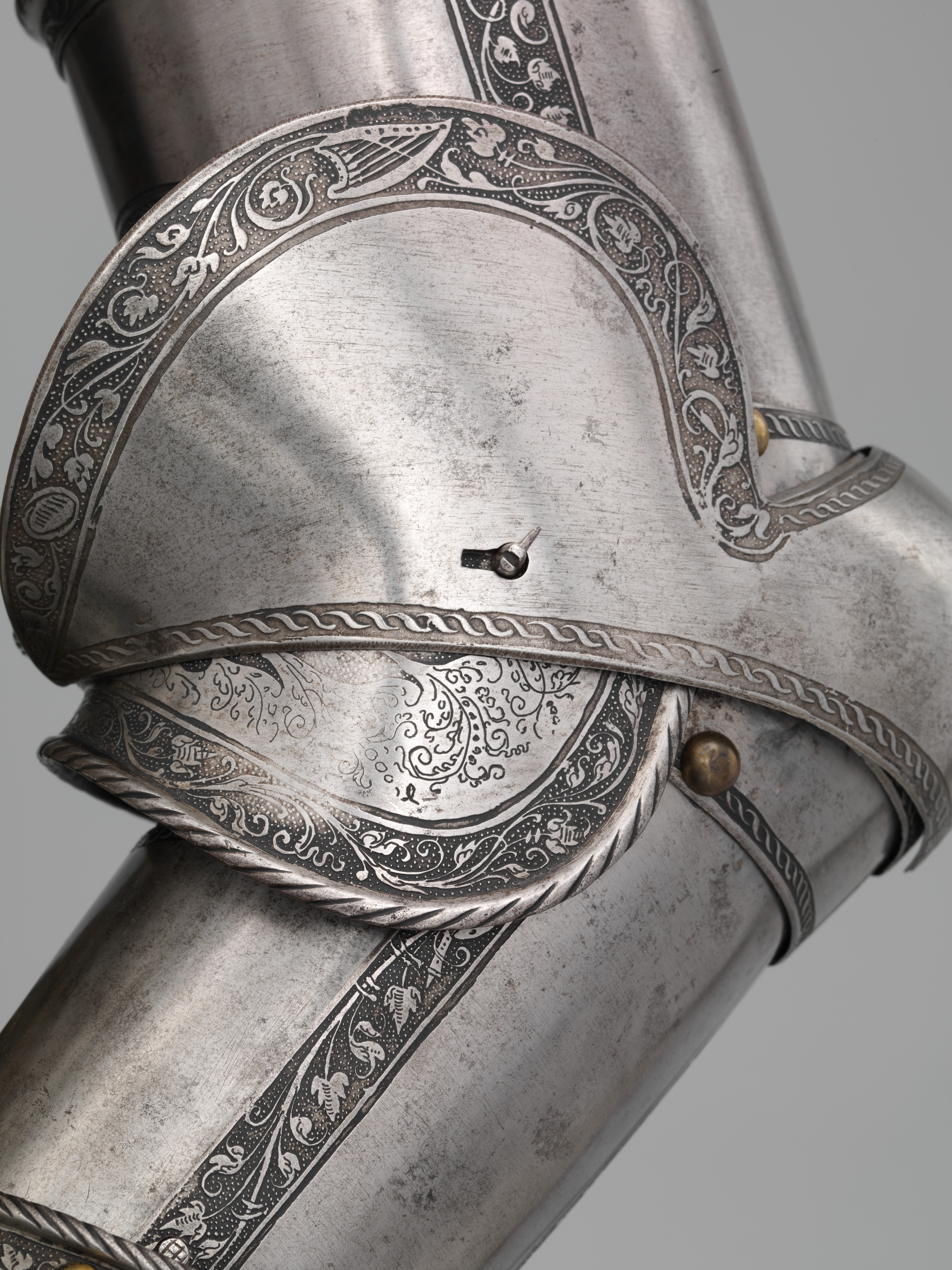
| Construction | Complete steel field harness of shaped and articulated plates, joined with sliding rivets and turning pins (visible at the right elbow in the Metropolitan Museum's own detail photography), with brass used in decorative fittings and leather for internal straps and linings.117 |
| Dimensions and weight | H. 170.2 cm (67 in.) as mounted; total weight 24 kg (52 lb. 14 oz.), across 25 catalogued elements under accession 33.164a-x.1 |
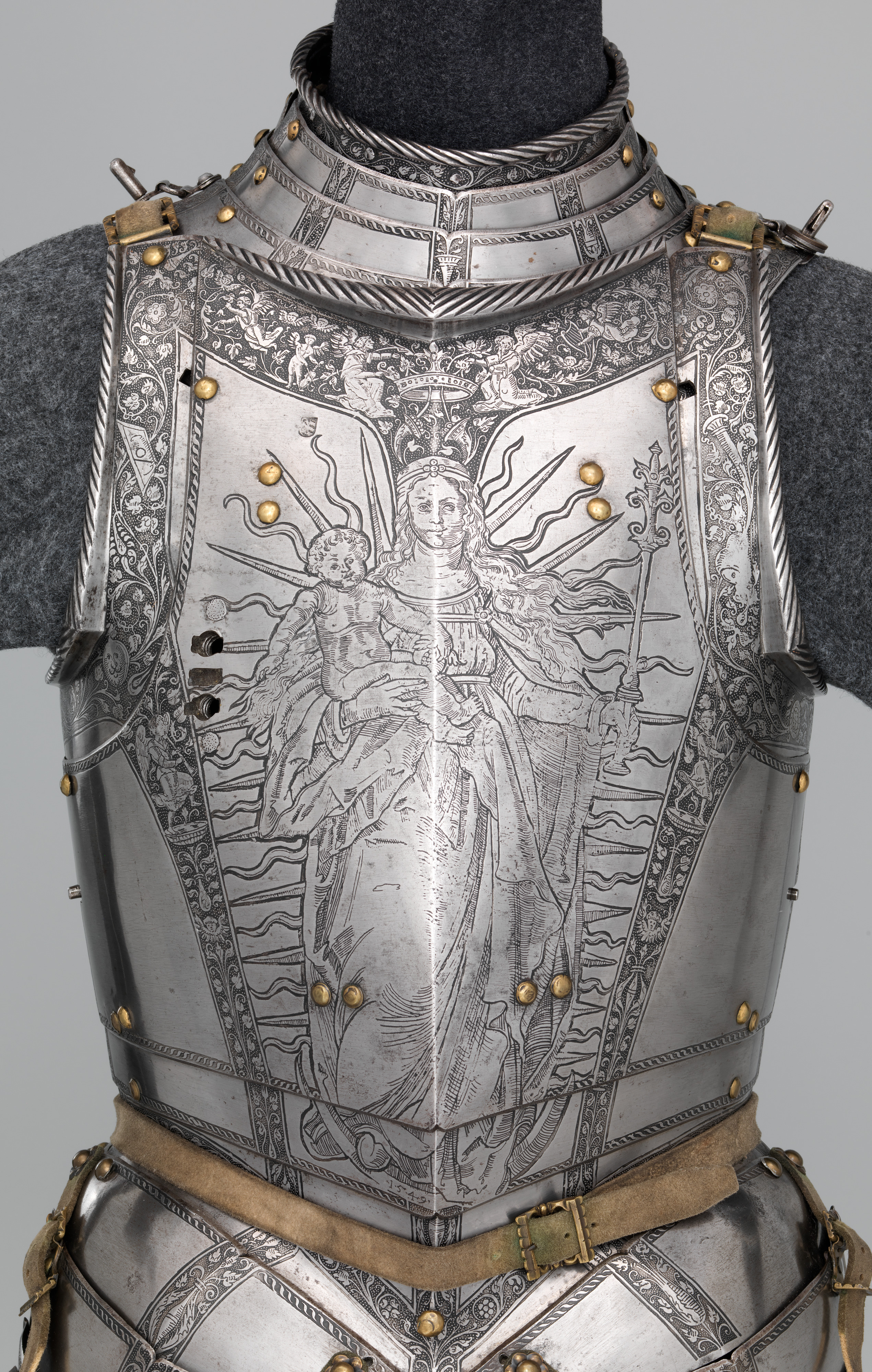
| Decoration technique | Acid-etched decoration throughout, a technique that bites the design into the steel with mordant rather than removing metal by hand-engraving, allowing complex figural ornament without reducing the plate's defensive thickness.34 |
| Marks | Struck with the Nuremberg city control marks: the letter N and the city's half-eagle stamp. The date 1549 is etched three times within the decorative scheme. No source consulted confirms Lochner's own recorded personal hallmark, a shield with a demi-lion, is present on this specific piece.3410 |
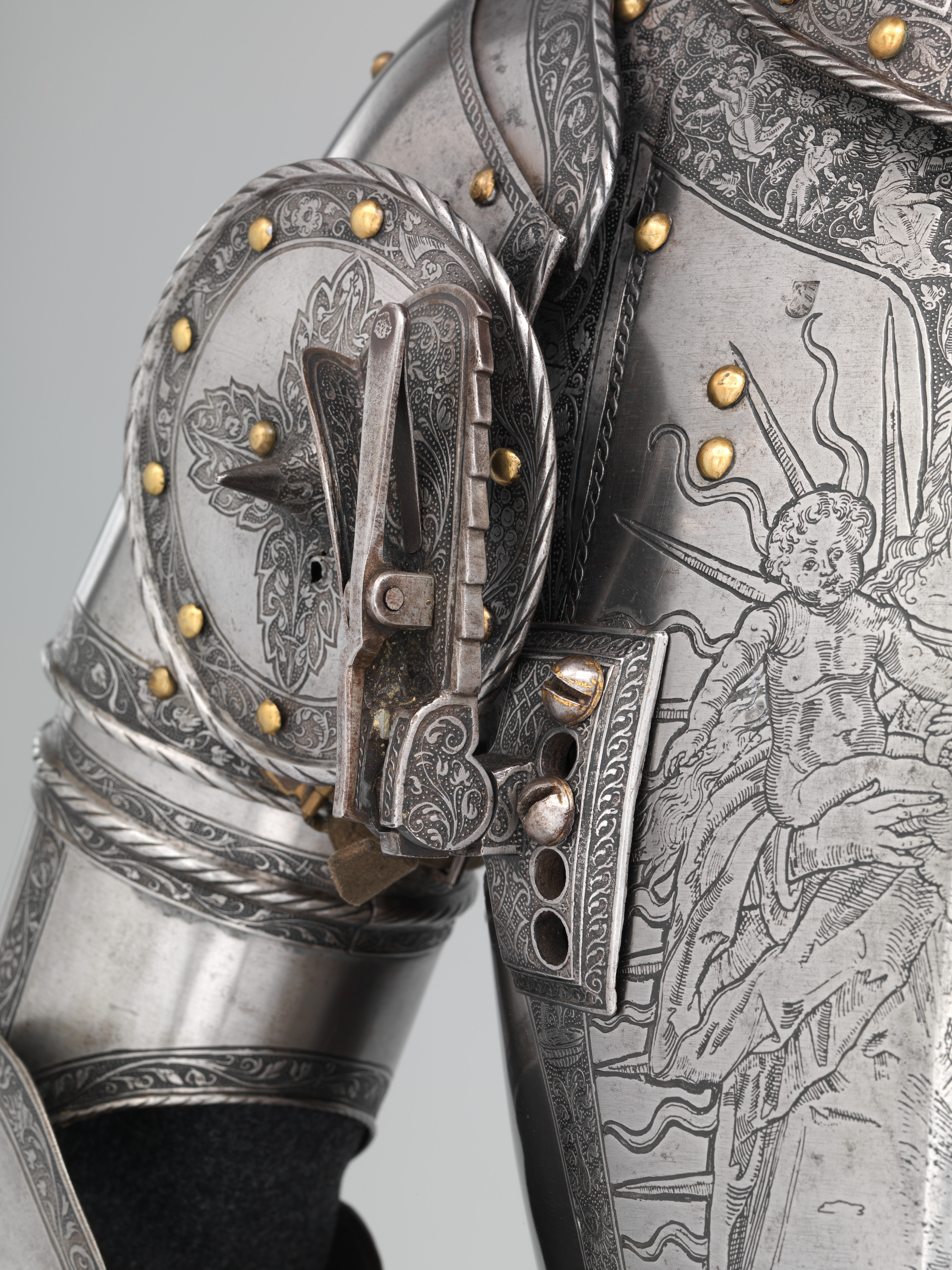
| Breastplate iconography | Etched image of the Madonna and Child as the Woman of the Apocalypse standing on a crescent moon, paralleling a design used on an armor of Ferdinand's brother Charles V, now in the Real Armeria, Madrid.38 |
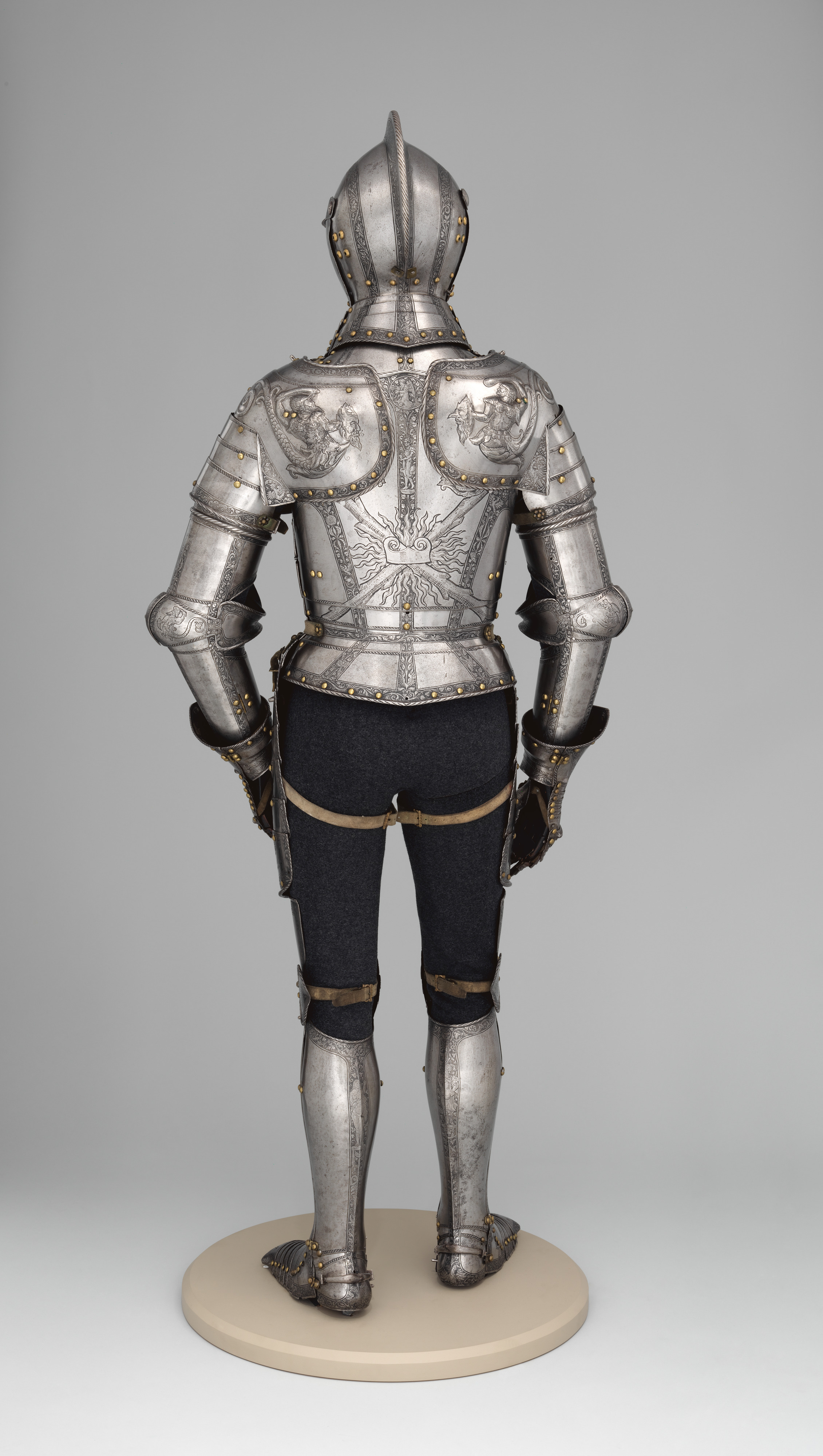
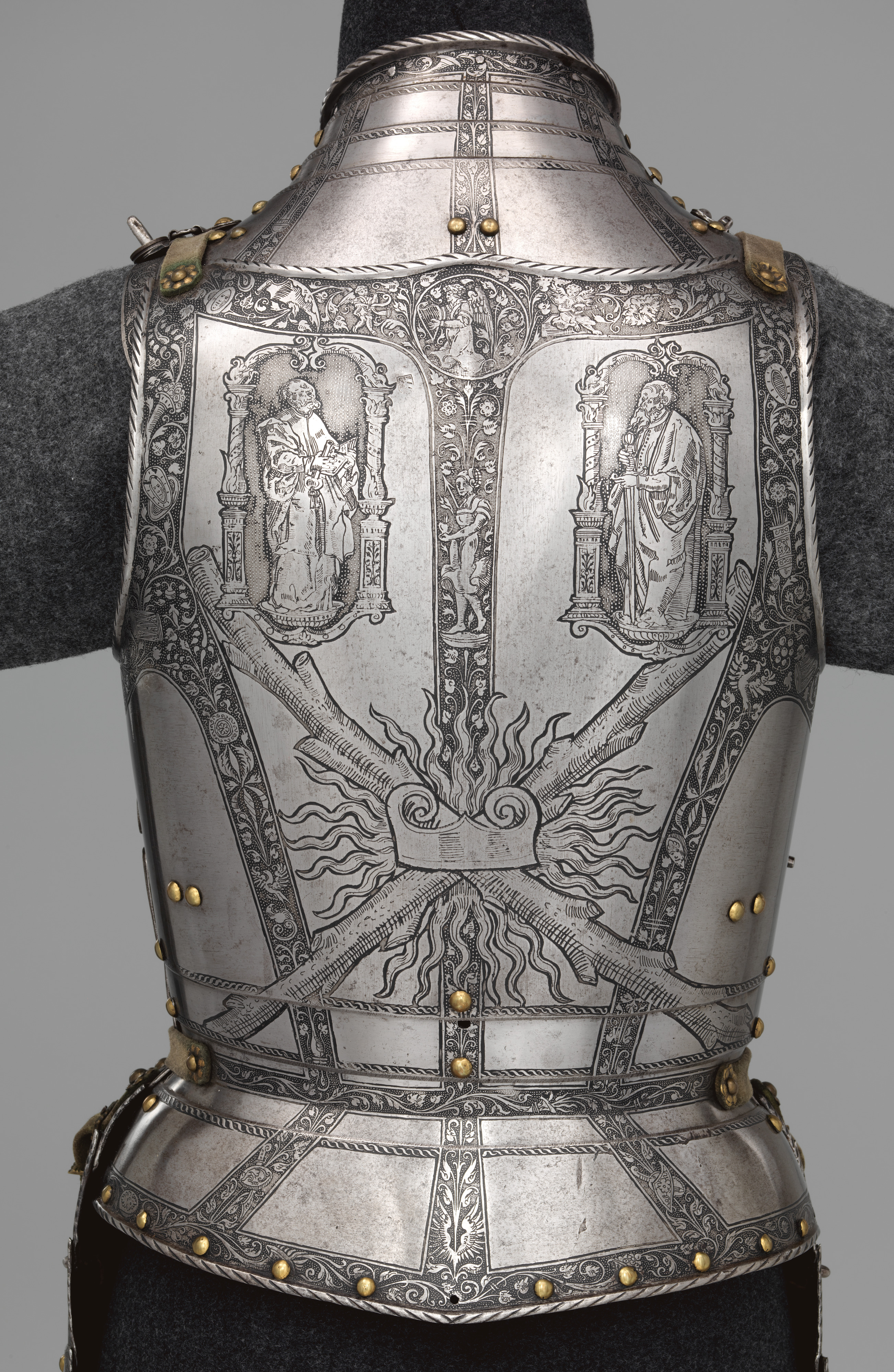
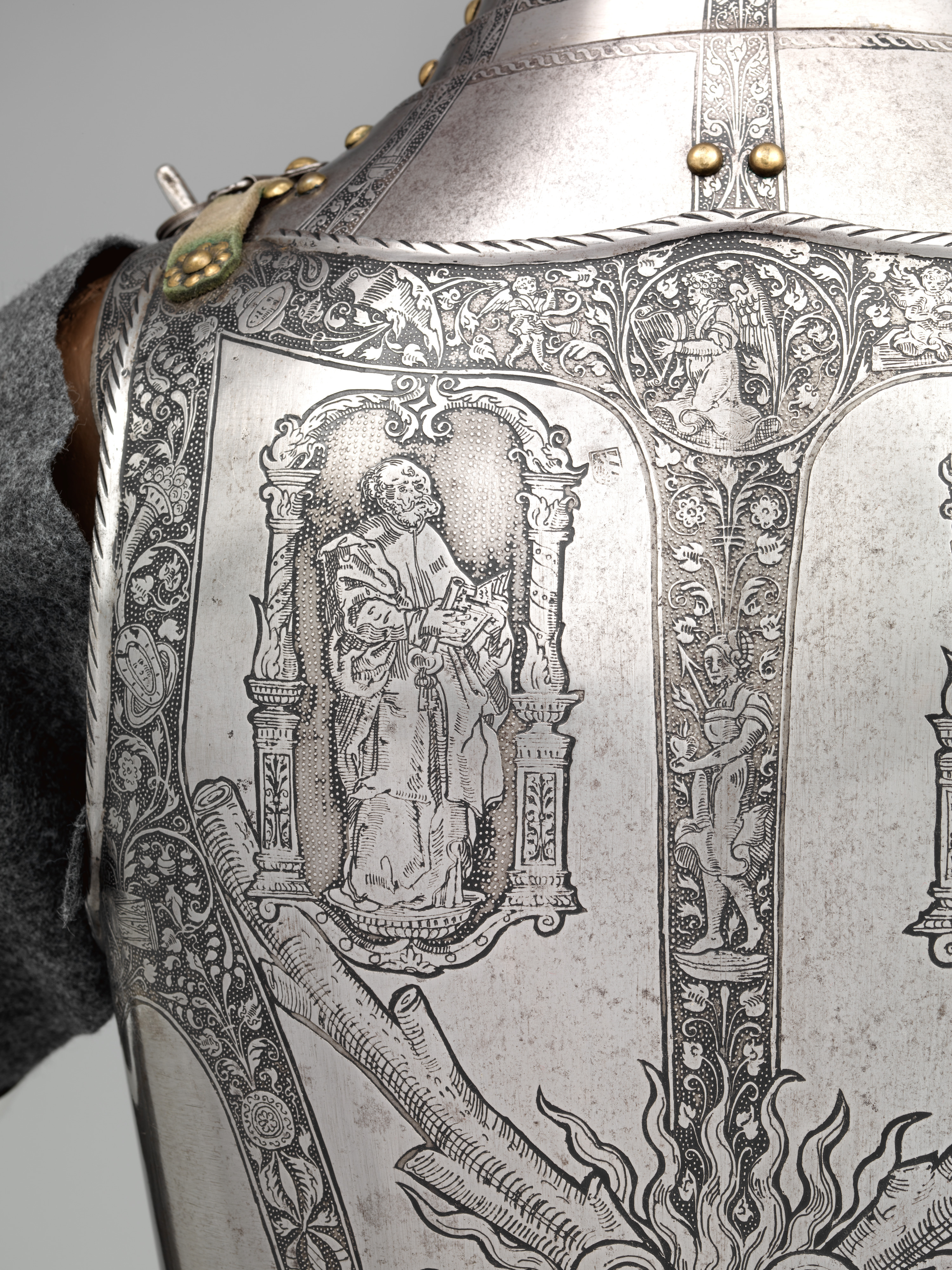
| Backplate iconography | Saints Peter and Paul in architectural niches above a fire-steel radiating sparks set at a saltire of crossed staves, the badge of the Order of the Golden Fleece.38 |
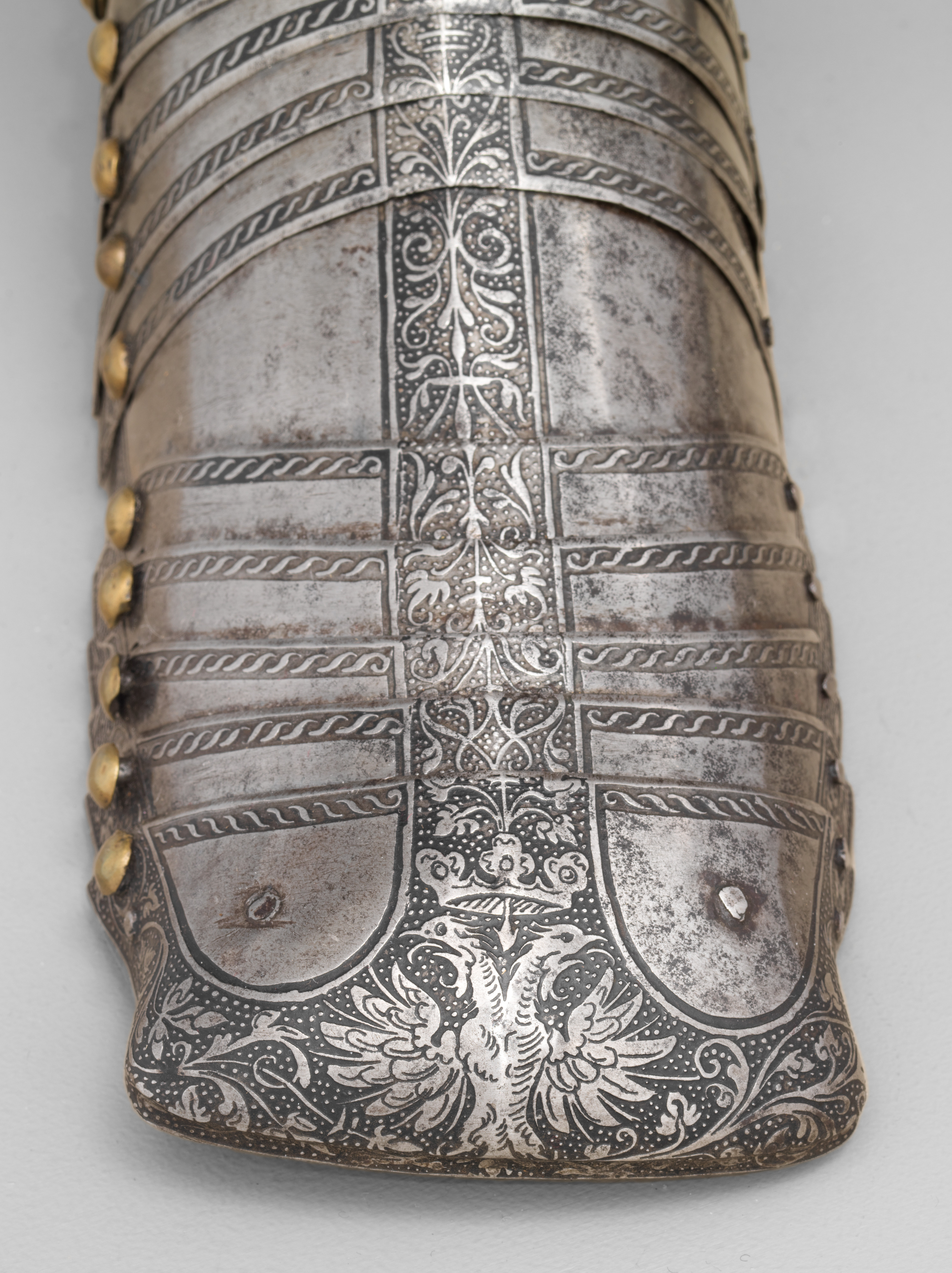
| Heraldic detail, sabatons | A crowned double-headed Reichsadler eagle etched on the toe caps, read by Metropolitan Museum scholarship as marking Ferdinand's status as King of the Romans, heir apparent to the imperial title, rather than as reigning Emperor.3617 |
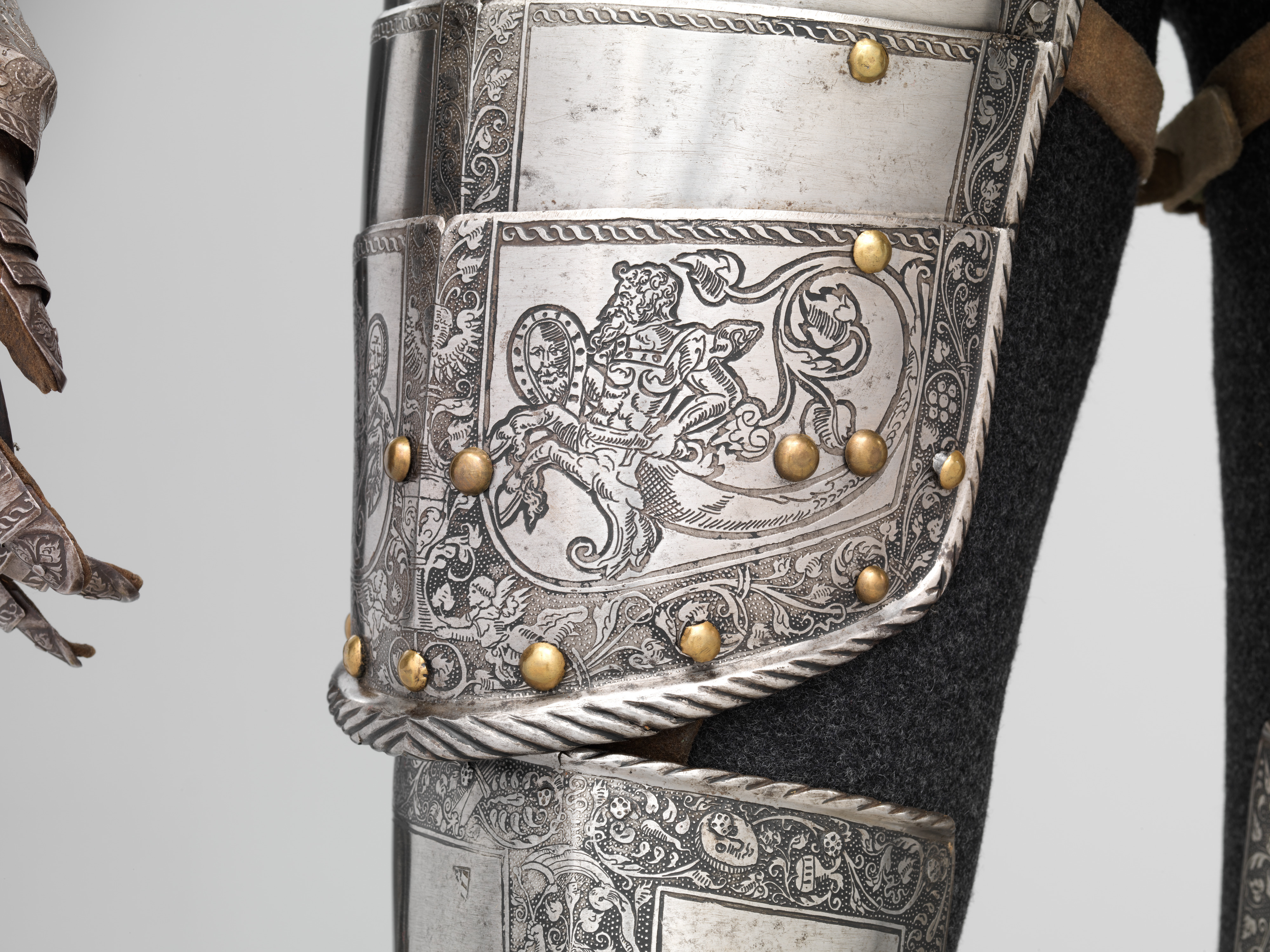
| Ornamental style | Figural decoration arranged in triple horizontal bands said in the museum's own published scholarship to imitate the slashed pattern of a contemporary Spanish court doublet, with scrollwork filled with tritons and grotesque creatures; a detail of a triton in the etched decoration and a detail of Saint Peter on the backplate are both separately documented in the Met's own photography of the piece.3817 |
| Functional fittings | A folding lance rest is fitted to the breastplate, and the harness includes a pair of reinforcing elbow cops in addition to the standard elbow articulation, both consistent with use in mounted combat or the tilt rather than with a display-only object.117 |
| Later alteration | A burgonet helmet not original to the harness was added while the armor was in the Erbach family's collection in the nineteenth century, to complete the ensemble for display. Sources consulted do not state whether the helmet element currently catalogued as 33.164a is that later addition or a subsequently substituted or corrected element.3 |
Images
The record in full
Chapter 1A complete field harness, not a curiosity
The armor comprises a close helmet or burgonet, gorget, breastplate and backplate, a pair of pauldrons, vambraces and gauntlets, upper and lower tassets, cuisses, greaves and sabatons, a brayette, a...
The armor comprises a close helmet or burgonet, gorget, breastplate and backplate, a pair of pauldrons, vambraces and gauntlets, upper and lower tassets, cuisses, greaves and sabatons, a brayette, a folding lance rest, and a pair of reinforcing elbow cops, all catalogued together under the single accession number 33.164a-x. Mounted, it stands 170.2 cm (67 inches) and weighs 24 kilograms (52 lb. 14 oz.), figures the Metropolitan Museum publishes for the assembled harness on its mount rather than for a single plate.
It is steel throughout, with brass used in the decorative etching grounds and fittings and leather for the internal straps and linings that are original to armors of this class, though not necessarily original to this exact assembly given the harness's documented later history. A turning pin at the right elbow, visible in the Met's own detail photography of the piece, shows the articulation mechanism that let the plates move with the wearer's arm, an ordinary but easily overlooked piece of period engineering.
Chapter 2Who Ferdinand was in 1549
The armor's common name calls its owner an Emperor, and that is the title by which the object is catalogued and known.
The armor's common name calls its owner an Emperor, and that is the title by which the object is catalogued and known. It is worth being precise about what was actually true in 1549. Ferdinand had been King of Bohemia, Hungary and Croatia since 1526 and King of the Romans, the formal title of the heir designate to the Holy Roman Empire, since 1531. His elder brother Charles V held the imperial title itself and would continue to hold it until his abdication process in 1556 and the transfer completed by 1558, four years after Ferdinand received him.
In 1549, then, Ferdinand was a senior and powerful Habsburg ruler, already governing Bohemia and Hungary and already the designated successor to the Empire, but he was not yet Emperor. The armor's decoration reflects exactly that intermediate status: the crowned double-headed Reichsadler etched on the toe caps of the sabatons is, on the reading given by Metropolitan Museum scholarship, a mark of his position as King of the Romans and heir apparent, not a claim to be sitting Emperor. This record keeps the object's traditional title, which is how it is catalogued and searched for, while treating the 1549 date as a date in Ferdinand's career as King of the Romans.
Chapter 3How Nuremberg armor of this class was made
Nuremberg in the mid-sixteenth century was, along with Augsburg and Landshut-Innsbruck, one of the principal centers of the German plate armor industry, organized around workshops that combined...
Nuremberg in the mid-sixteenth century was, along with Augsburg and Landshut-Innsbruck, one of the principal centers of the German plate armor industry, organized around workshops that combined blacksmithing, polishing and etching under one roof or in close cooperation. A finished harness like this one required raising and hardening dozens of individually shaped steel plates, articulating them with sliding rivets and internal straps so a wearer could move, and then decorating the surface, in this case by acid etching rather than engraving, a technique that bites a design into the steel with mordant rather than removing metal with a graver, allowing elaborate figural ornament without thinning or weakening the plate's defensive strength.
The finished armor carries the marks of the city's own quality control system rather than, so far as the sources consulted for this record establish, a confirmed personal mark of Lochner's own on this specific example: the letter N for Nuremberg and the city's half-eagle stamp, struck into the steel, alongside the date 1549 etched three times into the decorative scheme itself. Armorers in Nuremberg worked under a guild system that required this civic marking independently of whatever personal hallmark, in Lochner's case a shield bearing a demi-lion, a maker might also strike on his own account.
Chapter 4The decorative programme
The etched decoration is not generic ornament.
The etched decoration is not generic ornament. On the breastplate is the Madonna and Child shown as the Woman of the Apocalypse standing on a crescent moon, an image that, on the reading given in Metropolitan Museum scholarship (Helmut Nickel, cited via the object's published literature), echoes a design Charles V used on one of his own armors, now in the Real Armeria in Madrid. Placing a version of the Emperor's own religious image on his brother and heir's breastplate reads as a deliberate statement of shared Habsburg identity and Catholic allegiance at a moment, just after the first Schmalkaldic War against the Protestant princes, when that allegiance was a live political fact rather than a private devotion.
The backplate carries Saints Peter and Paul set in architectural niches above a fire-steel radiating sparks, set at a saltire of crossed staves. The fire-steel is a Burgundian emblem that originated with Philip the Good and became, through Habsburg inheritance of Burgundian lands and titles, the badge of the Order of the Golden Fleece, the chivalric order to which Ferdinand belonged. Wearing that badge on the back of a working harness put the wearer's membership of Christendom's most exclusive order of knighthood on permanent, if concealed-when-mounted, display.
The ornament is arranged in triple horizontal bands of fantastical figures, a pattern that Metropolitan Museum scholarship (again via Nickel) reads as imitating the slashed and paned fashion of a contemporary Spanish doublet, the courtly dress of the Habsburg court rather than a native German pattern, with scrollwork filled with tritons and other grotesque creatures in the spaces between. None of this reading claims access to Ferdinand's or Lochner's own stated intentions; it is a scholarly argument from comparison with other decorated armors and contemporary dress, not a documented brief from a patron, and this record presents it as an argued reading rather than an established fact about what either man believed he was doing.
Chapter 5Field armor or parade armor: a real disagreement
Sources disagree, in terms worth stating plainly rather than smoothing over, about what kind of armor this is.
Sources disagree, in terms worth stating plainly rather than smoothing over, about what kind of armor this is. When Stephen V. Grancsay published it in the Metropolitan Museum's Bulletin in 1934, he titled the piece A Sixteenth-Century Parade Armor, implying an object made for display and ceremony rather than combat. Later specialist literature, including Ortwin Gamber's 1984 study of Lochner's Habsburg commissions and a 2005 German exhibition catalogue on the Peace of Augsburg, instead classifies this class of harness as a feldharnisch or feldkuriss, a working field armor intended for actual military use during the Reformation-era and Ottoman conflicts of Ferdinand's reign, with the etched decoration read as elaboration that does not compromise the piece's defensive function.
This record does not arbitrate between the two readings. It notes that the object's own 1934 publication title and the later scholarly consensus point in different directions, that both readings agree the armor is functionally complete and wearable rather than a display-only fantasy piece, and that a visitor relying only on the Met's founding publication of the object would come away with the opposite classification from a visitor relying on the more recent German-language scholarship.
Chapter 6No documented single occasion
Asked directly: is there a specific tournament, campaign, coronation or diplomatic event this armor is documented as having been made for.
Asked directly: is there a specific tournament, campaign, coronation or diplomatic event this armor is documented as having been made for. No source located for this record identifies one. What the literature says, consistently, is only that this was one of several armors made for Ferdinand during the general period of the wars of the Reformation and his long, intermittent conflict with the Ottoman Empire over Hungary and Transylvania.
That general context is real: the first Schmalkaldic War against the Protestant princes had concluded in 1547 with the Habsburg and Catholic victory at Muhlberg, and Ottoman-Habsburg fighting and negotiation over Hungary continued through the late 1540s and into the 1550s. It would be easy, and wrong, to convert that general context into a claim that this armor was made for one of those campaigns specifically. No source consulted makes that link, and this record does not manufacture one. The honest statement is that the armor documents Ferdinand's general standing role as a Habsburg military and dynastic figure in 1549, not his participation in any single named event.
Chapter 7From Ferdinand's possession to a German country house
Between Ferdinand's own ownership in and after 1549 and the armor's documented reappearance in the nineteenth century in the collection of Franz, Count of Erbach-Erbach, at Erbach Castle in the...
Between Ferdinand's own ownership in and after 1549 and the armor's documented reappearance in the nineteenth century in the collection of Franz, Count of Erbach-Erbach, at Erbach Castle in the Odenwald, no source consulted records an owner, a date, or a transaction. That gap runs roughly three centuries. While the armor was at Erbach, a burgonet helmet not original to the harness was added to complete the ensemble for display, and the whole piece was, for an unstated period, believed to have belonged not to Ferdinand but to his son-in-law Albert V, Duke of Bavaria, who had married Ferdinand's daughter Anna and was himself a member of the Order of the Golden Fleece, a connection that made the misattribution at least internally consistent with the armor's own Golden Fleece badge. Under that misattribution, the armor's apparent youthful build was explained by the assumption it had been made for Albert as a young man, since he was known to have put on considerable weight later in life.
Chapter 8Reattribution to Ferdinand
The correction to Ferdinand I is credited in the secondary literature to the director of the armory at the Kunsthistorisches Museum in Vienna, on a combination of physical and heraldic evidence: the...
The correction to Ferdinand I is credited in the secondary literature to the director of the armory at the Kunsthistorisches Museum in Vienna, on a combination of physical and heraldic evidence: the wearer's slight build and short stature, no more than about 5 feet 7 inches (170 cm), a straight back, a slim waist and long arms, consistent with Ferdinand's other documented armors in the Vienna collections; and, decisively, the crowned double-headed Reichsadler on the sabatons, an emblem that marks the wearer specifically as King of the Romans rather than merely a Golden Fleece knight, which fits Ferdinand and not Albert V, who never held that title. No source consulted for this record gives the reattributing curator's name or a firm date for when the correction was made; that is recorded here as an open question rather than filled with a guess.
Chapter 9George D. Pratt and the Rogers Fund
The Metropolitan Museum's credit line reads Purchase, Rogers Fund and George D.
The Metropolitan Museum's credit line reads Purchase, Rogers Fund and George D. Pratt Gift, 1933, meaning the acquisition was jointly funded from the museum's general Rogers Fund endowment and a specific gift earmarked by Pratt. George Dupont Pratt (1869-1935) was a son of the Standard Oil executive and philanthropist Charles Pratt, and himself a trustee of both the Metropolitan Museum and the American Museum of Natural History, as well as a former New York State Conservation Commissioner and a major donor to the Metropolitan's decorative arts holdings more broadly. His name recurs on other Metropolitan arms and armor acquisitions of the period, consistent with a pattern of a wealthy trustee underwriting specific object purchases the curatorial department wanted rather than funding acquisitions at random. No source consulted specifies what fraction of the 1933 purchase price Pratt's gift covered relative to the Rogers Fund, or what the total price paid was.
Chapter 11From Erbach to New York: an undocumented step
Between the armor's presence in the Erbach family's collection and its purchase by the Metropolitan Museum in 1933, no source located for this record names a dealer, an intermediary, an auction, or...
Between the armor's presence in the Erbach family's collection and its purchase by the Metropolitan Museum in 1933, no source located for this record names a dealer, an intermediary, an auction, or any specific transaction. This is a real gap, not a minor one, in an otherwise reasonably well-documented modern history, and this record declines to fill it with a plausible-sounding dealer's name drawn from other, unrelated Erbach material that surfaces in the same period. A separate suit of armor from the Erbach collections, described in period sources as an Erbach Maximilian armor, was sold across the 1920s to 1950s to the American publisher William Randolph Hearst through intermediaries including the journalist Karl von Wiegand and the arms dealer Hans Schedelmann, and parts of the Hearst collection were later handled for sale by Parish-Watson and Company. That transaction concerns a different Erbach armor entirely and is not documented anywhere as connected to this one; it is noted here only to flag it explicitly as a piece of material a researcher might otherwise mistake for this object's own chain of custody.
Chapter 12Kunz Lochner and the Habsburg armor trade
Kunz Lochner came from a Nuremberg armoring family: his father, also named Kunz Lochner, worked the same trade until his death in 1527, and two brothers, Heinrich and Hans, were also armorers and...
Kunz Lochner came from a Nuremberg armoring family: his father, also named Kunz Lochner, worked the same trade until his death in 1527, and two brothers, Heinrich and Hans, were also armorers and blacksmiths. Lochner entered Ferdinand's service in 1543 at the royal armory in Prague Castle and, from 1544, also served Ferdinand's son, the future Emperor Maximilian II, as court armorer. His documented work for the Austrian Habsburgs appears to have wound down by around 1550, after which he is recorded supplying the Electorate of Saxony from 1552 and, from 1557, the court of Sigismund II Augustus, King of Poland, traveling personally to Poland in 1559 to collect payment for work delivered.
Surviving Lochner armors are held today in the Livrustkammaren in Stockholm (including harnesses made around 1540 for Gustav I Vasa of Sweden and around 1550 for Sigismund II Augustus of Poland), the Rustkammer in Dresden, the Musee de l'Armee in Paris, and the Metropolitan Museum in New York, which in addition to the Ferdinand I armor holds the 1548 small garniture and the matched Johann Ernst horse armor described above. That his work for one of the most powerful ruling families in Europe survives in this many national collections is itself evidence of the international reputation the literature attributes to him among mid-sixteenth-century Nuremberg armorers, most of whom worked and are now known only locally.
Chapter 13What is unresolved
The armor is on permanent display in Gallery 371 of the Metropolitan Museum's Arms and Armor department and is marked in the museum's own collection database as a highlight object, one of a...
The armor is on permanent display in Gallery 371 of the Metropolitan Museum's Arms and Armor department and is marked in the museum's own collection database as a highlight object, one of a relatively small number of works the museum flags for that status. Several factual questions about its history nonetheless remain open, and are recorded as such below rather than resolved by inference.
The artist
Kunz (also Cunz, Konrad, Conrad, Conrath) Lochner
Kunz Lochner worked in Nuremberg for roughly three and a half decades in the middle of the sixteenth century, in a family trade: his father of the same name and two brothers were also armorers and blacksmiths in the city. What sets him apart from most of his Nuremberg contemporaries is the geographic spread of his surviving clientele. Nuremberg produced armor for export across German-speaking Europe as a matter of course, but Lochner's documented patrons ran from the Habsburg imperial court in Prague and Vienna to the royal courts of Sweden and Poland, and his work survives today in national collections on both sides of the old Cold War line that once made comparing them difficult.
Related works
| Work | Relation | Where it is |
|---|---|---|
| Small garniture for field and tournament, and matched horse armor for Johann Ernst, Duke of Saxony-Coburg Kunz Lochner | Contemporary Lochner armor for a different Habsburg-allied patron, in the same Metropolitan Museum department; the man's portion entered via the Bashford Dean Memorial Collection gift in 1929, the horse armor via the Rogers Fund in 1932 Dated 1548, one year before the Ferdinand I armor. Its acquisition traces to Bashford Dean's own private collection, given by his widow after his 1928 death, a genuine Dean connection to Lochner material at the Met that is distinct from, and should not be confused with, the 1933 purchase of the Ferdinand I armor. | Metropolitan Museum of Art, New York (accessions 29.151.2a-s and 32.69a-q; displayed together as object 35739) |
| Armor for Sigismund II Augustus, King of Poland Kunz Lochner | Documented royal commission from later in Lochner's career, after his Habsburg court work wound down Made around 1550. Comparanda for Lochner's continuing production of elaborately decorated harnesses for reigning monarchs outside the Habsburg court. | Livrustkammaren (Royal Armoury), Stockholm |
| Armor for Gustav I Vasa, King of Sweden Kunz Lochner | Earlier documented royal commission Made around 1540, predating the Ferdinand I armor by roughly a decade. | Livrustkammaren (Royal Armoury), Stockholm |
| Armor of Emperor Charles V Unattributed in sources consulted for this record | Source of the Madonna-and-child-on-a-crescent-moon breastplate image echoed on the Ferdinand I armor Cited in Metropolitan Museum scholarship (Nickel) as the parallel for the breastplate iconography; not independently examined for this record. | Real Armeria (Royal Armoury), Madrid |
Open questions
- Is there any documentation of a specific occasion, tournament, campaign or diplomatic event this armor was made for? None was located; the armor is described in the literature only in the general context of the Reformation wars and the Ottoman conflict.
- Who exactly was 'the director of the armory at the Kunsthistorisches Museum' credited with reattributing the armor from Albert V of Bavaria to Ferdinand I, and in what year was that reattribution made? Not named or dated in the sources consulted.
- By what route, and through which dealer or intermediary if any, did the armor pass from the Erbach family's ownership to the Metropolitan Museum's 1933 purchase? No source consulted names a channel.
- Is the helmet element currently catalogued as 33.164a the non-original burgonet added during the Erbach ownership, or has it since been replaced or corrected? Sources consulted do not address the helmet's present status.
- What was the total 1933 purchase price, and what portion of it came from the Rogers Fund as against George D. Pratt's gift? Not published in the sources consulted.
- Does current Metropolitan Museum curatorial opinion classify this piece as parade armor, per Grancsay's 1934 title, or as functional field armor (feldharnisch), per the later German-language scholarship? The two classifications are not reconciled in any source consulted.
Questions about this object
What is Armor of Emperor Ferdinand I (1503-1564)?
Armor of Emperor Ferdinand I (1503-1564) is an arms and armour, dated dated 1549. Medium: Steel, brass, leather; etched decoration.
Who made Armor of Emperor Ferdinand I (1503-1564), and is the attribution settled?
The attribution to Kunz Lochner is recorded here as accepted. The armor carries no personal signature. Attribution to Kunz Lochner rests on the Nuremberg city control marks etched into the steel (the letter N and the city's half-eagle stamp), the date 1549 etched three times in the decoration, and stylistic comparison, principally by Stephen V. Grancsay (1934) and Ortwin Gamber (1984), with Lochner's other documented commissions for the Habsburg court, including a closely related pair of armors he made in 1548 for Johann Ernst, Duke of Saxony-Coburg, also now in the Metropolitan Museum. No source consulted for this record confirms that Lochner's own recorded personal hallmark, a shield with a demi-lion, appears on this specific piece; the attribution is scholarly consensus rather than a maker's mark match.
Where is Armor of Emperor Ferdinand I (1503-1564) now?
Metropolitan Museum of Art, New York, Arms and Armor department, Gallery 371. Inventory number 33.164a-x. Last confirmed 2 September 2026. Purchase, Rogers Fund and George D. Pratt Gift, 1933; verified directly against the Met Collection API for object 23944 (accessionNumber 33.164a-x, isPublicDomain true, isHighlight true).
What is still unknown about Armor of Emperor Ferdinand I (1503-1564)?
Is there any documentation of a specific occasion, tournament, campaign or diplomatic event this armor was made for? None was located; the armor is described in the literature only in the general context of the Reformation wars and the Ottoman conflict.
Sources
- 1Metropolitan Museum of Art Collection API, object 23944 (fetched directly). Confirms accessionNumber 33.164a-x, isPublicDomain: true, isHighlight: true, title, medium, dimensions, credit line, department, and the full list of measured armor elements. collectionapi.metmuseum.org/public/...
- 2Metropolitan Museum of Art, object page, 'Kunz Lochner | Armor of Emperor Ferdinand I (1503-1564)'. Direct fetch was blocked by the site's rate limiting during research; content is corroborated independently via the object's own CC0 image files' embedded metadata (source 17) and via secondary citation in Wikipedia (source 3). metmuseum.org/art/...
- 3Wikipedia, 'Armor of Ferdinand I, Holy Roman Emperor'. en.wikipedia.org/wiki/...
- 4Wikipedia (German), 'Rustung Kaiser Ferdinands I.'. de.wikipedia.org/wiki/...
- 5Grancsay, Stephen V. (1934). 'A Sixteenth-Century Parade Armor.' The Bulletin of the Metropolitan Museum of Art, vol. XXIX, no. 6, pp. 102-104. Cited via Wikipedia and German Wikipedia; the original article itself is JSTOR-paywalled and was not independently accessed for this record. Editor should verify directly against the original where possible. doi.org/10.2307/...
- 6Gamber, Ortwin (1984). 'Der Plattner Kunz Lochner - Harnische als Zeugnisse Habsburgischer Politik.' Jahrbuch der Kunsthistorischen Sammlungen in Wien, vol. 80, pp. 43-44. Cited via Wikipedia; not independently accessed for this record. en.wikipedia.org/wiki/...
- 7LaRocca, Donald J. (1995). 'An English Armor for the King of Portugal.' Metropolitan Museum Journal, vol. XXX, pp. 81-96. Cited via Wikipedia for general context on Habsburg armor as dynastic and religious statement; not independently accessed for this record. en.wikipedia.org/wiki/...
- 8Nickel, Helmut. 'Gothic and Renaissance Art in Nuremberg, 1300-1550.' MetPublications, Metropolitan Museum of Art, pp. 466-467. Cited via Wikipedia for the breastplate and ornament iconography; not independently accessed for this record. metmuseum.org/art/...
- 9Hoffmann, Carl A., Johanns, Markus, Kranz, Annette, Trepesch, Christof, and Zeidler, Oliver (2005). Als Frieden moeglich war: 450 Jahre Augsburger Religionsfrieden (Maximilianmuseum exhibition catalogue). Regensburg: Schnell and Steiner, pp. 325-326. Cited via Wikipedia for the feldharnisch/field-armor classification; not independently accessed for this record. en.wikipedia.org/wiki/...
- 10Wikipedia, 'Kunz Lochner'. en.wikipedia.org/wiki/...
- 11Wikipedia, 'George Dupont Pratt'. en.wikipedia.org/wiki/...
- 12Wikipedia, 'Bashford Dean'. en.wikipedia.org/wiki/...
- 13Wikipedia, 'Ferdinand I, Holy Roman Emperor'. en.wikipedia.org/wiki/...
- 14Metropolitan Museum of Art Collection API, object 23198, 'Armor from a Small Garniture for Field and Tournament' (fetched directly). Confirms accession 29.151.2a-s, credit line 'Bashford Dean Memorial Collection, Gift of Mrs. Bashford Dean, 1929', dated 1548. collectionapi.metmuseum.org/public/...
- 15Metropolitan Museum of Art Collection API, object 35739, 'Armor for Man and Horse' (fetched directly). Confirms the combined display of accessions 29.151.2a-s, 29.158.183-.184, and 32.69a-q. collectionapi.metmuseum.org/public/...
- 16Metropolitan Museum of Art Collection API, object 23358, 'Horse Armor Made for Johann Ernst, Duke of Saxony-Coburg' (fetched directly). Confirms accession 32.69a-q, credit line 'Rogers Fund, 1932', dated 1548. collectionapi.metmuseum.org/public/...
- 17Embedded XMP/IPTC metadata read directly from the Metropolitan Museum's own CC0 image files for accession 33.164a-x (files DP-12881-007 through DP-12881-015). Metadata confirms each file's own descriptive caption (e.g. 'Overall back view', 'Close up of breastplate', 'Detail of double headed eagle on toe cap'), the object URL matching accession 23944, and CC0 rights status (creativecommons.org/publicdomain/zero/1.0). images.metmuseum.org/CRDImages/...
Last verified · Published
Change log
2 September 2026 - Record created at the house standard: researched narrative, technical evidence, maker dossier, graded provenance chain, prices with hammer and premium separated, related works, open questions and sources.