Mamusse Wunneetupanatamwe Up-Biblum God
John Eliot, translator, with Job Nesuton, James Printer (Wowaus), John Sassamon and Cockenoe · 1663
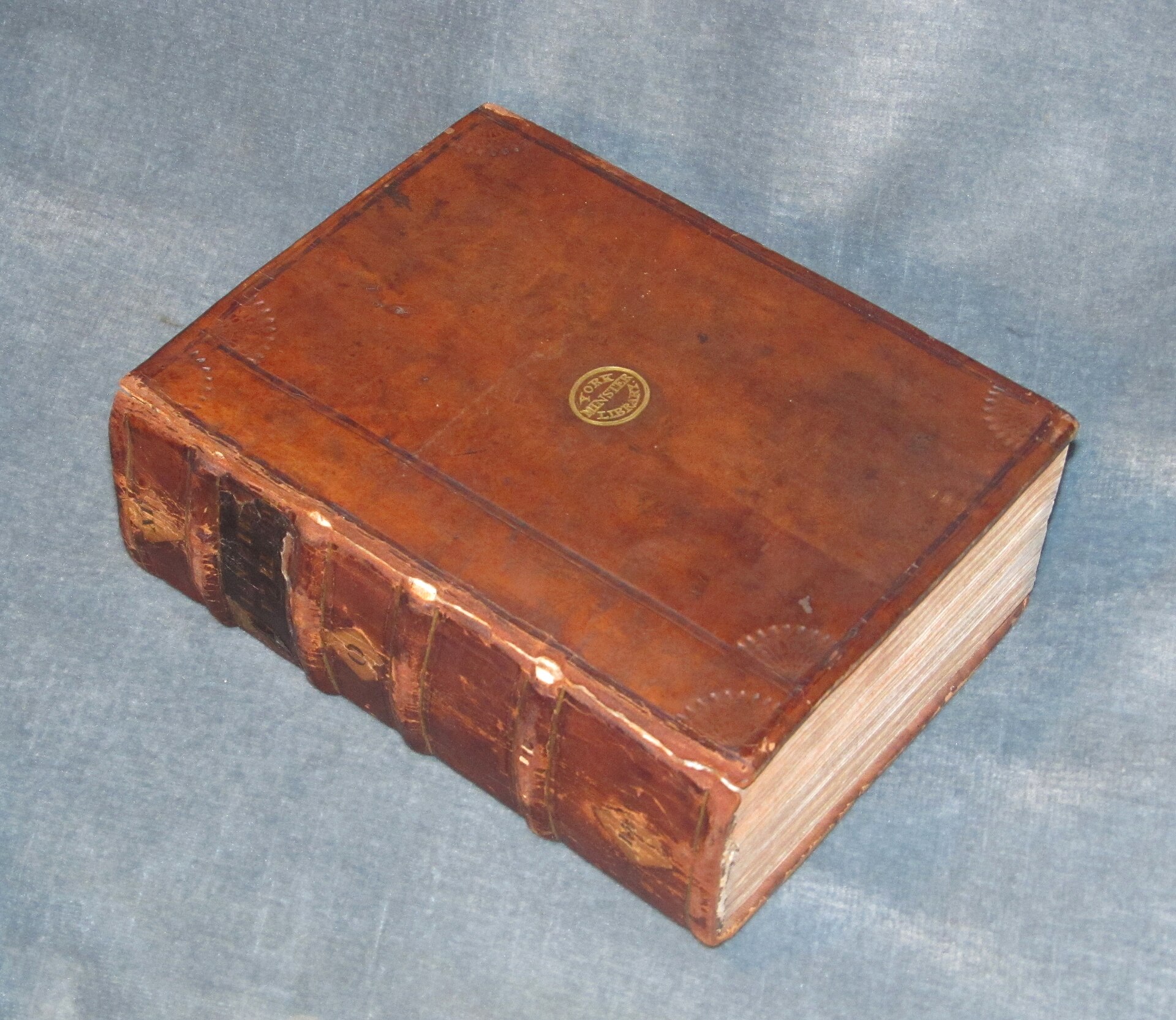
The Rosenbach Museum & Library's copy of the 1663 Eliot Indian Bible, the first complete Bible printed in the Western Hemisphere. Photo credit: Rosenbach Museum & Library.
Rosenbach Museum & Library, via Wikimedia Commons, CC BY 2.0 · Photograph by Rosenbach Museum & Library| Artist | John Eliot, translator, with Job Nesuton, James Printer (Wowaus), John Sassamon and Cockenoe |
|---|---|
| Date | 1663 |
| Medium | Letterpress printing on paper, in the Massachusett (Wopanaak/Natick) language rendered in Eliot's Roman-alphabet orthography, with an English title page and prefatory matter |
| Dimensions | Not independently measured for this copy in the course of this research. Comparable 1663 first-edition copies are recorded at approximately 19 x 14 cm (7.5 x 5.6 in) in a single bound volume of Old and New Testaments; whether this figure matches the Rosenbach copy exactly has not been confirmed against a public catalogue record. |
| Where it is now | The Rosenbach Museum & Library, Philadelphialast confirmed |
| Inventory number | Shelfmark A 663m (as given in the assignment for this record) |
| Attribution | DisputedThe title page and every subsequent catalogue credit the translation to John Eliot alone. Full note |
| Object type | Printed book |
| Period | Colonial North America, seventeenth century |
| Cases | Disputed attribution · Has a provenance gap |
| Inscriptions | None recorded in the sources consulted for this specific copy. Other surviving copies carry contemporary ownership inscriptions and family-record annotations (see Related works); no such annotation for the Rosenbach copy was located in this research pass. |
| Owners on record | 3 links2 documented, 1 unknown |
| Sources | 26 cited |
About this record Last verified · 26 sources cited · Change log
On this page 9 sections
ContentsClose
In 1663 a press at Cambridge, Massachusetts Bay Colony, finished printing the first complete Bible ever produced in the Western Hemisphere in any language: not in English, but in Massachusett, the Algonquian language of the region's Native inhabitants. The title page names one man, the missionary John Eliot. The work of putting the English Bible into Massachusett was in fact done by a team that included Cockenoe, Job Nesuton and John Sassamon as translators and James Printer, a Nipmuc apprentice, who set the type and is credited by modern scholars as the most accomplished Massachusett linguist among them. None of the four appears on the title page.
The book was inseparable from the 'praying towns,' the network of segregated Christian Indian settlements Eliot organized from 1646, whose residents faced escalating pressure to abandon Native dress, hairstyles and customary law along with their old religion. Within twelve years of the Bible's completion, King Philip's War (1675-76) had killed Sassamon, killed Nesuton, driven James Printer to the opposing side and back, interned praying-town residents on Deer Island, and broken the missionary project the Bible was built to serve. The language itself fell silent by the nineteenth century.
This copy, shelfmark A 663m at the Rosenbach Museum & Library in Philadelphia, has been part of that institution's Americana collection since its founding in 1954 out of the bequest of the brothers Abraham Simon Wolf Rosenbach and Philip H. Rosenbach. How or when it entered their personal collection before that date has not been established from public sources. Two and a half centuries after the language went silent, the Wopanaak Language Reclamation Project, founded by the Mashpee Wampanoag linguist Jessie Little Doe Baird, used Eliot's printed Massachusett texts, this Bible chief among them, as primary source material for reconstructing the language her own community had lost.
Provenance
Each link is graded. Documented: a cited source supports it. Disputed: the identification is argued but not established. Unknown: no owner for that span, and the gap is not smoothed into a narrative. The grades in the glossary.
- 1663 -Printed as one of approximately 1,000 to 1,050 copies of the complete Bibledocumented
Printed at Cambridge, Massachusetts Bay Colony, by Samuel Green and Marmaduke Johnson, financed by the Society for the Propagation of the Gospel in New England. Twenty copies are reported sent to English benefactors of the Society; the remainder distributed within the colony, chiefly to praying-town congregations and colonial and ecclesiastical figures. Which distribution channel this specific copy passed through is not established.16
- 1663 - by 1954Unknown intervening owners, then Abraham Simon Wolf Rosenbach and Philip H. Rosenbach, Philadelphiaunknown
No owner, dealer, or acquisition date is documented in the sources consulted for the roughly 290 years between printing and the copy's presence in the Rosenbach brothers' personal collection. A.S.W. Rosenbach was among the most active American dealers in early Americana in the first half of the twentieth century, so an acquisition through the ordinary channels of that trade during his working life is plausible, but this record makes no claim of a documented chain where none exists.71920
- 1954 - presentThe Rosenbach Museum & Library (now the Rosenbach), Philadelphiadocumented
Abraham Rosenbach died in 1952 and Philip Rosenbach in 1953, both childless, having established a foundation to receive their combined personal collection, business assets, and their Delancey Place townhouses. The museum opened from this testamentary gift in 1954 and has held the Bible as part of its Americana collection continuously since.72021
Technical evidence
| Attribution note | The title page and every subsequent catalogue credit the translation to John Eliot alone. The Massachusett-language text itself was produced by a working team: Cockenoe, Job Nesuton and John Sassamon did sustained translation work before 1663, and James Printer (Wowaus) set the type and is described by modern scholars as Eliot's most accomplished interpreter in the language. None of the four is named on the title page. This record treats the attribution to Eliot as accepted for the purposes of cataloguing an object whose imprint says so, and treats the erasure of his Native collaborators as a documented fact in its own right, argued at length by named scholars cited below. |
|---|---|
| Language and orthography | Massachusett (Wopanaak/Natick dialect), an Algonquian language, rendered in a Roman-alphabet orthography devised by John Eliot working with Native-speaking collaborators; the language had no prior written form.116 |
| Printers | Samuel Green and Marmaduke Johnson, at the Cambridge Press, Cambridge, Massachusetts Bay Colony. James Printer (Wowaus), a Nipmuc apprentice trained at the Harvard Indian College press, set type for the edition.136 |
| Contents | Complete Old and New Testament in Massachusett, following the separately printed 1661 New Testament; the 1663 issue bound both testaments as a single complete Bible, the first printed in the Western Hemisphere in any language.1 |
| Print run | Reported variously as 1,000 or 1,050 copies; sources consulted for this record do not agree on a single figure. Twenty copies are reported to have been sent to benefactors of the missionary society in England.124 |
| Financing | The Society for the Propagation of the Gospel in New England (the New England Company), a London missionary corporation funded by donations from England and Wales, paid for the presses, type, paper and printers' wages; Robert Boyle served as the Society's governor.16 |
| This copy's shelfmark | Rosenbach Museum & Library, Philadelphia, shelfmark A 663m, as supplied for this record. Not independently confirmed against a public catalogue entry in Phil (object database) or Rosy (library catalogue) during this research; the institution's own published Americana page confirms it holds a copy of the edition without citing the shelfmark.78 |
| Comparative dimensions (edition, not this copy) | A comparable 1663 first-edition copy sold at Sotheby's in 2013 is catalogued at 7.5 x 5.625 inches (19 x 14.3 cm), bound in contemporary English dark-blue morocco with gilt ornament. Whether the Rosenbach's copy matches these figures or this binding has not been confirmed.10 |
| Second edition, for comparison | A revised second edition followed in 1685, printed by Samuel Green in a run reported at roughly 2,000 copies, produced at markedly lower cost than the first; Eliot revised the text with the assistance of John Cotton Jr. This record concerns the 1663 first edition only.12223 |
| New type required | Massachusett orthography required unusually heavy use of the letters k and q relative to English, and at least one wholly new character devised by Eliot for a Natick sound without an English equivalent; the press's type supply had to be extended to accommodate the language before it could be set at all.25 |
| Digitized comparanda (not this copy) | A digitized scan of a 1685 second-edition copy held by the John Carter Brown Library (its 'copy 2', bound in contemporary full sheep, front board semi-detached) is freely available via the Internet Archive. This is a different institution's copy of a different edition, not the Rosenbach's 1663 volume.26 |
| Modern language-reclamation sourcing | The Wopanaak Language Reclamation Project's own published account names this 1663 Bible, roughly fifteen further Wopanaak-language books printed before 1692, and surviving handwritten deeds, wills and petitions as its combined source base, cross-checked against the King James Bible and related Algonquian languages. Founder Jessie Little Doe Baird was named a MacArthur Fellow in 2010 for this work.12131415 |
Images
The record in full
Chapter 1What the book is
Mamusse Wunneetupanatamwe Up-Biblum God is the complete Old and New Testament translated into Massachusett, the Algonquian language spoken by the Native peoples of coastal and southeastern New...
Mamusse Wunneetupanatamwe Up-Biblum God is the complete Old and New Testament translated into Massachusett, the Algonquian language spoken by the Native peoples of coastal and southeastern New England, printed at Cambridge in the Massachusetts Bay Colony by Samuel Green and Marmaduke Johnson and finished in 1663. It followed a 1661 printing of the New Testament alone, and the 1663 volume bound the two testaments together as a single complete Bible, the first ever produced in the Western Hemisphere in any language, English included. No complete English-language Bible had yet been printed anywhere in British North America; that would not happen for more than a century.
The title page is in English and Massachusett together, naming John Eliot as the man responsible for 'translating the Old Testament and the New' into the Indian language, financed and published under the authority of the colony's General Court and the London-based missionary society that paid for it. It does not name any of the Native men whose work made the translation possible, a point this record returns to because it is documented, not because it is a modern grievance read backward onto the seventeenth century.
Chapter 2The praying towns
The Bible did not exist in isolation from a wider missionary programme.
The Bible did not exist in isolation from a wider missionary programme. From 1646, Eliot organized Native converts into 'praying towns,' segregated settlements modeled on English town government where residents were expected to adopt Puritan worship together with English dress, hairstyles, agricultural labor by men, and a code of civil conduct enforced by fines. Natick, established in 1651, was the first and became the base for Eliot's translation work; at the height of the programme, roughly a dozen and a half such towns existed across eastern Massachusetts, with an estimated population, cited by different historians at different points, running into the low thousands of Native residents.
Self-government within a praying town was real: residents elected their own officers and used their own language for local administration. It coexisted with a civil and religious code that fined offenses against English cultural norms and pressed converts toward wholesale abandonment of customary practice as a condition of full membership in the praying community. The historian Kenneth M. Morrison examined Eliot's methods on exactly this point in a 1974 article in the journal Ethnohistory, arguing that assimilation to English cultural forms was built into the project of conversion from the start, not an incidental byproduct of it.
Chapter 3The men who actually wrote it
Eliot could not have produced a working Massachusett translation alone; no adequate grammar or dictionary of the language existed before his own, and he was learning it as an adult from Native...
Eliot could not have produced a working Massachusett translation alone; no adequate grammar or dictionary of the language existed before his own, and he was learning it as an adult from Native speakers. Cockenoe, a Montauk man who had been captured during the Pequot War and later worked as an interpreter, is credited as Eliot's first serious language teacher and translation collaborator, work that began years before the Bible project. Job Nesuton, a Massachusett man who had become active in the mission at Nonantum in 1646, went on to teach at Natick from 1651 and became, alongside Cockenoe and James Printer, one of the primary hands doing the sustained work of turning Eliot's drafts into workable Massachusett.
John Sassamon, also Massachusett, taught Eliot the language in exchange for instruction in English and Christianity, served as a schoolmaster at Natick, and in 1653 became one of the first Native students at Harvard College, studying there roughly two years before the college's Indian College was formally established. James Printer, born Wawaus at Hassanamesit to a Nipmuc family already converted under Eliot, trained at Harvard's Indian College press as an apprentice typesetter under Samuel Green and became, in the assessment of scholars working from the surviving evidence, the most linguistically accomplished of Eliot's Native collaborators, doing more of the actual translation work into Massachusett than any other single assistant. A recent academic account of the Bible project describes it plainly as the product of 'a team of Indigenous linguists, translators, and fact checkers, with varying levels of coercion' working under Eliot's name.
Chapter 4The press, the paper, and who paid for it
Cambridge already had a press by the time the Bible project began: Stephen Daye had brought the first printing press in British North America to Cambridge in 1638, later run by Samuel Green.
Cambridge already had a press by the time the Bible project began: Stephen Daye had brought the first printing press in British North America to Cambridge in 1638, later run by Samuel Green. The Massachusett Bible was too large a job for that equipment and Green's existing type alone. In 1656 the Society for the Propagation of the Gospel in New England, the London missionary body usually called the New England Company, sent Green a second press. In June 1660 the Company sent a professional printer, Marmaduke Johnson, who arrived at Boston aboard the Prudent Mary with a further press, a hundred reams of paper, and eighty pounds of new type, under a three-year contract to work alongside Green specifically to get the Massachusett Bible printed. Eliot had asked the Society directly for 'some honest young man, who hath skill to compose,' because projected sales of a Bible in a language with no cash market of readers could never cover the cost of producing it: this was a subsidized missionary project from the start, not a commercial publication.
The Society itself was funded by donations raised in England and Wales under a charter obtained from Parliament, with the natural philosopher and Christian benefactor Robert Boyle serving as its governor. It bore essentially the entire cost of paper, type, and printers' wages for a book whose intended readership was a colonized population the same institutions were simultaneously displacing from its land. The financing and the missionary purpose were not separate strands of the story; they were the same strand.
Green and Johnson's partnership, which produced the Bible along with more than forty other works in Massachusett and English, broke down by 1662 amid a personal and professional falling-out; Johnson went on to set up a rival Cambridge press and later moved to Boston in 1674 after a decade of legal disputes with the colony's licensing authorities.
Chapter 5Casting new type for a language that had never been printed
English printing type, as it existed at Cambridge in the 1650s, could not set Massachusett as written.
English printing type, as it existed at Cambridge in the 1650s, could not set Massachusett as written. Eliot's orthography leaned heavily on consonant clusters and sounds that English spelling did not need to represent, and reports of the project describe the press requiring extra supplies of the letters k and q, used far more densely in Massachusett than in English text, along with at least one wholly new character that Eliot devised to represent a Natick sound with no equivalent letter in the English alphabet. Casting new sorts and ordering additional type was itself part of what the Society for the Propagation of the Gospel in New England was paying for when it shipped Marmaduke Johnson to Cambridge with fresh type in 1660; the physical apparatus of English printing had to be modified before an Algonquian-language Bible could be set at all.
This is easy to read past as a footnote of printing-house logistics. It is better read as a measure of what the project actually required: not translating a familiar alphabet's worth of English words into new spellings, but extending the technology of the press itself to accommodate a language English printers had never had to typeset.
Chapter 6A contested achievement, read two ways
The Bible is genuinely both things historians now say it is, and neither claim cancels the other.
The Bible is genuinely both things historians now say it is, and neither claim cancels the other. It is a landmark of linguistic scholarship: Eliot and his Native collaborators devised a working Roman-alphabet orthography for a language that had never been written, built the grammar and vocabulary needed to render an entire Bible, and in doing so created the largest surviving body of any indigenous North American language committed to print before the twentieth century. Ives Goddard and Kathleen Bragdon, in their 1988 study Native Writings in Massachusett, documented in detail how literate Massachusett speakers went on to use that same orthography for their own purposes: deeds, wills, petitions and church records written by and for Native communities themselves, independent of missionary supervision, for generations after Eliot's death.
It was, at the same time, the printed instrument of a project whose explicit goal was the wholesale replacement of Native religion, dress, hairstyle, land use and customary law with English Puritan forms, delivered through towns where non-compliance carried civil penalties. Morrison's assessment of Eliot's coercive methods and Goddard and Bragdon's evidence of durable, self-directed Native literacy are not in conflict with each other; they describe two real and simultaneous outcomes of the same missionary press. This record states both because both are documented, and declines to resolve them into a single verdict that the evidence does not support.
Chapter 7King Philip's War caught up with the people who made the book
The war that broke out in June 1675 began, in its immediate trigger, with one of the Bible's own translators.
The war that broke out in June 1675 began, in its immediate trigger, with one of the Bible's own translators. John Sassamon, who had warned Plymouth Colony's governor of Wampanoag leader Metacom's planned uprising, was found dead in Assawompset Pond in January 1675 with a broken neck. Three Wampanoag men were tried and executed for his murder that June, in a mixed jury proceeding, and the Wampanoag response to what they saw as an unjust and jurisdictionally improper trial helped ignite the fighting within weeks.
Job Nesuton died in 1675 while serving as a translator for English colonial forces during the war. James Printer was falsely accused of taking part in a raid on Lancaster, narrowly escaped a colonial mob, and after warnings that praying-town residents would be forcibly relocated to an island and left to starve, joined Metacom's forces; scholars attribute to him an unsigned English-language letter left on a bridge post at Medfield warning colonists that the loss of their property made them vulnerable, evidence, in the letter's own literate English, that only someone with exactly Printer's Christian education could have written it. He was later involved in negotiating the ransom and release of the captive Mary Rowlandson, whose own published captivity narrative names him, before being granted amnesty and eventually returning to Cambridge and then to Hassanamesit, where he became a tribal leader advocating for Nipmuc land rights.
The war's effect on the praying towns was structural, not incidental. By 1677 the Massachusetts General Court had disbanded ten of the original praying towns. During the war itself, colonial authorities forcibly interned Christian Native residents, praying-town people who had done nothing to join the uprising, on Deer Island in Boston Harbor, where many died over the winter from exposure and starvation; some survivors were sold into slavery after their release in 1678. The very communities whose Christian conversion the Bible existed to consolidate were, within little more than a decade of its printing, treated by the colony they had converted for as an undifferentiated wartime threat.
Chapter 8What the war did to the language
The demographic and cultural cost to Massachusett and Wampanoag communities is documented, though the precise scale is measured differently by different historians and this record does not adopt a...
The demographic and cultural cost to Massachusett and Wampanoag communities is documented, though the precise scale is measured differently by different historians and this record does not adopt a single figure as settled. Population loss across the region's Algonquian communities during and immediately after the war is described by multiple accounts as catastrophic, driven by combat deaths, executions, forced displacement, and the Deer Island internment; Jill Lepore's The Name of War (1994) traces how the war's rhetoric and its aftermath hardened a colonial identity built in opposition to the very Native Christian communities Eliot's project had tried to absorb. Whatever the precise numbers, the praying-town system that had organized daily Massachusett-language life around the Bible and its associated primers did not recover its pre-war scale, and the language's decline from a living community language to eventual silence, completed by the nineteenth century, followed the war rather than preceding it.
Chapter 9The 1685 second edition
A revised second edition of the complete Bible was printed at Cambridge by Samuel Green in 1685, in a larger run reported at roughly 2,000 copies, produced at markedly lower cost than the first.
A revised second edition of the complete Bible was printed at Cambridge by Samuel Green in 1685, in a larger run reported at roughly 2,000 copies, produced at markedly lower cost than the first. Eliot undertook the revision with the assistance of John Cotton Jr., a missionary who had worked among the Wampanoag on Martha's Vineyard and had his own independent command of the language; presentation copies sent to Europe carried an added dedication leaf to Robert Boyle. The 1685 text incorporates Eliot's own accumulated linguistic corrections after two further decades of working in Massachusett, rather than a wholesale retranslation, and scholars treat the two editions as textually distinct states of the same underlying translation. This record concerns the 1663 first edition specifically; images or claims describing the 1685 second edition, held for example in the Museum of the Bible's collection in Washington, DC, describe a different printing and are not to be read as describing this copy.
Chapter 10How many copies survive, and where
Reported print figures for the 1663 first edition are not fully consistent across sources, ranging from 1,000 to 1,050 copies; twenty of these are reported to have been sent to English benefactors of...
Reported print figures for the 1663 first edition are not fully consistent across sources, ranging from 1,000 to 1,050 copies; twenty of these are reported to have been sent to English benefactors of the missionary project rather than distributed within the colony. A dedicated scholarly census, hosted at eliotcensus.org and directed by Gabriel Swift, Librarian for Early American Collections at Princeton University Library, is attempting a full modern count of all surviving copies of the 1661 New Testament, the 1663 Bible, and the 1685 second edition together, building on an 1880s census by Wilberforce Eames published in James Pilling's Bibliography of the Algonquian Languages. As of the project's own public description, it had documented data on nearly 150 copies across all three printings combined, with only about a third physically examined, and had not yet published a final per-edition count. Figures such as 'thirty-nine surviving copies' circulate in secondary and popular sources but could not be traced to a primary count in the course of this research and should be treated as approximate pending the census project's completed results.
Individual first-edition copies are documented at, among other institutions, the Library of Congress (a copy carrying Gaither family inscriptions from Anne Arundel County, Maryland), and in a copy that descended from William Cavendish, 3rd Earl of Devonshire, at Chatsworth, sold at Christie's on 30 June 1958 to the Philadelphia dealer Charles Sessler Inc., acquired by the private collector Florence Foerderer Tonner, and offered again at Sotheby's New York on 5 December 2013 as lot 173 with an estimate of 400,000 to 600,000 US dollars; the hammer price from that sale was not available in the sources consulted for this record. A further 1663 copy from the collection of Dr. Charles Caldwell Ryrie was offered at Sotheby's New York on 5 December 2016 with an estimate of 175,000 to 250,000 US dollars, again without a confirmed result in the sources consulted. Both figures establish an order of market value for the edition; neither describes a transaction involving the Rosenbach's copy, which the sources consulted show no record of ever being sold at public auction.
Circulation of the text today is not limited to the surviving physical copies. A digitized scan of the 1685 second edition, drawn from the John Carter Brown Library's own copy (recorded there as its 'copy 2,' bound in contemporary full sheep with a semi-detached front board), is freely available through the Internet Archive, alongside other institutional digitization projects for the 1663 first edition. This is a genuinely useful research resource and a genuinely separate object from the Rosenbach's copy; a reader consulting a digitized Eliot Bible online should check which edition and which institution's copy they are actually looking at before citing it as this one.
Chapter 11From the Rosenbach brothers to a public institution
Abraham Simon Wolf Rosenbach, generally known as A.S.W.
Abraham Simon Wolf Rosenbach, generally known as A.S.W. Rosenbach, was among the most consequential American rare-book dealers and collectors of the twentieth century, a man who over his career purchased eight Gutenberg Bibles and more than thirty Shakespeare first folios and did more than any other individual to make American literature and Americana a serious field of collecting rather than a curiosity beside European material. He and his brother Philip H. Rosenbach ran their rare-book and antiques business together from Philadelphia. Both men died childless within a year of each other, Abraham in 1952 and Philip in 1953, having already established a foundation to receive their combined personal collection, their Delancey Place house, and their firm's remaining assets. The Rosenbach Museum & Library opened from that testamentary bequest in 1954.
The institution's own published description of its Americana holdings states plainly that it holds the first complete Bible printed in the Western Hemisphere, in the Natick language of Massachusetts, alongside other founding-collection landmarks such as one of the eleven known copies of the 1640 Bay Psalm Book. What that description does not supply, and what neither of the Rosenbach's two public search databases returned in this research, is a documented acquisition history for this specific volume: when either brother bought it, from whom, or at what price. Given the scale and character of the Rosenbach firm's dealing in American historical printing through the first half of the twentieth century, the copy's presence in the founding 1954 bequest is itself well documented; everything earlier than that is, on the sources available for this record, an open gap rather than an established chain.
The Rosenbach's current permanent exhibition, Treasures: History and Literature of the Americas, draws named highlights from across the institution's American collecting areas and explicitly features the 1640 Bay Psalm Book, one of the founding collection's other Americana landmarks. The exhibition description consulted for this research does not name the Eliot Bible among its listed highlights, so whether this specific volume is currently on public display, in reserve storage, or shown only by appointment could not be confirmed from public sources and is recorded here as unresolved rather than assumed either way.
Chapter 12The language returns, and this Bible's place in that
Wopanaak (Wampanoag) had no living native speakers by the time Jessie Little Doe Baird, a citizen of the Mashpee Wampanoag Tribe, founded the Wopanaak Language Reclamation Project (WLRP) in 1993, an...
Wopanaak (Wampanoag) had no living native speakers by the time Jessie Little Doe Baird, a citizen of the Mashpee Wampanoag Tribe, founded the Wopanaak Language Reclamation Project (WLRP) in 1993, an undertaking she has described as beginning from a series of recurring dreams in the language before she had consciously studied it. The WLRP's own published account of its methods identifies its source base precisely: Eliot's 1663 Bible together with roughly fifteen further printed books in Wopanaak produced by the Harvard Indian College press before 1692, and a body of surviving handwritten Wopanaak-language deeds, wills and petitions from Wampanoag territory, among them the original deed to the town of Eastham. Reconstruction proceeded by comparing the Massachusett Bible text against the King James Bible it translated, cross-checked with sound-change patterns from related surviving Algonquian languages to keep the revived pronunciation on a conservative linguistic footing.
Baird earned a master's degree in linguistics from MIT in 2000, developed while pursuing the project, and worked closely with the MIT linguist Kenneth Hale until his death in 2001, and subsequently with MIT's Norvin Richards, in compiling a Wopanaak-English dictionary that has grown to roughly ten thousand entries. Where the seventeenth-century texts left gaps, the project has had to build new vocabulary from the language's own internal logic rather than borrow English terms outright, a documented instance being the coining of a Wopanaak word for 'hell' grounded in an existing Wampanoag understanding of the soul's location in the head, rather than any term found ready-made in Eliot's own translation. In 2010 the MacArthur Foundation named Baird a MacArthur Fellow, its own citation describing her as 'reviving a long-silent language and restoring to her Native American community a vital sense of its cultural heritage.' Her daughter, by an account published in 2024, became the first native speaker of Wopanaak born into the language in seven generations.
This record draws a deliberate line at this point: the documented claim is that Eliot's printed Massachusett corpus, this Bible foremost among the texts named by the WLRP itself, supplied the linguistic evidence base for the modern reconstruction. There is no basis in the sources consulted for a stronger claim that this specific physical copy, shelfmark A 663m at the Rosenbach, was itself consulted by the reclamation project; modern linguistic reconstruction of this kind works from published texts, facsimiles and the wider surviving corpus of copies and manuscripts, not from a single named exemplar. The distinction matters and this record keeps it.
The artist
John Eliot
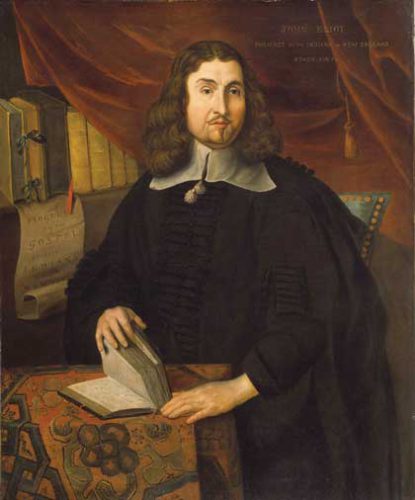
John Eliot is named on the title page as the Bible's translator, and the name that has attached to the book ever since, 'Eliot's Indian Bible,' is his alone. He learned Massachusett as an adult missionary, not a native speaker, and every serious account of how the translation was actually produced describes a working team of Native collaborators without whom the project could not have been completed. This dossier covers Eliot's own documented life and the documented lives of the Native men who did the work beside him, since the book cannot be honestly described with only one of those stories told.
Related works
| Work | Relation | Where it is |
|---|---|---|
| Mamusse Wunneetupanatamwe Up-Biblum God, 1663 (Devonshire-Sessler-Tonner copy) John Eliot and collaborators | Another surviving copy of the same first edition, one of the twenty sent to English benefactors in 1663 Descended from William Cavendish, 3rd Earl of Devonshire, at Chatsworth; sold Christie's 30 June 1958 to Charles Sessler Inc.; later owned by Florence Foerderer Tonner; offered again in 2013 at an estimate of USD 400,000-600,000, hammer price not confirmed in sources consulted. | Private ownership as of the 2013 sale; last recorded at Sotheby's New York, 5 December 2013, lot 173 |
| Mamusse Wunneetupanatamwe Up-Biblum God, 1663 (Gaither family copy) John Eliot and collaborators | Another surviving copy of the same first edition Carries Gaither family birth and death inscriptions from Anne Arundel County, Maryland. | Library of Congress, Washington, DC |
| Mamusse Wunneetupanatamwe Up-Biblum God, 1663 (Ryrie collection copy) John Eliot and collaborators | Another surviving copy of the same first edition Estimated USD 175,000-250,000; result not confirmed in sources consulted. | Offered at Sotheby's New York, 5 December 2016, from the collection of Dr. Charles Caldwell Ryrie |
| Mamusse Wunneetupanatamwe Up-Biblum God, second edition, 1685 John Eliot and collaborators, revised with John Cotton Jr. | Textually distinct second edition of the same translation project Provenance: John Tyrrell Bailey (1686), Edward Rawson (Secretary of the Massachusetts Bay Colony, by 1693), Grindal Rawson, Robert D.L. Gardiner's collection, Christie's sale 2005, donated to the Museum of the Bible in 2013. This is NOT the object described in this record; it is a different, later edition. | Museum of the Bible, Washington, DC (accession BIB.001469) |
| Mamusse Wunneetupanatamwe Wusku Testament, 1661 John Eliot and collaborators | The New Testament alone, printed two years before the complete Bible and later bound with the Old Testament to form the 1663 issue The direct textual and physical predecessor of this record's subject. | Various institutional holdings |
Open questions
- When and from whom did Abraham Simon Wolf Rosenbach or Philip H. Rosenbach acquire this specific copy? No acquisition record was located in the public sources consulted for this research; the copy's presence is documented only from the founding 1954 bequest onward.
- Is A 663m the Rosenbach's current, correct shelfmark for this volume? It could not be confirmed against a public catalogue record in either of the institution's two searchable databases during this research.
- What is the true surviving-copy count for the 1663 first edition, and the complete list of holding institutions? The most rigorous ongoing effort, the Eliot Bible census hosted at eliotcensus.org, had not published a final per-edition figure at the time of this research; a widely repeated figure of thirty-nine copies could not be traced to a primary source.
- Was this copy one of the twenty sent to English benefactors of the missionary society in 1663, or part of the wider domestic distribution within the colony? Not established from the sources consulted.
- What is the precise print run of the 1663 edition: 1,000 or 1,050 copies? Sources consulted for this record disagree.
- What is the full physical collation, binding, and condition of the Rosenbach's own copy? Not established from public sources; direct physical examination or a full institutional catalogue record would be needed.
- Beyond John Cotton Jr., did any other named individual, Native or English, assist with the specific textual revisions made for the 1685 second edition? Not established beyond Cotton's involvement in the sources consulted.
- Is this copy currently on public display at the Rosenbach, in storage, or shown by appointment only? The institution's current permanent exhibition description names the Bay Psalm Book among its Americana highlights but does not name this Bible, and its display status could not be confirmed from public sources.
Questions about this object
What is Mamusse Wunneetupanatamwe Up-Biblum God?
Mamusse Wunneetupanatamwe Up-Biblum God is a printed book, dated 1663. Medium: Letterpress printing on paper, in the Massachusett (Wopanaak/Natick) language rendered in Eliot's Roman-alphabet orthography, with an English title page and prefatory matter.
Who made Mamusse Wunneetupanatamwe Up-Biblum God, and is the attribution settled?
The attribution to John Eliot, translator, with Job Nesuton, James Printer (Wowaus), John Sassamon and Cockenoe is recorded here as disputed. The title page and every subsequent catalogue credit the translation to John Eliot alone. The Massachusett-language text itself was produced by a working team: Cockenoe, Job Nesuton and John Sassamon did sustained translation work before 1663, and James Printer (Wowaus) set the type and is described by modern scholars as Eliot's most accomplished interpreter in the language. None of the four is named on the title page. This record treats the attribution to Eliot as accepted for the purposes of cataloguing an object whose imprint says so, and treats the erasure of his Native collaborators as a documented fact in its own right, argued at length by named scholars cited below.
Where is Mamusse Wunneetupanatamwe Up-Biblum God now?
The Rosenbach Museum & Library, Philadelphia. Inventory number Shelfmark A 663m (as given in the assignment for this record). Last confirmed 3 September 2026. The Rosenbach's own published collection description confirms it holds a copy of the first complete Bible printed in the Western Hemisphere (1661-1663) as part of its Americana holdings. This research pass could not independently verify the shelfmark A 663m against a public catalogue entry in either of the Rosenbach's two searchable databases (Phil, for objects, and Rosy, for library holdings); neither returned a public record for this title during this research. The shelfmark is recorded here as supplied, flagged for verification against the institution's internal catalogue.
What is still unknown about Mamusse Wunneetupanatamwe Up-Biblum God?
When and from whom did Abraham Simon Wolf Rosenbach or Philip H. Rosenbach acquire this specific copy? No acquisition record was located in the public sources consulted for this research; the copy's presence is documented only from the founding 1954 bequest onward.
Sources
- 1Wikipedia, 'Eliot Indian Bible'. Wilberforce Eames or the modern Eliot Bible census). en.wikipedia.org/wiki/...
- 2Wikipedia, 'Job Nesuton'. en.wikipedia.org/wiki/...
- 3Wikipedia, 'James Printer'. Meserve, Cathy Rex, Siobhan Senier's Dawnland Voices, Neal Salisbury, and Jill Lepore. en.wikipedia.org/wiki/...
- 4Wikipedia, 'John Sassamon'. Drake's King Philip's War, and Eliot's own journal. en.wikipedia.org/wiki/...
- 5Wikipedia, 'Praying town'. Morrison (Ethnohistory, Winter 1974) and Ives Goddard and Kathleen J. Bragdon, Native Writings in Massachusett (1989). en.wikipedia.org/wiki/...
- 6American Antiquarian Society, 'Marmaduke Johnson', From English to Algonquian: Early New England Translations. collections.americanantiquarian.org/EnglishtoAlgonquian/...
- 7The Rosenbach Museum & Library, 'Americana' collection page. rosenbach.org/collections/...
- 8The Rosenbach Museum & Library, 'Catalogs, Databases, & Guides'. rosenbach.org/catalogs-databases-guides
- 9Museum of the Bible, 'The Indian Bible' (accession BIB.001469), collection description. collections.museumofthebible.org/artifacts/...
- 10Sotheby's, 'Bible in Massachuset', Books & Manuscripts sale N09057, lot 173, 5 December 2013. sothebys.com/en/...
- 11Fine Books & Collections, '6 Six-Figure Bibles Going to Auction'. finebooksmagazine.com/blog/...
- 12The Wopanaak Bible: A Census, 'About' page, directed by Gabriel Swift, Princeton University Library. eliotcensus.org/about
- 13Wopanaak Language Reclamation Project, 'Project History'. wlrp.org/project-history
- 14The Harvard Crimson, 'No Fear or Danger of Their Forgetting It: Revitalizing Wopanaak from John Eliot's Bible' (2024). thecrimson.com/article/...
- 15The MacArthur Foundation, 'Jessie Little Doe Baird', Class of 2010 Fellows. macfound.org/fellows/...
- 16King's College London Special Collections, 'Reclaiming a Language: Contextualizing John Eliot's Genesis'. blogs.kcl.ac.uk/kingscollections/...
- 17Wikimedia Commons, File:Rosenbach Eliot Indian Bible 1.jpg, API metadata (.LicenseShortName: CC BY 2.0). commons.wikimedia.org/wiki/...
- 18Wikimedia Commons, File:Portrait of John Eliot.jpg, API metadata (.LicenseShortName: Public domain). commons.wikimedia.org/wiki/...
- 19Wikipedia, 'A. S. W. Rosenbach'. en.wikipedia.org/wiki/...
- 20Hidden City Philadelphia, 'With Bloomsday Near, Remembering The Rosenbach Brothers'. hiddencityphila.org/2017/...
- 21Wikipedia, 'Rosenbach Museum and Library'. en.wikipedia.org/wiki/...
- 22Bridwell Library Special Collections Exhibitions, 'Second Edition of the Earliest Bible Printed in the Americas', Elizabeth Perkins Prothro Bible Collection. bridwell.omeka.net/exhibits/...
- 23GREATSITE.com, 'John Eliot', English Bible History timeline. greatsite.com/timeline-english-bible-history/...
- 24Atkins Bookshelf (blog), entries tagged how-many-copies-of-eliot-indian-bible-exist-today. atkinsbookshelf.wordpress.com/tag/...
- 25History of Information (Jeremy Norman), entry on Eliot's Indian Bible, on the type-casting required for Massachusett printing. historyofinformation.com/detail.php
- 26Internet Archive, digitized 1685 second-edition copy from the John Carter Brown Library ('copy 2'), used here only to establish that a different institution's copy of a different edition is freely circulating online, not as a source about the Rosenbach's own copy. archive.org/details/...


Last verified · Published
Change log
3 September 2026 - Record created at the house standard: researched narrative, technical evidence, maker dossier, graded provenance chain, prices with hammer and premium separated, related works, open questions and sources.