Dunlap Broadside [Declaration of Independence]
John Dunlap · Night of July 4-5, 1776
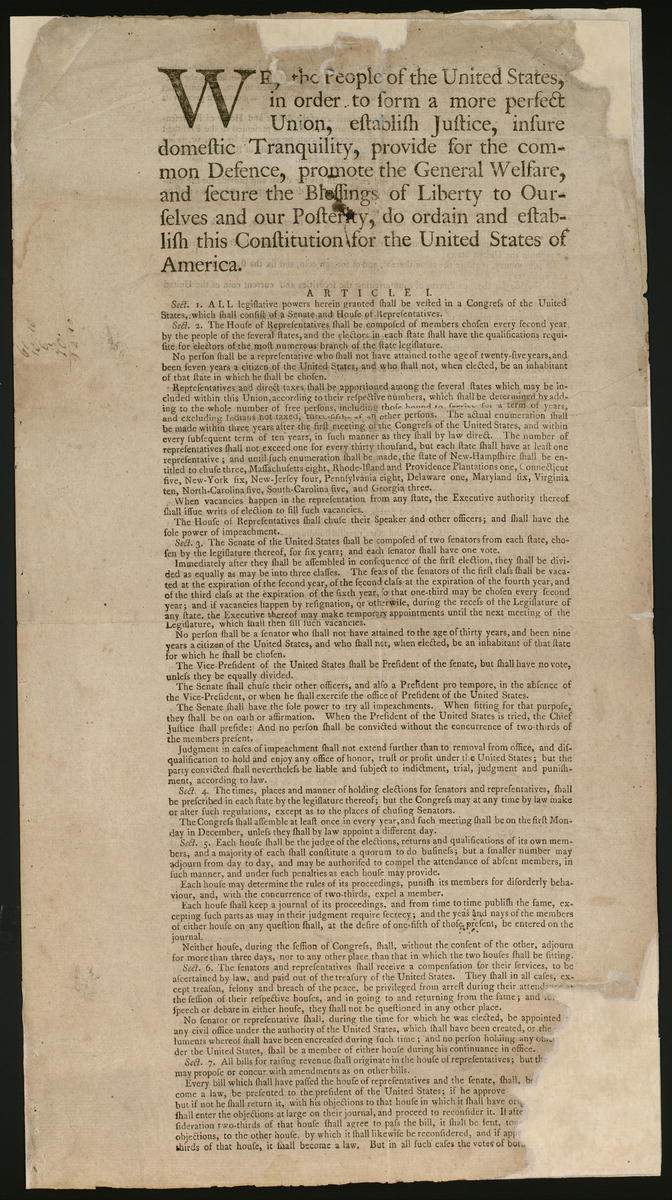
![Dunlap Broadside [Declaration of Independence] by John Dunlap](/assets/img/dunlap-broadside-declaration/dunlap-broadside-declaration-of-independence-nara-301682.jpg)
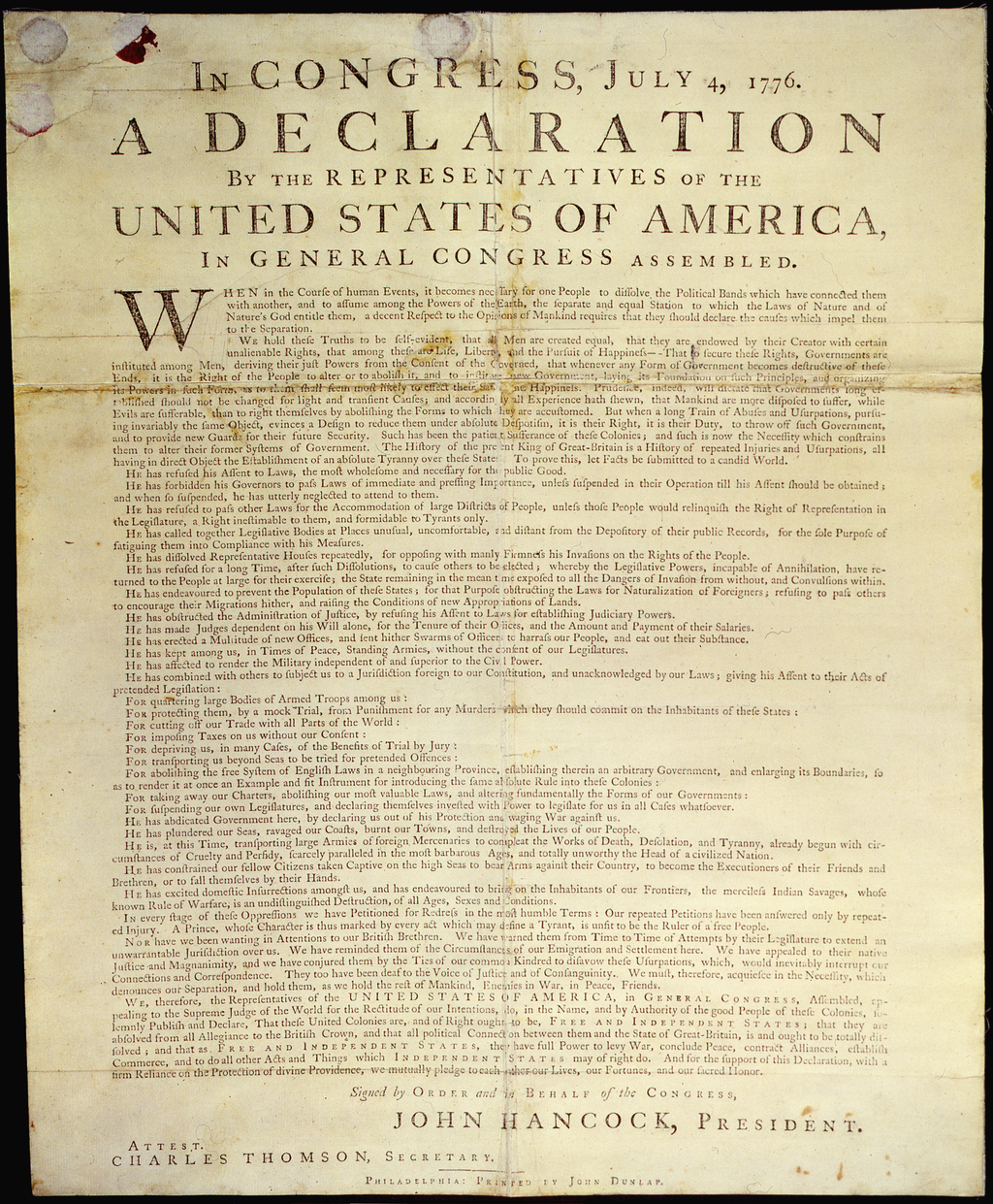
The record subject: the copy Secretary Charles Thomson pasted into Congress's own Rough Journal on July 5, 1776. Photographed by the National Archives and Records Administration (NAID 301682).
| Artist | John Dunlap |
|---|---|
| Date | Night of July 4-5, 1776 |
| Medium | Letterpress printing in black ink from movable type, on a single sheet of laid paper, printed on one side only |
| Dimensions | Not established to the precision of an exact measurement for this specific copy in the sources consulted; see technical notes |
| Where it is now | National Archives Building, Washington, DClast confirmed |
| Inventory number | Record Group 360, Papers of the Continental Congress, Rough Journal of the Continental Congress, vol. 3, p. 94; National Archives Identifier (NAID) 301682; local identifier NWDT1-360-ITEM1-ITEM1VOL3P94 |
| Attribution | AcceptedPrinted by John Dunlap, official printer engaged by the Continental Congress, in his Philadelphia shop on the night of July 4-5, 1776. Full note |
| Object type | |
| Period | American, Revolutionary War era, 1776 |
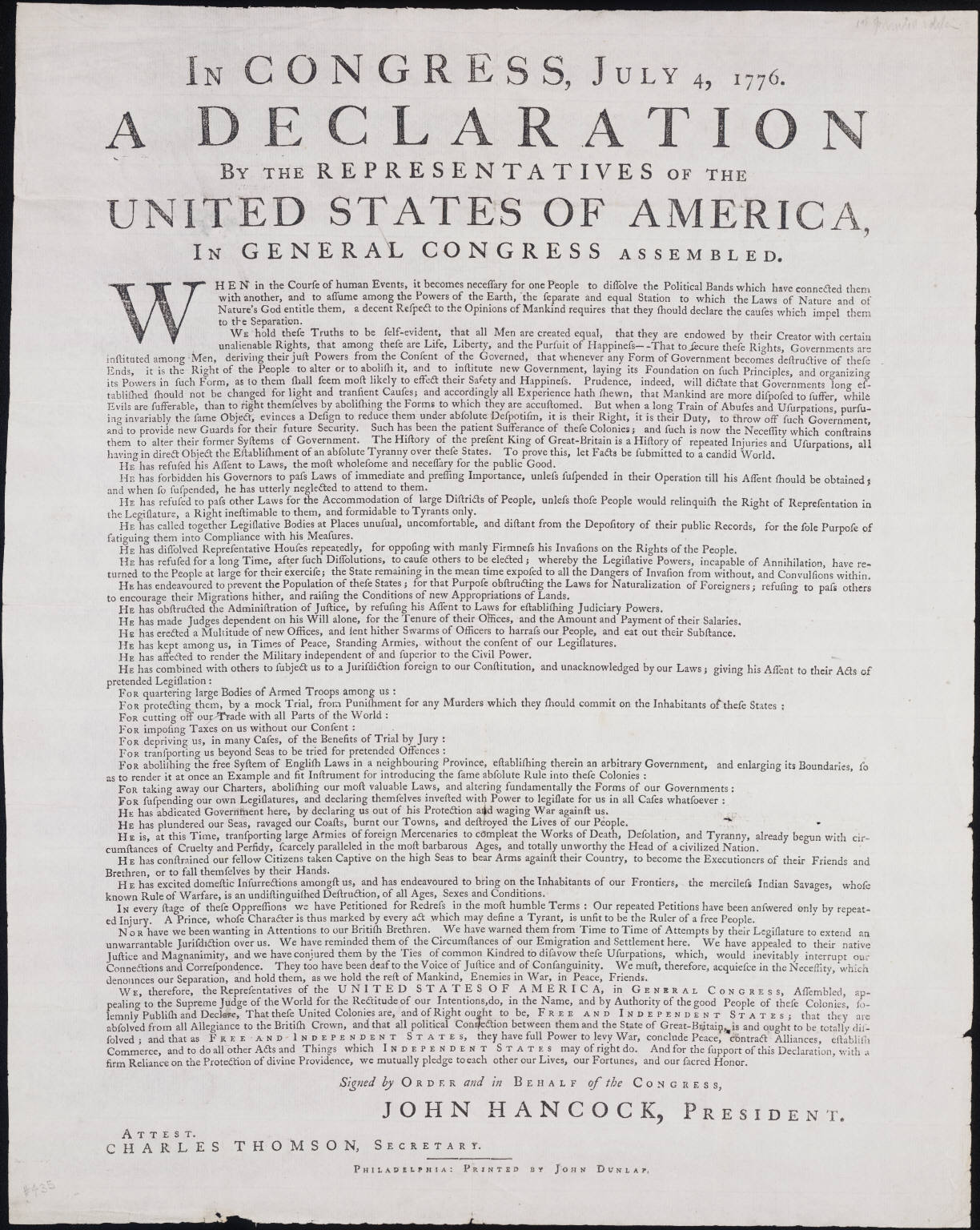
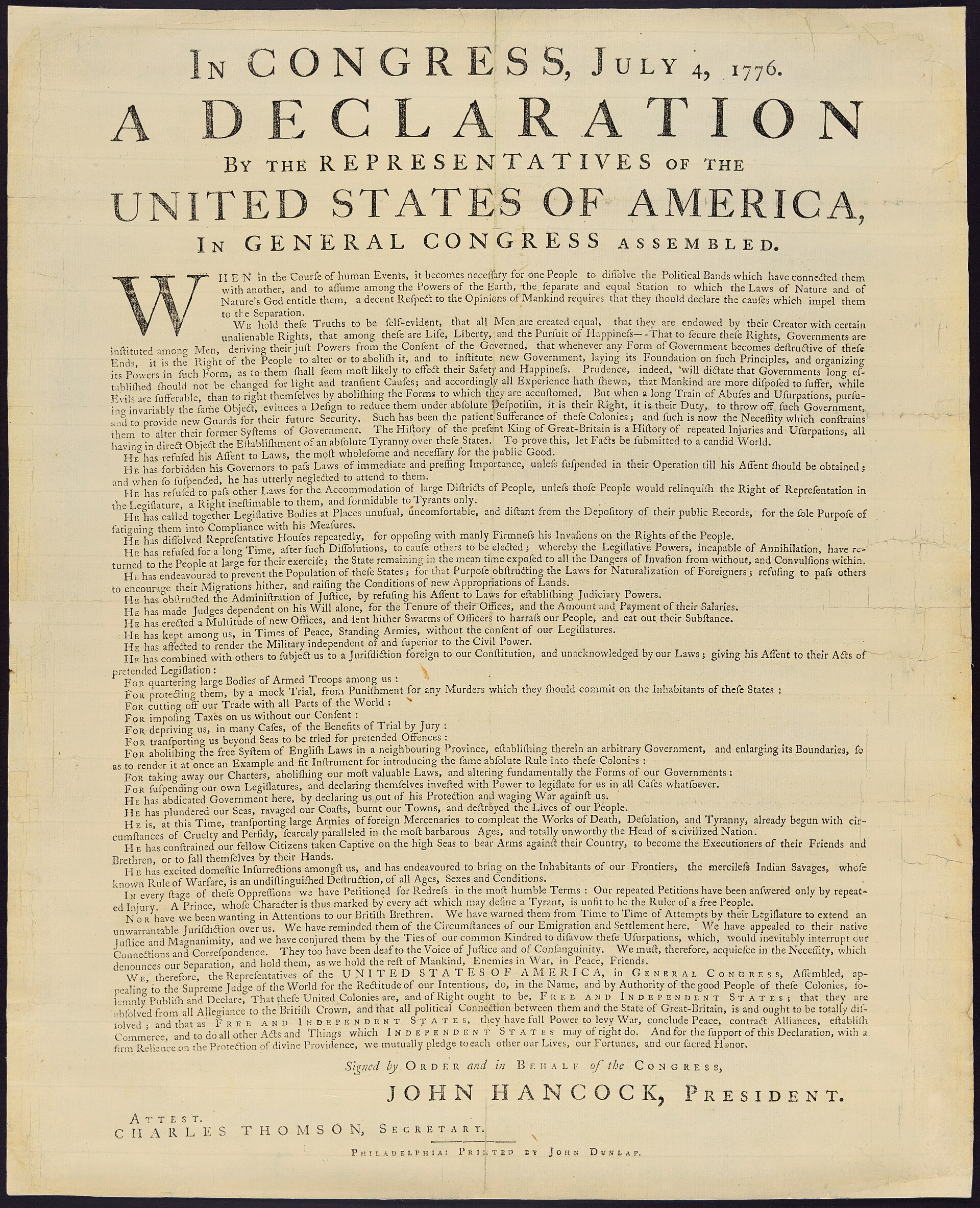
| Inscriptions | Printed text of the Declaration concluding: SIGNED BY ORDER AND IN BEHALF OF THE CONGRESS, JOHN HANCOCK, President. ATTEST. CHARLES THOMSON, Secretary. Only these two names appear in print; none of the roughly fifty signers of the later engrossed parchment are named. |
| Owners on record | 5 links5 documented |
| Sources | 20 cited |
About this record Last verified · 20 sources cited · Change log
On this page 10 sections
ContentsClose
This is not the famous signed parchment under glass in the National Archives Rotunda. It is the object that came before it: a single printed sheet, run off in John Dunlap's Philadelphia shop on the night of July 4-5, 1776, in an edition of perhaps one to two hundred copies, so that Congress's vote for independence could reach state governments and the army before the British did anything about it. This specific copy is the one Secretary Charles Thomson folded and sealed into Congress's own working journal on July 5, 1776, rather than sending out to a state or a general, which means it has never left United States government custody in two hundred and fifty years, surviving the burning of Washington in 1814 and two later conservation campaigns along the way.
The best-known Dunlap story belongs to a different copy entirely: the one found behind a four-dollar flea-market painting in 1989, sold in 1991 for 2.42 million dollars and again in 2000 for 8.14 million to a partnership that included Norman Lear, and toured to all fifty states. That copy remains in private hands and has no free, licensed photograph available, which is why this record documents its less famous but fully photographable sibling instead, with the flea-market copy's full history told in the narrative as context, not as the subject.
Roughly twenty-six copies of the Dunlap Broadside have been counted as survivors for most of the last decade; a still-unsettled reattribution in August 2026 at the UK National Archives may raise that to twenty-seven. About 170 or more of the original print run remain unaccounted for entirely.
Provenance
Each link is graded. Documented: a cited source supports it. Disputed: the identification is argued but not established. Unknown: no owner for that span, and the gap is not smoothed into a narrative. The grades in the glossary.
- 4-5 July 1776 - 5 July 1776John Dunlap (printer, acting for the Continental Congress)documented
Printed in Dunlap's Philadelphia shop the night Congress approved the Declaration's text, as one of an estimated 100 to 200 copies produced for immediate distribution.120
- 5 July 1776 - 1800The Continental Congress and its successor federal governmentdocumented
Secretary Charles Thomson folded this specific copy and adhered it with wafer seals into page 94 of volume 3 of the Rough Journal of the Continental Congress, at the entry for July 4, rather than sending it out to a state or army command. The bound volume moved with Congress through the disruptions of the Revolutionary War and the several temporary seats of government that followed, before the federal government settled in Washington, DC in 1800.346
- 1800 - 1903United States government, held in Washington, DCdocumented
The volume and its pasted-in broadside survived the British burning of Washington in 1814 and were subsequently moved among several State Department buildings over the course of the nineteenth century as the department's own premises changed.3
- 1903 - 1952Library of Congressdocumented
An act of Congress in 1903 transferred the Papers of the Continental Congress, including this volume, from the State Department to the Library of Congress.3
- 1952 - presentNational Archives and Records Administrationdocumented
Transferred to the newly established National Archives in 1952 as part of Record Group 360, where it remains. Exhibited publicly in American Originals (1995-1996) and, as of 2025-2027, as part of the America250 semiquincentennial display programme. Conserved 2016-2018.123
Technical evidence
| Attribution note | Printed by John Dunlap, official printer engaged by the Continental Congress, in his Philadelphia shop on the night of July 4-5, 1776. The attribution is not in dispute for the broadside genre as a whole: it rests on the printed imprint line naming Dunlap's press conventions, on the Congress's own contemporary record of ordering the printing, and on typographic matching to Dunlap's known type stock. Individual copies with non-standard imprint lines have required separate authentication; a copy long held by the National Archives of the United Kingdom carries a Baltimore imprint line and was confirmed only in August 2026, through comparative feature-matching analysis, to be a genuine product of the same Philadelphia press run rather than a later reprint. |
|---|---|
| Format | Single sheet of laid paper, letterpress-printed from movable type on one side only; the standard broadside format used for public proclamations in 1776.120 |
| Typeface | Roman and titling faces consistent with, but not a perfect match to, John Caslon's 1766 specimen book; the imperfect matches are consistent with imitation Caslon types, later-modified matrices, or substitute sorts used under the pressure of a single night's printing.20 |
| Layout | Full text of the Declaration set in a single column, with unusually long primary lines, liberal use of small capitals, wide inter-sentence spacing, and the long s character throughout, typical of American printing conventions in 1776.20 |
| Evidence of haste | Every known surviving copy of the broadside is printed slightly crooked on its sheet. Word spacing is noticeably expanded on at least one line where a compositor's error was caught and corrected during proofing that same night.20 |
| Imprint line | Text concludes: Signed by Order and in Behalf of the Congress, JOHN HANCOCK, President. Attest. CHARLES THOMSON, Secretary. No other names are printed.6 |
| Integration into the Rough Journal | This copy was folded and adhered with wafer seals to page 94 of volume 3 of the Rough Journal of the Continental Congress by Secretary Charles Thomson, on or shortly after July 5, 1776, at the entry recording the July 4 vote.346 |
| Condition before conservation | Tears and splits along the fold lines, small losses of paper, a discolored fabric lining applied to the reverse in an earlier, undated repair using a thick adhesive, moderate grime, and staining from the old adhesive bleeding through the sheet.3 |
| Conservation treatment, 2016-2018 | National Archives conservators removed surface grime, immersed the sheet in successive baths of purified water, applied enzymes matched to the specific old adhesive (identified by the National Archives Heritage Science Lab) to remove the fabric lining without damaging the paper, infilled losses with paper pulp, and relined the sheet with lightweight Japanese paper.3 |
| Repository and identifiers | National Archives Building, Washington, DC; Record Group 360, Papers of the Continental Congress; National Archives Identifier (NAID) 301682; local identifier NWDT1-360-ITEM1-ITEM1VOL3P94.12 |
| Estimated original print run | Commonly cited as approximately 100 to 200 copies printed the night of July 4-5, 1776. No surviving print order or receipt confirms an exact figure; the number is a working estimate, not a documented count.1 |
Images
The record in full
Chapter 1A broadside, not a manuscript
This is a single sheet of paper, printed on one side only, carrying the full text of the Declaration of Independence set in movable type.
This is a single sheet of paper, printed on one side only, carrying the full text of the Declaration of Independence set in movable type. It is not the famous parchment that hangs in the National Archives Rotunda under glass, and it was not signed by fifty-six delegates. It is the first thing the Declaration ever became after Congress voted for it on July 4, 1776: a fast, cheap, disposable-by-design piece of print, made to be nailed to a post, read aloud in a town square, and carried on horseback to an army camp.
The text closes with only two printed names: John Hancock as President of Congress and Charles Thomson as Secretary, attesting the vote. That is a deliberate and important difference from the engrossed parchment version, which was not even written out until weeks later and which carries the signatures people usually picture when they hear the word Declaration.
Chapter 2Printed through the night
Late on the afternoon of July 4, 1776, once Congress had approved the final text, a copy of the manuscript, possibly Thomas Jefferson's own fair copy of his draft, was carried to the print shop of...
Late on the afternoon of July 4, 1776, once Congress had approved the final text, a copy of the manuscript, possibly Thomas Jefferson's own fair copy of his draft, was carried to the print shop of John Dunlap at Second and Market Streets in Philadelphia. Dunlap was the printer whose press Congress was using; the formal title and printing contract for the Journals of Congress came to him only later, in 1777, but on this night it was his shop that did the work.
Congress wanted the news out immediately and it wanted it out everywhere at once. Dunlap's compositors set the text, roughly the length of the familiar parchment version, into single-column pages of Caslon-derived roman and titling type, working against a deadline of the following morning. The physical evidence of that haste survives in the paper itself: typographic study of the surviving copies has found that every known example is printed slightly crooked on its sheet, that word spacing is unusually wide in places where a compositor's error was caught and corrected during proofing, and that the type used shows small, inconsistent departures from Caslon's own 1766 specimen book, consistent with mixed or substitute sorts pressed into service under time pressure.
The estimated print run was in the range of one hundred to two hundred copies, run off that single night. No print order or receipt for an exact figure survives; every number cited for the original run, including the low two hundred usually quoted, is an estimate built backward from later evidence, not a document Dunlap or Congress left behind.
Chapter 3Congress's order and why speed mattered
Congress's instruction was that copies of the Declaration be sent to the several assemblies, conventions, and committees or councils of safety of the states, and to the commanding officers of the...
Congress's instruction was that copies of the Declaration be sent to the several assemblies, conventions, and committees or councils of safety of the states, and to the commanding officers of the Continental troops. This was not a ceremonial gesture. In July 1776 a British invasion fleet was already approaching New York, the Continental Army needed to know its legal footing had changed, and the fragile new state governments needed something they could read into their own records before the war made communication harder. A vote taken in a closed room in Philadelphia was not yet a fact on the ground anywhere else; the broadside was the mechanism that made it one.
Notably, the Continental Congress did not send a copy to King George III. The broadside's job was to inform Americans and their army that the break had happened, not to notify London through official channels.
Chapter 4How it moved in July 1776
On the morning of July 5, members of Congress began dispatching the freshly printed sheets.
On the morning of July 5, members of Congress began dispatching the freshly printed sheets. John Hancock, as President, forwarded copies under cover of his own letters to the state assemblies and conventions and to George Washington, commanding the Continental Army. Washington had his copy by July 9 and ordered it read aloud to the assembled troops in New York, a reading that reportedly helped touch off the toppling of the equestrian statue of George III on Bowling Green that same evening. In Philadelphia, Colonel John Nixon gave the first public reading in the State House yard on July 8, using one of the same printed sheets; that specific reading copy is a separate, distinctly documented example, now displayed at Independence National Historical Park, and should not be confused with this one.
The broadside also reached print before most Americans could have seen the parchment original, because there was no parchment original yet to see. Philadelphia printer Benjamin Towne reprinted the text in his newspaper, the Pennsylvania Evening Post, on July 6, making his paper the first newspaper to carry it, one day after Dunlap's broadside itself had already gone out as a standalone sheet. For most of the American public in the summer of 1776, a Dunlap broadside or a newspaper reprint of it, not any manuscript, was the Declaration of Independence.
Chapter 5This copy: Congress keeps one for itself
Among the sheets that came off Dunlap's press that night, one was set aside for Congress's own permanent record rather than sent out to a state or an army camp.
Among the sheets that came off Dunlap's press that night, one was set aside for Congress's own permanent record rather than sent out to a state or an army camp. On July 5, 1776, Charles Thomson, the Secretary of Congress, folded a printed copy and adhered it with wafer seals into page 94 of volume 3 of the Rough Journal of the Continental Congress, Congress's own working record of its proceedings, at the entry for July 4. That act is the reason this copy exists as an object at all in the form it now takes: not as a loose broadside that a state government filed away or lost, but as a page bound permanently into the federal government's own working archive, by the man whose signature appears printed on it.
This is, as far as the sources consulted for this record establish, the only surviving Dunlap Broadside that was pasted directly into Congress's own journal rather than distributed outward. It gives this specific copy an unusually strong and unusually simple claim to authenticity: its custody chain is not a chain of purchases and rediscoveries but a single unbroken line of official government possession, starting on the day it was printed.
Chapter 6Custody, 1776 to 1952
The Rough Journal, with the broadside sealed into it, moved with Congress through the disruptions of the Revolutionary War and through the several temporary seats of government that followed, before...
The Rough Journal, with the broadside sealed into it, moved with Congress through the disruptions of the Revolutionary War and through the several temporary seats of government that followed, before the federal government settled permanently in Washington, DC in 1800. It was still in Washington fourteen years later when the city itself came under direct attack: during the War of 1812, both the journal and the broadside pasted inside it barely escaped destruction when British forces burned the capital in 1814. For the rest of the nineteenth century the volume was moved among several State Department buildings in Washington as the department's own quarters changed.
An act of Congress in 1903 transferred the Papers of the Continental Congress, the Rough Journal among them, to the Library of Congress, where the volume remained for the next half century. In 1952 it was moved again, this time to the newly established National Archives, where it has remained since as part of Record Group 360.
Chapter 7Condition and conservation, 2016-2018
By the twenty-first century both the broadside and the journal volume around it showed the accumulated damage of nearly two and a half centuries of handling, repair, and earlier conservation attempts...
By the twenty-first century both the broadside and the journal volume around it showed the accumulated damage of nearly two and a half centuries of handling, repair, and earlier conservation attempts that had not aged well. The broadside itself had tears and splits along its fold lines, small losses of paper, a fabric lining applied to its reverse at some point in the early twentieth century using a thick adhesive that had since discolored to yellowish brown, moderate grime, and staining from that old adhesive bleeding through. The journal's pages around it were worn at the edges, torn, and repaired with a mix of old and modern materials, including pressure-sensitive tape; the iron gall ink used throughout the volume showed the corrosion common to that ink, cracking and eating into the paper beneath it; and residue from a nonaqueous deacidification treatment carried out in the 1970s was still visible as a gritty white film.
National Archives conservators treated both the broadside and the surrounding journal between 2016 and 2018. Work on the broadside itself included mechanical removal of ingrained grime, immersion in successive baths of highly purified water to reduce discoloration and loosen the old lining adhesive, and the application of enzymes, matched to the specific starch and protein adhesives identified by the National Archives' own Heritage Science Lab, to break that adhesive down without damaging the paper. Losses were infilled with paper pulp and the sheet was given a new lining of lightweight Japanese paper. The journal volume was surface-cleaned, had its old pressure-sensitive tape removed, was washed to reduce acidity and discoloration, and was disbound so that conservators could document its original sewing structure before individual folios were reinforced along their folds with Japanese paper, resized with a dilute gelatin solution to replace sizing lost in treatment, and rebound. The stated outcome was a much improved visual appearance and materially better chemical and physical stability going forward.
Chapter 8Why this copy, and not the flea market one
Any record of a Dunlap Broadside has to reckon with the single most famous story attached to this class of object, and it is worth telling in full, precisely because this record does not center on...
Any record of a Dunlap Broadside has to reckon with the single most famous story attached to this class of object, and it is worth telling in full, precisely because this record does not center on it.
In June 1989, an unidentified Philadelphia shopper bought an old, damaged painting at a flea market in Adamstown, Pennsylvania, paying four dollars because he liked the frame rather than the picture. At home, behind the painting, he found a folded printed sheet. A friend who collected Civil War material suggested he have it examined; Sotheby's authenticated it as a genuine Dunlap Broadside. On June 4, 1991, Sotheby's sold it for 2.42 million dollars against a pre-sale estimate of around one million, a record at the time for any piece of printed Americana. The buyer, Donald Scheer, president of the fine-art investment firm Visual Equities, called the price a bargain. A dispute over a later attempted resale led Scheer into litigation in the 1990s; he kept the document through it and held it until 2000, when Sotheby's sold it again, this time to a partnership of television producer Norman Lear and his wife Lyn with internet entrepreneur David Hayden, for a hammer price of 7.4 million dollars that came to 8.14 million dollars with the buyer's premium, then an internet-auction record. Lear immediately announced plans to send the document on what he called a theatrical event that will be unashamedly patriotic; the Declaration of Independence Road Trip toured the sheet to all fifty states starting July 4, 2001, including a stop at the Salt Lake City Winter Olympics and a public display at Seattle's Museum of History and Industry in August 2003. Lear sold the document again privately in 2011, immediately after the tour concluded; the identity of the current owner has not been made public in the sources consulted for this record, and no further sale has been reported since.
That copy is a remarkable and thoroughly documented object in its own right. It is not, however, the subject of this record, and the reason is a simple one that the house standard for this publication requires stating plainly: no free, rights-clear photograph of that specific privately owned sheet could be located. It has never, so far as the research for this record established, been digitized and released under an open license by a public institution, which is not surprising for an object that has spent almost its entire post-discovery life in private hands and on a commercial tour rather than in a museum's own collection. Rather than publish this record without an image of its actual subject, or attach an unrelated Dunlap image to the flea-market story and risk exactly the kind of version confusion this publication exists to prevent, this record instead documents a different, specific, and fully photographable copy: the one Congress kept for itself in 1776, now in the National Archives.
Chapter 9Counting the survivors
Roughly two hundred Dunlap Broadsides are estimated to have been printed on the night of July 4-5, 1776; the number that survives has been counted and recounted for half a century and the count keeps...
Roughly two hundred Dunlap Broadsides are estimated to have been printed on the night of July 4-5, 1776; the number that survives has been counted and recounted for half a century and the count keeps moving. In May 1975, ahead of the Declaration's bicentennial, the Library of Congress brought together seventeen of the then twenty-one known copies for physical examination by Frederick R. Goff, longtime chief of the Library's Rare Book Division. Working at a light table with a measuring grid, Goff recorded each copy's margins, trimming, chain lines, and watermarks, and in the process found that one copy, now at Yale's Beinecke Rare Book and Manuscript Library, is missing the word our from the phrase we have conjured them by the ties of our common kindred, an error apparently caught and corrected on the press partway through the run, since no other surviving copy shares it. That single missing word is a real piece of physical evidence about the order in which copies came off Dunlap's press that night, discovered by direct comparison of the paper itself rather than by any documentary record.
Standard references through 2025 generally cite twenty-six surviving copies: most in American institutional hands, a smaller number in British institutions, and, as of the flea-market copy's history above, as few as two or three in private ownership. That count changed again in August 2026, when the National Archives of the United Kingdom announced that a copy in its own holdings at Kew, carrying an unusual imprint line reading Baltimore rather than Philadelphia and previously treated as an outlier or possible later reprint, had been confirmed through comparative feature-matching analysis against high-resolution images of the accepted Philadelphia Dunlaps to be a genuine product of the same July 1776 press run. The finding was reported in connection with the UK National Archives' own Revolution 250 exhibition programme, running through November 2026, and would bring the documented total to twenty-seven, though how quickly that revised count becomes the settled reference figure was not established in the sources consulted for this record.
A second, separate identification made at the UK National Archives adds a different kind of evidence to the census rather than a new number. In 2022, the historian Emily Sneff, researching a book on how the Declaration was reported in 1776, connected a Dunlap Broadside long held among British prize papers to a July 1776 letter written by Jonas Phillips, a Jewish merchant on Philadelphia's Market Street, to his cousin and business partner Gumpel Samson in Amsterdam. Phillips had enclosed one of Dunlap's sheets with a covering note written partly in Yiddish, apparently hoping to obscure its contents from any British officer who intercepted it; a British warship seized the package anyway, and both letter and broadside were filed away in British government archives, eventually catalogued at the National Archives of the United Kingdom, where they sat unconnected to each other for close to two hundred and fifty years until Sneff's research tied them together. That copy went on public display in Philadelphia for the first time since 1776 in 2026, at the Museum of the American Revolution.
Chapter 10A cohort, not a single market
This copy has never been sold. It has never left United States government custody since Charles Thomson pasted it into the Rough Journal in 1776, and it carries no auction history of its own.
This copy has never been sold. It has never left United States government custody since Charles Thomson pasted it into the Rough Journal in 1776, and it carries no auction history of its own. But the objects it belongs to, the small surviving group of July 1776 first printings of the Declaration by any printer, do have a documented market, and it is worth setting out as context for what this specific copy is not for sale to prove.
Besides the two recorded sales of the flea-market Dunlap copy already described, a small number of other 1776 broadside printings of the Declaration by printers other than Dunlap, in other cities, have reached public auction in recent years: a July 11, 1776 printing by John Holt sold at Sotheby's for 3.36 million dollars; a copy of the first Massachusetts printing, one of only two examples of that edition known in private hands, sold at Heritage for 2.895 million dollars; a Boston first broadside printing sold at Christie's in 2009 for 722,500 dollars; a Salem, Massachusetts printing of July 1776 sold at Sotheby's in 2010 for 572,500 dollars; and a newspaper printing in the Pennsylvania Evening Post of July 6, 1776, the same Towne reprint described above, sold at Sotheby's in 2012 for 722,500 dollars. None of these is a Dunlap Broadside and none is this copy; they establish only that the entire class of first-week, first-month 1776 Declaration printings, across several printers and cities, trades in the high hundreds of thousands to low millions of dollars when an example does reach the market, and that Dunlap's own broadsides, when one has been available at all, have commanded the top of that range.
Chapter 11What is happening now
2026 is the 250th anniversary year of the Declaration, and the surviving Dunlap Broadsides, this copy included, are more publicly visible than at almost any point in their history.
2026 is the 250th anniversary year of the Declaration, and the surviving Dunlap Broadsides, this copy included, are more publicly visible than at almost any point in their history. This copy remains on exhibition at the National Archives Museum in Washington, DC as part of the America250 semiquincentennial programme, with its current display scheduled to run through July 5, 2027. Other surviving copies are on simultaneous public view elsewhere for the same anniversary: at the Museum of the American Revolution and the American Philosophical Society in Philadelphia, the Morgan Library and the New York Public Library in New York, and at university collections including Princeton, Indiana University Bloomington, the University of Virginia, and Yale. The Library of Congress is showing a reproduction of its own Dunlap copy rather than the original, which is itself fragmented and missing text below line fifty-four, a condition detail that is a useful reminder that institutional ownership of a Dunlap Broadside does not by itself guarantee a complete sheet. In the United Kingdom, the National Archives at Kew, which holds multiple Dunlap copies including the two discussed above, has its own copies on view as part of its Revolution 250 programme.
No sale, export application, litigation, or theft affecting this specific National Archives copy is recorded in the sources consulted for this record. Its present-tense story in 2026 is a conservation and exhibition story, not a market one.
Chapter 12Version safety: three different 1776-77 objects
Because the printed and manuscript versions of the Declaration are routinely confused with one another in casual reporting, and because getting that confusion into a reference record would be a...
Because the printed and manuscript versions of the Declaration are routinely confused with one another in casual reporting, and because getting that confusion into a reference record would be a serious error, three distinct objects are worth naming explicitly and keeping separate.
First, the Dunlap Broadside, the subject of this record: a typeset sheet printed the night of July 4-5, 1776, naming only Hancock and Thomson, made for immediate mass distribution.
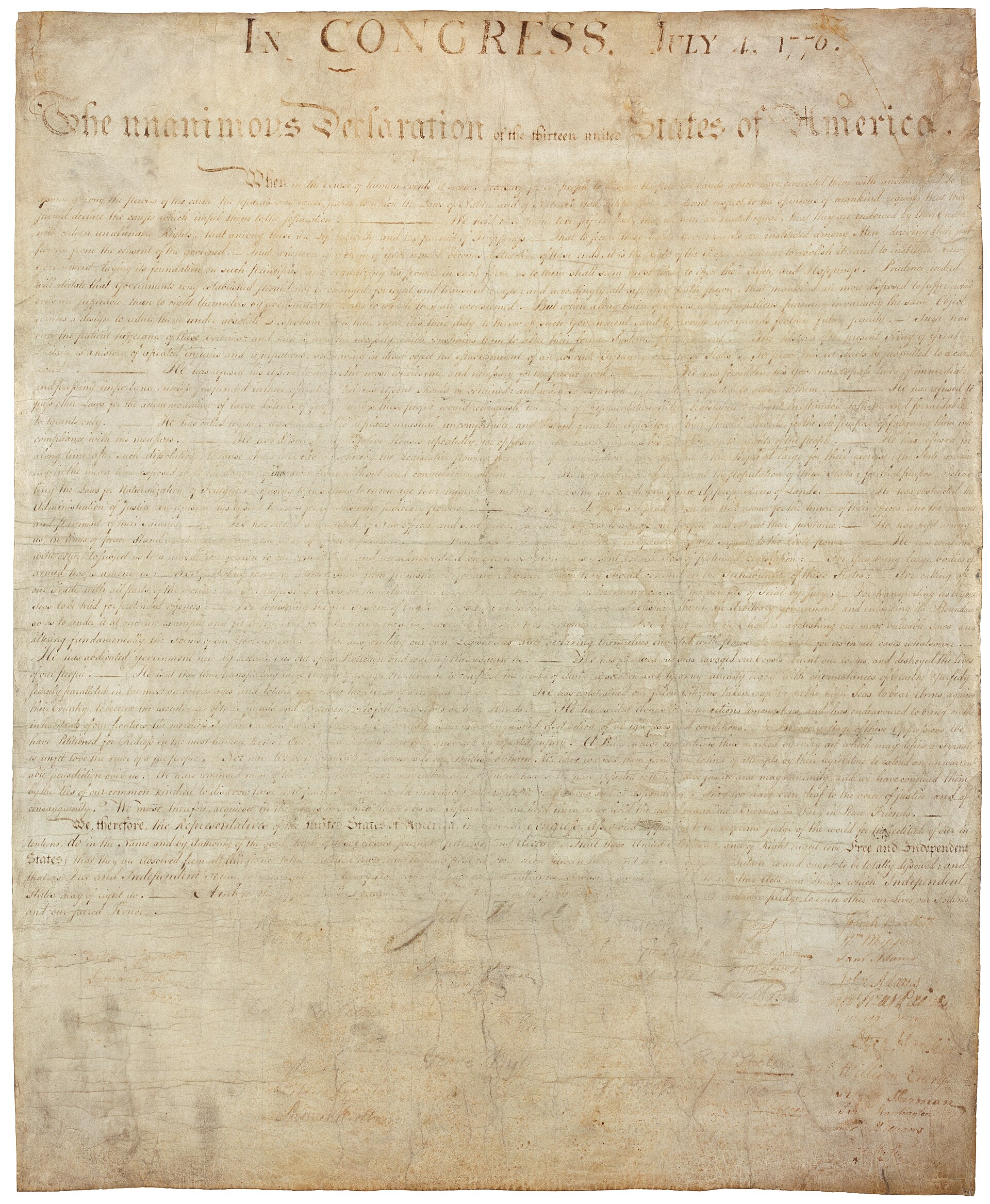
Second, the engrossed parchment Declaration: the large sheet of parchment that Congress ordered engrossed, meaning copied out by hand in a formal script, on July 19, 1776. Assistant Secretary Timothy Matlack did the engrossing, and delegates began actually signing that parchment on August 2, 1776, weeks after the broadsides had already gone out across the states and the army. This is the document most people picture when they hear Declaration of Independence, the one under glass in the National Archives Rotunda, and it is a wholly different physical object from the one described in this record, created by a different process, for a different purpose, weeks later.
Third, the Goddard Broadside: a second typeset broadside printing ordered by Congress and produced by the Baltimore printer Mary Katharine Goddard, issued on January 18, 1777. Unlike Dunlap's broadside, the Goddard printing lists the names of essentially all the signers of the engrossed parchment, with the documented exception of Thomas McKean, making it the first printed version of the Declaration to name the delegates who had actually signed. It postdates the Dunlap Broadside by more than six months and should never be described as the first printing of the Declaration; that description belongs to Dunlap's broadside alone.
The artist
John Dunlap
Dunlap did not become famous for the Declaration of Independence in his own lifetime; he became prosperous through real estate and newspapers, and the single night's work that made him historically important was, to him, one job among many for a client, Congress, that also happened to be his most important customer. He left no memoir and no account of what he thought he was printing. Almost everything known about him comes from business records, newspaper files, and the recollections of people who knew him, including one uncomfortably frank one.
Exhibited
- 1995-1996American OriginalsNational Archives Rotunda, Washington, DC
- 2025-2027Opening the Vault / Declaration of Independence display, America250 semiquincentennial programNational Archives Museum, Washington, DC (through 5 July 2027)
Related works
| Work | Relation | Where it is |
|---|---|---|
| The 1989 flea-market copy ("Declaration of Independence Road Trip") John Dunlap | A different surviving Dunlap Broadside; discussed at length in this record's narrative as the reason a less famous copy was chosen as the illustrated subject Discovered behind a painting bought for four dollars at a flea market in Adamstown, Pennsylvania in 1989; sold at Sotheby's in 1991 for 2.42 million dollars and again in 2000 for 8.14 million dollars to a partnership including Norman Lear; toured all fifty states 2001-2011 as the Declaration of Independence Road Trip. No free, rights-clear photograph of this specific copy could be located, which is why this record documents a different copy. | Private ownership, present holder not publicly disclosed since a private 2011 resale |
| Dunlap Broadside, Beinecke copy John Dunlap | A different surviving Dunlap Broadside, physically distinguished from most others by a printing-press error Missing the word "our" in the phrase "the ties of our common kindred," an error apparently corrected on the press partway through the print run; no other known surviving copy shares the omission. | Beinecke Rare Book and Manuscript Library, Yale University |
| Dunlap Broadside, Library of Congress copy John Dunlap | A different surviving Dunlap Broadside, held by a different federal institution Reported as of 2026 to be fragmented, with text missing below line fifty-four; the Library is displaying a full reproduction rather than the incomplete original for the 2026 anniversary. | Library of Congress, Washington, DC |
| Dunlap Broadside, the Jonas Phillips copy John Dunlap | A different surviving Dunlap Broadside, identified through correspondence rather than physical examination Mailed by Philadelphia merchant Jonas Phillips to a relative in Amsterdam in July 1776, intercepted by a British warship, and filed away in British archives for nearly 250 years until historian Emily Sneff connected the surviving broadside to Phillips's surviving covering letter in 2022. | Held among British government archives; on loan display at the Museum of the American Revolution, Philadelphia, through January 3, 2027 |
| Dunlap Broadside, the reattributed "Baltimore" imprint copy John Dunlap | A different surviving Dunlap Broadside, only recently confirmed as a genuine example of the July 1776 press run Long held at Kew and treated as an anomaly because its imprint line reads Baltimore rather than Philadelphia; confirmed in August 2026 through feature-matching comparison to be a genuine Philadelphia Dunlap rather than a later reprint, which, if the finding holds, brings the documented census of survivors to twenty-seven. | The National Archives of the United Kingdom, Kew |
| Engrossed Declaration of Independence Timothy Matlack (engrosser), after the text approved by the Second Continental Congress | A different object entirely, not a Dunlap Broadside: the signed parchment manuscript Ordered engrossed on July 19, 1776 and signed beginning August 2, 1776, weeks after Dunlap's broadsides had already been printed and distributed. This is the document most commonly pictured when people say Declaration of Independence, and it should never be confused with the broadside described in this record. | National Archives Rotunda, Washington, DC |
| Goddard Broadside Mary Katharine Goddard, printer | A later, different broadside printing of the Declaration Printed in Baltimore and issued January 18, 1777, more than six months after Dunlap's broadside. Unlike Dunlap's printing, it lists the names of nearly all the delegates who signed the engrossed parchment, missing only Thomas McKean, making it the first printed edition to name the signers. | Various institutional holdings |
Open questions
- Who was the 1989 flea-market buyer? His name has not been publicly disclosed in any source consulted for this record, only his profession, reportedly a Philadelphia-area financial analyst.
- Who owns the flea-market copy today? It was resold privately in 2011 immediately after its fifty-state tour ended; no subsequent owner has been publicly named and no further sale has been reported.
- Does the National Archives Rough Journal copy carry the corrected reading "our common kindred" or the earlier, erroneous reading identified at the Beinecke copy? This record found no source that states which state of the text this specific copy represents.
- How many Dunlap Broadsides actually survive as of this writing? Twenty-six is the figure in most references through 2025; a still-recent August 2026 reattribution at the UK National Archives would bring the count to twenty-seven, but whether that revised figure has been generally accepted by the scholarly and institutional community was not established in the sources consulted.
- Where are the roughly 170 or more copies from the original estimated print run of about 200 that have never been accounted for? Presumed lost, destroyed, or simply never rediscovered; no systematic accounting of their fate exists in the sources consulted.
- What did the 2016-2018 conservation treatment find or record about the Rough Journal's original sewing structure when the volume was disbound for treatment, beyond the general summary published on the National Archives' own blog? A fuller conservation report, if one exists, was not located for this record.
Questions about this object
What is Dunlap Broadside [Declaration of Independence]?
Dunlap Broadside [Declaration of Independence] is a print, dated night of July 4-5, 1776. Medium: Letterpress printing in black ink from movable type, on a single sheet of laid paper, printed on one side only.
Who made Dunlap Broadside [Declaration of Independence], and is the attribution settled?
The attribution to John Dunlap is recorded here as accepted. Printed by John Dunlap, official printer engaged by the Continental Congress, in his Philadelphia shop on the night of July 4-5, 1776. The attribution is not in dispute for the broadside genre as a whole: it rests on the printed imprint line naming Dunlap's press conventions, on the Congress's own contemporary record of ordering the printing, and on typographic matching to Dunlap's known type stock. Individual copies with non-standard imprint lines have required separate authentication; a copy long held by the National Archives of the United Kingdom carries a Baltimore imprint line and was confirmed only in August 2026, through comparative feature-matching analysis, to be a genuine product of the same Philadelphia press run rather than a later reprint.
Where is Dunlap Broadside [Declaration of Independence] now?
National Archives Building, Washington, DC. Inventory number Record Group 360, Papers of the Continental Congress, Rough Journal of the Continental Congress, vol. 3, p. 94; National Archives Identifier (NAID) 301682; local identifier NWDT1-360-ITEM1-ITEM1VOL3P94. Last confirmed 19 August 2026. In continuous United States government custody since it was pasted into the Congress's own Rough Journal in July 1776; transferred to the National Archives from the Library of Congress in 1952.
What is still unknown about Dunlap Broadside [Declaration of Independence]?
Who was the 1989 flea-market buyer? His name has not been publicly disclosed in any source consulted for this record, only his profession, reportedly a Philadelphia-area financial analyst.
Sources
- 1U.S. National Archives, "Dunlap Broadside (First Printing of the Declaration of Independence)". archives.gov/dc/...
- 2U.S. National Archives Catalog record for NAID 301682, "Dunlap Broadside [Declaration of Independence]", scope, content, and exhibit history mirrored via its Wikimedia Commons file description page. commons.wikimedia.org/wiki/...
- 3U.S. National Archives, "Preserving the Dunlap Broadside of the Declaration of Independence", Pieces of History blog, 2 July 2021. prologue.blogs.archives.gov/2021/...
- 4U.S. National Archives, "Dunlap's Declaration of Independence", Pieces of History blog, 3 July 2018. prologue.blogs.archives.gov/2018/...
- 5National Park Service, "Dunlap Broadside (First Printing of the Declaration of Independence)". nps.gov/articles/...
- 6World Digital Library / Library of Congress, item description for Dunlap Broadside [Declaration of Independence], WDL 2716, mirrored via Wikimedia Commons file description page. commons.wikimedia.org/wiki/...
- 7Declaration Stories, "Road Trip". declarationstories.org/stories/...
- 8The Seattle Times (archive), "'Declaration' copy found at flea market comes to Seattle", 20 August 2003. archive.seattletimes.com/archive/...
- 9The Christian Science Monitor, "The price of 'independence': $8.1 million", 3 July 2000. csmonitor.com/2000/...
- 10cllct, "How the Declaration of Independence was once bought for $4 at a flea market". cllct.com/sports-collectibles/...
- 11Snopes, "Did a Bargain Hunter Find Original Print of Declaration of Independence?" Consulted only through a search-engine summary; the page itself could not be retrieved (paywall). Flagged for direct verification before further reliance. snopes.com/fact-check/...
- 12Wikipedia, "John Dunlap". en.wikipedia.org/wiki/...
- 13Pennsylvania Center for the Book, Pennsylvania State University Libraries, "John Dunlap". pabook.libraries.psu.edu/literary-cultural-heritage-map-p...
- 14Anglotopia, "The National Archives Identifies Its Odd Declaration of Independence as the 27th Surviving Dunlap Broadside", 12 August 2026. Retrieved only in part (page metadata and summary; full article body did not load). Flagged for a fuller primary source, ideally the UK National Archives' own statement. anglotopia.net/british-news/...
- 15Spectrum News, "Exhibits highlight first printings of America's 'birth certificate'", 15 May 2026. spectrumlocalnews.com/us/...
- 16The Philadelphia Inquirer, "A Jewish merchant from Market Street mailed a copy of the Declaration of Independence 250 years ago. It's back in Philly.", 5 June 2026. inquirer.com/history/...
- 17U.S. National Archives, press release NR25-11, "National Archives to Display Rare Declaration of Independence-Related Documents". Consulted only through a search-engine summary; the release page itself could not be retrieved (repeated server error). Flagged for direct verification. archives.gov/press/...
- 18Wikimedia Commons, file description page for the Beinecke Rare Book and Manuscript Library's Dunlap Broadside. commons.wikimedia.org/wiki/...
- 19Declaration Stories, "Ties of Common Kindred" (on the Beinecke copy's missing word and the 1975 Library of Congress census examination led by Frederick R. Goff). declarationstories.org/stories/...
- 20Fonts In Use, "The Dunlap Broadside" (typographic analysis: type matching against Caslon's 1766 specimen book, line length, layout, and physical evidence of printing haste). fontsinuse.com/uses/...
_-_NARA_-_301682.jpg)
_WDL2716.png)

Last verified · Published
Change log
19 August 2026 - Record created at the house standard: researched narrative, technical evidence, maker dossier, graded provenance chain, prices with hammer and premium separated, related works, open questions and sources.