The Farnese Table
Designed by Jacopo Barozzi da Vignola; piers carved under Guglielmo della Porta; pietre dure top attributed to Jean Menard, called Giovanni Mynardo · ca. 1565-73 per the Museum's own date line; the curatorial entry argues a floor of 1566 from the arms and a ceiling of 1573 from Vignola's death. The machine record carries a bracket beginning 1560.
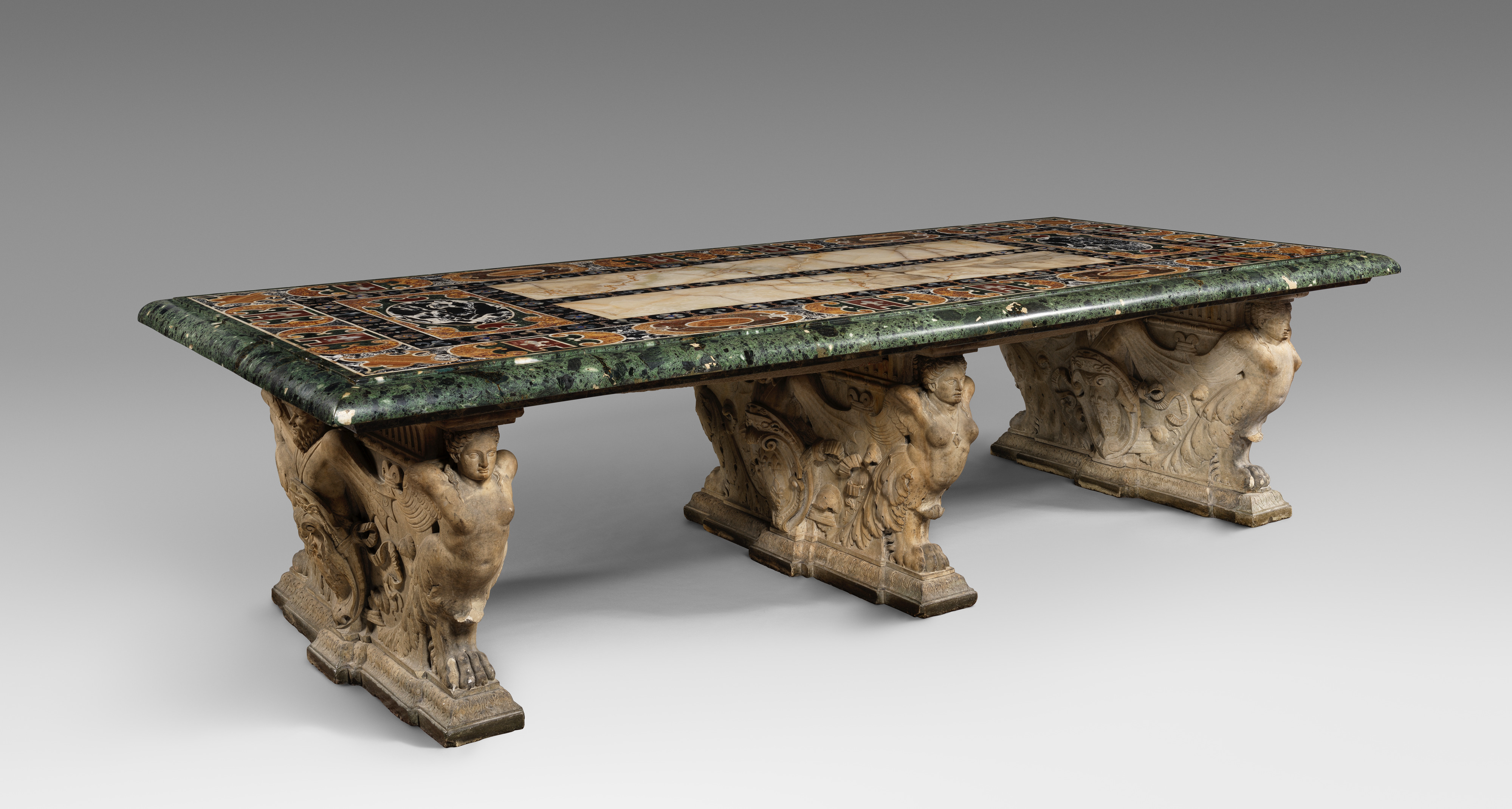
The record subject, photographed by the Metropolitan Museum. The pietre dure top, whose coloured stones are all ancient and many of which came out of the Baths of Caracalla, is carried on three marble piers carved in the palace workshop of Guglielmo della Porta. Made in Rome in the later 1560s for Cardinal Alessandro Farnese to Vignola's design.
| Artist | Designed by Jacopo Barozzi da Vignola; piers carved under Guglielmo della Porta; pietre dure top attributed to Jean Menard, called Giovanni Mynardo |
|---|---|
| Date | ca. 1565-73 per the Museum's own date line; the curatorial entry argues a floor of 1566 from the arms and a ceiling of 1573 from Vignola's death. The machine record carries a bracket beginning 1560. |
| Medium | Marble of different colours, semiprecious stones, Egyptian alabaster, with residue of paint of different colours on the piers |
| Dimensions | Overall 95.3 x 379.1 x 168.3 cm (37 1/2 in. x 12 ft 5 1/4 in. x 66 1/4 in.). The Museum also publishes confirmed weights for the three supports: south 1,306 lb (592.4 kg), centre 1,266 lb (574.3 kg), north 1,321 lb (599.2 kg) - 3,893 lb for the piers by simple addition of the Museum's own figures. No weight is published for the top. |
| Where it is now | Metropolitan Museum of Art, New York, Gallery 503last confirmed |
| Inventory number | 58.57a-d |
| Attribution | AttributedThe design is given to Vignola on the strength of Olga Raggio's article of March 1960, which presented the table as a rediscovered work by him; the case rests on ornament characteristic of Vignola rather than on a drawing or a contract. Full note |
| Object type | Furniture |
| Period | Italian, Rome, sixteenth century |
| Cases | Has a provenance gap |
| Inscriptions | None. The Farnese arms carved on the piers - six lilies on oval panels under a cross and a cardinal's galero - function as the dating evidence in place of an inscription. |
| Owners on record | 7 links6 documented, 1 unknown |
| Sources | 6 cited |
About this record Last verified · 6 sources cited · Change log
On this page 11 sections
ContentsClose
A marble table made in Rome in the later 1560s for Cardinal Alessandro Farnese, designed by Vignola, its piers carved in the palace workshop of Guglielmo della Porta and its pietre dure top believed to be the work of the French inlayer Jean Menard. Every coloured stone in it is ancient. Many came out of the Baths of Caracalla, which the cardinal was excavating; the two Egyptian alabaster panels at the centre were probably stripped from Egyptian monuments in antiquity, which makes them spoil taken twice.
It is dated by heraldry: Alessandro adopted the arms carved on the piers only in 1566, and Vignola died in 1573. A palace inventory of 1653 records that in the cardinal's absence a table whose three marble supports alone weigh nearly four thousand pounds was kept in a padlocked wooden box on a wool mattress under a quilted cloth, with a cover of gilded leather.
It is in the Palazzo Farnese inventory of 1796 and not in the one of 1834; the next record of it is a fire-insurance paper for Hamilton Palace in Scotland drawn up shortly after 1844. The Museum offers two incompatible accounts of that gap on the same page, one a tradition about a convent in Verona and one a supposition about a grand tourist. It was sold at Christie's in 1919 to Lord Leverhulme, returned to a Roman dealer at an unrecorded date, and reached New York in 1958. A recent examination found paint residues on the piers, which the Museum says may change how the object is understood.
Provenance
Each link is graded. Documented: a cited source supports it. Disputed: the identification is argued but not established. Unknown: no owner for that span, and the gap is not smoothed into a narrative. The grades in the glossary.
- ca. 1566-73 - 1653Cardinal Alessandro Farnese (1520-1589), Palazzo Farnese, Romedocumented
Designed by Jacopo Barozzi da Vignola, the cardinal's chief architect from about 1550; piers carved in the palace workshop under Guglielmo della Porta; the pietre dure top believed to be by the French master Jean Menard, called in Italy Giovanni Mynardo. Dated by the arms, which Alessandro adopted only in 1566, and by Vignola's death in 1573. Made for the main hall of the palace and later moved to the Philosophers' Hall beside the Carracci Gallery.1
- 1653 - 1796The Farnese collection, Palazzo Farnese, Romedocumented
Listed in palace inventories from 1653 to 1796 and described in the Philosophers' Hall by every seventeenth- and eighteenth-century Roman guidebook that mentions the palace treasures. Goethe probably saw it there in the spring of 1787, after Charles III of Spain had removed most of the palace's paintings and sculpture to Naples. It is NOT in the palace inventory of 1834.1
- 1796 - 1844Unrecordedunknown
Roughly half a century is undocumented. The Museum offers two accounts on the same page and labels both as unproven: its provenance field says 'by tradition, Convent, Verona, Italy', from which the 10th Duke of Hamilton is said to have acquired it; its curatorial essay says instead that 'we may suppose' the table was acquired by some English or Scottish grandee on a tour of Italy, and does not mention Verona. Neither is supported by a document in the record consulted.
- by 1844 - 1919Alexander Hamilton, 10th Duke of Hamilton, and the Dukes of Hamilton, Hamilton Palace, South Lanarkshiredocumented
Recorded in a fire-insurance document drawn up shortly after 1844 and in the Hamilton Palace inventories of 1852 and 1876; descended in the family until the 1919 sale.1
- 1919 - 1925 or laterWilliam Hesketh Lever, 1st Viscount Leverhulme (1851-1925), The Hill, Hampstead Heath, Londondocumented
Bought at Christie, Manson and Woods, London, 13 November 1919, lot 333. The Museum's own provenance string spells the buyer 'Leverhume'; the name is Leverhulme. No price is published in the sources consulted. Leverhulme died in 1925 and the Museum's chain gives no date for the table leaving his estate.1
- after 1925 - 1958The London art market, then Galleria Sangiorgi, Romedocumented
The Museum records both in square brackets, its convention for the trade, and gives no dates for either. The object therefore returned to Italy at an unrecorded point and left it again for New York in or shortly before 1958. Nothing in the record consulted states whether an Italian export licence was applied for or granted.1
- 1958 - presentMetropolitan Museum of Art, New Yorkdocumented
Accession 58.57a-d, Harris Brisbane Dick Fund, 1958. No price published. Two years later Olga Raggio published it in the Museum's Bulletin as a rediscovered work by Vignola. On view in Gallery 503 in 2026; shown in Art of the Royal Court: Treasures in Pietre Dure from the Palaces of Europe in 2008.123
Prices realised
The table has been sold at public auction once, in 1919. Its other two changes of hands were private: from the London art market to Galleria Sangiorgi in Rome at an unrecorded date after 1925, and from Sangiorgi to the Metropolitan Museum in 1958 with the Harris Brisbane Dick Fund. Neither private transaction has a published price, so neither carries a hammer or a premium.
| Date | Sale | Estimate | Result | Note |
|---|---|---|---|---|
| 13 November 1919 | Christie, Manson and Woods, London Hamilton Palace, lot 333 | Hammer Not published With premium Not published GBP | Sold from Hamilton Palace to William Hesketh Lever, 1st Viscount Leverhulme. No price appears in any source consulted here. Anyone who finds a figure for this lot should establish before quoting it whether it is the sum called in the room or a total including charges; this record will not print a number it cannot separate. |
Hammer is the price at which the bidding stopped; with premium adds the fee the house charges the buyer on top. Hammer price and buyer's premium in the glossary.
Technical evidence
| Attribution note | The design is given to Vignola on the strength of Olga Raggio's article of March 1960, which presented the table as a rediscovered work by him; the case rests on ornament characteristic of Vignola rather than on a drawing or a contract. The piers were carved in the Palazzo Farnese workshop run by Guglielmo della Porta and close inspection shows more than one hand in them. The pietre dure top is believed, not documented, to be by the French inlayer Jean Menard, called Giovanni Mynardo. The date is fixed between 1566, when Alessandro Farnese adopted the arms carved on the piers, and 1573, when Vignola died. |
|---|---|
| Dimensions | Overall 95.3 x 379.1 x 168.3 cm (37 1/2 in. x 12 ft 5 1/4 in. x 66 1/4 in.). Nearly 3.8 metres long.12 |
| Materials | Marble of different colours, semiprecious stones and Egyptian alabaster, with residue of paint of different colours on the piers.12 |
| Structure | A slab of white marble top on three marble piers. Each pier carries a grotesque torso and a coat of arms on its sides and a sphinx emerging from foliage at each end. The 1653 inventory describes the feet as harpies.1 |
| Inlay | Pietre dure and coloured marble set into a white marble matrix so densely that the matrix reads only as the lines around medallions, cartouches, rectangles and ovals. Two panels of Egyptian alabaster at the centre inside black slate borders with pietre dure rosettes and stylised lilies.1 |
| Stone sources | All the stones are ancient. Many came from the Baths of Caracalla, excavated from the 1540s under Cardinal Alessandro Farnese's supervision. The two alabaster panels were probably taken from Egyptian monuments and brought to Italy in antiquity. Marbles were also fetched from Ostia; in 1547 the architects went there, in the record's phrase, to get coloured marbles for the palace.1 |
| Paint residue | A recent examination disclosed slight residues of paint in small areas under the profiles supporting the top. The Museum states that this may change the current estimation of the table, because if the piers were painted the overall appearance must have been quite different. The pigments, the extent and the date of the examination are not published.12 |
| Hands | Close inspection shows the piers were carved by more than one person, consistent with workshop practice under Guglielmo della Porta, who supervised, carved major elements and added the final touches.1 |
| Weight - two figures that do not agree | The Museum publishes confirmed weights for the three supports only: 1,306 lb (592.4 kg), 1,266 lb (574.3 kg) and 1,321 lb (599.2 kg), which add to 3,893 lb. The gallery audio states that the table weighs some thirty thousand pounds and that moving it takes twelve men and several days. Those two statements are roughly an order of magnitude apart. The top has never been weighed in any published figure, so the audio number cannot be checked against the measured ones.124 |
| Heraldry as dating evidence | The arms carved on the piers were adopted by Alessandro Farnese only in 1566, so the design cannot predate that year; Vignola died in 1573. Palace inventories of 1566 and 1568 list other inlaid tables but not this one.1 |
| Ornament vocabulary | Confronted peltae - stylised ancient shields - and broken rectangles enclosing the Farnese lilies, motifs associated with Vignola and possibly taken from ancient Roman floors such as that of the Curia of Diocletian in Rome and pavements at Ostia.1 |
| How it was stored | Per the 1653 palace inventory: in the owner's absence the table went into a wooden box closed with a looping chain, with a small wool-filled mattress in the middle covered by a quilted checkered cloth, and it had a cover of tooled and gilded leather with four fringes, decorated borders and fleurs-de-lys.1 |
| Museum classification | Sculpture-Architectural. The Museum does not file this object under furniture.12 |
| Museum date line | ca. 1565-73, with a machine bracket beginning 1560. The curatorial entry's own reasoning gives a floor of 1566, the year Alessandro Farnese adopted the arms carved on the piers, and notes the table is absent from the palace inventories of 1566 and 1568.12 |
The record in full
Chapter 1A table built out of the Baths of Caracalla
Every coloured stone in this table is ancient, and many of them came out of the Baths of Caracalla, where excavation began in the 1540s under the supervision of Cardinal Alessandro Farnese.
Every coloured stone in this table is ancient, and many of them came out of the Baths of Caracalla, where excavation began in the 1540s under the supervision of Cardinal Alessandro Farnese. The two panels of Egyptian alabaster in the centre were probably stripped from Egyptian monuments and carried to Italy in antiquity, which makes them spoil taken twice.
That is the fact to start from, because it is what the object is. A Renaissance cardinal excavated an imperial bath complex he did not own in any modern sense, took its marbles, and had them cut up and reset as the top of a table for his own state rooms. For him and for his architects and masons the stones stood for the opulence of a vanished empire, and reusing them was physical proof that Rome was the Eternal City. It is also, in plain terms, a quarry operation on a ruin.
The Museum's curator puts the second half of the thought as well: the men who did it were not imitating the ancients but attempting to surpass them, superatio rather than imitatio.
Chapter 2What it is
A slab of white marble on three marble piers.
A slab of white marble on three marble piers. The top is inlaid in the ancient Roman manner with many different coloured marbles and with semiprecious hardstones - pietre dure - so densely that the white matrix shows only as the lines separating medallions, cartouches, rectangles and ovals. At the centre, inside black slate borders set with pietre dure rosettes and stylised lilies, are the two panels of Egyptian alabaster.
Each pier is carved on its long sides with a grotesque torso and a coat of arms, and at each end with a sphinx emerging from foliage. The arms carry six lilies on oval panels under a cross and a galero, a cardinal's hat.
The wide outer border of the top is rosso antico, and in it the Farnese lilies are bracketed by pairs of peltae, the stylised crescent shields of Roman art, arranged so that they guard the lilies as armed men guard a dignitary. That reading is the Museum's, and it is the kind of thing that only becomes visible once you know the border is a heraldic statement rather than a pattern.
Chapter 3It can be dated by a coat of arms
Alessandro Farnese adopted the coat of arms carved on the piers only in 1566.
Alessandro Farnese adopted the coat of arms carved on the piers only in 1566. Vignola's design therefore cannot predate that year. Vignola died in 1573. Inventories of the Palazzo Farnese taken in 1566 and 1568 list other inlaid tables - two of alabaster, two of porphyry, one set with many different stones - but not this one.
The Museum's own date line reads ca. 1565-73, with a machine bracket that opens in 1560, so the catalogue entry's reasoning and the tombstone beside it do not quite agree; and if the table is genuinely absent from the 1568 inventory, the honest floor is 1568 rather than 1566. What the evidence supports is that the table was probably under construction in the later 1560s and certainly by 1573. That is a tighter date than most sixteenth-century furniture carries, and it is arrived at entirely from heraldry and death dates rather than from any contract or payment.
Chapter 4Vignola, della Porta and a Frenchman called Mynardo
Jacopo Barozzi da Vignola began working at the Palazzo Farnese shortly before 1547, under Michelangelo's supervision, and became the cardinal's chief architect around 1550.
Jacopo Barozzi da Vignola began working at the Palazzo Farnese shortly before 1547, under Michelangelo's supervision, and became the cardinal's chief architect around 1550. The table and especially its top were created after his designs. Its ornamental vocabulary is his: the confronted peltae, the broken rectangles enclosing the Farnese lilies, motifs he may have taken from ancient Roman floors such as the one in the Curia of Diocletian, and from the pavements at Ostia, where in 1547 the architects went, in the phrase of the time, to get coloured marbles for the palace.
The carving was done in the palace workshop, which the sculptor Guglielmo della Porta ran. That workshop's business was restoring ancient sculpture and reshaping excavated stone into furnishings. Close inspection of the piers shows that they were carved by more than one person, which is what a supervised workshop looks like: della Porta directed, carved major elements himself and finished the rest.
The inlay is believed to be the work of a little-known French master, Jean Menard, known in Italy as Giovanni Mynardo, reckoned one of the finest craftsmen in stone intarsia and mosaic decoration working in Rome in the 1560s. Three names, three trades, one object, and the Museum's heading gives the design to Vignola, the piers to della Porta and the top to Mynardo without pretending that any of the three did all of it.
Chapter 5The piers may have been painted
The most consequential line in the Museum's catalogue entry is buried in the middle of it.
The most consequential line in the Museum's catalogue entry is buried in the middle of it. An examination of the piers disclosed slight residues of paint, in small areas, under the profiles supporting the top. The Museum's own words are that this astonishing discovery may change the current estimation of the table, because if the piers were originally painted then the overall appearance of the piece must have been quite different.
The footnote names the man and the moment. The observation was made when the table was moved in 2002, and Jack Soultanian Jr., conservator in the Museum's Department of Objects Conservation, confirmed and further investigated it. The residue is now in the medium line of the machine record, which reads: marble of different colours, semiprecious stones, Egyptian alabaster, residue of paint of different colours on the piers. Different colours, in the plural.
What has not been published is which pigments they are or how much of the piers they covered. What it means is that the object every visitor and every furniture historian has looked at since 1958 - white marble piers against a coloured top - may be the stripped remains of something polychrome, and that this has been known inside the building since a move in 2002.
Chapter 6Guarded like a jewel
An inventory of the Palazzo Farnese compiled in 1653 records how the table was kept.
An inventory of the Palazzo Farnese compiled in 1653 records how the table was kept. In the owner's absence, the large table of hard and soft stones, its centre of Oriental alabaster, supported by three marble feet in the shape of harpies with the arms of the Lord Cardinal, was protected in a wooden box with a chain that looped to close it and, in the middle, a small mattress full of wool covered with a quilted checkered cloth. There was also a cover for the table of tooled and gilded leather with four fringes, decorated borders and fleurs-de-lys.
The Museum draws the right conclusion from that. The household treated the table as an objet de vertu, something on the order of a gold or rock-crystal bibelot that could be cased and travel with its owner. It is in fact so heavy that even with a modern lifting device it takes a dozen men to move it, and several days. The weight is worth pausing on, because the Museum gives two answers: the gallery audio says some thirty thousand pounds, while the collection record publishes confirmed weights for the three supports that add to 3,893 pounds, with the top never weighed.
A padlocked box and a wool mattress for an object that cannot be lifted is not a security measure. It is a statement about rank.
Chapter 7Where it stood, and who saw it
The table was made for the main hall of the Palazzo Farnese, where it would have sat among the family's paintings and the ancient sculpture - the Farnese Hercules, the Urania, the Flora, the Farnese...
The table was made for the main hall of the Palazzo Farnese, where it would have sat among the family's paintings and the ancient sculpture - the Farnese Hercules, the Urania, the Flora, the Farnese Bull. It was later moved into the Philosophers' Hall, the elaborately furnished room next to the Carracci Gallery on the Tiber side of the palace, and every seventeenth- and eighteenth-century Roman guidebook that mentions the palace treasures describes it there.
Goethe probably saw it in that room on his visit to Rome in the spring of 1787, on the Museum's account of the date. By then much of the palace had gone: Charles III of Spain, who had inherited it from his Farnese mother, had moved many of the paintings and sculptures to Naples in what the Museum calls one of the largest art transfers in history. Goethe's comment was that if they could take the Carracci Gallery too, they would do it.
The table stayed. It appears in an inventory of the palace made in 1796. It does not appear in one made in 1834.
Chapter 8The gap, and the two stories about it
Between the 1796 inventory and a fire-insurance document drawn up shortly after 1844 for Hamilton Palace in South Lanarkshire, nothing is documented.
Between the 1796 inventory and a fire-insurance document drawn up shortly after 1844 for Hamilton Palace in South Lanarkshire, nothing is documented. That is roughly half a century in which a thirty-thousand-pound table left a palace in Rome and arrived in a house in Scotland, and the Museum tells two different stories about it in two different places on the same page.
The provenance field says: by tradition, a convent in Verona, Italy, from which it was acquired by Alexander Hamilton, 10th Duke of Hamilton. The curatorial essay says something else, and flags it as a guess: we may suppose that, like many other Italian antiquities, the treasured table of the Farnese family was acquired by some English or Scottish grandee while on a tour of Italy. Verona is not mentioned in the essay at all.
Neither account carries a document. The tradition of the Verona convent is labelled a tradition by the Museum itself, and the grand tour account is labelled a supposition. What is documented is the Hamilton end: the table is in the fire-insurance paper drawn up after 1844 and in the Hamilton Palace inventories of 1852 and 1876.
Chapter 9Sold out of Hamilton Palace, 1919
The table descended in the Hamilton family until 1919, when it was sold at Christie, Manson and Woods in London on 13 November as lot 333.
The table descended in the Hamilton family until 1919, when it was sold at Christie, Manson and Woods in London on 13 November as lot 333. The buyer was William Hesketh Lever, 1st Viscount Leverhulme, 1851 to 1925, the soap manufacturer who built Port Sunlight, and it went to his London house, The Hill, on Hampstead Heath. The Museum's provenance string renders the name Leverhume and then gives it correctly three words later.
No price is published in any source consulted here, and none should be assumed. Anyone who finds a figure for this lot should establish before quoting it whether it is the sum called in the room or a total including charges, because the two are routinely conflated in later retellings of sales of this period.
Chapter 10Back to Rome, then to New York
After Leverhulme the Museum's chain records only the London art market and then Galleria Sangiorgi, the Rome dealer, from whom the Museum bought the table in 1958 with the Harris Brisbane Dick Fund.
After Leverhulme the Museum's chain records only the London art market and then Galleria Sangiorgi, the Rome dealer, from whom the Museum bought the table in 1958 with the Harris Brisbane Dick Fund. No dates are given for either step and no prices for any of them.
The shape of that is worth stating plainly. An object made in Rome in the 1560s left Italy at some undocumented point before 1844, spent about a century in Britain, returned to a Roman dealer at some undocumented point after 1925, and left Italy again for New York in or shortly before 1958. Nothing in the record consulted says whether an Italian export licence was sought or granted for that second departure, or who handled it.
Two years after the purchase, in March 1960, Olga Raggio published it in the Museum's Bulletin as a rediscovered work by Vignola. That article is the reattribution: it took an object that had been a great piece of Roman furniture and made it a documented Vignola design. The Museum still describes it as a model for subsequent studies in the history of furniture.
Chapter 11What is unresolved
The date is close to fixed by the arms and by Vignola's death.
The date is close to fixed by the arms and by Vignola's death. The designer, the carving workshop and the inlayer are all named, with the qualification that the piers were carved by more than one hand and the top is only believed to be Mynardo's. The Roman provenance is continuous from the 1560s to 1796 through palace inventories and guidebooks.
Everything between 1796 and 1844 is missing, and the Museum offers two incompatible accounts of it, one labelled tradition and one labelled supposition. The 1919 price is unpublished, the 1958 price is unpublished, the route back to Rome is unrecorded, and the piers appear to have been painted a colour nobody has yet named.
For a piece of furniture that has been in the literature since 1960 and in a palace inventory since 1653, that is a great deal still open.
The artist
Jacopo Barozzi da Vignola, with Guglielmo della Porta and Jean Menard (Giovanni Mynardo)
This object has three makers and a patron, and the honest way to write the dossier is to keep them separate. Vignola designed it. Guglielmo della Porta's palace workshop carved the piers, with more than one hand visible in them. A French stone-inlayer known in Rome as Giovanni Mynardo is believed to have made the top. Cardinal Alessandro Farnese paid for it, supplied the ancient marble from his own excavation, and put his arms on the legs.
The reason the design is given to Vignola at all is a single article of 1960 by a Metropolitan curator. Before Olga Raggio wrote it, the table was a magnificent anonymous object; after it, the table was a Vignola.
Exhibited
- 2008Art of the Royal Court: Treasures in Pietre Dure from the Palaces of Europe, 1 July - 21 September 2008Metropolitan Museum of Art, New York
- 2026On view, Gallery 503Metropolitan Museum of Art, New York
Literature
- Olga Raggio, 'The Farnese Table: A Rediscovered Work by Vignola', The Metropolitan Museum of Art Bulletin 18 (March 1960), pp. 213-31 - NOT obtained; quoted at second hand through the Museum's own catalogue entry, which cites it as footnote 1. This is the first item to obtain for this record
- Wolfram Koeppe, catalogue entry for The Farnese Table, Metropolitan Museum of Art, 2006, with 19 footnotes - READ in full on the object page
- Wolfram Koeppe et al., Art of the Royal Court: Treasures in Pietre Dure from the Palaces of Europe, exh. cat. (New York: MMA, 2008) - NOT read
- John Morley, The History of Furniture - cited in the Museum's footnote 2 for a pier from a prototypical Roman table; NOT read
Related works
| Work | Relation | Where it is |
|---|---|---|
| Perseus with the Head of Medusa, and Phineus Guglielmo della Porta | By the sculptor who ran the workshop that carved the piers One of a group of plaquettes at the Museum given to della Porta. | Metropolitan Museum of Art, 60.55.68 |
| Mars and Venus Trapped by Vulcan Guglielmo della Porta | Same workshop, same museum Late sixteenth century. | Metropolitan Museum of Art, 41.109 |
| Banquet of the Gods Guglielmo della Porta | Same workshop After 1585. | Metropolitan Museum of Art, 12.135.5 |
| The Farnese Hercules, the Farnese Bull, the Flora and the Urania Ancient sculptors; restored in the Farnese workshop | The company the table was made to keep Removed from the Palazzo Farnese to Naples by Charles III of Spain. The table stayed in Rome for another century after they left. | Museo Archeologico Nazionale, Naples |
| Other inlaid tables in the Farnese inventories of 1566 and 1568 Unrecorded Roman workshops | The cohort this object belongs to Two of alabaster, two of porphyry and one set with many different stones. None of them is this table, which is part of how the date is fixed. | Not traced here |
Open questions
- What colours were the piers painted, and over how much of their surface? The paint residues were noticed when the table was moved in 2002 and investigated by the conservator Jack Soultanian Jr.; the Museum says the discovery may change the estimation of the table and has published no pigments, no extent and no report in the twenty-four years since.
- How did the table leave Rome between the palace inventory of 1796 and the Hamilton Palace fire-insurance document of shortly after 1844? The Museum's provenance field says a convent in Verona by tradition; its own catalogue essay says a grand tourist, by supposition. The two accounts are not compatible and neither carries a document.
- What did lot 333 fetch at Christie, Manson and Woods on 13 November 1919? No figure is published in the sources consulted.
- What did the Metropolitan pay Galleria Sangiorgi in 1958? No figure is published.
- When and how did the table return from Leverhulme's estate in London to a dealer in Rome, and was an Italian export licence sought or granted when it left Italy again for New York?
- Is the pietre dure top actually the work of Jean Menard? The Museum says only that it is believed to be, and names no document.
- How many carvers worked the piers, and can any of the hands beyond della Porta's be identified? The Museum states that more than one person carved them and stops there.
- Why do the Museum's two published weights differ by roughly an order of magnitude - some thirty thousand pounds in the gallery audio against 3,893 pounds of confirmed weight for the three supports - and has the top ever been weighed?
Questions about this object
What is The Farnese Table?
The Farnese Table is a furniture, dated ca. 1565-73 per the Museum's own date line; the curatorial entry argues a floor of 1566 from the arms and a ceiling of 1573 from Vignola's death. The machine record carries a bracket beginning 1560.. Medium: Marble of different colours, semiprecious stones, Egyptian alabaster, with residue of paint of different colours on the piers.
Who made The Farnese Table, and is the attribution settled?
The attribution to Designed by Jacopo Barozzi da Vignola; piers carved under Guglielmo della Porta; pietre dure top attributed to Jean Menard, called Giovanni Mynardo is recorded here as attributed. The design is given to Vignola on the strength of Olga Raggio's article of March 1960, which presented the table as a rediscovered work by him; the case rests on ornament characteristic of Vignola rather than on a drawing or a contract. The piers were carved in the Palazzo Farnese workshop run by Guglielmo della Porta and close inspection shows more than one hand in them. The pietre dure top is believed, not documented, to be by the French inlayer Jean Menard, called Giovanni Mynardo. The date is fixed between 1566, when Alessandro Farnese adopted the arms carved on the piers, and 1573, when Vignola died.
Where is The Farnese Table now?
Metropolitan Museum of Art, New York, Gallery 503. Inventory number 58.57a-d. Last confirmed 4 August 2026. Harris Brisbane Dick Fund, 1958; on view 2026.
What is still unknown about The Farnese Table?
What colours were the piers painted, and over how much of their surface? The paint residues were noticed when the table was moved in 2002 and investigated by the conservator Jack Soultanian Jr.; the Museum says the discovery may change the estimation of the table and has published no pigments, no extent and no report in the twenty-four years since.
Sources
- 1Metropolitan Museum of Art, collection record for The Farnese Table, accession 58.57a-d, including the full curatorial entry by Wolfram Koeppe (2006) with its footnotes, and the provenance and exhibition tabs. Read 4 August 2026. metmuseum.org/art/...
- 2Metropolitan Museum of Art Collection API, object 202115: isPublicDomain true, medium 'Marble of different colors, semiprecious stones, Egyptian alabaster, residue of paint of different colors on the piers', credit line 'Harris Brisbane Dick Fund, 1958'. collectionapi.metmuseum.org/public/...
- 3Olga Raggio, 'The Farnese Table: A Rediscovered Work by Vignola', The Metropolitan Museum of Art Bulletin 18 (March 1960), pp. 213-31. Cited as footnote 1 of the Museum's own catalogue entry and quoted there; the article itself was not obtained for this record. metmuseum.org/art/...
- 4Metropolitan Museum of Art gallery audio, track 2178, The Farnese Table, with Ian Wardropper and Wolfram Koeppe, transcript read from the object page. metmuseum.org/art/...
- 5Metropolitan Museum of Art, collection record for Perseus with the Head of Medusa, and Phineus, Guglielmo della Porta, accession 60.55.68. collectionapi.metmuseum.org/public/...
- 6Metropolitan Museum of Art, collection record for Mars and Venus Trapped by Vulcan, Guglielmo della Porta, accession 41.109. collectionapi.metmuseum.org/public/...
Last verified · Published
Change log
4 August 2026 - Record created at the house standard: researched narrative, technical evidence, maker dossier, graded provenance chain, prices with hammer and premium separated, related works, open questions and sources.
11 September 2026 - Re-verified 2026-09-11: checked for any 2024-2026 provenance development, claim or relocation. None found. The Metropolitan Museum appointed Lucian Simmons as head of provenance research in May 2025, a museum-wide policy step with no object-specific finding published against this table. Gallery location, accession and provenance chain confirmed unchanged against the Museum's own published catalogue entry. No factual correction required.