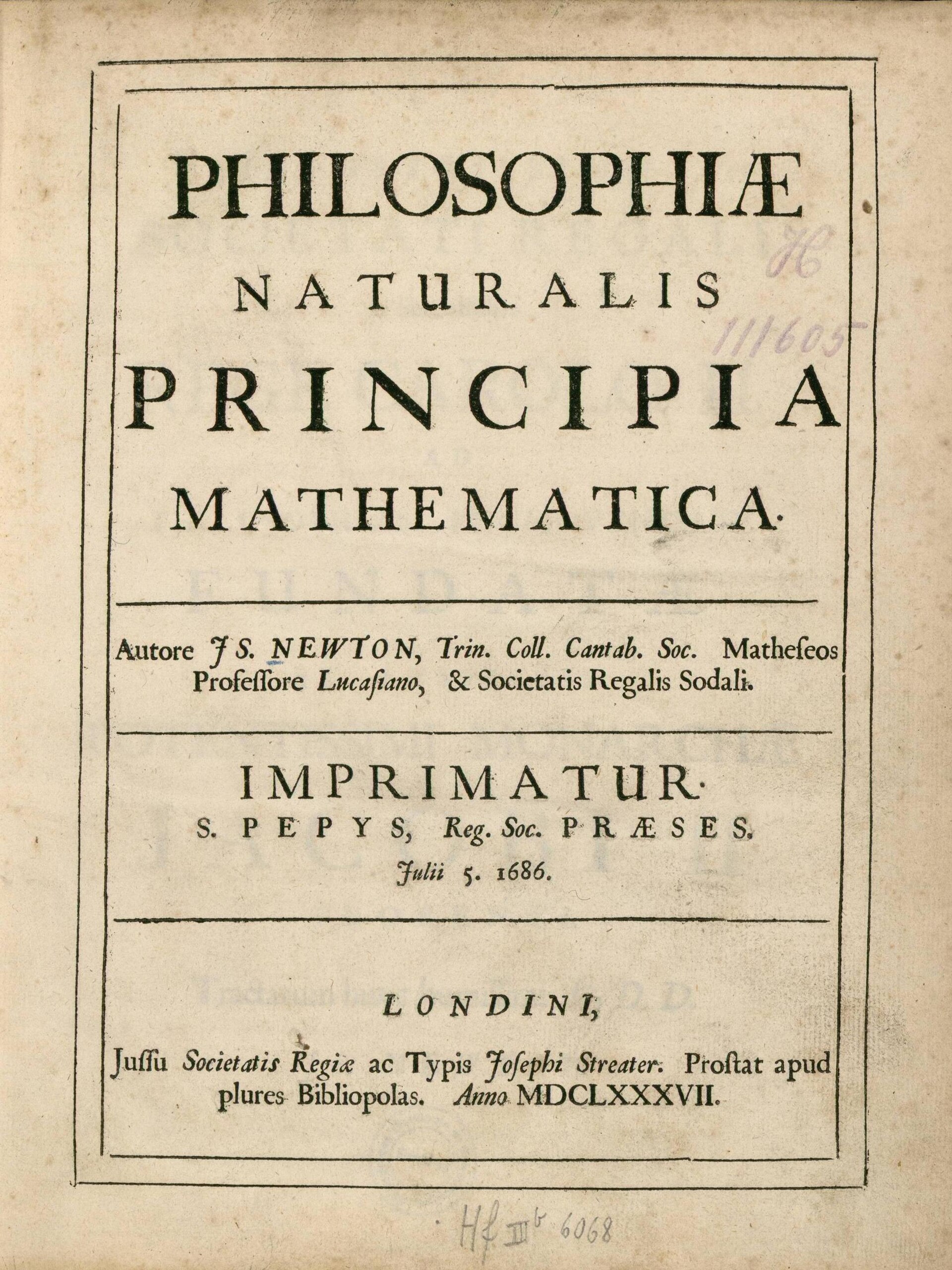
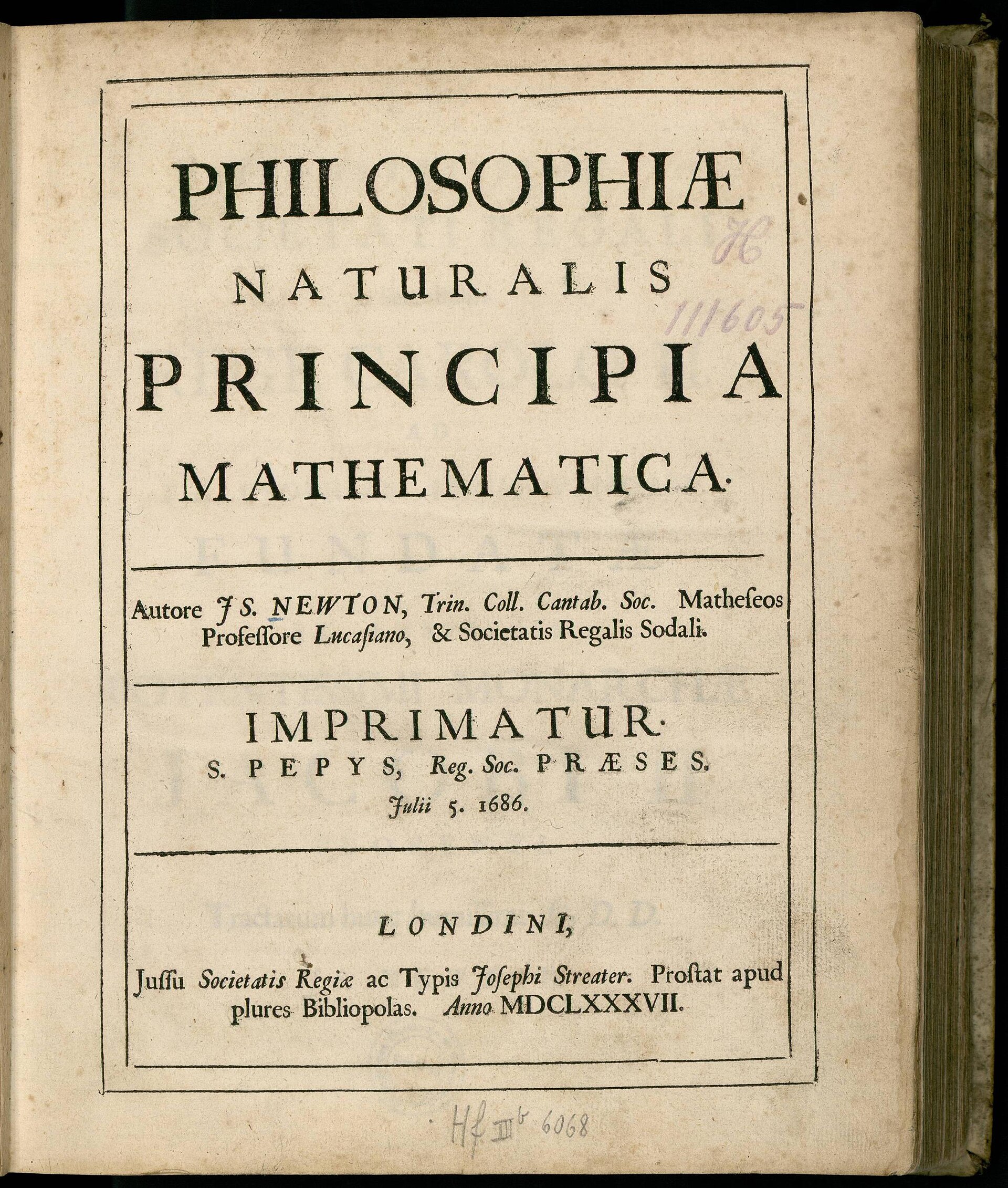
Philosophiae Naturalis Principia Mathematica
1687 · Letterpress printing on laid paper
Bibliotheque nationale et universitaire de...
 English · 1642-1727
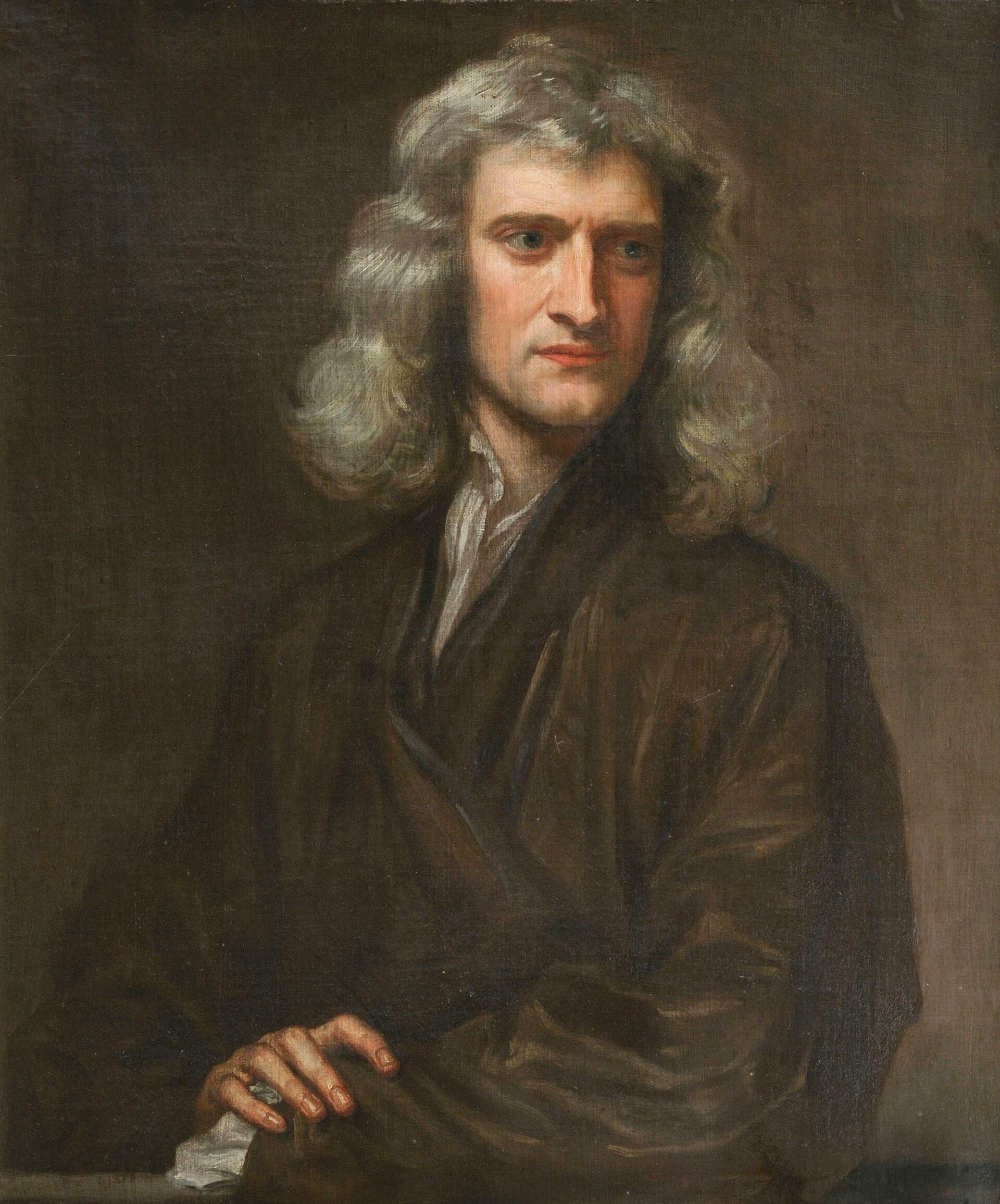
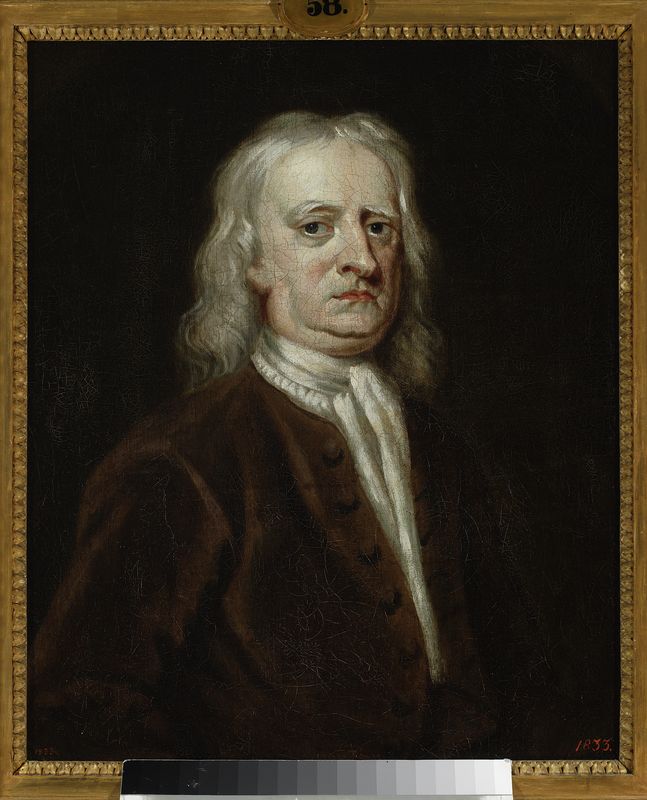
Newton at forty-six, painted by Godfrey Kneller in 1689, two years after the Principia's publication and the earliest of several Kneller portraits of him. The sitter's identity is not in dispute.
Godfrey Kneller| Full name | Sir Isaac Newton |
|---|---|
| Worked as | Natural philosopher, Mathematician, Astronomer, Theologian |
| Born | 25 December 1642 (Julian calendar) · Woolsthorpe-by-Colsterworth, Lincolnshire, England |
| Died | 20 March 1726/27 (Julian calendar) · Kensington, London, England |
| Nationality | English |
| Movement | The scientific revolution |
| In this archive | 1 artwork |
| Sources | 30 cited |
| Last verified |
About this page 1 artwork in the archive · Last verified · 30 sources cited
The same hand that wrote the Principia filled several times as many pages on the chronology of ancient kingdoms, the measurements of Solomon's Temple and the transmutation of metals, and almost none of it was published in his lifetime. Newton kept that second body of work deliberately hidden, because a chair he held at Cambridge required a religious oath he could not in conscience take, and because the practice that filled his private notebooks for three decades was one his own scientific reputation would not have survived becoming public. It stayed hidden for two centuries after his death, split apart by his heirs, and was only broken open by a single, badly organised sale in 1936 that scattered it across three continents.
Most accounts of Newton stop at the falling apple and the laws of motion. This page covers what the standard account leaves out: what his own manuscripts say he actually believed; how a Royal Society inquiry he ran himself decided a priority dispute in his own favour; what happened to his papers, piece by piece, after his heirs stopped wanting them; and what a first edition of his most famous book, or a page in his own hand, costs a collector today.
The gap between the public Newton and the private one is not a modern discovery. It is documented in his own handwriting, in an archive that took until the 1970s to become fully readable, and the discipline of this record is to say exactly which parts of it are settled fact, which are the argued position of a named scholar, and which remain open.
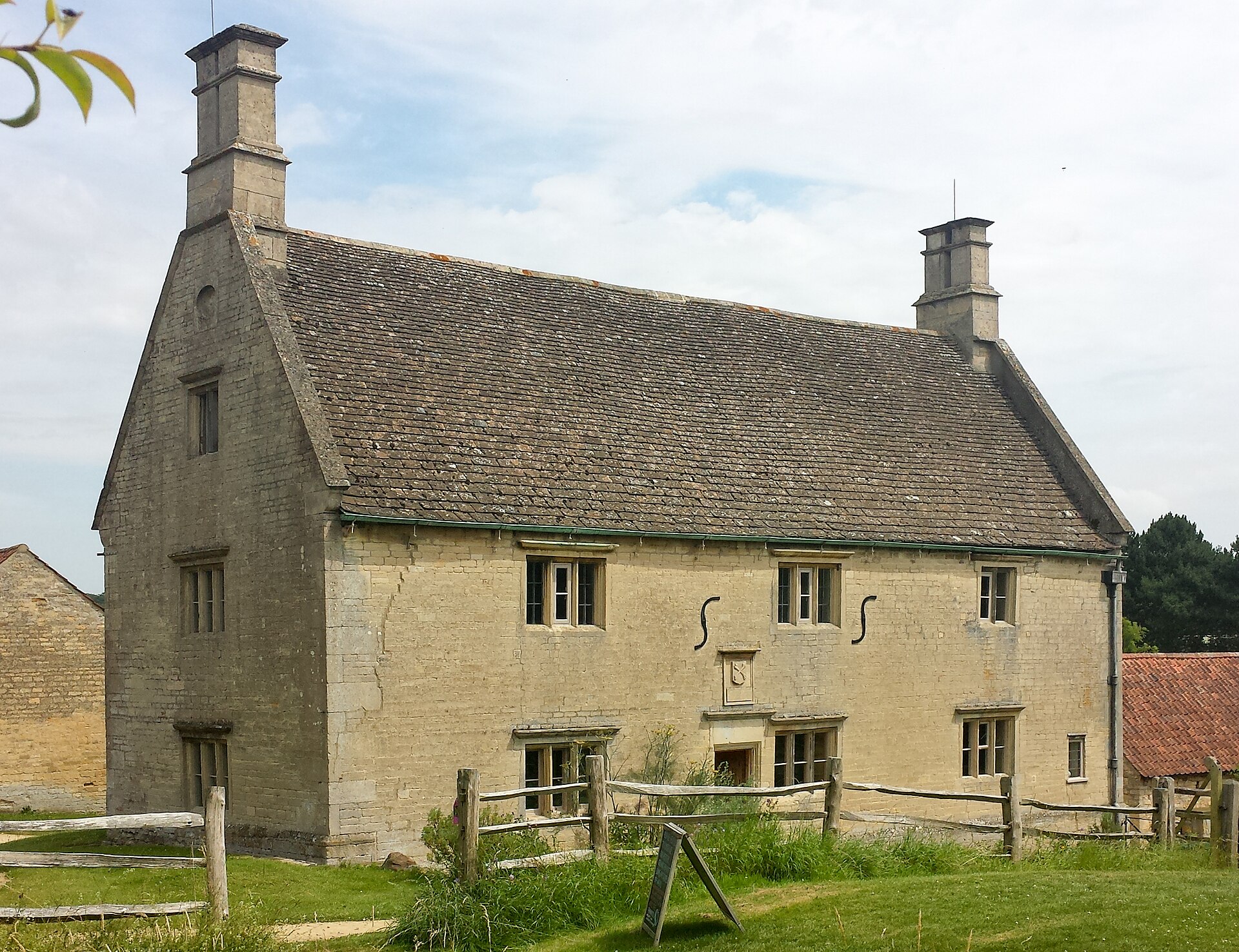
Born at Woolsthorpe Manor, Lincolnshire, three months after his father's death.1
Admitted to Trinity College, Cambridge, as a sizar.1
Cambridge closed for plague; working alone at Woolsthorpe, develops the calculus, the composition of light and the inverse-square approach to gravitation.2
Appointed Lucasian Professor of Mathematics on Isaac Barrow's recommendation.1
Elected Fellow of the Royal Society after demonstrating his reflecting telescope; Hooke disputes his optical results soon after.2
Royal dispensation under Charles II exempts the Lucasian chair from the ordination requirement Newton's anti-trinitarian belief would not let him meet.213
Edmond Halley visits Newton at Cambridge and asks the question that leads to De Motu Corporum in Gyrum.3
Philosophiae Naturalis Principia Mathematica published, printing financed personally by Halley.3
Appointed Warden of the Royal Mint; moves to London.1
Promoted Master of the Mint; secures the conviction and execution of the counterfeiter William Chaloner.118
Elected President of the Royal Society, a position held until his death.1
Opticks published in English, the year after Hooke's death.2
Knighted by Queen Anne, the first scientist honoured this way for his scientific work.1
Commercium Epistolicum produced by a Royal Society committee Newton appointed and largely wrote himself, ruling in his favour over Leibniz.4
William Stukeley records Newton's own account of the falling apple, sixty years after the event it describes.6
Dies intestate at Kensington; buried in Westminster Abbey on 28 March.21
A portion of the theological manuscripts, descended through the Ekins family, given to New College, Oxford.19
The 5th Earl of Portsmouth gives the bulk of the scientific and mathematical Portsmouth Papers to Cambridge University Library; a descriptive catalogue of them is not published until 1888.19
Remaining Portsmouth Papers, mostly alchemical and unorthodox theological material, sold at Sotheby's on 13 and 14 July; split chiefly between John Maynard Keynes and Abraham Yahuda.3
The Yahuda collection becomes generally accessible to scholars at the National Library of Israel, following its cataloguing by David Castillejo.3
Newton's market runs on two separate tracks that rarely meet: the printed Principia, where scarcity is measured in named surviving copies rather than editions, and the autograph manuscripts, where a single working page can outprice a bound book. Reporting on both tracks is inconsistent about separating the hammer price from the buyer's premium, and this record states plainly, sale by sale, which figure is actually available rather than presenting a premium-inclusive price as if it were the hammer.
| Date | Sale | Work | Result | Note |
|---|---|---|---|---|
| 2016-12 | Christie's, New York | Principia, 1687 first edition, Continental issue | Hammer not separately disclosed in the source consulted With premium USD 3,719,500 total price including buyer's premium USD | Against a pre-sale estimate of USD 1,000,000 to 1,500,000. Reported as the record price for any science book at auction at the time. |
| 2013 | not named in the sources consulted | Principia, 1687 first edition, presentation copy for King James II | Hammer not separately disclosed With premium USD 2,500,000 total price including buyer's premium, as reported USD | One widely circulated account of a later sale misidentifies the recipient as King James I, who died in 1625, before the book existed. This record follows the internally consistent identification of James II. |
| 26 May 2021 | University Archives (online-only sale) | Autograph manuscript, two pages, calculations on stellar and cometary positions related to Principia Book III | Hammer not separately disclosed With premium USD 118,750 total price including buyer's premium USD | Top lot of a 409-lot sale that achieved a 97 percent sell-through rate. |
| 21 June 2023 | Bonhams | Autograph letter signed, to Samuel Pepys, on the appointment of a mathematics master at Christ's Hospital | Hammer not separately disclosed With premium GBP 190,900 total price including buyer's premium GBP | Only four other Newton letters to Pepys are recorded as surviving. |
| 2001 | not named in the source consulted | Single leaf from a Paradoxical Questions manuscript | Hammer not stated With premium USD 18,000, as reported by the Newton Project USD | Cited by the Newton Project as a benchmark showing a single leaf could outsell the entire 1936 Portsmouth Papers sale total on its own; auction house and exact date not given in the source consulted. |
Hammer is the price at which the bidding stopped; with premium adds the fee the house charges the buyer on top. Hammer price and buyer's premium in the glossary.
| Institution | City | Holdings | Note |
|---|---|---|---|
| Cambridge University Library | Cambridge | The bulk of the scientific, mathematical and administrative Portsmouth Papers, given by the family in the 1870s and 1880s | Digitised in the Cambridge Digital Library Newton Papers project. |
| King's College, Cambridge | Cambridge | The Keynes collection of alchemical manuscripts, bequeathed 1946 | Built from lots John Maynard Keynes bought at the 1936 Sotheby sale. |
| National Library of Israel | Jerusalem | The Yahuda collection of theological, chronological and prophetic manuscripts, roughly 7,500 pages in Newton's hand | Accessible to scholars only from the late 1960s; recognised on UNESCO's Memory of the World register. |
| New College, Oxford | Oxford | A separate portion of theological manuscripts, descended through the Ekins family | Given in 1872, independently of the main Portsmouth Collection. |
| Science History Institute | Philadelphia | Alchemical manuscripts including material used in the Newton Watermark Project | Held in the Institute's Othmer Library. |
| Wren Library, Trinity College, Cambridge | Cambridge | Newton's own annotated copy of the Principia first edition, with his autograph corrections for the second edition | Trinity was Newton's own college. |
| The Royal Society | London | The manuscript from which the 1687 first edition was set in type, and Stukeley's manuscript account of the apple story | Newton was President from 1703 until his death. |
| Woolsthorpe Manor (National Trust) | Woolsthorpe-by-Colsterworth, Lincolnshire | Newton's birthplace, including a tree propagated from the tree associated with the apple story | |
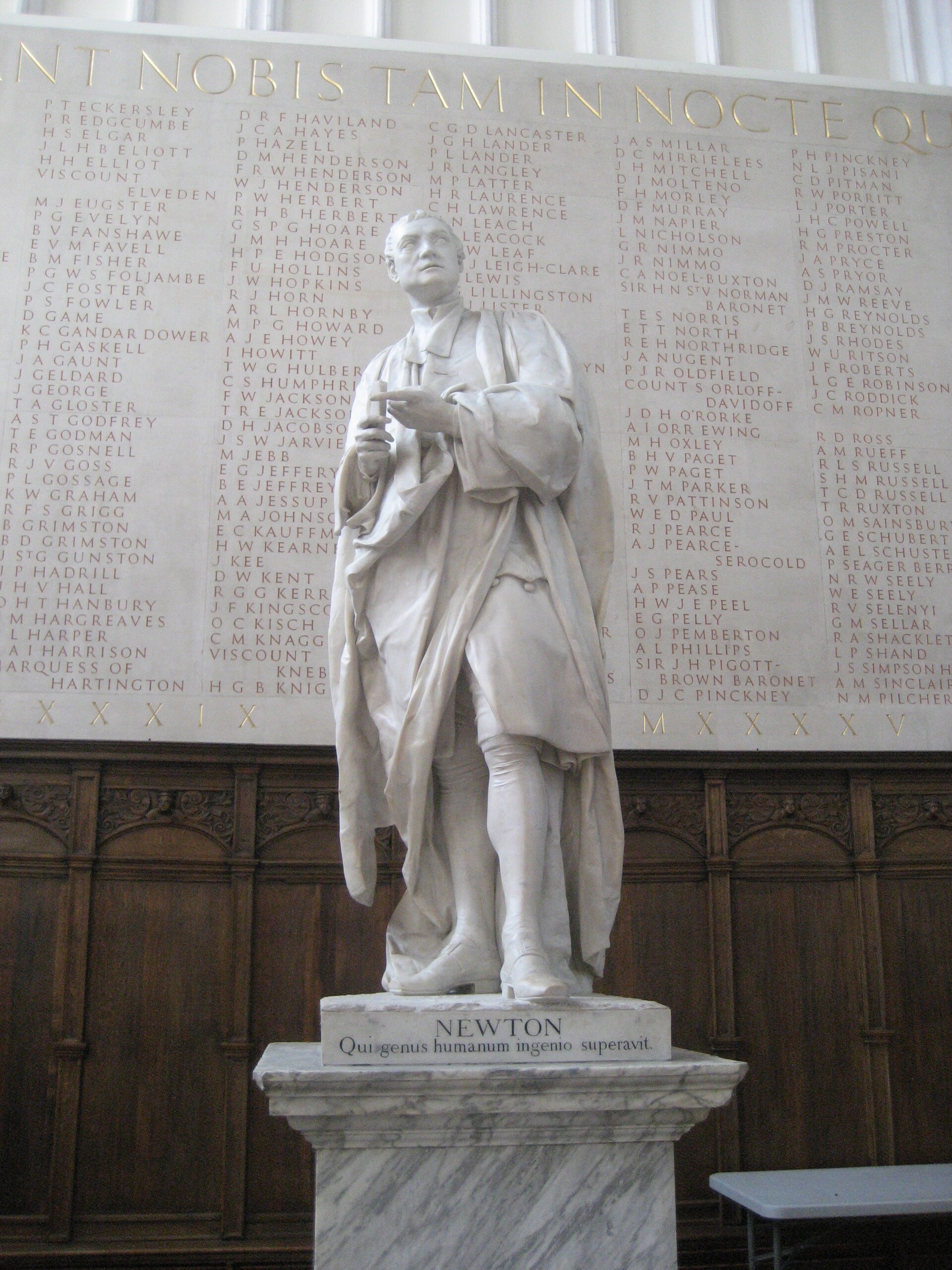
| Westminster Abbey | London | Newton's grave and monument, executed by Michael Rysbrack to William Kent's design | The Abbey's own records describe Newton as standing at the forefront of the scientists honoured in the area now nicknamed Scientists' Corner, without stating he was the first. |
Newton was born prematurely at Woolsthorpe Manor in Lincolnshire, on Christmas Day 1642 by the Julian calendar still used in England, three months after his father, a yeoman farmer also named Isaac...
Newton was born prematurely at Woolsthorpe Manor in Lincolnshire, on Christmas Day 1642 by the Julian calendar still used in England, three months after his father, a yeoman farmer also named Isaac Newton, had died. His mother Hannah remarried when he was three and moved to her new husband's parish, leaving the boy at Woolsthorpe in his grandmother's care, an arrangement biographers have connected to the difficult, suspicious temperament people who knew him later in life described. He was educated at the King's School in Grantham and admitted to Trinity College, Cambridge in June 1661 as a sizar, a fee-reduced status that in practice meant performing menial service for wealthier students, not the position of a boy marked from birth for a public monument in Westminster Abbey.
Cambridge closed for most of 1665 and 1666 because of the plague, and Newton spent all but a few months of that period back at Woolsthorpe.
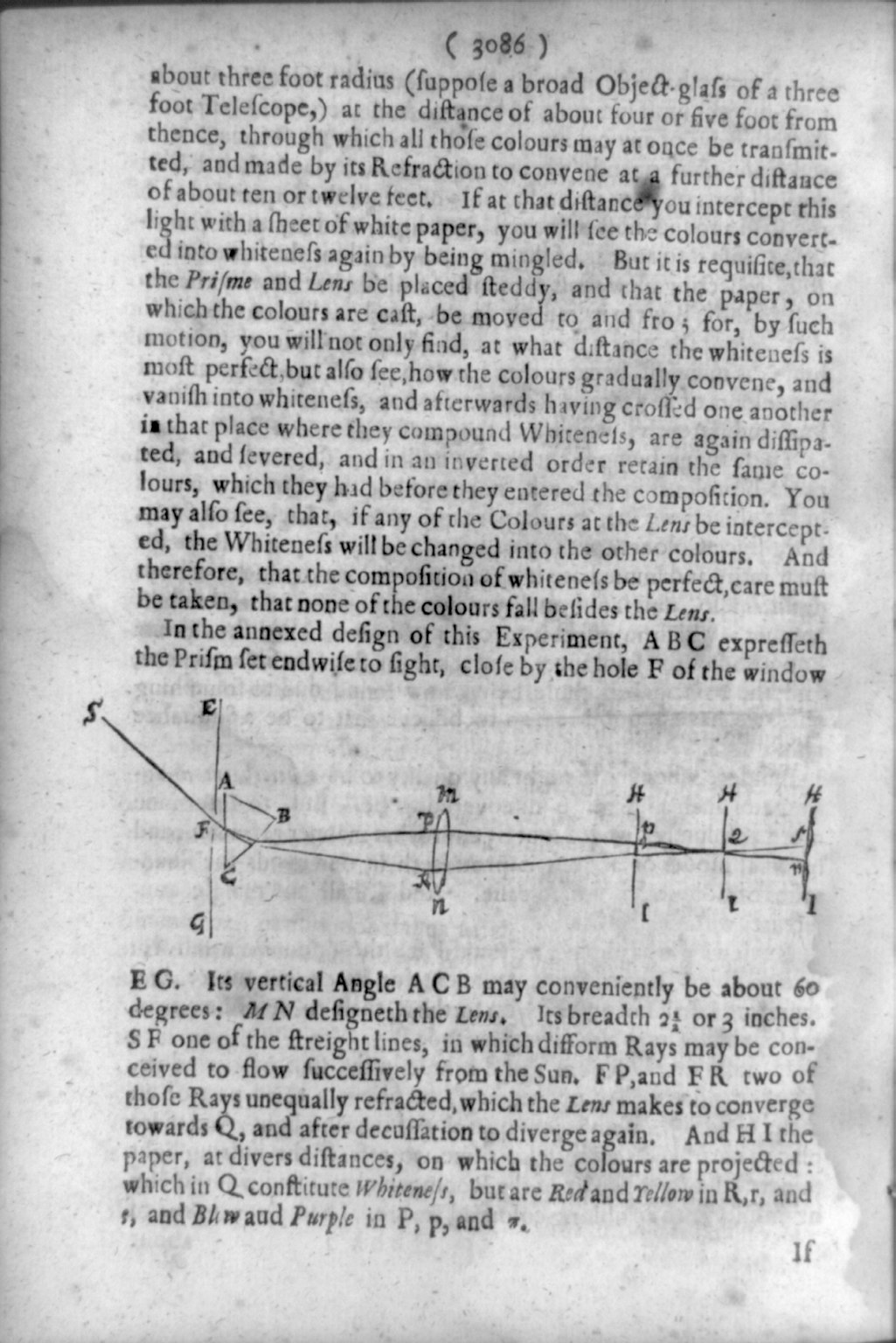
Cambridge closed for most of 1665 and 1666 because of the plague, and Newton spent all but a few months of that period back at Woolsthorpe. In that span, later called his annus mirabilis, he worked out the essentials of the calculus, ran the first experiments proving that white light is a mixture of differently coloured, differently refracted rays rather than a single uniform substance, and did enough on the inverse-square relationship between gravity and orbital motion to satisfy himself, by calculation, that the same force holding an apple to the ground could hold the Moon in its orbit. By late 1666, without having published a word of it, he was already the most advanced mathematician alive. He would not tell the world any of this for years.
Newton returned to Cambridge in 1667 as a Fellow, built the first working reflecting telescope in 1668 or 1669, and on Isaac Barrow's recommendation succeeded him as Lucasian Professor of Mathematics...
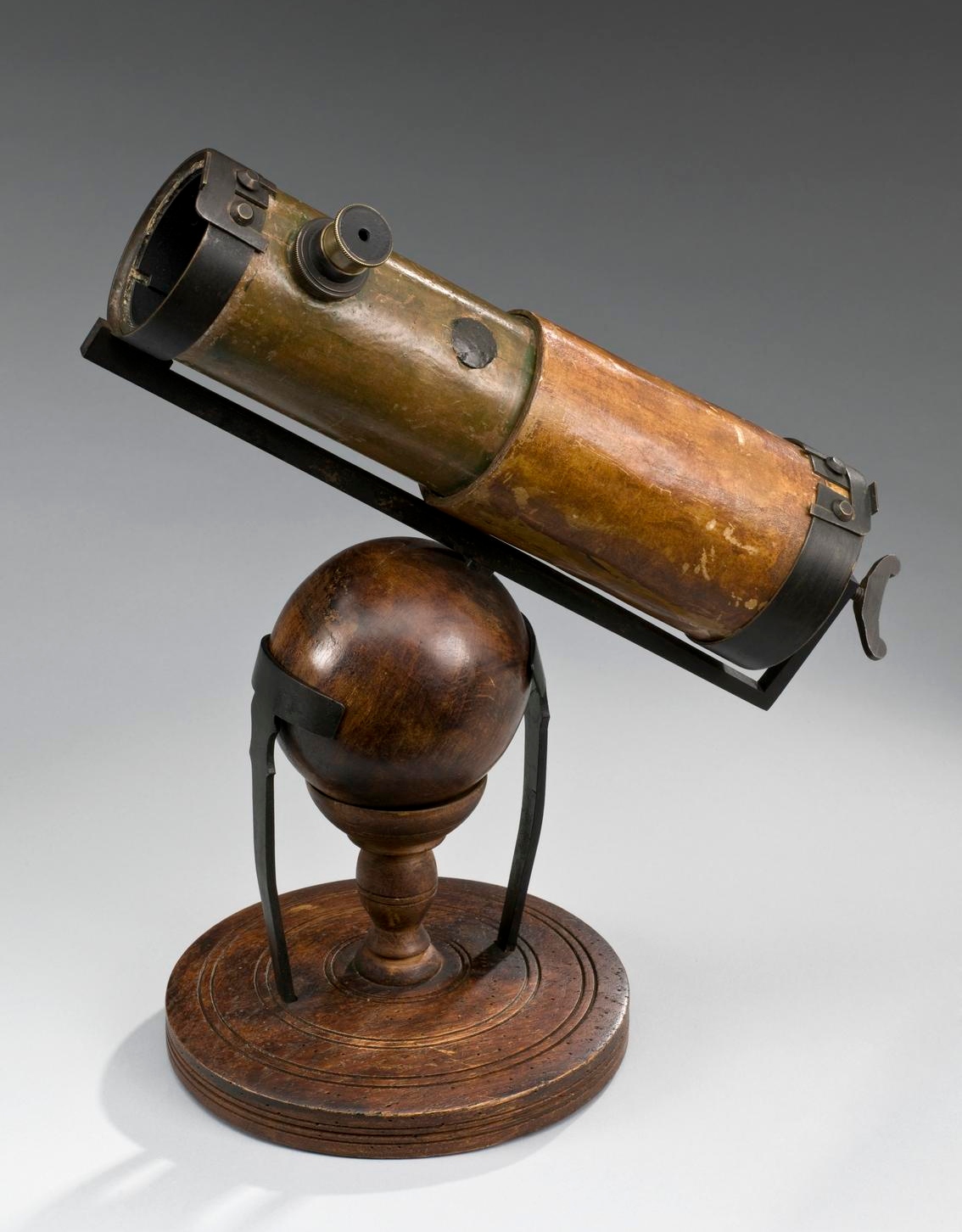
Newton returned to Cambridge in 1667 as a Fellow, built the first working reflecting telescope in 1668 or 1669, and on Isaac Barrow's recommendation succeeded him as Lucasian Professor of Mathematics in October 1669, in his mid-twenties. The Lucasian chair carried a requirement that its holder take holy orders in the Church of England within a set term. Preparing to satisfy that requirement is what seems to have driven Newton to a close study of the doctrine of the Trinity, and what he found convinced him that the doctrine was a corruption introduced centuries after the Gospels, not a position he could honestly swear to hold. He did not resign the chair and he did not take orders. A royal dispensation issued under Charles II on 27 April 1675 exempted the Lucasian professorship from the ordination requirement, a narrow and specific rescue that let him keep working at Cambridge without ever making his real theological position public. He held that position in near-total secrecy for the rest of his life.
Newton built his reflecting telescope to avoid the coloured fringing that afflicted the refracting telescopes of the day, a defect his own optical experiments had just explained.
Newton built his reflecting telescope to avoid the coloured fringing that afflicted the refracting telescopes of the day, a defect his own optical experiments had just explained. The instrument's small size and clean image won him election to the Royal Society in January 1672, and his first paper to the Society, on the composition of light, provoked immediate and sustained objection from Robert Hooke, who claimed priority over the underlying results. Newton's response to criticism, then and for the rest of his career, was not measured debate but withdrawal: he pulled back from Royal Society business for years afterward, and he held back publication of his full optical treatise, Opticks, until 1704, the year after Hooke died. It was his first major book published in English rather than Latin, a deliberate choice that reached a far wider readership than the geometry-heavy Principia ever could.
In August 1684 the astronomer Edmond Halley travelled to Cambridge and asked Newton what curve a planet would trace if it orbited under a force that weakened with the square of distance.
In August 1684 the astronomer Edmond Halley travelled to Cambridge and asked Newton what curve a planet would trace if it orbited under a force that weakened with the square of distance. Newton answered immediately that it would be an ellipse, and said he had already proved it, though he could not lay hands on the proof when Halley asked to see it. By December Halley was reporting to the Royal Society that Newton had produced a short treatise, De Motu Corporum in Gyrum, and had promised to register it formally. Over the following eighteen months that short paper grew into the three books of the Philosophiae Naturalis Principia Mathematica. The Royal Society had already committed its publication funds to Francis Willughby and John Ray's De Historia Piscium, a history of fishes that sold badly enough to leave the Society unable to honour its promise to print Newton's book. Halley paid the printing costs from his own pocket, edited the text, managed a prickly and demanding author, and fought off a dispute with Hooke over credit for the inverse-square law along the way. The book was finished on 5 July 1687. Halley's own payment for two years of that work was twenty pounds and seventy unsold copies of the fish book.
Newton's private theological writing runs to thousands of manuscript pages, most of it unpublished in his lifetime and unread by scholars until the second half of the twentieth century.
Newton's private theological writing runs to thousands of manuscript pages, most of it unpublished in his lifetime and unread by scholars until the second half of the twentieth century. It covers the chronology of ancient kingdoms, the architecture and measurements of the Temple of Solomon read as a prophetic diagram, and sustained interpretation of the biblical books of Daniel and Revelation. Threaded through all of it is the conviction that arrived at Cambridge in the early 1670s: that the doctrine of the Trinity was a fourth-century corruption of an original, simpler monotheism in which Christ held a real but subordinate status to the Father. The historian Stephen Snobelen, who has worked through this material at length, warns against simply calling Newton an Arian in the historical, fourth-century sense and instead describes him as a Nicodemite, a believer who practised outward religious conformity while privately holding a view he knew could end his career and his liberty if it became known. Denial of the Trinity was against the law in England throughout his life. He told almost no one.
Alchemy occupied Newton for roughly as long as physics did, not as a passing curiosity but as a sustained programme of reading and laboratory work that ran alongside the optics and the calculus in...
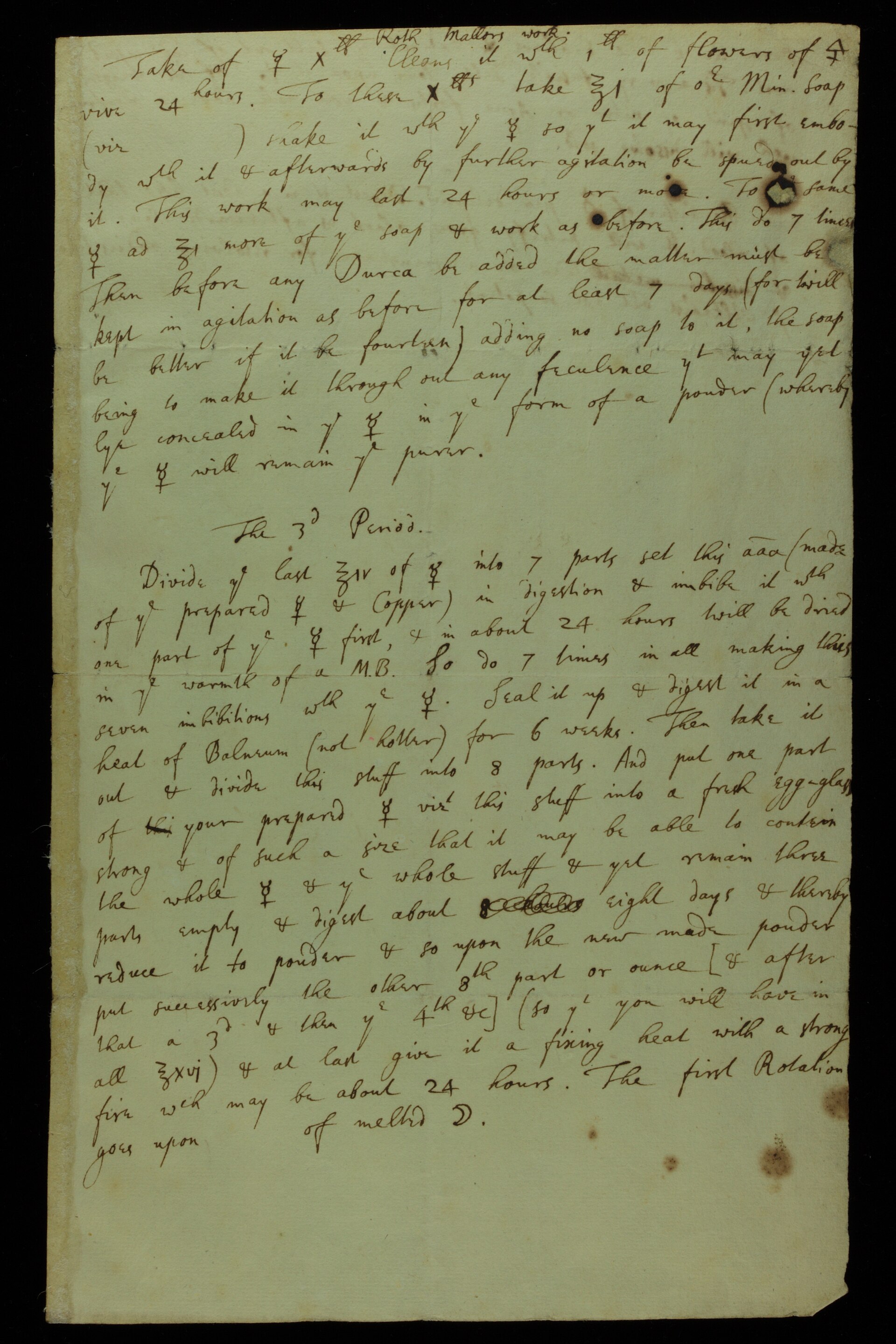
Alchemy occupied Newton for roughly as long as physics did, not as a passing curiosity but as a sustained programme of reading and laboratory work that ran alongside the optics and the calculus in the same Cambridge rooms. He wrote a lengthy alchemical treatise usually called Praxis in the early 1690s and never published it. For most of the twentieth century this material was treated as an embarrassing aberration, kept out of print and out of the standard biographies. The Chymistry of Isaac Newton Project at Indiana University, led by the historian William Newman, has argued instead that chymistry, the term Newton's contemporaries used for a field spanning metallic transmutation, industrial chemistry and pharmacology, was an ordinary and substantial part of the wider scientific culture Newton worked in, and the project has gone as far as replicating some of his recorded experiments in a modern laboratory to test what he actually observed. The manuscripts themselves are now scattered between Cambridge, King's College Cambridge and the Science History Institute in Philadelphia, among other repositories.
Gottfried Wilhelm Leibniz published his own version of the calculus in 1684, using different notation and, on the evidence available, arrived at independently.
Gottfried Wilhelm Leibniz published his own version of the calculus in 1684, using different notation and, on the evidence available, arrived at independently. Newton's supporters, and by the 1700s Newton himself, pressed the claim that Leibniz had seen Newton's unpublished work through correspondence and derived his method from it rather than discovering it afresh. In 1712, as sitting President of the Royal Society, Newton appointed a committee to examine the question, and that committee produced the Commercium Epistolicum, published under the Society's name in 1713 and presented as an impartial verdict. It was nothing of the kind. Newton wrote the substance of the report himself, drawing on old correspondence and papers held by the Society, and then published an anonymous review of his own committee's findings in the Society's own Philosophical Transactions, savaging Leibniz's position under cover of anonymity. The document concluded, predictably, that Newton had priority and that Leibniz's method derived from it. Historians since, including Rupert Hall, have set out how one-sided the process was; the modern consensus is that both men reached the calculus independently, by different routes, and that the 1712 inquiry was never capable of settling the question it claimed to answer because its subject was also its judge.
Newton left Cambridge for London in 1696 to become Warden of the Royal Mint, was promoted to Master in 1699, and treated the post as a serious office rather than a sinecure attached to his fame.
Newton left Cambridge for London in 1696 to become Warden of the Royal Mint, was promoted to Master in 1699, and treated the post as a serious office rather than a sinecure attached to his fame. He oversaw the Great Recoinage of the 1690s and took personal charge of investigating counterfeiters, a capital crime under the treason laws of the period. His most sustained case was against William Chaloner, a serial counterfeiter and confidence trickster who had twice previously talked his way out of conviction. Newton spent close to two years gathering testimony against him, had him arrested on a minor lottery-fraud charge in October 1698 to hold him while the counterfeiting case was built, and secured a conviction for high treason before the notoriously severe judge Sir Salathiel Lovell. Chaloner was hanged at Tyburn on 22 March 1699; the fullest surviving account of the execution describes him twitching for several minutes in the hangman's dance, and the only words of his on record are an earlier private letter begging Newton for mercy, not a public protestation of innocence. Newton held the Mastership of the Mint for the rest of his life alongside the presidency of the Royal Society, which he took up in 1703 and kept until his death.
The story of Newton and the falling apple comes from exactly one source: Newton's own telling, recorded by his friend William Stukeley after a conversation on 15 April 1726, less than a year before...
The story of Newton and the falling apple comes from exactly one source: Newton's own telling, recorded by his friend William Stukeley after a conversation on 15 April 1726, less than a year before Newton died, and written up by Stukeley into his Memoirs of Sir Isaac Newton's Life in 1752, a quarter of a century later still. Stukeley's manuscript survives in the Royal Society's own archive. Newton was describing events sixty years past, from his time at Woolsthorpe during the plague years, and there is no earlier or independent record of the incident. That does not make it invented: it makes it a late, single-source, first-person anecdote, which is a different and weaker kind of evidence than a diary entry or a witnessed letter, and it should be read as that. What Stukeley records is an apple falling from a tree while Newton sat outdoors in a reflective mood, prompting the question of why it always fell straight down rather than sideways or upward, not a blow to the head and not a single flash of complete insight. Grafts and cuttings claimed to descend from the actual tree at Woolsthorpe Manor have been propagated and distributed for two centuries, and the manor itself, now in the care of the National Trust, still displays a tree grown from one of them.
Newton died without a will in March 1727.
Newton died without a will in March 1727. His half-niece Catherine Barton, who had kept house for him in London for years, and her husband John Conduitt took charge of his papers, and Conduitt added his own notes toward a planned biography that was never finished. The collection passed on the death of their daughter, also named Catherine, into the Wallop family when she married John Wallop, later Viscount Lymington and in time the family that held the earldom of Portsmouth, and it stayed there, largely unpublished and increasingly unread, for nearly two centuries. A first portion, the scientific and mathematical papers, was given to Cambridge University Library by the family in the 1870s and 1880s. A second, smaller portion of theological manuscripts had already gone a different way in 1872, passed down through a descendant, the Reverend Jeffrey Ekins, and given to New College, Oxford. The rest, the material the family and Cambridge had not wanted, including nearly all of the alchemical notebooks and the bulk of the unorthodox theology, was put up for sale at Sotheby's on 13 and 14 July 1936 by Gerard Vernon Wallop, Viscount Lymington, who did not become the 9th Earl of Portsmouth until 1943, and raised a little over nine thousand pounds in total, a sum smaller than a single leaf from the same archive would fetch alone at auction in 2001. The economist John Maynard Keynes, alerted late, bought heavily into the alchemical lots and left his purchases to King's College, Cambridge on his death in 1946. The scholar Abraham Yahuda competed with him for the same lots and concentrated on the theological and chronological material; his collection passed, after his death in 1951 and a period of legal dispute over his estate, to the National Library of Israel in Jerusalem, where it became generally accessible to researchers only at the end of the 1960s. The frank scale of Newton's private writing did not become visible to scholarship as a single body of evidence until that access opened, more than two hundred years after his death.
A 1953 census counted 189 surviving copies of the 1687 first edition of the Principia.
A 1953 census counted 189 surviving copies of the 1687 first edition of the Principia. A far more thorough census published in 2020 by Mordechai Feingold and Andrej Svorencik, after more than a decade of tracing individual copies through libraries, dealers and private hands, found 387, and estimated that as many as 200 more may exist undocumented, against a print run the two historians now put at 600 to 750 copies rather than the smaller figure long assumed. Marginal notes and shared ownership marks in the copies they traced showed the book circulating and being read far more widely, and much earlier, than its reputation for extreme difficulty had suggested. The market for what survives is active and well documented at the top end, though the reporting is inconsistent about separating the hammer price from the buyer's premium, a gap this record notes rather than silently closes. A first-edition Continental issue, one of an estimated eighty copies bound for European buyers, sold at Christie's in New York in December 2016 for 3.7 million dollars including premium, against a pre-sale estimate of 1 to 1.5 million; a separate first-edition copy from the Giancarlo Beltrame collection, with a provenance including the historian Thomas Carlyle and the American banker Gustavus Wynne Cook, was estimated at 200,000 to 300,000 pounds at Christie's London on 12 July 2016, though the price it actually made is not stated in the source consulted for this record. A copy reported as a presentation copy for King James II sold in 2013 for 2.5 million dollars; one widely syndicated account of the later 2016 sale names the recipient as James I, a mistake, since James I died in 1625, sixty-two years before the book existed, and this record follows the internally consistent identification of James II rather than repeat the error. Newton's autograph manuscripts reach auction far more often than his printed books survive as unique copies: a two-page working sheet of calculations on stellar and cometary positions related to Book III of the Principia made 118,750 dollars including premium in an online-only sale in May 2021, and a 1695 letter to Samuel Pepys about the appointment of a mathematics master at Christ's Hospital made 190,900 pounds including premium at Bonhams in June 2023. Neither result is broken out into hammer and premium in the listings consulted for this record.
Natural philosopher; Mathematician; Astronomer; Theologian; Alchemist; Master of the Royal Mint. 1642-1727.
Born 25 December 1642 (Julian calendar); 4 January 1643 (Gregorian), Woolsthorpe-by-Colsterworth, Lincolnshire, England; died 20 March 1726/27 (Julian calendar); 31 March 1727 (Gregorian), Kensington, London, England.
The Vrain-Lucas forgeries sold to Michel Chasles, 1861-1870. The French forger Denis Vrain-Lucas sold the mathematician Michel Chasles a series of letters purporting to show that Blaise Pascal, not Newton, had first arrived at the theory of universal gravitation, supposedly through correspondence with Newton and Robert Boyle. Chasles paid an estimated 140,000 to 150,000 francs over the years for these and thousands of other forged autographs, and presented the Pascal material to the French Academy of Sciences from 1867 onward as genuine evidence displacing Newton's claim to priority.
Cambridge University Library (Cambridge); King's College, Cambridge (Cambridge); National Library of Israel (Jerusalem); New College, Oxford (Oxford); Science History Institute (Philadelphia); Wren Library, Trinity College, Cambridge (Cambridge).
Newton's market runs on two separate tracks that rarely meet: the printed Principia, where scarcity is measured in named surviving copies rather than editions, and the autograph manuscripts, where a single working page can outprice a bound book. Reporting on both tracks is inconsistent about separating the hammer price from the buyer's premium, and this record states plainly, sale by sale, which figure is actually available rather than presenting a premium-inclusive price as if it were the hammer.
What auction house handled the 2013 sale of the Principia presentation copy for King James II, and what was the actual hammer price before premium. The sources consulted give only a headline total and, in one case, misname the king.
Last verified
One artwork and its story every Tuesday, with the picture: who owned it, what it made, and what closes soon in the exhibition calendar. No promotion, and nothing we cannot cite.
We send one email to confirm the address and keep nothing else. Every letter carries a one-click unsubscribe. How we handle your data.


