Plaque with Oba (King) or Chief
Igun Eronmwon (brass-casting guild) artists · ca. 1540-70
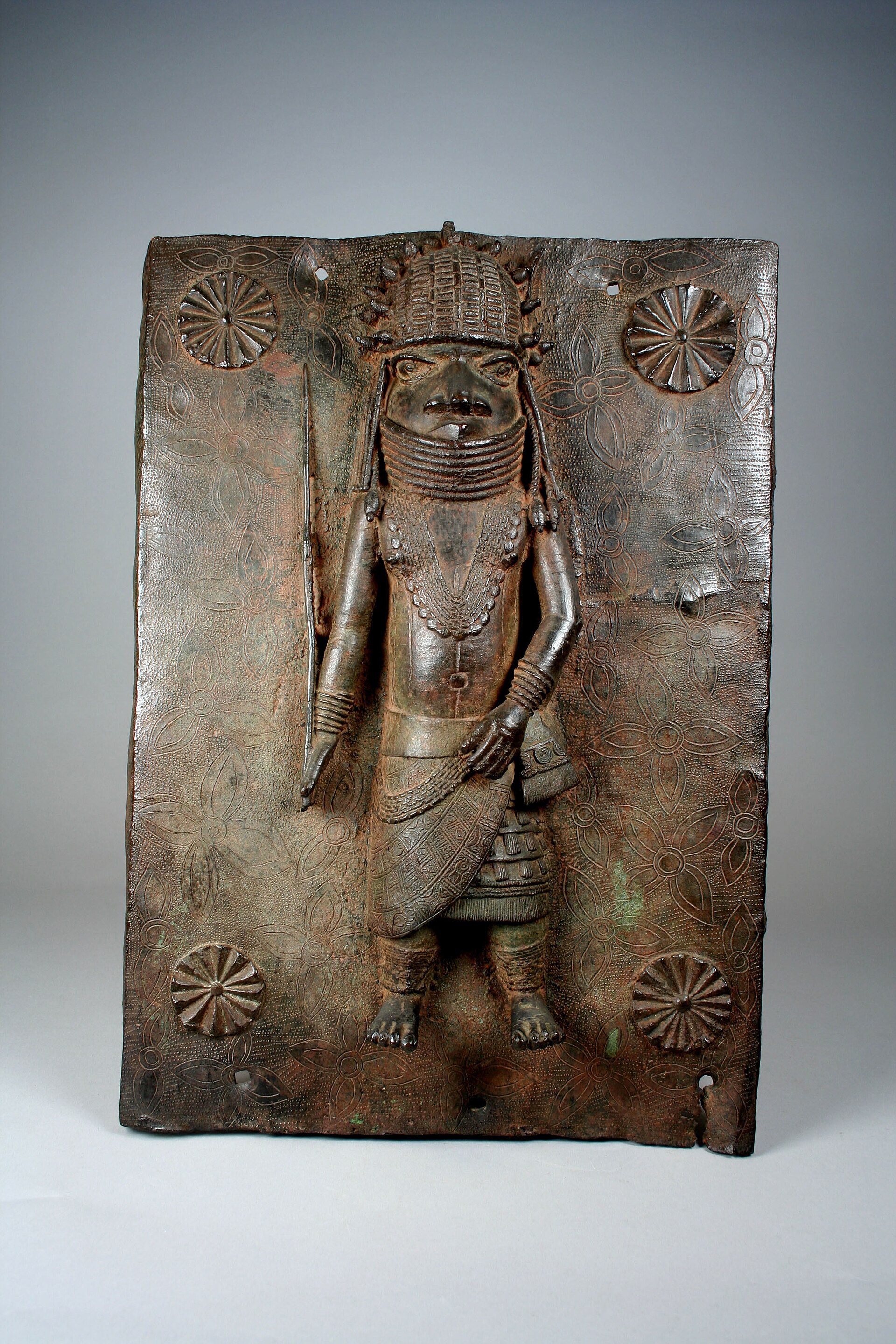
The record subject: the front of the plaque, brass, ca. 1540-70. Donated to Wikimedia Commons by the Metropolitan Museum of Art as part of the Museum's Open Access program.
| Artist | Igun Eronmwon (brass-casting guild) artists |
|---|---|
| Date | ca. 1540-70 |
| Medium | Brass, lost-wax (cire-perdue) cast in relief |
| Dimensions | H. 50.2 x W. 34.9 x D. 8.9 cm (19 3/4 x 13 3/4 x 3 1/2 in.) |
| Where it is now | Metropolitan Museum of Art, New York, on view in Gallery 342, The Michael C. Rockefeller Winglast confirmed |
| Inventory number | 1991.17.16 |
| Attribution | AcceptedAttributed by the Metropolitan Museum of Art to the Igun Eronmwon brass-casting guild of the Court of Benin as a corporate body, not to a named individual. Full note |
| Object type | Sculpture |
| Period | Edo, Court of Benin, Kingdom of Benin |
| Cases | Seized, looted or confiscated · Has a provenance gap |
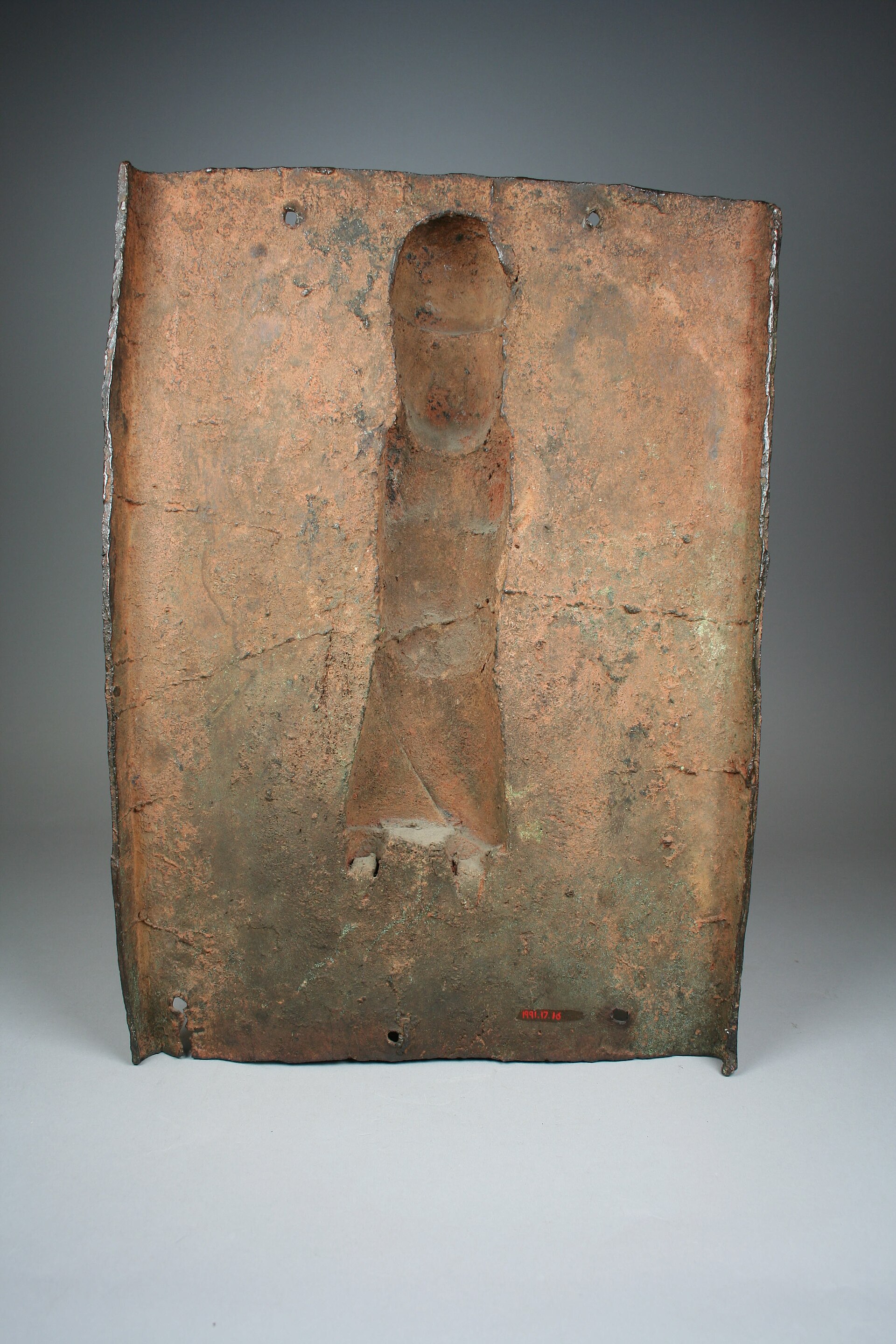
| Inscriptions | No inscription or signature on the front. This plaque's own reverse has not been separately described in the sources consulted; plaques of this type generally have a reverse roughly hollowed behind the raised figure to keep the metal of even thickness, and some carry incised marks on the back whose significance is not established. |
| Owners on record | 6 links5 documented, 1 unknown |
| Sources | 21 cited |
About this record Last verified · 21 sources cited · Change log
On this page 11 sections
ContentsClose
A brass relief plaque, about 50 by 35 centimetres, showing a richly regaled chief or king holding a ceremonial wand, cast by the Igun Eronmwon guild of Benin City for the walls of the royal palace, most likely between about 1540 and 1570 under Oba Esigie or his son Oba Orhogbua. It was seized from the palace by British forces during the 1897 Punitive Expedition and entered the Western art market by a route the Museum's own published record does not describe. The dealer Klaus Perls and his wife Amelia owned it by 1991, when they gave it, with 152 other Benin objects, to the Metropolitan Museum of Art.
It has never been sold at public auction and has not been individually named in any restitution claim found in the sources consulted. Two other plaques from the same 1991 gift were returned to Nigeria in 2021 after Museum research established they had been stolen from Nigeria's own National Museum in Lagos after 1960; the Museum's published record for this plaque describes no comparable finding, and whether the same research question has been put to this specific object is not stated anywhere found.
The plaque remains on view at the Met, one of roughly 180 Benin court works the Museum holds, the great majority from the same 1991 gift. Nigeria's National Commission for Museums and Monuments has requested the return of the wider Benin corpus since at least 2022, and a 2023 Nigerian government gazette naming the Oba of Benin, not the NCMM, as owner of returned works has since complicated further restitutions elsewhere. No announcement specific to this accession has been found.
Provenance
Each link is graded. Documented: a cited source supports it. Disputed: the identification is argued but not established. Unknown: no owner for that span, and the gap is not smoothed into a narrative. The grades in the glossary.
- ca. 1540 - ca. 1570Oba Esigie (r. ca. 1517-50) or his son Oba Orhogbua (r. ca. 1550-70), Court of Benindocumented
Per the Metropolitan Museum's own current catalogue dating. The precise dating of the whole plaque corpus is itself a live scholarly argument, set out in this record's narrative; ca. 1540-70 reflects Kathryn Wysocki Gunsch's 2018 revision of the older Fagg/Dark chronology, which the Museum's record now follows.129
- ca. 1570 - 1897By descent to Oba Ovonramwen (r. 1889-97), Benin Citydocumented
Per the Metropolitan Museum's own published provenance note for this accession.12
- 1897 - 1897Seized by British forcesdocumented
Taken from the Royal Palace during the British military occupation of Benin City in February 1897, per the Museum's own published provenance note and its wider account of the Punitive Expedition.123
- 1897 - by 1991Unknownunknown
No owner, dealer, sale or date is recorded in any source found for this interval. The Museum's own provenance note moves directly from the 1897 seizure to Perls ownership 'by 1991,' and the 1992 catalogue entry for this exact plaque (no. 35, p. 133) adds no ex-collection or reference line. Two sibling plaques from the same 1991 gift are documented to have passed through the British Museum (1898-1950) and the National Museum in Lagos (1950-51) before an undocumented post-1960 exit from Nigeria; whether this plaque shared that route is not established either way in the sources consulted, and this record does not assume it did.1231011
- by 1991 - 1991Mr. and Mrs. Klaus G. Perls, New Yorkdocumented
The Museum's provenance note establishes only that the Perls owned the plaque 'by 1991'; no acquisition date or seller is named. Klaus and Amelia (Dolly) Perls, dealers in modern European art, are recorded as having begun collecting Benin art in the 1970s.1212
- 1991 - presentMetropolitan Museum of Art, New Yorkdocumented
Accessioned 1991.17.16, one of 153 Benin objects given by Mr. and Mrs. Klaus G. Perls in 1991. Exhibited in 'Royal Art of Benin from the Perls Collection,' Metropolitan Museum of Art, January 16 - September 13, 1992, and published as catalogue no. 35. On view in Gallery 342, The Michael C. Rockefeller Wing, as of the date checked.123
Technical evidence
| Attribution note | Attributed by the Metropolitan Museum of Art to the Igun Eronmwon brass-casting guild of the Court of Benin as a corporate body, not to a named individual. Benin court brasswork was produced by a closed, hereditary guild answerable directly to the Oba; no maker's mark or signature practice is documented for this tradition, so an attribution to 'the guild' rather than a person is the accepted and correct level of specificity, not a gap in the record. |
|---|---|
| Casting method | Lost-wax (cire-perdue): a wax model was built, sometimes over a clay core, with finer details incised directly into the wax; the model was coated in fine then coarser clay to form a mold, which was fired to melt out the wax before molten brass was poured into the resulting cavity.3 |
| Dimensions (current) | H. 50.2 x W. 34.9 x D. 8.9 cm (19 3/4 x 13 3/4 x 3 1/2 in.), per the Metropolitan Museum's current published record.12 |
| Dimensions (1992 catalogue) | H. 19 1/2 in. (49.5 cm); no width or depth recorded. Kate Ezra, Royal Art of Benin: The Perls Collection, cat. no. 35, p. 133. The height differs from the Museum's current figure by about 0.7 cm; no source explains the difference.3 |
| Format | Turned-back vertical edges forming a rim about 1.3 cm (1/2 in.) deep, incised with a guilloche pattern - one of two known plaque formats, the other lacking a turned-back edge entirely. The variation is thought to reflect how a given plaque and its neighbors were fitted to a particular palace pillar.3 |
| Wall thickness and reverse | Plaques of this type are generally about 1/8 in. thick, with the reverse roughly hollowed behind the raised figure to keep the metal of even thickness; the plaques were fixed to their pillars with nails driven directly through the plate. This plaque's own reverse has not been separately described in the sources consulted.3 |
| Background decoration | Stylized four-lobed 'river leaf' (ebe-ame) pattern covering the background, with relief rosettes in the upper corners; both motifs are associated by scholars with Olokun, the Edo god of the sea and of wealth.3 |
| Classification and display | Museum classification: Metal-Sculpture. Curatorial department: The Michael C. Rockefeller Wing. On view at The Met Fifth Avenue, Gallery 342, as of the date checked.12 |
| Open-access status | Digitized and released by the Metropolitan Museum under CC0 (Creative Commons Zero / public domain dedication); the accession number was independently verified against the Museum's own public collection API, which returns an exact match on object ID 316489 with isPublicDomain: true.145 |
Images
The record in full
Chapter 1What it is
A rectangular brass plaque, cast in relief, showing a single male figure standing frontally: a chief or king wearing a coral-bead covered cap with a feather set on one side, a high beaded collar...
A rectangular brass plaque, cast in relief, showing a single male figure standing frontally: a chief or king wearing a coral-bead covered cap with a feather set on one side, a high beaded collar known as an odigba, and long strands of beads across his chest. He wears spiral bracelets, beaded anklets, and at least two wrapped and patterned cloth skirts tied with a sash. In his right hand he holds a slender rod. At his right hip hangs a swag or belt of beads, an element found on very few other figures in Benin art.
The plaque measures 50.2 by 34.9 by 8.9 centimetres in the Museum's current published dimensions (19 3/4 by 13 3/4 by 3 1/2 inches); the 1992 Metropolitan Museum catalogue recorded a height of 49.5 centimetres for the same object, a small difference between two Museum-published figures that is noted here rather than silently resolved. The vertical edges are turned back to form a raised rim about 1.3 centimetres deep, incised with a guilloche pattern, one of two known formats for these plaques and probably reflecting how the plaque and its neighbors were fitted to a particular palace pillar. The background is filled with a stylized four-lobed leaf pattern and, in the upper corners, relief rosettes.
Chapter 2The kingdom that made it
The plaque was made for the Oba of Benin, the divine king of an Edo-speaking state in the forest of what is now southern Nigeria, whose dynasty traced its founding to the thirteenth century...
The plaque was made for the Oba of Benin, the divine king of an Edo-speaking state in the forest of what is now southern Nigeria, whose dynasty traced its founding to the thirteenth century, according to oral tradition, when Edo chiefs are said to have invited Oranmiyan, a prince of neighboring Ife, to found a new royal line. Investiture as Oba conferred both religious authority, as chief priest of the state's rites, and command of an elaborate palace bureaucracy of chiefs, titleholders, priests and guilds.
By 1500 Benin's authority reached from the Niger Delta to the Lagos lagoon, and its rulers traded pepper, textiles and ivory to Portuguese, and later Dutch, French and English agents for imported brass, cloth and firearms, on Benin's own terms. For close to five hundred years Benin's kings dealt with European traders as equals and set the conditions of the exchange themselves. The plaque belongs to the period, from the reign of Oba Esigie (ca. 1517-50) into that of his son Oba Orhogbua (ca. 1550-70), when that contact, and the brass it brought, was at its height.
Chapter 3How it was made, and by whom
The Metropolitan Museum attributes the plaque not to a named artist but to the Igun Eronmwon guild as a body, the guild of brass-casters that worked exclusively for the Oba's court.
The Metropolitan Museum attributes the plaque not to a named artist but to the Igun Eronmwon guild as a body, the guild of brass-casters that worked exclusively for the Oba's court. Oral tradition collected by British colonial officers after 1897 credits a foreign craftsman, given as Ahammangiwa or Igueghae, with introducing lost-wax brass-casting to Benin in the reign of Oba Esigie, reportedly at the invitation of the Oba of Ife; Paula Ben-Amos, writing in the Metropolitan Museum's own 1992 catalogue of the Perls collection, notes that this tradition may describe the origin of the plaque form specifically or of brass-casting in Benin generally, and that either way it fixes the plaques to the period of Portuguese contact.
The guild was organized as a closed, hereditary body under direct royal patronage, the highest-ranked of as many as fifty guilds attached to the palace, passing its craft from father to son. Its quarters stood inside the palace grounds until 1897; after the Punitive Expedition scattered its members, they returned to Benin City following the 1914 restoration of the throne under Oba Eweka II and resettled on what is now Igun Street, where, according to the Metropolitan Museum's own 2025 documentary account, the guild continues to cast brass in the same lost-wax method today.
The casting itself used the cire-perdue process: a wax model, sometimes over a clay core, incised with the design's finer details, was coated in fine clay and then coarser clay to build a mold; the mold was fired, the wax ran out, and molten brass was poured into the resulting cavity. Once cast and broken free of the mold, the plaque's back was left roughly hollowed behind the raised figure, keeping the metal of fairly even thickness, about one-eighth of an inch on plaques of this type generally, and it was fixed to its palace pillar with nails driven directly through the plate.
Chapter 4The metal, and where it came from
The Edo language's own word for making this kind of object, sa-e-y-ama, translates literally as to cast a form in brass, according to the Metropolitan Museum's Objects Conservation department; the...
The Edo language's own word for making this kind of object, sa-e-y-ama, translates literally as to cast a form in brass, according to the Metropolitan Museum's Objects Conservation department; the phrase is usually rendered in English as "to commemorate," so that the material and the act of memory are named by the same word. Brass, an alloy of copper and zinc, was not smelted locally in meaningful quantity; the Museum's own historical account states that Benin exchanged pepper, textiles and ivory for the large quantities of imported metal that reached the court from Portuguese and other European traders.
A geochemical study published in 2023 examined the lead-isotope and trace-element signatures of manillas, the C-shaped brass rings used as trade currency along the West African coast, recovered from Atlantic shipwrecks and land sites of the 16th through 19th centuries, and compared them to a wider corpus of Benin brasswork. It found a strong match between manilla metal and Benin brass, and traced the manilla metal itself to ore from the German Rhineland - meaning that a large share of the brass in Benin court art of this period was very probably German in origin, carried to West Africa on Portuguese and other European ships as currency and then recast by Benin's own guild into royal regalia. This finding concerns the wider corpus of manillas and Benin brasswork studied in that survey; no alloy analysis of this specific plaque has been found in the sources consulted, and the finding is reported here as evidence about the material generally available to the guild in this period, not as a measurement of this object.
Paul Craddock, archaeometallurgist at the British Museum, separately found that the metal composition of individual plaques is not a reliable basis for dating them, a caution recorded in the Metropolitan Museum's own 1992 catalogue and still the working assumption in the scholarship consulted here.
Chapter 5What the figure shows, and what it may mean
Most of the coral regalia on this figure - the beaded cap, the high collar, the strands across the chest - is worn by many high-ranking chiefs in Benin art and marks the wearer's rank rather than a...
Most of the coral regalia on this figure - the beaded cap, the high collar, the strands across the chest - is worn by many high-ranking chiefs in Benin art and marks the wearer's rank rather than a single identity; only the Oba could grant the right to wear coral, whose associations with the sea god Olokun linked it to the crown's own claim on overseas wealth. The belt or swag of beads at the figure's right hip is rarer. Kate Ezra's 1992 Metropolitan Museum catalogue entry on this plaque records that an identical bead belt was noted as part of the king's own regalia by James Fawckner, an English sea captain who visited Benin in 1825, and that identically dressed figures recur on other plaques, sometimes alone, as here, and sometimes as the central figure of a larger group.
Barbara Blackmun, comparing this figure to similar figures on carved ivory altar tusks, found that her informants in Benin identified the type as Oba Esigie, whose reign, in the early sixteenth century, coincided with the height of Portuguese presence at court; on the tusks the figure often appears with foreign attendants, which is part of what led informants to the identification. Blackmun herself cautions that an identical figure on a plaque and on a tusk may not carry the same meaning in the two settings, and that without knowing which plaques originally hung beside this one on its pillar, the identification with Esigie can be argued but not confirmed. This record follows her caution: the reading is attributed here to Blackmun's informants and her own comparison, not stated as settled fact.
The rod in the figure's right hand is an unwenrhiontan, described in Benin ritual practice as a peeled branch, a "squirrel's whip," carried as a medicinally fortified wand that guides its holder and wards off danger on a path; Dutch chronicler D. R. recorded objects of this kind as early as the 1590s. Ezra's catalogue entry concludes that the figure most probably depicts an Oba engaged in a ceremony that required the wand, though, again, without knowing the plaque's original neighbors on the pillar a fuller reading is not possible from the object alone.
The plaque's background carries a further, more general layer of meaning. The four-lobed leaf pattern is identified by scholars as ebe-ame, or "river leaves," associated by Paula Ben-Amos with Olokun, the Edo god of the sea and of wealth, and used in the healing rites of Olokun's priestesses; the relief rosettes in the corners of related plaques have been read the same way, as the sun setting into the sea each night. Read together with the coral the figure wears, which is itself linked to Olokun's undersea wealth, the whole plaque restates in its background the same claim its subject makes in his regalia: that the Oba's power runs through, and draws upon, the god of the waters.
Chapter 6Where it hung, and the dating debate
The plaques were never a gallery of separate pictures.
The plaques were never a gallery of separate pictures. An eyewitness account of the Benin palace recorded by the Dutch writer Olfert Dapper in the seventeenth century describes galleries "resting on wooden pillars, from top to bottom covered with cast copper, on which are engraved the pictures of their war exploits and battles, and kept very clean"; about nine hundred such plaques are known to survive today, and Kate Ezra's Metropolitan Museum catalogue states that their interpretation depends on their arrangement in relation to each other, an arrangement lost since the pillars were stripped in 1897. When the Punitive Expedition took the palace, the plaques were not on the pillars at all: they had been placed into storage, probably by the Iwebo palace society responsible for the court's regalia, and a British officer, Reginald Hugh Bacon, recorded finding them, in his words, "buried in the dirt of ages, in one house."
Dating the plaques as a group has been argued over for a century. William Fagg, working from the same Rouppell-recorded oral tradition that credits Ahammangiwa with introducing brasswork under Oba Esigie, proposed production running from the mid-sixteenth to the end of the seventeenth century, treating the plaques as the central, dateable middle period of his three-part chronology of Benin art; he set his end date from the absence of any mention of plaques in the palace description left by the Dutch trader David van Nyendael, who visited in 1699 and 1702 and described other brasswork and woodwork in detail but not the plaques. Philip Dark proposed a stylistic sequence running from low relief to high, and suggested plaque production ceased around 1640, when oral tradition holds that Oba Ahenzae exhausted the royal brass reserves. Kathryn Wysocki Gunsch's 2018 monograph The Benin Plaques: A 16th Century Imperial Monument argues, against both Fagg's and Dark's roughly one-hundred-fifty-year span, that the whole surviving corpus was produced in a much tighter window of thirty to forty-five years spanning the middle of the sixteenth century, conforming closely to the reigns of Esigie and Orhogbua - the dating the Metropolitan Museum's own current catalogue record for this plaque, ca. 1540-70, now follows. Craddock's finding that metal composition does not reliably date individual plaques means this narrower chronology rests on stylistic and documentary argument, not metallurgy.
Chapter 71897: the Punitive Expedition
In 1892 Oba Ovonramwen signed an agreement easing British trade restrictions in Benin territory; Britain's view that the agreement was not being honored set the stage for what followed.
In 1892 Oba Ovonramwen signed an agreement easing British trade restrictions in Benin territory; Britain's view that the agreement was not being honored set the stage for what followed. In January 1897, James Phillips, the acting British Consul-General for the region, set out for Benin City without his superiors' authorization to press the trade question, accompanied by eight unarmed British officials and about two hundred African porters. The Oba, then engaged in a major ancestral rite, sent word asking Phillips to postpone the visit; Phillips continued regardless, and his party was ambushed on the road, most likely on the order of a group of chiefs rather than the Oba himself. Nearly all the Africans and all but two of the British were killed.
Britain assembled a punitive force of some fifteen hundred men, which captured and burned Benin City in February 1897, destroying much of the palace and the surrounding town. The Metropolitan Museum's own current account of this object states that soldiers plundered the palace and that the brutality of the destruction severed the individual royal altars, each built up over centuries for a specific Oba, from the very works made to commemorate them. Thousands of brass, ivory and wooden objects, including the palace's plaques, were seized; Oba Ovonramwen was exiled to Calabar, where he died in 1913 or 1914 depending on the source consulted, and the throne was restored under his son, Oba Eweka II, within a British protectorate.
Chapter 8Dispersal: how the palace's contents entered the world's museums
The seized objects were shipped to Britain and, according to the Metropolitan Museum's own 1992 catalogue, sold at auction to defray the cost of the expedition and to provide pensions for its...
The seized objects were shipped to Britain and, according to the Metropolitan Museum's own 1992 catalogue, sold at auction to defray the cost of the expedition and to provide pensions for its participants or their survivors. Some 200 objects were given directly to the British Museum by the Foreign Office; the British Museum's resulting Benin holding, formed at this time, remains the largest single collection of this material in the world. Other institutions bought or received pieces in turn, most notably the Museum fur Volkerkunde in Berlin under the anthropologist Felix von Luschan, along with ethnographic museums in Liverpool, Hamburg, Cologne, Stuttgart, Vienna, Philadelphia and Chicago. Dealers in ethnographic art, chief among them W. D. Webster of Bicester, England, bought objects from the Admiralty sales and from expedition members directly and resold them on to museums and private collectors across Europe and, eventually, the United States. By the start of the twentieth century, the thousands of objects that had filled the Oba's palace were dispersed across two continents.
Not every piece stayed where it first landed. In 1950-51 the British Museum itself transferred twenty-six Benin objects, including two brass plaques that would later matter directly to this Museum's own collection, to the National Museum in Lagos. Those two plaques, Warrior Chief and Junior Court Official, were never formally deaccessioned by the Lagos museum, but the Metropolitan Museum's own June 2021 statement records that they nonetheless entered the international art market "at an unknown date and under unclear circumstances" after Nigerian independence in 1960, and were eventually bought by a New York collector who gave his Benin collection to the Met in 1991. That collector was Klaus Perls.
Chapter 9The Perls collection, and this plaque's own gap
Klaus Perls was born in Berlin in 1912 into a family of art dealers and died in Mount Kisco, New York, in 2008.
Klaus Perls was born in Berlin in 1912 into a family of art dealers and died in Mount Kisco, New York, in 2008. He and his brother opened Perls Galleries in New York in 1937, dealing chiefly in the School of Paris - Picasso, Braque and their circle - and, from 1954, representing Alexander Calder. According to the Metropolitan Museum's own biographical account of Perls, he and his wife Amelia, known as Dolly, began collecting art from Benin in the 1970s, buying pieces as their taste and means allowed rather than as ethnographic specialists; in his own preface to the Museum's 1992 exhibition catalogue, dated January 2, 1991, Perls wrote that Benin art "soon" became "the only kind of African art I continued to buy, until, quite unnoticed, it developed into a collection" that eventually outgrew a room of the Perls Galleries townhouse on Madison Avenue.
In 1991 the Perls gave 153 Benin objects to the Metropolitan Museum, accessioned as 1991.17.1 through 1991.17.153; this plaque is 1991.17.16. A further gift of one Benin plaque had come from the Perls the year before, in 1990, and thirteen more objects followed in 1996. The Museum's own published provenance note for this specific plaque, reproduced in full, reads: "Commissioned by Esigie (r. ca. 1517-50) or Orhogbua (r. ca. 1550-70), Benin City; by descent to Ovonramwen (r. 1889-97); taken from the Royal Palace in 1897 during the British military occupation of Benin; Mr. and Mrs. Klaus G. Perls, New York, by 1991." No owner, dealer, sale or date is named for the interval between 1897 and the Perls' ownership "by 1991," and the 1992 catalogue entry for this exact plaque, no. 35 on page 133, adds nothing further: no ex-collection line, no auction reference, no acquisition date, of the kind that appears on other Perls-gift objects in the same catalogue.
That silence matters more than it might for an object without siblings. Two other plaques given by the Perls in the same 1991 gift, as described above, are documented to have passed through the British Museum from 1898 to 1950, then to the National Museum in Lagos from 1950-51, and then out of Nigeria's legal custody by an undocumented route after 1960, a chain the Museum uncovered only through research conducted jointly with Nigeria's National Commission for Museums and Monuments in 2020-21 and that led it to return both plaques to Nigeria in 2021. Whether this plaque, 1991.17.16, was part of the same 1950-51 transfer of twenty-six objects to Lagos, and left Nigeria the same way after 1960, or reached the West by an entirely separate and earlier route, is not stated in any source found for this record. The Museum's own current provenance note for 1991.17.16 does not mention the British Museum or Lagos at all, which is some evidence against a shared chain, but a provenance note recording only what has been established is not the same as a provenance note recording that the alternative has been checked and ruled out.
Chapter 10The restitution movement
A first, partial return happened decades before the modern movement: in 1950 the British Museum transferred a group of Benin works, by sale, exchange and donation, to what is now Nigeria's National...
A first, partial return happened decades before the modern movement: in 1950 the British Museum transferred a group of Benin works, by sale, exchange and donation, to what is now Nigeria's National Commission for Museums and Monuments, for display in Benin City and Lagos - the same 1950-51 transfer that, this record's own reading of the Museum's evidence suggests, is unrelated or related to this plaque in a way not established either way. The organized modern movement is more recent. The Benin Dialogue Group, bringing together museum directors from Austria, Germany, the Netherlands, Sweden and the United Kingdom with Nigeria's National Commission for Museums and Monuments, the Edo State government and the Benin royal court, has worked since the 2010s toward a museum in Benin City that could reunite Benin court art from collections worldwide; the National Commission for Museums and Monuments made a formal written request in January 2022 for the return of works taken during the 1897 sacking.
Digital Benin, a documentation project led by the Museum am Rothenbaum in Hamburg and funded by the Ernst von Siemens Kunststiftung, launched its public database on November 4, 2022, linking images, Edo-language object names, provenance information and museum records for 5,246 objects held across 131 institutions in 20 countries; the Metropolitan Museum is one of the participating institutions, and this exact plaque appears in the Digital Benin catalogue under the Edo designation Ama, in the category Palace Architecture and Ornamentation.
Restitution decisions since 2021 have been uneven and, at moments, in open conflict with each other. The Smithsonian's National Museum of African Art transferred ownership of 29 of the 39 Benin-attributed works in its collection to Nigeria's National Commission for Museums and Monuments in 2022, keeping nine on loan. Germany's Prussian Cultural Heritage Foundation and Nigeria's National Commission for Museums and Monuments signed an agreement on July 1, 2022, transferring ownership of more than 1,100 objects, chiefly from Berlin's Ethnological Museum, with two objects, a royal head and a plaque, handed over the same day. The University of Cambridge's Museum of Archaeology and Anthropology transferred legal ownership of 116 Benin objects to the National Commission for Museums and Monuments, but, according to the Commission's own director-general, Abba Isa Tijani, that return was paused after a March 2023 gazette signed by outgoing Nigerian President Muhammadu Buhari declared all repatriated and future-repatriated Benin works to be the personal property of the Oba of Benin, Ewuare II, "to the exclusion of any other person or persons and or institutions" - a declaration that reopened, in public, a dispute between the Oba's palace and the National Commission over who actually holds these objects once they leave Western museums.
Chapter 11The Met's own position, and this plaque's present status
The Metropolitan Museum's only announced Benin restitution to date is the June 2021 return, physically completed in November 2021, of the two plaques described above together with a...
The Metropolitan Museum's only announced Benin restitution to date is the June 2021 return, physically completed in November 2021, of the two plaques described above together with a fourteenth-century brass head from Ife that the Museum intercepted before a planned private sale once it determined the seller's claim to legal title was mistaken. Announcing the return, the Museum's director, Max Hollein, stated that the Museum was "committed to transparency and the responsible collecting of cultural property" and that it had "posted on its website images and known provenance for all of the works of art in its collection, including those from the Kingdom of Benin"; Nigeria's Minister of Information and Culture, Alhaji Lai Mohammed, welcomed the return and said the Museum had displayed "a sense of justice"; the National Commission's director-general, Abba Isa Tijani, called the Museum's transparency in the matter significant and looked forward to further collaboration, including on Digital Benin.
Press estimates place the Metropolitan Museum's total Benin holding at around 180 objects, the great majority from the 1991 and 1996 Perls gifts, meaning the two plaques returned in 2021 represent a small fraction of what the Museum still holds; this plaque, 1991.17.16, remains one of those still at the Met, on view in Gallery 342. No source found in this research states that the Museum has announced, or is considering, a further return of this specific accession, and no source states that the wider Perls gift has been individually re-examined, object by object, for the same post-1960 Lagos question that surfaced for its two sibling plaques. The Museum's own June 2021 statement describes a provenance review conducted "over the past year" in partnership with Nigeria and the British Museum; whether that review covered every object in the 1991 gift or only the pieces that were ultimately returned is not stated.
The wider institutional landscape into which any future decision about this plaque would land is itself unsettled. The Edo Museum of West African Art, designed by David Adjaye and intended to give Nigeria a purpose-built home for returned Benin court art, was due to open in Benin City on November 11, 2025; political protests during preview events on November 9, 2025, organized by supporters of Oba Ewuare II objecting to the museum's naming and governance, and a subsequent revocation by the Edo State government of the site's certificate of occupancy, left the museum closed "until further notice" as of the most recent report found. That museum's own leadership has stated it is not a repository for the Benin Bronzes themselves and has no entitlement to them, since Nigeria's federal government transferred the actual returned bronzes into the Oba's own custody in 2023; only clay replicas featured in its aborted opening exhibitions. Any account of this plaque's likely future, if the Metropolitan Museum were to consider a return, has to sit inside that unresolved contest between the National Commission for Museums and Monuments and the Benin royal palace over who receives Benin objects once they come home, and the sources consulted here do not show that contest settled as of this record's date.
Chapter 12Naming, and the catalogue history
This plaque's own title has changed at the Metropolitan Museum since its 1991 accession.
This plaque's own title has changed at the Metropolitan Museum since its 1991 accession. Kate Ezra's 1992 exhibition catalogue, and the Wikimedia Commons file used as this record's lead photograph, both give it as "Plaque: Oba or Chief." The Museum's current online catalogue record gives it as "Plaque with Oba (King) or Chief," adding the word "with" and, in the Museum's own transcription, Yoruba/Edo tone marks on the word Oba that this record's house style renders in plain spelling. Digital Benin separately records the object's Edo-language designation as Ama, under the broader category Palace Architecture and Ornamentation, a name that appears in none of the Museum's own English-language cataloguing. None of these are different objects; they are three names for the same accession, recorded here precisely because migrating titles are how version confusion enters a record.
The object's recorded dimensions have shifted in the same way and for reasons not stated in the sources: the 1992 catalogue gives a height of 49.5 centimetres and no width or depth; the Museum's current record gives 50.2 by 34.9 by 8.9 centimetres. Whether this reflects a re-measurement, a change in what point on the plaque was measured, or a transcription correction is not established, and is noted here as an unresolved detail rather than an error assigned to either publication.
The artist
Igun Eronmwon (the Benin royal brass-casting guild)
No individual maker's name attaches to this plaque, and none is expected to. Benin court brasswork was the output of a single hereditary guild working exclusively for the crown, and the guild, not any one caster within it, is what the Metropolitan Museum and this record attribute the work to. What follows is the guild's own history: how it was founded, how it was organized, what it made, what happened to it in 1897, and the fact, not always stated plainly in general accounts of Benin art, that it is not a historical subject only. It is a working guild today.
Exhibited
- 1992Royal Art of Benin from the Perls CollectionMetropolitan Museum of Art, New York (January 16 - September 13, 1992)
Literature
- Kate Ezra, Royal Art of Benin: The Perls Collection in the Metropolitan Museum of Art (New York: The Metropolitan Museum of Art, 1992), p. 133, no. 35.
Related works
| Work | Relation | Where it is |
|---|---|---|
| Plaque with equestrian Oba (king) and attendants Igun Eronmwon (brass-casting guild) artists | Shows the same identically dressed central figure - the coral cap, collar and rare hip belt described in this record - as the central figure of a larger group, the comparison Barbara Blackmun used, together with matching figures on carved altar tusks, to argue an identification with Oba Esigie Acquired by the Museum in 1965 as a gift of Nelson A. Rockefeller, from the Michael C. Rockefeller Memorial Collection - a wholly separate and well-documented acquisition route, unlike this plaque's undocumented one. | Metropolitan Museum of Art, New York (accession 1978.412.309) |
| Plaque with Warrior and Attendants Igun Eronmwon (brass-casting guild) artists | A companion plaque given by the same donors, Klaus and Amelia (Dolly) Perls, one year before this plaque Unlike this plaque, its 1992 catalogue entry records a documented pre-Met chain: ex-collection Paul Rose, then Robert Owen Lehman, sold London, Sotheby and Co., 1964, lot 114. The contrast with this plaque's undocumented chain is the point of citing it here. | Metropolitan Museum of Art, New York (accession 1990.332) |
| Warrior Chief and Junior Court Official (two plaques) Igun Eronmwon (brass-casting guild) artists | Two sibling plaques from the identical 1991 Perls gift, whose post-1897 chain the Metropolitan Museum traced to the British Museum (1898-1950), then the National Museum in Lagos (1950-51), then an undocumented exit from Nigeria after 1960 No longer at the Met. Cited here because the research finding that led to their return has not been shown, in any source found, to have been extended to this plaque, from the same gift. | Returned to Nigeria's National Commission for Museums and Monuments, November 2021; present whereabouts in Nigeria not established in the sources consulted |
| Horn Player Igun Eronmwon (brass-casting guild) artists | The specific Benin brass sculpture examined in the Metropolitan Museum's 2022 conservation-science essay on lost-wax casting and the surviving clay investment layer, cited in this record's artist dossier for the guild's casting and finishing practice generally This is a different object from the plaque described in this record. The conservation findings reported here concern the Horn Player specifically, not this plaque, which has not been the subject of a published conservation study found in this research. | Metropolitan Museum of Art, New York (accession 1978.412.310), Gift of Nelson A. Rockefeller, 1972 |
Open questions
- How and when did this plaque leave British or European custody and reach Klaus and Amelia Perls? Neither the Metropolitan Museum's published provenance note nor Kate Ezra's 1992 catalogue entry names an owner, dealer, sale, or date between the 1897 seizure and the Perls' ownership 'by 1991.'
- Was this plaque part of the 1950-51 British Museum transfer of twenty-six Benin objects to the National Museum in Lagos - the same transfer that included two other plaques from the identical 1991 Perls gift, which were later found to have left Nigeria illegally after 1960 and were returned in 2021 - or did it leave Europe by an entirely separate route? The Museum's own current record for this accession does not mention the British Museum or Lagos at all.
- Does the figure represent Oba Esigie specifically? The identification rests on Barbara Blackmun's comparison to carved ivory altar tusks and the reading of her Benin informants; Blackmun herself cautions that an identical figure on a plaque and a tusk may carry different meanings, and the comparison remains an argued reading, not a documented one.
- Where did this plaque hang on the palace pillars, and which plaques originally stood beside it? Kate Ezra's 1992 catalogue entry states that a fuller reading of the figure and his wand depends on knowing its neighbors in the original arrangement, information lost when the palace was stripped in 1897.
- Has the Metropolitan Museum's remaining Benin holding - roughly 180 objects, most from the same 1991 and 1996 Perls gifts - been individually re-examined for the same post-1960 Lagos question that surfaced for two of this plaque's sibling objects? The Museum's June 2021 statement describes a provenance review conducted 'over the past year' but does not state its scope, and no later announcement of a further review has been found.
- Will the Metropolitan Museum take any further action on its remaining Benin holdings, including this plaque, given the National Commission for Museums and Monuments' continuing requests, the unresolved 2023 dispute over whether the NCMM or the Oba of Benin holds legal title to returned works, and the disputed, currently closed state of the Edo Museum of West African Art following its disrupted November 2025 opening? No announcement naming this accession has been found as of the date of this record.
Questions about this object
What is Plaque with Oba (King) or Chief?
Plaque with Oba (King) or Chief is a sculpture, dated ca. 1540-70. Medium: Brass, lost-wax (cire-perdue) cast in relief.
Who made Plaque with Oba (King) or Chief, and is the attribution settled?
The attribution to Igun Eronmwon (brass-casting guild) artists is recorded here as accepted. Attributed by the Metropolitan Museum of Art to the Igun Eronmwon brass-casting guild of the Court of Benin as a corporate body, not to a named individual. Benin court brasswork was produced by a closed, hereditary guild answerable directly to the Oba; no maker's mark or signature practice is documented for this tradition, so an attribution to 'the guild' rather than a person is the accepted and correct level of specificity, not a gap in the record.
Where is Plaque with Oba (King) or Chief now?
Metropolitan Museum of Art, New York, on view in Gallery 342, The Michael C. Rockefeller Wing. Inventory number 1991.17.16. Last confirmed 14 August 2026. The Museum's own current object page and public collection API.
What is still unknown about Plaque with Oba (King) or Chief?
How and when did this plaque leave British or European custody and reach Klaus and Amelia Perls? Neither the Metropolitan Museum's published provenance note nor Kate Ezra's 1992 catalogue entry names an owner, dealer, sale, or date between the 1897 seizure and the Perls' ownership 'by 1991.'
Sources
- 1Metropolitan Museum of Art, public collection API record for object 316489 (accession 1991.17.16). collectionapi.metmuseum.org/public/...
- 2Metropolitan Museum of Art, 'Plaque with Oba (King) or Chief,' object page, including the Overview, Provenance, Exhibition History and References tabs. metmuseum.org/art/...
- 3Kate Ezra, Royal Art of Benin: The Perls Collection in the Metropolitan Museum of Art (New York: The Metropolitan Museum of Art, 1992), including the introduction, the 'Palace Plaques' chapter essay, Klaus Perls' preface, and catalogue entry no. 35, p. 133 (this object) and no. 36, p. 134 (comparandum, accession 1990.332). archive.org/stream/...
- 4Ellen G. Howe, 'Recovering the Brilliance of a Benin Bronze,' Metropolitan Museum of Art, August 1, 2022. metmuseum.org/essays/...
- 5Wikimedia Commons, file information for 'File:Plaque- Oba or Chief MET 1991.17.16.jpeg' and 'File:Plaque- Oba or Chief MET 1991.17.16 back.jpg' (LicenseShortName: CC0). commons.wikimedia.org/wiki/...
- 6Metropolitan Museum of Art object page narrative for accession 1991.17.16, covering the founding of Benin's royal dynasty, the Igun Eronmwon guild, the 1897 invasion and the 1950 transfer to Nigeria's National Commission for Museums and Monuments. metmuseum.org/art/...
- 7Metropolitan Museum of Art, 'Bronze Casters of Igun Street, Benin City, Nigeria,' Africa's Cultural Landmarks series, May 31, 2025. metmuseum.org/perspectives/...
- 8Ellen G. Howe, 'Recovering the Brilliance of a Benin Bronze' (on the Horn Player, Met accession 1978.412.310), Metropolitan Museum of Art, August 1, 2022. metmuseum.org/essays/...
- 9J. Nevadomsky, review of Kathryn Wysocki Gunsch, The Benin Plaques: A 16th Century Imperial Monument, African Arts vol. 52, no. 3 (MIT Press, 2019), summarizing Gunsch's revised 30-45 year chronology against Fagg's and Dark's earlier dating. direct.mit.edu/afar/...
- 10Metropolitan Museum of Art, press release, 'The Metropolitan Museum of Art and the Nigerian National Commission for Museums and Monuments Announce the Return of Three Works of Art to the Nigerian National Collections,' June 9, 2021. metmuseum.org/press-releases/...
- 11The Art Newspaper, 'The Met repatriates looted Benin works,' November 22, 2021. theartnewspaper.com/2021/...
- 12Metropolitan Museum of Art, Leonard A. Lauder Research Center, Modern Art Index Project, biographical entry for Klaus Perls. metmuseum.org/research-centers/...
- 13Barnaby Phillips, 'The Met ought to have returned two stolen Benin Bronzes years ago,' Apollo Magazine. apollo-magazine.com/benin-bronzes-metropolitan-museum-bar...
- 14Smithsonian Institution, newsdesk release, 'Smithsonian Returns 29 Benin Bronzes to the National Commission for Museums and Monuments in Nigeria.' si.edu/newsdesk/...
- 15The Art Newspaper, ''The Benin Bronzes are returning home': Germany and Nigeria sign historic restitution agreement,' July 4, 2022. theartnewspaper.com/2022/...
- 16The Art Newspaper, 'Who will museums partner with over Benin Bronzes now? ... latest Nigerian government announcement makes Oba owner of artefacts,' April 26, 2023. theartnewspaper.com/2023/...
- 17Wikipedia, 'Benin Dialogue Group,' consulted for the group's membership and its history of formal requests; with the group's own primary statements where available. en.wikipedia.org/wiki/...
- 18Wikipedia, 'Museum of West African Art,' consulted for the November 2025 opening dispute and current closure; flagged as a fast-moving news situation to be re-verified against primary Nigerian and museum-press sources. en.wikipedia.org/wiki/...
- 19Museums Association, 'Digital Benin project unveils online platform,' November 2022. museumsassociation.org/museums-journal/...
- 20Digital Benin, catalogue record for Metropolitan Museum of Art accession 1991.17.16. digitalbenin.org/catalogue/...
- 21Skowronek et al., 'German brass for Benin Bronzes: Geochemical analysis insights into the early Atlantic trade,' PLOS ONE, 2023, on the lead-isotope and trace-element analysis of manillas and Benin brasswork broadly. journals.plos.org/plosone/...

Last verified · Published
Change log
14 August 2026 - Record created at the house standard: researched narrative, technical evidence, maker dossier, graded provenance chain, prices with hammer and premium separated, related works, open questions and sources.