Nanjing Museum
Museum · Nanjing Bowuyuan · Founded 1933
Open, admission and hours confirmed 18 September 2026 · 14 sources
On this page 14 sections
ContentsClose
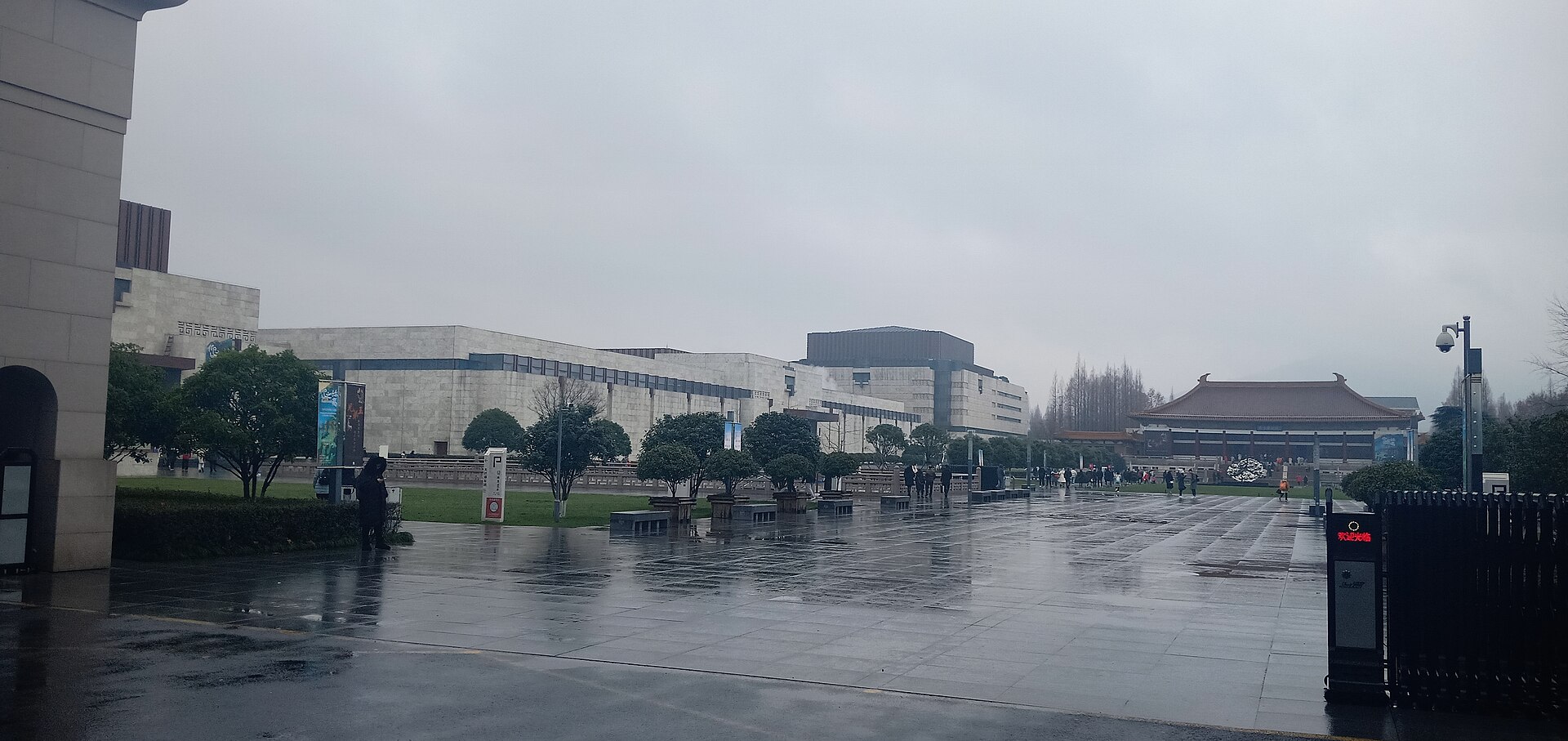
Nanjing Museum holds more than 430,000 pieces and sets, of which 371,032 are classed as precious cultural relics, ranking the collection second nationally after the Palace Museum in Beijing. Its particular strength is breadth rather than a single specialism: Jiangsu archaeology from the Neolithic through the Han dynasty, Ming and Qing imperial porcelain, painting and calligraphy, and a hoard of Republic-era material culture large enough to reconstruct an entire street. A residue of the National Central Museum's own 1930s-40s evacuation collection, thousands of crates still in storage under the museum's charge, sits behind the galleries as an unresolved inheritance from the institution's founding mission to hold a national rather than a regional collection.
| Local name | Nanjing Bowuyuan |
|---|---|
| Kind | Museum |
| Founded | 1933 |
| City and country |  Nanjing, China Nanjing, China |
| Address | 321 Zhongshan East Road, Xuanwu District, Nanjing, Jiangsu 210016, China |
| Website | njmuseum.com/en |
| Status | Open, confirmed 18 September 2026 |
| Record last verified | 23 September 2026 |
Visiting
- Hours
- Tuesday-Sunday09:00 to 17:00Last entry 16:00. Open all day, including a Monday, when a Chinese national public holiday falls on that day
- Closed
- Monday, except when a national public holiday falls on that day. Lunar New Year's Eve and the first day of the Lunar New Year.
- Admission
- General admission, permanent collection and themed exhibitionsFreeFree of charge under the national regulation governing state museums. Free online booking is required (the museum's own site or its WeChat account), with new slots released daily at 18:00 for up to seven days ahead; each booking covers one entry window, morning 9:00-13:00 or afternoon 12:00-16:00. Visitors without a Chinese phone number can book and collect a ticket in person at the service center on presentation of a passport or foreign permanent-residence ID. Ticketed special exhibitions are priced separately under the same regulation where the museum runs them; none was on sale at the time of research.
Free entry: Every day the museum is open; the permanent collection and the themed exhibitions drawn from it carry no admission charge- Tickets
- ticket.njmuseum.com.cn/reservation/userOut/ou... The museum's own ticket page.
- Do I need to book?
- Yes. Free timed-entry tickets must be booked online in advance through the museum's WeChat account or its own site; release is daily at 18:00 for slots up to seven days ahead. Visitors without a Chinese phone number can instead book and collect a ticket in person at the service center on presentation of a passport
- Address
- 321 Zhongshan East Road, Xuanwu District, Nanjing, Jiangsu 210016, China MapSubway Line 2, Minggugong (Ming Palace) station, about 300 meters east of Exit 1
Bus Routes 5, 34, 36, 55, 59 and 80 to the Zhongshanmen stop
Self-driving A bus-and-car parking lot is provided on site - Website
- njmuseum.com/en
- Telephone
- +86 25 8480 7923
Before you go how long, access, photography, bags, eating, shop
- How long to allow
- Not stated by the museum as a single figure. Six exhibition halls and more than 430,000 pieces mean a visit covering more than the highlights runs to the better part of a day
- Access
- Not detailed on the museum's English-language visitor pages at the time of research
- Photography
- Personal photography is permitted in the exhibition halls; professional camera equipment is not allowed
- Bags
- Large suitcases and large luggage may not be brought into the exhibition halls; the service center provides storage
- Eating
- The museum's own Services section lists a Meals and Drinks facility; no further detail was published in English at the time of research
- Shop
- The museum's own Services section lists a Merchandise (museum shop) facility; no further detail was published in English at the time of research
Prices and hours change. We take them from the institution's own pages and print the day we read them, and you can check the current position at the source we used. Confirm before you travel.
What is inside
History Gallery
Jiangsu's history told chronologically from prehistory through the Ming and Qing dynasties, including dinosaur fossils from the region and a Northern and Southern Dynasties carved brick relief of the Seven Sages of the Bamboo Grove and Rong Qiqi, ranked among China's top 100 20th-century archaeological discoveries
Art Gallery
About 7,000 square meters across eleven rooms of painting, calligraphy, sculpture, jade, bronze and ceramics, including Ming and Qing dynasty painting schools and work by the modern sculptor Wu Weishan
Republic of China Gallery
A recreated 1930s Nanjing street, built from collected Republic-era fixtures and furnishings, with a working post office, a barber shop, a pharmacy, a bookstore and a jewelry store, plus period cars and a tramcar
Digital Gallery
About 1,200 square meters of multimedia and interactive displays on ancient Chinese civilization, paired with an online virtual-museum component
Intangible Cultural Heritage Gallery
Traditional Jiangsu crafts and performance forms, including paper cutting, lantern making and Kun opera, with practitioners demonstrating work in the gallery and a teahouse hosting regular performances
Special Exhibition Gallery
Ten smaller rooms across a dedicated five-story building, given over to rotating temporary and loan exhibitions
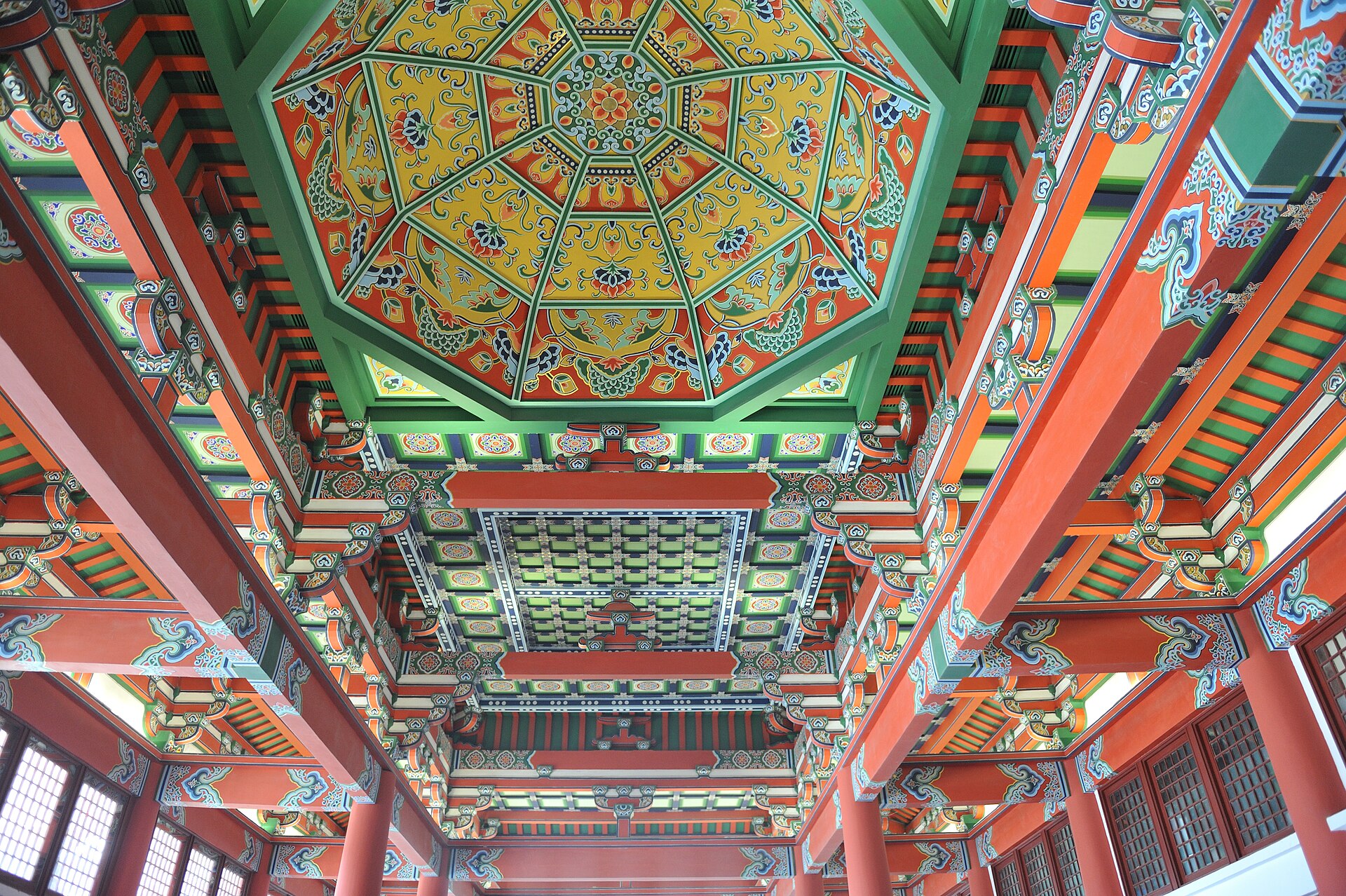
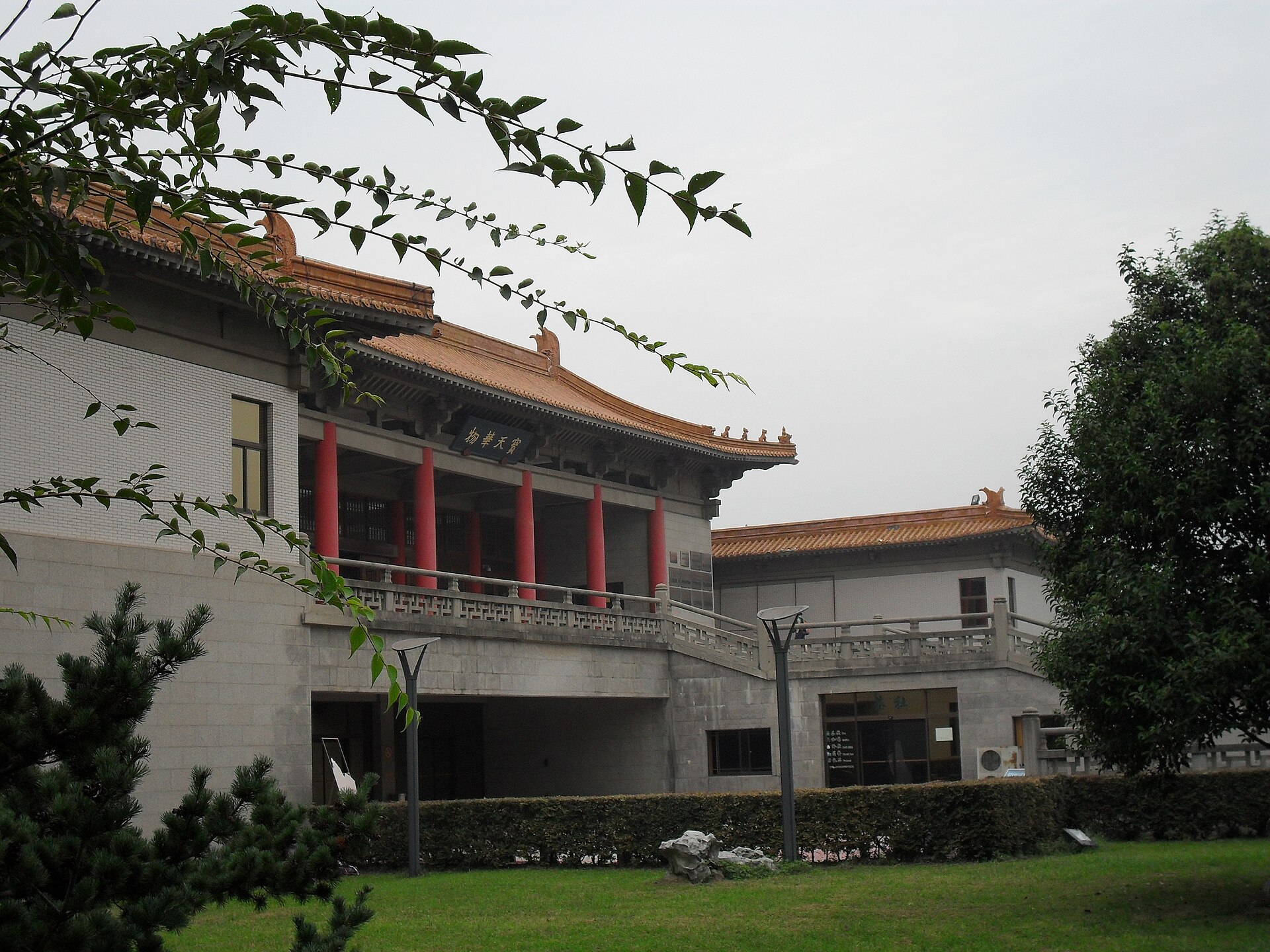
Photograph by Siyuwj · CC BY-SA 4.0 Main Hall (the original building)
The 1930s-1950s Humanity Hall designed under Liang Sicheng, raised three meters on its foundations during the 2009-2013 renovation so new lower levels could be built beneath it; now the entrance and orientation point connecting the historic hall to the 2013 extension
What to see first
Blue-and-white meiping vase with Xiao He chasing Han Xin under the moon
Unknown Yuan-dynasty (1271-1368) kilnRegarded as the museum's own 'town treasure', this 44.1-centimeter vase depicting a scene from early Han history is cited as one of the finest surviving examples of figural narrative painting on Yuan blue-and-white porcelain and is on China's list of relics barred from travelling abroad for exhibition. It came from the tomb of the Ming general Mu Ying, was looted when the tomb was robbed in early 1949, and resurfaced at a Nanjing antiques market in 1950, where a local collector bought it for ten gold bars before it entered the museum's collection12
Western Han gold 'beast'
Unknown, Western Han dynasty (202 BC-9 AD)Unearthed at Xuyi in 1982, this 9,100-gram solid-gold animal figure is 99 percent pure gold and is described by the museum's own sourced accounts as the heaviest gold casting yet recovered by Chinese archaeology12
Silver-thread jade burial suit
Unknown, Eastern Han dynasty (25-220 AD)A suit of jade plaques sewn with silver wire, made for a member of a princely Han house; jade burial suits were reserved for royalty and high nobility in the belief that jade would preserve the body, and the silver-thread grade marks a rank just below the gold-thread suits reserved for emperors and kings12
Celadon mythical-beast zun
Unknown, Western Jin dynasty, dated by inscription to 302 ADA guardian tomb vessel in the form of a crouched mythical beast, cited as one of the museum's national-treasure-grade objects and, like the Yuan vase, on the list of relics forbidden from travelling abroad12
Gilded pagoda from the underground palace of Hongjue Temple Pagoda
Unknown, early Ming dynasty (1436-1439)Excavated from the underground chamber of a Buddhist pagoda on Niushou Mountain outside Nanjing, the gilded pagoda stands on a red sandstone base surrounded by blue-and-white porcelain vases and encloses a small gold coffin holding a gold figure of the Buddha; described by secondary sources as the museum's primary treasure9
Seven Sages of the Bamboo Grove and Rong Qiqi brick relief
Unknown, Southern Dynasties (420-589 AD) tomb workshopA large carved and stamped brick panel depicting the Seven Sages, legendary 3rd-century scholars associated with Daoist withdrawal from official life, and the earlier musician-recluse Rong Qiqi; cited as the earliest and best-preserved brick painting of its kind found in China and ranked among the country's top 100 20th-century archaeological discoveries12
The Humanity Hall that outlived an empire's plan
In 1933 the Executive Yuan of the Republic of China approved a proposal, associated with the academic and former education minister Cai Yuanpei, to build the country's first large-scale, state-funded comprehensive museum in the capital, Nanjing. The plan called for three halls, named Humanity, Craft and Nature, standing together on the southern slope of Zijin Mountain, north of the old Ming-era Zhongshan Gate. Only the Humanity Hall was ever built. In 1935 the architect Liang Sicheng revised an earlier design by Xu Jingzhi, moving it away from a Qing-dynasty idiom toward the style of the Liao and Song dynasties: a golden-tiled, deep-eaved roof over a hall meant to read as unmistakably Chinese rather than as a museum copied from a Western model.
Construction began that year and stopped two years later when the Second Sino-Japanese War reached Nanjing, scattering the institution's founding collection west to Sichuan before a single visitor had seen it in its intended home. The hall itself was not finished until 1952, two years after the institution, renamed Nanjing Museum in March 1950 under the new government, had already reopened inside the unfinished building. The result, unusual for a museum of this size, is a main structure that is itself among the oldest objects on the site: a 1930s-1950s hall that was raised three meters on its own foundations during a 2009-2013 renovation and extension by the Beijing firm CCTN Design, so that new lower levels and 84,500 square meters of additional gallery space could be built beneath and around it without disturbing the roofline Liang Sicheng had fought to get right. The museum reopened in its current form on 6 November 2013. A separate art wing, dating to an intermediate 1999 expansion, stands to the west in a style that deliberately echoes early-20th-century Chinese architecture rather than either the 1930s hall or the 2013 extension around it.
A collection divided by two wars
The National Central Museum's preparatory department, as Nanjing Museum was then known, began evacuating its holdings west to Sichuan at the end of 1937, travelling with the second batch of treasures the Palace Museum in Beijing had itself sent south for safekeeping ahead of the Japanese advance. The crates went further, and stayed away longer, than most institutions anywhere moved their collections in the 20th century, and when they came back to Nanjing after 1945 they were split again, this time by the outcome of the Chinese Civil War rather than by invasion.
The Nationalist government shipped the pick of the joint evacuation collection to Taiwan in 1948 and 1949. Of roughly 13,491 crates that had left Beijing, 2,972 reached what became the National Palace Museum in Taipei, and more than 8,000 were eventually returned to the Palace Museum in Beijing. Nanjing kept the remainder: by publicly available accounts, 2,221 crates are still held in storage under Nanjing Museum's charge today, a physical remnant of the National Central Museum's original brief to hold a national, rather than a regional, collection. That inheritance, more than any single object on view, is the background against which a provincial museum in Jiangsu now ranks second nationally, after the Palace Museum in Beijing, for the number of pieces classed as precious cultural relics: 371,032 of the roughly 432,000 pieces and sets the museum holds.
Six galleries, and what is actually inside each one
The museum's own guiding map divides the visit into six halls plus the original Main Hall that connects them. The History Gallery runs chronologically from Jiangsu prehistory through the Qing dynasty and includes regional dinosaur fossils alongside a Southern Dynasties carved brick relief of the Seven Sages of the Bamboo Grove. The Art Gallery, about 7,000 square meters across eleven rooms, holds painting, calligraphy, sculpture, jade, bronze and ceramics, including Ming and Qing dynasty painting schools and modern sculpture by Wu Weishan. The Republic of China Gallery is a full-scale recreated 1930s Nanjing street built from collected period fixtures, with a working post office, a barber shop, a pharmacy, a bookstore, a jewelry store, period cars and a tramcar, rather than a conventional case-and-label display.
The Digital Gallery pairs about 1,200 square meters of multimedia and interactive installations on ancient Chinese civilization with an online virtual-museum component. The Intangible Cultural Heritage Gallery is given over to Jiangsu's living craft and performance traditions, including paper cutting, lantern making and Kun opera, with practitioners working in the gallery itself and a teahouse hosting regular performances. The Special Exhibition Gallery, a dedicated five-story building with ten smaller rooms, is reserved for rotating temporary and loan shows rather than the permanent collection. None of the six is small enough to see in passing; a visitor trying to cover all of them, plus the Main Hall's own architecture, is planning for most of a day rather than an afternoon.
The town treasure, a tomb robbery and ten bars of gold
Among the museum's holdings, one object is singled out by name in almost every account of the collection: a blue-and-white meiping vase, 44.1 centimeters tall, painted with a scene from early Han history showing the statesman Xiao He on horseback pursuing the general Han Xin under the moon. It is cited as one of the finest surviving examples of figural narrative painting on Yuan-dynasty blue-and-white porcelain and sits on China's list of cultural relics barred from travelling abroad for exhibition.
Its own history is as dramatic as its decoration. The vase was buried in the tomb of Mu Ying, a Ming-dynasty general and adopted son of the dynastic founder Zhu Yuanzhang, on Guanyin Mountain in what is now Jiangning county. The tomb was looted in early 1949; when archaeologists excavated the site properly the following year, some of its contents were already gone. In 1950 the vase turned up at an antiques market in Nanjing, where a local collector, Chen Xinmin, recognized it and bought it for ten gold bars before it passed into the museum's own collection, where it remains as what the museum's own guides describe as its town treasure.
Depth beyond the porcelain: gold, jade and a guardian beast
The Xiao He vase is not the only object doing this kind of work on the page. A solid-gold animal figure weighing 9,100 grams, 99 percent pure and unearthed at Xuyi in 1982, is described in sourced accounts as the heaviest gold casting yet recovered by Chinese archaeology. A silver-thread jade burial suit, made for a member of a princely Eastern Han house from jade plaques sewn with silver wire, sits a rank below the gold-thread suits reserved for emperors and kings in the belief system that made jade a guarantee of bodily preservation after death. A celadon vessel in the form of a crouched mythical beast, dated by its own inscription to 302 AD in the Western Jin dynasty, was made to guard a tomb and carries the same export-prohibited status as the Xiao He vase. A gilded pagoda recovered from the underground chamber of a Ming-dynasty Buddhist pagoda on Niushou Mountain, enclosing a small gold coffin and a gold figure of the Buddha, is named by outside guides as the museum's primary treasure in its own right.
None of these objects shares a period, a material or even a belief system with the others. Read together with the dinosaur fossils in the History Gallery and the reconstructed shopfronts of the Republic of China Gallery, they are the clearest evidence of what the National Central Museum's founders actually built: not a fine-art museum with an encyclopaedic ambition stapled on, but a single institution asked to hold the entire physical record of a place, from geology to living memory, in one building.
Free admission, hard-won tickets and a scandal the museum did not choose to tell
Visitors who write about Nanjing Museum in English tend to agree on two things at once: that it is one of the best general museums they have been to in China, and that visiting it on a weekend or a public holiday is an exercise in crowd management. Free admission and the scale of the collection are named as the draw; the WeChat-based booking system, which assumes a Chinese phone number, and the resulting crush inside the galleries are named as the cost of that access. The museum's own visiting rules, which restrict professional camera equipment and ask visitors to book a four-hour entry window rather than an open ticket, are a direct response to exactly that pressure.
The museum's more serious reckoning in the period covered by this research had nothing to do with crowd size. In 1959, the family of the collector Pang Laichen donated 137 paintings to the museum for permanent safekeeping. Investigators later found that in the 1990s a former vice-director and, later, director of the museum, Xu Huping, approved the transfer of some of those paintings to a state-owned cultural relics store in breach of a national ban on museum deaccessioning; one of them, Qiu Ying's Spring in Jiangnan, was resold through the store in 1997 and surfaced at a Beijing auction house in 2025 valued near 88 million yuan, prompting Pang's great-granddaughter to alert the authorities. A government investigation completed in February 2026, covering more than 1,100 interviews and 65,000 archival documents, found systemic mismanagement reaching back decades, and the museum publicly acknowledged what it called systemic problems. In September 2026 a court sentenced Xu Huping, then 81, to three years in prison and a fine for bribery in connection with the affair. Two of the five paintings transferred from the Pang donation were recovered through negotiation along with Spring in Jiangnan itself; one, sold for 16,000 yuan in 1995, remained unaccounted for as this record was researched. It is not a story the museum's own English-language visitor pages tell, and it belongs on the page precisely because the institution holding a national collection is also, on this evidence, a party that failed to guard part of it.
What visitors say
Visitors consistently describe Nanjing Museum as among the best general museums they have seen in China, citing the range of the collection in a single visit, from dinosaur fossils to Ming and Qing imperial porcelain to a full-scale recreated 1930s street, and free admission. The same visitors just as consistently name the crowds as the museum's defining problem: long queues on weekends and holidays, a booking system built around a Chinese phone number, and galleries so full that sightlines and object labels become hard to use.
What is praised, what is criticised
- Praised: The breadth of the collection in one visit, from prehistoric fossils and Han-dynasty jade burial suits to Ming porcelain and a recreated Republic-era street
- Praised: Free admission to the permanent collection and themed exhibitions
- Praised: English-language audio guides, priced around 20 yuan
- Praised: The building itself, where the 1930s hall and the 2013 extension read as one composition rather than an addition bolted onto an old front
- Criticised: Overcrowding on weekends and public holidays, which one Tripadvisor reviewer described as making parts of the museum feel like a bazaar rather than a gallery
- Criticised: A ticket-booking system built around a WeChat mini-program that assumes a Chinese phone number, workable for foreign visitors only by booking through the service center in person with a passport
- Criticised: Limited English-language object labelling away from the audio-guide route
- Criticised: A 2025-2026 government investigation, reported by the South China Morning Post, ArtReview and Caixin Global, which found that paintings donated to the museum in 1959 were illegally transferred, sold or lost from the 1990s onward, and which ended in September 2026 with the museum's former director sentenced to prison for bribery over the affair
Ratings on other platforms
Tripadvisor: 4.4 from 337 ratings, read 18 September 2026
A platform average is a tertiary source: it moves, it is not audited, and we quote no visitor's words.
Questions about Nanjing Museum
Where is Nanjing Museum?
321 Zhongshan East Road, Xuanwu District, Nanjing, Jiangsu 210016, China.
How much does it cost to visit?
General admission, permanent collection and themed exhibitions: free. As confirmed 18 September 2026.
When is it open?
Tuesday-Sunday 09:00-17:00. Closed: Monday, except when a national public holiday falls on that day. Lunar New Year's Eve and the first day of the Lunar New Year. As confirmed 18 September 2026.
How do you get there?
Subway: Line 2, Minggugong (Ming Palace) station, about 300 meters east of Exit 1; Bus: Routes 5, 34, 36, 55, 59 and 80 to the Zhongshanmen stop; Self-driving: A bus-and-car parking lot is provided on site.
What should you see first?
Blue-and-white meiping vase with Xiao He chasing Han Xin under the moon (Unknown Yuan-dynasty (1271-1368) kiln); Western Han gold 'beast' (Unknown, Western Han dynasty (202 BC-9 AD)); Silver-thread jade burial suit (Unknown, Eastern Han dynasty (25-220 AD)); Celadon mythical-beast zun (Unknown, Western Jin dynasty, dated by inscription to 302 AD); Gilded pagoda from the underground palace of Hongjue Temple Pagoda (Unknown, early Ming dynasty (1436-1439)); Seven Sages of the Bamboo Grove and Rong Qiqi brick relief (Unknown, Southern Dynasties (420-589 AD) tomb workshop).
What we could not confirm
- The full inventory and cataloguing status of the roughly 2,221 crates of former National Central Museum and Palace Museum evacuation material reported still held in storage under Nanjing Museum's charge has not been published in detail in any source located for this record
- Which of the five paintings transferred from the 1959 Pang Laichen donation remains unaccounted for, and whether it will surface as Spring in Jiangnan did, is not resolved in reporting current as of September 2026
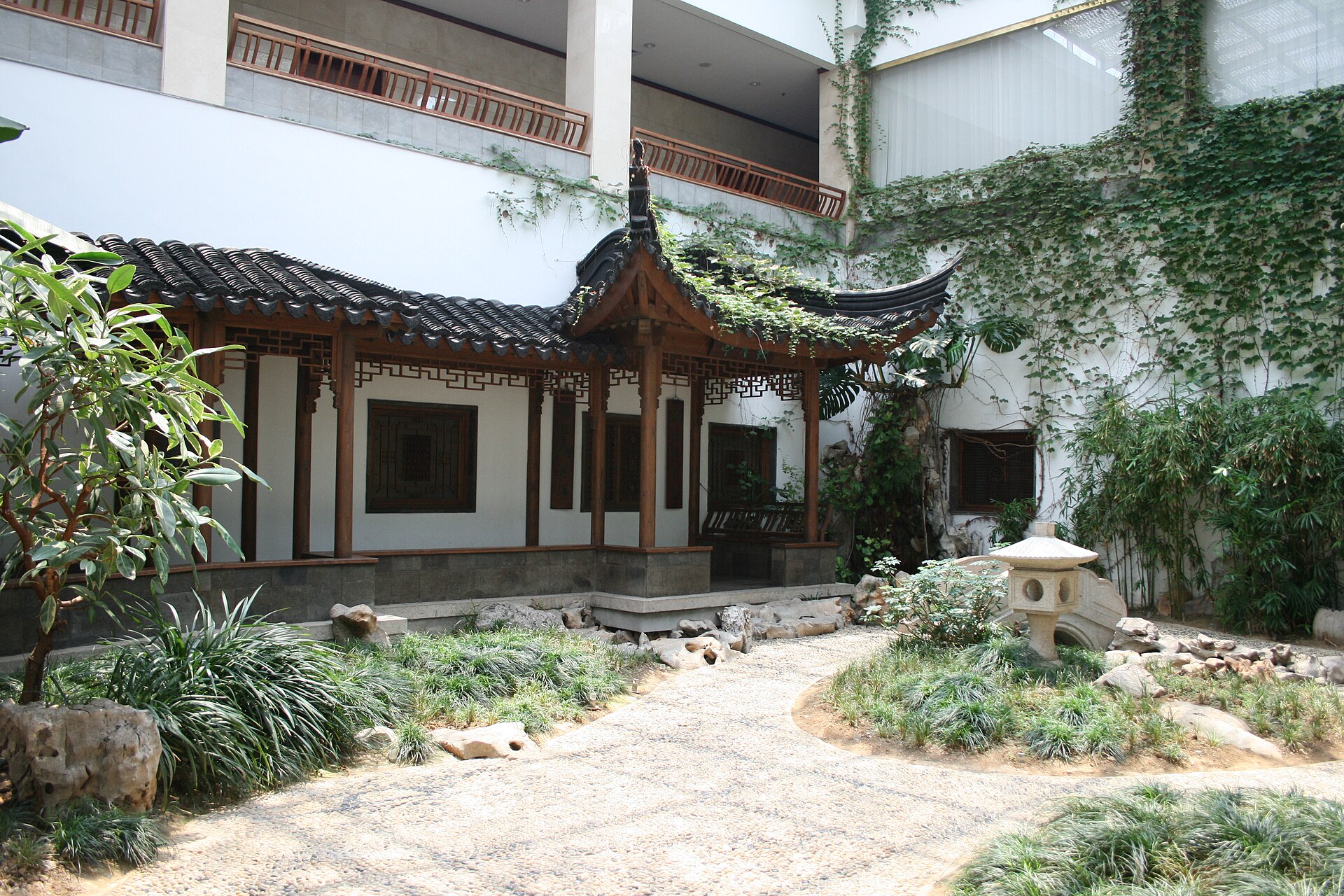
Images
Sources
- 1Nanjing Museum, official site, Visit / Opening Time, Traffic Routes and Visiting Instruction pages njmuseum.com/en/visitIndex
- 2Nanjing Museum, official site, Contact Us njmuseum.com/en/articleDetails?id=337115
- 3Nanjing Museum, official site, About Nanjing Museum njmuseum.com/en/expertIndex
- 4Nanjing Museum, Wikipedia (tertiary; history, architecture and founding background) en.wikipedia.org/wiki/Nanjing_Museum
- 5Nanjing Museum (Nanjing Bowuyuan), Tripadvisor, reviews and rating tripadvisor.com/Attraction_Review-g294220-d1799046-Reviews-Nanjing_Museum_Nanjing_Bowuyuan-Nanjing_Jiangsu.html
- 6South China Morning Post, 'China's Nanjing Museum artwork scandal probe uncovers historic mismanagement, corruption', 10 February 2026 scmp.com/news/china/politics/article/3343035/chinese-probe-nanjing-museum-scandal-alleges-historic-mismanagement-and-corruption
- 7ArtReview, 'Mismanagement and corruption alleged at Nanjing Museum', 10 February 2026 artreview.com/mismanagement-and-corruption-alleged-at-nanjing-museum/
- 8Caixin Global, 'Former Nanjing Museum Chief Jailed in Bribery Case Tied to Missing Masterpiece', 17 September 2026 caixinglobal.com/2026-09-17/former-nanjing-museum-chief-jailed-in-bribery-case-tied-to-missing-masterpiece-102485609.html
- 9China Discovery, Nanjing Museum visitor guide (top treasures, six galleries, admission and hours) chinadiscovery.com/jiangsu/nanjing/nanjing-museum.html
- 10TravelChinaGuide, 'Nanjing Museum: Six Main Exhibition Halls' travelchinaguide.com/attraction/jiangsu/nanjing/nanjing_museum.htm
- 11ArchDaily, 'Nanjing Museum / CCTN Design' (2009-2013 renovation and extension) archdaily.com/893634/nanjing-museum-cctn-design
- 12Trip.com Moments, 'Nanjing Museum: one museum and six galleries, half of Nanjing's history' (named highlight objects, confirmed as 321 Zhongshan East Road, Xuanwu District) my.trip.com/moments/detail/nanjing-9-144317181?locale=en-MY
- 13Wikimedia Commons, File:Nanjing Museum front door.jpg (licence and GPS verification for the lead image) commons.wikimedia.org/wiki/File:Nanjing_Museum_front_door.jpg
- 14Wikimedia Commons, Category:Nanjing Museum (image survey) commons.wikimedia.org/wiki/Category:Nanjing_Museum
