The Rothschild Faberge Egg
House of Faberge, Saint Petersburg · 1902
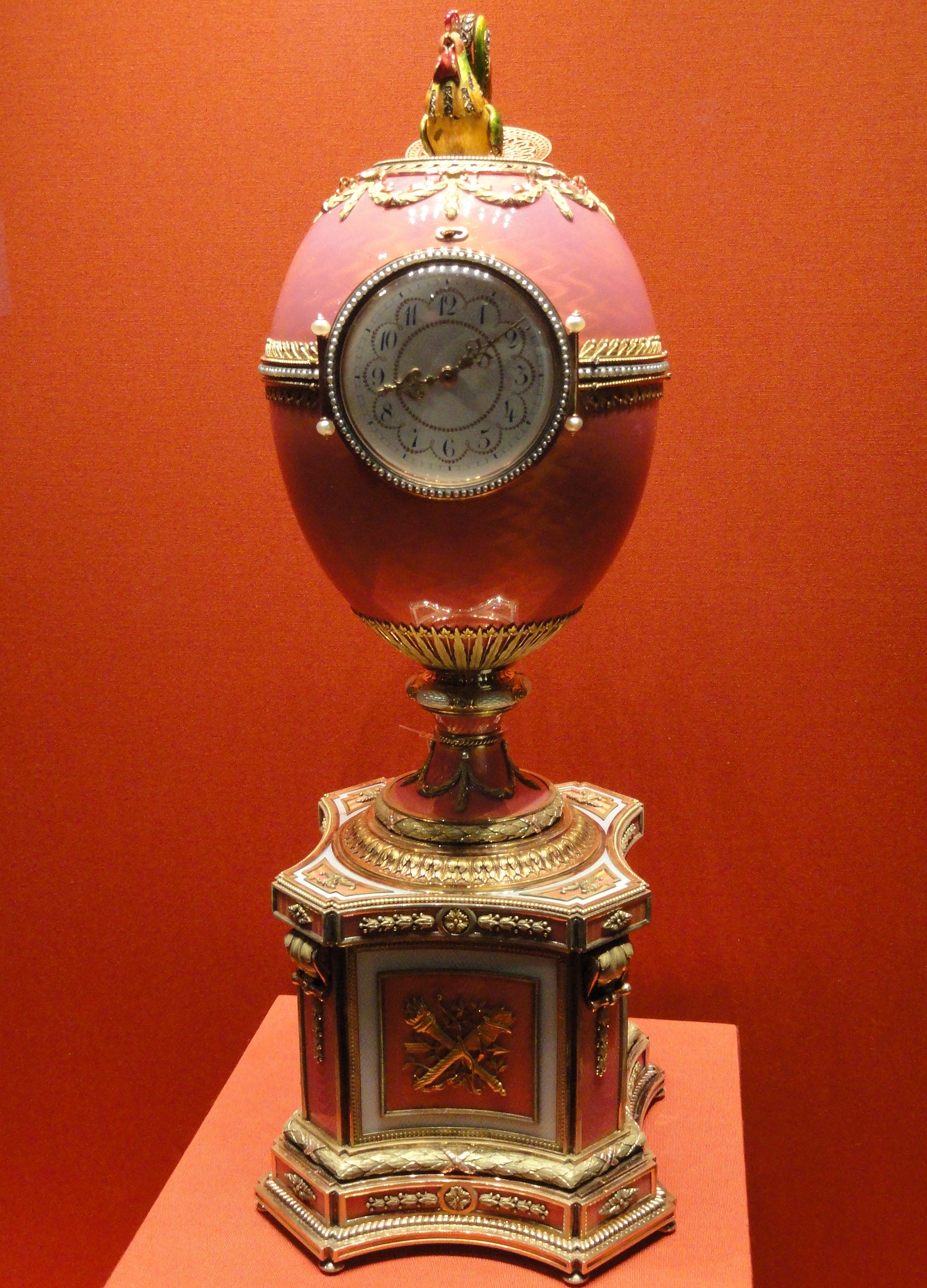
Photographed on display in the General Staff Building of the State Hermitage Museum, Saint Petersburg, in 2018, after the egg's transfer there as a gift from President Vladimir Putin in December 2014.
Photograph by Flickr user Damien, CC BY-SA 2.0, via Wikimedia Commons| Workshop | House of Faberge, Saint Petersburg |
|---|---|
| Date | 1902 |
| Medium | Gold, translucent rose-pink guilloche enamel, rose-cut diamonds, oriental pearls, and a concealed clockwork movement and automaton mechanism |
| Dimensions | Approximately 27 cm high on its circular base |
| Where it is now | State Hermitage Museum, Saint Petersburg, Russialast confirmed |
| Inventory number | Not published in the sources consulted |
| Attribution | AcceptedAccepted as a product of the House of Faberge under the supervision of Peter Carl Faberge, hallmarked to the workshop of Michael Perkhin, head workmaster of the firm from 1886 until his death in 1903. Full note |
| Object type | Goldsmith's work |
| Period | Russian, Faberge firm, reign of Nicholas II |
| Cases | Has a provenance gap |
| Inscriptions | Workmaster's mark of Michael Perkhin and the Faberge firm's mark, per the hallmarking convention of the House of Faberge; no source consulted publishes a transcription of the full mark or an inventory number |
| Owners on record | 7 links6 documented, 1 unknown |
| Sources | 15 cited |
About this record Last verified · 15 sources cited · Change log
On this page 10 sections
ContentsClose
A gold and rose-pink enamel egg of 1902, made by the House of Faberge under workmaster Michael Perkhin, that opens on the hour to release a diamond-set cockerel which flaps, nods, crows and retracts before a concealed clock strikes the bell. It was never an Imperial commission. Beatrice Ephrussi de Rothschild gave it as an engagement present to Germaine Halphen, who married Beatrice's brother Baron Edouard de Rothschild in 1905, and it stayed in that family for a century. Who ordered it from Faberge is not documented: Christie's states that no surviving documentary evidence records an order for this egg, as is the case for all private Faberge commissions, and the gift and the giver are known from a codicil of 22 March 1958 to the recipient's will.
Christie's London sold it on 28 November 2007 for a combined 8,980,500 pounds, a record at the time for any Russian work of art, any Faberge object and any timepiece at auction. The buyer, the Russian collector Alexander Ivanov, later gave it to President Vladimir Putin, who presented it to the State Hermitage Museum in December 2014 as a 250th-anniversary gift. A British and German tax investigation into the VAT treatment of Ivanov's purchase had raided his Baden-Baden museum about a week before that presentation.
It is routinely confused with a different object, the 1904 Kelch Chanticleer egg, which shares the same cockerel-and-clock mechanism, the same workshop and a near-identical date, but was made two years later for an entirely different family. The two eggs are not the same object and this record treats them as such.
Provenance
Each link is graded. Documented: a cited source supports it. Disputed: the identification is argued but not established. Unknown: no owner for that span, and the gap is not smoothed into a narrative. The grades in the glossary.
- 1902 - 1902House of Faberge, workshop of Michael Perkhindocumented
Made in 1902 and commissioned by Beatrice Ephrussi de Rothschild as an engagement gift for Germaine Halphen, who was to marry Beatrice's brother, Baron Edouard Alphonse James de Rothschild. Not an Imperial commission and not made for the Kelch family.1310
- 1902 - 1905Germaine Halphendocumented
Received as an engagement present. Halphen married Edouard de Rothschild in 1905.1310
- 1905 - 2007The Halphen-Rothschild familyunknown
Reported as having remained in the same family for roughly a century and sold in 2007 by descendants, but no source consulted names the individual family members who held it or gives dates for transfers within the family across this century.6
- 2007-10 - 2007-10Christie's, Moscow exhibitiondocumented
First shown publicly at a Christie's exhibition in Moscow ahead of the London sale.6
- 2007-11-28 - 2007-11-28Alexander Ivanovdocumented
Bought at Christie's London for a combined 8,980,500 pounds. Ivanov stated the egg would go into a private museum he was building in Moscow. Sold with full provenance documentation and an export licence.1235612
- 2007 - 2014Alexander Ivanov, displayed at the Faberge Museum, Baden-Badendocumented
Ivanov claimed a VAT exemption of approximately 600,000 pounds on the basis the egg was shipped directly to Russia; British investigators later suspected it had instead been routed through Germany and displayed at Ivanov's Baden-Baden museum, a claim the museum's director denied to the extent of calling it only a brief exhibition loan before the egg was returned to Moscow.28912
- 2014-12-08 - presentState Hermitage Museum, Saint Petersburgdocumented
Presented by President Vladimir Putin at the Hermitage's 250th-anniversary reception, with Alexander Ivanov named as the donor. The Hermitage's reported credit line reads: gift of the President of the Russian Federation V.V. Putin, through the donor A.N. Ivanov. Documented as a completed gift, not a loan. Last confirmed on display in Room 302 of the General Staff Building as of January 2019.1712
Prices realised
| Date | Sale | Estimate | Result | Note |
|---|---|---|---|---|
| 28 November 2007 | Christie's, London | GBP 6,000,000 - 9,000,000 | Hammer GBP 8,000,000, per source 4 (reported as approximately USD 16.5 million) With premium GBP 980,500, the difference between source 4's hammer price and the published total of GBP 8,980,500; no source consulted itemises the premium as a rate or percentage GBP | Source 4 (Mieks) is the only source consulted that separates the hammer price, GBP 8,000,000, from the total including buyer's premium, GBP 8,980,500. The other sources consulted (Wikipedia, skyjems.ca, and contemporary press) report only the combined total of GBP 8,980,500 and describe it explicitly as inclusive of commission; none of the sources consulted labels GBP 8,980,500 as a hammer price. Contemporary press converted the hammer price to approximately USD 16.5 million and the total to approximately USD 18.5 million (also reported as EUR 12.5 million). The sale set records at the time for the highest price paid at auction for any Russian work of art, any Faberge object, and any timepiece. |
Hammer is the price at which the bidding stopped; with premium adds the fee the house charges the buyer on top. Hammer price and buyer's premium in the glossary.
Technical evidence
| Attribution note | Accepted as a product of the House of Faberge under the supervision of Peter Carl Faberge, hallmarked to the workshop of Michael Perkhin, head workmaster of the firm from 1886 until his death in 1903. Perkhin's mark identifies the workshop, not a sole hand; the piece, like all Faberge work of this period, was made by a team of specialist craftsmen operating under his name. |
|---|---|
| Materials | Gold, translucent rose-pink guilloche enamel over an engine-turned ground, rose-cut diamonds, oriental pearls.310 |
| Dimensions | Approximately 27 cm high, on a circular base.10 |
| Mechanism | A continuously running clockwork movement in the lower body; on the hour, the upper shell opens and a diamond-set cockerel automaton rises, flaps its enamelled wings four times, nods its head three times while opening and closing its beak and crowing, for about fifteen seconds, before retracting and the clock striking the bell.1310 |
| Workmaster | Michael Perkhin, head workmaster of the House of Faberge, 1886-1903. The mark identifies the workshop rather than a single hand.313 |
| Style | Late Louis XVI revival, in the idiom Faberge's workshops used for European-taste commissions outside the Imperial series.10 |
Images
The record in full
Chapter 1What it is
The egg stands about 27 centimetres on a circular base, worked in gold under a translucent rose-pink enamel laid over an engine-turned, or guilloche, ground, the technique most associated with the...
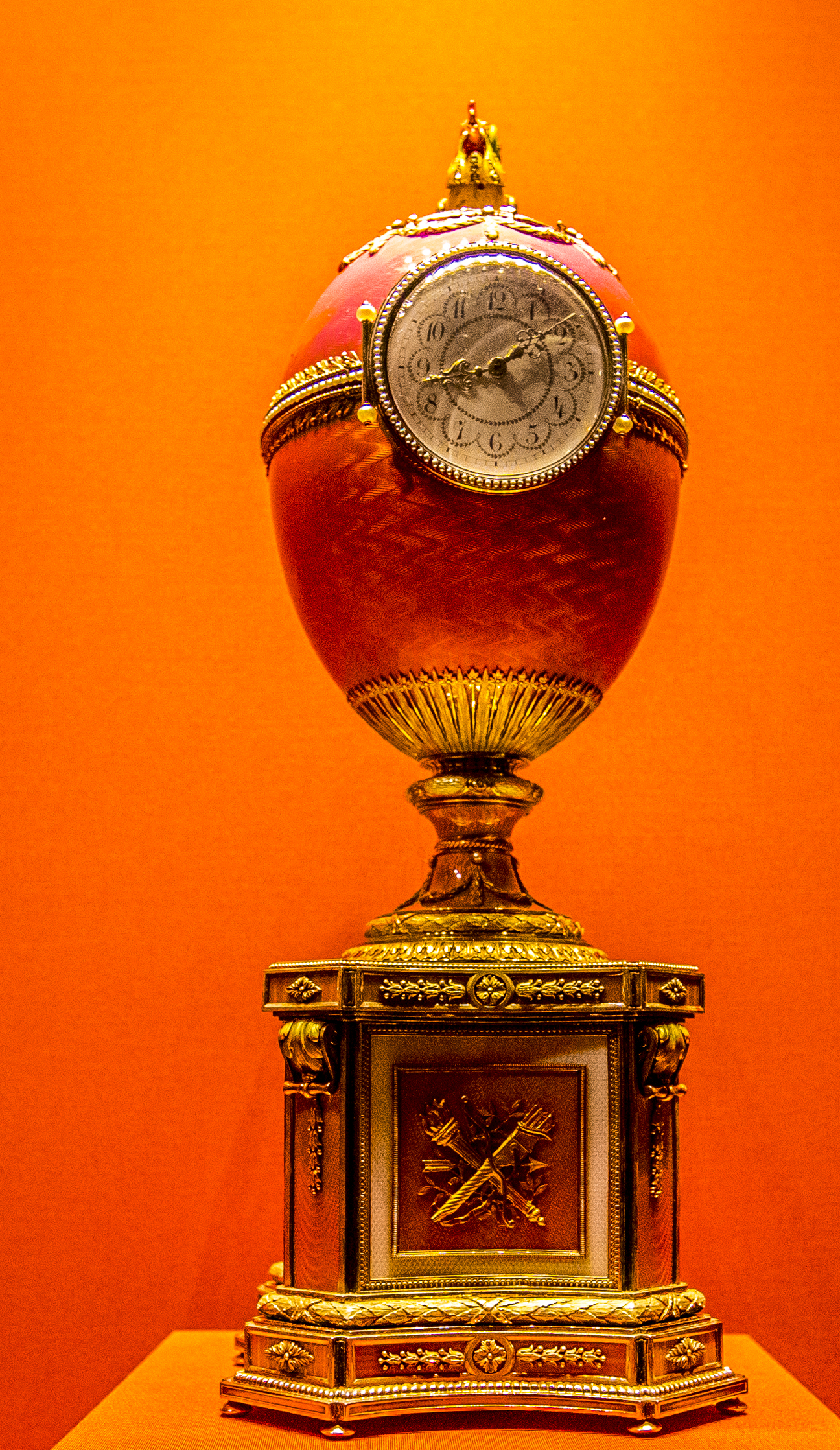
The egg stands about 27 centimetres on a circular base, worked in gold under a translucent rose-pink enamel laid over an engine-turned, or guilloche, ground, the technique most associated with the House of Faberge. A trellis of rose-cut diamonds and oriental pearls is applied over the shell, gathered into diamond-set garlands at the equator, in the late Louis XVI revival taste that Faberge's workshops used repeatedly for European and aristocratic clients outside the Imperial family.
It is, in effect, a very expensive clock built into the form of an Easter egg. The lower body houses a clockwork movement that runs continuously; the upper section is the mechanism's stage.
Chapter 2The mechanism
On the hour, the top of the egg opens and a diamond-set cockerel rises into view.
On the hour, the top of the egg opens and a diamond-set cockerel rises into view. It flaps its enamelled wings four times, nods its head three times while opening and closing its beak, and crows, in a routine that runs about fifteen seconds, before retracting and letting the clock strike the hour on a bell. It is one of only a small number of Faberge eggs built around a full clock-and-automaton combination, a category that includes the 1900 Cockerel egg made for the Imperial family and the 1904 Kelch Chanticleer egg made for a different private client; the mechanical design of the surprise, described in the sources consulted, is essentially the same across the group, which is precisely why the three eggs are so often mixed up.
Chapter 3The workshop that made it
The piece is hallmarked to Michael Perkhin, who became head workmaster of the House of Faberge in 1886 and held that position, overseeing the firm's most artistically ambitious commissions including...
The piece is hallmarked to Michael Perkhin, who became head workmaster of the House of Faberge in 1886 and held that position, overseeing the firm's most artistically ambitious commissions including a number of the Imperial Easter eggs, until his death in 1903. A workmaster's mark identifies the atelier responsible, not a single craftsman's hand; an object of this complexity would have passed through several specialist hands, including an enameller, a lapidary for the diamonds and pearls, and a clockmaker for the movement, all working under Perkhin's supervision and Faberge's name.
Chapter 4The 1902 commission, and what it was not
The egg was not made for the Russian Imperial family, and it is not one of the fifty Imperial Easter eggs Faberge produced and delivered for Alexander III and Nicholas II, on the authority of Tatiana...
The egg was not made for the Russian Imperial family, and it is not one of the fifty Imperial Easter eggs Faberge produced and delivered for Alexander III and Nicholas II, on the authority of Tatiana Faberge, Lynette Proler and Valentin Skurlov, The Faberge Imperial Easter Eggs, London, 1997, cited by Christie's, and of Kieran McCarthy writing for the Rothschild Archive; the count of fifty-two that also circulates includes eggs never delivered. It was given by Beatrice Ephrussi de Rothschild, a member of the Rothschild banking family, as an engagement present to Germaine Halphen, who was marrying Beatrice's younger brother, Baron Edouard Alphonse James de Rothschild. The gift and the giver are documented by a codicil of 22 March 1958 to Germaine de Rothschild's will, which Christie's quotes in translation. Who placed the order with Faberge is not documented at all: Christie's states that there is no surviving documentary evidence recording an order for this egg, as is the case for all private commissions executed by the Faberge workshops in Saint Petersburg, and its own press release of 4 October 2007 suggested instead that Beatrice's husband Maurice Ephrussi may have ordered it while in Saint Petersburg or on one of Faberge's selling trips to Paris. This record previously stated the commission as hers as a fact. Halphen and Rothschild married in 1905, and the egg is dated to the year of the engagement, 1902.
This places it in a small category of non-Imperial Faberge eggs commissioned by private clients of comparable wealth and standing to the Romanovs, a group that includes the seven eggs made for the Russian industrialist Alexander Kelch and his wife Barbara Kelch-Bazanova between 1898 and 1904, and the Duchess of Marlborough egg of the same year, 1902, commissioned by an American client. The Rothschild egg belongs with these, not with the Imperial series, and none of the sources consulted for this record documents any Romanov involvement in its commission, gift or ownership.
Chapter 5The object it is not: the Kelch Chanticleer egg
The Rothschild egg is regularly confused with, and sometimes wrongly called, the Kelch Chanticleer egg, and the confusion is understandable rather than careless.
The Rothschild egg is regularly confused with, and sometimes wrongly called, the Kelch Chanticleer egg, and the confusion is understandable rather than careless. Both are Faberge clock eggs with a diamond-set cockerel automaton built to the same fifteen-second routine of wing-flaps, head-nods and crowing before the hour strikes. Both were made in Perkhin's workshop within two years of each other, in a shared late-nineteenth-century taste for automaton clocks. But they are different objects, made for different clients, and they have different modern histories: the Chanticleer egg was made in 1904 for Alexander Kelch, who gave it to his wife Barbara Kelch-Bazanova, and it is today in the Faberge Museum in Saint Petersburg, part of Viktor Vekselberg's collection, not the State Hermitage. This record covers the Rothschild egg alone and does not draw on facts specific to the Kelch Chanticleer egg to fill any gap in this one.
Chapter 6The twentieth century: a documented family, an undocumented chain
The sources consulted agree that the egg remained with the Halphen-Rothschild family for roughly a century after 1902, one press account at the time of the 2007 sale describing it as having been in...
The sources consulted agree that the egg remained with the Halphen-Rothschild family for roughly a century after 1902, one press account at the time of the 2007 sale describing it as having been in the same family for a hundred years, sold by descendants of Germaine Halphen and Edouard de Rothschild. None of the sources consulted, however, names the individual family members who held it between Germaine Halphen's death and the 2007 sale, or gives dates for when it passed between them. It was first shown to the public at a Christie's exhibition in Moscow in October 2007, ahead of the London sale the following month, which suggests the piece had had little or no public exposure in the preceding decades.
Chapter 7The 2007 Christie's sale
Christie's London offered the egg on 28 November 2007 with a pre-sale estimate reported at 6,000,000 to 9,000,000 pounds.
Christie's London offered the egg on 28 November 2007 with a pre-sale estimate reported at 6,000,000 to 9,000,000 pounds. One source, the Mieks Faberge Eggs sale page, gives a hammer price of 8,000,000 pounds (reported as roughly 16.5 million US dollars) and a total of 8,980,500 pounds once the buyer's premium is added (reported as roughly 18.5 million US dollars, or 12.5 million euros). Most of the other sources consulted report only the combined figure of 8,980,500 pounds and describe it explicitly as inclusive of commission; none of the sources consulted labels 8,980,500 pounds as a hammer price.
The sale set three simultaneous auction records at the time: the highest price paid for any Russian work of art, for any Faberge object, and for any timepiece, surpassing the 9.6 million dollar sale of the Faberge Winter egg in 2002. The buyer was Alexander Ivanov, a Russian collector and the founder, in 1993, of Russia's first private museum; he stated at the time that the egg would go into a private museum he was building in Moscow and would not be resold. The sources consulted describe the egg as sold with full provenance documentation and an export licence, which indicates the transaction was legally unremarkable at the point of sale; none of the sources found for this record documents a UK Reviewing Committee on the Export of Works of Art case, a temporary export bar, or a deadline for a British institution to match the price for this specific object, despite a direct search for one. That absence is recorded in the open questions below rather than assumed to mean no such process occurred.
Chapter 8The VAT dispute and the 2014 raid
When Ivanov bought the egg, he arranged for it to be shipped directly to Russia, which under EU rules exempted the purchase from value-added tax, and he claimed a VAT refund reported at approximately...
When Ivanov bought the egg, he arranged for it to be shipped directly to Russia, which under EU rules exempted the purchase from value-added tax, and he claimed a VAT refund reported at approximately 600,000 pounds on that basis. British investigators later came to suspect the egg had in fact been routed through Germany rather than sent directly to Russia, which would have invalidated the exemption.
On 1 December 2014, around forty British law-enforcement officers, supported by Germany's Financial Investigation and Customs Department, raided Ivanov's Faberge Museum in Baden-Baden, Germany, together with the private home and vehicle of the museum's director, Sergei Avtonoshkin. The investigation, run by the UK's HM Revenue and Customs, concerned an alleged total of nearly 70,000 pounds in unpaid VAT across purchases made at London auction houses over roughly fifteen years, not only the Rothschild egg. Avtonoshkin told investigators the egg had been loaned briefly to Baden-Baden for an exhibition and then returned to Moscow. The museum denied wrongdoing and said nothing incriminating was found in the raid; Ivanov characterised the raid as politically motivated, timed to disrupt the gift to the Hermitage a week later. None of the sources consulted for this record reports a final legal resolution of the VAT investigation.
Chapter 9The gift to the Hermitage
On 8 December 2014, at a reception marking the State Hermitage Museum's 250th anniversary, President Vladimir Putin presented the museum with two Faberge-related objects, a nineteenth-century clock...
On 8 December 2014, at a reception marking the State Hermitage Museum's 250th anniversary, President Vladimir Putin presented the museum with two Faberge-related objects, a nineteenth-century clock made for the twenty-fifth wedding anniversary of Emperor Alexander III and Empress Maria Feodorovna, and the Rothschild egg. Putin is reported as saying, of the gifts, that he and his colleagues had not come empty-handed. The Hermitage's own credit line for the object, as reported, reads: gift of the President of the Russian Federation V.V. Putin, through the donor A.N. Ivanov. That phrasing, naming Ivanov as the donor acting through Putin's presentation, is the clearest documentation available of how ownership passed from a private Russian collector to a Russian state museum, and it reads as a completed gift rather than a loan.
This matters because the only confirmed free-licence photographs of the egg were taken at the Hermitage's General Staff Building, and it would be easy to read those photographs as documenting only a temporary loan exhibition of the kind museums stage constantly. The documentation available instead describes a permanent transfer of ownership completed in December 2014, with the object subsequently on ordinary long-term display, last confirmed in Room 302 of the General Staff Building as of January 2019. No source consulted documents the egg leaving the Hermitage since.
Chapter 10What the cockerel does not mean
Faberge did make one egg with an explicit Easter theme, the 1894 Resurrection egg showing Christ rising from the tomb, made by Perkhin for Maria Feodorovna.
Faberge did make one egg with an explicit Easter theme, the 1894 Resurrection egg showing Christ rising from the tomb, made by Perkhin for Maria Feodorovna. This egg is not that kind of object, and none of the sources consulted attaches an Easter or resurrection reading to its cockerel. It was not an Easter gift; it was an engagement gift, commissioned for a specific event in a private family's calendar rather than for the religious occasion the Faberge egg form nominally references. The cockerel automaton belongs to a European tradition of clockwork animal automata built into decorative clocks, and its most obvious function here is theatrical: a bird that performs on the hour is a display of the workshop's mechanical virtuosity and of the value the object represents, in the same spirit as Faberge's own remark that expensive materials interested him little next to the ingenuity of the making. Where a clearer symbolic or devotional programme exists for other Faberge eggs, this record has looked for one here and found none in the sources consulted; that absence is itself the honest finding, not a gap to be filled with speculation.
Chapter 11What is still unresolved
The chain of individual ownership within the Rothschild family between 1905 and 2007 is undocumented in every source consulted.
The chain of individual ownership within the Rothschild family between 1905 and 2007 is undocumented in every source consulted. Whether any UK export control process was triggered by the sale, and if so what the outcome was, could not be confirmed despite a direct search; the sale is instead reported as having proceeded with an export licence already in place. The outcome of the 2014 VAT investigation into Ivanov's museum has not been reported in any source found. And the egg's status since its last confirmed sighting in January 2019, whether it remains on permanent display, has moved within the Hermitage, or has travelled elsewhere on loan, is not addressed in any source consulted for this record.
The artist
Michael Evlampievich Perkhin, head workmaster of the House of Faberge, founded by Gustav Faberge and led in this period by Peter Carl Faberge
This object carries a workmaster's mark, not a signature, and the distinction matters. Michael Perkhin ran the workshop that made it, but the piece passed through several specialist hands under his supervision. Understanding this record's maker means understanding both the man and the firm's working method.
Related works
| Work | Relation | Where it is |
|---|---|---|
| Kelch Chanticleer Egg House of Faberge, workshop of Michael Perkhin | Shares the same clock-and-cockerel automaton mechanism and near-identical date; the object most often confused with this one Made in 1904 for the Russian industrialist Alexander Kelch, who gave it to his wife Barbara Kelch-Bazanova. Not the same object as the Rothschild egg despite the shared mechanism and workshop. | Faberge Museum, Saint Petersburg (Vekselberg collection) |
| Cockerel Egg (Cuckoo Clock Egg) House of Faberge, workshop of Michael Perkhin | The Imperial precedent for the clock-and-bird-automaton form Made in 1900 as a gift from Nicholas II to Empress Maria Feodorovna. Unlike the Rothschild egg, this is a genuine Imperial Easter egg. | Faberge Museum, Saint Petersburg (Vekselberg collection) |
| Duchess of Marlborough Egg House of Faberge, workshop of Michael Perkhin | A contemporary non-Imperial clock egg in the same Louis XVI revival taste Made in 1902, the same year as the Rothschild egg, for an American client, said to be the only large Faberge egg commissioned by an American. | Private collection |
| Third Imperial Easter Egg House of Faberge | Another Faberge egg record on this site; a genuinely Imperial commission and a different object entirely Made 1887 for the Romanov family. Included here explicitly to prevent conflation with the Rothschild egg, which is not part of the Imperial series. | Private collection, owner not named |
Open questions
- Who specifically held the egg within the Halphen-Rothschild family between Germaine Halphen's era and the 2007 sale, and when did it pass between them? No source consulted names individual holders or dates in this span.
- Was a UK export licence application or a Reviewing Committee on the Export of Works of Art case ever opened for this object after the 2007 sale? No source consulted documents one, despite a direct search; the sale is instead reported as having proceeded with an export licence already in place.
- Who was the underbidder at the 2007 sale? Not named in any source consulted.
- How was the 2014 UK and German VAT investigation into Alexander Ivanov's Baden-Baden museum resolved? No source consulted reports a conclusion.
- Does the egg carry a Hermitage inventory or accession number? Not published in the sources consulted.
- Has the egg remained on permanent display since it was last confirmed in Room 302 of the General Staff Building in January 2019? No later confirmation was found.
Questions about this object
What is The Rothschild Faberge Egg?
The Rothschild Faberge Egg is a goldsmith's work, dated 1902. Medium: Gold, translucent rose-pink guilloche enamel, rose-cut diamonds, oriental pearls, and a concealed clockwork movement and automaton mechanism.
Who made The Rothschild Faberge Egg, and is the attribution settled?
The attribution to House of Faberge, Saint Petersburg is recorded here as accepted. Accepted as a product of the House of Faberge under the supervision of Peter Carl Faberge, hallmarked to the workshop of Michael Perkhin, head workmaster of the firm from 1886 until his death in 1903. Perkhin's mark identifies the workshop, not a sole hand; the piece, like all Faberge work of this period, was made by a team of specialist craftsmen operating under his name.
Where is The Rothschild Faberge Egg now?
State Hermitage Museum, Saint Petersburg, Russia. Inventory number Not published in the sources consulted. Last confirmed 28 August 2026. Gift of the President of the Russian Federation V.V. Putin, through the donor A.N. Ivanov, presented 8 December 2014 at the Hermitage's 250th-anniversary reception. Last confirmed on public display in Room 302 of the Hermitage's General Staff Building as of January 2019, per the sources consulted; no later confirmation of its display status was found.
What has The Rothschild Faberge Egg sold for?
Hammer GBP 8,000,000, per source 4 (reported as approximately USD 16.5 million); with premium, GBP 980,500, the difference between source 4's hammer price and the published total of GBP 8,980,500; no source consulted itemises the premium as a rate or percentage. Christie's, London, 2007-11-28.
What is still unknown about The Rothschild Faberge Egg?
Who specifically held the egg within the Halphen-Rothschild family between Germaine Halphen's era and the 2007 sale, and when did it pass between them? No source consulted names individual holders or dates in this span.
Sources
- 1Wikipedia, 'Rothschild (Faberge egg)'. en.wikipedia.org/wiki/...
- 2Wikipedia, 'Alexander Ivanov (art collector)'. en.wikipedia.org/wiki/...
- 3Mieks Faberge Eggs, '1902 Rothschild Clock Egg'. wintraecken.nl/mieks/...
- 4Mieks Faberge Eggs, '2007 Sale of the Rothschild Faberge Clock Egg'. wintraecken.nl/mieks/...
- 5Antiques and The Arts Weekly, 'Discovered Rothschild Faberge Egg Brings $18.5 Million At Christie's'. antiquesandthearts.com/discovered-rothschild-faberg-egg-b...
- 6The Moscow Times, 'Rothschilds' Egg Set to Crack Faberge Record' (2007). themoscowtimes.com/archive/...
- 7The Moscow Times, 'Putin Gives Faberge Egg to Hermitage for 250th Anniversary' (9 December 2014). themoscowtimes.com/2014/...
- 8The Moscow Times, 'British Tax Agents Raid Museum in Search of Putin's Faberge Egg, Report Says' (12 December 2014). themoscowtimes.com/2014/...
- 9Prospect Magazine, 'Should we confiscate the Faberge eggs?'. prospectmagazine.co.uk/culture/...
- 10skyjems.ca, 'Rothschild Egg - Faberge's Lost-and-Found Banking-Family Easter Egg'. skyjems.ca/pages/...
- 11Wikipedia, 'Kelch Chanticleer (Faberge egg)'. en.wikipedia.org/wiki/...
- 12Artnet News, via search summary, 'Tax Agents Raid Faberge Museum'; corroborated by The Moscow Times (source 8) for the VAT dispute figures. news.artnet.com/art-world/...
- 13Wikipedia, 'Perkhin, Michael'. en.wikipedia.org/wiki/...
- 14Wikipedia, 'Peter Carl Faberge', for the firm's founding, nationalisation and the 1914 remark on expensive materials. en.wikipedia.org/wiki/...
- 15Wikimedia Commons, Category:Rothschild (Faberge egg), and file-level licence metadata for the images used in this record. commons.wikimedia.org/wiki/...
Last verified · Published
Change log
28 August 2026 - Record created at the house standard: researched narrative, technical evidence, maker dossier, graded provenance chain, prices with hammer and premium separated, related works, open questions and sources.
26 September 2026 - Corrected: the record stated in the summary and in the narrative that Beatrice Ephrussi de Rothschild commissioned or ordered the egg. Christie's own catalogue states that no documentary evidence records an order for it, or for any private Faberge commission, and its 2007 press release suggested her husband Maurice may have placed the order. The record now separates the documented gift from the undocumented order, which also removes a contradiction with the record's own text_gaps note. Found by iconotheca-women-desk while researching the-patron-who-left-no-invoices.
26 September 2026 - Corrected the Imperial egg count from fifty-two to fifty, the number produced AND DELIVERED on the authority of Faberge, Proler and Skurlov 1997 as cited by Christie's, and of Kieran McCarthy in the Rothschild Archive Review. The fifty-two that also circulates counts eggs never delivered, and the record now says so rather than swapping one bare number for another. Found by iconotheca-women-desk.