The Ascension: Leaf from a Book of Hours (4 of 6 Excised Leaves)
Henri d'Orquevaulx, or workshop · c. 1420-30
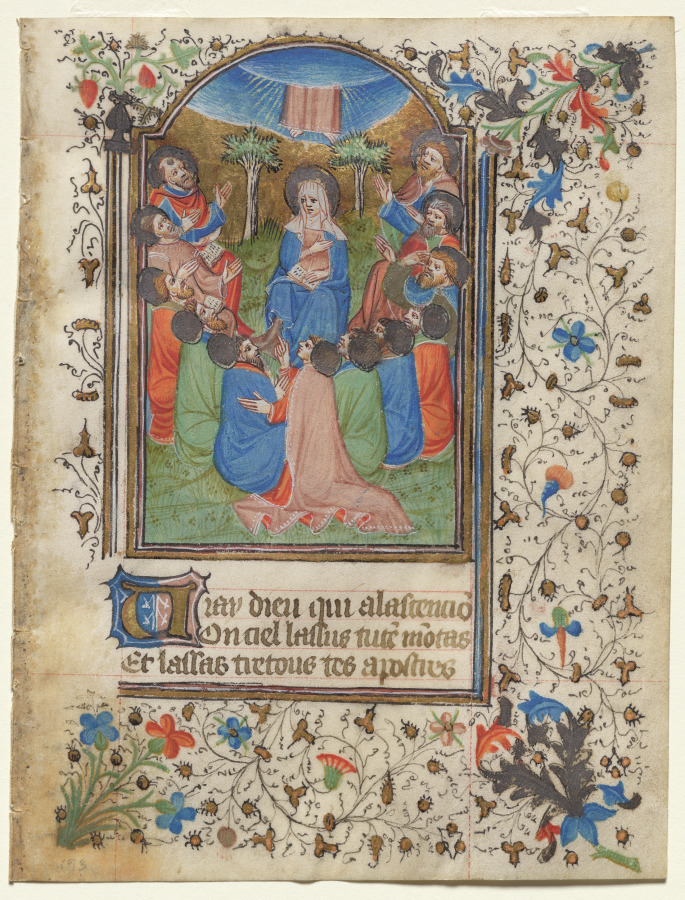
The museum's primary photograph: the Virgin among the apostles on a green hill under a gold ground, Christ's feet and hem at the top of the arch, three lines of French verse below a blue and gold initial, and a gold-studded vine border. Cleveland Open Access, CC0.
| Artist | Henri d'Orquevaulx, or workshop |
|---|---|
| Date | c. 1420-30 |
| Medium | Ink, tempera, silver and gold on vellum |
| Dimensions | Overall 15.9 x 11.6 cm (Cleveland Museum of Art); 162 x 124 mm as printed in the 1999 Blackburn catalogue |
| Where it is now | The Cleveland Museum of Art, Cleveland, Ohio (not on view, per the museum's page consulted)last confirmed |
| Inventory number | 2001.76 |
| Attribution | DisputedThe Cleveland Museum of Art catalogues the leaf as Henri d'Orquevaulx or workshop and says the illuminations appear to come from his workshop, not from his own hand. Full note |
| Object type | Manuscript |
| Period | French (Metz), early fifteenth century |
| Cases | Disputed attribution · Has a provenance gap |
| Inscriptions | French verse text in a Gothic hand below the miniature, opening in a blue and gold initial; more French verse on the other side of the leaf. The museum's page gives the opening words as Dieu qui and does not transcribe the rest. |
| Owners on record | 14 links10 documented, 1 disputed, 3 unknown |
| Sources | 8 cited |
About this record Last verified · 8 sources cited · Change log
On this page 10 sections
ContentsClose
A single leaf, about 16 by 12 centimetres, from a lavishly illuminated Book of Hours made in or near Metz around 1420 to 1430. It shows the Virgin and the apostles on a green hill looking up at the feet of the ascending Christ, with French verse beneath and a border of gold-studded vine scrolls. It is leaf 4 of 6 in the numbering Cleveland uses, drawn from a book whose leaves the museum's 1999 catalogue counted as ten in the Blackburn group, with numerous others in private hands.
The attribution is to Henri d'Orquevaulx, a documented Metz illuminator, or his workshop, and Cleveland's own wording is hedged. The ownership chain runs from Jehan de Poncy and his wife around 1539 through a Norwich family of Gurneys to Christie's New York in 1978, the dealer Bruce Ferrini and the collector Jeanne Miles Blackburn, who gave it to Cleveland in 2001. Between about 1541 and the Gurneys, and between the last Gurney and 1978, nothing is recorded, and nobody names the person who cut the book apart.
Provenance
Each link is graded. Documented: a cited source supports it. Disputed: the identification is argued but not established. Unknown: no owner for that span, and the gap is not smoothed into a narrative. The grades in the glossary.
- c. 1420-30 - before 1539Made, probably in Metz, for an unnamed patrondisputed
The Cleveland Museum of Art gives c. 1420-30 and Metz as the probable place, on calendar and dialect evidence, and attributes the miniatures to Henri d'Orquevaulx or his workshop. The attribution is by style. The patron is not known.13
- c. 1420-30 - before 1539Unknownunknown
No owner is recorded between the making of the book and the earliest named owners.13
- before 1539 - after 1541Jehan de Poncy (d. 1605) and his wife Margueritedocumented
Named as the earliest owners of the original manuscript in the 1999 catalogue (ca. 1539) and in Cleveland's record (before 1539 to after 1541). Neither source states the evidence for the dates.123
- after 1541 - before 1803Unknownunknown
Nothing is recorded between Poncy and Bartlett Gurney. The date at which Gurney acquired the book is not given.12
- - 1803Bartlett Gurney (1756-1803), Norwich, Englanddocumented
Bequeathed to his aunt Catherine Gurney. No acquisition date is given.123
- 1803 - 1808Catherine Gurney (1776-1850), Norwich, Englanddocumented
Received from Bartlett Gurney by bequest and gave the book in 1808 to the Reverend Edward Edwards. The record's dates make her twenty years younger than the nephew-by-bequest relationship implies; the museum prints them as given.123
- 1808 - 1849Reverend Edward Edwards (1766-1849), Lynn, Norfolkdocumented
Bequeathed to his godson William Hay Gurney. The 1999 catalogue gives his death as 15 March 1849.123
- 1849 - 1898William Hay Gurney (1827-1898), North Princetondocumented
Nephew of Catherine Gurney and godson of Edwards. The transfer date of 1849 is inferred from Edwards's death and is not stated in the sources; what happened to the book at William Hay Gurney's death is not recorded.123
- 1898 - 1978Unknownunknown
Nothing is recorded between William Hay Gurney's death and the Christie's sale of 1978.12
- 1978 - 1978Sale, Christie's New York, 7 April 1978, lot 226documented
Listed in Cleveland's provenance record and cited to Christie, Manson and Woods, Printed Books and Manuscripts Including an Important Manuscript Map of Southeastern North America, 1721. The Christie's catalogue itself was not seen. Price, buyer and whether the book was bound or in leaves are not recorded in the sources consulted. A dealer listing seen only in a search summary placed this sale in 1976; that could not be verified and is not adopted.12
- Edward R. Lubin, New York (dealer)documented
The 1999 catalogue says dismembered leaves from the original manuscript have appeared with Lubin. No date is given, and the order of this event and the Christie's sale is not stated.34
- - before 2001Bruce Ferrini (1950-2010), dealer, Akron, Ohiodocumented
Sold the leaf to Jeanne Miles Blackburn. Neither date nor price is given. The 1999 catalogue records that Ferrini was Blackburn's principal dealer.13
- before 2001 - 2001Jeanne Miles Blackburn, Maitland, Floridadocumented
Given to the Cleveland Museum of Art by 2001 as part of a phased gift announced in the 1999 catalogue.13
- 2001 - presentThe Cleveland Museum of Art, Cleveland, Ohiodocumented
Accession 2001.76, The Jeanne Miles Blackburn Collection; not on view according to the museum's page consulted.127
Prices realised
| Date | Sale | Estimate | Result | Note |
|---|---|---|---|---|
| 7 April 1978 | Christie's New York (Christie, Manson and Woods International Inc.) | Not found | Hammer Not found With premium Not found Not found; a New York sale would be expected to be in US dollars, but no source consulted states it | Lot 226 in the sale catalogued as Printed Books and Manuscripts Including an Important Manuscript Map of Southeastern North America, 1721, as cited by the Cleveland Museum of Art for the whole six-leaf group. The sale record, hammer price and buyer were not available from any source fetched. |
Hammer is the price at which the bidding stopped; with premium adds the fee the house charges the buyer on top. Hammer price and buyer's premium in the glossary.
Technical evidence
| Attribution note | The Cleveland Museum of Art catalogues the leaf as Henri d'Orquevaulx or workshop and says the illuminations appear to come from his workshop, not from his own hand. The 1999 Blackburn catalogue records that the miniatures show at least four stylistically similar but different artistic hands, and that earlier comparisons had been made to the Master of Morgan 453, which its author found less tenable. No signed work by the painter is connected to this book; the link rests on style. |
|---|---|
| Support | Vellum leaf, cut from a bound book. The museum's photographs show a stained, irregular left edge.12 |
| Medium | Ink, tempera, silver and gold on vellum. The border carries gold bosses and the miniature a gold ground.12 |
| Dimensions | Overall 15.9 x 11.6 cm (6 1/4 x 4 9/16 in.) in the museum's record. The 1999 catalogue prints 162 x 124 mm for this leaf; the two figures differ by a few millimetres and the museum does not say which is the leaf and which the overall measurement. The five sister leaves in the museum's records are given as 16.1 x 12.4 to 12.6 cm.136 |
| Date and place | c. 1420-30; probably Metz, on calendar and dialect evidence.13 |
| Calendar evidence | Clement of Metz in gold on 23 November and Arnoul of Metz in red on 18 July, per the 1999 catalogue's note on the whole group.3 |
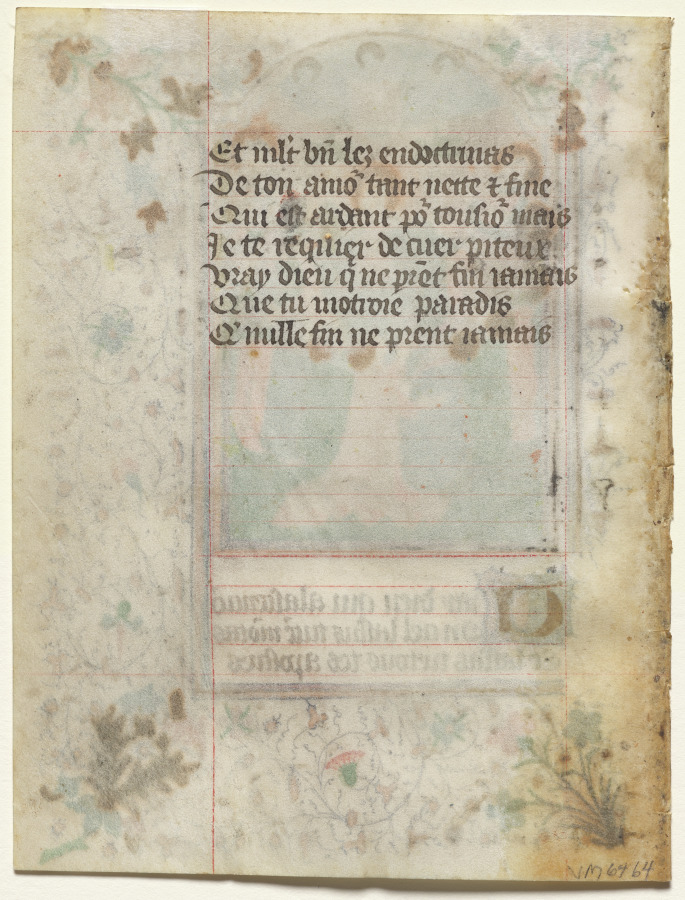
| Language | French verse text on both sides of the leaf, opening with the words Dieu qui; the catalogue states that some texts in the original book are in Lorraine dialect.23 |
| Hands | At least four stylistically similar but different artistic hands across the surviving miniatures of the book, per the 1999 catalogue; this leaf is not assigned to one of them in the sources consulted.3 |
| Text and image layout | Arched miniature above three lines of text with a blue and gold initial and floral border; a further seven lines of text on the other side. The catalogue notes that the book's full-page miniatures sit on versos.23 |
| Position in the book | Catalogue no. 34 in the 1999 group of ten (nos. 29-38); 4 of 6 in Cleveland's own numbering. The scanned catalogue caption for its office breaks off at the words Hours of the Holy.13 |
| Image rights | Cleveland Museum of Art Open Access, CC0. Wikidata item Q79985853 records the object and a TIFF on Wikimedia Commons.18 |
Images
The record in full
Chapter 1One page, one scene: the Ascension seen from the ground
The miniature is an arch-topped picture about the size of a postcard, painted on vellum with ink, tempera, silver and gold.
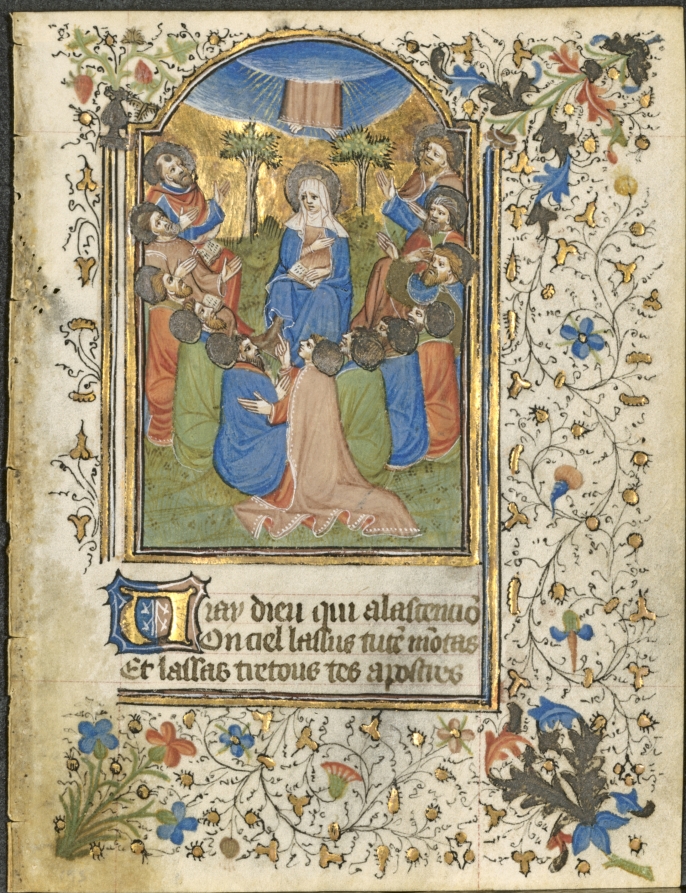
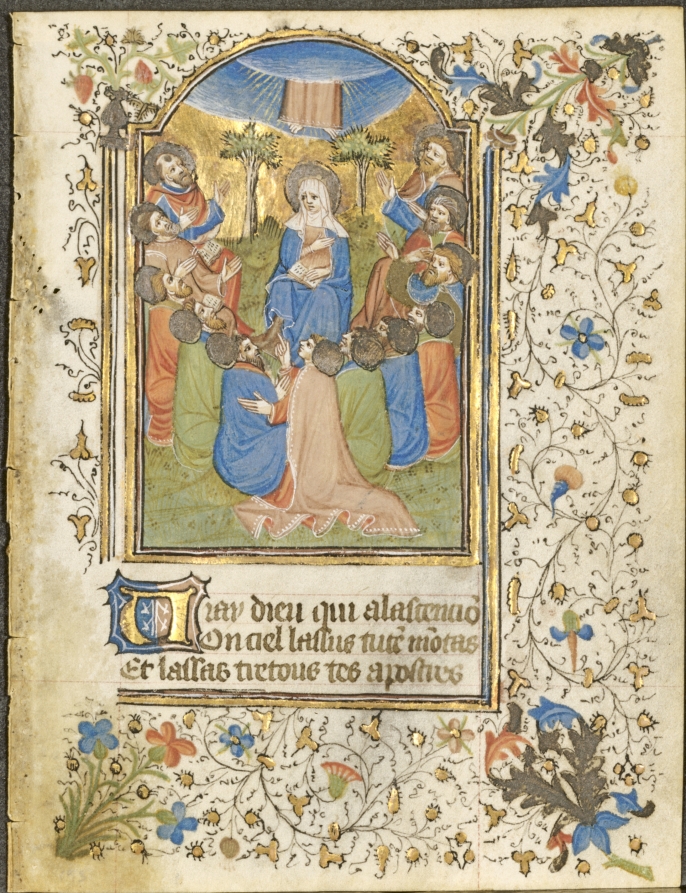
The miniature is an arch-topped picture about the size of a postcard, painted on vellum with ink, tempera, silver and gold. A gold ground fills the upper part of the frame and a blue sky with a ray-streaked cloud opens at the top, where, as Cleveland's description puts it, the feet of the ascending Christ are the last thing the viewers on earth can see. Below, the Virgin sits at the centre in a blue mantle with a book in her lap, ringed by the apostles on a green hill with two small trees behind her. The museum's page counts the Virgin and eleven apostles. A kneeling figure in a pale pink robe is turned from the viewer in the foreground, and the apostles around the Virgin look and gesture upward.
The image is built on the familiar Gospel picture of the Ascension, but it is the version in which only Christ's feet and hem remain visible, a device that keeps the whole scene on earth with the witnesses. Nothing in the sources consulted says why this composition was chosen for the book, and none says whether it follows a particular model. The Cleveland catalogue and the museum describe the scene and the style; they do not discuss the iconography of this leaf.
Chapter 2The rest of the page: initial, shield, border and French verse
Below the miniature three lines of Gothic script open with a blue and gold initial.
Below the miniature three lines of Gothic script open with a blue and gold initial. The museum's page reports that the text begins with the words Dieu qui, and the lines are in French, not Latin. In the museum's photograph a small shield appears inside the initial. No source consulted identifies the arms, and at the size of the museum's web image the charges cannot be read with confidence, so the shield is recorded here as an unanswered question and not as evidence of an owner.
A border of thin gold-studded vine scrolls with blue, red and green flowers, thistle-like leaves and tiny gold bosses runs around the page. The facing side of the leaf, shown in the museum's alternate photograph, carries seven lines of French verse in a Gothic hand with the miniature and the initial showing faintly through the thin vellum. The leaf was clearly trimmed: the museum's photographs show a ragged, stained left edge and an irregular lower margin, consistent with being cut from a bound book, although no source consulted describes the cutting itself.
The 1999 Cleveland catalogue draws a conclusion from layout. In its general entry for this group it observes that the full-page miniatures sit on the versos of leaves, a placement it calls often favoured by Netherlandish illuminators, and offers that as one reason the miniatures suggest strong links to the Netherlandish tradition.
Chapter 3One book, ten leaves in the catalogue, six in Cleveland's numbering
Cleveland holds leaves from several unrelated Books of Hours, bought and given in the same years, and the accession numbers alone do not say which belong together.
Cleveland holds leaves from several unrelated Books of Hours, bought and given in the same years, and the accession numbers alone do not say which belong together. For this leaf the sibling group is fixed by the museum's own records. Six Cleveland objects are catalogued as numbered excised leaves of one Metz book, all credited to Henri d'Orquevaulx or workshop and all sharing one identical nine-line provenance: 1999.128 Annunciation to the Shepherds (1 of 6), 1999.129 Christ before Pilate (2 of 6), 2001.75 The Nativity (3 of 6), this leaf 2001.76 (4 of 6), 2003.172 The Visitation (5 of 6) and 2011.57 Saint Barbara (6 of 6). A search of the museum's open-access data for the painter's name returns exactly these six.
That is not the whole of the group. The 1999 exhibition catalogue by Stephen N. Fliegel prints the book as Ten Leaves from a Book of Hours, catalogue numbers 29 to 38: the Visitation, the Nativity, the Annunciation to the Shepherds, Christ before Pilate, Christ before Herod, the Ascension, the Virgin and Child, Saint John the Baptist, Saint Nicholas and Saint Barbara. Its note says the group of leaves and numerous others now in private hands survive from the book. Four of the ten, Herod, Virgin and Child, John the Baptist and Nicholas, do not appear among Cleveland's six numbered leaves, and no record consulted says where they went. The 'of 6' on this leaf therefore counts the leaves that reached the museum under that numbering, not the leaves known to survive. Cleveland's order, with the Ascension as 4 of 6, also differs from the catalogue's order, where the Ascension is number 34 of 29 to 38 and follows Christ before Herod.
Chapter 4Why Metz: two bishop-saints and a regional dialect
No colophon names the book's place of origin, and the case for Metz rests on internal evidence that the 1999 catalogue sets out.
No colophon names the book's place of origin, and the case for Metz rests on internal evidence that the 1999 catalogue sets out. The calendar lists two bishop-saints of Metz: Clement, written in gold, for 23 November, and Arnoul, written in red, for 18 July. Some of the texts are in French, and the catalogue states that the French is the Lorraine dialect. The museum's own wording is that Metz was the probable place of production.
The catalogue adds the commercial setting: Metz, on the Moselle, was the cultural and commercial capital of Lorraine in the fifteenth century and the seat of an important bishopric, so a growing book trade is logical there. That is the catalogue's inference and not a document placing this book in a named Metz shop.
Chapter 5Henri d'Orquevaulx, or the people around him
The painter's name comes from outside this book.
The painter's name comes from outside this book. A Sotheby's catalogue of 2009, written for a copy of the French Livy translation, says a Maistre Henri is documented as illuminator and painter in Metz from 1437 to 1452 and that Jean de Vy commissioned murals from him in 1437. The 1999 Cleveland catalogue calls him a documented Metz manuscript painter known from a Livy he decorated in 1440, signed and dated in the colophon. Sotheby's names the Livy's scribe as Maistre Jeannin de Rouen and its patron as Jean III de Vy, a Metz echevin; the Cleveland catalogue, says the Livy was made for a bishop of Metz. The two accounts disagree about the patron and this record follows the later, more specific catalogue only for that point.
Cleveland's attribution is deliberately one step removed: the illuminations appear to derive from his workshop. The 1999 catalogue says the surviving miniatures show at least four stylistically similar but different artistic hands and concludes that Henri was assisted by associates in his workshop. It records that earlier writers had compared the style to the Master of Morgan 453, a northern French or Netherlandish illuminator active in Paris and Amiens, and judged the Orquevaulx workshop the more tenable source. Nobody in the sources consulted says which hand painted this particular Ascension.
Cleveland, the 1999 catalogue and the AMICO entry all say it is not known whether Henri was himself Netherlandish or only worked or trained in the Netherlands at some point. The AMICO record gives his dates as about 1380 to 1439, which cannot stand beside a Livy signed in 1440 and a documented career to 1452, so those dates are not used here.
Chapter 6What the book was: a rich private prayer book with a Passion cycle
Cleveland's text on the leaf says it survives from what must have been an extraordinarily rich book of hours and that the elaborate Passion cycle and suffrages point to an important patron or...
Cleveland's text on the leaf says it survives from what must have been an extraordinarily rich book of hours and that the elaborate Passion cycle and suffrages point to an important patron or commission. The catalogue captions show how the book was organised around the pictures. The Visitation opened lauds, the Nativity prime and the Annunciation to the Shepherds terce of the Office of the Virgin. Christ before Pilate and Christ before Herod belonged to the Hours of the Cross. The Virgin and Child belonged to a commemoration of the fifteen joys of the Virgin, and the leaves of Saint John the Baptist, Saint Nicholas and Saint Barbara to the suffrages, the short prayers to individual saints. The text layer of the scanned catalogue breaks off the Ascension's own heading after the words Hours of the Holy, so the office to which this leaf belonged is not confirmed in the copy read here.
In an entry on a different leaf the same catalogue explains the general arrangement: the Hours of the Cross normally had a single miniature, a Crucifixion, but some books carried a cycle of seven Passion miniatures, one for each hour except lauds. That is context about the type and not a statement about this book's count.
The patron is unknown. The sources consulted identify no owner, no commission, no coat of arms and no inscription for the book before about 1539. The function of such a book is not in doubt in the general sense: it was a private devotional book read at fixed hours of the day. The catalogue finds nothing hidden in the programme of these leaves beyond that ordinary devotional use, and nothing in the sources consulted proposes any further meaning for the Ascension leaf.
Chapter 7From Jehan de Poncy to the Gurneys of Norwich
The museum's record names the earliest known owners as Jehan de Poncy, who died in 1605, and his wife Marguerite, dated before 1539 to after 1541.
The museum's record names the earliest known owners as Jehan de Poncy, who died in 1605, and his wife Marguerite, dated before 1539 to after 1541. The 1999 catalogue gives the same pair as owners around 1539. The basis of the date, whether a signature, an inscription or a note in the manuscript, is not stated in either source, and the record cannot be checked further here.
The next named owner is Bartlett Gurney (1756 to 1803) of Norwich, who left it to his aunt Catherine Gurney (1776 to 1850), also of Norwich. The record's own dates make a person born in 1776 the aunt of one born in 1756, which is unusual but is what the museum prints; the catalogue gives no further detail and this record does not correct it. By 1808 Catherine had given the book to the Reverend Edward Edwards (1766 to 1849) of Lynn, Norfolk. Edwards, who died on 15 March 1849 according to the catalogue, left it to his godson William Hay Gurney (1827 to 1898), described in the record as a nephew of Catherine Gurney and listed at North Princeton.
Two gaps sit inside this chain and neither source fills them. Nothing is recorded between about 1541 and Bartlett Gurney, a span of over two centuries. Nothing is recorded between William Hay Gurney's death in 1898 and the 1978 sale.
Chapter 8The cutting up, the dealers and the 1978 sale
Two sources describe the break-up from different sides.
Two sources describe the break-up from different sides. The 1999 catalogue says dismembered leaves from the original manuscript have appeared with Edward R. Lubin, New York, and that the leaves it lists were with the Akron dealer Bruce Ferrini. The AMICO entry for the sibling leaf 1999.128 repeats the Lubin and Ferrini names. Cleveland's provenance record for each of the six leaves places a sale at Christie's New York on 7 April 1978 as lot 226 and cites the Christie's catalogue titled Printed Books and Manuscripts Including an Important Manuscript Map of Southeastern North America, 1721. Which came first, the Lubin dealings or the Christie's sale, is not stated, and the sources do not say whether the book was still bound at Christie's or already in leaves.
No source consulted names the person who cut the book up or gives the year. The Christie's lot, the price, the buyer and the underbidder have not been found in the sources fetched, so no hammer price, premium or currency can be reported for the 1978 sale. A later dealer listing, seen only as a search summary and since removed from its auction house's catalogue, was reported to place the Christie's sale in 1976 and to describe the book as intact there. That could not be read directly and is not relied on, but it means the sale date and the bound state both need checking in the Christie's catalogue itself.
Ferrini sold to Jeanne Miles Blackburn, a Florida collector. The 1999 catalogue says she formed her collection of eighty-two leaves between 1983 and about 1999 and relied on Ferrini as her principal dealer, whose advice and selections shaped it. Bruce Ferrini is recorded in the museum's record with the dates 1950 to 2010.
Chapter 9Blackburn's gift, and what Cleveland has shown
The museum announced in 1999 that Blackburn planned to present the majority of her leaves over time as a phased gift.
The museum announced in 1999 that Blackburn planned to present the majority of her leaves over time as a phased gift. The provenance records for the six leaves show that phase at work: 1999.128 and 1999.129 given by 1999, 2001.75 and this leaf by 2001, 2003.172 by 2003 and 2011.57 by 2011. The credit line is The Jeanne Miles Blackburn Collection.
This leaf has been shown in the original 1999 to 2000 Blackburn exhibition, where it was catalogue 34 and is illustrated on page 40, in Illuminated Manuscripts (2004 to 2005), in The Glory of the Painted Page (2010 to 2011) and in The Medieval Top Seller: The Book of Hours (2022 to 2023). The museum's page, as consulted, lists it as not on view. The museum releases the images as CC0 open access and its website warns that provenance information may not be current.
Chapter 10What nobody has established
The patron, the owner before Poncy and the identity of the coat of arms in the initial are all unrecorded in the sources consulted.
The patron, the owner before Poncy and the identity of the coat of arms in the initial are all unrecorded in the sources consulted. The person and year of the cutting are unrecorded. The 1978 sale's price and buyer are unrecorded. The present locations of the four catalogued leaves that are not among Cleveland's six, and of the numerous others the catalogue says are in private hands, are unrecorded. The Schoenberg Database of Manuscripts was not reachable for this record, so any sale history that database holds, including the Christie's sale and any earlier appearances, has not been checked.
What can be said firmly is narrower and still useful: this is one of a documented set of leaves from a single Metz book, each leaf carries the same ownership chain in Cleveland's records, and the attribution to Henri d'Orquevaulx is to his workshop, on the evidence of style.
The artist
Henri d'Orquevaulx (Maistre Henri), Metz illuminator, and his workshop
Henri d'Orquevaulx is one of the few illuminators of fifteenth-century Lorraine who can be called by a name. The name rests on a small group of documents and one signed manuscript, and the leaves of this Book of Hours are attributed to his workshop by stylistic comparison, not by any signature of their own. The spelling varies across catalogues; this record uses the form printed by Cleveland.
Related works
| Work | Relation | Where it is |
|---|---|---|
| Annunciation to the Shepherds: Leaf from a Book of Hours (1 of 6 Excised Leaves) Henri d'Orquevaulx or workshop | Sister leaf of the same book; Fliegel no. 31, Office of the Virgin, opening of terce Same nine-line provenance in the museum's record. | Cleveland Museum of Art, 1999.128 |
| Christ before Pilate: Leaf from a Book of Hours (2 of 6 Excised Leaves) Henri d'Orquevaulx or workshop | Sister leaf; Fliegel no. 32, Hours of the Cross One of the Passion-cycle leaves the museum cites as pointing to an important patron. | Cleveland Museum of Art, 1999.129 |
| The Nativity: Leaf from a Book of Hours (3 of 6 Excised Leaves) Henri d'Orquevaulx or workshop | Sister leaf; Fliegel no. 30, Office of the Virgin, opening of prime Given in the same year as this leaf; the catalogue points to its tub, ewer, towel and fireplace as Netherlandish-style domestic detail. | Cleveland Museum of Art, 2001.75 |
| The Visitation: Leaf from a Book of Hours (5 of 6 Excised Leaves) Henri d'Orquevaulx or workshop | Sister leaf; Fliegel no. 29, Office of the Virgin, opening of lauds Dated c. 1420 in the museum's record against c. 1420-30 for the others. | Cleveland Museum of Art, 2003.172 |
| Leaf from a Book of Hours: Saint Barbara (6 of 6 Excised Leaves) Henri d'Orquevaulx or workshop | Sister leaf; Fliegel no. 38, suffrages Its museum text adds the fullest description of Metz as a book-trade centre. | Cleveland Museum of Art, 2011.57 |
| French translation of Livy's Decades, signed and dated 1440 Henri d'Orquevaulx, with the scribe Maistre Jeannin de Rouen | The documented manuscript on which his name and the workshop's attribution rest Sotheby's names the patron as Jean III de Vy; the 1999 Cleveland catalogue says a bishop of Metz and gives the location as unknown. | Offered at Sotheby's in 2009; present location not confirmed in sources consulted |
| Book of Hours, Use of Metz (BnF lat. 10533) Attributed to Henri d'Orquevaulx by Avril 1989 | A complete Metz book of hours given to the same painter Reported in the Sotheby's catalogue; not examined directly for this record. | Bibliotheque nationale de France |
Open questions
- Who commissioned the book? The museum says only that the Passion cycle and suffrages point to an important patron, and no source consulted names a person, a coat of arms or a family.
- Whose arms is the small shield in the blue and gold initial on this leaf? No source consulted reads it, and it is the single most promising lead to a patron if it can be read on the full-resolution image.
- Who cut the book into leaves, and when? Edward R. Lubin and Bruce Ferrini are recorded as handling the leaves, but neither source says who did the cutting, or whether the book was still bound at Christie's New York on 7 April 1978 as lot 226.
- Where are the other four leaves of the catalogued ten (Christ before Herod, Virgin and Child, Saint John the Baptist, Saint Nicholas), and the numerous other leaves the 1999 catalogue says are in private hands?
- To which office did the Ascension belong? The scanned catalogue caption breaks off after the words Hours of the Holy, so the office is not confirmed in the copy read here.
- What is the basis of the Poncy date, before 1539 to after 1541, and what happened to the book between about 1541 and Bartlett Gurney?
- Do the Schoenberg Database of Manuscripts and the Christie's 1978 catalogue give a sale price, buyer and condition for lot 226? Neither could be read for this record.
Questions about this object
What is The Ascension: Leaf from a Book of Hours (4 of 6 Excised Leaves)?
The Ascension: Leaf from a Book of Hours (4 of 6 Excised Leaves) is a manuscript, dated c. 1420-30. Medium: Ink, tempera, silver and gold on vellum.
Who made The Ascension: Leaf from a Book of Hours (4 of 6 Excised Leaves), and is the attribution settled?
The attribution to Henri d'Orquevaulx, or workshop is recorded here as disputed. The Cleveland Museum of Art catalogues the leaf as Henri d'Orquevaulx or workshop and says the illuminations appear to come from his workshop, not from his own hand. The 1999 Blackburn catalogue records that the miniatures show at least four stylistically similar but different artistic hands, and that earlier comparisons had been made to the Master of Morgan 453, which its author found less tenable. No signed work by the painter is connected to this book; the link rests on style.
Where is The Ascension: Leaf from a Book of Hours (4 of 6 Excised Leaves) now?
The Cleveland Museum of Art, Cleveland, Ohio (not on view, per the museum's page consulted). Inventory number 2001.76. Last confirmed 2 August 2026. The Jeanne Miles Blackburn Collection, given to the museum in 2001 according to its provenance record; released as CC0 open access.
What has The Ascension: Leaf from a Book of Hours (4 of 6 Excised Leaves) sold for?
Hammer Not found; with premium, Not found. Christie's New York (Christie, Manson and Woods International Inc.), 1978-04-07.
What is still unknown about The Ascension: Leaf from a Book of Hours (4 of 6 Excised Leaves)?
Who commissioned the book? The museum says only that the Passion cycle and suffrages point to an important patron, and no source consulted names a person, a coat of arms or a family.
Sources
- 1The Cleveland Museum of Art, Open Access API record for 2001.76, The Ascension: Leaf from a Book of Hours (4 of 6 Excised Leaves) (object 162143): tombstone, description, provenance, citations, exhibitions, related works and image records, CC0. openaccess-api.clevelandart.org/api/...
- 2The Cleveland Museum of Art, collection page for 2001.76, and its print view, consulted for the image description, the opening words of the text, the provenance list and the not-on-view status. clevelandart.org/art/...
- 3Stephen N. Fliegel, The Jeanne Miles Blackburn Collection of Manuscript Illuminations (Cleveland: Cleveland Museum of Art, 1999), cat. nos. 29-38 (Ten Leaves from a Book of Hours; this leaf is no. 34, p. 40), full text read on the Internet Archive. archive.org/details/...
- 4AMICO / David Rumsey record for Ten Leaves from a Book of Hours: Annunciation to the Shepherds, Cleveland 1999.128, Fliegel cat. 31. amica.davidrumsey.com/amico2101619-38756.html
- 5Sotheby's, Western Manuscripts and Miniatures and the Korner Sale, London, 2009, lot 34 (French translation of Livy's Decades illuminated by Henri d'Orquevaulx), the essay on the painter. sothebys.com/en/...
- 6The Cleveland Museum of Art, Open Access API records for the five sister leaves: 1999.128 (160816), 1999.129 (160817), 2001.75 (162142), 2003.172 (162536) and 2011.57 (169741). openaccess-api.clevelandart.org/api/...
- 7The Cleveland Museum of Art, print view of the 2001.76 record. clevelandart.org/print/...
- 8Wikidata, item Q79985853 for 2001.76 (inventory number, collection, Commons image). wikidata.org/wiki/...
Last verified · Published
Change log
24 November 2026 - Record created at the house standard: researched narrative, technical evidence, maker dossier, graded provenance chain, prices with hammer and premium separated, related works, open questions and sources.