Hypnerotomachia Poliphili
Francesco Colonna (attributed) · December 1499
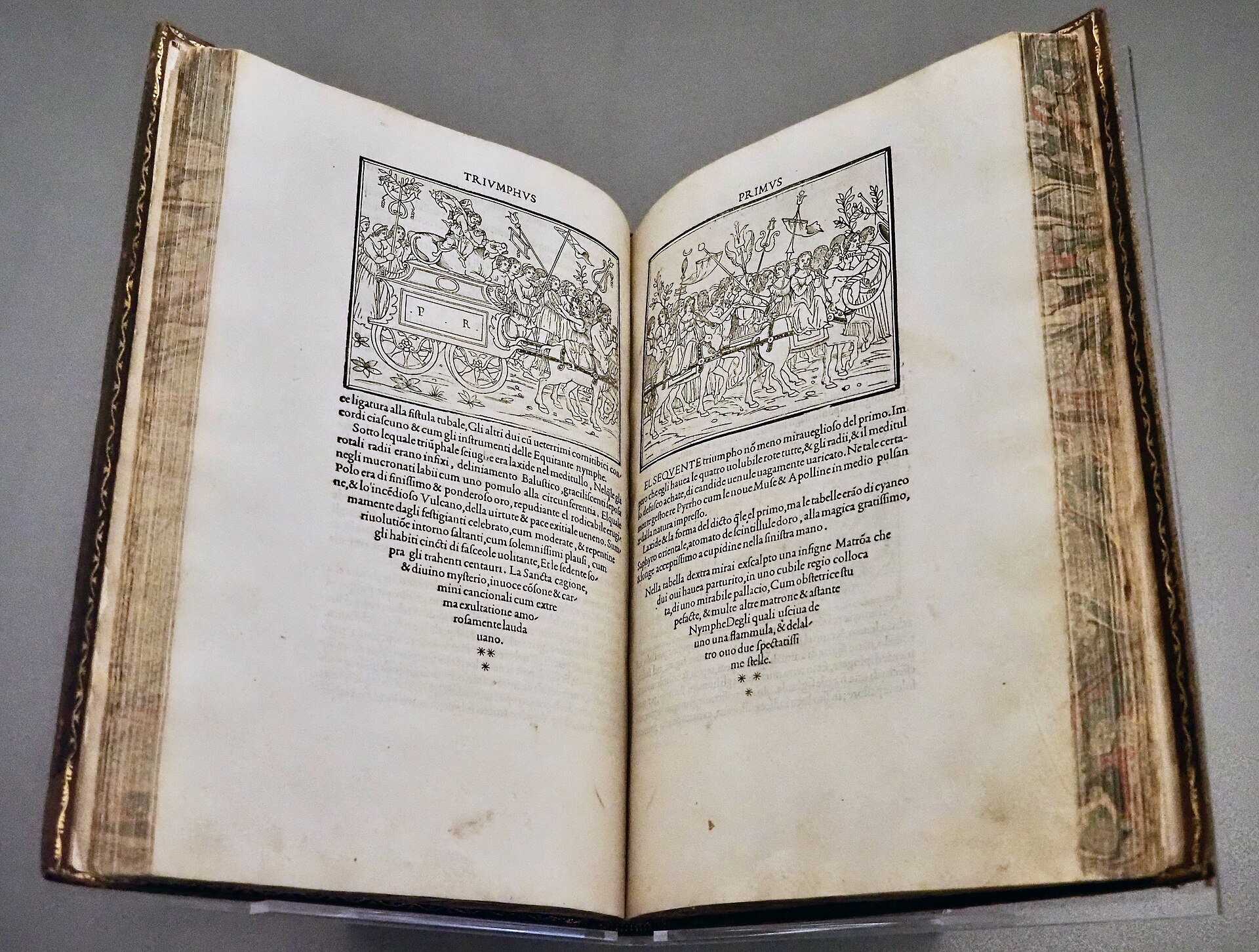
This copy, inventory 15678, photographed during the exhibition Thirty Masterpieces from the Lazaro Galdiano Library at the Museo Lazaro Galdiano, Madrid. The file description page confirms the inventory number and ties the photograph explicitly to this institution's own copy.
| Artist | Francesco Colonna (attributed) |
|---|---|
| Date | December 1499 |
| Medium | Letterpress printing in roman type, with woodcut illustrations, on paper |
| Dimensions | Format in-folio; exact trimmed dimensions of this copy not published in the sources consulted |
| Where it is now | Museo Lazaro Galdiano, Madridlast confirmed 23 September 2026 |
| Inventory number | 15678 |
| Attribution | DisputedCredited to a Francesco Colonna by an acrostic formed from the initial letters of the thirty-eight chapters, which reads POLIAM FRATER FRANCISCVS COLVMNA PERAMAVIT (Brother Francesco Colonna has greatly loved Polia). Full note |
| Object type | Printed book |
| Period | Italian Renaissance, fifteenth century (incunable) |
| Cases | Disputed attribution · Has a provenance gap |
| Inscriptions | The chapter-initial acrostic POLIAM FRATER FRANCISCVS COLVMNA PERAMAVIT, formed by the decorated initial letters across the text; invented hieroglyphic-style inscriptions within the woodcuts, presented in the narrative as ancient Egyptian writing |
| Owners on record | 5 links4 documented, 1 unknown |
| Sources | 19 cited |
About this record Last verified 23 September 2026 · 19 sources cited · Change log
On this page 9 sections
ContentsClose
Printed in Venice in December 1499 by Aldus Manutius on commission from Leonardo Crasso, the Hypnerotomachia Poliphili tells a single continuous dream in an invented hybrid of Latin and Italian, illustrated with 172 woodcuts that made it one of the most admired examples of book design to survive from the Renaissance. Its author signed only an acrostic, POLIAM FRATER FRANCISCVS COLVMNA PERAMAVIT, naming a Francesco Colonna without settling which of two candidates of that name wrote it: a Venetian Dominican friar, the traditional identification, or Francesco Colonna, Lord of Palestrina, a Roman nobleman proposed from the 1980s by the art historian Maurizio Calvesi. Its woodcuts are traditionally given to the Paduan illuminator Benedetto Bordon on stylistic grounds that fall short of documentary proof.
This copy, inventory 15678 at the Museo Lazaro Galdiano in Madrid, entered the historical record only when it appeared in the private library of the financier and collector Jose Lazaro Galdiano, who died on 1 December 1947 and left his entire collection to the Spanish State. The Fundacion Lazaro Galdiano was constituted in 1948 and the museum opened in his former residence in January 1951, where the book has remained since. How and when Lazaro Galdiano acquired it is not documented in the sources consulted for this record, leaving a genuine gap of roughly four and a half centuries between the book's printing and its documented presence in his hands.
The type Francesco Griffo cut for this edition outlived its own metal, returning in 1923 as Monotype's Poliphilus and shaping, alongside its sibling revival Bembo, the look of twentieth-century book printing. The book's authorship and its illustrator remain genuinely open questions in current scholarship, argued by named scholars from real evidence, not settled mysteries kept alive for effect.
Provenance
Each link is graded. Documented: a cited source supports it. Disputed: the identification is argued but not established. Unknown: no owner for that span, and the gap is not smoothed into a narrative. The grades in the glossary.
- December 1499 -Printed by Aldus Manutius's press in Venice, financed by Leonardo Crassodocumented
Crasso is named in the book's own colophon as having paid for the edition. This establishes the object's origin, not the ownership history of this specific surviving copy.311
- 1499 - by 1947Unknownunknown
No owner, dealer, sale or acquisition date is documented in the sources consulted for this specific copy between its printing in 1499 and its recorded presence in Jose Lazaro Galdiano's library by the time of his death in 1947. This is a recorded gap of roughly four and a half centuries, not a claim that the copy was untraceable in principle, only that this record found no documentation of it.1
- by 1947 - 1 December 1947Jose Lazaro Galdiano, Madriddocumented
The book was part of Lazaro Galdiano's personal library at his death on 1 December 1947. No acquisition date or source is documented for how it entered his collection.178
- 1 December 1947 - 17 July 1948Spanish State, by testamentary bequestdocumented
Lazaro Galdiano made his will naming the Spanish State as heir two days before his death. The State's acceptance of the inheritance was published by decree-law on 19 December 1947 and gazetted on 26 December 1947. The Fundacion Lazaro Galdiano was constituted by law on 17 July 1948 to hold and administer the collection.78
- 17 July 1948 - presentFundacion Lazaro Galdiano / Museo Lazaro Galdiano, Madriddocumented
The Museo Lazaro Galdiano opened to the public in Lazaro Galdiano's former Madrid residence on 27 January 1951 and has held the book since, currently as inventory 15678.127
Technical evidence
| Attribution note | Credited to a Francesco Colonna by an acrostic formed from the initial letters of the thirty-eight chapters, which reads POLIAM FRATER FRANCISCVS COLVMNA PERAMAVIT (Brother Francesco Colonna has greatly loved Polia). Tradition since the sixteenth century has read this as identifying a Venetian Dominican friar of San Giovanni e Paolo who lived 1433/1434-1527. From the 1980s the art historian Maurizio Calvesi argued instead for Francesco Colonna, Lord of Palestrina, a Roman nobleman of the Colonna family with documented ties to Pomponio Leto's Roman Academy and to the ancient site of Praeneste. Both identifications remain live in current scholarship; neither is proven by a document written in either man's own hand naming him as author. |
|---|---|
| Format | Folio, letterpress printed on paper, with the text set around and interleaved with the woodcut illustrations on the same page rather than on separate inserted plates.311 |
| Typeface | A roman type cut for Aldus Manutius by the punchcutter Francesco Griffo, an enlarged later state of the type Griffo had already cut for Aldus's 1495 edition of Pietro Bembo's De Aetna. Revived by the Monotype Corporation in 1923 as the commercial typeface Poliphilus.1011 |
| Illustrations | 172 woodcut illustrations of varying sizes, including 39 decorated initial letters that form the chapter-acrostic, per the holding museum's own description of this copy. Design traditionally attributed to Benedetto Bordon on stylistic and circumstantial grounds, not by a signed commission.1911 |
| Language | A constructed hybrid of Latin and Italian vocabulary and syntax, with passages and invented inscriptions in Greek, Hebrew and pseudo-Egyptian hieroglyphic characters.13 |
| Printer's device | The dolphin-and-anchor emblem with the motto festina lente appears within the book's illustrations in 1499, before Aldus Manutius adopted the same image as his personal Aldine press device from 1501 onward.18 |
| Illustration-count variation between surviving copies | An incomplete copy sold via Catawiki in an Italian incunabula sale in early 2023 was catalogued with 168 illustrations present, including 10 full-page cuts, against four missing woodcuts including a diagram, against the 172 illustrations and 39 initials the Museo Lazaro Galdiano gives for its own, apparently more complete, copy. Variation of this kind is normal for a hand-finished incunable.112 |
| First French translation | Hypnerotomachie, ou Discours du Songe de Poliphile, Paris: Jacques Kerver, 1546, credited to a revision by Jean Martin, added roughly a dozen new Mannerist-style woodcuts to a set loosely based on the Aldine originals, and was reprinted in 1554, 1561 and 1600.14 |
| Influence on garden and landscape design | The book's illustrated descriptions of an idealized antique garden, with geometric flowerbeds, obelisks and ruin-ornament, were used as source material by later garden and landscape designers in France and England into the eighteenth century.15 |
| Invented hieroglyphs and their later influence | The text's invented hieroglyphic inscriptions, modeled on the late-antique Horapollo tradition, helped fix a symbolic rather than phonetic idea of ancient Egyptian writing among European readers for roughly three centuries before Champollion's decipherment.16 |
| Comparable copies in the market and in collections | This copy has not appeared at public auction in the sources consulted. A copy was estimated at 60,000 to 80,000 euros at Sotheby's Paris in March 2023 (realised price not confirmed in sources consulted); a further copy is held by the Metropolitan Museum of Art, New York, accession 23.73.1, a gift of J. Pierpont Morgan in 1923.1317 |
Images
The record in full
Chapter 1What it is
The Hypnerotomachia Poliphili is a folio volume printed in Venice in December 1499 by Aldus Manutius, on commission from a Veronese papal protonotary named Leonardo Crasso, who paid for the edition...
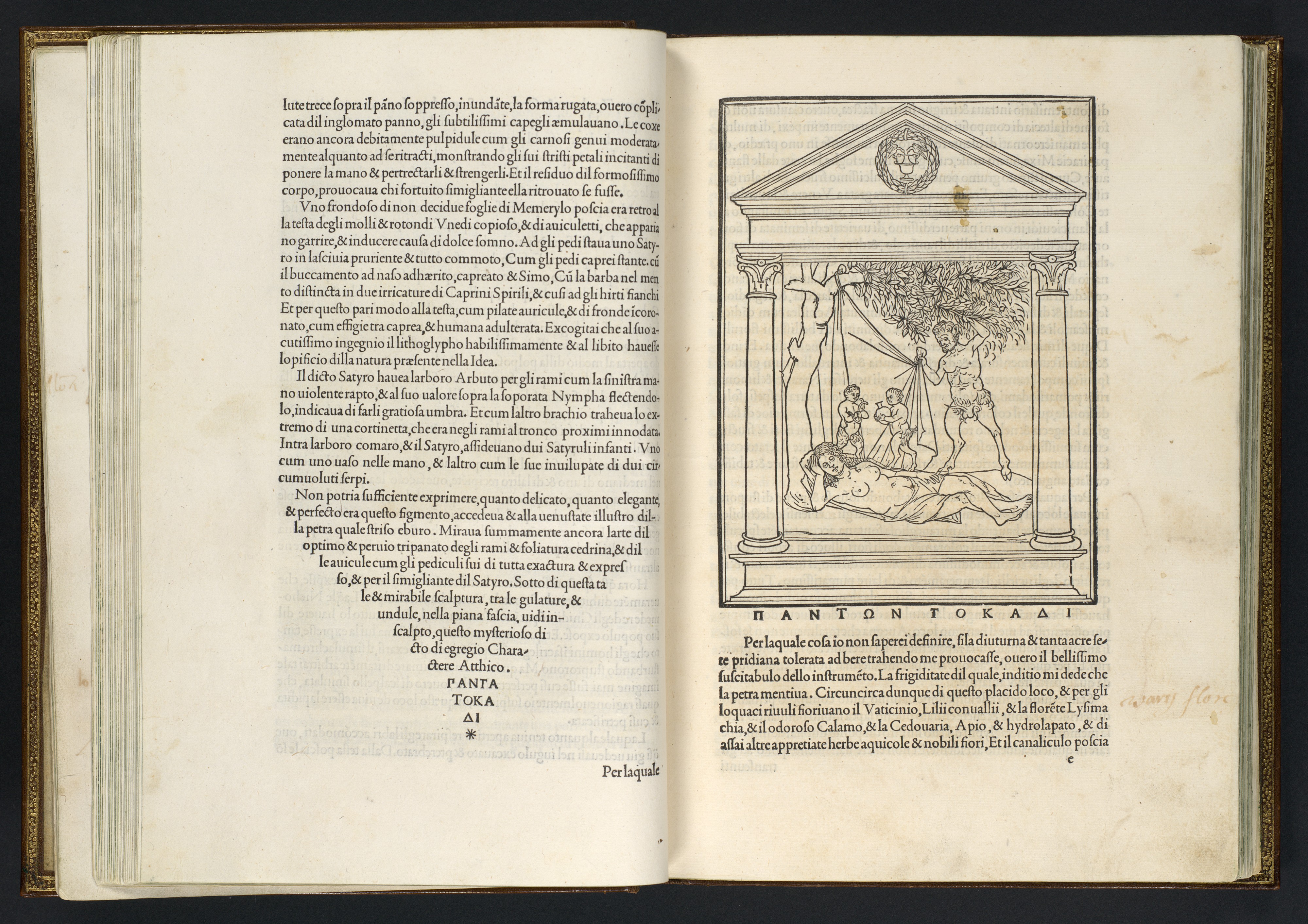
The Hypnerotomachia Poliphili is a folio volume printed in Venice in December 1499 by Aldus Manutius, on commission from a Veronese papal protonotary named Leonardo Crasso, who paid for the edition and is named in its colophon. The text is a first-person dream narrative, told in a dense invented language that mixes Latin and Italian with Greek, Hebrew and Chaldean vocabulary, in which the lover Poliphilo wanders through an imagined antique world of ruins, gardens, temples and pageants in search of his beloved Polia. It is illustrated throughout with woodcuts of varying size, some occupying a full page, set into the text block in a page design that was itself a deliberate innovation: image and letterpress share the same page as a single composed unit rather than as separate plates bound in.
This copy, inventory number 15678 in the library of the Museo Lazaro Galdiano in Madrid, is the museum's own holding of the 1499 first edition. The museum's own description of the volume counts 172 illustrations of varying sizes across the book, including 39 decorated initial letters woven into the acrostic. Other institutions and dealers give closely related but not identical counts for their own copies of the same edition, which is normal for a hand-finished incunable: some surviving copies are imperfect, lack a leaf or a cut, or were bound from sheets pulled at slightly different states of the press run.
Chapter 2How it was made
The book is set in a roman typeface cut for Aldus Manutius by the goldsmith and punchcutter Francesco Griffo.
The book is set in a roman typeface cut for Aldus Manutius by the goldsmith and punchcutter Francesco Griffo. It is a later, enlarged state of the same design Griffo had already cut for Aldus's 1495 edition of Pietro Bembo's De Aetna, and it is one of the works usually cited as an early landmark of roman type design distinct from the black-letter forms it displaced. The clarity and proportion of that type is one of the reasons the book has been prized by typographers for five centuries independently of its text.
The 172 woodcuts are unsigned. The attribution most widely repeated today gives their design to Benedetto Bordon, called Bordone, a Paduan manuscript illuminator and cartographer active mainly in Venice from the late 1480s. The case for Bordon rests on a lower-case b appearing worked into two of the cuts, and on a resemblance between the drawing style of the woodcuts and miniatures securely given to Bordon on other grounds; it is a plausible circumstantial case rather than a documented commission, and this record treats it that way. Other names have been floated over the centuries, including Andrea Mantegna, Gentile Bellini and a young Raphael, none of them resting on comparable evidence to the Bordon case; this record does not repeat them as live candidates.
Also new to this book, so far as the printed record shows, is the dolphin-and-anchor device that Aldus adopted as his personal printer's mark. An emblem of a dolphin curled around an anchor, with the motto festina lente (make haste slowly), appears as an illustration within the Hypnerotomachia in 1499 before Aldus began using the same image as his own press device from 1501 onward. The design was taken, by Aldus's own later account, from an antique Roman coin. The most famous printer's mark of the Renaissance therefore has its first printed appearance inside this book, as part of the story it tells, before it became the trademark of the press that made it.
Chapter 3The dream, and the world it describes
The narrative is a single continuous dream.
The narrative is a single continuous dream. Poliphilo falls asleep and finds himself in a wilderness that gives way to an idealized antique landscape of ruined temples, pyramids, obelisks, triumphal processions and formal gardens, each described in architectural and botanical detail far beyond what the plot strictly requires. He is conducted by nymphs to the temple of Venus, is united with Polia, and the second half of the book, narrated in Polia's own voice, retells the same events from her side before the lovers are parted by her death and Poliphilo wakes.
The descriptive excess is the point. Long passages function as an illustrated encyclopedia of an imagined classical architecture and garden design, precise enough in its measurements and orders that later architects and garden designers used the woodcuts as source material independent of the love story that frames them. The book gave the sixteenth, seventeenth and eighteenth centuries a visual vocabulary for knot gardens, obelisks, ruins-as-ornament and hieroglyph-bearing monuments that shows up repeatedly in garden design across France and England, from formal Renaissance schemes through to the emblematic follies of the eighteenth-century landscape garden.
Chapter 4An invented Egypt, taken seriously
Scattered through the text and carved into its imagined monuments are inscriptions the narrator presents as ancient Egyptian hieroglyphs, together with lengthy passages of invented hieroglyphic...
Scattered through the text and carved into its imagined monuments are inscriptions the narrator presents as ancient Egyptian hieroglyphs, together with lengthy passages of invented hieroglyphic interpretation modelled on the late-antique Hieroglyphica attributed to Horapollo, which fifteenth-century humanists read as a genuine key to Egyptian symbolic writing. The Hypnerotomachia's hieroglyphs are not a decorative aside: they are presented within the fiction as a superior, more ancient form of wisdom-writing, encountered by Poliphilo at the threshold of sacred spaces, and the book's illustrated commentary on them helped fix, for European readers with no access to the actual script, an idea of hieroglyphic writing as symbolic and allegorical rather than phonetic. That idea shaped European engagement with Egypt for the next three centuries, well before Champollion's decipherment showed the assumption to be wrong.
The same intellectual world supplies the book's Neoplatonic and hermetic register: Poliphilo's ascent toward Polia through successive trials and revelations echoes a Neoplatonic pattern of the soul's ascent toward a higher love and a higher wisdom, current in Italian humanist circles at the end of the fifteenth century. This record states that pattern as a documented feature of the text's structure and imagery; it is not evidence that either candidate author held membership in any specific philosophical circle, and no source consulted documents such membership for either man. Where scholars go further and argue for a specific hermetic or alchemical programme behind particular images, that argument belongs to named individual scholars and is stated below as theirs, not as settled fact.
Chapter 5The authorship dispute: two men named Francesco Colonna
The book was published without a named author.
The book was published without a named author. Its only internal signature is the chapter-initial acrostic, POLIAM FRATER FRANCISCVS COLVMNA PERAMAVIT, which names a Francesco Colonna and identifies him, through the word frater, as a friar. From the sixteenth century this was read as identifying Francesco Colonna, a Dominican who spent much of his life at the monastery of San Giovanni e Paolo in Venice, born 1433 or 1434 and living to 1527, who preached at St Mark's and was, on the evidence of surviving Dominican records, granted licence at times to live outside the strict enclosure of his order. He is documented as the author of a separate, securely attributed Latin work, the epic poem Delfili Somnium, which circulated in manuscript in his lifetime and was not printed until 1959. No surviving document in his own hand names him as author of the Hypnerotomachia itself; the identification rests on the acrostic together with later biographical tradition.
From the 1980s the Italian art historian Maurizio Calvesi proposed a rival identification: not the obscure Venetian friar, but Francesco Colonna, Lord of Palestrina, a member of the Roman baronial Colonna family with documented links to Pomponio Leto's Roman Academy. Calvesi read passages in the text describing ancient mosaic and hydraulic works as drawing on first-hand knowledge of the Nile Mosaic of Palestrina, a major Roman-era mosaic uncovered in the town of Palestrina (ancient Praeneste), which by the fifteenth century stood within territory controlled by the Roman Colonna family. On Calvesi's reading, a text this precise about the site's antiquities and about learned humanist Rome fits a Roman noble intimate with the Academy far better than a Venetian friar with no documented connection to Rome. Calvesi's thesis has been developed further in later scholarship, including work by Stefano Colonna, and remains an active line of research rather than a settled consensus.
Aldus Manutius's own later testimony adds a complication rather than resolving it: in a dedication written years after the Hypnerotomachia's publication, Aldus referred to its author as a distinguished, wealthy Roman rather than as a Venetian friar, a description that fits the Palestrina candidate better than the traditional one, though it is not itself a naming of either individual by full identity beyond doubt. Other candidates proposed over the centuries, including Leon Battista Alberti and Lorenzo de' Medici, are recorded here as historical curiosities; this record found no source consulted that treats either as a live scholarly candidate today. The dispute between the Venetian friar and the Roman lord is the genuine, unresolved one, and it is argued by named scholars on textual, biographical and topographical grounds, not settled by any document naming either man outright as the book's author.
Chapter 6Why it failed, and what changed
The edition was Aldus Manutius's only illustrated book and, unusually for his press, was produced on commission rather than at his own initiative: Leonardo Crasso paid for it and is named in the...
The edition was Aldus Manutius's only illustrated book and, unusually for his press, was produced on commission rather than at his own initiative: Leonardo Crasso paid for it and is named in the colophon as having done so. By most later accounts the book sold poorly on first publication. Its extravagant invented language, deliberately harder than ordinary humanist Latin or vernacular Italian, limited its readership from the outset, and the difficulty of the sixteenth-century Italian wars for cross-border trade further complicated distribution of an expensive illustrated folio. A second Italian edition did not appear until 1545, printed again at the Aldine press by Aldus's heirs, suggesting the book had not exhausted a first print run's demand quickly enough to justify an earlier reprint.
Its reputation took a different, longer route to fame than the text's original readership. In 1546 the Paris printer Jacques Kerver issued a free French adaptation, Hypnerotomachie, ou Discours du Songe de Poliphile, credited to a revision by Jean Martin, with a new set of Mannerist-style woodcuts loosely based on the Aldine originals and expanded by around a dozen further cuts; it was reprinted in 1554, 1561 and 1600 and did far more than the Italian original to spread Poliphilo's story and its visual vocabulary through French court and garden culture. A partial English translation, commonly attributed to a translator identified only as R.D., appeared in London in 1592 under the title Hypnerotomachia: The Strife of Love in a Dream, covering only the first book of the text. The Italian original itself remained, by comparison, a connoisseur's and typographer's object rather than a widely read work, which is part of why its illustrations proved more durable than its readership: they were copied, adapted and repurposed by artists and garden designers who never worked through the text that frames them.
Chapter 7The typeface's second life
The roman type Francesco Griffo cut for this edition survived in printed copies long after its metal punches and matrices were lost, and it became one of the models the Monotype Corporation drew on...
The roman type Francesco Griffo cut for this edition survived in printed copies long after its metal punches and matrices were lost, and it became one of the models the Monotype Corporation drew on when it began commissioning historical type revivals for machine composition in the 1920s. Monotype issued its revival of the Hypnerotomachia's roman as Poliphilus, its Series 170, in 1923, the same year the scholar and typographer Stanley Morison was appointed Monotype's typographic adviser; sources describing the programme note that Morison's own direct involvement in the Poliphilus revival specifically was limited, and that his closer personal role came immediately afterward, directing Monotype's revival of the earlier, unenlarged state of the same Griffo roman that Aldus had used in 1495 for Bembo's De Aetna. That second revival was issued as Bembo in 1929. Poliphilus and Bembo are therefore sibling revivals of two related but distinct cuts by the same punchcutter, both traceable to Aldus Manutius's press, and both remained in wide commercial use in twentieth-century book and text printing long after their fifteenth-century originals had become rare-book-room objects.
Chapter 8An object collected, not commissioned: Jose Lazaro Galdiano
Jose Lazaro Galdiano was born in Beire, Navarre, on 30 January 1862.
Jose Lazaro Galdiano was born in Beire, Navarre, on 30 January 1862. He trained in law and philosophy, took a post at the Bank of Spain in Barcelona in 1883, and built his fortune chiefly as a publisher and financier rather than as an inheritor: in 1889 he co-founded the literary review Espana Moderna with Marcelino Menendez y Pelayo among others, and went on to found a further review, Revista Internacional. The income from publishing and finance funded six decades of collecting across old master paintings, decorative arts, arms, jewellery and, in parallel, a library of incunabula and manuscripts that by his death numbered some 20,000 volumes within a wider personal patrimony that has been counted at roughly 12,600 to 13,000 objects depending on the inventory consulted.
He died at his Madrid residence on Calle Serrano on 1 December 1947, having made his will two days before his death naming the Spanish State as his heir. The State's acceptance of the inheritance was published by decree-law on 19 December 1947 and gazetted on 26 December 1947. A law of 17 July 1948 constituted the Fundacion Lazaro Galdiano as an autonomous public charitable and educational foundation to hold and administer the collection, and the Museo Lazaro Galdiano opened to the public in his former residence on 27 January 1951, where it remains.
What is not documented in the sources consulted for this record is how, when, or from whom Lazaro Galdiano acquired this particular copy of the Hypnerotomachia Poliphili. His incunabula and manuscript purchases were made across six decades of buying in the European trade, principally through dealers in Paris, London and Madrid, but no source consulted for this record names a dealer, an auction, or a purchase date for inventory 15678 specifically. What can be stated with confidence is only that the book was part of his library at the time of his death in 1947, and that it has remained with the collection, under Spanish state ownership through the Foundation, ever since. That is a genuine gap in the record, not a detail this record has chosen to omit.
Chapter 9The market for this edition, without this copy in it
This specific copy has not been sold at public auction in the period covered by the sources consulted for this record; it passed directly from private collection to state ownership in 1947-1948 and...
This specific copy has not been sold at public auction in the period covered by the sources consulted for this record; it passed directly from private collection to state ownership in 1947-1948 and has remained in institutional hands since. Other surviving copies of the 1499 first edition do appear periodically in the trade and establish a cohort against which the Lazaro Galdiano copy's rarity can be judged without any invented sale history being attached to it. A copy offered through Catawiki in an Italian incunabula sale in early 2023 was described as slightly incomplete, missing four woodcuts including a diagram, with 168 of its illustrations present including ten full-page cuts; no hammer price for that lot was found in the sources consulted. A separate copy was offered by Sotheby's in Paris in its Livres et Manuscrits sale of March 2023, bound in a nineteenth-century aubergine morocco binding by the binder Lortic, with a pre-sale estimate of 60,000 to 80,000 euros; the sources consulted for this record give the estimate but not a confirmed hammer or premium figure, and none is asserted here. A further copy, bound for the sixteenth-century French bibliophile Jean Grolier and later in the Spencer collection, has been catalogued by Sotheby's within its Bibliotheca Brookeriana sale of Aldine editions; the sources consulted did not include a confirmed realised price for that lot either. Other institutional copies, including one at the Metropolitan Museum of Art in New York, a gift of J. Pierpont Morgan in 1923, establish that surviving copies of the edition are distributed across major libraries and museums on both sides of the Atlantic; the Lazaro Galdiano copy is one holding among that wider surviving population, not a unique survival.
Chapter 10What is still unresolved
Two separate, genuine attribution disputes sit inside this one object: who wrote it, and who designed its woodcuts.
Two separate, genuine attribution disputes sit inside this one object: who wrote it, and who designed its woodcuts. Neither is a manufactured mystery for the sake of a good story. Both are argued by named scholars from real textual, stylistic and topographical evidence, and both remain open in current scholarship rather than settled in favour of either the traditional or the revisionist position. This record states both positions and names who holds them, and does not arbitrate between them.
A third, narrower gap belongs to this copy alone: its whereabouts and ownership for roughly four and a half centuries between its printing in 1499 and its documented presence in Jose Lazaro Galdiano's library by 1947 are not established in the sources consulted. That is not unusual for a working incunable that was bought and sold through the ordinary European book trade rather than tracked as an aristocratic set-piece, but it means this record cannot responsibly offer a continuous chain of ownership for the object it describes, only its origin and its modern institutional history, with an honestly recorded gap between them.
The artist
Francesco Colonna (contested identity between two candidates of the same name)
The Hypnerotomachia Poliphili names its author only through an acrostic, and the identity behind that acrostic has been argued over for five centuries without resolution. What follows sets out both candidates, the men who worked alongside whichever of them wrote it, and the evidence, rather than presenting a single settled biography, because no single settled biography exists to present.
Related works
| Work | Relation | Where it is |
|---|---|---|
| Delfili Somnium Francesco Colonna (Dominican friar candidate) | The only work securely attributed to the traditional candidate author in his own lifetime; a Latin epic poem that circulated in manuscript and was not printed until 1959 Used by scholars as a stylistic comparison text in the authorship debate. | Manuscript tradition; printed edition 1959 |
| De Aetna Pietro Bembo, printed by Aldus Manutius | Printed by the same press in 1495 in an earlier, unenlarged state of the same Francesco Griffo roman type used for the Hypnerotomachia; the basis for the 1929 Monotype revival Bembo, sibling to the 1923 Poliphilus revival Establishes the typographic lineage independent of the authorship dispute. | Various institutional copies |
| Hypnerotomachie, ou Discours du Songe de Poliphile French translation credited to a revision by Jean Martin, printed by Jacques Kerver | First French edition, Paris, 1546, with new Mannerist-style woodcuts loosely based on the Aldine originals plus roughly a dozen further cuts Reprinted 1554, 1561 and 1600; did more than the Italian original to spread the book's imagery through French garden and court culture. | Various institutional copies |
| Hypnerotomachia Poliphili (Metropolitan Museum copy) Francesco Colonna (attributed), printed by Aldus Manutius | Another surviving copy of the same 1499 first edition Gift of J. Pierpont Morgan, 1923; useful comparanda for the surviving population of the edition. | Metropolitan Museum of Art, New York, accession 23.73.1 |
Open questions
- Which Francesco Colonna actually wrote the book: the Venetian Dominican friar of the traditional identification, or Francesco Colonna, Lord of Palestrina, as Maurizio Calvesi and later scholars have argued? No document in either man's own hand claims authorship.
- Who designed the 172 woodcuts? The attribution to Benedetto Bordon rests on a lower-case b worked into two cuts and a stylistic resemblance to his miniatures, not on a signed or documented commission.
- How and from whom did Jose Lazaro Galdiano acquire this copy, and when? No dealer, sale, or acquisition date for inventory 15678 was found in the sources consulted.
- Was a real woman behind the figure of Polia, or is she purely an allegorical construction? The sources consulted for this record do not identify a documented real-world model.
- What did this copy cost Lazaro Galdiano, if he paid for it at all rather than receiving it by exchange or gift? No purchase price for this copy was found in the sources consulted.
Questions about this object
What is Hypnerotomachia Poliphili?
Hypnerotomachia Poliphili is a printed book, dated december 1499. Medium: Letterpress printing in roman type, with woodcut illustrations, on paper.
Who made Hypnerotomachia Poliphili, and is the attribution settled?
The attribution to Francesco Colonna (attributed) is recorded here as disputed. Credited to a Francesco Colonna by an acrostic formed from the initial letters of the thirty-eight chapters, which reads POLIAM FRATER FRANCISCVS COLVMNA PERAMAVIT (Brother Francesco Colonna has greatly loved Polia). Tradition since the sixteenth century has read this as identifying a Venetian Dominican friar of San Giovanni e Paolo who lived 1433/1434-1527. From the 1980s the art historian Maurizio Calvesi argued instead for Francesco Colonna, Lord of Palestrina, a Roman nobleman of the Colonna family with documented ties to Pomponio Leto's Roman Academy and to the ancient site of Praeneste. Both identifications remain live in current scholarship; neither is proven by a document written in either man's own hand naming him as author.
Where is Hypnerotomachia Poliphili now?
Museo Lazaro Galdiano, Madrid. Inventory number 15678. Last confirmed 23 September 2026. Held by the Fundacion Lazaro Galdiano, a Spanish state foundation, following Jose Lazaro Galdiano's testamentary bequest of his collection to the Spanish State on his death on 1 December 1947. The Foundation was constituted by law on 17 July 1948 and the Museo Lazaro Galdiano opened to the public in his former Madrid residence on 27 January 1951.
What is still unknown about Hypnerotomachia Poliphili?
Which Francesco Colonna actually wrote the book: the Venetian Dominican friar of the traditional identification, or Francesco Colonna, Lord of Palestrina, as Maurizio Calvesi and later scholars have argued? No document in either man's own hand claims authorship.
Sources
- 1Museo Lazaro Galdiano, museum's own object page, 'Hypnerotomachia Poliphili'. museolazarogaldiano.es/biblioteca-y-archivo/...
- 2Wikimedia Commons, file description page for the photograph of the Museo Lazaro Galdiano's copy, taken during the exhibition Thirty Masterpieces from the Lazaro Galdiano Library, confirming inventory 15678 and CC0 licensing. commons.wikimedia.org/wiki/...
- 3Wikipedia, 'Hypnerotomachia Poliphili'. Tertiary source; flagged for replacement with a scholarly critical edition. en.wikipedia.org/wiki/...
- 4Wikipedia, 'Francesco Colonna (writer)'. Tertiary source; flagged for replacement with a scholarly biographical study. en.wikipedia.org/wiki/...
- 5Review of Stefano Colonna, Hypnerotomachia Poliphili e Roma: Metodologie euristiche per lo studio del Rinascimento (Rome: Gangemi, 2012), summarizing and extending Maurizio Calvesi's Palestrina/Lord-of-Palestrina authorship thesis and its topographical evidence from the Nile Mosaic of Palestrina. rosa.uniroma1.it/rosa01/...
- 6Maurizio Calvesi, official website, biographical and bibliographical listing covering his fifteenth-to-seventeenth-century research including the Hypnerotomachia Poliphili authorship thesis. mauriziocalvesi.com/secoli-xv-xvii
- 7Wikipedia, 'Jose Lazaro Galdiano'. Tertiary source; flagged for replacement with the Fundacion Lazaro Galdiano's own institutional history and archive. en.wikipedia.org/wiki/...
- 8Rhian Davies, 'Jose Lazaro Galdiano (30 de enero de 1862 - 1 de diciembre de 1947)', biographical note, Biblioteca Virtual Miguel de Cervantes. cervantesvirtual.com/obra/...
- 9Wikipedia, 'Benedetto Bordone'. Tertiary source; flagged for replacement with a monographic study of Bordon's book-illustration work. en.wikipedia.org/wiki/...
- 10Fonts In Use, typeface entry for 'Poliphilus', covering its 1923 Monotype revival and Stanley Morison's role at Monotype from 1923. fontsinuse.com/typefaces/...
- 11Metropolitan Museum of Art, Heilbrunn Timeline of Art History, object entry for Hypnerotomachia Poliphili, accession 23.73.1. metmuseum.org/toah/...
- 12Fine Books & Collections, 'Colonna's Hypnerotomachia Poliphili Leads Italian Incunabula Auction', on a Catawiki sale of a copy of the 1499 edition, February 2023. finebooksmagazine.com/fine-books-news/...
- 13Sotheby's Paris, 'Livres et Manuscrits du XVe siecle a nos jours', lot listing for a copy of Hypnerotomachia Poliphili, Venice 1499, March 2023 sale (pre-sale estimate; realised price not confirmed in this source). sothebys.com/en/...
- 14University of Melbourne, Archives and Special Collections blog, 'Hypnerotomachia Poliphili: Woodcuts in the Italian and French Editions'. blogs.unimelb.edu.au/librarycollections/...
- 15Gardenvisit, 'Hypnerotomachia Poliphili and renaissance garden design history'. gardenvisit.com/blog/...
- 16Yale Peabody Museum, 'Echoes of Egypt', object entry on the Hypnerotomachia Poliphili's invented hieroglyphs and their role in Renaissance ideas of Egyptian writing. echoesofegypt.peabody.yale.edu/hieroglyphs/...
- 17Metropolitan Museum of Art, Open Access Collection API, object record 365313 (accession 23.73.1), confirming public-domain status and credit line, Gift of J. Pierpont Morgan, 1923. metmuseum.org/art/...
- 18Santa Clara University, Archives and Special Collections digital exhibit 'Paper, Wood, and Copper', entry on Aldus Manutius's dolphin-and-anchor printer's device and its first appearance in the Hypnerotomachia Poliphili. dh.scu.edu/exhibits/...
- 19Anthony Blunt, Artistic Theory in Italy, 1450-1600 (Oxford: Clarendon Press, 1940), on the Hypnerotomachia Poliphili as the major work of Renaissance Venetian art theory. spenceralley.blogspot.com/2017/...

Last verified 23 September 2026 · Published 23 September 2026
Change log
23 September 2026 - Record created at the house standard: researched narrative, technical evidence, maker dossier, graded provenance chain, prices with hammer and premium separated, related works, open questions and sources.