The Limburg Staurotheke
Anonymous Constantinopolitan court workshop · Cross: 945-959. Box (thekhe): c. 963-985
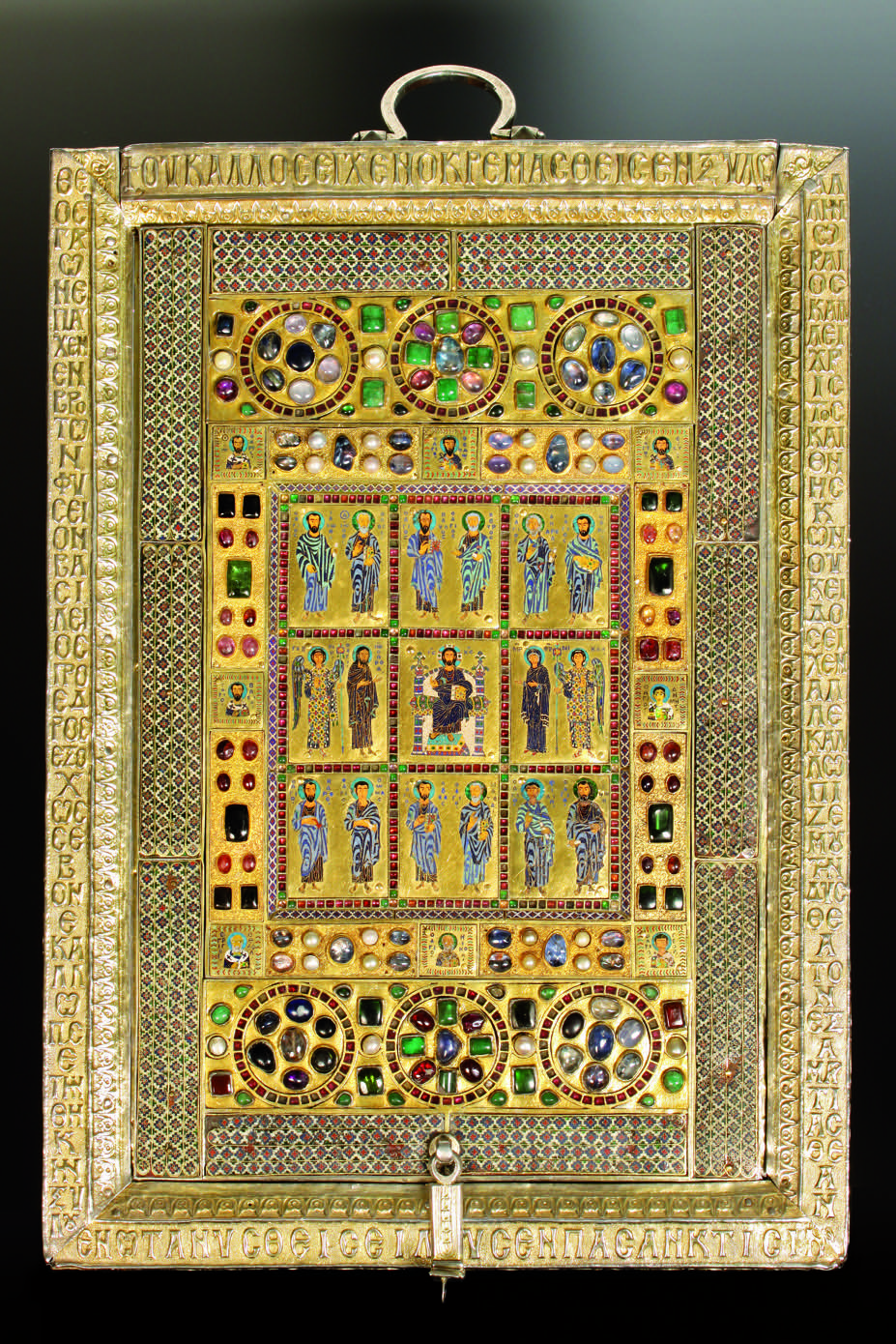
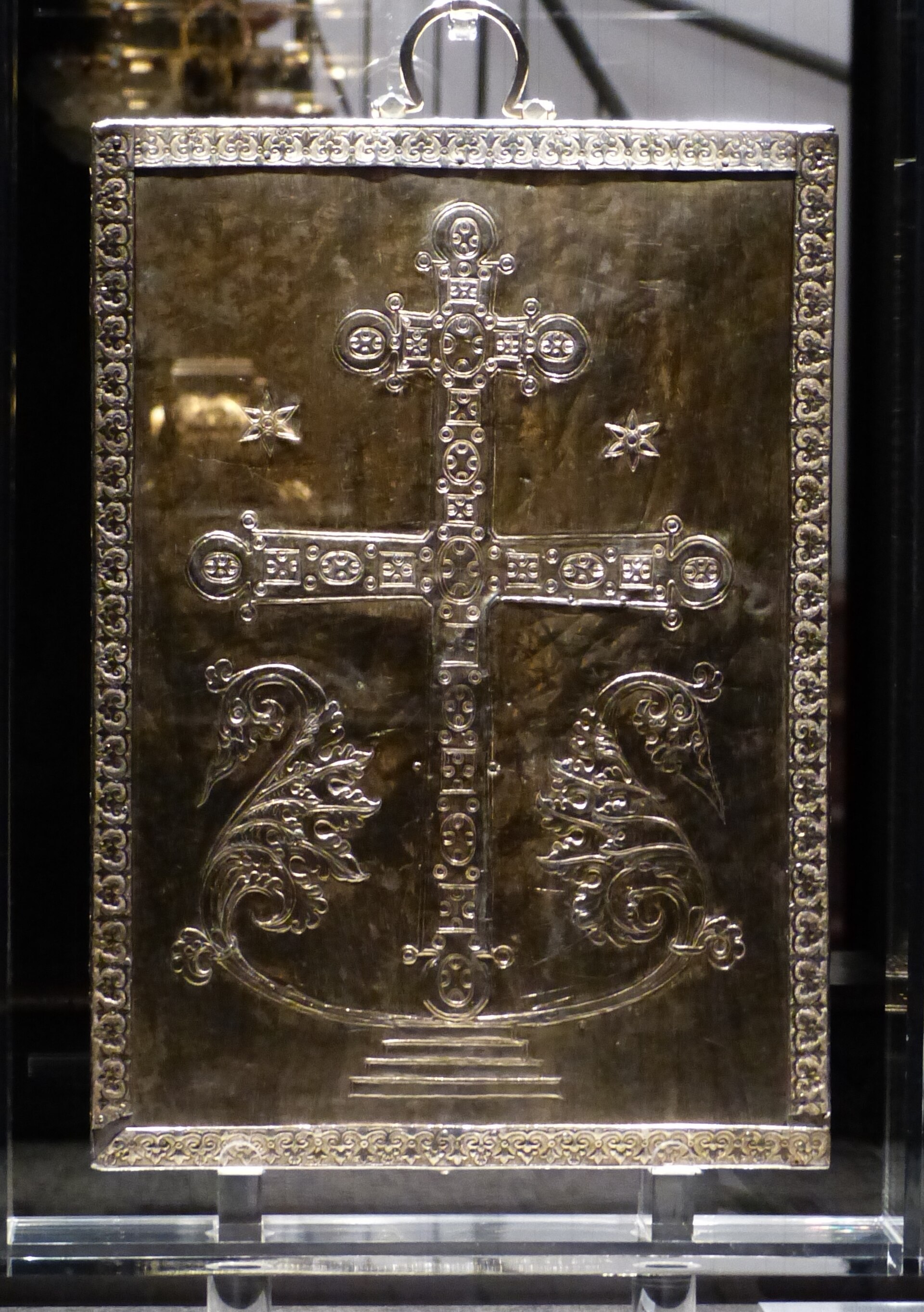
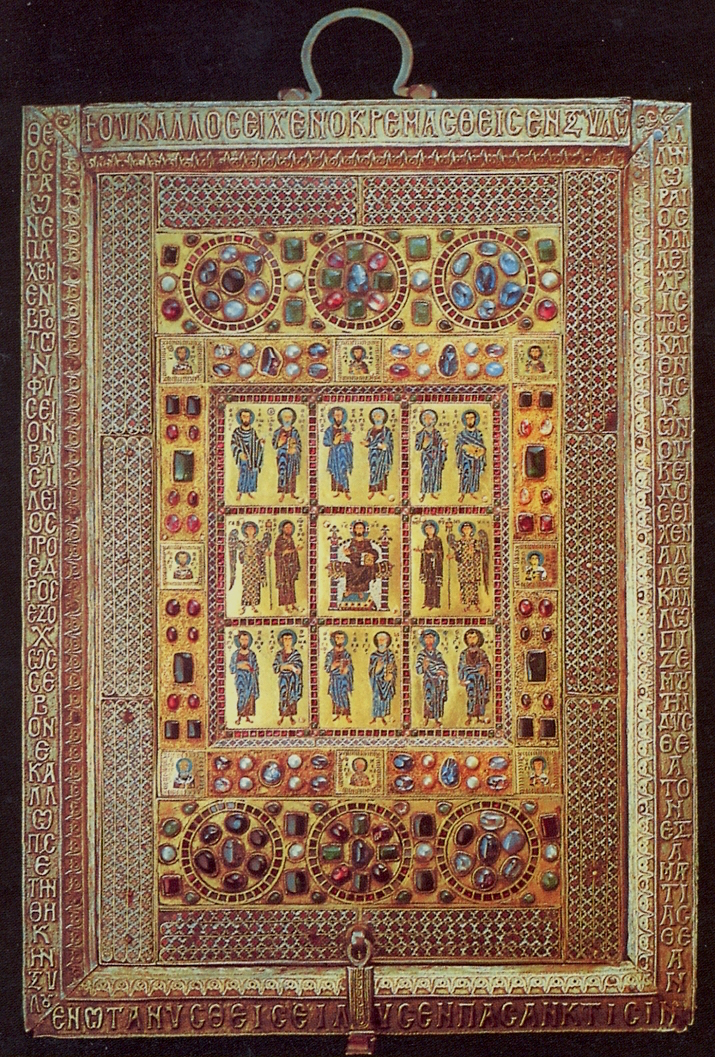
The reliquary in its closed, display state, gilded silver over a sycamore wood core with cloisonne enamel, pearls and gemstones. Made in Constantinople in two phases in the mid-to-late 10th century; in the Diozesanmuseum Limburg since 1835.
Markus Paul Engert, via Wikimedia Commons · Photograph by Markus Engert · CC BY-SA 4.0| Artist | Anonymous Constantinopolitan court workshop |
|---|---|
| Date | Cross: 945-959. Box (thekhe): c. 963-985 |
| Medium | Sycamore wood core covered in fire-gilt silver, decorated with cloisonne enamel, pearls, emeralds, sapphires, almandine garnets and cut gemstones |
| Dimensions | 48 cm long by 6 cm deep; width is given as 35 cm in the German-language literature and 38 cm in the English-language literature (unresolved, see technical notes); weight approximately 11 kg |
| Where it is now | Diozesanmuseum Limburg (Cathedral Treasury / Domschatz), Limburg an der Lahn, Germanylast confirmed |
| Inventory number | D 1/1-3 |
| Attribution | AcceptedNo individual maker is named or documented; the object is attributed on inscriptional evidence to an imperial court workshop in Constantinople working in two phases. Full note |
| Object type | Goldsmith's work |
| Period | Byzantine, mid-to-late 10th century |
| Cases | Has a provenance gap |
| Inscriptions | Two Greek dedicatory verse inscriptions: one on the reverse of the cross naming Constantine VII and Romanos II, one on the outer rim of the box naming Basil the proedros (Basil Lekapenos). Ten further inscriptions, one per relic compartment, identify each relic housed inside. |
| Owners on record | 9 links8 documented, 1 unknown |
| Sources | 8 cited |
About this record Last verified · 8 sources cited · Change log
On this page 9 sections
ContentsClose
A Byzantine reliquary of the True Cross made in two stages in Constantinople in the mid-to-late 10th century: a gilded, gem-set sycamore cross made for Emperors Constantine VII and Romanos II between 945 and 959, later enclosed in a cloisonne-enamel box commissioned separately by the eunuch court official Basil Lekapenos sometime between 963 and 985. It left Constantinople in the sack of the Fourth Crusade in 1204 and reached the Rhineland by 1208 in the hands of the knight Heinrich von Ulmen, who gave it to Stuben Abbey, where his sister was abbess. It stayed there for nearly six hundred years until the abbey's dissolution in 1802, passed through the House of Nassau-Weilburg as secularization property, and was given to the newly founded Diocese of Limburg in 1835, where it remains the centerpiece of the cathedral treasury.
Both of its two Byzantine phases are documented by the object's own inscriptions rather than by any external record, and no evidence located for this record supports the idea that either part was later reframed or recased in the West; instead, within twenty years of its arrival, the object itself became the direct model for two new western reliquaries at Trier and Mettlach. How exactly Heinrich von Ulmen came to own it is genuinely disputed rather than simply unrecorded, and this record sets out both the popular account and the more recent scholarly challenge to it.
Provenance
Each link is graded. Documented: a cited source supports it. Disputed: the identification is argued but not established. Unknown: no owner for that span, and the gap is not smoothed into a narrative. The grades in the glossary.
- 945 - 959Emperors Constantine VII Porphyrogennetos and Romanos IIdocumented
The double-armed cross, with its enclosed fragments of the True Cross, was made for the two emperors during their joint reign; both are named in the cross's own dedicatory inscription.14
- 963 - 985Basil Lekapenos, proedros and parakoimomenosdocumented
The surrounding box, with its ten relic compartments, was commissioned separately by Basil Lekapenos, named in the box's own rim inscription as proedros, a title he held from 963 until his fall from power and exile under Basil II in 985.1437
- - 1204Imperial treasury, Pharos Chapel, Great Palace of Constantinopledocumented
Byzantine sources place a relic container of this type among the treasures of the Pharos Chapel, the palace church holding the empire's principal Passion relics, until the Fourth Crusade's sack of the city in April 1204.4
- 1204 - 1207Unknownunknown
How the staurotheke passed out of the Constantinopolitan treasury and into the hands of Heinrich von Ulmen is not documented. Klein (2004) argues on timing grounds that Heinrich did not loot it personally during the 1204 sack, proposing instead, after Kuhn (1984), that he received it as a reward in Thessalonike one or two years later while serving in the retinue of Boniface of Montferrat. This remains an argued reconstruction, not a documented transaction.2
- 1207 - 1208Heinrich von Ulmendocumented
Heinrich, a knight of the Eifel region, brought the staurotheke and other relics to the Rhineland, arriving by the spring of 1208, later than the main wave of returning Fourth Crusaders.24
- 1208 - 1802Stuben Abbey (Kloster Stuben), Augustinian convent near Bremm on the Moselledocumented
Heinrich gave the staurotheke, as his own donation, to Stuben Abbey, where his sister Irmgard von Ulmen was prioress/abbess. It remained there for nearly six centuries.24
- 1802 - 1802In transit, right bank of the Rhinedocumented
Stuben Abbey was dissolved in 1802 under French administration of the left bank of the Rhine. The staurotheke was moved across to the right bank ahead of the dissolution, along with other relics from the abbey's treasury.6
- 1802 - 1835Festung Ehrenbreitstein (Koblenz), then the princely House of Nassau-Weilburgdocumented
The staurotheke was held at the Ehrenbreitstein fortress above Koblenz before passing into the possession of the Fursten von Nassau-Weilburg.4
- 1835 - presentDiocese of Limburg / Diozesanmuseum Limburgdocumented
Duke Wilhelm I of Nassau gave the staurotheke, explicitly as former secularization property, to the Diocese of Limburg, founded only eight years earlier in 1827. It is now the centerpiece of the diocesan cathedral treasury, museum inventory number D 1/1-3.4
Technical evidence
| Attribution note | No individual maker is named or documented; the object is attributed on inscriptional evidence to an imperial court workshop in Constantinople working in two phases. The cross was made for Emperors Constantine VII Porphyrogennetos and Romanos II (joint reign 945-959), whose names appear in its own dedicatory verse. The box (thekhe) that holds the cross was commissioned separately by Basil Lekapenos, described in its rim inscription as proedros, a title he held from 963 until his fall from power in 985, placing the box in that twenty-two year window. Neither goldsmith, enameller nor lapidary is named in either inscription; only the patrons are recorded. |
|---|---|
| Core support | Double-armed patriarchal cross carved from sycamore wood, entirely covered in fire-gilt silver sheet.41 |
| Box construction | Flat, panel-shaped box (thekhe) with a sliding lid, gilded silver over a wooden core, of a form common in Byzantium from at least the 9th century.24 |
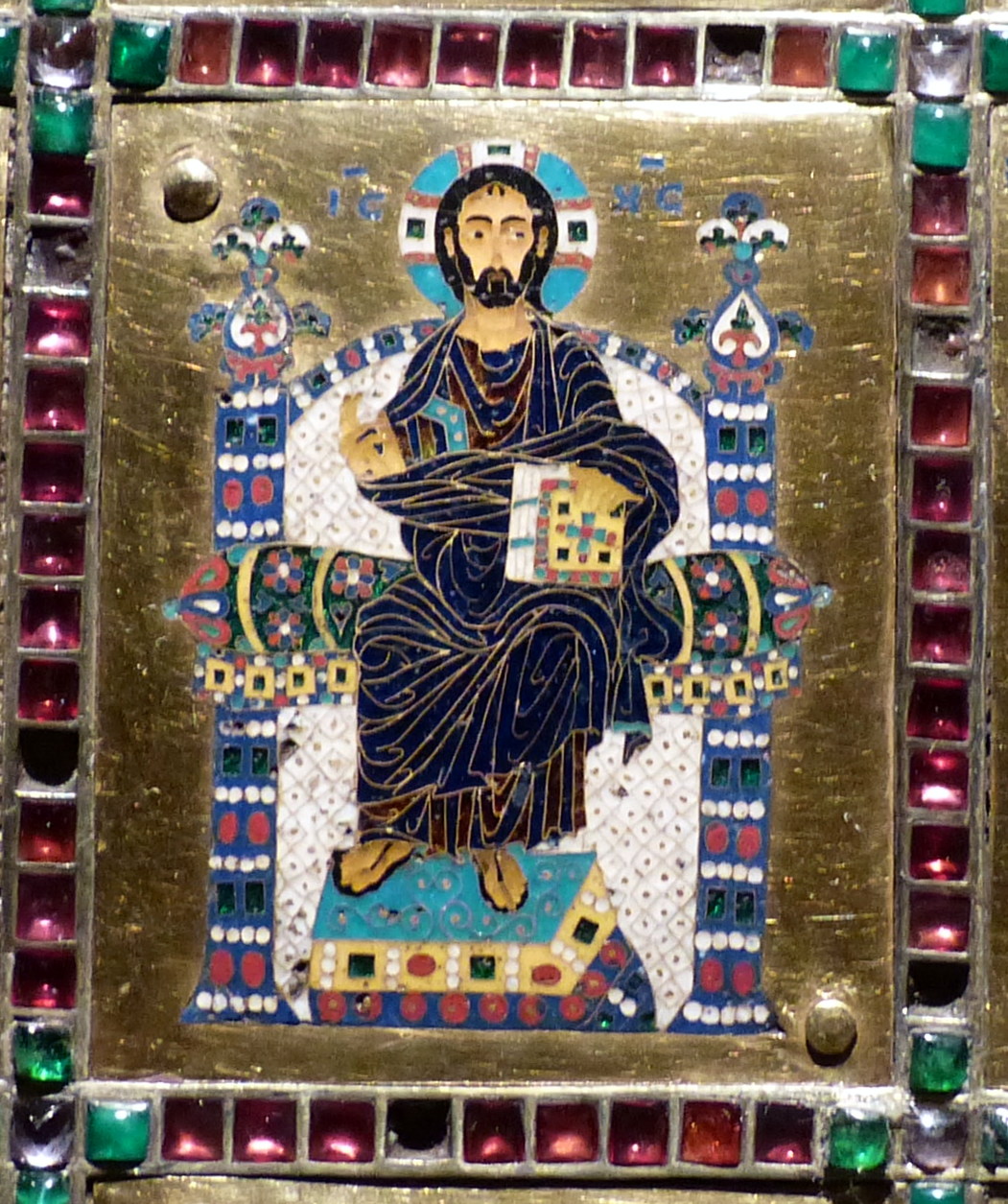
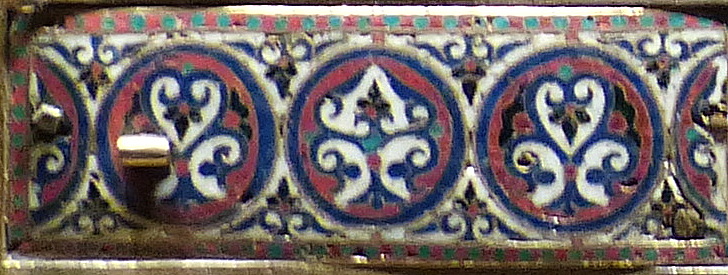
| Enamel technique | Cloisonne enamel throughout the box's twenty compartment covers and the lid's Deesis panels; considered one of the best-preserved large ensembles of Byzantine cloisonne enamel to survive.45 |
| Gemstones and pearls | Set with pearls, emeralds, sapphires, almandine garnets and cut gemstones across both the cross and the box.4 |
| Dimensions | 48 cm long by 6 cm deep in all sources consulted; width given as 35 cm in the German Wikipedia article (citing Ars Sacra, 2015) and as 38 cm in the English Wikipedia article. This record could not resolve the discrepancy against a primary museum measurement and flags it rather than silently picking one figure.45 |
| Weight | Approximately 11 kg.4 |
| Relic compartments | Ten enamel-covered compartments arranged around the central cross in the outline of a larger patriarchal cross, each individually inscribed with the name of the relic it holds; a further seven fragments of the True Cross are set at the crossing of the main cross's arms.145 |
| Inscriptions | Two dedicatory verse epigrams in Byzantine twelve-syllable meter: one on the reverse of the cross (naming Constantine VII and Romanos II), one on the outer rim of the box (naming Basil the proedros); plus ten short identifying inscriptions, one per relic compartment.14 |
| Conservation history | Restoration published by J. M. Wilm in 1935 (Das Munster), with accompanying art-historical study by E. Schenk zu Schweinsberg in the same volume; a further restoration published by Albert Boeckler in Kunstchronik in 1951. Technical detail of either campaign was not recovered for this record.2 |
Images
The record in full
Chapter 1A box within a box, made twice
The Limburg Staurotheke is not one Byzantine object but two, made roughly a generation apart and fitted together.
The Limburg Staurotheke is not one Byzantine object but two, made roughly a generation apart and fitted together. At its center is a double-armed patriarchal cross of sycamore wood, entirely sheathed in fire-gilt silver and set with gemstones and pearls, holding seven fragments of the True Cross at the point where its arms cross. This cross was made first, for Emperors Constantine VII Porphyrogennetos and his son and co-ruler Romanos II, who reigned jointly from 945 to 959.
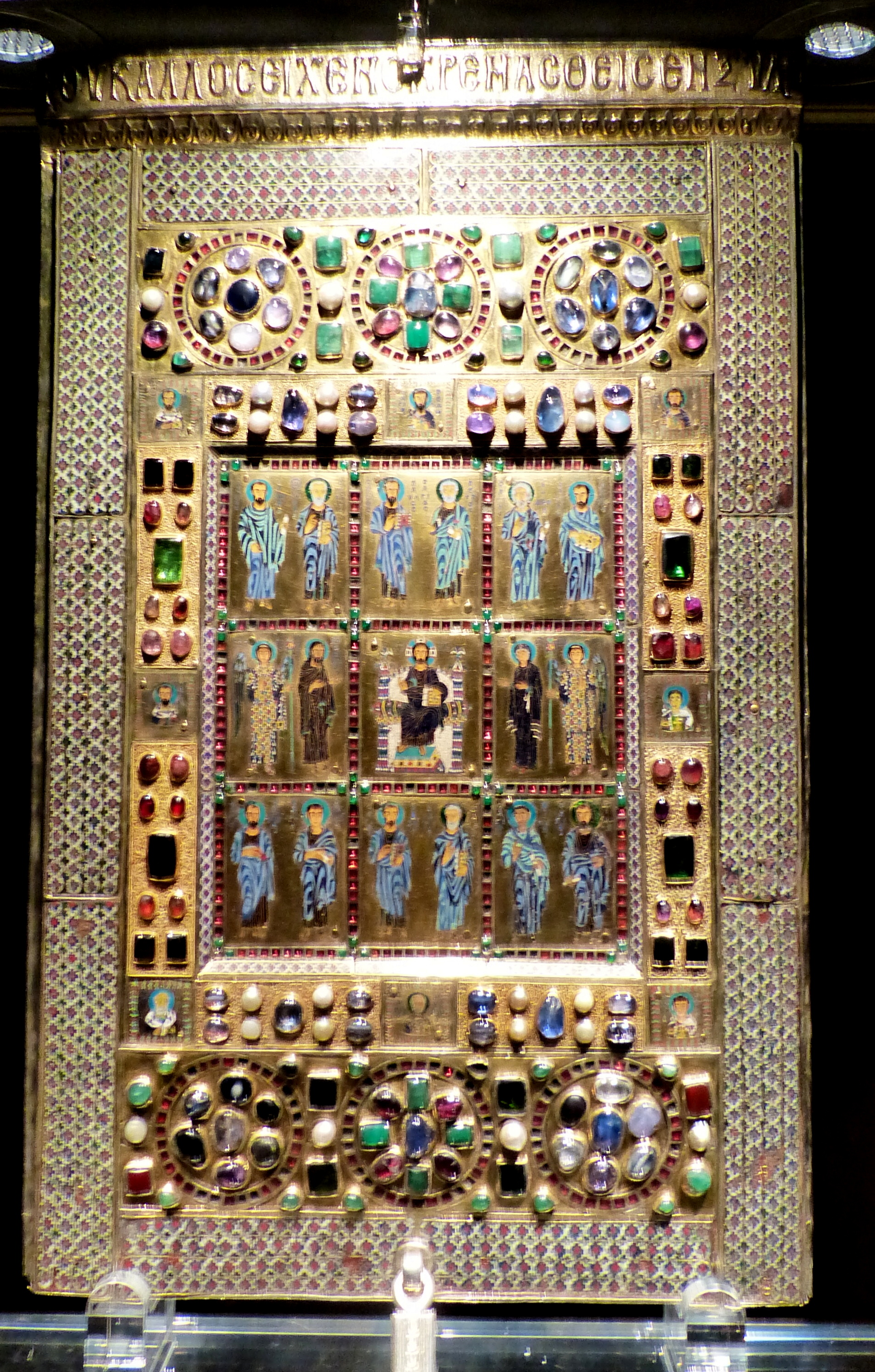
The cross does not stand alone. It sits inside a flat, panel-shaped box with a sliding lid, built to a reliquary format already common in Byzantium since at least the ninth century. This box was made later, commissioned separately by a court official named Basil, described in its own inscription as proedros, a senior court title conferred on him in 963. The box surrounds the cross with twenty further compartments framed by enamel images of angels, cherubim and seraphim, ten of which hold ten further relics of Christ, the Virgin and John the Baptist.
Both components are Byzantine work of the same imperial milieu, made in the same city within a few decades of each other. No evidence found in the course of this research supports the idea that either part was refashioned, reframed or cased in the West after the object left Constantinople; see the notes on that question below.
Chapter 2The cross and its inscription
The cross carries a nine-verse Greek epigram on its reverse, in the twelve-syllable meter standard for Byzantine dedicatory verse.
The cross carries a nine-verse Greek epigram on its reverse, in the twelve-syllable meter standard for Byzantine dedicatory verse. Brad Hostetler's 2012 study of the text argues that earlier translations missed a correlative construction, men followed later by de, that structures the whole poem around a deliberate parallel: on one hand God stretched out his hands on the wood and poured life through it; on the other hand, the emperors adorned that same wood with stones and pearls. Hostetler's translation renders the opening as: On the one hand, God stretched out his hands upon the wood, gushing forth through it the energies of life. On the other hand, Constantine and Romanos the despots, with the synthesis of radiant stones and pearls, displayed this same thing full of wonder.
The verse continues by stating that Christ once used the cross to smash the gates of Hades and give new life to the dead, and that the crowned emperors now use the same cross, adorned, to crush the temerity of barbarians. Hostetler reads this as a deliberate structural device, not decoration: the poem sets Christ's cosmic victory over death and the emperors' military victories over enemies side by side, in matching grammatical form, so that imperial power is presented as a continuation of Christ's own power channeled through the physical relic. This is Hostetler's argued interpretation of the text's rhetorical design; it rests on the wording of the inscription itself rather than on any external statement of imperial intent, and no dissenting reading of the passage was found in the sources consulted for this record.
Chapter 3The box, the relics, and their keeper
The box's own rim inscription, in a separate nine-verse epigram, reads in translation: No beauty had He, who was hanged on the Wood, and yet, even in death, Christ surpassed all beauty...
The box's own rim inscription, in a separate nine-verse epigram, reads in translation: No beauty had He, who was hanged on the Wood, and yet, even in death, Christ surpassed all beauty... Since Basil the Proedros highly revered Him, he greatly embellished the box of the wood, on which He was stretched and embraced all creation. The patron is named plainly: Basil, holder of the rank of proedros, a title Nikephoros II Phokas gave him in 963. Byzantine prosopography identifies this as Basil Lekapenos, illegitimate son of the earlier Emperor Romanos I Lekapenos, castrated as a child and, as an adult, one of the most powerful men in the empire, serving as parakoimomenos, the emperor's chamberlain, under five successive reigns from the 940s until his fall in 985. That collapse under Basil II, which stripped him of office and property, sets the latest plausible date for the box's commission; the earliest is his 963 promotion. The box is accordingly dated to somewhere in that twenty-two year span, not to a single year.
Around the cross, ten compartments, each covered by a small enamel panel of a cherub or seraph and each individually inscribed, hold: the purple mantle worn by Christ at his crucifixion; the linen cloth of his burial; the sponge offered to him on the cross; a girdle of the Virgin from the Chalkoprateia church; hair of John the Baptist; a second girdle of the Virgin, said to have come from the Bishop of Zela; the Virgin's veil (maphorion); Christ's burial shroud; his swaddling clothes; and the crown of thorns. Six relics are of Christ, three of the Virgin, one of John the Baptist. The compartments are arranged around the central cross in the shape of a larger patriarchal cross, so that the object's overall form repeats, in miniature, the very relic it protects.
Chapter 4What the box was for
The staurotheke was not made as a museum object.
The staurotheke was not made as a museum object. Byzantine sources place a reliquary of this general type among the treasures of the Pharos Chapel, the palace church that housed the empire's most important relics of the Passion inside the Great Palace at Constantinople, one of some thirty chapels there. From that setting, a cross relic of this kind could be removed from its box and carried out for use: in the liturgy, and, on the argued reading of scholars including Nancy Sevcenko and Johannes Koder (as reported in Hostetler's 2012 study), on military campaigns, where the emperor's proximity to a relic of the cross was understood to protect him and lend force to his army. This is a documented pattern for imperial relics of the True Cross in this period, though the specific claim that this particular staurotheke traveled on campaign is Sevcenko and Koder's argued position rather than an independently attested fact about this one object.
Basil Lekapenos's decision to commission the outer box for an existing imperial relic has drawn a further, more pointed reading from Bissera Pentcheva, who in a 2007 study argues that the box's decoration and its own epigram build a deliberate parallel between the eunuch and the reliquary: both are containers whose significance lies entirely in what they hold rather than in their own visible completeness. Pentcheva writes that elite relics in Byzantium were characteristically hidden from direct view, concealed inside layered containers, and reads Basil's embellishment of an already-concealed relic as a statement about his own paradoxical form of power, authority exercised through proximity and custodianship rather than through a physically whole, autonomous body. This is Pentcheva's own interpretive argument, clearly attributed to her; no other scholar's response to it was located in the course of this research, and it should be read as one argued position rather than a settled consensus.
Chapter 5How it left Constantinople
The staurotheke left Constantinople during the sack of the city by the Fourth Crusade in April 1204.
The staurotheke left Constantinople during the sack of the city by the Fourth Crusade in April 1204. Exactly how it came into the hands of the German knight Heinrich von Ulmen (c. 1175-1236) is not documented and has been the subject of direct scholarly disagreement. The plain assumption, repeated in most popular accounts, is that Heinrich looted it himself during the sack. Holger Klein's 2004 study argues against this: Heinrich is a minor figure in the crusade's own chronicles, is not recorded among the crusaders punished for looting immediately after the fall of the city, and did not return to Germany until 1207 or 1208, considerably later than the main wave of returning crusaders. Klein reports that Hans-Wolfgang Kuhn first proposed, in 1984, that Heinrich more likely received the staurotheke and other relics as a reward, one or two years after the conquest, in Thessalonike rather than Constantinople, in his capacity as a member of the retinue of his overlord Boniface of Montferrat. Klein finds Kuhn's central claim persuasive on the timing evidence, while treating some of Kuhn's more specific reconstructions of Boniface's own treasure as too speculative. Both explanations remain arguments rather than certainties: no source records the actual transaction. What is not disputed is that gifts of exactly this kind, high-value relics passed by crusade leaders to their subordinates as payment, were common in the years immediately after 1204, which is the pattern into which Klein places this object.
Chapter 6Stuben, and six centuries of quiet custody
Heinrich brought his relics to the Rhineland, arriving in the Eifel region near Trier by the spring of 1208.
Heinrich brought his relics to the Rhineland, arriving in the Eifel region near Trier by the spring of 1208. Rather than passing the staurotheke on immediately, he gave it, as his own donation, to the convent of Stuben (Kloster Stuben), an Augustinian house for women on the Moselle near Bremm, where his sister Irmgard von Ulmen was prioress. The object remained at Stuben for close to six hundred years. No incident, loss, alteration or documented display is recorded for that long span in any source consulted for this record; that silence is itself worth noting rather than assuming it means nothing happened; see open questions.
Chapter 7A model for the Rhineland's own goldsmiths
Within less than two decades of its arrival at Stuben, the staurotheke had already become a visible model for other Rhineland workshops.
Within less than two decades of its arrival at Stuben, the staurotheke had already become a visible model for other Rhineland workshops. Two western cross reliquaries, commissioned for the Benedictine abbey of St. Matthias in Trier and for the smaller Benedictine house of Sts. Peter and Luitwinus at Mettlach, were made, in Klein's assessment probably in the same Trier workshop, in conscious imitation of the Byzantine object: both arrange their relic particles in the same patriarchal-cross form, and both borrow the staurotheke's distinctive scheme of twenty small compartments for secondary relics. Neither western goldsmith copied the Byzantine model exactly. The St. Matthias reliquary abandons the sliding lid entirely and displays its main relic openly, with the secondary relics visible behind rock crystal rather than hidden; its own inscription names Heinrich von Ulmen directly as the donor of its relic, making its debt to the Byzantine original explicit. The Mettlach reliquary instead turns the flat Byzantine panel into the center of a triptych flanked by relief figures of the abbey's own patron saints, with its secondary relics hidden behind small painted doors rather than shown under crystal. Klein reads both choices as evidence of artists who understood their Byzantine source closely enough to depart from it deliberately rather than through ignorance.
This afterlife as a copied model is worth stating plainly for a further reason: it is Constantinopolitan work spreading outward into new, distinct western objects, not the Byzantine object itself being remade. The staurotheke that reached Limburg is, on the evidence assembled here, the same two-part Byzantine object that left Constantinople in 1204, not a hybrid of Byzantine and later western fabric.
Chapter 8Secularization and the road to Limburg
Stuben Abbey was dissolved in 1802 under French administration of the left bank of the Rhine, in the wave of confiscations that preceded the formal territorial reorganization of the...
Stuben Abbey was dissolved in 1802 under French administration of the left bank of the Rhine, in the wave of confiscations that preceded the formal territorial reorganization of the Reichsdeputationshauptschluss the following year. As French forces approached, the staurotheke was moved, along with other relics from the abbey's treasury, across to the right bank of the Rhine ahead of the dissolution. It came to rest at the fortress of Ehrenbreitstein above Koblenz, and from there passed into the possession of the princely house of Nassau-Weilburg. The abbey buildings themselves were sold off for demolition materials in 1820, eighteen years after the community that had kept the reliquary for six centuries was dispersed.
The staurotheke stayed in Nassau hands for roughly three decades. In 1835, Duke Wilhelm I of Nassau gave it, explicitly as former secularization property, to the Diocese of Limburg, which had itself been created only eight years earlier, in 1827, as part of the reorganization of the German Catholic church after the Napoleonic settlement. It has remained the central object of the diocese's cathedral treasury and is now the signature exhibit of the Diozesanmuseum Limburg, with the museum's own accession number D 1/1-3.
Chapter 9Condition and two twentieth-century restorations
The staurotheke has been the subject of at least two documented conservation campaigns in living scholarly memory.
The staurotheke has been the subject of at least two documented conservation campaigns in living scholarly memory. In 1935, three separate studies in a single volume of Das Munster (a German art-history annual) addressed the object together: one by J. M. Wilm specifically on its restoration, one by E. Schenk zu Schweinsberg on art-historical problems the restoration raised, alongside other contemporary study of the piece. A second restoration was published by Albert Boeckler in the journal Kunstchronik in 1951. The sources located for this record establish that both campaigns took place and were published, but not their technical content: what condition problems prompted either intervention, and what was physically done to the object, is not recorded in the literature accessed here and is flagged as an open question rather than assumed.
Chapter 10What the 2012 reassessment actually reassessed
The Athanor article that gives this record its title for the dating question, Hostetler's The Limburg Staurotheke: A Reassessment, is sometimes cited as though it resolved a dispute over which...
The Athanor article that gives this record its title for the dating question, Hostetler's The Limburg Staurotheke: A Reassessment, is sometimes cited as though it resolved a dispute over which emperor commissioned the object. On the evidence available, that is not quite what it does. Hostetler does not challenge the identification of Constantine VII and Romanos II as the cross's patrons, nor Basil Lekapenos as the box's; those identifications, resting on the plain wording of two inscriptions naming a securely attested emperor pair and a securely attested court official, are not contested in the literature located for this record. What Hostetler's reassessment revises is the reading of the cross's inscription itself: he argues that previous translators, by missing the men...de correlative structure, flattened a deliberately paired rhetorical argument (God's power on one side, the emperors' power on the other) into a simple list of facts. The dispute, in other words, is over how the text argues, not over who it names.
This record accordingly treats the two patronage attributions as documented rather than disputed, while treating the precise year within Basil Lekapenos's 963-985 window, and the interpretive readings of imperial mimesis and eunuch symbolism built on top of the secure attribution, as argued positions properly credited to the named scholars who hold them.
The artist
Anonymous imperial court workshop, Constantinople
No goldsmith, enameller or lapidary is named on either the cross or its box. What survives is the record of two patrons: an emperor and his co-ruling son for the cross, a eunuch court official for the box that now holds it. The workshop that actually cut, gilded, enameled and set the object is identified only by the quality and character of its work, and dated only by the identity of the men who paid for it.
Related works
| Work | Relation | Where it is |
|---|---|---|
| Reliquary of the True Cross (St. Matthias reliquary) Rhineland (Trier) workshop, western imitation of the Limburg model | Made within two decades of the staurotheke's arrival in Germany, copying its patriarchal-cross relic arrangement and compartment scheme; its own inscription names Heinrich von Ulmen as donor of its relic Abandons the Byzantine sliding lid; displays relics behind rock crystal instead. | Treasury of St. Matthias, Trier |
| Cross reliquary triptych, Mettlach Rhineland (probably Trier) workshop, western imitation of the Limburg model | A second, roughly contemporary western copy of the staurotheke's relic arrangement, made for the abbey of Sts. Peter and Luitwinus Rebuilds the flat Byzantine panel as the center of a triptych flanked by figures of the abbey's patron saints; secondary relics hidden behind painted doors rather than shown. | Katholische Pfarrgemeinde St. Luitwinus, Mettlach |
| Fieschi Morgan Staurotheke Anonymous Byzantine workshop, Constantinople (proposed date c. 815 or c. 843) | A different, smaller Byzantine reliquary of the same general staurotheke class; NOT another view of this object and not related to it by ownership, patron or manufacture Roughly a fifth the size of the Limburg piece (2.7 x 10.3 x 7.1 cm with lid), a century or more earlier, gilded silver with niello rather than the Limburg object's extensive cloisonne enamel programme, and with an entirely separate later history (Italy, then the Von Oppenheim and Morgan collections, to the Met in 1913). Named here only to prevent confusion between two similarly named Byzantine cross reliquaries. | Metropolitan Museum of Art, New York |
| Byzantine imperial reliquaries of the Pharos Chapel type Various Constantinopolitan court workshops, 9th-11th century | The broader class of imperial relic containers associated with the Great Palace's Pharos Chapel, of which the staurotheke is the most completely preserved surviving example Cited by Klein (2004) via Kalavrezou's study of imperial ceremonial and the cult of relics at court; the wider comparanda for this record's function as an instrument of imperial ceremony. | Various; most Pharos Chapel treasures were dispersed or destroyed |
Open questions
- How exactly did Heinrich von Ulmen obtain the staurotheke in the aftermath of the Fourth Crusade: did he loot it himself in Constantinople in 1204, as popular accounts assume, or receive it later as a reward in Thessalonike, as Hans-Wolfgang Kuhn proposed in 1984 and Holger Klein finds persuasive on the timing evidence? No source records the transaction itself.
- What specifically was found wrong with the object, and what was physically done to it, in the 1935 restoration published by J. M. Wilm and the 1951 restoration published by Albert Boeckler? Both campaigns are documented as having occurred and been published; their technical content was not recovered for this record.
- Why do the German-language and English-language literatures give different widths for the object, 35 cm against 38 cm? This record could not locate a primary museum measurement to resolve the conflict.
- What happened to the staurotheke during its nearly six centuries at Stuben Abbey (1208-1802)? No display, loss, damage or alteration is recorded in any source consulted for this record for that entire span, which may reflect a genuinely uneventful custody or simply a gap in the accessible literature.
- Where, precisely within Basil Lekapenos's twenty-two years as proedros (963-985), does the box belong? The inscription fixes only the outer bounds of his tenure in that rank, not a narrower date.
- What is the object's own inventory or catalogue history within the Diocese of Limburg between the 1835 gift and the present museum accession number D 1/1-3? This record could not directly access the museum's own published catalogue entry to trace that sequence.
Questions about this object
What is The Limburg Staurotheke?
The Limburg Staurotheke is a goldsmith's work, dated cross: 945-959. Box (thekhe): c. 963-985. Medium: Sycamore wood core covered in fire-gilt silver, decorated with cloisonne enamel, pearls, emeralds, sapphires, almandine garnets and cut gemstones.
Who made The Limburg Staurotheke, and is the attribution settled?
The attribution to Anonymous Constantinopolitan court workshop is recorded here as accepted. No individual maker is named or documented; the object is attributed on inscriptional evidence to an imperial court workshop in Constantinople working in two phases. The cross was made for Emperors Constantine VII Porphyrogennetos and Romanos II (joint reign 945-959), whose names appear in its own dedicatory verse. The box (thekhe) that holds the cross was commissioned separately by Basil Lekapenos, described in its rim inscription as proedros, a title he held from 963 until his fall from power in 985, placing the box in that twenty-two year window. Neither goldsmith, enameller nor lapidary is named in either inscription; only the patrons are recorded.
Where is The Limburg Staurotheke now?
Diozesanmuseum Limburg (Cathedral Treasury / Domschatz), Limburg an der Lahn, Germany. Inventory number D 1/1-3. Last confirmed 24 September 2026. Given to the newly founded Diocese of Limburg in 1835 by Duke Wilhelm I of Nassau, as former Napoleonic-era secularization property (Sakularisationsgut) that had passed through the House of Nassau-Weilburg after the 1802 dissolution of Stuben Abbey. The inventory number D 1/1-3 is cited in the German Wikipedia article on the object as the museum's own accession number; the museum's own dedicated page on the reliquary could not be retrieved directly during research (see notes_for_editor) so this number should be checked against the printed catalogue Im Zeichen des Kreuzes (2009) or the museum in person before final publication.
What is still unknown about The Limburg Staurotheke?
How exactly did Heinrich von Ulmen obtain the staurotheke in the aftermath of the Fourth Crusade: did he loot it himself in Constantinople in 1204, as popular accounts assume, or receive it later as a reward in Thessalonike, as Hans-Wolfgang Kuhn proposed in 1984 and Holger Klein finds persuasive on the timing evidence? No source records the transaction itself.
Sources
- 1Brad Hostetler, 'The Limburg Staurotheke: A Reassessment,' Athanor 30 (2012): 7-13. journals.flvc.org/athanor/...
- 2Holger A. Klein, 'Eastern Objects and Western Desires: Relics and Reliquaries between Byzantium and the West,' Dumbarton Oaks Papers 58 (2004): 283-314. arthistory.columbia.edu/sites/...
- 3Bissera V. Pentcheva, 'Containers of Power: Eunuchs and Reliquaries in Byzantium,' Res: Anthropology and Aesthetics 51 (2007): 109-120. academia.edu/2633904/...
- 4Wikipedia (German), 'Limburger Staurothek.' Tertiary source consolidating dimensions, inventory number, provenance dates and the literature list; flagged for replacement with the museum's own catalogue Im Zeichen des Kreuzes: Die Limburger Staurothek und ihre Geschichte, ed. August Heuser and Matthias Theodor Kloft (Regensburg, 2009), which could not be accessed directly for this record. de.wikipedia.org/wiki/...
- 5Wikipedia (English), 'Limburg Staurotheke.' Tertiary source, used for the relic list and an alternate inscription translation credited there to Nancy Sevcenko; flagged for replacement with Sevcenko's own published work. en.wikipedia.org/wiki/...
- 6Wikipedia (German), 'Kloster Stuben.' Tertiary source, used only for the 1802 dissolution date and the removal of relics to the right bank of the Rhine; flagged for replacement with a dedicated history of the abbey. de.wikipedia.org/wiki/...
- 7Wikipedia (English), 'Basil Lekapenos.' Tertiary source, used only for biographical dates (career under five emperors, fall from power in 985); flagged for replacement with a scholarly prosopographical source such as the Prosopographie der mittelbyzantinischen Zeit. en.wikipedia.org/wiki/...
- 8Wikipedia (English), 'Fieschi Morgan Staurotheke.' Tertiary source, consulted only for version-safety comparison against the distinct Metropolitan Museum object of the same reliquary class. en.wikipedia.org/wiki/...
Last verified · Published
Change log
24 September 2026 - Record created at the house standard: researched narrative, technical evidence, maker dossier, graded provenance chain, prices with hammer and premium separated, related works, open questions and sources.