Coppa Barovier
Venetian manufacture, Murano workshop (traditionally called the Barovier workshop) · c. 1460-1470
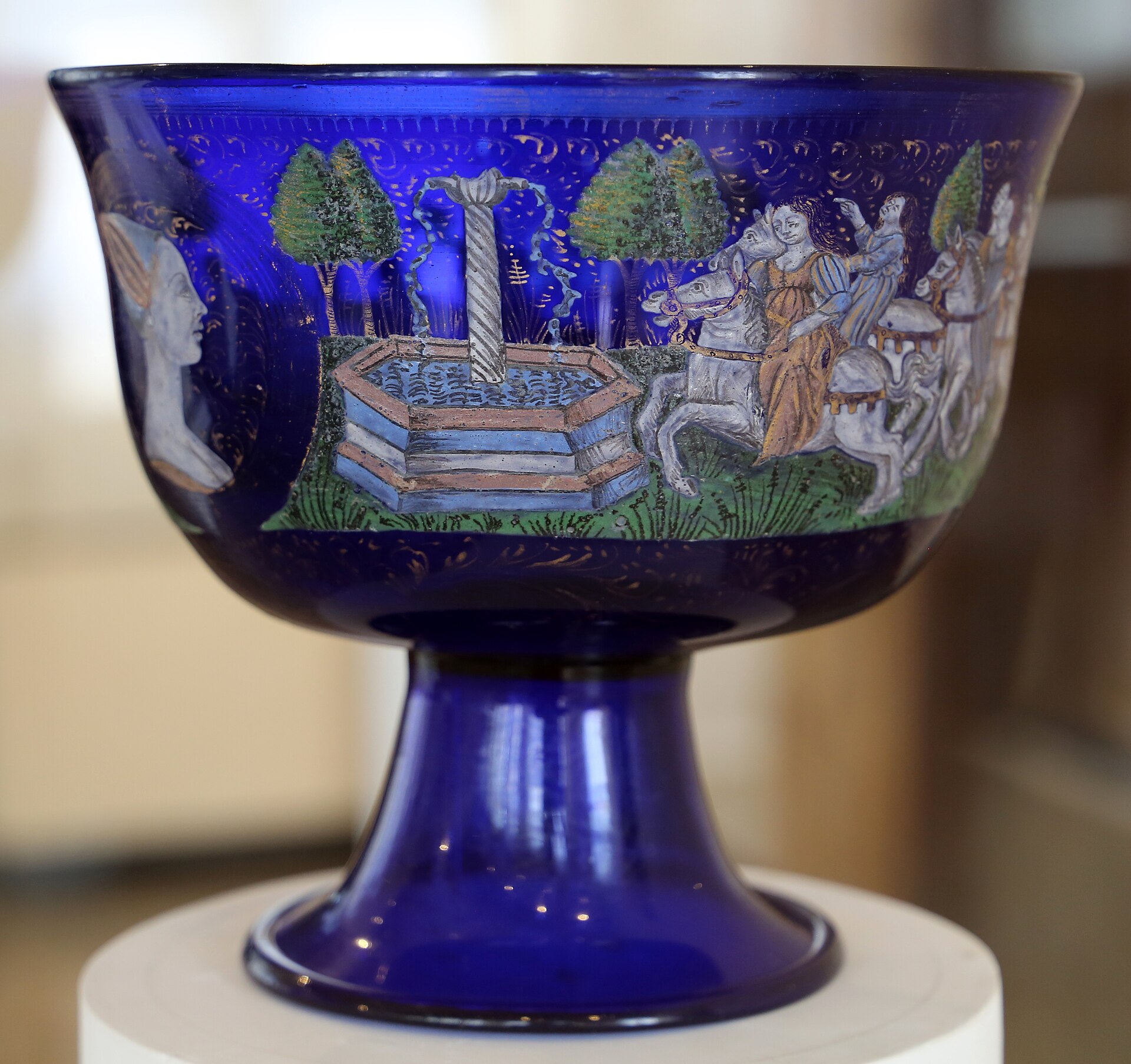
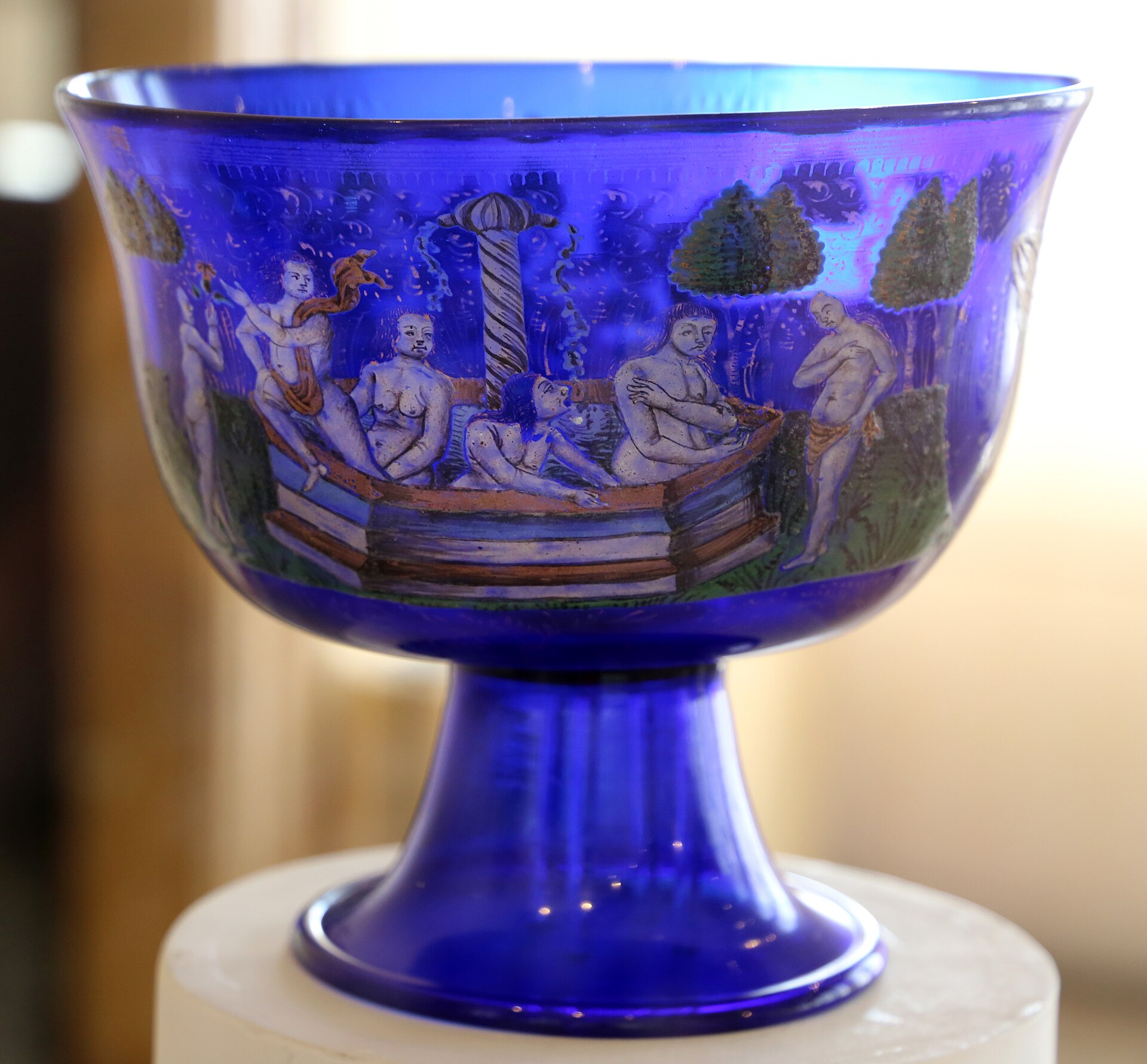
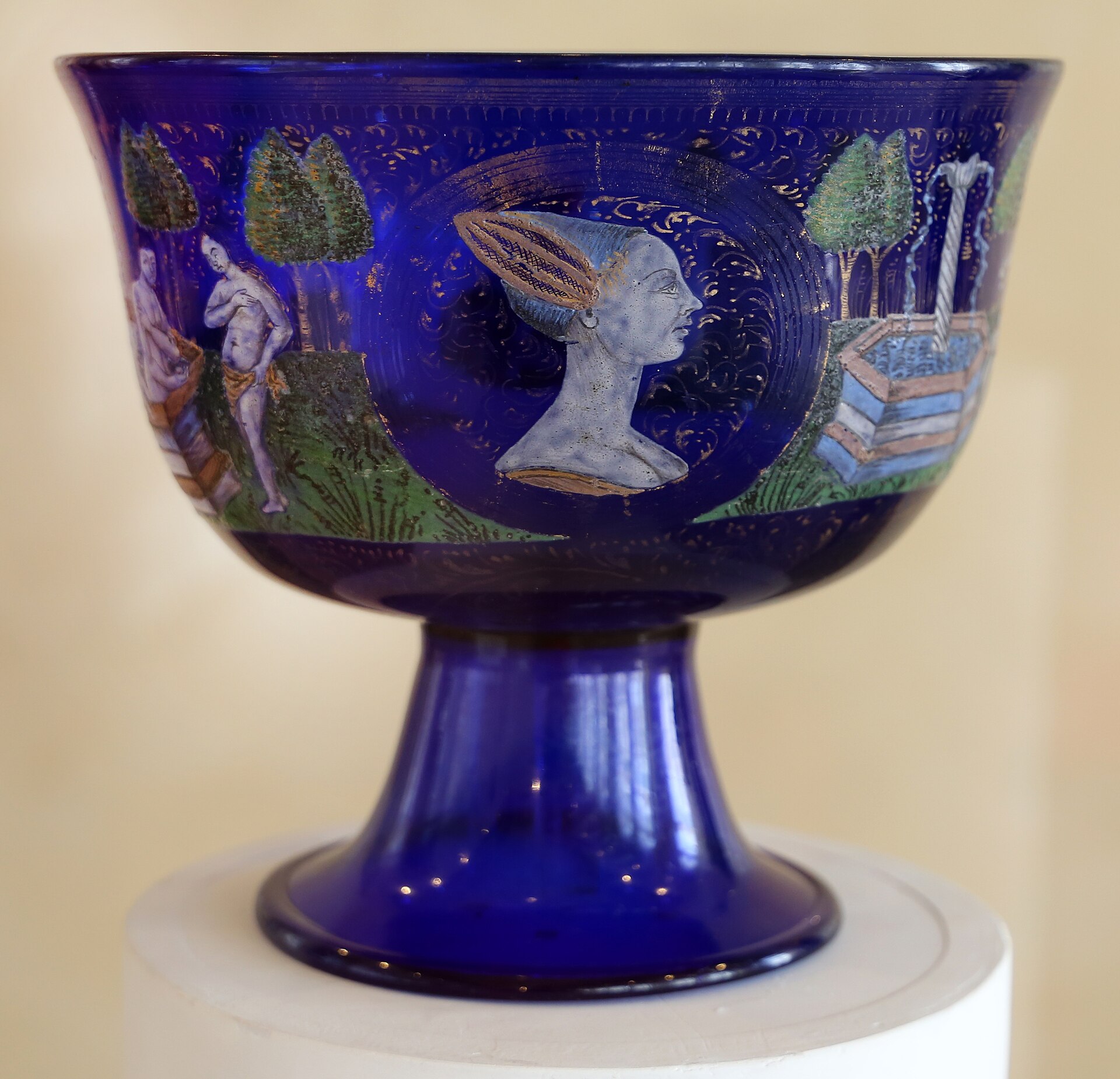
The Coppa Barovier, Museo del Vetro, Murano, c. 1460-1470. Blown blue glass painted with polychrome fusible enamels and gold. Photographed showing the fountain scene and part of the cavalcade frieze.
Photo Sailko, Museo del Vetro, Murano · CC BY 3.0| Artist | Venetian manufacture, Murano workshop (traditionally called the Barovier workshop) |
|---|---|
| Date | c. 1460-1470 |
| Medium | Free-blown blue glass, painted with polychrome fusible enamels and gold |
| Dimensions | Height 18 cm, maximum diameter 20 cm |
| Where it is now | Museo del Vetro, Murano (Fondazione Musei Civici di Venezia)last confirmed |
| Inventory number | Classe VI, n. 0001 |
| Attribution | DisputedThe museum's own current catalogue attributes the cup simply to Venetian manufacture, without naming an individual hand. Full note |
| Object type | Glass |
| Period | Venetian, fifteenth century |
| Cases | Disputed attribution · Has a provenance gap |
| Inscriptions | None recorded |
| Owners on record | 4 links3 documented, 1 unknown |
| Sources | 12 cited |
About this record Last verified · 12 sources cited · Change log
On this page 9 sections
ContentsClose
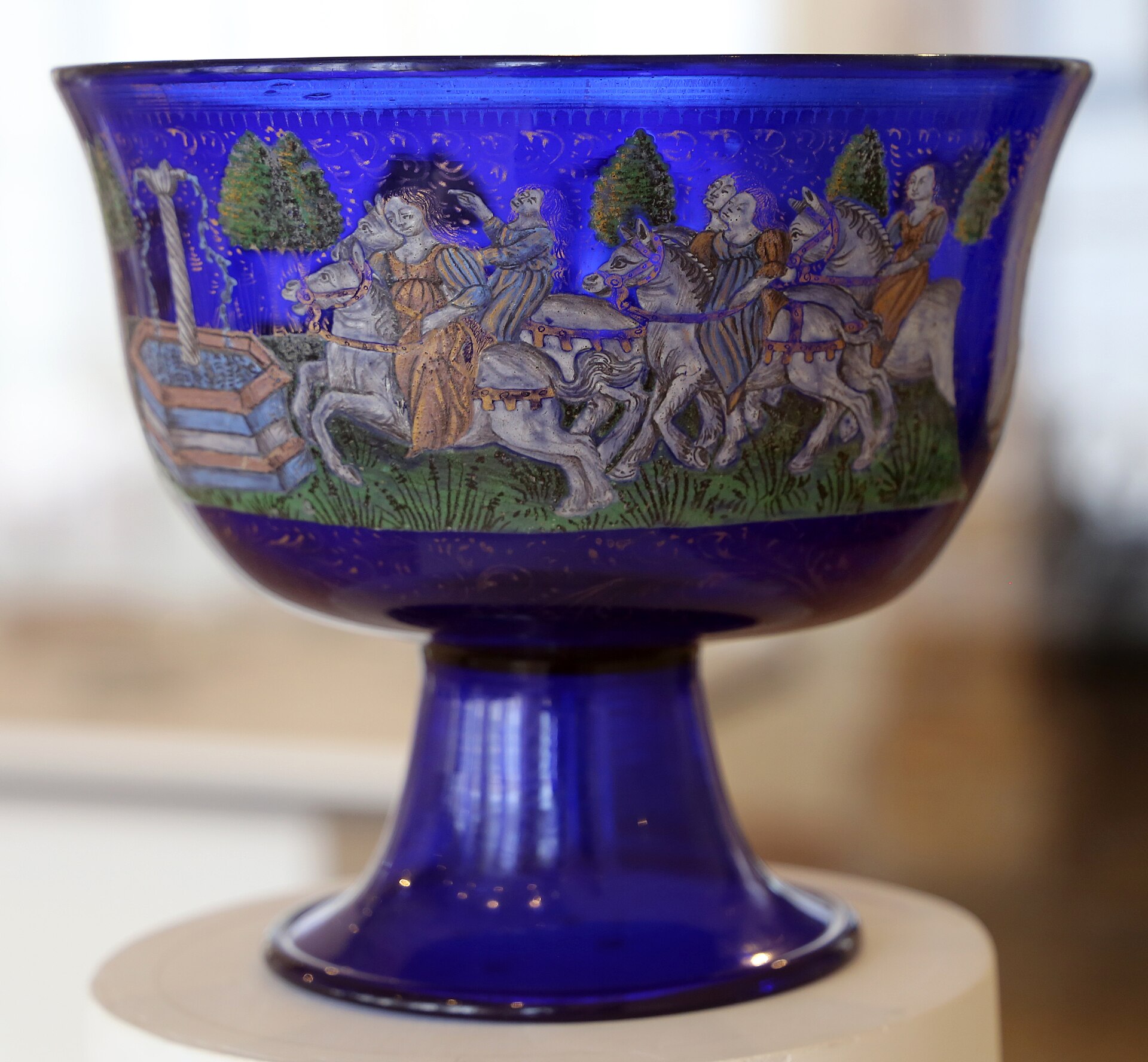
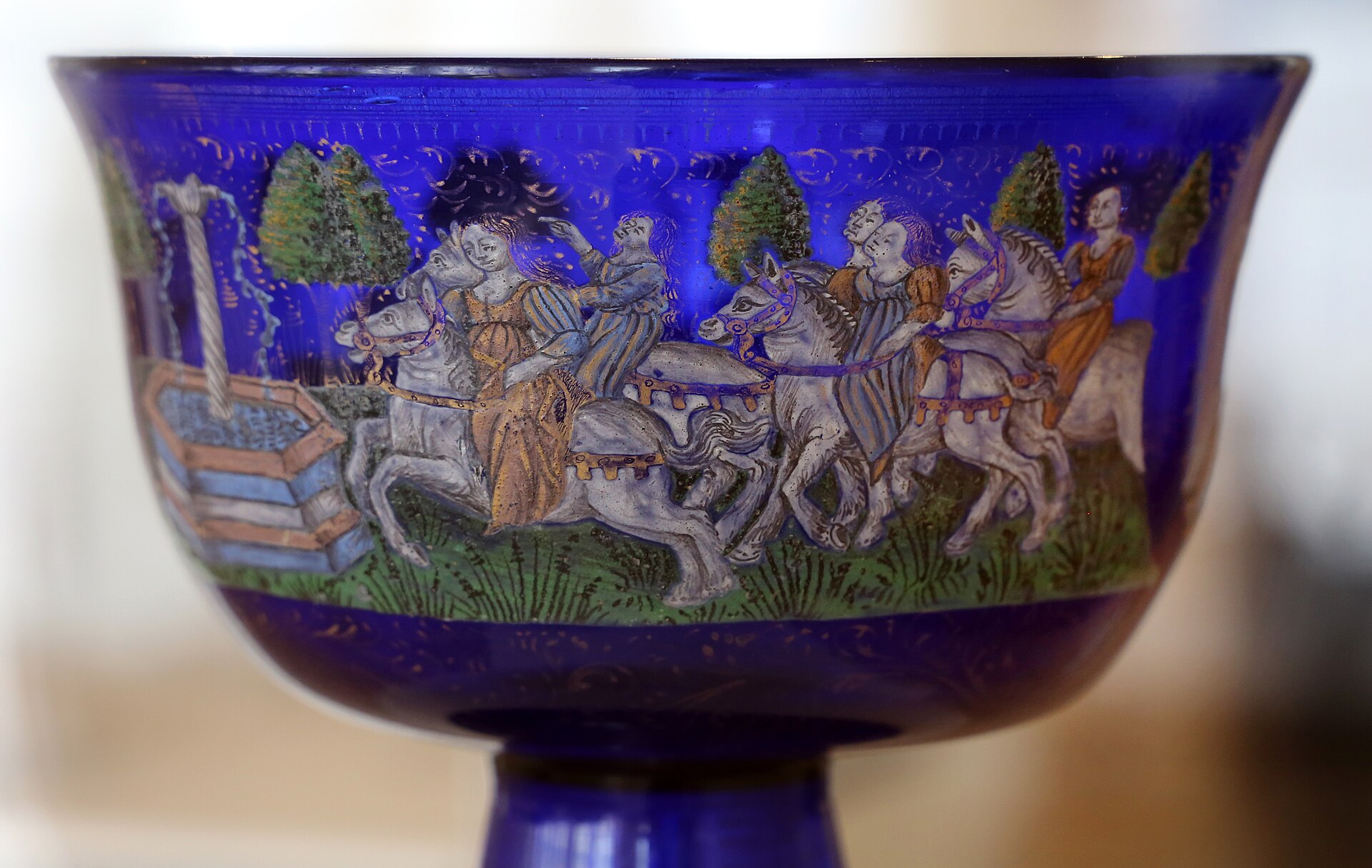
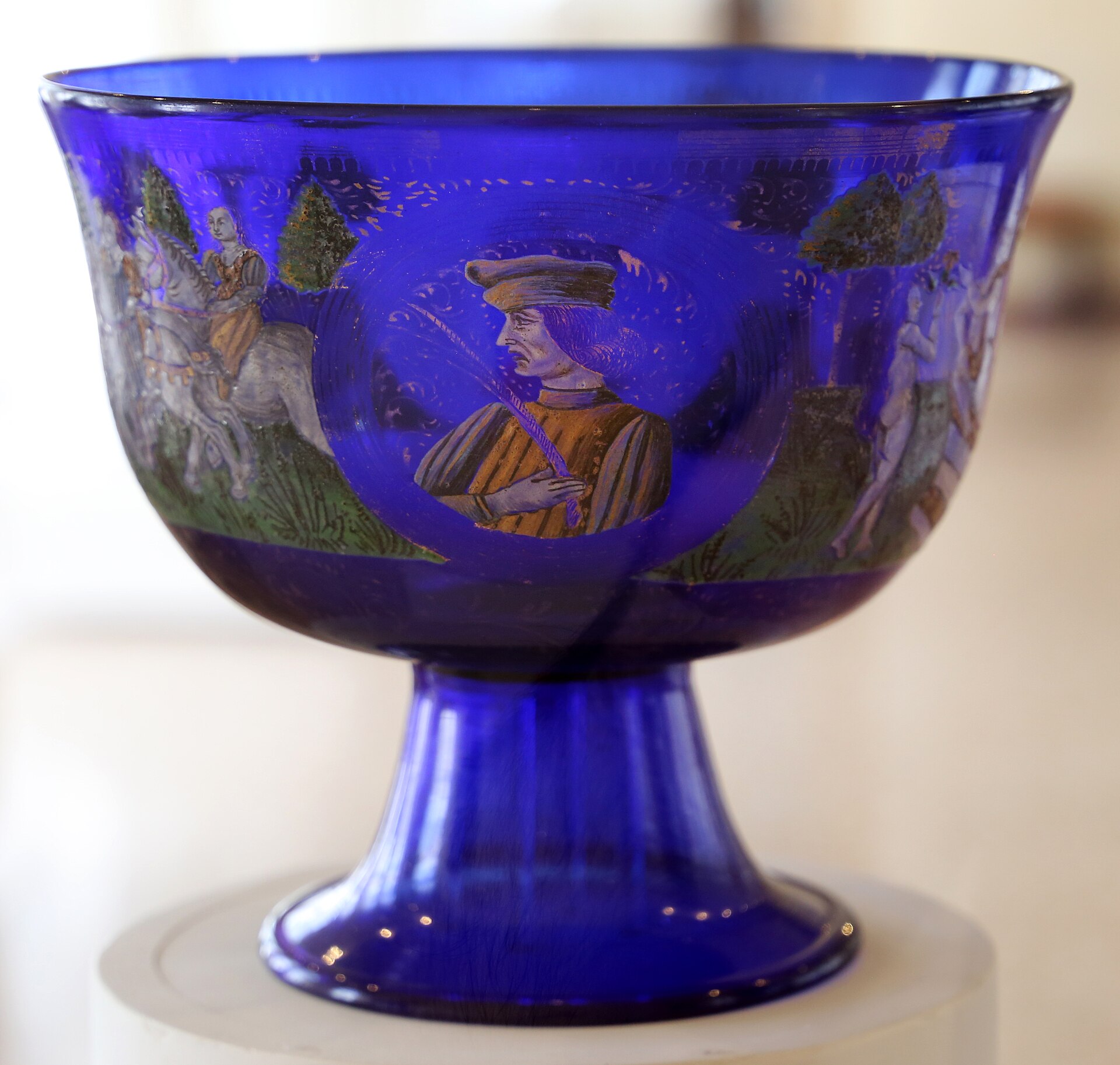
A small blown-glass standing cup in deep blue glass, painted around its bowl with polychrome enamels and gold: a cavalcade of courtly riders moving toward an octagonal fountain, and, opposite, bathers within that same fountain, framed on either side by two profile portrait medallions of an unnamed man and woman. It is dated on costume evidence to about 1460-1470 and is among the earliest and finest surviving examples of Venetian smalto painting on glass, a technique that made Murano famous at every court in Europe within a generation of this cup being made.
It is not, on the museum's own current account, a work by Angelo Barovier. That attribution is a nineteenth-century tradition built on Barovier family fame rather than on any signature, contract or contemporary record, and it survives today mainly in the cup's name. What is documented is narrower and more interesting: a Murano workshop, almost certainly the Barovier fabbrica or one very like it, made a wedding gift for a couple whose identity was never recorded, using a technique whose secrets the Venetian state spent three centuries trying to keep on this one island.
The cup has been part of Venice's civic collections since the Correr bequest of about 1830 and is now the single most reproduced and most cited object in the Museo del Vetro's holdings - to the point that its name has been borrowed, since the nineteenth century, for glass it did not make.
Provenance
Each link is graded. Documented: a cited source supports it. Disputed: the identification is argued but not established. Unknown: no owner for that span, and the gap is not smoothed into a narrative. The grades in the glossary.
- c. 1460-1470 -Original commissioning couple (unidentified), via a Murano glassworking workshop traditionally called Barovierdocumented
Made as a wedding gift; costume evidence in the painted portrait medallions dates the object to this decade. Neither the maker nor the couple is named in any source consulted.124
- - 1830Unknown intervening custodyunknown
No source consulted documents where or with whom the cup was held between its making in the 1460s-1470s and its appearance in the Correr collection by the time of Teodoro Correr's 1830 bequest.1
- 1830 - 1932 (or earlier)Museo Civico Correr, Venice, then Museo del Vetro, Muranodocumented
Entered Venice's civic collections via Teodoro Correr's bequest of about 1830. The Museo del Vetro itself was founded only in 1861; the documented reorganisation that brought the finest Renaissance glass from the Correr, Cicogna and Molin collections into the Museo del Vetro's display took place in 1932, under Giulio Lorenzetti and Nino Barbantini following the Fondazione Musei Civici di Venezia's 1923 assumption of the museum. Whether the cup itself was already on display at Murano before 1932 is not established in the sources located.11112
- 1932 (or earlier) - presentMuseo del Vetro, Murano (Fondazione Musei Civici di Venezia)documented
Currently displayed in Room 2 of the Museo del Vetro under inventory Classe VI, n. 0001, described by the museum as among its most important works.12
Technical evidence
| Attribution note | The museum's own current catalogue attributes the cup simply to Venetian manufacture, without naming an individual hand. The traditional attribution to Angelo Barovier personally is, on the museum's own account, an erroneous nineteenth-century belief: Angelo Barovier was a glass technologist credited with developing cristallo, not a documented enamel painter, and the standard scholarly biography (Treccani, Dizionario Biografico degli Italiani) records his death in 1461, before or at the very start of the 1460-1470 window the cup's costumes point to. The same source records an alternative, narrower proposal - that pieces of this kind belong to the hand or workshop of Angelo's daughter Maria, called Marietta, who ran the family fabbrica after 1461 - resting on citations in the Barovier workshop's own 1496 inventory (Archivio di Stato di Venezia). Treccani states plainly that neither attribution is certainly documented. |
|---|---|
| Body | Free-blown blue glass, worked by hand without a mould, in the form of a footed standing cup (tazza) without cover.12 |
| Decoration | Polychrome fusible enamel painting (smalto) with fused gold leaf, applied by brush and fixed by reheating the object at the furnace mouth to approximately 900-1000 C.19 |
| Dimensions | Height 18 cm; maximum diameter 20 cm.12 |
| Inventory number | Classe VI, n. 0001, Museo del Vetro, Murano (Sala 2).12 |
| Iconographic programme | A continuous painted frieze around the bowl: a cavalcade of courtly riders proceeding toward an octagonal fountain, and nude bathers within that fountain (the Fountain of Love/Youth topos), interrupted by two profile portrait medallions, one female and one male, in court dress of the 1460s.12 |
| Form source | The cup's simple, essential profile is stated by the museum to derive from Chinese Ming porcelain models known in Venice in the fifteenth century.1 |
| Dating basis | Stylistic, based on the fashion historian's reading of the costumes worn by the figures in the medallions and frieze, consistent with Italian court dress of the 1460s.12 |
| Enamel technique history | Enamel painting on glass (opus smaldorum) is documented at Murano from 1317 and attested from the late 13th century; the technique flourished after Angelo Barovier's mid-15th-century development of cristallo gave painters a purer, more transparent ground.910 |
Images
The record in full
Chapter 1What it is
The Coppa Barovier is a footed standing cup, or tazza, in blown blue glass, 18 centimetres high and 20 centimetres across at its widest point.
The Coppa Barovier is a footed standing cup, or tazza, in blown blue glass, 18 centimetres high and 20 centimetres across at its widest point. Its form is deliberately simple: a rounded bowl on a spreading foot, without cover, handle or added ornament to the glass body itself. The museum's own catalogue entry makes a point of this simplicity, noting that the profile derives from Chinese Ming porcelain bowls that were well known in Venice in the fifteenth century - a Venetian glass object modelled, in its silhouette, on an imported Chinese ceramic form, then made wholly Venetian by what was painted onto it.
What was painted onto it is the reason the object survives in every history of European glass. Around the exterior of the bowl runs a continuous painted frieze in polychrome fusible enamel and gold leaf, divided by two circular medallions containing profile busts, one female and one male, both in fashionable Italian court dress. Between the medallions the frieze tells two connected scenes: on one side, a cavalcade of young men and women on horseback, richly dressed, riding toward an octagonal walled fountain set among trees; on the other, an directly connected scene of nude bathers within that same fountain. The subject is the medieval and early Renaissance topos of the Fountain of Love, or Fountain of Youth: courtship and procession leading to immersion and renewal.
Chapter 2A wedding gift, not an altar or a table piece
Every institutional and scholarly source consulted for this record agrees on the object's function without disagreement: it is a nuptial cup.
Every institutional and scholarly source consulted for this record agrees on the object's function without disagreement: it is a nuptial cup. The paired portrait medallions are read, consistently, as likenesses of a bride and groom, and the fountain iconography as an allegorical wish for the couple's future love and long life together. This reading is old and is not seriously contested; what is contested, and unresolved, is who the couple actually were.
No source found for this record - not the Museo del Vetro's own published catalogue entry, not the Dizionario Biografico degli Italiani, not the French or English secondary literature consulted - names the bride and groom, and none of them documents a Barovier-Contarini marriage. Popular and tourist-facing accounts sometimes describe the scene simply as portraits of an unnamed young bride and her fiance; a specific identification with the Barovier and Contarini families does not appear in the museum's own material or in the scholarly biography of Angelo Barovier consulted here. This record treats the couple as unidentified, and treats any specific Barovier-Contarini claim as undocumented in the sources available, pending sight of whatever secondary source originated it.
Chapter 3How the surface was made
The technique is called smalto, or pittura a smalti fusibili - painting in fusible enamels.
The technique is called smalto, or pittura a smalti fusibili - painting in fusible enamels. The Museo del Vetro's own technical notes describe the process: a mixture of finely powdered glass, coloured pigments, metal oxides and a fatty binding medium is applied by brush to the surface of an already-formed and cooled glass object, and the decoration is then fixed permanently by returning the piece to the mouth of the furnace and reheating it to roughly 900 to 1000 degrees Celsius, low enough to fuse the enamel without melting the object beneath it.
The technique itself was not new in the 1460s. Venetian documents record an opus smaldorum, works in enamel, as early as 1317, and enamel painting on glass is attested at Murano from the late thirteenth century. What changed in the mid-fifteenth century was the base material it was applied to: Angelo Barovier's documented development of cristallo, a purer and more transparent glass formula, gave Murano's enamel painters a better ground to paint on, and enamelled glass of this quality became, within a generation, an export good sought by doges, popes and princely courts across Europe. The Coppa Barovier sits at the hinge of that development - not because Angelo Barovier painted it, on the evidence available, but because it is one of the earliest surviving objects to show what his glass and his workshop's decorators could do together.
Chapter 4The attribution problem: what the family name actually rests on
The cup's name has never meant what it appears to mean.
The cup's name has never meant what it appears to mean. The Museo del Vetro's own current descriptive text is direct about this: the association with Angelo Barovier is described as an erroneous nineteenth-century belief, one that assumed the most famous glass technologist of the Barovier family must also have been the enamel painter of its finest surviving object. Angelo Barovier's own documented biography does not support this. The Dizionario Biografico degli Italiani entry for the Barovier family records his death in 1461 and states plainly, of the nuptial cup, that this attribution is not certainly documented - not to Angelo, and not to anyone else by name.
The same entry offers the field's one alternative, sourced proposal: that cups of this type belong instead to Angelo's daughter, Maria, called Marietta, who took over direction of the family workshop jointly with her brother after Angelo's death in 1461 and who is independently documented, by name, as a specialist glass decorator in Venetian records between 1443 and 1516 - one of only two women among fourteen such named specialists in that period. The proposal rests on mentions of enamelled coloured cups in the Barovier workshop's own inventory of 1496, held in the Archivio di Stato di Venezia. Treccani is careful to grade this exactly as it grades the Angelo attribution: proposed, argued from workshop records, but not certainly documented as referring to this specific object.
No source consulted for this record claims a signature, a contract, or a contemporary inventory entry that names this cup and only this cup. What is documented is a workshop, a family, a date range fixed by costume history, and two competing, unproven names attached to it a century apart from the object's own making.
Chapter 5Dating: what the costumes fix, and what they do not
The cup carries no date. Its dating to approximately 1460-1470 is stylistic, resting on the fashion historian's reading of the clothing worn by the two profile busts and the mounted figures in the...
The cup carries no date. Its dating to approximately 1460-1470 is stylistic, resting on the fashion historian's reading of the clothing worn by the two profile busts and the mounted figures in the frieze, which matches Italian court dress current in that decade. Some institutional sources narrow this to 1470-1480; the Museo del Vetro's own current published dating is 1460-1470, and this record follows the holding institution.
The dating matters directly to the attribution question above. If the cup was painted any time from the mid-1460s onward, Angelo Barovier, who died in 1461, cannot have painted it himself even under the most generous reading of his biography. A costume-based dating of 1460-1470 leaves at most a narrow window in which a personal attribution to Angelo would be chronologically possible, and no source treats that narrow possibility as documented rather than merely not-yet-excluded.
Chapter 6Materials as meaning: why blue, why gold, why this shape
The deep cobalt-blue body is a colour choice, not a default: clear cristallo was the technical triumph Murano had just achieved, and choosing to obscure that achievement under opaque blue and paint...
The deep cobalt-blue body is a colour choice, not a default: clear cristallo was the technical triumph Murano had just achieved, and choosing to obscure that achievement under opaque blue and paint over it in enamel was a deliberate decision to treat the glass as a coloured ground for a picture, in the same way a panel painter treated gessoed wood. Blue glass of this depth required cobalt colourant, and gold leaf was fused into the design alongside the painted enamels - both materials whose cost signalled the object's status as a wedding gift meant to be seen and kept, not used for drinking.
The shape, as the museum's own catalogue notes, is borrowed from Chinese Ming porcelain bowls circulating in Venice in the fifteenth century - a reminder that Venice's Levantine and Asian trade networks fed directly into Murano's design vocabulary well before European porcelain existed, and that a supposedly purely Venetian masterpiece already carries an acknowledged foreign source for its silhouette.
Chapter 7The world that made this technique possible: guild secrecy and the Murano confinement
The Coppa Barovier was made inside one of the most tightly controlled manufacturing systems in medieval and Renaissance Europe.
The Coppa Barovier was made inside one of the most tightly controlled manufacturing systems in medieval and Renaissance Europe. From 1291 the Venetian Republic required all glass furnaces to be moved from the city itself to the island of Murano, ostensibly against fire risk but understood by most historians as, at least as much, a measure to concentrate and isolate the trade's secrets on a single, more easily watched island. Guild statutes from 1271 already restricted the disclosure of glassmaking methods outside Venice, and later law made it a capital matter: glassmakers who left Murano without licence and revealed the Republic's techniques abroad could be, and in the framing of the law were meant to be, hunted down and killed, with their families at risk of imprisonment in the meantime.
Set against that, Murano's glassworkers held real privileges most craftsmen did not: they could carry swords, intermarry with patrician families, and enjoyed a legal status closer to that of the nobility than that of ordinary tradesmen. The Coppa Barovier is a direct product of that bargain - a technique so valuable to the Republic that its makers were simultaneously privileged and confined, and an object whose export as a physical good was encouraged and prized across Europe at the exact moment its underlying knowledge was defended by threat of death.
Chapter 8Provenance: from the Correr bequest to the Museo del Vetro
The Museo del Vetro's own catalogue gives the cup's documented modern provenance in a single line: it came from the Museo Civico Correr in Venice, via the bequest of Teodoro Correr, around 1830.
The Museo del Vetro's own catalogue gives the cup's documented modern provenance in a single line: it came from the Museo Civico Correr in Venice, via the bequest of Teodoro Correr, around 1830. Teodoro Correr, a Venetian patrician and collector, left his collections to the city on his death in 1830, forming the founding core of what became the Museo Correr.
The Museo del Vetro itself did not yet exist in 1830. It was founded on Murano in 1861 by the priest and local historian Vincenzo Zanetti, initially conceived more as an archive of documents, guild records and historic glass-working models than as a collection of masterpiece objects, with an attached school for glassworkers opened the following year. The transfer of the finest Renaissance glass from Venice's civic collections, including material from the Correr, Cicogna and Molin holdings, into the reorganised Museo del Vetro display is recorded as taking place in 1932, under the Fondazione Musei Civici di Venezia's post-1923 administration of the museum, in a reinstallation overseen by Giulio Lorenzetti and Nino Barbantini.
Between the 1830 Correr bequest and the documented 1932 reorganisation, this record has not found a published account of exactly when the cup itself moved from Correr custody into the Murano museum's display, nor whether it was already exhibited there under Zanetti from the 1860s onward. This is recorded as an open question rather than bridged with a guess.
Chapter 9Market history: there is none
No source consulted for this record documents a sale of the Coppa Barovier at any date.
No source consulted for this record documents a sale of the Coppa Barovier at any date. It has been part of a Venetian civic collection continuously since at least 1830 and is not known to have been on the open market since. It has never been offered at auction, has no recorded estimate, hammer price or premium, and this record carries no auction_results block for that reason: there is nothing to report, and nothing has been invented to fill the gap.
Chapter 10Reproduction, revival, and why the name is dangerous
Because the Coppa Barovier is the Museo del Vetro's single most celebrated object, its design has been copied, adapted and sold under its own name for more than 150 years, and a reader searching for...
Because the Coppa Barovier is the Museo del Vetro's single most celebrated object, its design has been copied, adapted and sold under its own name for more than 150 years, and a reader searching for it online will find far more images of these later pieces than of the original. The clearest documented case is the so-called Guggenheim Cup at the Victoria and Albert Museum in London: a goblet and cover made by the Murano firm of Salviati & C., with the glasswork attributed to Giuseppe Barovier, dating from between 1875 and 1910, first produced by Salviati after a design supplied by the dealer and collector Michelangelo Guggenheim and shown at the 1878 Paris International Exhibition. It is a nineteenth-century revival piece named after, and visually indebted to, the Barovier tradition, made by a different glasshouse, by a different named maker, roughly four centuries after the object this record describes, and it is not the Coppa Barovier.
More broadly, the modern manufactory Barovier & Toso and numerous other Murano workshops and dealers have produced and continue to sell blue enamelled goblets explicitly marketed as "Coppa nuziale Barovier" reproductions, some from the early twentieth century and some contemporary, regularly appearing at auction and in the antiques trade. None of these later pieces should be confused with, or treated as evidence about, the fifteenth-century original at the Museo del Vetro. This record describes only the Museo del Vetro's Classe VI n. 0001, the object traditionally dated 1460-1470.
A further distinct object worth naming to avoid confusion: the Corning Museum of Glass holds a late-fifteenth-century Venetian nuptial goblet with polychrome enamel and gold-leaf decoration, from the Jerome Strauss bequest, a genuine historic piece of the same general type and period as the Coppa Barovier but a physically different object in a different collection, with its own separate history. It is comparanda for this record, not a version of the same cup.
Chapter 11What remains unresolved
Strip away the nineteenth-century name and what is left is genuinely well evidenced: a Murano workshop, a costume-based date in the 1460s or 1470s, a documented and highly restrictive guild and state...
Strip away the nineteenth-century name and what is left is genuinely well evidenced: a Murano workshop, a costume-based date in the 1460s or 1470s, a documented and highly restrictive guild and state system that this object was made inside, and a continuous civic ownership history back to 1830. What is not resolved is exactly the part that gives the object its popular fame - who made it with their own hands, and who it was made for. This record states both as open rather than inventing an answer for either.
The artist
Angelo di Iacopo Barovier, and the Barovier glassworking family of Murano
The Barovier were, by the fifteenth century, one of the oldest and most prominent glassworking families of Murano, and Angelo di Iacopo Barovier is the first member of the family for whom the documentary record is substantial. He is credited, on the basis of period testimony rather than a surviving signed object, with developing cristallo, a clearer and more workable glass formula that transformed what Murano's enamel painters had to work with. No object survives that is documented, by contract, signature or contemporary inventory entry, as personally made or decorated by his hand - a fact the standard Italian biographical reference for the family states without qualification. The dossier below treats Angelo, and the workshop his children inherited from him, as the subject, in place of a single artist whose personal touch on any surviving object cannot be demonstrated.
Related works
| Work | Relation | Where it is |
|---|---|---|
| Guggenheim Cup (goblet and cover) Salviati & C., glasswork attributed to Giuseppe Barovier, after a design supplied by Michelangelo Guggenheim | Nineteenth-century revival piece named after and visually indebted to the Barovier tradition; NOT the object described in this record Made 1875-1910, shown at the 1878 Paris International Exhibition. A different object, by a different named maker, roughly four centuries later than the Coppa Barovier. | Victoria and Albert Museum, London |
| Nuptial goblet, late 15th-century Venetian, polychrome enamel and gold leaf Unattributed Venetian workshop | Comparable genuine historic type (Venetian enamelled nuptial goblet), not the same object A separate, physically distinct fifteenth-century Venetian nuptial goblet in a different collection; useful comparanda for the type but not a version of the Coppa Barovier. | Corning Museum of Glass, Corning, New York (Jerome Strauss bequest) |
| Modern 'Coppa nuziale Barovier' reproductions Barovier & Toso and other Murano workshops, 20th-21st century | Commercial reproductions and revival pieces explicitly named after the Coppa Barovier Regularly offered at auction and by dealers under the historic cup's name; none document or evidence the fifteenth-century original and none should be conflated with it. | Various private collections and the antiques trade |
| Barovier workshop inventory of 1496 Barovier family fabbrica, Murano | Documentary source cited as the basis for proposing Marietta Barovier's connection to cups of this type A written inventory, not an object; cited by the Dizionario Biografico degli Italiani as evidence for, though not proof of, the family workshop's production of enamelled coloured cups. | Archivio di Stato di Venezia |
Open questions
- Who were the bride and groom depicted in the two portrait medallions? No source consulted, including the Museo del Vetro's own catalogue entry, names them, and no documented Barovier-Contarini marriage claim was found to corroborate the version of the story that circulates in some popular accounts.
- Which hand or workshop actually painted the enamel decoration? Neither the traditional attribution to Angelo Barovier nor the alternative scholarly proposal naming Marietta Barovier is, on the standard biographical reference's own account, certainly documented.
- Exactly when did the cup pass from the Correr bequest of about 1830 into the Museo del Vetro's own display? The museum's founding (1861) predates the documented 1932 reorganisation that added Correr, Cicogna and Molin glass to the collection, leaving roughly a century of custody unaccounted for in the sources located.
- Has the cup undergone any conservation treatment, condition assessment, or scientific/technical imaging campaign, and has it ever left Venice on loan? No published conservation or exhibition-loan record was located for this record.
- Is the object's dating better fixed at 1460-1470 (the museum's own current figure) or 1470-1480 (given in some secondary listings)? The two ranges are not reconciled in the sources consulted, and the distinction matters directly to whether any personal-attribution debate involving Angelo Barovier (d. 1461) is even chronologically possible.
Questions about this object
What is Coppa Barovier?
Coppa Barovier is a glass, dated c. 1460-1470. Medium: Free-blown blue glass, painted with polychrome fusible enamels and gold.
Who made Coppa Barovier, and is the attribution settled?
The attribution to Venetian manufacture, Murano workshop (traditionally called the Barovier workshop) is recorded here as disputed. The museum's own current catalogue attributes the cup simply to Venetian manufacture, without naming an individual hand. The traditional attribution to Angelo Barovier personally is, on the museum's own account, an erroneous nineteenth-century belief: Angelo Barovier was a glass technologist credited with developing cristallo, not a documented enamel painter, and the standard scholarly biography (Treccani, Dizionario Biografico degli Italiani) records his death in 1461, before or at the very start of the 1460-1470 window the cup's costumes point to. The same source records an alternative, narrower proposal - that pieces of this kind belong to the hand or workshop of Angelo's daughter Maria, called Marietta, who ran the family fabbrica after 1461 - resting on citations in the Barovier workshop's own 1496 inventory (Archivio di Stato di Venezia). Treccani states plainly that neither attribution is certainly documented.
Where is Coppa Barovier now?
Museo del Vetro, Murano (Fondazione Musei Civici di Venezia). Inventory number Classe VI, n. 0001. Last confirmed 6 September 2026. Museum's own published catalogue entry (visitmuve.it), current as of this record.
What is still unknown about Coppa Barovier?
Who were the bride and groom depicted in the two portrait medallions? No source consulted, including the Museo del Vetro's own catalogue entry, names them, and no documented Barovier-Contarini marriage claim was found to corroborate the version of the story that circulates in some popular accounts.
Sources
- 1Museo del Vetro / Fondazione Musei Civici di Venezia, catalogue entry 'Coppa Barovier' (visitmuve.it), giving inventory number, dimensions, materials, dating, the Chinese-porcelain form source, and the Correr provenance. visitmuve.it/capolavoro/...
- 2Fondazione Musei Civici di Venezia (MUVE), gallery entry 'Coppa Barovier'. visitmuve.it/it/...
- 3Wikipedia, 'Angelo Barovier', for the cristallo development, the 1455 Milan/Filarete episode, and the statement that no work is documented as personally by Barovier's hand. en.wikipedia.org/wiki/...
- 4Dizionario Biografico degli Italiani (Treccani), entry 'Barovier', for Angelo's 1461 death, the succession to Marino and Maria (Marietta), the 1496 workshop inventory in the Archivio di Stato di Venezia, and the explicit statement that the attribution of the nuptial cup is not certainly documented. treccani.it/enciclopedia/...
- 5Web Gallery of Art, 'Marriage Cup' by Barovier, Angelo - for Barovier's dates (c.1400-1460) as given in secondary literature and the c.1470 dating of the cup, illustrating the chronological tension with a personal attribution to Angelo. wga.hu/html_m/...
- 6Wikipedia, 'Marietta Barovier', for her documented status as one of fourteen named specialist glass decorators active in Venice 1443-1516, and her 1487 kiln privilege. en.wikipedia.org/wiki/...
- 7Wikipedia, 'Murano Glass Museum', for the museum's founding by Vincenzo Zanetti in 1861 and description of the Barovier Cup in its collection. en.wikipedia.org/wiki/...
- 8Victoria and Albert Museum collections online, 'Guggenheim Cup', goblet and cover, Salviati & C. / Giuseppe Barovier, 1875-1910 - the documented nineteenth-century revival piece distinguished in this record from the fifteenth-century original. collections.vam.ac.uk/item/...
- 9Museo del Vetro, 'Lavorazioni e composti del vetro' - the museum's own technical description of the pittura a smalto (fusible enamel painting) process, firing temperature, and the 1317 documentary reference to opus smaldorum. museovetro.visitmuve.it/it/...
- 10Wikipedia (Italian), 'Vetro di Murano' - for the guild secrecy laws of 1271 and the 1291 relocation of furnaces to Murano, the death-penalty framing for glassworkers disclosing techniques abroad, and the development of enamel decoration after Angelo Barovier's cristallo. it.wikipedia.org/wiki/...
- 11Wikipedia (Italian), 'Museo del vetro' - for the 1932 reorganisation under Giulio Lorenzetti and Nino Barbantini that added Correr, Cicogna and Molin glass to the collection, and the 1923 transfer of administration to the Fondazione Musei Civici di Venezia. it.wikipedia.org/wiki/...
- 12Wikimedia Commons, image metadata (/LicenseShortName) for the eight 'Coppa Barovier' photographs by Sailko used as plates in this record, confirming CC BY 3.0 licensing and the object description. commons.wikimedia.org/w/...

Last verified · Published
Change log
6 September 2026 - Record created at the house standard: researched narrative, technical evidence, maker dossier, graded provenance chain, prices with hammer and premium separated, related works, open questions and sources.