The Trewhiddle Hoard
Unknown Anglo-Saxon silversmiths · 9th century AD, buried c. AD 868
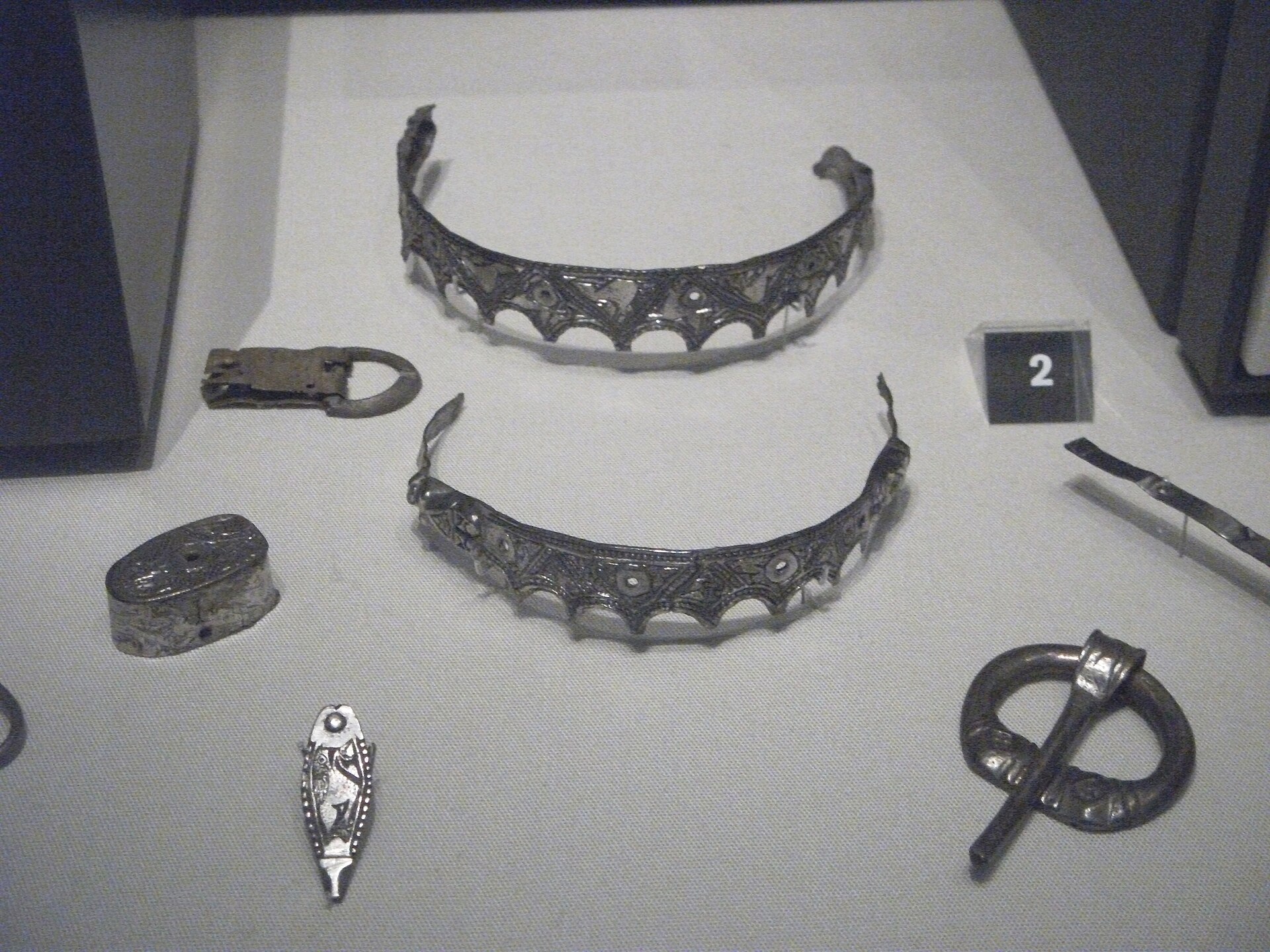
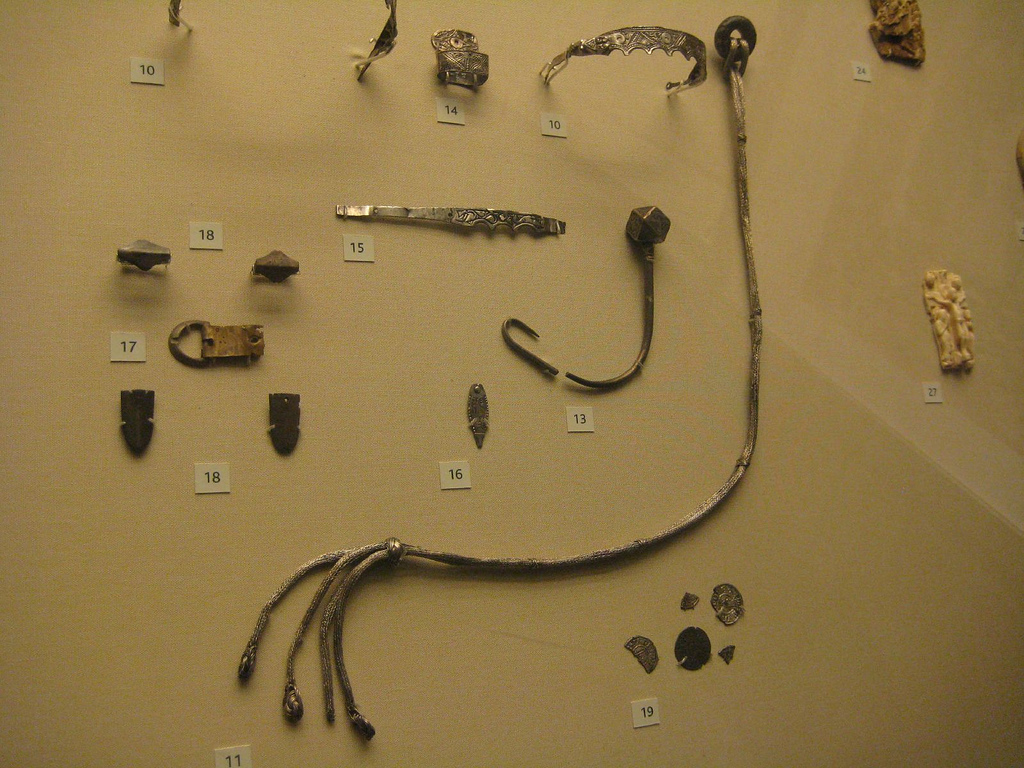
The Trewhiddle Hoard as displayed in Room 41 of the British Museum since 2014: the chalice, scourge, brooch, buckle, pin, drinking-horn mounts, box and strap ends grouped together.
British Museum, London; photograph by Johnbod · CC BY-SA 3.0| Artist | Unknown Anglo-Saxon silversmiths |
|---|---|
| Date | 9th century AD, buried c. AD 868 |
| Medium | Silver, largely undecorated and niello-inlaid, with the chalice bowl gilded internally; one buckle-plate of bronze; a glass terminal ring on the scourge; 114 Anglo-Saxon silver pennies |
| Dimensions | A hoard of at least nine silver and bronze objects plus a parcel of coins; the scourge, the largest single piece, extends to roughly 60 cm; see technical for individual measurements where published |
| Where it is now | British Museum, London, Room 41 (Sutton Hoo and Europe, AD 300-1100)last confirmed |
| Inventory number | 1880,0410.1-30 (chalice 1880,0410.1-3; scourge 1880,0410.4; further pieces and the coin parcel numbered within the same 1880,0410 registration group) |
| Attribution | UnknownNo maker, workshop or patron is named or documented for any object in the hoard. Full note |
| Object type | Silver |
| Period | Anglo-Saxon, ninth century (Viking Age) |
| Cases | Has a provenance gap |
| Inscriptions | None recorded on any surviving object in the hoard |
| Owners on record | 8 links6 documented, 2 unknown |
| Sources | 14 cited |
About this record Last verified · 14 sources cited · Change log
On this page 9 sections
ContentsClose
A group of ninth-century Anglo-Saxon silver, one bronze buckle and 114 coins, buried together near St Austell in Cornwall around AD 868 and found by chance by tin-streamers in 1774. It is the type-find for the Trewhiddle style, the name Anglo-Saxon art history uses for the whole ninth-century tradition of niello-inlaid zoomorphic ornament on silver, and it contains one of only two Anglo-Saxon chalices to survive anywhere.
It also contains an object nobody has ever explained with confidence: a silver scourge, precisely made and impractical as an actual whip, whose real function remains an open question a century and a half after the hoard entered the British Museum. The burial itself sits inside the general climate of Viking raiding that shaped southern England in the 860s and 870s, but no documented Viking force has been placed at Trewhiddle itself in that year, and a recent paper proposing the hoard as Viking property rather than Anglo-Saxon treasure hidden from Vikings remains, on the evidence available here, unread and unresolved.
Donated to the British Museum in 1880 by John Jope Rogers, a descendant of the antiquarian who first acquired the find, it has been in continuous public collection ever since and is now displayed in Room 41 alongside the Fuller Brooch and the Pentney and Cuerdale hoards, the objects and assemblages closest to it in style, period and kind.
Provenance
Each link is graded. Documented: a cited source supports it. Disputed: the identification is argued but not established. Unknown: no owner for that span, and the gap is not smoothed into a narrative. The grades in the glossary.
- 9th century -Unknown Anglo-Saxon silversmiths and their patronsunknown
Individual objects are dated by decorative style (Trewhiddle style, defined by this find) and, for the coin parcel, by regnal issue; no maker, workshop location or original owner is named in any surviving record.39
- - c. 868Unknowndocumented
The burial date is fixed to approximately AD 868 by the latest identifiable coins in the parcel, per the numismatic analysis of C. E. Blunt published jointly with D. M. Wilson's metalwork study in 1961. The identity of whoever buried the hoard, and the immediate reason, are not documented; a connection to Viking activity is the conventional but not independently evidenced explanation.12
- c. 868 - 1774None recordedunknown
The hoard lay undisturbed underground at Trewhiddle for 906 years. No intervening owner, disturbance or knowledge of its presence is recorded.2
- 1774-11-08 -Unnamed tin-streamers, then Philip Rashleighdocumented
Found by tin-workers streaming for tin at Trewhiddle, under loose stones roughly 17 feet down, in what was taken to be an old mine working. The finders are not individually named in the surviving accounts; the find was acquired by the Cornish mineralogist and antiquarian Philip Rashleigh, who published the first notice in 1789.26
- 1774 - 1811Philip Rashleighdocumented
Held by Rashleigh from acquisition until his death in 1811. His 1789 Archaeologia account is the earliest published record of the find.6
- 1811 - 1880Rashleigh and Rogers familiesdocumented
The hoard descended within the Rashleigh family and passed, by inheritance or marriage connection, to the related Rogers family. Both John Jope Rogers (1867) and Jonathan Rashleigh (1868) published accounts of the hoard from the surviving group during this period, by which time 39 of the original 114 coins were already missing.78
- 1880-03-24 - 1880John Jope Rogers, then the Trustees of the British Museumdocumented
John Jope Rogers sent the Anglo-Saxon silver and bronze from Trewhiddle to the British Museum by letter of 24 March 1880, asking that it be presented to the Trustees as a token of regard. It was accepted as a gift, not a purchase, and registered under accession group 1880,0410.4
- 1880 - presentBritish Museum, Londondocumented
In the Museum's collection since 1880, most recently displayed in Room 41, Sutton Hoo and Europe, AD 300-1100.4
Technical evidence
| Attribution note | No maker, workshop or patron is named or documented for any object in the hoard. The pieces are grouped and dated by their shared decorative vocabulary, the style that has taken the name Trewhiddle style from this find, and by the accompanying coins, not by any surviving record of production. A single East Anglian workshop has been proposed for the related Pentney Hoard brooches found in Norfolk; on current published evidence that proposal has not been extended to the Trewhiddle objects themselves, which are stylistically close but not shown to share a workshop or a findspot-adjacent origin with Pentney or with each other. |
|---|---|
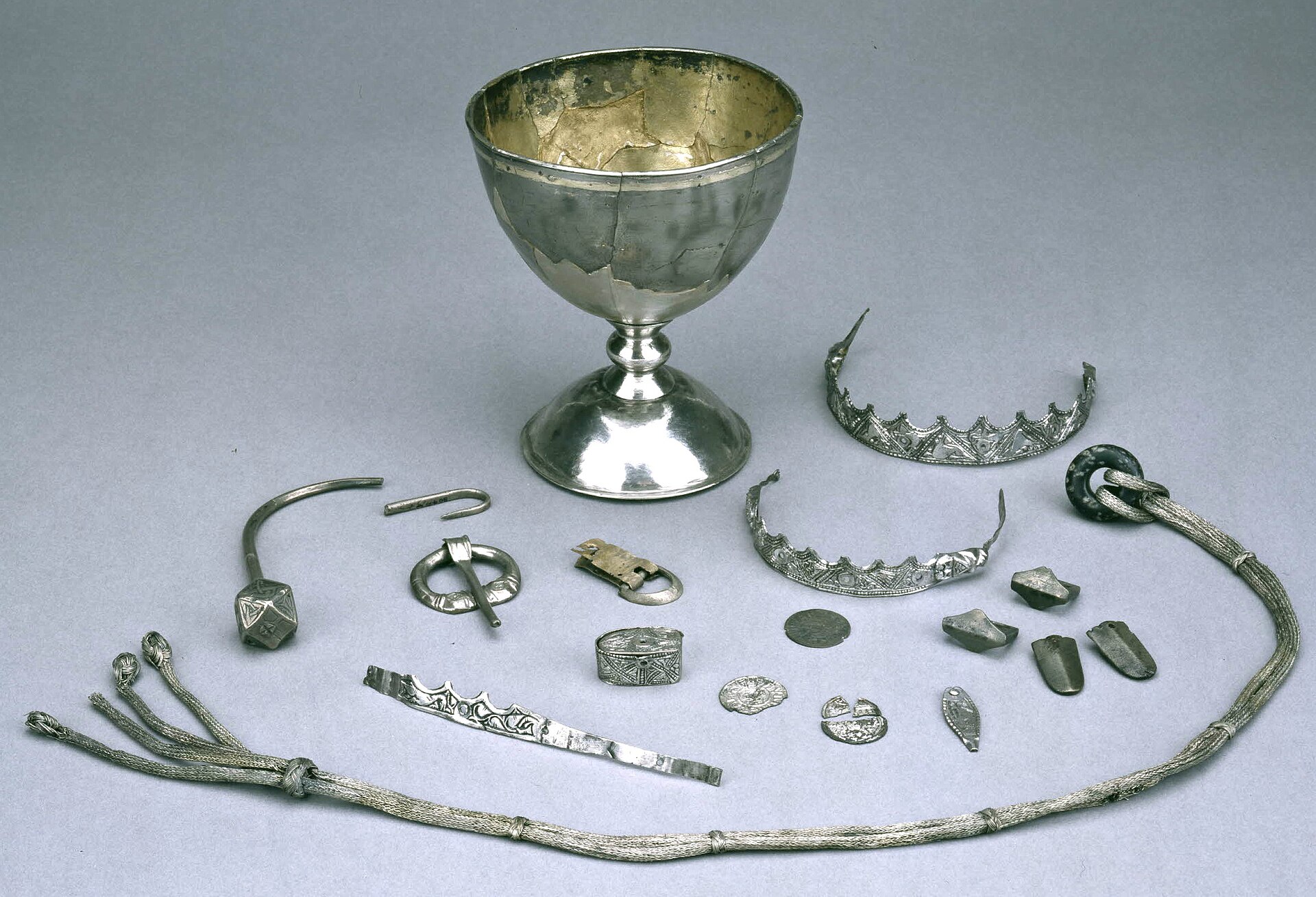
| Composition | A hoard of Anglo-Saxon silver (one bronze buckle-plate excepted) comprising a chalice, a scourge, an open ring brooch, a belt buckle and plate, a dress pin, three drinking-horn strip mounts, a small decorated box, two strap ends, and a parcel of 114 silver pennies.13 |
| The chalice | Reconstructed from separate foot, stem and bowl, originally riveted rather than soldered together; bowl gilded internally per canon law requirements for communion vessels; a band of incised interlace below the rim revealed by later conservation.4 |
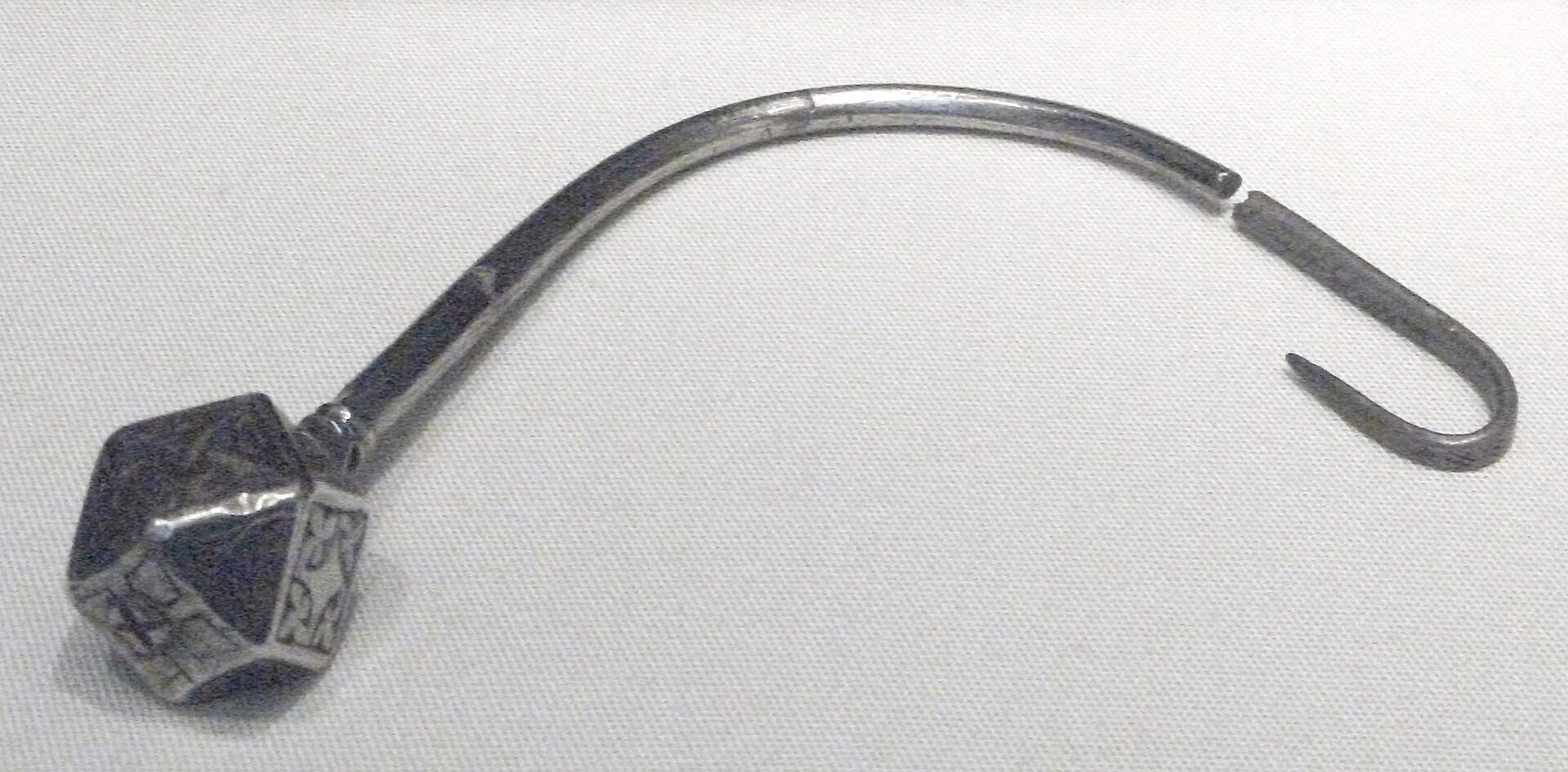
| The scourge | Approx. 60 cm; one strand of trichinopoly chainwork doubled and held by plaited wire loops at five unevenly spaced points, terminating in a large knot from which four slender tails hang, each ending in a plaited knot; a glass ring at the working end.3 |
| The coins | 114 Anglo-Saxon silver pennies, predominantly of Mercia and Wessex; earliest issues of Offa of Mercia (r. 757-796); 39 coins already lost from the group by the time of Jonathan Rashleigh's 1868 account.28 |
| Decorative technique | Trewhiddle-style ornament: zoomorphic, plant, interlace and geometric motifs in niello inlay, set in small fields with beaded borders around dome-headed rivets, most evident on the dress pin and strap ends.39 |
| Niello formula (comparandum) | Laboratory analysis of the related Fuller Brooch found its niello to be predominantly silver sulphide, the formula generally associated with the earlier Trewhiddle decorative tradition before later medieval niello shifted to copper-based recipes; not independently analysed for the Trewhiddle hoard's own pieces in the sources consulted.13 |
| Findspot | Trewhiddle, a stream-work near St Austell, Cornwall; found under loose stones approximately 17 feet below the surface, in what Philip Rashleigh took to be an old mine working.26 |
| Accession | British Museum registration group 1880,0410 (chalice 1880,0410.1-3; scourge 1880,0410.4; further pieces and coin parcel within the same group); donated 1880.4 |
Images
The record in full
Chapter 1A church's silver, or a wealthy household's, buried once and never recovered
The Trewhiddle Hoard is a group of Anglo-Saxon silver, one bronze fitting and 114 silver pennies, buried together in the ninth century and found by chance nine hundred and six years later.
The Trewhiddle Hoard is a group of Anglo-Saxon silver, one bronze fitting and 114 silver pennies, buried together in the ninth century and found by chance nine hundred and six years later. It is not a single object with a single history; it is an assemblage, and the questions it raises are the questions any buried group of valuables raises: who owned it, why was it put in the ground, and why did no one come back for it.
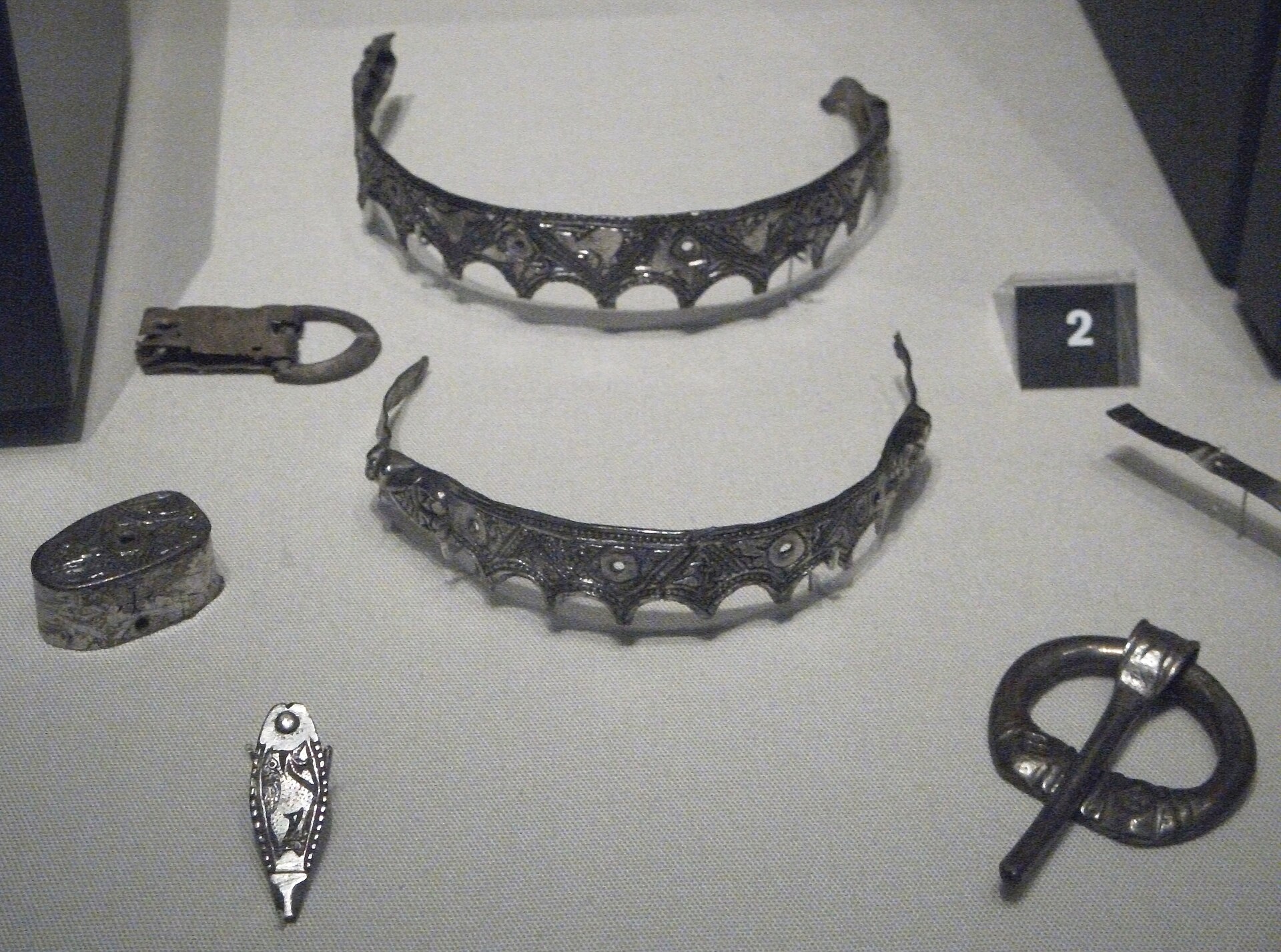
The surviving pieces are a silver chalice, a silver scourge of plaited wire, an open ring brooch of west British or Irish type, a bronze belt buckle with its plate, a large silver dress pin with a niello-inlaid head, three strip mounts from a drinking horn, a small decorated silver box, two strap ends, and the coins. Nothing about the group is uniform. A chalice is unambiguously ecclesiastical. A belt buckle and a dress pin are not. The British Museum's own reading is that this mixture points toward a church's accumulated plate and personal ornament rather than a single object type, and toward an owner, most likely an ecclesiastical community, keeping both liturgical vessels and secular valuables together, rather than a metalworker's raw stock waiting to be melted down and reused.
Chapter 2Seventeen feet down, in an old tin working
On 8 November 1774, men streaming for tin at Trewhiddle, a stream-work near St Austell in Cornwall, found the hoard under loose stones some seventeen feet below the surface, in what Philip Rashleigh...
On 8 November 1774, men streaming for tin at Trewhiddle, a stream-work near St Austell in Cornwall, found the hoard under loose stones some seventeen feet below the surface, in what Philip Rashleigh, the Cornish mineralogist and antiquarian who acquired the find, took to be an old mine working. The men who actually uncovered it are not named in the surviving record; what survives is Rashleigh's account of the find and his ownership of what was recovered.
Rashleigh published the first account within fifteen years, in Archaeologia in 1789, with an engraved plate of the finds. It is a short notice by modern standards, but it is the earliest documentation of the hoard, written by the man who held it, and it fixes the find date, the findspot and the fact of tin-streaming as the activity that brought the hoard to light. Two further, fuller accounts followed nearly a century later: John Jope Rogers in the Journal of the Royal Institution of Cornwall in 1867, and Jonathan Rashleigh, a descendant of the finder, in the Numismatic Chronicle in 1868. By the time of that second account, thirty-nine of the original 114 coins had already gone missing from the group, a loss that happened somewhere in the ninety-four years between discovery and Jonathan Rashleigh's count, with no record of when or how.
Chapter 3The chalice
The chalice is the single most important piece in the hoard and one of only two surviving chalices from Anglo-Saxon England, the other being the chalice still at Hexham Abbey in Northumberland.
The chalice is the single most important piece in the hoard and one of only two surviving chalices from Anglo-Saxon England, the other being the chalice still at Hexham Abbey in Northumberland. It survives as three separate elements, foot, stem and bowl, originally riveted together rather than cast or soldered as one piece. The bowl is gilded on the inside. That detail is not decorative preference; canon law of the period required the interior of a communion vessel to be gilded, so that the wine touched only gold and not bare silver, and the Trewhiddle chalice follows that requirement. A band of incised interlace below the rim, revealed by conservation work in modern times, is the chalice's only surviving decorative scheme; the rest of its surface is plain.
Two surviving Anglo-Saxon chalices out of what was presumably a much larger population of altar plate is a low survival rate, and it says something about what happened to precious church metalwork in the centuries after it was made: it was melted, reused, looted or simply lost, far more often than it was buried and left for someone else to find intact.
Chapter 4The scourge, and what no one can agree it was for
The scourge is the hoard's most argued-over object and the one least like anything else in Anglo-Saxon metalwork to survive.
The scourge is the hoard's most argued-over object and the one least like anything else in Anglo-Saxon metalwork to survive. The British Museum's own catalogue description is precise about its construction: one strand of trichinopoly chainwork, doubled, the two resulting strands held together by plaited loops of wire at five unevenly spaced points, the whole terminating in a large plaited knot from which four slender tails hang, each ending in its own plaited knot, with a glass ring at the working end. It runs to roughly sixty centimetres.
The traditional reading, repeated in most museum labelling, is that this is a scourge in the literal sense, a whip used for penitential self-discipline, a practice regulated under monastic and penitential rule. That reading has been challenged rather than confirmed by closer attention to the object itself. A working whip made of silver is a strange proposition: silver is a poor material for anything struck repeatedly against skin, plaited silver wire is difficult to clean of blood, and no residue or wear consistent with that use has been reported on the object. Commentators who have looked closely at it, including the historian Jonathan Jarrett writing on its construction and function, have set out the alternative readings without settling on one: an emblem of ecclesiastical correction worn or displayed rather than used, a mark of status suspended from a belt, or a maker's showpiece demonstrating a difficult technique rather than a functional tool at all. No published account resolves the question. The object is real, precisely made and undeniably a scourge in form; what it actually did, in whose hands, is not established.
Chapter 5The rest of the group
The remaining pieces are smaller but not incidental.
The remaining pieces are smaller but not incidental. The open ring brooch is of west British or Irish type rather than Anglo-Saxon, the one clearly Celtic object in an otherwise Anglo-Saxon assemblage, and its presence is itself a small piece of evidence for contact or exchange across the Anglo-Saxon and British-Cornish cultural boundary that Trewhiddle itself sits on. The belt buckle with its plate is the hoard's only bronze object among otherwise silver and gilt pieces, which may simply reflect that a working buckle did not need to be made of the more precious metal.
The dress pin, with a large hollow, faceted head inlaid in black niello, is a strongly Trewhiddle-style object in its own right. The three strip mounts belonged to a drinking horn, itself lost; mounted horns were markers of status at an Anglo-Saxon table, and their survival as isolated mounts, without the horn itself, is typical of how organic mounts of this kind reach us. The small decorated box has no confirmed function recorded in the sources consulted for this record; it has been described in general terms as a workbox or small container, but no specific identification, whether as a needle case, a relic box or something else, is established in the literature available here, and it is treated in this record as an open question rather than asserted as any one of those things.
Chapter 6The coins, and how they date the burial
The hoard's most important dating evidence is not the metalwork but the coins buried with it: 114 Anglo-Saxon silver pennies, predominantly of the kingdoms of Mercia and Wessex, the earliest struck...
The hoard's most important dating evidence is not the metalwork but the coins buried with it: 114 Anglo-Saxon silver pennies, predominantly of the kingdoms of Mercia and Wessex, the earliest struck under Offa of Mercia, who reigned 757 to 796. Anglo-Saxon pennies of this period were issued in the names of specific kings and, in many cases, specific moneyers, and can be arranged into a reasonably tight relative sequence; the latest identifiable issues in a hoard give a terminus post quem, a date before which the hoard cannot have been buried, because coins struck after that point could not yet have existed to be included.
The definitive modern analysis of the coins is by C. E. Blunt, working alongside David M. Wilson on the metalwork, published as a single joint article in Archaeologia in 1961. Their conclusion, repeated since in every serious account of the hoard, places burial at approximately AD 868 on the evidence of the latest coins present. Some accounts of the coin group describe it as potentially representing two distinct parcels of differing date, one clustering around 850 and a second, later parcel closer to 868, which would mean the hoard as buried was not necessarily a single, instantaneous act of assembly but possibly an accumulation gathered over roughly two decades before it went into the ground. That possibility affects how the hoard should be read: not necessarily one person's panicked act on one day, but conceivably a treasury's slower accumulation, concealed at one moment for reasons that remain unrecorded.
Chapter 7Why it was buried: the Viking question
The circumstantial case for connecting the burial to Viking activity is straightforward to state and harder to pin to a specific event.
The circumstantial case for connecting the burial to Viking activity is straightforward to state and harder to pin to a specific event. The 860s and 870s were the years of the Viking force usually called the Great Heathen Army, active in England from 865, and Anglo-Saxon treasure hoards of this general period are conventionally read against that background of instability. Trewhiddle's c. 868 date sits inside that window, and modern summaries of the hoard, including the British Museum's own, routinely describe it as buried possibly to protect it from Viking raiders.
What is not established in the sources consulted here is a specific, documented Viking force in Cornwall itself in or around 868. The Great Heathen Army's recorded movements in that particular year place it in Mercia, wintering at Nottingham, a considerable distance from St Austell. Viking activity closer to Cornwall is better documented rather later in the century, with a force wintering at Exeter in Devon in 876 to 877 under Guthrum, and with the Cornish themselves recorded in earlier alliance with Vikings against the West Saxons at the Battle of Hingston Down in 838, three decades before Trewhiddle's coin-dated burial. The honest position is that the c. 868 date and the general Viking threat of the period are well attested separately, and the connection between them, for this specific hoard, is inference rather than a documented event. A paper published under the title Re-evaluating Trewhiddle: evidence of a Viking hoard in Cornwall, in the Journal of Cornish Archaeology, proposes on its title alone a further possibility worth recording here as unresolved: that the hoard's contents might themselves represent Viking-acquired wealth rather than Anglo-Saxon property hidden from Viking raiders. That paper could not be obtained in full for this record; its argument and its author are not verified here and the claim is flagged accordingly rather than adopted.
Chapter 8The Trewhiddle style
The hoard's afterlife in art history is arguably larger than the hoard itself.
The hoard's afterlife in art history is arguably larger than the hoard itself. Much of the metalwork, most clearly the dress pin and the strap ends, carries a decorative repertoire of zoomorphic, plant, interlace and geometric motifs, in niello inlay, set into small fields separated by beaded borders, often organised around dome-headed rivets. That repertoire, wherever else it appears, is now called the Trewhiddle style, and Trewhiddle is its type-site, the find that gave the whole category its name.
The term itself was established by the Danish archaeologist Johannes Brondsted, in his 1924 study Early English Ornament, translated from his Danish manuscript by Albany F. Major with a preface by Reginald A. Smith. Brondsted had taken his doctorate in 1920 on the relationship between Anglo-Saxon and Norse art in the Viking period, and Early English Ornament was his attempt to set pre-Norman English ornamental metalwork into a coherent developmental sequence; naming the ninth-century phase after Trewhiddle was his recognition that this hoard supplied the fullest and best-dated assemblage of the style then known. Sir Thomas Kendrick's earlier work had already traced a continuous Anglo-Saxon tradition of animal ornament back toward the end of Roman Britain, providing the longer sequence into which Brondsted's Trewhiddle phase could be set. The term has held for a century since; David M. Wilson's 1961 catalogue, the standard synthesis Anglo-Saxon Ornamental Metalwork 700-1100 in the British Museum, and Leslie Webster's more recent surveys of Anglo-Saxon art all use Trewhiddle style as the accepted label for this ninth-century phase, now generally understood to extend somewhat earlier into the eighth century and later into the tenth at its margins, rather than being confined strictly to the ninth.
Chapter 9Material as method: how the niello was made
Niello decoration on Trewhiddle-style silver was produced by engraving, chiselling or otherwise cutting a recess into the silver surface, then filling that recess with a black metallic sulphide...
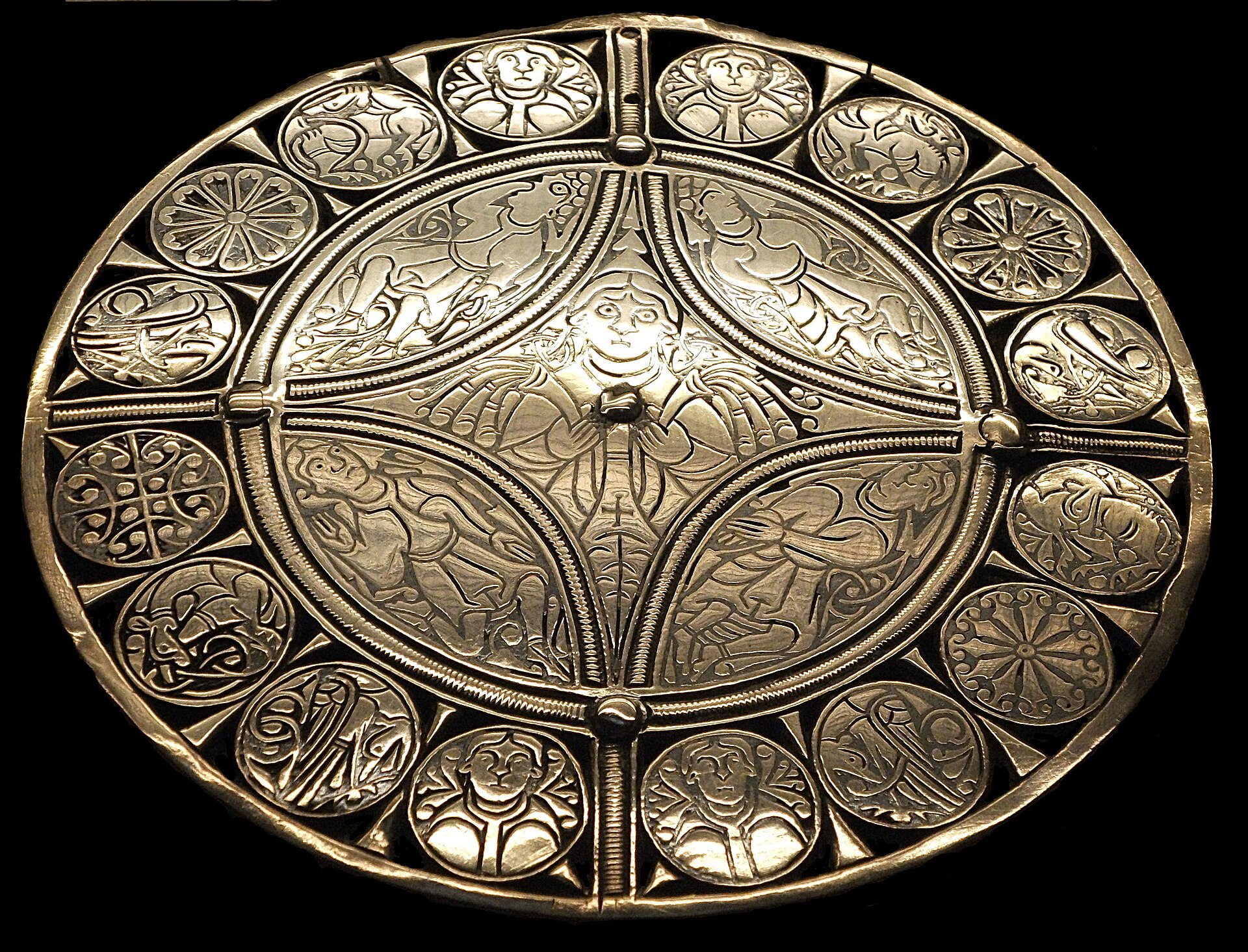
Niello decoration on Trewhiddle-style silver was produced by engraving, chiselling or otherwise cutting a recess into the silver surface, then filling that recess with a black metallic sulphide compound and fusing it in place, in a technique related to enamelling but using a metal sulphide rather than glass. Laboratory analysis of the related Fuller Brooch, a later and grander object in the same decorative tradition, found its niello to be predominantly silver sulphide, a formula that fell out of use later in the medieval period in favour of copper-based nielloes. That silver-sulphide recipe is generally associated with the earlier, Trewhiddle-tradition metalwork, meaning that the choice of niello formula is itself a piece of dating and technical evidence, not simply a decorative detail, for objects in this group.
No published analysis of the niello on the Trewhiddle hoard's own pieces was located for this record; the point is included here because it is established for the closely related Fuller Brooch and is relevant to how the wider group of Trewhiddle-style objects is technically characterised, and it is flagged as evidence drawn from a comparandum rather than from the hoard itself.
Chapter 10From a Cornish antiquarian's cabinet to Bloomsbury
The hoard's ownership after 1774 is documented, if thinly, through three generations.
The hoard's ownership after 1774 is documented, if thinly, through three generations. Philip Rashleigh held it from the find until his death in 1811, and it was his 1789 account that first put the discovery on record. It then descended within the Rashleigh family and, by marriage or inheritance, to the Rogers family, both prominent Cornish gentry with a shared interest in antiquities; John Jope Rogers published on the hoard in 1867 and Jonathan Rashleigh in 1868, each working from the same surviving group of objects and coins, by which point the thirty-nine missing coins were already gone.
The hoard came to the British Museum in 1880. The surviving documentation is a letter of 24 March 1880 in which John Jope Rogers sent the Anglo-Saxon silver and bronze from Trewhiddle to the Museum, asking that it be presented to the Trustees as a token of regard. It was accepted as a donation, not a purchase, and registered under the single accession group 1880,0410, within which the chalice, the scourge and the remaining pieces each carry their own sub-numbers. It has been in the Museum's keeping for the century and a half since, most recently displayed in Room 41, the Sutton Hoo and Europe gallery, alongside the Fuller Brooch, the Pentney Hoard and the Cuerdale Hoard, the major comparanda for its style and its period respectively.
Chapter 11Where Trewhiddle sits among the Viking-Age hoards
Trewhiddle belongs to a real and populated category: silver hoards buried in England across the ninth and into the early tenth century, against a backdrop of Viking raiding, settlement and eventual...
Trewhiddle belongs to a real and populated category: silver hoards buried in England across the ninth and into the early tenth century, against a backdrop of Viking raiding, settlement and eventual political conquest of large parts of the country. It is neither the largest nor the latest of that group. The Cuerdale Hoard, buried in Lancashire in the early tenth century, around 905, runs to more than eight thousand objects, chiefly coins, and is a Viking hoard in the fullest sense, assembled from Danelaw, Carolingian, Byzantine and Islamic silver and clearly the wealth of Scandinavian owners. Trewhiddle, by contrast, is entirely Anglo-Saxon and British in its metalwork content, apart from the one Celtic brooch, and its coins are English royal issues rather than the mixed international currency of a Viking hoard like Cuerdale's.
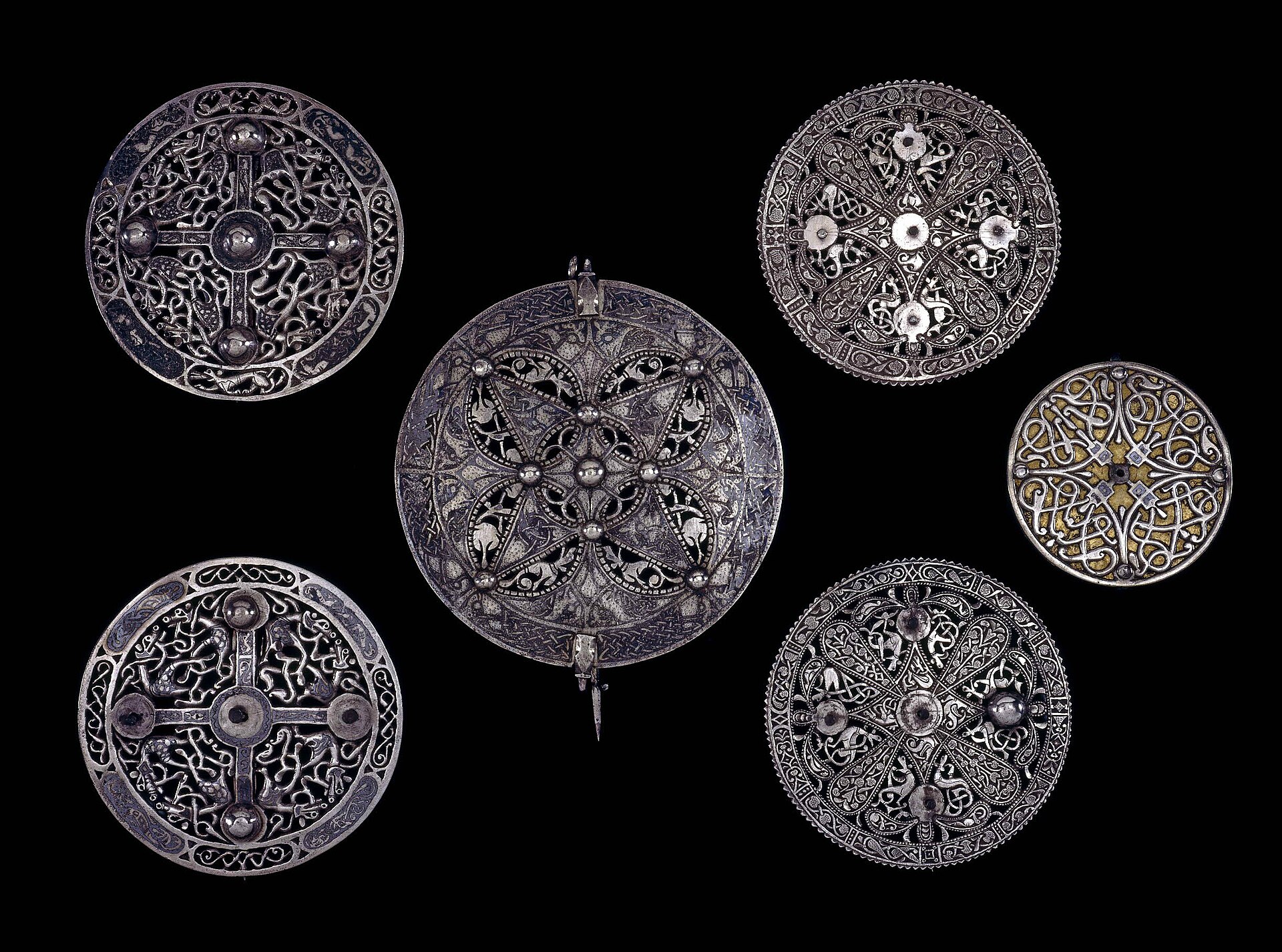
Closer in character is the Pentney Hoard, found by a gravedigger at Pentney in Norfolk in 1978: six silver disc brooches, all in Trewhiddle style, possibly the product of a single East Anglian workshop, and buried, on one proposed reading, during Viking raids on East Anglia in the mid-ninth century, though that dating and cause are debated in the same way Trewhiddle's are. Pentney and Trewhiddle together, along with smaller finds such as the Northumbrian silver hoard from Poppleton studied by Gabor Thomas, sketch the outline of a ninth-century England in which fine Trewhiddle-style silver was being made, owned, and in a number of documented cases buried and never recovered, across several different kingdoms, by owners whose individual reasons for concealment are, case by case, rarely spelled out in any surviving record.
Chapter 12What is still unresolved
Trewhiddle is unusually well published for an eighteenth-century find, with a first account within fifteen years of discovery and a definitive modern catalogue only sixty-five years old at the time...
Trewhiddle is unusually well published for an eighteenth-century find, with a first account within fifteen years of discovery and a definitive modern catalogue only sixty-five years old at the time of writing. That does not mean its questions are closed. The scourge's function has never been agreed. The reason for the coins' apparent division into an earlier and a later group is not settled. The identity of the burier, and whether the act was a single panicked concealment or the deliberate deposit of an accumulated treasury, are both unknown. And a recent claim that the hoard itself may be Viking rather than Anglo-Saxon property has not, on the evidence available for this record, been either confirmed or set aside. A hoard found by chance in a tin stream, with no burial context beyond loose stones and depth, was never going to answer every question it raises, and this record treats the open ones as part of what is known about it, not as gaps to be smoothed over.
The artist
Unknown Anglo-Saxon silversmiths, ninth century
Nothing survives naming the maker of any object in the Trewhiddle Hoard. What survives is the objects themselves, and the decorative language they share with other pieces found elsewhere in England, which is how they are placed, collectively, into a tradition rather than attributed to an individual hand. That tradition has a name only because this hoard exists: without Trewhiddle there would be no fixed, well-dated assemblage large enough to anchor a whole ninth-century phase of Anglo-Saxon metalworking, and the makers behind it would likely still be discussed in vaguer terms.
Related works
| Work | Relation | Where it is |
|---|---|---|
| The Fuller Brooch Unknown Anglo-Saxon silversmith | A later, grander object in the same decorative tradition, described as a very late version of the Trewhiddle style; its niello has been laboratory-analysed as silver sulphide. Bears the earliest known personification of the five senses in its central roundel. | British Museum, London (1952,0404.1) |
| The Strickland Brooch Unknown Anglo-Saxon silversmith | A convex disc brooch in Trewhiddle style, with gold inlay and niello zoomorphic ornament, a comparandum for the tradition's higher-status output. Named for a 19th-century owner rather than a findspot. | British Museum, London |
| The Pentney Hoard brooches Unknown Anglo-Saxon silversmith(s), possibly one East Anglian workshop | Six silver disc brooches in Trewhiddle style, the best-known assemblage of the style outside Trewhiddle itself. Found by a gravedigger; also read by some as a Viking-era concealment in East Anglia, with the same kind of unresolved burial-cause question as Trewhiddle. | British Museum, London (found Pentney, Norfolk, 1978) |
| Hexham Abbey chalice Unknown | The only other surviving Anglo-Saxon chalice besides the Trewhiddle example. Together the two chalices represent the entire known survival of Anglo-Saxon communion plate of this type. | Hexham Abbey, Northumberland |
| Poppleton silver hoard Unknown, Northumbrian tradition | A smaller ninth-century silver hoard studied as evidence of a distinct Northumbrian branch of Trewhiddle-related metalworking. Discussed by Gabor Thomas (2006) as reflecting a regional metalworking tradition related to, but distinct from, the southern Trewhiddle material. | Yorkshire Museum, York |
Open questions
- What was the silver scourge actually for? The traditional reading as a penitential whip is disputed on practical grounds (silver is a poor material for repeated striking and shows no confirmed wear or residue), and no alternative reading, ecclesiastical emblem, status ornament or maker's showpiece, has been established over the others.
- Was the hoard buried in a single act, or assembled over time from two coin parcels of differing date (one nearer 850, one nearer 868) before a single concealment? The published numismatic evidence supports either reading.
- Who buried the hoard, and why? No document records the act itself; the c. 868 date is fixed by the coins, but the identity, status and motive of whoever concealed it are unrecorded.
- Is the c. 868 burial actually connected to Viking activity, and if so to which specific force or raid? No Viking presence is documented in Cornwall itself at that date in the sources consulted; the connection made in most summaries is inferential, drawn from the wider Viking threat of the 860s-870s rather than from a specific attested event at or near Trewhiddle.
- What does the 2022-23 Journal of Cornish Archaeology paper 'Re-evaluating Trewhiddle: evidence of a Viking hoard in Cornwall' actually argue, and does it hold up? Its title proposes that the hoard may represent Viking-held wealth rather than Anglo-Saxon property hidden from Vikings; the paper could not be obtained in full for this record and its claim is unverified here.
- What was the small decorated silver box for? No specific function (needle case, small reliquary or other) is established in the sources consulted; it is generally described only as a box.
- What happened to the 39 coins missing from the group by 1868? Their loss occurred sometime in the 94 years after discovery, with no surviving record of when or how.
Questions about this object
What is The Trewhiddle Hoard?
The Trewhiddle Hoard is a silver, dated 9th century AD, buried c. AD 868. Medium: Silver, largely undecorated and niello-inlaid, with the chalice bowl gilded internally; one buckle-plate of bronze; a glass terminal ring on the scourge; 114 Anglo-Saxon silver pennies.
Who made The Trewhiddle Hoard, and is the attribution settled?
The attribution to Unknown Anglo-Saxon silversmiths is recorded here as unknown. No maker, workshop or patron is named or documented for any object in the hoard. The pieces are grouped and dated by their shared decorative vocabulary, the style that has taken the name Trewhiddle style from this find, and by the accompanying coins, not by any surviving record of production. A single East Anglian workshop has been proposed for the related Pentney Hoard brooches found in Norfolk; on current published evidence that proposal has not been extended to the Trewhiddle objects themselves, which are stylistically close but not shown to share a workshop or a findspot-adjacent origin with Pentney or with each other.
Where is The Trewhiddle Hoard now?
British Museum, London, Room 41 (Sutton Hoo and Europe, AD 300-1100). Inventory number 1880,0410.1-30 (chalice 1880,0410.1-3; scourge 1880,0410.4; further pieces and the coin parcel numbered within the same 1880,0410 registration group). Last confirmed 28 September 2026. Donated to the British Museum by John Jope Rogers in 1880, by letter of 24 March 1880.
What is still unknown about The Trewhiddle Hoard?
What was the silver scourge actually for? The traditional reading as a penitential whip is disputed on practical grounds (silver is a poor material for repeated striking and shows no confirmed wear or residue), and no alternative reading, ecclesiastical emblem, status ornament or maker's showpiece, has been established over the others.
Sources
- 1D. M. Wilson and C. E. Blunt, 'The Trewhiddle Hoard', Archaeologia, vol. 98 (1961), pp. 75-122. The definitive modern catalogue, with Wilson covering the find and the metalwork and Blunt the numismatic dating. cambridge.org/core/...
- 2Wikipedia, 'Trewhiddle', consolidating the find circumstances, the Rashleigh and Rogers publications, and the British Museum acquisition. en.wikipedia.org/wiki/...
- 3Wikipedia, 'Trewhiddle style', for the naming of the style, its characteristics and the scholars associated with it. en.wikipedia.org/wiki/...
- 4British Museum, Collection Online, chalice, object H_1880-0410-1-3, for the accession number, the chalice's construction and gilding, and the 1880 donation by John Jope Rogers. britishmuseum.org/collection/...
- 5British Museum, Collection Online, drinking-horn mount from the Trewhiddle hoard. britishmuseum.org/research/...
- 6Philip Rashleigh, 'Account of Antiquities Discovered in Cornwall, 1774', Archaeologia, vol. 9 (1789), pp. 187-188. The earliest published account, by the finder's first owner. Cited via the bibliography of the Wikipedia 'Trewhiddle' article; the original 1789 text was not independently retrieved for this record. en.wikipedia.org/wiki/...
- 7John Jope Rogers, 'Saxon Silver Ornaments and Coins Found at Trewhiddle, near St Austell, AD 1774', Journal of the Royal Institution of Cornwall, vol. 2 (1867), pp. 292-305. Cited via the bibliography of the Wikipedia 'Trewhiddle' article; the original text was not independently retrieved. en.wikipedia.org/wiki/...
- 8Jonathan Rashleigh, 'An Account of Anglo-Saxon Coins and Gold and Silver Ornaments Found at Trewhiddle, near St Austell, Cornwall, and Some Remarks on Other Anglo-Saxon Hoards', Numismatic Chronicle, new series vol. 8 (1868), pp. 137-157; confirmed as a first-edition pamphlet via an antiquarian bookseller listing. The count of 39 coins already missing by this date is drawn from secondary summaries of this account. timkcbooks.com/book/...
- 9Johannes Brondsted, Early English Ornament: The Sources, Development, and Relation to Foreign Styles of Pre-Norman Ornamental Art in England, translated from the Danish by Albany F. Major, preface by Reginald A. Smith (London: Hachette; Copenhagen: Levin & Munksgaard, 1924), the publication that established 'Trewhiddle style' as the name for this decorative phase. Cited via a contemporary review in The Antiquaries Journal; the original 1924 text was not independently retrieved. cambridge.org/core/...
- 10Jonathan Jarrett, 'Cat of Four Silver Tails', A Corner of Tenth-Century Europe (blog), 23 August 2014, for the detailed construction of the scourge and the range of scholarly and informal proposals for its function. Secondary and informal in format (a specialist medievalist's blog rather than a peer-reviewed article); flagged accordingly. tenthmedieval.wordpress.com/2014/...
- 11Wikipedia, 'Fuller Brooch', for the brooch's accession number, dimensions, description and its relationship to the Trewhiddle style, including its silver-sulphide niello. en.wikipedia.org/wiki/...
- 12Wikipedia, 'Pentney Hoard', for the 1978 discovery, the six brooches, their Trewhiddle-style decoration and the proposed single East Anglian workshop. en.wikipedia.org/wiki/...
- 13Search-derived summary citing laboratory analysis of the Fuller Brooch's niello as predominantly silver sulphide, associated with the earlier Trewhiddle decorative tradition before later medieval niello shifted to copper-based formulas. en.wikipedia.org/wiki/...
- 14'Re-evaluating Trewhiddle: evidence of a Viking hoard in Cornwall', Journal of Cornish Archaeology. Existence and title confirmed via search; the publication itself returned an access-denied response and its author, year and full argument are not verified here. Included only to record an open question, not as a source for any factual claim in this record. researchgate.net/publication/...
Last verified · Published
Change log
28 September 2026 - Record created at the house standard: researched narrative, technical evidence, maker dossier, graded provenance chain, prices with hammer and premium separated, related works, open questions and sources.