The Pisa Griffin
Unknown Islamic metalworking workshop (region of manufacture disputed) · c. 1085-1110 (proposed range within a broader 10th-12th century window argued by different scholars)
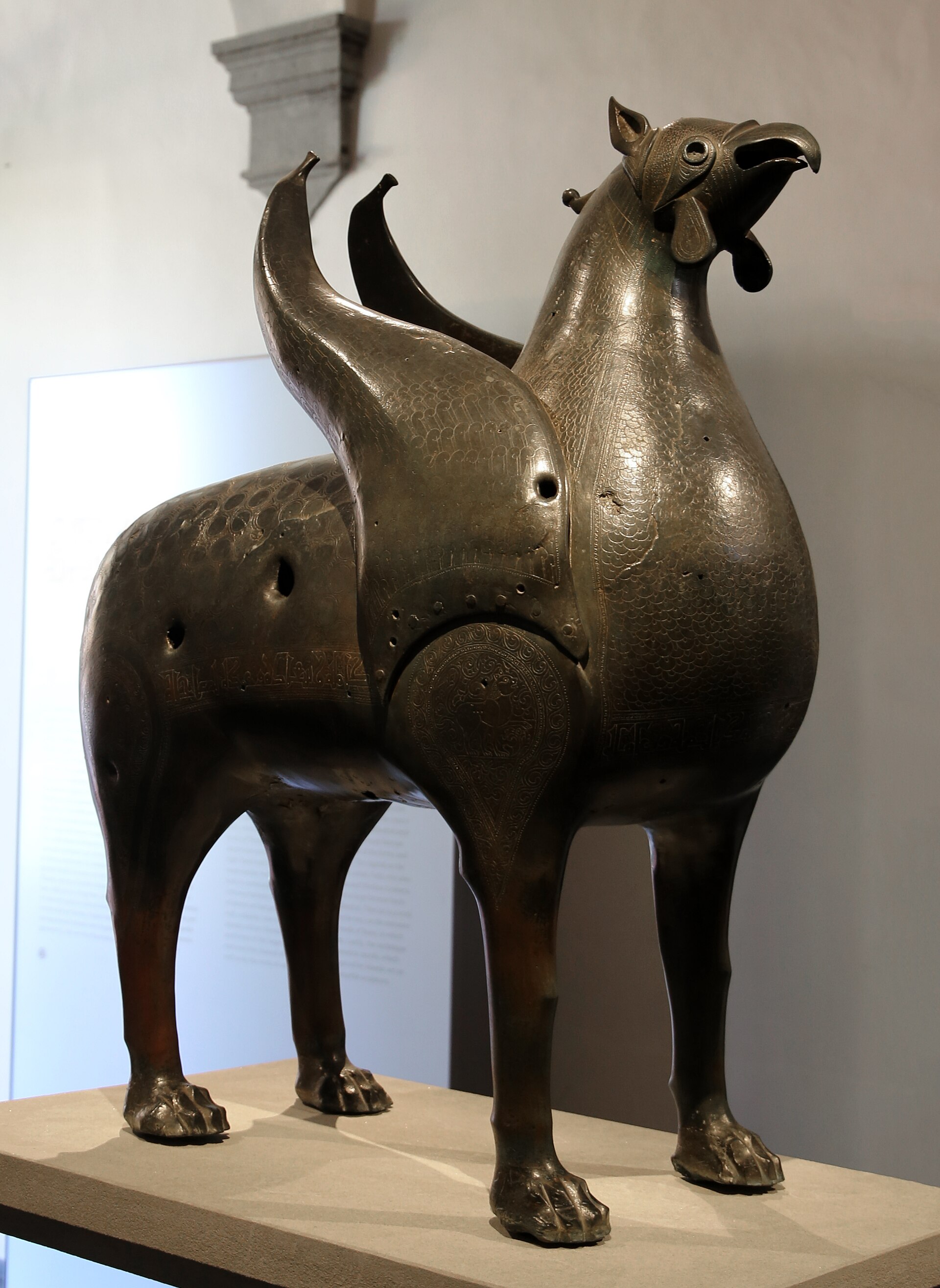
The griffin as displayed in the Museo dell'Opera del Duomo. Hollow-cast bronze, approximately 107 cm high, made somewhere in the Islamic Mediterranean around the turn of the twelfth century and removed from the cathedral roofline in 1828.
Photo: Sailko, via Wikimedia Commons · CC BY 3.0| Artist | Unknown Islamic metalworking workshop (region of manufacture disputed) |
|---|---|
| Date | c. 1085-1110 (proposed range within a broader 10th-12th century window argued by different scholars) |
| Medium | Cast bronze (leaded copper-tin alloy); hollow lost-wax casting with a separately cast internal vessel and riveted, separately cast wings; engraved and punch-worked surface decoration |
| Dimensions | Approximately 107 cm high; length and width are reported inconsistently across sources as 90 x 46 cm and as 87 x 43 cm |
| Where it is now | Museo dell'Opera del Duomo, Pisalast confirmed |
| Inventory number | No public inventory or accession number was found in the sources consulted |
| Attribution | DisputedNo maker is named on the object; the inscription is a benediction to an unnamed owner, not a signature. Full note |
| Object type | Islamic metalwork |
| Period | Islamic Mediterranean, 11th-12th century |
| Cases | Disputed attribution |
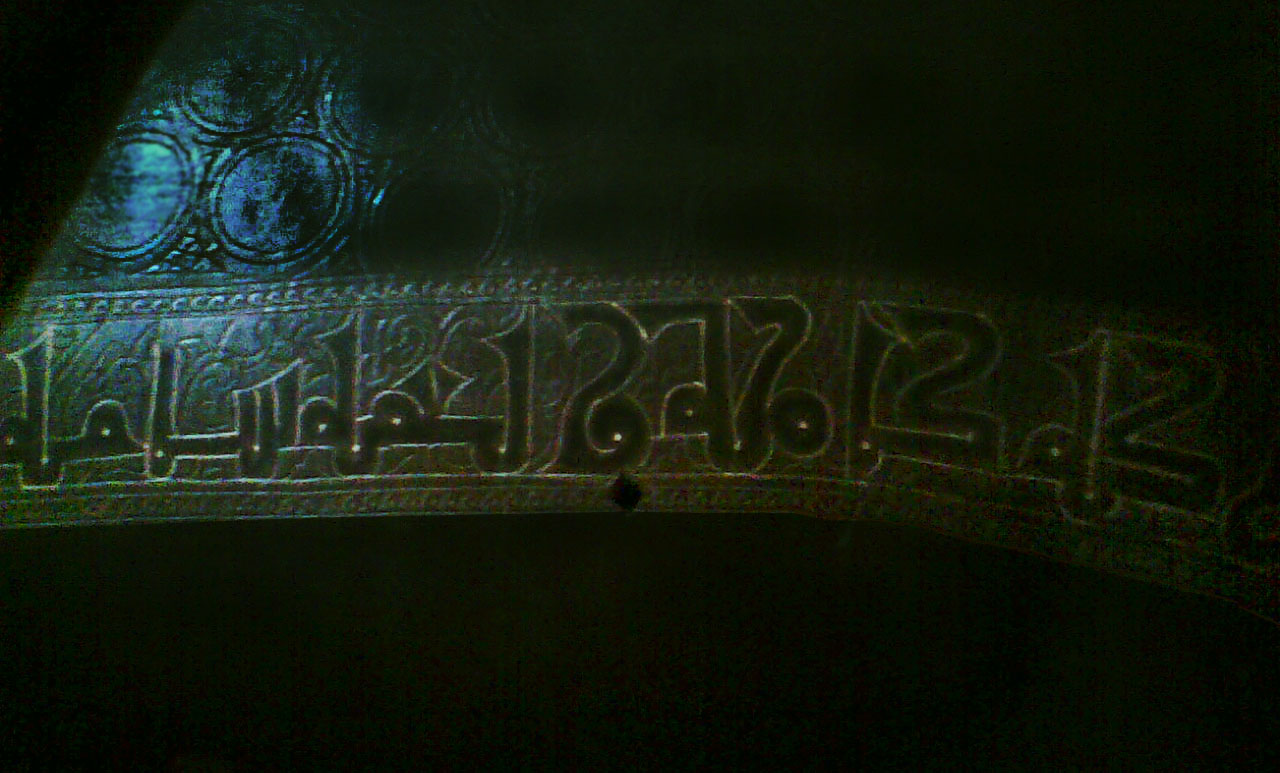
| Inscriptions | A band of Kufic Arabic script runs around the chest and flanks, a benedictory formula wishing an unnamed owner well-being and good fortune. Portions of the text are damaged and its final clause is read with uncertainty by different epigraphers. |
| Owners on record | 6 links4 documented, 2 disputed |
| Sources | 9 cited |
About this record Last verified · 9 sources cited · Change log
On this page 9 sections
ContentsClose
The largest known medieval Islamic bronze to survive: a hollow-cast griffin more than a metre tall, made somewhere in the Islamic Mediterranean around the turn of the twelfth century and carried to Pisa as the spoil of a naval campaign against a Muslim power. Which workshop made it, and which campaign brought it, are both still argued rather than settled.
For roughly seven centuries it stood on a column above the apse of Pisa Cathedral, its Islamic origin forgotten by the city that displayed it. It came down in 1828, and since 1986 it has stood inside the Museo dell'Opera del Duomo, a few hundred metres from the roofline it occupied for longer than most European nations have existed.
Provenance
Each link is graded. Documented: a cited source supports it. Disputed: the identification is argued but not established. Unknown: no owner for that span, and the gap is not smoothed into a narrative. The grades in the glossary.
- c. 1085 - c. 1110Unknown workshop, unknown original ownerdisputed
Manufactured by an unidentified workshop for an unnamed owner addressed only by the honorific benediction cast into the Kufic inscription. The region of manufacture is argued between al-Andalus, Fatimid Egypt and an Iranian hand working in Spain; no scholarly consensus exists. See narrative sections on the attribution dispute.1238
- c. 1087 or c. 1113-1115 -Republic of Pisadisputed
Taken as spoil of a Pisan naval campaign against a Muslim power. The two candidate campaigns in the literature are the 1087 Pisan-Genoese-papal raid on Mahdia in Zirid Tunisia, and the 1113-1115 Pisan-Catalan expedition against the Balearic Islands. No source consulted names which campaign actually delivered the griffin; both are proposed by different writers and neither is documented as fact.12567
- uncertain, by the 12th century - 1828Opera della Primaziale Pisana (Pisa Cathedral works board)documented
Displayed on a column above the apse of Pisa Cathedral's roofline. Sources are inconsistent on exactly when this installation began; one account gives a date as early as c. 1064, which cannot be correct for an object most scholars date after 1085, so the true installation date is treated here as unresolved rather than fixed. Over the centuries local tradition lost track of the object's Islamic origin, attaching Roman or miraculous legends to it instead.14
- 1828 - 1935Opera della Primaziale Pisanadocumented
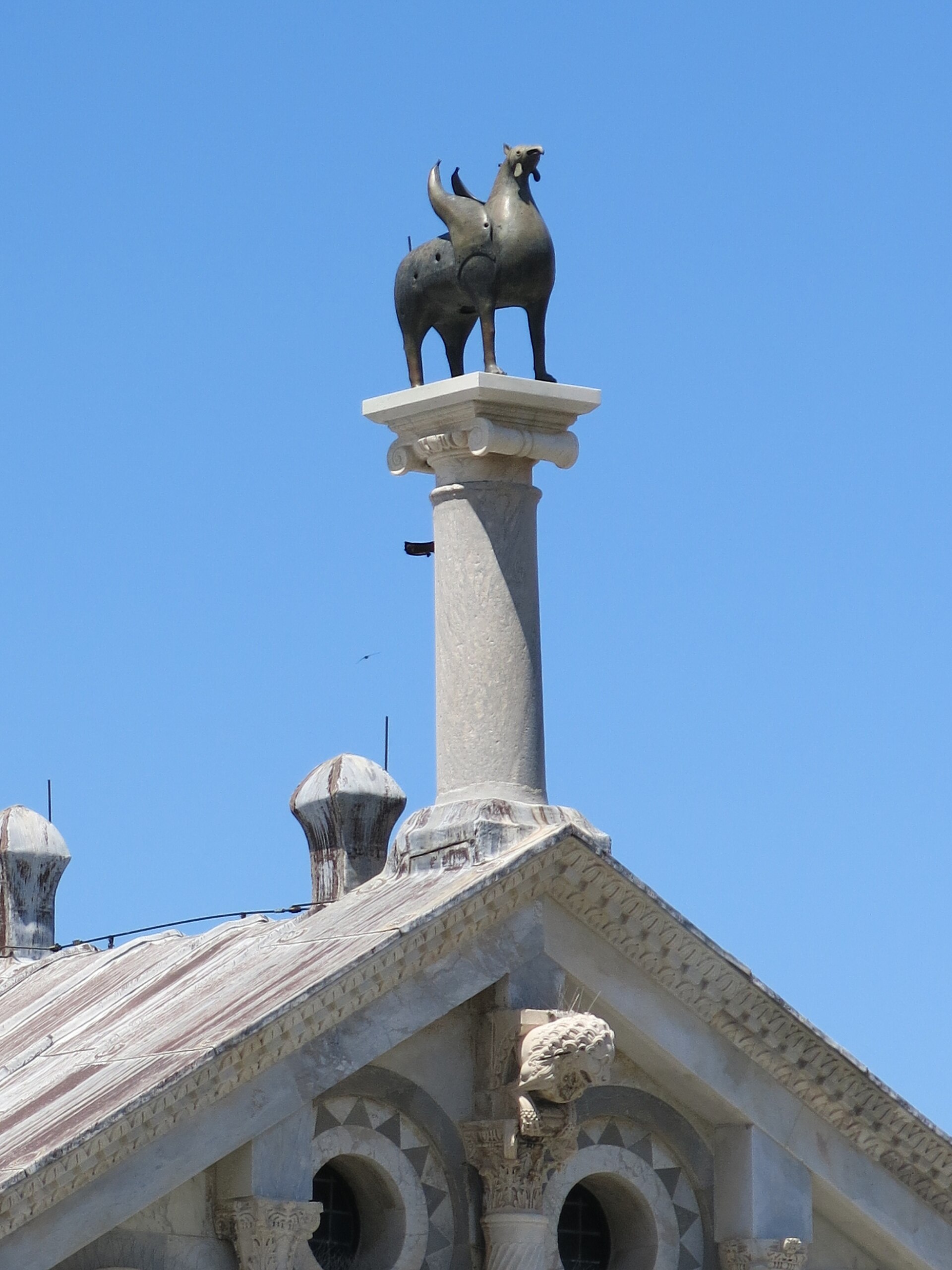
Taken down from the cathedral roof in 1828 and replaced there with a replica, which still stands in its place today. Where and how the original bronze was kept between 1828 and the twentieth century is not detailed in the sources consulted.19
- 1935 - 1986Opera della Primaziale Pisanadocumented
A small collection of sculpture and stone fragments, curated by the art historian Enzo Carli, was shown in the loggia and two rooms of the Palazzo dell'Opera from 1935. The griffin's presence specifically within this 1935 display is not confirmed in the sources consulted; it is recorded only that the Opera's collections, of which the griffin is part, were held there before 1986.9
- 1986 - presentOpera della Primaziale Pisanadocumented
The Museo dell'Opera del Duomo opened in 1986 under Guglielmo De Angelis d'Ossat in a dedicated building on the Piazza del Duomo, gathering works removed from the cathedral, baptistery and other Piazza dei Miracoli buildings. The griffin has been on permanent display there since. The museum was redesigned in 2019 by Guicciardini & Magni Architetti.9
Technical evidence
| Attribution note | No maker is named on the object; the inscription is a benediction to an unnamed owner, not a signature. Three positions stand in the literature with no consensus: manufacture in al-Andalus, most recently argued by Anna Contadini on alloy composition and a distinctive punch-mark tool shared with the Mari-Cha Lion; manufacture in Fatimid Egypt, proposed on stylistic grounds by Gaston Migeon and revived by Marilyn Jenkins-Madina; and Iranian-trained craftsmen working in an eleventh-century Spanish workshop, a compromise position argued by Assadullah Souren Melikian-Chirvani. |
|---|---|
| Overall height | Approximately 107 cm.1 |
| Length and width | Reported inconsistently across sources as 90 x 46 cm and as 87 x 43 cm.12 |
| Material | Cast bronze (leaded copper-tin alloy); reported composition approximately 78% copper and 22% tin.8 |
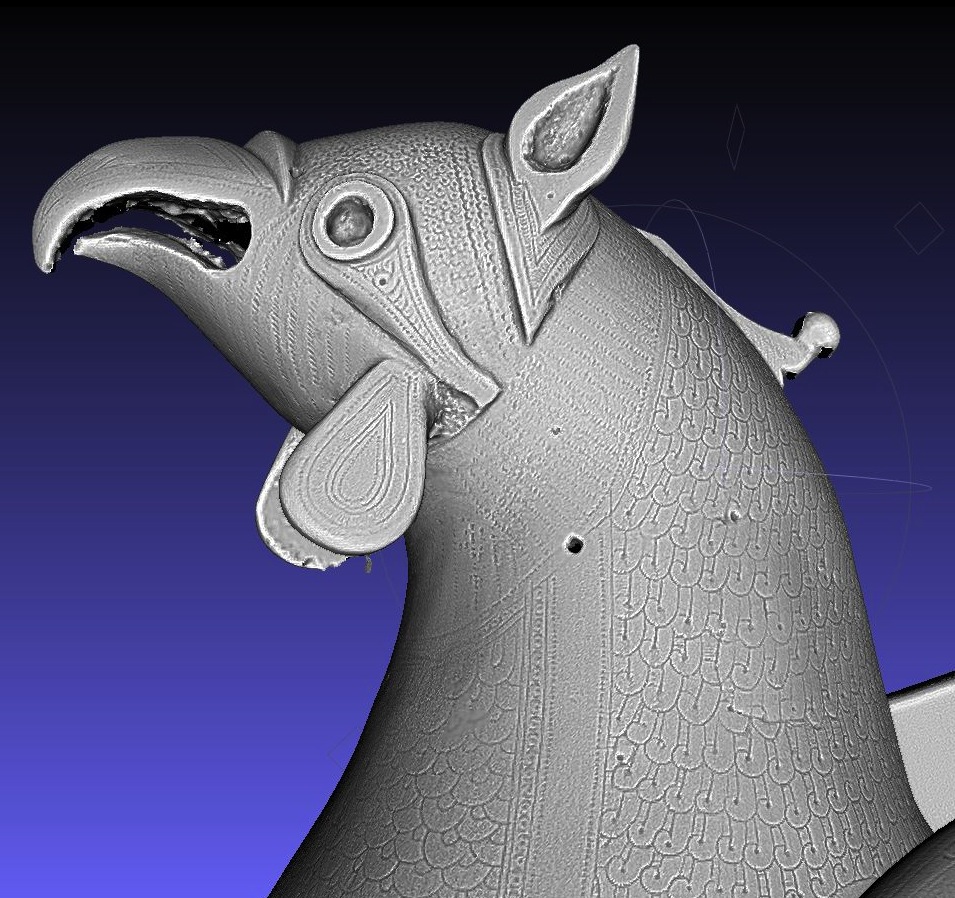
| Casting method | Hollow lost-wax casting of the body, with a separate globular bronze vessel soldered inside the back, open toward the belly. Wings were cast separately and attached by rivets. Three openings pierce the body: the mouth, a rear aperture (probably for a now-missing tail), and a larger belly opening.1 |
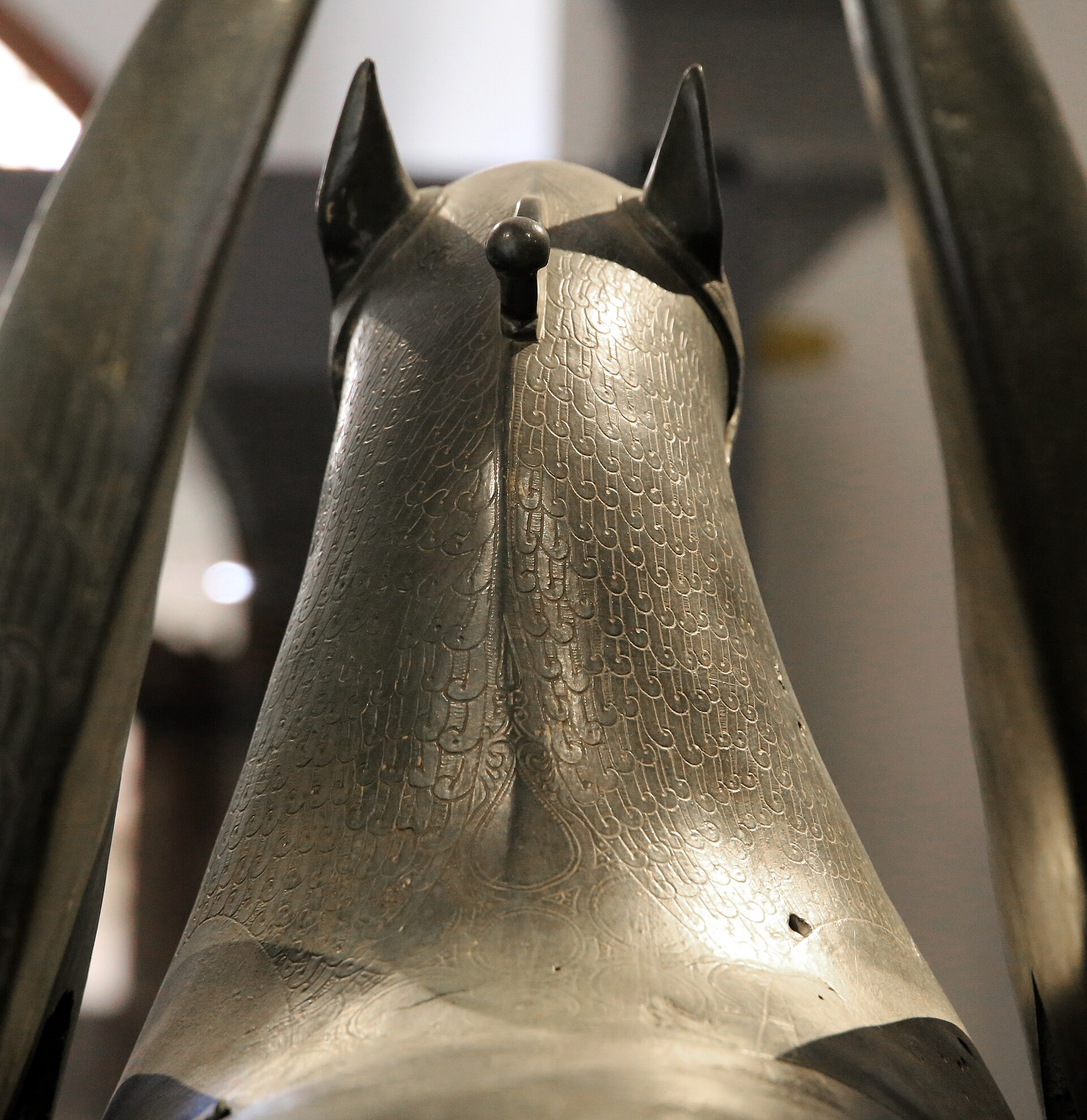
| Surface decoration | Engraved ornament worked with metal punches, including a distinctive rectangular five-dot punch (approximately 3 x 1 mm) identified and studied by Mirco Bassi, also found on the Mari-Cha Lion.3 |
| Inscription | Kufic Arabic script around the chest and flanks, a benedictory formula for an unnamed owner. Damaged in places; the final clause is read with uncertainty between published translations.12 |
| Function (disputed) | Proposed as a fountainhead (no hydraulic fittings survive to support this) or as a wind-activated sound-producing object using the internal vessel as an air reservoir and a reed near the mouth. Neither theory is confirmed.1 |
Images
The record in full
Chapter 1What it is
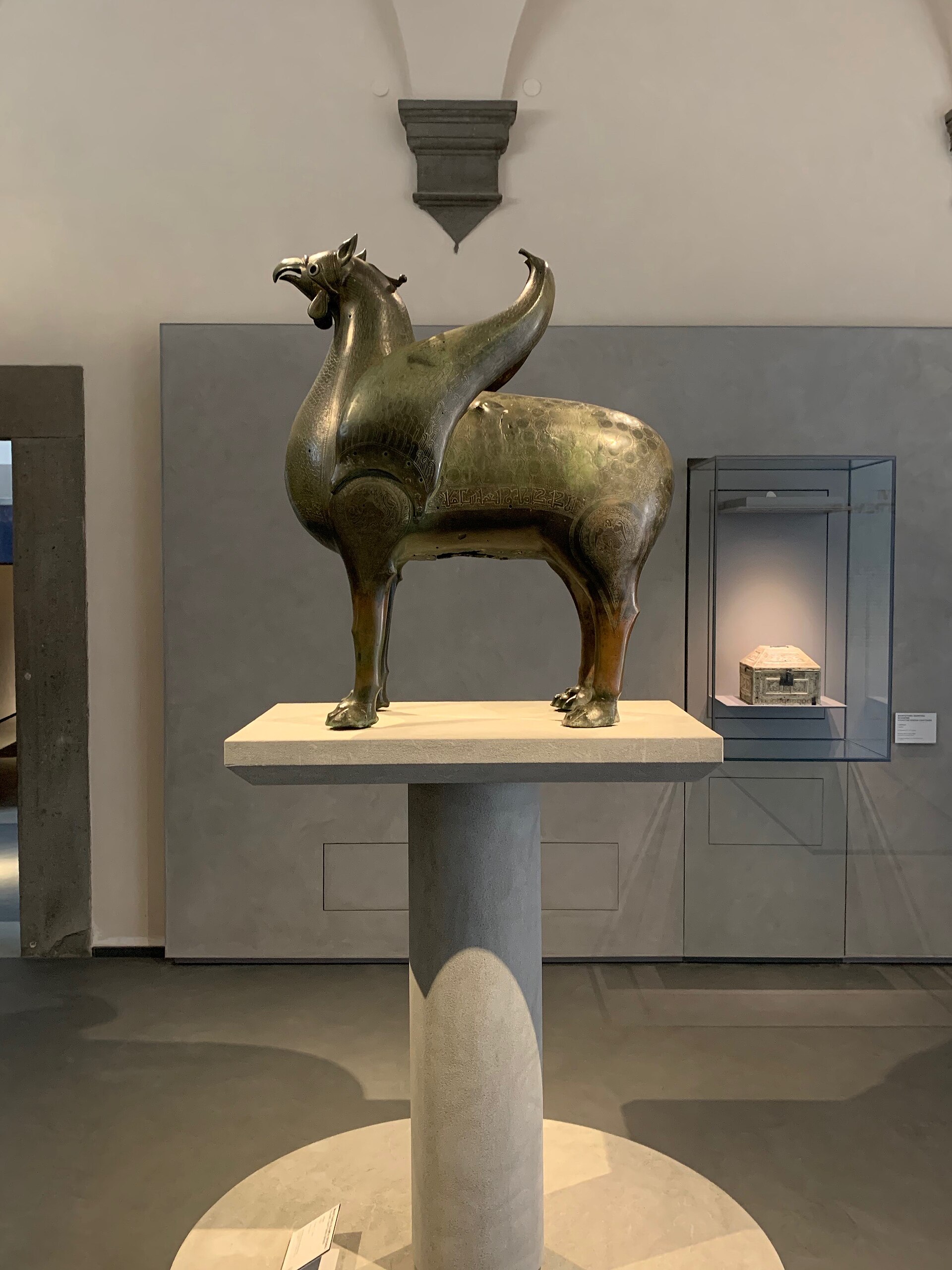
The Pisa Griffin is a cast bronze sculpture of a griffin, the composite lion-and-eagle beast of ancient Mediterranean myth, standing roughly 107 centimetres high.
The Pisa Griffin is a cast bronze sculpture of a griffin, the composite lion-and-eagle beast of ancient Mediterranean myth, standing roughly 107 centimetres high. It is the largest known medieval Islamic bronze sculpture to survive anywhere, by a wide margin over any comparable piece. The body is hollow-cast; the wings were cast separately and fixed on with rivets, a join point that has weathered visibly over nine centuries of handling and exposure.
Sources disagree on the other two dimensions by a few centimetres, giving both 90 x 46 cm and 87 x 43 cm for length and width. That small a discrepancy is normal for an object measured by different hands at different times without a single published conservation record available in English-language literature, and this record gives both rather than choosing one.
Chapter 2How it was cast
The griffin was made by hollow lost-wax casting, a technique capable of producing large bronze forms without the weight and material cost of a solid casting.
The griffin was made by hollow lost-wax casting, a technique capable of producing large bronze forms without the weight and material cost of a solid casting. Inside the body, examination has found a separate globular bronze vessel, open toward the belly and soldered to the interior of the back, essentially a bowl cast to sit within the larger form. Three openings pierce the surface: the mouth, an aperture at the rear where a tail was probably once fixed, and a larger opening in the belly.
The engraved surface decoration was worked with metal punches after casting. Among the tools identified is a distinctive rectangular punch bearing five dots, measuring about 3 by 1 millimetres, studied in detail by the researcher Mirco Bassi. The same tool appears on the Mari-Cha Lion, a related bronze discussed below, which is strong physical evidence that the two objects came out of the same workshop tradition, whatever region that tradition is finally assigned to.
Chapter 3The inscription
A band of Kufic Arabic script runs around the griffin's chest and flanks.
A band of Kufic Arabic script runs around the griffin's chest and flanks. Translated, it reads as a benediction: perfect blessing, complete well-being, perfect joy, eternal peace and perfect health, and happiness and good fortune, for the owner. It names no maker and no owner. It is a formula of goodwill of a kind common on luxury Islamic metalwork of the period, not a dedication or a signature, and it should not be read as evidence of who commissioned or who made the object.
Parts of the inscription are damaged, and the final clause in particular is read with some uncertainty between published translations. No source consulted offers a full epigraphic apparatus showing where the text is legible, restored, or conjectural letter by letter; that level of detail, if it exists, sits in specialist publications this record has not been able to obtain.
Chapter 4The attribution dispute: the case for al-Andalus
The Italian scholar Ugo Monneret de Villard argued for manufacture in Spain at the end of the eleventh or beginning of the twelfth century, connecting the griffin to the hypothesis of war spoil taken...
The Italian scholar Ugo Monneret de Villard argued for manufacture in Spain at the end of the eleventh or beginning of the twelfth century, connecting the griffin to the hypothesis of war spoil taken at the conquest of Almeria in 1089 or the Balearic Islands in 1114, and pointing to stylistic parallels with pieces of confirmed Spanish manufacture.
Anna Contadini, professor of the history of Islamic art at SOAS, has more recently reinforced the Andalusi case with material evidence rather than style alone. Her research found that the griffin's bronze alloy, and its decorative technique, do not match the metal objects securely attributed to Fatimid territories, and that its alloy composition instead aligns with metallurgical practice associated with Cordoba. Combined with Bassi's five-dot punch, shared with the Mari-Cha Lion and absent from confirmed Fatimid pieces, this is currently the most evidentially supported of the three positions, though it is not treated by Contadini or by this record as a closed question.
Chapter 5The attribution dispute: the case for Fatimid Egypt
The earlier attribution to Fatimid Egypt was made on stylistic grounds by the French scholar Gaston Migeon, comparing the griffin's decorative repertoire to Fatimid metalwork and ceramics.
The earlier attribution to Fatimid Egypt was made on stylistic grounds by the French scholar Gaston Migeon, comparing the griffin's decorative repertoire to Fatimid metalwork and ceramics. The American scholar Marilyn Jenkins-Madina later revived the Fatimid case, connecting the griffin instead to Pisan and Genoese raids on Tunisian cities in the eleventh century, which would place its origin and its arrival in Pisa within the same historical episode rather than requiring two separate acts of conquest against two different regions.
Museum and reference documentation on the griffin has at times listed both al-Andalus and Fatimid Egypt (by way of Palermo) as possible origins without resolving between them, reflecting how live this question has remained outside the most recent specialist literature. Current scholarly opinion has moved away from this position since Contadini's alloy and decoration work, but it has not been formally retracted by its proponents and is recorded here as an argued position, not a discredited one.
Chapter 6The attribution dispute: an Iranian compromise
A third position, associated with the scholar Assadullah Souren Melikian-Chirvani in a study titled 'Le griffon iranien de Pise' (the Iranian griffin of Pisa), splits the difference between the other...
A third position, associated with the scholar Assadullah Souren Melikian-Chirvani in a study titled 'Le griffon iranien de Pise' (the Iranian griffin of Pisa), splits the difference between the other two. Melikian-Chirvani proposed that the griffin was made by Iranian-trained craftsmen working within an eleventh-century Spanish workshop, dating production to the first half of that century, earlier than most other proposals. This reading treats the object's decorative vocabulary as evidence of an itinerant Iranian hand rather than of manufacture in Iran itself, and it has not displaced either of the other two positions in the wider literature.
No position among the three commands a consensus. This record does not adjudicate between them; a reader who needs a single answer should treat that need as unmet by the current state of scholarship, not by this record's caution.
Chapter 7What it was for
Two functional theories have been proposed and neither is settled.
Two functional theories have been proposed and neither is settled. The first treats the griffin as a fountainhead, on the model of the fountain animals from the caliphal palace-city of Madinat al-Zahra outside Cordoba, discussed below as comparanda. Recent examination has weighed against this: the griffin shows no trace of the plumbing or hydraulic fittings that a working fountain spout of this kind would need.
The second theory treats it as a wind-activated sound-producing object, on the logic of a bagpipe: the internal bronze vessel would have held an air reservoir, a reed near the mouth would have vibrated as wind was forced through the body, and mounted high on an exposed rooftop the object could have produced sound in the wind without any human player. This is an intriguing reading of the internal cup and the mouth aperture together, but it remains a hypothesis built from the object's plumbing rather than from any documentary record describing it in use, and this record treats it as such.
Chapter 8How it reached Pisa
What is documented is the pattern, not the event: the Republic of Pisa fought a series of successful naval campaigns against Muslim powers around the western and central Mediterranean in the late...
What is documented is the pattern, not the event: the Republic of Pisa fought a series of successful naval campaigns against Muslim powers around the western and central Mediterranean in the late eleventh and early twelfth centuries, and it was Pisan practice to bring back plunder, including Islamic decorative and religious objects, and display it publicly as a mark of civic and religious triumph. The griffin's arrival fits this pattern; no source consulted documents the specific ship, campaign, or year that brought it.
Two campaigns are proposed as candidates. The first is the August 1087 raid on Mahdia in Zirid Tunisia, a joint Pisan, Genoese and papally sanctioned expedition that sacked the port, extracted an indemnity, and is credited by the historian Carl Erdmann as a direct precursor to the First Crusade in its religious framing. Much of Pisa's share of that indemnity funded the cathedral itself and a new church dedicated to Saint Sixtus, which at minimum establishes that this campaign generated the kind of wealth and triumphalist building programme into which a captured bronze griffin would fit naturally.
The second is the 1113-1115 Balearic expedition, in which a fleet of some three hundred Pisan ships and a further hundred and twenty Catalan and Occitan vessels, under Archbishop Pietro Moriconi of Pisa and Count Ramon Berenguer III of Barcelona, took Ibiza in 1114 and Palma de Majorca in April 1115 before an Almoravid reconquest the same year ended Christian control. The chronicle of this campaign, the Liber Maiolichinus, celebrates a haul of gold, silver, ceramics and bronze objects, and later Pisan display of Islamic bacini ceramics and the griffin on the cathedral facade has been read by some writers as an echo of that chronicle's themes of conquest, though no source consulted quotes the Liber Maiolichinus naming the griffin specifically.
Both campaigns remain proposals, not findings. A reader who wants a single date and a single ship will not get one from the current literature, and this record has not invented one to fill the gap.
Chapter 9Centuries on the roofline
The griffin stood on a column above the apse of Pisa Cathedral for longer than it has spent anywhere else in its documented history.
The griffin stood on a column above the apse of Pisa Cathedral for longer than it has spent anywhere else in its documented history. Exactly when that display began is not settled by the sources consulted: one account gives a date around 1064, which would predate the object's own manufacture on every attribution offered above and cannot be correct as stated, so this record treats the installation date as unresolved rather than repeating that figure as fact.
What is clear is the outcome of centuries of rooftop display: the griffin's Islamic origin was forgotten by the city that had captured it as a trophy of exactly that origin. Local tradition instead attached Roman or miraculous explanations to the object on the roofline, a case of a war trophy outliving the memory of the war that brought it, and of triumphalist display eventually erasing the very meaning it had been built to broadcast.
Chapter 10From the roof to the museum
The griffin came down from the cathedral roof in 1828 and a replica was put up in its place, which still stands there today; a visitor looking up at Pisa Cathedral's roofline now sees a...
The griffin came down from the cathedral roof in 1828 and a replica was put up in its place, which still stands there today; a visitor looking up at Pisa Cathedral's roofline now sees a nineteenth-century copy, not the medieval original. What happened to the bronze immediately after 1828 is not detailed in the sources consulted for this record.
By 1935 the Opera della Primaziale Pisana, the historic works board responsible for the cathedral, was showing a small collection of sculpture and stone fragments in the loggia and two rooms of the Palazzo dell'Opera, curated by the art historian Enzo Carli; the griffin's presence in that specific 1935 display is not confirmed by name in the sources this record was able to consult, only that it belonged to the wider Opera holdings gathered there before the modern museum opened. The Museo dell'Opera del Duomo itself opened in 1986 under the direction of Guglielmo De Angelis d'Ossat, in a purpose-built museum on the Piazza del Duomo bringing together works removed over time from the cathedral, the baptistery and the other buildings of the Piazza dei Miracoli. The griffin has been on permanent display there since, and the museum was redesigned in 2019 by the firm Guicciardini & Magni Architetti, a project that won recognition at the 2021 Venice Biennale's Festa dell'Architetto.
Chapter 11Comparanda: the same tradition, different objects
The griffin does not stand alone stylistically.
The griffin does not stand alone stylistically. A cluster of related bronze animal sculptures from the medieval Islamicate Mediterranean shares its scale, its technique, or its decorative vocabulary, and comparing them is how scholars have built the attribution arguments above; none of the following is the Pisa Griffin, and none should be mistaken for it.
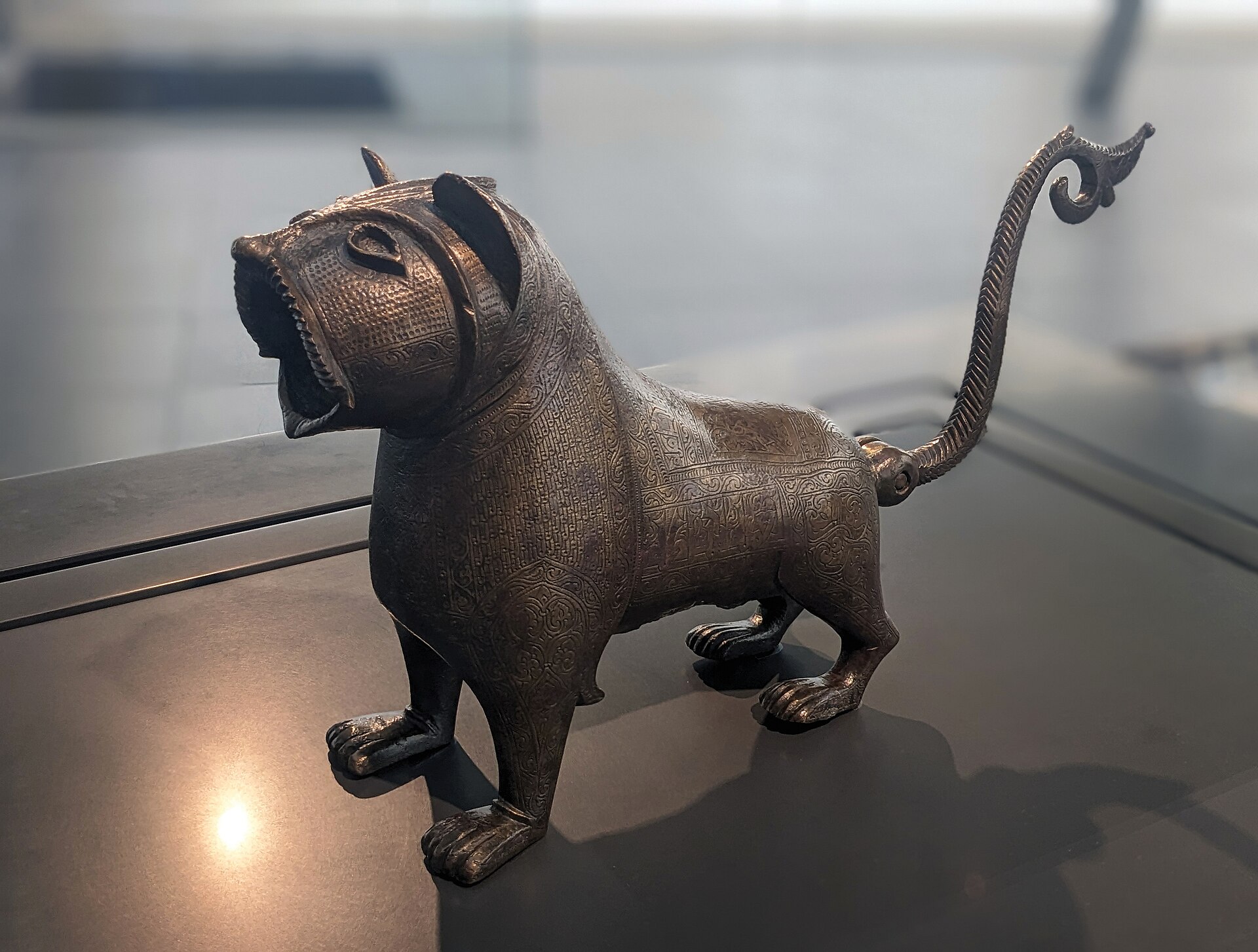
The Mari-Cha Lion is the closest comparandum: a bronze lion of comparable size and date, bearing a similar Kufic goodwill inscription and, critically, the same five-dot punch tool identified by Bassi. It surfaced from an anonymous noble European family and was bought by the collector Robert Miller at a London auction on 19 October 1993 for 2.4 million pounds sterling, at the time the highest price paid for a work of Islamic art; the auction house's own catalogue suggested it and the griffin might share a workshop. It remains, so far as this record's sources establish, in private hands.
Further afield in scale and closer to the fountainhead theory of function are the tenth-century bronze animals from the caliphal palace-city of Madinat al-Zahra outside Cordoba, including a stag and a hind now in the Museo Arqueologico Provincial de Cordoba and the Museo Arqueologico Nacional in Madrid respectively. The Lion of Monzon, an Andalusi bronze aquamanile now in the Louvre's Department of Islamic Art, and the Kassel Lion, an eleventh or twelfth-century piece signed by a craftsman named Abd Allah, complete the cohort most often cited alongside the griffin in the al-Andalus attribution case.
Chapter 12What research is underway
An interdisciplinary project involving Oxford University, the University of Pisa and the Italian National Research Council's Institute of Information Science and Technologies (CNR-ISTI) has produced...
An interdisciplinary project involving Oxford University, the University of Pisa and the Italian National Research Council's Institute of Information Science and Technologies (CNR-ISTI) has produced a 3D-scanned digital model of the griffin, used for close comparative study against the Mari-Cha Lion without moving either physical object. Anna Contadini's 2018 edited volume, The Pisa Griffin and the Mari-Cha Lion: Metalwork, Art and Technology in the Medieval Islamicate Mediterranean, brought together the alloy analysis, the punch-mark study and the decorative comparison that currently anchor the al-Andalus case, and remains the fullest technical treatment available in the literature this record was able to obtain.
None of this settles the origin question outright. It has shifted the weight of the argument toward al-Andalus more than at any point in the object's modern scholarly history, without closing the file on either of the other two positions.
The artist
Unidentified Islamic metalworking workshop, region of manufacture disputed among al-Andalus, Fatimid Egypt and an Iranian-trained hand in Spain
Nothing about the maker is documented. The griffin carries no signature, no maker's mark and no dedication naming a patron; its only inscribed text is a benediction to an unnamed owner. Everything said about the workshop that produced it is therefore built from comparative technical and stylistic analysis of the object itself and of a small group of related bronzes, not from any surviving record of a person, a name, or a commission.
Related works
| Work | Relation | Where it is |
|---|---|---|
| The Mari-Cha Lion Unidentified workshop, same disputed regional debate | Closest technical comparandum: shares scale, a similar Kufic benedictory inscription, and the same five-dot punch tool identified by Mirco Bassi Not the Pisa Griffin. A different bronze lion of comparable date; the auction house's own catalogue suggested a shared workshop with the griffin, a claim later given physical support by the matching punch tool. | Private collection (bought by Robert Miller at a London auction, 19 October 1993, for GBP 2.4 million) |
| Cordoba Stag and Hind fountainheads Cordoban caliphal workshop, Madinat al-Zahra | Proposed stylistic and functional comparanda for the al-Andalus attribution and the fountainhead-function theory Tenth-century, smaller in scale (stag approximately 61.6 cm high), and confirmed fountain fittings, unlike the griffin, which shows no surviving hydraulic apparatus. | Museo Arqueologico Provincial de Cordoba (stag); Museo Arqueologico Nacional, Madrid (hind) |
| Lion of Monzon Andalusi workshop | Comparandum cited in the al-Andalus attribution case for the griffin A bronze aquamanile, not the Pisa Griffin, included here for the shared regional bronze-casting tradition proposed by Monneret de Villard and later scholars. | Musee du Louvre, Departement des Arts de l'Islam, Paris (OA 7883) |
| Kassel Lion Signed by a craftsman named Abd Allah | Comparandum notable for carrying a maker's signature, which the griffin does not Eleventh or twelfth century. Distinct object; cited here only for contrast, since it is one of the few related pieces where the maker's name survives. | Kassel, Germany (museum collection) |
Open questions
- Which region actually produced the griffin: al-Andalus, Fatimid Egypt, or an Iranian hand working in Spain remain three argued positions with no scholarly consensus, and no source consulted for this record resolves between them.
- Which Pisan naval campaign delivered the griffin as booty: the 1087 Mahdia raid and the 1113-1115 Balearic expedition are both proposed candidates; no primary source consulted names the specific campaign, ship or year.
- What was the griffin originally made to do: the fountainhead theory lacks surviving hydraulic fittings, and the wind-instrument theory is an inference from its internal plumbing rather than a documented use.
- When did the griffin first go up on the cathedral roofline: one figure in circulation, c. 1064, predates the object's own probable manufacture date and cannot be correct as stated; the true installation date is not established in the sources consulted.
- Where and how was the griffin kept between its removal from the roof in 1828 and its appearance in Opera collections by the twentieth century: this interval is undocumented in the sources this record was able to obtain.
- Is the griffin's presence specifically confirmed within the 1935 Palazzo dell'Opera display curated by Enzo Carli, or did it enter Opera display only later: the sources consulted describe the 1935 collection in general terms without naming every object in it.
Questions about this object
What is The Pisa Griffin?
The Pisa Griffin is an islamic metalwork, dated c. 1085-1110 (proposed range within a broader 10th-12th century window argued by different scholars). Medium: Cast bronze (leaded copper-tin alloy); hollow lost-wax casting with a separately cast internal vessel and riveted, separately cast wings; engraved and punch-worked surface decoration.
Who made The Pisa Griffin, and is the attribution settled?
The attribution to Unknown Islamic metalworking workshop (region of manufacture disputed) is recorded here as disputed. No maker is named on the object; the inscription is a benediction to an unnamed owner, not a signature. Three positions stand in the literature with no consensus: manufacture in al-Andalus, most recently argued by Anna Contadini on alloy composition and a distinctive punch-mark tool shared with the Mari-Cha Lion; manufacture in Fatimid Egypt, proposed on stylistic grounds by Gaston Migeon and revived by Marilyn Jenkins-Madina; and Iranian-trained craftsmen working in an eleventh-century Spanish workshop, a compromise position argued by Assadullah Souren Melikian-Chirvani.
Where is The Pisa Griffin now?
Museo dell'Opera del Duomo, Pisa. Inventory number No public inventory or accession number was found in the sources consulted. Last confirmed 23 August 2026. On permanent display since the museum's 1986 opening in its dedicated building on the Piazza del Duomo; removed from the cathedral roof in 1828 and held in the Opera's own collections before that, including a small display in the Palazzo dell'Opera from 1935.
What is still unknown about The Pisa Griffin?
Which region actually produced the griffin: al-Andalus, Fatimid Egypt, or an Iranian hand working in Spain remain three argued positions with no scholarly consensus, and no source consulted for this record resolves between them.
Sources
- 1Wikipedia, 'Pisa Griffin'. Consolidates dimensions, dating, inscription translation, attribution positions and function theories. en.wikipedia.org/wiki/...
- 2Qantara - Mediterranean Heritage, 'The griffon of Pisa'. Gives the Monneret de Villard (al-Andalus, war spoil of Almeria 1089 or the Balearics 1114), Migeon and Jenkins (Fatimid Egypt, linked to Pisan-Genoese raids on Tunisia), and Melikian-Chirvani (Iranian craftsmen in eleventh-century Spain) positions, plus the Kufic inscription translation and dimensions. qantara-med.org/public/...
- 3Review of Anna Contadini (ed.), The Pisa Griffin and the Mari-Cha Lion: Metalwork, Art and Technology in the Medieval Islamicate Mediterranean (Pisa: Pacini Editore, 2018), consulted via Academia.edu. Covers Contadini's alloy and decoration argument against a Fatimid origin, and Mirco Bassi's identification of a shared 'five-dot punch' tool linking the Griffin to the Mari-Cha Lion and to al-Andalus workshop practice. academia.edu/45504361/...
- 4South China Morning Post, 'Ancient Mari-Cha Lion makes Hong Kong debut at Asia Society's lion-themed show'. Covers the Mari-Cha Lion's proposed origin, its 19 October 1993 London sale to Robert Miller for GBP 2.4 million, and the auction house's suggestion that it and the Pisa Griffin may share a workshop. scmp.com/magazines/...
- 5Wikipedia, 'Mahdia campaign of 1087'. Covers the joint Pisan-Genoese-papal raid on Zirid Mahdia, the indemnity extracted, and its proposed (not confirmed) link to the Pisa Griffin. en.wikipedia.org/wiki/...
- 6Wikipedia, '1113-1115 Balearic Islands expedition'. Covers the Pisan-Catalan-Occitan campaign against Ibiza and Majorca, its leadership and outcome. Does not itself mention the griffin; consulted to establish what is and is not documented about this campaign as a candidate source of the booty. en.wikipedia.org/wiki/...
- 7WebSearch summary of scholarship on Pisan Islamic artifacts and the Liber Maiolichinus, describing bacini ceramics and the Pisa Griffin displayed on the cathedral facade as trophies of the Balearic campaign narrated in that chronicle. finestresullarte.info/en/...
- 8WebSearch summary of Wikipedia and related material on the Griffin's alloy composition (approximately 78% copper, 22% tin), the 'five-dot punch' link to Cordoban workshop practice, and the al-Andalus attribution case built on scientific analysis of the bronze. en.wikipedia.org/wiki/...
- 9Opera della Primaziale Pisana, official site, 'Opera del Duomo Museum'. Gives the museum's 1986 opening under Guglielmo De Angelis d'Ossat, the earlier 1935 display of Opera collections in the Palazzo dell'Opera curated by Enzo Carli, and the 2019 redesign by Guicciardini & Magni Architetti. opapisa.it/en/...
Last verified · Published
Change log
23 August 2026 - Record created at the house standard: researched narrative, technical evidence, maker dossier, graded provenance chain, prices with hammer and premium separated, related works, open questions and sources.